
Numbers 30:12

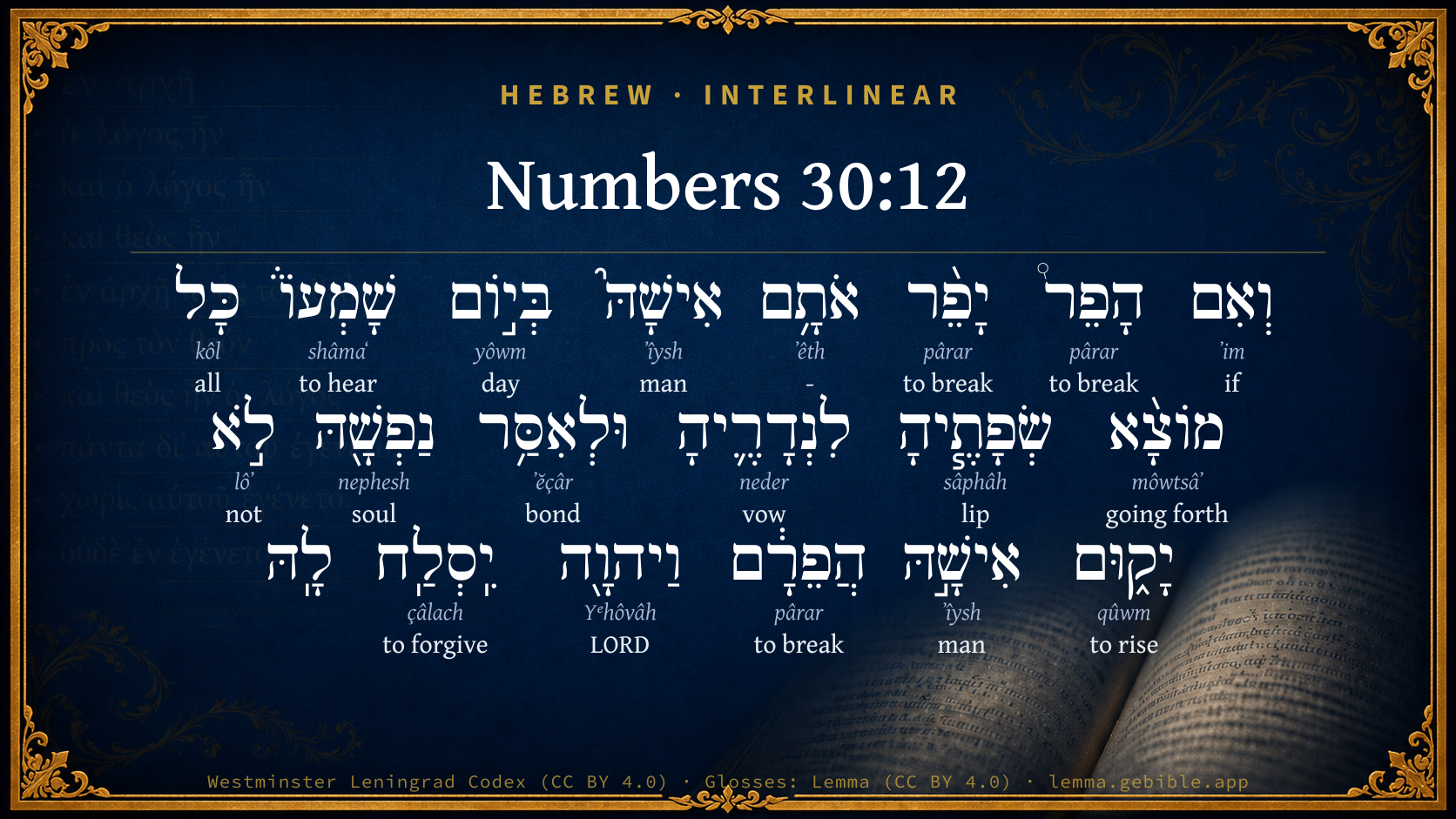
Hebrew (Westminster Leningrad Codex) Numbers 30:12 appears in the Hebrew Old Testament. The text above is from the Westminster Leningrad Codex. Each word links to its Strong’s number, a concise gloss, and parsing drawn from the Open Scriptures Hebrew Bible morphology. Click any word for its full Brown-Driver-Briggs (BDB) entry.
Download image
Cite this verse

Numbers 30:12 (World English Bible). Public Domain. Lemma interlinear Bible study tool, https://lemma.gebible.app/v/numbers/30/12.

Show BibTeX & RIS
BibTeX
RIS
English Translation
But if her husband made them null and void in the day that he heard them, then whatever proceeded out of her lips concerning her vows, or concerning the bond of her soul, shall not stand: her husband has made them void; and Yahweh will forgive her.
World English Bible · Public Domain
Highlights
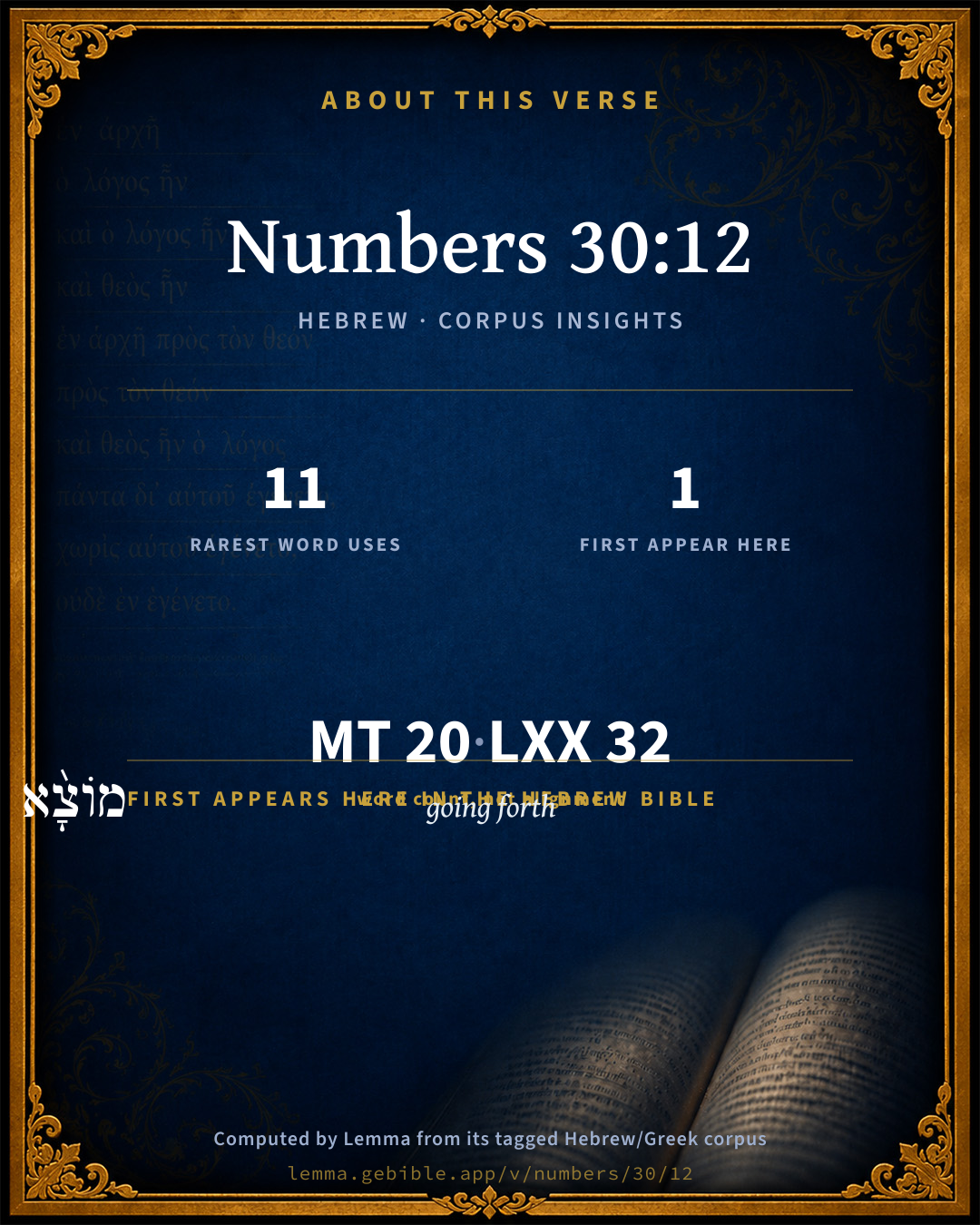
  • 1 first appearance in the Hebrew Bible
Full analysis ↓
Download a study sheet

One document with this verse’s original text, its word-by-word gloss line, the meaning frame, cross-references with their text, attributed commentary, and full source and license credits — printable, and it pastes into notes with its structure intact.

This verse Autodidact and up

Study sheet (.html) Plain text (.txt)

A passage Seminary Student

Up to 50 verses in one chapter. A passage sheet keeps up to 6 commentary sources and 12 cross-references per verse, in the order this page ranks them, and says so on the sheet whenever that leaves anything out. Ask for a single verse and you get the Autodidact verse sheet above.

Everything on this page stays free to read, with no account — the sheet is a download of what is already on screen, not access to it.

Want to remove ads? Support Godless Engineer
Compare translations 3

The same verse in 3 English versions, stacked beneath the original-language interlinear above. Click any original word for its lexicon entry.

Each is an independent rendering of the whole verse — the interlinear is not word-aligned to these translations.

Highlighted words mark where these versions differ — a whole-verse word diff, not a word-by-word alignment.

  • World English Bible Public Domain
    But if her husband made them null and void in the day that he heard them, then whatever proceeded out of her lips concerning her vows, or concerning the bond of her soul, shall not stand: her husband has made them void; and Yahweh will forgive her.
  • King James Version Public Domain
    But if her husband hath utterly made them void on the day he heard them; then whatsoever proceeded out of her lips concerning her vows, or concerning the bond of her soul, shall not stand: her husband hath made them void; and the LORD shall forgive her.
  • unfoldingWord Literal Text CC BY-SA 4.0
    And if her husband ever breaks them on the day of his hearing, all that went out of her lips for her vows and for the binding vow of her life shall not stand. Her husband has broken them, and Yahweh will forgive her.

unfoldingWord Literal Text — © unfoldingWord, licensed CC BY-SA 4.0. Word-aligned USFM3 via Door43 (git.door43.org/unfoldingWord/en_ult).

Versions to compare (up to 4)

3 of 4 selected

Show all 18 translations

Every available English version of this verse, each an independent rendering of the whole verse.

  • World English Bible Public Domain
    But if her husband made them null and void in the day that he heard them, then whatever proceeded out of her lips concerning her vows, or concerning the bond of her soul, shall not stand: her husband has made them void; and Yahweh will forgive her.
  • Berean Standard Bible Public Domain
    But if her husband nullifies them on the day he hears of them, then nothing that came from her lips, whether her vows or pledges, shall stand. Her husband has nullified them, and the LORD will absolve her.
  • Majority Standard Bible Public Domain
    But if her husband nullifies them on the day he hears of them, then nothing that came from her lips, whether her vows or pledges, shall stand. Her husband has nullified them, and the LORD will absolve her.
  • King James Version Public Domain
    But if her husband hath utterly made them void on the day he heard them; then whatsoever proceeded out of her lips concerning her vows, or concerning the bond of her soul, shall not stand: her husband hath made them void; and the LORD shall forgive her.
  • American Standard Version (1901) Public Domain
    But if her husband made them null and void in the day that he heard them, then whatsoever proceeded out of her lips concerning her vows, or concerning the bond of her soul, shall not stand: her husband hath made them void; and Jehovah will forgive her.
  • Revised Version (1885) Public Domain
    But if her husband made them null and void in the day that he heard them; then whatsoever proceeded out of her lips concerning her vows, or concerning the bond of her soul, shall not stand: her husband hath made them void; and the LORD shall forgive her.
  • Geneva Bible (1599) Public Domain
    And her husband hath heard it, and helde his peace cocerning her, not disalowing her, then all her vowes shall stand, and euery bond, wherewith she bound her selfe, shall stand in effect.
  • Douay-Rheims (1899) Public Domain
    If her husband hear, and hold his peace, and doth not disallow the promise, she shall accomplish whatsoever she had promised.
  • Young's Literal Translation Public Domain
    `And if her husband doth certainly break them in the day of his hearing, none of the outgoing of her lips concerning her vows, or concerning the bond of her soul, is established -- her husband hath broken them -- and Jehovah is propitious to her.
  • Literal Standard Version CC BY-SA 4.0
    And if her husband certainly breaks them in the day of his hearing, none of the outgoing of her lips concerning her vows, or concerning the bond of her soul, is established—her husband has broken them—and YHWH is propitious to her.
  • Unlocked Literal Bible CC BY-SA 4.0
    But if her husband cancels them on the day that he heard about them, then whatever came out of her lips about her vows or promises will not remain in force. Her husband has canceled them. Yahweh will release her.
  • unfoldingWord Literal Text CC BY-SA 4.0
    And if her husband ever breaks them on the day of his hearing, all that went out of her lips for her vows and for the binding vow of her life shall not stand. Her husband has broken them, and Yahweh will forgive her.
  • Darby Bible Public Domain
    But if her husband have expressly annulled them on the day that he heard them, then nothing of that which is gone out of her lips as to her vows or the bond on her soul, shall stand: her husband hath annulled them; and Jehovah will pardon her.
  • World Messianic Bible Public Domain
    But if her husband made them null and void in the day that he heard them, then whatever proceeded out of her lips concerning her vows, or concerning the bond of her soul, shall not stand. Her husband has made them void. The LORD will forgive her.
  • Webster's Bible Public Domain
    \\30:11\\And her husband heard it, and held his peace at her, and disallowed her not: then all her vows shall stand, and every bond with which she bound her soul shall stand.
  • Free Bible Version CC BY-SA 4.0
    But if her husband disallows them as soon as he finds out about it, then none of her promises or oaths remain valid. The Lord will release her from keeping them because her husband has disallowed them.
  • Bible in Basic English Public Domain
    And her husband, hearing of it, said nothing to her and did not put a stop to it, then all her oaths and every undertaking she gave will have force.
  • JPS Tanakh (1917) Public Domain
    (30-13) But if her husband make them null and void in the day that he heareth them, then whatsoever proceeded out of her lips, whether it were her vows, or the bond of her soul, shall not stand: her husband hath made them void; and the LORD will forgive her.

Literal Standard Version (2020), Covenant Press — licensed CC BY-SA 4.0. Text via the HelloAO Bible API (eBible.org). Unlocked Literal Bible (unfoldingWord) — licensed CC BY-SA 4.0. Text via the HelloAO Bible API (eBible.org). unfoldingWord Literal Text — © unfoldingWord, licensed CC BY-SA 4.0. Word-aligned USFM3 via Door43 (git.door43.org/unfoldingWord/en_ult). Free Bible Version, Dr. Jonathan Gallagher — licensed CC BY-SA 4.0. Text via the HelloAO Bible API (eBible.org).

Word by word

More ways to search: Search by grammar → Find every occurrence → Compare this word →

Practice this passage: Drill this verse → Learn its vocabulary →

וּלְאִסַּ֥ר
ʼĕçâr
H632
“and · to/for · bond of”
Conjunction + Preposition + Noun, Common, Masculine, Singular, Construct
Part of Speech
Conjunction + Preposition + Noun
Type
Common
Gender
Masculine
Number
Singular
State
Construct
Full BDB Definition

Origin: from H631

TWOT: 141d

bond, binding obligation, obligation
  1. וְאִם ʼim H518 “and · if” Conjunction + Conjunction
  2. הָפֵר֩ pârar H6565 “to break” Verb, Hiphil, Infinitive Absolute
  3. יָפֵ֨ר pârar H6565 “to break” Verb, Hiphil, Imperfect, 3rd Person, Masculine, Singular
  4. אֹתָ֥ם ʼêth H853 “- · them” Particle, Direct Object + Suffix, Personal, 3rd Person, Masculine, Plural
  5. אִישָׁהּ֮ ʼîysh H376 “man · her” Noun, Common, Masculine, Singular, Construct + Suffix, Personal, 3rd Person, Feminine, Singular
  6. בְּי֣וֹם yôwm H3117 “in/at · day of” Preposition + Noun, Common, Masculine, Singular, Construct
  7. שָׁמְעוֹ֒ shâmaʻ H8085 “to hear · him” Verb, Qal, Infinitive Construct + Suffix, Personal, 3rd Person, Masculine, Singular
  8. כָּל kôl H3605 “all of” Noun, Common, Masculine, Singular, Construct
  9. מוֹצָ֨א môwtsâʼ H4161 “going forth of” Noun, Common, Masculine, Singular, Construct
  10. שְׂפָתֶ֧יהָ sâphâh H8193 “lips · her” Noun, Common, Feminine, Dual, Construct + Suffix, Personal, 3rd Person, Feminine, Singular
  11. לִנְדָרֶ֛יהָ neder H5088 “to/for · vows · her” Preposition + Noun, Common, Masculine, Plural, Construct + Suffix, Personal, 3rd Person, Feminine, Singular
  12. נַפְשָׁ֖הּ nephesh H5315 “soul · her” Noun, Common, Both, Singular, Construct + Suffix, Personal, 3rd Person, Feminine, Singular
  13. לֹ֣א lôʼ H3808 “not” Particle, Negative
  14. יָק֑וּם qûwm H6965 “to rise” Verb, Qal, Imperfect, 3rd Person, Masculine, Singular
  15. אִישָׁ֣הּ ʼîysh H376 “man · her” Noun, Common, Masculine, Singular, Construct + Suffix, Personal, 3rd Person, Feminine, Singular
  16. הֲפֵרָ֔ם pârar H6565 “to break · them” Verb, Hiphil, Perfect, 3rd Person, Masculine, Singular + Suffix, Personal, 3rd Person, Masculine, Plural
  17. וַיהוָ֖ה Yᵉhôvâh H3068 “and · LORD” Conjunction + Noun, Proper
  18. יִֽסְלַֽח çâlach H5545 “to forgive” Verb, Qal, Imperfect, 3rd Person, Masculine, Singular

About this verse

These counts appear in no published source. They are computed here, from the morphology-tagged text and Lemma’s own curated glosses. What Lemma adds →

20
words
16
distinct lemmas
Pentateuch
section

Notable vocabulary

The rarest word here is וּלְאִסַּ֥ר bond H632 — appearing just 11 times in the whole Hebrew Bible.

First appearance in Scripture

This word makes its first canonical appearance in the Hebrew Bible here:

  • מוֹצָ֨א going forth H4161

Shared distinctive vocabulary

וּלְאִסַּ֥ר bond H632 occurs in 10 verses of the Hebrew Bible. Also found in:

Grammatical profile

  • 6 verbs
  • 10 nouns
  • 1 preposition
  • 1 conjunction
  • 2 particles

Verb forms

  • הָפֵר֩ Hiphil · Infinitive Absolute
  • יָפֵ֨ר Hiphil · Imperfect
  • שָׁמְעוֹ֒ Qal · Infinitive Construct
  • יָק֑וּם Qal · Imperfect
  • הֲפֵרָ֔ם Hiphil · Perfect
  • יִֽסְלַֽח Qal · Imperfect

Repetition

Words recur within this verse — often emphatic in Hebrew:

  • הָפֵר֩ to break H6565 ×3
  • אִישָׁהּ֮ man H376 ×2

Hebrew & Septuagint length

In English translation the verse runs 47 words from the Hebrew and 35 from the Septuagint (LXX English) — closely comparable.

A rough comparison of the two English renderings, which tokenize alike — not a word-level alignment.

Word counts can differ between the Hebrew and the Greek without any difference in meaning — e.g. the Hebrew direct-object marker אֵת has no separate Greek word, and Greek often adds the article ὁ.

In the original languages it is 20 Hebrew tokens and 32 Greek tokens — but the two are counted differently (Hebrew bundles its prefixes and suffixes into one token; the Greek is in lemma form), so that isn’t a like-for-like length.

Cross-references

5

Topical passages linked to Numbers 30:12 in the Treasury of Scripture Knowledge — connected by theme and wording, ordered by reader-vote popularity; previews shown in the World English Bible.

  • Numbers 30:8 But if her husband disallow her in the day that he hears it, then he shall make void her vow which is on her, and the rash utterance of her lips, with which she has bound her soul: and Yahweh will forgive her.
  • Numbers 15:25 The priest shall make atonement for all the congregation of the children of Israel, and they shall be forgiven; for it was an error, and they have brought their offering, an offering made by fire to Yahweh, and their sin-offering before Yahweh, for their error:
  • Numbers 15:28 The priest shall make atonement for the soul who errs, when he sins unwittingly, before Yahweh, to make atonement for him; and he shall be forgiven.
  • Numbers 30:5 But if her father disallow her in the day that he hears, none of her vows, or of her bonds with which she has bound her soul, shall stand: and Yahweh will forgive her, because her father disallowed her.
  • 1 Corinthians 11:3 But I would have you know that the head of every man is Christ, and the head of the woman is the man, and the head of Christ is God.

Cross-references courtesy of OpenBible.info (CC BY 4.0).

Hebrew and Greek witnesses Masoretic Hebrew ↔ Greek Septuagint

The same verse in the two great witnesses to the Old Testament, shown verse-for-verse.

These are two independent witnesses, not word-aligned to each other, and the Septuagint is shown in lemma (dictionary) form.

Hebrew Numbers 30:12 Masoretic · Westminster Leningrad Codex

וְאִם הָפֵר֩ יָפֵ֨ר אֹתָ֥ם אִישָׁהּ֮ בְּי֣וֹם שָׁמְעוֹ֒ כָּל מוֹצָ֨א שְׂפָתֶ֧יהָ לִנְדָרֶ֛יהָ וּלְאִסַּ֥ר נַפְשָׁ֖הּ לֹ֣א יָק֑וּם אִישָׁ֣הּ הֲפֵרָ֔ם וַיהוָ֖ה יִֽסְלַֽח לָֽהּ

But if her husband made them null and void in the day that he heard them, then whatever proceeded out of her lips concerning her vows, or concerning the bond of her soul, shall not stand: her husband has made them void; and Yahweh will forgive her.

World English Bible · Public Domain

Greek LXX Numbers 30:12 Septuagint · lemma form

καί ἀκούω ὁ ἀνήρ αὐτός καί παρασιωπάω αὐτός καί μή ἀνανεύω αὐτός καί ἵστημι πᾶς ὁ εὐχή αὐτός καί πᾶς ὁ ὁρισμός αὐτός ὅς ὁρίζω κατά ὁ ψυχή αὐτός ἵστημι κατά αὐτός

and her husband should hear, and hold his peace at her, and not disallow her, then all her vows shall stand, and all the obligations which she contracted against her soul, shall stand against her.

LXX2012 (modern English Septuagint) · Public Domain

Hebrew: Westminster Leningrad Codex (CC BY 4.0). Greek: Septuagint (public domain); English from LXX2012 (modern English Septuagint) (Public Domain). How the Septuagint differs from the Hebrew →

Targum (Aramaic paraphrase)

2

The Targum is the ancient Jewish Aramaic paraphrase of the Hebrew Scriptures — an interpretive translation, not the Hebrew text itself. Onkelos (literal) and Pseudo-Jonathan (expansive) render the Torah, and Jonathan the Prophets. Coverage is partial: where no permissively-licensed English translation exists for a verse, only the Aramaic is shown. This is verse-level text, not a word-by-word alignment to the Hebrew.

  1. Targum Onkelos Torah (Genesis–Deuteronomy)
    וְיִשְׁמַע בַּעֲלַהּ וְיִשְׁתּוֹק לַהּ לָא אַעֲדֵי יָתַהּ וִיקוּמוּן כָּל נִדְרָהָא וְכָל אֱסָרֵי דִי אֲסָרַת עַל נַפְשַׁהּ יְקוּמוּן

    (no public-domain English translation for this verse)

    Targum Onkelos — Aramaic: “Onkelos Genesis” (public domain); “Onkelos Exodus” (public domain); “Onkelos Leviticus” (public domain); “Onkelos Numbers” (public domain); “Onkelos Deuteronomy” (public domain). English: “Sefaria Community Translation” (CC0 1.0 (public-domain dedication)); “J.W. Etheridge. The Targums of Onkelos and Jonathan Ben Uzziel on the Pentateuch. London: Longmans, Green, 1862” (public domain). Text via Sefaria.

  2. Targum Pseudo-Jonathan Torah (Genesis–Deuteronomy)
    וְיִשְׁמַע בַּעֲלָהּ וְיִשְׁתּוֹק לָהּ וְלָא בָטִיל יָתָהּ וּמִית עַד דְלָא בָּגְרַת וְיִתְקַיְימוּן כָּל נִדְרָהָא וְכָל אִיסְרֵי דַאֲסָרַת עַל נַפְשָׁהּ יִתְקַיְימוּן וְלֵית אִיבָהָא זָכֵי בָהּ תּוּב לְבַטְלוּתְהוֹן

    which her husband had heard of, and had neither spoken nor prohibited her, or had died before she was married, then all her vows shall be confirmed, and all the obligations with which she had bound her soul be ratified, and her father shall have no power to absolve her.

    Targum Pseudo-Jonathan — Aramaic: “Targum Jonathan on Genesis” (public domain); “Targum Jonathan on Exodus” (public domain); “Targum Jonathan on Leviticus” (public domain); “Targum Jonathan on Numbers” (public domain); “Targum Jonathan on Deuteronomy” (public domain). English: “The Targum of Jonathan ben Uzziel, trans. J. W. Etheridge, London, 1862” (public domain). Text via Sefaria.

Commentary

Notes on Numbers 30:12 from classic Christian and Jewish commentators (each source and its license shown beneath its notes). The classic Christian expositions comment on the surrounding passage and are grouped to its opening verse, so a note may address several verses; the Jewish commentaries on the Tanakh (Rashi and others) are per-verse, so they appear only where the commentator wrote on this verse.

Lemma curates 59 commentaries, every one of them public domain or Creative Commons licensed, each selected and text-cleaned for this edition rather than reprinted as found. About our sources →

Adam Clarke's Commentary

Verse 12. Concerning the bond of her soul] Her life is at stake if she fulfil not the obligation under which she has laid herself.

Adam Clarke's Commentary on the Bible (1810–1826) — public domain. Text from a community e-Sword/MySword module.

John Gill's Exposition

But if her husband hath utterly made them void on the day he heard them,.... Declaring they were contrary to his mind and will, he disapproved of them, and forbid the carrying them into execution:

then whatsoever proceeded out of her lips concerning her vows, or concerning the bond of her soul, shall not stand; though her husband be dead, or she be divorced from him:

her husband hath made them void, and the Lord shall forgive her: she will neither incur his displeasure for not fulfilling her vow, nor have any punishment inflicted on her: the Targum of Jonathan is,"if her husband makes them void, and she knows it not and transgresses, it shall be forgiven her by the Lord.''

John Gill's Exposition of the Whole Bible (1746–1763) — public domain (CC PDM 1.0). Text via the HelloAO Bible API.

unfoldingWord translationNotes

Door43 World Missions Community

then whatever came out of her lips

Here what the woman said is referred to as something that came out of her lips. AT: "then whatever she said" (See: Metonymy)

will not remain in force

This is an idiom. It means that her vows will not remain in effect and she will be not required to fulfill them. See how you translated this phrase in Numbers 30:6. AT: "she will not be obligated to fulfill" (See: Idiom)

Yahweh will release her

Here Moses speaks about Yahweh forgiving the woman for not fulfilling her vow as if he were releasing her from something that bound her. The full meaning of this statement can be made clear. AT: "Yahweh will forgive her" or "Yahweh will forgive her for not fulfilling her vow" (See: Metaphor and Assumed Knowledge and Implicit Information)

unfoldingWord translationNotes — © Distant Shores Media and the Door43 World Missions Community, licensed CC BY-SA 4.0. Source: git.door43.org/Door43/en_tn.

Lesson kit

Teaching starters — assembled from the data on this page, not authored interpretation. Every prompt links to the verse data it draws on. Edit before teaching.

Numbers, in the Pentateuch, opens this verse with 20 words (16 distinct Hebrew lemmas). Its most distinctive word is ʼĕçâr (“bond”). A historical commentator’s framing appears above. Read the whole chapter for the surrounding context.

Discussion questions

  1. How does “bond” (ʼĕçâr) shape what this verse is saying?
  2. The word “going forth” first appears here in Scripture. What is being introduced at this debut?
  3. Numbers 30:2 shares the word «bond» with this verse. How do the two illuminate each other?
  4. “to break” occurs 3× in this one verse. What is the effect of the repetition?
  5. These translations render this verse differently. What is at stake in choosing one wording over another?
  6. The verb «הָפֵר֩» is Hiphil Infinitive Absolute. How does its form color the action?
  7. Reading how Adam Clarke's Commentary and John Gill's Exposition read this verse, where do the two commentators agree and where do they part?

Things to notice

Reading settings

Reading text

Shown beneath each verse's original-language words.

Old Testament
Old Testament edition

Read the OT as the Masoretic Hebrew (MT) or the Greek Septuagint (LXX).

English shown for the Greek Septuagint (in the Hebrew ↔ Greek comparison).

Comparing translations? Open the Compare panel on any verse page to stack up to four side by side.