Numbers 32:20

Hebrew (Westminster Leningrad Codex) Numbers 32:20 appears in the Hebrew Old Testament. The text above is from the Westminster Leningrad Codex. Each word links to its Strong’s number, a concise gloss, and parsing drawn from the Open Scriptures Hebrew Bible morphology. Click any word for its full Brown-Driver-Briggs (BDB) entry.
Download image
Cite this verse

Numbers 32:20 (World English Bible). Public Domain. Lemma interlinear Bible study tool, https://lemma.gebible.app/v/numbers/32/20.

Show BibTeX & RIS
BibTeX
RIS
English Translation
Moses said to them, If you will do this thing, if you will arm yourselves to go before Yahweh to the war,
World English Bible · Public Domain
Download a study sheet

One document with this verse’s original text, its word-by-word gloss line, the meaning frame, cross-references with their text, attributed commentary, and full source and license credits — printable, and it pastes into notes with its structure intact.

This verse Autodidact and up

Study sheet (.html) Plain text (.txt)

A passage Seminary Student

Up to 50 verses in one chapter. A passage sheet keeps up to 6 commentary sources and 12 cross-references per verse, in the order this page ranks them, and says so on the sheet whenever that leaves anything out. Ask for a single verse and you get the Autodidact verse sheet above.

Everything on this page stays free to read, with no account — the sheet is a download of what is already on screen, not access to it.

Want to remove ads? Support Godless Engineer
Compare translations 3

The same verse in 3 English versions, stacked beneath the original-language interlinear above. Click any original word for its lexicon entry.

Each is an independent rendering of the whole verse — the interlinear is not word-aligned to these translations.

Highlighted words mark where these versions differ — a whole-verse word diff, not a word-by-word alignment.

  • World English Bible Public Domain
    Moses said to them, If you will do this thing, if you will arm yourselves to go before Yahweh to the war,
  • King James Version Public Domain
    And Moses said unto them, If ye will do this thing, if ye will go armed before the LORD to war,
  • unfoldingWord Literal Text CC BY-SA 4.0
    And Moses said to them, “If you do this thing, if you equip yourselves before the face of Yahweh for the war,

unfoldingWord Literal Text — © unfoldingWord, licensed CC BY-SA 4.0. Word-aligned USFM3 via Door43 (git.door43.org/unfoldingWord/en_ult).

Versions to compare (up to 4)

3 of 4 selected

Show all 18 translations

Every available English version of this verse, each an independent rendering of the whole verse.

  • World English Bible Public Domain
    Moses said to them, If you will do this thing, if you will arm yourselves to go before Yahweh to the war,
  • Berean Standard Bible Public Domain
    Moses replied, “If you will do this—if you will arm yourselves before the LORD for battle,
  • Majority Standard Bible Public Domain
    Moses replied, “If you will do this—if you will arm yourselves before the LORD for battle,
  • King James Version Public Domain
    And Moses said unto them, If ye will do this thing, if ye will go armed before the LORD to war,
  • American Standard Version (1901) Public Domain
    And Moses said unto them, If ye will do this thing, if ye will arm yourselves to go before Jehovah to the war,
  • Revised Version (1885) Public Domain
    And Moses said unto them, If ye will do this thing; If ye will arm yourselves to go before the LORD to the war,
  • Geneva Bible (1599) Public Domain
    And Moses saide vnto them, If ye will doe this thing, and goe armed before the Lord to warre:
  • Douay-Rheims (1899) Public Domain
    And Moses said to them: If you do what you promise, go on well appointed for war before the Lord:
  • Young's Literal Translation Public Domain
    And Moses saith unto them, `If ye do this thing: if ye are armed before Jehovah for battle,
  • Literal Standard Version CC BY-SA 4.0
    And Moses says to them, “If you do this thing, if you are armed before YHWH for battle,
  • Unlocked Literal Bible CC BY-SA 4.0
    So Moses replied to them, “If you do what you say, if you arm yourselves to go before Yahweh to war,
  • unfoldingWord Literal Text CC BY-SA 4.0
    And Moses said to them, “If you do this thing, if you equip yourselves before the face of Yahweh for the war,
  • Darby Bible Public Domain
    And Moses said to them, If ye do this thing, if ye arm yourselves before Jehovah for war,
  • World Messianic Bible Public Domain
    Moses said to them: “If you will do this thing, if you will arm yourselves to go before the LORD to the war,
  • Webster's Bible Public Domain
    And Moses said to them, If ye will do this thing, if ye will go armed before the LORD to war,
  • Free Bible Version CC BY-SA 4.0
    Moses responded, “If this is what you will actually do, if you will get yourselves ready for battle under the Lord's direction,
  • Bible in Basic English Public Domain
    Then Moses said to them, If you will do this, arming yourselves to go before the Lord to the war,
  • JPS Tanakh (1917) Public Domain
    And Moses said unto them: 'If ye will do this thing: if ye will arm yourselves to go before the LORD to the war,

Literal Standard Version (2020), Covenant Press — licensed CC BY-SA 4.0. Text via the HelloAO Bible API (eBible.org). Unlocked Literal Bible (unfoldingWord) — licensed CC BY-SA 4.0. Text via the HelloAO Bible API (eBible.org). unfoldingWord Literal Text — © unfoldingWord, licensed CC BY-SA 4.0. Word-aligned USFM3 via Door43 (git.door43.org/unfoldingWord/en_ult). Free Bible Version, Dr. Jonathan Gallagher — licensed CC BY-SA 4.0. Text via the HelloAO Bible API (eBible.org).

Word by word

More ways to search: Search by grammar → Find every occurrence → Compare this word →

Practice this passage: Drill this verse → Learn its vocabulary →

תֵּחָֽלְצ֛וּ
châlats
H2502
“to arm”
Verb, Niphal, Imperfect, 2nd Person, Masculine, Plural
Part of Speech
Verb
Stem
Niphal
Form
Imperfect
Person
2nd Person
Gender
Masculine
Number
Plural
Full BDB Definition

Origin: a primitive root

TWOT: 667 , 668

to remove, draw out, draw off, take off, withdraw, equip (for war), arm for war, rescue, be rescued - (Qal) equipped (participle) - (Niphal) - to be equipped - to go equipped - to be armed - (Hiphil) - to make strong, brace up - to invigorate - to draw off or out, withdraw - (Qal) - to draw, draw off - to withdraw - (Niphal) - to be delivered - to be saved - (Piel) - to pull out, tear out - to rescue, deliver, set free - to take away, plunder
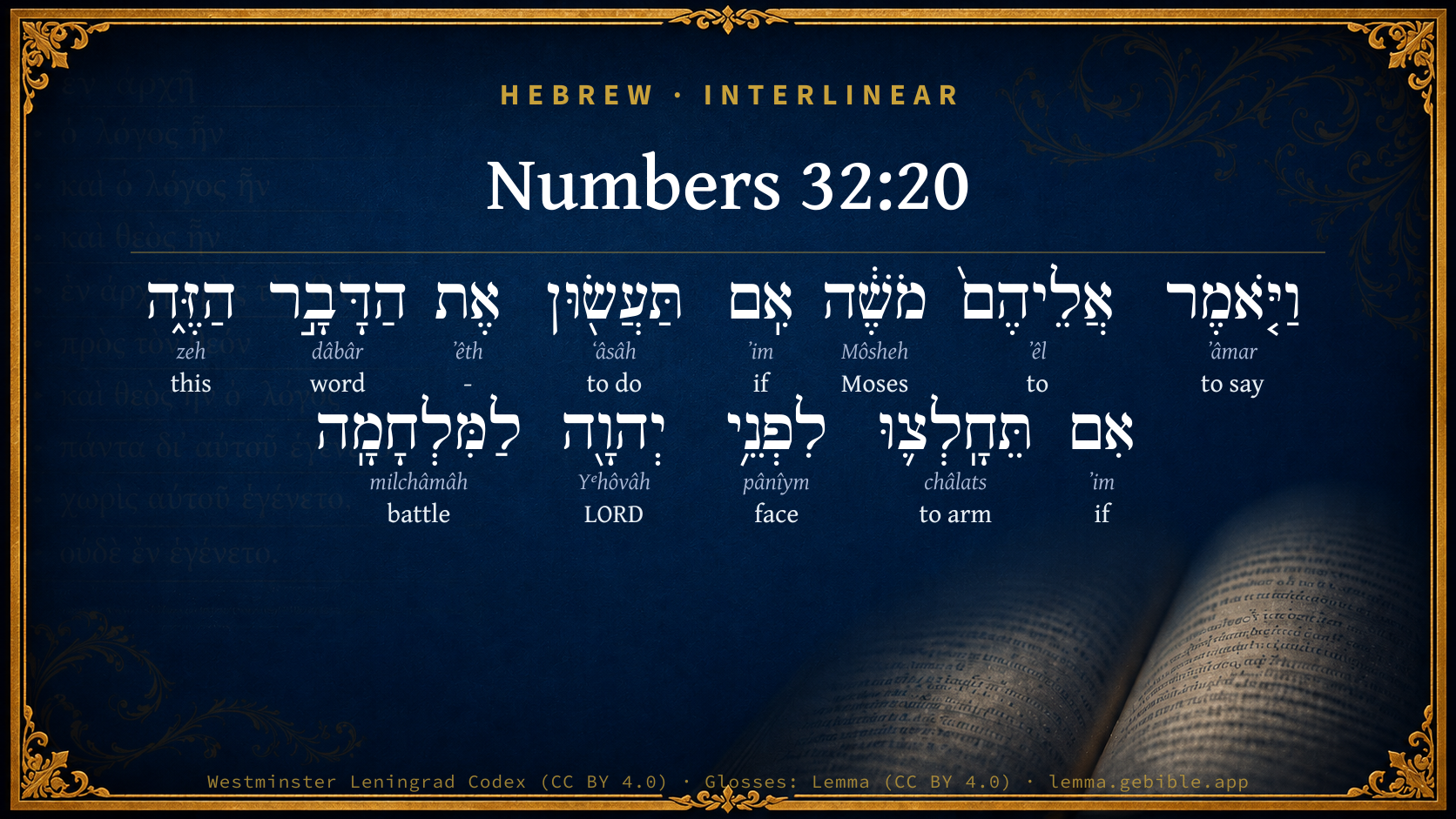
  1. וַיֹּ֤אמֶר ʼâmar H559 “and · to say” Conjunction + Verb, Qal, Sequential Imperfect, 3rd Person, Masculine, Singular
  2. אֲלֵיהֶם֙ ʼêl H413 “to · them” Preposition + Suffix, Personal, 3rd Person, Masculine, Plural
  3. מֹשֶׁ֔ה Môsheh H4872 “Moses” Noun, Proper
  4. אִֽם ʼim H518 “if” Conjunction
  5. תַּעֲשׂ֖וּן ʻâsâh H6213 “to do” Verb, Qal, Imperfect, 2nd Person, Masculine, Plural + Suffix, n
  6. אֶת ʼêth H853 “-” Particle, Direct Object
  7. הַדָּבָ֣ר dâbâr H1697 “the · word” Particle, Definite Article + Noun, Common, Masculine, Singular, Absolute
  8. הַזֶּ֑ה zeh H2088 “the · this” Particle, Definite Article + Pronoun, Demonstrative, Masculine, Singular
  9. אִם ʼim H518 “if” Conjunction
  10. לִפְנֵ֥י pânîym H6440 “to/for · face(s) of” Preposition + Noun, Common, Both, Plural, Construct
  11. יְהוָ֖ה Yᵉhôvâh H3068 “LORD” Noun, Proper
  12. לַמִּלְחָמָֽה milchâmâh H4421 “to/for the · battle” Preposition, Determined + Noun, Common, Feminine, Singular, Absolute

About this verse

These counts appear in no published source. They are computed here, from the morphology-tagged text and Lemma’s own curated glosses. What Lemma adds →

13
words
12
distinct lemmas
Pentateuch
section

Shared distinctive vocabulary

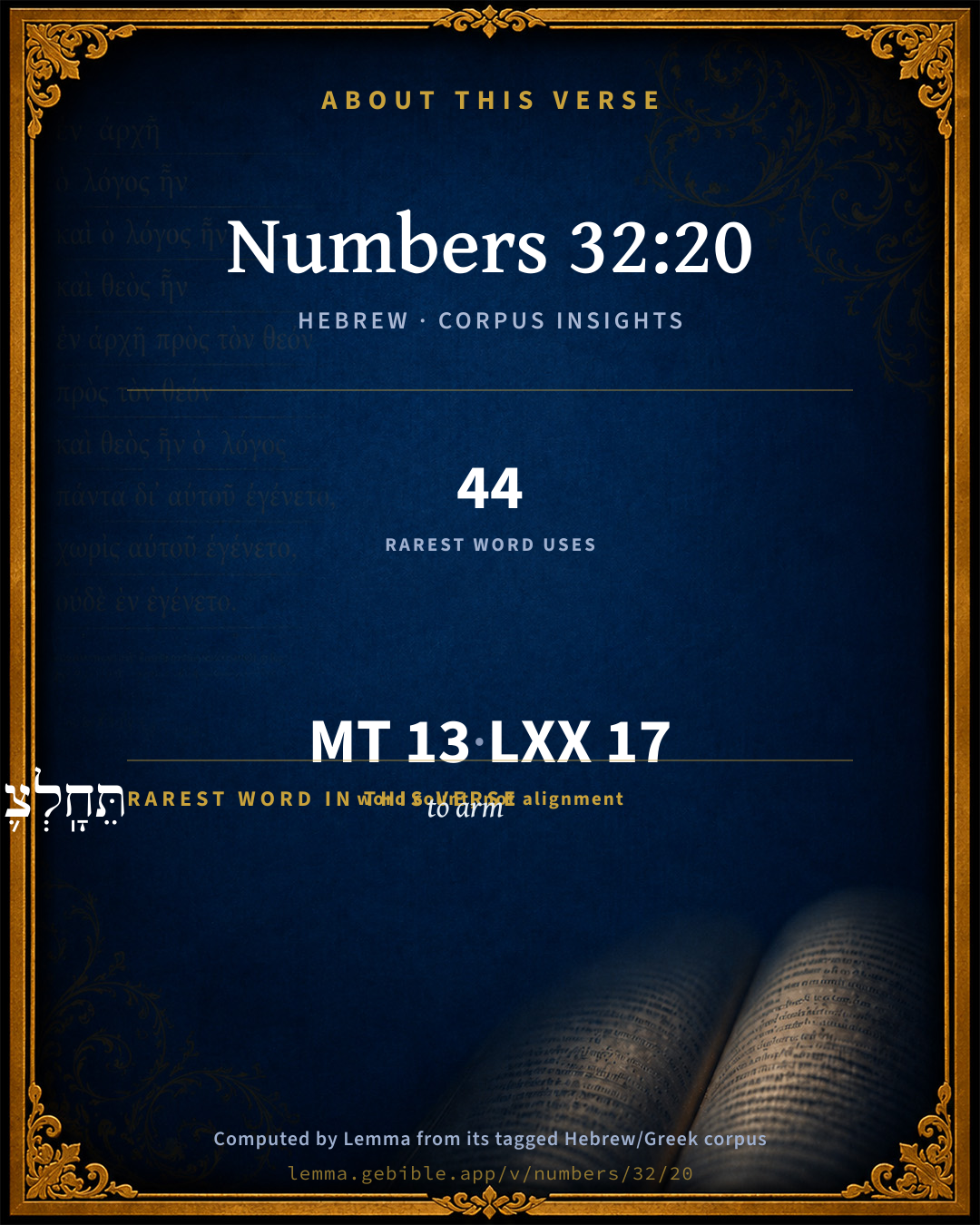
תֵּחָֽלְצ֛וּ to arm H2502 occurs in 44 verses of the Hebrew Bible. Also found in:

Grammatical profile

  • 3 verbs
  • 5 nouns
  • 1 pronoun
  • 1 preposition
  • 2 conjunctions
  • 1 particle

Verb forms

  • וַיֹּ֤אמֶר Qal · Sequential Imperfect
  • תַּעֲשׂ֖וּן Qal · Imperfect
  • תֵּחָֽלְצ֛וּ Niphal · Imperfect

Repetition

A word recurs within this verse — often emphatic in Hebrew:

  • אִֽם if H518 ×2

Hebrew & Septuagint length

In English translation the verse runs 22 words from the Hebrew and 23 from the Septuagint (LXX English) — closely comparable.

A rough comparison of the two English renderings, which tokenize alike — not a word-level alignment.

Word counts can differ between the Hebrew and the Greek without any difference in meaning — e.g. the Hebrew direct-object marker אֵת has no separate Greek word, and Greek often adds the article ὁ.

In the original languages it is 13 Hebrew tokens and 17 Greek tokens — but the two are counted differently (Hebrew bundles its prefixes and suffixes into one token; the Greek is in lemma form), so that isn’t a like-for-like length.

Cross-references

4

Topical passages linked to Numbers 32:20 in the Treasury of Scripture Knowledge — connected by theme and wording, ordered by reader-vote popularity; previews shown in the World English Bible.

  • Joshua 4:12–13 The children of Reuben, and the children of Gad, and the half-tribe of Manasseh, passed over armed before the children of Israel, as Moses spoke to them:
  • Deuteronomy 3:18–20 I commanded you at that time, saying, Yahweh your God has given you this land to possess it: you shall pass over armed before your brothers the children of Israel, all the men of valor.
  • Joshua 1:13–15 Remember the word which Moses the servant of Yahweh commanded you, saying, Yahweh your God gives you rest, and will give you this land.
  • Joshua 22:2–4 and said to them, You have kept all that Moses the servant of Yahweh commanded you, and have listened to my voice in all that I commanded you:

Cross-references courtesy of OpenBible.info (CC BY 4.0).

Hebrew and Greek witnesses Masoretic Hebrew ↔ Greek Septuagint

The same verse in the two great witnesses to the Old Testament, shown verse-for-verse.

These are two independent witnesses, not word-aligned to each other, and the Septuagint is shown in lemma (dictionary) form.

Hebrew Numbers 32:20 Masoretic · Westminster Leningrad Codex

וַיֹּ֤אמֶר אֲלֵיהֶם֙ מֹשֶׁ֔ה אִֽם תַּעֲשׂ֖וּן אֶת הַדָּבָ֣ר הַזֶּ֑ה אִם תֵּחָֽלְצ֛וּ לִפְנֵ֥י יְהוָ֖ה לַמִּלְחָמָֽה

Moses said to them, If you will do this thing, if you will arm yourselves to go before Yahweh to the war,

World English Bible · Public Domain

Greek LXX Numbers 32:20 Septuagint · lemma form

καί εἶπον πρός αὐτός μωυσῆς ἐάν ποιέω κατά ὁ ῥῆμα οὗτος ἐάν ἐνὁπλίζω ἔναντι κύριος εἰς πόλεμος

And Moses said to them, If you⌃ will do according to these words, if you⌃ will arm yourselves before the Lord for battle,

LXX2012 (modern English Septuagint) · Public Domain

Hebrew: Westminster Leningrad Codex (CC BY 4.0). Greek: Septuagint (public domain); English from LXX2012 (modern English Septuagint) (Public Domain). How the Septuagint differs from the Hebrew →

Targum (Aramaic paraphrase)

2

The Targum is the ancient Jewish Aramaic paraphrase of the Hebrew Scriptures — an interpretive translation, not the Hebrew text itself. Onkelos (literal) and Pseudo-Jonathan (expansive) render the Torah, and Jonathan the Prophets. Coverage is partial: where no permissively-licensed English translation exists for a verse, only the Aramaic is shown. This is verse-level text, not a word-by-word alignment to the Hebrew.

  1. Targum Onkelos Torah (Genesis–Deuteronomy)
    וַאֲמַר לְהוֹן משֶׁה אִם תַּעְבְדוּן יָת פִּתְגָמָא הָדֵין אִם תִּזְדָרְזוּן קֳדָם עַמָא דַיְיָ לִקְרָבָא

    (no public-domain English translation for this verse)

    Targum Onkelos — Aramaic: “Onkelos Genesis” (public domain); “Onkelos Exodus” (public domain); “Onkelos Leviticus” (public domain); “Onkelos Numbers” (public domain); “Onkelos Deuteronomy” (public domain). English: “Sefaria Community Translation” (CC0 1.0 (public-domain dedication)); “J.W. Etheridge. The Targums of Onkelos and Jonathan Ben Uzziel on the Pentateuch. London: Longmans, Green, 1862” (public domain). Text via Sefaria.

  2. Targum Pseudo-Jonathan Torah (Genesis–Deuteronomy)
    וַאֲמַר לְהוֹן משֶׁה אִין תַּעַבְדוּן יַת פִּתְגָמָא הָדֵין אִין תִּזְדַרְזוּן קֳדָם עַמָא דַיְיָ לְאַגָחָא קְרָבָא

    And Mosheh said to them, If you will perform this thing; if you will go forth armed before the people of the Lord to the war,

    Targum Pseudo-Jonathan — Aramaic: “Targum Jonathan on Genesis” (public domain); “Targum Jonathan on Exodus” (public domain); “Targum Jonathan on Leviticus” (public domain); “Targum Jonathan on Numbers” (public domain); “Targum Jonathan on Deuteronomy” (public domain). English: “The Targum of Jonathan ben Uzziel, trans. J. W. Etheridge, London, 1862” (public domain). Text via Sefaria.

Commentary

Notes on Numbers 32:20 from classic Christian and Jewish commentators (each source and its license shown beneath its notes). The classic Christian expositions comment on the surrounding passage and are grouped to its opening verse, so a note may address several verses; the Jewish commentaries on the Tanakh (Rashi and others) are per-verse, so they appear only where the commentator wrote on this verse.

Lemma curates 59 commentaries, every one of them public domain or Creative Commons licensed, each selected and text-cleaned for this edition rather than reprinted as found. About our sources →

Joseph Benson's Commentary

Num 32:20. Before the Lord — Before the ark, which was the token of God’s presence. He alludes either to the order of the tribes in their march, whereby Reuben and Gad marched immediately before the ark, or to the manner of their passage over Jordan, wherein the ark went first into Jordan, and stood there while all the tribes marched over Jordan by and before it, and these among the rest, as is expressly noted in these very words, that they passed over before the Lord, Jos 4:13.

Joseph Benson's Commentary on the Old and New Testaments (1811–1818) — public domain. Text from a community e-Sword module.

Keil & Delitzsch

C. F. Keil & F. Delitzsch

Upon this declaration Moses absolves them from all guilt, and promises them the desired land for a possession, on condition that they fulfil their promise; but he reminds them again of the sin that they will commit, and will have to atone for, if their promise is not fulfilled, and closes with the admonition to build towns for their families and pens for their flocks, and to do what they have promised. Upon this they promise again (Num 32:25-27), through their spokesman (as the singular ויּאמר in Num 32:25, and the suffix in אדני in Num 32:27, clearly show), that they will fulfil his command. The use of the expression "before Jehovah," in the words, "go armed before Jehovah to war," in Num 32:20 and Num 32:21, may be explained from the fact, that in the war which they waged at the command of their God, the Israelites were the army of Jehovah, with Jehovah in the midst. Hence the ark of the covenant was taken into the war, as the vehicle and substratum of the presence of Jehovah; whereas it remained behind in the camp, when the people wanted to press forward into Canaan of their own accord (Num 14:44). But if this is the meaning of the expression "before Jehovah," we may easily understand why the Reubenites and Gadites do not make use of it in Num 32:17, namely, because they only promise to go equipped "before the children of Israel," i.e., to help their brethren to conquer Canaan. In Num 32:32 they also adopt the expression, after hearing it from the mouth of Moses (Num 32:20).

(Note: This completely sets aside the supposed discrepancy which Knobel adduces in support of his fragmentary hypothesis, viz., that the Elohist writes "before Israel" in Num 32:17 and Num 32:29, when the Jehovist would write "before Jehovah," - a statement which is not even correct; since we find "before Jehovah" in Num 32:29, which Knobel is obliged to erase from the text in order to establish his assertion.)

נקיּים, innocent, "free from guilt before Jehovah and before Israel." By drawing back from participation in the war against the Canaanites, they would not only sin against Jehovah, who had promised Canaan to all Israel, and commanded them to take it, but also against Israel itself, i.e., against the rest of the tribes, as is more fully stated in Num 32:7-15. In Num 32:22, "before Jehovah" signifies according to the judgment of Jehovah, with divine approval. חטּאתכם וּדעוּ, "ye will know your sin," which will overtake (מצא) or smite you, i.e., ye will have to make atonement for them.

Keil & Delitzsch — Biblical Commentary on the Old Testament (1861–1891) — public domain (CC PDM 1.0). Text via the HelloAO Bible API. (Old Testament only.)

Tyndale Open Study Notes

Tyndale Open Resources

32:20-24 Moses accepted the terms offered by Reuben and Gad. If they joined their kindred in fighting the Canaanites, they would fulfill their end of the agreement and could then return to their settlements east of the Jordan (32:22). If they failed to keep their promise, it would be a serious sin against God (32:23).

Tyndale Open Study Notes — © Tyndale Open Resources, licensed CC BY-SA 4.0. Text via the HelloAO Bible API.

Geneva Bible (1599)

Geneva Bible translators

Before the Ark of the Lord.

Geneva Bible (1599) marginal notes — public domain. Text via Bolls.life.

Jamieson, Fausset & Brown

Robert Jamieson, A. R. Fausset & David Brown

Moses said unto them, If ye will do this thing--with sincerity and zeal.

go before the Lord to war--The phrase was used in allusion to the order of march in which the tribes of Reuben and Gad immediately preceded the ark (see on Num. 2:10-31), or to the passage over the Jordan, in which the ark stood in mid-channel, while all the tribes marched by in succession (Jos 3:4), of course including those of Reuben and Gad, so that, literally, they passed over before the Lord and before the rest of Israel (Jos 4:13). Perhaps, however, the phrase is used merely in a general sense to denote their marching on an expedition, the purpose of which was blessed with the presence, and destined to promote the glory, of God. The displeasure which Moses had felt on the first mention of their proposal had disappeared on the strength of their solemn assurances. But a lurking suspicion of their motives seems still to have been lingering in his mind--he continued to speak to them in an admonitory strain; and he concluded by warning them that in case of their failing to redeem their pledge, the judgments of an offended God would assuredly fall upon them. This emphatic caution against such an eventuality throws a strong doubt on the honesty of their first intentions; and yet, whether through the opposing attitude or the strong invectives of Moses they had been brought to a better state of mind, their final reply showed that now all was right.

Jamieson, Fausset & Brown — Commentary Critical and Explanatory on the Whole Bible (1871) — public domain (CC PDM 1.0). Text via the HelloAO Bible API.

Ellicott's Commentary for English Readers

(20) if ye will go armed before the Lord . . . —The same verb and the same preposition are here used which are used in Num_32:17. It may be inferred from this expression that the army of the Israelites was regarded as the army of the Lord; and it seems probable that there is a reference to the ark of the Lord as being carried on certain occasions into the war. If the order of march prescribed in the second chapter of this Book was still observed, there may be a reference to the fact that the tribes of Reuben and Gad, which encamped on the south side of the Tabernacle, immediately preceded the ark (see Num_10:18-22), just as those of Ephraim, Benjamin, and Manasseh immediately followed it (Psa_80:2). At the time of the passage of the Jordan, the priests who bare the ark stood still in the river until the whole of the people had passed over “before the ark of the Lord” (Jos_4:5; Jos_4:11); but at the siege of Jericho it appears that the ark was carried in the midst of the host, some of the armed men going before it, and some following after it (Jos_6:9). If this is the true meaning of the word “before the Lord,” it was natural that the Reubenites, or their spokesman, should first use the words “before the children of Israel” in Num_32:17, and should not adopt the expression “before the Lord,” as in Num_32:32, until it had been previously employed by Moses.

A Bible Commentary for English Readers, edited by Charles John Ellicott (1878–1897) — public domain. Text from a community e-Sword module.

John Gill's Exposition

And will go all of you armed over Jordan before the Lord,.... Moses tries them thoroughly, and is very express in his words, requiring them not only to go armed, or march from the place where they were, towards the land of Canaan, but to go over Jordan, and not some of them only, but all, and that before the Lord; though indeed, when the tribes came to the river Jordan, the ark, which was the symbol of the divine Presence, went before all the tribes into it, and there stayed till they passed over, and then these two tribes and the half tribe of Manasseh passed before the children of Israel, and before the Lord, unto battle, Jos 3:11.

until he hath driven out his enemies before him: the Canaanites, who were the enemies of the Lord, as well as of his people; and because of their sins, in which they showed their enmity to God, the land spewed them out, and he drove them out to make way for his people Israel, and till this was done the tribes of Reuben and Gad were to continue with them.

John Gill's Exposition of the Whole Bible (1746–1763) — public domain (CC PDM 1.0). Text via the HelloAO Bible API.

Haydock's Catholic Bible Commentary

Lord, or the ark, under the guidance and protection of God.

George Leo Haydock (1774–1849), Haydock's Catholic Family Bible and Commentary, 1859 edition — public domain. Excludes Psalms (Douay-Rheims chapter numbering differs from Protestant) and Deuterocanonical books (Catholic canon only).

Matthew Poole's English Annotations

Before the Lord; either,

1. Sincerely and heartily, as in God’s presence. Or rather,

2. Before the ark, which was the token of God’s presence. He alludes either to the order of the tribes in their march, whereby Reuben and Gad marched next and immediately before the ark, as appears from Num 2:10,14,16,17; or to the manner of their passage over Jordan, wherein the ark went first into Jordan, and stood there whilst all the tribes marched over Jordan by and before it, Jos 3; Jos 5, and these amongst the rest, as is expressly noted in these very words, that they passed over before the Lord, Jos 4:13.

Matthew Poole's English Annotations on the Holy Bible (1683–1685) — public domain. Text from a community e-Sword/MySword module.

Whedon's Commentary on the Bible

Daniel D. Whedon

20. Go armed before the Lord — The ark of the covenant was taken into battle as the symbol and the vehicle of Jehovah’s presence. The expression originated with Moses. This explains why the petitioners used it in Num_32:32 and not in Num_32:17, where they promise to go before Israel.

Daniel D. Whedon (gen. ed.), Commentary on the Old and New Testaments (1874–1909) — public domain. Text from a community e-Sword module.

The Pulpit Commentary

Before the Lord. Perhaps in a quasi-local sense, as the vanguard of the host before the sacred symbols of the Lord"s presence. (see on Num_10:21, and Jos_6:9) But since the same expression (hwOhy ynepli) is twice used in a much vaguer sense in verse 22, it is more probable,that it only means "in the Lord"s service, or "beneath his eye."

The Pulpit Commentary (1880–1919), ed. H.D.M. Spence-Jones & Joseph S. Exell — public domain. Text from a community e-Sword module.

John Wesley's Explanatory Notes

Before the Lord - Before the ark, which was the token of God's presence. He alludes either to the order of the tribes in their march, whereby Reuben and Gad marched immediately before the ark, or to the manner of their passage over Jordan, wherein the ark went first into Jordan, and stood there while all the tribes marched over Jordan by and before it, and these amongst the rest, as is expressly noted in these very words, that they passed over before the Lord, Josh. iv, 13.

John Wesley, Explanatory Notes Upon the Whole Bible (1754–1765) — public domain. Text via the GEBible commentary corpus.

Kretzmann's Popular Commentary

Paul E. Kretzmann

The Petition Granted with the Proposed Condition

v. 20. And Moses said unto them, If ye will do this thing, if ye will go armed before the Lord to war,

v. 21. and will go all of you armed over Jordan before the Lord, until He hath driven out His enemies from before Him, the matter was to be performed in good faith, in solemn earnestness, as before the face of Jehovah, with His eyes resting upon them,

v. 22. and the land be subdued before the Lord, then, afterward, ye shall return and be guiltless before the Lord and before Israel, since they would then have fulfilled all the obligations resting upon them as members of the Lord’s people; and this land shall be your possession before the Lord.

v. 23. But if ye will not do so, refusing to fulfill the duty which lay before them so plainly, behold, ye have sinned against the Lord; and be sure your sin will find you out, its punishment would surely strike them.

v. 24. Build you cities for your little ones and folds for your sheep; and do that which hath proceeded out of your mouth, they should keep the promise which they had made of their own free will.

v. 25. And the children of Gad and the children of Reuben spake unto Moses, saying, Thy servants will do as my lord commandeth.

v. 26. Our little ones, our wives, our flocks, and all our cattle shall be there in the cities of Gilead;

v. 27. but thy servants will pass over, every man armed for war, before the Lord to battle, as my lord saith.

v. 28. So concerning them Moses commanded Eleazar, the priest, and Joshua, the son of Nun, and the chief fathers of the tribes of the children of Israel, since Moses knew that he himself would not live to see the accomplishment of the agreement;

v. 29. and Moses said unto them, If the children of Gad and the children of Reuben will pass with you over Jordan, every man armed to battle, before the Lord, who still accompanied the host, and the land shall be subdued before you, then ye shall give them the land of Gilead for a possession, which they were now holding only in a temporary and tentative manner, subject to the fulfillment of their promise;

v. 30. but it they will not pass over with you armed, they shall have possessions among you in the land of Canaan. The text seems to imply that the two tribes would lose their identity in that case, their status as two separate and distinct tribes, their members being distributed among the other tribes of Israel.

v. 31. And the children of Gad and the children of Reuben answered, saying, As the Lord hath said unto thy servants, so will we do, thus declaring their willingness to accept the terms as stated.

v. 32. We will pass over armed before the Lord into the land of Canaan, that the possession of our inheritance on this side of Jordan may be ours, for the possession of it was actually dependent upon their fulfilling the condition.

v. 33. And Moses gave unto them, even to the children of Gad and to the children of Reuben and unto half the tribe of Manasseh, the son of Joseph, this tribe thus being recognized as having equal claims with the other two, the kingdom of Sihon, king of the Amorites, and the kingdom of Og, king of Bashan, the land, with the cities thereof in the coasts (boundaries), even the cities of the country round about, the entire country with its cities and the cultivated land in the neighborhood of the cities.

v. 34. And. the children of Gad built Dibon, and Ataroth, and Aroer,

v. 35. and Atroth, Shophan, and Jaazer, and Jogbehah,

v. 36. and Beth-nimrah, and Beth-haran, fenced cities; and folds, walled corals, for sheep.

v. 37. And the children of Reuben built Heshbon, the city which had been the capital of Sihon, and Elealeh, and Kirjathaim,

v. 38. and Nebo, and Baal-meon, (their names being changed,) and Shibmah; and gave other names unto the cities which they builded. Some of these cities have been located more or less exactly, while the location of others is altogether a matter of conjecture; but they were all in the territory east of the Jordan. y. 39. And the children of Machir, the son of Manasseh, went to Gilead, that is, they had gone there, this fact causing them to be included in this grant, and took it, and dispossessed the Amorite which was in it.

v. 40. And Moses gave Gilead unto Machir, the son of Manasseh; and he dwelt therein.

v. 41. And Jair, the son of Manasseh, went, had gone, and took the small towns thereof, and called them Havoth-jair.

v. 42. And Nobah went, had gone, and took Kenath and the villages thereof, and called it Nobah, after his own name. Cf Deu 3:4-14; 1Ch 2:22-23, where we learn that Jair was the leader in these expeditions, that he himself took twenty-three cities, and that the total number of towns with their suburbs taken in the campaign was sixty. For the people of God the motto holds true: A common warfare and peril, a common triumph and inheritance.

Paul E. Kretzmann, Popular Commentary of the Bible (1921–1924) — public domain. Text from a community e-Sword module.

unfoldingWord translationNotes

Door43 World Missions Community

if you arm yourselves

"if you take your weapons"

before Yahweh

This means Yahweh will go with them to battle and enable them to defeat their enemy and take their land. AT: "in the presence of Yahweh" (See: Idiom)

until he has driven out his enemies from before him

"until Yahweh has driven out his enemies from his presence." The pronouns here all refer to Yahweh. Yahweh enabling the Israelites to defeat their enemies is spoken of as if Yahweh were fighting their battles. AT: "until Yahweh has enabled your soldiers to defeat the enemy and force them away from his presence" (See: Metaphor)

the land is subdued before him

Here the word "land" refers to the people who live there. This can be stated in active form. AT: "in his presence the Israelites have subdued the people who live in the land" (See: Metonymy and Active or Passive)

you may return

It is implied that they will return to the east side of the Jordan. AT: "you may return to this land on the east side of the Jordan" (See: Assumed Knowledge and Implicit Information)

You will be guiltless toward Yahweh and toward Israel

Possible meanings are 1) "You will have fulfilled your obligation to Yahweh and to Israel" or 2) "There will be nothing for which Yahweh or the people of Israel can blame you."

translationWords

Moses

Yahweh

cast out

possess

unfoldingWord translationNotes — © Distant Shores Media and the Door43 World Missions Community, licensed CC BY-SA 4.0. Source: git.door43.org/Door43/en_tn.

Lesson kit

Teaching starters — assembled from the data on this page, not authored interpretation. Every prompt links to the verse data it draws on. Edit before teaching.

Numbers, in the Pentateuch, opens this verse with 13 words (12 distinct Hebrew lemmas). Its most distinctive word is châlats (“to arm”). A historical commentator’s framing appears above. Read the whole chapter for the surrounding context.

Discussion questions

  1. How does “to arm” (châlats) shape what this verse is saying?
  2. How does Leviticus 14:40, which shares the word «to arm», read alongside this verse?
  3. What does the repetition of “if” (2× in this one verse) do in this verse?
  4. The translations on this page render this verse differently — a whole-verse word diff, not a word-by-word alignment. What might account for the different wordings?
  5. «וַיֹּ֤אמֶר» is a Qal Sequential Imperfect verb. How does that grammatical form shape the action described?
  6. Compare how Joseph Benson's Commentary and Keil & Delitzsch read this verse. Where do they agree or differ?

Things to notice

Reading settings

Reading text

Shown beneath each verse's original-language words.

Old Testament
Old Testament edition

Read the OT as the Masoretic Hebrew (MT) or the Greek Septuagint (LXX).

English shown for the Greek Septuagint (in the Hebrew ↔ Greek comparison).

Comparing translations? Open the Compare panel on any verse page to stack up to four side by side.