
Ecclesiastes 11:3

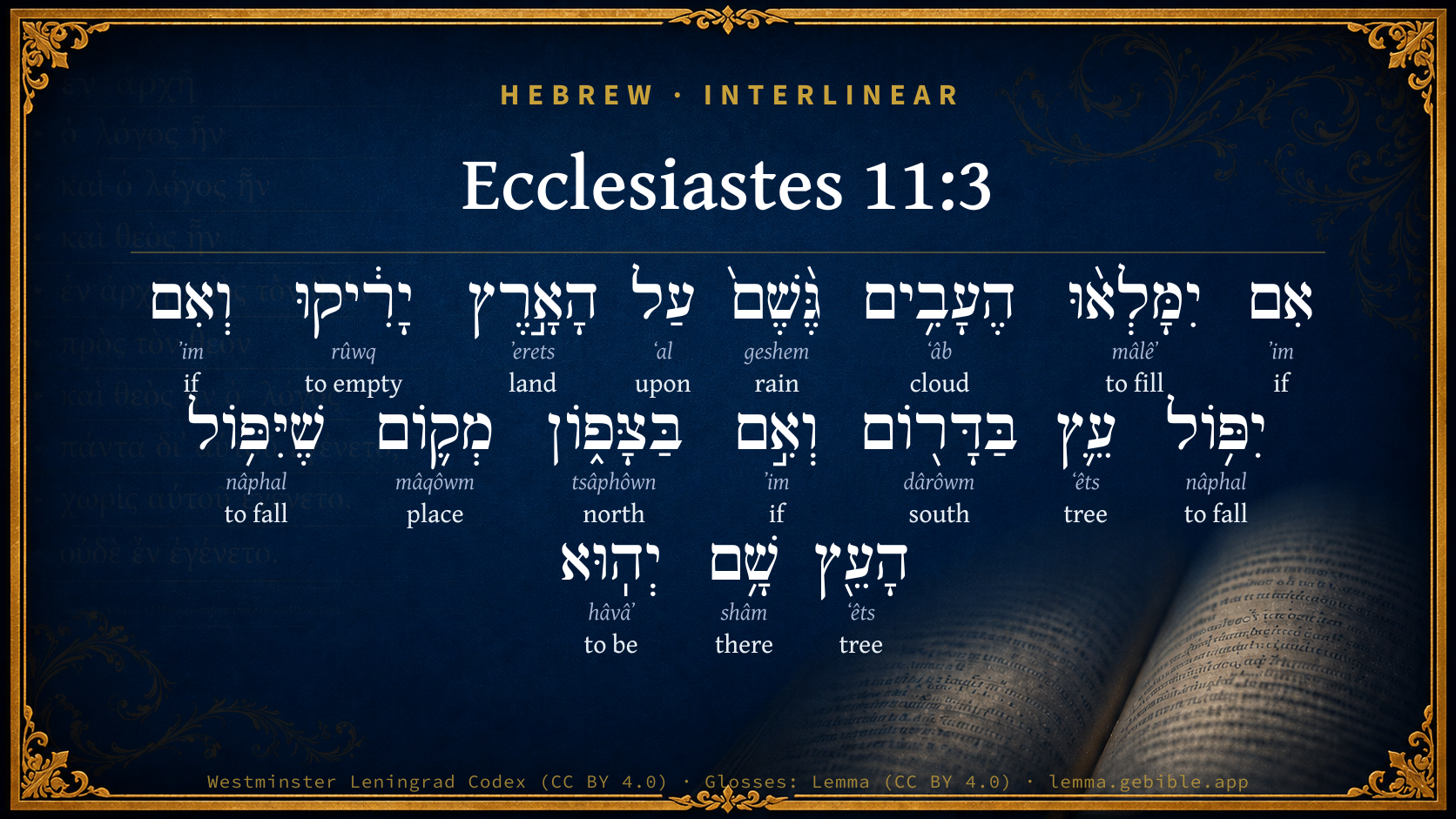
Hebrew (Westminster Leningrad Codex) Ecclesiastes 11:3 appears in the Hebrew Old Testament. The text above is from the Westminster Leningrad Codex. Each word links to its Strong’s number, a concise gloss, and parsing drawn from the Open Scriptures Hebrew Bible morphology. Click any word for its full Brown-Driver-Briggs (BDB) entry.
Download image
Cite this verse

Ecclesiastes 11:3 (World English Bible). Public Domain. Lemma interlinear Bible study tool, https://lemma.gebible.app/v/ecclesiastes/11/3.

Show BibTeX & RIS
BibTeX
RIS
English Translation
If the clouds are full of rain, they empty themselves on the earth; And if a tree falls toward the south, or toward the north, In the place where the tree falls, there shall it be.
World English Bible · Public Domain
Download a study sheet

One document with this verse’s original text, its word-by-word gloss line, the meaning frame, cross-references with their text, attributed commentary, and full source and license credits — printable, and it pastes into notes with its structure intact.

This verse Autodidact and up

Study sheet (.html) Plain text (.txt)

A passage Seminary Student

Up to 50 verses in one chapter. A passage sheet keeps up to 6 commentary sources and 12 cross-references per verse, in the order this page ranks them, and says so on the sheet whenever that leaves anything out. Ask for a single verse and you get the Autodidact verse sheet above.

Everything on this page stays free to read, with no account — the sheet is a download of what is already on screen, not access to it.

Want to remove ads? Support Godless Engineer
Compare translations 3

The same verse in 3 English versions, stacked beneath the original-language interlinear above. Click any original word for its lexicon entry.

Each is an independent rendering of the whole verse — the interlinear is not word-aligned to these translations.

Highlighted words mark where these versions differ — a whole-verse word diff, not a word-by-word alignment.

  • World English Bible Public Domain
    If the clouds are full of rain, they empty themselves on the earth; And if a tree falls toward the south, or toward the north, In the place where the tree falls, there shall it be.
  • King James Version Public Domain
    If the clouds be full of rain, they empty themselves upon the earth: and if the tree fall toward the south, or toward the north, in the place where the tree falleth, there it shall be.
  • unfoldingWord Literal Text CC BY-SA 4.0
    If the clouds are filled with rain, they will pour out on the earth. And whether a tree will fall in the south or in the north, place where the tree will fall—there it will be.

unfoldingWord Literal Text — © unfoldingWord, licensed CC BY-SA 4.0. Word-aligned USFM3 via Door43 (git.door43.org/unfoldingWord/en_ult).

Versions to compare (up to 4)

3 of 4 selected

Show all 18 translations

Every available English version of this verse, each an independent rendering of the whole verse.

  • World English Bible Public Domain
    If the clouds are full of rain, they empty themselves on the earth; And if a tree falls toward the south, or toward the north, In the place where the tree falls, there shall it be.
  • Berean Standard Bible Public Domain
    If the clouds are full, they will pour out rain upon the earth; whether a tree falls to the south or to the north, in the place where it falls, there it will lie.
  • Majority Standard Bible Public Domain
    If the clouds are full, they will pour out rain upon the earth; whether a tree falls to the south or to the north, in the place where it falls, there it will lie.
  • King James Version Public Domain
    If the clouds be full of rain, they empty themselves upon the earth: and if the tree fall toward the south, or toward the north, in the place where the tree falleth, there it shall be.
  • American Standard Version (1901) Public Domain
    If the clouds be full of rain, they empty themselves upon the earth; and if a tree fall toward the south, or toward the north, in the place where the tree falleth, there shall it be.
  • Revised Version (1885) Public Domain
    If the clouds be full of rain, they empty themselves upon the earth: and if a tree fall toward the south, or toward the north, in the place where the tree falleth, there shall it be.
  • Geneva Bible (1599) Public Domain
    If the clouds be full, they wil powre forth raine vpon the earth: and if the tree doe fall toward the South, or toward the North, in the place that the tree falleth, there it shalbe.
  • Douay-Rheims (1899) Public Domain
    If the clouds be full, they will pour out rain upon the earth. If the tree fall to the south, or to the north, in what place soever it shall fall, there shall it be.
  • Young's Literal Translation Public Domain
    If the thick clouds are full of rain, On the earth they empty `themselves'; And if a tree doth fall in the south or to the north, The place where the tree falleth, there it is.
  • Literal Standard Version CC BY-SA 4.0
    If the thick clouds are full of rain, || On the earth they empty [themselves]; And if a tree falls in the south or to the north, || The place where the tree falls, there it is.
  • Unlocked Literal Bible CC BY-SA 4.0
    If the clouds are full of rain, they empty themselves on the earth, and if a tree falls toward the south or toward the north, wherever the tree falls, there it will remain.
  • unfoldingWord Literal Text CC BY-SA 4.0
    If the clouds are filled with rain, they will pour out on the earth. And whether a tree will fall in the south or in the north, place where the tree will fall—there it will be.
  • Darby Bible Public Domain
    If the clouds be full of rain, they empty themselves upon the earth; and if a tree fall toward the south, or toward the north, in the place where the tree falleth, there it shall be.
  • World Messianic Bible Public Domain
    If the clouds are full of rain, they empty themselves on the earth; and if a tree falls toward the south, or toward the north, in the place where the tree falls, there shall it be.
  • Webster's Bible Public Domain
    If the clouds are full of rain, they empty themselves upon the earth: and if the tree falleth towards the south, or towards the north, in the place where the tree falleth, there it shall be.
  • Free Bible Version CC BY-SA 4.0
    When the clouds are full they pour rain down upon the earth. Whether a tree falls to the north or to the south, it stays where it fell.
  • Bible in Basic English Public Domain
    If the clouds are full of rain, they send it down on the earth; and if a tree comes down to the south, or the north, in whatever place it comes down, there it will be.
  • JPS Tanakh (1917) Public Domain
    If the clouds be full of rain, they empty themselves upon the earth; and if a tree fall in the south, or in the north, in the place where the tree falleth, there shall it be.

Literal Standard Version (2020), Covenant Press — licensed CC BY-SA 4.0. Text via the HelloAO Bible API (eBible.org). Unlocked Literal Bible (unfoldingWord) — licensed CC BY-SA 4.0. Text via the HelloAO Bible API (eBible.org). unfoldingWord Literal Text — © unfoldingWord, licensed CC BY-SA 4.0. Word-aligned USFM3 via Door43 (git.door43.org/unfoldingWord/en_ult). Free Bible Version, Dr. Jonathan Gallagher — licensed CC BY-SA 4.0. Text via the HelloAO Bible API (eBible.org).

Word by word

More ways to search: Search by grammar → Find every occurrence → Compare this word →

Practice this passage: Drill this verse → Learn its vocabulary →

יְהֽוּא
hâvâʼ
H1933
“to be”
Verb, Qal, Imperfect, 3rd Person, Masculine, Singular
Part of Speech
Verb
Stem
Qal
Form
Imperfect
Person
3rd Person
Gender
Masculine
Number
Singular
Full BDB Definition

Origin: a primitive root [compare H183 , H1961 ]

TWOT: 484 , 491

Qal) - to fall - to be, become, exist, happen
  1. אִם ʼim H518 “if” Conjunction
  2. יִמָּלְא֨וּ mâlêʼ H4390 “to fill” Verb, Niphal, Imperfect, 3rd Person, Masculine, Plural
  3. הֶעָבִ֥ים ʻâb H5645 “the · clouds” Particle, Definite Article + Noun, Common, Both, Plural, Absolute
  4. גֶּ֨שֶׁם֙ geshem H1653 “rain” Noun, Common, Masculine, Singular, Absolute
  5. עַל ʻal H5921 “upon” Preposition
  6. הָאָ֣רֶץ ʼerets H776 “the · land” Particle, Definite Article + Noun, Common, Both, Singular, Absolute
  7. יָרִ֔יקוּ rûwq H7324 “to empty” Verb, Hiphil, Imperfect, 3rd Person, Masculine, Plural
  8. וְאִם ʼim H518 “and · if” Conjunction + Conjunction
  9. יִפּ֥וֹל nâphal H5307 “to fall” Verb, Qal, Imperfect, 3rd Person, Masculine, Singular
  10. עֵ֛ץ ʻêts H6086 “tree” Noun, Common, Masculine, Singular, Absolute
  11. בַּדָּר֖וֹם dârôwm H1864 “in/at the · south” Preposition, Determined + Noun, Common, Masculine, Singular, Absolute
  12. וְאִ֣ם ʼim H518 “and · if” Conjunction + Conjunction
  13. בַּצָּפ֑וֹן tsâphôwn H6828 “in/at the · north” Preposition, Determined + Noun, Common, Feminine, Singular, Absolute
  14. מְק֛וֹם mâqôwm H4725 “place of” Noun, Common, Masculine, Singular, Construct
  15. שֶׁיִּפּ֥וֹל nâphal H5307 “who/which · to fall” Particle, Relative + Verb, Qal, Imperfect, 3rd Person, Masculine, Singular
  16. הָעֵ֖ץ ʻêts H6086 “the · tree” Particle, Definite Article + Noun, Common, Masculine, Singular, Absolute
  17. שָׁ֥ם shâm H8033 “there” Adverb

About this verse

These counts appear in no published source. They are computed here, from the morphology-tagged text and Lemma’s own curated glosses. What Lemma adds →

18
words
14
distinct lemmas
Wisdom
section

Notable vocabulary

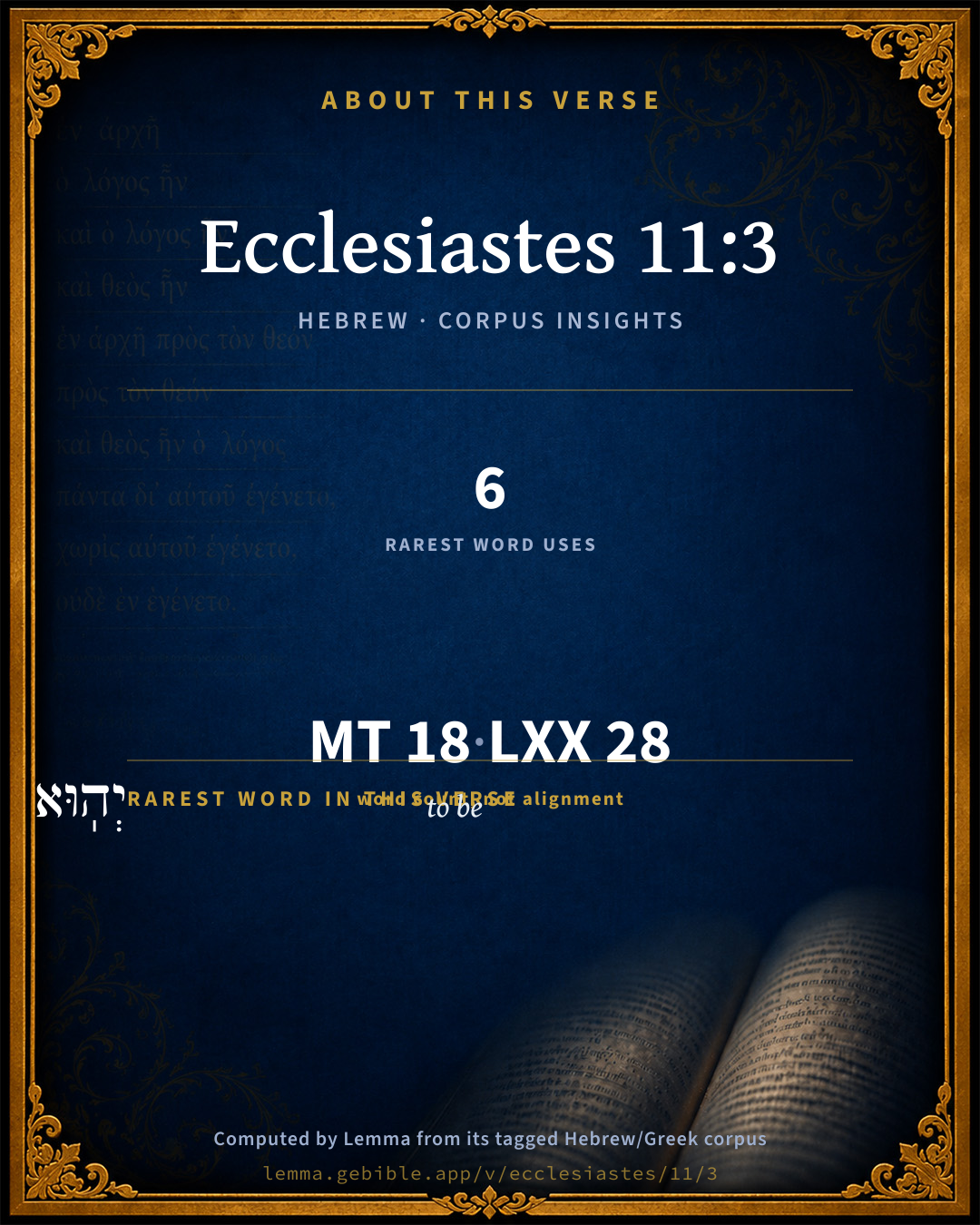
The rarest word here is יְהֽוּא to be H1933 — appearing just 6 times in the whole Hebrew Bible.

Shared distinctive vocabulary

יְהֽוּא to be H1933 occurs in 6 verses of the Hebrew Bible. Also found in:

Grammatical profile

  • 5 verbs
  • 8 nouns
  • 1 preposition
  • 3 conjunctions
  • 1 adverb

Verb forms

  • יִמָּלְא֨וּ Niphal · Imperfect
  • יָרִ֔יקוּ Hiphil · Imperfect
  • יִפּ֥וֹל Qal · Imperfect
  • שֶׁיִּפּ֥וֹל Qal · Imperfect
  • יְהֽוּא Qal · Imperfect

Repetition

Words recur within this verse — often emphatic in Hebrew:

  • יִפּ֥וֹל to fall H5307 ×2
  • עֵ֛ץ tree H6086 ×2
  • אִם if H518 ×3

Hebrew & Septuagint length

In English translation the verse runs 36 words from the Hebrew and 37 from the Septuagint (LXX English) — closely comparable.

A rough comparison of the two English renderings, which tokenize alike — not a word-level alignment.

Word counts can differ between the Hebrew and the Greek without any difference in meaning — e.g. the Hebrew direct-object marker אֵת has no separate Greek word, and Greek often adds the article ὁ.

In the original languages it is 18 Hebrew tokens and 28 Greek tokens — but the two are counted differently (Hebrew bundles its prefixes and suffixes into one token; the Greek is in lemma form), so that isn’t a like-for-like length.

Cross-references

7

Topical passages linked to Ecclesiastes 11:3 in the Treasury of Scripture Knowledge — connected by theme and wording, ordered by reader-vote popularity; previews shown in the World English Bible.

  • Psalms 65:9–13 You visit the earth, and water it. You greatly enrich it. The river of God is full of water. You provide them grain, for so you have ordained it.
  • Isaiah 55:10–11 For as the rain comes down and the snow from the sky, and doesn't return there, but waters the earth, and makes it bring forth and bud, and gives seed to the sower and bread to the eater;
  • 1 John 3:17 But whoever has the world's goods, and sees his brother in need, and closes his heart of compassion against him, how does the love of God remain in him?
  • Luke 13:7 He said to the vine dresser, 'Behold, these three years I have come looking for fruit on this fig tree, and found none. Cut it down. Why does it waste the soil?'
  • 1 Kings 18:45 It happened in a little while, that the sky grew black with clouds and wind, and there was a great rain. Ahab rode, and went to Jezreel:
  • Matthew 3:10 "Even now the axe lies at the root of the trees. Therefore, every tree that doesn't bring forth good fruit is cut down, and cast into the fire.
  • Luke 16:22–26 It happened that the beggar died, and that he was carried away by the angels to Abraham's bosom. The rich man also died, and was buried.

Cross-references courtesy of OpenBible.info (CC BY 4.0).

Hebrew and Greek witnesses Masoretic Hebrew ↔ Greek Septuagint

The same verse in the two great witnesses to the Old Testament, shown verse-for-verse.

These are two independent witnesses, not word-aligned to each other, and the Septuagint is shown in lemma (dictionary) form.

Hebrew Ecclesiastes 11:3 Masoretic · Westminster Leningrad Codex

אִם יִמָּלְא֨וּ הֶעָבִ֥ים גֶּ֨שֶׁם֙ עַל הָאָ֣רֶץ יָרִ֔יקוּ וְאִם יִפּ֥וֹל עֵ֛ץ בַּדָּר֖וֹם וְאִ֣ם בַּצָּפ֑וֹן מְק֛וֹם שֶׁיִּפּ֥וֹל הָעֵ֖ץ שָׁ֥ם יְהֽוּא

If the clouds are full of rain, they empty themselves on the earth; And if a tree falls toward the south, or toward the north, In the place where the tree falls, there shall it be.

World English Bible · Public Domain

Greek LXX Ecclesiastes 11:3 Septuagint · lemma form

ἐάν πληρόω ὁ νέφος ὑετός ἐπί ὁ γῆ ἐκχέω καί ἐάν πίπτω ξύλον ἐν ὁ νότος καί ἐάν ἐν ὁ βορέας τόπος ὅς πίπτω ὁ ξύλον ἐκεῖ εἰμί

If the clouds be filled with rain, they pour it out upon the earth: and if a tree fall southward, or if it fall northward, in the place where the tree shall fall, there it shall be.

LXX2012 (modern English Septuagint) · Public Domain

Hebrew: Westminster Leningrad Codex (CC BY 4.0). Greek: Septuagint (public domain); English from LXX2012 (modern English Septuagint) (Public Domain). How the Septuagint differs from the Hebrew →

Commentary

Notes on Ecclesiastes 11:3 from classic Christian and Jewish commentators (each source and its license shown beneath its notes). The classic Christian expositions comment on the surrounding passage and are grouped to its opening verse, so a note may address several verses; the Jewish commentaries on the Tanakh (Rashi and others) are per-verse, so they appear only where the commentator wrote on this verse.

Lemma curates 59 commentaries, every one of them public domain or Creative Commons licensed, each selected and text-cleaned for this edition rather than reprinted as found. About our sources →

Trapp's Complete Commentary

John Trapp

Ecc 11:3 If the clouds be full of rain, they empty [themselves] upon the earth: and if the tree fall toward the south, or toward the north, in the place where the tree falleth, there it shall be.

Ver. 3. If the clouds be full of rain.] As the sun draws up vapours into the air, not to retain them there, but to return them to the earth, for its relief, and the creatures’ comfort, so those that have attracted to themselves much riches should plentifully pour them out for the benefit of their poorer brethren. Clouds, when full of great and strong rain, as the word here signifies, pour down amain; and the spouts run, and the eaves shed, and the presses overflow, and the aromatic trees sweat out their precious oils; so should rich men be ready to distribute, willing to share. But it happens otherwise, for commonly the richer the harder; and those that should be as clouds to water the earth, as a common blessing, are either "waterless clouds," as St Jude hath it, or at best they are but as waterpots, that water a few spots of ground only in a small garden. The earth is God’s purse, {a} as one saith, and rich men’s houses are his storehouses. This the righteous rich man knoweth, and therefore he "disperseth," as a steward for God; "he giveth to the poor; his righteousness," and his riches too, "endureth for ever." {Psa 112:9} Whereas the wicked rich man retaineth his fulness to rot with him; he feedeth upon earth like a serpent, and striveth, like a toad, to die with much mould in his mouth, and is therefore bidden by St James to "weep and howl for the miseries that are coming upon him," for his cursed hoard of evilgotten and worse kept goods. The rottenness of his riches, the canker of his cash, the moth of his garments, "shall be a witness against him, and eat up his flesh as fire." {Jas 5:1-3} He shall be sure to be arraigned as an arrant thief, as a cursed cheat; for that, having a better thing by him, he brings a worse; {Mal 1:14} and being a rich man, he makes himself poor, lest he should do good to the poor. As Pope Alexander V said of himself that when he was a bishop he was rich, when a cardinal he was poor, and when he was pope he was a beggar. I should sooner have believed him if he had said as his successor, Pius Quintus, did, Cum essem religiosus, sperabam bene de salute animae meae; cardinalis factus extimui; pontifex creatus pene despero: {b} When I was first in orders, without any farther ecclesiastical dignity, I had good hopes of my salvation; when a cardinal, I feared myself; but now that I am pope, I am almost out of hope.

And if the tree fall toward the south,] i.e., Which way soever it groweth, it bears fruit; so should rich men be rich in good works, {1Ti 6:18} and being fat olive trees, they should be, as David, {Psa 52:8} green olive trees, full of good fruits. Or thus: Trees must down, and men must die; and as trees fall southward or northward, so shall men be set either at the right hand of the judge, or at the left, according as they have carried themselves towards Christ’s poor members. {Mat 25:31-46} Up, therefore, and be doing while life lasteth, and so lay hold upon eternal life. Mors atra impendet agenti. Where the boughs of holy desires aud good deeds are most and greatest, on that side, no doubt, the tree will fall; but being fallen, it can bear no fruit for ever.

{a} Domini marsupium.

{b} Corn. a Lap. in Num 11:11.

John Trapp, A Commentary or Exposition upon All the Books of the Old and New Testament (1647–1656) — public domain. Text from a community e-Sword module.

The Biblical Illustrator

Joseph S. Exell

Ecc_11:3

If the clouds be full of rain, they empty themselves upon the earth.

Black clouds and bright blessings

It was raining very heavily when I was thinking over this text. When I came here I found that you had not had a drop of ram. This seemed to me like an example and an illustration of the sovereignty of Gods dispensations. In one part of the Church Gods grace descends in a flood, while another part remains as dry and arid as the wilderness itself. He hath the key of the rain, and it is for us to ask Him to give us of the dew and the rain of His Holy Spirit.

I. Comfort for the timid. The clouds are black, they lower; they shut out the sunlight; they obscure the landscape. The timid one looks up and says, Alas! how black they are, and how they gather, fold on fold! What makes them black? It is because they are full, and hence light cannot pierce them. And if they be full, what then? Why, then it will rain, and then the hot earth will be refreshed, and every little plant, and every tiny leaf and rootlet of that plant will suck up moisture, and begin to laugh for joy. If the clouds were not black, you might not expect rain. If your afflictions were not grievous, they would not be profitable. If your adversities did not pain and trouble you, they would not be blessed to you. We have heard some people say, If this trouble had come in such and such a shape, I would not have minded it. But God meant you to mind it, for it was in your minding it that it was blessed to you. I do not know--how can I tell--what is your particular trouble; but you may well believe that He who appointed it, He who measured it, He who has set its bounds, will bring you to the end of it, and prove His gracious design in it all. Do not think that God deals roughly with His children, and gives them needless pain. It grieves Him to grieve you. It is easy to have a faith that acts backwards, but faith that will act forwards from the point of your present emergency is the true faith that you want now. Hath God helped you out of one trouble after another, and is it to be supposed that He will leave you in this? Do ask, then, for grace that you may believe while you are still under the cloud, black as it looks, that it will empty itself in blessed rain upon you. So will it be on the largest possible scale in the whole Church of Christ. There are many clouds surrounding the Church of God just now, and I must confess that, with all the religious activity there is abroad, there is very much to cause us great sorrow. But we must not yield to fear. The Master knows.

II. An argument with the doubting and the desponding. It is a law of nature that a full thing begins to empty itself. When the cloud gets full, it no longer has the power of retaining its fluid contents, but it pours them down upon the earth. Well now, I want you to draw an argument from this. Our gracious God never makes a store of any good thing, but He intends to give it to us. Just think for a moment of God, our gracious Father. He is love. He is all goodness. He is a bottomless, shoreless sea, brimful of goodness He is full of pardoning goodness to forgive sin. He is full of faithful goodness to watch over His children; full of bounteous goodness to bestow upon them all that they want. Now, if there be such a plenitude of goodness in the leather, it must be for some object--not for Himself. Why should it be given to Himself? It must be there for His creatures. Is it not written that He delighteth in mercy? We know that He maketh the sun to shine upon the evil as well as upon the just. Then I, even though I be evil, will hope that this store of goodness in the heart of the everlasting Father is intended--some of it, at any rate--to be poured out upon me, poor unworthy me. Ah, troubled, doubting soul! think again; let me ask you this time to muse a little upon Jesus Christ the Son of the Father. Now, if thou believe Christ to be a cloud that is full of rain, for what reason is He full? Why, that He may empty Himself upon the earth. To proceed yet further, I would ask the doubter to look at the infinite fulness of power which is treasured up in the Holy Spirit. Is thy heart hard? He will empty His softening influence upon it. Is it dead? His quickening power shall there find a congenial sphere. Art thou dark? Then there is room for His light. Art thou sick? Then is there a province for His healing energy.

III. The text furnishes a lesson to Christians. The drift of the passage is, of course, to be gathered from the connection, and it was intended by Solomon to teach us liberality. If your pocket is full, empty it out upon the poor and needy; and if God has endowed you with much of this worlds substance, look out for cases of necessity, and consider it as much the object of your existence to bestow help upon the needy, as it is the design in the creation of a cloud that it should empty itself upon the earth. When a man once gets into the habit of giving to the cause of God, it becomes as much a delight to contribute of his substance as to pray for Gods bounty, or to drink in the promise. Let the wealthy empty themselves upon the earth, and this shall be the way to fill themselves. But, though not many of us are entrusted with much wealth, we have other aptitudes to be useful. Some Christians have a considerable amount of ability to serve the Lord. They are, perhaps, able to speak for the Master. Now, I think that wherever there is some knowledge of Gods Word, a personal acquaintance with its power, and a facility to speak, we should exercise our talent, if it be but one; and if we have ten, we should not keep one of the ten to ourselves. Some Christians have a large amount of experimental knowledge. They are not eloquent, they are not educated, but they are wise. If you have any experience, let me say to you--do, as you have opportunity, tell it out; empty it upon the earth. If you have gained some knowledge of God, communicate it. If you have proved Him, confess to a generation about you that He is a faithful God. Observe, lastly, when it is that the clouds do empty themselves. The text says, when they are full. This is a broad hint, I think, to the Christian; it tells him when to work. David was to attack the Philistines at a certain signal. When thou hearest the sound of a going in the tops of the mulberry-trees, then thou shalt bestir thyself. Take this as a Divine signal; when you are full, it is time for you to set about doing good, emptying yourselves upon the earth. (C. H. Spurgeon.)

The Biblical Illustrator, edited by Joseph S. Exell (c. 1880s–1900s) — public domain. Text from a community e-Sword module.

Joseph Benson's Commentary

Ecc 11:3. If the clouds be full of rain, they empty themselves, &c. — Learn, O man, the practice of liberality from the very lifeless creatures, from the clouds; which, when they are filled with water, do not hoard it up, but plentifully pour it forth, for the refreshment both of the fruitful field and the barren wilderness. And if the tree fall, &c. — As if he had said, Therefore, let us just now bring forth the fruits of righteousness, because death will shortly cut us down, and we shall then be determined to unchangeable happiness or misery, according as our works have been.

Joseph Benson's Commentary on the Old and New Testaments (1811–1818) — public domain. Text from a community e-Sword module.

Keil & Delitzsch

C. F. Keil & F. Delitzsch

With this verse there is not now a transition, εἰς ἄλλο γένος (as when one understands Ecc 11:1. of beneficence); the thoughts down to Ecc 11:6 move in the same track. "When the clouds are full of rain, they empty themselves on the earth: and if a tree fall in the south, or in the north - the place where the tree falleth, there it lieth." Man knows not - this is the reference of the verse backwards - what misfortune, as e.g., hurricane, flood, scarcity, will come upon the earth; for all that is done follows fixed laws, and the binding together of cause and effect is removed beyond the influence of the will of man, and also in individual cases beyond his knowledge. The interpunction of 3a: אם־ימּלאוּ העבים גּשׁם (not as by v. d. Hooght, Mendelss., and elsewhere העבים, but as the Venet. 1515, 21, Michael. העבים, for immediately before the tone syllable Mahpach is changed into Mercha) appears on the first glance to be erroneous, and much rather it appears that the accentuation ought to be

אם־ימלאו העבים גשם על־הארץ יריקו

but on closer inspection גשׁם is rightly referred to the conditional antecedent, for "the clouds could be filled also with hail, and thus not pour down rain" (Hitz.). As in Ecc 4:10, the fut. stands in the protasis as well as in the apodosis. If A is done, then as a consequence B will be done; the old language would prefer the words והריקו ... נמלאו (כי) אם, Ewald, 355b: as often as A happens, so always happens B. יריקוּ carries (without needing an external object to be supplied), as internally transitive, its object is itself: if the clouds above fill themselves with rain, they make an emptying, i.e., they empty themselves downwards. Man cannot, if the previous condition is fixed, change the necessary consequences of it.

The second conditioning clause: si ceciderit lignum ad austraum aut ad aquilonem, in quocunque loco cociderit ibi erit. Thus rightly Jerome. It might also be said: ואם־יפול עץ אם בדרום ואם בחפין, and if a tree falls, whether it be in the south or in the north; this sive ... sive would thus be a parenthetic parallel definition. Thus regarded, the protasis as it lies before us consists in itself, as the two veim in Amo 9:3, of two correlated halves: "And if a tree falls on the south side, and (or) if it fall on the north side," i.e., whether it fall on the one or on the other. The Athnach, which more correctly belongs to יריקי, sets off in an expressive way the protasis over against the apodosis; that a new clause begins with veim yippol is unmistakeable; for the contrary, there was need for a chief disjunctive to בץ. Meqom is accus. loci for bimqom, as at Est 4:3; Est 8:17. Sham is rightly not connected with the relat. clause (cf. Eze 6:13); the relation is the same as at Est 1:7. The fut. יהוּא is formed from הוה, whence Ecc 2:22, as at Neh 6:6, and in the Mishna (Aboth, vi. 1;

(Note: Vid., Baer, Abodath Jisrael, p. 290.)

Aboda zara, iii. 8) the part. הוה. As the jussive form יהי is formed from יהיה, so יהיה (יהוה) passes into יהוּ, which is here written יהוּא. Hitzig supposes that, according to the passage before us and Job 37:6, the word appears to have been written with א, in the sense of "to fall." Certainly הוה has the root-signification of delabi, cadere, and derives from thence the meaning of accidere, exsistere, esse (vid., under Job 37:6); in the Book of Job, however, הוה may have this meaning as an Arabism; in the usus loq. of the author of the Book of Koheleth it certainly was no longer so used. Rather it may be said that יהוּ had to be written with an א added to distinguish it from the abbreviated tetragramm, if the א, as in אבוּא, Isa 28:12, and הל, Jos 10:24, does not merely represent the long terminal vowel (cf. the German-Jewish דוא = thou, דיא = the, etc.).

(Note: Otherwise Ewald, 192b: יהוּא, Aram. of הוּא (as בּוא) = הוא.)

Moreover, יהוּא, as written, approaches the Mishnic inflection of the fut. of the verb הוה; the sing. there is יהא, תּהא, אהא, and the plur. יהוּ, according to which Rashi, Aben Ezra, and Kimchi interpret יהוּא here also as plur.; Luzzatto, 670, hesitates, but in his Commentary he takes it as sing., as the context requires: there will it (the tree) be, or in accordance with the more lively meaning of the verb הוה: there will it find itself, there it continues to lie. As it is an invariable law of nature according to which the clouds discharge the masses of water that have become too heavy for them, so it is an unchangeable law of nature that the tree that has fallen before the axe or the tempest follows the direction in which it is impelled. Thus the future forms itself according to laws beyond the control of the human will, and man also has no certain knowledge of the future; wherefore he does well to be composed as to the worst, and to adopt prudent preventive measures regarding it. This is the reference of Ecc 11:3 looking backwards. But, on the other hand, from this incalculableness of the future-this is the reference of Ecc 11:3 looking forwards-he ought not to vie up fresh venturesome activity, much rather he ought to abstain from useless and impeding calculations and scruples.

Keil & Delitzsch — Biblical Commentary on the Old Testament (1861–1891) — public domain (CC PDM 1.0). Text via the HelloAO Bible API. (Old Testament only.)

Tyndale Open Study Notes

Tyndale Open Resources

11:3 clouds . . . rains: Sometimes we can be reasonably certain of what will happen. • a tree . . . stays where it falls: Our actions sometimes yield irrevocable consequences.

Tyndale Open Study Notes — © Tyndale Open Resources, licensed CC BY-SA 4.0. Text via the HelloAO Bible API.

Geneva Bible (1599)

Geneva Bible translators

As the clouds that are full, pour out rain, so the rich that have abundance, must distribute it liberally.

He exhorteth to be liberal while we live: for after, there is no power.

Geneva Bible (1599) marginal notes — public domain. Text via Bolls.life.

Jamieson, Fausset & Brown

Robert Jamieson, A. R. Fausset & David Brown

clouds--answering to "evil" (Ecc 11:2), meaning, When the times of evil are fully ripe, evil must come; and speculations about it beforehand, so as to prevent one sowing seed of liberality, are vain (Ecc 11:4).

tree--Once the storm uproots it, it lies either northward or southward, according as it fell. So man's character is unchangeable, whether for hell or heaven, once that death overtakes him (Rev 22:11, Rev 22:14-15). Now is his time for liberality, before the evil days come (Ecc 12:1).

Jamieson, Fausset & Brown — Commentary Critical and Explanatory on the Whole Bible (1871) — public domain (CC PDM 1.0). Text via the HelloAO Bible API.

Adam Clarke's Commentary

Verse 3. If the clouds be full of rain.] Act as the clouds; when they are full they pour out their water indifferently on the field and on the desert. By giving charity indiscriminately, it may be that thou wilt often give it to the unworthy: but thou shouldst ever consider that he is an object of thy charity, who appears to be in real want; and better relieve or give to a hundred worthless persons, than pass by one who is in real distress.

Where the tree falleth, there it shall be.] Death is at no great distance; thou hast but a short time to do good. Acquire a heavenly disposition while here; for there will be no change after this life. If thou die in the love of God, and in the love of man, in that state wilt thou be found in the day of judgment. If a tree about to fall lean to the north, to the north it will fall; if to the south, it will fall to that quarter. In whatever disposition or state of soul thou diest, in that thou wilt be found in the eternal world. Death refines nothing, purifies nothing, kills no sin, helps to no glory. Let thy continual bent and inclination be to God, to holiness, to charity, to mercy, and to heaven: then, fall when thou mayest, thou wilt fall well.

Adam Clarke's Commentary on the Bible (1810–1826) — public domain. Text from a community e-Sword/MySword module.

Ellicott's Commentary for English Readers

(3) The world is ruled by fixed laws, the operation of which man has no power to suspend.

A Bible Commentary for English Readers, edited by Charles John Ellicott (1878–1897) — public domain. Text from a community e-Sword module.

The Cambridge Bible for Schools and Colleges

gen. ed. J. J. S. Perowne

3. If the clouds be full of rain] The thought is linked to that which precedes it by the mention of the “evil coming upon the earth.” In regard to that evil, the sweeping calamities that lie beyond man’s control, he is as powerless as he is when the black clouds gather and the winds rush wildly. He knows only that the clouds will pour down their rain, that the tree will lie as the tempest has blown it down. Is he therefore to pause, and hesitate and stand still, indulging the temper

“over exquisite

To cast the fashion of uncertain evils”?

That question is answered in the next verse. It may be noted, as an illustration of the way in which the after-thoughts of theology have worked their way into the interpretation of Scripture, that the latter clause has been expounded as meaning that the state in which men chance to be when death comes on them is unalterable, that there is “no repentance in the grave.” So far as it expresses the general truth that our efforts to alter the character of others for the better must cease when the man dies, that when the tree falls to south or north, towards the region of light or that of darkness, we, who are still on earth, cannot prune, or dig about, or dung it (Luk_13:8), the inference may be legitimate enough, but it is clear that it is not that thought which was prominent in the mind of the writer.

The Cambridge Bible for Schools and Colleges (gen. ed. J. J. S. Perowne; Cambridge University Press, 1878–1918) — public domain. Text from a community e-Sword module.

John Gill's Exposition

If the clouds be full of rain, they empty themselves upon the earth,.... They do not retain it; sad would it be for the earth if they did; but they let it down softly and gently, in plentiful showers upon each of the parts of the earth without distinction, by which it is refreshed, and made fruitful; nor are they losers by it, for they draw up great quantities again out of the ocean, and so constantly answer the ends for which they are appointed. And so rich men, who are full of the good things of this world, should not keep them to themselves, and for their own use only; but should consider they are stewards under God, and for others, and should be like the full clouds, empty themselves; and give to those who want of what God has given them, freely and cheerfully, bountifully and plentifully, and that without respect of persons, imitating their God and Creator, who sendeth rain upon the just and the unjust, Mat 5:45; and such in the issue are no losers, but gainers; they fill again as fast as they empty;

and if the tree fall toward the south, or toward the north, in the place where the tree falleth, there it shall be; where the seed falls, and it grows up into a plant, and to a tree, there it continues, whether to the north or to the south; and so accordingly brings forth fruit, and such as it is men partake of it; to which purpose Jarchi, and who applies it to the disciple of a wise man, who is profitable in the place where he is, not only in life, but after death: or where the fruit of a tree fall, "there they are", so Aben Ezra reads the last clause in the plural number; that is, there are persons enough to gather the fruit; and so where a rich man is, there are poor enough about him to partake of his bounty: or as when a tree is cut down, let it fall where it will, there it abides, and is no more fruitful; so when a man is cut off by death, as he was then, so he remains; if a gracious and good man, and has done good, he is like a tree that falls to the south, he enters into the paradise of God, the joys of heaven; and if not a good man, and has not done good, he is like a tree that falls to the north, he goes into a state of darkness, misery, and distress; see Rev 22:11; or however, be this as it will, he is no more useful in this world; and therefore it becomes men to do all the good they can in health and life, for there is none to be done in the grave where they are going: or else the sense is, that as when a tree falls, whether it be to the south or to the north, it matters not to the owner, there it lies, and is of the same advantage to him; so an act of beneficence, let it be done to what object soever, a worthy or an unworthy one, yet being done with a view to the glory of God and the good of men, it shall not lose its reward: and so this is an answer to the objection of some against giving, because they do not know whether the object proposed is deserving: though some think the same thing is intended by these metaphorical expressions, as is suggested in the latter part of Ecc 11:2, that evils or calamities may come upon men like heavy showers of rain, which wash away things; or like storms and tempests of rain, thunder and lightning, which break down trees, and cause them to fall to the north or to the south; and thus in like manner by one judgment or another men may be stripped of all their substance, and therefore it is right to make use of it while they have it.

John Gill's Exposition of the Whole Bible (1746–1763) — public domain (CC PDM 1.0). Text via the HelloAO Bible API.

Albert Barnes' Notes on the Bible

“Unforeseen events come from God; and the man who is always gazing on the uncertain future will neither begin nor complete any useful work: but do thou bear in mind that times and circumstances, the powers of nature and the results to which they minister, are in the hand of God; and be both diligent and trustful.” The images are connected chiefly with the occupation of an agricultural laborer: the discharge of rain from the cloud, and the inclination of the falling tree, and the direction of the wind, are beyond his control, though the result of his work is affected by them. The common application of the image of the fallen tree to the state of departed souls was probably not in the mind of the inspired writer.

Ecc 11:5

Spirit - The same Hebrew word (like πνεῦμα pneuma in Greek and “Spirit” in English) signifies both the wind Ecc 11:4 and the Spirit (compare marginal reference). The Old Testament in many places recognizes the special operation of God Job 10:8-12; Psa 139:13-16; Jer 1:5, and distinctly of the Spirit of God Job 31:15 in the origination of every child. Compare Gen 2:7.

Albert Barnes' Notes on the Bible (1834–1885) — public domain. Text from a community e-Sword/MySword module.

Haydock's Catholic Bible Commentary

If the tree fall, &c. The state of the soul is unchangeable, when once she comes to heaven or hell: and the soul that departs this life in the state of grace, shall never fall from grace; as on the other side, a soul that dies out of the state of grace, shall never come to it. But this does not exclude a place of temporal punishment for such souls as die in the state of grace: yet not so as to be entirely pure; and therefore they shall be saved, indeed, yet so as by fire, 1 Corinthians iii. 13, 14, 15. (Challoner) --- After death, none can merit. (Worthington) --- "He who shall not have cultivated his field, (the soul) shall after this life experience the fire of purgation, or eternal punishment." (St. Augustine, de Gen. contra Man. iii. 20.) (Haydock) --- The souls in purgatory have their names inscribed in heaven, like the ancient saints, who were detained in the bosom of Abraham. (Calmet) --- They fall, therefore, to the south. Let people dispense their alms to all, as the clouds rain upon the just and unjust, (Haydock) upon the cultivated and the barren land, and let them do it before death. They know not how soon it may lay them low. (Calmet) --- By looking at the branches of a tree, we may conclude which way it will fall; so we may form a judgment of our future state, by reflecting on our present dispositions. "Our branches are our desires, by which we stretch ourselves to the south, if they be spiritual," &c. (St. Bernard, ser. xlix.) The liberal are not concerned where they bestow charity. People will gather up the fruit both on the north and south, and they who have given alms will find them (Abenezra; Mercer.) laid up in the heavenly tabernacles. (Haydock) --- This agrees with the sequel. (Calmet)

George Leo Haydock (1774–1849), Haydock's Catholic Family Bible and Commentary, 1859 edition — public domain. Excludes Psalms (Douay-Rheims chapter numbering differs from Protestant) and Deuterocanonical books (Catholic canon only).

Matthew Poole's English Annotations

If the clouds be full of rain, they empty themselves upon the earth: learn, O man, the practice of liberality from the very lifeless creatures, from the clouds; which when they are filled with water, do not hoard it up, or keep it to themselves, but plentifully pour it forth for the refreshment both of the fruitful field and of the barren wilderness.

In the place where the tree falleth, there it shall be: these words contain either,

1. An argument to persuade men to charity, because they must shortly fall or die, and then all opportunity of being charitable will be lost, and they must expect certainly and eternally to reap whatsoever they have sown, whether it hath been mercy or unmercifulness. Or rather,

2. An answer to a common objection against it, because we are not certain whether the person who desires our charity doth really need it, or be worthy of it. To this he answers, As a tree when it falls, either by the violence of the wind, or being cut down by its owner’s order, it is not considerable whether it falls southward or northward, for there it lies ready for the master’s use; so thy charity, though it may possibly be misapplied by thee, or abused by the receiver, yet being conscientiously given by thee, it shall assuredly return to thee, and thou shalt reap the fruit of it.

Matthew Poole's English Annotations on the Holy Bible (1683–1685) — public domain. Text from a community e-Sword/MySword module.

Whedon's Commentary on the Bible

Daniel D. Whedon

3. If the tree fall — The idea of a reversal of fortune is continued. A “tree” by the rivers of water, fully flourishing, may be undermined and washed out in time, when the full clouds send down their floods, and the tree falls and lies utterly helpless. So one now prospering in trade, or, like Wolsey, in politics, may in an evil time “fall,” to lift up himself no more. Then if he, like “the tree,” has blessed others with shelter and generous fruit, they will take hold and lift him up.

Daniel D. Whedon (gen. ed.), Commentary on the Old and New Testaments (1874–1909) — public domain. Text from a community e-Sword module.

The Pulpit Commentary

If the clouds be full of rain, they empty themselves upon the earth. This verse is closely connected with the preceding paragraph. The misfortune there intimated may fall at any moment; this is as certain as the laws of nature, unforeseen, uncontrollable. When the clouds are overcharged with moisture, they deliver their burden upon the earth, according to laws which man cannot alter; these are of irresistible necessity, and must be expected and endured. And if the tree fall toward the, south, etc.; or, it may be, in the south; i.e. let it fall where it will; the particular position is of no importance. When the tempest overthrows it, it lies where it has fallen. When the evil day comes, we must bend to the blow, we are powerless to avert it; the future can be neither calculated nor controlled. The next verse tells how the wise man acts under such circumstances. Christian commentators have argued from this clause concerning the unchangeable state of the departed that there is no repentance in the grave; that what death leaves them judgment shall find them. Of course, no such thought was in Koheleth"s mind; nor do we think that the inspiring Spirit intended such meaning to be wrung from the passage. Indeed, it may be said that, as it stands, the clause does not bear this interpretation. The fallen or felled tree is not at once fit for the master"s use; it has to be exposed to atmospheric influences seasoned, tried. It is not left in the place where it lay, nor in the condition in which it was; so that, if we reason from this analogy, we must conceive that there is some ripening, purifying process in the intermediate state. St. Gregory speaks thus: "For when, at the moment of the falling of the human being, either the Holy Spirit or the evil spirit receives the soul departed from the chambers of the flesh, he will keel, it with him for ever without change, so that neither, once exalted, shall it be precipitated into woe, nor, once plunged into eternal woes, any further arise to take the means of escape" ("Moral.," 8:30).

The Pulpit Commentary (1880–1919), ed. H.D.M. Spence-Jones & Joseph S. Exell — public domain. Text from a community e-Sword module.

John Wesley's Explanatory Notes

The clouds - Learn, O man, the practice of liberality from the very lifeless creatures, from the clouds; which when they are filled with water, do not hoard it up, but plentifully pour it forth for the refreshment both of the fruitful field and the barren wilderness. Therefore, let us just not bring forth the fruits of righteousness, because death will shortly cut us down, and we shall then be determined to unchangeable happiness or misery, according as our works have been.

John Wesley, Explanatory Notes Upon the Whole Bible (1754–1765) — public domain. Text via the GEBible commentary corpus.

Rashi

Rabbi Shlomo Yitzchaki (Rashi)

If the clouds be full of rain If you have seen clouds full of rain, you know that they will ultimately empty their rains upon the earth. In the place where the benefit grows and is discernible, there it is destined to come to rest. Likewise, you should know that if a tree rests, etc. If a wise and righteous man resides in a city or in a province, the place where he resides, there his deeds will be discernible after his demise, and his words of wisdom, his exemplary traits and his bestowal of goodness upon the inhabitants of the place through his good custom that he guided them on the straight road.

rests Heb. יִפּוֹל, will rest (or dwell), like (Gen. 25:18): “before the face of all his brothers did he settle (נָפָל).”

a tree A Torah scholar, who protects with his merit like a tree, which shades the ground.

Rashi on the Tanakh — English translations: “The Judaica Press complete Tanach with Rashi, translated by A. J. Rosenberg” (CC BY 4.0); “Pentateuch with Rashi's commentary by M. Rosenbaum and A.M. Silbermann, 1929-1934” (public domain); “The Metsudah Tanach series, Lakewood, N.J” (CC BY 4.0); and “The Book of Joshua, Metsudah Publications, 1997” (CC BY 4.0). Text via Sefaria.

Lesson kit

Teaching starters — assembled from the data on this page, not authored interpretation. Every prompt links to the verse data it draws on. Edit before teaching.

Ecclesiastes, in the Wisdom, opens this verse with 18 words (14 distinct Hebrew lemmas). Its most distinctive word is hâvâʼ (“to be”). A historical commentator’s framing appears above. Read the whole chapter for the surrounding context.

Discussion questions

  1. The word hâvâʼ carries the sense “to be.” How does it shape the verse?
  2. How does Genesis 27:29, which shares the word «to be», read alongside this verse?
  3. What does the repetition of “to fall” (2× in this one verse) do in this verse?
  4. The translations on this page render this verse differently — a whole-verse word diff, not a word-by-word alignment. What might account for the different wordings?
  5. «יִמָּלְא֨וּ» is a Niphal Imperfect verb. How does that grammatical form shape the action described?
  6. Compare how Trapp's Complete Commentary and The Biblical Illustrator read this verse. Where do they agree or differ?

Things to notice

Reading settings

Reading text

Shown beneath each verse's original-language words.

Old Testament
Old Testament edition

Read the OT as the Masoretic Hebrew (MT) or the Greek Septuagint (LXX).

English shown for the Greek Septuagint (in the Hebrew ↔ Greek comparison).

Comparing translations? Open the Compare panel on any verse page to stack up to four side by side.