Jeremiah 39:12

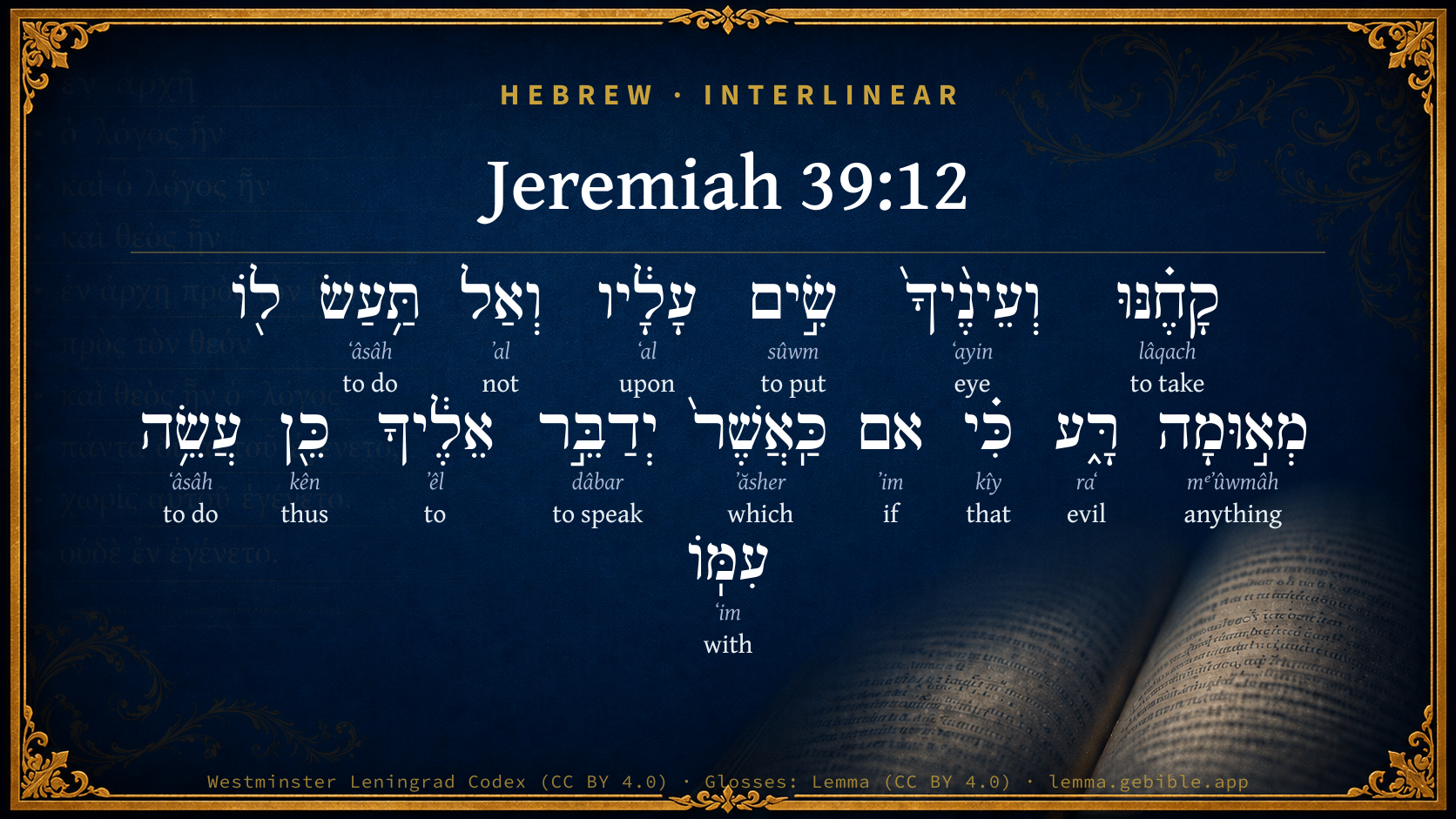
Hebrew (Westminster Leningrad Codex) Jeremiah 39:12 appears in the Hebrew Old Testament. The text above is from the Westminster Leningrad Codex. Each word links to its Strong’s number, a concise gloss, and parsing drawn from the Open Scriptures Hebrew Bible morphology. Click any word for its full Brown-Driver-Briggs (BDB) entry.
Download image
Cite this verse

Jeremiah 39:12 (World English Bible). Public Domain. Lemma interlinear Bible study tool, https://lemma.gebible.app/v/jeremiah/39/12.

Show BibTeX & RIS
BibTeX
RIS
English Translation
Take him, and look well to him, and do him no harm; but do to him even as he shall tell you.
World English Bible · Public Domain
Download a study sheet

One document with this verse’s original text, its word-by-word gloss line, the meaning frame, cross-references with their text, attributed commentary, and full source and license credits — printable, and it pastes into notes with its structure intact.

This verse Autodidact and up

Study sheet (.html) Plain text (.txt)

A passage Seminary Student

Up to 50 verses in one chapter. A passage sheet keeps up to 6 commentary sources and 12 cross-references per verse, in the order this page ranks them, and says so on the sheet whenever that leaves anything out. Ask for a single verse and you get the Autodidact verse sheet above.

Everything on this page stays free to read, with no account — the sheet is a download of what is already on screen, not access to it.

Want to remove ads? Support Godless Engineer
Compare translations 3

The same verse in 3 English versions, stacked beneath the original-language interlinear above. Click any original word for its lexicon entry.

Each is an independent rendering of the whole verse — the interlinear is not word-aligned to these translations.

Highlighted words mark where these versions differ — a whole-verse word diff, not a word-by-word alignment.

  • World English Bible Public Domain
    Take him, and look well to him, and do him no harm; but do to him even as he shall tell you.
  • King James Version Public Domain
    Take him, and look well to him, and do him no harm; but do unto him even as he shall say unto thee.
  • unfoldingWord Literal Text CC BY-SA 4.0
    “Take him and care for him. Do not harm him. Do for him anything he tells you.”

unfoldingWord Literal Text — © unfoldingWord, licensed CC BY-SA 4.0. Word-aligned USFM3 via Door43 (git.door43.org/unfoldingWord/en_ult).

Versions to compare (up to 4)

3 of 4 selected

Show all 18 translations

Every available English version of this verse, each an independent rendering of the whole verse.

  • World English Bible Public Domain
    Take him, and look well to him, and do him no harm; but do to him even as he shall tell you.
  • Berean Standard Bible Public Domain
    “Take him, look after him, and do not let any harm come to him; do for him whatever he says.”
  • Majority Standard Bible Public Domain
    “Take him, look after him, and do not let any harm come to him; do for him whatever he says.”
  • King James Version Public Domain
    Take him, and look well to him, and do him no harm; but do unto him even as he shall say unto thee.
  • American Standard Version (1901) Public Domain
    Take him, and look well to him, and do him no harm; but do unto him even as he shall say unto thee.
  • Revised Version (1885) Public Domain
    Take him, and look well to him, and do him no harm; but do unto him even as he shall say unto thee.
  • Geneva Bible (1599) Public Domain
    Take him, and looke well to him, and doe him no harme, but doe vnto him euen as he shall say vnto thee.
  • Douay-Rheims (1899) Public Domain
    Take him, and set thy eyes upon him, and do him no harm: but as he hath a mind, so do with him.
  • Young's Literal Translation Public Domain
    `Take him, and place thine eyes upon him, and do no evil thing to him, but as he speaketh unto thee, so do with him.'
  • Literal Standard Version CC BY-SA 4.0
    “Take him, and place your eyes on him, and do no evil thing to him, but as he speaks to you, so do with him.”
  • Unlocked Literal Bible CC BY-SA 4.0
    “Take him and care for him. Do not harm him. Do for him anything he tells you.”
  • unfoldingWord Literal Text CC BY-SA 4.0
    “Take him and care for him. Do not harm him. Do for him anything he tells you.”
  • Darby Bible Public Domain
    Take him, and keep an eye upon him, and do him no harm; but do unto him even as he shall say unto thee.
  • World Messianic Bible Public Domain
    “Take him and take care of him. Do him no harm; but do to him even as he tells you.”
  • Webster's Bible Public Domain
    Take him, and look well to him, and do him no harm; but do to him even as he shall say to thee.
  • Free Bible Version CC BY-SA 4.0
    “Go and get Jeremiah and watch out that nothing bad happens to him. Do whatever he wants.”
  • Bible in Basic English Public Domain
    Take him and keep an eye on him and see that no evil comes to him; but do with him whatever he says to you.
  • JPS Tanakh (1917) Public Domain
    'Take him, and look well to him, and do him no harm; but do unto him even as he shall say unto thee.'

Literal Standard Version (2020), Covenant Press — licensed CC BY-SA 4.0. Text via the HelloAO Bible API (eBible.org). Unlocked Literal Bible (unfoldingWord) — licensed CC BY-SA 4.0. Text via the HelloAO Bible API (eBible.org). unfoldingWord Literal Text — © unfoldingWord, licensed CC BY-SA 4.0. Word-aligned USFM3 via Door43 (git.door43.org/unfoldingWord/en_ult). Free Bible Version, Dr. Jonathan Gallagher — licensed CC BY-SA 4.0. Text via the HelloAO Bible API (eBible.org).

Word by word

More ways to search: Search by grammar → Find every occurrence → Compare this word →

Practice this passage: Drill this verse → Learn its vocabulary →

מְא֣וּמָה
mᵉʼûwmâh
H3972
“anything”
Noun, Common, Feminine, Singular, Absolute
Part of Speech
Noun
Type
Common
Gender
Feminine
Number
Singular
State
Absolute
Full BDB Definition

Origin: apparently a form of H3971

TWOT: 1136

anything
  1. קָחֶ֗נּוּ lâqach H3947 “take · him” Verb, Qal, Imperative, 2nd Person, Masculine, Singular + Suffix, Personal, 3rd Person, Masculine, Singular
  2. וְעֵינֶ֨יךָ֙ ʻayin H5869 “and · eyes · your” Conjunction + Noun, Common, Both, Dual, Construct + Suffix, Personal, 2nd Person, Masculine, Singular
  3. שִׂ֣ים sûwm H7760 “put” Verb, Qal, Imperative, 2nd Person, Masculine, Singular
  4. עָלָ֔יו ʻal H5921 “upon · him” Preposition + Suffix, Personal, 3rd Person, Masculine, Singular
  5. וְאַל ʼal H408 “and · not” Conjunction + Particle, Negative
  6. תַּ֥עַשׂ ʻâsâh H6213 “to do” Verb, Qal, Jussive, 2nd Person, Masculine, Singular
  7. רָּ֑ע raʻ H7451 “evil” Adjective, Adjective, Masculine, Singular, Absolute
  8. כִּ֗י kîy H3588 “that” Conjunction
  9. אם ʼim H518 “if” Conjunction
  10. כַּֽאֲשֶׁר֙ ʼăsher H834 “like/as · which” Preposition + Particle, Relative
  11. יְדַבֵּ֣ר dâbar H1696 “to speak” Verb, Piel, Imperfect, 3rd Person, Masculine, Singular
  12. אֵלֶ֔יךָ ʼêl H413 “to · you” Preposition + Suffix, Personal, 2nd Person, Masculine, Singular
  13. כֵּ֖ן kên H3651 “thus” Particle, Demonstrative
  14. עֲשֵׂ֥ה ʻâsâh H6213 “do” Verb, Qal, Imperative, 2nd Person, Masculine, Singular
  15. עִמּֽוֹ ʻim H5973 “with · him” Preposition + Suffix, Personal, 3rd Person, Masculine, Singular

About this verse

These counts appear in no published source. They are computed here, from the morphology-tagged text and Lemma’s own curated glosses. What Lemma adds →

17
words
15
distinct lemmas
Prophets
section

Shared distinctive vocabulary

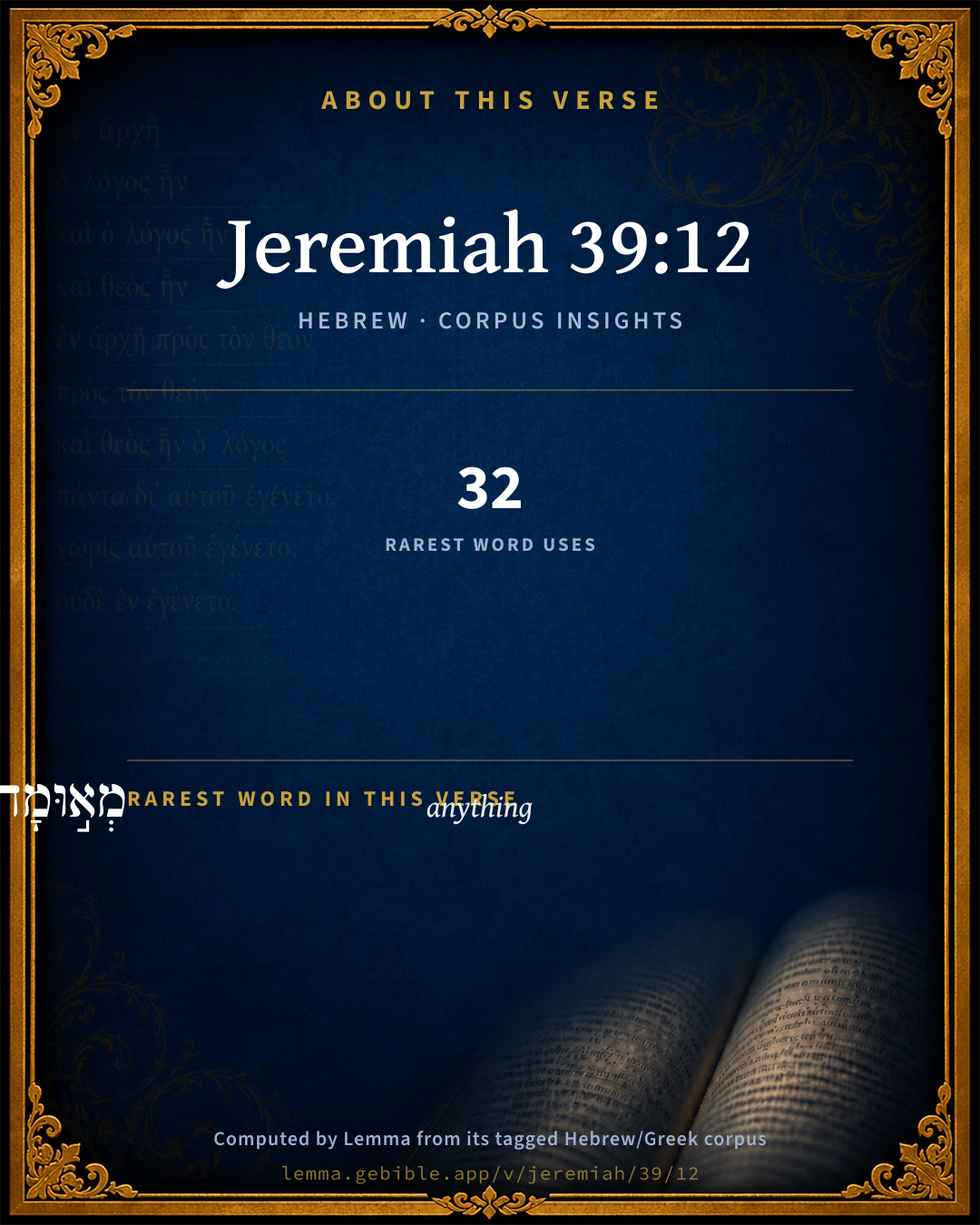
מְא֣וּמָה anything H3972 occurs in 32 verses of the Hebrew Bible. Also found in:

Grammatical profile

  • 5 verbs
  • 2 nouns
  • 1 adjective
  • 4 prepositions
  • 2 conjunctions
  • 3 particles

Verb forms

  • קָחֶ֗נּוּ Qal · Imperative
  • שִׂ֣ים Qal · Imperative
  • תַּ֥עַשׂ Qal · Jussive
  • יְדַבֵּ֣ר Piel · Imperfect
  • עֲשֵׂ֥ה Qal · Imperative

Repetition

A word recurs within this verse — often emphatic in Hebrew:

  • תַּ֥עַשׂ to do H6213 ×2

Cross-references

9

Topical passages linked to Jeremiah 39:12 in the Treasury of Scripture Knowledge — connected by theme and wording, ordered by reader-vote popularity; previews shown in the World English Bible.

  • Proverbs 16:7 When a man's ways please Yahweh, He makes even his enemies to be at peace with him.
  • Psalms 105:14–15 He allowed no one to do them wrong. Yes, he reproved kings for their sakes,
  • Proverbs 21:1 The king's heart is in Yahweh's hand like the watercourses. He turns it wherever he desires.
  • Jeremiah 40:4 Now, behold, I loose you this day from the chains which are on your hand. If it seem good to you to come with me into Babylon, come, and I will look well to you; but if it seem ill to you to come with me into Babylon, forbear: behold, all the land is before you; where it seems good and right to you to go, there go.
  • Proverbs 23:5 Why do you set your eyes on that which is not? For it certainly sprouts wings like an eagle and flies in the sky.
  • Jeremiah 24:6 For I will set my eyes on them for good, and I will bring them again to this land: and I will build them, and not pull them down; and I will plant them, and not pluck them up.
  • Amos 9:4 Though they go into captivity before their enemies, there I will command the sword, and it will kill them. I will set my eyes on them for evil, and not for good.
  • Acts 7:10 and delivered him out of all his afflictions, and gave him favor and wisdom before Pharaoh, king of Egypt. He made him governor over Egypt and all his house.
  • 1 Peter 3:12–13 For the eyes of the Lord are on the righteous, And his ears open to their prayer; But the face of the Lord is against those who do evil."

Cross-references courtesy of OpenBible.info (CC BY 4.0).

Hebrew and Greek witnesses Masoretic Hebrew ↔ Greek Septuagint

The same verse in the two great witnesses to the Old Testament, shown verse-for-verse.

These are two independent witnesses, not word-aligned to each other, and the Septuagint is shown in lemma (dictionary) form.

Hebrew Jeremiah 39:12 Masoretic · Westminster Leningrad Codex

קָחֶ֗נּוּ וְעֵינֶ֨יךָ֙ שִׂ֣ים עָלָ֔יו וְאַל תַּ֥עַשׂ ל֖וֹ מְא֣וּמָה רָּ֑ע כִּ֗י אם כַּֽאֲשֶׁר֙ יְדַבֵּ֣ר אֵלֶ֔יךָ כֵּ֖ן עֲשֵׂ֥ה עִמּֽוֹ

Take him, and look well to him, and do him no harm; but do to him even as he shall tell you.

World English Bible · Public Domain

Greek LXX Structure differs

In the Septuagint, Jeremiah is about an eighth shorter than the Hebrew and arranges its material differently — the Oracles Against the Nations (Hebrew chapters 46–51) appear in the middle of the Greek book, after 25:13. Because the chapter and verse boundaries do not line up, a verse-for-verse comparison with the Hebrew is not shown.

A verse-for-verse comparison isn’t shown here because the chapters and verses don’t line up. Switch to the LXX edition with the MT / LXX toggle above to read the Greek directly.

Hebrew: Westminster Leningrad Codex (CC BY 4.0). Greek: Septuagint (public domain); English from a public-domain English Septuagint. How the Septuagint differs from the Hebrew →

Targum (Aramaic paraphrase)

1

The Targum is the ancient Jewish Aramaic paraphrase of the Hebrew Scriptures — an interpretive translation, not the Hebrew text itself. Onkelos (literal) and Pseudo-Jonathan (expansive) render the Torah, and Jonathan the Prophets. Coverage is partial: where no permissively-licensed English translation exists for a verse, only the Aramaic is shown. This is verse-level text, not a word-by-word alignment to the Hebrew.

  1. Targum Jonathan Prophets (Joshua–Malachi)
    דַבַּרְהִי וְעֵינָךְ שַׁוֵי עֲלוֹהִי וְלָא תַעְבֵּיד לֵיהּ מִדַעַם בִּישׁ אֱלָהֵין כְּמָא דְמַלֵיל עִמָךְ כֵּן עֲבֵיד עִמֵיהּ:

    (no public-domain English translation for this verse)

    Targum Jonathan — Aramaic: “Mikraot Gedolot” (public domain). English: “Sefaria Community Translation” (CC0 1.0 (public-domain dedication)); “London "Chaldee Paraphrase," 1871” (public domain). Text via Sefaria.

Commentary

Notes on Jeremiah 39:12 from classic Christian and Jewish commentators (each source and its license shown beneath its notes). The classic Christian expositions comment on the surrounding passage and are grouped to its opening verse, so a note may address several verses; the Jewish commentaries on the Tanakh (Rashi and others) are per-verse, so they appear only where the commentator wrote on this verse.

Lemma curates 59 commentaries, every one of them public domain or Creative Commons licensed, each selected and text-cleaned for this edition rather than reprinted as found. About our sources →

Trapp's Complete Commentary

John Trapp

Jer 39:12 Take him, and look well to him, and do him no harm; but do unto him even as he shall say unto thee.

Ver. 12. Take him, and look well to him.] A wicked man, we see, may be loving and liberal to a godly minister for self ends. Let no man, therefore, rest in it alone as a sure sign of an honest man.

John Trapp, A Commentary or Exposition upon All the Books of the Old and New Testament (1647–1656) — public domain. Text from a community e-Sword module.

Geneva Bible (1599)

Geneva Bible translators

Thus God preserved his prophet by his means, whom he made the scourge to punish the king, and them that were his enemies.

Hebrew, set thine eyes upon them.

Geneva Bible (1599) marginal notes — public domain. Text via Bolls.life.

Jamieson, Fausset & Brown

Robert Jamieson, A. R. Fausset & David Brown

look well to him--Hebrew, "set thine eyes upon him"; provide for his well-being.

Jamieson, Fausset & Brown — Commentary Critical and Explanatory on the Whole Bible (1871) — public domain (CC PDM 1.0). Text via the HelloAO Bible API.

Adam Clarke's Commentary

Verse 12. Take him - look well to him] Nebuchadnezzar had heard that this prophet had foretold his capture of the city, and had frequently used all his influence to induce Zedekiah to pay the tribute, and not rebel against him; and on this account would be inclined to show the prophet especial favour.

Adam Clarke's Commentary on the Bible (1810–1826) — public domain. Text from a community e-Sword/MySword module.

John Calvin's Commentaries

It is indeed probable that the king of Babylon had heard of Jeremiah; and though he was in prison, yet the Word of God, which he boldly proclaimed, was not bound. Then the report of this might have reached the king of Babylon: and hence it was, that he was disposed to preserve him; for he had given a faithful counsel to Zedekiah. But Nebuchadnezzar no doubt regarded only his own advantage; and hence we ought to bear in mind the wonderful goodness of God in preserving, as it were, by his own hand, the life of the Prophet; so that in extremities no one touched him, but he remained free and quiet, as we shall hereafter see. But we must put off the rest until to-morrow.

John Calvin's Commentaries (1540-1563) — public domain. Text from the Calvin Translation Society English edition (1840s-50s) via the Christian Classics Ethereal Library (ccel.org). Calvin's coverage is partial (roughly two-thirds of the Bible); uncommented books and verses are honest gaps, never fabricated. The 19th-century editor's footnotes and remarks are omitted so the notes are faithfully Calvin's own voice.

The Cambridge Bible for Schools and Colleges

gen. ed. J. J. S. Perowne

12. If we are to accept this as historical (see introd. note to ch.), Nebuchadnezzar’s action was due to the fact that Jeremiah had consistently throughout counselled submission to him on the part of the Jews. See Jer_40:4.

look well to him] Heb. set thine eyes upon him.

The Cambridge Bible for Schools and Colleges (gen. ed. J. J. S. Perowne; Cambridge University Press, 1878–1918) — public domain. Text from a community e-Sword module.

John Gill's Exposition

Take him, and look well to him,.... Take him out of prison; take him under your immediate care; receive him kindly, and use him humanely; provide everything necessary for him, and let him not want for anything: or, "set thine eyes upon him" (m) look pleasantly at him, and let him be always under your view and inspection; treat him not with neglect and contempt, but see to it that nothing is wanting to him:

and do him no harm; no injury to his person by beating, imprisoning, or starving him; nor suffer any to be done to him by the common soldiers, or by his own people:

but do unto him even as he shall say unto thee: let him have whatever he asks for: this was great favour from a Heathen prince indeed, and more than he met with from his own countrymen.

(m) "et oculos tuos pone super eum", V. L. Vatablus, Pagninus, Montanus, Schmidt.

John Gill's Exposition of the Whole Bible (1746–1763) — public domain (CC PDM 1.0). Text via the HelloAO Bible API.

Matthew Poole's English Annotations

It is more than probable that Nebuchadrezzar had been informed by some of the chief commanders of his army, who had it from some of the Jews that had escaped out of the city to the Chaldean army, that Jeremiah had constantly told the king and the nobles that the Chaldeans should take the city, and as steadily persuaded both the king, and princes, and people to surrender it to them, and prevent the effusion of blood; and that he was imprisoned for this, and had been a great sufferer that way; and that this made, this heathen prince so kind to the prophet as to give this order. In the mean time the hand of God is to be taken notice of, who undoubtedly put this into the heart of this pagan prince; and we may learn that none shall lose any thing at last by being faithful to the commands of God, though they may be for the present losers. What we translate,

look well to him, is in the Hebrew, set thine eyes upon him; and expounded by the following words, commanding him to

do him no harm, and to give or grant to him whatever he desired.

Matthew Poole's English Annotations on the Holy Bible (1683–1685) — public domain. Text from a community e-Sword/MySword module.

John Wesley's Explanatory Notes

Take him - It is probable, that Nebuchadnezzar had been informed, Jeremiah had constantly told the king, that the Chaldeans should take the city, and as steadily persuaded both the king and princes to surrender it to them.

John Wesley, Explanatory Notes Upon the Whole Bible (1754–1765) — public domain. Text via the GEBible commentary corpus.

Lesson kit

Teaching starters — assembled from the data on this page, not authored interpretation. Every prompt links to the verse data it draws on. Edit before teaching.

Jeremiah, in the Prophets, opens this verse with 17 words (15 distinct Hebrew lemmas). Its most distinctive word is mᵉʼûwmâh (“anything”). A historical commentator’s framing appears above. Read the whole chapter for the surrounding context.

Discussion questions

  1. How does “anything” (mᵉʼûwmâh) shape what this verse is saying?
  2. Genesis 22:12 shares the word «anything» with this verse. How do the two illuminate each other?
  3. “to do” occurs 2× in this one verse. What is the effect of the repetition?
  4. These translations render this verse differently. What is at stake in choosing one wording over another?
  5. The verb «קָחֶ֗נּוּ» is Qal Imperative. How does its form color the action?
  6. Reading how Trapp's Complete Commentary and Geneva Bible (1599) read this verse, where do the two commentators agree and where do they part?

Things to notice

Reading settings

Reading text

Shown beneath each verse's original-language words.

Old Testament
Old Testament edition

Read the OT as the Masoretic Hebrew (MT) or the Greek Septuagint (LXX).

English shown for the Greek Septuagint (in the Hebrew ↔ Greek comparison).

Comparing translations? Open the Compare panel on any verse page to stack up to four side by side.