
Numbers 22:20

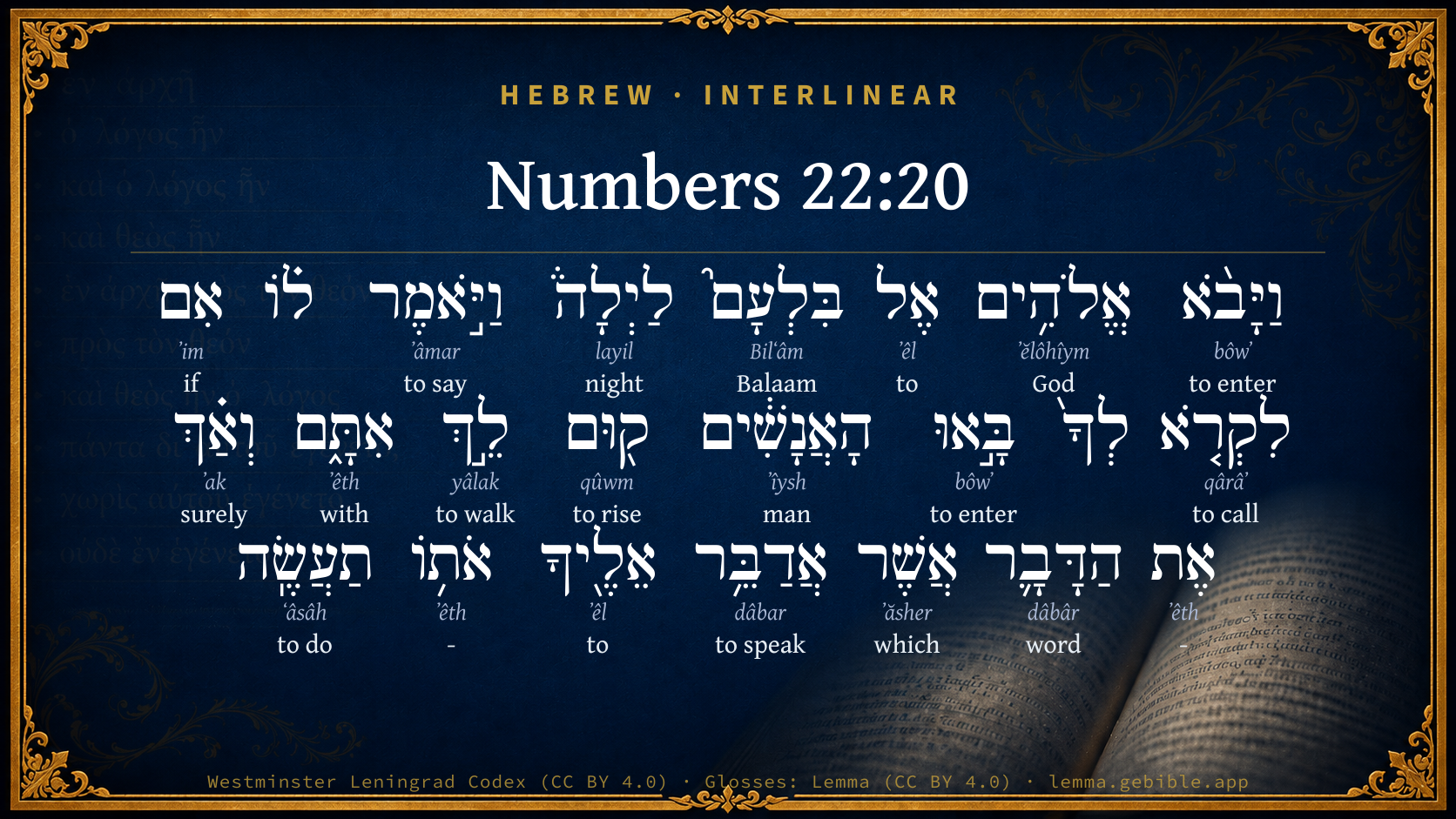
Hebrew (Westminster Leningrad Codex) Numbers 22:20 appears in the Hebrew Old Testament. The text above is from the Westminster Leningrad Codex. Each word links to its Strong’s number, a concise gloss, and parsing drawn from the Open Scriptures Hebrew Bible morphology. Click any word for its full Brown-Driver-Briggs (BDB) entry.
Download image
Cite this verse

Numbers 22:20 (World English Bible). Public Domain. Lemma interlinear Bible study tool, https://lemma.gebible.app/v/numbers/22/20.

Show BibTeX & RIS
BibTeX
RIS
English Translation
God came to Balaam at night, and said to him, If the men are come to call you, rise up, go with them; but only the word which I speak to you, that shall you do.
World English Bible · Public Domain
Download a study sheet

One document with this verse’s original text, its word-by-word gloss line, the meaning frame, cross-references with their text, attributed commentary, and full source and license credits — printable, and it pastes into notes with its structure intact.

This verse Autodidact and up

Study sheet (.html) Plain text (.txt)

A passage Seminary Student

Up to 50 verses in one chapter. A passage sheet keeps up to 6 commentary sources and 12 cross-references per verse, in the order this page ranks them, and says so on the sheet whenever that leaves anything out. Ask for a single verse and you get the Autodidact verse sheet above.

Everything on this page stays free to read, with no account — the sheet is a download of what is already on screen, not access to it.

Want to remove ads? Support Godless Engineer
Compare translations 3

The same verse in 3 English versions, stacked beneath the original-language interlinear above. Click any original word for its lexicon entry.

Each is an independent rendering of the whole verse — the interlinear is not word-aligned to these translations.

Highlighted words mark where these versions differ — a whole-verse word diff, not a word-by-word alignment.

  • World English Bible Public Domain
    God came to Balaam at night, and said to him, If the men are come to call you, rise up, go with them; but only the word which I speak to you, that shall you do.
  • King James Version Public Domain
    And God came unto Balaam at night, and said unto him, If the men come to call thee, rise up, and go with them; but yet the word which I shall say unto thee, that shalt thou do.
  • unfoldingWord Literal Text CC BY-SA 4.0
    And God came to Balaam at night and said to him, “If the men have come to summon you, rise, go with them. But only the word that I speak to you, it you shall do.”

unfoldingWord Literal Text — © unfoldingWord, licensed CC BY-SA 4.0. Word-aligned USFM3 via Door43 (git.door43.org/unfoldingWord/en_ult).

Versions to compare (up to 4)

3 of 4 selected

Show all 18 translations

Every available English version of this verse, each an independent rendering of the whole verse.

  • World English Bible Public Domain
    God came to Balaam at night, and said to him, If the men are come to call you, rise up, go with them; but only the word which I speak to you, that shall you do.
  • Berean Standard Bible Public Domain
    That night God came to Balaam and said, “Since these men have come to summon you, get up and go with them, but you must only do what I tell you.”
  • Majority Standard Bible Public Domain
    That night God came to Balaam and said, “Since these men have come to summon you, get up and go with them, but you must only do what I tell you.”
  • King James Version Public Domain
    And God came unto Balaam at night, and said unto him, If the men come to call thee, rise up, and go with them; but yet the word which I shall say unto thee, that shalt thou do.
  • American Standard Version (1901) Public Domain
    And God came unto Balaam at night, and said unto him, If the men are come to call thee, rise up, go with them; but only the word which I speak unto thee, that shalt thou do.
  • Revised Version (1885) Public Domain
    And God came unto Balaam at night, and said unto him, If the men be come to call thee, rise up, go with them; but only the word which I speak unto thee, that shalt thou do.
  • Geneva Bible (1599) Public Domain
    And God came vnto Balaam by night, and sayd vnto him, If the men come to call thee, rise vp, and goe with them: but onely what thing I say vnto thee, that shalt thou doe.
  • Douay-Rheims (1899) Public Domain
    God therefore came to Balaam in the night, and said to him: It these men be come to call thee, arise and go with them: yet so, that thou do what I shall command thee.
  • Young's Literal Translation Public Domain
    And God cometh in unto Balaam, by night, and saith to him, `If to call for thee the men have come, rise, go with them, and only the thing which I speak unto thee -- it thou dost do.'
  • Literal Standard Version CC BY-SA 4.0
    And God comes to Balaam by night and says to him, “If the men have come to call for you, rise, go with them, and only the thing which I speak to you—do it.”
  • Unlocked Literal Bible CC BY-SA 4.0
    God came to Balaam at night and said to him, “Since these men have come to summon you, get up and go with them. But only do what I tell you to do.”
  • unfoldingWord Literal Text CC BY-SA 4.0
    And God came to Balaam at night and said to him, “If the men have come to summon you, rise, go with them. But only the word that I speak to you, it you shall do.”
  • Darby Bible Public Domain
    Then God came to Balaam at night, and said to him, If the men have come to call thee, rise up, [and] go with them; but only what I shall say unto thee shalt thou do.
  • World Messianic Bible Public Domain
    God came to Balaam at night, and said to him, “If the men have come to call you, rise up, go with them; but only the word which I speak to you, that you shall do.”
  • Webster's Bible Public Domain
    And God came to Balaam at night, and said to him, If the men come to call thee, rise and go with them; but yet the word which I shall say to thee, that shalt thou perform.
  • Free Bible Version CC BY-SA 4.0
    God came to Balaam during the night and told him, “Since these men have come for you, get up and go with them. But only do what I tell you.”
  • Bible in Basic English Public Domain
    And that night God came to Balaam and said to him, If these men have come for you, go with them: but do only what I say to you.
  • JPS Tanakh (1917) Public Domain
    And God came unto Balaam at night, and said unto him: 'If the men are come to call thee, rise up, go with them; but only the word which I speak unto thee, that shalt thou do.'

Literal Standard Version (2020), Covenant Press — licensed CC BY-SA 4.0. Text via the HelloAO Bible API (eBible.org). Unlocked Literal Bible (unfoldingWord) — licensed CC BY-SA 4.0. Text via the HelloAO Bible API (eBible.org). unfoldingWord Literal Text — © unfoldingWord, licensed CC BY-SA 4.0. Word-aligned USFM3 via Door43 (git.door43.org/unfoldingWord/en_ult). Free Bible Version, Dr. Jonathan Gallagher — licensed CC BY-SA 4.0. Text via the HelloAO Bible API (eBible.org).

Word by word

More ways to search: Search by grammar → Find every occurrence → Compare this word →

Practice this passage: Drill this verse → Learn its vocabulary →

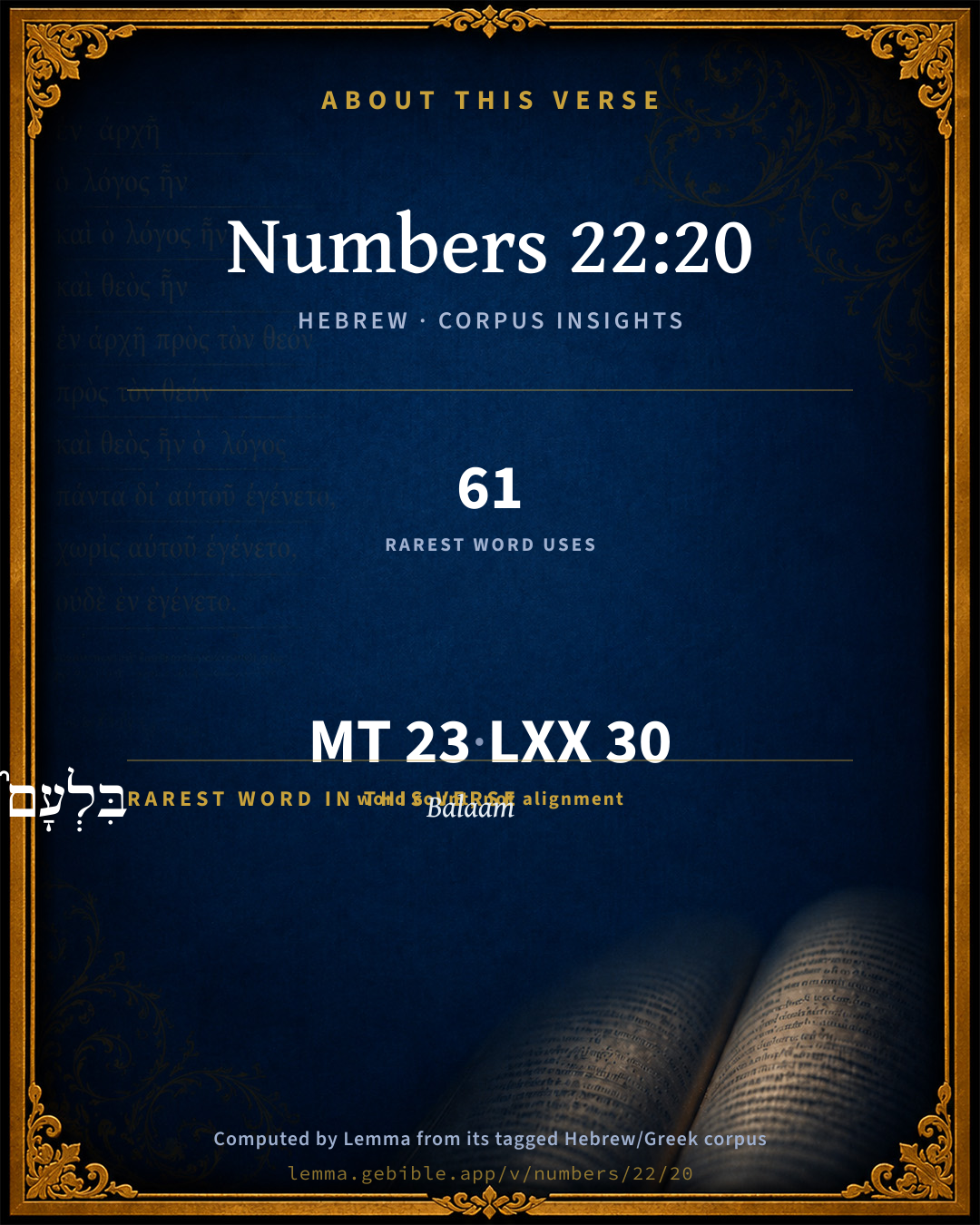
בִּלְעָם֮
Bilʻâm
H1109
“Balaam”
Noun, Proper
Part of Speech
Noun
Type
Proper
Full BDB Definition

Origin: probably from H1077 and H5971

TWOT: 251b

Balaam = "not of the people" - the son of Beor, a man endowed with the gift of prophecy (noun proper masculine) - a town in Manasseh (noun proper locative)
  1. וַיָּבֹ֨א bôwʼ H935 “and · to enter” Conjunction + Verb, Qal, Sequential Imperfect, 3rd Person, Masculine, Singular
  2. אֱלֹהִ֥ים ʼĕlôhîym H430 “God(s)” Noun, Common, Masculine, Plural, Absolute
  3. אֶל ʼêl H413 “to” Preposition
  4. לַיְלָה֒ layil H3915 “night” Noun, Common, Masculine, Singular, Absolute
  5. וַיֹּ֣אמֶר ʼâmar H559 “and · to say” Conjunction + Verb, Qal, Sequential Imperfect, 3rd Person, Masculine, Singular
  6. אִם ʼim H518 “if” Conjunction
  7. לִקְרֹ֤א qârâʼ H7121 “to call” Preposition + Verb, Qal, Infinitive Construct
  8. בָּ֣אוּ bôwʼ H935 “to enter” Verb, Qal, Perfect, 3rd Person, Common, Plural
  9. הָאֲנָשִׁ֔ים ʼîysh H376 “the · men” Particle, Definite Article + Noun, Common, Masculine, Plural, Absolute
  10. ק֖וּם qûwm H6965 “rise” Verb, Qal, Imperative, 2nd Person, Masculine, Singular
  11. לֵ֣ךְ yâlak H3212 “walk” Verb, Qal, Imperative, 2nd Person, Masculine, Singular
  12. אִתָּ֑ם ʼêth H854 “with · them” Preposition + Suffix, Personal, 3rd Person, Masculine, Plural
  13. וְאַ֗ךְ ʼak H389 “and · surely” Conjunction + Adverb
  14. אֶת ʼêth H853 “-” Particle, Direct Object
  15. הַדָּבָ֛ר dâbâr H1697 “the · word” Particle, Definite Article + Noun, Common, Masculine, Singular, Absolute
  16. אֲשֶׁר ʼăsher H834 “which” Particle, Relative
  17. אֲדַבֵּ֥ר dâbar H1696 “to speak” Verb, Piel, Imperfect, 1st Person, Common, Singular
  18. אֵלֶ֖יךָ ʼêl H413 “to · you” Preposition + Suffix, Personal, 2nd Person, Masculine, Singular
  19. אֹת֥וֹ ʼêth H853 “- · him” Particle, Direct Object + Suffix, Personal, 3rd Person, Masculine, Singular
  20. תַעֲשֶֽׂה ʻâsâh H6213 “to do” Verb, Qal, Imperfect, 2nd Person, Masculine, Singular

About this verse

These counts appear in no published source. They are computed here, from the morphology-tagged text and Lemma’s own curated glosses. What Lemma adds →

23
words
18
distinct lemmas
Pentateuch
section

Grammatical profile

  • 8 verbs
  • 5 nouns
  • 5 prepositions
  • 1 conjunction
  • 1 adverb
  • 3 particles

Verb forms

  • וַיָּבֹ֨א Qal · Sequential Imperfect
  • וַיֹּ֣אמֶר Qal · Sequential Imperfect
  • לִקְרֹ֤א Qal · Infinitive Construct
  • בָּ֣אוּ Qal · Perfect
  • ק֖וּם Qal · Imperative
  • לֵ֣ךְ Qal · Imperative
  • אֲדַבֵּ֥ר Piel · Imperfect
  • תַעֲשֶֽׂה Qal · Imperfect

Repetition

Words recur within this verse — often emphatic in Hebrew:

  • וַיָּבֹ֨א to enter H935 ×2
  • אֶל to H413 ×2

Hebrew & Septuagint length

In English translation the verse runs 36 words from the Hebrew and 36 from the Septuagint (LXX English) — the same length.

A rough comparison of the two English renderings, which tokenize alike — not a word-level alignment.

Word counts can differ between the Hebrew and the Greek without any difference in meaning — e.g. the Hebrew direct-object marker אֵת has no separate Greek word, and Greek often adds the article ὁ.

In the original languages it is 23 Hebrew tokens and 30 Greek tokens — but the two are counted differently (Hebrew bundles its prefixes and suffixes into one token; the Greek is in lemma form), so that isn’t a like-for-like length.

Cross-references

15

Topical passages linked to Numbers 22:20 in the Treasury of Scripture Knowledge — connected by theme and wording, ordered by reader-vote popularity; previews shown in the World English Bible.

  • Numbers 23:12 He answered and said, Must I not take heed to speak that which Yahweh puts in my mouth?
  • Numbers 23:26 But Balaam answered Balak, Didn't I tell you, saying, All that Yahweh speaks, that I must do?
  • Numbers 24:13 If Balak would give me his house full of silver and gold, I can't go beyond the word of Yahweh, to do either good or bad of my own mind; what Yahweh speaks, that will I speak?
  • Numbers 22:35 The angel of Yahweh said to Balaam, Go with the men; but only the word that I shall speak to you, that you shall speak. So Balaam went with the princes of Balak.
  • Numbers 23:5 Yahweh put a word in Balaam's mouth, and said, Return to Balak, and thus you shall speak.
  • Numbers 23:16 Yahweh met Balaam, and put a word in his mouth, and said, Return to Balak, and thus shall you speak.
  • 1 Samuel 8:5–9 and they said to him, Behold, you are old, and your sons don't walk in your ways: now make us a king to judge us like all the nations.
  • 1 Samuel 12:12–19 When you saw that Nahash the king of the children of Ammon came against you, you said to me, No, but a king shall reign over us; when Yahweh your God was your king.
  • Psalms 33:10–11 Yahweh brings the counsel of the nations to nothing. He makes the thoughts of the peoples to be of no effect.
  • Psalms 78:30–31 They didn't turn from their cravings. Their food was yet in their mouths,
  • Psalms 81:12 So I let them go after the stubbornness of their hearts, That they might walk in their own counsels.
  • Isaiah 37:29 Because of your raging against me, and because your arrogance is come up into my ears, therefore will I put my hook in your nose, and my bridle in your lips, and I will turn you back by the way by which you came.
  • Ezekiel 14:2–5 The word of Yahweh came to me, saying,
  • Hosea 13:11 I have given you a king in my anger, And have taken him away in my wrath.
  • 2 Thessalonians 2:9–12 even he whose coming is according to the working of Satan with all power and signs and lying wonders,

Cross-references courtesy of OpenBible.info (CC BY 4.0).

Hebrew and Greek witnesses Masoretic Hebrew ↔ Greek Septuagint

The same verse in the two great witnesses to the Old Testament, shown verse-for-verse.

These are two independent witnesses, not word-aligned to each other, and the Septuagint is shown in lemma (dictionary) form.

Hebrew Numbers 22:20 Masoretic · Westminster Leningrad Codex

וַיָּבֹ֨א אֱלֹהִ֥ים אֶל בִּלְעָם֮ לַיְלָה֒ וַיֹּ֣אמֶר ל֗וֹ אִם לִקְרֹ֤א לְךָ֙ בָּ֣אוּ הָאֲנָשִׁ֔ים ק֖וּם לֵ֣ךְ אִתָּ֑ם וְאַ֗ךְ אֶת הַדָּבָ֛ר אֲשֶׁר אֲדַבֵּ֥ר אֵלֶ֖יךָ אֹת֥וֹ תַעֲשֶֽׂה

God came to Balaam at night, and said to him, If the men are come to call you, rise up, go with them; but only the word which I speak to you, that shall you do.

World English Bible · Public Domain

Greek LXX Numbers 22:20 Septuagint · lemma form

καί ἔρχομαι ὁ θεός πρός βαλααμ νύξ καί εἶπον αὐτός εἰ καλέω σύ παραεἰμί ὁ ἄνθρωπος οὗτος ἀναἵστημι ἀκολουθέω αὐτός ἀλλά ὁ ῥῆμα ὅς ἄν λαλέω πρός σύ οὗτος ποιέω

And God came to Balaam by night, and said to him, If these men are come to call you, rise and follow them; nevertheless the word which I shall speak to you, it shall you do.

LXX2012 (modern English Septuagint) · Public Domain

Hebrew: Westminster Leningrad Codex (CC BY 4.0). Greek: Septuagint (public domain); English from LXX2012 (modern English Septuagint) (Public Domain). How the Septuagint differs from the Hebrew →

Targum (Aramaic paraphrase)

2

The Targum is the ancient Jewish Aramaic paraphrase of the Hebrew Scriptures — an interpretive translation, not the Hebrew text itself. Onkelos (literal) and Pseudo-Jonathan (expansive) render the Torah, and Jonathan the Prophets. Coverage is partial: where no permissively-licensed English translation exists for a verse, only the Aramaic is shown. This is verse-level text, not a word-by-word alignment to the Hebrew.

  1. Targum Onkelos Torah (Genesis–Deuteronomy)
    וַאֲתָּא מֵימַר מִן קֳדָם יְיָ לְבִלְעָם בְּלֵילְיָא וַאֲמַר לֵיהּ אִם לְמִקְרֵי לָךְ אֲתוֹ גֻבְרַיָא קוּם אִיזֵיל עִמְהוֹן וּבְרַם יַת פִּתְגָמָא דִי אֲמַלֵיל עִמָךְ יָתֵיהּ תַּעְבֵיד

    (no public-domain English translation for this verse)

    Targum Onkelos — Aramaic: “Onkelos Genesis” (public domain); “Onkelos Exodus” (public domain); “Onkelos Leviticus” (public domain); “Onkelos Numbers” (public domain); “Onkelos Deuteronomy” (public domain). English: “Sefaria Community Translation” (CC0 1.0 (public-domain dedication)); “J.W. Etheridge. The Targums of Onkelos and Jonathan Ben Uzziel on the Pentateuch. London: Longmans, Green, 1862” (public domain). Text via Sefaria.

  2. Targum Pseudo-Jonathan Torah (Genesis–Deuteronomy)
    וְאָתָא מֵימַר מִן קֳדָם יְיָ לְבִלְעָם בְּלֵילְיָא וַאֲמַר לֵיהּ אִין לְמִקְרֵי לָךְ אָתוּ גוּבְרַיָא קוּם טַיֵיל עִמְהוֹן וּלְחוֹד פִּתְגָמָא דַאֲמַלֵיל עִמָךְ יָתֵיהּ תַּעֲבֵיד

    And the Word came from before the Lord unto Bileam in the night, and said to him, If these men come to call thee, arise, go with them; only, the word that I will speak with thee, that shalt thou do.

    Targum Pseudo-Jonathan — Aramaic: “Targum Jonathan on Genesis” (public domain); “Targum Jonathan on Exodus” (public domain); “Targum Jonathan on Leviticus” (public domain); “Targum Jonathan on Numbers” (public domain); “Targum Jonathan on Deuteronomy” (public domain). English: “The Targum of Jonathan ben Uzziel, trans. J. W. Etheridge, London, 1862” (public domain). Text via Sefaria.

Commentary

Notes on Numbers 22:20 from classic Christian and Jewish commentators (each source and its license shown beneath its notes). The classic Christian expositions comment on the surrounding passage and are grouped to its opening verse, so a note may address several verses; the Jewish commentaries on the Tanakh (Rashi and others) are per-verse, so they appear only where the commentator wrote on this verse.

Lemma curates 59 commentaries, every one of them public domain or Creative Commons licensed, each selected and text-cleaned for this edition rather than reprinted as found. About our sources →

Trapp's Complete Commentary

John Trapp

Num 22:20 And God came unto Balaam at night, and said unto him, If the men come to call thee, rise up, [and] go with them; but yet the word which I shall say unto thee, that shalt thou do.

Ver. 20. Rise up and go.] God answers him according to the idols of his heart; bids him go, since he was set upon it, but at his utmost peril; like as Solomon bids the young man "walk in the ways of his own heart"; {Ecc 11:9} but then follows that stinging but.

John Trapp, A Commentary or Exposition upon All the Books of the Old and New Testament (1647–1656) — public domain. Text from a community e-Sword module.

Joseph Benson's Commentary

Num 22:20-21. If the men come to call thee, rise up and go with them — He had no leave to go at all unless the messengers came again in the morning to him. And, perhaps, if he had not gone to them, after having promised them an answer, they might have thought their master’s great offers neglected, and have gone away without him. But his head and heart were too full of expectations from the journey, to run the hazard of not being further invited into it. And so he rose early in the morning, and saddled his ass — Or commanded it to be saddled, for he had servants to wait upon him; and went to them, directly contrary to God’s express order, and was opposed by the angel for the breach of his duty.

Joseph Benson's Commentary on the Old and New Testaments (1811–1818) — public domain. Text from a community e-Sword module.

The Expositor's Bible

BALAAM ON THE WAY

Num_22:20-38

THE history is moving towards a great vindication of Israel and prediction of its coming power, all the more impressive that they are to be wrung from an unwilling witness, a man who would pronounce a curse rather than a blessing; all the more impressive, too, because the enemies of Israel will themselves arrange on a mountain pinnacle the scene of the revelation, with smoking altars and princely spectators. The great Actor in the drama is unseen: but His voice is heard. However tractable the omens may have been under other circumstances in the hands of the soothsayer, he now finds a Master. As the story unfolds, Balaam is seen attempting the impossible, endeavouring to force the hands of Providence, held as in a chain at every stage. There is a Power that treats him as if he were a child. Finally, with most unwilling eloquence, he is compelled to fling far and wide a challenge to Israels enemies, the praises of her rising star.

In harmony with this general movement is the result of Balaams second appeal for permission to take the journey to Moab. He receives it, but with a reservation. Fear of the great God whom he invokes holds him to the conviction that whatever he may do no word must pass his lips other than Jehovah gives him to speak. In repeating his inquiry he has assumed that the God of Israel is amenable to human urgency; and as he will have Jehovah to be, so within limits he seems to find Him. Yet there is more to reckon with than a dubious oracle, discovered through signs and portents of the sky or whisperings of the breeze at night. Jehovah has brought His people from Egypt, fed them in the desert, given them victory. Balaam finds that this God can send angels upon His errands, that there is no escape from His presence nor evasion of His will.

It was in a kind of madness the diviner set out from Pethor by the way of the Euphrates ford. Excited by the hope of gaining the rewards and enjoying the fame awaiting him in Moab, he was at the same time conscious of being in opposition to the God of Israel, and committed to an adventure that might end disastrously. He went in a mood of wilfulness, hoping and yet half doubting that his way would become clear, irritable therefore, ready to resent every hindrance. A diviner of repute, credited with powers of blessing and cursing, he perhaps felt himself safe on ordinary occasions, especially among his own people, even when he went against those who consulted him. But could he count on the forbearance of the king of Moab into whose country he was venturing? Jehovah might be opening his way only to destruction. Such fears could hardly be avoided.

And men who have gone back to conscience endeavouring to extort from it a sanction or permission previously denied, who, with some half assurance that the way is open, set out on a desired course, are practically in the same mad mood, have equal reason to dread the issue. Is this understood? It may be safely asserted that half the wrong things men do-taking an average of human action, half at least-are done not in despite of conscience, but with its dubious consent, when the first clear decision has been set aside. No doubt the urgency is often very great, as it was in Balaams case, and frequently of a less questionable kind. Not the desire of envious persons to have others cursed or evil in-treated, but possibly the desire of some to have the shadow of adverse judgment taken away, may be the plea, and be supported by the promise of large reward. The first word of conscience is distinct-have nothing whatever to do with the matter: the shadow has fallen on the wrongdoer; he has not repented; let him suffer still. But his agents come with gold and silver, with plausible words, with seeming Christian arguments. Then the appeal to conscience is renewed, and he who should be firm in judgment finds a false permission. Or the case may be of one in business, tempted to some practice, common enough, but dishonest, vile. His first feeling has been that of disgust. He could not for a moment contemplate a thing so base. But under the pressure of what appears to be necessity, plausible arguments and pretexts gain ground. The fact that reputable men find no difficulty about the matter, the notion that a custom is excusable because it is followed by most if not by all, along with other considerations of a personal kind, are allowed to have some weight, and then to overbalance the sense of duty. And the result is that the moral atmosphere is confused. The man sets out on a way which appears to be opened for him; but he goes under the shadow of a haunting fear.

Like Balaam, one who thus extorts from conscience, that is from God, permission to go where he himself desires, knowing it to be a wrong way, is quite aware, may indeed be eager to acknowledge to himself, that he is still held by a Divine command extending over a part of his conduct. He will not speak a word that shall be against truth. He will resume friendship with the rich transgressor; but he will not in words excuse or palliate his crime. He will adulterate certain commodities in which he deals, but he will never assert that they are genuine. This is the tribute to religion and to conscience that sustains decaying self-respect. By this the man who passes for a Christian endeavours to keep himself separate from those who have no conscience. The most is made of the difference. As compared with those who unblushingly defend the wrong, this man may think himself a saint. He would on no account speak a falsehood. Does he not fear God? Is he a dog that he should do this thing? Nevertheless, the way leads into a bottomless quagmire. For a time the waning light of religion may shine. It may even burst before it dies into a bright flame of indignation against sin - the crimes others commit-or of loud protestation against what are called false charges. But the man dies a Balaam, with a perverted conscience, and must face the dreadful result.

Well has it been said that no virtue is safe without enthusiasm. A man cannot be true to the highest law unless he has the motive within him of pure devotion to God as his personal Redeemer, unless he recognises that his joy in God and his salvation are bound up with fidelity to the moral ideal which is presented to him. Faith, hope, love must inspire and keep the soul in fervour of desire to reach the heights to which it is called by the Divine voice. But the most of men come far short of this enthusiasm. It is rather with reluctance, after a kind of struggle with themselves, that they look duty in the face. And even when they do they find no pleasure in resolving to press on where the absolutely right is seen. Their pleasure lies in doing less than that. They seek accordingly some way of observing the letter of duty while they avoid its spirit. But the sense of having come short in a matter that involves their highest wellbeing, their standing before God, their very right to hope and to live, remains with them. Marriage, for example, is often entered upon after a struggle with conscience in which a clear mandate has been set aside. The desire to please self is allowed to overcome the conviction that the new bond will keep life on the low worldly ground, or drag it back from spirituality. The merely expedient is chosen rather than the ideal of moral independence and power. And of this come fretfulness, dissatisfaction with self, with others, with Providence. All the sophistries that can be used fail to set the mind at rest. Events continually occur which throw flashes of light on the past and reveal the lost hope, the forfeited vision.

God does not make the wrong way smooth for one who has extorted permission to follow it. A man desiring to enter on a course which he sees to be dishonourable or at least dubious may be absolutely prevented at first. His appeal is to Providence. If circumstances allowed his plan he would reckon the Divine will favourable to it. But they do not. Every door he tries in the direction he wishes to take is barred against him. Afterwards one yields to pressure, or is thrown wide because he knocks at it persistently. Then he advances, taking for granted that he has obtained permission from God. But he does not go far till he is undeceived. So, Balaam sets out on his adventure, riding on his ass and attended by his two servants. Yet he does not get clear of the vineyards of Pethor without hindrance. Obstacles to his journey which do not appear in the narrative may have at first stood in his way, certain political complications, we may suppose. Now they are removed. But he is met by others. The angel of the Lord opposes him, one who stands with a drawn sword in hand in a hollow way between the vineyards, a path closely fenced on the one side and the other. Balaam fails to see the adversary; be is absorbed in his own thoughts. But the ass sees, and will not go forward, and as Balaam becomes aware of resistance his anger is kindled.

The narrative here is confessedly difficult. One of the most reverent commentators on the passage declares that he feels too deeply the essential veracity of the story to be troubled with minute questions about its details. "I would not," he says, "force them upon any ones belief merely by uttering the coarse sentence, that they are in the Bible and therefore must be received. One is afraid of leading people to fancy that they do believe what they do not believe, and so of propagating hypocrisy under the name of faith." To some the narrative may present no serious difficulty. They accept it literally at every point. Others again are not so easily satisfied that the occasion called for miracles like those which appear on the face of the history. It seems to them of no great moment whether Balaam went or did not go to Moab, whether he cursed Israel or blessed it. Neither the curse nor the blessing of a man of Balaams sort could make the least difference to Israel. These readers accordingly would find a parabolical or pictorial explanation of the incidents. Literal belief, in any case, need not be made a test of reverence; the spirit is surely more than the letter. The point of greatest importance is to believe that God dealt with this man, opposed his perverse will by gracious influences and unexpected protests. To Balaam, no doubt, the angels appearance and the asss rebuke were real, as real and impressive as any experiences he ever had. He was humbled; he acknowledged his sin and offered to return. When he reached the land of Moab, the recollection of what befell him by the way had a salutary influence on all he said and did.

In many unforeseen, singular, and often homely ways, men are checked in the endeavour to carry out the schemes which ambition and avarice prompt. The angel of the Lord who opposes one bent on a bad enterprise often appears in familiar guise. To some men their wives stand in the way, some are challenged by their children. What in voluntary blindness they have declined to see-the madness of the wrong course, the intrinsic baseness of the thing undertaken-those who look with pure eyes perceive clearly and are brave enough to condemn. At other times obstacles are placed in the way by the simple ordinary duties which claim attention, occupy thought and time, and tend to bring back the mind to humility and saneness. Yet covetousness can make men very blind. Under the influence of it they suppose themselves to be acting cleverly, while all the time those whom they think they are outwitting see them posting on the way to bankruptcy and shame.

Even a good man may lose his spiritual discrimination occasionally when he fancies himself called to curse not Israel but Moab, and sets out in heat upon the errand. He fails to see that the case of Balaam is so far parallel to his own that he ought to expect an angel to oppose him. The critical Balaam who feels it his high duty to pronounce maledictions on some theological opponent, not for silver and gold, but for the cause of God, is resisted by many an angel bearing the sharp sword of the Word, set to declare the great tolerance of Christ, and to vindicate the liberty that is in Him. That men fail to see these angels, or else ride past them, is abundantly evident, for the altars smoke on many a height, and scrolls of futile condemnation are flung upon the breeze.

Balaam smites the ass even when she falls down under him in her abject terror. He endeavours to force her on till at last he is put to shame by her rebuke. We are pointed to the irrational way in which, those act whose moral judgment is blinded. Their course being wrong, they do not turn against themselves, but rise in passion against every person or thing that hinders. The husband who is resolved to take a wrong path thrusts away his faithful wife; the son bent on what will be his ruin pushes off his weeping mother when she pleads before him. Often an apparently inexplicable fit of temper in public or in private means that a man is in the wrong and is aware of a mistake, from the consequences of which he would fain escape. Ones heart bleeds for none more than for those victims of selfish anger who suffer under the abuse of the Balaams of society. They have seen the angel in the way. They have sought by a gesture or a warning word to arrest the friend who would go on to evil. Then the cruel strokes fall on them, curses, foul abuse, taunts often directed against their religion. They are charged with setting themselves up as holier and better than other people. They are denounced as meddlers and fools. They protest without effect often, and suffer apparently to no purpose. Yet shall we suppose their endeavours altogether lost? Good is surely stronger than evil. Every right act and word is germinal. After long years it bears fruit.

In Balaams case there was a happier issue than is often seen. The protest against his cruelty opened his eyes to the truth that a messenger of God stood in his way. The rebuke came home to him. So might a hard self-willed man who rode rough-shod over the feelings and rights of others be brought suddenly to a sense of his cruelty by the look on the face of a dog. Bad as men and women may be, violent and abusive as they may become in times of anger and impatience, there are ways of softening their hearts. They go on for years attempting to justify themselves in a rough and selfish course. But who shall say that even the seeming worst are beyond recovery? When there appears to be no redeeming feature left in the character, the crisis may be at hand, the transgressor, may be so taught by the piteous look of a dumb animal that his infatuation will come to an end. Recoiling from himself he will acknowledge his perversity and turn to better thoughts.

How far did Balaams repentance go? There can be little doubt the motive of it was the sudden discovery that the God of Israel was mightier and more observant than he had imagined; in short, that Jehovah was his master. Balaam yields, changes his mind, not because he is in the least degree more disposed to do what is right, but because he finds the antagonism of God falling suddenly upon his life. To the angel he says: "I have sinned: for I knew not that thou stoodest in the way against me: now therefore, if it displease thee, I will get me back again." This is an acknowledgment of authority, but not of an obligation into which any sense of Gods goodness enters. It is the sullen acquiescence of a foiled adventurer, who at the very outset is made to understand the terms and narrow limits of his power. He has his knowledge, his vision. When he set out he intended to use them, if possible, under such conditions as would secure his own liberty. He is now made to understand that he is not free. The angel with the drawn sword will be in Moab before him, ready to cut him down if he should do or say anything opposed to the mind of the God of Israel. He is cowed, not converted.

And so it often is with men who find their schemes counteracted, and are made to feel their weakness in presence of the forces of human government, or of the natural world. Their confession of sin is really a sullen acknowledgment of impotence. Sift their feelings and you discover no sense of guilt. They miscalculated, and they regret having done so, because it is to their shame. They will go back to make other plans, to lay the foundations deeper with greater subtlety, and by-and-by, if they can, to carry out their ideas and gratify their covetousness and ambition in other ways. Sometimes indeed it may become clear to a man that his efforts to advance himself, such as he is, cannot prosper because Omnipotence is against him. Then acknowledgment of defeat is confession of despair. Of this we see an example in the first Napoleon after his final capture when he was on the voyage to St. Helena. He had forced his way over obstacles enough, leaving blood and ruin behind him. But at length the stronger power came down to meet him, and he knew that the game was lost. Beneath the seeming acquiescence there lurked rebellion. He often spoke as a believer in God; but the God he knew was one he could have wished to foil. In the island to which he was confined he schemed desperately to regain his freedom that he might renew the vain conflict with Providence for his own glory and the glory of France. "I have sinned: I will get me back again." Yes. But will it be to lay other and more cunning plots for self-aggrandisement, and recover the lost ground by some daring stroke? Then it will be also to meet other angels, and at the last the minister who bears the sword of doom.

Balaam will return, confessing himself defeated for the time. But he learns that he may not. He has come so far with designs of his own; he must now go on to Moab to serve the purposes of God. The permission he wrested, so to speak, from Providence, was not wrested after all. There are deeper schemes than Balaam can form, the great far-reaching plans of the God of Israel, and by these, however unwillingly, the soothsayer of Pethor is now bound. This journey has been of his own perverse choosing; now he must finish it, feeling himself at every point a servant, an instrument; and if danger and even death await him, still he must proceed. Easy it is to begin in the craftiness of human purpose and the foolishness of earthly hope; but the end is not under the control of him who begins. There is One who orders all things so that the gifts of men and their perversity and their wrath shall all praise Him, shall all be woven into the web of His evolving purpose, universal, holy, sure.

It is a startling thought that in a sense whatever we begin in pride or self-will playing, as it were, the first act of the drama on some stage we ourselves select, the movement cannot be arrested when we choose. In one way or another, act after act must proceed to the very end which God foreordains. Many human purposes appear to be sharply and completely broken off. In the midst of his days man hears the call he cannot disobey. His tools, his hopes, his declared intentions must be laid aside. But the end is not yet. The curtain has fallen here. It will be raised again. And in many unfoldings of Divine purpose we witness scene after scene, in scene after scene have to play our part. One who has begun ill may sincerely repent, and then the development takes a direction which will be to the glory of Divine grace. That act of repentance over, another comes, in which the humble thought of the penitent reveals itself. He is seen a new man, timorous where he was bold, bold where he was timorous. Beyond there are other scenes, in which he shall be found endeavouring to repair the evil he has done, to gather the poisoned arrows he has strewed about the world. And the consummation shall be reached when the task at which he has vainly laboured is completed for him by Christ, and his recovery and the restitution he toiled for shall be complete.

But if there is no penitence, still the drama must go on to its finish. The man resenting, yet unable to resist, shall do what God requires, what God permits. He shall attempt to curse, yet be constrained to bless. He shall in bitterness of anger frame new devices and carry them out. Then, when the cup of his iniquity is full, and all is done Providence allows, retribution shall overtake him. In the thick of battle the sword of the angel shall smite him to the ground. For each man, under Gods rule, in the midst of the forces He upholds, there is a destiny, some stages of which we can trace. Entering on life we of necessity become subject to great laws which our revolt cannot in the least affect. And these are moral laws. The seeming success of the immoral who are intellectually or brutally strong is within the narrow limits of time and space. In the breadths of eternity and infinity there is no strength for any but the good.

There is a purpose of God which Balaam is unwilling to subserve; and of that the man becomes gradually aware. When he is met by Balak and his train and upbraided with his reluctance to come where honours and rewards are to be had, the soothsayer realises his peril and begins at once to prepare the Moabite king for disappointment. "Lo, I am come unto thee," he says: "have I now any power at all to speak anything? The word that God putteth in my mouth, that shall I speak." What we see now is a contest between the influence of Balak, with his power to reward and also to punish, and the consciousness of a constraint which had entered deeply into Balaams mind. The sense of Jehovahs authority over him on this occasion was indeed supported by another strong motive which the diviner never allowed to fall into the background. He had his reputation to maintain. At whatever hazard, he must show himself to Moabites, Midianites, Aramaeans, a man who knew the knowledge of the Most High. The ignorance of Balak is seen in his absurd hope that for the sake of some bribe of his the prophet of Pethor will be induced to fling away his fame.

There are things which even money cannot buy. There is a limit beyond which even a false and avaricious man cannot venture for the sake of hononrs and rewards. It is a vulgar judgment that every man has his price. One who is not particularly conscientious on most occasions will sometimes touch the bounds of concession and take his stand for what is left, all the self he has in any true sense. Neither will money buy nor threats compel his further acquiescence in what he deems wrong. Again, as in Balaams case, the limit of the power of gold or of threats may be fixed by pride. There are gifts, qualities, distinctions possessed by some, in virtue of which they seem to themselves to occupy a place which all might covet. The veteran has his decoration, once attached to his uniform by some honoured commander under whom he served. No money could buy that. He would die rather than part with it. Another is proud of his name. To dishononr that would be treachery to his ancestors. Balaam has his unique power of vision, and for a while at least he preserves it. A man like Balak, measuring others by himself, regards a diviner as one of a lower order who may be moved by menaces and promises. He finds that Balaam has pride enough to lift him above them. Thus vanity counteracts vanity; the comparatively base keeps the base in check.

William Robertson Nicoll, ed., The Expositor's Bible (London: Hodder & Stoughton, 1887–1910) — public domain. 65 of 66 books (1 Corinthians is not separately keyed, as that volume carries no machine-parseable verse references); section-level commentary keyed to the opening verse. Introductory and overview sections not keyed to a specific passage are excluded.

Adam Clarke's Commentary

Verse 20. If the men come - go with them] This is a confirmation of what was observed on the twelfth verse; though we find his going was marked with the Divine displeasure, because he wished, for the sake of the honours and rewards, to fulfil as far as possible the will of the king of Moab. Mr. Shuckford observes that the pronoun הוא hu is sometimes used to denote a person's doing a thing out of his own head, without regard to the directions of another. Thus in the case of Balaam, when God had allowed him to go with the messengers of Balak, if they came in the morning to call him; because he was more hasty than he ought to have been, and went to them instead of staying till they should come to him, it was said of him, not כי הלך ki halach, that he went, but כי הולך הוא ki holech hu, i. e., he went of his own head - without being called; and in this, Mr. Shuckford supposes, his iniquity chiefly lay. - Connex., vol. iii., p. 115. How many are restrained from sinning, merely through the fear of God! They would gladly do the evil, but it is forbidden on awful penalties; they wish the thing were not prohibited for they have a strong desire to do it.

Adam Clarke's Commentary on the Bible (1810–1826) — public domain. Text from a community e-Sword/MySword module.

Ellicott's Commentary for English Readers

(20) If the men come to call thee.—The words may be rendered Since (or, forasmuch as) the men have come to call thee. The messengers had already come for that purpose, as it is stated in Num_22:16, where the same verb is used. The phrase which is here rendered to “call” occurs also in Num_22:5.

Rise up, and go with them.—There is no real inconsistency with Num_22:12. The absolute and immutable prohibition had reference to the cursing. The going with the messengers, which was forbidden in mercy at first, was enjoined in judgment at last. God often punishes disobedience to His declared will by permitting the transgressors to “eat the fruit of their own way, and to be filled with their own devices” (Pro_1:31). “He gave them their request, but sent leanness into their soul” (Psa_106:15). Comp. Psa_81:12; Isa_66:4; Jer_2:19.

A Bible Commentary for English Readers, edited by Charles John Ellicott (1878–1897) — public domain. Text from a community e-Sword module.

The Cambridge Bible for Schools and Colleges

gen. ed. J. J. S. Perowne

20. If the men be come to call thee] i.e. since the men have come this long distance to summon thee. The A.V. ‘if the men come to call thee’ has sometimes given rise to the erroneous idea that God gave Balaam permission to go only if the messengers came to him in the morning and again asked him to accompany them, and that Balaam, in his eager desire to go, did not wait for this.

The Cambridge Bible for Schools and Colleges (gen. ed. J. J. S. Perowne; Cambridge University Press, 1878–1918) — public domain. Text from a community e-Sword module.

John Gill's Exposition

And the ass saw the angel of the Lord standing in the way,.... Which Balaam did not; his eyes being held from seeing him by the power and providence of God, that he might be reproved and rebuked by his ass, to whom God gave power to see, more than to him, as Jarchi notes, so that he had little reason to boast of his visions and revelations, and that he was the man whose eyes were open: the angel stood in the very pathway on which the ass was carrying Balaam: and his sword drawn in his hand; as threatening to destroy him, and as if he was just about to push at him, and signifying hereby not only that he deserved to die, but what death he should die of, namely, by the sword, as he did, Num 31:8.

and the ass turned aside out of the way; out of the common road, to save its master and itself, from a natural principle of self-preservation: and went into the field; adjoining to, and that lay along the road side:

and Balaam smote the ass to turn her into the way; with his staff, as in Num 22:27 to bring her into the common road again.

John Gill's Exposition of the Whole Bible (1746–1763) — public domain (CC PDM 1.0). Text via the HelloAO Bible API.

Matthew Poole's English Annotations

Go with them, since this is thy great desire and purpose; as far as thou canst, take thy course; I will, according to thy wish, withdraw my restraint, and leave thee to thyself and thy own choice. Compare Psa 81:11,12.

That shalt thou do: these words signify not so much his duty as the event and his disappointment, Thou shalt not do what thou desirest, to wit, curse my people, and so enrich and advance thyself; but I will so overrule thy mind, and bridle thy tongue, that thou shalt speak nothing but what is contrary to thy desire and interest; and therefore though I permit thee to go, thou shalt lose thy design in it.

Matthew Poole's English Annotations on the Holy Bible (1683–1685) — public domain. Text from a community e-Sword/MySword module.

Whedon's Commentary on the Bible

Daniel D. Whedon

20. If the men come — Inasmuch as the men have come.

Go with them — Because Balaam obeyed the first injunction with inward repugnance, his second prayer for the divine direction is answered in wrath, so that he was in danger of dying by the sword of the angel, a type of the sword of Israel which pierced his heart. Num_31:8; Jos_13:22. This seeming change of mind in God misled Balaam to repeated and vain endeavours to procure leave from God to curse his people. Men who will not hearken to the voice of the Lord are given up to walk in their own counsels, as God gave Israel a king in his anger when the theocracy had been rejected.

But yet — This proviso shields Israel from all harm from Balaam, while it allows him to hope that he will attain his desire. In the place of the first plain oracle, Num_22:12, a darker response is given, Thou shalt do the word that I shall speak unto thee. Balaam thought he would hear more from God, but heard less, and lost that which he had heard before. A rebellious will gets less and less light from prayer to God. Mat_6:23, note.

Daniel D. Whedon (gen. ed.), Commentary on the Old and New Testaments (1874–1909) — public domain. Text from a community e-Sword module.

John Wesley's Explanatory Notes

If the men come - On this condition he was to go.

John Wesley, Explanatory Notes Upon the Whole Bible (1754–1765) — public domain. Text via the GEBible commentary corpus.

Rashi

Rabbi Shlomo Yitzchaki (Rashi)

אם לקרא לך IF [THE MEN COME] TO CALL THEE — If the call be for you, for your benefit, and you think to take a fee for it.

קום לך אתם ARISE, GO WITH THEM, ואך BUT, in spite of yourself, את הדבר אשר אדבר אליך אתו תעשה THE WORD WHICH I SHALL SPEAK TO THEE, THAT SHALL YOU DO, and, nevertheless, Balaam went (as it is stated in the next verse), for he said: perhaps I may persuade Him and He will agree that I should curse.

Rashi on the Tanakh — English translations: “The Judaica Press complete Tanach with Rashi, translated by A. J. Rosenberg” (CC BY 4.0); “Pentateuch with Rashi's commentary by M. Rosenbaum and A.M. Silbermann, 1929-1934” (public domain); “The Metsudah Tanach series, Lakewood, N.J” (CC BY 4.0); and “The Book of Joshua, Metsudah Publications, 1997” (CC BY 4.0). Text via Sefaria.

Ramban (Nachmanides)

Rabbi Moshe ben Nachman (Ramban / Nachmanides)

[AND G-D CAME UNTO BALAAM AT NIGHT, AND SAID UNTO HIM]: ‘IF THE MEN ARE COME TO CALL THEE.’” ‘If the call be ‘for you’ [for your benefit] and you think you will receive a reward for it, then rise up, go with them. But [you should realize that even] against your will, the word which I speak unto thee, that shalt thou do’. And nevertheless Balaam went [as stated in the following verse], for he said: ‘Perhaps I may persuade Him to agree [that I should curse’].” This is Rashi’s language. “And G-d’s anger was kindled because he went. [This was because] Balaam realized that the matter was not pleasing in the sight of the Eternal, and [yet] he longed to go.” This too, is the Rabbi’s language.And Rabbi Abraham ibn Ezra wrote: “The Gaon [Rav Saadia] said: If someone wishes to argue, saying: ‘Since He had told Balaam, Thou shalt not go with them, how is it that He told him [afterwards], Rise up, go with them?’ one may answer that G-d [indeed] did not want him to go with the first [emissaries], until more honorable princes than they would come. but with others, more honorable than they, you may go.” The reason for this may be that since Balaam, speaking against his intention and desire, was later on to confirm G-d’s love of Israel, it was fitting that this be done in the presence of more distinguished men than the former ones. But in my opinion [continues Ibn Ezra] there is no need for this [interpretation of the Gaon], for the meaning [of Rise up, go with them is not that this was a command, but] is like Send thou men [which is not a Divine command, but permission in the nature of a concession to Israel’s demand]. For G-d had said to Israel, Go up, take possession, but they did not believe [that they would conquer it], and said instead, Let us send men, Verse 22. — so Moses asked G-d [and He told him, Send thou men, meaning: ‘I do not command you, but if you wish to do so, send them’]. And this case [here too] is similar, for why did Balaam have to tell [Balak’s servants], tarry ye also here this night, that I may know what the Eternal will speak unto me more, [since G-d had already told him not to go with them]? It was because he harbored an evil intention in his heart [persisting in the hope that G-d would agree that he should go to Balak], and so G-d told him: ‘[You may] go with them, but be careful only to speak that which I will say to you.’ And the proof for my interpretation [that G-d was angry with Balaam for his evil intention in persisting in his request to go to Balak, and that go with them is a concession, not a command], is the following verse, And G-d’s anger was kindled because he went.” These are the words [of Abraham ibn Ezra].Yet all this availeth me nothing. For the explanation of the Gaon [Rav Saadia, that G-d wanted him to go with more honorable men] is not correct, for G-d told Balaam, Thou shalt not go with them; thou shalt not curse the people, for they are blessed, [thus clearly indicating] that He forbade him to go in order that he should not curse the people, and he did not prohibit him from going because these princes were not sufficiently important, so how could it be permissible for him to go with other princes! And Rabbi Abraham ibn Ezra’s explanation [that G-d was angry with him because of his persistence in his evil desire to go] is also not correct, [for it would mean] that G-d changed His mind and withdrew His word [in finally allowing Balaam to go], because of the persistence of the person making the request! And the matter of Send thou men is not so [as Ibn Ezra explained it]; and I have already explained its [correct] meaning [there]. Furthermore, far be it from G-d to punish [a person for doing] something for which He had [previously] given permission! And in the Midrash the Rabbis have said: 8; Bamidbar Rabbah 20:11. — From this Midrash too, it is obvious that there was no Divine concession here at all to Balaam, but that he was merely led on the path that he desired to tread. “From here you learn that on whichever path a person desires to tread, he is led.”The correct interpretation of this matter appears to me to be that at first G-d forbade him to curse the people, for they are blessed, and so there was no purpose in Balaam going with them [the elders], since he could not curse them [Israel], and they did not require him for any other reason. Therefore He said [to Balaam], “Thou shalt not go with them, and do not curse the people, for they are blessed.” Now it is self-understood that Balaam informed them of G-d’s words [although Scripture does not expressly say so], but [nonetheless] Balak sent him [messengers] a second time, because he did not believe him [that G-d did not allow him to go, but thought that he merely wanted a greater reward], and so he showed him greater honor by sending princes, more in number, and more honorable than the first, and promised to increase his reward and honor. But Balaam answered them that the matter did not depend upon money, nor upon his [own] will; but it was entirely in the hand of G-d, and he would again ask Him what He commands him [to do]. This [answer of Balaam] was properly given, for what could he know of the knowledge of the Most High — and the counsel of the Eternal is good forever, and He doth instruct sinners in the way, 25:8. G-d is hereby described as giving instructions even to sinners [such as Balaam] in the path they should follow. and He would inform him what he shall answer the messengers of the nation, or He would tell him what would happen to them [the Moabites] in the future. And G-d told him: “I have already informed you that the people are blessed and that you will not be able to curse them. But now that they [the messengers] have come back to you, if the men are come merely to call thee, meaning that they will agree to your going with them [although it is] on condition that you shall not curse the people, as I informed you at the beginning, then rise up, go with them; but only the word which I speak unto thee, that shalt thou do, for even if I command you to bless them, you shall [do so and] not be afraid of Balak.” This then is the meaning of [the expression], if the men are come ‘to call thee’ [i.e., if they merely ask you to go with them, despite being fully aware that you may not curse Israel — then go with them]. And this was the wish of the Glorious Name from the [very] beginning — that he [Balaam] should go with them after telling them that he would not curse them [Israel], and that he would conduct himself towards them [entirely] as G-d would command him — because it was the Will of G-d, blessed be He, to bless Israel through the mouth of the prophet of the nations. Thus Balaam ought to have disclosed this to the princes of Balak and to say to them: “Now G-d has only permitted me to be invited by you [i.e., to accompany you], and [only] on the express condition that I do not curse the people, and that if He commands me to bless them, that I shall do so, and if they are not agreeable to these [conditions], they should leave me alone.” But even on this second occasion Balak said, come therefore, I pray thee, curse me this people, [thus indicating that] he did not want Balaam for the purpose of fortelling future events or for any other purpose, except that of cursing the people. And Balaam, because of his overriding desire to go, did not inform them of this [Divine message with the conditions mentioned above], and did not tell them anything at all; [instead], Balaam rose up in the morning, and saddled his ass, and went with them, like someone who is eager to fulfill their wish. Therefore G-d’s anger was kindled because he went, for had he informed them [of the conditions], he would not [necessarily] have gone [because they might have refused to let him come under such conditions]. Furthermore a profanation of G-d’s Name was involved in this [behavior of Balaam], for since he went with them without explanation, whereas he was in fact under the control of G-d, they thought that He had given him permission to curse the people for them. Therefore [they thought that] G-d had reneged on that which He had said originally, thou shalt not curse the people, for they are blessed — according to what Balaam had told them — and when they saw later on that he did not curse them, they said that He changed [His word] yet again, or that He is mocking them as one mocketh a man. Far be it from G-d to do after this manner, for the Eternal One of Israel will not … repent!

Ramban (Nachmanides) on the Tanakh — English translation: “Commentary on the Torah by Ramban (Nachmanides). Translated and annotated by Charles B. Chavel. New York, Shilo Pub. House, 1971-1976” (CC BY 4.0). Text via Sefaria.

Lesson kit

Teaching starters — assembled from the data on this page, not authored interpretation. Every prompt links to the verse data it draws on. Edit before teaching.

Numbers, in the Pentateuch, opens this verse with 23 words (18 distinct Hebrew lemmas). Its most distinctive word is Bilʻâm (“Balaam”). A historical commentator’s framing appears above. Read the whole chapter for the surrounding context.

Discussion questions

  1. What does “Balaam” (Bilʻâm) contribute to the verse as a whole?
  2. Numbers 23:12 shares this passage’s theme. How do the two illuminate each other?
  3. “to enter” occurs 2× in this one verse. What is the effect of the repetition?
  4. These translations render this verse differently; the difference is in the English rendering, not the original. What questions does that raise?
  5. The verb «וַיָּבֹ֨א» is Qal Sequential Imperfect. How does its form color the action?
  6. Reading how Trapp's Complete Commentary and Joseph Benson's Commentary read this verse, where do the two commentators agree and where do they part?

Things to notice

Reading settings

Reading text

Shown beneath each verse's original-language words.

Old Testament
Old Testament edition

Read the OT as the Masoretic Hebrew (MT) or the Greek Septuagint (LXX).

English shown for the Greek Septuagint (in the Hebrew ↔ Greek comparison).

Comparing translations? Open the Compare panel on any verse page to stack up to four side by side.