Numbers 21:2

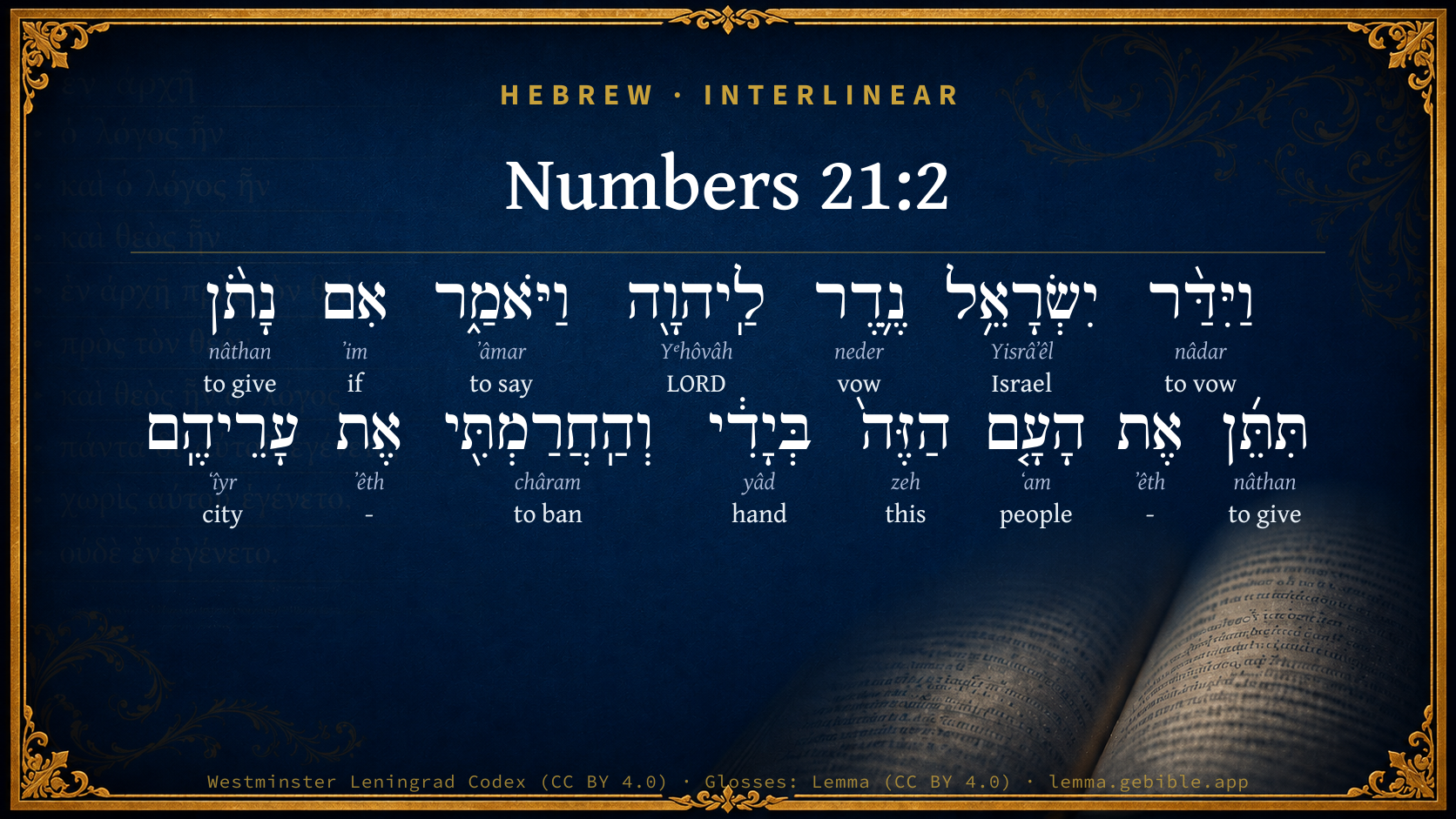
Hebrew (Westminster Leningrad Codex) Numbers 21:2 appears in the Hebrew Old Testament. The text above is from the Westminster Leningrad Codex. Each word links to its Strong’s number, a concise gloss, and parsing drawn from the Open Scriptures Hebrew Bible morphology. Click any word for its full Brown-Driver-Briggs (BDB) entry.
Download image
Cite this verse

Numbers 21:2 (World English Bible). Public Domain. Lemma interlinear Bible study tool, https://lemma.gebible.app/v/numbers/21/2.

Show BibTeX & RIS
BibTeX
RIS
English Translation
Israel vowed a vow to Yahweh, and said, If you will indeed deliver this people into my hand, then I will utterly destroy their cities.
World English Bible · Public Domain
Download a study sheet

One document with this verse’s original text, its word-by-word gloss line, the meaning frame, cross-references with their text, attributed commentary, and full source and license credits — printable, and it pastes into notes with its structure intact.

This verse Autodidact and up

Study sheet (.html) Plain text (.txt)

A passage Seminary Student

Up to 50 verses in one chapter. A passage sheet keeps up to 6 commentary sources and 12 cross-references per verse, in the order this page ranks them, and says so on the sheet whenever that leaves anything out. Ask for a single verse and you get the Autodidact verse sheet above.

Everything on this page stays free to read, with no account — the sheet is a download of what is already on screen, not access to it.

Want to remove ads? Support Godless Engineer
Compare translations 3

The same verse in 3 English versions, stacked beneath the original-language interlinear above. Click any original word for its lexicon entry.

Each is an independent rendering of the whole verse — the interlinear is not word-aligned to these translations.

Highlighted words mark where these versions differ — a whole-verse word diff, not a word-by-word alignment.

  • World English Bible Public Domain
    Israel vowed a vow to Yahweh, and said, If you will indeed deliver this people into my hand, then I will utterly destroy their cities.
  • King James Version Public Domain
    And Israel vowed a vow unto the LORD, and said, If thou wilt indeed deliver this people into my hand, then I will utterly destroy their cities.
  • unfoldingWord Literal Text CC BY-SA 4.0
    And Israel vowed a vow to Yahweh, and they said, “If giving, you give this people into my hand, then I will devote their cities to destruction.”

unfoldingWord Literal Text — © unfoldingWord, licensed CC BY-SA 4.0. Word-aligned USFM3 via Door43 (git.door43.org/unfoldingWord/en_ult).

Versions to compare (up to 4)

3 of 4 selected

Show all 18 translations

Every available English version of this verse, each an independent rendering of the whole verse.

  • World English Bible Public Domain
    Israel vowed a vow to Yahweh, and said, If you will indeed deliver this people into my hand, then I will utterly destroy their cities.
  • Berean Standard Bible Public Domain
    So Israel made a vow to the LORD: “If You will deliver this people into our hands, we will devote their cities to destruction.”
  • Majority Standard Bible Public Domain
    So Israel made a vow to the LORD: “If You will deliver this people into our hands, we will devote their cities to destruction.”
  • King James Version Public Domain
    And Israel vowed a vow unto the LORD, and said, If thou wilt indeed deliver this people into my hand, then I will utterly destroy their cities.
  • American Standard Version (1901) Public Domain
    And Israel vowed a vow unto Jehovah, and said, If thou wilt indeed deliver this people into my hand, then I will utterly destroy their cities.
  • Revised Version (1885) Public Domain
    And Israel vowed a vow unto the LORD, and said, If thou wilt indeed deliver this people into my hand, then I will utterly destroy their cities.
  • Geneva Bible (1599) Public Domain
    So Israel vowed a vowe vnto the Lord, and said, If thou wilt deliuer and giue this people into mine hand, then I wil vtterly destroy their cities.
  • Douay-Rheims (1899) Public Domain
    But Israel binding himself by vow to the Lord, said: It thou wilt deliver this people into my hand, I will utterly destroy their cities.
  • Young's Literal Translation Public Domain
    And Israel voweth a vow to Jehovah, and saith, `If Thou dost certainly give this people into my hand, then I have devoted their cities;'
  • Literal Standard Version CC BY-SA 4.0
    And Israel vows a vow to YHWH and says, “If You certainly give this people into my hand, then I have devoted their cities”;
  • Unlocked Literal Bible CC BY-SA 4.0
    Israel vowed to Yahweh and said, “If you give us victory over these people, then we will completely destroy their cities.”
  • unfoldingWord Literal Text CC BY-SA 4.0
    And Israel vowed a vow to Yahweh, and they said, “If giving, you give this people into my hand, then I will devote their cities to destruction.”
  • Darby Bible Public Domain
    Then Israel vowed a vow to Jehovah, and said, If thou give this people wholly into my hand, then I will utterly destroy their cities.
  • World Messianic Bible Public Domain
    Israel vowed a vow to the LORD, and said, “If you will indeed deliver this people into my hand, then I will utterly destroy their cities.”
  • Webster's Bible Public Domain
    And Israel vowed a vow to the LORD, and said, If thou wilt indeed deliver this people into my hand, then I will utterly destroy their cities.
  • Free Bible Version CC BY-SA 4.0
    So Israel made a solemn promise to the Lord: “If you hand these people over to us, we pledge to completely destroy their towns.”
  • Bible in Basic English Public Domain
    Then Israel made an oath to the Lord, and said, If you will give up this people into my hands, then I will send complete destruction on all their towns.
  • JPS Tanakh (1917) Public Domain
    And Israel vowed a vow unto the LORD, and said: 'If Thou wilt indeed deliver this people into my hand, then I will utterly destroy their cities.'

Literal Standard Version (2020), Covenant Press — licensed CC BY-SA 4.0. Text via the HelloAO Bible API (eBible.org). Unlocked Literal Bible (unfoldingWord) — licensed CC BY-SA 4.0. Text via the HelloAO Bible API (eBible.org). unfoldingWord Literal Text — © unfoldingWord, licensed CC BY-SA 4.0. Word-aligned USFM3 via Door43 (git.door43.org/unfoldingWord/en_ult). Free Bible Version, Dr. Jonathan Gallagher — licensed CC BY-SA 4.0. Text via the HelloAO Bible API (eBible.org).

Word by word

More ways to search: Search by grammar → Find every occurrence → Compare this word →

Practice this passage: Drill this verse → Learn its vocabulary →

וַיִּדַּ֨ר
nâdar
H5087
“and · to vow”
Conjunction + Verb, Qal, Sequential Imperfect, 3rd Person, Masculine, Singular
Part of Speech
Conjunction + Verb
Stem
Qal
Form
Sequential Imperfect
Person
3rd Person
Gender
Masculine
Number
Singular
Full BDB Definition

Origin: a primitive root

TWOT: 1308

to vow, make a vow - (Qal) to vow a vow
  1. יִשְׂרָאֵ֥ל Yisrâʼêl H3478 “Israel” Noun, Proper
  2. נֶ֛דֶר neder H5088 “vow” Noun, Common, Masculine, Singular, Absolute
  3. לַֽיהוָ֖ה Yᵉhôvâh H3068 “to/for · LORD” Preposition + Noun, Proper
  4. וַיֹּאמַ֑ר ʼâmar H559 “and · to say” Conjunction + Verb, Qal, Sequential Imperfect, 3rd Person, Masculine, Singular
  5. אִם ʼim H518 “if” Conjunction
  6. נָתֹ֨ן nâthan H5414 “to give” Verb, Qal, Infinitive Absolute
  7. תִּתֵּ֜ן nâthan H5414 “to give” Verb, Qal, Imperfect, 2nd Person, Masculine, Singular
  8. אֶת ʼêth H853 “-” Particle, Direct Object
  9. הָעָ֤ם ʻam H5971 “the · people” Particle, Definite Article + Noun, Common, Masculine, Singular, Absolute
  10. הַזֶּה֙ zeh H2088 “the · this” Particle, Definite Article + Pronoun, Demonstrative, Masculine, Singular
  11. בְּיָדִ֔י yâd H3027 “in/at · hand · my” Preposition + Noun, Common, Both, Singular, Construct + Suffix, Personal, 1st Person, Common, Singular
  12. וְהַֽחֲרַמְתִּ֖י châram H2763 “and · to ban” Conjunction + Verb, Hiphil, Sequential Perfect, 1st Person, Common, Singular
  13. אֶת ʼêth H853 “-” Particle, Direct Object
  14. עָרֵיהֶֽם ʻîyr H5892 “cities · their” Noun, Common, Feminine, Plural, Construct + Suffix, Personal, 3rd Person, Masculine, Plural

About this verse

These counts appear in no published source. They are computed here, from the morphology-tagged text and Lemma’s own curated glosses. What Lemma adds →

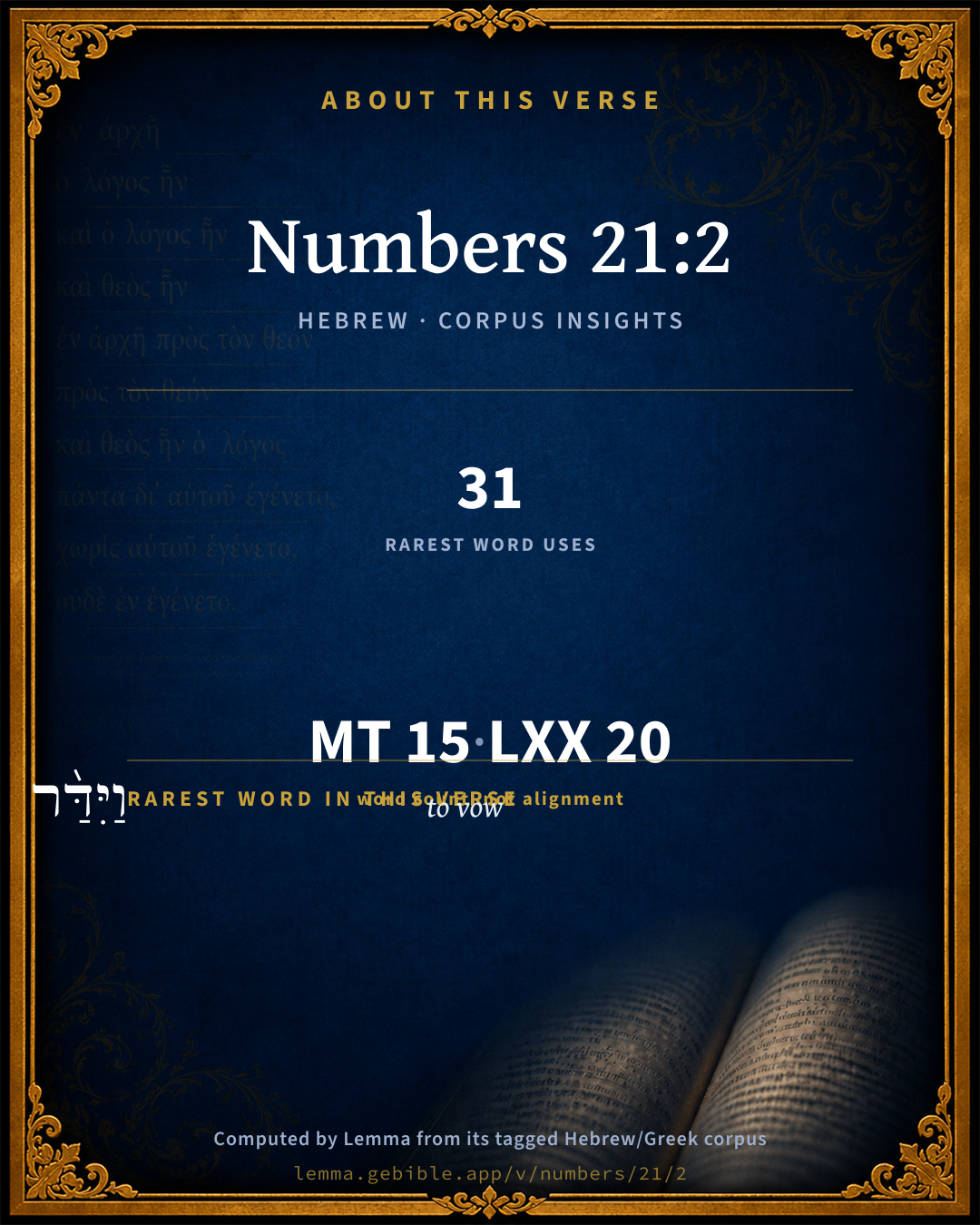
15
words
13
distinct lemmas
Pentateuch
section

Shared distinctive vocabulary

וַיִּדַּ֨ר to vow H5087 occurs in 28 verses of the Hebrew Bible. Also found in:

Grammatical profile

  • 5 verbs
  • 6 nouns
  • 1 pronoun
  • 1 conjunction
  • 2 particles

Verb forms

  • וַיִּדַּ֨ר Qal · Sequential Imperfect
  • וַיֹּאמַ֑ר Qal · Sequential Imperfect
  • נָתֹ֨ן Qal · Infinitive Absolute
  • תִּתֵּ֜ן Qal · Imperfect
  • וְהַֽחֲרַמְתִּ֖י Hiphil · Sequential Perfect

Repetition

A word recurs within this verse — often emphatic in Hebrew:

  • נָתֹ֨ן to give H5414 ×2

Hebrew & Septuagint length

In English translation the verse runs 25 words from the Hebrew and 28 from the Septuagint (LXX English) — closely comparable.

A rough comparison of the two English renderings, which tokenize alike — not a word-level alignment.

Word counts can differ between the Hebrew and the Greek without any difference in meaning — e.g. the Hebrew direct-object marker אֵת has no separate Greek word, and Greek often adds the article ὁ.

In the original languages it is 15 Hebrew tokens and 20 Greek tokens — but the two are counted differently (Hebrew bundles its prefixes and suffixes into one token; the Greek is in lemma form), so that isn’t a like-for-like length.

Cross-references

11

Topical passages linked to Numbers 21:2 in the Treasury of Scripture Knowledge — connected by theme and wording, ordered by reader-vote popularity; previews shown in the World English Bible.

  • Genesis 28:20 Jacob vowed a vow, saying, "If God will be with me, and will keep me in this way that I go, and will give me bread to eat, and clothing to put on,
  • Judges 11:30 Jephthah vowed a vow to Yahweh, and said, If you will indeed deliver the children of Ammon into my hand,
  • Joshua 6:26 Joshua charged them with an oath at that time, saying, Cursed be the man before Yahweh, that rises up and builds this city Jericho: with the loss of his firstborn shall he lay the foundation of it, and with the loss of his youngest son shall he set up the gates of it.
  • 1 Samuel 1:11 She vowed a vow, and said, Yahweh of hosts, if you will indeed look on the affliction of your handmaid, and remember me, and not forget your handmaid, but will give to your handmaid a man-child, then I will give him to Yahweh all the days of his life, and there shall no razor come on his head.
  • Leviticus 27:28–29 "'Notwithstanding, no devoted thing, that a man shall devote to Yahweh of all that he has, whether of man or animal, or of the field of his possession, shall be sold or redeemed: every devoted thing is most holy to Yahweh.
  • Deuteronomy 13:15 you shall surely strike the inhabitants of that city with the edge of the sword, destroying it utterly, and all that is therein and the cattle of it, with the edge of the sword.
  • 2 Samuel 15:7–8 It happened at the end of forty years, that Absalom said to the king, please let me go and pay my vow, which I have vowed to Yahweh, in Hebron.
  • Psalms 56:12–13 Your vows are on me, God. I will give thank offerings to you.
  • Psalms 116:18 I will pay my vows to Yahweh, Yes, in the presence of all his people,
  • Psalms 132:2 How he swore to Yahweh, And vowed to the Mighty One of Jacob:
  • Joshua 6:17 The city shall be devoted, even it and all that is therein, to Yahweh: only Rahab the prostitute shall live, she and all who are with her in the house, because she hid the messengers that we sent.

Cross-references courtesy of OpenBible.info (CC BY 4.0).

Hebrew and Greek witnesses Masoretic Hebrew ↔ Greek Septuagint

The same verse in the two great witnesses to the Old Testament, shown verse-for-verse.

These are two independent witnesses, not word-aligned to each other, and the Septuagint is shown in lemma (dictionary) form.

Hebrew Numbers 21:2 Masoretic · Westminster Leningrad Codex

וַיִּדַּ֨ר יִשְׂרָאֵ֥ל נֶ֛דֶר לַֽיהוָ֖ה וַיֹּאמַ֑ר אִם נָתֹ֨ן תִּתֵּ֜ן אֶת הָעָ֤ם הַזֶּה֙ בְּיָדִ֔י וְהַֽחֲרַמְתִּ֖י אֶת עָרֵיהֶֽם

Israel vowed a vow to Yahweh, and said, If you will indeed deliver this people into my hand, then I will utterly destroy their cities.

World English Bible · Public Domain

Greek LXX Numbers 21:2 Septuagint · lemma form

καί εὔχομαι ἰσραήλ εὐχή κύριος καί εἶπον ἐάν ἐγώ παραδίδωμι ὁ λαός οὗτος ὑποχείριος ἀναθεματίζω αὐτός καί ὁ πόλις αὐτός

And Israel vowed a vow to the Lord, and said, If you will deliver this people into my power, I will devote it and its cities to you.

LXX2012 (modern English Septuagint) · Public Domain

Hebrew: Westminster Leningrad Codex (CC BY 4.0). Greek: Septuagint (public domain); English from LXX2012 (modern English Septuagint) (Public Domain). How the Septuagint differs from the Hebrew →

Targum (Aramaic paraphrase)

2

The Targum is the ancient Jewish Aramaic paraphrase of the Hebrew Scriptures — an interpretive translation, not the Hebrew text itself. Onkelos (literal) and Pseudo-Jonathan (expansive) render the Torah, and Jonathan the Prophets. Coverage is partial: where no permissively-licensed English translation exists for a verse, only the Aramaic is shown. This is verse-level text, not a word-by-word alignment to the Hebrew.

  1. Targum Onkelos Torah (Genesis–Deuteronomy)
    וְקַיֵים יִשְׂרָאֵל קְיָים קֳדָם יְיָ וַאֲמַר אִם מִמְסַר תִּמְסַר יָת עַמָא הָדֵין בִּידִי וַאֲגַמַר יָת קִרְוֵיהוֹן

    (no public-domain English translation for this verse)

    Targum Onkelos — Aramaic: “Onkelos Genesis” (public domain); “Onkelos Exodus” (public domain); “Onkelos Leviticus” (public domain); “Onkelos Numbers” (public domain); “Onkelos Deuteronomy” (public domain). English: “Sefaria Community Translation” (CC0 1.0 (public-domain dedication)); “J.W. Etheridge. The Targums of Onkelos and Jonathan Ben Uzziel on the Pentateuch. London: Longmans, Green, 1862” (public domain). Text via Sefaria.

  2. Targum Pseudo-Jonathan Torah (Genesis–Deuteronomy)
    וְקַיֵים יִשְרָאֵל קְיַים קֳדָם יְיָ וַאֲמַר אִין מִמְסַר תִּמְסַר יַת עַמָא הָדֵין בִּידִי וְאִגְמַר יַת קִירְוֵיהוֹן

    And Israel vowed a vow before the Lord and said, If Thou wilt indeed deliver this people into my hand, I will destroy their cities.

    Targum Pseudo-Jonathan — Aramaic: “Targum Jonathan on Genesis” (public domain); “Targum Jonathan on Exodus” (public domain); “Targum Jonathan on Leviticus” (public domain); “Targum Jonathan on Numbers” (public domain); “Targum Jonathan on Deuteronomy” (public domain). English: “The Targum of Jonathan ben Uzziel, trans. J. W. Etheridge, London, 1862” (public domain). Text via Sefaria.

Commentary

Notes on Numbers 21:2 from classic Christian and Jewish commentators (each source and its license shown beneath its notes). The classic Christian expositions comment on the surrounding passage and are grouped to its opening verse, so a note may address several verses; the Jewish commentaries on the Tanakh (Rashi and others) are per-verse, so they appear only where the commentator wrote on this verse.

Lemma curates 59 commentaries, every one of them public domain or Creative Commons licensed, each selected and text-cleaned for this edition rather than reprinted as found. About our sources →

Jamieson, Fausset & Brown

Robert Jamieson, A. R. Fausset & David Brown

Israel vowed a vow unto the Lord--Made to feel their own weakness, they implored the aid of Heaven, and, in anticipation of it, devoted the cities of this king to future destruction. The nature and consequence of such anathemas are described (Lev. 27:1-34; Deu. 13:1-18). This vow of extermination against Arad [Num 21:2] gave name to the place Hormah (slaughter and destruction) though it was not accomplished till after the passage of the Jordan. Others think Hormah the name of a town mentioned (Jos 12:14).

Jamieson, Fausset & Brown — Commentary Critical and Explanatory on the Whole Bible (1871) — public domain (CC PDM 1.0). Text via the HelloAO Bible API.

Trapp's Complete Commentary

John Trapp

Num 21:2 And Israel vowed a vow unto the LORD, and said, If thou wilt indeed deliver this people into my hand, then I will utterly destroy their cities.

Ver. 2. And Israel vowed a vow.] This is the way to prevail with God, as Jacob found it, {Gen 28:20} who is therefore called, the father of vows. Concerning vows, {See Trapp on "Gen 28:20".}

John Trapp, A Commentary or Exposition upon All the Books of the Old and New Testament (1647–1656) — public domain. Text from a community e-Sword module.

Joseph Benson's Commentary

Num 21:2. Israel vowed a vow unto the Lord — Being unexperienced in war, and sensible of their own weakness, they were afraid of these Canaanites, and therefore thus endeavour to engage God to help them in the war which they intended to renew. I will utterly destroy their cities — I will reserve no person or thing for my own use, but devote them all to total destruction. The Israelites knew that the destruction of the seven nations of Canaan was predetermined in the counsels of heaven, on account of their excessive national wickedness, (Gen 9:25-27,) and that it had only been deferred till their incorrigible iniquity, having baffled all the gentler methods of Providence, which, during the course of some hundreds of years, had been employed for their reformation, had proved itself to be full, as God himself expresses it, Gen 15:16. They believed, it seems, that the time for effecting this destruction was now come, and hence made the vow here recorded.

The reader will observe, that it appears from all historical records of the seven Canaanitish nations, that before they were given up to utter destruction they were sunk into the deepest degeneracy and depravity. Thus (Leviticus 18.) where the Israelites are cautioned against the commission of several enormous crimes, such as offering their children to Moloch, lying with mankind as with womankind, lying with beasts, and women standing before beasts to lie down to them, it is added, For in all these the nations are defiled which I cast out before you. And again, — For all these abominations have the men of the land done, which were before you. Thus it appears that the destined period for their extirpation was arrived; their iniquities were full, and they brought down this desolation upon themselves. It must be observed, however, that this decree of utter destruction only extended to the seven nations of Canaan, all, it seems, equally sunk in guilt and depravity. The Israelites were at liberty to offer, nay, were commanded to offer, peace to other cities or states that were not of those nations, on condition that they became tributaries to them. See the whole command on this subject, (Deu 20:10-18,) with the reason assigned for destroying the seven nations, which is thus expressed: That they teach you not to do after their abominations, which they have done unto their gods, so should you sin against the Lord your God. It may be proper to observe further here, that the extirpation of this people, so sunk in idolatry and wickedness, was intended to be a warning to the Israelites themselves, and a most awful one it certainly was; and it was one which they had great need of; for such was their proneness to idolatry in that age of the world, that nothing less seemed likely to be effectual to restrain them from it, than to impress their minds with the most horrid idea of that crime, as what rendered nations accursed in the sight of God and men, and destined to be utterly extirpated from the face of the earth.

Joseph Benson's Commentary on the Old and New Testaments (1811–1818) — public domain. Text from a community e-Sword module.

Tyndale Open Study Notes

Tyndale Open Resources

21:2-3 completely destroy (Hebrew kharam): Israel was instructed to completely destroy their enemies and their enemies’ property (see Lev 27:28-29; Deut 7:2; 20:17; Josh 6–7; 10:1–11:23). • This battle reflects a play on words between kharam and Hormah (Hebrew khormah, Num 21:3). It marks a turning point in Israel’s interaction with the Canaanites, who remained a formidable enemy throughout the period of the conquest.

Tyndale Open Study Notes — © Tyndale Open Resources, licensed CC BY-SA 4.0. Text via the HelloAO Bible API.

The Cambridge Bible for Schools and Colleges

gen. ed. J. J. S. Perowne

2. utterly destroy] i.e. place under a ‘ban,’ Heb. ḥçrem. In the next verse the writer plays upon the word, in order to explain the name Hormah, as is done also in Jdg_1:17 (see note above).

The Cambridge Bible for Schools and Colleges (gen. ed. J. J. S. Perowne; Cambridge University Press, 1878–1918) — public domain. Text from a community e-Sword module.

John Gill's Exposition

And Israel vowed a vow unto the Lord,.... The Israelites made supplication to the Lord for help against their enemies, and that he would give them victory over them, and made promises to him:

and said, if thou wilt indeed deliver this people into my hand; certainly and entirely deliver them, so as that a complete victory shall be obtained over them:

then will I utterly destroy their cities; or "anathematize", or devote them to utter destruction (o); slay man and beast, burn their houses and take their goods, not for a spoil, for their own private use, but reserve them for the service of God; all which is implied in the vow made, as was done to Jericho, Jos 6:21 and so it is a vow, as Abendana observes, of what they would do when they came to the land of Canaan.

(o) "et anathematisabo", Montanus; "devovebo", Tigurine version.

John Gill's Exposition of the Whole Bible (1746–1763) — public domain (CC PDM 1.0). Text via the HelloAO Bible API.

Haydock's Catholic Bible Commentary

Cities. Hebrew, "I will subject their cities to anathema, or utter destruction." This vow they probably made at the place called Horma, or "Anathema," which was anciently called Saphaad, Judges i. 17. They fully executed their threat under Josue, who defeated the king of Hered, (Josue xii. 14,) though they destroyed, at present, whatever they could. Arad was afterwards rebuilt by Hobab.

George Leo Haydock (1774–1849), Haydock's Catholic Family Bible and Commentary, 1859 edition — public domain. Excludes Psalms (Douay-Rheims chapter numbering differs from Protestant) and Deuterocanonical books (Catholic canon only).

Matthew Poole's English Annotations

Being sensible of their own weakness, they endeavour to engage God to help them in the war, which they intended to renew.

I will utterly destroy their cities; I will reserve no person nor thing for my own use, but devote them all to total destruction, which was the consequent of such vows. See Lev 27:29; Deu 13:15

Matthew Poole's English Annotations on the Holy Bible (1683–1685) — public domain. Text from a community e-Sword/MySword module.

Whedon's Commentary on the Bible

Daniel D. Whedon

2. Vowed a vow — The Hebrew has two verbs to express a vow, one to do, and the other to abstain from doing, a certain act. The former is used here.

Utterly destroy their cities — Consecrate or devote them all to destruction. The person or thing thus devoted could never be redeemed. The cities were razed to the foundations, and the inhabitants, both man and beast, were slain. See note on Lev_27:28-29. Up to this time we find no command to exterminate the Canaanites by the sword. But we have in the promise to Abraham (Gen_15:16) an intimation of great judgments when the iniquity of the Amorites should be full. As this was the divine purpose, we are prepared for the record that the Lord hearkened — granted their desire.

Daniel D. Whedon (gen. ed.), Commentary on the Old and New Testaments (1874–1909) — public domain. Text from a community e-Sword module.

The Pulpit Commentary

And Israel vowed a vow. On these vows, and on things "devoted" or "banned" (anayema ), see on Lev_27:28, and on the moral character of such wholesale slaughters see on Nu 31. If it was right to destroy the Canaanites at all, no fault can be found with the vow; it merely did for that military proceeding what national feeling and discipline does for the far more bloody exigencies of modern warfare, removing it from the sphere of private hatred, revenge, and cupidity, and placing it upon a higher level. The patriot soldier of these days feels himself to be a mere instrument in the hands of the rulers of his people to maintain their rights or avenge their wrongs. The Israelite could not have this feeling, which was foreign to his time and place in history, but he could feel that he was a mere instrument in the hands of God to perform his will upon his enemies. In either case a must important advantage is secured; the soldier does not slay in order to gratify his own hatred, or in order to satisfy his own cupidity. It is quite true that such vows as are here mentioned would certainly in a more advanced stage of civilization be abused to throw a cloak of religion over frightful enormities; but it does not in the least follow that they were not permitted and even encouraged by God in an age to which they were natural, and under circumstances in which they were beneficial.

The Pulpit Commentary (1880–1919), ed. H.D.M. Spence-Jones & Joseph S. Exell — public domain. Text from a community e-Sword module.

John Wesley's Explanatory Notes

I will utterly destroy them - I will reserve no person or thing for my own use, but devote them all to total destruction.

John Wesley, Explanatory Notes Upon the Whole Bible (1754–1765) — public domain. Text via the GEBible commentary corpus.

Rashi

Rabbi Shlomo Yitzchaki (Rashi)

והחרמתי means I WILL DEDICATE their spoil (that of the cities) to the Most High.

Rashi on the Tanakh — English translations: “The Judaica Press complete Tanach with Rashi, translated by A. J. Rosenberg” (CC BY 4.0); “Pentateuch with Rashi's commentary by M. Rosenbaum and A.M. Silbermann, 1929-1934” (public domain); “The Metsudah Tanach series, Lakewood, N.J” (CC BY 4.0); and “The Book of Joshua, Metsudah Publications, 1997” (CC BY 4.0). Text via Sefaria.

Lesson kit

Teaching starters — assembled from the data on this page, not authored interpretation. Every prompt links to the verse data it draws on. Edit before teaching.

Numbers, in the Pentateuch, opens this verse with 15 words (13 distinct Hebrew lemmas). Its most distinctive word is nâdar (“to vow”). A historical commentator’s framing appears above. Read the whole chapter for the surrounding context.

Discussion questions

  1. What does “to vow” (nâdar) contribute to the verse as a whole?
  2. How does Genesis 28:20, which shares the word «to vow», read alongside this verse?
  3. What does the repetition of “to give” (2× in this one verse) do in this verse?
  4. These translations render this verse differently. What is at stake in choosing one wording over another?
  5. «וַיִּדַּ֨ר» is a Qal Sequential Imperfect verb. How does that grammatical form shape the action described?
  6. Compare how Jamieson, Fausset & Brown and Trapp's Complete Commentary read this verse. Where do they agree or differ?

Things to notice

Reading settings

Reading text

Shown beneath each verse's original-language words.

Old Testament
Old Testament edition

Read the OT as the Masoretic Hebrew (MT) or the Greek Septuagint (LXX).

English shown for the Greek Septuagint (in the Hebrew ↔ Greek comparison).

Comparing translations? Open the Compare panel on any verse page to stack up to four side by side.