Amos 9:2

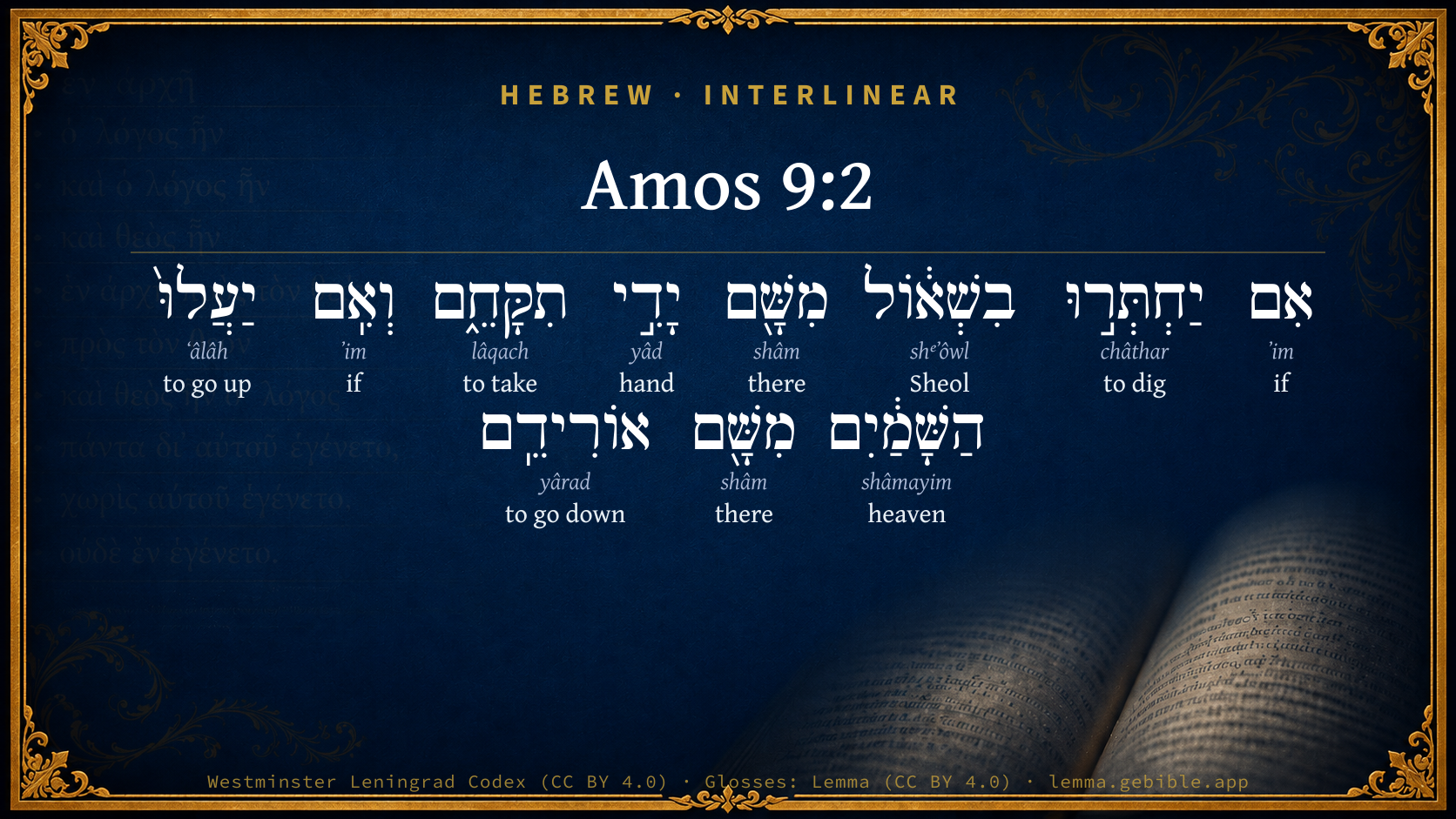
Hebrew (Westminster Leningrad Codex) Amos 9:2 appears in the Hebrew Old Testament. The text above is from the Westminster Leningrad Codex. Each word links to its Strong’s number, a concise gloss, and parsing drawn from the Open Scriptures Hebrew Bible morphology. Click any word for its full Brown-Driver-Briggs (BDB) entry.
Download image
Cite this verse

Amos 9:2 (World English Bible). Public Domain. Lemma interlinear Bible study tool, https://lemma.gebible.app/v/amos/9/2.

Show BibTeX & RIS
BibTeX
RIS
English Translation
Though they dig into Sheol, there my hand will take them; and though they climb up to heaven, there I will bring them down.
World English Bible · Public Domain
Download a study sheet

One document with this verse’s original text, its word-by-word gloss line, the meaning frame, cross-references with their text, attributed commentary, and full source and license credits — printable, and it pastes into notes with its structure intact.

This verse Autodidact and up

Study sheet (.html) Plain text (.txt)

A passage Seminary Student

Up to 50 verses in one chapter. A passage sheet keeps up to 6 commentary sources and 12 cross-references per verse, in the order this page ranks them, and says so on the sheet whenever that leaves anything out. Ask for a single verse and you get the Autodidact verse sheet above.

Everything on this page stays free to read, with no account — the sheet is a download of what is already on screen, not access to it.

Want to remove ads? Support Godless Engineer
Compare translations 3

The same verse in 3 English versions, stacked beneath the original-language interlinear above. Click any original word for its lexicon entry.

Each is an independent rendering of the whole verse — the interlinear is not word-aligned to these translations.

Highlighted words mark where these versions differ — a whole-verse word diff, not a word-by-word alignment.

  • World English Bible Public Domain
    Though they dig into Sheol, there my hand will take them; and though they climb up to heaven, there I will bring them down.
  • King James Version Public Domain
    Though they dig into hell, thence shall mine hand take them; though they climb up to heaven, thence will I bring them down:
  • unfoldingWord Literal Text CC BY-SA 4.0
    Though they dig into Sheol, there my hand will take them. Though they climb up to heaven, there I will bring them down.

unfoldingWord Literal Text — © unfoldingWord, licensed CC BY-SA 4.0. Word-aligned USFM3 via Door43 (git.door43.org/unfoldingWord/en_ult).

Versions to compare (up to 4)

3 of 4 selected

Show all 18 translations

Every available English version of this verse, each an independent rendering of the whole verse.

  • World English Bible Public Domain
    Though they dig into Sheol, there my hand will take them; and though they climb up to heaven, there I will bring them down.
  • Berean Standard Bible Public Domain
    Though they dig down to Sheol, from there My hand will take them; and though they climb up to heaven, from there I will pull them down.
  • Majority Standard Bible Public Domain
    Though they dig down to Sheol, from there My hand will take them; and though they climb up to heaven, from there I will pull them down.
  • King James Version Public Domain
    Though they dig into hell, thence shall mine hand take them; though they climb up to heaven, thence will I bring them down:
  • American Standard Version (1901) Public Domain
    Though they dig into Sheol, thence shall my hand take them; and though they climb up to heaven, thence will I bring them down.
  • Revised Version (1885) Public Domain
    Though they dig into hell, thence shall mine hand take them; and though they climb up to heaven, thence will I bring them down.
  • Geneva Bible (1599) Public Domain
    Though they digge into the hell, thence shall mine hande take them: though they clime vp to heauen, thence will I bring them downe.
  • Douay-Rheims (1899) Public Domain
    Though they go down even to hell, thence shall my hand bring them out: and though they climb up to heaven, thence will I bring them down.
  • Young's Literal Translation Public Domain
    If they dig through into sheol, From thence doth My hand take them, And if they go up the heavens, From thence I cause them to come down.
  • Literal Standard Version CC BY-SA 4.0
    If they dig through into Sheol, || From there My hand takes them, || And if they go up [to] the heavens, || From there I cause them to come down.
  • Unlocked Literal Bible CC BY-SA 4.0
    Though they dig into Sheol, there my hand will take them. Though they climb up to heaven, there I will bring them down.
  • unfoldingWord Literal Text CC BY-SA 4.0
    Though they dig into Sheol, there my hand will take them. Though they climb up to heaven, there I will bring them down.
  • Darby Bible Public Domain
    Though they dig into Sheol, thence shall my hand take them; and though they climb up to the heavens, thence will I bring them down;
  • World Messianic Bible Public Domain
    Though they dig into Sheol, there my hand will take them; and though they climb up to heaven, there I will bring them down.
  • Webster's Bible Public Domain
    Though they dig into the place of the dead, thence shall my hand take them; though they climb up to heaven, thence will I bring them down:
  • Free Bible Version CC BY-SA 4.0
    Even if they dig down into Sheol, I will catch them and pull them up. Even if they climb up to heaven, I will bring them down.
  • Bible in Basic English Public Domain
    Even if they go deep into the underworld, my hand will take them up from there; if they go up to heaven, I will get them down:
  • JPS Tanakh (1917) Public Domain
    Though they dig into the nether-world, thence shall My hand take them; and though they climb up to heaven, thence will I bring them down.

Literal Standard Version (2020), Covenant Press — licensed CC BY-SA 4.0. Text via the HelloAO Bible API (eBible.org). Unlocked Literal Bible (unfoldingWord) — licensed CC BY-SA 4.0. Text via the HelloAO Bible API (eBible.org). unfoldingWord Literal Text — © unfoldingWord, licensed CC BY-SA 4.0. Word-aligned USFM3 via Door43 (git.door43.org/unfoldingWord/en_ult). Free Bible Version, Dr. Jonathan Gallagher — licensed CC BY-SA 4.0. Text via the HelloAO Bible API (eBible.org).

Word by word

More ways to search: Search by grammar → Find every occurrence → Compare this word →

Practice this passage: Drill this verse → Learn its vocabulary →

יַחְתְּר֣וּ
châthar
H2864
“to dig”
Verb, Qal, Imperfect, 3rd Person, Masculine, Plural
Part of Speech
Verb
Stem
Qal
Form
Imperfect
Person
3rd Person
Gender
Masculine
Number
Plural
Full BDB Definition

Origin: a primitive root

TWOT: 783

to dig, row - (Qal) - to dig (into houses - of burglary) - to row (in water)
  1. אִם ʼim H518 “if” Conjunction
  2. בִשְׁא֔וֹל shᵉʼôwl H7585 “in/at · Sheol” Preposition + Noun, Proper
  3. מִשָּׁ֖ם shâm H8033 “from · there” Preposition + Adverb
  4. יָדִ֣י yâd H3027 “hand · my” Noun, Common, Both, Singular, Construct + Suffix, Personal, 1st Person, Common, Singular
  5. תִקָּחֵ֑ם lâqach H3947 “to take · them” Verb, Qal, Imperfect, 3rd Person, Feminine, Singular + Suffix, Personal, 3rd Person, Masculine, Plural
  6. וְאִֽם ʼim H518 “and · if” Conjunction + Conjunction
  7. יַעֲלוּ֙ ʻâlâh H5927 “to go up” Verb, Qal, Imperfect, 3rd Person, Masculine, Plural
  8. הַשָּׁמַ֔יִם shâmayim H8064 “the · heaven(s)” Particle, Definite Article + Noun, Common, Masculine, Plural, Absolute
  9. מִשָּׁ֖ם shâm H8033 “from · there” Preposition + Adverb
  10. אוֹרִידֵֽם yârad H3381 “to go down · them” Verb, Hiphil, Imperfect, 1st Person, Common, Singular + Suffix, Personal, 3rd Person, Masculine, Plural

About this verse

These counts appear in no published source. They are computed here, from the morphology-tagged text and Lemma’s own curated glosses. What Lemma adds →

11
words
9
distinct lemmas
Prophets
section

Notable vocabulary

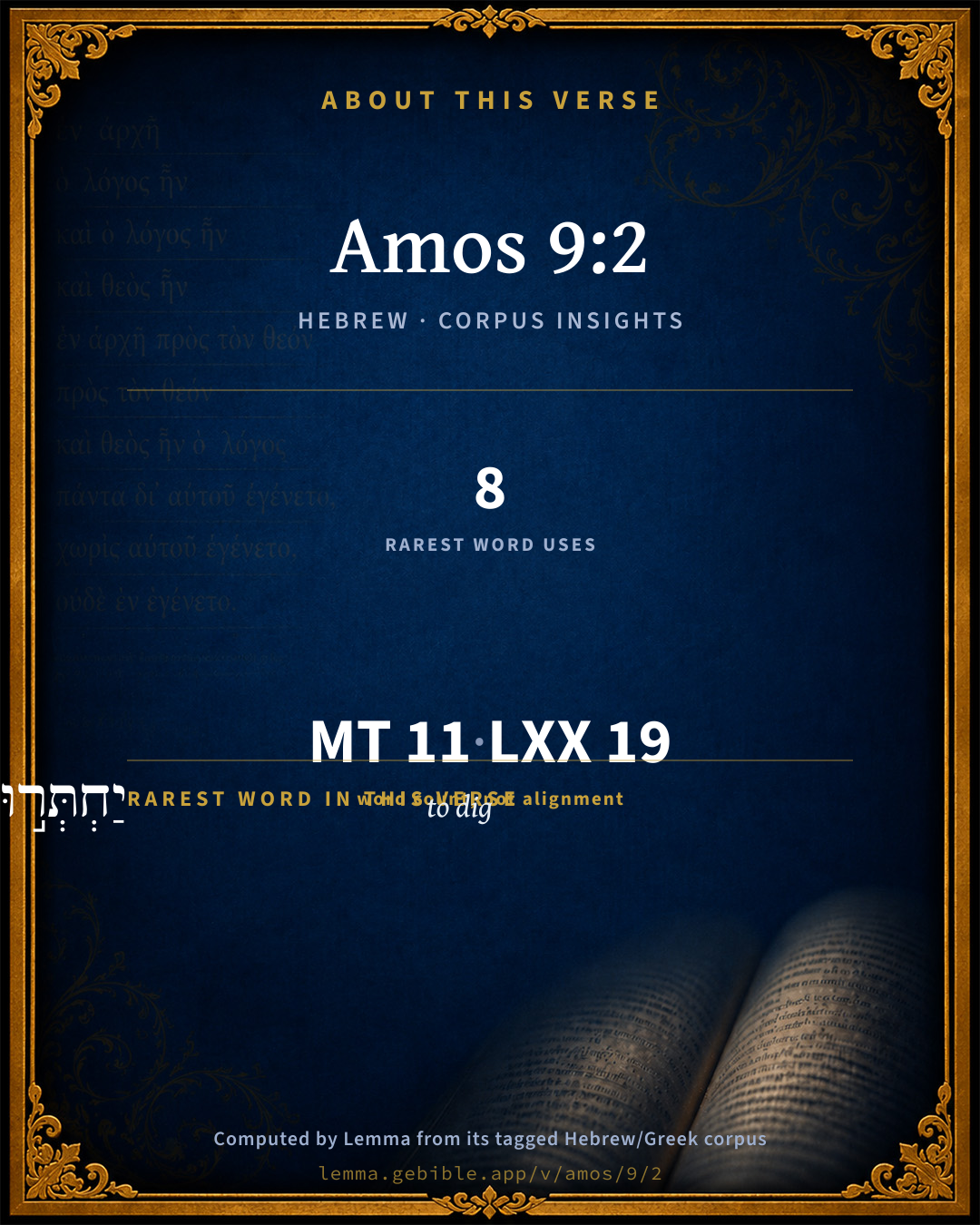
The rarest word here is יַחְתְּר֣וּ to dig H2864 — appearing just 8 times in the whole Hebrew Bible.

Shared distinctive vocabulary

יַחְתְּר֣וּ to dig H2864 occurs in 7 verses of the Hebrew Bible. Also found in:

Grammatical profile

  • 4 verbs
  • 3 nouns
  • 2 conjunctions
  • 2 adverbs

Verb forms

  • יַחְתְּר֣וּ Qal · Imperfect
  • תִקָּחֵ֑ם Qal · Imperfect
  • יַעֲלוּ֙ Qal · Imperfect
  • אוֹרִידֵֽם Hiphil · Imperfect

Repetition

Words recur within this verse — often emphatic in Hebrew:

  • מִשָּׁ֖ם there H8033 ×2
  • אִם if H518 ×2

Hebrew & Septuagint length

In English translation the verse runs 24 words from the Hebrew and 26 from the Septuagint (LXX English) — closely comparable.

A rough comparison of the two English renderings, which tokenize alike — not a word-level alignment.

Word counts can differ between the Hebrew and the Greek without any difference in meaning — e.g. the Hebrew direct-object marker אֵת has no separate Greek word, and Greek often adds the article ὁ.

In the original languages it is 11 Hebrew tokens and 19 Greek tokens — but the two are counted differently (Hebrew bundles its prefixes and suffixes into one token; the Greek is in lemma form), so that isn’t a like-for-like length.

Cross-references

10

Topical passages linked to Amos 9:2 in the Treasury of Scripture Knowledge — connected by theme and wording, ordered by reader-vote popularity; previews shown in the World English Bible.

  • Psalms 139:7–10 Where could I go from your Spirit? Or where could I flee from your presence?
  • Jeremiah 51:53 Though Babylon should mount up to the sky, and though she should fortify the height of her strength, yet from me shall destroyers come to her, says Yahweh.
  • Obadiah 1:4 Though you mount on high as the eagle, and though your nest is set among the stars, I will bring you down from there, says Yahweh.
  • Job 20:6 Though his height mount up to the heavens, And his head reach to the clouds,
  • Job 26:6 Sheol is naked before God, And Abaddon has no covering.
  • Isaiah 2:19 Men shall go into the caves of the rocks, And into the holes of the earth, From before the terror of Yahweh, And from the glory of his majesty, When he arises to shake the earth mightily.
  • Isaiah 14:13–16 You said in your heart, I will ascend into heaven, I will exalt my throne above the stars of God; and I will sit on the mountain of congregation, in the uttermost parts of the north;
  • Jeremiah 49:16 As for your terror, the pride of your heart has deceived you, O you who dwell in the clefts of the rock, who hold the height of the hill: though you should make your nest as high as the eagle, I will bring you down from there, says Yahweh.
  • Ezekiel 28:13–16 You were in Eden, the garden of God; every precious stone adorned you: ruby, topaz, emerald, chrysolite, onx, jasper, sapphire, turquoise, and beryl. Gold work of tambourines and of pipes was in you. In the day that you were created they were prepared.
  • Luke 10:18 He said to them, "I saw Satan having fallen like lightning from heaven.

Cross-references courtesy of OpenBible.info (CC BY 4.0).

Hebrew and Greek witnesses Masoretic Hebrew ↔ Greek Septuagint

The same verse in the two great witnesses to the Old Testament, shown verse-for-verse.

These are two independent witnesses, not word-aligned to each other, and the Septuagint is shown in lemma (dictionary) form.

Hebrew Amos 9:2 Masoretic · Westminster Leningrad Codex

אִם יַחְתְּר֣וּ בִשְׁא֔וֹל מִשָּׁ֖ם יָדִ֣י תִקָּחֵ֑ם וְאִֽם יַעֲלוּ֙ הַשָּׁמַ֔יִם מִשָּׁ֖ם אוֹרִידֵֽם

Though they dig into Sheol, there my hand will take them; and though they climb up to heaven, there I will bring them down.

World English Bible · Public Domain

Greek LXX Amos 9:2 Septuagint · lemma form

ἐάν καταὀρύσσω εἰς ᾅδης ἐκεῖθεν ὁ χείρ ἐγώ ἀνασπάω αὐτός καί ἐάν ἀναβαίνω εἰς ὁ οὐρανός ἐκεῖθεν καταἄγω αὐτός

Though they hid themselves in hell, thence shall my hand drag them forth; and though they go up to heaven, thence will I bring them down.

LXX2012 (modern English Septuagint) · Public Domain

On this verse, The Pulpit Commentary discusses the Septuagint’s reading. Read the note in Commentary ↓

Hebrew: Westminster Leningrad Codex (CC BY 4.0). Greek: Septuagint (public domain); English from LXX2012 (modern English Septuagint) (Public Domain). How the Septuagint differs from the Hebrew →

Targum (Aramaic paraphrase)

1

The Targum is the ancient Jewish Aramaic paraphrase of the Hebrew Scriptures — an interpretive translation, not the Hebrew text itself. Onkelos (literal) and Pseudo-Jonathan (expansive) render the Torah, and Jonathan the Prophets. Coverage is partial: where no permissively-licensed English translation exists for a verse, only the Aramaic is shown. This is verse-level text, not a word-by-word alignment to the Hebrew.

  1. Targum Jonathan Prophets (Joshua–Malachi)
    אִם יְדַמוּן לְאִטַמָרָא כִּדְבִשְׁאוֹל מִתַּמָן בְּמֵימְרִי יַדְבְּרִינוּן סַנְאֵיהוֹן וְאִם יִסְקוּן בְּטוּרִין דְרָמִין עַד צֵית שְׁמַיָא מִן תַּמָן בְּמֵימְרִי יַחֲתוּנוּן:

    (no public-domain English translation for this verse)

    Targum Jonathan — Aramaic: “Mikraot Gedolot” (public domain). English: “Sefaria Community Translation” (CC0 1.0 (public-domain dedication)); “London "Chaldee Paraphrase," 1871” (public domain). Text via Sefaria.

Commentary

Notes on Amos 9:2 from classic Christian and Jewish commentators (each source and its license shown beneath its notes). The classic Christian expositions comment on the surrounding passage and are grouped to its opening verse, so a note may address several verses; the Jewish commentaries on the Tanakh (Rashi and others) are per-verse, so they appear only where the commentator wrote on this verse.

Lemma curates 59 commentaries, every one of them public domain or Creative Commons licensed, each selected and text-cleaned for this edition rather than reprinted as found. About our sources →

Trapp's Complete Commentary

John Trapp

Amo 9:2 Though they dig into hell, thence shall mine hand take them; though they climb up to heaven, thence will I bring them down:

Ver. 2. Though they dig into hell, &c.] No starting hole shall secure them from the wrath of God and rage of the creature, set at work by him. "Hell and destruction are before the Lord," Pro 15:11, yea, hell is naked before him, and destruction hath no covering, Job 26:6. He hath a sharp eye, and a long hand, to pull men out of their lurking holes; as he did Adam out of the thicket, Manasseh from among the thorns, 2Ch 33:11, Jonah from the sides of the ship, the Duke of Buckingham in Richard III’s time, &c. "Be sure," saith Moses, "your sin will find you out," Num 32:23, and God’s hand will hale you to punishment.

Though they climb up to heaven] That is (by a hyperbole), to high and strong places; as the Babel builders, the Benjamites that fled to the rock Rimmon, and there abode four months, Jdg 20:47, the gibing Jebusites, that were so confident of their stronghold of Zion that they flouted David and his forces, 2Sa 5:8, the proud prince of Tyre, and others.

Thence will I bring them down] From their loftiest tops of pride and creature confidence, which God loves to confute and defeat: as I might instance in Nebuchadnezzar, Xerxes, Haman, Sejanus, Bajazet, that terror of the world, and (as he thought) superior to fortune, yet in an instant, with his state, in one battle overthrown into the bottom of misery and despair; and that in the midst of his great strength. The same end awaits the Pope and his hierarchyruet alto a culmine Roma, that Jupiter Capitolinus shall be one day unroosted by him, who casteth the wicked down to the ground, Psa 147:6.

John Trapp, A Commentary or Exposition upon All the Books of the Old and New Testament (1647–1656) — public domain. Text from a community e-Sword module.

The Biblical Illustrator

Joseph S. Exell

Amo_9:2-3

Though they dig into hell, thence shall Mine hand take them; though they climb up to heaven, thence will I bring them down.

The danger of impenitence

In this passage God manifests His determination to arrest and punish the worker of iniquity. The prophet shows that when God came forth in judgment, none would be able to stand before Him, or escape from His vengeance. This subject is enlarged upon, as a warning to those who profane the ordinances and violate the laws of the Most High, to stand in awe, lest the Divine indignation be poured out upon them. These things have, however, very little influence on us. Many seem to believe, because sentence against their evil deeds has not been executed speedily, that it will never be executed.

I. Some of the reasons why many entertain this belief.

1. Their success upon former occasions. When sinners first deviate into the paths of error, they experience many uneasy feelings. But when the lusts of the flesh have prevailed over other considerations, they try to persuade themselves that their former fears were in great measure imaginary. Sometimes men are checked at the very outset. They are detected and exposed. There is interposition of providence in their favour. When enticed to the commission of sin, the recollection of the check he formerly received will occur fresh to his memory, and deter him from the paths wherein destroyers go.

2. The successful example of other men. Frequently we see men rising to opulence and power by the most unjustifiable means. We see the wicked living in triumph, and dying in apparent Peace. When such is frequently the prosperity of the wicked, others are enticed to follow their example. They are induced to forsake the path of duty, and engage in pursuits that are dangerous to happiness. Could we discern the thoughts of wicked men when their conscience condemned them for their wickedness, we should perceive them frequently endeavouring to stifle their convictions and banish their fears, by appealing to Persons who had succeeded, or were at that time successful, in the same evil courses as those upon which they had entered.

3. They think they can repent whenever they see danger approaching. So great is the propensity of men to sin, that no motives, no considerations can prevent them from going on in their wicked practices. But at the same time they have such an aversion to suffering, that when they sin, they always wish to do so with security and with safety. And they generally contrive to persuade themselves that, in their case at least, this object may be attained. Among the many false reasonings which they employ for this purpose, there is none more successful than that which is founded on an after repentance. Many think that, after having drunk the cup of sinful pleasures to the dregs, all they have to do is to profess themselves sorry, and cast themselves upon the mercy of God. This, they think, whatever their present conduct may be, will set all things right at last. Repentance is not such an easy work as many people imagine. We cannot repent at whatever moment we may wish to do so. Alas! many, relying upon future repentance, neglect and abuse their present mercies.

II. It is impossible for wicked men to escape the just judgments of God. This world is not a state of complete retribution, yet the Most High does rule among the children of men. He has connected with holiness a portion of happiness, and with sin a portion of misery. Whatever happiness wicked men may pretend to, still happiness is a state of mind to which they can have no claim. They cannot possibly be really happy. Wicked men may evade the vigilance of human laws, but they are still amenable to their own consciences. And sometimes wicked men are punished more immediately by the hand of God Himself; as were Ananias and Sapphira. Then there is death, which is not the extinction of being. After death there is a judgment to come, which will seal the doom of every human being. (John Mamsay, M. A.)

No escape for the sinner

Though they dig into hell, or though they undermine our kingdom with vaults and cellarage, their impious labour shall come to nothing but to their own utter shame.

1. Here is the negotiation of the wicked, that they dig: there wants no pains, there wants no secrecy.

2. Here is the object of their employment, and that is hell.

3. There is a twofold end implied, why they undertake such a business, either for their own refuge, or to undermine others.

4. Here is the defeating and frustrating of their work. To what toil iniquity puts men to. They dig and labour. To what secrecy, to what dread of conscience. They dig into hell. How unprofitable is the event. For when all is done, they are apprehended by the hand of God. (Bishop Hackett.)

The impossibility of the sinners escape

If we consider man in reference to God, we see in him a strange compound of hardihood and cowardice. When Divine judgments are remote, he not only deems himself secure, but bids defiance to Omnipotence itself. But when they actually come, he trembles like a leaf shaken by the wind.

I. The means by which men seek to hide themselves from God. Some of the expressions used indicate fear; others, presumption. Men will try and persuade themselves that God is too great to notice the insignificant doings of creatures like ourselves. Another subterfuge is, that as sinners they have numbers on their side. But if numbers do anything, it is only to enhance the doom. Men have great confidence in their own virtues, however little conformity there may be in their conduct to the Spirit of God and the commands of God.

II. The vanity of all attempts of sinners to hide themselves from God. Who can flee from the presence of such a Being? Where is the region which His all-penetrating gaze does not pervade? None has ever hardened himself against God and prospered; sin has ever had the seed of punishment along with it, and given beforehand some earnest of its bitter wages. Be assured nothing can screen you from the wrath of heaven, nothing give you composure in this world of afflictions and trials, but faith in the Lord Jesus Christ. (Stephen Bridge, A.M.)

The Biblical Illustrator, edited by Joseph S. Exell (c. 1880s–1900s) — public domain. Text from a community e-Sword module.

Joseph Benson's Commentary

Amo 9:2-4. Though they dig into hell, &c. — Here the subject is enlarged upon to impress it more deeply on the minds of all that read or hear it. Though they hide themselves in the deepest holes or caverns of the earth, (see Isa 2:10,) or take refuge in the highest fortresses, they shall not escape my vengeance, but shall be brought forth to destruction or captivity. And though they hide themselves in the top of Carmel — There were great caves formed by nature in the tops of some mountains, where men used to secure themselves in the times of danger. Such was the cave in a mountain of the wilderness of Ziph. I will search and take them out thence —

Neither the thickest bushes nor the darkest caves shall serve to hide them. Though they be hid in the bottom of the sea — The Chaldee reads, in the islands of the sea; but the expression is rather to be understood metaphorically, as signifying that they should not, by any means whatsoever, be able to escape the calamities which God had determined to bring upon them. The word rendered serpent in our translation, is in some versions rendered a whale. Without doubt it should be translated here by the name of some great sea animal. And though they go into captivity, thence will I command the sword, &c. — The same judgment is denounced against them in the passages referred to in the margin.

Joseph Benson's Commentary on the Old and New Testaments (1811–1818) — public domain. Text from a community e-Sword module.

Keil & Delitzsch

C. F. Keil & F. Delitzsch

The thought is still further expanded in Amo 9:2-6. Amo 9:2. "If they break through into hell, my hand will take them thence; and if they climb up to heaven, thence will I fetch them down. Amo 9:3. And if they hide themselves upon the top of Carmel, I will trace them, and fetch them thence; and if they conceal themselves from before mine eyes in the bottom of the sea, thence do I command the serpent, and it biteth them. Amo 9:4. And if they go into captivity before their enemies, I will command the sword thence, and it slayeth them; and I direct my eye upon them for evil, and not for good." The imperfects, with אם, are to be taken as futures. They do not assume what is impossible as merely hypothetical, in the sense of "if they should hide themselves;" but set forth what was no doubt in actual fact an impossible case, as though it were possible, in order to cut off every escape. For the cases mentioned in Amo 9:3 and Amo 9:4 might really occur. Hiding upon Carmel and going into captivity belong to the sphere of possibility and of actual occurrence. In order to individualize the thought, that escape from the punishing arm of the Almighty is impossible, the prophet opposes the most extreme spaces of the world to one another, starting from heaven and hell, as the loftiest height and deepest depth of the universe, in doing which he has in all probability Psa 139:7-8 floating before his mind. He commences with the height, which a man cannot possibly climb, and the depth, to which he cannot descend, to show that escape is impossible. חתר, to break through, with ב, to make a hole into anything (Eze 8:8; Eze 12:5, Eze 12:7). According to the Hebrew view, Sheol was deep in the interior of the earth. The head of Carmel is mentioned (see at Jos 19:26). The reference is not to the many caves in this promontory, which afford shelter to fugitives; for they are not found upon the head of Carmel, but for the most part on the western side (see v. Raumer, Pal. p. 44). The emphasis lies rather upon the head, as a height overgrown with trees, which, even if not very high (about 1800 feet; see at Kg1 18:19), yet, in comparison with the sea over which it rises, might appear to be of a very considerable height; in addition to which, the situation of Carmel, on the extreme western border of the kingdom of Israel, might also be taken into consideration. "Whoever hides himself there, must assuredly know of no other place of security in the whole of the land besides. And if there is no longer any security there, there is nothing left but the sea." But even the deep sea-bottom will not shelter from the vengeance of God. God commands the serpent, or summons the serpent to bite him. Nâchâsh, here the water-serpent, called elsewhere livyāthān or tannı̄n (Isa 27:1), a sea-monster, which was popularly supposed to be extremely dangerous, but which cannot be more exactly defined. Even by going into captivity, they will not be protected from the sword. בּשּׁבי, not into captivity, but in statu captivitatis: even if they should be among those who were wandering into captivity, where men are generally sure of their lives (see Lam 1:5). For God has fixed His eye upon them, i.e., has taken them under His special superintendence (cf. Jer 39:12); not, however, to shelter, to protect, and to bless, but לרעה, for evil, i.e., to punish them. "The people of the Lord remain, under all circumstances, the object of special attention. They are more richly blessed than the world, but they are also more severely punished" (Hengstenberg).

Keil & Delitzsch — Biblical Commentary on the Old Testament (1861–1891) — public domain (CC PDM 1.0). Text via the HelloAO Bible API. (Old Testament only.)

Tyndale Open Study Notes

Tyndale Open Resources

9:2-4 God is inescapable (cp. Ps 139:7-12). When people trust, believe, and obey God, his inescapability is a great blessing. But because Israel rejected God’s revelation, his presence would mean judgment, not comfort.

9:2 to the place of the dead (literally to Sheol): In the Old Testament, Sheol is a place beneath the earth where the dead have their abode.

Tyndale Open Study Notes — © Tyndale Open Resources, licensed CC BY-SA 4.0. Text via the HelloAO Bible API.

Jamieson, Fausset & Brown

Robert Jamieson, A. R. Fausset & David Brown

Though they dig into hell--though they hide ever so deeply in the earth (Psa 139:8).

though they climb up to heaven--though they ascend the greatest heights (Job 20:6-7; Jer 51:53; Oba 1:4).

Jamieson, Fausset & Brown — Commentary Critical and Explanatory on the Whole Bible (1871) — public domain (CC PDM 1.0). Text via the HelloAO Bible API.

Adam Clarke's Commentary

Verse 2. Though they dig into hell] Though they should get into the deepest caverns; though they climb up to heaven - get to the most inaccessible heights; I will drag them up from the one, and pull them down from the other.

Adam Clarke's Commentary on the Bible (1810–1826) — public domain. Text from a community e-Sword/MySword module.

John Calvin's Commentaries

Here the Prophet denounces horrible punishments; but not without reason, for there was astonishing torpidity in that people, as there is usually in all hypocrites when they have any shadow of excuse. They were then the only elect people in the whole world. When, therefore, they thought that they excelled others and that they were endued with singular privileges beyond all other nations, this glory inebriated them, and they imagined that God was in a manner bound to them, as we have seen in other places. This, then, was the reason why the Prophet in so many ways enlarged on the judgment of God on hypocrites; it was, that they might be terrified by the vehemence and severity of his words.

Hence he says, If they dig for themselves passages to hell, that is, to the center of the earth, for שאול, shaul, is here put for the center; thence shall my hand draw them forth; and then, If they ascend to heaven, thence I will draw them down, saith the Lord; If they hide themselves in deserts, if they flee to the top of Carmel, I will trace them out: in short, they shall find no corner either in heaven, or on the earth, or in the sea, where they can be hid from my sight. There is no need here to understand by heavens high citadels, as the Chaldean paraphraser explains it: it is a frigid paraphrase. But the Prophet speaks in an hyperbolical language of the center of the earth, of the heavens, and of the deep of the sea; as though he had said, “Should all the elements open themselves for hiding-places, yet the Israelites shall in vain try to escape, for I will follow them when sunk in the depth of the sea, I will draw them down from heaven itself; there shall, in a word, be no hiding-place for them either above or below.”

We now understand the Prophet’s meaning; and an useful warning may be hence gathered, — that when God threatens us, we in vain seek subterfuges, as his hand extends itself to the lowest deep as well as to heaven; as it is said in Psalm 139:7-9,

‘Where shall I flee from thy presence, O Lord? If I ascend into heaven, thou art there; if I descend to the grave, thou art present; if I take the wings of the dawn, (or, of the morning star,) and dwell in the extremities of the sea, there also shall thy hand lead me.’

The Prophet speaks not in that psalm, as some have very absurdly philosophized, of the unlimited essence of God; but he rather shows, that we are always in his sight. So then we ought to feel assured that we cannot escape, whenever God designs to make a scrutiny as to our sins, and to summon us to his tribunal.

But we must at the same time remember, that the Prophet has not employed a superfluous heap of words; there is not here one syllable which is not important though at the first view it seems to be otherwise. But the Holy Spirit, as I have already reminded you, knowing our heedlessness, does here shake off all our self-flatteries. There is in us, we know, an innate torpor by nature, so that we despise all threatenings, or at least we are not duly moved by them. As the Lord sees us to be so careless, he rouses us by his goads. Whenever then Scripture denounces punishment on us, let us at the same time learn to join with it what the Prophet here relates; “Thou hast to do with God, what can’t thou effect now by evasions? though thou climbest to heaven, the Lord can draw thee down; though thou descendent to the abyss, God’s hand will thence draw thee forth; if thou seekest a hiding-place in the lowest depths, he will thence also bring thee forth to the light; and if thou hidest thyself in the deep sea, he will there find thee out; in a word, wherever thou betakest thyself, thou canst not withdraw thyself from the presence and from the hand of God.” We hence see the design of all these expressions, and that is, that we may not think of God as of ourselves, but that we may know that his power extends to all hiding-places. But these words ought to be subjects at meditations though it be sufficient for our purpose to include in few words what the Prophet had in view. But as we are so entangled in our vain confidences, the Prophet, as I have said, has not in vain used so many words.

John Calvin's Commentaries (1540-1563) — public domain. Text from the Calvin Translation Society English edition (1840s-50s) via the Christian Classics Ethereal Library (ccel.org). Calvin's coverage is partial (roughly two-thirds of the Bible); uncommented books and verses are honest gaps, never fabricated. The 19th-century editor's footnotes and remarks are omitted so the notes are faithfully Calvin's own voice.

Ellicott's Commentary for English Readers

(2) Dig.—For this expression break should be substituted. “Hell,” or rather, Hades (Sheôl), the dark abode of the gathered dead, is contrasted with “heaven,” the abode of light. Escape from the universal Lord is impossible.

A Bible Commentary for English Readers, edited by Charles John Ellicott (1878–1897) — public domain. Text from a community e-Sword module.

The Cambridge Bible for Schools and Colleges

gen. ed. J. J. S. Perowne

2. Two examples of places, inaccessible to man, in which they are pictured hyperbolically as seeking to escape the Divine hand; Sheol, the deep and cavernous (Isa_14:15) abode of the dead, which was located by the Hebrews far down below the earth (Deu_32:22; Job_26:5; Eze_32:18); and the lofty heights of heaven (Jer_51:53). Comp. the words in which the Psalmist expresses the thought of God’s omnipresence, Psa_139:8; also (with the second clause) Oba_1:4.

dig through] The word is used of digging through a wall, Eze_8:8; Eze_12:5; Eze_12:7; Eze_12:12; and the cognate subst. of the act of robbers digging into a house (Exo_22:2; Jer_2:34); cf. διορύσσειν, Mat_6:19.

2–4. In whatever direction they flee, wherever they essay to hide themselves, and even though they should be in captivity in the enemy’s land, they will not be able to elude the Divine anger.

The Cambridge Bible for Schools and Colleges (gen. ed. J. J. S. Perowne; Cambridge University Press, 1878–1918) — public domain. Text from a community e-Sword module.

John Gill's Exposition

Though they dig into hell, thence shall mine hand take them,.... That is, they that endeavour to make their escape from their enemies, though they seek for places of the greatest secrecy and privacy; not hell, the place of the damned; nor the grave, the repository of the dead; neither of which they chose to he in, but rather sought to escape them; but the deepest and darkest caverns, the utmost recesses of the earth, the very centre of it; which, could they get into, would not secure them from the power and providence of God, and from their enemies in pursuit of them, by his permission:

though they climb up to heaven, thence will I bring them down; the summit of the highest mountains, and get as near to heaven, and at as great a distance from men, as can be, and yet all in vain. The Targum is,

"if they think to be hid as it were in hell, from thence their enemies shall take them by my word; and if they ascend the high mountains, to the top of heaven, thence will I bring them;''

see Psa 139:8.

John Gill's Exposition of the Whole Bible (1746–1763) — public domain (CC PDM 1.0). Text via the HelloAO Bible API.

Albert Barnes' Notes on the Bible

Height or depth are alike open to the Omnipresent God. The grave is not so awful as God. The sinner would gladly “dig through” into hell, bury himself, the living among the dead, if so he could escape the sight of God. But thence, God says, “My hand shall take them,” to place them in His presence, to receive their sentence. Or if, like the rebel angels, they could “place” their “throne amid the stars Isa 14:12-14 of God thence will I bring them down,” humbling, judging, condemning.

Albert Barnes' Notes on the Bible (1834–1885) — public domain. Text from a community e-Sword/MySword module.

Haydock's Catholic Bible Commentary

Hell; to the deepest caves, where they used to flee, Psalm cxxxviii. 8.

George Leo Haydock (1774–1849), Haydock's Catholic Family Bible and Commentary, 1859 edition — public domain. Excludes Psalms (Douay-Rheims chapter numbering differs from Protestant) and Deuterocanonical books (Catholic canon only).

Matthew Poole's English Annotations

When David would describe the omnipresence of God, Psa 139:7-12, he doth it most elegantly in almost the same manner as our inspired herdman here doth. Wherever these seek to hide themselves from the pursuing vengeance, they shall be found; he is with them, from whom they hide.

Though they dig into hell; the deepest recesses, the heart and centre of the earth or the grave; or literally, for so we may lay the supposition, were it possible to be done, to hide in the centre of the earth, or the depth of hell.

Thence shall mine hand take them; for hell is naked to God, and the grave did not hide some of these sinners; when dead and buried, the rage of famine, or of the enemy, might dig some out of their graves.

Though they climb up to heaven; could they fly up to heaven, they would be out of the reach of men;

thence will I bring them down; but there they would meet an offended God, and he would east them down.

Matthew Poole's English Annotations on the Holy Bible (1683–1685) — public domain. Text from a community e-Sword/MySword module.

The Pulpit Commentary

The thought of ver. 1 is further expanded, the notion of flight being, as Jerome says, dissected. For dig, the LXX reads, "be hidden;" but the expression implies a breaking through. (Eze_8:8) Hell ( Sheol) is supposed to be in the inmost part of the earth (comp. Psa_139:7, Psa_139:8; Oba_1:4) Take them. To receive punishment.

The Pulpit Commentary (1880–1919), ed. H.D.M. Spence-Jones & Joseph S. Exell — public domain. Text from a community e-Sword module.

John Wesley's Explanatory Notes

Hell - The center of the earth, or the depth of hell.

John Wesley, Explanatory Notes Upon the Whole Bible (1754–1765) — public domain. Text via the GEBible commentary corpus.

Scofield Reference Notes

C. I. Scofield

hell

Heb. "Sheol," (See Scofield "Hab 2:5").

The Scofield Reference Bible (1917 edition), notes by C. I. Scofield — public domain. Text from a community e-Sword module.

Rashi

Rabbi Shlomo Yitzchaki (Rashi)

If they dig down into the grave—If they think to hide in Sheol.

My hand shall take them—Their enemies shall take them with My word. -[from Jonathan]

and if they ascend to the heavens—And if they ascend to the lofty mountains up to the heavens, from there they shall bring them down with My word.

Rashi on the Tanakh — English translations: “The Judaica Press complete Tanach with Rashi, translated by A. J. Rosenberg” (CC BY 4.0); “Pentateuch with Rashi's commentary by M. Rosenbaum and A.M. Silbermann, 1929-1934” (public domain); “The Metsudah Tanach series, Lakewood, N.J” (CC BY 4.0); and “The Book of Joshua, Metsudah Publications, 1997” (CC BY 4.0). Text via Sefaria.

Lesson kit

Teaching starters — assembled from the data on this page, not authored interpretation. Every prompt links to the verse data it draws on. Edit before teaching.

Amos, in the Prophets, opens this verse with 11 words (9 distinct Hebrew lemmas). Its most distinctive word is châthar (“to dig”). A historical commentator’s framing appears above. Read the whole chapter for the surrounding context.

Discussion questions

  1. The word châthar carries the sense “to dig.” How does it shape the verse?
  2. How does Job 24:16, which shares the word «to dig», read alongside this verse?
  3. What does the repetition of “there” (2× in this one verse) do in this verse?
  4. The translations on this page render this verse differently — a whole-verse word diff, not a word-by-word alignment. What might account for the different wordings?
  5. «יַחְתְּר֣וּ» is a Qal Imperfect verb. How does that grammatical form shape the action described?
  6. Compare how Trapp's Complete Commentary and The Biblical Illustrator read this verse. Where do they agree or differ?

Things to notice

Reading settings

Reading text

Shown beneath each verse's original-language words.

Old Testament
Old Testament edition

Read the OT as the Masoretic Hebrew (MT) or the Greek Septuagint (LXX).

English shown for the Greek Septuagint (in the Hebrew ↔ Greek comparison).

Comparing translations? Open the Compare panel on any verse page to stack up to four side by side.