Jeremiah 12:17

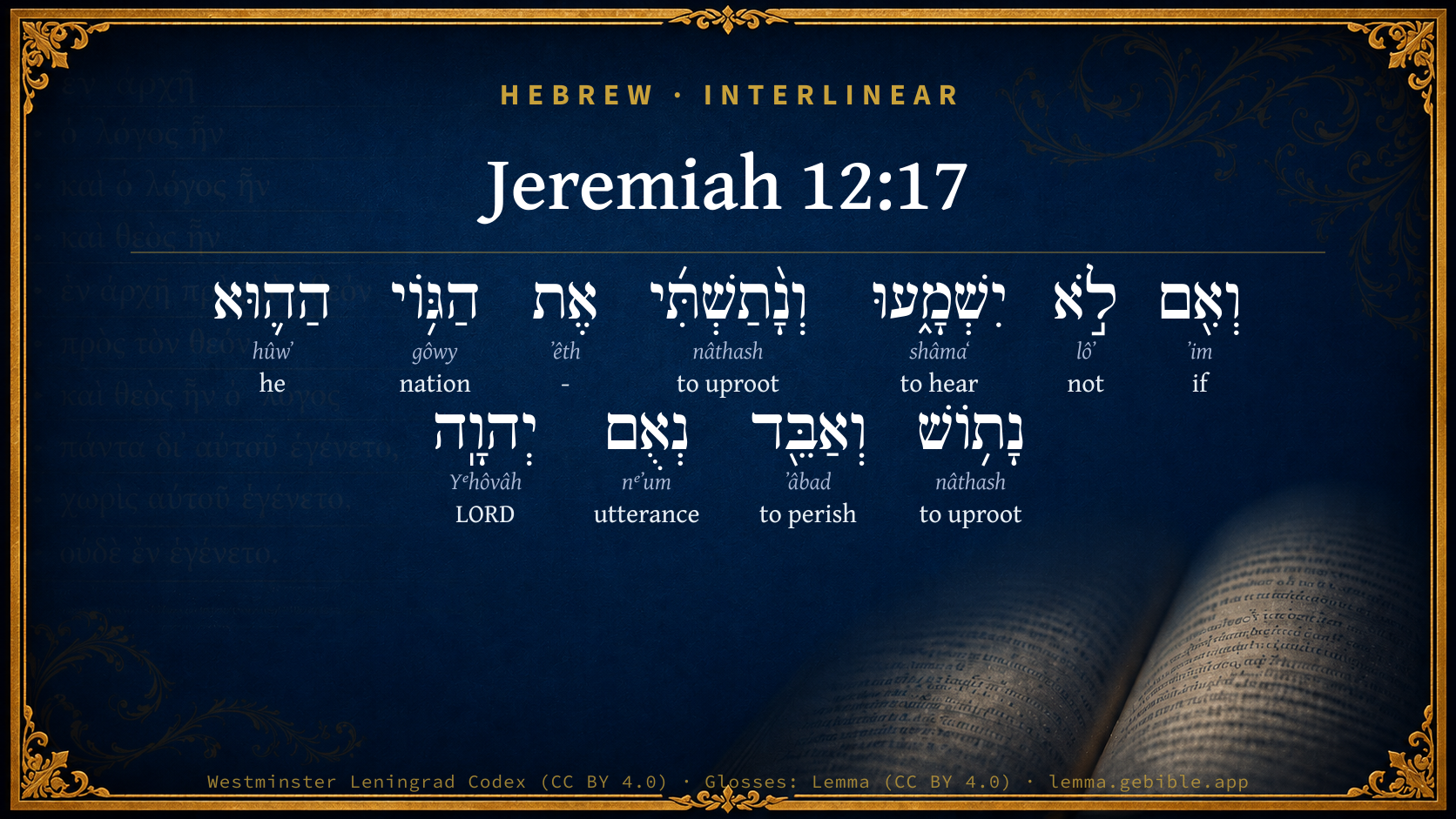
Hebrew (Westminster Leningrad Codex) Jeremiah 12:17 appears in the Hebrew Old Testament. The text above is from the Westminster Leningrad Codex. Each word links to its Strong’s number, a concise gloss, and parsing drawn from the Open Scriptures Hebrew Bible morphology. Click any word for its full Brown-Driver-Briggs (BDB) entry.
Download image
Cite this verse

Jeremiah 12:17 (World English Bible). Public Domain. Lemma interlinear Bible study tool, https://lemma.gebible.app/v/jeremiah/12/17.

Show BibTeX & RIS
BibTeX
RIS
English Translation
But if they will not hear, then will I pluck up that nation, plucking up and destroying it, says Yahweh.
World English Bible · Public Domain
Download a study sheet

One document with this verse’s original text, its word-by-word gloss line, the meaning frame, cross-references with their text, attributed commentary, and full source and license credits — printable, and it pastes into notes with its structure intact.

This verse Autodidact and up

Study sheet (.html) Plain text (.txt)

A passage Seminary Student

Up to 50 verses in one chapter. A passage sheet keeps up to 6 commentary sources and 12 cross-references per verse, in the order this page ranks them, and says so on the sheet whenever that leaves anything out. Ask for a single verse and you get the Autodidact verse sheet above.

Everything on this page stays free to read, with no account — the sheet is a download of what is already on screen, not access to it.

Want to remove ads? Support Godless Engineer
Compare translations 3

The same verse in 3 English versions, stacked beneath the original-language interlinear above. Click any original word for its lexicon entry.

Each is an independent rendering of the whole verse — the interlinear is not word-aligned to these translations.

Highlighted words mark where these versions differ — a whole-verse word diff, not a word-by-word alignment.

  • World English Bible Public Domain
    But if they will not hear, then will I pluck up that nation, plucking up and destroying it, says Yahweh.
  • King James Version Public Domain
    But if they will not obey, I will utterly pluck up and destroy that nation, saith the LORD.
  • unfoldingWord Literal Text CC BY-SA 4.0
    But if they do not listen, then I will pluck up that nation, to pluck up and destroy”—the declaration of Yahweh.

unfoldingWord Literal Text — © unfoldingWord, licensed CC BY-SA 4.0. Word-aligned USFM3 via Door43 (git.door43.org/unfoldingWord/en_ult).

Versions to compare (up to 4)

3 of 4 selected

Show all 18 translations

Every available English version of this verse, each an independent rendering of the whole verse.

  • World English Bible Public Domain
    But if they will not hear, then will I pluck up that nation, plucking up and destroying it, says Yahweh.
  • Berean Standard Bible Public Domain
    But if they will not obey, then I will uproot that nation; I will uproot it and destroy it, declares the LORD.”
  • Majority Standard Bible Public Domain
    But if they will not obey, then I will uproot that nation; I will uproot it and destroy it, declares the LORD.”
  • King James Version Public Domain
    But if they will not obey, I will utterly pluck up and destroy that nation, saith the LORD.
  • American Standard Version (1901) Public Domain
    But if they will not hear, then will I pluck up that nation, plucking up and destroying it, saith Jehovah.
  • Revised Version (1885) Public Domain
    But if they will not hear, then will I pluck up that nation, plucking up and destroying it, saith the LORD.
  • Geneva Bible (1599) Public Domain
    But if they will not obey, then will I vtterly plucke vp, and destroy that nation, sayeth the Lord.
  • Douay-Rheims (1899) Public Domain
    But if they will not hear, I will utterly pluck out and destroy that nation, saith the Lord.
  • Young's Literal Translation Public Domain
    And if they do not hearken, Then I have plucked up that nation, Plucking up and destroying, An affirmation of Jehovah!'
  • Literal Standard Version CC BY-SA 4.0
    And if they do not listen, || Then I have plucked up that nation, || Plucking up and destroying,” || A declaration of YHWH!
  • Unlocked Literal Bible CC BY-SA 4.0
    But if any do not listen, then I will uproot that nation. It will certainly be uprooted and destroyed—this is Yahweh's declaration.”
  • unfoldingWord Literal Text CC BY-SA 4.0
    But if they do not listen, then I will pluck up that nation, to pluck up and destroy”—the declaration of Yahweh.
  • Darby Bible Public Domain
    And if they will not obey, I will utterly pluck up and destroy that nation, saith Jehovah.
  • World Messianic Bible Public Domain
    But if they will not hear, then I will pluck up that nation, plucking up and destroying it,” says the LORD.
  • Webster's Bible Public Domain
    But if they will not obey, I will utterly pluck up and destroy that nation, saith the LORD.
  • Free Bible Version CC BY-SA 4.0
    But if they refuse to obey, then I will not only uproot that nation but I will completely destroy it, declares the Lord.
  • Bible in Basic English Public Domain
    But if they will not give ear, then I will have that nation uprooted, and given to destruction, says the Lord.
  • JPS Tanakh (1917) Public Domain
    But if they will not hearken, then will I pluck up that nation, plucking up and destroying it, saith the LORD.

Literal Standard Version (2020), Covenant Press — licensed CC BY-SA 4.0. Text via the HelloAO Bible API (eBible.org). Unlocked Literal Bible (unfoldingWord) — licensed CC BY-SA 4.0. Text via the HelloAO Bible API (eBible.org). unfoldingWord Literal Text — © unfoldingWord, licensed CC BY-SA 4.0. Word-aligned USFM3 via Door43 (git.door43.org/unfoldingWord/en_ult). Free Bible Version, Dr. Jonathan Gallagher — licensed CC BY-SA 4.0. Text via the HelloAO Bible API (eBible.org).

Word by word

More ways to search: Search by grammar → Find every occurrence → Compare this word →

Practice this passage: Drill this verse → Learn its vocabulary →

וְנָ֨תַשְׁתִּ֜י
nâthash
H5428
“and · to uproot”
Conjunction + Verb, Qal, Sequential Perfect, 1st Person, Common, Singular
Part of Speech
Conjunction + Verb
Stem
Qal
Form
Sequential Perfect
Person
1st Person
Gender
Common
Number
Singular
Full BDB Definition

Origin: a primitive root

TWOT: 1451

to pull up, expel, root out, pluck up - (Qal) to pull or pluck up - (Niphal) to be plucked up - (Hophal) to be plucked up
  1. וְאִ֖ם ʼim H518 “and · if” Conjunction + Conjunction
  2. לֹ֣א lôʼ H3808 “not” Particle, Negative
  3. יִשְׁמָ֑עוּ shâmaʻ H8085 “to hear” Verb, Qal, Imperfect, 3rd Person, Masculine, Plural
  4. אֶת ʼêth H853 “-” Particle, Direct Object
  5. הַגּ֥וֹי gôwy H1471 “the · nation” Particle, Definite Article + Noun, Common, Masculine, Singular, Absolute
  6. הַה֛וּא hûwʼ H1931 “the · he” Particle, Definite Article + Pronoun, Personal, 3rd Person, Masculine, Singular
  7. נָת֥וֹשׁ nâthash H5428 “to uproot” Verb, Qal, Infinitive Absolute
  8. וְאַבֵּ֖ד ʼâbad H6 “and · to perish” Conjunction + Verb, Piel, Infinitive Absolute
  9. נְאֻם nᵉʼum H5002 “utterance of” Noun, Common, Masculine, Singular, Construct
  10. יְהוָֽה Yᵉhôvâh H3068 “LORD” Noun, Proper

About this verse

These counts appear in no published source. They are computed here, from the morphology-tagged text and Lemma’s own curated glosses. What Lemma adds →

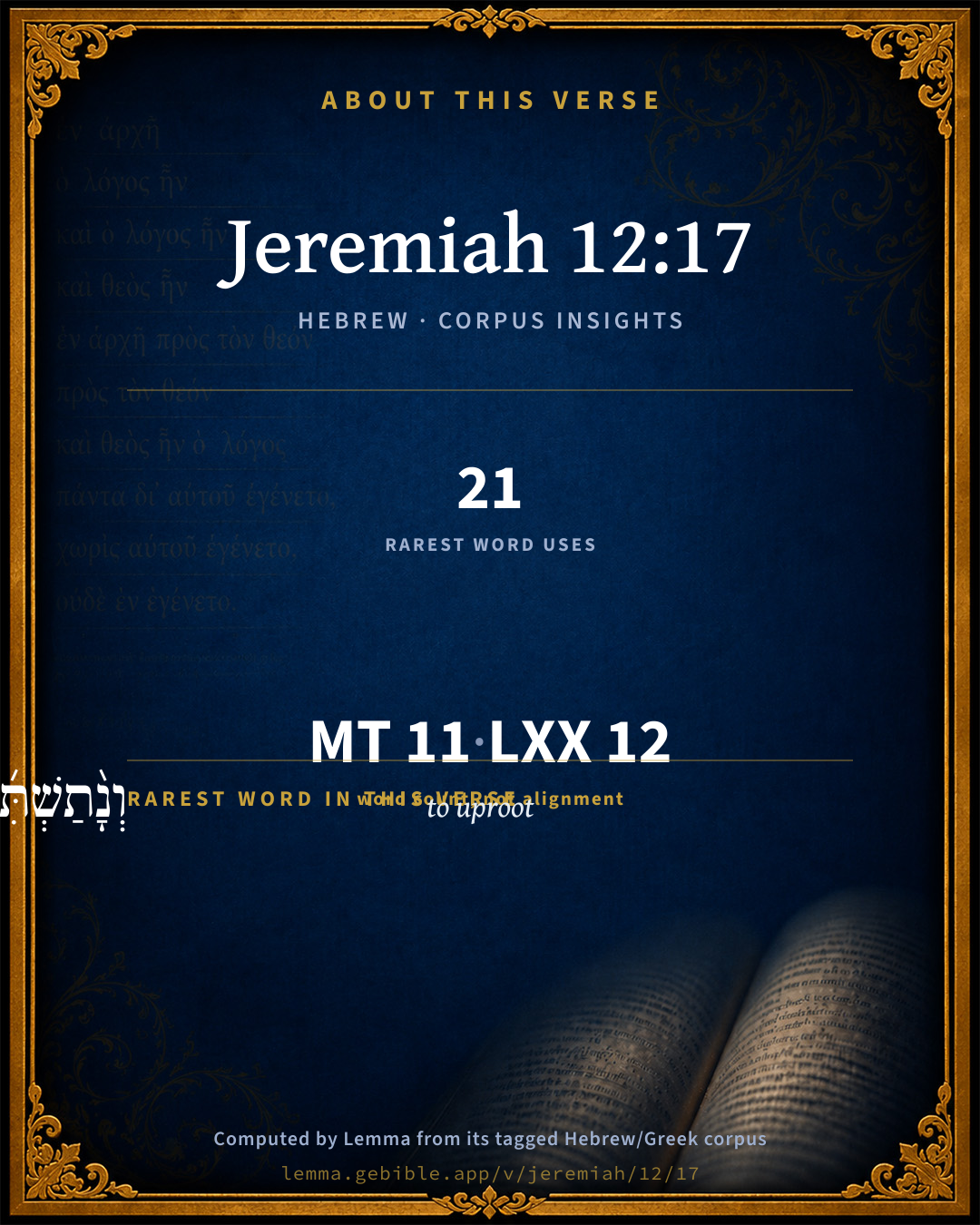
11
words
10
distinct lemmas
Prophets
section

Notable vocabulary

The rarest word here is וְנָ֨תַשְׁתִּ֜י to uproot H5428 — appearing just 21 times in the whole Hebrew Bible.

Shared distinctive vocabulary

וְנָ֨תַשְׁתִּ֜י to uproot H5428 occurs in 19 verses of the Hebrew Bible. Also found in:

Grammatical profile

  • 4 verbs
  • 3 nouns
  • 1 pronoun
  • 1 conjunction
  • 2 particles

Verb forms

  • יִשְׁמָ֑עוּ Qal · Imperfect
  • וְנָ֨תַשְׁתִּ֜י Qal · Sequential Perfect
  • נָת֥וֹשׁ Qal · Infinitive Absolute
  • וְאַבֵּ֖ד Piel · Infinitive Absolute

Repetition

A word recurs within this verse — often emphatic in Hebrew:

  • וְנָ֨תַשְׁתִּ֜י to uproot H5428 ×2

Hebrew & Septuagint length

In the original languages it is 11 Hebrew tokens and 12 Greek tokens — but the two are counted differently (Hebrew bundles its prefixes and suffixes into one token; the Greek is in lemma form), so that isn’t a like-for-like length.

Cross-references

12

Topical passages linked to Jeremiah 12:17 in the Treasury of Scripture Knowledge — connected by theme and wording, ordered by reader-vote popularity; previews shown in the World English Bible.

  • Isaiah 60:12 For that nation and kingdom that will not serve you shall perish; yes, those nations shall be utterly wasted.
  • Psalms 2:8–12 Ask of me, and I will give the nations for your inheritance, The uttermost parts of the earth for your possession.
  • Jeremiah 12:14–17 Thus says Yahweh against all my evil neighbors, who touch the inheritance which I have caused my people Israel to inherit: behold, I will pluck them up from off their land, and will pluck up the house of Judah from among them.
  • Jeremiah 18:7 At what instant I shall speak concerning a nation, and concerning a kingdom, to pluck up and to break down and to destroy it;
  • Jeremiah 31:28 It shall happen that, like as I have watched over them to pluck up and to break down and to overthrow and to destroy and to afflict, so will I watch over them to build and to plant, says Yahweh.
  • Ezekiel 19:12 But it was plucked up in fury, it was cast down to the ground, and the east wind dried up its fruit: its strong rods were broken off and withered; the fire consumed them.
  • Daniel 7:4–8 The first was like a lion, and had eagle's wings: I saw until the wings of it were plucked, and it was lifted up from the earth, and made to stand on two feet as a man; and a man's heart was given to it.
  • Daniel 11:4 When he shall stand up, his kingdom shall be broken, and shall be divided toward the four winds of the sky, but not to his posterity, nor according to his dominion with which he ruled; for his kingdom shall be plucked up, even for others besides these.
  • Zechariah 14:16–19 It will happen that everyone who is left of all the nations that came against Jerusalem will go up from year to year to worship the King, Yahweh of Hosts, and to keep the feast of tents.
  • Luke 19:27 But bring those enemies of mine who didn't want me to reign over them here, and kill them before me.'"
  • 2 Thessalonians 1:8 giving vengeance to those who don't know God, and to those who don't obey the Gospel of our Lord Jesus,
  • 1 Peter 2:6–8 Because it is contained in Scripture, "Behold, I lay in Zion a chief cornerstone, chosen, and precious: He who believes in him will not be disappointed."

Cross-references courtesy of OpenBible.info (CC BY 4.0).

Hebrew and Greek witnesses Masoretic Hebrew ↔ Greek Septuagint

The same verse in the two great witnesses to the Old Testament, shown verse-for-verse.

These are two independent witnesses, not word-aligned to each other, and the Septuagint is shown in lemma (dictionary) form.

Hebrew Jeremiah 12:17 Masoretic · Westminster Leningrad Codex

וְאִ֖ם לֹ֣א יִשְׁמָ֑עוּ וְנָ֨תַשְׁתִּ֜י אֶת הַגּ֥וֹי הַה֛וּא נָת֥וֹשׁ וְאַבֵּ֖ד נְאֻם יְהוָֽה

But if they will not hear, then will I pluck up that nation, plucking up and destroying it, says Yahweh.

World English Bible · Public Domain

Greek LXX Structure differs

In the Septuagint, Jeremiah is about an eighth shorter than the Hebrew and arranges its material differently — the Oracles Against the Nations (Hebrew chapters 46–51) appear in the middle of the Greek book, after 25:13. Because the chapter and verse boundaries do not line up, a verse-for-verse comparison with the Hebrew is not shown.

A verse-for-verse comparison isn’t shown here because the chapters and verses don’t line up. Switch to the LXX edition with the MT / LXX toggle above to read the Greek directly.

Hebrew: Westminster Leningrad Codex (CC BY 4.0). Greek: Septuagint (public domain); English from a public-domain English Septuagint. How the Septuagint differs from the Hebrew →

Targum (Aramaic paraphrase)

1

The Targum is the ancient Jewish Aramaic paraphrase of the Hebrew Scriptures — an interpretive translation, not the Hebrew text itself. Onkelos (literal) and Pseudo-Jonathan (expansive) render the Torah, and Jonathan the Prophets. Coverage is partial: where no permissively-licensed English translation exists for a verse, only the Aramaic is shown. This is verse-level text, not a word-by-word alignment to the Hebrew.

  1. Targum Jonathan Prophets (Joshua–Malachi)
    וְאִם לָא יְקַבְּלוּן אוּלְפַן וֶאֱטַלְטֵל יַת עַמָא הָדֵין טִלְטוּל דְאָבְדַן אֲמַר יְיָ:

    (no public-domain English translation for this verse)

    Targum Jonathan — Aramaic: “Mikraot Gedolot” (public domain). English: “Sefaria Community Translation” (CC0 1.0 (public-domain dedication)); “London "Chaldee Paraphrase," 1871” (public domain). Text via Sefaria.

Commentary

Notes on Jeremiah 12:17 from classic Christian and Jewish commentators (each source and its license shown beneath its notes). The classic Christian expositions comment on the surrounding passage and are grouped to its opening verse, so a note may address several verses; the Jewish commentaries on the Tanakh (Rashi and others) are per-verse, so they appear only where the commentator wrote on this verse.

Lemma curates 59 commentaries, every one of them public domain or Creative Commons licensed, each selected and text-cleaned for this edition rather than reprinted as found. About our sources →

Trapp's Complete Commentary

John Trapp

Jer 12:17 But if they will not obey, I will utterly pluck up and destroy that nation, saith the LORD.

Ver. 17. But if they will not obey.] The tartness of the threatening maketh us best taste the sweetness of the promise, and a mixture of them serves to keep the heart in the best temper.

I will utterly pluck up and destroy that nation.] This is fulfilled to the utmost upon the Jews, especially since the last destruction of Jerusalem.

John Trapp, A Commentary or Exposition upon All the Books of the Old and New Testament (1647–1656) — public domain. Text from a community e-Sword module.

Tyndale Open Study Notes

Tyndale Open Resources

12:17 If these nations refused to obey the Lord, they would be uprooted and destroyed (1:10). • I, the Lord, have spoken: This statement gave God’s declaration the force of a divine decree.

Tyndale Open Study Notes — © Tyndale Open Resources, licensed CC BY-SA 4.0. Text via the HelloAO Bible API.

Jamieson, Fausset & Brown

Robert Jamieson, A. R. Fausset & David Brown

(Isa 60:12).

Many of these figurative acts being either not possible, or not probable, or decorous, seem to have existed only in the mind of the prophet as part of his inward vision. [So CALVIN]. The world he moved in was not the sensible, but the spiritual, world. Inward acts were, however, when it was possible and proper, materialized by outward performance but not always, and necessarily so. The internal act made a naked statement more impressive and presented the subject when extending over long portions of space and time more concentrated. The interruption of Jeremiah's official duty by a journey of more than two hundred miles twice is not likely to have literally taken place.

Next: Jeremiah Chapter 13

Jamieson, Fausset & Brown — Commentary Critical and Explanatory on the Whole Bible (1871) — public domain (CC PDM 1.0). Text via the HelloAO Bible API.

Adam Clarke's Commentary

Verse 17. I will - destroy that nation] Several of them did not obey, and are destroyed. Of the Moabites, Ammonites, and Chaldeans, not one vestige remains. The sixteenth verse is supposed to be a promise of the conversion of the Gentiles. See Eph 2:13-22.

From the thirteenth verse to the end is a different discourse, and Dahler supposes it to have been delivered in the seventh or eighth year of the reign of Jehoiakim.

Adam Clarke's Commentary on the Bible (1810–1826) — public domain. Text from a community e-Sword/MySword module.

John Calvin's Commentaries

As he had shewn that there was a sure hope of salvation to his own people, when the Gentiles would embrace his mercy, so he now threatens the Gentiles with destruction in case they repented not; for he had promised to be merciful to the Gentiles conditionally, and said, — “If they learn the ways of my people, if they submit to my authority:” but now he says, if they will not hear, etc We hence see that God here threatens extreme vengeance to the Gentiles if they subjected not themselves to his yoke, so as to render obedience to him. His object, no doubt, was to terrify the Jews as well as the nations; for as the Gentiles could not with impunity despise God, though unknown to them, how inexcusable would the Jews be, who had from their infancy imbibed the true knowledge of the law, if, after the manner of the Gentiles, they were perverse and intractable?

We in short see that God, on one side, sweetly allured the Jews to render a wining obedience to his law, and, on the other, he threatened them; for as he could by no means bear with the perverseness of the Gentiles, much less could the Jews hope to escape punishment. This is the import of the passage. Now follows another prophecy —

John Calvin's Commentaries (1540-1563) — public domain. Text from the Calvin Translation Society English edition (1840s-50s) via the Christian Classics Ethereal Library (ccel.org). Calvin's coverage is partial (roughly two-thirds of the Bible); uncommented books and verses are honest gaps, never fabricated. The 19th-century editor's footnotes and remarks are omitted so the notes are faithfully Calvin's own voice.

Ellicott's Commentary for English Readers

(17) I will utterly pluck up.—In this, as in the preceding verse, there is an obvious reference to the prophet’s calling as described in Jer_1:10, the self-same word being used as that which is there rendered “root out.” The adverb “utterly” answers to the usual Hebrew reduplication of emphasis.

A Bible Commentary for English Readers, edited by Charles John Ellicott (1878–1897) — public domain. Text from a community e-Sword module.

John Gill's Exposition

But if they will not obey,.... Or "hear" (k); the word of the Lord, and hearken to the ministers of the Gospel, and be subject to the ordinances of it; or as the Targum,

"will not receive instruction:''

I will utterly pluck up and destroy that nation, saith the Lord: root it up from being a nation, strip it of all its privileges and enjoyments, and destroy it with an everlasting destruction; see Zac 14:16.

(k) "audierint", V. L. Pagninus, Montanus; "audient", Cocceius.

Next: Jeremiah Chapter 13

John Gill's Exposition of the Whole Bible (1746–1763) — public domain (CC PDM 1.0). Text via the HelloAO Bible API.

Matthew Poole's English Annotations

But for those, whether they be Jews or Gentiles, that shall continue in their idolatrous and superstitious courses, that shall refuse the Messias, and continue in unbelief, and go on in courses of rebellion and disobedience, (saith God,) I will utterly destroy that people. Thus Isa 60:12, The nation and kingdom that will not serve thee shall perish; yea, those nations shall be utterly wasted.

Matthew Poole's English Annotations on the Holy Bible (1683–1685) — public domain. Text from a community e-Sword/MySword module.

Lesson kit

Teaching starters — assembled from the data on this page, not authored interpretation. Every prompt links to the verse data it draws on. Edit before teaching.

Jeremiah, in the Prophets, opens this verse with 11 words (10 distinct Hebrew lemmas). Its most distinctive word is nâthash (“to uproot”). A historical commentator’s framing appears above. Read the whole chapter for the surrounding context.

Discussion questions

  1. The word nâthash carries the sense “to uproot.” How does it shape the verse?
  2. Deuteronomy 29:28 shares the word «to uproot» with this verse. How do the two illuminate each other?
  3. “to uproot” occurs 2× in this one verse. What is the effect of the repetition?
  4. These translations render this verse differently. What is at stake in choosing one wording over another?
  5. The verb «יִשְׁמָ֑עוּ» is Qal Imperfect. How does its form color the action?
  6. Reading how Trapp's Complete Commentary and Tyndale Open Study Notes read this verse, where do the two commentators agree and where do they part?

Things to notice

Reading settings

Reading text

Shown beneath each verse's original-language words.

Old Testament
Old Testament edition

Read the OT as the Masoretic Hebrew (MT) or the Greek Septuagint (LXX).

English shown for the Greek Septuagint (in the Hebrew ↔ Greek comparison).

Comparing translations? Open the Compare panel on any verse page to stack up to four side by side.