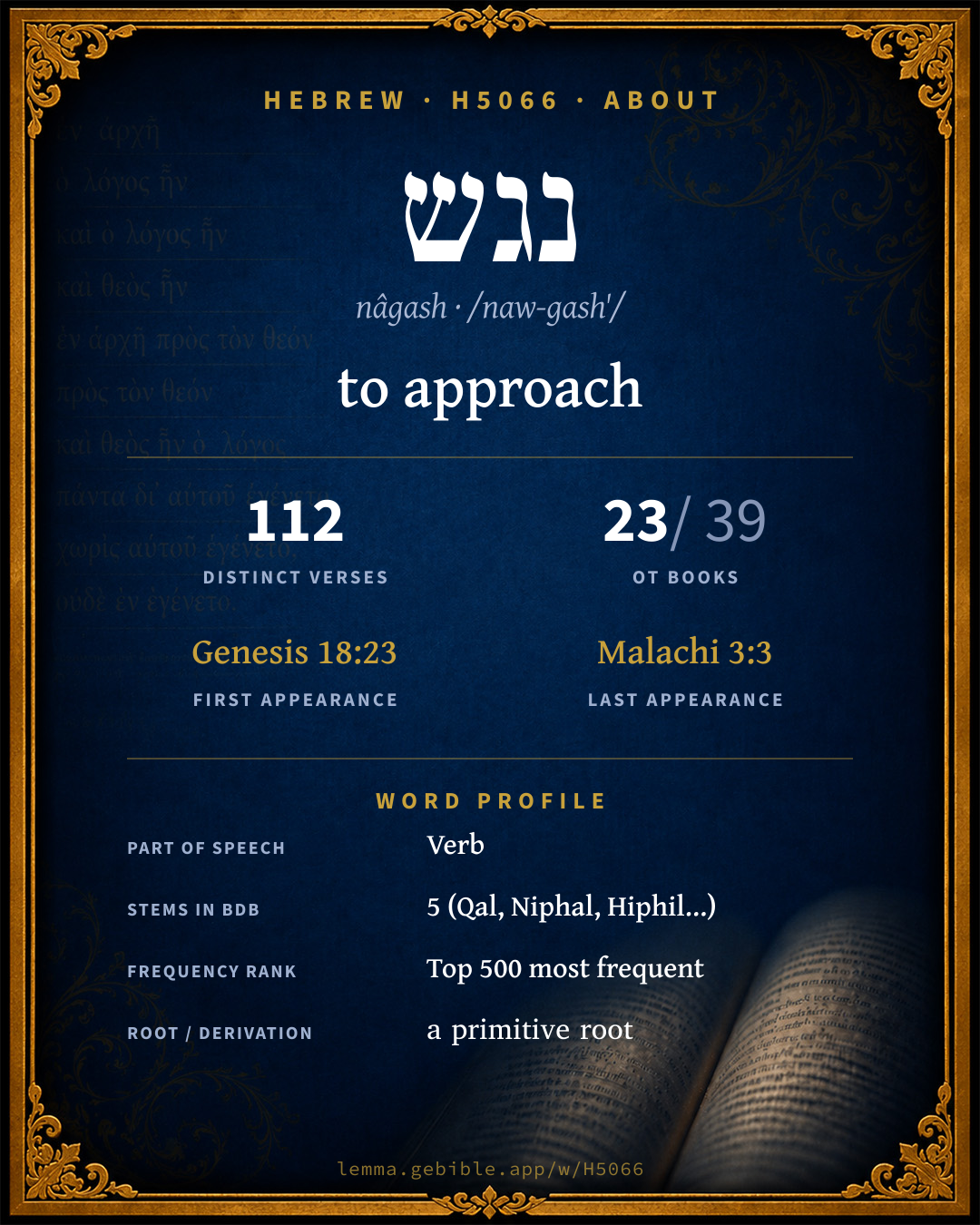
נָגַשׁ
to approach
‘to approach’ is one of 6 main senses fuller range ↓
Full lexicon entry — Brown-Driver-Briggs (BDB)
From Brown-Driver-Briggs (BDB)
Where this word appears
See every Qal verb in the Hebrew Bible →
Grammar key — what these labels mean
Part of speech
- Verb
- An action or state-of-being word.
Stem
- Qal
- The basic, simple active stem — the plain form of the verb (“he wrote”). Here: ‘human subj.’
- Hiphil
- The causative active stem (“he caused / brought about”).
- Niphal
- Usually the simple passive or reflexive of the Qal (“he was written”).
- Hophal
- The passive counterpart of the Hiphil (“he was caused to…”).
- Hithpael
- The reflexive or reciprocal stem (the subject acts on itself).
Form
- Sequential Imperfect
- An imperfect with prefixed waw — the standard past-narrative form (waw-consecutive imperfect).
- Imperfect
- An incomplete, ongoing, or future action (“he will / would write”).
- Imperative
- A direct command (“write!”).
- Sequential Perfect
- A perfect with prefixed waw continuing a preceding imperfect or command (waw-consecutive perfect).
- Infinitive Construct
- A bound verbal noun, frequently with prepositions (“to write / in writing”).
- Perfect
- A completed action or state — Hebrew marks aspect (completeness) more than strict tense (“he wrote”).
- Participle Active
- A verbal adjective expressing ongoing or characteristic action (“writing / one who writes”).
- Jussive
- A third- or second-person volitional form expressing wish or command (“let him write”).
- Participle Passive
- A verbal adjective expressing action received (“written”).
State
- Absolute
- The independent form of a noun, not bound to a following word.
- Construct
- A noun bound to a following noun in a possessive / “of” relationship (the construct chain).
Person
- 3rd Person
- The one spoken about (“he / she / it / they”).
- 2nd Person
- The one addressed (“you”).
Gender
- Masculine
- Grammatically masculine.
- Common
- Either gender — not distinguished for this form.
- Feminine
- Grammatically feminine.
Number
- Singular
- One.
- Plural
- More than one (in Hebrew, generally three or more).
63 distinct verses where H5066 appears in the Qal stem, across 20 books. Filtered view — show all forms. Click any verse to open its interlinear word-by-word view. Verse text shown in the World English Bible for context — . Each verse’s Hebrew form is shown with its reference; the English is not keyword-highlighted, since the data carries no word-level English alignment. Use “Compare translations” on any verse to read it across multiple English versions. This concordance covers the Hebrew Bible; Septuagint (Greek Old Testament) occurrences are not indexed here.
Genesis 13 verses
- Genesis 18:23 וַ/יִּגַּ֥שׁ conj + Qal wimpf 3ms Abraham drew near, and said, "Will you consume the righteous with the wicked?
- Genesis 19:9 גֶּשׁ וַֽ/יִּגְּשׁ֖וּ Qal impv 2ms conj + Qal wimpf 3mp They said, "Stand back!" They said, "This one fellow came in to live as a foreigner, and he appoints himself a judge. Now will we deal worse with you, than with them!" They pressed hard on the man, even Lot, and drew near to break the door.
- Genesis 27:21 גְּשָׁ/ה Qal impv 2ms + sfx h Isaac said to Jacob, "Please come near, that I may feel you, my son, whether you are really my son Esau or not."
- Genesis 27:22 וַ/יִּגַּ֧שׁ conj + Qal wimpf 3ms Jacob went near to Isaac his father. He felt him, and said, "The voice is Jacob's voice, but the hands are the hands of Esau."
- Genesis 27:26 גְּשָׁ/ה Qal impv 2ms + sfx h His father Isaac said to him, "Come near now, and kiss me, my son."
- Genesis 27:27 וַ/יִּגַּשׁ֙ conj + Qal wimpf 3ms He came near, and kissed him. He smelled the smell of his clothing, and blessed him, and said, "Behold, the smell of my son Is as the smell of a field which Yahweh has blessed.
- Genesis 29:10 וַ/יִּגַּ֣שׁ conj + Qal wimpf 3ms It happened, when Jacob saw Rachel the daughter of Laban, his mother's brother, and the sheep of Laban, his mother's brother, that Jacob went near, and rolled the stone from the well's mouth, and watered the flock of Laban his mother's brother.
- Genesis 33:3 גִּשְׁתּ֖/וֹ Qal inf.cs + sfx pers 3ms He himself passed over in front of them, and bowed himself to the ground seven times, until he came near to his brother.
- Genesis 33:6 וַ/תִּגַּ֧שְׁןָ conj + Qal wimpf 3fp Then the handmaids came near with their children, and they bowed themselves.
- Genesis 33:7 וַ/תִּגַּ֧שׁ נִגַּ֥שׁ conj + Qal wimpf 3fs Niphal pf 3ms Leah also and her children came near, and bowed themselves. After them, Joseph came near with Rachel, and they bowed themselves.
- Genesis 43:19 וַֽ/יִּגְּשׁוּ֙ conj + Qal wimpf 3mp They came near to the steward of Joseph's house, and they spoke to him at the door of the house,
- Genesis 44:18 וַ/יִּגַּ֨שׁ conj + Qal wimpf 3ms Then Judah came near to him, and said, "Oh, my lord, please let your servant speak a word in my lord's ears, and don't let your anger burn against your servant; for you are even as Pharaoh.
- Genesis 45:4 גְּשׁוּ וַ/יִּגָּ֑שׁוּ Qal impv 2mp conj + Qal wimpf 3mp Joseph said to his brothers, "Come near to me, please." They came near. "He said, I am Joseph, your brother, whom you sold into Egypt.
Exodus 6 verses
- Exodus 19:15 תִּגְּשׁ֖וּ Qal juss 2mp He said to the people, "Be ready by the third day. Don't have sexual relations with a woman."
- Exodus 24:2 וְ/נִגַּ֨שׁ יִגָּ֑שׁוּ conj + Niphal wpf 3ms Qal impf 3mp Moses alone shall come near to Yahweh, but they shall not come near, neither shall the people go up with him."
- Exodus 24:14 יִגַּ֥שׁ Qal impf 3ms He said to the elders, "Wait here for us, until we come again to you. Behold, Aaron and Hur are with you. Whoever is involved in a dispute can go to them."
- Exodus 28:43 בְ/גִשְׁתָּ֤/ם prep + Qal inf.cs + sfx pers 3mp They shall be on Aaron, and on his sons, when they go in to the tent of meeting, or when they come near to the altar to minister in the holy place; that they don't bear iniquity, and die: it shall be a statute forever to him and to his descendants after him.
- Exodus 30:20 בְ/גִשְׁתָּ֤/ם prep + Qal inf.cs + sfx pers 3mp When they go into the tent of meeting, they shall wash with water, that they not die; or when they come near to the altar to minister, to burn an offering made by fire to Yahweh.
- Exodus 34:30 מִ/גֶּ֥שֶׁת prep + Qal inf.cs When Aaron and all the children of Israel saw Moses, behold, the skin of his face shone; and they were afraid to come near him.
Leviticus 2 verses
- Leviticus 21:21 יִגַּ֔שׁ יִגַּ֖שׁ Qal impf 3ms Qal impf 3ms no man of the seed of Aaron the priest, who has a blemish, shall come near to offer the offerings of Yahweh made by fire. Since has a blemish, he shall not come near to offer the bread of his God.
- Leviticus 21:23 יִגַּ֖שׁ Qal impf 3ms He shall not come near to the veil, nor come near to the altar, because he has a blemish; that he may not profane my sanctuaries, for I am Yahweh who sanctifies them.'"
Numbers 3 verses
- Numbers 4:19 בְּ/גִשְׁתָּ֖/ם prep + Qal inf.cs + sfx pers 3mp but thus do to them, that they may live, and not die, when they approach to the most holy things: Aaron and his sons shall go in, and appoint them everyone to his service and to his burden;
- Numbers 8:19 בְּ/גֶ֥שֶׁת prep + Qal inf.cs I have given the Levites as a gift to Aaron and to his sons from among the children of Israel, to do the service of the children of Israel in the Tent of Meeting, and to make atonement for the children of Israel; that there be no plague among the children of Israel, when the children of Israel come near to the sanctuary."
- Numbers 32:16 וַ/יִּגְּשׁ֤וּ conj + Qal wimpf 3mp They came near to him, and said, We will build sheepfolds here for our cattle, and cities for our little ones:
Joshua 4 verses
- Joshua 3:9 גֹּ֣שׁוּ Qal impv 2mp Joshua said to the children of Israel, Come here, and hear the words of Yahweh your God.
- Joshua 8:11 וַֽ/יִּגְּשׁ֔וּ conj + Qal wimpf 3mp All the people, [even] the [men of] war who were with him, went up, and drew near, and came before the city, and encamped on the north side of Ai: now there was a valley between him and Ai.
- Joshua 14:6 וַ/יִּגְּשׁ֨וּ conj + Qal wimpf 3mp Then the children of Judah drew near to Joshua in Gilgal: and Caleb the son of Jephunneh the Kenizzite said to him, You know the thing that Yahweh spoke to Moses the man of God concerning me and concerning you in Kadesh-barnea.
- Joshua 21:1 וַֽ/יִּגְּשׁ֗וּ conj + Qal wimpf 3mp Then came near the heads of fathers' [houses] of the Levites to Eleazar the priest, and to Joshua the son of Nun, and to the heads of fathers' [houses] of the tribes of the children of Israel;
Judges 2 verses
- Judges 9:52 וַ/יִּגַּ֛שׁ conj + Qal wimpf 3ms Abimelech came to the tower, and fought against it, and drew near to the door of the tower to burn it with fire.
- Judges 20:23 לָ/גֶ֨שֶׁת֙ prep + Qal inf.cs The children of Israel went up and wept before Yahweh until even; and they asked of Yahweh, saying, Shall I again draw near to battle against the children of Benjamin my brother? Yahweh said, Go up against him.
Ruth 1 verse
1 Samuel 5 verses
- 1 Samuel 9:18 וַ/יִּגַּ֥שׁ conj + Qal wimpf 3ms Then Saul drew near to Samuel in the gate, and said, Tell me, Please, where the seer's house is.
- 1 Samuel 14:38 גֹּ֣שֽׁוּ Qal impv 2mp Saul said, Draw near here, all you chiefs of the people; and know and see in which this sin has been this day.
- 1 Samuel 17:16 וַ/יִּגַּ֥שׁ conj + Qal wimpf 3ms The Philistine drew near morning and evening, and presented himself forty days.
- 1 Samuel 17:40 וַ/יִּגַּ֖שׁ conj + Qal wimpf 3ms He took his staff in his hand, and chose him five smooth stones out of the brook, and put them in the shepherd's bag which he had, even in his wallet; and his sling was in his hand: and he drew near to the Philistine.
- 1 Samuel 30:21 וַ/יִּגַּ֤שׁ conj + Qal wimpf 3ms David came to the two hundred men, who were so faint that they could not follow David, whom also they had made to abide at the brook Besor; and they went forth to meet David, and to meet the people who were with him: and when David came near to the people, he greeted them.
2 Samuel 2 verses
1 Kings 6 verses
- 1 Kings 18:21 וַ/יִּגַּ֨שׁ conj + Qal wimpf 3ms Elijah came near to all the people, and said, "How long will you waver between the two sides? If Yahweh is God, follow him; but if Baal, then follow him." The people answered him not a word.
- 1 Kings 18:30 גְּשׁ֣וּ וַ/יִּגְּשׁ֥וּ Qal impv 2mp conj + Qal wimpf 3mp Elijah said to all the people, Come near to me; and all the people came near to him. He repaired the altar of Yahweh that was thrown down.
- 1 Kings 18:36 וַ/יִּגַּ֞שׁ conj + Qal wimpf 3ms It happened at the time of the offering of the [evening] offering, that Elijah the prophet came near, and said, Yahweh, the God of Abraham, of Isaac, and of Israel, let it be known this day that you are God in Israel, and that I am your servant, and that I have done all these things at your word.
- 1 Kings 20:22 וַ/יִּגַּ֤שׁ conj + Qal wimpf 3ms The prophet came near to the king of Israel, and said to him, Go, strengthen yourself, and mark, and see what you do; for at the return of the year the king of Syria will come up against you.
- 1 Kings 20:28 וַ/יִּגַּ֞שׁ conj + Qal wimpf 3ms A man of God came near and spoke to the king of Israel, and said, Thus says Yahweh, Because the Syrians have said, Yahweh is a god of the hills, but he is not a god of the valleys; therefore will I deliver all this great multitude into your hand, and you shall know that I am Yahweh.
- 1 Kings 22:24 וַ/יִּגַּשׁ֙ conj + Qal wimpf 3ms Then Zedekiah the son of Chenaanah came near, and struck Micaiah on the cheek, and said, Which way went the Spirit of Yahweh from me to speak to you?
2 Kings 3 verses
- 2 Kings 2:5 וַ/יִּגְּשׁ֨וּ conj + Qal wimpf 3mp The sons of the prophets who were at Jericho came near to Elisha, and said to him, "Do you know that Yahweh will take away your master from your head today?" He answered, "Yes, I know it. Hold your peace."
- 2 Kings 4:27 וַ/יִּגַּ֨שׁ conj + Qal wimpf 3ms When she came to the man of God to the hill, she caught hold of his feet. Gehazi came near to thrust her away; but the man of God said, Let her alone: for her soul is vexed within her; and Yahweh has hid it from me, and has not told me.
- 2 Kings 5:13 וַ/יִּגְּשׁ֣וּ conj + Qal wimpf 3mp His servants came near, and spoke to him, and said, My father, if the prophet had bid you do some great thing, wouldn't you have done it? how much rather then, when he says to you, Wash, and be clean?
1 Chronicles 1 verse
2 Chronicles 2 verses
- 2 Chronicles 18:23 וַ/יִּגַּשׁ֙ conj + Qal wimpf 3ms Then Zedekiah the son of Chenaanah came near, and struck Micaiah on the cheek, and said, Which way went the Spirit of Yahweh from me to speak to you?
- 2 Chronicles 29:31 גֹּ֧שׁוּ Qal impv 2mp Then Hezekiah answered, Now you have consecrated yourselves to Yahweh; come near and bring sacrifices and thank-offerings into the house of Yahweh. The assembly brought in sacrifices and thank-offerings; and as many as were of a willing heart [brought] burnt offerings.
Ezra 1 verse
Job 1 verse
Psalms 1 verse
Isaiah 4 verses
- Isaiah 41:1 יִגְּשׁוּ֙ Qal impf 3mp Keep silence before me, islands; and let the peoples renew their strength: let them come near; then let them speak; let us come near together to judgment.
- Isaiah 49:20 גְּשָׁ/ה Qal impv 2ms + sfx h The children of your bereavement shall yet say in your ears, The place is too small for me; give place to me that I may dwell.
- Isaiah 50:8 יִגַּ֥שׁ Qal impf 3ms He is near who justifies me; who will bring charges against me? Let us stand up together: who is my adversary? Let him come near to me.
- Isaiah 65:5 תִּגַּשׁ Qal juss 2ms who say, Stand by yourself, don't come near to me, for I am holier than you. These are a smoke in my nose, a fire that burns all the day.
Jeremiah 3 verses
- Jeremiah 30:21 וְ/נִגַּ֣שׁ לָ/גֶ֥שֶׁת conj + Niphal wpf 3ms prep + Qal inf.cs Their prince shall be of themselves, and their ruler shall proceed from the midst of them; and I will cause him to draw near, and he shall approach to me: for who is he who has had boldness to approach to me? says Yahweh.
- Jeremiah 42:1 וַֽ/יִּגְּשׁוּ֙ conj + Qal wimpf 3mp Then all the captains of the forces, and Johanan the son of Kareah, and Jezaniah the son of Hoshaiah, and all the people from the least even to the greatest, came near,
- Jeremiah 46:3 וּ/גְשׁ֖וּ conj + Qal impv 2mp Prepare you the buckler and shield, and draw near to battle.
Ezekiel 2 verses
- Ezekiel 9:6 תִּגַּ֔שׁוּ Qal juss 2mp kill utterly the old man, the young man and the virgin, and little children and women; but don't come near any man on whom is the mark: and begin at my sanctuary. Then they began at the old men that were before the house.
- Ezekiel 44:13 יִגְּשׁ֤וּ וְ/לָ/גֶ֨שֶׁת֙ Qal impf 3mp conj + prep + Qal inf.cs They shall not come near to me, to execute the office of priest to me, nor to come near to any of my holy things, to the things that are most holy; but they shall bear their shame, and their abominations which they have committed.
Joel 1 verse
About this entry
At a glance — auto-summarized from this page’s data, not written by a person. Every figure links to its source below. This summary describes the numbers; it doesn’t interpret them.
נגש — transliterated nâgash — is a Hebrew verb carrying the sense “to approach.” Where the King James Version says “came near,” newer translations reach for “approached” (Berean Standard Bible) and “and” (unfoldingWord Literal Text); the renderings breakdown has the detail. The Hebrew Bible uses it across 112 verses — common. Debuting at Genesis 18:23, it then recurs through the corpus. As a verb its force shifts by stem, across 5 stems (Qal, Niphal, and more). See the sense tree, 112-verse concordance, and the renderings breakdown below.
Gloss history
Strong's 1890 vs modern scholarship

About this word
Strong's H5066 catalogs a Hebrew word from the Hebrew Old Testament.
These counts are not copied from any lexicon or concordance. They are computed here, from the morphology-tagged Hebrew Old Testament. What Lemma adds →
- 112
- distinct verses
- The word appears in 112 distinct verses.
- 23 / 39
- OT books
- The word appears in 23 of 39 Old Testament books.
- #352
- by frequency
- Top 500 most frequent Hebrew words (rank 352 of 8,640 Hebrew words by occurrence).
View all 112 occurrences in the concordance →
By section of the Old Testament
By traditional corpus
Conventional, traditional groupings — biblical authorship is debated, so this is a traditional corpus grouping, not an authorship claim. Each share is this word’s portion of its verses in that division of the Hebrew canon. Each figure is a share of the word’s 112 distinct verses.
- Prophets (Nevi'im) 64 verses · 57%
- Torah (Pentateuch) 38 verses · 34%
- Writings (Ketuvim) 10 verses · 9%
How translations render this word
Counts come from each version’s own published word-to-Strong’s tagging or interlinear alignment — an approximate guide to how each version renders this word, not a word-level alignment the data otherwise carries. Because each total is that version’s own tagged count, the per-version totals vary from one another and need not match the appearance or distinct-verse counts above. These counts may also differ from a printed concordance because Lemma counts each distinctly tagged rendering and does not collapse phrase taggings into a single head-word total. This is a fixed set of word-tagged versions (KJV, ASV, BSB, ULT) and does not change with the reading translation you choose elsewhere. Each version’s license is shown beside its name below (and on Sources).
- King James Version: Came near 12×, Come near 8×, Came 7×
- American Standard Version: Came near 10×, Came 6×, Drew near 6×
- Berean Standard Bible: Approached 18×, Approach 7×, Come near 6×
- unfoldingWord Literal Text: And 16×, Approached 14×, Came near 11×
King James Version Public Domain
Renders H5066 across 127 tagged occurrences — most commonly:
Plus other, less common renderings. Plus 63 renderings that appear only once — usually multi-word phrases or single function words the recovered tagging swept in, not distinct renderings.
American Standard Version Public Domain
Renders H5066 across 124 tagged occurrences — most commonly:
Plus other, less common renderings. Plus 63 renderings that appear only once — usually multi-word phrases or single function words the recovered tagging swept in, not distinct renderings.
Berean Standard Bible Public Domain
Renders H5066 across 123 tagged occurrences — most commonly:
Plus other, less common renderings. Plus 58 renderings that appear only once — usually multi-word phrases or single function words the recovered tagging swept in, not distinct renderings. Not rendered by a distinct English word in 2 further occurrences.
unfoldingWord Literal Text CC BY-SA 4.0
Renders H5066 across 173 tagged occurrences — most commonly:
Plus other, less common renderings. Plus 62 renderings that appear only once — usually multi-word phrases or single function words the recovered tagging swept in, not distinct renderings.
7 senses and sub-senses in the full BDB
Hebrew verbs can shift meaning by stem (binyan): Qal is the basic action, Niphal is often passive or reflexive, Piel often intensifies or makes it factitive, and Hiphil is typically causative. The senses below are grouped under the stem BDB assigns to each. This entry also uses Hophal (the passive of Hiphil) and Hithpael (reflexive or reciprocal).
What do BDB’s symbols mean?
BDB uses these scholarly abbreviations:
| Symbol | Meaning |
|---|---|
| 𝔊 | the Septuagint (the ancient Greek translation, LXX) |
| 𝔙 | the Vulgate (the Latin translation) |
| 𝔖 | the Syriac version (the Peshitta) |
| 𝔗 | the Targum (the Aramaic translation) |
| ψ | the Psalms |
| √ | root (the underlying root or stem) |
| ‖ | parallel passage (a synonymous or contrasted parallel) |
| † | the dagger: every passage where the word occurs is cited |
The 7 senses and sub-senses the full Brown-Driver-Briggs lexicon distinguishes for this word, in lexicon order (not ranked by frequency), with BDB’s own verbatim wording and sub-sense lettering. Shown in Hebrew script with BDB’s own scholarly abbreviations. The condensed entry is in the Lexicon Entry tab. See also the Forms in the corpus table below.
Qal
- Impf. יִגַּשׁ Ex 24:14 +, יִגָּ֑שׁ ψ 91:7, וַיִּגַּשׁ Gn 18:23 +; 3 fs. וַתִּגַּשׁ Gn 33:7; 2 ms. תִּגַּשׁ־ Is 65:5; 3 mpl. יִגְּשׁוּ Is 41:1 +, יִגָּ֑שׁוּ Ex 24:2, יִגַּ֑שׁוּ Jb 41:8 (Baer; van d. H. יִגָּ֑שׁוּ); 3 fpl. וַתִּגַּשְׁןָ Gn 33:6, etc.; Imv. גַּשׁ 2 S 1:15, גֶּשׁ־ Gn 19:9, גְּשָׁה Gn 27:21 +; גֹּשִׁי Ru 2:14, וּגְשׁוּ Je 46:3 גּשׁוּ Jos 3:9; Inf. cstr. לָגֶ֫שֶׁת Ju 20:23 +; sf. גִּשְׁתּוֹ Gn 33:3; גִּשְׁתָּם Ex 28:43 + 2 times;—draw or come near, e.g. Exodus 24:14
- 1. human subj.: sq. אֶל־ pers. Gn 27:22; 43:19; 44:18; 45:4 (all J), Ex 19:15 (of sexual intercourse), 24:2 Nu 32:16; Jos 14:6 (all E), Ex 34:30; Jos 21:1 (P), + 10 times elsewhere (not D), + ψ 91:7 (subj. pestilence personif.); of priestly approach to י׳ Ez 44:13, cf. Je 30:21b, also sq. אֶל־ of altar Ex 28:43; 30:20; Lv 21:23 and abs., v 21 (all P or H); sq. אֶל־ rei also Nu 8:19; sq. עַד־ pers. Gn 33:3 (J), rei Ju 9:52; sq. עַל־ pers. Ez 9:6, rei 44:13; sq. בְּ pers. Is 65:5 (‖ קָרַב אֶל־); in Am 9:10 read תִּגַּשׁ בַּעֲדֵנוּ (for MT תַּגִּישׁ Hiph. cf. We GASm Dr Now; ‖ קִדֵּם); sq. לַמִּלְחָמָה draw near for battle Ju 20:23; Je 46:3; 2 S 10:13 = 1 Ch 19:14 (+ לִפְנֵי pers.); sq. acc. pers. 1 S 9:18; 30:21, rei Nu 4:19 (P), but acc. difficult; Dr reads אֶל־ for אֶת־ 1 S 9:18 Nu 4:19, cf. Klo HPS; in 1 S 30:21 Dr takes אֶת־ = with; sq. הֲלוֹם hither, 1 S 14:38 Ru 2:14; abs. Gn 18:23; 27:21; 29:10; 33:6, 7; 45:4 (all J), Ex 24:2 (E), Jos 8:11 (E; + ויבאו), + 9 times (not P, D), + Gn 27:26, 27 (E), Jos 3:9 (J), 2 S 1:15; 2 Ch 29:31 (all Imv. sq. 2nd Imv.), + Gn 19:9 (J), Lv 21:21(×2) (H), 2 K 4:27 (all sq. Inf. purpose). Note especially גֶּשׁ־הָ֫לְאָה Gn 19:9 lit. approach thither! i.e. move away! cf. גְּשָׁה־לִי וְאֵשֵׁ֑בָה Is 49:20 move away for me (make room for me) that I may dwell (‖ צַר־לִי הַמָּקוֹם). e.g. Genesis 27:22
- 2. inanim. subj. אֶחָד בְּאֶחָד יִגַּ֑שׁוּ Jb 41:8 one to another they approach (fit closely together; of scales of crocodile).—Qal not in D. e.g. Job 41:8
Niphal
- Pf. נִגַּשׁ Gn 33:7 +; 3 fs. וְנִגְּשָׁה Dt 25:9; 3 mpl. נִגְּשׁוּ Ex 34:32 +; נִגַּשְׁתֶּם 2 S 11:20, 21; Pt. pl. נִגָּשִׁים Ex 19:22;—draw near = Qal (and substit. for it in D):—sq. אֶל־ pers. Dt 25:9; 1 K 20:13; Ezr 9:1, of priestly approach to Yahweh Ex 19:22 (J), Je 30:21; sq. אֶל־ rei Ex 20:21; 24:2 (both E), 2 S 11:20, 21, אֶל־הַמִּשְׁפָּט Dt 25:1; sq. בְּ pers. Am 9:13; sq. לַמִּלְחָמָה 1 S 7:10; abs. Gn 33:7 (J), Dt 20:2 (‖ קרב), 21:5; Ex 34:32 (P), so fig. of worship Is 29:13. e.g. Genesis 33:7
Hiphil
- Pf. 3 ms. sf. consec. וְהִגִּישׁוֹ Ex 21:6(×2), וְהִגִּישָׁהּ Lv 2:8; 3 pl. הִגִּ֫ישׁוּ 2 S 17:29; 2 mpl. הִגַּשְׁתֶּם Am 5:25; Impf. juss. יַגֵּשׁ Jb 40:19; וַיַּגֶּשׁ־ Gn 27:25; וַיַּגַּ֑שׁ Ju 6:19; 3 fs. תַּגִּישׁ Am 9:10, וַתַּגֵּשׁ 1 S 28:25; 2 S 13:11; 3 mpl. יַגִּ֫ישׁוּ Is 41:22; 2 mpl. תַּגִּ֫ישׁוּ Mal 1:8, תַּגִּישׁוּן v 8, וַתַּגִּישׁוּן Am 6:3, etc.; Imv. ms. הַגִּ֫ישָׁה Gn 27:25 +; mpl. הַגִּ֫ישׁוּ 1 S 13:9 +; Pt. מַגִּישׁ Mal 2:12; pl. cstr. מַגִּישֵׁי Mal 3:3, etc.;—cause to approach, bring near, bring, sq. אֶל־ pers. (usually obj. acc. rei, rarely pers. Ex 21:6(×2) 1 S 15:32; Gn 48:10 cf. v 13):—Gn 48:10, 13 (E), Ex 21:6(×2) (E), 1 S 13:9; 14:34; 15:32; 2 S 13:11 (+ Inf. purpose), 2 K 4:5, 6; sq. אֶל־הַמִּזְבֵּחַ Lv 2:8 (P; of sacrifice); עַל־מִזְבְּחִי Mal 1:7 (sacrif.); לְ pers. Gn 27:25(×2) (E), 1 S 30:7; 2 S 17:29 (read וַיַּגִּישׁוּ 𝔊 Th We Klo Kit, cf. Dr), of sacrifice Am 5:25 Mal 2:12; 3:3; לִפְנֵי pers. 1 S 28:25; 2 Ch 29:23; no prep. Ex 32:6 (J), 1 S 14:18, 34; 23:9; 30:7; Ju 6:19 (foll. הוציא אֶל־), Am 6:3; 1 K 5:1; Lv 8:14 (P), of sacrif. also Mal 1:8 (לִזְבֹּחַ), v 8 (‖ הקריב); fig. (obj. proofs, evidences) Is 41:21 (‖ קרב), v 22 (+ וַיַּגִּידוּ), cf. 45:21 (‖ הַגִּידוּ); הָעשֹׁוֹ יַגֵּשׁ חַרְבּוֹ Jb 40:19 let him that made him (the hippot.) draw near his sword, is dub.; Du הֶעָשׂוּ[י] נֹגֵשׂ חֲבֵרָו wh. is made ruler of its fellows (other conject. v. Di Bu); Am 9:10 read תִּגַּשׁ Qal q.v.). e.g. Exodus 21:6
Hophal
- Pf. 3 mpl. לֹא־לִנְחֻשְׁתַּיִם הֻנַּ֑שׁוּ 2 S 3:34 (Ginsb הֻנָּ֑שׁוּ) thy feet have not been brought near (put into) fetters; Pt. מֻגָּשׁ לשׁמי Mal 1:11 it (impers.) is offered to my name. e.g. 2 Samuel 3:34
Hithpael
- Imv. mpl. הִתְנַגְּשׁוּ Is 45:20 draw near! (‖ הִקָּֽבְצוּ וָבֹאוּ). e.g. Isaiah 45:20
Senses from the full Brown-Driver-Briggs lexicon (Brown, Driver, Briggs; Oxford 1906 — public domain), digitized via Sefaria, supplemented by the OpenScriptures HebrewLexicon (CC BY 4.0). Full attribution on Sources.
Word origin
vb. draw near, approach, less freq. syn. of קרב q.v. (NH id. Hiph. (rare) and deriv.);—
— Brown-Driver-Briggs (Oxford 1906, public domain), digitized via Sefaria, supplemented by the OpenScriptures HebrewLexicon (CC BY 4.0). See Sources.
Origin: a primitive root
Jastrow Dictionary
A second Hebrew/Aramaic lexicon for comparison, covering Aramaic and post-biblical (Talmudic, Targumic, Midrashic) usage that the biblical-Hebrew BDB does not. Matched by lemma rather than by Strong’s number, so a lemma may carry more than one Jastrow headword (shown separately below), and the entries cover usage well beyond the Bible.
נָגַשׁ
- (b. h.) also Nif. נִגַּשׁ to come in contact; to draw near. Yalk. Ps. 842 (ref. to יגש, Ps. XCI, 7) אין אחד מהם נִגָּשׁ אליך וכ׳ none of them comes to thee, none says, provide for me; Midr. Till. to Ps. XVII, 7 נוֹגֵשׁ אצלך ed. Bub. (oth. ed. נוֹגֵשׂ אותך, v. נָגַשׂ).—Tanḥ. Vayigg. 5 (ref. to Gen. XLIV, 18) שנ׳ בתוכחות he came near (attacked him, v. next w.) with rebukes. Yalk. Gen. 150 (ref. to Gen. l. c.) אין וַיִּגַּשׁ אלא לשון שלום vayyigash has the meaning of (coming near in) peacefulness &c., v. הַגָּשָׁה. e.g. Psalms 91:7
- to bring near. B. Kam. 46ᵇ (ref. to Ex. XXIV, 14) יַגִּישׁ ראיה אליהם (a claimant) must offer evidence &c.; יגיש דבריו וכ׳ must prefer his claims &c., is the first to be heard; a. e. e.g. Exodus 24:14
נְגַשׁ
- , to attack, gore. Targ. Y. Ex. XXI, 28. Ib. 32 (ed. Amst. a. oth. נגח).—[Yalk. Gen. 148, v. נְגַס.]—Part. נָגֵישׁ; f. נְגִישָׁא. Gen. R. s. 80, beg. (prov.) לית תורתא נ׳ עד וכ׳ ‘Rashi’ (ed. ענישא; Ar. עגישא) no cow is a gorer until her calf is a kicker (the mother is judged by her daughter).
נָגַשׂ
- cmp. preced.) to push on, drive, press. Midr. Till. to Ps. XVII, 7 ואין אחד מהם נוֹגֵשׂ אותך וכ׳ none of them presses thee &c., v. נָגַשׁ.—נוֹגֵשׂ task-master. Tanḥ. Sh’moth 9 אותו נ׳ עשוי וכ׳ that taskmaster was appointed over &c.; Ex. R. s. 1 נ׳ ממונה על עשרה שוטרים one (Egyptian) taskmaster was appointed over ten (Israelitish) officers. Lev. R. s. 32 (in Chald. dict.) קרץ נ׳ גבי וכ׳ Ar. (ed. קדם) the taskmaster came early to the officer, saying, go and gather thy men &c.; a. fr.—Pl. נוֹגְשִׂים, נוֹגְשִׂין. Ib.; Ex. R. l. c. Pirké d’R. El. ch. XLVIII נוֹגְשֵׂי פרעה the taskmasters appointed by Pharaoh; a. fr.—Esp. to exact a debt. Macc. 3ᵇ (ref. to Deut. XV, 2) לא קרינן ביה לא יִגּוֹשׂ we do not apply to him (he does not violate the law) ‘he shall not exact’; סוף אתי לידי יגוש he will finally (after the lapse of ten years) transgress &c.—Sifré Deut. 113 (ref. to Deut. XV, 3) ואת אחיך לא תִגּוֹשׂ but thou must not exact of thy brother. e.g. Deuteronomy 15:2
A Dictionary of the Targumim, the Talmud Babli and Yerushalmi, and the Midrashic Literature (Marcus Jastrow; London, Luzac, 1903) — Public Domain. Digitized via Sefaria. Digitized via Sefaria. Full attribution on Sources.
Forms in the corpus
The 105 distinct written forms H5066 takes in the Hebrew Bible, most frequent first — each parse links to that stem’s occurrences in the concordance. Hebrew forms include their vowel points and cantillation, so a single lemma takes many written forms.
The 60 most common forms are shown; 45 rarer forms follow in the full concordance.
Septuagint verse parallels
This word appears in 109 verses that also exist in the Greek Old Testament (Septuagint), out of the 112 Hebrew verses it occurs in. You can read those verses in Greek by switching the Old Testament edition to the Septuagint.
Read these verses in the Septuagint
- Genesis 18:23
- Exodus 19:15
- Leviticus 2:8
- Numbers 4:19
- Deuteronomy 20:2
- Joshua 3:9
- Judges 6:19
- Ruth 2:14
- 1 Samuel 7:10
- 2 Samuel 1:15
- 1 Kings 18:21
- 2 Kings 2:5
This is a verse-level parallel only — the same verses exist in both the Hebrew and Greek Old Testaments. No word-level Hebrew↔Greek correspondence is claimed: the data carries no such alignment, so no Greek word is shown as this Hebrew word’s translation. Coverage is not total — the Septuagint omits the deuterocanon and renumbers the Psalms, so some Hebrew verses have no direct Greek parallel.