
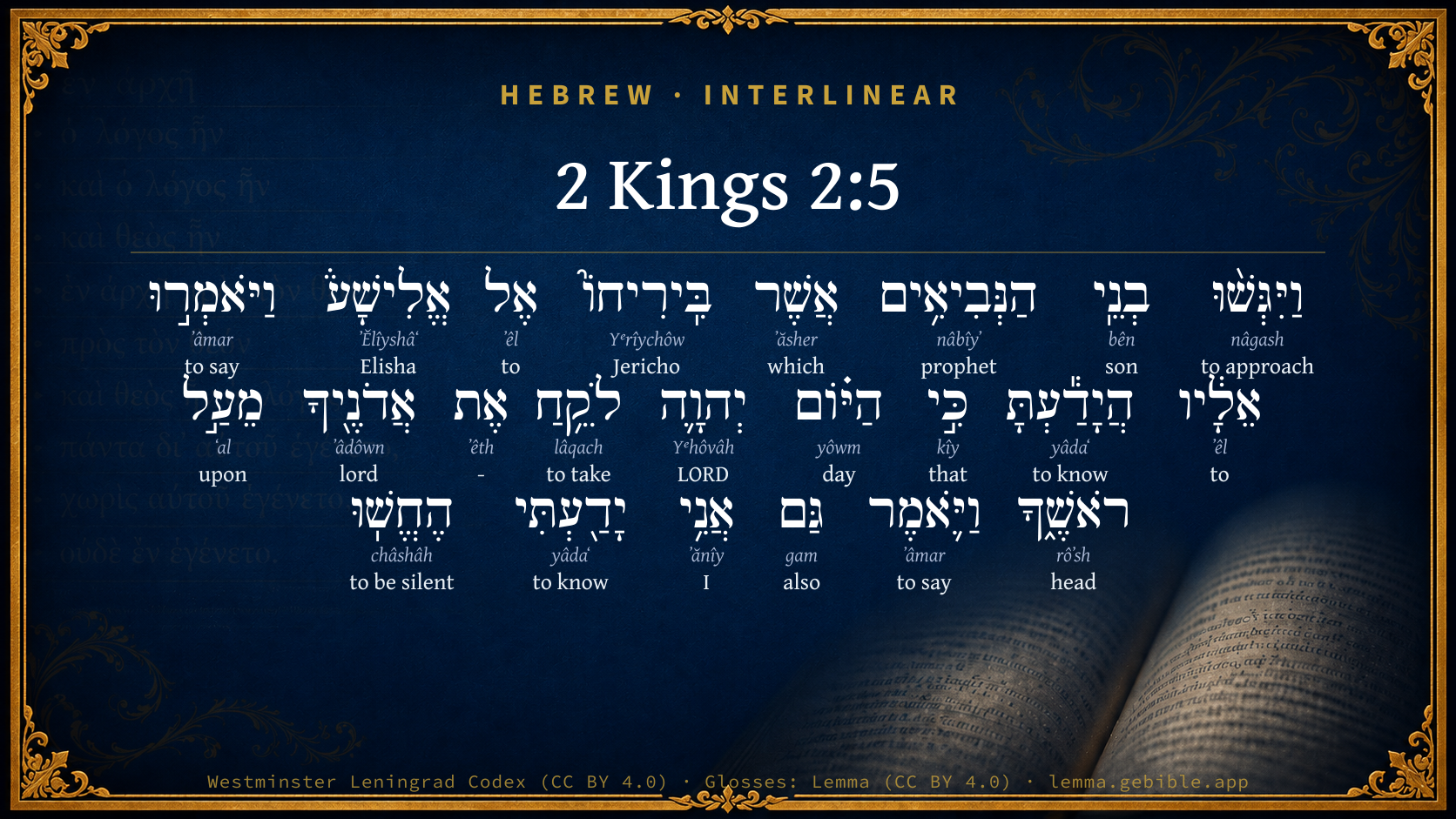
2 Kings 2:5

Hebrew (Westminster Leningrad Codex) 2 Kings 2:5 appears in the Hebrew Old Testament. The text above is from the Westminster Leningrad Codex. Each word links to its Strong’s number, a concise gloss, and parsing drawn from the Open Scriptures Hebrew Bible morphology. Click any word for its full Brown-Driver-Briggs (BDB) entry.
Download image
Cite this verse

2 Kings 2:5 (World English Bible). Public Domain. Lemma interlinear Bible study tool, https://lemma.gebible.app/v/2-kings/2/5.

Show BibTeX & RIS
BibTeX
RIS
English Translation
The sons of the prophets who were at Jericho came near to Elisha, and said to him, "Do you know that Yahweh will take away your master from your head today?" He answered, "Yes, I know it. Hold your peace."
World English Bible · Public Domain
Download a study sheet

One document with this verse’s original text, its word-by-word gloss line, the meaning frame, cross-references with their text, attributed commentary, and full source and license credits — printable, and it pastes into notes with its structure intact.

This verse Autodidact and up

Study sheet (.html) Plain text (.txt)

A passage Seminary Student

Up to 50 verses in one chapter. A passage sheet keeps up to 6 commentary sources and 12 cross-references per verse, in the order this page ranks them, and says so on the sheet whenever that leaves anything out. Ask for a single verse and you get the Autodidact verse sheet above.

Everything on this page stays free to read, with no account — the sheet is a download of what is already on screen, not access to it.

Want to remove ads? Support Godless Engineer
Compare translations 3

The same verse in 3 English versions, stacked beneath the original-language interlinear above. Click any original word for its lexicon entry.

Each is an independent rendering of the whole verse — the interlinear is not word-aligned to these translations.

Highlighted words mark where these versions differ — a whole-verse word diff, not a word-by-word alignment.

  • World English Bible Public Domain
    The sons of the prophets who were at Jericho came near to Elisha, and said to him, "Do you know that Yahweh will take away your master from your head today?" He answered, "Yes, I know it. Hold your peace."
  • King James Version Public Domain
    And the sons of the prophets that were at Jericho came to Elisha, and said unto him, Knowest thou that the LORD will take away thy master from thy head to day? And he answered, Yea, I know it; hold ye your peace.
  • unfoldingWord Literal Text CC BY-SA 4.0
    And sons of the prophets who in Jericho drew near to Elisha, and they said to him, “Do you know that today Yahweh is taking your master from over your head?” And he said, “I, I also know. Be quiet.”

unfoldingWord Literal Text — © unfoldingWord, licensed CC BY-SA 4.0. Word-aligned USFM3 via Door43 (git.door43.org/unfoldingWord/en_ult).

Versions to compare (up to 4)

3 of 4 selected

Show all 18 translations

Every available English version of this verse, each an independent rendering of the whole verse.

  • World English Bible Public Domain
    The sons of the prophets who were at Jericho came near to Elisha, and said to him, "Do you know that Yahweh will take away your master from your head today?" He answered, "Yes, I know it. Hold your peace."
  • Berean Standard Bible Public Domain
    Then the sons of the prophets at Jericho came up to Elisha and said, “Do you know that the LORD will take your master away from you today?” “Yes, I know,” he replied. “Do not speak of it.”
  • Majority Standard Bible Public Domain
    Then the sons of the prophets at Jericho came up to Elisha and said, “Do you know that the LORD will take your master away from you today?” “Yes, I know,” he replied. “Do not speak of it.”
  • King James Version Public Domain
    And the sons of the prophets that were at Jericho came to Elisha, and said unto him, Knowest thou that the LORD will take away thy master from thy head to day? And he answered, Yea, I know it; hold ye your peace.
  • American Standard Version (1901) Public Domain
    And the sons of the prophets that were at Jericho came near to Elisha, and said unto him, Knowest thou that Jehovah will take away thy master from thy head to-day? And he answered, Yea, I know it; hold ye your peace.
  • Revised Version (1885) Public Domain
    And the sons of the prophets that were at Jericho came near to Elisha, and said unto him, Knowest thou that the LORD will take away thy master from thy head today? And he answered, Yea, I know it; hold ye your peace.
  • Geneva Bible (1599) Public Domain
    And the children of the Prophets that were at Iericho, came to Elisha, and saide vnto him, Knowest thou, that the Lord will take thy master from thine head this day? And he sayde, Yea, I knowe it: holde ye your peace.
  • Douay-Rheims (1899) Public Domain
    The sons of the prophets that were at Jericho, came to Eliseus, and said to him: Dost thou know that this day the Lord will take away thy master from thee? And he said: I also know it: hold your peace.
  • Young's Literal Translation Public Domain
    And sons of the prophets who `are' in Jericho come nigh unto Elisha, and say unto him, `Hast thou known that to-day Jehovah is taking thy lord from thy head?' and he saith, `I also have known -- keep silent.'
  • Literal Standard Version CC BY-SA 4.0
    And sons of the prophets who [are] in Jericho come near to Elisha, and say to him, “Have you known that today YHWH is taking your lord from your head?” And he says, “I also have known—keep silent.”
  • Unlocked Literal Bible CC BY-SA 4.0
    Then the sons of the prophets who were at Jericho came to Elisha and said to him, “Do you know that Yahweh will take away your master from you today?” Elisha answered, “Yes, I know it, but do not talk about it.”
  • unfoldingWord Literal Text CC BY-SA 4.0
    And sons of the prophets who in Jericho drew near to Elisha, and they said to him, “Do you know that today Yahweh is taking your master from over your head?” And he said, “I, I also know. Be quiet.”
  • Darby Bible Public Domain
    And the sons of the prophets that were at Jericho drew near to Elisha and said to him, Dost thou know that Jehovah will take away thy master from over thy head to-day? And he said, I also know it: be silent!
  • World Messianic Bible Public Domain
    The sons of the prophets who were at Jericho came near to Elisha, and said to him, “Do you know that the LORD will take away your master from over you today?” He answered, “Yes, I know it. Hold your peace.”
  • Webster's Bible Public Domain
    And the sons of the prophets that were at Jericho came to Elisha, and said to him, Knowest thou that the LORD will take away thy master from thy head to-day? And he answered, Yes, I know it; hold ye your peace.
  • Free Bible Version CC BY-SA 4.0
    The sons of the prophets who lived in Jericho came to Elisha and told him, “You do know that the Lord is going to take your master away from you today, don't you?” “Yes, I know,” he replied. “Don't talk about it.”
  • Bible in Basic English Public Domain
    And at Jericho the sons of the prophets came up to Elisha and said to him, Has it been made clear to you that the Lord is going to take away your master from over you today? And he said in answer, Yes, I have knowledge of it: say no more.
  • JPS Tanakh (1917) Public Domain
    And the sons of the prophets that were at Jericho came near to Elisha, and said unto him: 'Knowest thou that the LORD will take away thy master from thy head to-day?' And he answered: 'Yea, I know it; hold ye your peace.' —

Literal Standard Version (2020), Covenant Press — licensed CC BY-SA 4.0. Text via the HelloAO Bible API (eBible.org). Unlocked Literal Bible (unfoldingWord) — licensed CC BY-SA 4.0. Text via the HelloAO Bible API (eBible.org). unfoldingWord Literal Text — © unfoldingWord, licensed CC BY-SA 4.0. Word-aligned USFM3 via Door43 (git.door43.org/unfoldingWord/en_ult). Free Bible Version, Dr. Jonathan Gallagher — licensed CC BY-SA 4.0. Text via the HelloAO Bible API (eBible.org).

Word by word

More ways to search: Search by grammar → Find every occurrence → Compare this word →

Practice this passage: Drill this verse → Learn its vocabulary →

הֶחֱשֽׁוּ
châshâh
H2814
“be silent”
Verb, Hiphil, Imperative, 2nd Person, Masculine, Plural
Part of Speech
Verb
Stem
Hiphil
Form
Imperative
Person
2nd Person
Gender
Masculine
Number
Plural
Full BDB Definition

Origin: a primitive root

TWOT: 768

to be silent, quiet, still, inactive - (Qal) to be silent, be still - (Hiphil) - to be silent, exhibit silence - to show inactivity, be inactive - to make silent, make quiet, cause to be still
  1. וַיִּגְּשׁ֨וּ nâgash H5066 “and · to approach” Conjunction + Verb, Qal, Sequential Imperfect, 3rd Person, Masculine, Plural
  2. בְנֵֽי bên H1121 “sons of” Noun, Common, Masculine, Plural, Construct
  3. הַנְּבִיאִ֥ים nâbîyʼ H5030 “the · prophets” Particle, Definite Article + Noun, Common, Masculine, Plural, Absolute
  4. אֲשֶׁר ʼăsher H834 “which” Particle, Relative
  5. בִּֽירִיחוֹ֮ Yᵉrîychôw H3405 “in/at · Jericho” Preposition + Noun, Proper
  6. אֶל ʼêl H413 “to” Preposition
  7. אֱלִישָׁע֒ ʼĔlîyshâʻ H477 “Elisha” Noun, Proper
  8. וַיֹּאמְר֣וּ ʼâmar H559 “and · to say” Conjunction + Verb, Qal, Sequential Imperfect, 3rd Person, Masculine, Plural
  9. אֵלָ֔יו ʼêl H413 “to · him” Preposition + Suffix, Personal, 3rd Person, Masculine, Singular
  10. הֲיָדַ֕עְתָּ yâdaʻ H3045 “to know” Particle, Interrogative + Verb, Qal, Perfect, 2nd Person, Masculine, Singular
  11. כִּ֣י kîy H3588 “that” Conjunction
  12. הַיּ֗וֹם yôwm H3117 “the · day” Particle, Definite Article + Noun, Common, Masculine, Singular, Absolute
  13. יְהוָ֛ה Yᵉhôvâh H3068 “LORD” Noun, Proper
  14. לֹקֵ֥חַ lâqach H3947 “taking” Verb, Qal, Participle Active, Masculine, Singular, Absolute
  15. אֶת ʼêth H853 “-” Particle, Direct Object
  16. אֲדֹנֶ֖יךָ ʼâdôwn H113 “lords · your” Noun, Common, Masculine, Plural, Construct + Suffix, Personal, 2nd Person, Masculine, Singular
  17. מֵעַ֣ל ʻal H5921 “from · upon” Preposition + Preposition
  18. רֹאשֶׁ֑ךָ rôʼsh H7218 “head · your” Noun, Common, Masculine, Singular, Construct + Suffix, Personal, 2nd Person, Masculine, Singular
  19. וַיֹּ֛אמֶר ʼâmar H559 “and · to say” Conjunction + Verb, Qal, Sequential Imperfect, 3rd Person, Masculine, Singular
  20. גַּם gam H1571 “also” Particle, Accusative
  21. אֲנִ֥י ʼănîy H589 “I” Pronoun, Personal, 1st Person, Common, Singular
  22. יָדַ֖עְתִּי yâdaʻ H3045 “to know” Verb, Qal, Perfect, 1st Person, Common, Singular

About this verse

These counts appear in no published source. They are computed here, from the morphology-tagged text and Lemma’s own curated glosses. What Lemma adds →

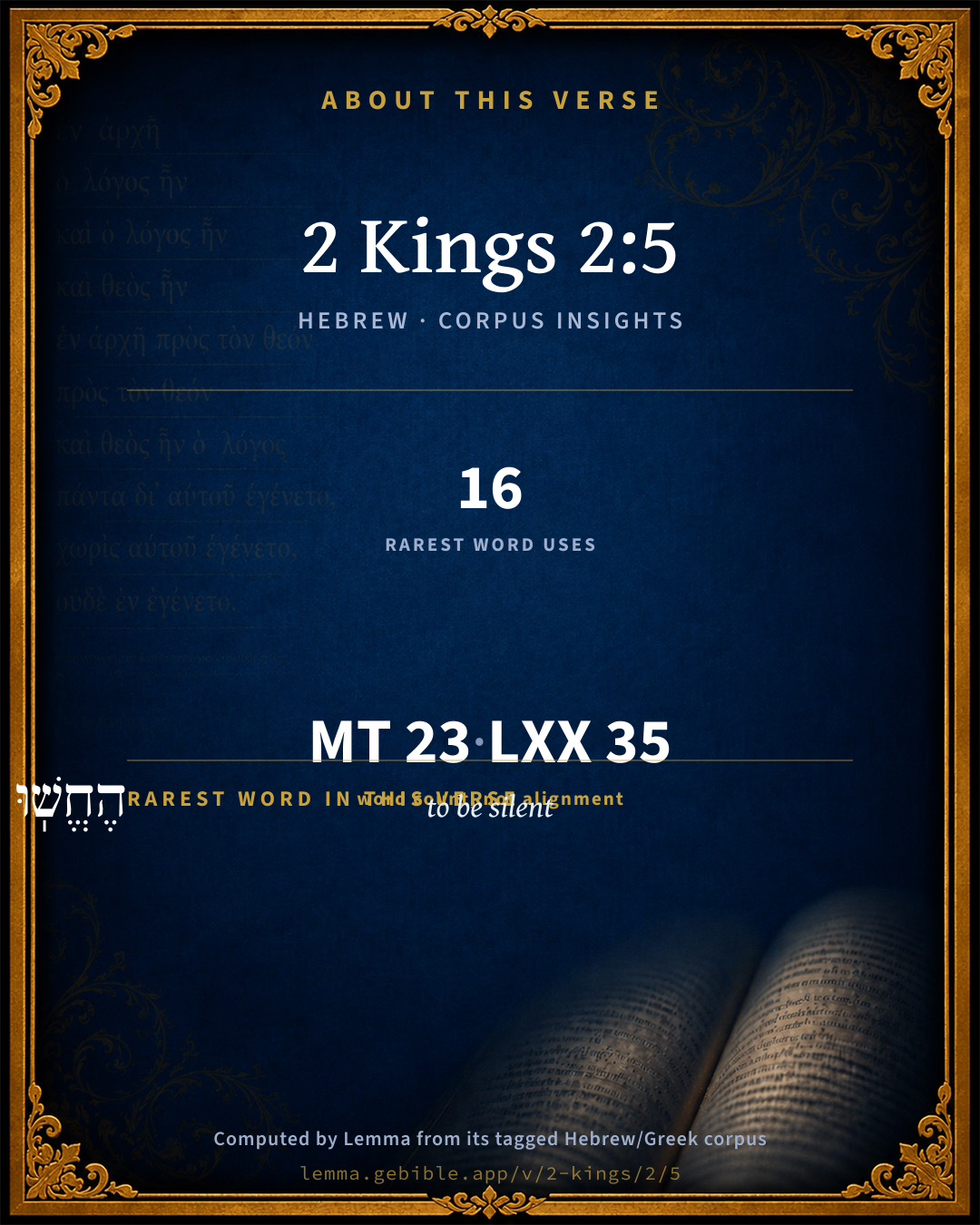
23
words
20
distinct lemmas
Historical
section

Notable vocabulary

The rarest word here is הֶחֱשֽׁוּ to be silent H2814 — appearing just 16 times in the whole Hebrew Bible.

Shared distinctive vocabulary

הֶחֱשֽׁוּ to be silent H2814 occurs in 16 verses of the Hebrew Bible. Also found in:

Grammatical profile

  • 7 verbs
  • 8 nouns
  • 1 pronoun
  • 3 prepositions
  • 1 conjunction
  • 3 particles

Verb forms

  • וַיִּגְּשׁ֨וּ Qal · Sequential Imperfect
  • וַיֹּאמְר֣וּ Qal · Sequential Imperfect
  • הֲיָדַ֕עְתָּ Qal · Perfect
  • לֹקֵ֥חַ Qal · Participle Active
  • וַיֹּ֛אמֶר Qal · Sequential Imperfect
  • יָדַ֖עְתִּי Qal · Perfect
  • הֶחֱשֽׁוּ Hiphil · Imperative

Repetition

Words recur within this verse — often emphatic in Hebrew:

  • וַיֹּאמְר֣וּ to say H559 ×2
  • הֲיָדַ֕עְתָּ to know H3045 ×2
  • אֶל to H413 ×2

Hebrew & Septuagint length

In English translation the verse runs 40 words from the Hebrew and 45 from the Septuagint (LXX English) — closely comparable.

A rough comparison of the two English renderings, which tokenize alike — not a word-level alignment.

Word counts can differ between the Hebrew and the Greek without any difference in meaning — e.g. the Hebrew direct-object marker אֵת has no separate Greek word, and Greek often adds the article ὁ.

In the original languages it is 23 Hebrew tokens and 35 Greek tokens — but the two are counted differently (Hebrew bundles its prefixes and suffixes into one token; the Greek is in lemma form), so that isn’t a like-for-like length.

Cross-references

11

Topical passages linked to 2 Kings 2:5 in the Treasury of Scripture Knowledge — connected by theme and wording, ordered by reader-vote popularity; previews shown in the World English Bible.

  • 2 Kings 2:3 The sons of the prophets who were at Bethel came forth to Elisha, and said to him, "Do you know that Yahweh will take away your master from your head today?" He said, "Yes, I know it; hold your peace."
  • Genesis 48:19 His father refused, and said, "I know, my son, I know. He also will become a people, and he also will be great. However, his younger brother will be greater than he, and his seed will become a multitude of nations."
  • Joshua 1:1–2 Now it happened after the death of Moses the servant of Yahweh, that Yahweh spoke to Joshua the son of Nun, Moses' minister, saying,
  • Ecclesiastes 3:7 A time to tear, And a time to sew; A time to keep silence, And a time to speak;
  • Isaiah 41:1 Keep silence before me, islands; and let the peoples renew their strength: let them come near; then let them speak; let us come near together to judgment.
  • Habakkuk 2:20 But Yahweh is in his holy temple. Let all the earth be silent before him!"
  • Luke 24:51 It happened, while he blessed them, that he withdrew from them, and was carried up into heaven.
  • John 17:5–7 Now, Father, glorify me with your own self with the glory which I had with you before the world existed.
  • Acts 1:2 until the day in which he was received up, after he had given commandment through the Holy Spirit to the apostles whom he had chosen.
  • Acts 1:11 who also said, "You men of Galilee, why do you stand looking into the sky? This Jesus, who was received up from you into the sky will come back in the same way as you saw him going into the sky."
  • Acts 26:25 But he said, "I am not crazy, most excellent Festus, but boldly declare words of truth and reasonableness.

Cross-references courtesy of OpenBible.info (CC BY 4.0).

Hebrew and Greek witnesses Masoretic Hebrew ↔ Greek Septuagint

The same verse in the two great witnesses to the Old Testament, shown verse-for-verse.

These are two independent witnesses, not word-aligned to each other, and the Septuagint is shown in lemma (dictionary) form.

Hebrew 2 Kings 2:5 Masoretic · Westminster Leningrad Codex

וַיִּגְּשׁ֨וּ בְנֵֽי הַנְּבִיאִ֥ים אֲשֶׁר בִּֽירִיחוֹ֮ אֶל אֱלִישָׁע֒ וַיֹּאמְר֣וּ אֵלָ֔יו הֲיָדַ֕עְתָּ כִּ֣י הַיּ֗וֹם יְהוָ֛ה לֹקֵ֥חַ אֶת אֲדֹנֶ֖יךָ מֵעַ֣ל רֹאשֶׁ֑ךָ וַיֹּ֛אמֶר גַּם אֲנִ֥י יָדַ֖עְתִּי הֶחֱשֽׁוּ

The sons of the prophets who were at Jericho came near to Elisha, and said to him, "Do you know that Yahweh will take away your master from your head today?" He answered, "Yes, I know it. Hold your peace."

World English Bible · Public Domain

Greek LXX 2 Kings 2:5 Septuagint · lemma form

καί ἐγγίζω ὁ υἱός ὁ προφήτης ὁ ἐν ιεριχω πρός ελισαιε καί εἶπον πρός αὐτός εἰ γιγνώσκω ὅτι σήμερον λαμβάνω κύριος ὁ κύριος σύ ἐπάνωθεν ὁ κεφαλή σύ καί εἶπον καί γέ ἐγώ γιγνώσκω σιωπάω

And the sons of the prophets who were in Jericho drew near to Elisaie, and said to him, Do you know that the Lord is about to take away your master today from your head? And he said, Yes, I know it; hold your peace.

LXX2012 (modern English Septuagint) · Public Domain

Hebrew: Westminster Leningrad Codex (CC BY 4.0). Greek: Septuagint (public domain); English from LXX2012 (modern English Septuagint) (Public Domain). How the Septuagint differs from the Hebrew →

Targum (Aramaic paraphrase)

1

The Targum is the ancient Jewish Aramaic paraphrase of the Hebrew Scriptures — an interpretive translation, not the Hebrew text itself. Onkelos (literal) and Pseudo-Jonathan (expansive) render the Torah, and Jonathan the Prophets. Coverage is partial: where no permissively-licensed English translation exists for a verse, only the Aramaic is shown. This is verse-level text, not a word-by-word alignment to the Hebrew.

  1. Targum Jonathan Prophets (Joshua–Malachi)
    וּקְרִיבוּ תַלְמִידֵי נְבִיַיָא דִי בִירִיחוֹ לְוַת אֱלִישָׁע וַאֲמַרוּ לֵיהּ הַיְדַעְתָּא אֲרֵי יוֹמָא דֵין יְיָ דְבַר יַת רִבּוֹנָךְ מִנָךְ וַאֲמַר אַף אֲנָא יְדַעְנָא שְׁתוּקוּ:

    (no public-domain English translation for this verse)

    Targum Jonathan — Aramaic: “Mikraot Gedolot” (public domain). English: “Sefaria Community Translation” (CC0 1.0 (public-domain dedication)); “London "Chaldee Paraphrase," 1871” (public domain). Text via Sefaria.

Commentary

Notes on 2 Kings 2:5 from classic Christian and Jewish commentators (each source and its license shown beneath its notes). The classic Christian expositions comment on the surrounding passage and are grouped to its opening verse, so a note may address several verses; the Jewish commentaries on the Tanakh (Rashi and others) are per-verse, so they appear only where the commentator wrote on this verse.

Lemma curates 59 commentaries, every one of them public domain or Creative Commons licensed, each selected and text-cleaned for this edition rather than reprinted as found. About our sources →

Trapp's Complete Commentary

John Trapp

2Ki 2:5 And the sons of the prophets that [were] at Jericho came to Elisha, and said unto him, Knowest thou that the LORD will take away thy master from thy head to day? And he answered, Yea, I know [it]; hold ye your peace.

Ver. 5. And the sons of the prophets.] See ver. 3.

John Trapp, A Commentary or Exposition upon All the Books of the Old and New Testament (1647–1656) — public domain. Text from a community e-Sword module.

Joseph Benson's Commentary

2Ki 2:5. The sons of the prophets that were at Jericho — Here also was a school, where the same revelation had been made to the sons of the prophets, concerning Elijah’s removal, which had been communicated to those at Beth-el. And their thoughts, like the thoughts of the others, were wholly occupied about the extraordinary matter, and big with expectation.

Joseph Benson's Commentary on the Old and New Testaments (1811–1818) — public domain. Text from a community e-Sword module.

Geneva Bible (1599)

Geneva Bible translators

Not only at Bethel, but at Jericho and other places were there Prophets, which had scholars, whom they instructed and brought up in the true fear of God.

Geneva Bible (1599) marginal notes — public domain. Text via Bolls.life.

Ellicott's Commentary for English Readers

(5) Came.—Drew near.

Answered—Said.

A Bible Commentary for English Readers, edited by Charles John Ellicott (1878–1897) — public domain. Text from a community e-Sword module.

John Gill's Exposition

And the sons of the prophets that were at Jericho,.... For though this place was lately rebuilt under a curse to the builder, yet was blessed with a school of the prophets: whose disciples came to Elisha, and said unto him; as in Kg2 2:3 and to whom he made the same reply.

and to whom he made the same reply.

2 Kings 2:6

kg2 2:6

kg2 2:6

kg2 2:6And Elijah said unto him, tarry, I pray thee, here,.... At Jericho, seemingly very desirous to get rid of him, that he might not see his assumption:

for the Lord hath sent me to Jordan: where passing that he was to be taken up:

and he said, &c. Elisha swore, as before, he would not leave him:

and they two went on; to Jordan, which was six miles from Jericho (k).

(k) Travels, &c. p. 205.

John Gill's Exposition of the Whole Bible (1746–1763) — public domain (CC PDM 1.0). Text via the HelloAO Bible API.

Haydock's Catholic Bible Commentary

From thee. Hebrew, "from thy head," thy superior, and raise him into the air, ver. 3. (Calmet)

George Leo Haydock (1774–1849), Haydock's Catholic Family Bible and Commentary, 1859 edition — public domain. Excludes Psalms (Douay-Rheims chapter numbering differs from Protestant) and Deuterocanonical books (Catholic canon only).

The Pulpit Commentary

And the sons of the prophets that were at Jericho came to Elisha, and said unto him; Knowest thou that the Lord will take away thy master from thy head today? And he answered, Yea, I know it. hold ye your peace. At Jericho, too, as well as at Bethel, there was a school of the prophets, though the two places were not more than about twenty miles apart. This would seem to imply the existence of a large number of such seminaries at this period. No doubt, when the secular power was most strongly opposed to true religion, the prophetical order had to make increased efforts to raise its numbers and multiply its schools. The prophets of Israel, it must be remembered, were, after the withdrawal of the priests and Levites, (2Ch_11:13, 2Ch_11:14) the sole teachers of the people in true religion.

The Pulpit Commentary (1880–1919), ed. H.D.M. Spence-Jones & Joseph S. Exell — public domain. Text from a community e-Sword module.

unfoldingWord translationNotes

Door43 World Missions Community

Then the sons of the prophets who were at Jericho came to Elisha and said to him

"When Elijah and Elisha came near Jericho, the sons of the prophets who were from there said to Elisha"

the sons of the prophets

This does not mean that they were the sons of prophets, but rather, that they were a group of prophets. See how you translated this phrase in 2 Kings 2:3. AT: "the group of men who were prophets" (See: Idiom)

As Yahweh lives, and as you live, I will not leave you

"As surely as Yahweh lives and as you live, I will not leave you." Here Elisha compares the certainty that Yahweh and Elijah are alive to the certainty of what he is saying. This is a way of making a solemn promise. See how you translated this phrase in 2 Kings 2:2. AT: "I solemnly promise you that I will not leave you" (See: Simile)

translationWords

Jordan River

unfoldingWord translationNotes — © Distant Shores Media and the Door43 World Missions Community, licensed CC BY-SA 4.0. Source: git.door43.org/Door43/en_tn.

Lesson kit

Teaching starters — assembled from the data on this page, not authored interpretation. Every prompt links to the verse data it draws on. Edit before teaching.

2 Kings, in the Historical, opens this verse with 23 words (20 distinct Hebrew lemmas). Its most distinctive word is châshâh (“to be silent”). A historical commentator’s framing appears above. Read the whole chapter for the surrounding context.

Discussion questions

  1. The word châshâh carries the sense “to be silent.” How does it shape the verse?
  2. How does Judges 18:9, which shares the word «to be silent», read alongside this verse?
  3. What does the repetition of “to say” (2× in this one verse) do in this verse?
  4. The translations on this page render this verse differently — a whole-verse word diff, not a word-by-word alignment. What might account for the different wordings?
  5. «וַיִּגְּשׁ֨וּ» is a Qal Sequential Imperfect verb. How does that grammatical form shape the action described?
  6. Compare how Trapp's Complete Commentary and Joseph Benson's Commentary read this verse. Where do they agree or differ?

Things to notice

Reading settings

Reading text

Shown beneath each verse's original-language words.

Old Testament
Old Testament edition

Read the OT as the Masoretic Hebrew (MT) or the Greek Septuagint (LXX).

English shown for the Greek Septuagint (in the Hebrew ↔ Greek comparison).

Comparing translations? Open the Compare panel on any verse page to stack up to four side by side.