
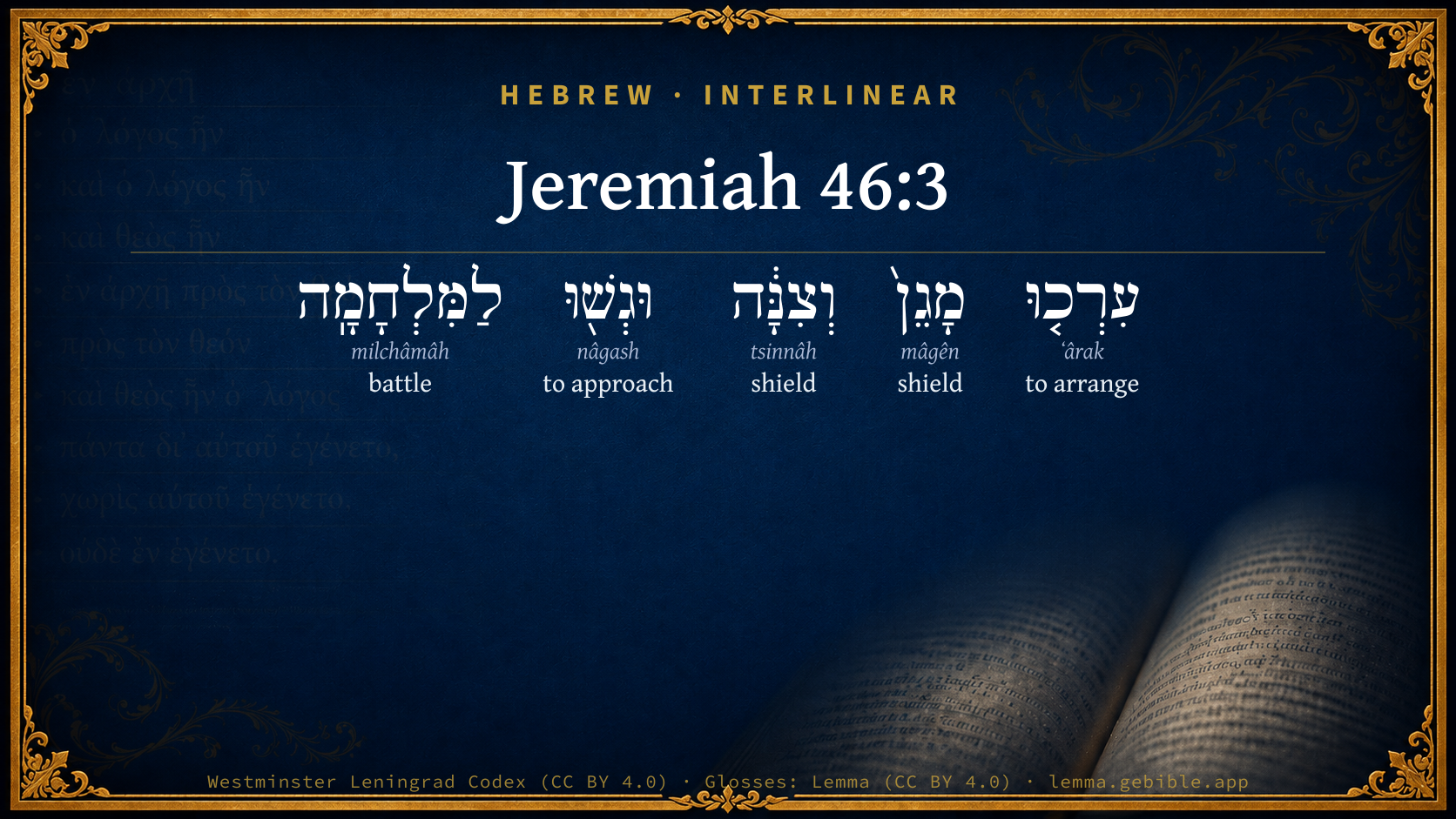
Jeremiah 46:3

Hebrew (Westminster Leningrad Codex) Jeremiah 46:3 appears in the Hebrew Old Testament. The text above is from the Westminster Leningrad Codex. Each word links to its Strong’s number, a concise gloss, and parsing drawn from the Open Scriptures Hebrew Bible morphology. Click any word for its full Brown-Driver-Briggs (BDB) entry.
Download image
Cite this verse

Jeremiah 46:3 (World English Bible). Public Domain. Lemma interlinear Bible study tool, https://lemma.gebible.app/v/jeremiah/46/3.

Show BibTeX & RIS
BibTeX
RIS
English Translation
Prepare you the buckler and shield, and draw near to battle.
World English Bible · Public Domain
Download a study sheet

One document with this verse’s original text, its word-by-word gloss line, the meaning frame, cross-references with their text, attributed commentary, and full source and license credits — printable, and it pastes into notes with its structure intact.

This verse Autodidact and up

Study sheet (.html) Plain text (.txt)

A passage Seminary Student

Up to 50 verses in one chapter. A passage sheet keeps up to 6 commentary sources and 12 cross-references per verse, in the order this page ranks them, and says so on the sheet whenever that leaves anything out. Ask for a single verse and you get the Autodidact verse sheet above.

Everything on this page stays free to read, with no account — the sheet is a download of what is already on screen, not access to it.

Want to remove ads? Support Godless Engineer
Compare translations 3

The same verse in 3 English versions, stacked beneath the original-language interlinear above. Click any original word for its lexicon entry.

Each is an independent rendering of the whole verse — the interlinear is not word-aligned to these translations.

Highlighted words mark where these versions differ — a whole-verse word diff, not a word-by-word alignment.

  • World English Bible Public Domain
    Prepare you the buckler and shield, and draw near to battle.
  • King James Version Public Domain
    Order ye the buckler and shield, and draw near to battle.
  • unfoldingWord Literal Text CC BY-SA 4.0
    Get the small shields and the large shields ready, and go forward to fight.

unfoldingWord Literal Text — © unfoldingWord, licensed CC BY-SA 4.0. Word-aligned USFM3 via Door43 (git.door43.org/unfoldingWord/en_ult).

Versions to compare (up to 4)

3 of 4 selected

Show all 18 translations

Every available English version of this verse, each an independent rendering of the whole verse.

  • World English Bible Public Domain
    Prepare you the buckler and shield, and draw near to battle.
  • Berean Standard Bible Public Domain
    “Deploy your shields, small and large; advance for battle!
  • Majority Standard Bible Public Domain
    “Deploy your shields, small and large; advance for battle!
  • King James Version Public Domain
    Order ye the buckler and shield, and draw near to battle.
  • American Standard Version (1901) Public Domain
    Prepare ye the buckler and shield, and draw near to battle.
  • Revised Version (1885) Public Domain
    Order ye the buckler and shield, and draw near to battle.
  • Geneva Bible (1599) Public Domain
    Make readie buckler and shielde, and goe forth to battell.
  • Douay-Rheims (1899) Public Domain
    Prepare ye the shield and buckler, and go forth to battle.
  • Young's Literal Translation Public Domain
    `Set ye in array shield and buckler, And draw nigh to battle.
  • Literal Standard Version CC BY-SA 4.0
    “Set shield and buckler in array, || And draw near to battle.
  • Unlocked Literal Bible CC BY-SA 4.0
    Get the small shields and the large shields ready, and go forward to fight.
  • unfoldingWord Literal Text CC BY-SA 4.0
    Get the small shields and the large shields ready, and go forward to fight.
  • Darby Bible Public Domain
    Make ready buckler and shield, and draw near to battle!
  • World Messianic Bible Public Domain
    “Prepare the buckler and shield, and draw near to battle!
  • Webster's Bible Public Domain
    Order ye the buckler and shield, and draw near to battle.
  • Free Bible Version CC BY-SA 4.0
    Pick up both your small and large shields, and advance ready for battle!
  • Bible in Basic English Public Domain
    Get out the breastplate and body-cover, and come together to the fight.
  • JPS Tanakh (1917) Public Domain
    Make ready buckler and shield, and draw near to battle.

Literal Standard Version (2020), Covenant Press — licensed CC BY-SA 4.0. Text via the HelloAO Bible API (eBible.org). Unlocked Literal Bible (unfoldingWord) — licensed CC BY-SA 4.0. Text via the HelloAO Bible API (eBible.org). unfoldingWord Literal Text — © unfoldingWord, licensed CC BY-SA 4.0. Word-aligned USFM3 via Door43 (git.door43.org/unfoldingWord/en_ult). Free Bible Version, Dr. Jonathan Gallagher — licensed CC BY-SA 4.0. Text via the HelloAO Bible API (eBible.org).

Word by word

More ways to search: Search by grammar → Find every occurrence → Compare this word →

Practice this passage: Drill this verse → Learn its vocabulary →

About this verse

These counts appear in no published source. They are computed here, from the morphology-tagged text and Lemma’s own curated glosses. What Lemma adds →

5
words
5
distinct lemmas
Prophets
section

Notable vocabulary

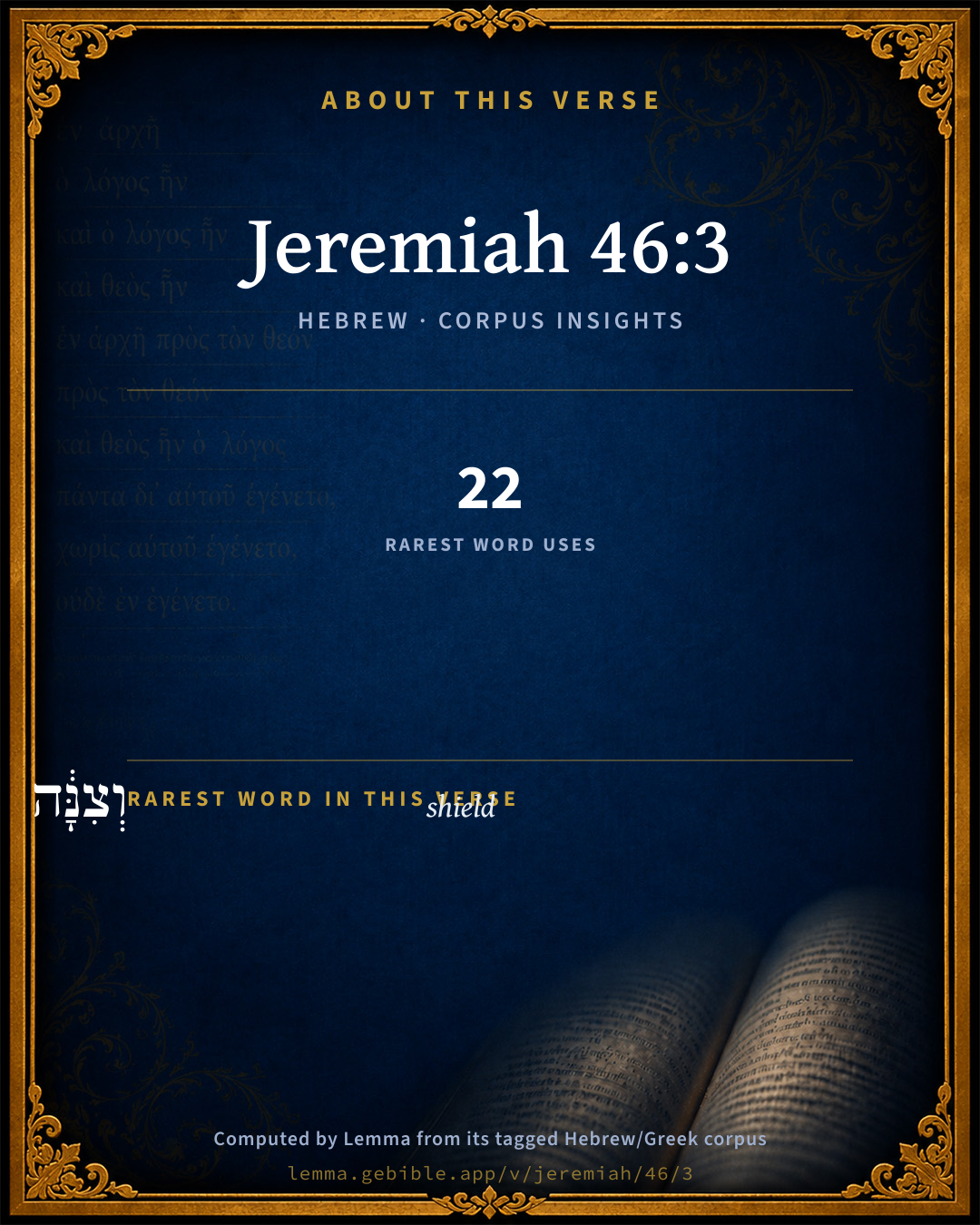
The rarest word here is וְצִנָּ֔ה shield H6793 — appearing just 22 times in the whole Hebrew Bible.

Shared distinctive vocabulary

וְצִנָּ֔ה shield H6793 occurs in 20 verses of the Hebrew Bible. Also found in:

Grammatical profile

  • 2 verbs
  • 3 nouns

Verb forms

  • עִרְכ֤וּ Qal · Imperative
  • וּגְשׁ֖וּ Qal · Imperative

Cross-references

6

Topical passages linked to Jeremiah 46:3 in the Treasury of Scripture Knowledge — connected by theme and wording, ordered by reader-vote popularity; previews shown in the World English Bible.

  • Isaiah 21:5 They prepare the table, they set the watch, they eat, they drink: rise up, you princes, anoint the shield.
  • Jeremiah 51:11–12 Make sharp the arrows; hold firm the shields: Yahweh has stirred up the spirit of the kings of the Medes; because his purpose is against Babylon, to destroy it: for it is the vengeance of Yahweh, the vengeance of his temple.
  • Joel 3:9 Proclaim this among the nations: Prepare war. Stir up the mighty men. Let all the warriors draw near. Let them come up.
  • Nahum 2:1 He who dashes in pieces has come up against you. Keep the fortress! Watch the way! Strengthen your loins! Fortify your power mightily!
  • Nahum 3:14 Draw water for the siege. Strengthen your fortresses. Go into the clay, and tread the mortar. Make the brick kiln strong.
  • Isaiah 8:9–10 Make an uproar, O you peoples, and be broken in pieces! And give ear, all you of far countries: gird yourselves, and be broken in pieces! Gird yourselves, and be broken in pieces!

Cross-references courtesy of OpenBible.info (CC BY 4.0).

Hebrew and Greek witnesses Masoretic Hebrew ↔ Greek Septuagint

The same verse in the two great witnesses to the Old Testament, shown verse-for-verse.

These are two independent witnesses, not word-aligned to each other, and the Septuagint is shown in lemma (dictionary) form.

Hebrew Jeremiah 46:3 Masoretic · Westminster Leningrad Codex

עִרְכ֤וּ מָגֵן֙ וְצִנָּ֔ה וּגְשׁ֖וּ לַמִּלְחָמָֽה

Prepare you the buckler and shield, and draw near to battle.

World English Bible · Public Domain

Greek LXX Structure differs

In the Septuagint, Jeremiah is about an eighth shorter than the Hebrew and arranges its material differently — the Oracles Against the Nations (Hebrew chapters 46–51) appear in the middle of the Greek book, after 25:13. Because the chapter and verse boundaries do not line up, a verse-for-verse comparison with the Hebrew is not shown.

A verse-for-verse comparison isn’t shown here because the chapters and verses don’t line up. Switch to the LXX edition with the MT / LXX toggle above to read the Greek directly.

Hebrew: Westminster Leningrad Codex (CC BY 4.0). Greek: Septuagint (public domain); English from a public-domain English Septuagint. How the Septuagint differs from the Hebrew →

Targum (Aramaic paraphrase)

1

The Targum is the ancient Jewish Aramaic paraphrase of the Hebrew Scriptures — an interpretive translation, not the Hebrew text itself. Onkelos (literal) and Pseudo-Jonathan (expansive) render the Torah, and Jonathan the Prophets. Coverage is partial: where no permissively-licensed English translation exists for a verse, only the Aramaic is shown. This is verse-level text, not a word-by-word alignment to the Hebrew.

  1. Targum Jonathan Prophets (Joshua–Malachi)
    סִדְרוּ עֲגִילִין וּתְרֵיסִין וְאִתְקְרָבוּ לְאַגָחָא קְרָבָא:

    (no public-domain English translation for this verse)

    Targum Jonathan — Aramaic: “Mikraot Gedolot” (public domain). English: “Sefaria Community Translation” (CC0 1.0 (public-domain dedication)); “London "Chaldee Paraphrase," 1871” (public domain). Text via Sefaria.

Commentary

Notes on Jeremiah 46:3 from classic Christian and Jewish commentators (each source and its license shown beneath its notes). The classic Christian expositions comment on the surrounding passage and are grouped to its opening verse, so a note may address several verses; the Jewish commentaries on the Tanakh (Rashi and others) are per-verse, so they appear only where the commentator wrote on this verse.

Lemma curates 59 commentaries, every one of them public domain or Creative Commons licensed, each selected and text-cleaned for this edition rather than reprinted as found. About our sources →

Trapp's Complete Commentary

John Trapp

Jer 46:3 Order ye the buckler and shield, and draw near to battle.

Ver. 3. Order ye the buckler and shield.] So Pharaoh is brought in bespeaking his forces, when he was going to fight against Nebuchadnezzar. Or so the prophet bespeaketh the Egyptians ironically, {a} and by way of scoff; q.d., Do so, but all shall be to no purpose, {b} See the like Isa 8:9. Congregamini et vincemini. We are assembled and will be conquered. Yea, though upon Pharaoh’s shield should be the same inscription that was once upon Agamemnon’s, This is the terror of all mortal wights. {c}

{a} Hypotuposis ironica.

{b} State galeati, loricati, lanceati: sed frustra.

{c} Oυτος μεν φσβος εστι βροτων. - Pausan.

John Trapp, A Commentary or Exposition upon All the Books of the Old and New Testament (1647–1656) — public domain. Text from a community e-Sword module.

Joseph Benson's Commentary

Jer 46:3-6. Order ye the buckler, &c. — In these verses the mighty preparations of the Egyptians for war are described, which causes the prophet, who foresees the defeat, to express, as he does in the next two verses, “his astonishment at an event so contrary to what might have been expected; but he accounts for it by ascribing it to the disposition of the Almighty, who had spread terror all around, and had decreed that neither swiftness nor strength should avail the owners so as to save them from the impending overthrow.” — Blaney. I have seen them dismayed and turned back — God had, in a vision, shown Jeremiah the army of the Egyptians discomfited and fleeing; and their mighty ones — Their most powerful warriors and valiant commanders; are beaten down, and are fled apace — Either fall in the battle, or flee away as fast as they can; for fear is round about — A panic fear hath seized the whole army. Let not the swift flee away — Let them not be able to escape from those that pursue them, but be either killed or taken. They shall stumble, &c., toward the north by the river Euphrates — Which was northward from Egypt, and even from Judea: so Babylon is described as lying northward, being situate upon that river.

Joseph Benson's Commentary on the Old and New Testaments (1811–1818) — public domain. Text from a community e-Sword module.

Whedon's Commentary on the Bible

Daniel D. Whedon

SONG OF TRIUMPH FOR THE DEFEAT OF EGYPT, Jer_46:3-12.

3. Order — Prepare, make ready. Buckler — Small shield, carried by the light-armed troops.

Shield — A piece of larger defensive size for the heavy armed troops.

Daniel D. Whedon (gen. ed.), Commentary on the Old and New Testaments (1874–1909) — public domain. Text from a community e-Sword module.

Keil & Delitzsch

C. F. Keil & F. Delitzsch

"Prepare shield and target, and advance to the battle. Jer 46:4. Yoke the horses [to the chariots]; mount the steeds, and stand with helmets on; polish the spears, put on the armour. Jer 46:5. Why do I see? they are terrified and turned back, and their heroes are beaten, and flee in flight, and do not turn: terror is round about, saith Jahveh. Jer 46:6. Let not the swift one flee, nor let the hero escape; towards the north, by the side of the river Euphrates, they stumble and fall. Jer 46:7. Who is this that cometh up like the Nile? his waters wave like the rivers. Jer 46:8. Egypt cometh up like the Nile, [his] waters are moved like the rivers; and he saith, I will go up, I will cover the earth; I will destroy the city, and those who dwell in it. Jer 46:9. Go up, ye horses; and drive furiously, ye chariots; and let the heroes go forth; Cushites and Phutites, bearing the shield; and Lydians, handling [and] bending the bow. Jer 46:10. But that day [belongs] to the Lord Jahveh of hosts, a day of vengeance for avenging Himself on His enemies: and the sword shall devour and be satisfied, and shall drink its fill of their blood; for the Lord Jahveh of hosts holdeth a slaying of sacrifices in the land of the north at the river Euphrates. Jer 46:11. Go up to Gilead, and take balsam, O virgin, daughter of Egypt: in vain hast thou multiplied medicines; cure there is none for thee. Jer 46:12. The nations have heard of thine ignominy, and thy cry hath filled the earth: for heroes stumble against heroes, both of them fall together."

This address falls into two strophes, Jer 46:3-6 and Jer 46:7-12. In both are depicted in a lively manner, first the advance of the Egyptian host to the battle, then their flight and destruction. The whole has been arranged so as to form a climax: in the first strophe, the admirable equipment of the armies, and their sudden flight and defeat, are set forth in brief sentences; in the second, there is fully described not merely the powerful advance of the host that covers the earth, but also the judgment of inevitable destruction passed on them by God: the reason for the whole is also assigned. Jer 46:3. In order to represent the matter in a lively way, the description begins with the call addressed to the army, to make ready for the battle. "Make ready shield and target," the two main pieces of defensive armour. מגן was the small [round] shield; צנּה, scutum, the large shield, covering the whole body. "Advance to the fight," i.e., go forward into the battle. Then the address turns to the several portions of the army: first to those who fight from chariots, who are to yoke the horses; then to the horsemen, to mount the steeds. פּרשׁים are not horsemen, but riding-horses, as in Kg1 5:6; Kg1 10:26; Eze 27:14. עלה is construed with the accus., as in Gen 49:4. The rendering given by Dahler and Umbreit, "Mount, ye horsemen," and that of Hitzig, "Advance, ye horsemen," are against the parallelism; and the remark of the last-named writer, that "Mount the steeds" would be רכבוּ, does not accord with Sa1 30:17. Next, the address is directed to the foot-soldiers, who formed the main portion of the army. These are to take up their position with helmets on, to polish the spears, i.e., to sharpen them, and to put on the pieces of armour, in order to be arrayed for battle. מרק, to rub, polish, remove rust from the spear, and thereby sharpen it. סריון, here and in Jer 51:3 for שׁריון, a coat of mail, pieces of armour.

Keil & Delitzsch — Biblical Commentary on the Old Testament (1861–1891) — public domain (CC PDM 1.0). Text via the HelloAO Bible API. (Old Testament only.)

Tyndale Open Study Notes

Tyndale Open Resources

46:3-4 Military commands such as these would have been issued when the soldiers were excited, well armed, and ready to fight.

Tyndale Open Study Notes — © Tyndale Open Resources, licensed CC BY-SA 4.0. Text via the HelloAO Bible API.

Geneva Bible (1599)

Geneva Bible translators

He warneth the Egyptians to prepare themselves to war.

Geneva Bible (1599) marginal notes — public domain. Text via Bolls.life.

Jamieson, Fausset & Brown

Robert Jamieson, A. R. Fausset & David Brown

Derisive summons to battle. With all your mighty preparation for the invasion of Nebuchadnezzar, when ye come to the encounter, ye shall be "dismayed" (Jer 46:5). Your mighty threats shall end in nothing.

buckler--smaller, and carried by the light-armed cavalry.

shield--of larger size, and carried by the heavily armed infantry.

Jamieson, Fausset & Brown — Commentary Critical and Explanatory on the Whole Bible (1871) — public domain (CC PDM 1.0). Text via the HelloAO Bible API.

Adam Clarke's Commentary

Verse 3. Order ye the buckler] This is the call to the general armament of the people against the Chaldeans.

Adam Clarke's Commentary on the Bible (1810–1826) — public domain. Text from a community e-Sword/MySword module.

John Calvin's Commentaries

Jeremiah uses now a form of speaking very common in the Prophets though remote from common use. For the Prophets, when they denounce God’s judgments and punishments on the ungodly, do not speak in a simple language, as though they were giving a narrative, but they employed figurative expressions, as though they wished to introduce men into the very scene itself. And that their doctrine might more effectually penetrate into the hearts of men, they bring forward various persons; they at one time introduce God as speaking, and at another they pronounce this or that according to the sentiments of others; and again, they declare the commands of God.

Jeremiah begins here by summoning the Egyptians, as though he were the herald of Pharaoh, and thus borrows the name of another person. He says, Prepare The verb ערך, orec, properly means to set in order, but here it signifies to prepare; Prepare, then, the buckler and the shield The word צנה, tsane, was a shield of a larger form, and מגן, megen, seems to have been a buckler carried by horsemen of light armor. And come near to battle: He then adds, Bind or he the horses The manner of fighting is not the same now as it was formerly; they fought in chariots, as heathen authors abundantly shew. He therefore says, he the horses, that is, join them together that they may draw the chariots. Go up, ye horsemen, stand in your helmets, clean your lances, and put on your coats of mail. The meaning is, that Egyptians would come well prepared with all kinds of arms that they might be formidable to their enemies. And hence the vengeance appeared more clearly, because they had been well furnished, so that they might seem to have gained the victory before they engaged with their enemies. This is the reason why the Prophet enumerates their complete armor, having omitted no material part; he mentions the lances, the helmets, the coats of mail, the chariots, the horses, and the shield, so that victory, according to the judgment of men, was already theirs. This is the first thing.

But we must observe the design of the Holy Spirit; it was his purpose to remove the veil from the eyes of the faithful, which for the most part prevents us to see as clearly as we ought the power of God; for when we fix our attention on warlike preparations, we do not think that anything is left for God to do; for they who are well prepared seem to be beyond the hazard of losing the day. That the Jews then might know that it would be nothing for God to punish the Egyptians, he records this preparation. And there is a kind of concession when he says, They shall indeed be furnished with a helmet, a coat of mail, a shield, a sword, and a lance; but all this would avail nothing as to the issue. Then from this prophetic word let us learn, that God makes no account of all those things which men prepare when they wish to effect anything. For smoke is everything that dazzles our eyes; so forces and arms have no importance before God; for by a single blast he can dissipate all such clouds. And this truth is very useful; for we look on external things, and when anything specious presents itself to us, we are immediately taken up with it, and rob God of all power; for we transfer his glory to these masks which appear before us. We now then understand why the Prophet speaks here of bucklers, and shields, and lances, and chariots, and helmets, and coats of mail.

John Calvin's Commentaries (1540-1563) — public domain. Text from the Calvin Translation Society English edition (1840s-50s) via the Christian Classics Ethereal Library (ccel.org). Calvin's coverage is partial (roughly two-thirds of the Bible); uncommented books and verses are honest gaps, never fabricated. The 19th-century editor's footnotes and remarks are omitted so the notes are faithfully Calvin's own voice.

Ellicott's Commentary for English Readers

(3, 4) Order ye the buckler and shield . . .—The poem opens with a summons to the hosts of Nebuchadnezzar to prepare for their victory. First the foot-soldiers are called, then the horse, lastly the light-armed troops.

Put on the brigandines.—The history of the word is not without interest. Light-armed skirmishers were known in Italian as “brigands” (briganti—literally, “quarrellers”); the light coat of mail worn by them was accordingly known as a “brigandine.” When the Italian word became synonymous with robbers by land or sea, the ship used by them was called a brigantino, and from this is derived our English “brig” (W. A. Wright: Bible Word Book). The word “brigandine” is accordingly used by writers of the sixteenth century in both senses: by Spenser, for a ship—

“Like as a warlike brigandine applied

To fight;”

and by Milton—

“Then put on all thy gorgeous arms, thy helmet

And brigandine or brass”

(Sams. Agonist., 1120)—in the same sense as here and in Jer_51:3.

A Bible Commentary for English Readers, edited by Charles John Ellicott (1878–1897) — public domain. Text from a community e-Sword module.

The Cambridge Bible for Schools and Colleges

gen. ed. J. J. S. Perowne

3. Order ye] rather, Prepare ye. Or, more literally, Set in line.

buckler and shield] The former of these was a small round shield which the light-armed troops carried, while the latter covered the whole body and was borne accordingly by the heavy-armed.

3–6. These verses give us a lively description of the preparation and the advance, which were followed by the disastrous defeat at Carchemish.

The Cambridge Bible for Schools and Colleges (gen. ed. J. J. S. Perowne; Cambridge University Press, 1878–1918) — public domain. Text from a community e-Sword module.

John Gill's Exposition

Order ye the buckler and shield,.... Both signify one and the same sort of armour, only of a different form, the one being lesser and lighter than the other. Jarchi makes the difference to be, that the former was made of skin, the latter of wood; they were both used to defend the body in war. To order them is not only to prepare them, and get them ready; but to fit them to the body, and to put them on, that they might be in a readiness to engage in battle. The exhortation is made either to the Chaldean army, to prepare to fight against the Egyptians; or to the army of Pharaohnecho, to defend themselves against the king of Babylon, who was coming against them, as Kimchi and Abarbinel, who seem to be in doubt which it should be; but the latter is most probable: and it is either a direction of Pharaoh to his army, to be in readiness; or rather of God, speaking ironically to them, suggesting, that let them do what they would, and make ever such preparations for battle, all would come to nothing, victory would be on the other side;

and draw near to battle; engage the enemy briskly, and with the greatest courage, and use all your military skill; and, when ye have done, it will all be in vain.

John Gill's Exposition of the Whole Bible (1746–1763) — public domain (CC PDM 1.0). Text via the HelloAO Bible API.

Albert Barnes' Notes on the Bible

Order ye ... - “i. e., prepare ye, make ready.” The buckler was a small round target carried by the lightly-armed troops: the shield belonged to the heavily-armed troops, and was large enough to protect the whole body.

Albert Barnes' Notes on the Bible (1834–1885) — public domain. Text from a community e-Sword/MySword module.

Haydock's Catholic Bible Commentary

Prepare Egyptians, the enemy is at hand. (Calmet)

George Leo Haydock (1774–1849), Haydock's Catholic Family Bible and Commentary, 1859 edition — public domain. Excludes Psalms (Douay-Rheims chapter numbering differs from Protestant) and Deuterocanonical books (Catholic canon only).

The Pulpit Commentary

Order ye, etc. The leaders of the Egyptians are heard summoning their men to make ready their armour, and set themselves in array (comp. ver. 9). The buckler (Hebrew, magen) is the small shield; the shield (Hebrew, cinnah) is the large one (scutum), which covered the whole body. (comp. 2Ch_9:15, 2Ch_9:16)

The Pulpit Commentary (1880–1919), ed. H.D.M. Spence-Jones & Joseph S. Exell — public domain. Text from a community e-Sword module.

Rashi

Rabbi Shlomo Yitzchaki (Rashi)

shield Heb. מגן. It is made of leather, and it is boiled, and when he goes forth to battle, he anoints it with oil.

and buckler Heb. וצנה, [made] of wood, in the likeness of our shields.

Rashi on the Tanakh — English translations: “The Judaica Press complete Tanach with Rashi, translated by A. J. Rosenberg” (CC BY 4.0); “Pentateuch with Rashi's commentary by M. Rosenbaum and A.M. Silbermann, 1929-1934” (public domain); “The Metsudah Tanach series, Lakewood, N.J” (CC BY 4.0); and “The Book of Joshua, Metsudah Publications, 1997” (CC BY 4.0). Text via Sefaria.

Lesson kit

Teaching starters — assembled from the data on this page, not authored interpretation. Every prompt links to the verse data it draws on. Edit before teaching.

Jeremiah, in the Prophets, opens this verse with 5 words (5 distinct Hebrew lemmas). Its most distinctive word is tsinnâh (“shield”). A historical commentator’s framing appears above. Read the whole chapter for the surrounding context.

Discussion questions

  1. The word tsinnâh carries the sense “shield.” How does it shape the verse?
  2. 1 Samuel 17:7 shares the word «shield» with this verse. How do the two illuminate each other?
  3. The translations on this page render this verse differently — a whole-verse word diff, not a word-by-word alignment. What might account for the different wordings?
  4. The verb «עִרְכ֤וּ» is Qal Imperative. How does its form color the action?
  5. Reading how Trapp's Complete Commentary and Joseph Benson's Commentary read this verse, where do the two commentators agree and where do they part?

Things to notice

Reading settings

Reading text

Shown beneath each verse's original-language words.

Old Testament
Old Testament edition

Read the OT as the Masoretic Hebrew (MT) or the Greek Septuagint (LXX).

English shown for the Greek Septuagint (in the Hebrew ↔ Greek comparison).

Comparing translations? Open the Compare panel on any verse page to stack up to four side by side.