Isaiah 65:5

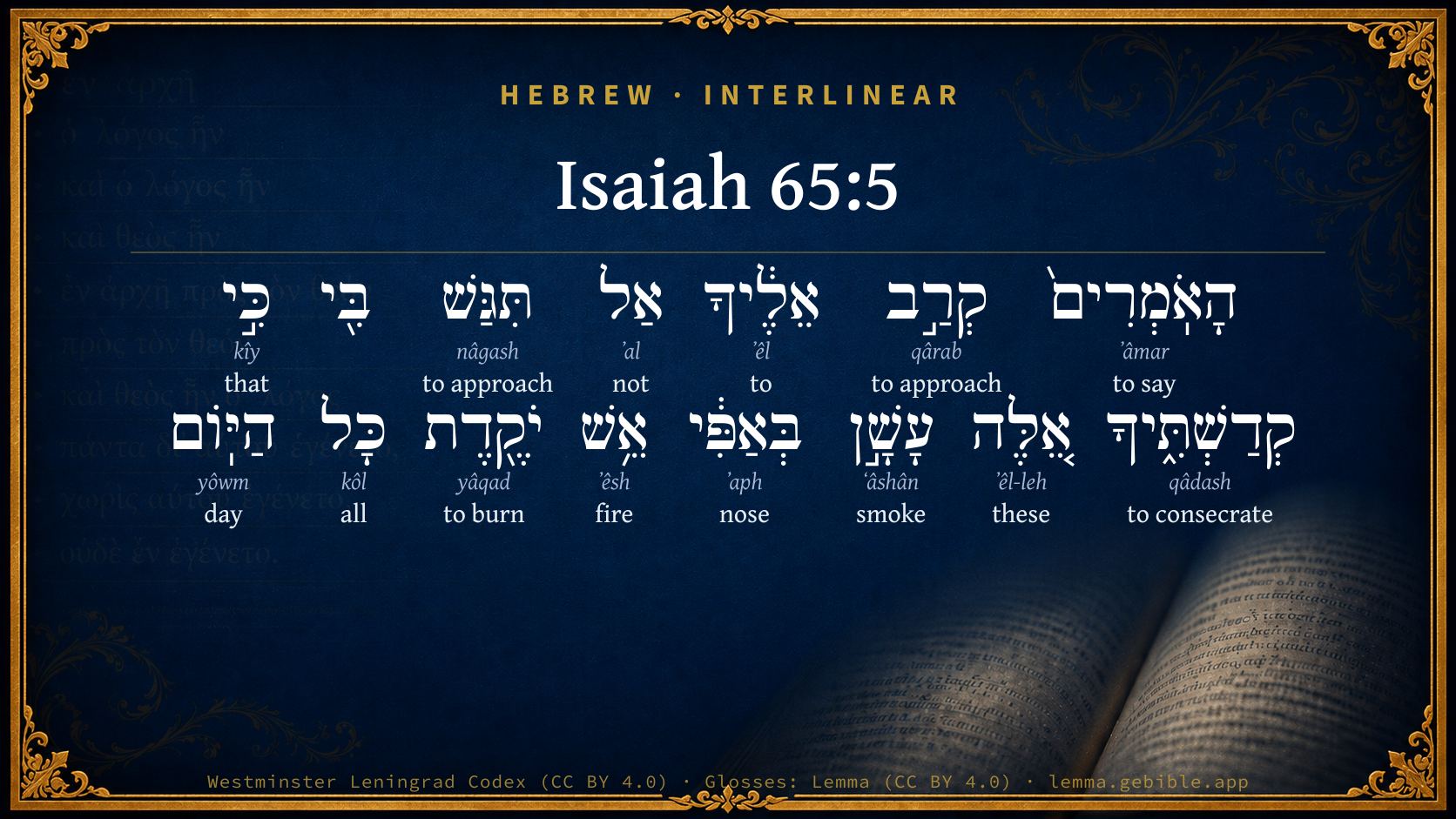
Hebrew (Westminster Leningrad Codex) Isaiah 65:5 appears in the Hebrew Old Testament. The text above is from the Westminster Leningrad Codex. Each word links to its Strong’s number, a concise gloss, and parsing drawn from the Open Scriptures Hebrew Bible morphology. Click any word for its full Brown-Driver-Briggs (BDB) entry.
Download image
Cite this verse

Isaiah 65:5 (World English Bible). Public Domain. Lemma interlinear Bible study tool, https://lemma.gebible.app/v/isaiah/65/5.

Show BibTeX & RIS
BibTeX
RIS
English Translation
who say, Stand by yourself, don't come near to me, for I am holier than you. These are a smoke in my nose, a fire that burns all the day.
World English Bible · Public Domain
Download a study sheet

One document with this verse’s original text, its word-by-word gloss line, the meaning frame, cross-references with their text, attributed commentary, and full source and license credits — printable, and it pastes into notes with its structure intact.

This verse Autodidact and up

Study sheet (.html) Plain text (.txt)

A passage Seminary Student

Up to 50 verses in one chapter. A passage sheet keeps up to 6 commentary sources and 12 cross-references per verse, in the order this page ranks them, and says so on the sheet whenever that leaves anything out. Ask for a single verse and you get the Autodidact verse sheet above.

Everything on this page stays free to read, with no account — the sheet is a download of what is already on screen, not access to it.

Want to remove ads? Support Godless Engineer
Compare translations 3

The same verse in 3 English versions, stacked beneath the original-language interlinear above. Click any original word for its lexicon entry.

Each is an independent rendering of the whole verse — the interlinear is not word-aligned to these translations.

Highlighted words mark where these versions differ — a whole-verse word diff, not a word-by-word alignment.

  • World English Bible Public Domain
    who say, Stand by yourself, don't come near to me, for I am holier than you. These are a smoke in my nose, a fire that burns all the day.
  • King James Version Public Domain
    Which say, Stand by thyself, come not near to me; for I am holier than thou. These are a smoke in my nose, a fire that burneth all the day.
  • unfoldingWord Literal Text CC BY-SA 4.0
    saying, ‘Come near to yourself, do not come near to me, for I am holier than you.’ These smoke in my nose, a fire burning all of the day.

unfoldingWord Literal Text — © unfoldingWord, licensed CC BY-SA 4.0. Word-aligned USFM3 via Door43 (git.door43.org/unfoldingWord/en_ult).

Versions to compare (up to 4)

3 of 4 selected

Show all 18 translations

Every available English version of this verse, each an independent rendering of the whole verse.

  • World English Bible Public Domain
    who say, Stand by yourself, don't come near to me, for I am holier than you. These are a smoke in my nose, a fire that burns all the day.
  • Berean Standard Bible Public Domain
    They say, ‘Keep to yourself; do not come near me, for I am holier than you!’ Such people are smoke in My nostrils, a fire that burns all day long.
  • Majority Standard Bible Public Domain
    They say, ‘Keep to yourself; do not come near me, for I am holier than you!’ Such people are smoke in My nostrils, a fire that burns all day long.
  • King James Version Public Domain
    Which say, Stand by thyself, come not near to me; for I am holier than thou. These are a smoke in my nose, a fire that burneth all the day.
  • American Standard Version (1901) Public Domain
    that say, Stand by thyself, come not near to me, for I am holier than thou. These are a smoke in my nose, a fire that burneth all the day.
  • Revised Version (1885) Public Domain
    which say, Stand by thyself, come not near to me, for I am holier than thou: these are a smoke in my nose, a fire that burneth all the day.
  • Geneva Bible (1599) Public Domain
    Which say, Stand apart, come not neere to me: for I am holier then thou: these are a smoke in my wrath and a fire that burneth all the day.
  • Douay-Rheims (1899) Public Domain
    That say: Depart from me, come not near me, because thou art unclean: these shall be smoke in my anger, a fire burning all the day.
  • Young's Literal Translation Public Domain
    Who are saying, `Keep to thyself, come not nigh to me, For I have declared thee unholy.' These `are' a smoke in Mine anger, A fire burning all the day.
  • Literal Standard Version CC BY-SA 4.0
    Who are saying, Keep to yourself, do not come near to me, || For I have declared you unholy. These [are] smoke in My anger, || A fire burning all the day.
  • Unlocked Literal Bible CC BY-SA 4.0
    They say, 'Stand away, do not come near to me, for I am holier than you.' These things are smoke in my nose, a fire that burns all day long.
  • unfoldingWord Literal Text CC BY-SA 4.0
    saying, ‘Come near to yourself, do not come near to me, for I am holier than you.’ These smoke in my nose, a fire burning all of the day.
  • Darby Bible Public Domain
    who say, Stand by thyself, come not near to me; for I am holier than thou. These are a smoke in my nose, a fire that burneth all the day.
  • World Messianic Bible Public Domain
    who say, ‘Stay by yourself, don’t come near to me, for I am holier than you.’ These are smoke in my nose, a fire that burns all day.
  • Webster's Bible Public Domain
    Which say, Stand by thyself, come not near to me; for I am holier than thou. These are a smoke in my nose, a fire that burneth all the day.
  • Free Bible Version CC BY-SA 4.0
    They tell others, “Keep your distance! Don't come close to me as I'm too holy to be touched by you!” These people are like smoke in my nostrils, a stink burning all day long!
  • Bible in Basic English Public Domain
    Who say, Keep away, do not come near me, for fear that I make you holy: these are a smoke in my nose, a fire burning all day.
  • JPS Tanakh (1917) Public Domain
    That say: 'Stand by thyself, come not near to me, for I am holier than thou'; these are a smoke in My nose, a fire that burneth all the day.

Literal Standard Version (2020), Covenant Press — licensed CC BY-SA 4.0. Text via the HelloAO Bible API (eBible.org). Unlocked Literal Bible (unfoldingWord) — licensed CC BY-SA 4.0. Text via the HelloAO Bible API (eBible.org). unfoldingWord Literal Text — © unfoldingWord, licensed CC BY-SA 4.0. Word-aligned USFM3 via Door43 (git.door43.org/unfoldingWord/en_ult). Free Bible Version, Dr. Jonathan Gallagher — licensed CC BY-SA 4.0. Text via the HelloAO Bible API (eBible.org).

Word by word

More ways to search: Search by grammar → Find every occurrence → Compare this word →

Practice this passage: Drill this verse → Learn its vocabulary →

יֹקֶ֖דֶת
yâqad
H3344
“burning”
Verb, Qal, Participle Active, Feminine, Singular, Absolute
Part of Speech
Verb
Stem
Qal
Form
Participle Active
Gender
Feminine
Number
Singular
State
Absolute
Full BDB Definition

Origin: a primitive root

TWOT: 901

to burn, kindle, be kindled - (Qal) to be kindled - (Hophal) to burn, be burning
  1. הָאֹֽמְרִים֙ ʼâmar H559 “the · saying” Particle, Definite Article + Verb, Qal, Participle Active, Masculine, Plural, Absolute
  2. קְרַ֣ב qârab H7126 “approach” Verb, Qal, Imperative, 2nd Person, Masculine, Singular
  3. אֵלֶ֔יךָ ʼêl H413 “to · you” Preposition + Suffix, Personal, 2nd Person, Masculine, Singular
  4. אַל ʼal H408 “not” Particle, Negative
  5. תִּגַּשׁ nâgash H5066 “to approach” Verb, Qal, Jussive, 2nd Person, Masculine, Singular
  6. כִּ֣י kîy H3588 “that” Conjunction
  7. קְדַשְׁתִּ֑יךָ qâdash H6942 “to consecrate · you” Verb, Qal, Perfect, 1st Person, Common, Singular + Suffix, Personal, 2nd Person, Masculine, Singular
  8. אֵ֚לֶּה ʼêl-leh H428 “these” Pronoun, Demonstrative, Common, Plural
  9. עָשָׁ֣ן ʻâshân H6227 “smoke” Noun, Common, Masculine, Singular, Absolute
  10. בְּאַפִּ֔י ʼaph H639 “in/at · nose · my” Preposition + Noun, Common, Masculine, Singular, Construct + Suffix, Personal, 1st Person, Common, Singular
  11. אֵ֥שׁ ʼêsh H784 “fire” Noun, Common, Both, Singular, Absolute
  12. כָּל kôl H3605 “all of” Noun, Common, Masculine, Singular, Construct
  13. הַיּֽוֹם yôwm H3117 “the · day” Particle, Definite Article + Noun, Common, Masculine, Singular, Absolute

About this verse

These counts appear in no published source. They are computed here, from the morphology-tagged text and Lemma’s own curated glosses. What Lemma adds →

15
words
14
distinct lemmas
Prophets
section

Notable vocabulary

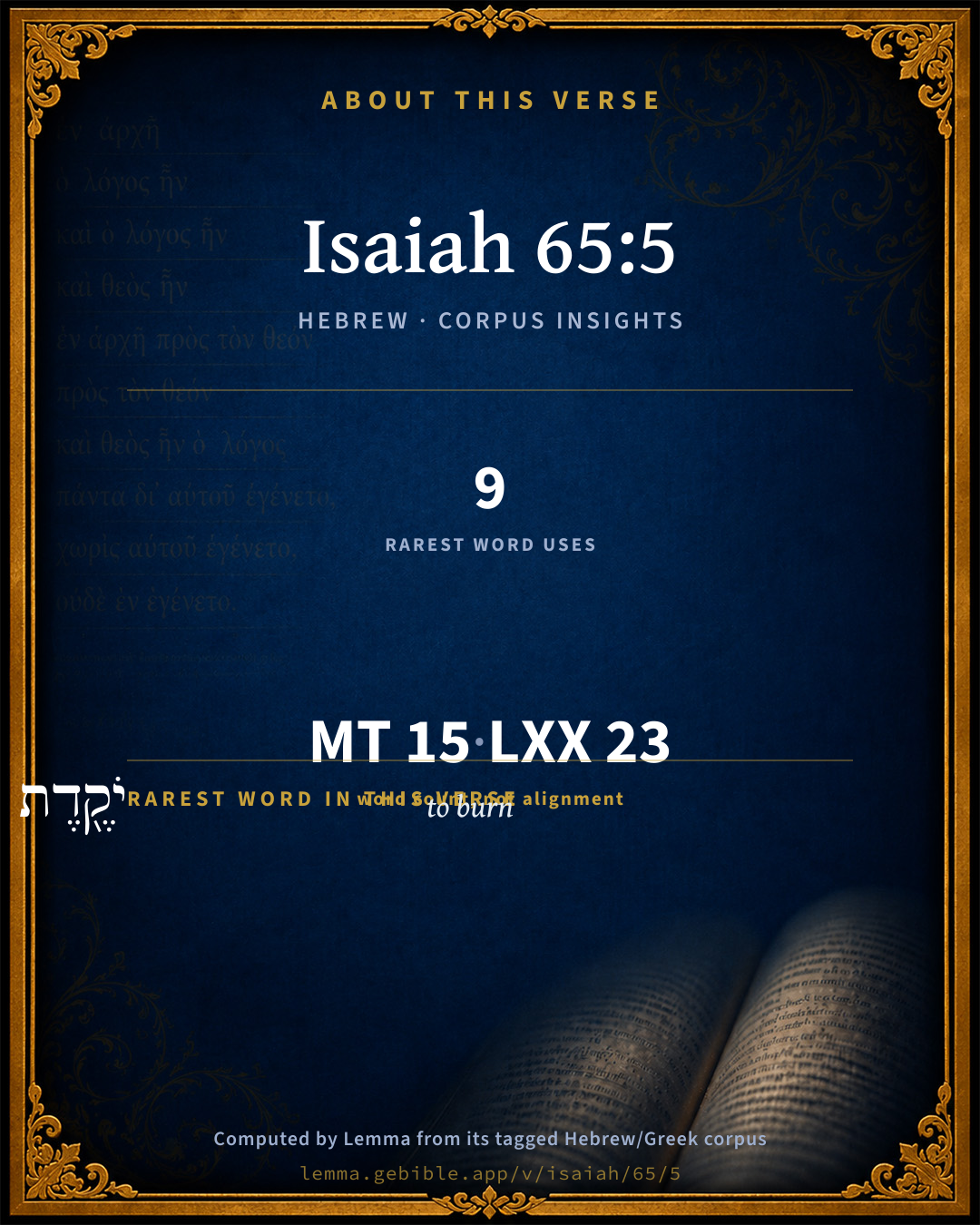
The rarest word here is יֹקֶ֖דֶת to burn H3344 — appearing just 9 times in the whole Hebrew Bible.

Shared distinctive vocabulary

יֹקֶ֖דֶת to burn H3344 occurs in 9 verses of the Hebrew Bible. Also found in:

Grammatical profile

  • 5 verbs
  • 5 nouns
  • 1 pronoun
  • 2 prepositions
  • 1 conjunction
  • 1 particle

Verb forms

  • הָאֹֽמְרִים֙ Qal · Participle Active
  • קְרַ֣ב Qal · Imperative
  • תִּגַּשׁ Qal · Jussive
  • קְדַשְׁתִּ֑יךָ Qal · Perfect
  • יֹקֶ֖דֶת Qal · Participle Active

Hebrew & Septuagint length

In English translation the verse runs 30 words from the Hebrew and 27 from the Septuagint (LXX English) — closely comparable.

A rough comparison of the two English renderings, which tokenize alike — not a word-level alignment.

Word counts can differ between the Hebrew and the Greek without any difference in meaning — e.g. the Hebrew direct-object marker אֵת has no separate Greek word, and Greek often adds the article ὁ.

In the original languages it is 15 Hebrew tokens and 23 Greek tokens — but the two are counted differently (Hebrew bundles its prefixes and suffixes into one token; the Greek is in lemma form), so that isn’t a like-for-like length.

Cross-references

16

Topical passages linked to Isaiah 65:5 in the Treasury of Scripture Knowledge — connected by theme and wording, ordered by reader-vote popularity; previews shown in the World English Bible.

  • Luke 18:9–12 He spoke also this parable to certain people who were convinced of their own righteousness, and who despised all others.
  • Luke 7:39 Now when the Pharisee who had invited him saw it, he said to himself, "This man, if he were a prophet, would have perceived who and what kind of woman this is who touches him, that she is a sinner."
  • Proverbs 16:5 Everyone who is proud in heart is an abomination to Yahweh: They shall assuredly not be unpunished.
  • Luke 15:28–30 But he was angry, and would not go in. Therefore his father came out, and begged him.
  • Romans 2:17–29 Indeed you bear the name of a Jew, and rest on the law, and glory in God,
  • Deuteronomy 29:20 Yahweh will not pardon him, but then the anger of Yahweh and his jealousy will smoke against that man, and all the curse that is written in this book shall lie on him, and Yahweh will blot out his name from under the sky.
  • Luke 5:30 Their scribes and the Pharisees murmured against his disciples, saying, "Why do you eat and drink with the tax collectors and sinners?"
  • Deuteronomy 32:20–22 He said, I will hide my face from them, I will see what their end shall be: For they are a very perverse generation, Children in whom is no faithfulness.
  • Proverbs 6:16–17 There are six things which Yahweh hates; Yes, seven which are an abomination to him:
  • Proverbs 10:26 As vinegar to the teeth, and as smoke to the eyes, So is the sluggard to those who send him.
  • Matthew 9:11 When the Pharisees saw it, they said to his disciples, "Why does your teacher eat with tax collectors and sinners?"
  • Acts 22:21–22 "He said to me, 'Depart, for I will send you out far from here to the Gentiles.'"
  • 1 Peter 5:5 Likewise, you younger ones, be subject to the elder. Yes, all of you gird yourselves with humility, to subject yourselves to one another; for "God resists the proud, but gives grace to the humble."
  • Jude 1:19 These are they who cause divisions, and are sensual, not having the Spirit.
  • Luke 15:2 The Pharisees and the scribes murmured, saying, "This man welcomes sinners, and eats with them."
  • James 4:6 But he gives more grace. Therefore it says, "God resists the proud, but gives grace to the humble."

Cross-references courtesy of OpenBible.info (CC BY 4.0).

Hebrew and Greek witnesses Masoretic Hebrew ↔ Greek Septuagint

The same verse in the two great witnesses to the Old Testament, shown verse-for-verse.

These are two independent witnesses, not word-aligned to each other, and the Septuagint is shown in lemma (dictionary) form.

Hebrew Isaiah 65:5 Masoretic · Westminster Leningrad Codex

הָאֹֽמְרִים֙ קְרַ֣ב אֵלֶ֔יךָ אַל תִּגַּשׁ בִּ֖י כִּ֣י קְדַשְׁתִּ֑יךָ אֵ֚לֶּה עָשָׁ֣ן בְּאַפִּ֔י אֵ֥שׁ יֹקֶ֖דֶת כָּל הַיּֽוֹם

who say, Stand by yourself, don't come near to me, for I am holier than you. These are a smoke in my nose, a fire that burns all the day.

World English Bible · Public Domain

Greek LXX Isaiah 65:5 Septuagint · lemma form

ὁ λέγω πόρρω ἀπό ἐγώ μή ἐγγίζω ἐγώ ὅτι καθαρός εἰμί οὗτος καπνός ὁ θυμός ἐγώ πῦρ καίω ἐν αὐτός πᾶς ὁ ἡμέρα

who say, Depart from me, draw not near to me, for I am pure. This is the smoke of my wrath, a fire burns with it continually.

LXX2012 (modern English Septuagint) · Public Domain

On this verse, Albert Barnes' Notes on the Bible discusses the Septuagint’s reading. Read the note in Commentary ↓

Hebrew: Westminster Leningrad Codex (CC BY 4.0). Greek: Septuagint (public domain); English from LXX2012 (modern English Septuagint) (Public Domain). How the Septuagint differs from the Hebrew →

Targum (Aramaic paraphrase)

1

The Targum is the ancient Jewish Aramaic paraphrase of the Hebrew Scriptures — an interpretive translation, not the Hebrew text itself. Onkelos (literal) and Pseudo-Jonathan (expansive) render the Torah, and Jonathan the Prophets. Coverage is partial: where no permissively-licensed English translation exists for a verse, only the Aramaic is shown. This is verse-level text, not a word-by-word alignment to the Hebrew.

  1. Targum Jonathan Prophets (Joshua–Malachi)
    דְאָמְרִין רָחֵיק לְהָלָא לָא תִקְרַב בִּי אֲרֵי דָכֵינָא מִנָךְ אִלֵין רוּגְזֵיהוֹן כִּתְנָנָא קֳדָמַי פּוּרְעֲנוּתְהוֹן בְּגֵיהִנָם דְאֶשְׁתָּא דְלָקָא בָהּ כָּל יוֹמָא:

    Who say, Stand by thyself, come not near to me; because I am purer than thou. These their provocations are as smoke before me: their recompense shall be in hell, where the fire burneth all the day.

    Targum Jonathan — Aramaic: “Mikraot Gedolot” (public domain). English: “Sefaria Community Translation” (CC0 1.0 (public-domain dedication)); “London "Chaldee Paraphrase," 1871” (public domain). Text via Sefaria.

Commentary

Notes on Isaiah 65:5 from classic Christian and Jewish commentators (each source and its license shown beneath its notes). The classic Christian expositions comment on the surrounding passage and are grouped to its opening verse, so a note may address several verses; the Jewish commentaries on the Tanakh (Rashi and others) are per-verse, so they appear only where the commentator wrote on this verse.

Lemma curates 59 commentaries, every one of them public domain or Creative Commons licensed, each selected and text-cleaned for this edition rather than reprinted as found. About our sources →

Trapp's Complete Commentary

John Trapp

Isa 65:5 Which say, Stand by thyself, come not near to me; for I am holier than thou. These [are] a smoke in my nose, a fire that burneth all the day.

Ver. 5. Which say, Stand by thyself; come not near to me.] These Jews were all manner of naughts, and therefore worthily rejected by God; necromancers, idolaters, epicures, gross hypocrites, as here their words, full of pride and contempt of others, show them to be. Such were the Pharisees with their sanctior sum quam tu {Luk 7:39} the monks and mass priests among the Papists, and the Brownists with their broad leaves of formal profession among us. From Mat 18:19, because Christ promiseth not doing for them that ask, except they agree on earth, Brownists peremptorily conclude that they ought not to pray with them that do not consent with them in their opinions; nor will they pray with their own wives and children, though never so pious, if they do not meet in the same centre of conceits. {a}

These are a smoke in my nose, a fire that burneth all the day,] i.e., A continual offence to me, as smoke is to the nose and eyes, {Pro 10:26} and shall be perpetually tormented by me in the hottest fire of hell; whereof hypocrites are the freeholders, and other sinners are but tenants as it were to them, while they are said to have their portion with the devil and hypocrites. Some think he hinteth at their smoking and sacrificing in their gardens and groves. {Isa 65:3}

{a} Abbott’s Trial of Church Forsakers, p. 148.

John Trapp, A Commentary or Exposition upon All the Books of the Old and New Testament (1647–1656) — public domain. Text from a community e-Sword module.

The Biblical Illustrator

Joseph S. Exell

Isa_65:5

Which may, Stand by thyself

I am holier than thou

For I am holier read, probably, else I will make thee holy.

The practices referred to were mysteries, and the initiated would communicate his holiness to others by contact with them, and so unfit them for all the ordinary uses of life (cp. Eze_44:19). (A. B.Davidson, D. D.)

Verse 5 alludes to those who claimed superior sanctity in virtue of certain rites into which they had been initiated. (Prof. S. R. Driver, D. D.)

Self-righteousness,--a smouldering heap of rubbish

The application of the passage to Israel is just thus. Year after year God dealt with great patience towards His chosen people, but they seemed to be desperately set upon idolatry in one form or another. Sometimes they worshipped Jehovah, but then they did it under figure and symbol, whereas He has expressly forbidden that even His own worship should be thus celebrated. At other times they altogether rejected Jehovah, and worshipped Baal and Ashtaroth, and whole troops of the gods of the heathen, and thus they provoked the Lord exceedingly. They also practised necromancy, or pretended communion with the dead, and witchcraft and sorcery, and all manner of abominable rites, like the depraved nations around them. When this open rebellion was given up, as it was after the captivity--for the Jews have never been guilty of idolatry since that day--they fell into another form of the same evil, namely, self-righteousness: so that when our Lord came He found self-righteousness to be the crying sin of Israel, the Pharisees carrying it to such a pitch as to render it utterly ridiculous. They reckoned that the touch of a common person polluted their sacredness, so that they needed to wash after walking down a street. When they traversed the ways they took the edge of the pavement, so that they might not brush against the garments of the passers-by, and even in the temple in prayer they stood by themselves lest they should be defiled. Their whole spirit is expressed in the words of the text--Stand by thyself, come not near to me; for I am holier than thou. This God declares to be as obnoxious to Him as smoke in a mans nose. Self-righteousness is rampant in our own day.

I. THE SIN OF SELF-RIGHTEOUSNESS GROWS UP AMONG RELIGIOUS PEOPLE. It is not always the sin of the outside world, for many outsiders do not pretend to any righteousness at all, and I fancy they think all the better of themselves for that. This is an idle plea which it needs not many words to expose. I make no profession, says one. This is about as honour-able a confession as if a thief should, boast when caught at picking pockets, I do not make any pretence to be honest, or a liar when detected should turn round and cry, I never professed to speak the truth. Among those who profess to be religious, self-righteousness very frequently comes in, because they have not truly received the religion of Jesus Christ; if they were true believers they would be humble and contrite, for self-righteousness and faith in Christ are diametrically opposed. Many who mingle with Christians, and are religious in a certain sense because they practise the forms of religion, are wont to put the form into the place of the spirit. These persons, too, even when they do not join the Christian Church, but only worship or seem to worship with Christians, are very apt to think that they must be better than other people because they do so. It is the danger of outwardly religious people, who are not savingly converted, to dream that they are somewhat advantaged by a mere attendance on the means of grace. Should an Egyptian rub his shoulders against an Israelite, would it turn him into an Israelite? Will living near a rich man make you rich? Do you forget that cry of our Lord, Woe unto thee, Chorazin. Woe unto thee, Bethsaida?

II. THIS IS A SIN WHICH FLOURISHES WHERE OTHER SINS ABOUND. We read of these people that they did evil before the eyes of God, and chose that wherein He delighted not. They blasphemed God, and polluted themselves with unhallowed rites, communing with demons and the powers of darkness, and pretending to speak with departed spirits; and yet for all that they said--Stand by thyself, I am holier than thou. Self-righteousness is never more ridiculous than in persons whose conduct would not bear scrutiny for a moment. Self-righteous men, like foxes, have many tricks and schemes. They condemn in other people what they consider to be very excusable in themselves. These people will make a righteousness this way--they plead that if they do wrong yet there are some points in which theyare splendid fellows. Some one thing in which the unconverted man may excel is put in to make up for his deficiencies in a hundred other ways. By hook or by crook a man will make out that he is not so bad as he seems to be; the inventiveness of self-esteem is prodigious. No heap of rubbish is too rotten for the accursed toadstool of proud self to grow upon.

III. IT IS IN ITSELF A GREAT SIN. One is almost startled to find self-esteem placed after such a list of sins as this chapter records. To the Jew the eating of swines flesh and broth of abominable things was a great pollution, but self-righteousness is classed with it; it is even placed with necromancy and witchcraft. Drunkenness and swearing are sin in rags, but self-righteousness is sin in a respectable black coat. It is an aristocratic sin, and does not like to be put down with the common Tuck; and if we call it sin, yet many will plead that it is only so in a very refined sense. But God does not think so; He classes it with the very worst, and He does so because it is one of the worst. For a man to be self-righteous is in itself a sin of sins. For, first, it is blasphemy. God is holy. Here comes this base impostor and boasts, And I am holy too. Is not that a ludicrous and contemptible form of blasphemy? It is profanity in its very essence. More, this self-righteousness is idolatry, for the man who counts himself to be righteous by his own works worships himself. Practically, the object of his adoration is his own dear, delectable, excellent self. Then, again, it is profanity, for it gives God the distinct lie. The Lord declares that no man is righteous.

IV. SELF-RIGHTEOUSNESS IS THE FRUIT OF MANS OWN THOUGHTS. Look at Isa_65:2. Those who have high thoughts of themselves do not walk according to Gods commandments, but according to their own notions. If any man thinketh himself to be righteous in himself, he has never derived that idea from Gods law, and certainly not from the Gospel, for the Gospel knows no man after the flesh as righteous, but it regards all men as sinners, and comes to them with pardon; it treats men as lost and comes to save them. Self-righteous people are not much inclined to search the Scriptures, they do not read them with an understanding heart, so as to get the meaning; they rather make the Bible say their own meaning, and twist it to support their own pleasing dream.

V. SELF-RIGHTEOUSNESS HAS THIS VICE ABOUT IT, THAT IT ALWAYS LEADS TO DESPISING OTHERS. That is the pith of the text.

VI. SELF-RIGHTEOUSNESS IS MOST ABOMINABLE IN THE SIGHT OF GOD. What does He compare it to? He says, It is a smoke in My nose, a fire that burneth all the day. At the bottom of the garden we gather together the dead leaves, and all the rubbish of the garden, and the heap is lighted, and it keeps on burning and smouldering all the day; and if you go and stand in the eye of the wind your eyes will smart, your nose will be offended, and you will feel that you cannot bear it. We do not wonder that He thus scorns and abhors proud selfrighteousness, for God is a God of truth, and truth cannot bear a lie, and selfrighteousness is a mass of lies. Moreover, self-righteousness is such a proud thing. God is always provoked with pride. Self-righteousness also denies the wisdom of Gods plan, and is utterly opposed to it. Gods present plan of working in the world goes upon the theory that we are guilty; being guilty, He provides a Saviour for us, and sends us a Gospel full of grace.

VII. SELF-RIGHTEOUSNESS MOST EFFECTUALLY BARS A MAN FROM ALL HOPE OF SALVATION. We cannot be saved unless we become truly holy, but no man ever becomes truly holy who is content with a false holiness. Self-righteousness prevents repentance. You will never believe in Jesus Christ while you believe in yourself. What is the remedy for all this? God saith, Behold Me; that is to say, He bids thee cease from doting upon thine own fancied beauties and worshipping thine own foolish image. Look first to the holy God and tremble. Canst thou, of thyself, ever be like Him, pure, spotless, glorious? Look to Him and despair. Then comes the second, Behold Me. See Jesus Christ on the cross dying, the just for the unjust, to bring us to God. As thou seest Him dying thy self-righteousness will die. (C. H.Spurgeon.)

False grounds of superiority in holiness

The disposition to arrogate the dignity of religious worth and excellence has never become extinct among men, nor the quite consistent disposition to turn it to the use of pride.

1. In some instances, an assumption of superior holiness has been made upon the ground of belonging to a certain division or class of mankind; a class having its distinction in the circumstance of descent and nativity, or in some artificial constitution of society. Thus the ancient Jews,--in virtue merely of being Jews. Imagine the worst Jew comparing himself with Aristides, Phocion or Socrates. The Brahmins, in virtue of a pretended pre-eminently holy descent; an emanation from the head of their creating god. In popish countries, the numerous ecclesiastical class. Something of this even in protestant England. In these instances there has been an assumption of holiness independently of individual personal character. What an infamy to perverted human reason, that anything which might leave the individual evidently bad, in heart and life, could yet be taken as constituting him the reverse of bad, that is, holy!

2. In many periods and places men have reputed themselves holy on the ground of a punctilious observance of religious forms and ceremonies whether of Divine appointment or human invention. This took the place of the true religious sanctity among the Jews. It is a grand characteristic of paganism. It actually stands instead of religion and morality among the far greater part of the people under the dominion of the Romish Church. It is to be feared there are some among us who venture a delusive assumption on the ground of a regular attention to the external services of religion. But we have cause to know that all this may be, and yet no vital transforming prevalence of religion in the heart.

3. Another ground of such assumption is general rectitude of practical conduct, separate from the true religious principle of moral excellence.

4. The pride of self-estimation for holiness is apt to be betrayed by persons who have preserved a character substantially free from reproach, against those who have, in some known instance, fallen into great sin. It might have been a case in which they were encountered by sudden, or complicated, or very extraordinary temptation, such as all should pray earnestly to be saved from. The delinquent may have penitently deplored the transgression through many subsequent years. But it has been often enough seen that another person, who has been happy enough not to incur any such marked blemish on his character, will assume a tone of high superiority against him, though he may never have had the same strength of temptation to combat with; may never think of ascribing his exemption to any higher cause than his own good principles; and may be quite destitute of some valuable qualities the other possesses. The whole life of this self-applauder may have been little better than a series of negatives. His faulty, penitent brother may have done much good.

5. A man may have had his mind directed to a speculative knowledge of religious doctrine; and we will suppose that it is valuable knowledge that he has gained. All this ma be, and yet the man feel little or nothing of the sanctifying power of religious truth. Yet, so ready is the speculatist to take to himself all the dignity and excellence of his subject and his cause, that this man may take up a lofty pretension--if not strictly and formally to holiness, yet to some meritorious relation to truth and religion; something which authorizes him in a high contempt,--not only of those who know nothing about religion, but also of those who feel its genuine influence and power, when they are feeble in the speculative intelligence of it. He accounts himself to be, as it were, in the confidence of religion, and that he must be invested with something of its venerable character, when he can so authentically declare its mind.

6. There is such a thing as a factitious zeal in the active service of religion; and that forms a ground of high pretension. Men in restless activity; hill of scheme, and expedient, and experiment, and ostentatious enterprise. But an attentive observer could easily descry that the cause of God was a very secondary concern with them, even at the best interpretation. Their grand object (whether they were conscious of it or not) was their own notoriety; and the cause of religion happened to be that which would most effectually serve this purpose.

7. There are a number of persons among professing Christians whose minds are almost ever dwelling on certain high points of doctrine, sought chiefly in the book of Gods eternal decrees. And it is on these doctrines that they found, in some manner, an absolute assurance of their being in the Divine favour. God forbid that we should deny or doubt that there is a firm and rational assurance of salvation attainable in this life. But such persons as we are referring to betray that their assurance, which takes its stand on so lofty a position, independent of a faithful estimate of the heart and life, has an unsanctifying effect; it slackens and narrows the force and compass of the jurisdiction of conscience; and, especially, cherishes in them the spirit of our text.

8. We may name as one of the things made a ground of pretension and pride, the experience of elated, ardent, enthusiastic feelings, in some semblance of connection with religion, bat not really of its genuine inspiration. (John Foster.)

The Biblical Illustrator, edited by Joseph S. Exell (c. 1880s–1900s) — public domain. Text from a community e-Sword module.

Joseph Benson's Commentary

Isa 65:5-6. Who say, Stand by thyself, come not near to me — Though they were so exceedingly guilty, yet they pretended to singular sanctity, so that they would not suffer others to come near or touch them. The reader will observe that the crime of hypocrisy is here decried, and every one that is acquainted with the gospels will easily see that the character of the Pharisees and their followers is drawn in this passage; see Luk 18:10. And there cannot be a more lively description of spiritual pride and hypocritical arrogance than it gives us. For I am holier than thou — Thus they esteemed themselves holier than others, though all their holiness lay in rituals, and those too such as God never commanded. Of these God saith, These are a smoke in my nostrils, a fire that burneth all the day —

That is, a continual provocation to me: as smoke is an offence to our noses. Behold, it is written before me — They may think I take no notice of these things, but I will as certainly remember them as princes remember the things which, in order that they may not forget them, they record in writing. And they shall know that I take notice of, and will remember them; for I will not keep silence — That is, I will not long neglect the punishment of them, though for a while I have delayed it, like a man who restrains his wrath, for some wise reasons which are best known to himself, Psa 50:21; but will recompense into their bosom — My punishment of them shall be severe and certain, but yet it shall be just, and not greater than their sins have merited.

Joseph Benson's Commentary on the Old and New Testaments (1811–1818) — public domain. Text from a community e-Sword module.

The Preacher's Complete Homiletical Commentary

Joseph S. Exell (gen. ed.)

REPUDIATING THE SOCIETY OF OTHERS

Isa_65:5. Which say, Stand by thyself, come not near to me, &c.

There are few things in which it becomes us to be more careful than in our judgment of others, and in action founded on that judgment. Some relations in which we stand to men involve judgment of them. We are not forbidden to judge (Mat_7:1-5). Our text accuses those to whom it applies, of asserting their own moral superiority, and repudiating the society of others on that account. But we must discriminate.

I. THERE IS A SENSE IN WHICH IT IS JUSTIFIABLE.

We are not called upon to consider all men morally equal to ourselves, nor to associate with them as if they were. We are forbidden so to do (2Co_6:14-18; 2Th_3:6). It may be perfectly true that you are holier than some who may be considered; and that fact may be involved in your very profession of Christianity. The fact of conversion involves moral superiority to the unconverted, &c. And if this wide distinction exists between saints and sinners, why should it not be professed? We need a visible organisation as a point around which the saints may gather. Such an organisation the Saviour’s wisdom and grace has provided in the fellowship of the Church. Those who join that fellowship emphatically declare their separation from the world. Not only so. In the multiform relations of individual life, and in relation to many practices and principles which obtain in the world, Christians must be prepared practically to say, “Stand by thyself,” &c. But

II. THERE IS A SENSE IN WHICH IT IS UNJUSTIFIABLE.

It is possible to say this in an improper and irreligious spirit. It may be said—

1. By the self-deceived. It may be quite contrary to the fact. The Jewish people said it. But they are solemnly charged in the verses before the text with practising some of the vilest abominations of heathenism (Isa_65:2; Isa_65:4). Nor is theirs a solitary case.

2. By the self-righteous. They are under a delusion as to the nature of holiness, &c. Nor has the self-righteous spirit been cast out of the world.

3. By the uncharitable. They are ever quick to discern the failings of others, while their eyes are closed to their own, &c. The Church of Christ should free itself from this uncharitableness and censoriousness.

Let us place ourselves habitually in the pure light of God’s holiness. Then we shall be so humbled by the consciousness of our own sinfulness as to be very tender and pitiful towards the imperfections of our brethren. And in any case, let us see that we possess and cultivate the holiness which is assumed by those who assert their own superiority.—J. Rawlinson.

I. A picture of self-righteous pride. Despises others. Glorifies self. Pretends to peculiar sanctity. II. Its offensiveness in the sight of God. It offends His purity. Arouses His indignation.

Isa_65:6-7. Man’s iniquities are—I. Multiplied. By personal acts. From generation to generation. II. Recorded. In God’s book—minutely, accurately. III. Will certainly be recompensed. Justly. By measure into every man’s bosom.—J. Lyth, D.D.

The Preacher's Complete Homiletical Commentary (gen. ed. Joseph S. Exell; Funk & Wagnalls, c. 1892) — public domain (pre-1929). A full-Bible homiletical/sermon-outline anthology covering 65 of 66 books (2 John is absent from the source module). Text from a community e-Sword module.

Tyndale Open Study Notes

Tyndale Open Resources

65:5 you will defile me! I am holier than you! The people of Israel used the language of ritual purification, as stated in the laws of Moses, yet they practiced rites influenced by paganism. Because of this hypocrisy, they were a stench in God’s nostrils (see 1:10-15).

Tyndale Open Study Notes — © Tyndale Open Resources, licensed CC BY-SA 4.0. Text via the HelloAO Bible API.

Geneva Bible (1599)

Geneva Bible translators

Their punishment shall never have end.

He showeth that hypocrisy is ever joined with pride and contempt of others.

Geneva Bible (1599) marginal notes — public domain. Text via Bolls.life.

Jamieson, Fausset & Brown

Robert Jamieson, A. R. Fausset & David Brown

(Mat 9:11; Luk 5:30; Luk 18:11; Jde 1:19). Applicable to the hypocritical self-justifiers of our Lord's time.

smoke--alluding to the smoke of their self-righteous sacrifices; the fire of God's wrath was kindled at the sight, and exhibited itself in the smoke that breathed forth from His nostrils; in Hebrew the nose is the seat of anger; and the nostrils distended in wrath, as it were, breathe forth smoke [ROSENMULLER] (Psa 18:8).

Jamieson, Fausset & Brown — Commentary Critical and Explanatory on the Whole Bible (1871) — public domain (CC PDM 1.0). Text via the HelloAO Bible API.

Adam Clarke's Commentary

Verse 5. For I am holier than thou] So the Chaldee renders it.

קדשתיך kedashticha is the same with קדשתי ממך kadashti mimmecha. In the same manner חזקתני chazaktani, Jer 20:7, is used for חזקת ממני chazacta mimmenni, "thou art stronger than I." - L.

Adam Clarke's Commentary on the Bible (1810–1826) — public domain. Text from a community e-Sword/MySword module.

Ellicott's Commentary for English Readers

(5) Which say, Stand by thyself . . .—The picture, in its main outlines, reminds us of the proud exclusiveness of the later Pharisees, and the root-evil is, of course, identical. Here, however, the ground of the exclusiveness is not the consciousness of the peculiar privileges of Israel, but rests on what was an actual apostasy. Those of whom Isaiah speaks boasted of their initiation into heathen mysteries (Baal, Thammuz, or the like) as giving them a kind of consecrated character, and separating them from the profanum vulgus of the Israelites, who were faithful to the God of their fathers.

I am holier than thou.—Literally, I am holy to thee: i.e., one whom thou mayest not approach. (Comp. Lev_21:8.) By some commentators the verb is taken as transitive, I make thee holy: i.e., have power to impart holiness; but this is less satisfactory, both grammatically and as to meaning.

These are a smoke in my nose . . .—The point of the clause is that the punishment is represented as not future. The self-exalting idolaters are already as those who are being consumed in the fire of the Divine wrath, and their smoke is “a savour of death” in the nostrils of Jehovah.

A Bible Commentary for English Readers, edited by Charles John Ellicott (1878–1897) — public domain. Text from a community e-Sword module.

The Cambridge Bible for Schools and Colleges

gen. ed. J. J. S. Perowne

5. Stand by thyself] Lit. “Draw near to thyself.” Cf. Isa_49:20.

for I am holier than thou] This construction of the accus. suffix is hardly admissible. The verb is to be pointed as Piel, and the clause rendered: else I sanctify thee (cf. the similar use of the perf. in 1Sa_2:16). The words express no Pharisaic sense of superior virtue; they are addressed by a Mystagogue (see on Isa_66:17), or at least a member of a special religious fellowship, to the uninitiated, warning them against the dangerous degree of holiness (taboo) which would be incurred by contact with the initiated (cf. Eze_44:19). (See Rel. of Sem.2 pp. 343, 357–368). It is true we have no further evidence of the existence of such mystic societies in Palestine at any time. But the whole passage (Isa_65:3-5) is unique, and furnishes a startling revelation of a state of things without parallel in the O.T., although something similar may be inferred from Eze_8:10. Its emergence at this particular period is no doubt to be explained by the collapse of the old national religions, which was the inevitable result of the Assyrian and Babylonian conquests. This naturally led to a recrudescence of primitive superstitions which had been handed down in obscure circles, but had been kept in check so long as the public religion of the state retained its vitality (Rel. of Sem.2 pp. 357 f.). But while this general explanation may be sufficient, the situation becomes perhaps still more intelligible if we suppose the description to apply to descendants of the colonists settled by Assyrian kings in Samaria (Cheyne, Introd. p. 369).

these are a smoke in my nose] If the clause stood alone it would be interpreted as a figurative expression of the idea of Isa_65:3 a,—a smoke entering into and irritating the nostrils. The parallel clause, however, has led nearly all commentators to understand the “smoke” as a symbol of the Divine anger (cf. Psa_18:8); and to paraphrase the line thus: “these are (the cause of) a smoke (proceeding from) my nostrils.” This is certainly very unnatural. Why should not the second line be subordinate to the first,—the continually burning fire being the source of the “smoke” as the emblem of provocation?

a fire that burneth all the day] Probably a citation from Jer_17:4; cf. Deu_32:22.

The Cambridge Bible for Schools and Colleges (gen. ed. J. J. S. Perowne; Cambridge University Press, 1878–1918) — public domain. Text from a community e-Sword module.

John Gill's Exposition

Which say, stand by thyself, &c. According to Aben Ezra, Jarchi, and Kimchi, these are the unclean persons that did the above things; who say to the righteous, "draw near to thyself" (p); so the words are, go to thine own place, or to thine own company:

and come not near to me; keep off at a distance, as unworthy of such company:

for I am holier than thou; but this is the language of a self-righteous man, of a Pharisee that strictly observed the rituals of the law; and fitly describes such who lived in the times of Christ; and exactly agrees with the characters of such, who not only would have no dealings with the Samaritans, but washed themselves when they came from market, or any public place, lest they should be defiled with the common people of their own nation; and, even with religious persons, would not stand near them while praying; but despised them, if they had not arrived to that pitch of outward sanctity they had; see Joh 4:9, Luk 18:9. The phrase may be rendered, "do not touch me" (q); and the Pharisees would not suffer themselves to be touched by the common people, nor would they touch them. Maimonides (r) says,

"if the Pharisees touched but the garments of the common people, they were defiled all one as if they had touched a profluvious person, and were obliged to dip themselves all over;''

so that, when they walked in the streets, they used to walk on the sides of the way, that they might not be defiled by touching them (s). So Epiphanius (t) relates of the Samaritan Jews, that when they touch one of another nation, they dip themselves with their clothes in water; for they reckon it a defilement to touch anyone, or to touch any man of another religion; and of the Dositheans, who were another sect of the Samaritans the same writer observes (u), that they studiously avoid touching any, for they abhor every man. A certain Arabic geographer of note (w) makes mention of an island, called the island of the Samaritans, inhabited by some Samaritan Jews, as appears by their saying to any that apply to them, do not touch; and by this it is known that they are of the Jews who are called Samaritans; and this same arrogant superstition, as Scaliger observes (x), continues in that people to this day, as those relate who have conversed with them:

these are a smoke in my nose, a fire that burneth all the day: very offensive to the divine Being, as smoke is to the eyes and nostrils; very abominable to him; and whose proud and vain conduct raised indignation in him, and kindled the fire of his anger, which was continually exercised on them; see Luk 16:15. The Targum is,

"their vengeance is in hell, where the fire burns all the day.''

(p) "accede ad te", Vatablus, Montanus, Tigurine version, Cocceius; "appropinqua ad te", Piscator. (q) "ne contigas me"; so some in Vatablus; "ne attingite me", Junius & Tremellius, Piscator; "ne tangae rue": Cocceius. (r) In Misn. Chagiga, c. 2. sect. 7. (s) lb. Hilcot Abot Tumaot, c. 13. sect. 8. (t) Contra Haeres. haeres. 9. (u) Contra Haeres, haeres 13. (w) Apud Scaliger de Emendat, Temp. l. 7. (x) Ibid.

John Gill's Exposition of the Whole Bible (1746–1763) — public domain (CC PDM 1.0). Text via the HelloAO Bible API.

Albert Barnes' Notes on the Bible

Which say, Stand by thyself - Who at the time that they engage in these abominations are distinguished for spiritual pride. The most worthless people are commonly the most proud; and they who have wandered farthest from God have in general the most exalted idea of their own goodness. It was a characteristic of a large part of the Jewish nation, and especially of the Pharisees, to be self-righteous and proud. A striking illustration of this we have in the following description of the Hindu yogis, by Roberts: ‘Those men are so isolated by their superstition and penances, that they hold but little contact with the rest of mankind. They wander about in the dark in the place of burning the dead, or “among the graves;” there they affect to hold converse with evil and other spirits; and there they pretend to receive intimations respecting the destinies of others. They will eat things which are religiously clean or unclean; they neither wash their bodies, nor comb their hair, nor cut their nails, nor wear clothes. They are counted to be most holy among the people, and are looked upon as beings of another world.’

These are a smoke in my nose - Margin, ‘Anger.’ The word rendered ‘nose’ (אף 'aph) means sometimes nose Num 11:20; Job 40:24, and sometimes ‘anger,’ because anger is evinced by hard breathing. The Septuagint renders this, ‘This is the smoke of my anger.’ But the correct idea is, probably, that their conduct was offensive to God, as smoke is unpleasant or painful in the nostrils; or as smoke excites irritation when breathed, so their conduct excited displeasure (Rosenmuller). Or it may mean, as Lowth suggests, that their conduct kindled a smoke and a fire in his nose as the emblems of his wrath. There is probably an allusion to their sacrifices here. The smoke of their sacrifices constantly ascending was unpleasant and provoking to God.

A fire that burneth all the day - The idea here probably is, that their conduct kindled a fire of indignation that was continually breathed out upon them. A similar figure occurs in Deu 32:22 : ‘For a fire is kindled in mine anger,’ or in my nose (באפי be'appı̂y), ‘and shall burn unto the lowest hell.’ So in Psa 18:8 :

There went up a smoke out of his nostrils,

And fire out of his mouth devoured.

Compare Eze 38:18.

Albert Barnes' Notes on the Bible (1834–1885) — public domain. Text from a community e-Sword/MySword module.

Haydock's Catholic Bible Commentary

Unclean. Thus acted the hypocritical Pharisees. --- Smoke. A just punishment of those who had sought the smoke of human applause.

George Leo Haydock (1774–1849), Haydock's Catholic Family Bible and Commentary, 1859 edition — public domain. Excludes Psalms (Douay-Rheims chapter numbering differs from Protestant) and Deuterocanonical books (Catholic canon only).

Matthew Poole's English Annotations

Though they were so exceedingly guilty, yet they pretended to a singular sanctity, so as they would not suffer others to come near or touch them. The Samaritans are usually charged with this uncharitableness, and the use of this form of words; but as some do more excuse the Samaritans than the other Jews as to this rigour, so it may be questioned whether they were not at this time carried into captivity; and certain it is, that among the Jews there was such a generation from whom the Pharisees in our Saviour’s time were derived, and this was the reason of their not eating, except they washed, when they came from the market, Mar 7:4, lest peradventure they should there have touched some heathen, or some person who was legally unclean. Thus they esteemed themselves holier than others, though all their holiness lay in these rituals, and those too such as God never commanded. And indeed those who most exceed in such ritual holiness (lying merely in a separation from others, by the usage of some unwritten traditions) come most short in moral and true holiness; for of these God saith,

These are a smoke in my nostrils, a fire that burneth all the day; that is, a continual provocation to me; as smoke is an offence to our noses, Pro 10:26; which seemeth to be the sense rather than what some make, who make it a threatening of God’s wrath smoking against them, which is sufficiently expressed in the following verses.

Matthew Poole's English Annotations on the Holy Bible (1683–1685) — public domain. Text from a community e-Sword/MySword module.

The Pulpit Commentary

Stand by thyself; i.e. "keep aloof come not into contact with me; for mine is a higher holiness than thine, and I should be polluted by thy near approach." Initiation into heathen mysteries was thought to confer on the initiated a holiness unattainable otherwise. Thus the heathenized Jew claimed to be holier than the true servants of Jehovah. These are a smoke... a fire. (comp. Psa_18:8, "There went up a smoke out of his nostrils, and fire out of his mouth devoured; coals were kindled by it The heathenized Jews are fuel for the wrath of God, which kindles a fire wherein they burn continually. (comp. Isa_66:24)

The hopeless.

The husbandman is often tempted to tear up the vine, or to pluck up the herb, or to plough up the crop, when patience and painstaking would result in flower and fruit. In the spiritual world, it is often found that where death seemed to prevail, there was life beneath the surface.

I THE APPEARANCE OF SPIRITUAL DEATH. The Church is so degenerate, that the teaching of Divine truth is found to be ineffectual; the nation so corrupt, that the statesman and the magistrate and the teacher are powerless; the family so depraved, that it is a pest to the community; the child so wayward, that parental authority is no restraint. Then is entertained

II THE POLICY OF ABANDONMENT. Those who are pure, reverent, loyal; they to whom iniquity is found to be hateful; men that are anxious to use their opportunities, so as to get some spiritual returns: these say, or are inclined to say," Let us leave these souls so fast imbedded in sin whom we cannot extricate, and let us seek and save those who can be reached and rescued." Then comes

III THE PLEA OF FAITH AND PITY. "Destroy it not; for a blessing is in it." "Let it alone this year". (Luk_13:6-9) That root that looks dead is not dead, and under careful nourishment it will revive. That soul that seems dead is not dead; there is a seed of life in it still; beneath all its folly, its waywardness, its vice, its guilt, there is a possibility of true repentance; there is a sensibility which will respond to patient, human love; there is a spiritual capacity which the truth of God, made mighty by the Spirit of God, will touch with renewing power, and from which unsuspected beauties and graces will arise. Within the ugliest and most worthless souls there may lie concealed germs of real nobility. Wait long, very long, before you abandon to destruction. Over them, and of them, the Divine voice may be whispering, "There is a blessing in them for the loving, patient, prayerful workman. C.

The pride of superior holiness.

Dr. W. Kay has a suggestive note on this verse: "A deep insight is here given us into the nature of the mysterious fascination which heathenism exercised on the Jewish people. The Law humbled them at every turn with mementoes of their own sin, and of God"s unapproachable holiness. Paganism freed them from this, and allowed them (in the midst of moral pollution) to cherish lofty pretensions to sanctity. The man who had been offering incense on the mountain-top despised the penitent who went to the temple to present "a broken and contrite heart." If Pharisaism led to a like result, it was because it, too, had emptied the Law of its spiritual import, and turned its provisions into intellectual idols." Henderson says, "The conceit of imaginary holiness, accruing from certain external relations, and the performance of certain ritual or bodily exercises, such as the Jews have long entertained, and which is also awfully prevalent among nominal Christians, Jehovah here declares to be peculiarly offensive to him." The illustration of this "stand-by" attitude is found in our Lord"s parable of the Pharisee and the publican.

I HOLINESS OF RITUAL. Religion may be a doing or a being. The religion of doing is the minute and careful observance of ritual. It may be ritual as appointed by God, or it may be ritual as arranged by man. A certain goodness, righteousness, bringing with it much self-satisfaction, and a great disposition to despise others, may come out of a religion of doing. Thousands have been fascinated by it in every age. And yet it is but an external matter, of the senses and of the mind; and it has always been found possible to keep it up along with heart-impurities and life-immoralities. The ritualist is not at all bound to be a clean-living man. Pharisees thought themselves holy, on the ground of their precise obediences; and it was a Pharisaic commonplace to live in self-indulgence and sin. Matthew Arnold, writing of such mere ritual holiness, says,:" Doing all this out of superstition, and out of the vain notion that it will be of religious avail to them, they insolently repel their unsuperstitious and faithful brethren as less holy than themselves." In a thousand ways, and constantly, it is needful to press on attention that ritual is an aid to holiness, not holiness, and the danger of ritual is

(1) that it may blind us to the goodness of those who are not holy in the same way; and

(2) it may make us indifferent to the claims of spiritual holiness.

II HOLINESS OF HEART. (See the kind of holiness acceptable to God, shown in former homily on Isa_66:1, Isa_66:2) R.T.

The Pulpit Commentary (1880–1919), ed. H.D.M. Spence-Jones & Joseph S. Exell — public domain. Text from a community e-Sword module.

John Wesley's Explanatory Notes

Holier - Thus they esteemed themselves holier than others, though all their holiness lay in rituals, and those too, such as God never commanded. Of these God saith, These are a smoak in my nostrils, a fire that burneth all the day; that is, a continual provocation to me: as smoak is an offense to our noses.

John Wesley, Explanatory Notes Upon the Whole Bible (1754–1765) — public domain. Text via the GEBible commentary corpus.

J. A. Alexander on Isaiah

Joseph Addison Alexander

“The (men) saying, Keep to thyself, come not near to me, for I am holy to thee, these (are) a smoke in my wrath, a fire burning all the day (or every day).” The literal translation of the second phrase is ‘approach to thyself’, implying removal from the speaker. The common English version (stand by thyself) suggests an idea not contained in the original, viz. that of standing alone, whereas all that is expressed by the Hebrew phrase is the act of standing away from the speaker, for which Lowth has found the idiomatic equivalent (keep to thyself). Another unusual expression is the one which may be represented by the English words, ‘I am holy thee’, (i.e., ‘I am holy with respect to thee);’ and as this implies comparison, the same sense is attained as by the old construction. As to the question who are here described, there are two main opinions: first, that the clause relates to the idolaters mentioned in the foregoing verses; the other, that it is descriptive of a wholly different class. The latter explanation is substantially the true one. The great end which the Prophet had in view was to describe the unbelieving Jews as abominable in the sight of God. His manner of expressing this idea is poetical, by means of figures drawn from various periods of their history, without intending to exhibit either of these periods exclusively. To a Hebrew writer, what could be more natural than to express the idea of religious corruption by describing its subjects as idolaters, diviners, eaters of swine’s flesh, worshippers of outward forms, and self-righteous hypocrites? Of such the text declares God’s abhorrence. ‘Smoke’ and ‘fire’ may be taken as natural concomitants and parallel figures, as if He had said, ‘against whom my wrath smokes and burns continually’. Or the smoke may represent the utter consumption of the object, and the fire the means by which it is effected, which appears to have been Luther’s idea.

Joseph Addison Alexander, The Prophecies of Isaiah (1846–1847; New York: Scribner, 1870–1878) — public domain. Text from a community e-Sword module.

unfoldingWord translationNotes

Door43 World Missions Community

General Information:

Yahweh continues speaking to and about the people of Israel.

These things are smoke in my nose

Yahweh compares these people who are continually annoying him to smoke that irritates a person's breathing. (See: Metaphor)

a fire that burns all day long

Yahweh compares the people of Israel to a slow-burning fire that sends out smoke without stopping as it irritates. (See: Metaphor)

translationWords

holy

fire

unfoldingWord translationNotes — © Distant Shores Media and the Door43 World Missions Community, licensed CC BY-SA 4.0. Source: git.door43.org/Door43/en_tn.

Rashi

Rabbi Shlomo Yitzchaki (Rashi)

Those who say to the righteous, קְרַב אֵלֶיךָ, “Keep to yourself and do not come near me.”

for I am holier than you Heb. כִּי קְדַשְׁתִּיךָ. For I am holier and purer than you. In this manner Jonathan renders.

these abominations that they committed are as smoke, wrath in My nostrils.

Rashi on the Tanakh — English translations: “The Judaica Press complete Tanach with Rashi, translated by A. J. Rosenberg” (CC BY 4.0); “Pentateuch with Rashi's commentary by M. Rosenbaum and A.M. Silbermann, 1929-1934” (public domain); “The Metsudah Tanach series, Lakewood, N.J” (CC BY 4.0); and “The Book of Joshua, Metsudah Publications, 1997” (CC BY 4.0). Text via Sefaria.

Ibn Ezra

Rabbi Abraham ibn Ezra

Which say. They, the unclean, say to the others, that have never eaten swine’s meat, etc.

גשה אליך═קרב אליך Stand by thyself. Lit. Go nearer to thyself.

קדשתיך I am holier than thou. It is an intransitive verb; as to the suffix, קרשתיך I am holier than thou. comp. יצאוני have gone out of me (Jer. x 20); similarly קדשתיך has the same meaning as קדשתי ממך I am holy, more than thou.

אלה עשן באפי These put smoke in my nose.

Ibn Ezra on the Tanakh — English translations: “Sefaria Community Translation” (CC0 1.0 (public-domain dedication)); “Yalkut, Sifsei Chachomim Chumash, Metsudah Publications, 2009” (CC BY 4.0); and “Commentary of Ibn Ezra on Isaiah - trans. by M. Friedlander, 1873” (public domain). Text via Sefaria.

Lesson kit

Teaching starters — assembled from the data on this page, not authored interpretation. Every prompt links to the verse data it draws on. Edit before teaching.

Isaiah, in the Prophets, opens this verse with 15 words (14 distinct Hebrew lemmas). Its most distinctive word is yâqad (“to burn”). A historical commentator’s framing appears above. Read the whole chapter for the surrounding context.

Discussion questions

  1. What does “to burn” (yâqad) contribute to the verse as a whole?
  2. How does Leviticus 6:9, which shares the word «to burn», read alongside this verse?
  3. These translations render this verse differently. What is at stake in choosing one wording over another?
  4. «הָאֹֽמְרִים֙» is a Qal Participle Active verb. How does that grammatical form shape the action described?
  5. Compare how Trapp's Complete Commentary and The Biblical Illustrator read this verse. Where do they agree or differ?

Things to notice

Reading settings

Reading text

Shown beneath each verse's original-language words.

Old Testament
Old Testament edition

Read the OT as the Masoretic Hebrew (MT) or the Greek Septuagint (LXX).

English shown for the Greek Septuagint (in the Hebrew ↔ Greek comparison).

Comparing translations? Open the Compare panel on any verse page to stack up to four side by side.