
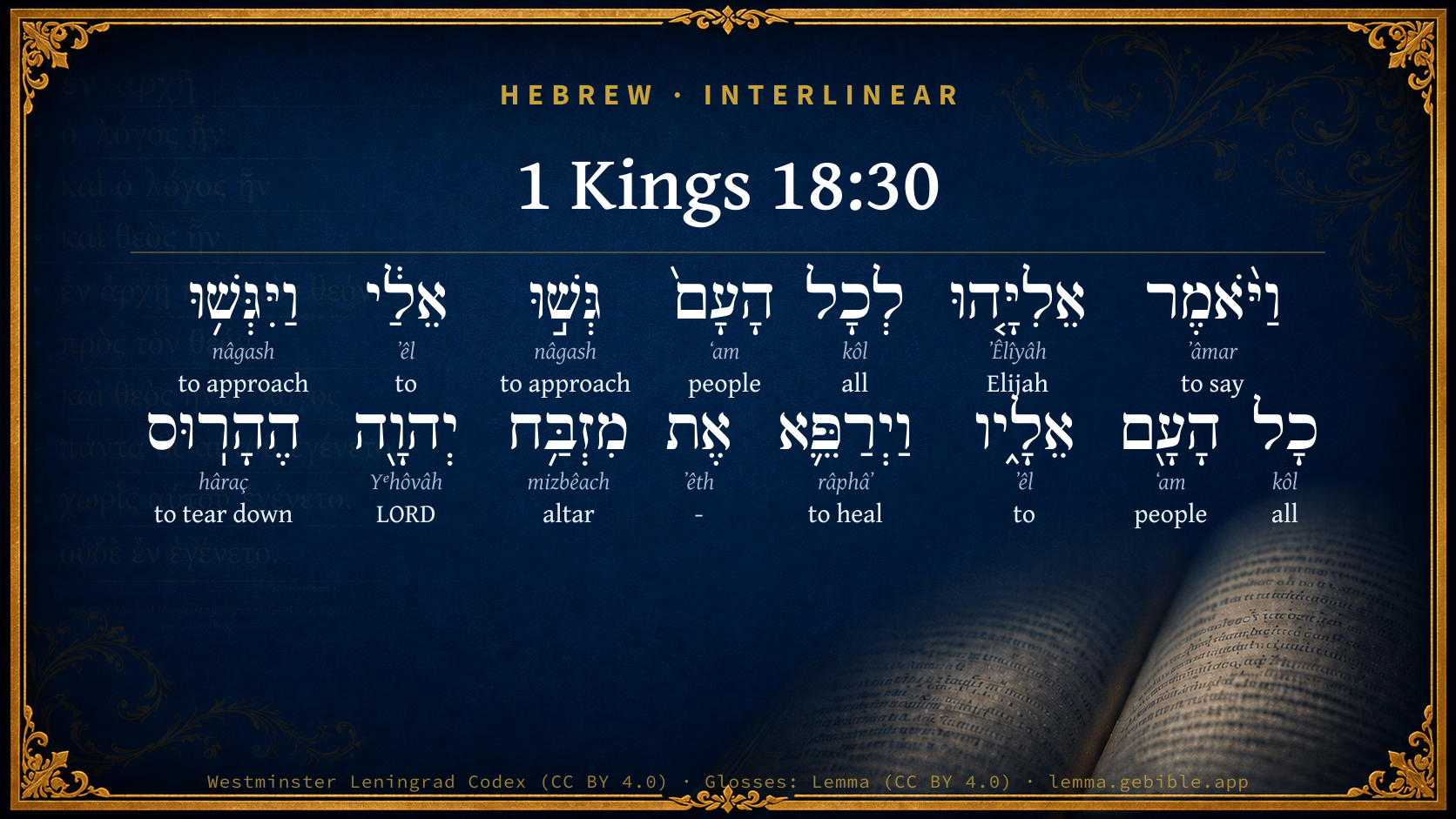
1 Kings 18:30

Hebrew (Westminster Leningrad Codex) 1 Kings 18:30 appears in the Hebrew Old Testament. The text above is from the Westminster Leningrad Codex. Each word links to its Strong’s number, a concise gloss, and parsing drawn from the Open Scriptures Hebrew Bible morphology. Click any word for its full Brown-Driver-Briggs (BDB) entry.
Download image
Cite this verse

1 Kings 18:30 (World English Bible). Public Domain. Lemma interlinear Bible study tool, https://lemma.gebible.app/v/1-kings/18/30.

Show BibTeX & RIS
BibTeX
RIS
English Translation
Elijah said to all the people, Come near to me; and all the people came near to him. He repaired the altar of Yahweh that was thrown down.
World English Bible · Public Domain
Download a study sheet

One document with this verse’s original text, its word-by-word gloss line, the meaning frame, cross-references with their text, attributed commentary, and full source and license credits — printable, and it pastes into notes with its structure intact.

This verse Autodidact and up

Study sheet (.html) Plain text (.txt)

A passage Seminary Student

Up to 50 verses in one chapter. A passage sheet keeps up to 6 commentary sources and 12 cross-references per verse, in the order this page ranks them, and says so on the sheet whenever that leaves anything out. Ask for a single verse and you get the Autodidact verse sheet above.

Everything on this page stays free to read, with no account — the sheet is a download of what is already on screen, not access to it.

Want to remove ads? Support Godless Engineer
Compare translations 3

The same verse in 3 English versions, stacked beneath the original-language interlinear above. Click any original word for its lexicon entry.

Each is an independent rendering of the whole verse — the interlinear is not word-aligned to these translations.

Highlighted words mark where these versions differ — a whole-verse word diff, not a word-by-word alignment.

  • World English Bible Public Domain
    Elijah said to all the people, Come near to me; and all the people came near to him. He repaired the altar of Yahweh that was thrown down.
  • King James Version Public Domain
    And Elijah said unto all the people, Come near unto me. And all the people came near unto him. And he repaired the altar of the LORD that was broken down.
  • unfoldingWord Literal Text CC BY-SA 4.0
    And Elijah said to all of the people, “Come near to me.” And all of the people came near to him. And he repaired the broken-down altar of Yahweh.

unfoldingWord Literal Text — © unfoldingWord, licensed CC BY-SA 4.0. Word-aligned USFM3 via Door43 (git.door43.org/unfoldingWord/en_ult).

Versions to compare (up to 4)

3 of 4 selected

Show all 18 translations

Every available English version of this verse, each an independent rendering of the whole verse.

  • World English Bible Public Domain
    Elijah said to all the people, Come near to me; and all the people came near to him. He repaired the altar of Yahweh that was thrown down.
  • Berean Standard Bible Public Domain
    Then Elijah said to all the people, “Come near to me.” So all the people approached him, and he repaired the altar of the LORD that had been torn down.
  • Majority Standard Bible Public Domain
    Then Elijah said to all the people, “Come near to me.” So all the people approached him, and he repaired the altar of the LORD that had been torn down.
  • King James Version Public Domain
    And Elijah said unto all the people, Come near unto me. And all the people came near unto him. And he repaired the altar of the LORD that was broken down.
  • American Standard Version (1901) Public Domain
    And Elijah said unto all the people, Come near unto me; and all the people came near unto him. And he repaired the altar of Jehovah that was thrown down.
  • Revised Version (1885) Public Domain
    And Elijah said unto all the people, Come near unto me; and all the people came near unto him. And he repaired the altar of the LORD that was thrown down.
  • Geneva Bible (1599) Public Domain
    And Eliiah said vnto all the people, Come to me. And all the people came to him. And he repayred the altar of the Lord that was broken downe.
  • Douay-Rheims (1899) Public Domain
    Elias said to all the people: Come se unto me. And the people coming near unto him, he repaired the altar of the Lord, that was broken down:
  • Young's Literal Translation Public Domain
    And Elijah saith to all the people, `Come nigh unto me;' and all the people come nigh unto him, and he repaireth the altar of Jehovah that is broken down;
  • Literal Standard Version CC BY-SA 4.0
    And Elijah says to all the people, “Come near to me”; and all the people come near to him, and he repairs the altar of YHWH that is broken down;
  • Unlocked Literal Bible CC BY-SA 4.0
    Then Elijah said to all the people, “Come near to me,” and all the people came near to him. Then he repaired the altar of Yahweh that was lying in ruin.
  • unfoldingWord Literal Text CC BY-SA 4.0
    And Elijah said to all of the people, “Come near to me.” And all of the people came near to him. And he repaired the broken-down altar of Yahweh.
  • Darby Bible Public Domain
    Then Elijah said to all the people, Draw near to me. And all the people drew near to him. And he repaired the altar of Jehovah which was broken down.
  • World Messianic Bible Public Domain
    Elijah said to all the people, “Come near to me!”; and all the people came near to him. He repaired the LORD’s altar that had been thrown down.
  • Webster's Bible Public Domain
    And Elijah said to all the people, Come near to me. And all the people came near to him. And he repaired the altar of the LORD that was broken down.
  • Free Bible Version CC BY-SA 4.0
    Then Elijah told everyone, “Come over here to me.” They went over to him, and he repaired the altar of the Lord that had been torn down.
  • Bible in Basic English Public Domain
    Then Elijah said to all the people, Come near to me; and all the people came near. And he put up again the altar of the Lord which had been broken down.
  • JPS Tanakh (1917) Public Domain
    And Elijah said unto all the people: 'Come near unto me'; and all the people came near unto him. And he repaired the altar of the LORD that was thrown down.

Literal Standard Version (2020), Covenant Press — licensed CC BY-SA 4.0. Text via the HelloAO Bible API (eBible.org). Unlocked Literal Bible (unfoldingWord) — licensed CC BY-SA 4.0. Text via the HelloAO Bible API (eBible.org). unfoldingWord Literal Text — © unfoldingWord, licensed CC BY-SA 4.0. Word-aligned USFM3 via Door43 (git.door43.org/unfoldingWord/en_ult). Free Bible Version, Dr. Jonathan Gallagher — licensed CC BY-SA 4.0. Text via the HelloAO Bible API (eBible.org).

Word by word

More ways to search: Search by grammar → Find every occurrence → Compare this word →

Practice this passage: Drill this verse → Learn its vocabulary →

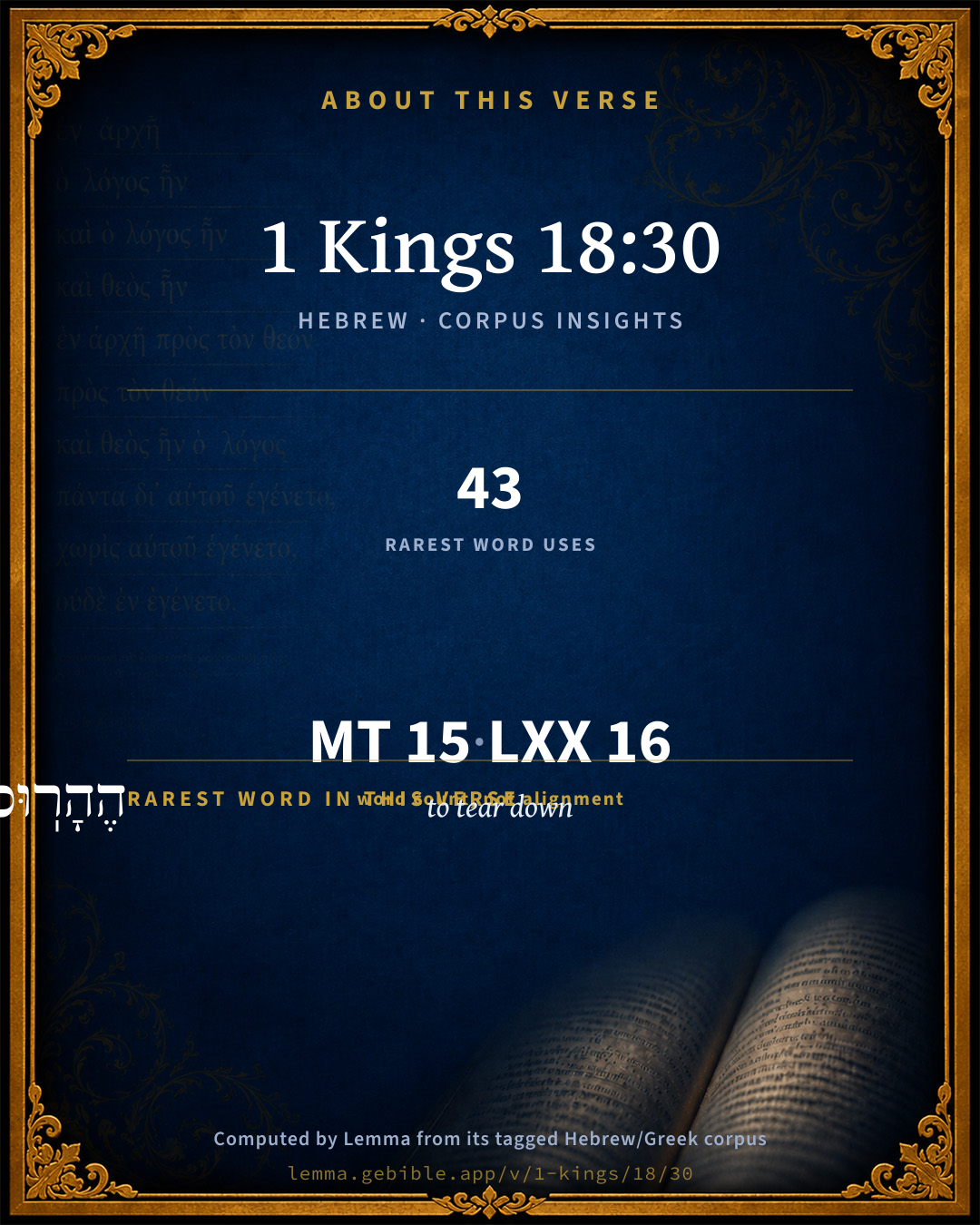
הֶהָרֽוּס
hâraç
H2040
“the · torn down”
Particle, Definite Article + Verb, Qal, Participle Passive, Masculine, Singular, Absolute
Part of Speech
Particle + Verb
Stem
Qal
Form
Participle Passive
Gender
Masculine
Number
Singular
State
Absolute
Full BDB Definition

Origin: a primitive root

TWOT: 516

to tear down, break down, overthrow, beat down, break, break through, destroy, pluck down, pull down, throw down, ruined, destroyer, utterly - (Qal) - to throw down, tear down - to break through - to break down, break away - (Niphal) to be torn down, be thrown down - (Piel) - to overthrow, tear down - destroyer (participle)
  1. וַיֹּ֨אמֶר ʼâmar H559 “and · to say” Conjunction + Verb, Qal, Sequential Imperfect, 3rd Person, Masculine, Singular
  2. אֵלִיָּ֤הוּ ʼÊlîyâh H452 “Elijah” Noun, Proper
  3. לְכָל kôl H3605 “to/for · all of” Preposition + Noun, Common, Masculine, Singular, Construct
  4. הָעָם֙ ʻam H5971 “the · people” Particle, Definite Article + Noun, Common, Masculine, Singular, Absolute
  5. גְּשׁ֣וּ nâgash H5066 “approach” Verb, Qal, Imperative, 2nd Person, Masculine, Plural
  6. אֵלַ֔י ʼêl H413 “to · me” Preposition + Suffix, Personal, 1st Person, Common, Singular
  7. וַיִּגְּשׁ֥וּ nâgash H5066 “and · to approach” Conjunction + Verb, Qal, Sequential Imperfect, 3rd Person, Masculine, Plural
  8. כָל kôl H3605 “all of” Noun, Common, Masculine, Singular, Construct
  9. הָעָ֖ם ʻam H5971 “the · people” Particle, Definite Article + Noun, Common, Masculine, Singular, Absolute
  10. אֵלָ֑יו ʼêl H413 “to · him” Preposition + Suffix, Personal, 3rd Person, Masculine, Singular
  11. וַיְרַפֵּ֛א râphâʼ H7495 “and · to heal” Conjunction + Verb, Piel, Sequential Imperfect, 3rd Person, Masculine, Singular
  12. אֶת ʼêth H853 “-” Particle, Direct Object
  13. מִזְבַּ֥ח mizbêach H4196 “altar of” Noun, Common, Masculine, Singular, Construct
  14. יְהוָ֖ה Yᵉhôvâh H3068 “LORD” Noun, Proper

About this verse

These counts appear in no published source. They are computed here, from the morphology-tagged text and Lemma’s own curated glosses. What Lemma adds →

15
words
11
distinct lemmas
Historical
section

Shared distinctive vocabulary

הֶהָרֽוּס to tear down H2040 occurs in 42 verses of the Hebrew Bible. Also found in:

Grammatical profile

  • 5 verbs
  • 7 nouns
  • 2 prepositions
  • 1 particle

Verb forms

  • וַיֹּ֨אמֶר Qal · Sequential Imperfect
  • גְּשׁ֣וּ Qal · Imperative
  • וַיִּגְּשׁ֥וּ Qal · Sequential Imperfect
  • וַיְרַפֵּ֛א Piel · Sequential Imperfect
  • הֶהָרֽוּס Qal · Participle Passive

Repetition

Words recur within this verse — often emphatic in Hebrew:

  • לְכָל all H3605 ×2
  • הָעָם֙ people H5971 ×2
  • גְּשׁ֣וּ to approach H5066 ×2
  • אֵלַ֔י to H413 ×2

Hebrew & Septuagint length

In English translation the verse runs 28 words from the Hebrew and 18 from the Septuagint (LXX English) — the Septuagint runs noticeably shorter here. See the side-by-side →

A rough comparison of the two English renderings, which tokenize alike — not a word-level alignment.

Word counts can differ between the Hebrew and the Greek without any difference in meaning — e.g. the Hebrew direct-object marker אֵת has no separate Greek word, and Greek often adds the article ὁ.

In the original languages it is 15 Hebrew tokens and 16 Greek tokens — but the two are counted differently (Hebrew bundles its prefixes and suffixes into one token; the Greek is in lemma form), so that isn’t a like-for-like length.

Cross-references

4

Topical passages linked to 1 Kings 18:30 in the Treasury of Scripture Knowledge — connected by theme and wording, ordered by reader-vote popularity; previews shown in the World English Bible.

  • 2 Chronicles 33:16 He built up the altar of Yahweh, and offered thereon sacrifices of peace-offerings and of thanksgiving, and commanded Judah to serve Yahweh, the God of Israel.
  • 1 Kings 19:14 He said, I have been very jealous for Yahweh, the God of hosts; for the children of Israel have forsaken your covenant, thrown down your altars, and slain your prophets with the sword; and I, even I only, am left; and they seek my life, to take it away.
  • 1 Kings 19:10 He said, I have been very jealous for Yahweh, the God of hosts; for the children of Israel have forsaken your covenant, thrown down your altars, and slain your prophets with the sword: and I, even I only, am left; and they seek my life, to take it away.
  • Romans 11:3 "Lord, they have killed your prophets, they have broken down your altars; and I am left alone, and they seek my life."

Cross-references courtesy of OpenBible.info (CC BY 4.0).

Hebrew and Greek witnesses Masoretic Hebrew ↔ Greek Septuagint

The same verse in the two great witnesses to the Old Testament, shown verse-for-verse.

Here the Septuagint runs noticeably shorter than the Hebrew — LXX2012 (modern English Septuagint) 18 words vs World English Bible 28. A rough length comparison of the two English translations, not a word-level alignment — read both below.

These are two independent witnesses, not word-aligned to each other, and the Septuagint is shown in lemma (dictionary) form.

Hebrew 1 Kings 18:30 Masoretic · Westminster Leningrad Codex

וַיֹּ֨אמֶר אֵלִיָּ֤הוּ לְכָל הָעָם֙ גְּשׁ֣וּ אֵלַ֔י וַיִּגְּשׁ֥וּ כָל הָעָ֖ם אֵלָ֑יו וַיְרַפֵּ֛א אֶת מִזְבַּ֥ח יְהוָ֖ה הֶהָרֽוּס

Elijah said to all the people, Come near to me; and all the people came near to him. He repaired the altar of Yahweh that was thrown down.

World English Bible · Public Domain

Greek LXX 1 Kings 18:30 Septuagint · lemma form

καί εἶπον ηλιου πρός ὁ λαός προςἄγω πρός ἐγώ καί προςἄγω πᾶς ὁ λαός πρός αὐτός

And Eliu said to the people, Come near to me. And all the people came near to him.

LXX2012 (modern English Septuagint) · Public Domain

On this verse, The Cambridge Bible for Schools and Colleges discusses the Septuagint’s reading. Read the note in Commentary ↓

Hebrew: Westminster Leningrad Codex (CC BY 4.0). Greek: Septuagint (public domain); English from LXX2012 (modern English Septuagint) (Public Domain). How the Septuagint differs from the Hebrew →

Targum (Aramaic paraphrase)

1

The Targum is the ancient Jewish Aramaic paraphrase of the Hebrew Scriptures — an interpretive translation, not the Hebrew text itself. Onkelos (literal) and Pseudo-Jonathan (expansive) render the Torah, and Jonathan the Prophets. Coverage is partial: where no permissively-licensed English translation exists for a verse, only the Aramaic is shown. This is verse-level text, not a word-by-word alignment to the Hebrew.

  1. Targum Jonathan Prophets (Joshua–Malachi)
    וַאֲמַר אֵלִיָהוּ לְכָל עַמָא אִתְקְרִיבוּ לְוָתִי וּקְרִיבוּ כָל עַמָא לְוָתֵיהּ וּבְנָא יַת מַדְבְּחָא דַייָ דַהֲוָה מְפַגָר:

    (no public-domain English translation for this verse)

    Targum Jonathan — Aramaic: “Mikraot Gedolot” (public domain). English: “Sefaria Community Translation” (CC0 1.0 (public-domain dedication)); “London "Chaldee Paraphrase," 1871” (public domain). Text via Sefaria.

Commentary

Notes on 1 Kings 18:30 from classic Christian and Jewish commentators (each source and its license shown beneath its notes). The classic Christian expositions comment on the surrounding passage and are grouped to its opening verse, so a note may address several verses; the Jewish commentaries on the Tanakh (Rashi and others) are per-verse, so they appear only where the commentator wrote on this verse.

Lemma curates 59 commentaries, every one of them public domain or Creative Commons licensed, each selected and text-cleaned for this edition rather than reprinted as found. About our sources →

Trapp's Complete Commentary

John Trapp

1Ki 18:30 And Elijah said unto all the people, Come near unto me. And all the people came near unto him. And he repaired the altar of the LORD [that was] broken down.

Ver. 30. And he repaired the altar of the Lord.] Defaced, likely, by idolaters, and haply by these Baalists now in their frantic fits, and to make work for Elijah, who had so taunted them, and would yet take them a link lower.

John Trapp, A Commentary or Exposition upon All the Books of the Old and New Testament (1647–1656) — public domain. Text from a community e-Sword module.

The Biblical Illustrator

Joseph S. Exell

1Ki_18:30

He repaired the altar of the Lord that was broken down.

I. The significance of broken altars. That is a simple line from an old chronicle, but it is the present root of many a pathetic human tragedy. It sets out in terms of quite harmless simplicity an apparently incidental fact; really it unveils the spring of the nation s calamity, and reveals the source of her uttermost disaster. Famine is everywhere. What is the root of this menacing peril, what the cause of this desolating misfortune? The whole answer lies in the broken altar. That little heap of indistinguishable rubbish, those few overturned stones, that desolated shrine--these are the central fact, the key to the situation, the pivot upon which the whole thing turns. The nation has been recreant to the sovereign sanctities, it has outraged lifes august supremacies, and at last the inexorable retribution has come, slow but sure-footed Nemesis has overtaken the people; and their pride has been overthrown, their security stripped away, and calamity overwhelmed them. Life is crammed with rich and fruitful symbols. And those few stones, lying in unregarded confusion, are the symbol of a forgotten God. They seem so unimportant, but they are the pathetic mementoes of dead worships, forgotten loyalties, quenched visions, faded raptures, and lifeless loves. That is lifes most arrestive pathos, to have known God and to have been intimate with the Eternal, and to have seen the vision splendid fade into the light of common day, and the divinity of heaven degraded into a powerless commonplace. And that soon runs out into every part of our complex lives and touches each least thing with its paralysing and degrading hand. These two things are inexorably fastened together--the famine in the land is the certain consequence of spiritual disloyalty and recreancy. When the soul becomes materialised, its visions arc quenched, its raptures die, disintegration inevitably sets in, the descent is begun, which, unless it is arrested, can have but one, and that no uncertain end. Life loses its high incentives, the breath of its most spacious inspirations perishes, the spell of its holiest attractions is broken, bit by bit the glory vanishes from the sky, and quenched stars presage the uttermost dark. And this is no capricious law, which once--but once only--worked itself out to its awful issue, and smote them that disregarded the sanctities with the desolation of devastating famine. This is one of those eternal laws of Gods wise government of the world, whereby every outraged piety vindicates its awful holiness and supremacy, and a certain Nemesis is securely fastened to every act of wrong-doing. Spiritual disloyalties degrade physical conditions, and sins o the heart work out their awful issue in plain facts which none can dispute. The punishment may vary, famine or some other scourge of God, but it is never uncertain. And we to-day may be sure that every broken altar in our individual life is mysteriously, but certainly, working to its inevitable close.

II. Repairing the altar of the Lord. He is the real helper and healer of the people, who can put his finger upon the root of their sorrow, who discovers the cause of their calamity and defeat. It is little good to peddle about the circumference, to remedy this evil, to heal this wound, to satisfy this hunger--all these are but varied forms of a sovereign defect, to find and to heal which is the supreme necessity. Things must be seen in their proper perspective, and dealt with in their imperative sequence, before good can be established and welfare made secure. Some might have said to the prophet, Why trouble about the altar now? Submit the final issue, decide the great question, then build the altar to the certain God! But with a sure instinct he touched the secret of the nations sorrows--that tiny heap of broken stones is the root of all its disasters. The reconstruction of life must begin at the point of its incipient overthrow. However tired the feet may be, and however painful the journey, men must retrace their steps along the sad way of their disobedience, until they stand at the point of their departure from the precepts of the Lord. They must confront the past with wide-open eyes, see every bit of its disloyalty and tragic failure; the erring of heart as well as of feet; its revolt against high heaven and dissonance with the spirit of goodness. Every bit of stable reconstruction either in personal or national life must go back and begin at the point of departure, it must build on the old foundation when every uncertain stone has been removed; so, and so only, can it hope to be secure. And this old story has a pathetic relevancy to the life of many of us today. There was a time when our days were bound each to each by natural piety. But bit by bit it has all been changed. The circumstances of life have taken on an added pomp, but a glory has faded out of our days, and we sit listening to strains of distant and ever fainter music, and watch the passing of receding angels. Bit by bit the vision faded, the revelation was withdrawn, the glory vanished, the simplicity departed, the pledge was broken, the purity was despoiled, the integrity disintegrated, and with them the radiant angels of joy and peace have withdrawn. That is the degradation that comes of neglect. No rough hands of ours tore stone from stone and piled the shrine with ruins, day by day we swept away its crumbled fragments, until at last it was gone we knew not how. But oh, the difference to me! To-day the ruin is not absolute, the Presence has not wholly gone. But there is only one way. The souls intimacy with Heaven must be re-established. (G. Beesley Austin.)

The destruction and restoration of the altar

The altar, the sacred possession of all the twelve stones which Elijah rebuilt to represent the whole of Israel. Broken down and deserted. Apply to practical desertion of worship.

I. When worldliness or any other sin absorbs the soul and prayer is abandoned. Scepticism as to reality and answer to prayer allows the fires to go out and the altar to go to decay. When even preaching usurps the place of worship, so monopolising time and attention that worship is reduced to a minimum.

II. Restoration--effected by calling to repentance, and vindication of the honour of God, Fire must come from heaven to rekindle, and special descent of the Holy Spirit of prayer and supplication will be the answer to diligent seeking.

III. Restoration of the family altar a special demand of our time. General decay thereof. Sad results. Blessed effects of restoring. (Homiletic Review.)

The altar a necessity

An eminent worldling wrote to a learned professor a letter in which he said: It has been proved in the Colonies that rapid social deterioration follows upon local inability to go to church. If the settlers grant be so remote that churchgoing becomes an impossibility he gradually ceases to miss it, abandons the weekly burnishing and outside decorum, and the rest rapidly follows. Oliver Wendell Holmes, far from an Evangelical--but a man of keen insight into the human heart says, I have in the corner of my heart a plant called reverence, which I find needs watering at least once a week. (H. O. Mackey.)

The Biblical Illustrator, edited by Joseph S. Exell (c. 1880s–1900s) — public domain. Text from a community e-Sword module.

Joseph Benson's Commentary

1Ki 18:30. Elijah said, Come near unto me — Come away from these impudent deceivers to me, and expect from me the satisfaction of your desire. He repaired the altar of the Lord — An altar which probably had remained from the time of the judges; at least, it had been built by some of their ancestors, for the offering of sacrifices to the God of Israel, which was frequently done in high places, of which, it is probable, Carmel was once one of the most eminent in the whole kingdom. This altar Elijah now repaired, because it had been broken down, doubtless, by some of the Baalites out of their enmity to the true God, whose temple they could not reach, and therefore showed their malignity in destroying his altars. “Both Tacitus and Suetonius speak of the God of Carmel, whom Vespasian went to consult when he was in Judea; but they tell us, that there was neither temple nor statue upon the mountain, except one altar only, plain, but venerable for its antiquity. The altar of Carmel seems to have had its original from this altar of the true God, which the ancient Hebrews first erected, and Elijah afterward repaired; and which even the heathen held in such veneration, that when they came to be masters of the country, they would not so much as place an image by it.” — Dodd.

Joseph Benson's Commentary on the Old and New Testaments (1811–1818) — public domain. Text from a community e-Sword module.

Adam Clarke's Commentary

Verse 30. He repaired the altar of the Lord] There had been an altar of Jehovah in that place, called, even among the heathens, the altar of Carmel, probably built in the time of the judges, or, as the rabbins imagine, by Saul. Tacitus and Suetonius mention an altar on Mount Carmel, which Vespasian went to consult; there was no temple nor statue, but simply an altar that was respectable for its antiquity. "Est Judaeam inter Syriamque Carmelus; ita vocant montem Deumque: nec simulachrum Deo, aut templum situm tradidere majores: aram tantum, et reverentiam." - TACIT. Hist. lib. ii., c. 78. A priest named Basilides officiated at that altar, and assured Vespasian that all his projects would be crowned with success.

Suetonius speaks to this purpose: "Apud Judaeam Carmeli Dei oraculum consulentem ita confirmavere sortes, ut quicquid cogitaret volveretque animo quamlibet magnum, id esse proventurum pollicerentur." SUET. in Vespas. cap. 5. The mount, the absence of a temple, no image, but a simple altar, very ancient, and which was held in reverence on account of the true answers which had been given there, prove that this was originally the altar of Jehovah: though in the time of Vespasian it seems to have been occupied by a heathen priest, and devoted to lying vanities.

Adam Clarke's Commentary on the Bible (1810–1826) — public domain. Text from a community e-Sword/MySword module.

Ellicott's Commentary for English Readers

(30) The altar of the Lord—evidently referred to as well known, and here accepted by Elijah as having a true sacredness. The exclusive consecration of the appointed sanctuary at Jerusalem, if ever as yet thoroughly recognised, was now obviously broken down by the religious severance of Israel.

A Bible Commentary for English Readers, edited by Charles John Ellicott (1878–1897) — public domain. Text from a community e-Sword module.

The Cambridge Bible for Schools and Colleges

gen. ed. J. J. S. Perowne

30. And he repaired the altar of the Lord that was broken down] On the top of Carmel had been one of the high places where worship was paid to Jehovah, after the manner of the worship in the wilderness, till the place which God had chosen became known and the Temple built there. The custom of worship at such spots was continued for a long time after Solomon’s date, and Elijah here treats the altar as a specially sacred erection, to be restored in Jehovah’s honour.

The LXX. omits this clause here, but introduces one very similar in 1Ki_18:32.

The Cambridge Bible for Schools and Colleges (gen. ed. J. J. S. Perowne; Cambridge University Press, 1878–1918) — public domain. Text from a community e-Sword module.

John Gill's Exposition

And with the stones he built an altar in the same of the Lord,.... Whom the twelve tribes had formerly worshipped; and though now divided in their civil state, yet ought to be united in the worship of God:

and he made a trench about the altar, as great as would contain two measures of seed; or two seahs, one of which was the third part of an ephah, and two of them were more than half a bushel; and this trench or ditch round the altar was as broad as such a measure of seed would sow.

John Gill's Exposition of the Whole Bible (1746–1763) — public domain (CC PDM 1.0). Text via the HelloAO Bible API.

Haydock's Catholic Bible Commentary

Down, by the false prophets, whose fury the people now repressed. (Tirinus) --- The altar might have been erected, under the judges, lawfully. (Calmet)

George Leo Haydock (1774–1849), Haydock's Catholic Family Bible and Commentary, 1859 edition — public domain. Excludes Psalms (Douay-Rheims chapter numbering differs from Protestant) and Deuterocanonical books (Catholic canon only).

Matthew Poole's English Annotations

Come near unto me; come away from these impudent deceivers to me, and expect from me what satisfaction you desire.

He repaired the altar, which by the people’s help was quickly done; the materials being all ready, and very slightly put together, only for the present occasion.

The altar of the Lord; which had been built there by some of their ancestors for the offering of sacrifice to the God of Israel, which was frequently done in high places, of which this was none of the least eminent ones; but being for some time neglected, it needed reparations.

That was broken down; either, first, By the priests of Baal at this time, who leaped upon it to that end; of which See Poole "1Ki 18:26". Or rather, secondly, By some of the Baalites, out of their enmity to the true God, whose temple, because they could not reach, they showed their malignity in destroying his altars, 1Ki 19:14.

Matthew Poole's English Annotations on the Holy Bible (1683–1685) — public domain. Text from a community e-Sword/MySword module.

Whedon's Commentary on the Bible

Daniel D. Whedon

30. Come near — The people had, perhaps, withdrawn somewhat, being shocked at the wild dances and ravings of the false prophets, whose number, too, would not allow the people to approach so closely to the scene as when Elijah became the sole minister at the altar.

He repaired the altar of the Lord — One of those altars which had been erected and used before the days of Solomon, when “the people sacrificed in high places, because there was no house built unto the name of the Lord.” See 1Ki_3:2. This altar must have been on the same summit where the priests of Baal had just been worshipping, but a little distance removed from the spot of their orgies. It had probably been broken down at the time of Jezebel’s persecution, (compare 1Ki_18:4 with 1Ki_19:10,) and Elijah repaired it in the manner described in the two following verses, for he would not use the altar which the false prophets had made, and had polluted with their hideous idolatries.

Daniel D. Whedon (gen. ed.), Commentary on the Old and New Testaments (1874–1909) — public domain. Text from a community e-Sword module.

The Pulpit Commentary

And Elijah said unto all the people He has now done with the priests. They have had their opportunity; his turn is come, Come dear unto me. Hitherto they had gathered round the altar of Baal, and some, it may he, had joined their prayers to those of the priests (ver. 24). In ver. 21, he "drew near same word to them. Now they must stand round the altar he is about to build. He will have "eyewitnesses and ear-witnesses" (Keil). There must be no suspicion of imposture. And all the people came near unto him And he repaired the altar of the Lord that was broken down. It has been already suggested that this altar may have dated from the time when there was no house built unto the name of the Lord. But it is just as likely that it had been restored, if not raised, by some of the "seven thousand who had not bowed their knees unto Baal," or by some of the faithful remaining in Israel after the calf-worship and the hostility between the two kingdoms had made worship at Jerusalem an impossibility. Anyhow we can hardly be mistaken in holding that this was one of the "altars", (1Ki_19:10) thrown down" by command of Ahab or Jezebel. Elijah"s repairing it wag an act of profound significance. It showed him as the restorer of the law and the true religion.

Vers. 30-35.

The Prepatation.

As the time of the evening sacrifice approached, Elijah left the priests of Baal prophesying in despair. Satan, if permitted, could have brought fire down (see Job_1:12, Job_1:16; Rev_13:13, Rev_13:14) but God restrained him. The people were now convinced that Baal was not able to hear his priests; so they drew round Elijah, and observed the order in which he proceeded with his preparation.

I HE REPAIRED THE ALTAR OF THE LORD.

1. Then there had been an altar of the Lord on Carmel.

(1) Some great man, as Abraham or Samuel, had built an altar there. Its relies remained a memorial of the piety of earlier times. Influence for good or evil is posthumous.

(2) This mount was, in consequence, reputed as holy. Perhaps this determined Elijah in his choice. Holy places were formerly more important than they are under this spiritual dispensation (see Mal_1:11; Joh_4:20-24; 1Ti_2:8)

2. But this altar had been "broken down.

(1) Not only had it fallen into decay, but it had suffered from the hand of violence. Probably this was one of the sad evidences of the wicked zeal of Jezebel It was significant of the apostasy of the times (see 1 Kings. Rom_11:2, Rom_11:8) Idolatry was in favour at court; courtiers therefore favoured it; so did the multitude who followed the fashions.

(2) Such influences still are potent. Idolatrous fashions in dress. In furniture. Even in religion.

3. Elijah would not use the altar used by the priests of Baal.

(1) The service of Jehovah must be pure. It must not be contaminated by the remotest connection with idolatrous abominations. Let us search our hearts. (see 2Co_6:15-18)

(2) In repairing the disused altar of Jehovah, Elijah showed that his was no new religion, but that of the fathers of the nation. So he significantly rebuked the apostasy.

4. Twelve stones were employed in the repairs.

(1) This was "according to the number of the sons of Jacob, unto whom the word of the Lord came, saying, Israel shall be thy name." This was done to show that, though ten of the tribes had separated from the house of David, still, in worship there should be no division (see Genesis Exo_24:4; Jos_4:5, Jos_4:20)

(2) "The twelve stones being for the twelve tribes were the mystical body of Him who was their sacrifice and altar both, or who offered His own body, and suffered in it, and who was promised to be accepted in the name (lar Israel, i.e. (r pleasing to, right with, or upright before (la) the Lord. (see Mat_3:17) But

(3) It was also prophetic of the healing of all schisms in the mystical body of Christ in the happy time to come. (see Eze_37:21, Eze_37:22)

(4) All this the prophet did "in the name of the Lord" (ver. 32). By His direction; therefore with notable significance. For His glory. And since God so expressly authorized such a deviation from the Levitical law, does it not indicate that that law had its principal value in its typical teaching, and that when the antitypes came it should pass away? (See Col_2:22; Heb_8:1-7)

II HE PREPARED THE SACRIFICE.

1. He put the wood in order.

(1) Why did he not dispense with the wood? The celestial fire certainly did not need it, for it fell upon the sacrifice before it touched the wood, and was so fervent that nothing could stand before it. Stones and dust could no more resist it than wood. Had the wood been intended for fuel, would the prophet have overflowed it with water?

(2) The order was usual in sacrifices. It was observed for typical purposes. The holocaust was a type of Christ, our Sacrifice, who, when consumed in the holy fires of the Godhead on the altar of Calvary, was laid on the wood of the Cross.

2. He poured writer upon the sacrifice.

(1) He poured it in great quantity and with much deliberation, for in preparing the altar he dug a trench to receive the overflow (vers. 32-35). The water probably came from a deep well-spring in the mountain side rather than from the Kishon. The Mediterranean seems out of the question. Josephus states the well to have been the source (Ant. 8:13).

(2) It was conveyed in four barrels, and these were filled and emptied three times, thus making twelve. Here again we meet with the number of the tribes of Israel. The order, viz., in sets of four three times repeated, was that of the stones in the high priest"s breastplate, upon which were engraven the names of the tribes.

(3) Could this sign be intended to show that a plentiful rain would shortly come upon all Israel? And further, that it should come through the repentance of the people for whose sin it had been withholden? That it should come through the return of the people from the altar of Baal to that of Jehovah? If so, then in this sign the gospel also is preached to us. We too must be saved from spiritual drought and death through repentance towards God and faith in Christ. J.A.M.

The Pulpit Commentary (1880–1919), ed. H.D.M. Spence-Jones & Joseph S. Exell — public domain. Text from a community e-Sword module.

John Wesley's Explanatory Notes

The altar - This had been built by some of their ancestors for the offering of sacrifice to the God of Israel, which was frequently done in high places. Broken down - By some of the Baalites, out of their enmity to the true God, whose temple, because they could not reach, they shewed their malignity in destroying his altars.

John Wesley, Explanatory Notes Upon the Whole Bible (1754–1765) — public domain. Text via the GEBible commentary corpus.

unfoldingWord translationNotes

Door43 World Missions Community

twelve stones

"12 stones" (See: Numbers)

in the name of Yahweh

"Name" here is a metonym for honor and reputation. Possible meanings are 1) "to honor Yahweh" or 2) "with the authority of Yahweh." (See: Metonymy)

trench

a small waterway to hold water

two seahs of seeds

A seah is a unit of volume equal to about 7.7 liters. AT: "about 15 liters of seeds" (See: Biblical Volume)

translationWords

altar

Yahweh

ruin

twelve tribes of Israel

son

Jacob

word of God

name

seed

unfoldingWord translationNotes — © Distant Shores Media and the Door43 World Missions Community, licensed CC BY-SA 4.0. Source: git.door43.org/Door43/en_tn.

Rashi

Rabbi Shlomo Yitzchaki (Rashi)

And he repaired the altar of Adonoy that had been broken down. He built an altar and reminded Yisroel that God’s altar should enter their thoughts and should be oft mentioned, for it was torn down and destroyed, and its name and its mention had ceased from the mouth of all the ten tribes. Thus I heard is its plain interpretation. And its Midrashic interpretation I heard, is that Shaul built an altar on Mount Carmel, and that is what it states, “Shaul came to Carmel, and is setting up a place for himself,” and there it states, “and he erected an altar there.” But the kings of Yisroel tore down all the altars and high places in their land that were made in the Name of Heaven, and Eliyahu built this altar of Shaul that had been torn down.

Rashi on the Tanakh — English translations: “The Judaica Press complete Tanach with Rashi, translated by A. J. Rosenberg” (CC BY 4.0); “Pentateuch with Rashi's commentary by M. Rosenbaum and A.M. Silbermann, 1929-1934” (public domain); “The Metsudah Tanach series, Lakewood, N.J” (CC BY 4.0); and “The Book of Joshua, Metsudah Publications, 1997” (CC BY 4.0). Text via Sefaria.

Lesson kit

Teaching starters — assembled from the data on this page, not authored interpretation. Every prompt links to the verse data it draws on. Edit before teaching.

1 Kings, in the Historical, opens this verse with 15 words (11 distinct Hebrew lemmas). Its most distinctive word is hâraç (“to tear down”). The Greek Septuagint runs shorter here. A historical commentator’s framing appears above. Read the whole chapter for the surrounding context.

Discussion questions

  1. The word hâraç carries the sense “to tear down.” How does it shape the verse?
  2. How does Exodus 15:7, which shares the word «to tear down», read alongside this verse?
  3. What does the repetition of “all” (2× in this one verse) do in this verse?
  4. The Septuagint runs shorter here than the Hebrew. What might account for the difference?
  5. The translations on this page render this verse differently — a whole-verse word diff, not a word-by-word alignment. What might account for the different wordings?
  6. «וַיֹּ֨אמֶר» is a Qal Sequential Imperfect verb. How does that grammatical form shape the action described?
  7. Compare how Trapp's Complete Commentary and The Biblical Illustrator read this verse. Where do they agree or differ?

Things to notice

Reading settings

Reading text

Shown beneath each verse's original-language words.

Old Testament
Old Testament edition

Read the OT as the Masoretic Hebrew (MT) or the Greek Septuagint (LXX).

English shown for the Greek Septuagint (in the Hebrew ↔ Greek comparison).

Comparing translations? Open the Compare panel on any verse page to stack up to four side by side.