Isaiah 50:8

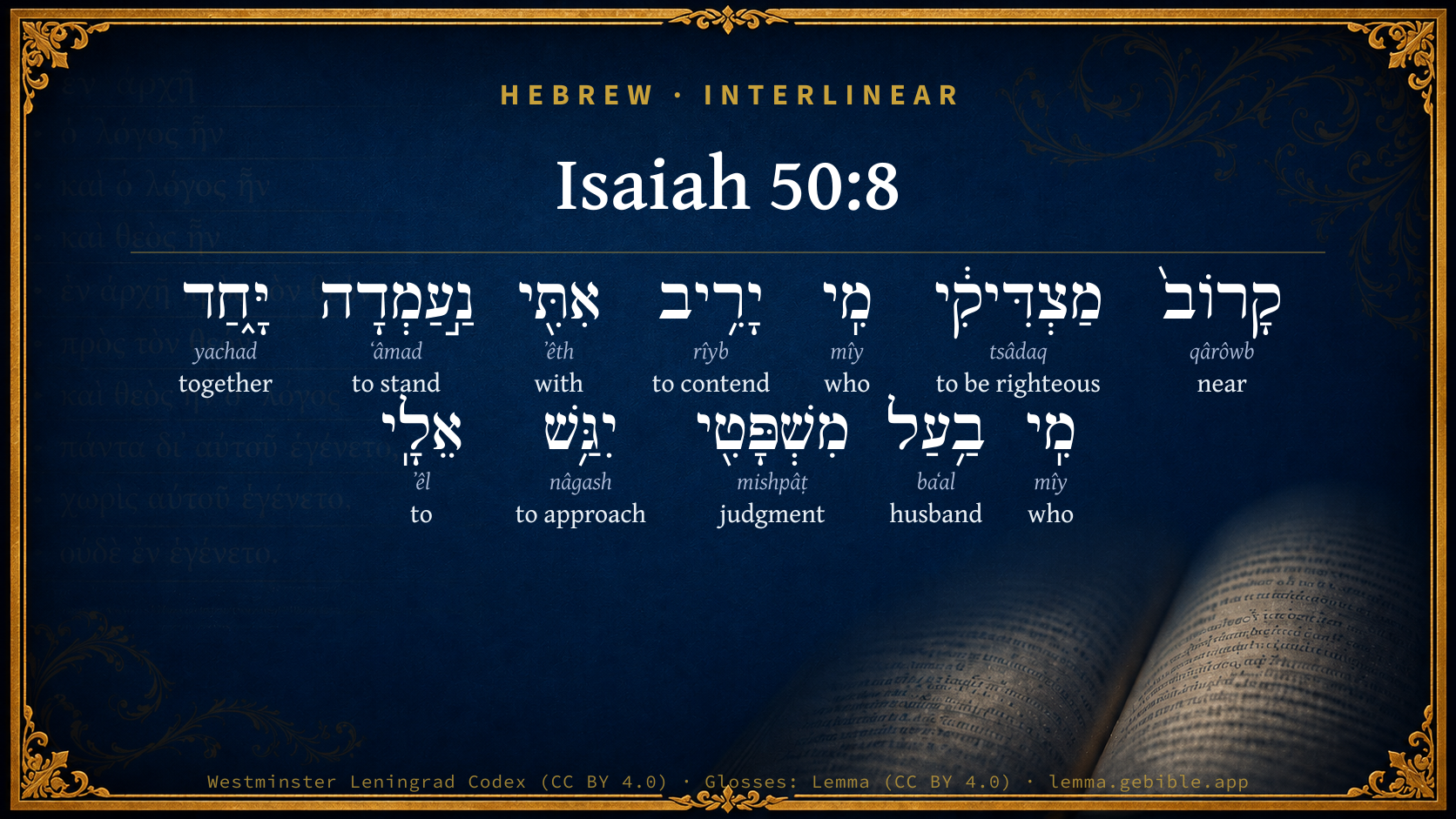
Hebrew (Westminster Leningrad Codex) Isaiah 50:8 appears in the Hebrew Old Testament. The text above is from the Westminster Leningrad Codex. Each word links to its Strong’s number, a concise gloss, and parsing drawn from the Open Scriptures Hebrew Bible morphology. Click any word for its full Brown-Driver-Briggs (BDB) entry.
Download image
Cite this verse

Isaiah 50:8 (World English Bible). Public Domain. Lemma interlinear Bible study tool, https://lemma.gebible.app/v/isaiah/50/8.

Show BibTeX & RIS
BibTeX
RIS
English Translation
He is near who justifies me; who will bring charges against me? Let us stand up together: who is my adversary? Let him come near to me.
World English Bible · Public Domain
Download a study sheet

One document with this verse’s original text, its word-by-word gloss line, the meaning frame, cross-references with their text, attributed commentary, and full source and license credits — printable, and it pastes into notes with its structure intact.

This verse Autodidact and up

Study sheet (.html) Plain text (.txt)

A passage Seminary Student

Up to 50 verses in one chapter. A passage sheet keeps up to 6 commentary sources and 12 cross-references per verse, in the order this page ranks them, and says so on the sheet whenever that leaves anything out. Ask for a single verse and you get the Autodidact verse sheet above.

Everything on this page stays free to read, with no account — the sheet is a download of what is already on screen, not access to it.

Want to remove ads? Support Godless Engineer
Compare translations 3

The same verse in 3 English versions, stacked beneath the original-language interlinear above. Click any original word for its lexicon entry.

Each is an independent rendering of the whole verse — the interlinear is not word-aligned to these translations.

Highlighted words mark where these versions differ — a whole-verse word diff, not a word-by-word alignment.

  • World English Bible Public Domain
    He is near who justifies me; who will bring charges against me? Let us stand up together: who is my adversary? Let him come near to me.
  • King James Version Public Domain
    He is near that justifieth me; who will contend with me? let us stand together: who is mine adversary? let him come near to me.
  • unfoldingWord Literal Text CC BY-SA 4.0
    The one justifying me is near. Who will contend with me? Let us stand together! Who the master of my judgment? Let him come near to me!

unfoldingWord Literal Text — © unfoldingWord, licensed CC BY-SA 4.0. Word-aligned USFM3 via Door43 (git.door43.org/unfoldingWord/en_ult).

Versions to compare (up to 4)

3 of 4 selected

Show all 18 translations

Every available English version of this verse, each an independent rendering of the whole verse.

  • World English Bible Public Domain
    He is near who justifies me; who will bring charges against me? Let us stand up together: who is my adversary? Let him come near to me.
  • Berean Standard Bible Public Domain
    The One who vindicates Me is near. Who will dare to contend with Me? Let us confront each other! Who has a case against Me? Let him approach Me!
  • Majority Standard Bible Public Domain
    The One who vindicates Me is near. Who will dare to contend with Me? Let us confront each other! Who has a case against Me? Let him approach Me!
  • King James Version Public Domain
    He is near that justifieth me; who will contend with me? let us stand together: who is mine adversary? let him come near to me.
  • American Standard Version (1901) Public Domain
    He is near that justifieth me; who will content with me? let us stand up together: who is mine adversary? let him come near to me.
  • Revised Version (1885) Public Domain
    He is near that justifieth me; who will contend with me? let us stand up together: who is mine adversary? let him come near to me.
  • Geneva Bible (1599) Public Domain
    Hee is neere that iustifieth mee: who will contend with me? Let vs stande together: who is mine aduersarie? let him come neere to me.
  • Douay-Rheims (1899) Public Domain
    He is near that justifieth me, who will contend with me? let us stand together, who is my adversary? let him come near to me.
  • Young's Literal Translation Public Domain
    Near `is' He who is justifying me, Who doth contend with me? We stand together, who `is' mine opponent? Let him come nigh unto me.
  • Literal Standard Version CC BY-SA 4.0
    Near [is] He who is justifying Me, || Who contends with Me? We stand together, who [is] My opponent? Let him come near to Me.
  • Unlocked Literal Bible CC BY-SA 4.0
    He who will justify me is close by. Who will oppose me? Let us stand and confront one another. Who is my accuser? Let him come near to me.
  • unfoldingWord Literal Text CC BY-SA 4.0
    The one justifying me is near. Who will contend with me? Let us stand together! Who the master of my judgment? Let him come near to me!
  • Darby Bible Public Domain
    He is near that justifieth me: who will contend with me? let us stand together; who is mine adverse party? let him draw near unto me.
  • World Messianic Bible Public Domain
    He who justifies me is near. Who will bring charges against me? Let us stand up together. Who is my adversary? Let him come near to me.
  • Webster's Bible Public Domain
    He is near that justifieth me; who will contend with me? let us stand together; who is my adversary? let him come near to me.
  • Free Bible Version CC BY-SA 4.0
    The one who vindicates me is close by, so who will bring charges against me? Let's stand to oppose one another! Come on, anyone who wants to accuse me!
  • Bible in Basic English Public Domain
    He who takes up my cause is near; who will go to law with me? let us come together before the judge: who is against me? let him come near to me.
  • JPS Tanakh (1917) Public Domain
    He is near that justifieth me; who will contend with me? let us stand up together; who is mine adversary? let him come near to me.

Literal Standard Version (2020), Covenant Press — licensed CC BY-SA 4.0. Text via the HelloAO Bible API (eBible.org). Unlocked Literal Bible (unfoldingWord) — licensed CC BY-SA 4.0. Text via the HelloAO Bible API (eBible.org). unfoldingWord Literal Text — © unfoldingWord, licensed CC BY-SA 4.0. Word-aligned USFM3 via Door43 (git.door43.org/unfoldingWord/en_ult). Free Bible Version, Dr. Jonathan Gallagher — licensed CC BY-SA 4.0. Text via the HelloAO Bible API (eBible.org).

Word by word

More ways to search: Search by grammar → Find every occurrence → Compare this word →

Practice this passage: Drill this verse → Learn its vocabulary →

מַצְדִּיקִ֔י
tsâdaq
H6663
“being righteous · me”
Verb, Hiphil, Participle Active, Masculine, Singular, Construct + Suffix, Personal, 1st Person, Common, Singular
Part of Speech
Verb
Stem
Hiphil
Form
Participle Active
Gender
Masculine
Number
Singular
State
Construct
Full BDB Definition

Origin: a primitive root

TWOT: 1879

to be just, be righteous - (Qal) - to have a just cause, be in the right - to be justified - to be just (of God) - to be just, be righteous (in conduct and character) - (Niphal) to be put or made right, be justified - (Piel) justify, make to appear righteous, make someone righteous - (Hiphil) - to do or bring justice (in administering law) - to declare righteous, justify - to justify, vindicate the cause of, save - to make righteous, turn to righteousness - (Hithpael) to justify oneself
  1. קָרוֹב֙ qârôwb H7138 “near” Adjective, Adjective, Masculine, Singular, Absolute
  2. מִֽי mîy H4310 “who” Particle, Interrogative
  3. יָרִ֥יב rîyb H7378 “to contend” Verb, Qal, Imperfect, 3rd Person, Masculine, Singular
  4. אִתִּ֖י ʼêth H854 “with · me” Preposition + Suffix, Personal, 1st Person, Common, Singular
  5. נַ֣עַמְדָה ʻâmad H5975 “to stand” Verb, Qal, Cohortative, 1st Person, Common, Plural
  6. יָּ֑חַד yachad H3162 “together” Adverb
  7. מִֽי mîy H4310 “who” Particle, Interrogative
  8. בַ֥עַל baʻal H1167 “husband of” Noun, Common, Masculine, Singular, Construct
  9. מִשְׁפָּטִ֖י mishpâṭ H4941 “judgment · my” Noun, Common, Masculine, Singular, Construct + Suffix, Personal, 1st Person, Common, Singular
  10. יִגַּ֥שׁ nâgash H5066 “to approach” Verb, Qal, Imperfect, 3rd Person, Masculine, Singular
  11. אֵלָֽי ʼêl H413 “to · me” Preposition + Suffix, Personal, 1st Person, Common, Singular

About this verse

These counts appear in no published source. They are computed here, from the morphology-tagged text and Lemma’s own curated glosses. What Lemma adds →

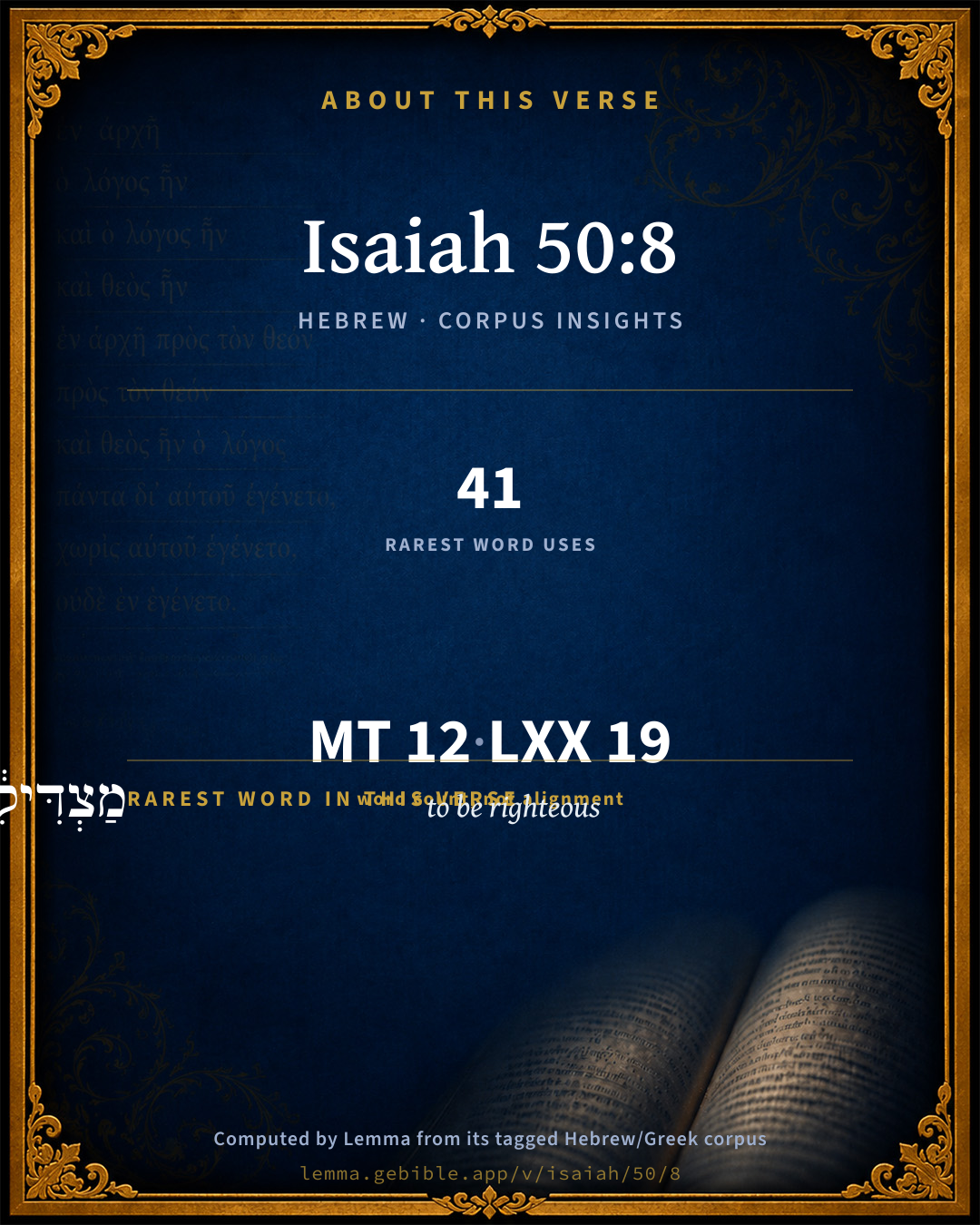
12
words
11
distinct lemmas
Prophets
section

Shared distinctive vocabulary

מַצְדִּיקִ֔י to be righteous H6663 occurs in 40 verses of the Hebrew Bible. Also found in:

Grammatical profile

  • 4 verbs
  • 2 nouns
  • 1 adjective
  • 2 prepositions
  • 1 adverb
  • 2 particles

Verb forms

  • מַצְדִּיקִ֔י Hiphil · Participle Active
  • יָרִ֥יב Qal · Imperfect
  • נַ֣עַמְדָה Qal · Cohortative
  • יִגַּ֥שׁ Qal · Imperfect

Repetition

A word recurs within this verse — often emphatic in Hebrew:

Hebrew & Septuagint length

In English translation the verse runs 27 words from the Hebrew and 39 from the Septuagint (LXX English) — the Septuagint runs noticeably longer here. See the side-by-side →

A rough comparison of the two English renderings, which tokenize alike — not a word-level alignment.

Word counts can differ between the Hebrew and the Greek without any difference in meaning — e.g. the Hebrew direct-object marker אֵת has no separate Greek word, and Greek often adds the article ὁ.

In the original languages it is 12 Hebrew tokens and 19 Greek tokens — but the two are counted differently (Hebrew bundles its prefixes and suffixes into one token; the Greek is in lemma form), so that isn’t a like-for-like length.

Cross-references

11

Topical passages linked to Isaiah 50:8 in the Treasury of Scripture Knowledge — connected by theme and wording, ordered by reader-vote popularity; previews shown in the World English Bible.

  • Romans 8:32–34 He who didn't spare his own Son, but delivered him up for us all, how would he not also with him freely give us all things?
  • Isaiah 41:1 Keep silence before me, islands; and let the peoples renew their strength: let them come near; then let them speak; let us come near together to judgment.
  • Revelation 12:10 I heard a loud voice in heaven, saying, "Now is come the salvation, the power, and the Kingdom of our God, and the authority of his Christ; for the accuser of our brothers has been thrown down, who accuses them before our God day and night.
  • Isaiah 41:21 Produce your cause, says Yahweh; bring forth your strong reasons, says the King of Jacob.
  • Isaiah 43:26 Put me in remembrance; let us plead together: set you forth [your cause], that you may be justified.
  • Exodus 22:9 For every matter of trespass, whether it be for ox, for donkey, for sheep, for clothing, or for any kind of lost thing, about which one says, 'This is mine,' the cause of both parties shall come before God. He whom God condemns shall pay double to his neighbor.
  • Deuteronomy 19:17 then both the men, between whom the controversy is, shall stand before Yahweh, before the priests and the judges who shall be in those days;
  • Zechariah 3:1–10 He showed me Joshua the high priest standing before the angel of Yahweh, and Satan standing at his right hand to be his adversary.
  • Matthew 5:25 Agree with your adversary quickly, while you are with him in the way; lest perhaps the prosecutor deliver you to the judge, and the judge deliver you to the officer, and you be cast into prison.
  • 1 Timothy 3:16 Without controversy, the mystery of godliness is great: God was revealed in the flesh, Justified in the spirit, Seen by angels, Preached among the nations, Believed on in the world, And received up in glory.
  • Job 23:3–7 Oh that I knew where I might find him! That I might come even to his seat!

Cross-references courtesy of OpenBible.info (CC BY 4.0).

Hebrew and Greek witnesses Masoretic Hebrew ↔ Greek Septuagint

The same verse in the two great witnesses to the Old Testament, shown verse-for-verse.

Here the Septuagint runs noticeably longer than the Hebrew — LXX2012 (modern English Septuagint) 39 words vs World English Bible 27. A rough length comparison of the two English translations, not a word-level alignment — read both below.

These are two independent witnesses, not word-aligned to each other, and the Septuagint is shown in lemma (dictionary) form.

Hebrew Isaiah 50:8 Masoretic · Westminster Leningrad Codex

קָרוֹב֙ מַצְדִּיקִ֔י מִֽי יָרִ֥יב אִתִּ֖י נַ֣עַמְדָה יָּ֑חַד מִֽי בַ֥עַל מִשְׁפָּטִ֖י יִגַּ֥שׁ אֵלָֽי

He is near who justifies me; who will bring charges against me? Let us stand up together: who is my adversary? Let him come near to me.

World English Bible · Public Domain

Greek LXX Isaiah 50:8 Septuagint · lemma form

ὅτι ἐγγίζω ὁ δικαιόω ἐγώ τίς ὁ κρίνω ἐγώ ἀντιἵστημι ἐγώ ἅμα καί τίς ὁ κρίνω ἐγώ ἐγγίζω ἐγώ

for he that has justified me draws near; who is he that pleads with me? let him stand up against me at the same time: yes, who is he that pleads with me? let him draw near to me.

LXX2012 (modern English Septuagint) · Public Domain

Hebrew: Westminster Leningrad Codex (CC BY 4.0). Greek: Septuagint (public domain); English from LXX2012 (modern English Septuagint) (Public Domain). How the Septuagint differs from the Hebrew →

Targum (Aramaic paraphrase)

1

The Targum is the ancient Jewish Aramaic paraphrase of the Hebrew Scriptures — an interpretive translation, not the Hebrew text itself. Onkelos (literal) and Pseudo-Jonathan (expansive) render the Torah, and Jonathan the Prophets. Coverage is partial: where no permissively-licensed English translation exists for a verse, only the Aramaic is shown. This is verse-level text, not a word-by-word alignment to the Hebrew.

  1. Targum Jonathan Prophets (Joshua–Malachi)
    קְרִיבָא זְכוּתִי מַן יְדִין עִמִי נְקּוּם כַּחֲדָא מִן בְּעֵיל דִינִי יִתְקְרֵיב לְוָתִי:

    My righteousness is near; who is he that will contend with me? Let us stand forth together: who is my adversary? let him come near me.

    Targum Jonathan — Aramaic: “Mikraot Gedolot” (public domain). English: “Sefaria Community Translation” (CC0 1.0 (public-domain dedication)); “London "Chaldee Paraphrase," 1871” (public domain). Text via Sefaria.

Commentary

Notes on Isaiah 50:8 from classic Christian and Jewish commentators (each source and its license shown beneath its notes). The classic Christian expositions comment on the surrounding passage and are grouped to its opening verse, so a note may address several verses; the Jewish commentaries on the Tanakh (Rashi and others) are per-verse, so they appear only where the commentator wrote on this verse.

Lemma curates 59 commentaries, every one of them public domain or Creative Commons licensed, each selected and text-cleaned for this edition rather than reprinted as found. About our sources →

Trapp's Complete Commentary

John Trapp

Isa 50:8 [He is] near that justifieth me; who will contend with me? let us stand together: who [is] mine adversary? let him come near to me.

Ver. 8. He is near that justifieth me,] i.e., God the Father will shortly clear up mine innocence, and declare me to be the son of God (my only crime now), "with power by the resurrection from the dead." {Rom 1:4}

Who will contend with me?] So Joh 8:46 Rom 8:33-34, where the apostle Paul, as a stout soldier and imitator of Christ, the "Captain of his salvation," useth the same argument, and teacheth us to do likewise.

John Trapp, A Commentary or Exposition upon All the Books of the Old and New Testament (1647–1656) — public domain. Text from a community e-Sword module.

The Biblical Illustrator

Joseph S. Exell

Isa_50:8-9

He is near that justifieth Me

Jehovah the justifier

The consciousness of innocence is expressed (as often in the Book of Job) under the conception of a legal process.

(Prof. J. Skinner, D. D.)

To justify

To justify is to show to be in the right, by giving Him victory in His cause. The time-long conflict of Israel and her religion with the nations and their idolatries is represented under the figure of a process or plea before Gods tribunal. The triumph of the religion of Jehovah is Israels justification, or success in her plea. (A. B. Davidson, D.D.)

Messiahs justification

By His resurrection from the dead and ascension to the right hand of God, with their joyful consequences, He was declared to be the true Messiah, and the Son of God with power (Act_2:36). (R. Macculloch.)

The enemies of Christ as a moth-eaten garment

They fall into decay like a worn-out garment, and become the food of the moth, which they already carry within them--a figure of destroying power which works imperceptibly and slowly, yet all the more surely (Isa_51:8; JobHo 5:12). (F. Delitzsch, D.D.)

The Biblical Illustrator, edited by Joseph S. Exell (c. 1880s–1900s) — public domain. Text from a community e-Sword module.

MacLaren's Expositions of Holy Scripture

Alexander MacLaren

Isaiah

THE SERVANT’S TRIUMPH

Isa 50:8 - Isa 50:9.

We have reached the final words of this prophecy, and we hear in them a tone of lofty confidence and triumph. While the former ones sounded plaintive like soft flute music, this rings out clear like the note of a trumpet summoning to battle. The Servant of the Lord seems here to be eager for the conflict, not merely patient and enduring, not merely setting His face like a flint, but confidently challenging His adversaries, and daring them to the strife.

As for the form of the words, the image underlying the whole is that of a suit at law. It is noteworthy that since Isa 41:1 - Isa 41:29 this metaphor has run through the whole prophecy. The great controversy is God versus Idols. God appears at the bar of men, pleads His cause, calls His witnesses {Isa 43:9}. ‘Let them’ {i.e. idols} ‘bring forth their witnesses that they may be justified.’

Possibly the form of the words here is owing to the dominance of that idea in the context, and implies nothing more than the general notion of opposition and victory. But it is at least worth remembering that in the life of Christ we have many instances in which the prophetic images were literally fulfilled even though their meaning was mainly symbolical: as e.g. the riding on the ass, the birth in Bethlehem, the silence before accusers, ‘a bone of Him shall not be broken,’ and in this very contest, ‘shame and spitting.’ So here there may be included a reference to that time when the hatred of opposition reached its highest point-in the sufferings and death of our Lord. And it is at least a remarkable coincidence that that highest point was reached in formal trials before the ecclesiastical and civil authorities, for the purpose of convicting Him, and that these processes as legal procedures broke down so signally.

Keeping up the metaphor, we mark here-

I. Messiah’s lofty challenge to His accusers.

The ‘justifying’ which He expects may refer either to personal character or to official functional faithfulness. I think it refers to both, and that we have here, expressed in prophetic outline, not only the fact of Christ’s sinlessness, but the fact of His consciousness of sinlessness.

The words are the strongest assertion of His absolute freedom from anything that an adversary could lay hold of on which to found a charge, and not merely so, but they also dare to assert that the unerring and all-penetrating eye of the Judge of all will look into His heart, and find nothing there but the mirrored image of His own perfection. I do not need to dwell on the fact of Christ’s sinlessness, that He is perfect manhood without stain, without defect. I have had occasion to touch upon that truth in a former sermon on ‘I was not rebellious.’ Here we have to do not so much with sinlessness as with the consciousness of sinlessness.

Now note that consciousness on Christ’s part.

We have to reckon with the fact of it as expressed in His own words: ‘I do always the things that please Him. Which of you convinceth Me of sin?’ ‘The Prince of this world cometh and hath nothing in Me.’

In Him there is the absence of all trace of sense of sin.

No prayer for forgiveness comes from His lips.

No penitence, no acknowledgment of even weakness is heard from Him. Even in His baptism, which for others was an acknowledgment of impurity, He puts His submission to the rite, not on the ground of needing to be washed from sin, but of ‘fulfilling all righteousness.’

Now, unless Christ was sinless, what do we say of these assertions? ‘If we say that we have no sin, we deceive ourselves and the truth is not in us’-are we to apply that canon to Him when He stands before us and asks, ‘Which of you convinceth Me of sin?’ Surely it augurs small self-knowledge or a low moral standard if, from the lips of a religious teacher, there never comes one word to indicate that he has felt the hold of evil on him. I make bold to say that if Christ were not sinless, the Apostle Paul stood far above Him, with his ‘of whom I am chief.’ What difference would there be between Him and the Pharisees who called forth His bitterest words by this very absence in them of consciousness of sin: ‘If ye were blind ye would have no sin, but now ye say, We see, therefore your sin remaineth.’

Singularly enough the world has accepted Him at His own estimate, and has felt that these lofty assertions of absolute perfection were borne out by His life, and were consistent with the utmost lowliness of heart.

As to the adversary’s failure, I need only recall the close of His life, which is representative of the whole impression made on the world by Him. What a wonderful and singular concurrence of testimonies was borne to His pure and blameless life! After months of hatred and watching, even the rulers’ lynx-eyed jealousy found nothing, and they had to fall back upon false witnesses. ‘Hearest thou not how many things they witness against Thee?’ He stood with unmoved silence, and the lies fell down dead at His feet. Had He answered, they would have been preserved and owed their immortality to the Gospels: He held His peace and they vanished. All attempts failed so signally that at the last they were fain, in well-simulated holy abhorrence, to base His condemnation on what He had said in their presence. ‘How think ye, ye have heard the blasphemy?’ So all that the adversary, raking through a life, could find, was that one word. That was His sin; in all else He was pure. Remember Pilate’s acquittal: ‘I find no fault in Him,’ and his wife’s warning, ‘Have thou nothing to do with that just Person.’ Think of Judas, ‘I have sinned in that I have betrayed the innocent blood.’ Listen to the penitent thief’s low voice gasping out in his pangs and almost collapse: ‘This man hath done nothing amiss.’ Listen to the Centurion telling the impression made even on his rough nature: ‘Truly this was a righteous Man.’

These are the answers to the Servant’s challenge, wrung from the lips of His adversaries; and they but represent the universal judgment of humanity.

There is one Man whose life has been without stain or spot, whose soul has never been crossed by a breath of passion, nor dimmed by a speck of sin, whose will has ever been filled with happy obedience, whose conscience has been undulled by evil and untaught to speak in condemnation, whose whole nature has been like some fair marble, pure in hue, perfect in form, and unstained to the very core. There is one Man who can front the most hostile scrutiny with the bold challenge, ‘Which of you convinceth Me of sin?’ and His very haters have to answer, ‘I find no fault in Him,’ while those that love Him rejoice to proclaim Him ‘holy, harmless, undefiled, and separate from sinners.’ There is one Man who can front the most rigid Law of Duty and say, ‘I came not to destroy but to fulfil,’ and the stony tables seem to glow with tender light, as of rocky cliffs in morning sunshine, attesting that He has indeed fulfilled all righteousness. There is one Man who can stand before God without repentance or confession, and whose claim ‘I do always the things that please Him,’ the awful voice from the opening heavens endorses, when it proclaims; ‘This is My beloved Son in whom I am well pleased.’ The lowly Servant of God flings out His challenge to the universe: ‘Who will contend with Me?’ and that gage has lain in the lists for nineteen centuries unlifted.

II. The Messiah’s expectation of divine vindication and acquittal.

Like many another man, Christ had to strengthen Himself against calumny and slander by turning to God, and finding comfort in the belief that there was One who would do Him right, and as throughout this context we have had the true humanity of our Lord in great prominence, it is worth while to dwell for a moment on that thought of His real sharing in the pain of misconstruction and groundless charges, and of His too having to say, as we have so often to say, ‘Well, there is one who knows. Men may condemn but God will acquit.’

But there is something more than that here. The divine vindication and acquittal is not a mere hidden thought and judgment in the mind of God. It is a declaring and showing to be innocent, and that not by word but by deed. That expectation seemed to be annihilated and made ludicrous by His death. But the ‘justifying’ of which our text speaks takes place in Christ’s resurrection and ascension.

‘Manifest in the flesh, justified in the spirit’ {1Ti 3:16}. ‘Declared to be the Son of God with power, . . . by the resurrection from the dead’ {Rom 1:4}.

His death seems the entire abandonment of this holy and sinless man. It seems to demonstrate His claims to be madness, His hope to be futile, His promises to be wind. No wonder that the sorrowing apostles wailed, ‘We trusted that it had been He who should have redeemed Israel.’ The death of Christ, if it were but a martyr’s death, and if we had to believe that that frame had crumbled into dust, and that heart ceased for ever to beat, would not only destroy the worth of all that He spoke, but would be the saddest instance in all history of the irreversible sway that death wields over all mankind, and would deepen the darkness and sadden the gloom of the grave. True, there were not wanting even in His dying hours mysterious indications, such as His promise to the penitent thief. But these only make the disappointment the deeper, if there was nothing more after His death.

So Christ’s justification is in His resurrection and ascension.

III. The Messiah’s confidence of ultimate triumph.

In the last words of the text the adversaries are massed together. The confidence that the Lord God will help and justify leads to the conviction that all opposition to Him is futile and leads to destruction.

We see the historical fulfilment in the fate of the nation. ‘His blood be upon us and upon our children.’

We have a truth applying universally that antagonism to Him is self-destructive.

Two forms of destruction are here named. There is a slow decay going on in the opponents and their opposition, as a garment waxing old, and there is a being fretted away by the imperceptible working of external causes, as by gnawing moths.

Applied to persons. To opposing systems.

How many antagonists the Gospel has had, and one after another has been antiquated, and their books are only known because fragments of them are preserved in Christian writings. Paganism is gone from Europe, and its idols are in our museums. Each generation has its own phase of opposition, which lasts for a little while. The mists round the sun melt, the clouds piled in the north, surging up to bury it beneath their banks, are dissipated. The sea roars and smashes on the cliffs, but it ebbs and calms. Some of us have seen more than one school of thought which came to the assault of Christianity, with colours flying and drums rattling, defeated utterly and forgotten, and so it will always be. One may be sure that each enemy in turn will descend to the oblivion that has already received so many, and can imagine these beaten foes rising from their seats to welcome the newcomer with the sad greeting: ‘Art thou also become weak as we? art thou become like unto us?’

We are ‘justified’ in His ‘justification.’

The real connection between us and Christ by faith, makes our justification to be involved in His, so that it is no mere accommodation but a profound perception of the real relation between Christ and us, when Paul, in Rom 8:34, triumphantly claims the words of our text for Christ’s disciples, and rings out their challenge on behalf of all believers: ‘It is God that justifieth, who is he that condemneth?’

Do you trust in Christ? Then you too can dare to say: ‘The Lord God will help me; who is he that shall condemn me?’

Alexander MacLaren, Expositions of Holy Scripture (1904–1910) — public domain. Text from a community e-Sword module.

Tyndale Open Study Notes

Tyndale Open Resources

50:8 He who gives me justice is near: God vindicates those who suffer for doing his will. Vindication is an act of God by which he exalts those who have been wrongly disgraced and strikes down the wicked, self-exalted, and arrogant (see also 2 Thes 1:6-9). • bring charges . . . my accusers: Confidence in God’s vindication removes fear and bolsters faith (see Rom 8:31-34).

Tyndale Open Study Notes — © Tyndale Open Resources, licensed CC BY-SA 4.0. Text via the HelloAO Bible API.

Jamieson, Fausset & Brown

Robert Jamieson, A. R. Fausset & David Brown

(Isa 49:4). The believer, by virtue of his oneness with Christ, uses the same language (Psa 138:8; Rom 8:32-34). But "justify" in His case, is God's judicial acceptance and vindication of Him on the ground of His own righteousness (Luk 23:44-47; Rom 1:4; Ti1 3:16, with which compare Pe1 3:18); in their case, on the ground of His righteousness and meritorious death imputed to them (Rom 5:19).

stand together--in judgment, to try the issue.

adversary--literally, "master of my cause," that is, who has real ground of accusation against me, so that he can demand judgment to be given in his favor (compare Zac 3:1, &c. Rev 12:10).

Jamieson, Fausset & Brown — Commentary Critical and Explanatory on the Whole Bible (1871) — public domain (CC PDM 1.0). Text via the HelloAO Bible API.

Adam Clarke's Commentary

Verse 8. Who will contend with me] The Bodleian MS. and another add the word הוא hu; מי הוא יריב mi hu yarib, as in the like phrase in the next verse; and in the very same phrase Job 13:19, and so likewise in many other places, Job 17:3; Job 41:1. Sometimes on the like occasions it is מי זה mi zeh, and מי הוא זה mi hu zeh, "Who is this one?" The word has probably been lost out of the present text; and the reading of the MSS. above mentioned seems to be genuine.

Adam Clarke's Commentary on the Bible (1810–1826) — public domain. Text from a community e-Sword/MySword module.

Ellicott's Commentary for English Readers

(8) He is near that justifieth—i.e., declares innocent and righteous. Appealing from the unrighteous judges of the earth, the Servant commits himself to Him who judges righteously (Luk_23:46). With that Judge to declare his innocence, what does he care for the accuser? (Comp. Rom_8:33-34.)

Who is mine adversary?—Literally, the master of a law-suit, i.e., the prosecutor.

A Bible Commentary for English Readers, edited by Charles John Ellicott (1878–1897) — public domain. Text from a community e-Sword module.

The Cambridge Bible for Schools and Colleges

gen. ed. J. J. S. Perowne

8. He is near that justifieth me] Cf. ch. Isa_49:4 (“my judgement is with Jehovah”); Isa_51:5. To “justify” is, as nearly always, to declare in the right; so “condemn” in Isa_50:9 is to pronounce in the wrong.

who will contend with me?] cf. Job_13:19.

stand together] stand forth together (as Isa_47:12-13).

who is mine adversary?] lit. “the master of my cause” (dominus litis). A similar expression is used in Exo_24:14.

8, 9. The consciousness of innocence is expressed (as often in the Book of Job) under the conception of a legal process.

The Cambridge Bible for Schools and Colleges (gen. ed. J. J. S. Perowne; Cambridge University Press, 1878–1918) — public domain. Text from a community e-Sword module.

John Gill's Exposition

He is near that justifieth me,.... His Father was "near" him in his whole state of humiliation; he left him not alone; he was at his right hand, and therefore he was not moved; and "justified" him from all the calumnies of his enemies, or the false charges they brought against him, and from all the sins of his people that were upon him; these he took upon him, and bore them, and made satisfaction for them, upon which he was acquitted; and which is evident by his resurrection from the dead, by his ascension to heaven, and session at the right hand of God; and by the gifts of the Spirit, extraordinary and ordinary, he received for men, and gave unto them; see Ti1 3:16.

Who will contend with me? being thus acquitted; will the law and justice of God litigate the point with him? they are both satisfied; will Satan dispute the matter with him? he is foiled, conquered, and destroyed; or will the wicked Jews enter the argument with him? wrath is come upon them to the uttermost.

Let us stand together; face to face, if they dare; let them face me, if they can:

who is mine adversary? let him appear, that he may be known:

let him come near to me: and engage with me, if he has courage or skill. This is bidding defiance to all his enemies, and triumphing over them.

John Gill's Exposition of the Whole Bible (1746–1763) — public domain (CC PDM 1.0). Text via the HelloAO Bible API.

Albert Barnes' Notes on the Bible

He is near that justifieth me - That is, God, who will vindicate my character, and who approves what I do, does not leave nor forsake me, and I can with confidence commit myself and my cause to him (see the note at Isa 49:4). The word justify here is not used in the sense in which it is often in the Scriptures, to denote the act by which a sinner is justified before God, but in the proper, judicial sense, that he would declare him to be righteous; he would vindicate his character, and show him to be innocent. This was done by all the testimonies of God in his favor - by the voice which spake from heaven at his baptism - by the miracles which he performed, showing that he was commissioned and approved by God - by the fact that even Pilate was constrained to declare him innocent - by the wonders that attended his crucifixion, showing that ‘he was a righteous man,’ even in the view of the Roman centurion Luk 23:47, and by the fact that he was raised from the dead, and was taken to heaven, and placed at the right hand of the Father - thus showing that his whole work was approved by God, and furnishing the most ample vindication of his character from all the accusations of his foes.

Who will contend with me? - This question indicates confidence in God, and in the integrity of his own character. The language is taken from transactions in the courts of justice; and it is a solemn call, on any who would dare to oppose him, to enter into a trial, and allege the accusations against him before the tribunal of a holy God.

Let us stand together - Before the seat of judgment as in a court (compare the note at Isa 41:1).

Who is mine adversary? - Margin, ‘Who is the master of my cause?’ The Hebrew is ‘Lord (בעל ba‛al) of judgment.’ The expression means not merely one who has a lawsuit, or a cause, but one who is ‘lord of the judgment,’ i. e, possessor of the cause, or one who has a claim, and can demand that the judgment should be in his favor. And the call here is on any who should have such a claim to prefer against the Messiah; who should have any real ground of accusation against him; that is, it is an assertion of innocence.

Let him come near to me - Let him come and make his charges, and enter on the trial.

Albert Barnes' Notes on the Bible (1834–1885) — public domain. Text from a community e-Sword/MySword module.

Matthew Poole's English Annotations

He is near; God, though he seem to be at a distance, and to hide his face from me, yet he is in truth at my right hand, and ready to help me.

That justifieth me; that will publicly acquit me from all the calumnies of mine adversaries, who say that I am a transgressor of the law, a false teacher and deceiver, a blasphemer, and a devil, and the like, in which opinion they are confirmed by my death and sufferings. But God will clear up my righteousness, and show by many and mighty signs and wonders that he is well pleased with me, and that I lived and died his faithful servant.

Let him come near to me; I challenge all my accusers to stand and appear before the Judge face to face, and to produce all their charges against me; for I am conscious of mine own innocency, and I know that God will give sentence for me.

Matthew Poole's English Annotations on the Holy Bible (1683–1685) — public domain. Text from a community e-Sword/MySword module.

The Pulpit Commentary

Vers. 8, 9. He is near that justifieth me. God, who knows his innocence, is near at hand, and will shortly "make his righteousness clear as the noonday." This was done when God raised up from the dead "the Holy One and the Just". (Act_3:14) whom cruel men "by wicked hands had crucified and slain". (Act_2:23) By the resurrection God acquitted Christ of the charge of blasphemy on which he had been condemned, and proclaimed him "holy, harmless, undefiled, separate from sinners". (Heb_7:26) Who will contend with me? (compare St. Paul"s words in Rom_8:33, Rom_8:34, "It is God that justifieth. Who is he that condemneth? God is the sole Judge of all men of the "Servant" in his human capacity, no less than of others. If he acquits, it is idle for any accuser to stand forth and "contend" or "condemn" (ver. 9). God will help the innocent, whom he has acquitted, and will destroy the accuser by a secret but most sure destruction. The moth shall eat them up. (comp. Psa_39:11, and infra, Isa_51:8)

Vers. 8, 9. No condemnation for those whom God justifies.

Those whom God has justified may still be, sometimes are, arraigned

(1) by Satan;

(2) by their fellow-men.

I SATAN"S ARRAIGNMENT VAIN. "Hast thou considered my servant Job," said Jehovah to Satan, "that there is none like him in the earth, a perfect and an upright man, one that feareth God, and escheweth evil?" To which the answer was given, "Doth Job fear God for nought?". (Job_1:8, Job_1:9) Satan arraigned Job as selfish, hypocritical, irreligious, and was allowed to put him to the proof; but with the result that Job"s integrity was established, and the accuser put to shame. Satan, however, gains no wisdom by experience. Still he remains "the accuser of the brethren, which accuseth them before God day and night". (Rev_12:10) All that can be said against them, doubtless, he says misrepresents their motives, exposes their shortcomings, exaggerates their failings and their sins. But to what purpose? "They overcame him by the blood of the Lamb". (Rev_12:11) To them whom God has justified, whom God has forgiven, past sins are blotted out, past shortcomings are made up. The merits of Christ suffice to cover all their iniquities. Let them but have true faith in him, let them but cling to him, and then "their sins, though they be as scarlet, shall be white as snow; though they be red like crimson, they shall be as wool". (Isa_1:18)

II MAN"S ARRAIGNMENT IDLE. Man"s arraignment of his fellowmen can have no effect at all excepting in this world. He may bring them before tribunals, obtain their condemnation, their execution, their temporal disgrace. He may gibbet them in history, misrepresent, malign, blacken their names and their reputations. But over their real selves he is powerless. God justifies them, pardons them, receives them into his kingdom, looks on them with favour, reckons them among his saints, gives them the blessing of eternal communion with him in heaven. What matters it to them that somewhere, in a paltry planet, ignorant and ephemeral mortals speak evil of them and brand their memories? "It is God that justifieth." One justifying word from him may well outweigh any amount of human dispraise, of human contumely. Their end in this world may have been "without honour;" but their entrance into the next is with words at once of promise and of high honour, "Well done, good and faithful servant; enter thou into the joy of thy Lord,

The Justifier"s protection.

"Near is he that justifieth me." Reference is to the Servant of Jehovah, whom we identify as the Messiah. The associations of our Lord"s trial and death may suggest that he was a malefactor. God allows no such impression to remain. He justifies him, by raising him from the dead and granting him full acceptance. He declares him to have been innocent and righteous. The security of those who have a standing in Christ lies in the plea made for them by their Justifier. (see Rom_8:33, Rom_8:34) (For the earlier form of appeal to God as Justifier, see Job and David: Job_27:5 Psa_28:2, etc.) Compare the expressions, "It is God that justifieth;" "Raised again for our justification;" "Justified in the Spirit." "The Father justified him when he accepted the satisfaction he made for the sin of man, and constituted him "the Lord our Righteousness," who was made sin for us." It is not, however, the doctrine of justification which is first suggested by the text. Its reference is to the confidence which a wronged, slandered, persecuted "good man may have, that God will stand by him, and in due time justify him, bringing forth his righteousness as the light. Our Lord and his servants may say, with misrepresented Job, "I know that" God, my Goel, "my Redeemer, liveth.

I GOD JUSTIFIES BY GIVING THE INWARD WITNESS OF HIS ACCEPTANCE. It is plain that he gave such witness to Christ in his last hours. Even in the dreadful sense of "being forsaken," our Lord could say, "My God, my God," add commit himself into the Father"s hands. Before Pilate he held such confidence in God"s approval that he could calmly reply to him, "Thou couldest have no power at all against me unless it were given thee from above." A divinely whispered "Fear not," from our Justifier, enables us to bear all things.

II GOD JUSTIFIES BY THE LASTING IMPRESSION THE GOOD MAN PRODUCES. Illustrate from the exclamation of the centurion, "Truly this was the Son of God." A careful estimate of the inward struggles of Saul of Tarsus brings to view a deep feeling that the claims of Jesus of Nazareth possibly might be true. The good man only gains more power when his goodness is shown on a background of persecutions.

III GOD JUSTIFIES BY THE FINAL RESULTS OF THE GOOD MAN"S WORK. The slandering and the suffering pass, but the work a man does, and the witness a man makes, abide. Men mistook the Christ. We know the results of his work, and they become the fullest justification of him. R.T.

The Pulpit Commentary (1880–1919), ed. H.D.M. Spence-Jones & Joseph S. Exell — public domain. Text from a community e-Sword module.

John Wesley's Explanatory Notes

Justifieth - God will clear up my righteousness, and shew by many and mighty signs and wonders, that I lived and died his faithful servant. Let him come - l am conscious of mine own innocency, and I know that God will give sentence for me.

John Wesley, Explanatory Notes Upon the Whole Bible (1754–1765) — public domain. Text via the GEBible commentary corpus.

Keil & Delitzsch

C. F. Keil & F. Delitzsch

In the midst of his continued sufferings he was still certain of victory, feeling himself exalted above every human accusation, and knowing that Jehovah would acknowledge him; whereas his opponents were on the way to that destruction, the germ of which they already carried with them. "He is near that justifieth me; who will contend with me?! We will draw near together! Who is my adversary in judgment?! Let him draw near to me! Behold, the Lord Jehovah will help me; who is he that could condemn me?! Behold, they all shall fall to pieces like a garment; the moth shall eat them up." הצדּיו and הרשׁיע are forensic antitheses: the former signifies to set one forth, both practically and judicially, as righteous (Sa2 15:4; Psa 82:3); the latter as guilty, רשׁע (Deu 25:1; Psa 109:7). נעמדה, which has lost the principal tone on account of the following יחד (יּהד), has munach instead of metheg in the antepenultimate. Ba‛al mishpâtı̄ means, "he who has a judicial cause of lawsuit against me," just as in Roman law the dominus litis is distinguished from the procurator, i.e., from the person who represents him in court (syn. ba‛al debhârı̄m, Exo 24:14, and 'ı̄sh rı̄bhı̄ in Job 31:35; compare Isa 41:11). מי־הוּא are connected, and form an emphatic τίς, Rom 8:34 (Ewald 325, a). "All of them" (kullâm): this refers to all who are hostile to him. They fall to pieces like a worn-out garment, and fall a prey to the moth which they already carry within them - a figure which we meet with again in Isa 51:8 (cf., Job 13:28; Hos 5:12), and one which, although apparently insignificant, is yet really a terrible one, inasmuch as it points to a power of destruction working imperceptibly and slowly, but yet effecting the destruction of the object selected with all the greater certainty.

Keil & Delitzsch — Biblical Commentary on the Old Testament (1861–1891) — public domain (CC PDM 1.0). Text via the HelloAO Bible API. (Old Testament only.)

J. A. Alexander on Isaiah

Joseph Addison Alexander

“Near (is) my justifier (or the one justifying me).” This is strictly a forensic term meaning to acquit or pronounce innocent, in case of accusation, and to right or do justice to, in case of civil controversy. The use of this word and of several correlative expressions, may be clearly learned from Deu 25:1. The justifier is of course Jehovah. His being near is not intended to denote the proximity of an event still future, but to describe His intervention as constantly within reach and available. It is not the justification which is said to be near to the time of speaking, but the Justifier Who is said to be near the speaker Himself. The justification of His Servant is the full vindication of His claims to divine authority and inspiration. At the same time there is a designed coincidence between the terms of the prediction and the issue of our Savior’s trial; but the prophecy is not to be restricted to this object. The general meaning of the words is, ‘all this reproach is undeserved, as will be seen hereafter’. Since God Himself has undertaken His defense, the accuser’s case is hopeless. He therefore asks triumphantly, “Who will contend with me?” The Hebrew verb denotes specifically ‘litigation’ or ‘forensic strife’ (Rom 8:33-34), is an obvious imitation of this passage as to form. But even the warmest advocates for letting the New Testament explain the Old, are forced to acknowledge that in this case Paul merely borrows his expressions from the Prophet, and applies them to a different object. In any other case this class of writers would no doubt have insisted that the justifier must be Christ and the justified His people; but from this they are precluded by their own assumption, that the Messiah is the speaker. Both hypotheses, so far as they have any just foundation, may be reconciled by the supposition that the ideal speaker is the Body and the Head in union. In the sense here intended, Christ is justified by the Father, and at the same time justifies His people. “He will stand (or let us stand) together,” at the bar, before the judgment-seat, a frequent application of the Hebrew verb. (See Num 27:2; Deu 19:17; 1Ki 3:16). This is an indirect defiance or ironical challenge; as if he had said, ‘If any will still venture to accuse me, let us stand up together.’ The same thing is then expressed in other words, the form of interrogation and proposal being still retained. “Who is my adversary?” This is more literally rendered in the margin of the English Bible, ‘who is the master of my cause?’ But even this fails to convey the precise sense of the original, and may be even said to reverse it, for ‘the master of my cause’ seems to imply ascendancy or better right, and is not therefore applicable to a vanquished adversary whose case was just before described as hopeless. The truth is that the pronoun ‘my’ belongs not to the last word merely but to the whole complex phrase, and ba‘al simply means ‘possessor,’ (i.e., one to whom a given thing belongs). Thus ‘a cause-master’ means one who has a cause or lawsuit, a party litigant; and ‘my cause-master’ means one who has a controversy with me, my opponent or adversary; so that the common version really conveys the meaning better than what seems to be the more exact translation of the margin. In sense, the question is precisely parallel and tantamount to the one before it, ‘who will contend with me? Let him draw near to me, confront me, or engage in conflict with me.’ The forensic figures of this verse, and some of its expressions, have repeatedly occurred in the course of the preceding chapters. (See Isa 41:1; Isa 41:21; Isa 43:9; Isa 43:26; Isa 45:20; Isa 48:14; Isa 48:16).

Joseph Addison Alexander, The Prophecies of Isaiah (1846–1847; New York: Scribner, 1870–1878) — public domain. Text from a community e-Sword module.

unfoldingWord translationNotes

Door43 World Missions Community

General Information:

Yahweh's servant continues speaking.

Who will oppose me? Let us stand ... Who is my accuser? Let him come

The servant uses these questions to emphasize that there is no one who can legitimately accuse him of wrong. AT: "If anyone would oppose me, let us stand ... If anyone would accuse me, let him come" (See: Rhetorical Question)

Who will declare me guilty?

The servant uses this question to assert that no one can declare him guilty. AT: "There is no one who can declare me guilty." (See: Rhetorical Question)

they will all wear out like a garment; the moth will eat them up

There being no one left to accuse the servant of being guilty is spoken of as if the accusers were garments that wear thin and are eaten by moths. (See: Metaphor)

translationWords

just

accuse

Lord Yahweh

declare

guilt

unfoldingWord translationNotes — © Distant Shores Media and the Door43 World Missions Community, licensed CC BY-SA 4.0. Source: git.door43.org/Door43/en_tn.

Rashi

Rabbi Shlomo Yitzchaki (Rashi)

He Who vindicates me is near The Holy One, blessed be He, is near to me to vindicate me in judgment.

Rashi on the Tanakh — English translations: “The Judaica Press complete Tanach with Rashi, translated by A. J. Rosenberg” (CC BY 4.0); “Pentateuch with Rashi's commentary by M. Rosenbaum and A.M. Silbermann, 1929-1934” (public domain); “The Metsudah Tanach series, Lakewood, N.J” (CC BY 4.0); and “The Book of Joshua, Metsudah Publications, 1997” (CC BY 4.0). Text via Sefaria.

Ibn Ezra

Rabbi Abraham ibn Ezra

Near is, etc. Near is the time, when I shall appear as justified in my prophecies; then I shall say, Who will, etc.

Ibn Ezra on the Tanakh — English translations: “Sefaria Community Translation” (CC0 1.0 (public-domain dedication)); “Yalkut, Sifsei Chachomim Chumash, Metsudah Publications, 2009” (CC BY 4.0); and “Commentary of Ibn Ezra on Isaiah - trans. by M. Friedlander, 1873” (public domain). Text via Sefaria.

Lesson kit

Teaching starters — assembled from the data on this page, not authored interpretation. Every prompt links to the verse data it draws on. Edit before teaching.

Isaiah, in the Prophets, opens this verse with 12 words (11 distinct Hebrew lemmas). Its most distinctive word is tsâdaq (“to be righteous”). The Greek Septuagint runs longer here. A historical commentator’s framing appears above. Read the whole chapter for the surrounding context.

Discussion questions

  1. The word tsâdaq carries the sense “to be righteous.” How does it shape the verse?
  2. Genesis 38:26 shares the word «to be righteous» with this verse. How do the two illuminate each other?
  3. “who” occurs 2× in this one verse. What is the effect of the repetition?
  4. Compared with the Hebrew, the Septuagint runs longer here. What questions does that raise?
  5. The translations on this page render this verse differently — a whole-verse word diff, not a word-by-word alignment. What might account for the different wordings?
  6. The verb «מַצְדִּיקִ֔י» is Hiphil Participle Active. How does its form color the action?
  7. Reading how Trapp's Complete Commentary and The Biblical Illustrator read this verse, where do the two commentators agree and where do they part?

Things to notice

Reading settings

Reading text

Shown beneath each verse's original-language words.

Old Testament
Old Testament edition

Read the OT as the Masoretic Hebrew (MT) or the Greek Septuagint (LXX).

English shown for the Greek Septuagint (in the Hebrew ↔ Greek comparison).

Comparing translations? Open the Compare panel on any verse page to stack up to four side by side.