
1 Samuel 13:9

Hebrew (Westminster Leningrad Codex) 1 Samuel 13:9 appears in the Hebrew Old Testament. The text above is from the Westminster Leningrad Codex. Each word links to its Strong’s number, a concise gloss, and parsing drawn from the Open Scriptures Hebrew Bible morphology. Click any word for its full Brown-Driver-Briggs (BDB) entry.
Download image
Cite this verse

1 Samuel 13:9 (World English Bible). Public Domain. Lemma interlinear Bible study tool, https://lemma.gebible.app/v/1-samuel/13/9.

Show BibTeX & RIS
BibTeX
RIS
English Translation
Saul said, Bring here the burnt offering to me, and the peace-offerings. He offered the burnt offering.
World English Bible · Public Domain
Download a study sheet

One document with this verse’s original text, its word-by-word gloss line, the meaning frame, cross-references with their text, attributed commentary, and full source and license credits — printable, and it pastes into notes with its structure intact.

This verse Autodidact and up

Study sheet (.html) Plain text (.txt)

A passage Seminary Student

Up to 50 verses in one chapter. A passage sheet keeps up to 6 commentary sources and 12 cross-references per verse, in the order this page ranks them, and says so on the sheet whenever that leaves anything out. Ask for a single verse and you get the Autodidact verse sheet above.

Everything on this page stays free to read, with no account — the sheet is a download of what is already on screen, not access to it.

Want to remove ads? Support Godless Engineer
Compare translations 3

The same verse in 3 English versions, stacked beneath the original-language interlinear above. Click any original word for its lexicon entry.

Each is an independent rendering of the whole verse — the interlinear is not word-aligned to these translations.

Highlighted words mark where these versions differ — a whole-verse word diff, not a word-by-word alignment.

  • World English Bible Public Domain
    Saul said, Bring here the burnt offering to me, and the peace-offerings. He offered the burnt offering.
  • King James Version Public Domain
    And Saul said, Bring hither a burnt offering to me, and peace offerings. And he offered the burnt offering.
  • unfoldingWord Literal Text CC BY-SA 4.0
    So Saul said, “Bring the burnt offering and the peace offerings to me.” And he offered the burnt offering.

unfoldingWord Literal Text — © unfoldingWord, licensed CC BY-SA 4.0. Word-aligned USFM3 via Door43 (git.door43.org/unfoldingWord/en_ult).

Versions to compare (up to 4)

3 of 4 selected

Show all 18 translations

Every available English version of this verse, each an independent rendering of the whole verse.

  • World English Bible Public Domain
    Saul said, Bring here the burnt offering to me, and the peace-offerings. He offered the burnt offering.
  • Berean Standard Bible Public Domain
    So he said, “Bring me the burnt offering and the peace offerings.” And he offered up the burnt offering.
  • Majority Standard Bible Public Domain
    So he said, “Bring me the burnt offering and the peace offerings.” And he offered up the burnt offering.
  • King James Version Public Domain
    And Saul said, Bring hither a burnt offering to me, and peace offerings. And he offered the burnt offering.
  • American Standard Version (1901) Public Domain
    And Saul said, Bring hither the burnt-offering to me, and the peace-offerings. And he offered the burnt-offering.
  • Revised Version (1885) Public Domain
    And Saul said, Bring hither the burnt offering to me, and the peace offerings. And he offered the burnt offering.
  • Geneva Bible (1599) Public Domain
    And Saul sayde, Bring a burnt offering to me and peace offrings: and he offered a burnt offering.
  • Douay-Rheims (1899) Public Domain
    Then Saul said: Bring me the holocaust, and the peace offerings. And he offered the holocaust.
  • Young's Literal Translation Public Domain
    And Saul saith, `Bring nigh unto me the burnt-offering, and the peace-offerings;' and he causeth the burnt-offering to ascend.
  • Literal Standard Version CC BY-SA 4.0
    And Saul says, “Bring the burnt-offering and the peace-offerings near to me”; and he causes the burnt-offering to ascend.
  • Unlocked Literal Bible CC BY-SA 4.0
    Saul said, “Bring me the burnt offering and the peace offerings.” Then he offered the burnt offering.
  • unfoldingWord Literal Text CC BY-SA 4.0
    So Saul said, “Bring the burnt offering and the peace offerings to me.” And he offered the burnt offering.
  • Darby Bible Public Domain
    And Saul said, Bring hither to me the burnt-offering and the peace-offerings. And he offered up the burnt-offering.
  • World Messianic Bible Public Domain
    Saul said, “Bring the burnt offering to me here, and the peace offerings.” He offered the burnt offering.
  • Webster's Bible Public Domain
    And Saul said, Bring hither a burnt-offering to me, and peace-offerings. And he offered the burnt-offering.
  • Free Bible Version CC BY-SA 4.0
    So Saul ordered, “Bring the burnt offering and the friendship offerings to me,” and he presented the burnt offering.
  • Bible in Basic English Public Domain
    Then Saul said, Come here and give me the burned offering and the peace-offerings. And he made a burned offering to the Lord.
  • JPS Tanakh (1917) Public Domain
    And Saul said: 'Bring hither to me the burnt-offering and the peace-offerings.' And he offered the burnt-offering.

Literal Standard Version (2020), Covenant Press — licensed CC BY-SA 4.0. Text via the HelloAO Bible API (eBible.org). Unlocked Literal Bible (unfoldingWord) — licensed CC BY-SA 4.0. Text via the HelloAO Bible API (eBible.org). unfoldingWord Literal Text — © unfoldingWord, licensed CC BY-SA 4.0. Word-aligned USFM3 via Door43 (git.door43.org/unfoldingWord/en_ult). Free Bible Version, Dr. Jonathan Gallagher — licensed CC BY-SA 4.0. Text via the HelloAO Bible API (eBible.org).

Word by word

More ways to search: Search by grammar → Find every occurrence → Compare this word →

Practice this passage: Drill this verse → Learn its vocabulary →

וְהַשְּׁלָמִ֑ים
shelem
H8002
“and · the · peace offerings”
Conjunction + Particle, Definite Article + Noun, Common, Masculine, Plural, Absolute
Part of Speech
Conjunction + Particle + Noun
Type
Common
Gender
Masculine
Number
Plural
State
Absolute
Full BDB Definition

Origin: from H7999

TWOT: 2401b

peace offering, requital, sacrifice for alliance or friendship - voluntary sacrifice of thanks
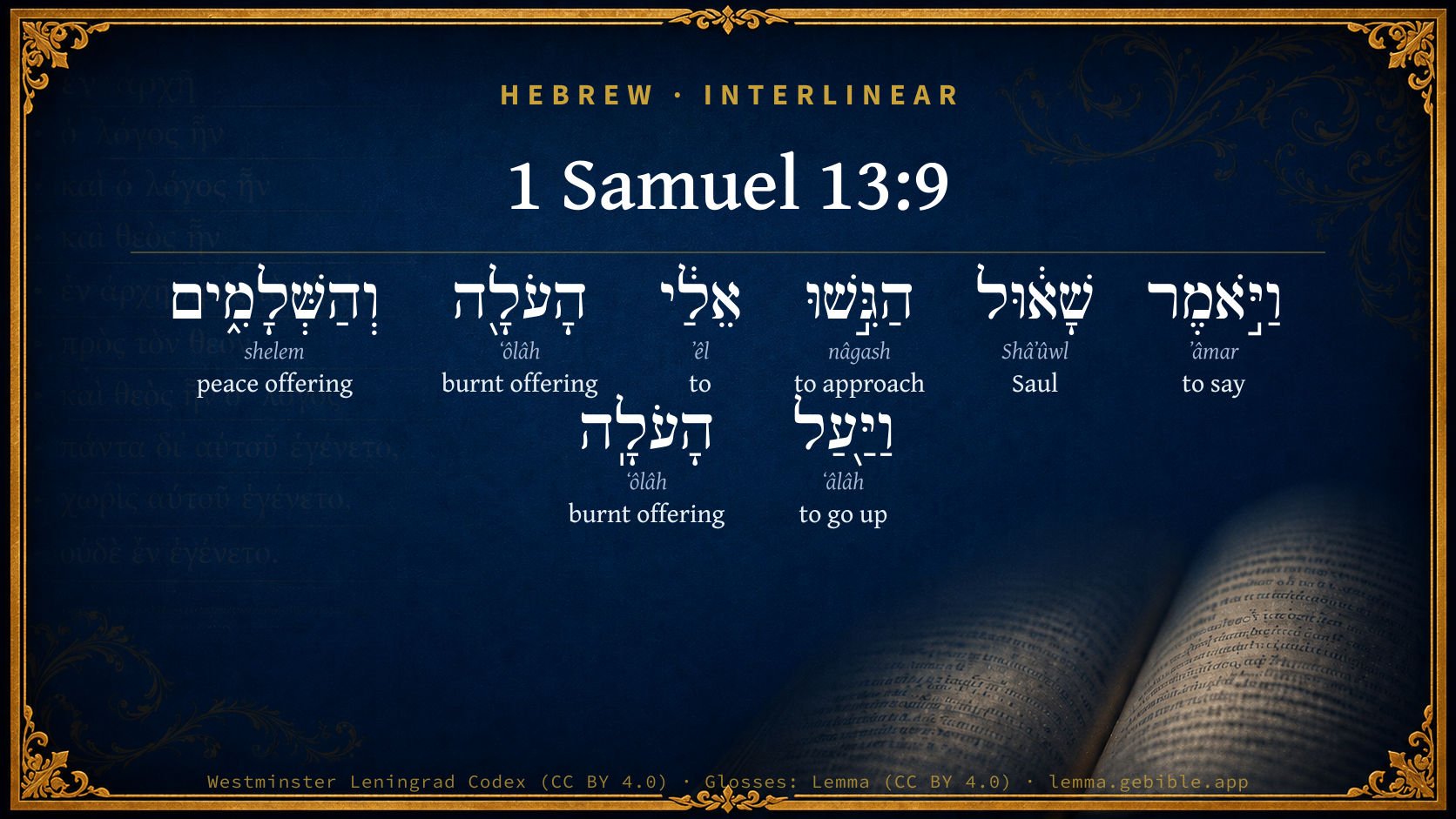
  1. וַיֹּ֣אמֶר ʼâmar H559 “and · to say” Conjunction + Verb, Qal, Sequential Imperfect, 3rd Person, Masculine, Singular
  2. שָׁא֔וּל Shâʼûwl H7586 “Saul” Noun, Proper
  3. הַגִּ֣שׁוּ nâgash H5066 “approach” Verb, Hiphil, Imperative, 2nd Person, Masculine, Plural
  4. אֵלַ֔י ʼêl H413 “to · me” Preposition + Suffix, Personal, 1st Person, Common, Singular
  5. הָעֹלָ֖ה ʻôlâh H5930 “the · burnt offering” Particle, Definite Article + Noun, Common, Feminine, Singular, Absolute
  6. וַיַּ֖עַל ʻâlâh H5927 “and · to go up” Conjunction + Verb, Hiphil, Sequential Imperfect, 3rd Person, Masculine, Singular
  7. הָעֹלָֽה ʻôlâh H5930 “the · burnt offering” Particle, Definite Article + Noun, Common, Feminine, Singular, Absolute

About this verse

These counts appear in no published source. They are computed here, from the morphology-tagged text and Lemma’s own curated glosses. What Lemma adds →

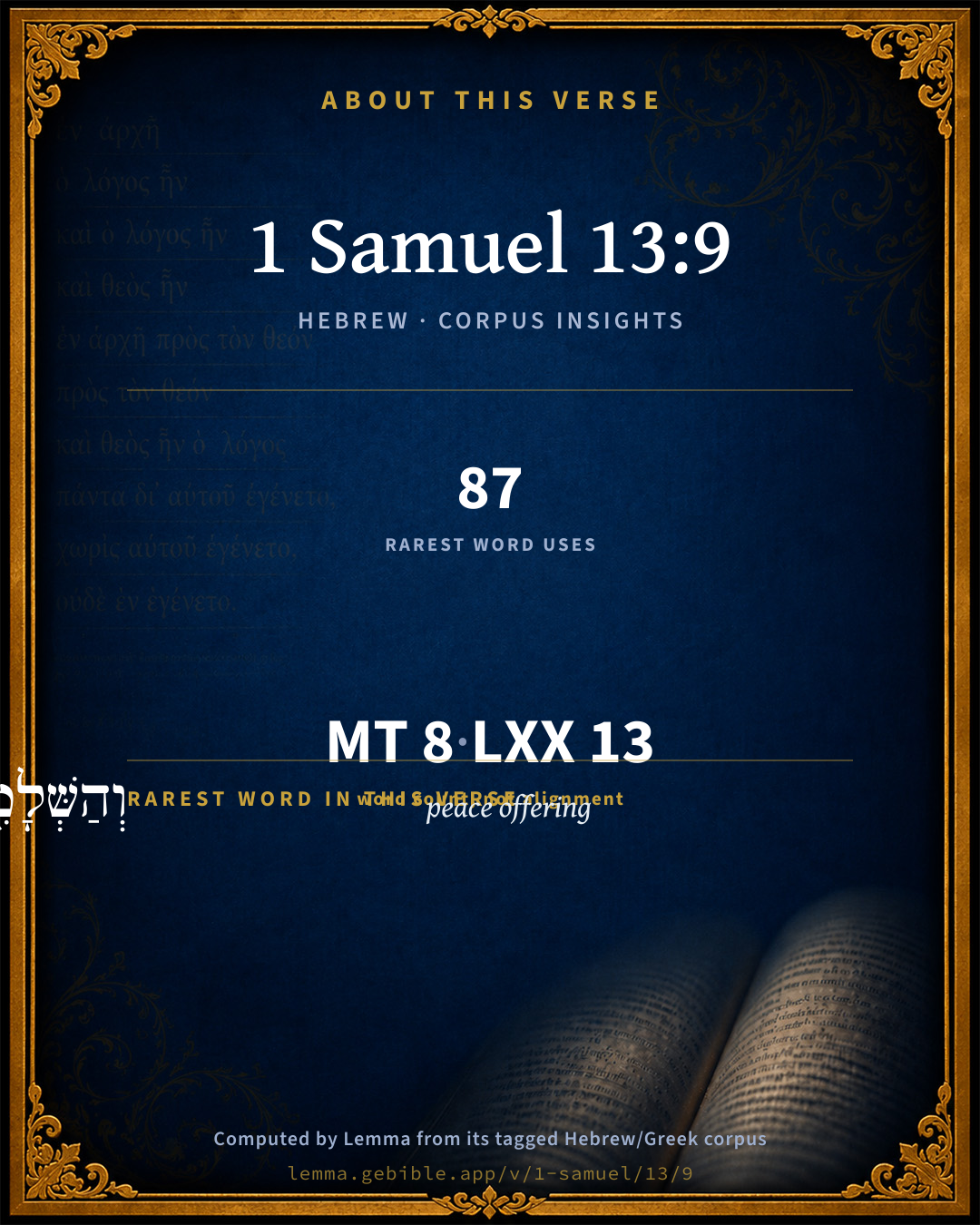
8
words
7
distinct lemmas
Historical
section

Grammatical profile

  • 3 verbs
  • 4 nouns
  • 1 preposition

Verb forms

  • וַיֹּ֣אמֶר Qal · Sequential Imperfect
  • הַגִּ֣שׁוּ Hiphil · Imperative
  • וַיַּ֖עַל Hiphil · Sequential Imperfect

Repetition

A word recurs within this verse — often emphatic in Hebrew:

  • הָעֹלָ֖ה burnt offering H5930 ×2

Hebrew & Septuagint length

In English translation the verse runs 17 words from the Hebrew and 22 from the Septuagint (LXX English) — closely comparable.

A rough comparison of the two English renderings, which tokenize alike — not a word-level alignment.

Word counts can differ between the Hebrew and the Greek without any difference in meaning — e.g. the Hebrew direct-object marker אֵת has no separate Greek word, and Greek often adds the article ὁ.

In the original languages it is 8 Hebrew tokens and 13 Greek tokens — but the two are counted differently (Hebrew bundles its prefixes and suffixes into one token; the Greek is in lemma form), so that isn’t a like-for-like length.

Cross-references

12

Topical passages linked to 1 Samuel 13:9 in the Treasury of Scripture Knowledge — connected by theme and wording, ordered by reader-vote popularity; previews shown in the World English Bible.

  • 1 Kings 3:4 The king went to Gibeon to sacrifice there; for that was the great high place: a thousand burnt offerings did Solomon offer on that altar.
  • Proverbs 21:27 The sacrifice of the wicked is an abomination: How much more, when he brings it with a wicked mind!
  • Proverbs 15:8 The sacrifice made by the wicked is an abomination to Yahweh, But the prayer of the upright is his delight.
  • Proverbs 21:3 To do righteousness and justice Is more acceptable to Yahweh than sacrifice.
  • Deuteronomy 12:6 and there you shall bring your burnt offerings, and your sacrifices, and your tithes, and the heave-offering of your hand, and your vows, and your freewill-offerings, and the firstborn of your herd and of your flock:
  • 1 Samuel 13:12–13 therefore said I, Now will the Philistines come down on me to Gilgal, and I haven't entreated the favor of Yahweh: I forced myself therefore, and offered the burnt offering.
  • 1 Samuel 14:18 Saul said to Ahijah, Bring here the ark of God. For the ark of God was [there] at that time with the children of Israel.
  • 1 Samuel 15:21–22 But the people took of the spoil, sheep and oxen, the chief of the devoted things, to sacrifice to Yahweh your God in Gilgal.
  • 2 Samuel 24:25 David built there an altar to Yahweh, and offered burnt offerings and peace-offerings. So Yahweh was entreated for the land, and the plague was stayed from Israel.
  • Isaiah 66:3 He who kills an ox is as he who kills a man; he who sacrifices a lamb, as he who breaks a dog's neck; he who offers an offering, [as he who offers] pig's blood; he who burns frankincense, as he who blesses an idol. Yes, they have chosen their own ways, and their soul delights in their abominations:
  • Psalms 37:7 Rest in Yahweh, and wait patiently for him. Don't fret because of him who prospers in his way, Because of the man who makes wicked plots happen.
  • Proverbs 20:22 Don't say, "I will pay back evil." Wait for Yahweh, and he will save you.

Cross-references courtesy of OpenBible.info (CC BY 4.0).

Hebrew and Greek witnesses Masoretic Hebrew ↔ Greek Septuagint

The same verse in the two great witnesses to the Old Testament, shown verse-for-verse.

These are two independent witnesses, not word-aligned to each other, and the Septuagint is shown in lemma (dictionary) form.

Hebrew 1 Samuel 13:9 Masoretic · Westminster Leningrad Codex

וַיֹּ֣אמֶר שָׁא֔וּל הַגִּ֣שׁוּ אֵלַ֔י הָעֹלָ֖ה וְהַשְּׁלָמִ֑ים וַיַּ֖עַל הָעֹלָֽה

Saul said, Bring here the burnt offering to me, and the peace-offerings. He offered the burnt offering.

World English Bible · Public Domain

Greek LXX 1 Samuel 13:9 Septuagint · lemma form

καί εἶπον σαούλ προςἄγω ὅπως ποιέω ὁλοκαύτωσις καί εἰρηνικός καί ἀναφέρω ὁ ὁλοκαύτωσις

And Saul said, Bring hither victims, that I may offer whole burnt offerings and peace-offerings: and he offered the whole burnt offering.

LXX2012 (modern English Septuagint) · Public Domain

Hebrew: Westminster Leningrad Codex (CC BY 4.0). Greek: Septuagint (public domain); English from LXX2012 (modern English Septuagint) (Public Domain). How the Septuagint differs from the Hebrew →

Targum (Aramaic paraphrase)

1

The Targum is the ancient Jewish Aramaic paraphrase of the Hebrew Scriptures — an interpretive translation, not the Hebrew text itself. Onkelos (literal) and Pseudo-Jonathan (expansive) render the Torah, and Jonathan the Prophets. Coverage is partial: where no permissively-licensed English translation exists for a verse, only the Aramaic is shown. This is verse-level text, not a word-by-word alignment to the Hebrew.

  1. Targum Jonathan Prophets (Joshua–Malachi)
    וַאֲמַר שָׁאוּל קְרִיבוּ לְוָתִי עֲלָתָא וְנִכְסַת קוּדְשַׁיָא וְאַסֵיק עֲלָתָא:

    (no public-domain English translation for this verse)

    Targum Jonathan — Aramaic: “Mikraot Gedolot” (public domain). English: “Sefaria Community Translation” (CC0 1.0 (public-domain dedication)); “London "Chaldee Paraphrase," 1871” (public domain). Text via Sefaria.

Commentary

Notes on 1 Samuel 13:9 from classic Christian and Jewish commentators (each source and its license shown beneath its notes). The classic Christian expositions comment on the surrounding passage and are grouped to its opening verse, so a note may address several verses; the Jewish commentaries on the Tanakh (Rashi and others) are per-verse, so they appear only where the commentator wrote on this verse.

Lemma curates 59 commentaries, every one of them public domain or Creative Commons licensed, each selected and text-cleaned for this edition rather than reprinted as found. About our sources →

Jamieson, Fausset & Brown

Robert Jamieson, A. R. Fausset & David Brown

SAUL, WEARY OF WAITING FOR SAMUEL, SACRIFICES. (Sa1 13:9-16)

Saul said, Bring hither a burnt offering to me, and peace offerings--Saul, though patriotic enough in his own way, was more ambitious of gaining the glory of a triumph to himself than ascribing it to God. He did not understand his proper position as king of Israel; and although aware of the restrictions under which he held the sovereignty, he wished to rule as an autocrat, who possessed absolute power both in civil and sacred things. This occasion was his first trial. Samuel waited till the last day of the seven, in order to put the constitutional character of the king to the test; and, as Saul, in his impatient and passionate haste knowingly transgressed (Sa1 13:12) by invading the priest's office and thus showing his unfitness for his high office (as he showed nothing of the faith of Gideon and other Hebrew generals), he incurred a threat of the rejection which his subsequent waywardness confirmed.

Jamieson, Fausset & Brown — Commentary Critical and Explanatory on the Whole Bible (1871) — public domain (CC PDM 1.0). Text via the HelloAO Bible API.

Trapp's Complete Commentary

John Trapp

1Sa 13:9 And Saul said, Bring hither a burnt offering to me, and peace offerings. And he offered the burnt offering.

Ver. 9. And Saul said, Bring hither a burnt offering.] The heathens also were wont to sacrifice before they went to war: whence also they called a sacrifice hostia, from the enemies they went against. It was Saul’s error here, that he thought God would be pleased with the external act of sacrifice, though it were not offered up in faith and obedience. Luther {a} calleth such hypocrites Cainists. But what saith a reverend man {b} here? If Saul were among the prophets before, will he now be among the priests? Can there be any devotion in disobedience? O vain man! what can it avail to sacrifice to God, against God?

And he offered the burnt offering.] If he did it with his own hands, invading the priest’s office, as Uzziah did, his offence was far the greater.

{a} Luth., in Decal.

{b} Dr Hall.

John Trapp, A Commentary or Exposition upon All the Books of the Old and New Testament (1647–1656) — public domain. Text from a community e-Sword module.

Tyndale Open Study Notes

Tyndale Open Resources

13:9 the burnt offering and the peace offerings: These general-purpose offerings (see Exod 24:5; 32:6; Num 10:10; 15:8; Deut 27:6-7) were always offered on a solemn occasion filled with either danger or joy. Typically, only priests were to offer these sacrifices (but see study note on 1 Sam 13:13).

Tyndale Open Study Notes — © Tyndale Open Resources, licensed CC BY-SA 4.0. Text via the HelloAO Bible API.

Adam Clarke's Commentary

Verse 9. And he offered the burnt-offering.] This was most perfectly unconstitutional; he had no authority to offer, or cause to be offered, any of the Lord's sacrifices.

Adam Clarke's Commentary on the Bible (1810–1826) — public domain. Text from a community e-Sword/MySword module.

Ellicott's Commentary for English Readers

(9) Bring hither a burnt offering to me.—It has been supposed by many that the greatness of the sin of Saul consisted in his offering sacrifice with his own hand, but not a hint of this is anywhere given us. It is more than probable that the sacrifice which was offered so prematurely in the absence of the seer of God was performed by the hand of Ahiah the priest, who, no doubt, was in attendance on the king. No unlawful assumption of priestly functions, as in the case of King Uzziah (2Ch_26:18), is anywhere charged on Saul.

A Bible Commentary for English Readers, edited by Charles John Ellicott (1878–1897) — public domain. Text from a community e-Sword module.

The Cambridge Bible for Schools and Colleges

gen. ed. J. J. S. Perowne

9. Bring hither a burnt offering, &c.] “Bring hither to me the burnt-offering and the peace-offerings,” which were ready, awaiting Samuel’s arrival.

he offered the burnt offering] The same phrase is used of David (2Sa_24:25), and Solomon (1Ki_3:4), and probably does not mean that they actually performed the sacrifice themselves, If they did do so, it must be inferred that it was lawful for the king to act as priest. At any rate there is no hint here that Saul’s sin consisted in the usurpation of priestly functions.

The Cambridge Bible for Schools and Colleges (gen. ed. J. J. S. Perowne; Cambridge University Press, 1878–1918) — public domain. Text from a community e-Sword module.

John Gill's Exposition

And Saul said,.... Being impatient, and seeing the people deserting him apace, and unwilling to engage in a battle without first sacrificing to God, and imploring his help and assistance:

bring hither a burnt offering to me; that is, a creature for a burnt offering, a bullock, sheep, goat, or lamb:

and peace offerings; which also were either of the herd, or of the flock:

and he offered the burnt offering; either he himself, or by a priest. In this unsettled time, while the tabernacle, altar, and ark, were at different places, and not yet fixed, it is thought that such who were not priests might offer, and that in high places, and where the tabernacle and altar were not.

John Gill's Exposition of the Whole Bible (1746–1763) — public domain (CC PDM 1.0). Text via the HelloAO Bible API.

Albert Barnes' Notes on the Bible

There is a difference of opinion among commentators whether Saul himself offered the sacrifices prepared for Samuel, thus entrenching upon the priest’s office; or whether he ordered the priests to sacrifice, as Solomon did. In the latter case his sin consisted in disobeying the word of God, who had bidden him wait until Samuel came. And this is, on the whole, the more probable; since Samuel’s rebuke says nothing of any assumption of priesthood, such as we read in the case of Uzziah 2Ch 26:18.

Albert Barnes' Notes on the Bible (1834–1885) — public domain. Text from a community e-Sword/MySword module.

Matthew Poole's English Annotations

Either himself; or rather by the priest, as Solomon is said to offer, 1Ki 3:4. Compare 1Sa 1:3.

Matthew Poole's English Annotations on the Holy Bible (1683–1685) — public domain. Text from a community e-Sword/MySword module.

Whedon's Commentary on the Bible

Daniel D. Whedon

9. He offered the burnt offering — We need not suppose that Saul offered this sacrifice with his own hand. As we have observed on chap. 1Sa_7:9, the presence of priests on such occasions is naturally understood, and no specification of that fact was necessary. So Saul’s blowing of the trumpet (1Sa_13:3) throughout all the land is not to be understood of his personal act. The command, Bring hither a burnt offering to me, is but a part of the order to offer such sacrifice in his presence.

Daniel D. Whedon (gen. ed.), Commentary on the Old and New Testaments (1874–1909) — public domain. Text from a community e-Sword module.

The Pulpit Commentary

A burnt offering, etc. The Hebrew has the definite article, the burnt offering and the peace offerings, which were there ready for Samuel to offer. He offered. Not with his own hand, but by the hand of the attendant priest, Ahiah, who was, we know, with him. Possibly, nevertheless, the Levitical law was not at this period strictly observed.

The Pulpit Commentary (1880–1919), ed. H.D.M. Spence-Jones & Joseph S. Exell — public domain. Text from a community e-Sword module.

Rashi

Rabbi Shlomo Yitzchaki (Rashi)

Bring me the burnt-offering. A non-kohein is permitted to sacrifice on a high place.

Rashi on the Tanakh — English translations: “The Judaica Press complete Tanach with Rashi, translated by A. J. Rosenberg” (CC BY 4.0); “Pentateuch with Rashi's commentary by M. Rosenbaum and A.M. Silbermann, 1929-1934” (public domain); “The Metsudah Tanach series, Lakewood, N.J” (CC BY 4.0); and “The Book of Joshua, Metsudah Publications, 1997” (CC BY 4.0). Text via Sefaria.

Lesson kit

Teaching starters — assembled from the data on this page, not authored interpretation. Every prompt links to the verse data it draws on. Edit before teaching.

1 Samuel, in the Historical, opens this verse with 8 words (7 distinct Hebrew lemmas). Its most distinctive word is shelem (“peace offering”). A historical commentator’s framing appears above. Read the whole chapter for the surrounding context.

Discussion questions

  1. The word shelem carries the sense “peace offering.” How does it shape the verse?
  2. How does 1 Kings 3:4, which shares this passage’s theme, read alongside this verse?
  3. What does the repetition of “burnt offering” (2× in this one verse) do in this verse?
  4. The translations on this page render this verse differently — a whole-verse word diff, not a word-by-word alignment. What might account for the different wordings?
  5. «וַיֹּ֣אמֶר» is a Qal Sequential Imperfect verb. How does that grammatical form shape the action described?
  6. Compare how Jamieson, Fausset & Brown and Trapp's Complete Commentary read this verse. Where do they agree or differ?

Things to notice

Reading settings

Reading text

Shown beneath each verse's original-language words.

Old Testament
Old Testament edition

Read the OT as the Masoretic Hebrew (MT) or the Greek Septuagint (LXX).

English shown for the Greek Septuagint (in the Hebrew ↔ Greek comparison).

Comparing translations? Open the Compare panel on any verse page to stack up to four side by side.