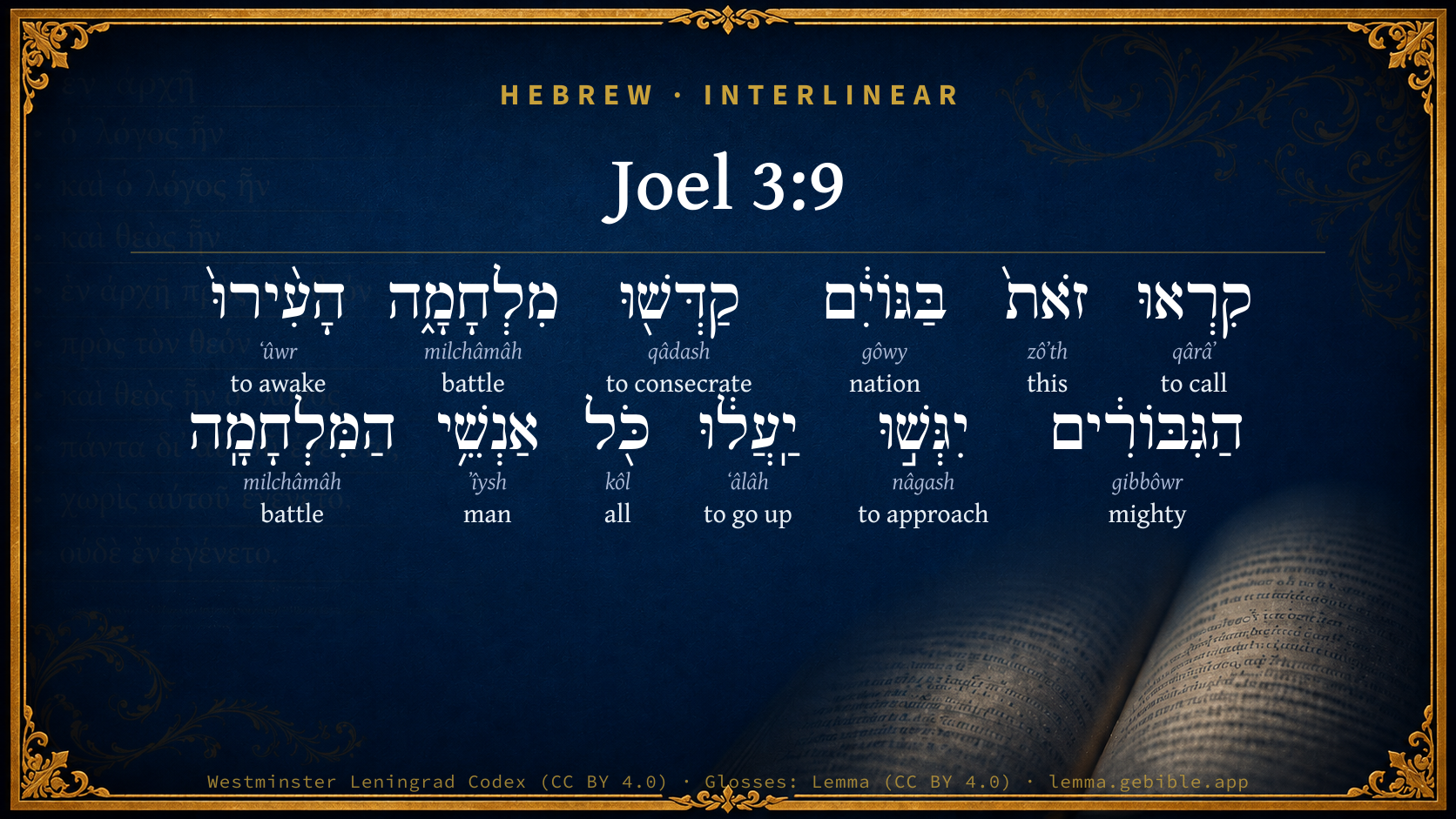
Joel 3:9

Hebrew (Westminster Leningrad Codex) Joel 3:9 appears in the Hebrew Old Testament. The text above is from the Westminster Leningrad Codex. Each word links to its Strong’s number, a concise gloss, and parsing drawn from the Open Scriptures Hebrew Bible morphology. Click any word for its full Brown-Driver-Briggs (BDB) entry.
Download image
Cite this verse

Joel 3:9 (World English Bible). Public Domain. Lemma interlinear Bible study tool, https://lemma.gebible.app/v/joel/3/9.

Show BibTeX & RIS
BibTeX
RIS
English Translation
Proclaim this among the nations: Prepare war. Stir up the mighty men. Let all the warriors draw near. Let them come up.
World English Bible · Public Domain
Download a study sheet

One document with this verse’s original text, its word-by-word gloss line, the meaning frame, cross-references with their text, attributed commentary, and full source and license credits — printable, and it pastes into notes with its structure intact.

This verse Autodidact and up

Study sheet (.html) Plain text (.txt)

A passage Seminary Student

Up to 50 verses in one chapter. A passage sheet keeps up to 6 commentary sources and 12 cross-references per verse, in the order this page ranks them, and says so on the sheet whenever that leaves anything out. Ask for a single verse and you get the Autodidact verse sheet above.

Everything on this page stays free to read, with no account — the sheet is a download of what is already on screen, not access to it.

Want to remove ads? Support Godless Engineer
Compare translations 3

The same verse in 3 English versions, stacked beneath the original-language interlinear above. Click any original word for its lexicon entry.

Each is an independent rendering of the whole verse — the interlinear is not word-aligned to these translations.

Highlighted words mark where these versions differ — a whole-verse word diff, not a word-by-word alignment.

  • World English Bible Public Domain
    Proclaim this among the nations: Prepare war. Stir up the mighty men. Let all the warriors draw near. Let them come up.
  • King James Version Public Domain
    Proclaim ye this among the Gentiles; Prepare war, wake up the mighty men, let all the men of war draw near; let them come up:
  • unfoldingWord Literal Text CC BY-SA 4.0
    Proclaim this among the nations: “Consecrate a war! Rouse the warriors! May they approach: may all of the men of war come up.

unfoldingWord Literal Text — © unfoldingWord, licensed CC BY-SA 4.0. Word-aligned USFM3 via Door43 (git.door43.org/unfoldingWord/en_ult).

Versions to compare (up to 4)

3 of 4 selected

Show all 18 translations

Every available English version of this verse, each an independent rendering of the whole verse.

  • World English Bible Public Domain
    Proclaim this among the nations: Prepare war. Stir up the mighty men. Let all the warriors draw near. Let them come up.
  • Berean Standard Bible Public Domain
    Proclaim this among the nations: “Prepare for war; rouse the mighty men; let all the men of war advance and attack!
  • Majority Standard Bible Public Domain
    Proclaim this among the nations: “Prepare for war; rouse the mighty men; let all the men of war advance and attack!
  • King James Version Public Domain
    Proclaim ye this among the Gentiles; Prepare war, wake up the mighty men, let all the men of war draw near; let them come up:
  • American Standard Version (1901) Public Domain
    Proclaim ye this among the nations; prepare war; stir up the mighty men; let all the men of war draw near, let them come up.
  • Revised Version (1885) Public Domain
    Proclaim ye this among the nations; prepare war: stir up the mighty men; let all the men of war draw near, let them come up.
  • Geneva Bible (1599) Public Domain
    Publish this among the Gentiles: prepare warre, wake vp the mightie men: let all the men of warre drawe neere and come vp.
  • Douay-Rheims (1899) Public Domain
    Proclaim ye this among the nations: prepare war, rouse up the strong: let them come, let all the men of war come up.
  • Young's Literal Translation Public Domain
    Proclaim ye this among nations, Sanctify a war, stir up the mighty ones, Come nigh, come up, let all the men of war.
  • Literal Standard Version CC BY-SA 4.0
    Proclaim this among nations, || Sanctify a war, stir up the mighty ones, || Come near, come up, let all the men of war.
  • Unlocked Literal Bible CC BY-SA 4.0
    Proclaim this among the nations, “Prepare yourselves for war, rouse the mighty men, let them come near, let all the men of battle come up.
  • unfoldingWord Literal Text CC BY-SA 4.0
    Proclaim this among the nations: “Consecrate a war! Rouse the warriors! May they approach: may all of the men of war come up.
  • Darby Bible Public Domain
    Proclaim this among the nations: prepare war, arouse the mighty men, let all the men of war draw near, let them come up.
  • World Messianic Bible Public Domain
    Proclaim this among the nations: “Prepare for war! Stir up the mighty men. Let all the warriors draw near. Let them come up.
  • Webster's Bible Public Domain
    \\3:4\\Yes, and what have ye to do with me, O Tyre, and Zidon, and all the coasts of Palestine? will ye render me a recompense? and if ye recompense me, swiftly and speedily I will return your recompense upon your own head;
  • Free Bible Version CC BY-SA 4.0
    Proclaim this among the nations: “Prepare for war! Call up the mighty warriors! Let all the soldiers get ready and advance!
  • Bible in Basic English Public Domain
    And further, what are you to me, O Tyre and Zidon and all the circle of Philistia? will you give me back any payment? and if you do, quickly and suddenly I will send it back on your head,
  • JPS Tanakh (1917) Public Domain
    (4-9) Proclaim ye this among the nations, prepare war; stir up the mighty men; let all the men of war draw near, let them come up.

Literal Standard Version (2020), Covenant Press — licensed CC BY-SA 4.0. Text via the HelloAO Bible API (eBible.org). Unlocked Literal Bible (unfoldingWord) — licensed CC BY-SA 4.0. Text via the HelloAO Bible API (eBible.org). unfoldingWord Literal Text — © unfoldingWord, licensed CC BY-SA 4.0. Word-aligned USFM3 via Door43 (git.door43.org/unfoldingWord/en_ult). Free Bible Version, Dr. Jonathan Gallagher — licensed CC BY-SA 4.0. Text via the HelloAO Bible API (eBible.org).

Word by word

More ways to search: Search by grammar → Find every occurrence → Compare this word →

Practice this passage: Drill this verse → Learn its vocabulary →

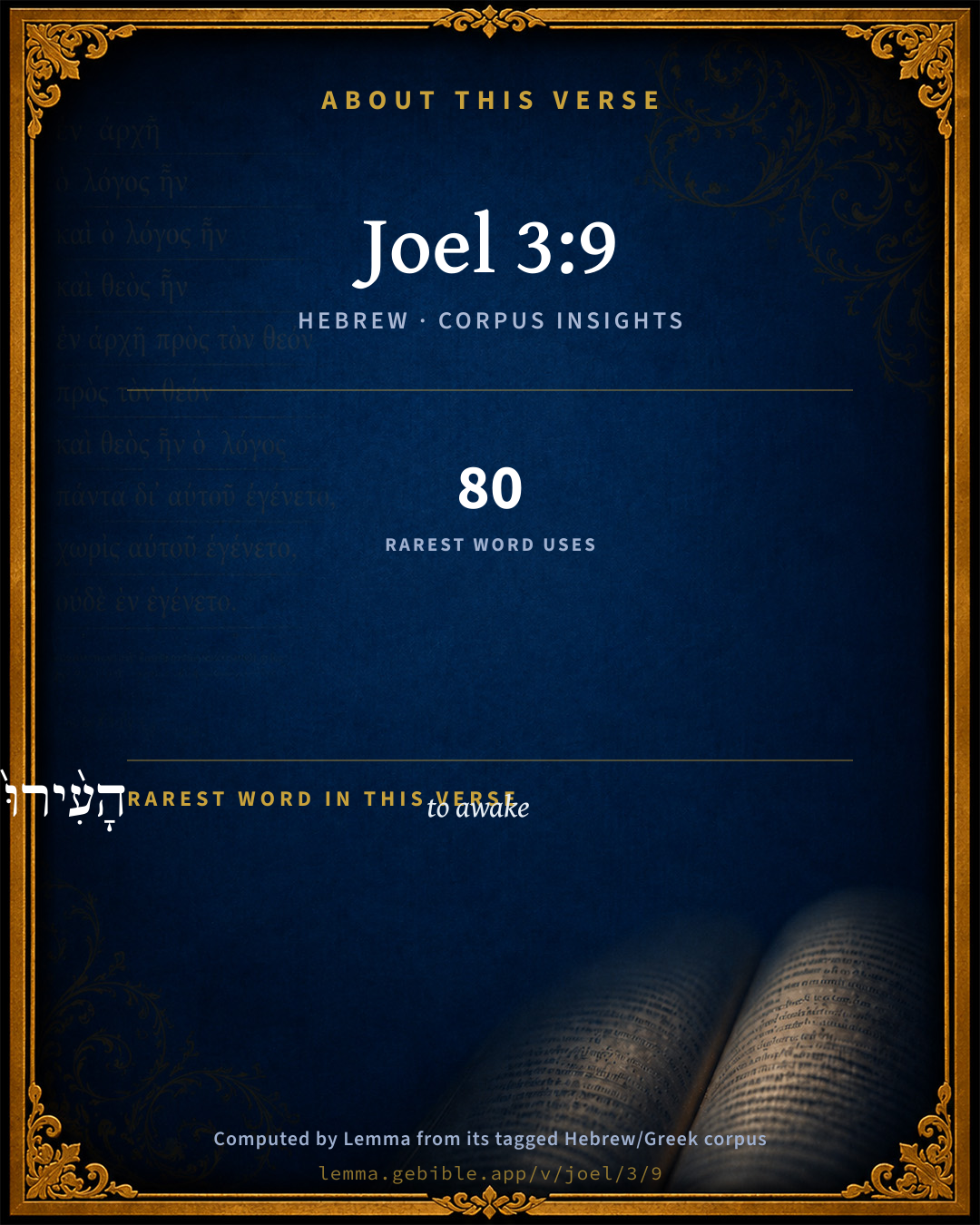
הָעִ֨ירוּ֙
ʻûwr
H5782
“awake”
Verb, Hiphil, Imperative, 2nd Person, Masculine, Plural
Part of Speech
Verb
Stem
Hiphil
Form
Imperative
Person
2nd Person
Gender
Masculine
Number
Plural
Full BDB Definition

Origin: a primitive root [rather identical with H5783 through the idea of opening the eyes]

TWOT: 1587

to rouse oneself, awake, awaken, incite - (Qal) to rouse oneself, awake - (Niphal) to be roused - (Polel) to stir up, rouse, incite - (Hithpolel) to be excited, be triumphant - (Hiphil) - to rouse, stir up - to act in an aroused manner, awake
  1. קִרְאוּ qârâʼ H7121 “call” Verb, Qal, Imperative, 2nd Person, Masculine, Plural
  2. זֹאת֙ zôʼth H2063 “this” Pronoun, Demonstrative, Feminine, Singular
  3. בַּגּוֹיִ֔ם gôwy H1471 “in/at the · nations” Preposition, Determined + Noun, Common, Masculine, Plural, Absolute
  4. קַדְּשׁ֖וּ qâdash H6942 “consecrate” Verb, Piel, Imperative, 2nd Person, Masculine, Plural
  5. מִלְחָמָ֑ה milchâmâh H4421 “battle” Noun, Common, Feminine, Singular, Absolute
  6. הַגִּבּוֹרִ֔ים gibbôwr H1368 “the · mighty” Particle, Definite Article + Adjective, Adjective, Masculine, Plural, Absolute
  7. יִגְּשׁ֣וּ nâgash H5066 “to approach” Verb, Qal, Jussive, 3rd Person, Masculine, Plural
  8. יַֽעֲל֔וּ ʻâlâh H5927 “to go up” Verb, Qal, Jussive, 3rd Person, Masculine, Plural
  9. כֹּ֖ל kôl H3605 “all of” Noun, Common, Masculine, Singular, Construct
  10. אַנְשֵׁ֥י ʼîysh H376 “men of” Noun, Common, Masculine, Plural, Construct
  11. הַמִּלְחָמָֽה milchâmâh H4421 “the · battle” Particle, Definite Article + Noun, Common, Feminine, Singular, Absolute

About this verse

These counts appear in no published source. They are computed here, from the morphology-tagged text and Lemma’s own curated glosses. What Lemma adds →

12
words
11
distinct lemmas
Prophets
section

Grammatical profile

  • 5 verbs
  • 5 nouns
  • 1 adjective
  • 1 pronoun

Verb forms

  • קִרְאוּ Qal · Imperative
  • קַדְּשׁ֖וּ Piel · Imperative
  • הָעִ֨ירוּ֙ Hiphil · Imperative
  • יִגְּשׁ֣וּ Qal · Jussive
  • יַֽעֲל֔וּ Qal · Jussive

Repetition

A word recurs within this verse — often emphatic in Hebrew:

  • מִלְחָמָ֑ה battle H4421 ×2

Hebrew & Septuagint length

In English translation the verse runs 22 words from the Hebrew and 21 from the Septuagint (LXX English) — closely comparable.

A rough comparison of the two English renderings, which tokenize alike — not a word-level alignment.

Word counts can differ between the Hebrew and the Greek without any difference in meaning — e.g. the Hebrew direct-object marker אֵת has no separate Greek word, and Greek often adds the article ὁ.

Cross-references

9

Topical passages linked to Joel 3:9 in the Treasury of Scripture Knowledge — connected by theme and wording, ordered by reader-vote popularity; previews shown in the World English Bible.

  • Jeremiah 46:3–4 Prepare you the buckler and shield, and draw near to battle.
  • Isaiah 8:9–10 Make an uproar, O you peoples, and be broken in pieces! And give ear, all you of far countries: gird yourselves, and be broken in pieces! Gird yourselves, and be broken in pieces!
  • Jeremiah 31:10 Hear the word of Yahweh, you nations, and declare it in the isles afar off; and say, He who scattered Israel will gather him, and keep him, as shepherd does his flock.
  • Ezekiel 38:7 Be prepared, yes, prepare yourself, you, and all your companies who are assembled to you, and be a guard to them.
  • Psalms 96:10 Say among the nations, "Yahweh reigns." The world is also established. It can't be moved. He will judge the peoples with equity.
  • Isaiah 34:1 Come near, you nations, to hear; and listen, you peoples: let the earth hear, and the fullness of it; the world, and all things that come forth from it.
  • Jeremiah 50:2 Declare you among the nations and publish, and set up a standard; publish, and don't conceal: say, Babylon is taken, Bel is disappointed, Merodach is dismayed; her images are disappointed, her idols are dismayed.
  • Ezekiel 21:21–22 For the king of Babylon stood at the parting of the way, at the head of the two ways, to use divination: he shook the arrows back and forth, he consulted the teraphim, he looked in the liver.
  • Micah 3:5 Thus says Yahweh concerning the prophets who lead my people astray; for those who feed their teeth, they proclaim, "Peace!" and whoever doesn't provide for their mouths, they prepare war against him:

Cross-references courtesy of OpenBible.info (CC BY 4.0).

Hebrew and Greek witnesses Masoretic Hebrew ↔ Greek Septuagint

The same verse in the two great witnesses to the Old Testament, shown verse-for-verse.

These are two independent witnesses, not word-aligned to each other, and the Septuagint is shown in lemma (dictionary) form.

Hebrew Joel 3:9 Masoretic · Westminster Leningrad Codex

קִרְאוּ זֹאת֙ בַּגּוֹיִ֔ם קַדְּשׁ֖וּ מִלְחָמָ֑ה הָעִ֨ירוּ֙ הַגִּבּוֹרִ֔ים יִגְּשׁ֣וּ יַֽעֲל֔וּ כֹּ֖ל אַנְשֵׁ֥י הַמִּלְחָמָֽה

Proclaim this among the nations: Prepare war. Stir up the mighty men. Let all the warriors draw near. Let them come up.

World English Bible · Public Domain

Greek LXX Joel 3:9 Septuagint · lemma form
Proclaim these things among the Gentiles; declare war, arouse the warriors, draw near and go up, all you⌃ men of war.

LXX2012 (modern English Septuagint) · Public Domain

On this verse, Keil & Delitzsch discusses the Septuagint’s reading. Read the note in Commentary ↓

Hebrew: Westminster Leningrad Codex (CC BY 4.0). Greek: Septuagint (public domain); English from LXX2012 (modern English Septuagint) (Public Domain). How the Septuagint differs from the Hebrew →

Commentary

Notes on Joel 3:9 from classic Christian and Jewish commentators (each source and its license shown beneath its notes). The classic Christian expositions comment on the surrounding passage and are grouped to its opening verse, so a note may address several verses; the Jewish commentaries on the Tanakh (Rashi and others) are per-verse, so they appear only where the commentator wrote on this verse.

Lemma curates 59 commentaries, every one of them public domain or Creative Commons licensed, each selected and text-cleaned for this edition rather than reprinted as found. About our sources →

Matthew Henry's Commentary

What the psalmist had long before ordered to be said among the heathen (Psa 96:10) the prophet here will have in like manner to be published to all nations, That the Lord reigns, and that he comes, he comes to judge the earth, as he had long been judging in the earth. The notice here given of God's judging the nations may have reference to the destruction of Sennacherib, Nebuchadnezzar, Antiochus, and to the Antichrist especially, and all the proud enemies of the Christian church; but some of the best interpreters, ancient and modern (particularly the learned Dr. Polock), think the scope of these verses is to set forth the day of the last judgment under the similitude of God's making war upon the enemies of his kingdom, and his gathering in the harvest of the earth, both which similitudes we find used in the Revelation, Rev 19:11; Rev 14:18. Here we have,

I. A challenge given to all the enemies of God's kingdom to do their worst. To signify to them that God is preparing war against them, they are called upon to prepare war against him, Joe 3:9-11. When the hour of God's judgment shall come effectual methods shall be taken to gather all nations to the battle of that great day of God Almighty, Rev 16:14; Rev 20:8. It seems to be here spoken ironically: "Proclaim you this among the Gentiles; let all the forces of the nations be summoned to join in confederacy against God and his people." It is like that, Isa 7:9, "Associate yourselves, O you people! and gird yourselves, but you shall be broken to pieces. Prepare war; muster up all your strength; wake up the mighty men; call them into your service; excite them to vigilance and resolution; let all the men of war draw near. Let them come and enter the lists with Omnipotence if they dare; let them not complain for want of weapons, but let them beat their ploughshares into swords and their pruning-hooks into spears. Let them resolve, if they will, never to return to their husbandry again, but either to conquer or die; let none plead unfitness to bear arms, but let the weak say, I am strong and will venture into the field of battle." Thus does a God of almighty power bid defiance to all the opposition of the powers of darkness; let the heathen rage, and the kings of the earth take counsel together, against the Lord and his Christ; let them assemble, and come, and gather themselves together; but he that sits in heaven shall laugh at them, and, while he thus calls them, he has them in derision, Psa 2:1, Psa 2:4. The heathen must be wakened, must be raised from the dead, that they may come up to the valley of Jehoshaphat, to receive their doom (Joe 3:12), may come up out of their graves, come up into the air, to meet the Lord there. Jehoshaphat signifies the judgment of the Lord. Let them come to the place of God's judgment, which perhaps is the chief reason for the using of this name here, but it is put together as a proper name for the sake of allusions to the place so called, which we observed before; let them come thither where God will sit to judge the heathen, to that throne of glory before which shall be gathered all nations (Mat 25:32), for before the judgment-seat of Christ we must all appear. The challenge (Joe 3:9) is turned into a summons, Joe 3:12. It is not only, Come if you dare, but You shall come whether you will or no, for there is no escaping the judgments of God.

II. A charge given to the ministers of God's justice to appear and act against these daring enemies of his kingdom among men: And therefore cause thy mighty ones to come down, O Lord! Joe 3:11. When they bring their forces into the field, let God bring his, let the archangel's trumpet sound a charge, to call together his mighty ones, that is, his angels. Perhaps it is with reference to this that Christ's coming from heaven at the last day is said to be with his mighty angels, Th2 1:7. These are the hosts of the Lord, that shall fight his battles when he shall put down all opposing rule, principality, and power when he shall judge among the heathen, Psa 110:6. Some think these words (Joe 3:9, Joe 3:10), Prepare war, wake up the mighty men, are not a challenge to the enemies' hosts, but a charge to God's hosts; let them draw near, and come up. When God's cause is to be pleaded, either by the law or by the sword, he has those ready that shall please it effectually, witnesses ready to appear for him in the court of judgment, soldiers ready to appear for him in the field of battle. They shall beat ploughshares into swords, if need be. However, it is plain that to them the charge in given (Joe 3:13), Put you in the sickle, for the harvest is ripe; that is, their wickedness is great, the measure of it is full, and they are ripe for ruin. Our Saviour has expounded this, Mat 13:39. The harvest is the end of the world, and the reapers are the angels. And they are commanded to thrust in their sickle. their sharp sickle, and gather in both the harvest and the vintage, Rev 14:15, Rev 14:18. Note, The greatness of men's wickedness makes them ripe for God's judgment.

III. The vast appearance that shall be in that great and solemn day (Joe 3:14): Multitudes, multitudes, in the valley of decision, the same which before was called the valley of Jehoshaphat, or of the judgment of the Lord, for the day of the Lord is near in that valley. Note, 1. The judgment-day, that day of the Lord, has all along been looked upon, and spoken of, as nigh at hand. Enoch said, Behold, the Lord comes, as if the Judge were then standing before the door, because it is certain that that day will come and will come according to the appointment, and a thousand years with God are but as one day; things are ripening apace for it; we ought always to be ready for it, because our judgment is at hand. 2. The day of judgment will be the day of decision, when every man's eternal state will be determined, and the controversy that has been long depending between the kingdom of Christ and that of Satan shall be finally decided, and an end put to the struggle. The valley of the distribution of judgment (so the Chaldee), when every man shall receive according to the things done in the body. The valley of threshing (so the margin), carrying on the metaphor of the harvest, Joe 3:13. The proud enemies of God's people will then be crushed and broken to pieces, and made as the dust of the summer threshing-floors. 3. Innumerable multitudes will be gathered together to receive their final doom in that day, as in the destruction of Gog we read of the valley of Hamon-Gog, and the city of Hamonah (Eze 39:15, Eze 39:16), both signifying the multitude of the vanquished enemies; it is the word here used, Hamonim, Hamonim, expressed by the way of admiration - O what vast multitudes of sinners will divine justice be glorified in the ruin of at that day! A multitude of living (says one of the rabbin) and a multitude of dead, for Christ shall come to judge both the quick and the dead.

IV. The amazing change that shall then be made in the kingdom of nature (Joe 3:15): The sun and moon shall be darkened, as before, Joe 2:31. Their glory and lustre shall be eclipsed by the far greater brightness of that glory in which the Judge shall then appear. Nay, they shall themselves be set aside in the dissolution of all things; for the damned sinners in hell shall not be allowed their light, for God himself will be their everlasting light, Isa 60:19. Those that fall under the wrath of God in that day of wrath shall be cut off from all comfort and joy, signified by the darkening not only of sun and moon, but of the stars also.

V. The different impressions which that day will make upon the children of this world and the children of God, according as it will be to them. 1. To the wicked it will be a terrible day. The Lord shall then speak from Zion and Jerusalem, from the throne of his glory, from heaven, where he manifests himself in a peculiar manner, as sometimes he has done in the glorious high throne of his sanctuary, which yet was but a faint resemblance of the glory of that day. He shall speak from heaven, from the midst of his saints and angels (so some understand it), the holy society of which may be called Zion and Jerusalem; for, when we come to the heavenly Jerusalem, we come to the innumerable company of angels; see Heb 12:22, Heb 12:25. Now is speaking in that day will be to the wicked as roaring, terrible as the roaring of a lion (for so the word signifies); he long kept silence, but now our God shall come, and shall not keep silence, Psa 50:3, Psa 50:21. Note, The judgment of the great day will make the ears of those to tingle that continue the implacable enemies of God's kingdom. God's voice will then shake terribly both heaven and earth (Isa 2:21), yet once more, Hag 2:6; Heb 12:26. This denotes that the voice of God will in the great day speak such terror to the wicked as were enough to put even heaven and earth into a consternation. When God comes to pull down and destroy his enemies, and make them all his footstool, though heaven and earth should stand up in defence of them and undertake their protection, it shall be all in vain. Even they shall shake before him and be an insufficient shelter to those whom he comforts forth to contend with. Note, As blessings out of Zion are the sweetest blessings, and enough to make heaven and earth sing, so terrors out of Zion are the sorest terrors, and enough to make heaven and earth shake. 2. To the righteous it will be a joyful day. When the heaven and earth shall tremble, and be dissolved and burnt up, then will the Lord be the hope of his people and the strength of the children of Israel (Joe 3:16), and then shall Jerusalem be holy, Joe 3:17. The saints are the Israel of God; they are his people; the church is his Jerusalem. They are in covenant and communion with him; now in the great day, (1.) Their longings shall be satisfied: The Lord will be the hope of his people. As he always was the founder and foundation of their hopes, so he then will be the crown of their hopes. He will be the harbour of his people (so the word is), their receptacle, refuge, and home. The saints in the great day shall arrive at the desired haven, shall put to shore after a stormy voyage; they shall go to be for ever at home with God, to their Father's house, the house not made with hands. (2.) Their happiness shall be confirmed. God will be in that day the strength of the children of Israel, enabling them to bid that day welcome and to bear up under the weight of its glories and joys. In this world, when the judgments of God are abroad, and sinners are falling under them, God is and will be the hope and strength of his people, the strength of their heart, and their portion, when other men's hearts fail them for fear. (3.) Their holiness shall be completed (Joe 3:17): Then shall Jerusalem be holy, the holy city indeed; such shall the heavenly Jerusalem be, such the glorious church, without spot, or wrinkle, or any such thing. Jerusalem shall be holiness (so the word is); it shall be perfectly holy; there shall be no remainder of sin in it. The gospel-church is a holy society, even in its militant state, but will never be holiness itself till it comes to be triumphant. Then no stranger shall pass through her any more; there shall not enter into the New Jerusalem any thing that defiles or works iniquity; none shall be there but those who have a right to be there, none but its own citizens; for it shall be an unmixed society. (4.) God shall in all this be manifested and magnified: So shall you know that I am the Lord your God. By the sanctifying and glorifying of the church God will be known in his holiness and glory, as the God that dwells in his holy mountain and makes it holy by dwelling in it; and those that are sanctified and glorified are so through the knowledge of him that called them. The knowledge which true believers have of God is, [1.] An appropriating knowledge. They know that he is the Lord their God, yet not theirs only, but theirs in common with the whole church, that he is their God, but dwelling in Zion his holy mountain; for, though faith appropriates, it does not engross or monopolize the privileges of the covenant. [2.] It is an experimental knowledge. They shall find him their hope and strength in the worst of times, and so they shall know that he is the Lord their God. Those know best the goodness of God who have tasted and seen it, and have found him good to them.

Matthew Henry's Commentary on the Whole Bible (1708–1710) — public domain (CC PDM 1.0). Text via the HelloAO Bible API.

The Cambridge Bible for Schools and Colleges

gen. ed. J. J. S. Perowne

9. Proclaim ye] The words are addressed to those whose duty it would be to make such a proclamation (comp. on Amo_3:9), i.e. the heralds, whom the prophet pictures as ready to carry Jehovah’s command to the nations.

this] i.e. the following command.

Gentiles] nations, as Joe_3:2 (twice).

sanctify (or consecrate) war] i.e. begin war; the phrase having reference to the custom of opening a campaign by means of sacrifices. So Mic_3:5, Jer_6:4; also Isa_13:3, Jer_22:7; Jer_51:27-28, where the warriors are spoken of similarly as “sanctified.”

stir up the mighty men] i.e. arouse the warriors (Joe_2:7) from the inactivity of peace.

let, &c.] with a dramatic change of person, such as the Hebrew poets love (e.g. Isa_34:1; Isa_41:1). In the Heb., let draw near, let them come up, consists of two short words only, the second following rapidly upon the first: the concise and forcible style can be better represented in Greek or Latin (accedant, ascendant), than in English.

come up] the expression used of an attacking or invading army (Joe_1:6).

9–17. After the digression on the Phoenicians and Philistines (Joe_3:4-8), the thought of Joe_3:1-3 is resumed; and the description of the judgement on the nations, announced in Joe_3:2, is continued. The heathen are invited to arm themselves, and advance for the great contest with Israel in the valley of Jehoshaphat, Joe_3:9-12; but once arrived there, they are annihilated, amid celestial portents, by the agents of Jehovah’s will, whom He commissions to engage with them, while His own people look on securely.

The Cambridge Bible for Schools and Colleges (gen. ed. J. J. S. Perowne; Cambridge University Press, 1878–1918) — public domain. Text from a community e-Sword module.

Trapp's Complete Commentary

John Trapp

Joe 3:9 Proclaim ye this among the Gentiles; Prepare war, wake up the mighty men, let all the men of war draw near; let them come up:

Ver. 9. Proclaim ye this among the Gentiles] Oratio tota est figurata, saith Pareus: All this following discourse is figurative; Hortatio sarcasmon habens, saith Mercer. It is an ironic challenge to all God’s enemies, to do their worst to Christ and his Church; somewhat like that Jdg 9:29, "Increase thine army, and come out" (which seems to be the challenge that Gaal sent to Abimelech, by some messenger), or that of Rabshakeh, Isa 36:8, "I will give thee two thousand horses, if thou be able on thy part to set riders on them," or that, Isa 8:9-10.

Prepare war] Heb. sanctify war; that is, laying aside all other business, give yourselves wholly to it (like as at holy services they were called upon, Hoc agere, This to manage, to mind the business in hand, and nothing else), as Scanderbeg did; out of whose lips, while he was fighting, the very blood would start; so earnest he was at it.

Wake up the mighty men] The giants, the champions, such as were Goliath the Gittite, David’s band of worthies, Achilles, Albertus, Marquess of Brandenburg, who for his valour was called Achilles Teutonicus. Put what mettle you can into these your mighties, that they may do their utmost. But also know that they shall soon meet with their matches, viz. God’s "mighty ones" mentioned Joe 3:11.

Let all the men of war draw near] That they may join battle, and not stand daring and facing one another; as the two armies of Christians and Turks did in the days of Baldwin II, King of Jerusalem, for three months together, and then rose and returned without any notable thing done. It is the ancient and manful fashion (saith our chronicler) of the English (who are naturally most impatient of lingering mischiefs) to put their public quarrels quickly to the trial of the sword. Praestat semel quam semper was Caesar’s motto; and his property was

“ Credere nil actum, dum quid superesset agendum ”( Lucan).

John Trapp, A Commentary or Exposition upon All the Books of the Old and New Testament (1647–1656) — public domain. Text from a community e-Sword module.

The Biblical Illustrator

Joseph S. Exell

Joe_3:9-17

Prepare war, wake up the mighty men.

The final battle between good and evil

I. In this battle evil will gather all its available energies. Proclaim ye this among the Gentiles; Prepare war, wake up the up. mighty men, let all the men of war draw near; let them come This is sublime irony. The wicked will collect all their agencies for this last struggle. The prophet intimates that all this shall only render their destruction more complete. Great armies are arrayed against God. They are bold in atheism. They are cunning in sin. They are malicious in temper. But let them come up, and they shall be consumed by the breath of the Lord. Evil has many agencies. It has many mighty men on its side. They are united in their purpose. Their dormant energies will be awakened. But they cannot be finally victorious.

II. In this battle evil will turn many useful agencies into destructive instruments. Beat your ploughshares into swords, and your pruning-hooks into spears: let the weak say, I am strong. When Isaiah and Micah prophesied of the kingdom of Christ, they said, Beat your swords into pruning-hooks, and your spears into ploughshares (Isa_2:1-22.; Mic_4:1-13.). This sentence is now inverted by Joel. The words of Isaiah show the condition of the world under the rule of goodness. The words of Joel show the condition of men under the tyranny of evil. Sin converts the instruments of peace into the implements of war. And in the last great battle between good and evil, many useful principles and institutions will be converted into the means of attack upon truth. The peaceful life and words of Christ have been turned into swords; and eminently will this be the case in the last great conflict with evil.

III. In this battle evil will present itself as naturally ready for destruction. Put ye in the sickle, for the harvest is ripe: come, get you down; for the press is full, the fats overflow; for their wickedness is great. There are here two metaphors, one taken from the harvest, the other from the vintage,--.indicating that sin shall reach its limit. This gives us insight into the method of the Divine government. Sin is not always destroyed in its earliest stage. It remains as a discipline to the world. It tests the patience and moral resistance of the good. The time of its harvest is not yet.

IV. In this battle the natural and helpful agencies of the universe shall aid the defeat of moral evil. The sun and the moon shall be darkened, and the stars shall withdraw their shining. When the wicked gather for the great battle they will find the ordinary agencies of the universe against them.

V. In this battle the good shall enjoy the divine protection. The Lord also shall roar out of Zion, etc. Lessons:--

1. That evil often leads the Church of God into captivity.

2. That moral evil is advancing to its perilous destiny.

3. That the good will finally triumph over the combined forces of evil. (J. S. Exell, M. A.)

The Biblical Illustrator, edited by Joseph S. Exell (c. 1880s–1900s) — public domain. Text from a community e-Sword module.

Joseph Benson's Commentary

Joe 3:9-10. Proclaim ye this among the Gentiles — “God having foretold these judgments against Tyre and Sidon, the Philistines, and the neighbouring nations, who had used the Jews with injustice and cruelty, proceeds here to confirm his people in the belief of the certainty of their destruction; which he tells them should be as sure as though they themselves had gathered them together by proclamation for it: for so are these words, Proclaim ye, &c., to be understood. Not as commanding what they were actually to do, but in order to excite their attention, and to let them know that God was as certainly preparing to bring this vengeance on their enemies, as though he had actually sent messengers from the Jews to proclaim it among them:” see Chandler. Prepare war, wake up the mighty men — Rouse and bring forward into the field your strong and valiant men. In these words the prophet, in an ironical manner, encourages them to make their utmost effort to oppose the designs of Providence; but signifies that it should be all in vain. For, should they strengthen themselves by all the means in their power, yet they should be overcome and punished. Beat your plough-shares into swords, &c. — That is, make all the provision and preparation for war, or for your own defence, that you possibly can. For a people to beat their very plough-shares into swords, &c., signifies a general arming of themselves, much beyond what had been usual.

Joseph Benson's Commentary on the Old and New Testaments (1811–1818) — public domain. Text from a community e-Sword module.

Whedon's Commentary on the Bible

Daniel D. Whedon

9-16. After this condemnation of the bitterest enemies of the chosen people the prophet returns to the announcement broken off in Joe_3:3. The nations are urged to equip themselves for the conflict, to gather in the valley of Jehoshaphat; but when they gather at the command of Jehovah they are annihilated, while his own people remain secure. 9.

Proclaim ye — Not the pious Jews (Wuensche), but those whose duty it is to make such proclamation, the heralds, who are at the command of Jehovah (Amo_3:9; Amo_3:13).

This — The message which follows.

Gentiles — Better, R.V., “nations.”

Prepare war — Literally, sanctify. Bring the sacrifices, perform the religious rites customary before the opening of a war; by these means the campaign is brought under the divine sanction and favor (1Sa_7:8-9; Jer_6:4).

Wake up — Or, stir up. In a transitive sense, arouse the heroes, for this is no time for slumber. The verbs now change to the third person, a very common transition in vivid poetic or prophetic style.

Draw near — To battle.

Come up — Against the enemy (Joe_1:6). Both are technical terms. In Hebrew two short words, which could be uttered very rapidly and thus add force and vividness to the appeal. 10. The agricultural implements are to be beaten into weapons of war.

Plowshares — Heb, ittim, a rare word (Isa_2:4); in 1Sa_13:20, the same word is employed alongside of one meaning plowshare; for that reason many, following Symmachus, prefer the translation “hoe,” “mattock.”

Spears — Not the same word as in the parallel passages, Isa_2:4; Mic_4:3, but a word otherwise used only in writings from the northern kingdom or from the later period of Hebrew literature. Even the weak is to arouse himself into activity, into heroism, “as it happens frequently when warlike enthusiasm seizes a whole nation.” Compare Schiller: “But war brings strength to light; it raises all above the common, even in the coward it begets courage.” The injunction here is the very opposite of the promise in Isa_2:4; Mic_4:3, that in the Messianic age the weapons of war will be turned into agricultural implements.

The first part of Joe_3:11 is better translated, with R.V., “Haste ye, and come, all ye nations round about, and gather yourselves together.” Assemble yourselves [“Haste ye”] — The matter is to be settled speedily, no delay can be permitted.

All ye heathen [“nations”]… round about — Not merely the immediate neighbors, but all nations outside of Israel. In the latter part of Joe_3:11 Joel utters a prayer that Jehovah may send down his heavenly warriors to the assistance of his chosen people.

Thither — Where the nations have gathered.

Thy mighty ones — Not the heroes, the mighty ones of Judah, but heavenly powers, angels, who execute the commands of God (Psa_68:17; Psa_103:20; Zec_14:5). In all periods of their history the Israelites believed that Jehovah was fighting their battles; so in this last great conflict he will be the one supreme moving power; he will use his own hosts to bring victory to his people.

To this brief petition Jehovah replies, though not directly, in Joe_3:12-13. He will look after the interests of his people. Let them come; I will be there to meet them.

Sit to judge — Not to listen to further pleas, but to pronounce sentence. On Jehoshaphat compare Joe_3:2; another play upon words in Hebrew.

All the heathen [“nations”] round about — As in Joe_3:11, all the nations of the earth. The sentence is announced in Joe_3:13 in words addressed to the mighty ones of Joe_3:11. They are to discharge their judicial office. The judgment itself is represented under a twofold figure, the reaping of grain and the treading out of grapes (Rev_14:15 f., 19f.); the latter is a common picture of terrible judgment.

Harvest — Not “vintage” (Hitzig, R.V. margin).

Is ripe — They are so sinful that they are ready for judgment (Amo_8:1).

Press — R.V., “wine-press.”

Is full — Another picture of extreme sinfulness, parallel to the preceding and to the following.

Fats — Better, vats. The receptacles for the juice after the grapes are pressed out (Joe_2:24). The grapes of sin are so numerous and ripe that even before they are artificially crushed the juice is pressed out by their own weight. The same thought is expressed in the last clause of the verse without metaphor.

In the next few verses we have a picture of the judgment. First (Joe_3:14), the tumult made by the nations as they are assembling; the prophet hears them coming.

Multitudes — The word is repeated for the sake of emphasis: great multitudes; literally, tumults, which refers rather to the noise made by the great multitudes than to the numbers.

Valley of decision — Defines the term used in Joe_3:12; the judgment will be decisive, the chaff will be separated from the wheat; the doom of the former is certain.

Decision — Margin, “threshing”; so the great Jewish commentator Kimchi and a few moderns. The judgment is so severe that it may be likened to the threshing of grain (Isa_28:27; Amo_1:3); but the first interpretation is preferable. The nations are gathered because the judgment is ready to burst forth.

15, 16 While the nations are gathering, the supernatural forebodings of the day are seen (compare Joe_2:10; Joe_2:30-31). In Joe_2:10, from which passage Joe_3:15 is quoted, these phenomena marked the beginning of the day of judgment upon Judah; here upon the nations. Nothing is said of the execution of the judgment, but the description of the events accompanying it is so vivid that there can be no doubt about the final outcome.

Jehovah… shall roar — The figure of an angry lion is in the prophet’s mind. The verb used describes the angry roar with which the lion springs upon the prey (Amo_1:2; Jer_25:30). Jehovah is ready to leap upon the nations.

Utter his voice — The appearance of Jehovah is described frequently in the imagery of a thunderstorm; his voice is the thunder (Psa_18:9-13).

Zion,… Jerusalem — The temple on Mount Zion in Jerusalem is the earthly abode of Jehovah; from it the manifestations of his power proceed. The very fact that Jehovah has not left the holy city is a favorable sign to the people.

The heavens and the earth shall shake — A severe earthquake is to accompany the storm.

Thus far the prophet takes us; the sequel imagination must supply. The roaring lion will not allow his prey to escape; in the storm and the earthquake the nations will be annihilated. But it is only to his enemies that Jehovah shows himself terrible. From the awful judgment scene the prophet turns abruptly to describe the fate of the pious people of God.

Hope… strength — Better, with R.V., “refuge… stronghold,” or “strong tower.”

They may flee to Jehovah for refuge as terrified inhabitants flee to the citadel of a city for protection. These and similar terms are often applied to Jehovah in the Psalms (Psa_14:6; Psa_18:3), 17. The present crisis, the destruction of the nations, and the deliverance of Israel will teach the latter that Jehovah is their

God — They will now recognize him in his supremacy (Joe_2:27; Hos_2:8; Eze_38:23).

Dwelling in Zion — Synonymous with “in the midst of Israel” (Joe_2:27); near enough to respond to any appeal for assistance.

Then shall Jerusalem be holy — Set apart for God, and pure in character (compare Joe_2:1). Judgment, in the thought of the prophets, always has a purifying effect (Isa_4:4). The destruction of the enemies will prevent future defilement by them (Nah_1:15).

Strangers — Aliens, members of foreign nations, who have no interest in nor love for the things precious to the Jews (Hos_7:9; Jer_30:8).

Daniel D. Whedon (gen. ed.), Commentary on the Old and New Testaments (1874–1909) — public domain. Text from a community e-Sword module.

The Preacher's Complete Homiletical Commentary

Joseph S. Exell (gen. ed.)

CRITICAL NOTES.

Joe_3:9.] A call to war (Eze_38:7). Prepare] Lit. sanctify, for heathen war began with religious ceremonies (Jer_6:4; 1Sa_7:8-9). Wake up] Arouse the heroes from sleep; forge tools of peaceful agriculture into weapons, and the weakest must be a hero.

Joe_3:11. Assemble] Hasten, quickly as possible meet together.

Joe_3:12. Wakened] Not now to war with God and his people, but to be judged (Isa_2:4; Psa_110:6).

HOMILETICS

THE HOLY WAR.—Joe_3:9-12

God is now about to execute the sentence, and all nations are summoned together. At God’s command, yet of their own accord, they assemble in the valley of Jehoshaphat, to receive righteous retribution.

I. The solemn preparation. “Proclaim ye this among the Gentiles.” The combatants are mighty, and the results will be decisive. Every preparation is needful for this moral warfare.

1. This warfare is moral. “Prepare, i.e. sanctify, war.” It is a holy war, a crusade between good and evil. Not like those in which the pilgrims of Europe sought to rescue the holy sepulchre from the hands of infidel Turks. God’s people and God’s enemies are in battle-array. Moral powers and evil principles are engaged in mortal contest; the kingdom of darkness and the kingdom of light are striving for dominion. “For we wrestle not against flesh and blood, but against principalities, against powers, against the rulers of the darkness of this world, against spiritual wickedness in high places.”

2. This warfare is close. “Let all the men of war draw near.” The armies are not spectators, nor do they stand afar off, daring and defying one another, like Israel and the Philistines did (1Sa_17:3), and the Turks and the Christians in the reign of Baldwin II., king of Jerusalem. They “come up” into close quarters, and fight for life. The enemy is bold, comes up into the very presence of God, and insults his people. We must not hesitate nor fear. “Into the ranks of the enemy,” cried a general, on the field of battle. Stand still, and you are overcome; fight, and you conquer. “Quit yourselves like men, and fight.”

3. This warfare is urgent. “Assemble yourselves and come.” The nations must hasten and come speedily. All “round about” must gather themselves together, and draw closer and closer in the contest. Christian life is urgent and important. The gospel demands immediate and earnest decision for God. There must be no delay. Judgment delays not. “Now is the accepted time.”

4. This warfare demands sacrifice. “Beat your ploughshares into swords,” &c. The tools of peaceful agriculture must be forged into weapons of war, the reverse of the time when instruments of war will be turned into implements of agriculture (Isa_2:4; Mic_4:3). All was unsettled; the means of subsistence and the care of health were to give way to war. In spiritual warfare, ease and pleasure, sin and the world, must be given up. All must be equipped. The aim is not temporary; it requires a weapon and strength to use it. “He that hath no sword, let him sell his garment and buy one.” God has provided a complete armour in which he must fight, and by which alone he can triumph. The self-willed, who fight in their own way, and with their own weapons, will never conquer. “Put on, therefore, the whole armour of God, that ye may be able to stand.”

II. The mighty hosts. “Come, all ye heathen.” “Multitudes, multitudes, in the valley of decision.”

1. A universal gathering. “All nations.” Not simply all the heathens, but all nations of the world are concerned in this warfare, and will stand before the throne of God at last. All the generations of men, innumerable angels will appear before the Great Judge. Our Lord directs our attention to this very thought of Joel. “When the Son of man shall come in his glory, and all the holy angels, with him, then shall he sit on the throne of his glory, and before him shall be gathered all nations.”

2. An imposing gathering. “Wake up the mighty men, let all the men of war draw near.” Heroes, men of valour and experience, will be there, and, like Homer’s gods, engaged in the conflict. The Great God who calls it, the solemn purpose for which it is called, and the method of dealing with it, will make that assembly most awful. The Judge will be clothed in majesty and terror. Angels and millions of the human race will stand before the great tribunal. The splendour of the great white throne will eclipse the sun.

No sun had e’er dawned on

So fearful a day,

No trumpet had marshalled

So dread an array.

3. An enthusiastic gathering. The whole nations are seized with warlike enthusiasm, and rise from slumber at the summons. Even “the weak” one must “say, I am strong.” None, however apparently unfit, was to be spared, and none left behind. Inspired with ardour, and drawn by numbers, they gather “to the battle of that great day of God Almighty” (Rev_16:14; Rev_20:8).

III. The great defeat. Ostensibly the nations assemble to destroy God’s people, but are overcome themselves. God sits upon the throne to judge “the heathen round about.” The conflict is instigated by the very parties whose doom is settled for ever.

1. Their resistance was in vain. Let the mighty men “wake up” to gather their resources and strengthen their ranks, all is futile. Men may resolve, and eagerly undertake opposition to God, but they will be disappointed. “The heathen rage,” but their rage displays their folly. God is omnipotent, and can overcome the mightiest hero. “The people imagine a vain thing,” for “He that sitteth in the heavens shall laugh: the Lord shall have them in derision.”

2. Their overthrow was great. There was not mere failure, but terrible disaster. God’s mighty ones came down, the powers of nature robed themselves in opposition, the sentence was passed, and execution followed. The purpose was defeated, and those who mustered for victory were overthrown with disgrace. Popery has hastened its downfall, by trying to break the power of Protestantism. The French were crushed in their efforts to destroy the political influence of Germany. Those who fight against God, despite imperial strength, will be broken in pieces. The ruin of sinners will be eternal if God shall smite them. “Associate yourselves, O ye people, and ye shall be broken in pieces; and give ear, all ye of far countries: gird yourselves, and ye shall be broken in pieces; gird yourselves, and ye shall be broken in pieces.” (Isa_8:9.)

ILLUSTRATIONS TO CHAPTER 3

Joe_3:9-12. Here, as in other respects, the predictions and promises are but partially fulfilled in the literal Israel. Their real accomplishment, their awful completion, will be when Zion’s King comes in glory and majesty, with a rod of iron, to dash in pieces the great antichristian confederacy of kings and peoples, and to take possession of his long-promised and dearly-bought inheritance. The signs of the times seem to indicate that the coming of the Lord draws nigh.

The Preacher's Complete Homiletical Commentary (gen. ed. Joseph S. Exell; Funk & Wagnalls, c. 1892) — public domain (pre-1929). A full-Bible homiletical/sermon-outline anthology covering 65 of 66 books (2 John is absent from the source module). Text from a community e-Sword module.

Keil & Delitzsch

C. F. Keil & F. Delitzsch

Fulfilment of the judgment upon all the heathen predicted in Joe 3:2. Compare the similar prediction of judgment in Zac 14:2. The call is addressed to all nations to equip themselves for battle, and march into the valley of Jehoshaphat to war against the people of God, but in reality to be judged by the Lord through His heavenly heroes, whom He sends down thither. Joe 3:9. "Proclaim ye this among the nations; sanctify a war, awaken the heroes, let all the men of war draw near and come up! Joe 3:10. Forge your coulters into swords, and your vine-sickles into spears: let the weak one say, A hero am I. Joe 3:11. Hasten and come, all ye nations round about, and assemble yourselves! Let thy heroes come down thither, O Jehovah! Joe 3:12. The nations are to rise up, and come into the valley of Jehoshaphat; for there shall I sit to judge all the heathen round about." The summons to prepare for war (Joe 3:9) is addressed, not to the worshippers of Jehovah or the Israelites scattered among the heathen (Cyr., Calv., Umbreit), but to the heathen nations, though not directly to the heroes and warriors among the heathen, but to heralds, who are to listen to the divine message, and convey it to the heathen nations. This change belongs to the poetical drapery of thought, that at a sign from the Lord the heathen nations are to assemble together for war against Israel. קדּשׁ מלחמה does not mean "to declare war" (Hitzig), but to consecrate a war, i.e., to prepare for war by sacrifices and religious rites of consecration (cf. Sa1 7:8-9; Jer 6:4). העירוּ: waken up or arouse (not wake up) the heroes from their peaceful rest to battle. With יגּשׁוּ the address passes over from the second person to the third, which Hitzig accounts for on the ground that the words state what the heralds are to say to the nations or heroes; but the continuance of the imperative kōttū in Joe 3:10 does not suit this. This transition is a very frequent one (cf. Isa 41:1; Isa 34:1), and may be very simply explained from the lively nature of the description. עלה is here applied to the advance of hostile armies against a land or city. The nations are to summon up all their resources and all their strength for this war, because it will be a decisive one. They are to forge the tools of peaceful agriculture into weapons of war (compare Isa 2:4 and Mic 4:3, where the Messianic times of peace are depicted as the turning of weapons of war into instruments of agriculture). Even the weak one is to rouse himself up to be a hero, "as is generally the case when a whole nation is seized with warlike enthusiasm" (Hitzig). This enthusiasm is expressed still further in the appeal in Joe 3:11 to assemble together as speedily as possible. The ἁπ. λεγ. עוּשׁ is related to חוּשׁ, to hasten; whereas no support can be found in the language to the meaning "assemble," adopted by the lxx, Targ., etc. The expression כּל־הגּוים by no means necessitates our taking these words as a summons or challenge on the part of Joel to the heathen, as Hitzig does; for this can be very well interpreted as a summons, with which the nations call one another to battle, as the following ונקבּצוּ requires; and the assumption of Hitzig, Ewald, and others, that this form is the imperative for הקּבצוּ, cannot be sustained from Isa 43:9 and Jer 50:5. It is not till Joe 3:11 that Joel steps in with a prayer addressed to the Lord, that He will send down His heavenly heroes to the place to which the heathen are flowing together. Hanchath an imper. hiph., with pathach instead of tzere, on account of the guttural, from nâchath, to come down. The heroes of Jehovah are heavenly hosts, or angels, who execute His commands as gibbōrē khōăch (Psa 103:20, cf. Psa 78:25). This prayer is answered thus by Jehovah in Joe 3:12 : "Let the nations rise up, and come into the valley of Jehoshaphat, for there will He hold judgment upon them." יעורוּ corresponds to העירוּ in Joe 3:9; and at the close, "all the heathen round about" is deliberately repeated. Still there is no antithesis in this to "all nations" in Joe 3:2, as though here the judgment was simply to come upon the hostile nations in the neighbourhood of Judah, and not upon all the heathen universally (Hitzig). For even in Joe 3:2 כל הגוים are simply all the heathen who have attacked the people of Jehovah - that is to say, all the nations round about Israel. Only these are not merely the neighbouring nations to Judah, but all heathen nations who have come into contact with the kingdom of God, i.e., all the nations of the earth without exception, inasmuch as before the last judgment the gospel of the kingdom is to be preached in all the world for a testimony to all nations (Mat 24:14; Mar 13:10).

It is to the last decisive judgment, in which all the single judgments find their end, that the command of Jehovah to His strong heroes refers. Joe 3:13. "Put ye in the sickle; for the harvest is ripe: come, tread, for the win-press is full, the vats overflow: for their wickedness is great." The judgment is represented under the double figure of the reaping of the fields and the treading out of the grapes in the wine-press. The angels are first of all summoned to reap the ripe corn (Isa 17:5; Rev 14:16), and then commanded to tread the wine-presses that are filled with grapes. The opposite opinion expressed by Hitzig, viz., that the command to tread the wine-presses is preceded by the command to cut off the grapes, is supported partly by the erroneous assertion, that bâshal is not applied to the ripening of corn, and partly upon the arbitrary assumption that qâtsı̄r, a harvest, stands for bâtsı̄r, a vintage; and maggâl, a sickle (cf. Jer 50:16), for mazmērâh, a vine-dresser's bill. But bâshal does not mean "to boil," either primarily or literally, but to be done, or to be ripe, like the Greek πέσσω, πέπτω, to ripen, to make soft, to boil (see at Exo 12:9), and hence in the piel both to boil and roast, and in the hiphil to make ripe of ripen (Gen 40:10), applied both to grapes and corn. It is impossible to infer from the fact that Isaiah (Isa 16:9) uses the word qâtsı̄r for the vintage, on account of the alliteration with qayits, that this is also the meaning of the word in Joel. But we have a decisive proof in the resumption of this passage in Rev 14:15 and Rev 14:18, where the two figures (of the corn-harvest and the gathering of the grapes) are kept quite distinct, and the clause כּי בשׁל קציר is paraphrased and explained thus: "The time is come for thee to reap, for the harvest of the earth is ripe." The ripeness of the corn is a figurative representation of ripeness for judgment. Just as in the harvest - namely, at the threshing and winnowing connected with the harvest - the grains of corn are separated from the husk, the wheat being gathered into the barns, the husk blown away by the wind, and the straw burned; so will the good be separated from the wicked by the judgment, the former being gathered into the kingdom of God for the enjoyment of eternal life, - the latter, on the other hand, being given up to eternal death. The harvest field is the earth (ἡ γῆ, Rev 14:16), i.e., the inhabitants of the earth, the human race. The ripening began at the time of the appearance of Christ upon the earth (Joh 4:35; Mat 9:38). With the preaching of the gospel among all nations, the judgment of separation and decision (ἡ κρίσις, Joh 3:18-21) commenced; with the spread of the kingdom of Christ in the earth it passes over all nations; and it will be completed in the last judgment, on the return of Christ in glory at the end of this world. Joel does not carry out the figure of the harvest any further, but simply presents the judgment under the similar figure of the treading of the grapes that have been gathered. רדוּ, not from yârad, to descend, but from râdâh, to trample under foot, tread the press that is filled with grapes. השׁיקוּ היקבים is used in Joe 2:24 to denote the most abundant harvest; here it is figuratively employed to denote the great mass of men who are ripe for the judgment, as the explanatory clause, for "their wicked (deed) is much," or "their wickedness is great," which recals Gen 6:5, clearly shows. The treading of the wine-press does not express the idea of wading in blood, or the execution of a great massacre; but in Isa 63:3, as well as in Rev 14:20, it is a figure denoting an annihilating judgment upon the enemies of God and of His kingdom. The wine-press is "the wine-press of the wrath of God," i.e., "what the wine-press is to ordinary grapes, the wrath of God is to the grapes referred to here" (Hengstenberg on Rev 14:19).

The execution of this divine command is not expressly mentioned, but in Joe 3:14. the judgment is simply depicted thus: first of all we have a description of the streaming of the nations into the valley of judgment, and then of the appearance of Jehovah upon Zion in the terrible glory of the Judge of the world, and as the refuge of His people. Joe 3:14. "Tumult, tumult in the valley of decision: for the day of Jehovah is near in the valley of decision." Hămōnı̄m are noisy crowds, whom the prophet sees in the Spirit pouring into the valley of Jehoshaphat. The repetition of the word is expressive of the great multitude, as in Kg2 3:16. עמק החרוּץ not valley of threshing; for though chârūts is used in Isa 28:27 and Isa 41:15 for the threshing-sledge, it is not used for the threshing itself, but valley of the deciding judgment, from chârats, to decide, to determine irrevocably (Isa 10:22; Kg1 20:40), so that chârūts simply defines the name Jehoshaphat with greater precision. כּי קרוב וגו (compare Joe 1:15; Joe 2:1) is used here to denote the immediate proximity of the judgment, which bursts at once, according to Joe 3:15.

Keil & Delitzsch — Biblical Commentary on the Old Testament (1861–1891) — public domain (CC PDM 1.0). Text via the HelloAO Bible API. (Old Testament only.)

Scofield Reference Notes

C. I. Scofield

Prepare war

Joe 3:9-14 refer to Armageddon; Joe 3:15-16 are parallel with Joe 2:30-32. From Joe 3:9-16 we have a resume of Joe 2:9-32.

The Scofield Reference Bible (1917 edition), notes by C. I. Scofield — public domain. Text from a community e-Sword module.

Tyndale Open Study Notes

Tyndale Open Resources

3:9 The nations are mockingly called to a futile war against the Lord that would end in their destruction and judgment.

Tyndale Open Study Notes — © Tyndale Open Resources, licensed CC BY-SA 4.0. Text via the HelloAO Bible API.

Jamieson, Fausset & Brown

Robert Jamieson, A. R. Fausset & David Brown

The nations hostile to Israel are summoned by Jehovah to "come up" (this phrase is used because Jerusalem was on a hill) against Jerusalem, not that they may destroy it, but to be destroyed by the Lord (Eze. 38:7-23; Zac 12:2-9; Zac 14:2-3).

Prepare war--literally, sanctify war: because the heathen always began war with religious ceremonies. The very phrase used of Babylon's preparations against Jerusalem (Jer 6:4) is now used of the final foes of Jerusalem. As Babylon was then desired by God to advance against her for her destruction, so now all her foes, of whom Babylon was the type, are desired to advance against her for their own destruction.

Jamieson, Fausset & Brown — Commentary Critical and Explanatory on the Whole Bible (1871) — public domain (CC PDM 1.0). Text via the HelloAO Bible API.

Adam Clarke's Commentary

Verse 9. Prepare war] Let all the enemies of God and of his people join together; let them even call all the tillers of the ground to their assistance, instead of labouring in the field; let every peasant become a soldier. Let them turn their agricultural implements into offensive weapons, so that the weak, being well armed, may confidently say, I am strong: yet, when thus collected and armed, Jehovah will bring down thy mighty ones; for so the clause in Joe 3:11 should be rendered.

Adam Clarke's Commentary on the Bible (1810–1826) — public domain. Text from a community e-Sword/MySword module.

John Calvin's Commentaries

Some think these words were announced lest the people, being terrified by their evils, should become wholly dejected; and they elicit this meaning, — that God placed this dreadful spectacle of evils before their eyes, that the Jews might prepare and strengthen themselves for enduring them; that though nations should everywhere rise up, they might yet abide arm in the hope, that God would be the defender of his own Church. But the Prophet, I doubt not, continues the same discourse, and denounces war on the heathen nations, who had molested the Church with so many troubles; Publish this, he says, among the nations, proclaim war, rouse the strong; let them come, let them ascend: and we know how necessary it was by such means to confirm what he had previously said: for the ungodly are moved by no threats, nay, they laugh to scorn all God’s judgments; while the faithful yielding to their evils, can hardly raise up their minds, even though God promises to be a helper to them. Except, then, the matter had been set forth as painted before their eyes they would not have experienced the power of consolation. Hence the lively representation we see here was intended for this end, — that the people, being led to view the whole event, might entertain hope of their future salvation, while they now saw God collecting his army, and mustering his forces to punish the enemies of his Church. The faithful, then not only hearing by mere words that this would be, but also seeing, as it were, with their eyes what the Lord sets forth by a figure, and a lively representation, were more effectually impressed and felt more assured that God would become at length their deliverer.

We now then see why the Prophet here bids war to be everywhere announced and proclaimed, and also why he bids the strong to assemble, and all warlike men to ascend; as though he said, “The Lord will not disappoint you with empty words, but will come provided with an army to save you. When ye hear, then, that he will be the author of your salvation, think also that all nations are in his power, and that the whole world can in a moment be roused up by his rod, so that all its forces may from all quarters come together, and all the power of the world meet in obedience to him. Know, then, that being provided with his forces, he comes not to you naked, nor feeds you with mere words, as they are wont to do who have no help to give but words only: this is not what God does; for he can even to-day execute what he has denounced; but he stays for the ripened time. In the meanwhile, give him his honor, and know that there is not wanting the means to protect you, if he wished; but he would have you for a time to be subject to the cross and to tribulations that he may at length avenge the wrongs done to you.”

It may be now asked who are the nations meant by the Prophet? for he said before, that God would visit all nations with punishment, whereas, there was then no nation in the world friendly to the Jews. But in this there is nothing inconsistent; for God caused all the enemies of the Church to assail one another on every side, and to destroy themselves with mutual slaughters. Hence, when he designed to take vengeance on the Tyrians and Sidonians, he roused up the Persian and Medes; and when he purposed to punish the Persian and Medes, he called the Greeks into Asia; and he had before brought low the Assyrians. Thus he armed all nations, but each in its turn; and one after the other underwent the punishment they deserved. And so the expression of the Prophet must not be taken in a too restricted sense, as though the Lord would at the same time collect an army from the whole world, to punish the enemies of his Church; but that he rouses the whole world, so that some suffer punishment from others; and yet no enemy of the Church remains unpunished. We now perceive the Prophet’s objects in saying, Publish this among the nations; that is, God will move dreadful tumults through the whole world, and will do this for the sake of his Church: for though he exposes his people to many miseries, he will yet have the remnant, as we have before seen, to be saved.

John Calvin's Commentaries (1540-1563) — public domain. Text from the Calvin Translation Society English edition (1840s-50s) via the Christian Classics Ethereal Library (ccel.org). Calvin's coverage is partial (roughly two-thirds of the Bible); uncommented books and verses are honest gaps, never fabricated. The 19th-century editor's footnotes and remarks are omitted so the notes are faithfully Calvin's own voice.

Ellicott's Commentary for English Readers

(9) Prepare war . . .—Literally, sanctify war. It was to be taken up deliberately, and after due religious rites, according to the customs of the nations. They are thus challenged, or rather summoned, to a trial of strength with Jehovah at a typical “Armageddon.”

A Bible Commentary for English Readers, edited by Charles John Ellicott (1878–1897) — public domain. Text from a community e-Sword module.

John Gill's Exposition

Proclaim ye this among the Gentiles,.... This decree of God, concerning the deliverance of his church; and the destruction of their enemies; which is to be proclaimed among them, to the terror of them, and the comfort of God's people, encouraging them to the battle, since they might be sure of victory; for the prophet here returns to give an account of the armies to be gathered together, and to be destroyed in the valley of Jehoshaphat, as appears from Joe 3:12; and to this end heralds are here ordered to make proclamation of war throughout the nations, and to gather them to the battle of Almighty God; whether seriously, or ironically, may be considered; what follows seems to be spoken in the latter way, to the enemies of the church; though they may be interpreted as spoken seriously to the people of God themselves:

prepare war; get all things ready for it, men and arms:

wake up the mighty men; generals, captains, and other officers, men of strength and courage; let them arouse from the sleep and lethargy in which they are, and get themselves in a readiness for war, and put themselves at the head of their troops:

let all the men of war draw near, let them come up; to the land of Judea, and to Jerusalem; that is, either the Christian powers with their armies, to defend Jerusalem against the Turks, and deliver it out of their hands; let them appear on the behalf of the Jews: or else let the enemies of Christ's church and people come up against them, even the most powerful of them; let them muster up all their forces, and do the most they can, they shall not prevail.

John Gill's Exposition of the Whole Bible (1746–1763) — public domain (CC PDM 1.0). Text via the HelloAO Bible API.

Albert Barnes' Notes on the Bible

Proclaim ye this among the Gentiles - God having before said that He would “gather all nations,” now, by a solemn irony, bids them prepare, if, by any means, they can fight against Him. So in Isaiah; “Associate yourselves, O ye people, and ye shall be broken in pieces; and give ear, all ye of far countries; gird yourselves, and ye shall be broken in pieces; gird yourselves, and ye shall be broken in pieces; take counsel together, and it shall come to nought; speak the word, and it shall not stand, for God is with us” (Isa 8:9-10; see also Ezek. 38:7-23).

Prepare - Literally, “hallow, war.” To “hallow war” was to make it holy, either in appearance or in truth, as the prophet bade them, “sanctify a fast,” i. e., keep it holily. So God calls the Medes, whom He employed against Babylon, “My sanctified ones” Isa. 13, and bids, “sanctify the nations against her” Jer 51:27; and the enemies of Judah encourage themselves, “sanctify ye war against her” Jer 6:4; and Micah says, that whosover bribed not the false prophets, “they sanctify war against him” Mic 3:5, i. e., proclaim war against him in the Name of God. The enemies of God, of His people, of His truth, declare war against all, in the Name of God. The Jews would have stoned our Lord for blasphemy, and, at the last, they condemned Him as guilty of it. “He hath spoken blasphemy. What further need have we of witttesses? behold, now ye have heard His blasphemy” Mat 26:65. And He foretold to His disciples, “Whosoever killeth you, will think he doeth God service” Joh 16:2.

Stephen was persecuted for speaking “blasphemous words against Moses and against God, this holy place and the law” Act 6:11, Act 6:13. Paul was persecuted for “persuading people to worship God contrary to the law and polluting this holy place” Act 18:13; Act 21:28; Act 24:6. Antichrist shall set himself up as God, “so that he, as God, sitteth in the temple of God shewing himself that he is God” 2Th 2:4. Heretics and unbelievers declaim against the Gospel, as though it, and not themselves, were opposed to the holiness and Majesty and love of God. The Gnostics of old spake against the Creator in the Name of God. Arians affected reverence for the glory of God , being, on their own mis-belief, idolaters or polytheists . The Apollinarians charged the Church with ascribing to our Lord a sinful soul, as though the soul must needs be such , find themselves held the Godhead to have been united to a soulless, and so a brute, nature.

Manichaeans accused her of making God the author of evil, and themselves, as do Pantheists now, invented a god who sinned . Novatians and Donatists accused the Church of laxity. Pelagians charged her with denying the perfectibility of man’s nature, themselves denying the grace whereby it is perfected. Muhammed arrayed the truth of the Unity of God against His Being in Three Persons, and fought against the truth as idolatry. Some now array “Theism,” i. e., truths as to God which they have stolen from Holy Scripture, against the belief in God as He has revealed Himself. Indeed, no imposture ever long held its ground against truth, unless it masked itself under some truth of God which it perverted, and so “hallowed” its “war” against God in the Name of God.

Wake up the mighty men - Arouse them, as if their former state had been a state of sleep; arouse all their dormant powers, all within them, that they may put forth all their strength, if so be they may prevail against God.

Let all the men of war draw near - , as if to contend, and close, as it were, with God and His people (see 1Sa 17:41. 2Sa 10:13), as, on the other hand, God says, “I will come near to you to judgment” (Mal 3:5; see Isa 41:1; Isa 50:8). “Let them come up” into His very presence. Even while calling them to fulfill this their vain purpose of striving with God, the prophet keeps in mind, into whose presence they are summoned, and so calls them to “come up,” as to a place of dignity.

Albert Barnes' Notes on the Bible (1834–1885) — public domain. Text from a community e-Sword/MySword module.

Haydock's Catholic Bible Commentary

Prepare. Literally, "sanctify." (Haydock) --- God sends Cambyses to chastise Egypt. His turn will then come.

George Leo Haydock (1774–1849), Haydock's Catholic Family Bible and Commentary, 1859 edition — public domain. Excludes Psalms (Douay-Rheims chapter numbering differs from Protestant) and Deuterocanonical books (Catholic canon only).

Matthew Poole's English Annotations

Proclaim; publish, or make known, as by sound of trumpet: some say it is an irony; I rather think it is a declaration of what is to come to pass through some ages before the coming of the Messiah, as will appear probable from what followeth.

This; or these things, which I am purposed to do in retaliating to the enemies of my people; proclaim wars which may make captives for sale under the hand of my people.

Among the Gentiles; the Assyrians, Chaldeans, Babylonians, and Grecians successively. Prepare war; make ready for wars against the enemies of my people, who shall by these be corrected, but their enemies at last shall be destroyed.

Wake up the mighty men; the valiant men, who dare attempt any thing, and are of great strength to execute what they attempt.

Let all the men of war draw near; all the captains, and experienced soldiers, let them appear at the rendezvous.

Let them come up; when marshalled, let them march up on their design, toward the seat of the war, which will now for many ages be in or about the valley of vision, the church, the valley of judgment from the Lord.

Matthew Poole's English Annotations on the Holy Bible (1683–1685) — public domain. Text from a community e-Sword/MySword module.

The Pulpit Commentary

Vers. 9-17. After a parenthesis of five verses, viz. 4-8, detailing the injurious treatment of the Jews by some of the surrounding nations, and the righteous retribution visited on those nations, the prophet resumes the subject broached at the beginning of the chapter, especially in ver. 2, about the judgment to be visited on the nations in general. The verses now before us describe very graphically the execution of that judgment.

Ver. 9 pictures the proclamation and other preliminaries of war. Heralds are sent out to make proclamation among the nations. Prepare (margin, sanctify) war. Certain formalities of a religious nature were customary among the heathen when war was proclaimed and prepared for. Thus also among the Jews supplication was made and sacrifices offered, as we read 1Sa_7:8, 1Sa_7:9, that before the battle with the Philistines at Mizpeh, the people urged Samuel to make earnest supplication and sacrifice for them, when in compliance he "took a sucking lamb, and offered it for a burnt offering wholly unto the Lord: and Samuel cried unto the Lord for Israel;" and thus a preparation for war was a consecration of war by religious rites. Wake up the mighty men; or rather,

(1) according to Keil, waken up or arouse the mighty men.

(2) A preferable rendering, according to Wunsche, is, "Wake up, ye mighty men;" while he understands the whole address as directed to the covenant people. It is observable theft one manuscript has wzyh, equivalent to "make strong," i.e. the heroes. In either case, the heroes may be conceived as enjoying peaceful repose when they are rudely roused by the declaration of war; and as the word "war" is indefinite through the absence of the article, it implies, "What a war! how great and terrible!" Let all the men of war drew near; let them come up. The terms here used are technical military terms, summoning the warriors to advance and march onward in haste to the place of conflict.

Vers. 9-14. Providence, preparation, and prevention.

Circumstances of great solemnity and grandeur shall usher in the day of vengeance on the wicked sinners of every class, especially such as persecute and oppress the people of God.

I THE PROVIDENCE GOD AT WORK. Men propose, God disposes; they pursue their own individual plans, and yet all the while they are only carrying out the Divine purposes. A remarkable example of the wonderful scheme of God"s providence is recorded in the fourth chapter of the Acts, when earthly kings and rulers were gathered against the Lord and his Anointed. "Of a truth," it is added, "against thy holy Child Jesus, whom thou hast anointed, both Herod and Pontius Pilate, with the Gentiles, and the people of Israel, were gathered together;" but in all they planned and purposed and performed, though following their own impulses, they only did "whatsoever thy hand and thy counsel determined before to be done." So in the case before us, the Gentiles are assembling in great force and strenuously pushing forward their hostile movements against the people of God; and yet they, without thinking it and without intending it, are accomplishing the Divine purposes against themselves. They are hastening on their own destruction, and rushing on their own ruin.

II THE PREPARATION MADE. The preparation is heralded among the Gentiles by a formal and fearful proclamation. The warlike preparations are on the grandest scale; they mean the work of war in earnest. Not only mighty men and men of war are summoned to the strife; but, besides the men whose trade is war, husbandmen are called away from their peaceful occupations, their implements of husbandry are changed into weapons of war. Even the weak are for the time to gird themselves with strength. What is the object, one naturally asks, of all this immense assemblage, of their activity and energy and vast preparations? Every one in that huge multitude thinks his mission is to destroy the people and Church of the Most High, and imagines himself commissioned for that purpose; nor do those mighty masses dream that their own doom is sealed, and that they are convened, not for the annihilation of the people of God, but for their own. They are convoked to appear before the august tribunal of the righteous Ruler of the universe to receive their sentence a sentence in agreement with unerring justice, and to be executed in accordance therewith. The executioners are already on the spot; they are agents appointed and armed for the express purpose. It matters not whether they are angels or men; perhaps the enemies themselves, engaging in internecine strife, as was the case with the confederates that once came to fight against Jehoshaphat, then turned their arms against each other.

III PREVENTION OF HIS PEOPLE"S FEARS. God repeats the summons to his enemies to assemble themselves for judgment.

1. This he does to persuade his own people that their fears are groundless, and to prevent them apprehending peril from the power and preparations of their enemies. To prevent them being troubled by the might and multitude of their enemies, he repeats his challenge, if I may so term it, for them to come on, one and all, with all their powers. Thus he means to show how puny and insignificant all those enemies were in his sight, and let his people know that his hand is in the whole business, overruling all and controlling all.

2. But he makes it evident that all his proceedings are in righteousness, that justice and judgment are the habitation of his throne. He pleads before he punishes; he sifts the case judicially before he passes sentence. He sits to judge, taking sufficient time and pains, so that he is justified when he speaks, and clear when he judges.

IV PERIOD OF EXECUTION. Once judgment is pronounced and sentence passed, the execution is not long delayed. The ripeness of the harvest now ready for reaping, the fulness of the presses now fit for treading, and the overflow of the vats now waiting for the foot of the trampler, are figures easily understood, and of which the corresponding fact is the greatness of the wickedness. Harvest is used in a good sense, oftener in a bad sense; while the treading of the wine-press is always expressive of Divine wrath. The ripeness of the one and the fulness of the other imply not only the height of abounding ungodliness, but that the fulness of the time for punishment has arrived, as in the case or" the old world, when all flesh had corrupted his way upon the earth, so that God said, "The end of all flesh is before me;" or as Sodom, when fire and brimstone were rained from heaven on its wicked inhabitants; or as when our Lord said, "Fill ye up the measure of your fathers. "They," says Pococke, "were ripe in their sins, fit for a harvest, and as full of wickedness as ripe grapes, which fill and overflow the vats, through the abundance of the juice with which they swell

V PROCESSION OF THE CONDEMNED CRIMINALS TO THE PLACE OF PUNISHMENT. The prophet himself is tilled with amazement at the assembling multitudes. He looks on for a time in wonder, as one mass of living beings follows in quick succession another, till at last, as if the procession would never come to an end, he is lost in wonder, and exclaims, in view of the assembling throngs and multitudes, "Whichever way he looked there were yet more of these tumultuous masses, so that there was nothing beside them. It was one living, surging, boiling sea; throngs upon throngs mere throngs." The place of rendezvous is the valley of Jehoshaphat, or the valley of judgment, where Jehovah judgeth; but it is also the valley of decision. This is something more than mere judgment; it is the place of sharp, strict, severe judgment.

Vers. 9-13. War and judgment.

This is truly prophetic language; for the writer is not merely relating historical facts, or foretelling future events; he is uttering great moral and religions principles. The form these utterances assume is determined by the circumstances of Judah in the time of the prophet; but the truth enunciated is one which is universal and all-important.

I A PICTURE OF WAR.

1. The vastness of the scale upon which it is conducted appears from the language employed to designate those who take part in it. They are "the Gentiles;" "all the nations.

2. The valour and renown of the combatants are set forth in the expressions," the mighty men," "the men of war," etc.

3. The military preparation and warlike accoutrements are brought before us very vividly and picturesquely in the representation of ploughshares fashioned into swords, and pruning-hooks into spears.

4. The warlike array is denoted by the directions to "assemble," to "comeup," etc.

II A PICTURE OF JUDGMENT AND RETRIBUTION.

1. The vast multitudes who intend to gather for battle prove in reality to have gathered for judgment. They came in battle array to contend with the Lord of hosts; and 1o! they find themselves standing at the bar of the great Judge of all.

2. The Lord sits upon his judgment-seat, his throne, whilst before him are gathered all nations.

3. Under two striking figures is set forth the judicial process and the punitive consequences which ensue. The harvest is reaped, the wine-press is trodden. The enemies of the Lord and of his people are, as it were, mown down by the hand of the reaper; their blood flows from the winepress of the wrath of God.

APPLICATION. The passage shows us the omniscient regard of God surveying all the sons of men, and the power of God defeating the counsels of rebels and foes, delivering the righteous from oppression, vindicating the cause of truth and obedience. The sway of the Supreme extends throughout the universe; and however we may be perplexed and baffled by seeming disorder, we may be assured that the sceptre of righteousness is the sceptre of God"s kingdom, and that every enemy shall be put beneath his feet. T.

Vers. 9-17. Retribution.

"Proclaim ye this among the Gentiles," etc. Here is the first startling boom of the righteous retribution. Some think the reference is to the approach of Sennacherib, or Nebuchadnezzar, or Antiochus; but the language seems strong and grand enough to represent the approach of the last day. In this retributive scene there are several things observable.

I THE GREATEST RESISTANCE ABSOLUTELY FUTILE. "Proclaim ye this among the Gentiles; Prepare war, wake up the mighty men, let all the men of war draw near; let them come up: beat your ploughshares into swords, and your pruning-hooks into spears: let the weak say, I am strong. Assemble yourselves, and come, all ye heathen, and gather yourselves together round about: thither cause thy mighty ones to come down, O Lord." The idea is Let all the enemies of God do their utmost to ward off this judgment. It means Do your utmost, muster all your strength, "wake up the mighty men," let them turn their agricultural implements into weapons of war, swords and spears; all will be futile. Heaven bids defiance to all such opposition. "The heathen may rage, and the people imagine a vain thing; but he that sitteth in the heavens laughs them to scorn." "We must all appear before the judgment-seat of Christ." Wicked spirits will fight to the utmost, but will fail.

II THE GREATEST MULTITUDES ASSEMBLED TOGETHER. "Assemble yourselves, and come, all ye heathen, and gather yourselves together round about Multitudes, multitudes in the valley of decision." Oh, this valley of decision, this valley of Jehoshaphat, this scene of judgment! what untold multitudes are summoned to appear therein! All the men of all generations will be there, and the Judge will appear also, and all the holy angels too, etc.

III THE GREATEST PROPRIETY DISPLAYED IN THE WHOLE. "Put ye in the sickle, for the harvest is ripe: come, get you down; for the press is full, the fats overflow; for their wickedness is great." The judgment is only the harvest; hell is only sin ripened into fruit. "In that valley those that have sowed to the flesh shall of the flesh reap corruption; those that have sowed to the Spirit shall of the Spirit reap everlasting life." No one, then, will have any just reason to complain. It is mere reaping of what they have sown; it is the mere result of their own labours.

IV THE GREATEST AWFULNESS DISPLAYED. "The Lord also shall roar out of Zion, and utter his voice from Jerusalem; and the heavens and the earth shall shake." He shall "roar." Now he speaks in the still small voice of mercy, then he shall roar like a lion, striking terror into all ungodly hearts. "At his voice the heavens and the earth shall shake." The idea is

(1) he will appear on that day in such a way as to strike terror into the hearts of his enemies; and

(2) to inspire hope in the hearts of his people. "The Lord will be the Hope of his people" Should the material universe be frightened into nothingness at his approach, even then his people will still have a strong Hope in him. "God is our Refuge and Strength, a very present Help in time of trouble." Let us learn calmly to await the judgment. "God"s ways seem dark, but soon or late They touch the shining hills of day; The evil cannot brook delay, The good can well afford to wait, D.T.

The Pulpit Commentary (1880–1919), ed. H.D.M. Spence-Jones & Joseph S. Exell — public domain. Text from a community e-Sword module.

John Wesley's Explanatory Notes

This - These things which I will do to the enemies of God's people. The Gentiles - The Assyrians, Chaldeans, and Grecians successively. Prepare war - Make ready for wars against the enemies of my people.

John Wesley, Explanatory Notes Upon the Whole Bible (1754–1765) — public domain. Text via the GEBible commentary corpus.

Kretzmann's Popular Commentary

Paul E. Kretzmann

Jehovah The Hope of the People

v. 9. Proclaim ye this among the Gentiles, as they made ready to wage war against the Lord’s people. Prepare war, consecrate the undertaking by means of sacrifices, wake up the mighty men, let them arouse themselves from their inactivity, let all the men of war draw near, let them come up, assembling for the campaign.

v. 10. Beat your plowshares into swords and your pruning-hooks into spears, bending every effort toward the winning of their unholy war. Let the weak say, I am strong, as when warlike excitement takes hold of a whole nation.

v. 11. Assemble yourselves and come, all ye heathen, and gather yourselves together round about, for the Lord’s people are ever regarded as occupying a central position in the earth; thither cause Thy mighty ones to come down, O Lord, to meet the invasion of the enemies with a fearless countercharge,

v. 12. Let the heathen be wakened, stirred up for warfare, and come up to the Valley of Jehoshaphat; for there will I sit to judge all the heathen round about, all the heathen nations of the world, since they all, by the time of the final Judgment, would have come into contact with the Gospel-message.

v. 13. Put ye in the sickle, so the Lord shouts to His mighty champions, for the harvest is ripe, the crop of the world having reached its maturity. Come, get you down, stamping the vats of gathered grapes, for the press is full, the fats overflow, the earth being more than ripe for the Lord’s Judgment; for their wickedness is great. Cf Rev 14:15-18.

v. 14. Multitudes, multitudes in the Valley of Decision, for with the preaching of the Gospel among all nations the hour of decision for them all is come, Cf Joh 3:18-21; for the Day of the Lord, the final Judgment, is near in the Valley of Decision, bound to be revealed as soon as all men would have had an opportunity to learn the Gospel-message.

v. 15. The sun and the moon shall be darkened, and the stars shall withdraw their shining.

v. 1. . The Lord also shall roar out of Zion, with a voice of thunder terrifying His enemies, and utter His voice from Jerusalem, in the Word which was proclaimed there for so many centuries; and the heavens and the earth shall shake. But the Lord will be the Hope of His people and the Strength of the children of Israel. "Zion, or Jerusalem, is naturally not the earthly, Palestinian Jerusalem, but the Holy City of the living God, in which the Lord will be forever united with His saved and glorified congregation. "

v. 17. So shall ye know that I am the Lord, your God, dwelling in Zion, My holy mountain, in the midst of the congregation of believers. Then shall Jerusalem be holy, a true communion of saints; and there shall no strangers pass through her any more, only those who have been brought nigh by the blood of Christ.

v. 18. And it shall come to pass in that day, when the blessings of the Messianic period would be dispensed, that the mountains shall drop down new wine, and the hills shall flow with milk, and all the rivers of Judah, most of which were dry except during the rainy season, shall flow with waters, and a fountain shall come forth of the house of the Lord, and shall water the Valley of Shittim, otherwise an arid desert. The description aptly shows the power of the Gospel-message going forth from the Church of Christ and bringing fertility even to the unfruitful places of the earth, to the hearts of unbelievers and godless people everywhere.

v. 19. Egypt shall be a desolation, and Edom shall be a desolate wilderness, these two being representative of the Lord’s enemies, for the violence against the children of Judah, the representatives of the Lord’s Church, because they have shed innocent blood in their land.

v. 20. But Judah shall dwell forever and Jerusalem from generation to generation, for the Church Militant will merge into the Church Triumphant.

v. 21. For I will cleanse their blood that I have not cleansed, namely, through the atonement wrought by the Messiah; for the Lord dwelleth in Zion. The entire description clearly does not speak of a mere earthly, temporal glorification of Jerusalem and a corresponding desolation of Egypt and Edom, but the latter are types of the powers opposing the Church of God, and Jehovah is setting forth the blessings which the work of the Church is bringing to men, on the basis of the redemption brought about by Jesus Christ. Cf Rev 22:2. The Lord is dwelling in the midst of His Church and revealing Himself as the King of His people, partly by the destruction of His enemies, partly by the perfection of His kingdom in glory.

Paul E. Kretzmann, Popular Commentary of the Bible (1921–1924) — public domain. Text from a community e-Sword module.

unfoldingWord translationNotes

Door43 World Missions Community

General Information:

Yahweh continues the speech he began in Joel 2:25, promising good things for the people of Israel. Here he begins an ironic call to the nations to prepare for a war in which Yahweh will completely destroy the nations. (See: Irony)

rouse the mighty men

"make the mighty men ready for action"

Beat your plowshares into swords and your pruning knives into spears

These two phrases share similar meanings. Both of them instruct the people to turn their farming tools into weapons. (See: Parallelism)

plowshares

tools that are used to break up the soil in order to plant crops

pruning knives

knives that are used to cut off small branches

translationWords

preach

nation

might

sword

spear

unfoldingWord translationNotes — © Distant Shores Media and the Door43 World Missions Community, licensed CC BY-SA 4.0. Source: git.door43.org/Door43/en_tn.

Lesson kit

Teaching starters — assembled from the data on this page, not authored interpretation. Every prompt links to the verse data it draws on. Edit before teaching.

Joel, in the Prophets, opens this verse with 12 words (11 distinct Hebrew lemmas). Its most distinctive word is ʻûwr (“to awake”). A historical commentator’s framing appears above. Read the whole chapter for the surrounding context.

Discussion questions

  1. How does “to awake” (ʻûwr) shape what this verse is saying?
  2. Jeremiah 46:3–4 shares this passage’s theme. How do the two illuminate each other?
  3. “battle” occurs 2× in this one verse. What is the effect of the repetition?
  4. These translations render this verse differently. What is at stake in choosing one wording over another?
  5. The verb «קִרְאוּ» is Qal Imperative. How does its form color the action?
  6. Reading how Matthew Henry's Commentary and The Cambridge Bible for Schools and Colleges read this verse, where do the two commentators agree and where do they part?

Things to notice

Reading settings

Reading text

Shown beneath each verse's original-language words.

Old Testament
Old Testament edition

Read the OT as the Masoretic Hebrew (MT) or the Greek Septuagint (LXX).

English shown for the Greek Septuagint (in the Hebrew ↔ Greek comparison).

Comparing translations? Open the Compare panel on any verse page to stack up to four side by side.