1 Samuel 30:7

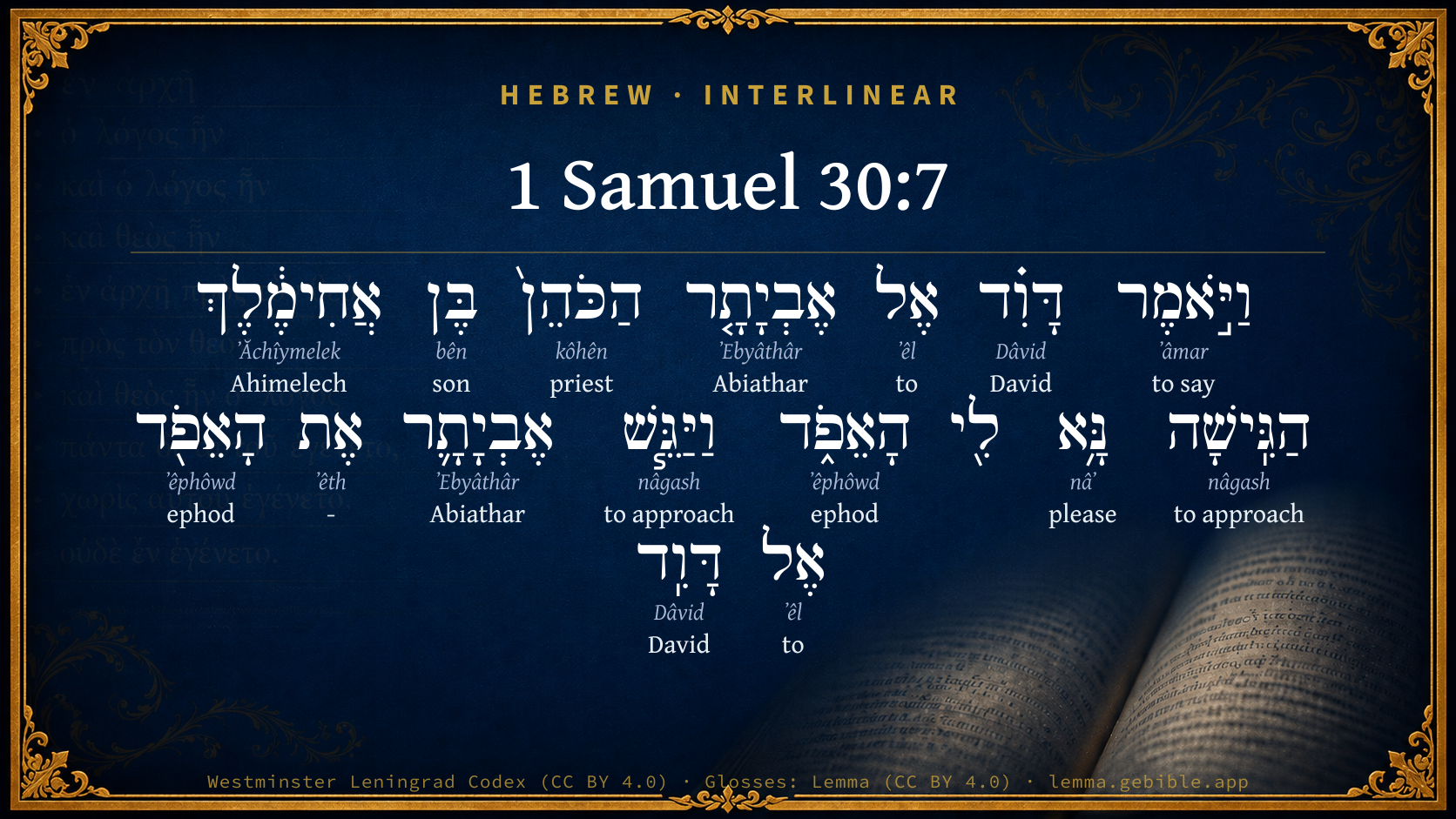
Hebrew (Westminster Leningrad Codex) 1 Samuel 30:7 appears in the Hebrew Old Testament. The text above is from the Westminster Leningrad Codex. Each word links to its Strong’s number, a concise gloss, and parsing drawn from the Open Scriptures Hebrew Bible morphology. Click any word for its full Brown-Driver-Briggs (BDB) entry.
Download image
Cite this verse

1 Samuel 30:7 (World English Bible). Public Domain. Lemma interlinear Bible study tool, https://lemma.gebible.app/v/1-samuel/30/7.

Show BibTeX & RIS
BibTeX
RIS
English Translation
David said to Abiathar the priest, the son of Ahimelech, Please bring me here the ephod. Abiathar brought there the ephod to David.
World English Bible · Public Domain
Download a study sheet

One document with this verse’s original text, its word-by-word gloss line, the meaning frame, cross-references with their text, attributed commentary, and full source and license credits — printable, and it pastes into notes with its structure intact.

This verse Autodidact and up

Study sheet (.html) Plain text (.txt)

A passage Seminary Student

Up to 50 verses in one chapter. A passage sheet keeps up to 6 commentary sources and 12 cross-references per verse, in the order this page ranks them, and says so on the sheet whenever that leaves anything out. Ask for a single verse and you get the Autodidact verse sheet above.

Everything on this page stays free to read, with no account — the sheet is a download of what is already on screen, not access to it.

Want to remove ads? Support Godless Engineer
Compare translations 3

The same verse in 3 English versions, stacked beneath the original-language interlinear above. Click any original word for its lexicon entry.

Each is an independent rendering of the whole verse — the interlinear is not word-aligned to these translations.

Highlighted words mark where these versions differ — a whole-verse word diff, not a word-by-word alignment.

  • World English Bible Public Domain
    David said to Abiathar the priest, the son of Ahimelech, Please bring me here the ephod. Abiathar brought there the ephod to David.
  • King James Version Public Domain
    And David said to Abiathar the priest, Ahimelech's son, I pray thee, bring me hither the ephod. And Abiathar brought thither the ephod to David.
  • unfoldingWord Literal Text CC BY-SA 4.0
    And David said to Abiathar the priest, the son of Ahimelech, “Please bring the ephod near to me.” So Abiathar brought the ephod near to David.

unfoldingWord Literal Text — © unfoldingWord, licensed CC BY-SA 4.0. Word-aligned USFM3 via Door43 (git.door43.org/unfoldingWord/en_ult).

Versions to compare (up to 4)

3 of 4 selected

Show all 18 translations

Every available English version of this verse, each an independent rendering of the whole verse.

  • World English Bible Public Domain
    David said to Abiathar the priest, the son of Ahimelech, Please bring me here the ephod. Abiathar brought there the ephod to David.
  • Berean Standard Bible Public Domain
    Then David said to Abiathar the priest, the son of Ahimelech, “Bring me the ephod.” So Abiathar brought it to him,
  • Majority Standard Bible Public Domain
    Then David said to Abiathar the priest, the son of Ahimelech, “Bring me the ephod.” So Abiathar brought it to him,
  • King James Version Public Domain
    And David said to Abiathar the priest, Ahimelech's son, I pray thee, bring me hither the ephod. And Abiathar brought thither the ephod to David.
  • American Standard Version (1901) Public Domain
    And David said to Abiathar the priest, the son of Ahimelech, I pray thee, bring me hither the ephod. And Abiathar brought thither the ephod to David.
  • Revised Version (1885) Public Domain
    And David said to Abiathar the priest, the son of Ahimelech, I pray thee, bring me hither the ephod. And Abiathar brought thither the ephod to David.
  • Geneva Bible (1599) Public Domain
    And Dauid saide to Abiathar the Priest Ahimelechs sonne, I pray thee, bring me the Ephod. And Abiathar brought the Ephod to Dauid.
  • Douay-Rheims (1899) Public Domain
    And he said to Abiathar the priest the son of Achimelech: Bring me hither the ephod. And Abiathar brought the ephod to David.
  • Young's Literal Translation Public Domain
    And David saith unto Abiathar the priest, son of Ahimelech, `Bring nigh, I pray thee, to me the ephod;' and Abiathar bringeth nigh the ephod unto David,
  • Literal Standard Version CC BY-SA 4.0
    And David says to Abiathar the priest, son of Ahimelech, “Please bring the ephod near to me”; and Abiathar brings the ephod near to David,
  • Unlocked Literal Bible CC BY-SA 4.0
    David said to Abiathar son of Ahimelech, the priest, “I beg you, bring the ephod here for me.” Abiathar brought the ephod to David.
  • unfoldingWord Literal Text CC BY-SA 4.0
    And David said to Abiathar the priest, the son of Ahimelech, “Please bring the ephod near to me.” So Abiathar brought the ephod near to David.
  • Darby Bible Public Domain
    And David said to Abiathar the priest, Ahimelech's son, Bring near to me, I pray thee, the ephod. And Abiathar brought the ephod near to David.
  • World Messianic Bible Public Domain
    David said to Abiathar the priest, the son of Ahimelech, “Please bring the ephod here to me.” Abiathar brought the ephod to David.
  • Webster's Bible Public Domain
    And David said to Abiathar the priest, Ahimelech's son, I pray thee bring me hither the ephod. And Abiathar brought thither the ephod to David.
  • Free Bible Version CC BY-SA 4.0
    David went to Abiathar the priest, the son of Ahimelech, and said, “Bring me the ephod.” Abiathar brought it to him.
  • Bible in Basic English Public Domain
    And David said to Abiathar the priest, the son of Ahimelech, Come here to me with the ephod. And Abiathar took the ephod to David.
  • JPS Tanakh (1917) Public Domain
    And David said to Abiathar the priest, the son of Ahimelech: 'I pray thee, bring me hither the ephod.' And Abiathar brought thither the ephod to David.

Literal Standard Version (2020), Covenant Press — licensed CC BY-SA 4.0. Text via the HelloAO Bible API (eBible.org). Unlocked Literal Bible (unfoldingWord) — licensed CC BY-SA 4.0. Text via the HelloAO Bible API (eBible.org). unfoldingWord Literal Text — © unfoldingWord, licensed CC BY-SA 4.0. Word-aligned USFM3 via Door43 (git.door43.org/unfoldingWord/en_ult). Free Bible Version, Dr. Jonathan Gallagher — licensed CC BY-SA 4.0. Text via the HelloAO Bible API (eBible.org).

Word by word

More ways to search: Search by grammar → Find every occurrence → Compare this word →

Practice this passage: Drill this verse → Learn its vocabulary →

אֲחִימֶ֔לֶךְ
ʼĂchîymelek
H288
“Ahimelech”
Noun, Proper
Part of Speech
Noun
Type
Proper
Full BDB Definition

Origin: from H251 and H4428

TWOT: None

Ahimelech = "my brother is king" or " brother of Melek" - a priest murdered by Doeg at Saul's command, for supposedly assisting David - a Hittite warrior under David
  1. וַיֹּ֣אמֶר ʼâmar H559 “and · to say” Conjunction + Verb, Qal, Sequential Imperfect, 3rd Person, Masculine, Singular
  2. דָּוִ֗ד Dâvid H1732 “David” Noun, Proper
  3. אֶל ʼêl H413 “to” Preposition
  4. אֶבְיָתָ֤ר ʼEbyâthâr H54 “Abiathar” Noun, Proper
  5. הַכֹּהֵן֙ kôhên H3548 “the · priest” Particle, Definite Article + Noun, Common, Masculine, Singular, Absolute
  6. בֶּן bên H1121 “son of” Noun, Common, Masculine, Singular, Construct
  7. הַגִּֽישָׁה nâgash H5066 “approach” Verb, Hiphil, Imperative, 2nd Person, Masculine, Singular + Suffix, h
  8. נָּ֥א nâʼ H4994 “please” Particle, Interjection
  9. הָאֵפֹ֑ד ʼêphôwd H646 “the · ephod” Particle, Definite Article + Noun, Common, Masculine, Singular, Absolute
  10. וַיַּגֵּ֧שׁ nâgash H5066 “and · to approach” Conjunction + Verb, Hiphil, Sequential Imperfect, 3rd Person, Masculine, Singular
  11. אֶבְיָתָ֛ר ʼEbyâthâr H54 “Abiathar” Noun, Proper
  12. אֶת ʼêth H853 “-” Particle, Direct Object
  13. הָאֵפֹ֖ד ʼêphôwd H646 “the · ephod” Particle, Definite Article + Noun, Common, Masculine, Singular, Absolute
  14. אֶל ʼêl H413 “to” Preposition
  15. דָּוִֽד Dâvid H1732 “David” Noun, Proper

About this verse

These counts appear in no published source. They are computed here, from the morphology-tagged text and Lemma’s own curated glosses. What Lemma adds →

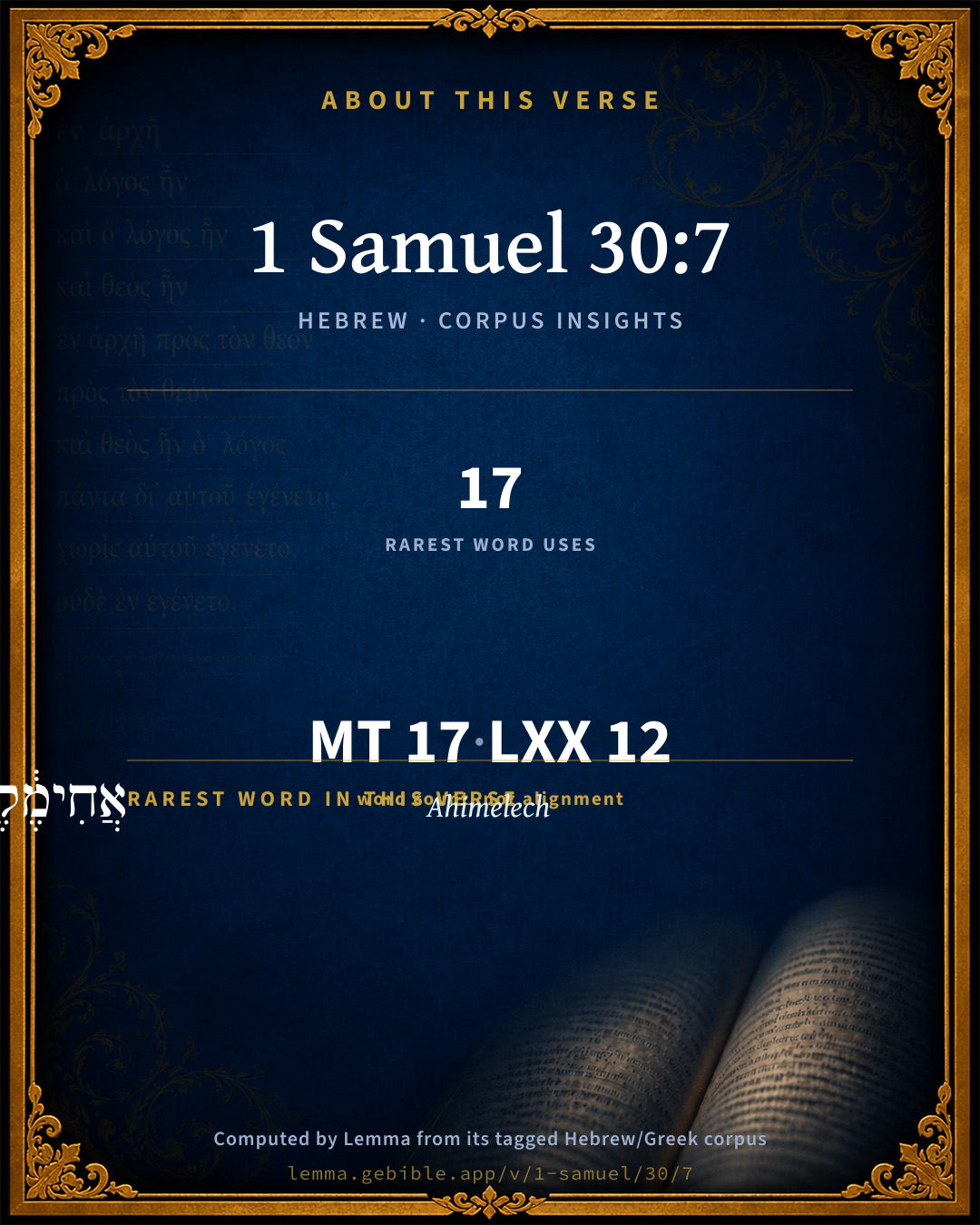
17
words
11
distinct lemmas
Historical
section

Notable vocabulary

The rarest word here is אֲחִימֶ֔לֶךְ Ahimelech H288 — appearing just 17 times in the whole Hebrew Bible.

Shared distinctive vocabulary

אֲחִימֶ֔לֶךְ Ahimelech H288 occurs in 16 verses of the Hebrew Bible. Also found in:

Grammatical profile

  • 3 verbs
  • 9 nouns
  • 3 prepositions
  • 2 particles

Verb forms

  • וַיֹּ֣אמֶר Qal · Sequential Imperfect
  • הַגִּֽישָׁה Hiphil · Imperative
  • וַיַּגֵּ֧שׁ Hiphil · Sequential Imperfect

Repetition

Words recur within this verse — often emphatic in Hebrew:

  • דָּוִ֗ד David H1732 ×2
  • אֶבְיָתָ֤ר Abiathar H54 ×2
  • הַגִּֽישָׁה to approach H5066 ×2
  • הָאֵפֹ֑ד ephod H646 ×2
  • אֶל to H413 ×2

Hebrew & Septuagint length

In English translation the verse runs 23 words from the Hebrew and 15 from the Septuagint (LXX English) — the Septuagint runs noticeably shorter here. See the side-by-side →

A rough comparison of the two English renderings, which tokenize alike — not a word-level alignment.

Word counts can differ between the Hebrew and the Greek without any difference in meaning — e.g. the Hebrew direct-object marker אֵת has no separate Greek word, and Greek often adds the article ὁ.

In the original languages it is 17 Hebrew tokens and 12 Greek tokens — but the two are counted differently (Hebrew bundles its prefixes and suffixes into one token; the Greek is in lemma form), so that isn’t a like-for-like length.

Cross-references

4

Topical passages linked to 1 Samuel 30:7 in the Treasury of Scripture Knowledge — connected by theme and wording, ordered by reader-vote popularity; previews shown in the World English Bible.

  • 1 Samuel 22:20–21 One of the sons of Ahimelech, the son of Ahitub, named Abiathar, escaped, and fled after David.
  • 1 Kings 2:26 To Abiathar the priest said the king, Get you to Anathoth, to your own fields; for you are worthy of death: but I will not at this time put you to death, because you bear the ark of the Lord Yahweh before David my father, and because you were afflicted in all in which my father was afflicted.
  • 1 Samuel 23:2–9 Therefore David inquired of Yahweh, saying, Shall I go and strike these Philistines? Yahweh said to David, Go, and strike the Philistines, and save Keilah.
  • Mark 2:26 How he entered into the house of God when Abiathar was high priest, and ate the show bread, which it is not lawful to eat except for the priests, and gave also to those who were with him?"

Cross-references courtesy of OpenBible.info (CC BY 4.0).

Hebrew and Greek witnesses Masoretic Hebrew ↔ Greek Septuagint

The same verse in the two great witnesses to the Old Testament, shown verse-for-verse.

Here the Septuagint runs noticeably shorter than the Hebrew — LXX2012 (modern English Septuagint) 15 words vs World English Bible 23. A rough length comparison of the two English translations, not a word-level alignment — read both below.

These are two independent witnesses, not word-aligned to each other, and the Septuagint is shown in lemma (dictionary) form.

Hebrew 1 Samuel 30:7 Masoretic · Westminster Leningrad Codex

וַיֹּ֣אמֶר דָּוִ֗ד אֶל אֶבְיָתָ֤ר הַכֹּהֵן֙ בֶּן אֲחִימֶ֔לֶךְ הַגִּֽישָׁה נָּ֥א לִ֖י הָאֵפֹ֑ד וַיַּגֵּ֧שׁ אֶבְיָתָ֛ר אֶת הָאֵפֹ֖ד אֶל דָּוִֽד

David said to Abiathar the priest, the son of Ahimelech, Please bring me here the ephod. Abiathar brought there the ephod to David.

World English Bible · Public Domain

Greek LXX 1 Samuel 30:7 Septuagint · lemma form

καί εἶπον δαυίδ πρός αβιαθαρ ὁ ἱερεύς υἱός αχιμελεχ προςἄγω ὁ εφουδ

And David said to Abiathar the priest the son of Achimelech, Bring near the ephod.

LXX2012 (modern English Septuagint) · Public Domain

Hebrew: Westminster Leningrad Codex (CC BY 4.0). Greek: Septuagint (public domain); English from LXX2012 (modern English Septuagint) (Public Domain). How the Septuagint differs from the Hebrew →

Targum (Aramaic paraphrase)

1

The Targum is the ancient Jewish Aramaic paraphrase of the Hebrew Scriptures — an interpretive translation, not the Hebrew text itself. Onkelos (literal) and Pseudo-Jonathan (expansive) render the Torah, and Jonathan the Prophets. Coverage is partial: where no permissively-licensed English translation exists for a verse, only the Aramaic is shown. This is verse-level text, not a word-by-word alignment to the Hebrew.

  1. Targum Jonathan Prophets (Joshua–Malachi)
    וַאֲמַר דָוִד לְאֶבְיָתָר כַּהֲנָא בַּר אֲחִימֶלֶךְ קָרִיב כְּעַן לִי אֵפוֹדָא וְקָרֵיב אֶבְיָתָר יַת אֵפוֹדָא לְדָוִד:

    (no public-domain English translation for this verse)

    Targum Jonathan — Aramaic: “Mikraot Gedolot” (public domain). English: “Sefaria Community Translation” (CC0 1.0 (public-domain dedication)); “London "Chaldee Paraphrase," 1871” (public domain). Text via Sefaria.

Commentary

Notes on 1 Samuel 30:7 from classic Christian and Jewish commentators (each source and its license shown beneath its notes). The classic Christian expositions comment on the surrounding passage and are grouped to its opening verse, so a note may address several verses; the Jewish commentaries on the Tanakh (Rashi and others) are per-verse, so they appear only where the commentator wrote on this verse.

Lemma curates 59 commentaries, every one of them public domain or Creative Commons licensed, each selected and text-cleaned for this edition rather than reprinted as found. About our sources →

Trapp's Complete Commentary

John Trapp

1Sa 30:7 And David said to Abiathar the priest, Ahimelech’s son, I pray thee, bring me hither the ephod. And Abiathar brought thither the ephod to David.

Ver. 7. I pray thee, bring me hither the ephod.] Some other times, when he should, he called not for it; but proceeded only upon his own head. Now being in this great distress, though very desirous to pursue his enemies, and recover his wives, he would not go without God’s approbation and direction. We are usually best when at worst.

John Trapp, A Commentary or Exposition upon All the Books of the Old and New Testament (1647–1656) — public domain. Text from a community e-Sword module.

Joseph Benson's Commentary

1Sa 30:7. Bring hither the ephod — And put it on thyself, that thou mayest inquire of God according to his ordinance. David was sensible of his former error, in neglecting to ask counsel of God by the ephod, when he came to Achish, and when he went out with Achish to the battle; and his necessity now brings him to his duty, and his duty meets with success.

Joseph Benson's Commentary on the Old and New Testaments (1811–1818) — public domain. Text from a community e-Sword module.

Tyndale Open Study Notes

Tyndale Open Resources

30:7 the ephod: See study notes on 2:18; 23:6.

Tyndale Open Study Notes — © Tyndale Open Resources, licensed CC BY-SA 4.0. Text via the HelloAO Bible API.

Matthew Henry's Commentary

Solomon observes that the righteous is delivered out of trouble and the wicked cometh in his stead, that the just falleth seven times a-day and riseth again; so it was with David. Many were his troubles, but the Lord delivered him out of them all, and particularly out of this of which we have here an account.

I. He enquired of the Lord both concerning his duty - Shall I pursue after this troop? and concerning the event - Shall I overtake them? Sa1 30:8. It was a great advantage to David that he had the high priest with him and the breast-plate of judgment, which, as a public person, he might consult in all his affairs, Num 27:21. We cannot think that he left Abiathar and the ephod at Ziklag, for then he and it would have been carried away by the Amalekites, unless we may suppose them hidden by a special providence, that they might be ready for David to consult at his return. If we conclude that David had his priest and ephod with him in the camp of the Philistines, it was certainly a great neglect in him that he did not enquire of the Lord by them concerning his engagement to Achish. Perhaps he was ashamed to own his religion so far among the uncircumcised; but now he begins to apprehend that this trouble is brought upon him to correct him for that oversight, and therefore the first thing he does is to call for the ephod. It is well if we get this good by our afflictions, to be reminded by them of neglected duties, and particularly to be quickened by them to enquire of the Lord. See Ch1 15:13. David had no room to doubt but that his war against these Amalekites was just, and he had an inclination strong enough to set upon them when it was for the recovery of that which was dearest to him in this world; and yet he would not go about it without asking counsel of God, thereby owning his dependence upon God and submission to him. If we thus, in all our ways, acknowledge God, we may expect that he will direct our steps, as he did David's here, answering him above what he asked, with an assurance that he should recover all.

II. He went himself in person, and took with him all the force he had, in pursuit of the Amalekites, Sa1 30:9, Sa1 30:10. See how quickly, how easily, how effectually the mutiny among the soldiers was quelled by his patience and faith. When they spoke of stoning him (Sa1 30:6), if he had spoken of hanging them, or had ordered that the ringleaders of the faction should immediately have their heads struck off, though it would have been just, yet it might have been of pernicious consequence to his interest in this critical juncture; and, while he and his men were contending, the Amalekites would have clearly carried off their spoil. But when he, as a deaf man, heard not, smothered his resentments, and encouraged himself in the Lord his God, the tumult of the people was stilled by his gentleness and the power of God on their hearts; and, being thus mildly treated, they are now as ready to follow his foot as they were but a little before to fly in his face. Meekness is the security of any government. All his men were willing to go along with him in pursuit of the Amalekites, and he needed them all; but he was forced to drop a third part of them by the way; 200 out of 600 were so fatigued with their long march, and so sunk under the load of their grief, that they could not pass the brook Besor, but staid behind there. This was, 1. A great trial of David's faith, whether he could go on, in a dependence upon the word of God, when so many of his men failed him. When we are disappointed and discouraged in our expectations from second causes, then to go on with cheerfulness, confiding in the divine power, this is giving glory to God, by believing against hope, in hope. 2. A great instance of David's tenderness to his men, that he would by no means urge them beyond their strength, though the case itself was so very urgent. The Son of David thus considers the frame of his followers, who are not all alike strong and vigorous in their spiritual pursuits and conflicts; but, where we are weak, there he is kind; nay, more there he is strong, Co2 12:9, Co2 12:10.

III. Providence threw one in their way that gave them intelligence of the enemy's motions, and guided theirs; a poor Egyptian lad, scarcely alive, is made instrumental of a great deal of good to David. God chooses the foolish things of the world, with them to confound the wise. Observe, 1. His master's cruelty to him. He had got out of him all the service he could, and when the lad fell sick, probably being over-toiled with his work, he barbarously left him to perish in the field, when he was in no such haste but he might have put him into some of the carriages, and brought him home, or, at least, have left him wherewithal to support himself. That master has the spirit of an Amalekite, not of an Israelite, that can thus use a servant worse than one would use a beast. The tender mercies of the wicked are cruel. This Amalekite thought he should now have servants enough of the Israelite-captives, and therefore cared not what became of his Egyptian slave, but could willingly let him die in a ditch for want of necessaries, while he himself was eating and drinking, Sa1 30:16. Justly did Providence make this poor servant, that was thus basely abused, instrumental towards the destruction of a whole army of Amalekites and his master among the rest; for God hears the cry of oppressed servants. 2. David's compassion to him. Though he had reason to think he was one of those that had helped to destroy Ziklag, yet, finding him in distress, he generously relieved him, not only with bread and water (Sa1 30:11), but with figs and raisins, Sa1 30:12. Though the Israelites were in haste, and had no great plenty for themselves, yet they would not forbear to deliver one that was drawn unto death, nor say, Behold, we knew it not, Pro 24:11, Pro 24:12. Those are unworthy the name of Israelites who shut up the bowels of their compassion from persons in distress. It was also prudently done to relieve this Egyptian; for, though despicable, he was capable of doing them service: so it proved, though they were not certain of this when they relieved him. It is a good reason why we should neither do an injury nor deny a kindness to any man that we know not but, some time or other, it may be in his power to return either a kindness or an injury. 3. The intelligence David received from this poor Egyptian when he had come to himself. He gave him an account concerning his party. (1.) What they had done (Sa1 30:14): We made an invasion, etc. The countries which David had pretended to Achish to have made an incursion upon (Sa1 27:10) they really had invaded and laid waste. What was then false now proved too true. (2.) Whither they had gone, Sa1 30:15. This he promised David to inform him of upon condition he would spare his life and protect him from his master, who, if he could hear of him again (he thought), would add cruelty to cruelty. Such an opinion this poor Egyptian had of the obligation of an oath that he desired no greater security for his life than this: Swear unto me by God, not by the gods of Egypt or Amalek, but by the one supreme God.

IV. David, being directed to the place where they lay, securely celebrating their triumphs, fell upon them, and, as he used to pray, saw his desire upon his enemies. 1. The spoilers were cut off. The Amalekites, finding the booty was rich, and having got with it (as they thought) out of the reach of danger, were making themselves very merry with it, Sa1 30:16. All thoughts of war were laid aside, nor were they in any haste to house their prey, but spread themselves abroad on the earth in the most careless manner that could be, and there they were found eating, and drinking, and dancing, probably in honour of their idol-gods, to whom they gave the praise of their success. In this posture David surprised them, which made the conquest of them, and the blow he gave them, the more easy to him and the more dismal to them. Then are sinners nearest to ruin when they cry, Peace and safety, and put the evil day far from them. Nor does any thing give our spiritual enemies more advantage against us than sensuality and the indulgence of the flesh. Eating, and drinking, and dancing, have been the soft and pleasant way in which many have gone down to the congregation of the dead. Finding them thus off their guard, and from their arms (many of them, it may be, drunk, and unable to make any resistance), he put them all to the sword, and only 400 escaped, Sa1 30:17. Thus is the triumphing of the wicked short, and wrath comes on them, as on Belshazzar, when they are in the midst of their jollity. 2. The spoil was recovered and brought off, and nothing was lost, but a great deal gotten. (1.) They retrieved all their own (Sa1 30:18, Sa1 30:19): David rescued his two wives; this is mentioned particularly, because this pleased David more than all the rest of his achievements. Providence had so ordered it that the Amalekites carefully preserved all that they had taken, concluding that they kept it for themselves, though really they preserved it for the right owners, so that there was nothing lacking to them; so it proved, when they concluded all was gone: so much better is God oftentimes to us than our own fears. Our Lord Jesus was indeed the Son of David and the Son of Abraham, in this resembling them both (Abraham, Gen 14:16, and David here), that he took the prey from the mighty, and led captivity captive. But this was not all. (2.) They took all that belonged to the Amalekites besides (Sa1 30:20): Flocks and herds, either such as were taken from the Philistines and others, which David had the disposal of by the law of war; or perhaps he made a sally into the enemy's country, and fetched off these flocks and herds thence, as interest for his own. This drove was put in the van of the triumph, with this proclamation, "This is David's spoil. This we may thank him for." Those who lately spoke of stoning him now caressed him and cried him up, because they got by him more than they had then lost. Thus are the world and its sentiments governed by interest.

Matthew Henry's Commentary on the Whole Bible (1708–1710) — public domain (CC PDM 1.0). Text via the HelloAO Bible API.

Adam Clarke's Commentary

Verse 7. Bring me hither the ephod.] It seems as if David had put on the ephod, and inquired of the Lord for himself; but it is more likely that he caused Abiathar to do it.

Adam Clarke's Commentary on the Bible (1810–1826) — public domain. Text from a community e-Sword/MySword module.

Ellicott's Commentary for English Readers

(7) Abiathar.—Abiathar had doubtless been with David, and he had joined him at Keilah. Through all his wanderings we hear, however, nothing of prayer and of consultation of the Urim. As regards the unfortunate Philistine sojourn, David seems to have determined upon that step entirely of himself; distrustful and despairing, he had fled the country, and taken refuge with the enemies of his people. One unbroken series of sin and calamity was the result ha sees of his fatal error.

And Abiathar brought thither the ephod.—Modern commentators, as a rule, prefer to disbelieve in any response coming through the medium of the Urim in the ephod. They either pass over the whole transaction in silence, or assume that some Divine inspiration came to the high priest when vested with the sacred garment. The plain meaning, however, of the frequent references tells us in some way or other the Divine will was made known through the agency of the mysterious Urim and Thummim. See, for instance, in the case of Saul, where definitely it is stated that the Lord answered him not “by Urim” (1Sa_28:6), where this peculiar Divine response is carefully distinguished from the manifestation of the will of God in a dream or a vision, or through the Divine instrumentality of the prophet or seer. The ancient Hebrews had no hesitation in attributing to the sacred precious stones an occasional special power of declaring the oracles of God. The Talmudical traditions are clear and decisive here. Now, without attaching anything like an implicit credence to these most ancient Hebrew traditions—many of them fanciful and wild, many of them written in a cryptograph, or secret cypher, to which Christians in most cases do not possess the key—it does seem in the highest degree arbitrary to reject the ancient traditional belief of the Hebrew race contained in the Talmud with respect to this most mysterious ephod and its sacred gems, and to adopt another interpretation, which fits in very lamely with the plain text. The whole question respecting the traditions of the Urim and Thummim is discussed at some length in the short Excursus M on the Urini, at the end of this Commentary on the First Book of Samuel.

A Bible Commentary for English Readers, edited by Charles John Ellicott (1878–1897) — public domain. Text from a community e-Sword module.

The Cambridge Bible for Schools and Colleges

gen. ed. J. J. S. Perowne

7–20. The pursuit

7. bring me hither the ephod] He desired to consult God by means of the Urim and Thummim, as before at Keilah (1Sa_23:9).

The Cambridge Bible for Schools and Colleges (gen. ed. J. J. S. Perowne; Cambridge University Press, 1878–1918) — public domain. Text from a community e-Sword module.

John Gill's Exposition

And David said to Abiathar the priest, Ahimelech's son,.... The son of Ahimelech, who was slain at Nob by the order of Saul, Sa1 22:19; and Abiathar his son, who fled to David with the ephod, on the death of his father, Sa1 22:20, was now high priest in his room; and who it seems was with David when he went with Achish, and returned with him; for had he been left at Ziklag, he and his ephod, in all probability, had been carried off by the Amalekites, unless we can suppose him under the protection of a special providence: it is much David had not inquired of the Lord by him about his going with Achish; perhaps the present disaster brought to mind that neglect, and made him the more diligent now:

I pray thee, bring me hither the ephod; not to put it on himself, but that the high priest might put it on, and inquire by it before him of the Lord:

and Abiathar brought thither the ephod to David; for the sake of David, that inquiry might be made before him of the Lord by Urim and Thummim.

John Gill's Exposition of the Whole Bible (1746–1763) — public domain (CC PDM 1.0). Text via the HelloAO Bible API.

Albert Barnes' Notes on the Bible

Abiathar had continued to abide with David, ever since he joined him at Keilah 1Sa 23:6. On inquiry of the Lord by the ephod, see Jdg 1:1 note. The answers were evidently given by the Word of the Lord in the mouth of the high priest (compare Joh 11:51).

Albert Barnes' Notes on the Bible (1834–1885) — public domain. Text from a community e-Sword/MySword module.

Haydock's Catholic Bible Commentary

To David. Some think that David put on the ephod; but this was the function of the high priest, who, according to Grotius, turned towards David, that he might see the brightness of the precious stones. See Exodus xxviii. 30. By means of the priest David was enlightened. (Worthington)

George Leo Haydock (1774–1849), Haydock's Catholic Family Bible and Commentary, 1859 edition — public domain. Excludes Psalms (Douay-Rheims chapter numbering differs from Protestant) and Deuterocanonical books (Catholic canon only).

Matthew Poole's English Annotations

Bring me hither the ephod, and put it upon thyself, that thou mayst inquire of God according to his ordinance, Num 27:21. See above, 1Sa 23:9. David was sensible of his former error in neglecting to ask counsel of God by the ephod when he came to Achish, and when he went out with Achish to the battle; and his necessity now brings him to his duty, and his duty meets with success.

Matthew Poole's English Annotations on the Holy Bible (1683–1685) — public domain. Text from a community e-Sword/MySword module.

The Pulpit Commentary

DAVID"S PURSUIT OF THE AMALEKITES (vers. 7-16).

Vers. 7, 8. Looking only to Jehovah for aid, David sends for Abiathar, who seems to have remained constantly with him, and bids him consult Jehovah by the Urim. In strong contrast to the silence which surrounds, (1Sa_28:6) the answer is most encouraging. Literally it is, "Pursue; for overtaking thou shalt overtake, and delivering thou shalt deliver."

The Pulpit Commentary (1880–1919), ed. H.D.M. Spence-Jones & Joseph S. Exell — public domain. Text from a community e-Sword module.

John Wesley's Explanatory Notes

The ephod - And put it upon thyself, that thou mayst inquire of God according to his ordinance, David was sensible of his former error in neglecting to ask counsel of God by the ephod, when he came to Achish, and when he went out with Achish to the Battle; and his necessity now brings him to his duty, and his duty meets with success.

John Wesley, Explanatory Notes Upon the Whole Bible (1754–1765) — public domain. Text via the GEBible commentary corpus.

unfoldingWord translationNotes

Door43 World Missions Community

General Information:

David seeks Yahweh's direction in dealing with the raid on his people.

David prayed to Yahweh for direction

The abstract noun "direction" can be translated as a clause. AT: "David prayed that Yahweh would tell David what David should do" (See: Abstract Nouns)

pursue

chase and try to catch

translationWords

David

Abiathar

priest

ephod

pray

Yahweh

unfoldingWord translationNotes — © Distant Shores Media and the Door43 World Missions Community, licensed CC BY-SA 4.0. Source: git.door43.org/Door43/en_tn.

Lesson kit

Teaching starters — assembled from the data on this page, not authored interpretation. Every prompt links to the verse data it draws on. Edit before teaching.

1 Samuel, in the Historical, opens this verse with 17 words (11 distinct Hebrew lemmas). Its most distinctive word is ʼĂchîymelek (“Ahimelech”). The Greek Septuagint runs shorter here. A historical commentator’s framing appears above. Read the whole chapter for the surrounding context.

Discussion questions

  1. The word ʼĂchîymelek carries the sense “Ahimelech.” How does it shape the verse?
  2. 1 Samuel 21:1 shares the word «Ahimelech» with this verse. How do the two illuminate each other?
  3. “David” occurs 2× in this one verse. What is the effect of the repetition?
  4. Compared with the Hebrew, the Septuagint runs shorter here. What questions does that raise?
  5. The translations on this page render this verse differently — a whole-verse word diff, not a word-by-word alignment. What might account for the different wordings?
  6. The verb «וַיֹּ֣אמֶר» is Qal Sequential Imperfect. How does its form color the action?
  7. Reading how Trapp's Complete Commentary and Joseph Benson's Commentary read this verse, where do the two commentators agree and where do they part?

Things to notice

Reading settings

Reading text

Shown beneath each verse's original-language words.

Old Testament
Old Testament edition

Read the OT as the Masoretic Hebrew (MT) or the Greek Septuagint (LXX).

English shown for the Greek Septuagint (in the Hebrew ↔ Greek comparison).

Comparing translations? Open the Compare panel on any verse page to stack up to four side by side.