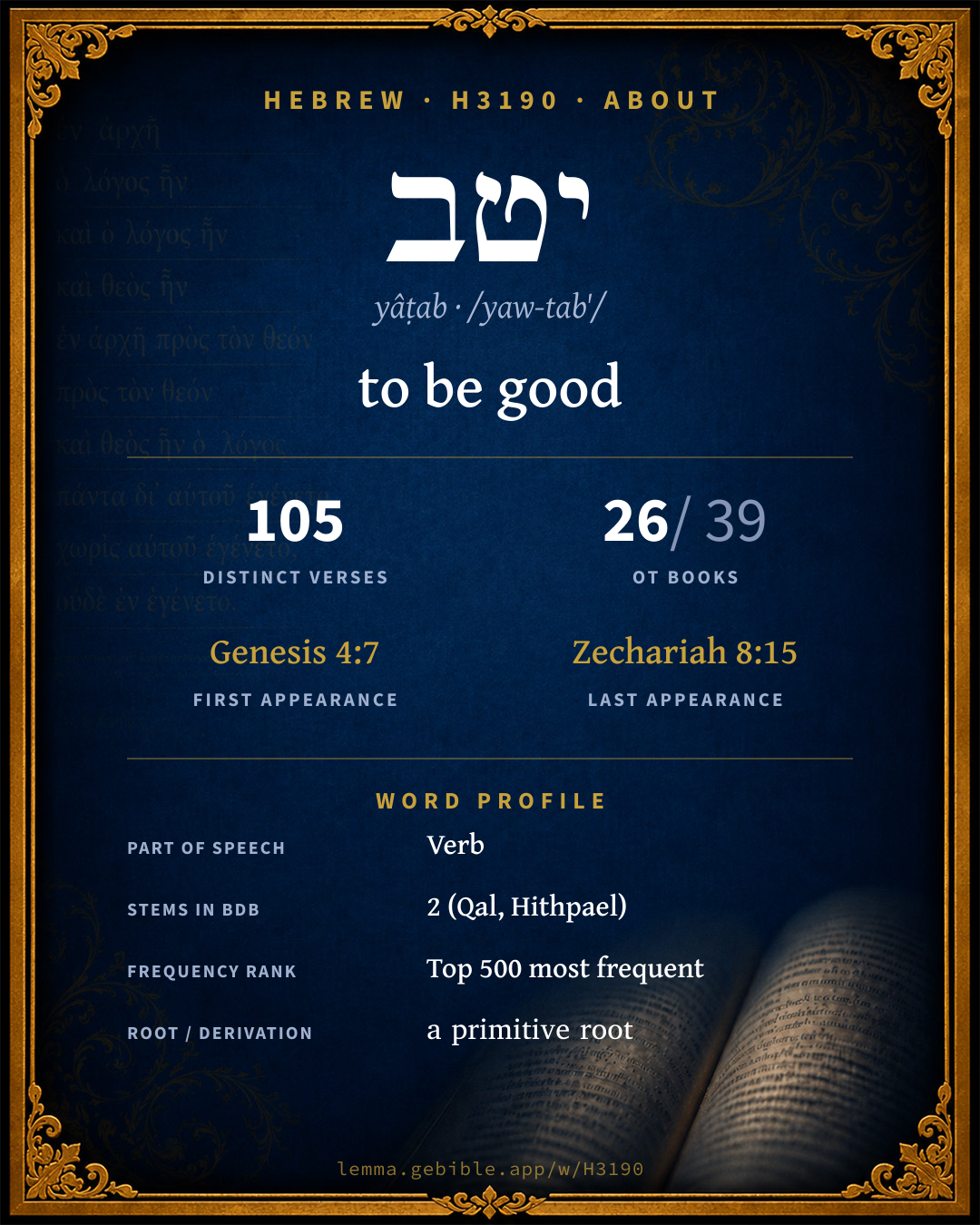
יָטַב
to be good
also: be pleasing, be well, be glad fuller range ↓
Full lexicon entry — Brown-Driver-Briggs (BDB)
From Brown-Driver-Briggs (BDB)
Where this word appears
See every Hiphil verb in the Hebrew Bible →
Grammar key — what these labels mean
Part of speech
- Verb
- An action or state-of-being word.
Stem
- Qal
- The basic, simple active stem — the plain form of the verb (“he wrote”). Here: ‘be glad’
- Hiphil
- The causative active stem (“he caused / brought about”).
Form
- Imperfect
- An incomplete, ongoing, or future action (“he will / would write”).
- Sequential Imperfect
- An imperfect with prefixed waw — the standard past-narrative form (waw-consecutive imperfect).
- Infinitive Absolute
- An unbound verbal noun, often intensifying or standing in for a finite verb.
- Infinitive Construct
- A bound verbal noun, frequently with prepositions (“to write / in writing”).
- Perfect
- A completed action or state — Hebrew marks aspect (completeness) more than strict tense (“he wrote”).
- Imperative
- A direct command (“write!”).
- Sequential Perfect
- A perfect with prefixed waw continuing a preceding imperfect or command (waw-consecutive perfect).
- Participle Active
- A verbal adjective expressing ongoing or characteristic action (“writing / one who writes”).
- Cohortative
- A first-person volitional form expressing wish or resolve (“let me / let us write”).
- Jussive
- A third- or second-person volitional form expressing wish or command (“let him write”).
State
- Construct
- A noun bound to a following noun in a possessive / “of” relationship (the construct chain).
- Absolute
- The independent form of a noun, not bound to a following word.
Person
- 3rd Person
- The one spoken about (“he / she / it / they”).
- 2nd Person
- The one addressed (“you”).
- 1st Person
- The speaker (“I / we”).
Gender
- Masculine
- Grammatically masculine.
- Common
- Either gender — not distinguished for this form.
- Feminine
- Grammatically feminine.
Number
- Singular
- One.
- Plural
- More than one (in Hebrew, generally three or more).
Grammatical forms 31 distinct
- Verb, Qal, Imperfect, 3rd Person, Masculine, Singular 23 times (21%)
- Verb, Qal, Sequential Imperfect, 3rd Person, Masculine, Singular 15 times (13%)
- Verb, Hiphil, Infinitive Absolute 13 times (12%)
- Verb, Hiphil, Infinitive Construct 11 times (10%)
- Verb, Hiphil, Imperfect, 3rd Person, Masculine, Singular 8 times (7%)
- Verb, Hiphil, Imperative, 2nd Person, Masculine, Plural 5 times (4%)
- Verb, Hiphil, Imperfect, 2nd Person, Masculine, Singular 3 times (3%)
- Verb, Hiphil, Perfect, 3rd Person, Common, Plural 3 times (3%)
+23 more forms (31 occurrences)
Parsed forms decoded from the imported morphology (morphhb / Westminster Leningrad Codex — WLC text public domain, morphhb tagging CC BY 4.0), counted across 112 parsed occurrences — not distinct verses.
Every verse where H3190 appears — 105 distinct verses across 26 books. Click any verse to open its interlinear word-by-word view. Verse text shown in the World English Bible for context — . Each verse’s Hebrew form is shown with its reference; the English is not keyword-highlighted, since the data carries no word-level English alignment. Use “Compare translations” on any verse to read it across multiple English versions. This concordance covers the Hebrew Bible; Septuagint (Greek Old Testament) occurrences are not indexed here.
Genesis 9 verses
- Genesis 4:7 תֵּיטִיב֙ תֵיטִ֔יב Hiphil impf 2ms Hiphil impf 2ms If you do well, will it not be lifted up? If you don't do well, sin crouches at the door. Its desire is for you, but you are to rule over it."
- Genesis 12:13 יִֽיטַב Qal impf 3ms Please say that you are my sister, that it may be well with me for your sake, and that my soul may live because of you."
- Genesis 12:16 הֵיטִ֖יב Hiphil pf 3ms He dealt well with Abram for her sake. He had sheep, and oxen, and male donkeys, and men-servants, and maid-servants, and female donkeys, and camels.
- Genesis 32:9 וְ/אֵיטִ֥יבָה conj + Hiphil coh 1cs Jacob said, "God of my father Abraham, and God of my father Isaac, Yahweh, who said to me, 'Return to your country, and to your relatives, and I will do you good.'
- Genesis 32:12 הֵיטֵ֥ב אֵיטִ֖יב Hiphil inf.abs Hiphil impf 1cs You said, 'I will surely do you good, and make your seed as the sand of the sea, which can't be numbered because there are so many.'"
- Genesis 34:18 וַ/יִּֽיטְב֥וּ conj + Qal wimpf 3mp Their words pleased Hamor, and Shechem, Hamor's son.
- Genesis 40:14 יִ֣יטַב Qal impf 3ms But remember me when it will be well with you, and show kindness, please, to me, and make mention of me to Pharaoh, and bring me out of this house.
- Genesis 41:37 וַ/יִּיטַ֥ב conj + Qal wimpf 3ms The thing was good in the eyes of Pharaoh, and in the eyes of all his servants.
- Genesis 45:16 וַ/יִּיטַב֙ conj + Qal wimpf 3ms The report of it was heard in Pharaoh's house, saying, "Joseph's brothers have come." It pleased Pharaoh well, and his servants.
Exodus 2 verses
Leviticus 3 verses
- Leviticus 5:4 לְ/הֵיטִ֗יב prep + Hiphil inf.cs "'Or if anyone swears rashly with his lips to do evil, or to do good, whatever it is that a man might utter rashly with an oath, and it is hidden from him; when he knows of it, then he shall be guilty of one of these.
- Leviticus 10:19 הַ/יִּיטַ֖ב ptcl inter + Qal impf 3ms Aaron spoke to Moses, "Behold, this day they have offered their sin offering and their burnt offering before Yahweh; and such things as these have happend to me: and if I had eaten the sin offering today, would it have been pleasing in the sight of Yahweh?"
- Leviticus 10:20 וַ/יִּיטַ֖ב conj + Qal wimpf 3ms When Moses heard that, it was pleasing in his sight.
Numbers 2 verses
- Numbers 10:29 וְ/הֵטַ֣בְנוּ conj + Hiphil wpf 1cp Moses said to Hobab, the son of Reuel the Midianite, Moses' father-in-law, We are journeying to the place of which Yahweh said, I will give it you: come you with us, and we will do you good; for Yahweh has spoken good concerning Israel.
- Numbers 10:32 יֵיטִ֧יב וְ/הֵטַ֥בְנוּ Hiphil impf 3ms conj + Hiphil wpf 1cp It shall be, if you go with us, yes, it shall be, that whatever good Yahweh shall do to us, the same will we do to you.
Deuteronomy 19 verses
- Deuteronomy 1:23 וַ/יִּיטַ֥ב conj + Qal wimpf 3ms The thing pleased me well; and I took twelve men of you, one man for every tribe:
- Deuteronomy 4:40 יִיטַ֣ב Qal impf 3ms You shall keep his statutes, and his commandments, which I command you this day, that it may go well with you, and with your children after you, and that you may prolong your days in the land, which Yahweh your God gives you, forever.
- Deuteronomy 5:16 יִ֣יטַב Qal impf 3ms "Honor your father and your mother, as Yahweh your God commanded you; that your days may be long, and that it may go well with you, in the land which Yahweh your God gives you.
- Deuteronomy 5:28 הֵיטִ֖יבוּ Hiphil pf 3cp Yahweh heard the voice of your words, when you spoke to me; and Yahweh said to me, I have heard the voice of the words of this people, which they have spoken to you: they have well said all that they have spoken.
- Deuteronomy 5:29 יִיטַ֥ב Qal impf 3ms Oh that there were such a heart in them, that they would fear me, and keep all my commandments always, that it might be well with them, and with their children forever!
- Deuteronomy 6:3 יִיטַ֣ב Qal impf 3ms Hear therefore, Israel, and observe to do it; that it may be well with you, and that you may increase mightily, as Yahweh, the God of your fathers, has promised to you, in a land flowing with milk and honey.
- Deuteronomy 6:18 יִ֣יטַב Qal impf 3ms You shall do that which is right and good in the sight of Yahweh; that it may be well with you, and that you may go in and possess the good land which Yahweh swore to your fathers,
- Deuteronomy 8:16 לְ/הֵיטִֽבְ/ךָ֖ prep + Hiphil inf.cs + sfx pers 2ms who fed you in the wilderness with manna, which your fathers didn't know; that he might humble you, and that he might prove you, to do you good at your latter end:
- Deuteronomy 9:21 הֵיטֵ֔ב Hiphil inf.abs I took your sin, the calf which you had made, and burnt it with fire, and stamped it, grinding it very small, until it was as fine as dust: and I cast the dust of it into the brook that descended out of the mountain.
- Deuteronomy 12:25 יִיטַ֤ב Qal impf 3ms You shall not eat it; that it may go well with you, and with your children after you, when you shall do that which is right in the eyes of Yahweh.
- Deuteronomy 12:28 יִיטַ֨ב Qal impf 3ms Observe and hear all these words which I command you, that it may go well with you, and with your children after you forever, when you do that which is good and right in the eyes of Yahweh your God.
- Deuteronomy 13:14 הֵיטֵ֑ב Hiphil inf.abs then shall you inquire, and make search, and ask diligently; and, behold, if it be truth, and the thing certain, that such abomination is done in the midst of you,
- Deuteronomy 17:4 הֵיטֵ֔ב Hiphil inf.abs and it be told you, and you have heard of it, then shall you inquire diligently; and, behold, if it be true, and the thing certain, that such abomination is done in Israel,
- Deuteronomy 18:17 הֵיטִ֖יבוּ Hiphil pf 3cp Yahweh said to me, They have well said that which they have spoken.
- Deuteronomy 19:18 הֵיטֵ֑ב Hiphil inf.abs and the judges shall make diligent inquisition: and, behold, if the witness is a false witness, and has testified falsely against his brother;
- Deuteronomy 22:7 יִ֣יטַב Qal impf 3ms you shall surely let the hen go, but the young you may take to yourself; that it may be well with you, and that you may prolong your days.
- Deuteronomy 27:8 הֵיטֵֽב Hiphil inf.abs You shall write on the stones all the words of this law very plainly.
- Deuteronomy 28:63 לְ/הֵיטִ֣יב prep + Hiphil inf.cs It shall happen that as Yahweh rejoiced over you to do you good, and to multiply you, so Yahweh will rejoice over you to cause you to perish, and to destroy you; and you shall be plucked from off the land where you go in to possess it.
- Deuteronomy 30:5 וְ/הֵיטִֽבְ/ךָ֥ conj + Hiphil wpf 3ms + sfx pers 2ms and Yahweh your God will bring you into the land which your fathers possessed, and you shall possess it; and he will do you good, and multiply you above your fathers.
Joshua 3 verses
- Joshua 22:30 וַ/יִּיטַ֖ב conj + Qal wimpf 3ms When Phinehas the priest, and the princes of the congregation, even the heads of the thousands of Israel that were with him, heard the words that the children of Reuben and the children of Gad and the children of Manasseh spoke, it pleased them well.
- Joshua 22:33 וַ/יִּיטַ֣ב conj + Qal wimpf 3ms The thing pleased the children of Israel; and the children of Israel blessed God, and spoke no more of going up against them to war, to destroy the land in which the children of Reuben and the children of Gad lived.
- Joshua 24:20 הֵיטִ֥יב Hiphil pf 3ms If you forsake Yahweh, and serve foreign gods, then he will turn and do you evil, and consume you, after that he has done you good.
Judges 5 verses
- Judges 17:13 יֵיטִ֥יב Hiphil impf 3ms Then said Micah, Now know I that Yahweh will do me good, seeing I have a Levite to my priest.
- Judges 18:20 וַ/יִּיטַב֙ conj + Qal wimpf 3ms The priest's heart was glad, and he took the ephod, and the teraphim, and the engraved image, and went in the midst of the people.
- Judges 19:6 וְ/יִטַ֥ב conj + Qal impf 3ms So they sat down, and ate and drink, both of them together: and the young lady's father said to the man, Please be pleased to stay all night, and let your heart be merry.
- Judges 19:9 וְ/יִיטַ֣ב conj + Qal impf 3ms When the man rose up to depart, he, and his concubine, and his servant, his father-in-law, the young lady's father, said to him, Behold, now the day draws toward evening, please stay all night: behold, the day grows to an end, lodge here, that your heart may be merry; and tomorrow get you early on your way, that you may go home.
- Judges 19:22 מֵיטִיבִ֣ים Hiphil ptcp.act mp As they were making their hearts merry, behold, the men of the city, certain base fellows, beset the house round about, beating at the door; and they spoke to the master of the house, the old man, saying, Bring forth the man who came into your house, that we may know him.
Ruth 3 verses
- Ruth 3:1 יִֽיטַב Qal impf 3ms Naomi her mother-in-law said to her, My daughter, shall I not seek rest for you, that it may be well with you?
- Ruth 3:7 וַ/יִּיטַ֣ב conj + Qal wimpf 3ms When Boaz had eaten and drunk, and his heart was merry, he went to lie down at the end of the heap of grain: and she came softly, and uncovered his feet, and laid her down.
- Ruth 3:10 הֵיטַ֛בְתְּ Hiphil pf 2fs He said, Blessed are you by Yahweh, my daughter: you have shown more kindness in the latter end than at the beginning, inasmuch as you didn't follow young men, whether poor or rich.
1 Samuel 6 verses
- 1 Samuel 2:32 יֵיטִ֖יב Hiphil impf 3ms You shall see the affliction of [my] habitation, in all the wealth which [God] shall give Israel; and there shall not be an old man in your house forever.
- 1 Samuel 16:17 מֵיטִ֣יב Hiphil ptcp.act ms Saul said to his servants, Provide me now a man who can play well, and bring him to me.
- 1 Samuel 18:5 וַ/יִּיטַב֙ conj + Qal wimpf 3ms David went out wherever Saul sent him, [and] behaved himself wisely: and Saul set him over the men of war, and it was good in the sight of all the people, and also in the sight of Saul's servants.
- 1 Samuel 20:13 יֵיטִ֨ב Hiphil impf 3ms Yahweh do so to Jonathan, and more also, should it please my father to do you evil, if I don't disclose it to you, and send you away, that you may go in peace: and Yahweh be with you, as he has been with my father.
- 1 Samuel 24:4 יִטַ֣ב Qal impf 3ms The men of David said to him, Behold, the day of which Yahweh said to you, Behold, I will deliver your enemy into your hand, and you shall do to him as it shall seem good to you. Then David arose, and cut off the skirt of Saul's robe secretly.
- 1 Samuel 25:31 וְ/הֵיטִ֤ב conj + Hiphil wpf 3ms that this shall be no grief to you, nor offense of heart to my lord, either that you have shed blood without cause, or that my lord has avenged himself. When Yahweh shall have dealt well with my lord, then remember your handmaid.
2 Samuel 2 verses
- 2 Samuel 3:36 וַ/יִּיטַ֖ב conj + Qal wimpf 3ms All the people took notice of it, and it pleased them; as whatever the king did pleased all the people.
- 2 Samuel 18:4 יִיטַ֥ב Qal impf 3ms The king said to them, What seems you best I will do. The king stood by the gate-side, and all the people went out by hundreds and by thousands.
1 Kings 3 verses
- 1 Kings 1:47 יֵיטֵ֨ב Hiphil juss 3ms Moreover the king's servants came to bless our lord king David, saying, Your God make the name of Solomon better than your name, and make his throne greater than your throne: and the king bowed himself on the bed.
- 1 Kings 3:10 וַ/יִּיטַ֥ב conj + Qal wimpf 3ms The speech pleased the Lord, that Solomon had asked this thing.
- 1 Kings 21:7 וְ/יִטַ֣ב conj + Qal juss 3ms Jezebel his wife said to him, Do you now govern the kingdom of Israel? arise, and eat bread, and let your heart be merry: I will give you the vineyard of Naboth the Jezreelite.
2 Kings 3 verses
- 2 Kings 9:30 וַ/תֵּ֣יטֶב conj + Hiphil wimpf 3fs When Jehu was come to Jezreel, Jezebel heard of it; and she painted her eyes, and attired her head, and looked out at the window.
- 2 Kings 11:18 הֵיטֵ֔ב Hiphil inf.abs All the people of the land went to the house of Baal, and broke it down; his altars and his images broke they in pieces thoroughly, and killed Mattan the priest of Baal before the altars. The priest appointed officers over the house of Yahweh.
- 2 Kings 25:24 וְ/יִטַ֥ב conj + Qal impf 3ms Gedaliah swore to them and to their men, and said to them, Don't be afraid because of the servants of the Chaldeans: dwell in the land, and serve the king of Babylon, and it shall be well with you.
Nehemiah 2 verses
- Nehemiah 2:5 יִיטַ֥ב Qal impf 3ms I said to the king, If it please the king, and if your servant have found favor in your sight, that you would send me to Judah, to the city of my fathers' tombs, that I may build it.
- Nehemiah 2:6 וַ/יִּיטַ֤ב conj + Qal wimpf 3ms The king said to me (the queen also sitting by him), For how long shall your journey be? and when will you return? So it pleased the king to send me; and I set him a time.
Esther 4 verses
- Esther 1:21 וַ/יִּיטַב֙ conj + Qal wimpf 3ms The saying pleased the king and the princes; and the king did according to the word of Memucan:
- Esther 2:4 תִּיטַב֙ וַ/יִּיטַ֧ב Qal impf 3fs conj + Qal wimpf 3ms and let the maiden who pleases the king be queen instead of Vashti. The thing pleased the king; and he did so.
- Esther 2:9 וַ/תִּיטַ֨ב conj + Qal wimpf 3fs The maiden pleased him, and she obtained kindness of him; and he speedily gave her things for her purification, with her portions, and the seven maidens who were meet to be given her out of the king's house: and he removed her and her maidens to the best place of the house of the women.
- Esther 5:14 וַ/יִּיטַ֧ב conj + Qal wimpf 3ms Then said Zeresh his wife and all his friends to him, Let a gallows be made fifty cubits high, and in the morning speak you to the king that Mordecai may be hanged thereon: then go you in merrily with the king to the banquet. The thing pleased Haman; and he caused the gallows to be made.
Job 1 verse
Psalms 5 verses
- Psalms 33:3 הֵיטִ֥יבוּ Hiphil impv 2mp Sing to him a new song. Play skillfully with a shout of joy!
- Psalms 36:3 לְ/הֵיטִֽיב prep + Hiphil inf.cs The words of his mouth are iniquity and deceit. He has ceased to be wise and to do good.
- Psalms 49:18 תֵיטִ֥יב Hiphil impf 2ms Though while he lived he blessed his soul-- And men praise you when you do well for yourself--
- Psalms 51:18 הֵיטִ֣יבָ/ה Hiphil impv 2ms + sfx h Do well in your good pleasure to Zion. Build the walls of Jerusalem.
- Psalms 69:31 וְ/תִיטַ֣ב conj + Qal impf 3fs It will please Yahweh better than an ox, Or a bull that has horns and hoofs.
Proverbs 4 verses
- Proverbs 15:2 תֵּיטִ֣יב Hiphil impf 3fs The tongue of the wise commends knowledge, But the mouth of fools gush out folly.
- Proverbs 15:13 יֵיטִ֣ב Hiphil impf 3ms A glad heart makes a cheerful face; But an aching heart breaks the spirit.
- Proverbs 17:22 יֵיטִ֣ב Hiphil impf 3ms A cheerful heart makes good medicine, But a crushed spirit dries up the bones.
- Proverbs 30:29 מֵיטִ֣יבֵי מֵיטִ֥בֵי Hiphil ptcp.act mp cs Hiphil ptcp.act mp cs "There are three things which are stately in their march, Four which are stately in going:
Ecclesiastes 2 verses
- Ecclesiastes 7:3 יִ֥יטַב Qal impf 3ms Sorrow is better than laughter; for by the sadness of the face the heart is made good.
- Ecclesiastes 11:9 וִֽ/יטִֽיבְ/ךָ֤ conj + Hiphil juss 3ms + sfx pers 2ms Rejoice, young man, in your youth, And let your heart cheer you in the days of your youth, And walk in the ways of your heart, And in the sight of your eyes; But know that for all these things God will bring you into judgment.
Isaiah 3 verses
- Isaiah 1:17 הֵיטֵ֛ב Hiphil inf.abs Learn to do well. Seek justice, Relieve the oppressed, Judge the fatherless, Plead for the widow."
- Isaiah 23:16 הֵיטִ֤יבִי Hiphil impv 2fs Take a harp, go about the city, you prostitute that has been forgotten; make sweet melody, sing many songs, that you may be remembered.
- Isaiah 41:23 תֵּיטִ֣יבוּ Hiphil impf 2mp Declare the things that are to come hereafter, that we may know that you are gods: yes, do good, or do evil, that we may be dismayed, and see it together.
Jeremiah 16 verses
- Jeremiah 1:12 הֵיטַ֣בְתָּ Hiphil pf 2ms Then said Yahweh to me, You have well seen: for I watch over my word to perform it.
- Jeremiah 2:33 תֵּיטִ֥בִי Hiphil impf 2fs How trimmest you your way to seek love! therefore even the wicked women have you taught your ways.
- Jeremiah 4:22 וּ/לְ/הֵיטִ֖יב conj + prep + Hiphil inf.cs For my people are foolish, they don't know me; they are foolish children, and they have no understanding; they are wise to do evil, but to do good they have no knowledge.
- Jeremiah 7:3 הֵיטִ֥יבוּ Hiphil impv 2mp Thus says Yahweh of Hosts, the God of Israel, Amend your ways and your doings, and I will cause you to dwell in this place.
- Jeremiah 7:5 הֵיטֵיב֙ תֵּיטִ֔יבוּ Hiphil inf.abs Hiphil impf 2mp For if you thoroughly amend your ways and your doings; if you thoroughly execute justice between a man and his neighbor;
- Jeremiah 7:23 יִיטַ֥ב Qal impf 3ms but this thing I commanded them, saying, Listen to my voice, and I will be your God, and you shall be my people; and walk you in all the way that I command you, that it may be well with you.
- Jeremiah 10:5 הֵיטֵ֖יב Hiphil inf.abs They are like a palm tree, of turned work, and don't speak: they must be carried, because they can't go. Don't be afraid of them; for they can't do evil, neither is it in them to do good."
- Jeremiah 13:23 לְ/הֵיטִ֔יב prep + Hiphil inf.cs Can the Ethiopian change his skin, or the leopard his spots? then may you also do good, who are accustomed to do evil.
- Jeremiah 18:10 לְ/הֵיטִ֥יב prep + Hiphil inf.cs if they do that which is evil in my sight, that they not obey my voice, then I will repent of the good, with which I said I would benefit them.
- Jeremiah 18:11 וְ/הֵיטִ֥יבוּ conj + Hiphil impv 2mp Now therefore, speak to the men of Judah, and to the inhabitants of Jerusalem, saying, Thus says Yahweh: Behold, I frame evil against you, and devise a device against you: return you now everyone from his evil way, and amend your ways and your doings.
- Jeremiah 26:13 הֵיטִ֤יבוּ Hiphil impv 2mp Now therefore amend your ways and your doings, and obey the voice of Yahweh your God; and Yahweh will repent him of the evil that he has pronounced against you.
- Jeremiah 32:40 לְ/הֵיטִיבִ֖/י prep + Hiphil inf.cs + sfx pers 1cs and I will make an everlasting covenant with them, that I will not turn away from following them, to do them good; and I will put my fear in their hearts, that they may not depart from me.
- Jeremiah 35:15 וְ/הֵיטִ֣יבוּ conj + Hiphil impv 2mp I have sent also to you all my servants the prophets, rising up early and sending them, saying, Return you now every man from his evil way, and amend your doings, and don't go after other gods to serve them, and you shall dwell in the land which I have given to you and to your fathers: but you have not inclined your ear, nor listened to me.
- Jeremiah 38:20 וְ/יִ֥יטַב conj + Qal impf 3ms But Jeremiah said, They shall not deliver you. Obey, I beg you, the voice of Yahweh, in that which I speak to you: so it shall be well with you, and your soul shall live.
- Jeremiah 40:9 וְ/יִיטַ֥ב conj + Qal impf 3ms Gedaliah the son of Ahikam the son of Shaphan swore to them and to their men, saying, Don't be afraid to serve the Chaldeans: dwell in the land, and serve the king of Babylon, and it shall be well with you.
- Jeremiah 42:6 יִֽיטַב Qal impf 3ms Whether it be good, or whether it be evil, we will obey the voice of Yahweh our God, to whom we send you; that it may be well with us, when we obey the voice of Yahweh our God.
Hosea 1 verse
Jonah 2 verses
Micah 2 verses
- Micah 2:7 יֵיטִ֔יבוּ Hiphil impf 3mp Shall it be said, O house of Jacob: "Is the Spirit of Yahweh angry? Are these his doings? Don't my words do good to him who walks blamelessly?"
- Micah 7:3 לְ/הֵיטִ֔יב prep + Hiphil inf.cs Their hands are on that which is evil to do it diligently. The ruler and judge ask for a bribe; And the powerful man dictates the evil desire of his soul. Thus they conspire together.
Nahum 1 verse
Zephaniah 1 verse
Zechariah 1 verse
About this entry
At a glance — auto-summarized from this page’s data, not written by a person. Every figure links to its source below. This summary describes the numbers; it doesn’t interpret them.
יטב — transliterated yâṭab — is a Hebrew verb carrying the sense “to be good.” Where the King James Version says “pleased,” newer translations reach for “and” (unfoldingWord Literal Text); the renderings breakdown has the detail. The Hebrew Bible uses it across 105 verses — common. Debuting at Genesis 4:7, it then recurs through the corpus. Across 2 stems, its meaning turns on the binyan (Qal, Hithpael). See the sense tree, 105-verse concordance, and the renderings breakdown below.
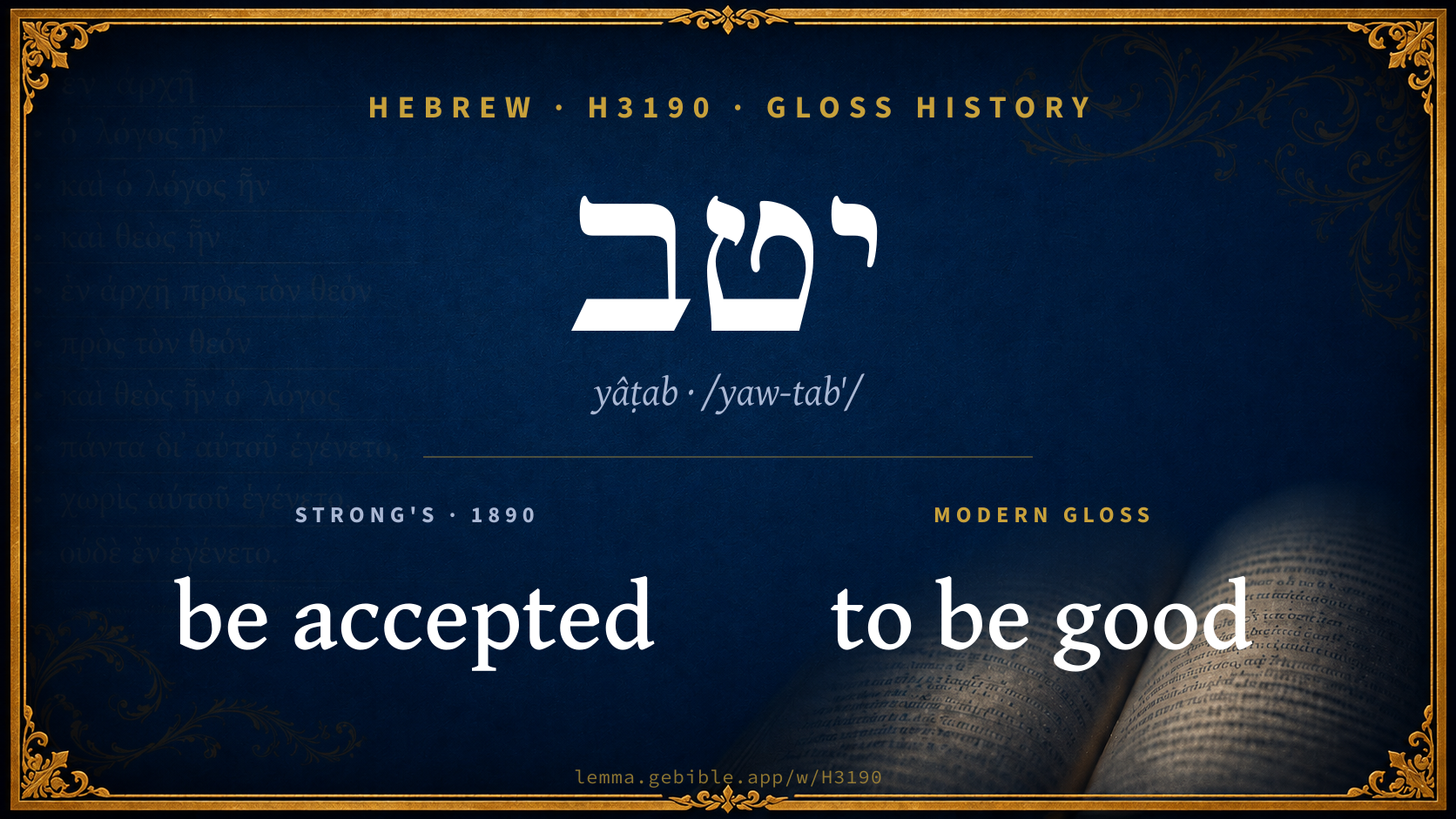
Gloss history
Strong's 1890 vs modern scholarship
About this word
Strong's H3190 catalogs a Hebrew word from the Hebrew Old Testament.
These counts are not copied from any lexicon or concordance. They are computed here, from the morphology-tagged Hebrew Old Testament. What Lemma adds →
- 105
- distinct verses
- The word appears in 105 distinct verses.
- 26 / 39
- OT books
- The word appears in 26 of 39 Old Testament books.
- #387
- by frequency
- Top 500 most frequent Hebrew words (rank 387 of 8,640 Hebrew words by occurrence).
View all 105 occurrences in the concordance →
Most concentrated in
- Deuteronomy 19 verses 18%
- Jeremiah 16 verses 15%
- Genesis 9 verses 9%
By section of the Old Testament
By traditional corpus
Conventional, traditional groupings — biblical authorship is debated, so this is a traditional corpus grouping, not an authorship claim. Each share is this word’s portion of its verses in that division of the Hebrew canon. Each figure is a share of the word’s 105 distinct verses.
- Prophets (Nevi'im) 49 verses · 47%
- Torah (Pentateuch) 35 verses · 33%
- Writings (Ketuvim) 21 verses · 20%
How translations render this word
Counts come from each version’s own published word-to-Strong’s tagging or interlinear alignment — an approximate guide to how each version renders this word, not a word-level alignment the data otherwise carries. Because each total is that version’s own tagged count, the per-version totals vary from one another and need not match the appearance or distinct-verse counts above. These counts may also differ from a printed concordance because Lemma counts each distinctly tagged rendering and does not collapse phrase taggings into a single head-word total. This is a fixed set of word-tagged versions (KJV, ASV, BSB, ULT) and does not change with the reading translation you choose elsewhere. Each version’s license is shown beside its name below (and on Sources).
- King James Version: Pleased 11×, Do good 4×, Well 4×
- American Standard Version: Pleased 7×, Thee 6×, Do good 5×
- Berean Standard Bible: Pleased 5×, Correct 4×, May go well 4×
- unfoldingWord Literal Text: And 13×, Was good 12×, Do good 11×
King James Version Public Domain
Renders H3190 across 110 tagged occurrences — most commonly:
Plus other, less common renderings. Plus 66 renderings that appear only once — usually multi-word phrases or single function words the recovered tagging swept in, not distinct renderings.
American Standard Version Public Domain
Renders H3190 across 109 tagged occurrences — most commonly:
Plus other, less common renderings. Plus 64 renderings that appear only once — usually multi-word phrases or single function words the recovered tagging swept in, not distinct renderings.
Berean Standard Bible Public Domain
Renders H3190 across 110 tagged occurrences — most commonly:
Plus 73 renderings that appear only once — usually multi-word phrases or single function words the recovered tagging swept in, not distinct renderings. Not rendered by a distinct English word in 7 further occurrences.
unfoldingWord Literal Text CC BY-SA 4.0
Renders H3190 across 140 tagged occurrences — most commonly:
Plus other, less common renderings. Plus 48 renderings that appear only once — usually multi-word phrases or single function words the recovered tagging swept in, not distinct renderings.
9 senses and sub-senses in the full BDB
Hebrew verbs can shift meaning by stem (binyan): Qal is the basic action, Niphal is often passive or reflexive, Piel often intensifies or makes it factitive, and Hiphil is typically causative. The senses below are grouped under the stem BDB assigns to each. This entry also uses Hithpael (reflexive or reciprocal).
What do BDB’s symbols mean?
BDB uses these scholarly abbreviations:
| Symbol | Meaning |
|---|---|
| 𝔊 | the Septuagint (the ancient Greek translation, LXX) |
| 𝔙 | the Vulgate (the Latin translation) |
| 𝔖 | the Syriac version (the Peshitta) |
| 𝔗 | the Targum (the Aramaic translation) |
| ψ | the Psalms |
| √ | root (the underlying root or stem) |
| ‖ | parallel passage (a synonymous or contrasted parallel) |
| † | the dagger: every passage where the word occurs is cited |
The 9 senses and sub-senses the full Brown-Driver-Briggs lexicon distinguishes for this word, in lexicon order (not ranked by frequency), with BDB’s own verbatim wording and sub-sense lettering. Shown in Hebrew script with BDB’s own scholarly abbreviations. The condensed entry is in the Lexicon Entry tab. See also the Forms in the corpus table below.
Qal
- 1. be glad, joyful
- 2. be well placed
- 3. impers. be well for or with, go well with
- 4. be pleasing
Hithpael
- 1. make glad, rejoice
- 2. do good to, deal well with
- 3. do well or thoroughly
- 4. make a thing good, right, beautiful
- 5. do well, right, ethically
Senses from the full Brown-Driver-Briggs lexicon (Brown, Driver, Briggs; Oxford 1906 — public domain), digitized via Sefaria, supplemented by the OpenScriptures HebrewLexicon (CC BY 4.0). Full attribution on Sources.
Word origin
[ יָטַב ] vb. be good, well, glad, pleasing
— Brown-Driver-Briggs (Oxford 1906, public domain), digitized via Sefaria, supplemented by the OpenScriptures HebrewLexicon (CC BY 4.0). See Sources.
Origin: a primitive root
Jastrow Dictionary
A second Hebrew/Aramaic lexicon for comparison, covering Aramaic and post-biblical (Talmudic, Targumic, Midrashic) usage that the biblical-Hebrew BDB does not. Matched by lemma rather than by Strong’s number, so a lemma may carry more than one Jastrow headword (shown separately below), and the entries cover usage well beyond the Bible.
יָטַב
- (v. next w.), part. Hof. מוּטָב, q. v.
יְטַב
- (cmp. טוב) to be good, well. Impf. יֵיטַב. Targ. O. Gen. XII, 13 ed. Berl. (ed. יוֹטִיב, Y. יֵיטִיב). Targ. O. Deut. IV, 40 (Y. יוֹטֵיב); a. fr.
- 1. same, v. supra.—2)
- to do good, be kind. Targ. Gen. XXXII, 10; a. fr.—3) to do a thing well. Targ. I Sam. XVI, 17 מוֹטִיב לנגנא who plays well. Targ. Gen. VI, 7; a. e.
A Dictionary of the Targumim, the Talmud Babli and Yerushalmi, and the Midrashic Literature (Marcus Jastrow; London, Luzac, 1903) — Public Domain. Digitized via Sefaria. Digitized via Sefaria. Full attribution on Sources.
Forms in the corpus
The 82 distinct written forms H3190 takes in the Hebrew Bible, most frequent first — each parse links to that stem’s occurrences in the concordance. Hebrew forms include their vowel points and cantillation, so a single lemma takes many written forms.
The 60 most common forms are shown; 22 rarer forms follow in the full concordance.
Same root — word family
Other BDB entries built from the same root as H3190, grouped by Strong’s listed origin. These share a root / origin per the lexicon — not necessarily a shared meaning. Each links to that word’s own entry.
Derived from this word
Proper names from this root
People and places named from this root — a name, not an additional meaning of the word.
Compare all same-root words → Showing 4 of 5 — not the complete family. 2 of the same-root words are proper names (people or places). They share a root, not necessarily a meaning.
Septuagint verse parallels
This word appears in 98 verses that also exist in the Greek Old Testament (Septuagint), out of the 105 Hebrew verses it occurs in. You can read those verses in Greek by switching the Old Testament edition to the Septuagint.
Read these verses in the Septuagint
- Genesis 4:7
- Exodus 1:20
- Leviticus 5:4
- Numbers 10:29
- Deuteronomy 1:23
- Joshua 22:30
- Judges 17:13
- Ruth 3:1
- 1 Samuel 2:32
- 2 Samuel 3:36
- 1 Kings 1:47
- 2 Kings 9:30
This is a verse-level parallel only — the same verses exist in both the Hebrew and Greek Old Testaments. No word-level Hebrew↔Greek correspondence is claimed: the data carries no such alignment, so no Greek word is shown as this Hebrew word’s translation. Coverage is not total — the Septuagint omits the deuterocanon and renumbers the Psalms, so some Hebrew verses have no direct Greek parallel.