Jeremiah 7:3

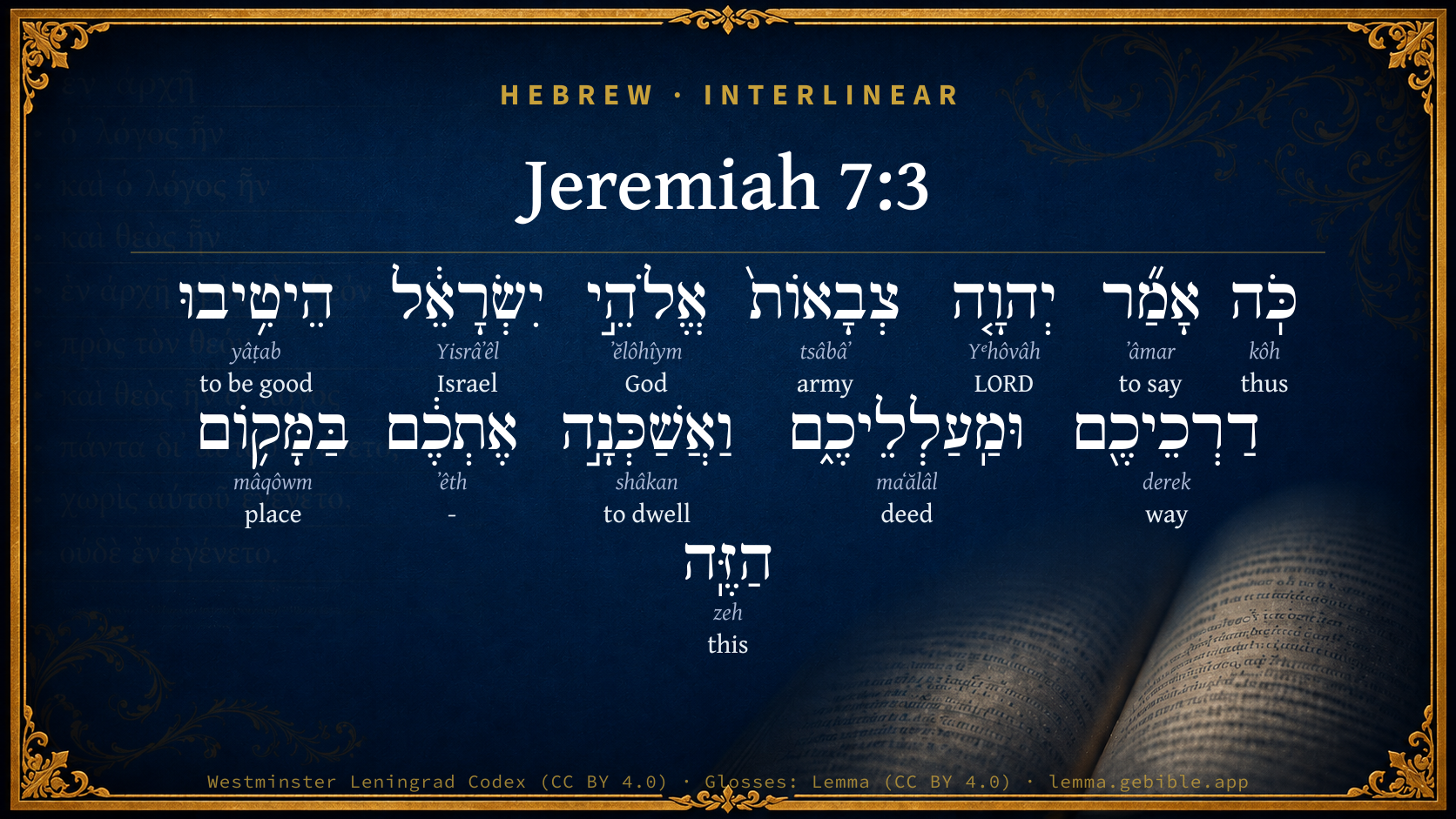
Hebrew (Westminster Leningrad Codex) Jeremiah 7:3 appears in the Hebrew Old Testament. The text above is from the Westminster Leningrad Codex. Each word links to its Strong’s number, a concise gloss, and parsing drawn from the Open Scriptures Hebrew Bible morphology. Click any word for its full Brown-Driver-Briggs (BDB) entry.
Download image
Cite this verse

Jeremiah 7:3 (World English Bible). Public Domain. Lemma interlinear Bible study tool, https://lemma.gebible.app/v/jeremiah/7/3.

Show BibTeX & RIS
BibTeX
RIS
English Translation
Thus says Yahweh of Hosts, the God of Israel, Amend your ways and your doings, and I will cause you to dwell in this place.
World English Bible · Public Domain
Download a study sheet

One document with this verse’s original text, its word-by-word gloss line, the meaning frame, cross-references with their text, attributed commentary, and full source and license credits — printable, and it pastes into notes with its structure intact.

This verse Autodidact and up

Study sheet (.html) Plain text (.txt)

A passage Seminary Student

Up to 50 verses in one chapter. A passage sheet keeps up to 6 commentary sources and 12 cross-references per verse, in the order this page ranks them, and says so on the sheet whenever that leaves anything out. Ask for a single verse and you get the Autodidact verse sheet above.

Everything on this page stays free to read, with no account — the sheet is a download of what is already on screen, not access to it.

Want to remove ads? Support Godless Engineer
Compare translations 3

The same verse in 3 English versions, stacked beneath the original-language interlinear above. Click any original word for its lexicon entry.

Each is an independent rendering of the whole verse — the interlinear is not word-aligned to these translations.

Highlighted words mark where these versions differ — a whole-verse word diff, not a word-by-word alignment.

  • World English Bible Public Domain
    Thus says Yahweh of Hosts, the God of Israel, Amend your ways and your doings, and I will cause you to dwell in this place.
  • King James Version Public Domain
    Thus saith the LORD of hosts, the God of Israel, Amend your ways and your doings, and I will cause you to dwell in this place.
  • unfoldingWord Literal Text CC BY-SA 4.0
    Thus says Yahweh of hosts, the God of Israel: Make your ways and your deeds good, and I will cause you to dwell in this place.

unfoldingWord Literal Text — © unfoldingWord, licensed CC BY-SA 4.0. Word-aligned USFM3 via Door43 (git.door43.org/unfoldingWord/en_ult).

Versions to compare (up to 4)

3 of 4 selected

Show all 18 translations

Every available English version of this verse, each an independent rendering of the whole verse.

  • World English Bible Public Domain
    Thus says Yahweh of Hosts, the God of Israel, Amend your ways and your doings, and I will cause you to dwell in this place.
  • Berean Standard Bible Public Domain
    Thus says the LORD of Hosts, the God of Israel: Correct your ways and deeds, and I will let you live in this place.
  • Majority Standard Bible Public Domain
    Thus says the LORD of Hosts, the God of Israel: Correct your ways and deeds, and I will let you live in this place.
  • King James Version Public Domain
    Thus saith the LORD of hosts, the God of Israel, Amend your ways and your doings, and I will cause you to dwell in this place.
  • American Standard Version (1901) Public Domain
    Thus saith Jehovah of hosts, the God of Israel, Amend your ways and your doings, and I will cause you to dwell in this place.
  • Revised Version (1885) Public Domain
    Thus saith the LORD of hosts, the God of Israel, Amend your ways and your doings, and I will cause you to dwell in this place.
  • Geneva Bible (1599) Public Domain
    Thus sayeth the Lord of hostes, the God of Israel, Amend your waies and your woorkes, and I will let you dwell in this place.
  • Douay-Rheims (1899) Public Domain
    Thus saith the Lord of hosts the God of Israel: Make your ways and your doings good: and I will dwell with you in this place.
  • Young's Literal Translation Public Domain
    Thus said Jehovah of Hosts, God of Israel, Amend your ways, and your doings, And I cause you to dwell in this place.
  • Literal Standard Version CC BY-SA 4.0
    Thus said YHWH of Hosts, God of Israel: “Amend your ways, and your doings, || And I cause you to dwell in this place.
  • Unlocked Literal Bible CC BY-SA 4.0
    Yahweh of hosts, God of Israel, says this: Make your ways and practices good, and I will let you continue to live in this place.
  • unfoldingWord Literal Text CC BY-SA 4.0
    Thus says Yahweh of hosts, the God of Israel: Make your ways and your deeds good, and I will cause you to dwell in this place.
  • Darby Bible Public Domain
    Thus saith Jehovah of hosts, the God of Israel: Amend your ways and your doings, and I will cause you to dwell in this place.
  • World Messianic Bible Public Domain
    The LORD of Hosts, the God of Israel says, “Amend your ways and your doings, and I will cause you to dwell in this place.
  • Webster's Bible Public Domain
    Thus saith the LORD of hosts, the God of Israel, Amend your ways and your doings, and I will cause you to dwell in this place.
  • Free Bible Version CC BY-SA 4.0
    This is what the Lord Almighty, the God of Israel says: Change your ways and do what's right, and I'll let you go on living here.
  • Bible in Basic English Public Domain
    The Lord of armies, the God of Israel, says, Let your ways and your doings be changed for the better and I will let you go on living in this place.
  • JPS Tanakh (1917) Public Domain
    Thus saith the LORD of hosts, the God of Israel: Amend your ways and your doings, and I will cause you to dwell in this place.

Literal Standard Version (2020), Covenant Press — licensed CC BY-SA 4.0. Text via the HelloAO Bible API (eBible.org). Unlocked Literal Bible (unfoldingWord) — licensed CC BY-SA 4.0. Text via the HelloAO Bible API (eBible.org). unfoldingWord Literal Text — © unfoldingWord, licensed CC BY-SA 4.0. Word-aligned USFM3 via Door43 (git.door43.org/unfoldingWord/en_ult). Free Bible Version, Dr. Jonathan Gallagher — licensed CC BY-SA 4.0. Text via the HelloAO Bible API (eBible.org).

Word by word

More ways to search: Search by grammar → Find every occurrence → Compare this word →

Practice this passage: Drill this verse → Learn its vocabulary →

וּמַֽעַלְלֵיכֶ֑ם
maʻălâl
H4611
“and · deeds · your”
Conjunction + Noun, Common, Masculine, Plural, Construct + Suffix, Personal, 2nd Person, Masculine, Plural
Part of Speech
Conjunction + Noun
Type
Common
Gender
Masculine
Number
Plural
State
Construct
Full BDB Definition

Origin: from H5953

TWOT: 1627e

deed, practice - practice (usually bad) - deeds - acts
  1. כֹּֽה kôh H3541 “thus” Adverb
  2. אָמַ֞ר ʼâmar H559 “to say” Verb, Qal, Perfect, 3rd Person, Masculine, Singular
  3. יְהוָ֤ה Yᵉhôvâh H3068 “LORD” Noun, Proper
  4. צְבָאוֹת֙ tsâbâʼ H6635 “armies” Noun, Common, Both, Plural, Absolute
  5. אֱלֹהֵ֣י ʼĕlôhîym H430 “God(s) of” Noun, Common, Masculine, Plural, Construct
  6. יִשְׂרָאֵ֔ל Yisrâʼêl H3478 “Israel” Noun, Proper
  7. הֵיטִ֥יבוּ yâṭab H3190 “be good” Verb, Hiphil, Imperative, 2nd Person, Masculine, Plural
  8. דַרְכֵיכֶ֖ם derek H1870 “ways · your” Noun, Common, Both, Plural, Construct + Suffix, Personal, 2nd Person, Masculine, Plural
  9. וַאֲשַׁכְּנָ֣ה shâkan H7931 “and · to dwell” Conjunction + Verb, Piel, Cohortative, 1st Person, Common, Singular
  10. אֶתְכֶ֔ם ʼêth H853 “- · you” Particle, Direct Object + Suffix, Personal, 2nd Person, Masculine, Plural
  11. בַּמָּק֥וֹם mâqôwm H4725 “in/at the · place” Preposition, Determined + Noun, Common, Masculine, Singular, Absolute
  12. הַזֶּֽה zeh H2088 “the · this” Particle, Definite Article + Pronoun, Demonstrative, Masculine, Singular

About this verse

These counts appear in no published source. They are computed here, from the morphology-tagged text and Lemma’s own curated glosses. What Lemma adds →

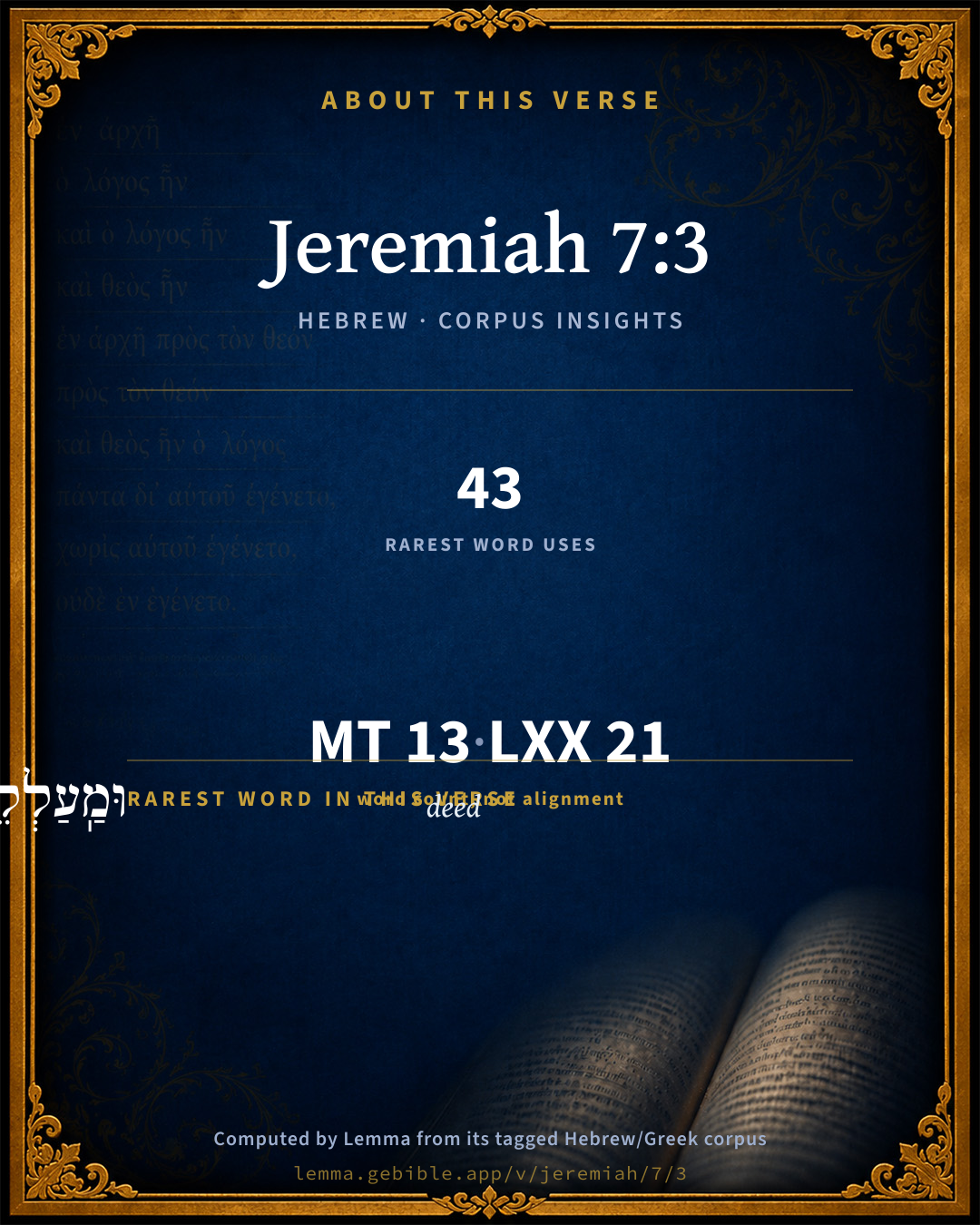
13
words
13
distinct lemmas
Prophets
section

Shared distinctive vocabulary

וּמַֽעַלְלֵיכֶ֑ם deed H4611 occurs in 41 verses of the Hebrew Bible. Also found in:

Grammatical profile

  • 3 verbs
  • 7 nouns
  • 1 pronoun
  • 1 adverb
  • 1 particle

Verb forms

  • אָמַ֞ר Qal · Perfect
  • הֵיטִ֥יבוּ Hiphil · Imperative
  • וַאֲשַׁכְּנָ֣ה Piel · Cohortative

Hebrew & Septuagint length

In the original languages it is 13 Hebrew tokens and 21 Greek tokens — but the two are counted differently (Hebrew bundles its prefixes and suffixes into one token; the Greek is in lemma form), so that isn’t a like-for-like length.

Cross-references

11

Topical passages linked to Jeremiah 7:3 in the Treasury of Scripture Knowledge — connected by theme and wording, ordered by reader-vote popularity; previews shown in the World English Bible.

  • Jeremiah 18:11 Now therefore, speak to the men of Judah, and to the inhabitants of Jerusalem, saying, Thus says Yahweh: Behold, I frame evil against you, and devise a device against you: return you now everyone from his evil way, and amend your ways and your doings.
  • Jeremiah 26:13 Now therefore amend your ways and your doings, and obey the voice of Yahweh your God; and Yahweh will repent him of the evil that he has pronounced against you.
  • Proverbs 28:13 He who conceals his sins doesn't prosper, But whoever confesses and renounces them finds mercy.
  • Isaiah 1:16–19 Wash yourselves, make yourself clean. Put away the evil of your doings from before my eyes; Cease to do evil.
  • Isaiah 55:7 let the wicked forsake his way, and the unrighteous man his thoughts; and let him return to Yahweh, and he will have mercy on him; and to our God, for he will abundantly pardon.
  • Jeremiah 7:5–7 For if you thoroughly amend your ways and your doings; if you thoroughly execute justice between a man and his neighbor;
  • Ezekiel 18:30–31 Therefore I will judge you, house of Israel, everyone according to his ways, says the Lord Yahweh. Return you, and turn yourselves from all your transgressions; so iniquity shall not be your ruin.
  • Ezekiel 33:4–11 then whoever hears the sound of the trumpet, and doesn't take warning, if the sword come, and take him away, his blood shall be on his own head.
  • Matthew 3:8–10 Therefore bring forth fruit worthy of repentance!
  • Jeremiah 35:15 I have sent also to you all my servants the prophets, rising up early and sending them, saying, Return you now every man from his evil way, and amend your doings, and don't go after other gods to serve them, and you shall dwell in the land which I have given to you and to your fathers: but you have not inclined your ear, nor listened to me.
  • James 4:8 Draw near to God, and he will draw near to you. Cleanse your hands, you sinners; and purify your hearts, you double-minded.

Cross-references courtesy of OpenBible.info (CC BY 4.0).

Hebrew and Greek witnesses Masoretic Hebrew ↔ Greek Septuagint

The same verse in the two great witnesses to the Old Testament, shown verse-for-verse.

These are two independent witnesses, not word-aligned to each other, and the Septuagint is shown in lemma (dictionary) form.

Hebrew Jeremiah 7:3 Masoretic · Westminster Leningrad Codex

כֹּֽה אָמַ֞ר יְהוָ֤ה צְבָאוֹת֙ אֱלֹהֵ֣י יִשְׂרָאֵ֔ל הֵיטִ֥יבוּ דַרְכֵיכֶ֖ם וּמַֽעַלְלֵיכֶ֑ם וַאֲשַׁכְּנָ֣ה אֶתְכֶ֔ם בַּמָּק֥וֹם הַזֶּֽה

Thus says Yahweh of Hosts, the God of Israel, Amend your ways and your doings, and I will cause you to dwell in this place.

World English Bible · Public Domain

Greek LXX Structure differs

In the Septuagint, Jeremiah is about an eighth shorter than the Hebrew and arranges its material differently — the Oracles Against the Nations (Hebrew chapters 46–51) appear in the middle of the Greek book, after 25:13. Because the chapter and verse boundaries do not line up, a verse-for-verse comparison with the Hebrew is not shown.

A verse-for-verse comparison isn’t shown here because the chapters and verses don’t line up. Switch to the LXX edition with the MT / LXX toggle above to read the Greek directly.

Hebrew: Westminster Leningrad Codex (CC BY 4.0). Greek: Septuagint (public domain); English from a public-domain English Septuagint. How the Septuagint differs from the Hebrew →

Targum (Aramaic paraphrase)

1

The Targum is the ancient Jewish Aramaic paraphrase of the Hebrew Scriptures — an interpretive translation, not the Hebrew text itself. Onkelos (literal) and Pseudo-Jonathan (expansive) render the Torah, and Jonathan the Prophets. Coverage is partial: where no permissively-licensed English translation exists for a verse, only the Aramaic is shown. This is verse-level text, not a word-by-word alignment to the Hebrew.

  1. Targum Jonathan Prophets (Joshua–Malachi)
    כִּדְנַן אֲמַר יְיָ צְבָאוֹת אֱלָהָא דְיִשְׂרָאֵל אַתְקִינוּ אוֹרְחָתְכוֹן וְעוֹבָדֵיכוֹן וְאַשְׁרֵי יַתְכוֹן בְּאַתְרָא הָדֵין:

    (no public-domain English translation for this verse)

    Targum Jonathan — Aramaic: “Mikraot Gedolot” (public domain). English: “Sefaria Community Translation” (CC0 1.0 (public-domain dedication)); “London "Chaldee Paraphrase," 1871” (public domain). Text via Sefaria.

Commentary

Notes on Jeremiah 7:3 from classic Christian and Jewish commentators (each source and its license shown beneath its notes). The classic Christian expositions comment on the surrounding passage and are grouped to its opening verse, so a note may address several verses; the Jewish commentaries on the Tanakh (Rashi and others) are per-verse, so they appear only where the commentator wrote on this verse.

Lemma curates 59 commentaries, every one of them public domain or Creative Commons licensed, each selected and text-cleaned for this edition rather than reprinted as found. About our sources →

Trapp's Complete Commentary

John Trapp

Jer 7:3 Thus saith the LORD of hosts, the God of Israel, Amend your ways and your doings, and I will cause you to dwell in this place.

Ver. 3. Amend your ways and your doings.] Heb., Make good your ways, sc., by repentance for and from your sins, and by believing the Gospel. Defaecantur enim mores, ubi medullitus excipitur evangelium. Amendment of life is an upright, earnest, and constant endeavour to do all that God commandeth, and to forbear what he forbiddeth.

John Trapp, A Commentary or Exposition upon All the Books of the Old and New Testament (1647–1656) — public domain. Text from a community e-Sword module.

Joseph Benson's Commentary

Jer 7:3. Thus saith the Lord of hosts, the God of Israel — As creatures, we are all bound to regard the Lord of hosts; as members of the visible church, the God of Israel; what he said to them he says to us; and it is much the same with that which John the Baptist said to those whom he baptized, Mat 3:8-9. Bring forth fruits meet for repentance, and think not to say, within yourselves, We have Abraham for our father. Amend your ways and your doings — This implies that there had been much amiss in their ways and doings, but it was a great instance of the goodness of God to them, that he gave them liberty to amend, showed them wherein and how they must amend, and promised to accept them upon their amendment. And I will cause you to dwell in this place — Namely, quietly and peaceably. You shall not go into captivity, but a stop shall be put to that which threatens your expulsion. Observe, reader, reformation is the only way, and a sure way to prevent ruin.

Joseph Benson's Commentary on the Old and New Testaments (1811–1818) — public domain. Text from a community e-Sword module.

Tyndale Open Study Notes

Tyndale Open Resources

7:3-4 Pagans believed that a symbol was identical with what it represented, so in the paganized worship of Jeremiah’s day, the Temple was God’s heavenly house. It would be ridiculous to think that enemies could destroy it. To reinforce that idea, the people vigorously repeated a chant, The Lord’s Temple is here. However, the Lord of Heaven’s Armies needed no earthly house (2 Sam 7:6-7; 1 Kgs 8:27); whatever security the Israelites obtained from the Temple came from the Lord himself, and only on his terms (1 Kgs 6:12).

Tyndale Open Study Notes — © Tyndale Open Resources, licensed CC BY-SA 4.0. Text via the HelloAO Bible API.

Jamieson, Fausset & Brown

Robert Jamieson, A. R. Fausset & David Brown

cause you to dwell--permit you still to dwell (Jer 18:11; Jer 26:13).

Jamieson, Fausset & Brown — Commentary Critical and Explanatory on the Whole Bible (1871) — public domain (CC PDM 1.0). Text via the HelloAO Bible API.

John Calvin's Commentaries

Make good, he says, your ways and your doings, then will I dwell in this place This promise contains an implied contrast; for the Prophet intimates, that the people would not long survive, unless they sought in another way to pacify God. “I will dwell, “he seems to say, — in this place, when your life is changed.” It then follows on the other hand, “God will drive you into exile, except you change your life: in vain then do you seek a quiet and happy state through offering your sacrifices. God indeed esteems as nothing this external worship, except it be preceded by inward sincerity, unless integrity of life accompanies your profession.” This is one thing.

John Calvin's Commentaries (1540-1563) — public domain. Text from the Calvin Translation Society English edition (1840s-50s) via the Christian Classics Ethereal Library (ccel.org). Calvin's coverage is partial (roughly two-thirds of the Bible); uncommented books and verses are honest gaps, never fabricated. The 19th-century editor's footnotes and remarks are omitted so the notes are faithfully Calvin's own voice.

Ellicott's Commentary for English Readers

(3) Your ways and your doings.—“Ways,” as in Zec_1:6, of general habits, “doings” of separate acts.

I will cause you to dwell.—The English suggests the thoughts of something new, but what Jeremiah promises is simply the continuance of the blessings they had hitherto enjoyed. I will let you dwell.

A Bible Commentary for English Readers, edited by Charles John Ellicott (1878–1897) — public domain. Text from a community e-Sword module.

The Cambridge Bible for Schools and Colleges

gen. ed. J. J. S. Perowne

3. your ways and your doings] a frequent expression in this Book. See Intr. iii. § 14 (b), note. Cp. Eze_14:22 f., Eze_20:43, Jer_36:17; Zec_1:4; Zec_1:6.

The Cambridge Bible for Schools and Colleges (gen. ed. J. J. S. Perowne; Cambridge University Press, 1878–1918) — public domain. Text from a community e-Sword module.

John Gill's Exposition

Thus saith the Lord of hosts, the God of Israel,.... The Lord of armies above and below in general, and the God of Israel in particular; wherefore they ought to hearken to what he was about to say, and to be obedient to him:

amend your ways and your doings; or, "make them good" (l); which shows that they were bad, and were not agreeable to the law and will of God, to which they ought to have been conformed; and the way to amend them was to act according to the rule of the divine word they were favoured with:

and I will cause you to dwell in this place; to continue to dwell in Jerusalem, and in Judea, the land of their nativity, and in the temple, the house of God, and place of religious worship; but, if not, it is suggested that they should not continue here, but be carried captive into a strange land.

(l) "bonas facite vias vestras", V. L. Munster, Pagninus, Montanus; "efficite", &c. Junius & Tremellius, Piscator.

John Gill's Exposition of the Whole Bible (1746–1763) — public domain (CC PDM 1.0). Text via the HelloAO Bible API.

Albert Barnes' Notes on the Bible

If the people repented, instead of being led into captivity, God would maintain their national existence. It is a promise of the continuance of an old blessing.

Albert Barnes' Notes on the Bible (1834–1885) — public domain. Text from a community e-Sword/MySword module.

Haydock's Catholic Bible Commentary

Dwell. Hebrew, "make you dwell here." (Haydock)

George Leo Haydock (1774–1849), Haydock's Catholic Family Bible and Commentary, 1859 edition — public domain. Excludes Psalms (Douay-Rheims chapter numbering differs from Protestant) and Deuterocanonical books (Catholic canon only).

Matthew Poole's English Annotations

Amend your ways and your doings, i.e. mend your manners. Amending signifies both to turn from our evil works, and make our good better.

I will cause you to dwell in this place; you shall not go into captivity, implying that otherwise they should; he will continue their habitations to them from age to age, as Jer 7:7. The doing of a thing in Scripture often implies the continuance of it: Lev 26:11,

I will set my tabernacle, i.e. I will continue it.

Matthew Poole's English Annotations on the Holy Bible (1683–1685) — public domain. Text from a community e-Sword/MySword module.

Whedon's Commentary on the Bible

Daniel D. Whedon

3. Amend your ways and your doings — Habits and particular acts.

Daniel D. Whedon (gen. ed.), Commentary on the Old and New Testaments (1874–1909) — public domain. Text from a community e-Sword module.

unfoldingWord translationNotes

Door43 World Missions Community

Connecting Statement:

Yahweh continues giving Jeremiah his message to the people of Judah.

Yahweh of hosts ... says this

Jeremiah often uses these words to introduce an important message from Yahweh. See how you translated this in Jeremiah 6:6.

Make your ways and practices good, and I will let you continue

"If you improve your ways and your practices, then I will let you continue"

in this place

This means in the land of Judah, not in the temple.

Do not entrust yourself to deceitful words and say

The reflexive pronoun "yourself" emphasizes the personal risk to the Israelites. AT: "Do not trust in deceitful words to protect you, saying" (See: Reflexive Pronouns)

Temple of Yahweh! Temple of Yahweh! Temple of Yahweh!

It is implied that, since the temple belongs to Yahweh and represents his presence, he will protect it and the people of Judah will be safe. Possible meanings for why "Temple of Yahweh" is repeated three times are 1) it was repeated for emphasis or 2) it was repeated as part of a temple liturgy. AT: "This is the temple of Yahweh so it is absolutely certain that no one will destroy it and we are safe." (See: Assumed Knowledge and Implicit Information)

translationWords

Yahweh of hosts

God

Israel

good

life

deceive

word

temple

Yahweh

unfoldingWord translationNotes — © Distant Shores Media and the Door43 World Missions Community, licensed CC BY-SA 4.0. Source: git.door43.org/Door43/en_tn.

Lesson kit

Teaching starters — assembled from the data on this page, not authored interpretation. Every prompt links to the verse data it draws on. Edit before teaching.

Jeremiah, in the Prophets, opens this verse with 13 words (13 distinct Hebrew lemmas). Its most distinctive word is maʻălâl (“deed”). A historical commentator’s framing appears above. Read the whole chapter for the surrounding context.

Discussion questions

  1. How does “deed” (maʻălâl) shape what this verse is saying?
  2. How does Deuteronomy 28:20, which shares the word «deed», read alongside this verse?
  3. These translations render this verse differently; the difference is in the English rendering, not the original. What questions does that raise?
  4. «אָמַ֞ר» is a Qal Perfect verb. How does that grammatical form shape the action described?
  5. Compare how Trapp's Complete Commentary and Joseph Benson's Commentary read this verse. Where do they agree or differ?

Things to notice

Reading settings

Reading text

Shown beneath each verse's original-language words.

Old Testament
Old Testament edition

Read the OT as the Masoretic Hebrew (MT) or the Greek Septuagint (LXX).

English shown for the Greek Septuagint (in the Hebrew ↔ Greek comparison).

Comparing translations? Open the Compare panel on any verse page to stack up to four side by side.