Judges 17:13

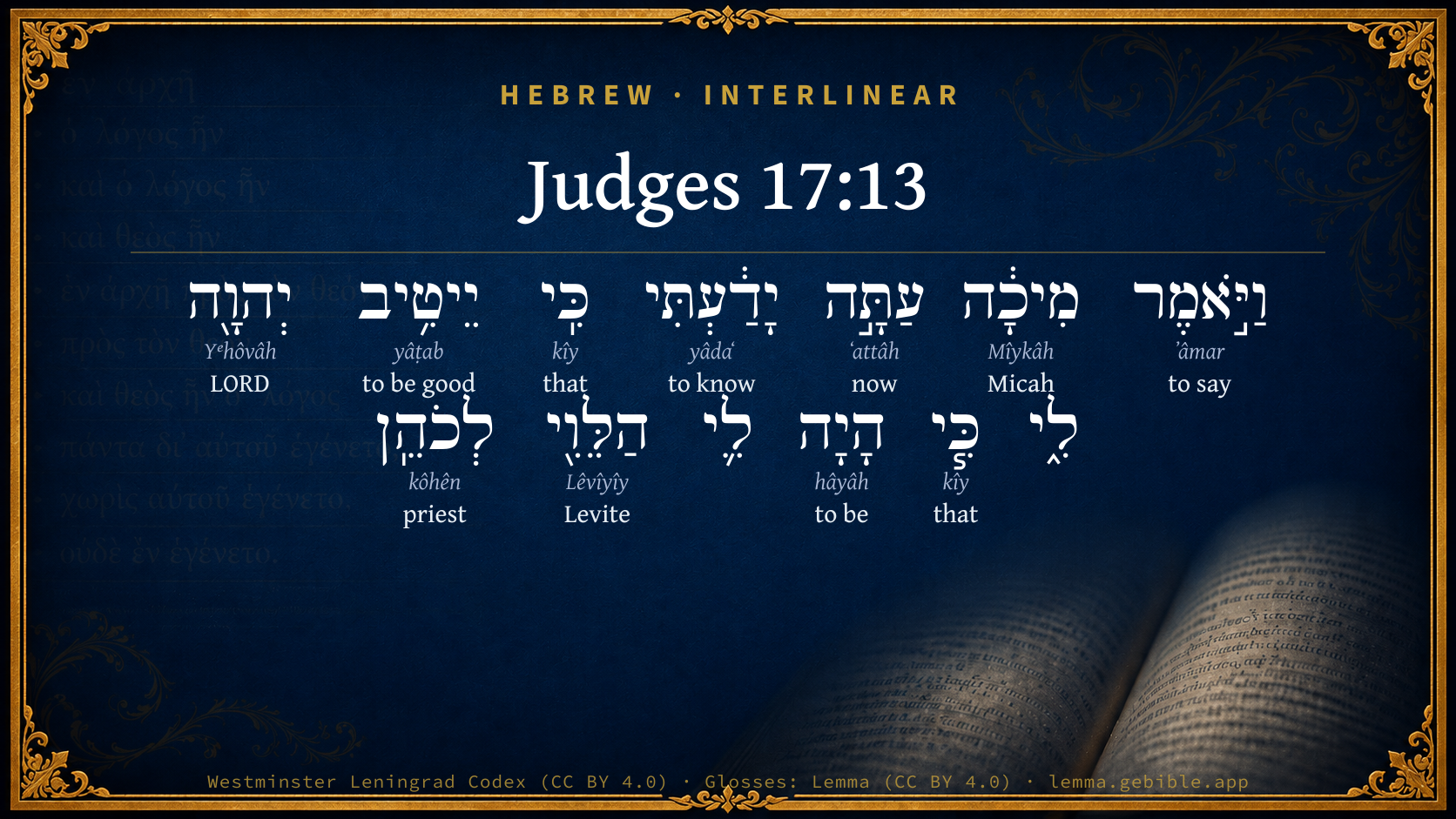
Hebrew (Westminster Leningrad Codex) Judges 17:13 appears in the Hebrew Old Testament. The text above is from the Westminster Leningrad Codex. Each word links to its Strong’s number, a concise gloss, and parsing drawn from the Open Scriptures Hebrew Bible morphology. Click any word for its full Brown-Driver-Briggs (BDB) entry.
Download image
Cite this verse

Judges 17:13 (World English Bible). Public Domain. Lemma interlinear Bible study tool, https://lemma.gebible.app/v/judges/17/13.

Show BibTeX & RIS
BibTeX
RIS
English Translation
Then said Micah, Now know I that Yahweh will do me good, seeing I have a Levite to my priest.
World English Bible · Public Domain
Download a study sheet

One document with this verse’s original text, its word-by-word gloss line, the meaning frame, cross-references with their text, attributed commentary, and full source and license credits — printable, and it pastes into notes with its structure intact.

This verse Autodidact and up

Study sheet (.html) Plain text (.txt)

A passage Seminary Student

Up to 50 verses in one chapter. A passage sheet keeps up to 6 commentary sources and 12 cross-references per verse, in the order this page ranks them, and says so on the sheet whenever that leaves anything out. Ask for a single verse and you get the Autodidact verse sheet above.

Everything on this page stays free to read, with no account — the sheet is a download of what is already on screen, not access to it.

Want to remove ads? Support Godless Engineer
Compare translations 3

The same verse in 3 English versions, stacked beneath the original-language interlinear above. Click any original word for its lexicon entry.

Each is an independent rendering of the whole verse — the interlinear is not word-aligned to these translations.

Highlighted words mark where these versions differ — a whole-verse word diff, not a word-by-word alignment.

  • World English Bible Public Domain
    Then said Micah, Now know I that Yahweh will do me good, seeing I have a Levite to my priest.
  • King James Version Public Domain
    Then said Micah, Now know I that the LORD will do me good, seeing I have a Levite to my priest.
  • unfoldingWord Literal Text CC BY-SA 4.0
    Then Micah said, “Now I know that Yahweh will be good to me, because the Levite is to me for a priest.”

unfoldingWord Literal Text — © unfoldingWord, licensed CC BY-SA 4.0. Word-aligned USFM3 via Door43 (git.door43.org/unfoldingWord/en_ult).

Versions to compare (up to 4)

3 of 4 selected

Show all 18 translations

Every available English version of this verse, each an independent rendering of the whole verse.

  • World English Bible Public Domain
    Then said Micah, Now know I that Yahweh will do me good, seeing I have a Levite to my priest.
  • Berean Standard Bible Public Domain
    Then Micah said, “Now I know that the LORD will be good to me, because a Levite has become my priest.”
  • Majority Standard Bible Public Domain
    Then Micah said, “Now I know that the LORD will be good to me, because a Levite has become my priest.”
  • King James Version Public Domain
    Then said Micah, Now know I that the LORD will do me good, seeing I have a Levite to my priest.
  • American Standard Version (1901) Public Domain
    Then said Micah, Now know I that Jehovah will do me good, seeing I have a Levite to my priest.
  • Revised Version (1885) Public Domain
    Then said Micah, Now know I that the LORD will do me good, seeing I have a Levite to my priest.
  • Geneva Bible (1599) Public Domain
    Then said Michah, Nowe I know that the Lord will be good vnto me, seeing I haue a Leuite to my Priest.
  • Douay-Rheims (1899) Public Domain
    Now I know God will do me good, since I have a priest of the race of the Levites.
  • Young's Literal Translation Public Domain
    and Micah saith, `Now I have known that Jehovah doth good to me, for the Levite hath been to me for a priest.'
  • Literal Standard Version CC BY-SA 4.0
    and Micah says, “Now I have known that YHWH does good to me, for the Levite has been for a priest to me.”
  • Unlocked Literal Bible CC BY-SA 4.0
    Then Micah said, “Now I know that Yahweh will do good for me, because this Levite has become my priest.”
  • unfoldingWord Literal Text CC BY-SA 4.0
    Then Micah said, “Now I know that Yahweh will be good to me, because the Levite is to me for a priest.”
  • Darby Bible Public Domain
    Then Micah said, "Now I know that the LORD will prosper me, because I have a Levite as priest."
  • World Messianic Bible Public Domain
    Then Micah said, “Now I know that the LORD will do good to me, since I have a Levite as my priest.”
  • Webster's Bible Public Domain
    Then said Micah, Now I know that the LORD will do me good, seeing I have a Levite for my priest.
  • Free Bible Version CC BY-SA 4.0
    “I'm sure the Lord will bless me now, because I have a Levite as my priest,” Micah concluded.
  • Bible in Basic English Public Domain
    Then Micah said, Now I am certain that the Lord will do me good, seeing that the Levite has become my priest.
  • JPS Tanakh (1917) Public Domain
    Then said Micah: 'Now know I that the LORD will do me good, seeing I have a Levite as my priest.'

Literal Standard Version (2020), Covenant Press — licensed CC BY-SA 4.0. Text via the HelloAO Bible API (eBible.org). Unlocked Literal Bible (unfoldingWord) — licensed CC BY-SA 4.0. Text via the HelloAO Bible API (eBible.org). unfoldingWord Literal Text — © unfoldingWord, licensed CC BY-SA 4.0. Word-aligned USFM3 via Door43 (git.door43.org/unfoldingWord/en_ult). Free Bible Version, Dr. Jonathan Gallagher — licensed CC BY-SA 4.0. Text via the HelloAO Bible API (eBible.org).

Word by word

More ways to search: Search by grammar → Find every occurrence → Compare this word →

Practice this passage: Drill this verse → Learn its vocabulary →

מִיכָ֔ה
Mîykâh
H4318
“Micah”
Noun, Proper
Part of Speech
Noun
Type
Proper
Full BDB Definition

Origin: an abbrev. of H4320

TWOT: None

Micah or Micaiah or Michah = "who is like God" - the 6th in order of the minor prophets; a native of Moresheth, he prophesied during the reigns of Jotham, Ahaz, and Hezekiah of Judah, and was contemporary with the prophets Hosea, Amos, and Isaiah - an Ephraimite during the period of the judges - a descendant of Joel the Reubenite - son of Meribbaal and grandson of Jonathan - a Kohathite Levite, the eldest son of Uzziel the brother of Amram - father of Abdon, a man of high station in the reign of Josiah - son of Imlah and a prophet of Samaria who predicted the defeat and death of king Ahab of Israel
  1. וַיֹּ֣אמֶר ʼâmar H559 “and · to say” Conjunction + Verb, Qal, Sequential Imperfect, 3rd Person, Masculine, Singular
  2. עַתָּ֣ה ʻattâh H6258 “now” Adverb
  3. יָדַ֔עְתִּי yâdaʻ H3045 “to know” Verb, Qal, Perfect, 1st Person, Common, Singular
  4. כִּֽי kîy H3588 “that” Conjunction
  5. יֵיטִ֥יב yâṭab H3190 “to be good” Verb, Hiphil, Imperfect, 3rd Person, Masculine, Singular
  6. יְהוָ֖ה Yᵉhôvâh H3068 “LORD” Noun, Proper
  7. כִּ֧י kîy H3588 “that” Conjunction
  8. הָיָה hâyâh H1961 “to be” Verb, Qal, Perfect, 3rd Person, Masculine, Singular
  9. הַלֵּוִ֖י Lêvîyîy H3881 “the · Levite” Particle, Definite Article + Noun, Gentilic, Masculine, Singular, Absolute
  10. לְכֹהֵֽן kôhên H3548 “to/for · priest” Preposition + Noun, Common, Masculine, Singular, Absolute

About this verse

These counts appear in no published source. They are computed here, from the morphology-tagged text and Lemma’s own curated glosses. What Lemma adds →

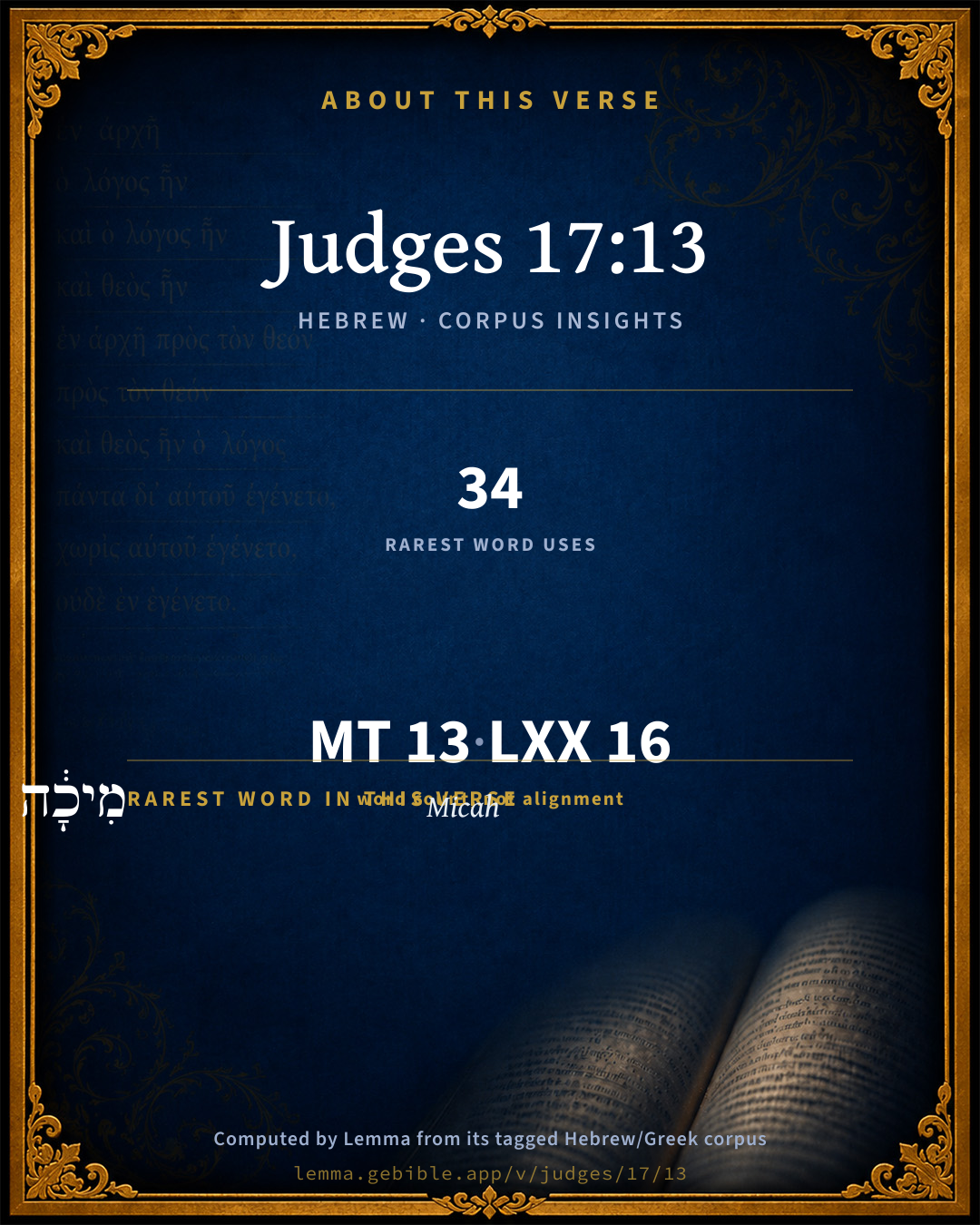
13
words
10
distinct lemmas
Historical
section

Shared distinctive vocabulary

מִיכָ֔ה Micah H4318 occurs in 31 verses of the Hebrew Bible. Also found in:

Grammatical profile

  • 4 verbs
  • 4 nouns
  • 2 prepositions
  • 2 conjunctions
  • 1 adverb

Verb forms

  • וַיֹּ֣אמֶר Qal · Sequential Imperfect
  • יָדַ֔עְתִּי Qal · Perfect
  • יֵיטִ֥יב Hiphil · Imperfect
  • הָיָה Qal · Perfect

Repetition

A word recurs within this verse — often emphatic in Hebrew:

  • כִּֽי that H3588 ×2

Hebrew & Septuagint length

In English translation the verse runs 20 words from the Hebrew and 20 from the Septuagint (LXX English) — the same length.

A rough comparison of the two English renderings, which tokenize alike — not a word-level alignment.

Word counts can differ between the Hebrew and the Greek without any difference in meaning — e.g. the Hebrew direct-object marker אֵת has no separate Greek word, and Greek often adds the article ὁ.

In the original languages it is 13 Hebrew tokens and 16 Greek tokens — but the two are counted differently (Hebrew bundles its prefixes and suffixes into one token; the Greek is in lemma form), so that isn’t a like-for-like length.

Cross-references

8

Topical passages linked to Judges 17:13 in the Treasury of Scripture Knowledge — connected by theme and wording, ordered by reader-vote popularity; previews shown in the World English Bible.

  • Matthew 15:13 But he answered, "Every plant which my heavenly Father didn't plant will be uprooted.
  • John 16:2 They will put you out of the synagogues. Yes, the time comes that whoever kills you will think that he offers service to God.
  • Acts 26:9 "I myself most assuredly thought that I ought to do many things contrary to the name of Jesus of Nazareth.
  • Romans 10:2–3 For I testify about them that they have a zeal for God, but not according to knowledge.
  • Proverbs 14:12 There is a way which seems right to a man, But in the end it leads to death.
  • Isaiah 44:20 He feeds on ashes; a deceived heart has turned him aside; and he can't deliver his soul, nor say, Is there not a lie in my right hand?
  • Isaiah 66:3–4 He who kills an ox is as he who kills a man; he who sacrifices a lamb, as he who breaks a dog's neck; he who offers an offering, [as he who offers] pig's blood; he who burns frankincense, as he who blesses an idol. Yes, they have chosen their own ways, and their soul delights in their abominations:
  • Matthew 15:9 And in vain do they worship me, Teaching as doctrine rules made by men.'"

Cross-references courtesy of OpenBible.info (CC BY 4.0).

Hebrew and Greek witnesses Masoretic Hebrew ↔ Greek Septuagint

The same verse in the two great witnesses to the Old Testament, shown verse-for-verse.

These are two independent witnesses, not word-aligned to each other, and the Septuagint is shown in lemma (dictionary) form.

Hebrew Judges 17:13 Masoretic · Westminster Leningrad Codex

וַיֹּ֣אמֶר מִיכָ֔ה עַתָּ֣ה יָדַ֔עְתִּי כִּֽי יֵיטִ֥יב יְהוָ֖ה לִ֑י כִּ֧י הָיָה לִ֛י הַלֵּוִ֖י לְכֹהֵֽן

Then said Micah, Now know I that Yahweh will do me good, seeing I have a Levite to my priest.

World English Bible · Public Domain

Greek LXX Judges 17:13 Septuagint · lemma form

καί εἶπον μιχαιας νῦν γιγνώσκω ὅτι ἀγαθύνω κύριος ἐγώ ὅτι γίγνομαι ἐγώ ὁ λευίτης εἰς ἱερεύς

And Michaias said, Now I know that the Lord will do me good, because a Levite has become my priest.

LXX2012 (modern English Septuagint) · Public Domain

Hebrew: Westminster Leningrad Codex (CC BY 4.0). Greek: Septuagint (public domain); English from LXX2012 (modern English Septuagint) (Public Domain). How the Septuagint differs from the Hebrew →

Targum (Aramaic paraphrase)

1

The Targum is the ancient Jewish Aramaic paraphrase of the Hebrew Scriptures — an interpretive translation, not the Hebrew text itself. Onkelos (literal) and Pseudo-Jonathan (expansive) render the Torah, and Jonathan the Prophets. Coverage is partial: where no permissively-licensed English translation exists for a verse, only the Aramaic is shown. This is verse-level text, not a word-by-word alignment to the Hebrew.

  1. Targum Jonathan Prophets (Joshua–Malachi)
    וַאֲמַר מִיכָה כְּעַן יָדַעְנָא אֲרֵי אוֹטֵיב יְיָ לִי אֲרֵי הֲוָה לִי לֵוָאָה לְכוּמְרָא:

    (no public-domain English translation for this verse)

    Targum Jonathan — Aramaic: “Mikraot Gedolot” (public domain). English: “Sefaria Community Translation” (CC0 1.0 (public-domain dedication)); “London "Chaldee Paraphrase," 1871” (public domain). Text via Sefaria.

Commentary

Notes on Judges 17:13 from classic Christian and Jewish commentators (each source and its license shown beneath its notes). The classic Christian expositions comment on the surrounding passage and are grouped to its opening verse, so a note may address several verses; the Jewish commentaries on the Tanakh (Rashi and others) are per-verse, so they appear only where the commentator wrote on this verse.

Lemma curates 59 commentaries, every one of them public domain or Creative Commons licensed, each selected and text-cleaned for this edition rather than reprinted as found. About our sources →

Trapp's Complete Commentary

John Trapp

Jdg 17:13 Then said Micah, Now know I that the LORD will do me good, seeing I have a Levite to [my] priest.

Ver. 13. Now know I that the Lord.] In his blind devotion he promiseth himself prosperity: so do Papists in their priests’ absolution, Pope’s pardon. But it happened otherwise with Micah; {Jdg 18:18-20} like as it did with the riflers of Semiramis’ tomb, who expected rich treasure, but met with a deadly poison.

“ Fallitur augurio spes bona saepe suo. ”

John Trapp, A Commentary or Exposition upon All the Books of the Old and New Testament (1647–1656) — public domain. Text from a community e-Sword module.

Joseph Benson's Commentary

Jdg 17:13. Do me good — I am assured God will bless me. So blind and grossly partial he was in his judgment, to think that one right circumstance would answer for all his substantial errors, in making and worshipping images against God’s express command, in worshipping God in a forbidden place, by a priest illegally appointed. “He persuades himself,” says Calmet, “that the people, seeing his chapel served by a man of the family of Levi, will come thither with greater confidence, and that this concourse, together with the offerings to be brought, will procure him considerable gain. It is evidently this gain which he here calls the blessing of God. How just a representation is this of those superstitiously covetous persons who would connect religion with the love of riches, and who, as St. Paul expresses it, fancy that piety should serve as a means of enriching themselves.”

Joseph Benson's Commentary on the Old and New Testaments (1811–1818) — public domain. Text from a community e-Sword module.

Geneva Bible (1599)

Geneva Bible translators

Thus the idolaters persuade themselves of God’s favor, when indeed he doth detest them.

Geneva Bible (1599) marginal notes — public domain. Text via Bolls.life.

Jamieson, Fausset & Brown

Robert Jamieson, A. R. Fausset & David Brown

Now know I that the Lord will do me good--The removal of his son, followed by the installation of this Levite into the priestly office, seems to have satisfied his conscience, that by what he deemed the orderly ministrations of religion he would prosper. This expression of his hope evinces the united influence of ignorance and superstition.

Next: Judges Chapter 18

Jamieson, Fausset & Brown — Commentary Critical and Explanatory on the Whole Bible (1871) — public domain (CC PDM 1.0). Text via the HelloAO Bible API.

Adam Clarke's Commentary

Verse 13. Now know I that the Lord will do me good] As he had already provided an epitome of the tabernacle, a model of the ark, mercy-seat, and cherubim; and had got proper sacerdotal vestments, and a Levite to officiate; he took for granted that all was right, and that he should now have the benediction of God. Some think that he expected great gain from the concourse of the people to his temple; but of this there is no evidence in the text. Micah appears to have been perfectly sincere in all that he did.

I HAVE already remarked that there is no positive evidence that Micah or his mother intended to establish any idolatrous worship. Though they acted without any Divine command in what they did; yet they appear, not only to have been perfectly sincere, but also perfectly disinterested. They put themselves to considerable expense to erect this place of worship, and to maintain, at their own proper charges, a priest to officiate there; and without this the place, in all probability, would have been destitute of the worship and knowledge of the true God. His sincerity, disinterestedness, and attachment to the worship of the God of his fathers, are farther seen in the joy which he expressed on finding a Levite who might legally officiate in his house. It is true, he had not a Divine warrant for what he did; but the state of the land, the profligacy of his countrymen, his distance from Shiloh, &c., considered, he appears to deserve more praise than blame, though of the latter he has received a most liberal share from every quarter. This proceeds from that often-noticed propensity in man to take every thing which concerns the character of another by the worst handle. It cannot be considered any particular crime, should these notes be found at any time leaning to the other side.

Adam Clarke's Commentary on the Bible (1810–1826) — public domain. Text from a community e-Sword/MySword module.

Ellicott's Commentary for English Readers

(13) That the Lord will do me good.—In this anticipation we find a very little further on that he was rudely undeceived, and we are hardly in a position to know whether it was due to hypocrisy or to mere ignorance. So far as Micah was devout and sincere, we must feel that the Lord did him good by stripping him of his gorgeous instruments of superstition and humbling his pride.

I have a Levite to my priest.—Rather, the Levite. The article may be generic, meaning “one of the Levites;” but Jonathan, as a son of Gershom, has a special right to be called “the Levite,” as a representative of the tribe. It is at least doubtful whether the priestly functions expected of him in this instance included sacrifice; but, in any case, Micah could hardly have been entirely unaware that the Levites were incapable of priestly functions (“Seek ye the priesthood also?”—Num_16:10), or of the fact that the authorised worship of the nation was to be confined to the place which God should choose, which in this instance was Shiloh. In any case, however, the passage furnishes us with a fresh proof of the utter neglect of the Mosaic law, as represented in the Book of Leviticus, from a very early period. His “house of God” seems to have resembled the high places, which even the faithful kings of Israel were unable or unwilling to clear away. They were ultimately cleared away by Hezekiah, but not without so great a shock to the then established custom, that Rabshakeh actually appeals to the fact in proof of Hezekiah’s impiety, and as a sign that he has forfeited the favour of Jehovah (2Ki_18:22).

A Bible Commentary for English Readers, edited by Charles John Ellicott (1878–1897) — public domain. Text from a community e-Sword module.

The Cambridge Bible for Schools and Colleges

gen. ed. J. J. S. Perowne

13. This verse may belong to either of the two narratives.

The Cambridge Bible for Schools and Colleges (gen. ed. J. J. S. Perowne; Cambridge University Press, 1878–1918) — public domain. Text from a community e-Sword module.

John Gill's Exposition

Then said Micah,.... Within himself, pleased with what he had done, and with what he engaged in:

now know I that the Lord will do me good; that I shall enjoy his favour, be a happy man, and prosper; and by this it appears, that notwithstanding the idolatry he had fallen into, he had not utterly forsaken the Lord, but worshipped him in and by his images; there was a mixture of the worship of God, and of the worship of images:

seeing I have a Levite to my priest; who was of the same tribe the priests were, and so the nearest to them of any, and which he thought would be acceptable to God, and an omen of good to himself.

Next: Judges Chapter 18

John Gill's Exposition of the Whole Bible (1746–1763) — public domain (CC PDM 1.0). Text via the HelloAO Bible API.

Albert Barnes' Notes on the Bible

This shows the ignorance as well as the superstition of the age (compare 2Ki 18:22), and gives a picture of the lawlessness of the times. The incidental testimony to the Levitical priesthood is to be noted; but the idolatrous worship in the immediate neighborhood of Shiloh is passing strange.

Albert Barnes' Notes on the Bible (1834–1885) — public domain. Text from a community e-Sword/MySword module.

Haydock's Catholic Bible Commentary

Good. He was in hopes that the people would come and make their offerings with more zeal, so that he would derive greater advantage: the true character of superstitious misers, 1 Timothy vi. 5. (Calmet) -- He foolishly flattered himself that God would be pleased with his devotion; though he had done so many things contrary to the law. (Menochius) --- Thus many form a religion to themselves, and would still claim the title of Christians. But the judge will drive them away with, I never knew you, Matthew vii. 23. They think that if they believe some things (which they are pleased to call fundamental, though the cannot agree what they are) they may form a "true Catholic church" out of all the contradictory heresies which have made such havoc in the world! Perhaps Michas thus deluded himself with the idea that his innovations were not fundamental. It is rather ridiculous to hear J. Wesley, and a late very weak defendant of his, (Mr. Slack,) refusing the title of Christian to Roman Catholics, while they prostitute it to almost every sectary. But heretics have, indeed, no just pretensions to it. See St. Athanasius, &c.

George Leo Haydock (1774–1849), Haydock's Catholic Family Bible and Commentary, 1859 edition — public domain. Excludes Psalms (Douay-Rheims chapter numbering differs from Protestant) and Deuterocanonical books (Catholic canon only).

Matthew Poole's English Annotations

I am assured God will bless me. So blind and grossly partial he was in his judgment, to think that one right circumstance would answer for all his substantial errors, in making and worshipping images against God’s express command, in worshipping God in a forbidden place, and in that he, being an Ephraimite, presumed to make a priest, &c.

Matthew Poole's English Annotations on the Holy Bible (1683–1685) — public domain. Text from a community e-Sword/MySword module.

Whedon's Commentary on the Bible

Daniel D. Whedon

13. Now know I — Micah had not felt easy and safe before. He seems to have feared that he had gone too far, and he evidently knew enough of the law to understand that the tribe of Levi had been set apart to the priesthood and ministry of the sanctuary. But now, having a priest from the divinely chosen tribe, he begins to feel sure of Jehovah’s favour.

Daniel D. Whedon (gen. ed.), Commentary on the Old and New Testaments (1874–1909) — public domain. Text from a community e-Sword module.

The Pulpit Commentary

Then said Micah, etc. We may notice this incidental proof that the Levites in the time of Micah held the religious position which is ascribed to them in the Pentateuch. I have a Levite. Rather, the Levite, meaning the particular Levite of whom it is the question. A Levite would be without the article, as in ver. 7, or would be expressed as in Jud_1:19:1 (Hebrews), a man a Levite.

Faith in the priest.

I FAITH IN THE PRIEST IMPLIES A DESIRE FOR GOD"S BLESSING. The priest is trusted for his influence with God. He is sought after because God"s blessing is desired. So far the faith in the priest indicates good qualities. It is a sign of religious ideas, though these are vague and perverted. There is something pathetic in Micah"s utterance. Now at last he may expect blessing. His mother"s graven image did not secure this; his temple and its elaborate worship left him dissatisfied; but he can have no rest till he is assured that God is blessing him. He is wealthy, but wealth will not satisfy him without the blessing of God. So he presses on to find this one source of true peace. How many men are ready to mock at Micah"s superstition who have no gleam of his true faith I It is better to be seeking the blessing of God, though in mistaken ways, than, while discerning the folly of these ways by the light of a cold rationalism, to be dead to any yearnings for the supreme good.

II FAITH IN THE PRIEST IMPLIES A CONSCIOUS NEED OF AN INTERCESSOR. All priestly religions spring out of a true instinct of conscience. They are not simply the fabrications of a tyrannical priest craft. Religion requires a priest. It is right to feel, like Micah, unworthy and unable to obtain God"s blessings for ourselves, and, like him, to look for an intercessor. Christianity is based on these ideas; it is the religion of a mediator, a priest. Christ satisfies this desire to seek God"s blessing through the help of another, through the work of a priest. (Heb_6:20)

III FAITH IN THE PRIEST IMPLIES SUPERSTITIOUS TRUST IN RELIGIOUS OFFICIALISM. The error is to be found,

(1) in choosing a merely human priest, and

(2) in placing a wrong kind of trust in him, and not simply in believing in the idea of priesthood.

1. This priestly superstition expects blessings irrespective of the character of the print. Micah has had a priest before his own son. He has no reason to believe that the Levite is a better man. He only knows that he belongs to the sacred tribe of temple officials. This is characteristic of the superstition of priestliness. It supposes that the office sanctifies the man, not the man the office. It looks for good from the priest simply through his official functions. Christ is a priest not by reason of birth or anointing (he was not of the tribe of Levi), but by reason of nature, and character, and work.

2. This priestly superstition expects blessings apart from the religious character of the recipient. Micah believes that the mere presence of the Levite in his house will benefit him. He does not think of the Levite influencing his character for good. So there are people who imagine the priest can do them good apart from their own character and conduct. But Christ, the true Priest, only brings to us the blessings secured by his sacrifice and intercession when we submit to him so as to receive a new birth to a holy life. A.

The Pulpit Commentary (1880–1919), ed. H.D.M. Spence-Jones & Joseph S. Exell — public domain. Text from a community e-Sword module.

John Wesley's Explanatory Notes

Do me good - I am assured God will bless me. So blind and grossly partial he was in his judgment, to think that one right circumstance would answer for all his substantial errors, in making and worshipping images against God's express command, in worshipping God in a forbidden place, by a priest illegally appointed.

John Wesley, Explanatory Notes Upon the Whole Bible (1754–1765) — public domain. Text via the GEBible commentary corpus.

Scofield Reference Notes

C. I. Scofield

Now know I

A striking illustration of all apostasy. With his entire departure from the revealed will of God concerning worship and priesthood, there is yet an exaltation of false priesthood. Saying, "Blessed be thou of Jehovah," Micah’s mother makes an idol; and Micah expects the blessing of Jehovah because he has linked his idolatry to the ancient levitical order.

The Scofield Reference Bible (1917 edition), notes by C. I. Scofield — public domain. Text from a community e-Sword module.

Lesson kit

Teaching starters — assembled from the data on this page, not authored interpretation. Every prompt links to the verse data it draws on. Edit before teaching.

Judges, in the Historical, opens this verse with 13 words (10 distinct Hebrew lemmas). Its most distinctive word is Mîykâh (“Micah”). A historical commentator’s framing appears above. Read the whole chapter for the surrounding context.

Discussion questions

  1. The word Mîykâh carries the sense “Micah.” How does it shape the verse?
  2. Judges 17:5 shares the word «Micah» with this verse. How do the two illuminate each other?
  3. “that” occurs 2× in this one verse. What is the effect of the repetition?
  4. These translations render this verse differently. What is at stake in choosing one wording over another?
  5. The verb «וַיֹּ֣אמֶר» is Qal Sequential Imperfect. How does its form color the action?
  6. Reading how Trapp's Complete Commentary and Joseph Benson's Commentary read this verse, where do the two commentators agree and where do they part?

Things to notice

Reading settings

Reading text

Shown beneath each verse's original-language words.

Old Testament
Old Testament edition

Read the OT as the Masoretic Hebrew (MT) or the Greek Septuagint (LXX).

English shown for the Greek Septuagint (in the Hebrew ↔ Greek comparison).

Comparing translations? Open the Compare panel on any verse page to stack up to four side by side.