
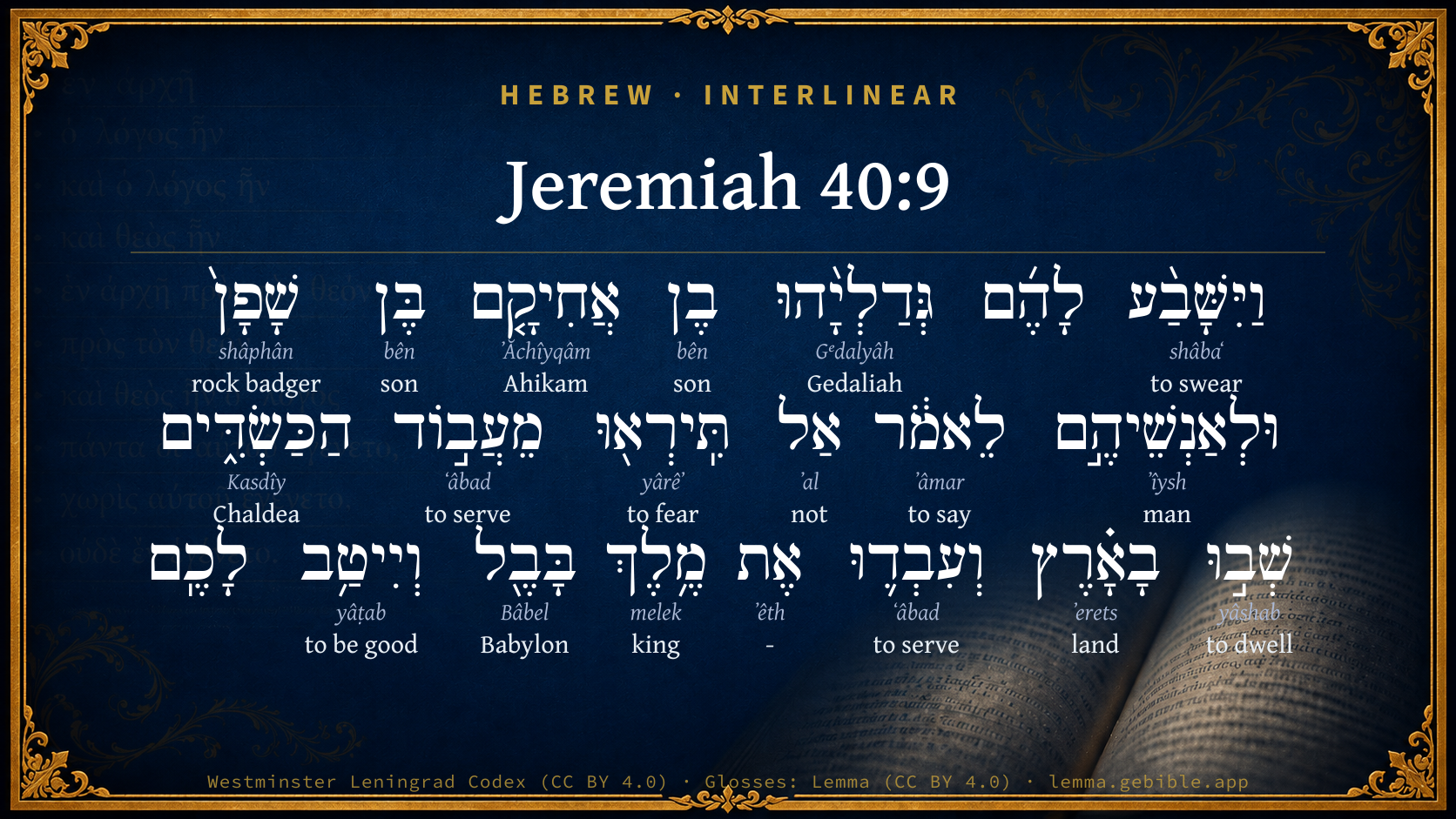
Jeremiah 40:9

Hebrew (Westminster Leningrad Codex) Jeremiah 40:9 appears in the Hebrew Old Testament. The text above is from the Westminster Leningrad Codex. Each word links to its Strong’s number, a concise gloss, and parsing drawn from the Open Scriptures Hebrew Bible morphology. Click any word for its full Brown-Driver-Briggs (BDB) entry.
Download image
Cite this verse

Jeremiah 40:9 (World English Bible). Public Domain. Lemma interlinear Bible study tool, https://lemma.gebible.app/v/jeremiah/40/9.

Show BibTeX & RIS
BibTeX
RIS
English Translation
Gedaliah the son of Ahikam the son of Shaphan swore to them and to their men, saying, Don't be afraid to serve the Chaldeans: dwell in the land, and serve the king of Babylon, and it shall be well with you.
World English Bible · Public Domain
Download a study sheet

One document with this verse’s original text, its word-by-word gloss line, the meaning frame, cross-references with their text, attributed commentary, and full source and license credits — printable, and it pastes into notes with its structure intact.

This verse Autodidact and up

Study sheet (.html) Plain text (.txt)

A passage Seminary Student

Up to 50 verses in one chapter. A passage sheet keeps up to 6 commentary sources and 12 cross-references per verse, in the order this page ranks them, and says so on the sheet whenever that leaves anything out. Ask for a single verse and you get the Autodidact verse sheet above.

Everything on this page stays free to read, with no account — the sheet is a download of what is already on screen, not access to it.

Want to remove ads? Support Godless Engineer
Compare translations 3

The same verse in 3 English versions, stacked beneath the original-language interlinear above. Click any original word for its lexicon entry.

Each is an independent rendering of the whole verse — the interlinear is not word-aligned to these translations.

Highlighted words mark where these versions differ — a whole-verse word diff, not a word-by-word alignment.

  • World English Bible Public Domain
    Gedaliah the son of Ahikam the son of Shaphan swore to them and to their men, saying, Don't be afraid to serve the Chaldeans: dwell in the land, and serve the king of Babylon, and it shall be well with you.
  • King James Version Public Domain
    And Gedaliah the son of Ahikam the son of Shaphan sware unto them and to their men, saying, Fear not to serve the Chaldeans: dwell in the land, and serve the king of Babylon, and it shall be well with you.
  • unfoldingWord Literal Text CC BY-SA 4.0
    Gedaliah son of Ahikam son of Shaphan took an oath to them and to their men and said to them, “Do not be afraid to serve the Chaldean officials. Live in the land and serve the king of Babylon, and it will go well with you.

unfoldingWord Literal Text — © unfoldingWord, licensed CC BY-SA 4.0. Word-aligned USFM3 via Door43 (git.door43.org/unfoldingWord/en_ult).

Versions to compare (up to 4)

3 of 4 selected

Show all 18 translations

Every available English version of this verse, each an independent rendering of the whole verse.

  • World English Bible Public Domain
    Gedaliah the son of Ahikam the son of Shaphan swore to them and to their men, saying, Don't be afraid to serve the Chaldeans: dwell in the land, and serve the king of Babylon, and it shall be well with you.
  • Berean Standard Bible Public Domain
    Gedaliah son of Ahikam, the son of Shaphan, swore an oath to them and their men, assuring them, “Do not be afraid to serve the Chaldeans. Live in the land and serve the king of Babylon, and it will go well with you.
  • Majority Standard Bible Public Domain
    Gedaliah son of Ahikam, the son of Shaphan, swore an oath to them and their men, assuring them, “Do not be afraid to serve the Chaldeans. Live in the land and serve the king of Babylon, and it will go well with you.
  • King James Version Public Domain
    And Gedaliah the son of Ahikam the son of Shaphan sware unto them and to their men, saying, Fear not to serve the Chaldeans: dwell in the land, and serve the king of Babylon, and it shall be well with you.
  • American Standard Version (1901) Public Domain
    And Gedaliah the son of Ahikam the son of Shaphan sware unto them and to their men, saying, Fear not to serve the Chaldeans: dwell in the land, and serve the king of Babylon, and it shall be well with you.
  • Revised Version (1885) Public Domain
    And Gedaliah the son of Ahikam the son of Shaphan sware unto them and to their men, saying, Fear not to serve the Chaldeans: dwell in the land, and serve the king of Babylon, and it shall be well with you.
  • Geneva Bible (1599) Public Domain
    And Gedaliah the sonne of Ahikam, the sonne of Shaphan sware vnto them, and to their men, saying, Feare not to serue the Caldeans: dwell in the lande, and serue the King of Babel, and it shall be well with you.
  • Douay-Rheims (1899) Public Domain
    And Godolias the son of Ahicam the son of Saphan swore to them and to their companions, saying: Fear not to serve the Chaldeass: dwell in the land, and serve the king of Babylon, and it shall be well with you.
  • Young's Literal Translation Public Domain
    And swear to them doth Gedaliah son of Ahikam, son of Shaphan, and to their men, saying, `Be not afraid of serving the Chaldeans, abide in the land, and serve the king of Babylon, and it is well for you;
  • Literal Standard Version CC BY-SA 4.0
    And Gedaliah son of Ahikam, son of Shaphan, swears to them and to their men, saying, “Do not be afraid of serving the Chaldeans, abide in the land, and serve the king of Babylon, and it is well for you;
  • Unlocked Literal Bible CC BY-SA 4.0
    Gedaliah son of Ahikam son of Shaphan took an oath to them and to their men and said to them, “Do not be afraid to serve the Chaldean officials. Live in the land and serve the king of Babylon, and it will go well with you.
  • unfoldingWord Literal Text CC BY-SA 4.0
    Gedaliah son of Ahikam son of Shaphan took an oath to them and to their men and said to them, “Do not be afraid to serve the Chaldean officials. Live in the land and serve the king of Babylon, and it will go well with you.
  • Darby Bible Public Domain
    And Gedaliah the son of Ahikam the son of Shaphan swore unto them and to their men, saying, Fear not to serve the Chaldeans: dwell in the land, and serve the king of Babylon, and it shall be well with you.
  • World Messianic Bible Public Domain
    Gedaliah the son of Ahikam the son of Shaphan swore to them and to their men, saying, “Don’t be afraid to serve the Kasdim. Dwell in the land, and serve the king of Babylon, and it will be well with you.
  • Webster's Bible Public Domain
    And Gedaliah the son of Ahikam the son of Shaphan, swore to them and to their men, saying, Fear not to serve the Chaldeans: dwell in the land, and serve the king of Babylon, and it shall be well with you.
  • Free Bible Version CC BY-SA 4.0
    Gedaliah son of Ahikam, the son of Shaphan, made them a solemn promise, saying, “Don't worry about serving the Babylonians. Stay here in the country and serve the king of Babylon, and things will go well for you.
  • Bible in Basic English Public Domain
    And Gedaliah, the son of Ahikam, the son of Shaphan, took an oath to them and their men, saying, Have no fear of the servants of the Chaldaeans: go on living in the land, and become the servants of the king of Babylon, and all will be well.
  • JPS Tanakh (1917) Public Domain
    And Gedaliah the son of Ahikam the son of Shaphan swore unto them and to their men, saying: 'Fear not to serve the Chaldeans; dwell in the land, and serve the king of Babylon, and it shall be well with you.

Literal Standard Version (2020), Covenant Press — licensed CC BY-SA 4.0. Text via the HelloAO Bible API (eBible.org). Unlocked Literal Bible (unfoldingWord) — licensed CC BY-SA 4.0. Text via the HelloAO Bible API (eBible.org). unfoldingWord Literal Text — © unfoldingWord, licensed CC BY-SA 4.0. Word-aligned USFM3 via Door43 (git.door43.org/unfoldingWord/en_ult). Free Bible Version, Dr. Jonathan Gallagher — licensed CC BY-SA 4.0. Text via the HelloAO Bible API (eBible.org).

Word by word

More ways to search: Search by grammar → Find every occurrence → Compare this word →

Practice this passage: Drill this verse → Learn its vocabulary →

אֲחִיקָ֤ם
ʼĂchîyqâm
H296
“Ahikam”
Noun, Proper
Part of Speech
Noun
Type
Proper
Full BDB Definition

Origin: from H251 and H6965

TWOT: None

Ahikam = "my brother has risen (arisen)" - son of Shaphan, an officer in Josiah's reign - protector of Jeremiah - father of Gedaliah
  1. וַיִּשָּׁבַ֨ע shâbaʻ H7650 “and · to swear” Conjunction + Verb, Niphal, Sequential Imperfect, 3rd Person, Masculine, Singular
  2. גְּדַלְיָ֨הוּ Gᵉdalyâh H1436 “Gedaliah” Noun, Proper
  3. בֶן bên H1121 “son of” Noun, Common, Masculine, Singular, Construct
  4. בֶּן bên H1121 “son of” Noun, Common, Masculine, Singular, Construct
  5. שָׁפָן֙ shâphân H8227 “rock badger” Noun, Proper
  6. וּלְאַנְשֵׁיהֶ֣ם ʼîysh H376 “and · to/for · men · their” Conjunction + Preposition + Noun, Common, Masculine, Plural, Construct + Suffix, Personal, 3rd Person, Masculine, Plural
  7. לֵאמֹ֔ר ʼâmar H559 “to say” Preposition + Verb, Qal, Infinitive Construct
  8. אַל ʼal H408 “not” Particle, Negative
  9. תִּֽירְא֖וּ yârêʼ H3372 “to fear” Verb, Qal, Jussive, 2nd Person, Masculine, Plural
  10. מֵעֲב֣וֹד ʻâbad H5647 “from · to serve” Preposition + Verb, Qal, Infinitive Construct
  11. הַכַּשְׂדִּ֑ים Kasdîy H3778 “the · Chaldea” Particle, Definite Article + Noun, Proper
  12. שְׁב֣וּ yâshab H3427 “dwell” Verb, Qal, Imperative, 2nd Person, Masculine, Plural
  13. בָאָ֗רֶץ ʼerets H776 “in/at the · land” Preposition, Determined + Noun, Common, Both, Singular, Absolute
  14. וְעִבְד֛וּ ʻâbad H5647 “and · serve” Conjunction + Verb, Qal, Imperative, 2nd Person, Masculine, Plural
  15. אֶת ʼêth H853 “-” Particle, Direct Object
  16. מֶ֥לֶךְ melek H4428 “king of” Noun, Common, Masculine, Singular, Construct
  17. בָּבֶ֖ל Bâbel H894 “Babylon” Noun, Proper
  18. וְיִיטַ֥ב yâṭab H3190 “and · to be good” Conjunction + Verb, Qal, Imperfect, 3rd Person, Masculine, Singular

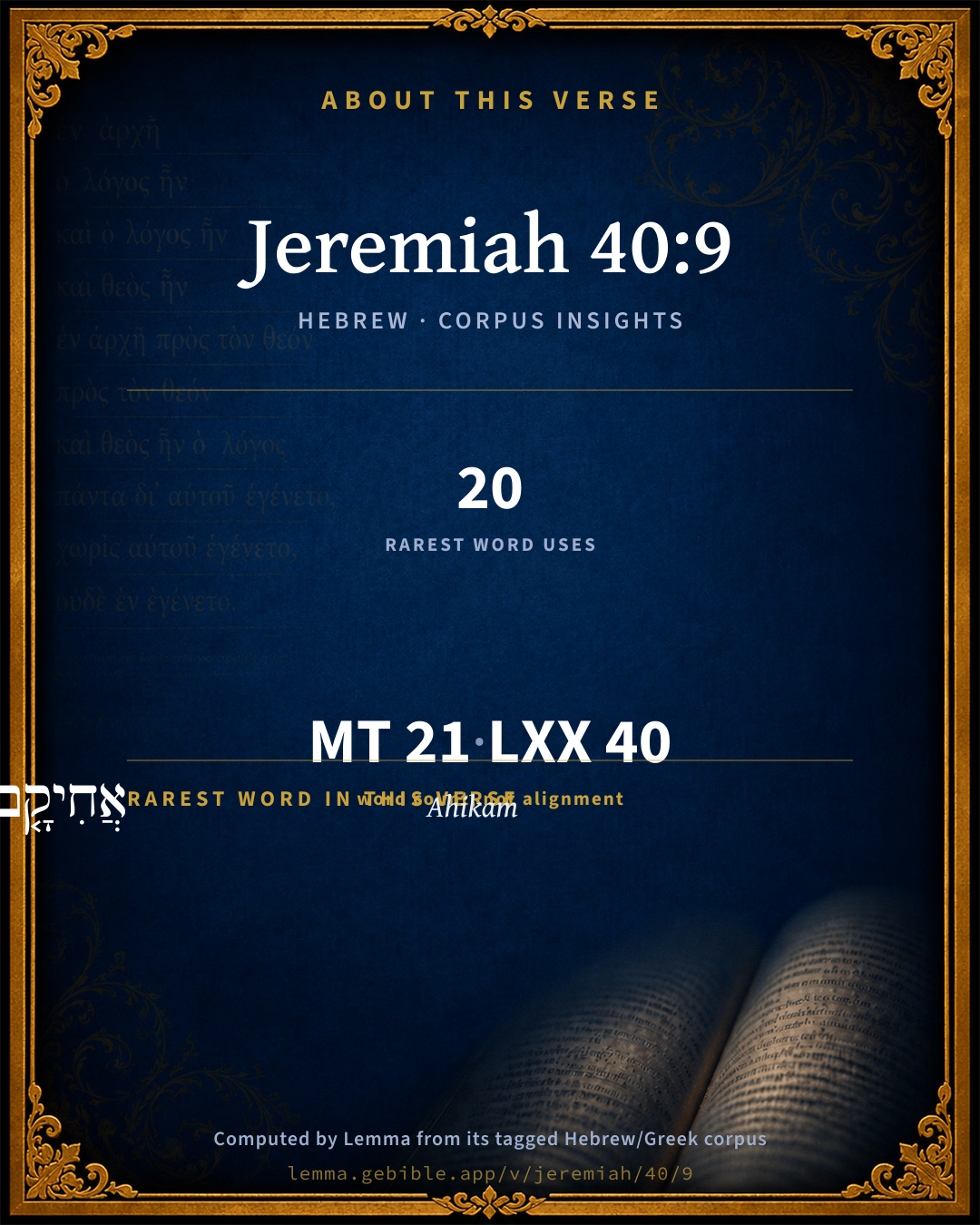
About this verse

These counts appear in no published source. They are computed here, from the morphology-tagged text and Lemma’s own curated glosses. What Lemma adds →

21
words
17
distinct lemmas
Prophets
section

Notable vocabulary

The rarest word here is אֲחִיקָ֤ם Ahikam H296 — appearing just 20 times in the whole Hebrew Bible.

Shared distinctive vocabulary

אֲחִיקָ֤ם Ahikam H296 occurs in 20 verses of the Hebrew Bible. Also found in:

Grammatical profile

  • 7 verbs
  • 10 nouns
  • 2 prepositions
  • 2 particles

Verb forms

  • וַיִּשָּׁבַ֨ע Niphal · Sequential Imperfect
  • לֵאמֹ֔ר Qal · Infinitive Construct
  • תִּֽירְא֖וּ Qal · Jussive
  • מֵעֲב֣וֹד Qal · Infinitive Construct
  • שְׁב֣וּ Qal · Imperative
  • וְעִבְד֛וּ Qal · Imperative
  • וְיִיטַ֥ב Qal · Imperfect

Repetition

Words recur within this verse — often emphatic in Hebrew:

  • בֶן son H1121 ×2
  • מֵעֲב֣וֹד to serve H5647 ×2

Hebrew & Septuagint length

In the original languages it is 21 Hebrew tokens and 40 Greek tokens — but the two are counted differently (Hebrew bundles its prefixes and suffixes into one token; the Greek is in lemma form), so that isn’t a like-for-like length.

Cross-references

7

Topical passages linked to Jeremiah 40:9 in the Treasury of Scripture Knowledge — connected by theme and wording, ordered by reader-vote popularity; previews shown in the World English Bible.

  • Jeremiah 27:11 But the nation that shall bring their neck under the yoke of the king of Babylon, and serve him, that [nation] will I let remain in their own land, says Yahweh; and they shall till it, and dwell therein.
  • 1 Samuel 20:16–17 So Jonathan made a covenant with the house of David, [saying], Yahweh will require it at the hand of David's enemies.
  • 2 Kings 25:24 Gedaliah swore to them and to their men, and said to them, Don't be afraid because of the servants of the Chaldeans: dwell in the land, and serve the king of Babylon, and it shall be well with you.
  • Jeremiah 38:17–20 Then said Jeremiah to Zedekiah, Thus says Yahweh, the God of hosts, the God of Israel: If you will go forth to the king of Babylon's princes, then your soul shall live, and this city shall not be burned with fire; and you shall live, and your house.
  • Genesis 49:15 He saw a resting-place, that it was good, The land, that it was pleasant; He bows his shoulder to the burden, And becomes a servant doing forced labor.
  • Psalms 37:3 Trust in Yahweh, and do good. Dwell in the land, and enjoy safe pasture.
  • Psalms 128:2 For you will eat the labor of your hands. You will be happy, and it will be well with you.

Cross-references courtesy of OpenBible.info (CC BY 4.0).

Hebrew and Greek witnesses Masoretic Hebrew ↔ Greek Septuagint

The same verse in the two great witnesses to the Old Testament, shown verse-for-verse.

These are two independent witnesses, not word-aligned to each other, and the Septuagint is shown in lemma (dictionary) form.

Hebrew Jeremiah 40:9 Masoretic · Westminster Leningrad Codex

וַיִּשָּׁבַ֨ע לָהֶ֜ם גְּדַלְיָ֨הוּ בֶן אֲחִיקָ֤ם בֶּן שָׁפָן֙ וּלְאַנְשֵׁיהֶ֣ם לֵאמֹ֔ר אַל תִּֽירְא֖וּ מֵעֲב֣וֹד הַכַּשְׂדִּ֑ים שְׁב֣וּ בָאָ֗רֶץ וְעִבְד֛וּ אֶת מֶ֥לֶךְ בָּבֶ֖ל וְיִיטַ֥ב לָכֶֽם

Gedaliah the son of Ahikam the son of Shaphan swore to them and to their men, saying, Don't be afraid to serve the Chaldeans: dwell in the land, and serve the king of Babylon, and it shall be well with you.

World English Bible · Public Domain

Greek LXX Structure differs

In the Septuagint, Jeremiah is about an eighth shorter than the Hebrew and arranges its material differently — the Oracles Against the Nations (Hebrew chapters 46–51) appear in the middle of the Greek book, after 25:13. Because the chapter and verse boundaries do not line up, a verse-for-verse comparison with the Hebrew is not shown.

A verse-for-verse comparison isn’t shown here because the chapters and verses don’t line up. Switch to the LXX edition with the MT / LXX toggle above to read the Greek directly.

On this verse, The Cambridge Bible for Schools and Colleges discusses the Septuagint’s reading. Read the note in Commentary ↓

Hebrew: Westminster Leningrad Codex (CC BY 4.0). Greek: Septuagint (public domain); English from a public-domain English Septuagint. How the Septuagint differs from the Hebrew →

Targum (Aramaic paraphrase)

1

The Targum is the ancient Jewish Aramaic paraphrase of the Hebrew Scriptures — an interpretive translation, not the Hebrew text itself. Onkelos (literal) and Pseudo-Jonathan (expansive) render the Torah, and Jonathan the Prophets. Coverage is partial: where no permissively-licensed English translation exists for a verse, only the Aramaic is shown. This is verse-level text, not a word-by-word alignment to the Hebrew.

  1. Targum Jonathan Prophets (Joshua–Malachi)
    וְקַיֵם לְהוֹן גְדַלְיָה בַּר אֲחִיקָם בַּר שָׁפָן וּלְגַבְרֵיהוֹן לְמֵימָר לָא תִדַחֲלוּן מִלְמִפְלַח לְכַסְדָאֵי תְּבוּ בְאַרְעָא וּפְלַחוּ יַת מַלְכָּא דְבָבֶל וְיִיטַב לְכוֹן:

    (no public-domain English translation for this verse)

    Targum Jonathan — Aramaic: “Mikraot Gedolot” (public domain). English: “Sefaria Community Translation” (CC0 1.0 (public-domain dedication)); “London "Chaldee Paraphrase," 1871” (public domain). Text via Sefaria.

Commentary

Notes on Jeremiah 40:9 from classic Christian and Jewish commentators (each source and its license shown beneath its notes). The classic Christian expositions comment on the surrounding passage and are grouped to its opening verse, so a note may address several verses; the Jewish commentaries on the Tanakh (Rashi and others) are per-verse, so they appear only where the commentator wrote on this verse.

Lemma curates 59 commentaries, every one of them public domain or Creative Commons licensed, each selected and text-cleaned for this edition rather than reprinted as found. About our sources →

Trapp's Complete Commentary

John Trapp

Jer 40:9 And Gedaliah the son of Ahikam the son of Shaphan sware unto them and to their men, saying, Fear not to serve the Chaldeans: dwell in the land, and serve the king of Babylon, and it shall be well with you.

Ver. 9. And Gedaliah sware unto them,] viz., That what he spake was from his heart, and out of good affection to them all.

John Trapp, A Commentary or Exposition upon All the Books of the Old and New Testament (1647–1656) — public domain. Text from a community e-Sword module.

Tyndale Open Study Notes

Tyndale Open Resources

40:9-10 Gedaliah did his best to assure the Judean guerrillas that peaceful settlement under the rule of the Babylonians would bring prosperity.

Tyndale Open Study Notes — © Tyndale Open Resources, licensed CC BY-SA 4.0. Text via the HelloAO Bible API.

Jamieson, Fausset & Brown

Robert Jamieson, A. R. Fausset & David Brown

Fear not--They were afraid that they should not obtain pardon from the Chaldeans for their acts. He therefore assured them of safety by an oath.

serve--literally, "to stand before" (Jer 40:10; Jer 52:12), that is, to be at hand ready to execute the commands of the king of Babylon.

Jamieson, Fausset & Brown — Commentary Critical and Explanatory on the Whole Bible (1871) — public domain (CC PDM 1.0). Text via the HelloAO Bible API.

John Calvin's Commentaries

Here, as I have hinted, is explained the great humanity of Gedaliah, and also his pious solicitude for his own nation, in order that the perfidy and cruelty of the son of Nethaniah might appear the more detestable, who slew a man so well deserving in his conduct to him and to others, having been led to do so by reward.

The Prophet says that he swore to them; nor was it strange to interpose an oath in a state of things so disturbed. Hardly could Ishmael and the rest have any confidence, since the Chaldeans had been so extremely hostile to them; they must, indeed, have been in the greatest trepidation. There was, therefore, need of a remedy, even that Gedaliah should assure them of his integrity. This was the reason why he made an oath; for had it been in times of tranquillity, an oath would not have been necessary. But as their life hung, as it were, on a thread, and they saw many dangers on every side, there was need of a confirmation; nor did Gedaliah receive them without some danger; for it was not pleasing to the Chaldeans that such men should continue in the land. For we have seen that the princes had been on this account killed, and then all the chief men among the people had been removed to Chaldea, lest any of them should attempt some new commotions. It was, therefore, the object of Nebuchadnezzar to keep the country quiet; and this was the best way to prevent any disturbance. Gedaliah then, no doubt, saw that this would not be very agreeable to the Chaldeans, and yet his humanity prevailed, and his concern for his own nation, that he not only hospitably received them, but also promised them by an oath, that there would be safety for them. He therefore exhorted them to be confident, and also to serve the Chaldeans. It was, indeed, especially expected of them, that they should surrender up themselves, as their case was hopeless. Then Gedaliah promised that the Chaldeans would be content with a voluntary submission; and he promised them also, that there would be a safe dwelling for them in the land.

John Calvin's Commentaries (1540-1563) — public domain. Text from the Calvin Translation Society English edition (1840s-50s) via the Christian Classics Ethereal Library (ccel.org). Calvin's coverage is partial (roughly two-thirds of the Bible); uncommented books and verses are honest gaps, never fabricated. The 19th-century editor's footnotes and remarks are omitted so the notes are faithfully Calvin's own voice.

Ellicott's Commentary for English Readers

(9) Fear not to serve the Chaldeans . . .—Gedaliah, acting as Satrap of the province, assures them that, though they had fought against the conquerors, there would be a full amnesty, and that they might therefore banish all fears of being maltreated. He will remain at his post, and they may return to their own homes.

A Bible Commentary for English Readers, edited by Charles John Ellicott (1878–1897) — public domain. Text from a community e-Sword module.

The Cambridge Bible for Schools and Colleges

gen. ed. J. J. S. Perowne

9. to serve the Chaldeans] The LXX here have “because of the servants of the Chaldaeans,” i.e. the officers placed here and there through the land by the conquerors. This agrees with MT. in 2Ki_25:24, but probably the original reading of the Hebrew in both places (lost through confusing two very similar consonants) is that preserved by LXX in Kgs, viz. the passing through of the Chaldaeans, i.e. the danger arising from the frequent passage of Babylonian forces in military operations, such as attacks on Egypt.

The Cambridge Bible for Schools and Colleges (gen. ed. J. J. S. Perowne; Cambridge University Press, 1878–1918) — public domain. Text from a community e-Sword module.

John Gill's Exposition

And Gedaliah the son of Ahikam the son of Shaphan aware unto them and to their men,.... They might express their fears, that should they continue with Gedaliah, as they were inclined to do, could they be safe; that seeing they had encouraged Zedekiah to hold out the siege to the last against the Chaldeans, and they should hear where they were, would demand them, and they, should be taken and delivered up into their hands; upon which Gedaliah not only promises them safety, but swears to them that they should live safely with him, and never be delivered up to the Chaldeans, and that he would undertake to indemnify them, and preserve them:

saying, fear not to serve the Chaldeans; as if it was an evil to do it; or as if their yoke was hard and intolerable; or as if it would be unprofitable, and turn to no account; or they should be always in danger of their lives:

dwell in the land, and serve the king of Babylon, and it shall he well with you; settle in the land, and do not rove about from place to place like fugitives; nor go out of the land through fear of the king of Babylon, but continue in it, and live in subjection to him, and depend upon it you will live comfortably and safely.

John Gill's Exposition of the Whole Bible (1746–1763) — public domain (CC PDM 1.0). Text via the HelloAO Bible API.

Albert Barnes' Notes on the Bible

To serve the Chaldeans - literally, as margin; to be their minister and lieutenant. Gedaliah supposed that officers of high rank would come from time to time from Babylon to look after the king’s interests. But whatever was ordered would be done through him, as being the prime minister.

Gather ye wine - As Jerusalem was captured in the fifth month, August, it would now be autumn, and there would be fruit upon the trees, enough to maintain the scanty population during the winter.

Taken - Or, seized. Every captain had probably occupied some place by force as his head quarters, and Gedaliah bids them retain them. He frankly accepts the whole existing state of things, as a necessary step toward re-establishing confidence.

Albert Barnes' Notes on the Bible (1834–1885) — public domain. Text from a community e-Sword/MySword module.

Haydock's Catholic Bible Commentary

With you. They might naturally suspect Godolias, and think that the Chaldeans would seize them as soon as they should know of their escape.

George Leo Haydock (1774–1849), Haydock's Catholic Family Bible and Commentary, 1859 edition — public domain. Excludes Psalms (Douay-Rheims chapter numbering differs from Protestant) and Deuterocanonical books (Catholic canon only).

Matthew Poole's English Annotations

They might reasonably suspect that the Chaldeans would have a jealous eye upon any conflux of people to Jerusalem, especially military men, and therefore be something suspicious of him who was the Chaldean deputy governor; the securing of them from fears on this account was the cause of this voluntary oath taken by Gedaliah. He encourageth them to be servants to the Chaldeans, and to dwell in the land, assuring them that if they would, they should fare well; he was well enough assured of the Chaldeans’ favour, that if they would live peaceably in their own land, they should, they would not come any more to carry them away captive.

Matthew Poole's English Annotations on the Holy Bible (1683–1685) — public domain. Text from a community e-Sword/MySword module.

Whedon's Commentary on the Bible

Daniel D. Whedon

9. Fear not to serve the Chaldeans — The tone of this communication is friendly and encouraging. Gedaliah speaks to them as conquered and tributary, but assures them of the friendly disposition of the government which he represents.

Daniel D. Whedon (gen. ed.), Commentary on the Old and New Testaments (1874–1909) — public domain. Text from a community e-Sword module.

unfoldingWord translationNotes

Door43 World Missions Community

took an oath to them

"swore to the Judean commanders"

Look

"Listen carefully" or "Pay attention"

summer fruit

"fruit that becomes ripe during the summer"

you have occupied

"you have taken over." "Occupy" here is a military term. Gedaliah was talking to soldiers (Jeremiah 40:7) who may have conquered or otherwise taken control of cities.

translationWords

oath

fear

servant

Chaldea

life

king

harvest

wine

fruit

oil

unfoldingWord translationNotes — © Distant Shores Media and the Door43 World Missions Community, licensed CC BY-SA 4.0. Source: git.door43.org/Door43/en_tn.

Lesson kit

Teaching starters — assembled from the data on this page, not authored interpretation. Every prompt links to the verse data it draws on. Edit before teaching.

Jeremiah, in the Prophets, opens this verse with 21 words (17 distinct Hebrew lemmas). Its most distinctive word is ʼĂchîyqâm (“Ahikam”). A historical commentator’s framing appears above. Read the whole chapter for the surrounding context.

Discussion questions

  1. What does “Ahikam” (ʼĂchîyqâm) contribute to the verse as a whole?
  2. 2 Kings 22:12 shares the word «Ahikam» with this verse. How do the two illuminate each other?
  3. “son” occurs 2× in this one verse. What is the effect of the repetition?
  4. These translations render this verse differently. What is at stake in choosing one wording over another?
  5. The verb «וַיִּשָּׁבַ֨ע» is Niphal Sequential Imperfect. How does its form color the action?
  6. Reading how Trapp's Complete Commentary and Tyndale Open Study Notes read this verse, where do the two commentators agree and where do they part?

Things to notice

Reading settings

Reading text

Shown beneath each verse's original-language words.

Old Testament
Old Testament edition

Read the OT as the Masoretic Hebrew (MT) or the Greek Septuagint (LXX).

English shown for the Greek Septuagint (in the Hebrew ↔ Greek comparison).

Comparing translations? Open the Compare panel on any verse page to stack up to four side by side.