
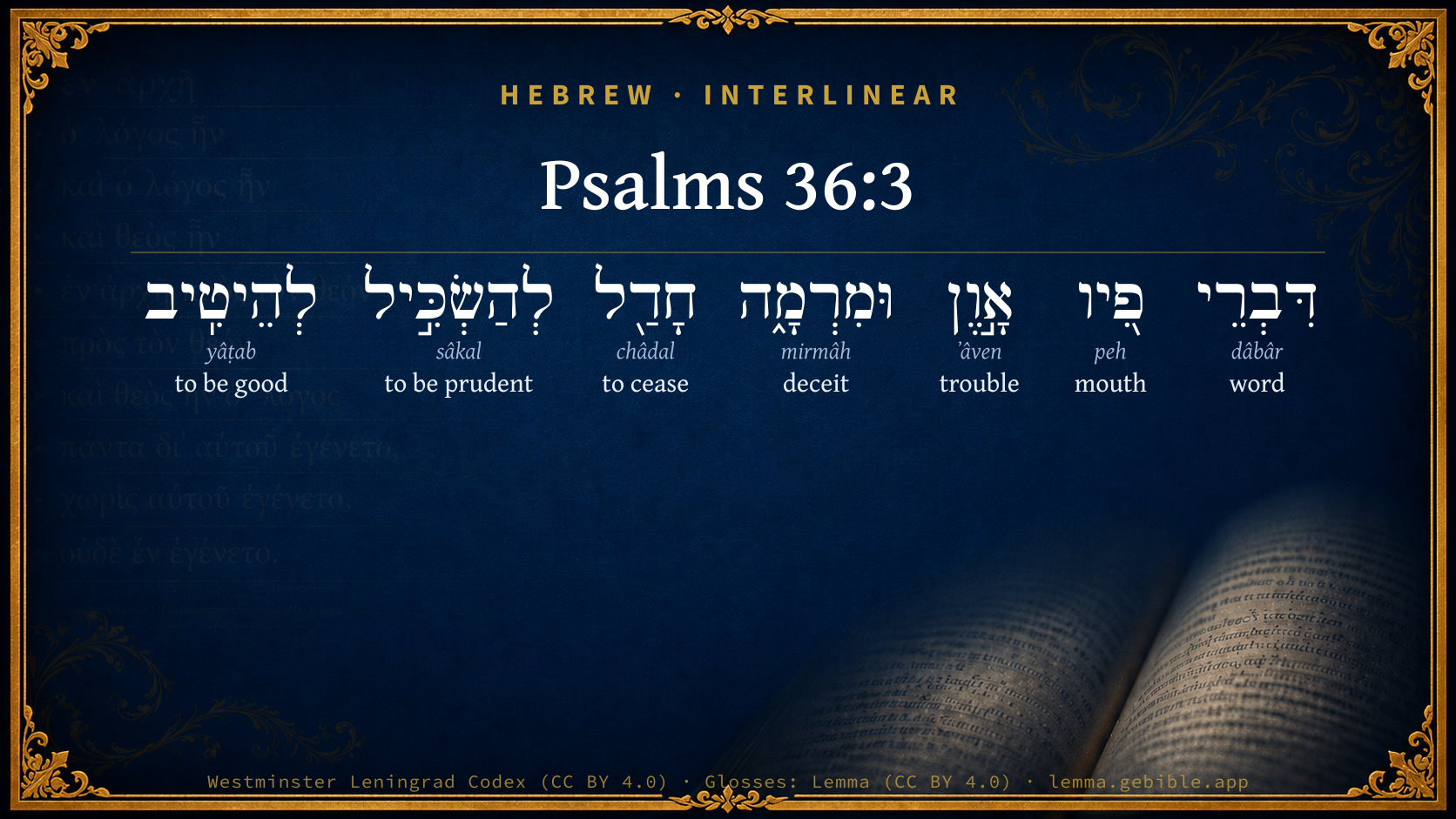
Psalms 36:3

Hebrew (Westminster Leningrad Codex) Psalms 36:3 appears in the Hebrew Old Testament. The text above is from the Westminster Leningrad Codex. Each word links to its Strong’s number, a concise gloss, and parsing drawn from the Open Scriptures Hebrew Bible morphology. Click any word for its full Brown-Driver-Briggs (BDB) entry.
Download image
Cite this verse

Psalms 36:3 (World English Bible). Public Domain. Lemma interlinear Bible study tool, https://lemma.gebible.app/v/psalms/36/3.

Show BibTeX & RIS
BibTeX
RIS
English Translation
The words of his mouth are iniquity and deceit. He has ceased to be wise and to do good.
World English Bible · Public Domain
Download a study sheet

One document with this verse’s original text, its word-by-word gloss line, the meaning frame, cross-references with their text, attributed commentary, and full source and license credits — printable, and it pastes into notes with its structure intact.

This verse Autodidact and up

Study sheet (.html) Plain text (.txt)

A passage Seminary Student

Up to 50 verses in one chapter. A passage sheet keeps up to 6 commentary sources and 12 cross-references per verse, in the order this page ranks them, and says so on the sheet whenever that leaves anything out. Ask for a single verse and you get the Autodidact verse sheet above.

Everything on this page stays free to read, with no account — the sheet is a download of what is already on screen, not access to it.

Want to remove ads? Support Godless Engineer
Compare translations 3

The same verse in 3 English versions, stacked beneath the original-language interlinear above. Click any original word for its lexicon entry.

Each is an independent rendering of the whole verse — the interlinear is not word-aligned to these translations.

Highlighted words mark where these versions differ — a whole-verse word diff, not a word-by-word alignment.

  • World English Bible Public Domain
    The words of his mouth are iniquity and deceit. He has ceased to be wise and to do good.
  • King James Version Public Domain
    The words of his mouth are iniquity and deceit: he hath left off to be wise, and to do good.
  • unfoldingWord Literal Text CC BY-SA 4.0
    The words of his mouth iniquity and deceit; he has ceased to act wisely, to do good.

unfoldingWord Literal Text — © unfoldingWord, licensed CC BY-SA 4.0. Word-aligned USFM3 via Door43 (git.door43.org/unfoldingWord/en_ult).

Versions to compare (up to 4)

3 of 4 selected

Show all 18 translations

Every available English version of this verse, each an independent rendering of the whole verse.

  • World English Bible Public Domain
    The words of his mouth are iniquity and deceit. He has ceased to be wise and to do good.
  • Berean Standard Bible Public Domain
    The words of his mouth are wicked and deceitful; he has ceased to be wise and well-doing.
  • Majority Standard Bible Public Domain
    The words of his mouth are wicked and deceitful; he has ceased to be wise and well-doing.
  • King James Version Public Domain
    The words of his mouth are iniquity and deceit: he hath left off to be wise, and to do good.
  • American Standard Version (1901) Public Domain
    The words of his mouth are iniquity and deceit: He hath ceased to be wise `and' to do good.
  • Revised Version (1885) Public Domain
    The words of his mouth are iniquity and deceit: he hath left off to be wise and to do good.
  • Geneva Bible (1599) Public Domain
    The wordes of his mouth are iniquitie and deceit: hee hath left off to vnderstand and to doe good.
  • Douay-Rheims (1899) Public Domain
    For in his sight he hath done deceitfully, that his iniquity may be found unto hatred.
  • Young's Literal Translation Public Domain
    The words of his mouth `are' iniquity and deceit, He ceased to act prudently -- to do good.
  • Literal Standard Version CC BY-SA 4.0
    The words of his mouth [are] iniquity and deceit, || He ceased to act prudently—to do good.
  • Unlocked Literal Bible CC BY-SA 4.0
    His words are sinful and deceitful; he does not want to be wise and do good.
  • unfoldingWord Literal Text CC BY-SA 4.0
    The words of his mouth iniquity and deceit; he has ceased to act wisely, to do good.
  • Darby Bible Public Domain
    The words of his mouth are wickedness and deceit: he hath left off to be wise, to do good.
  • World Messianic Bible Public Domain
    The words of his mouth are iniquity and deceit. He has ceased to be wise and to do good.
  • Webster's Bible Public Domain
    \\36:2\\For he flattereth himself in his own eyes, until his iniquity is found to be hateful.
  • Free Bible Version CC BY-SA 4.0
    Whatever they say is deceptive and deceitful. They no longer do anything wisely or for good.
  • Bible in Basic English Public Domain
    In the words of his mouth are evil and deceit; he has given up being wise and doing good.
  • JPS Tanakh (1917) Public Domain
    (36-4) The words of his mouth are iniquity and deceit; he hath left off to be wise, to do good.

Literal Standard Version (2020), Covenant Press — licensed CC BY-SA 4.0. Text via the HelloAO Bible API (eBible.org). Unlocked Literal Bible (unfoldingWord) — licensed CC BY-SA 4.0. Text via the HelloAO Bible API (eBible.org). unfoldingWord Literal Text — © unfoldingWord, licensed CC BY-SA 4.0. Word-aligned USFM3 via Door43 (git.door43.org/unfoldingWord/en_ult). Free Bible Version, Dr. Jonathan Gallagher — licensed CC BY-SA 4.0. Text via the HelloAO Bible API (eBible.org).

Word by word

More ways to search: Search by grammar → Find every occurrence → Compare this word →

Practice this passage: Drill this verse → Learn its vocabulary →

About this verse

These counts appear in no published source. They are computed here, from the morphology-tagged text and Lemma’s own curated glosses. What Lemma adds →

7
words
7
distinct lemmas
Wisdom
section

Shared distinctive vocabulary

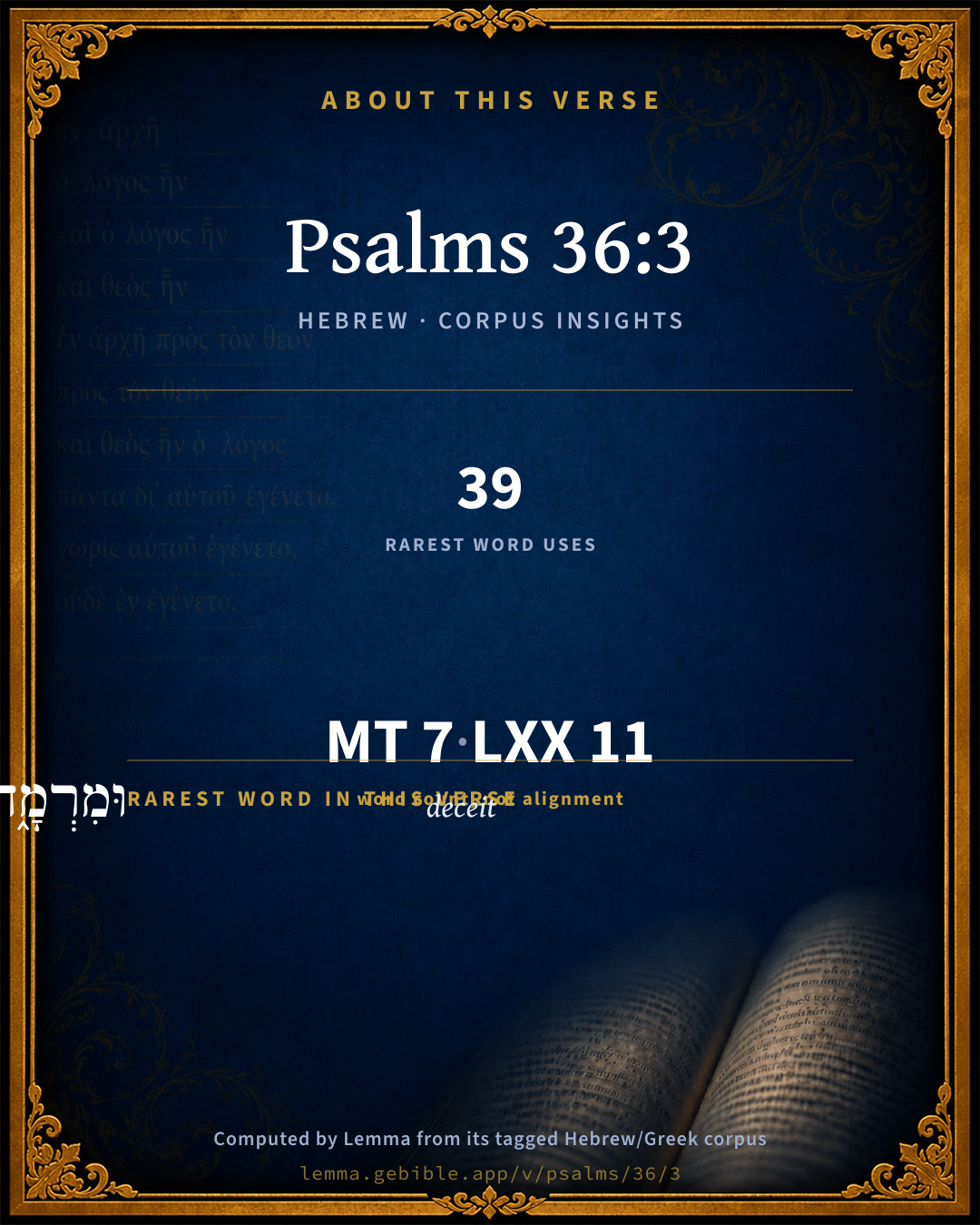
וּמִרְמָ֑ה deceit H4820 occurs in 38 verses of the Hebrew Bible. Also found in:

Grammatical profile

  • 3 verbs
  • 4 nouns

Verb forms

  • חָדַ֖ל Qal · Perfect
  • לְהַשְׂכִּ֣יל Hiphil · Infinitive Construct
  • לְהֵיטִֽיב Hiphil · Infinitive Construct

Hebrew & Septuagint length

In English translation the verse runs 19 words from the Hebrew and 19 from the Septuagint (LXX English) — the same length.

A rough comparison of the two English renderings, which tokenize alike — not a word-level alignment.

Word counts can differ between the Hebrew and the Greek without any difference in meaning — e.g. the Hebrew direct-object marker אֵת has no separate Greek word, and Greek often adds the article ὁ.

In the original languages it is 7 Hebrew tokens and 11 Greek tokens — but the two are counted differently (Hebrew bundles its prefixes and suffixes into one token; the Greek is in lemma form), so that isn’t a like-for-like length.

Cross-references

21

Topical passages linked to Psalms 36:3 in the Treasury of Scripture Knowledge — connected by theme and wording, ordered by reader-vote popularity; previews shown in the World English Bible.

  • Psalms 55:21 His mouth was smooth as butter, But his heart was war. His words were softer than oil, Yet they were drawn swords.
  • Jeremiah 4:22 For my people are foolish, they don't know me; they are foolish children, and they have no understanding; they are wise to do evil, but to do good they have no knowledge.
  • Psalms 10:7 His mouth is full of cursing, deceit, and oppression. Under his tongue is mischief and iniquity.
  • Matthew 22:15–18 Then the Pharisees went and took counsel how they might entrap him in his talk.
  • 1 John 2:19 They went out from us, but they didn't belong to us; for if they had belonged to us, they would have continued with us. But they left, that they might be revealed that none of them belong to us.
  • 1 Samuel 11:6–13 The Spirit of God came mightily on Saul when he heard those words, and his anger was kindled greatly.
  • 1 Samuel 13:13–14 Samuel said to Saul, You have done foolishly; you have not kept the commandment of Yahweh your God, which he commanded you: for now would Yahweh have established your kingdom on Israel forever.
  • 1 Samuel 15:26 Samuel said to Saul, I will not return with you; for you have rejected the word of Yahweh, and Yahweh has rejected you from being king over Israel.
  • 1 Samuel 16:14 Now the Spirit of Yahweh departed from Saul, and an evil spirit from Yahweh troubled him.
  • 1 Samuel 18:21 Saul said, I will give her to him, that she may be a snare to him, and that the hand of the Philistines may be against him. Therefore Saul said to David, You shall this day be my son-in-law a second time.
  • 1 Samuel 19:6–7 Saul listened to the voice of Jonathan: and Saul swore, As Yahweh lives, he shall not be put to death.
  • 1 Samuel 26:21 Then said Saul, I have sinned: return, my son David; for I will no more do you harm, because my life was precious in your eyes this day: behold, I have played the fool, and have erred exceedingly.
  • Psalms 5:9 For there is no faithfulness in their mouth. Their heart is destruction. Their throat is an open tomb. They flatter with their tongue.
  • Psalms 12:2–3 Everyone lies to his neighbor. They speak with flattering lips, and with a double heart.
  • Psalms 58:3 The wicked go astray from the womb. They are wayward as soon as they are born, speaking lies.
  • Psalms 94:8 Consider, you senseless among the people; You fools, when will you be wise?
  • Psalms 125:5 But as for those who turn aside to their crooked ways, Yahweh will lead them away with the workers of iniquity. Peace be on Israel.
  • Psalms 140:3 They have sharpened their tongues like a serpent. Viper's poison is under their lips. Selah.
  • Zephaniah 1:6 those who have turned back from following Yahweh, and those who haven't sought Yahweh nor inquired after him.
  • Matthew 22:35 One of them, a lawyer, asked him a question, testing him.
  • Hebrews 10:39 But we are not of those who shrink back to destruction, but of those who have faith to the saving of the soul.

Cross-references courtesy of OpenBible.info (CC BY 4.0).

Hebrew and Greek witnesses Masoretic Hebrew ↔ Greek Septuagint

The same verse in the two great witnesses to the Old Testament, shown verse-for-verse.

You’re reading Greek Psalm 35 (Hebrew Psalm 36). The Septuagint counts the superscription, so verse numbers can differ from the Hebrew — chapter-level alignment, not verse-by-verse. Numbering follows Rahlfs.

These are two independent witnesses, not word-aligned to each other, and the Septuagint is shown in lemma (dictionary) form.

Hebrew Psalms 36:3 Masoretic · Westminster Leningrad Codex

דִּבְרֵי פִ֭יו אָ֣וֶן וּמִרְמָ֑ה חָדַ֖ל לְהַשְׂכִּ֣יל לְהֵיטִֽיב

The words of his mouth are iniquity and deceit. He has ceased to be wise and to do good.

World English Bible · Public Domain

Greek LXX Greek Psalm 35:3 Septuagint · lemma form

ὅτι δολόω ἐνώπιον αὐτός ὁ εὑρίσκω ὁ ἀνομία αὐτός καί μισέω

The words of his mouth are transgression and deceit: he is not inclined to understand how to do good.

LXX2012 (modern English Septuagint) · Public Domain

Hebrew: Westminster Leningrad Codex (CC BY 4.0). Greek: Septuagint (public domain); English from LXX2012 (modern English Septuagint) (Public Domain). How the Septuagint differs from the Hebrew →

Commentary

Notes on Psalms 36:3 from classic Christian and Jewish commentators (each source and its license shown beneath its notes). The classic Christian expositions comment on the surrounding passage and are grouped to its opening verse, so a note may address several verses; the Jewish commentaries on the Tanakh (Rashi and others) are per-verse, so they appear only where the commentator wrote on this verse.

Lemma curates 59 commentaries, every one of them public domain or Creative Commons licensed, each selected and text-cleaned for this edition rather than reprinted as found. About our sources →

Trapp's Complete Commentary

John Trapp

Psa 36:3 The words of his mouth [are] iniquity and deceit: he hath left off to be wise, [and] to do good.

Ver. 3. The words of his mouth are iniquity and deceit] That is, saith Calvin, he hath something to say to excuse and justify himself, to the hardening of his heart and hastening of his destruction; and there is no wool so coarse but will take some colour. But God will one day wash off his varnish with rivers of brimstone; he can skill of no other language but that of hell; the words of his mouth are, desiderium et dolus; there is no truth, and as little trust to be put in anything that he speaketh. And why? there is no fear of God before his eyes. See a like text, Rom 3:13-15.

He hath left off to be wise, and to do good] That little light he once had he hath lost, and cast off such good practices as once in hypocrisy he performed; neither will he learn to do better. Dicit reprobos fugitare rationem bene agendi, ne vitam suam in melius corrigere cogantur, saith Vatablus.

John Trapp, A Commentary or Exposition upon All the Books of the Old and New Testament (1647–1656) — public domain. Text from a community e-Sword module.

Joseph Benson's Commentary

Psa 36:3-4. The words of his mouth are iniquity and deceit — Are wicked and deceitful. He hath left off to be wise and to do good — Once he had some degrees of wisdom, and did things that were apparently good, and seemed to be under the government of religion: but now he is an open apostate from that which he once professed. He deviseth mischief upon his bed — Freely from his own inclination, when none are present to provoke him to it. He setteth himself in a way that is not good — He doth not repent of his wicked devices, but resolutely proceeds to execute them, and persists therein. He abhorreth not evil — Though he sometimes professes to feel remorse for his conduct, and desists for a time from his evil practices, yet he does not truly repent of, nor abhor them, and therefore is ready to return to them when any occasion offers itself.

Joseph Benson's Commentary on the Old and New Testaments (1811–1818) — public domain. Text from a community e-Sword module.

J. A. Alexander on Psalms

Joseph Addison Alexander

4. (Psa 36:3). The words of his mouth (are) falsehood and fraud, he has ceased to act wisely, to act well (do good). The use of the abstract for the concrete, falsehood and deceit for false and deceitful, adds to the strength of the expression. What he say is not merely false, but falsity itself. For the precise meaning of the Hebrew words, see above, on Psa 5:6-7 (5, 6). The verbs of the last clause are in the causative form, which always has an active meaning. To be wise is therefore an inadequate translation, and to do good an ambiguous one, as this English phrase is specially applied to acts of benefience or practical utility. The true sense of the last verb is to do well or right, in opposition to doing wrong. See below, on Psa 37:3. Instead of ceasing from his sins, the sinner has abandoned even the appearance of well-doing. The form of epression is like that in Isa 1:16

Joseph Addison Alexander, The Psalms Translated and Explained (1850) — public domain. Text from a community e-Sword module.

Geneva Bible (1599)

Geneva Bible translators

The reprobate mock at wholesome doctrine, and put not difference between good and evil.

Geneva Bible (1599) marginal notes — public domain. Text via Bolls.life.

Adam Clarke's Commentary

Verse 3. The words of his mouth are iniquity] In the principle; and deceit calculated to pervert others, and lead them astray.

He hath left off to be wise, and to do good.] His heart is become foolish, and his actions wicked. He has cut off the connection between himself and all righteousness.

Adam Clarke's Commentary on the Bible (1810–1826) — public domain. Text from a community e-Sword/MySword module.

John Calvin's Commentaries

3. The words of his mouth are iniquity and deceit. The two clauses of this verse may be understood as referring to the same thing, namely, that the wicked indulging in deceit and vanity, will not receive or admit the light of understanding. This, I apprehend, is the meaning of David. He reproves the wicked not merely for circumventing others by their wiles and stratagems, but especially because they are altogether destitute of uprightness and sincerity. We have already said that the Psalmist is here speaking not of sinful and wicked men, in whose hearts there still remains some fear of God, but of the profane despisers of his name, who have given themselves up entirely to the practice of sin. He therefore says that they have always in their mouth some frivolous excuses and vain pretexts, by which they encourage themselves in rejecting and scoffing at all sound doctrine. He then adds, that they purposely suppress in themselves all knowledge or understanding of the distinction between good and evil, because they have no desire to become better than they are. We know that God has given understanding to men to direct them to do what is good. Now David says that the wicked shun it, and strive to deprive themselves of it, that they may not be constrained to repent of their wickedness, and to amend their lives. We are taught from this passage, that if at any time we turn aside from the path of rectitude, the only remedy in such a case is to open the eyes of our understanding, that we may rightly distinguish between good and evil, and that thus we may be led back from our wandering. When, instead of doing this, a man refuses instruction, it is an indication that he is in a state of depravity altogether desperate.

John Calvin's Commentaries (1540-1563) — public domain. Text from the Calvin Translation Society English edition (1840s-50s) via the Christian Classics Ethereal Library (ccel.org). Calvin's coverage is partial (roughly two-thirds of the Bible); uncommented books and verses are honest gaps, never fabricated. The 19th-century editor's footnotes and remarks are omitted so the notes are faithfully Calvin's own voice.

Ellicott's Commentary for English Readers

(3, 4) From the secret promptings of sin, the description of the ungodly passes on to its issues in words and deeds. It is an awful picture of wickedness of a man abandoning himself without check or remorse to the inspiration of his own evil heart. He goes from bad to worse. In a great English tragedy, the murderer, though he has determined to wade farther in blood, yet prays against the horror of nightly temptations:

“Merciful powers,

Restrain in me the cursed thoughts that nature

Gives way to in repose.

But this man “deviseth mischief upon his bed.” When even the worst criminals shudder at their own deeds, whispering to their “deaf pillows” the agonies that creep over them with darkness and silence, this ungodly man of the Hebrew poet’s picture is occupied rather in scheming fresh villainies; even then he abhorreth not evil, or better, rejecteth not, catches rather at every fresh suggestion, and shapes it to his end.

A Bible Commentary for English Readers, edited by Charles John Ellicott (1878–1897) — public domain. Text from a community e-Sword module.

The Cambridge Bible for Schools and Colleges

gen. ed. J. J. S. Perowne

3. iniquity and deceit] Cp. Psa_5:5-6; Psa_10:7.

he hath left off &c.] Or, he hath ceased to be wise to do good. Cf. Jer_4:22. He inverts the prophetic exhortation, Isa_1:16-17. The word here rendered to be wise is specially used of the intelligence which leads to right and successful conduct. Cp. Psa_14:2 (understand); Psa_101:2 (behave myself wisely).

3, 4. The fruits of this reckless atheism described.

The Cambridge Bible for Schools and Colleges (gen. ed. J. J. S. Perowne; Cambridge University Press, 1878–1918) — public domain. Text from a community e-Sword module.

John Gill's Exposition

The words of his mouth are iniquity and deceit,.... Not only sinful, but sin itself; his mouth is full of cursing and bitterness, of filthy and unchaste words, of corrupt communication, lying, deceit, and flattery; out of the abundance of the wickedness of his heart his mouth speaketh; and which shows the badness of it, and proves all that is said before of him;

he hath left off to be wise, and to do good; by which the psalmist seems to intend one that had been a professor of religion, who, besides the light of nature he had acted contrary to, had had the advantage of a divine revelation, and had been enlightened into the knowledge of divine things, and had done many things externally good, particularly acts of beneficence; but now had dropped his profession of religion, denied the truths he had been enlightened into, and ceased from doing good; otherwise a natural man understandeth not; and, though he is wise to do evil, to do good he has no knowledge.

John Gill's Exposition of the Whole Bible (1746–1763) — public domain (CC PDM 1.0). Text via the HelloAO Bible API.

Albert Barnes' Notes on the Bible

The words of his mouth are iniquity and deceit - Are false and wicked. See the notes at Psa 12:2. It is words do not fairly represent or express what is in his heart.

He hath left off to be wise - To act wisely; to do right.

And to do good - To act benevolently and kindly. This would seem to imply that there had been a change in his conduct, or that he was not what he once professed to be, and appeared to be. This language would be applicable to the change in the conduct of Saul toward David after he became envious and jealous of him 1 Sam. 18; and it is possible, as Amyraldus supposed, that this may have had particular reference to him. But such instances of a change, of feeling and conduct are not very uncommon in the world, and it may doubtless have happened that David experienced this more than once in his life.

Albert Barnes' Notes on the Bible (1834–1885) — public domain. Text from a community e-Sword/MySword module.

Matthew Poole's English Annotations

Are iniquity and deceit, i.e. are wicked and deceitful. Once he had some shadows or degrees of wisdom, and sometimes did some things that were good in their kind; but new he hath not so much as the appearance of it, and is become an open apostate from that which once he professed.

Matthew Poole's English Annotations on the Holy Bible (1683–1685) — public domain. Text from a community e-Sword/MySword module.

The Treasury of David

Charles H. Spurgeon

Ver. 3. The words of his mouth are iniquity and deceit. This pair of hell dogs generally hunt together, and what one does not catch the other will; if iniquity cannot win by oppression, deceit will gain by chicanery. When the heart is so corrupt as to flatter itself, the tongue follows suit. The open sepulchre of the throat reveals the foulness of the inner nature. God fearing men make a conscience of their words, and if they sin through infirmity they do not invent excuses, or go about to boast of their wickedness: but because wicked men think little of evil and artful speeches, we may be clear that God rules not in their souls. The original by declaring that the words of the wicked are falsehood and deceit is peculiarly strong; as if they were not only false in quality, but actual falseness itself. He hath left off to be wise, and to do good. From the good way he has altogether gone aside. Men who fear God proceed from strength to strength in the right path, but godless men soon forsake what little good they once knew. How could men apostatise if they had respect unto the supreme Judge? Is it not because they grow more and more forgetful of God, that in due season they relinquish even that hypocritical reverence of him which in former days they maintained in order to flatter their souls?

Ver. 3. He hath left off. That little light he once had, he hath lost, and cast off such good practices as once in hypocrisy he performed; neither will he learn to do better. John Trapp.

Ver. 3. (last clause). Apostasy from God is really an undoing of all the good which we have done. It is a wicked repentance quite contrary to the grace of repentance; as that is a repentance from dead works, so this is a repentance from works of a better sort: He hath left off to be wise, and to do good. It is a perversion to evil after a seeming conversion from it. Timothy Cruso.

Ver. 3-4:

Yet did he spare his sleep, and hear the clock

Number the midnight watches, on his bed

Devising mischief more; and early rose,

And made most hellish meals of good men's names.

From door to door you might have seen him speed,

Or placed amid a group of gaping fools.

Peace fled the neighbourhood in which he made

His haunts; and, like a moral pestilence,

Before his breath the healthy shoots and blooms

Of social joy and happiness decayed.

Fools only in his company were seen,

And those forsaken of God, and to themselves

Given up. The prudent shunned him and his house

As one who had a deadly moral plague.

Robert Pollock, 1799-1827.

Ver. 3. Bad words. Two out of many kinds.

Ver. 3. (second clause). The relation between true wisdom and practical goodness.

Psalms 36:4*

Charles H. Spurgeon's The Treasury of David (1869–1885) — public domain. Psalms only. Text from a community e-Sword/MySword module.

Whedon's Commentary on the Bible

Daniel D. Whedon

3, 4. The words of his mouth—From the silent oracle of sin in the midst of his heart, (Psa_36:1,) and the self-flattery of Psa_36:2, the growth of sin has now put on the form of words, which, like his thoughts, are iniquity and deceit. His conversation and his objective rule of life conform to his evil heart.

He deviseth mischief upon his bed—His retired and nightly hours are given to the concoction of schemes of wickedness. See Pro_4:16, and contrast Psa_63:6.

He hath left off… to do good—His sin at first manifests itself negatively. As his ultimate object of living is sinful, he has “left off” duty and the practice of virtue as not subservient to his plans.

He setteth himself in a way… not good—He takes a firm stand in his evil course of life. The description is climactic, rising from listening to corrupt inclinations, to self-flattery, words, evil devisings, neglect of all virtuous life, confirmed habits of evil. Comp. Psa_1:1

Daniel D. Whedon (gen. ed.), Commentary on the Old and New Testaments (1874–1909) — public domain. Text from a community e-Sword module.

The Pulpit Commentary

The words of his mouth are iniquity and deceit. (comp. Psa_12:2 Psa_28:3) He hath left off to be wise, and to do good. There was a time when he occasionally acted wisely, and did what was right. But that time is gone by. Now he is consistently wicked.

The Pulpit Commentary (1880–1919), ed. H.D.M. Spence-Jones & Joseph S. Exell — public domain. Text from a community e-Sword module.

John Wesley's Explanatory Notes

Left off - Once he had some degrees of wisdom, but now he is become an open apostate.

John Wesley, Explanatory Notes Upon the Whole Bible (1754–1765) — public domain. Text via the GEBible commentary corpus.

unfoldingWord translationNotes

Door43 World Missions Community

His words are

"What he says is"

do good

"do things that are good"

he sets out on an evil way

The sinful actions of the man are spoken of as if he was walking along a path that was evil. AT: "he begins to do evil things" (See: Metaphor)

he does not reject evil

Here "evil" can be stated in another form. AT: "he does not reject evil behavior" (See: Abstract Nouns)

translationWords

word

deceive

wise

good

sin

evil

reject

unfoldingWord translationNotes — © Distant Shores Media and the Door43 World Missions Community, licensed CC BY-SA 4.0. Source: git.door43.org/Door43/en_tn.

Rashi

Rabbi Shlomo Yitzchaki (Rashi)

For it smoothed The transgression made smooth places appear to his eyes in order that the Holy One, blessed be He, find his iniquity to hate him.

Rashi on the Tanakh — English translations: “The Judaica Press complete Tanach with Rashi, translated by A. J. Rosenberg” (CC BY 4.0); “Pentateuch with Rashi's commentary by M. Rosenbaum and A.M. Silbermann, 1929-1934” (public domain); “The Metsudah Tanach series, Lakewood, N.J” (CC BY 4.0); and “The Book of Joshua, Metsudah Publications, 1997” (CC BY 4.0). Text via Sefaria.

Lesson kit

Teaching starters — assembled from the data on this page, not authored interpretation. Every prompt links to the verse data it draws on. Edit before teaching.

Psalms, in the Wisdom, opens this verse with 7 words (7 distinct Hebrew lemmas). Its most distinctive word is mirmâh (“deceit”). A historical commentator’s framing appears above. Read the whole chapter for the surrounding context.

Discussion questions

  1. The word mirmâh carries the sense “deceit.” How does it shape the verse?
  2. Genesis 27:35 shares the word «deceit» with this verse. How do the two illuminate each other?
  3. These translations render this verse differently. What is at stake in choosing one wording over another?
  4. The verb «חָדַ֖ל» is Qal Perfect. How does its form color the action?
  5. Reading how Trapp's Complete Commentary and Joseph Benson's Commentary read this verse, where do the two commentators agree and where do they part?

Things to notice

Reading settings

Reading text

Shown beneath each verse's original-language words.

Old Testament
Old Testament edition

Read the OT as the Masoretic Hebrew (MT) or the Greek Septuagint (LXX).

English shown for the Greek Septuagint (in the Hebrew ↔ Greek comparison).

Comparing translations? Open the Compare panel on any verse page to stack up to four side by side.