
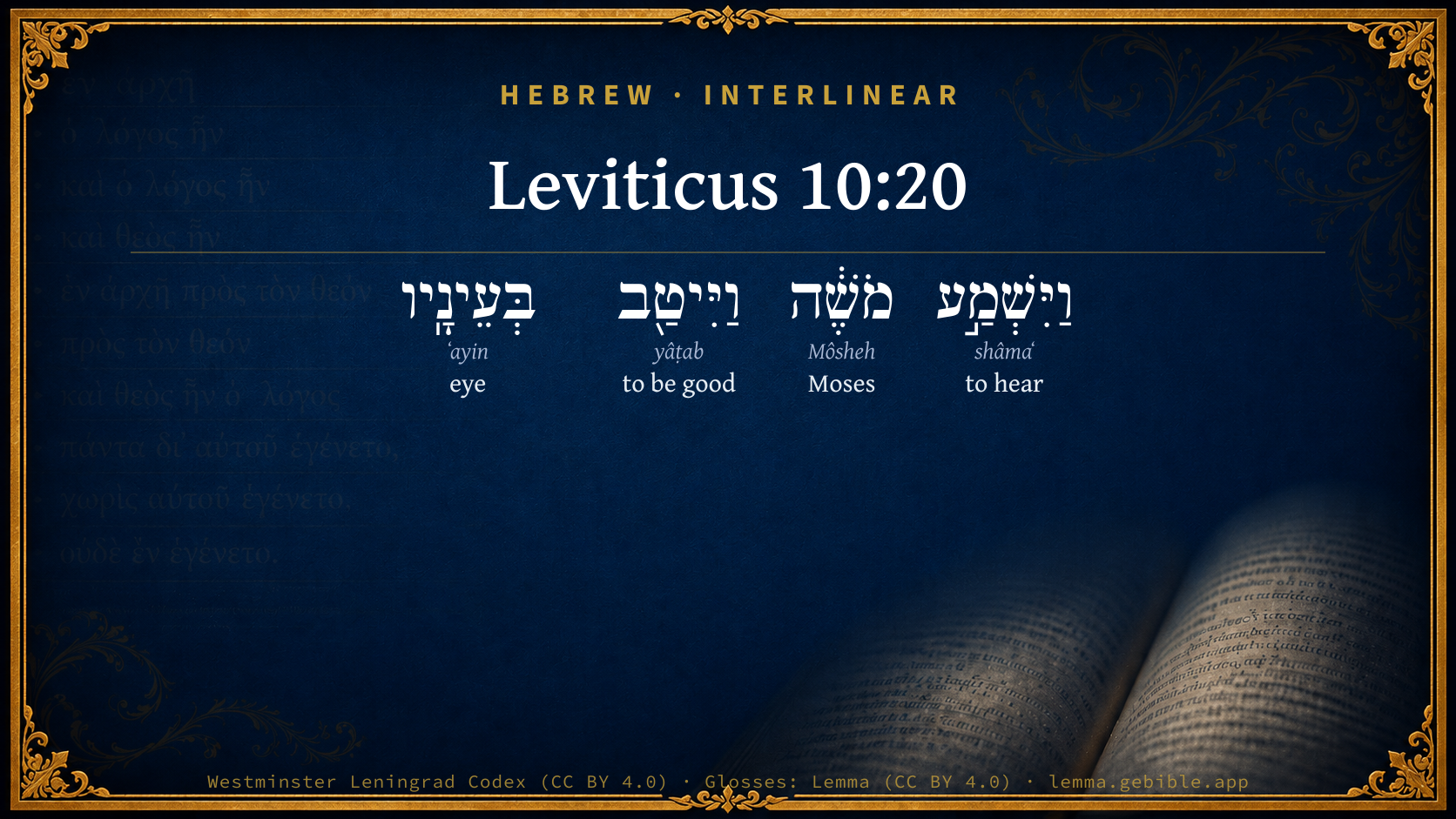
Leviticus 10:20

Hebrew (Westminster Leningrad Codex) Leviticus 10:20 appears in the Hebrew Old Testament. The text above is from the Westminster Leningrad Codex. Each word links to its Strong’s number, a concise gloss, and parsing drawn from the Open Scriptures Hebrew Bible morphology. Click any word for its full Brown-Driver-Briggs (BDB) entry.
Download image
Cite this verse

Leviticus 10:20 (World English Bible). Public Domain. Lemma interlinear Bible study tool, https://lemma.gebible.app/v/leviticus/10/20.

Show BibTeX & RIS
BibTeX
RIS
English Translation
When Moses heard that, it was pleasing in his sight.
World English Bible · Public Domain
Download a study sheet

One document with this verse’s original text, its word-by-word gloss line, the meaning frame, cross-references with their text, attributed commentary, and full source and license credits — printable, and it pastes into notes with its structure intact.

This verse Autodidact and up

Study sheet (.html) Plain text (.txt)

A passage Seminary Student

Up to 50 verses in one chapter. A passage sheet keeps up to 6 commentary sources and 12 cross-references per verse, in the order this page ranks them, and says so on the sheet whenever that leaves anything out. Ask for a single verse and you get the Autodidact verse sheet above.

Everything on this page stays free to read, with no account — the sheet is a download of what is already on screen, not access to it.

Want to remove ads? Support Godless Engineer
Compare translations 3

The same verse in 3 English versions, stacked beneath the original-language interlinear above. Click any original word for its lexicon entry.

Each is an independent rendering of the whole verse — the interlinear is not word-aligned to these translations.

Highlighted words mark where these versions differ — a whole-verse word diff, not a word-by-word alignment.

  • World English Bible Public Domain
    When Moses heard that, it was pleasing in his sight.
  • King James Version Public Domain
    And when Moses heard that, he was content.
  • unfoldingWord Literal Text CC BY-SA 4.0
    And Moses heard, and it was good in his eyes.

unfoldingWord Literal Text — © unfoldingWord, licensed CC BY-SA 4.0. Word-aligned USFM3 via Door43 (git.door43.org/unfoldingWord/en_ult).

Versions to compare (up to 4)

3 of 4 selected

Show all 18 translations

Every available English version of this verse, each an independent rendering of the whole verse.

  • World English Bible Public Domain
    When Moses heard that, it was pleasing in his sight.
  • Berean Standard Bible Public Domain
    And when Moses heard this explanation, he was satisfied.
  • Majority Standard Bible Public Domain
    And when Moses heard this explanation, he was satisfied.
  • King James Version Public Domain
    And when Moses heard that, he was content.
  • American Standard Version (1901) Public Domain
    And when Moses heard `that', it was well-pleasing in his sight.
  • Revised Version (1885) Public Domain
    And when Moses heard that, it was well-pleasing in his sight.
  • Geneva Bible (1599) Public Domain
    So when Moses heard it, he was content.
  • Douay-Rheims (1899) Public Domain
    Which when Moses had heard he was satisfied.
  • Young's Literal Translation Public Domain
    And Moses hearkeneth, and it is good in his eyes.
  • Literal Standard Version CC BY-SA 4.0
    And Moses listens, and it is good in his eyes.
  • Unlocked Literal Bible CC BY-SA 4.0
    When Moses heard that, he was satisfied.
  • unfoldingWord Literal Text CC BY-SA 4.0
    And Moses heard, and it was good in his eyes.
  • Darby Bible Public Domain
    And Moses heard it; and it was good in his sight.
  • World Messianic Bible Public Domain
    When Moses heard that, it was pleasing in his sight.
  • Webster's Bible Public Domain
    And when Moses heard that, he was content.
  • Free Bible Version CC BY-SA 4.0
    When Moses heard what Aaron had to say, he accepted the explanation.
  • Bible in Basic English Public Domain
    And after hearing this, Moses was no longer angry.
  • JPS Tanakh (1917) Public Domain
    And when Moses heard that, it was well-pleasing in his sight.

Literal Standard Version (2020), Covenant Press — licensed CC BY-SA 4.0. Text via the HelloAO Bible API (eBible.org). Unlocked Literal Bible (unfoldingWord) — licensed CC BY-SA 4.0. Text via the HelloAO Bible API (eBible.org). unfoldingWord Literal Text — © unfoldingWord, licensed CC BY-SA 4.0. Word-aligned USFM3 via Door43 (git.door43.org/unfoldingWord/en_ult). Free Bible Version, Dr. Jonathan Gallagher — licensed CC BY-SA 4.0. Text via the HelloAO Bible API (eBible.org).

Word by word

More ways to search: Search by grammar → Find every occurrence → Compare this word →

Practice this passage: Drill this verse → Learn its vocabulary →

וַיִּיטַ֖ב
yâṭab
H3190
“and · to be good”
Conjunction + Verb, Qal, Sequential Imperfect, 3rd Person, Masculine, Singular
Part of Speech
Conjunction + Verb
Stem
Qal
Form
Sequential Imperfect
Person
3rd Person
Gender
Masculine
Number
Singular
Full BDB Definition

Origin: a primitive root

TWOT: 863

to be good, be pleasing, be well, be glad - (Qal) - to be glad, be joyful - to be well placed - to be well for, be well with, go well with - to be pleasing, be pleasing to - (Hiphil) - to make glad, rejoice - to do good to, deal well with - to do well, do thoroughly - to make a thing good or right or beautiful - to do well, do right
  1. וַיִּשְׁמַ֣ע shâmaʻ H8085 “and · to hear” Conjunction + Verb, Qal, Sequential Imperfect, 3rd Person, Masculine, Singular
  2. מֹשֶׁ֔ה Môsheh H4872 “Moses” Noun, Proper
  3. בְּעֵינָֽיו ʻayin H5869 “in/at · eyes · his” Preposition + Noun, Common, Both, Dual, Construct + Suffix, Personal, 3rd Person, Masculine, Singular

About this verse

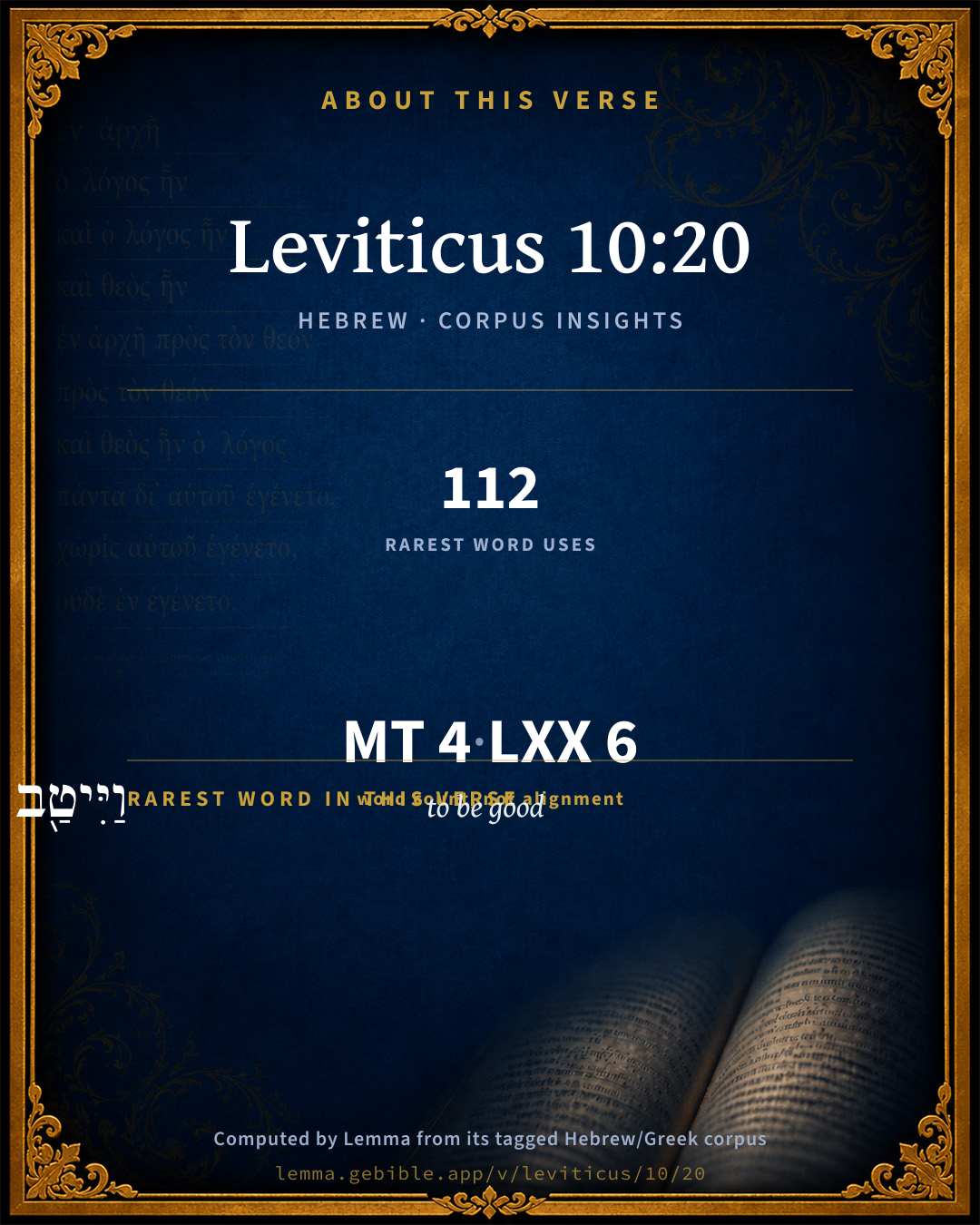
These counts appear in no published source. They are computed here, from the morphology-tagged text and Lemma’s own curated glosses. What Lemma adds →

4
words
4
distinct lemmas
Pentateuch
section

Grammatical profile

  • 2 verbs
  • 2 nouns

Verb forms

  • וַיִּשְׁמַ֣ע Qal · Sequential Imperfect
  • וַיִּיטַ֖ב Qal · Sequential Imperfect

Hebrew & Septuagint length

In English translation the verse runs 10 words from the Hebrew and 8 from the Septuagint (LXX English) — closely comparable.

A rough comparison of the two English renderings, which tokenize alike — not a word-level alignment.

Word counts can differ between the Hebrew and the Greek without any difference in meaning — e.g. the Hebrew direct-object marker אֵת has no separate Greek word, and Greek often adds the article ὁ.

In the original languages it is 4 Hebrew tokens and 6 Greek tokens — but the two are counted differently (Hebrew bundles its prefixes and suffixes into one token; the Greek is in lemma form), so that isn’t a like-for-like length.

Cross-references

4

Topical passages linked to Leviticus 10:20 in the Treasury of Scripture Knowledge — connected by theme and wording, ordered by reader-vote popularity; previews shown in the World English Bible.

  • 2 Chronicles 30:18–20 For a multitude of the people, even many of Ephraim and Manasseh, Issachar and Zebulun, had not cleansed themselves, yet did they eat the Passover otherwise than it is written. For Hezekiah had prayed for them, saying, The good Yahweh pardon everyone
  • Zechariah 7:8–9 The word of Yahweh came to Zechariah, saying,
  • Matthew 12:3–7 But he said to them, "Haven't you read what David did, when he was hungry, and those who were with him;
  • Matthew 12:20 He won't break a bruised reed. He won't quench a smoking flax, Until he leads justice to victory.

Cross-references courtesy of OpenBible.info (CC BY 4.0).

Hebrew and Greek witnesses Masoretic Hebrew ↔ Greek Septuagint

The same verse in the two great witnesses to the Old Testament, shown verse-for-verse.

These are two independent witnesses, not word-aligned to each other, and the Septuagint is shown in lemma (dictionary) form.

Hebrew Leviticus 10:20 Masoretic · Westminster Leningrad Codex

וַיִּשְׁמַ֣ע מֹשֶׁ֔ה וַיִּיטַ֖ב בְּעֵינָֽיו

When Moses heard that, it was pleasing in his sight.

World English Bible · Public Domain

Greek LXX Leviticus 10:20 Septuagint · lemma form

καί ἀκούω μωυσῆς καί ἀρέσκω αὐτός

And Moses heard it, and it pleased him.

LXX2012 (modern English Septuagint) · Public Domain

Hebrew: Westminster Leningrad Codex (CC BY 4.0). Greek: Septuagint (public domain); English from LXX2012 (modern English Septuagint) (Public Domain). How the Septuagint differs from the Hebrew →

Targum (Aramaic paraphrase)

2

The Targum is the ancient Jewish Aramaic paraphrase of the Hebrew Scriptures — an interpretive translation, not the Hebrew text itself. Onkelos (literal) and Pseudo-Jonathan (expansive) render the Torah, and Jonathan the Prophets. Coverage is partial: where no permissively-licensed English translation exists for a verse, only the Aramaic is shown. This is verse-level text, not a word-by-word alignment to the Hebrew.

  1. Targum Onkelos Torah (Genesis–Deuteronomy)
    וּשְׁמַע מֹשֶׁה וּשְׁפַר בְּעֵינוֹהִי

    (no public-domain English translation for this verse)

    Targum Onkelos — Aramaic: “Onkelos Genesis” (public domain); “Onkelos Exodus” (public domain); “Onkelos Leviticus” (public domain); “Onkelos Numbers” (public domain); “Onkelos Deuteronomy” (public domain). English: “Sefaria Community Translation” (CC0 1.0 (public-domain dedication)); “J.W. Etheridge. The Targums of Onkelos and Jonathan Ben Uzziel on the Pentateuch. London: Longmans, Green, 1862” (public domain). Text via Sefaria.

  2. Targum Pseudo-Jonathan Torah (Genesis–Deuteronomy)
    וּשְׁמַע משֶׁה וּשְׁפַר קֳדָמוֹי וְאַפֵּיק כְּרוֹזָא בְּמַשְׁרִיתָא לְמֵימָר אֲנָא הוּא דְאִיתְעַלָמִית הִילְכָתָא מִנִי וְאַהֲרן אָחִי אִדְכַּר יָתָהּ לִי

    And Mosheh heard, and it was approvable before him, and he sent out a crier through the camp, saying, I am he from whom the rite hath been hidden, and Aharon my brother hath brought its remembrance to me.

    Targum Pseudo-Jonathan — Aramaic: “Targum Jonathan on Genesis” (public domain); “Targum Jonathan on Exodus” (public domain); “Targum Jonathan on Leviticus” (public domain); “Targum Jonathan on Numbers” (public domain); “Targum Jonathan on Deuteronomy” (public domain). English: “The Targum of Jonathan ben Uzziel, trans. J. W. Etheridge, London, 1862” (public domain). Text via Sefaria.

Commentary

Notes on Leviticus 10:20 from classic Christian and Jewish commentators (each source and its license shown beneath its notes). The classic Christian expositions comment on the surrounding passage and are grouped to its opening verse, so a note may address several verses; the Jewish commentaries on the Tanakh (Rashi and others) are per-verse, so they appear only where the commentator wrote on this verse.

Lemma curates 59 commentaries, every one of them public domain or Creative Commons licensed, each selected and text-cleaned for this edition rather than reprinted as found. About our sources →

Trapp's Complete Commentary

John Trapp

Lev 10:20 And when Moses heard [that], he was content.

Ver. 20. He was content.] For that time at least. It is not good sowing in a high wind. To choose a fit time to admonish an offender, is a singular skill, and a very great advantage. The mildest medicine is troublesome to an eye that is inflamed.

John Trapp, A Commentary or Exposition upon All the Books of the Old and New Testament (1647–1656) — public domain. Text from a community e-Sword module.

Joseph Benson's Commentary

Lev 10:20. Moses was content — He rested satisfied with Aaron’s answer, who, it appeared, had sincerely aimed at pleasing God; and those who do so, will find he is not extreme to mark what is amiss.

Joseph Benson's Commentary on the Old and New Testaments (1811–1818) — public domain. Text from a community e-Sword module.

Geneva Bible (1599)

Geneva Bible translators

Moses bare with his infirmity, considering his great sorrow, but doth not leave an example to forgive them that maliciously transgress the commandment of God.

Geneva Bible (1599) marginal notes — public domain. Text via Bolls.life.

Adam Clarke's Commentary

Verse 20. When Moses heard that, he was content.] The argument used by Aaron had in it both good sense and strong reason, and Moses, as a reasonable man, felt its force; and as God evidenced no kind of displeasure at this irregularity, which was, in a measure at least, justified by the present necessity, he thought proper to urge the matter no farther.

THOUGH the punishment of Nadab and Abihu may appear severe, because the sacred text does not specify clearly the nature and extent of their crime, we may rest assured that it was of such a nature as not only to justify but to demand such a punishment. God has here given us a full proof that he will not suffer human institutions to take the place of his own prescribed worship. It is true this is frequently done, for by many what is called natural religion is put in the place of Divine revelation; and God seems not to regard it: but though vengeance is not speedily executed on an evil work, and therefore the hearts of the children of men are set to do wickedness, yet God ceases not to be just; and those who have taken from or added to his words, or put their own inventions in their place, shall be reproved and found liars in the great day. His long-suffering leads to repentance; but if men will harden their hearts, and put their own ceremonies, rites, and creeds, in the place of Divine ordinances and eternal truths, they must expect to give an awful account to him who is shortly to judge the quick and the dead.

Were the religion of Christ stripped of all that state policy, fleshly interest, and gross superstition have added to it, how plain and simple, and may we not add, how amiable and glorious, would it appear! Well may we say of human inventions in Divine worship what one said of the paintings on old cathedral windows, Their principal tendency is to prevent the light from coming in. Nadab and Abihu would perform the worship of God not according to his command, but in their own way; and God not only would not receive the sacrifice from their hands, but, while encompassing themselves with their own sparks, and warming themselves with their own fire, this had they from the hand of the Lord - they lay down in sorrow, for there went out a fire from the Lord, and devoured them. What is written above is to be understood of persons who make a religion for themselves, leaving Divine revelation; for, being wilfully ignorant of God's righteousness, they go about to establish their own. This is a high offence in the sight of God. Reader, God is a Spirit, and they who worship him must worship him in spirit and truth. Such worshippers the Father seeketh.

Adam Clarke's Commentary on the Bible (1810–1826) — public domain. Text from a community e-Sword/MySword module.

Ellicott's Commentary for English Readers

(20) And . . . he was content.—He acknowledged Aaron’s plea to be just, and that he had himself spoken hastily. This is a remarkable instance of Moses’ humility, and of the human side of his nature as a lawgiver. (See also Num_32:6, &c.) Hence Jewish tradition from time immemorial ascribes the mistake to Moses, and not to Aaron. The paraphrase of this verse in the Palestine Chaldee Version, which embodies the ancient opinions, is very instructive. It is as follows: “And when Moses heard it, he approved of this explanation. Whereupon he sent a herald through the whole camp of Israel, saying, It is I from whom the law had been hid, and my brother Aaron brought it to my remembrance.”

A Bible Commentary for English Readers, edited by Charles John Ellicott (1878–1897) — public domain. Text from a community e-Sword module.

Matthew Poole's English Annotations

He rested satisfied with his answer, either because he thought it reasonable, seeing the letter of the law ofttimes yields to necessities or great accidents, 2Ch 30:18; Mat 12:3,4; or at least because the things alleged were mitigations of his fault, and he would not add affliction to the afflicted, but rather defer the debate of it to a fitter opportunity.

Matthew Poole's English Annotations on the Holy Bible (1683–1685) — public domain. Text from a community e-Sword/MySword module.

John Wesley's Explanatory Notes

He rested satisfied with his answer. it appeared, that Aaron sincerely aimed at pleasing God: and those who do so, will find he is not extreme to mark what is done amiss.

John Wesley, Explanatory Notes Upon the Whole Bible (1754–1765) — public domain. Text via the GEBible commentary corpus.

Rashi

Rabbi Shlomo Yitzchaki (Rashi)

וייטב בעיניו AND IT WAS PLEASING IN HIS EYES — He admitted his error and was not ashamed to do so, by saying (instead of admitting it) “I have not heard a statement (from God regarding this)", but rather he said, “I have heard, but I forgot it” (Sifra, Shemini, Chapter 2 12; Zevachim 101b).

Rashi on the Tanakh — English translations: “The Judaica Press complete Tanach with Rashi, translated by A. J. Rosenberg” (CC BY 4.0); “Pentateuch with Rashi's commentary by M. Rosenbaum and A.M. Silbermann, 1929-1934” (public domain); “The Metsudah Tanach series, Lakewood, N.J” (CC BY 4.0); and “The Book of Joshua, Metsudah Publications, 1997” (CC BY 4.0). Text via Sefaria.

Sforno

Rabbi Ovadia Sforno

And it was good in his eyes. He rejoiced over the excellent reasoning of his brother and his brother’s sons who had excelled in perceiving and ruling the correct halachah.

Sforno on the Tanakh — English translation: “Yalkut, Sifsei Chachomim Chumash, Metsudah Publications, 2009” (CC BY 4.0). Text via Sefaria.

Lesson kit

Teaching starters — assembled from the data on this page, not authored interpretation. Every prompt links to the verse data it draws on. Edit before teaching.

Leviticus, in the Pentateuch, opens this verse with 4 words (4 distinct Hebrew lemmas). Its most distinctive word is yâṭab (“to be good”). A historical commentator’s framing appears above. Read the whole chapter for the surrounding context.

Discussion questions

  1. What does “to be good” (yâṭab) contribute to the verse as a whole?
  2. How does 2 Chronicles 30:18–20, which shares this passage’s theme, read alongside this verse?
  3. The translations on this page render this verse differently — a whole-verse word diff, not a word-by-word alignment. What might account for the different wordings?
  4. «וַיִּשְׁמַ֣ע» is a Qal Sequential Imperfect verb. How does that grammatical form shape the action described?
  5. Compare how Trapp's Complete Commentary and Joseph Benson's Commentary read this verse. Where do they agree or differ?

Things to notice

Reading settings

Reading text

Shown beneath each verse's original-language words.

Old Testament
Old Testament edition

Read the OT as the Masoretic Hebrew (MT) or the Greek Septuagint (LXX).

English shown for the Greek Septuagint (in the Hebrew ↔ Greek comparison).

Comparing translations? Open the Compare panel on any verse page to stack up to four side by side.