Esther 2:4

Hebrew (Westminster Leningrad Codex) Esther 2:4 appears in the Hebrew Old Testament. The text above is from the Westminster Leningrad Codex. Each word links to its Strong’s number, a concise gloss, and parsing drawn from the Open Scriptures Hebrew Bible morphology. Click any word for its full Brown-Driver-Briggs (BDB) entry.
Download image
Cite this verse

Esther 2:4 (World English Bible). Public Domain. Lemma interlinear Bible study tool, https://lemma.gebible.app/v/esther/2/4.

Show BibTeX & RIS
BibTeX
RIS
English Translation
and let the maiden who pleases the king be queen instead of Vashti. The thing pleased the king; and he did so.
World English Bible · Public Domain
Download a study sheet

One document with this verse’s original text, its word-by-word gloss line, the meaning frame, cross-references with their text, attributed commentary, and full source and license credits — printable, and it pastes into notes with its structure intact.

This verse Autodidact and up

Study sheet (.html) Plain text (.txt)

A passage Seminary Student

Up to 50 verses in one chapter. A passage sheet keeps up to 6 commentary sources and 12 cross-references per verse, in the order this page ranks them, and says so on the sheet whenever that leaves anything out. Ask for a single verse and you get the Autodidact verse sheet above.

Everything on this page stays free to read, with no account — the sheet is a download of what is already on screen, not access to it.

Want to remove ads? Support Godless Engineer
Compare translations 3

The same verse in 3 English versions, stacked beneath the original-language interlinear above. Click any original word for its lexicon entry.

Each is an independent rendering of the whole verse — the interlinear is not word-aligned to these translations.

Highlighted words mark where these versions differ — a whole-verse word diff, not a word-by-word alignment.

  • World English Bible Public Domain
    and let the maiden who pleases the king be queen instead of Vashti. The thing pleased the king; and he did so.
  • King James Version Public Domain
    And let the maiden which pleaseth the king be queen instead of Vashti. And the thing pleased the king; and he did so.
  • unfoldingWord Literal Text CC BY-SA 4.0
    And let the young woman who is pleasing in the eyes of the king become queen instead of Vashti.” And the word was pleasing in the eyes of the king, so he did thus.

unfoldingWord Literal Text — © unfoldingWord, licensed CC BY-SA 4.0. Word-aligned USFM3 via Door43 (git.door43.org/unfoldingWord/en_ult).

Versions to compare (up to 4)

3 of 4 selected

Show all 18 translations

Every available English version of this verse, each an independent rendering of the whole verse.

  • World English Bible Public Domain
    and let the maiden who pleases the king be queen instead of Vashti. The thing pleased the king; and he did so.
  • Berean Standard Bible Public Domain
    Then let the young woman who pleases the king become queen in place of Vashti.” This suggestion pleased the king, and he acted accordingly.
  • Majority Standard Bible Public Domain
    Then let the young woman who pleases the king become queen in place of Vashti.” This suggestion pleased the king, and he acted accordingly.
  • King James Version Public Domain
    And let the maiden which pleaseth the king be queen instead of Vashti. And the thing pleased the king; and he did so.
  • American Standard Version (1901) Public Domain
    and let the maiden that pleaseth the king be queen instead of Vashti. And the thing pleased the king; and he did so.
  • Revised Version (1885) Public Domain
    and let the maiden which pleaseth the king be queen instead of Vashti. And the thing pleased the king, and he did so.
  • Geneva Bible (1599) Public Domain
    And the mayde that shall please the King, let her reigne in the steade of Vashti. And this pleased the King, and he did so.
  • Douay-Rheims (1899) Public Domain
    And whosoever among them all shall please the king's eyes, let her be queen instead of Vasthi. The word pleased the king: and he commanded it should be done as they had suggested.
  • Young's Literal Translation Public Domain
    and the young woman who is good in the eyes of the king doth reign instead of Vashti;' and the thing is good in the eyes of the king, and he doth so.
  • Literal Standard Version CC BY-SA 4.0
    and the young woman who is good in the eyes of the king reigns instead of Vashti”; and the thing is good in the eyes of the king, and he does so.
  • Unlocked Literal Bible CC BY-SA 4.0
    Let the young girl who pleases the king become queen in the place of Vashti.” This advice pleased the king, and he did so.
  • unfoldingWord Literal Text CC BY-SA 4.0
    And let the young woman who is pleasing in the eyes of the king become queen instead of Vashti.” And the word was pleasing in the eyes of the king, so he did thus.
  • Darby Bible Public Domain
    And let the maiden that pleaseth the king be queen instead of Vashti. And the thing pleased the king; and he did so.
  • World Messianic Bible Public Domain
    and let the maiden who pleases the king be queen instead of Vashti.” The thing pleased the king, and he did so.
  • Webster's Bible Public Domain
    And let the maiden who pleaseth the king be queen instead of Vashti. And the thing pleased the king; and he did so.
  • Free Bible Version CC BY-SA 4.0
    The young woman the king finds most attractive can become queen in place of Vashti.” The king thought this was a good idea, so he acted upon it.
  • Bible in Basic English Public Domain
    And let the girl who is pleasing to the king be queen in place of Vashti. And the king was pleased with this suggestion; and he did so.
  • JPS Tanakh (1917) Public Domain
    and let the maiden that pleaseth the king be queen instead of Vashti.' And the thing pleased the king; and he did so.

Literal Standard Version (2020), Covenant Press — licensed CC BY-SA 4.0. Text via the HelloAO Bible API (eBible.org). Unlocked Literal Bible (unfoldingWord) — licensed CC BY-SA 4.0. Text via the HelloAO Bible API (eBible.org). unfoldingWord Literal Text — © unfoldingWord, licensed CC BY-SA 4.0. Word-aligned USFM3 via Door43 (git.door43.org/unfoldingWord/en_ult). Free Bible Version, Dr. Jonathan Gallagher — licensed CC BY-SA 4.0. Text via the HelloAO Bible API (eBible.org).

Word by word

More ways to search: Search by grammar → Find every occurrence → Compare this word →

Practice this passage: Drill this verse → Learn its vocabulary →

וַשְׁתִּ֑י
Vashtîy
H2060
“Vashti”
Noun, Proper
Part of Speech
Noun
Type
Proper
Full BDB Definition

Origin: of Persian origin

TWOT: None

Vashti = "beautiful" - the queen, wife of Ahasuerus, whom he divorced for disobeying his orders
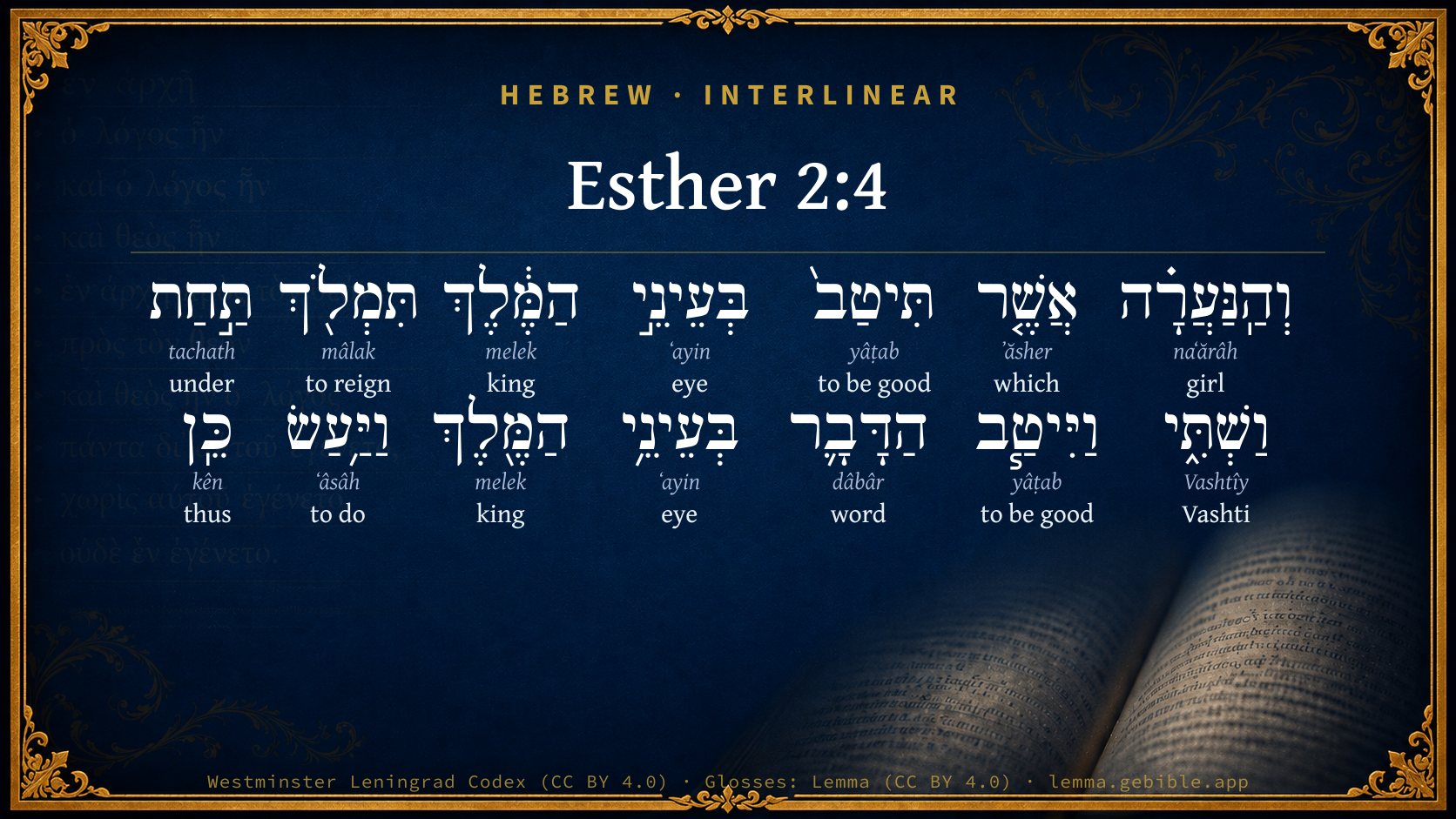
  1. וְהַֽנַּעֲרָ֗ה naʻărâh H5291 “and · the · girl” Conjunction + Particle, Definite Article + Noun, Common, Feminine, Singular, Absolute
  2. אֲשֶׁ֤ר ʼăsher H834 “which” Particle, Relative
  3. תִּיטַב֙ yâṭab H3190 “to be good” Verb, Qal, Imperfect, 3rd Person, Feminine, Singular
  4. בְּעֵינֵ֣י ʻayin H5869 “in/at · eyes of” Preposition + Noun, Common, Both, Dual, Construct
  5. הַמֶּ֔לֶךְ melek H4428 “the · king” Particle, Definite Article + Noun, Common, Masculine, Singular, Absolute
  6. תִּמְלֹ֖ךְ mâlak H4427 “to reign” Verb, Qal, Jussive, 3rd Person, Feminine, Singular
  7. תַּ֣חַת tachath H8478 “under” Preposition
  8. וַיִּיטַ֧ב yâṭab H3190 “and · to be good” Conjunction + Verb, Qal, Sequential Imperfect, 3rd Person, Masculine, Singular
  9. הַדָּבָ֛ר dâbâr H1697 “the · word” Particle, Definite Article + Noun, Common, Masculine, Singular, Absolute
  10. בְּעֵינֵ֥י ʻayin H5869 “in/at · eyes of” Preposition + Noun, Common, Both, Dual, Construct
  11. הַמֶּ֖לֶךְ melek H4428 “the · king” Particle, Definite Article + Noun, Common, Masculine, Singular, Absolute
  12. וַיַּ֥עַשׂ ʻâsâh H6213 “and · to do” Conjunction + Verb, Qal, Sequential Imperfect, 3rd Person, Masculine, Singular
  13. כֵּֽן kên H3651 “thus” Particle, Demonstrative

About this verse

These counts appear in no published source. They are computed here, from the morphology-tagged text and Lemma’s own curated glosses. What Lemma adds →

14
words
11
distinct lemmas
Historical
section

Notable vocabulary

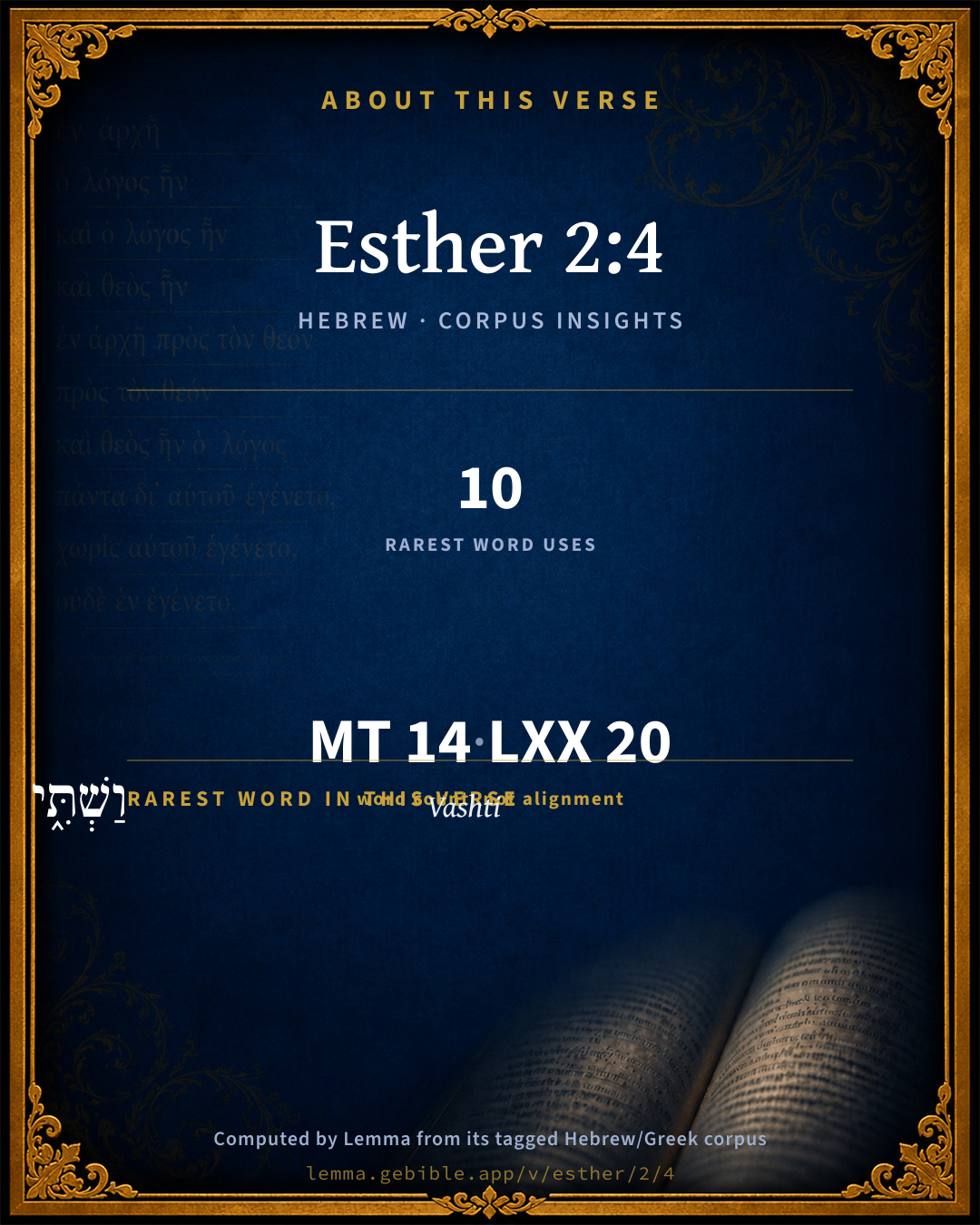
The rarest word here is וַשְׁתִּ֑י Vashti H2060 — appearing just 10 times in the whole Hebrew Bible.

Shared distinctive vocabulary

וַשְׁתִּ֑י Vashti H2060 occurs in 10 verses of the Hebrew Bible. Also found in:

Grammatical profile

  • 4 verbs
  • 7 nouns
  • 1 preposition
  • 2 particles

Verb forms

  • תִּיטַב֙ Qal · Imperfect
  • תִּמְלֹ֖ךְ Qal · Jussive
  • וַיִּיטַ֧ב Qal · Sequential Imperfect
  • וַיַּ֥עַשׂ Qal · Sequential Imperfect

Repetition

Words recur within this verse — often emphatic in Hebrew:

  • תִּיטַב֙ to be good H3190 ×2
  • בְּעֵינֵ֣י eye H5869 ×2
  • הַמֶּ֔לֶךְ king H4428 ×2

Hebrew & Septuagint length

In English translation the verse runs 22 words from the Hebrew and 24 from the Septuagint (LXX English) — closely comparable.

A rough comparison of the two English renderings, which tokenize alike — not a word-level alignment.

Word counts can differ between the Hebrew and the Greek without any difference in meaning — e.g. the Hebrew direct-object marker אֵת has no separate Greek word, and Greek often adds the article ὁ.

In the original languages it is 14 Hebrew tokens and 20 Greek tokens — but the two are counted differently (Hebrew bundles its prefixes and suffixes into one token; the Greek is in lemma form), so that isn’t a like-for-like length.

Cross-references

8

Topical passages linked to Esther 2:4 in the Treasury of Scripture Knowledge — connected by theme and wording, ordered by reader-vote popularity; previews shown in the World English Bible.

  • Matthew 14:6 But when Herod's birthday came, the daughter of Herodias danced among them and pleased Herod.
  • Matthew 20:16 So the last will be first, and the first last. For many are called, but few are chosen."
  • 2 Samuel 17:4 The saying pleased Absalom well, and all the elders of Israel.
  • Esther 1:21 The saying pleased the king and the princes; and the king did according to the word of Memucan:
  • Esther 3:9–10 If it please the king, let it be written that they be destroyed: and I will pay ten thousand talents of silver into the hands of those who have the charge of the [king's] business, to bring it into the king's treasuries.
  • Matthew 22:14 For many are called, but few chosen."
  • 2 Samuel 13:4–6 He said to him, Why, son of the king, are you thus lean from day to day? Won't you tell me? Amnon said to him, I love Tamar, my brother Absalom's sister.
  • 2 Samuel 16:21–23 Ahithophel said to Absalom, Go in to your father's concubines, that he has left to keep the house; and all Israel will hear that you are abhorred of your father: then will the hands of all who are with you be strong.

Cross-references courtesy of OpenBible.info (CC BY 4.0).

Hebrew and Greek witnesses Masoretic Hebrew ↔ Greek Septuagint

The same verse in the two great witnesses to the Old Testament, shown verse-for-verse.

These are two independent witnesses, not word-aligned to each other, and the Septuagint is shown in lemma (dictionary) form.

Hebrew Esther 2:4 Masoretic · Westminster Leningrad Codex

וְהַֽנַּעֲרָ֗ה אֲשֶׁ֤ר תִּיטַב֙ בְּעֵינֵ֣י הַמֶּ֔לֶךְ תִּמְלֹ֖ךְ תַּ֣חַת וַשְׁתִּ֑י וַיִּיטַ֧ב הַדָּבָ֛ר בְּעֵינֵ֥י הַמֶּ֖לֶךְ וַיַּ֥עַשׂ כֵּֽן

and let the maiden who pleases the king be queen instead of Vashti. The thing pleased the king; and he did so.

World English Bible · Public Domain

Greek LXX Esther 2:4 Septuagint · lemma form

καί ὁ γυνή ὅς ἄν ἀρέσκω ὁ βασιλεύς βασιλεύω ἀντί αστιν καί ἀρέσκω ὁ βασιλεύς ὁ πρᾶγμα καί ποιέω οὕτως

And let the woman who shall please the king be queen instead of Astin. And the thing pleased the king; and he did so.

LXX2012 (modern English Septuagint) · Public Domain

Hebrew: Westminster Leningrad Codex (CC BY 4.0). Greek: Septuagint (public domain); English from LXX2012 (modern English Septuagint) (Public Domain). How the Septuagint differs from the Hebrew →

Commentary

Notes on Esther 2:4 from classic Christian and Jewish commentators (each source and its license shown beneath its notes). The classic Christian expositions comment on the surrounding passage and are grouped to its opening verse, so a note may address several verses; the Jewish commentaries on the Tanakh (Rashi and others) are per-verse, so they appear only where the commentator wrote on this verse.

Lemma curates 59 commentaries, every one of them public domain or Creative Commons licensed, each selected and text-cleaned for this edition rather than reprinted as found. About our sources →

Trapp's Complete Commentary

John Trapp

Est 2:4 And let the maiden which pleaseth the king be queen instead of Vashti. And the thing pleased the king; and he did so.

Ver. 4. And let the maiden] Herein unhappy that she got her honour with the loss of her honesty; and that so many maids are made miserable for her sake.

That pleaseth the king] Heb. That is good in his eyes. The eye is the lamp and ornament of the whole body; and yet that most lightsome part doth ofttimes draw the soul into utter darkness; while by those windows of wickedness and loopholes of lust Satan windeth himself into the heart, and maketh it impudicitiae cloacam (as Venus’s temple on the top of Lebanon is called by Eusebius), a very sink and sewer of all lewdness and abomination.

Be queen instead of Vashti] This was held a great business, and a sufficient recompense. The bramble held it a goodly thing to reign over the trees: not so the vine and fig tree, Jdg 9:15.

And the thing pleased the king] Because it added more fuel to the fire of his lust, and that he may lengthen out his days in dalliance and wantonness: ut libidine libidinem provocante, nihil nisi muliebris fiat, saith an expositor here, that he might be the right successor of Sardanapalus, who buried himself in the bosoms of his harlots, and left behind him this infamous epitaph: πα φι λι πα λι \φι-Tαυτ εχω οσσ’ εφαγον και εφυβοισα και μετ ερωτος, πα λι φι Tεοπν επαθον τα δε αλλα και ολβια παντα λελειπται

An epitaph fit for an ox, saith Aristotle. The kings of Persia are noted for effeminate, fitter for a canopy than a camp; and affecting such sights, ubi Imperator Apparator, lanx phalanx, acies facies, bella labella, spicula pocula, scutum scortum, &c.

And he did so] According to the counsel of those court parasites (whose word is that of Stratocles, Mihi placer quicquid Regi placet), he walked in the ways of his heart, and in the sight of his eyes, little thinking that for all these things God would bring him into judgment, Ecc 11:9. But such governors the wicked world deserveth, as being itself totus in maligno positus, 1Jn 5:19 When Phocas, that filthy traitor, reigned at Constantinople, Cedrinus saith that a certain honest poor man was very earnest with God to know why such a man, or rather monster, was set up; he was answered again by a voice, that there could not be a worse man found, and that the sins of Christians did require it.

John Trapp, A Commentary or Exposition upon All the Books of the Old and New Testament (1647–1656) — public domain. Text from a community e-Sword module.

John Gill's Exposition

And let the maiden which pleaseth the king be queen instead of Vashti,.... Have the royal estate, that was taken from Vashti, given to her, the crown royal set on her head, &c.

and the thing pleased the king, and he did so; appointed officers in all his provinces to seek out the most beautiful virgins, and bring them to his palace; so with the Chinese now, the king never marries with any of his kindred, though ever so remote; but there is sought throughout his kingdom a damsel of twelve or fourteen years, of perfect beauty, good natural parts, and well inclined to virtue; whence, for the most part, the queen is the daughter of some artisan; and in their history (e), mention is made of one that was the daughter of a mason.

(e) Semedo's History of China, part 1. ch. 23.

John Gill's Exposition of the Whole Bible (1746–1763) — public domain (CC PDM 1.0). Text via the HelloAO Bible API.

Haydock's Catholic Bible Commentary

Commanded. Hebrew, "did so."

George Leo Haydock (1774–1849), Haydock's Catholic Family Bible and Commentary, 1859 edition — public domain. Excludes Psalms (Douay-Rheims chapter numbering differs from Protestant) and Deuterocanonical books (Catholic canon only).

The Pulpit Commentary

The verdict of pleasure an untrustworthy basis of action.

If wisdom and goodness sometimes make all profit they can by embracing opportunity, much more often do policy and evil. For the "children of this world are wiser in their generation than the children of light." They most studiously adapt means to end; they most patiently bide their time; they most unerringly, in this disordered scene, this dislocated system, see and snatch the opportunity. Let us observe here the appeal made to the King Ahasuerus

I IN THE LIGHT OF THE OPPORTUNE TIME AT WHICH IT WAS MADE. Meaning much there was in that time. The moment makes often the difference. Now the moment and the man met. A cheerless blank before the king. An aching void within him, as though emptiness were the most veritable existence. We do not indeed read that of this inner vacancy the king said a word or uttered a complaint; he would not make so humiliating a confession. But whether he did so or not, it was no doubt seen, and he was seen through by the minions of his retinue and his court. His own "wrath," and, as we have reason to know, matters of state and matters of war, had helped him tide over several months; but un-ease at heart can be no longer endured, and is bound to betray him. Neither momentary diversion of heart nor months" diversion of mind destroys facts, nor turns back dissatisfaction"s natural tide. The most they do is to arrest awhile, certain to aggravate after a while.

II IN THE LIGHT OF THE SPECIAL INNER PREPARATION FOR IT WHICH THE WHOLE HERETOFORE COURSE OF HIS LIFE HAD MADE. That antecedent course of life might have been judged to be a deliberately-constituted preparation for such a moment as the present. No outward opportunity for good or evil, no outward invitation of gain or loss, is comparable for effect with that opportuneness which is, which is made, which grows within. There is no such ripeness of time as that which comes of ripeness of disposition. If the spark also is to have its fair chance, it must fall on touch-paper, dry wood, gunpowder. If an ill-starred suggestion, or the happiest, holiest impulse, is to have each its own due course, the one and the other must fall, though in time"s briefest instant, upon the material of a character that has been consciously or unconsciously fitting and maturing a long time for each respectively. An instant"s mere hint, whether of good or had, will not mean much, except it come upon the product of months" or years" education; but if it light upon this, it may.

III IN THE UNJUSTIFIABLY READY AND HASTY ACCEPTANCE OF IT. There was apparently no consideration of the proposal contained in it. There was certainly no careful exercise of the judgment upon it. No counsellors are called in as before. The seven "wise men which saw the king"s face, and sat the first in the kingdom," are not called in to consult. Nay, not so much as an hour"s time is reserved before an answer. It seems plainly that all was considered safe, and he acted on a momentary impulse, thinking only of self-gratification. "The thing pleased the king; and he did so. " Self-pleasure is made the basis of conduct. The thing that pleases is the right. The thing that pleases is to be done. Poor learner, Ahasuerus! He has already forgotten what he.was remembering, regretting, only yesterday the hasty thing "which was decreed against Vashti." And that also was at the suggestion of others ratified at his own pleasure. B.

The Pulpit Commentary (1880–1919), ed. H.D.M. Spence-Jones & Joseph S. Exell — public domain. Text from a community e-Sword module.

Lesson kit

Teaching starters — assembled from the data on this page, not authored interpretation. Every prompt links to the verse data it draws on. Edit before teaching.

Esther, in the Historical, opens this verse with 14 words (11 distinct Hebrew lemmas). Its most distinctive word is Vashtîy (“Vashti”). A historical commentator’s framing appears above. Read the whole chapter for the surrounding context.

Discussion questions

  1. The word Vashtîy carries the sense “Vashti.” How does it shape the verse?
  2. How does Esther 1:9, which shares the word «Vashti», read alongside this verse?
  3. What does the repetition of “to be good” (2× in this one verse) do in this verse?
  4. The translations on this page render this verse differently — a whole-verse word diff, not a word-by-word alignment. What might account for the different wordings?
  5. «תִּיטַב֙» is a Qal Imperfect verb. How does that grammatical form shape the action described?
  6. Compare how Trapp's Complete Commentary and John Gill's Exposition read this verse. Where do they agree or differ?

Things to notice

Reading settings

Reading text

Shown beneath each verse's original-language words.

Old Testament
Old Testament edition

Read the OT as the Masoretic Hebrew (MT) or the Greek Septuagint (LXX).

English shown for the Greek Septuagint (in the Hebrew ↔ Greek comparison).

Comparing translations? Open the Compare panel on any verse page to stack up to four side by side.