
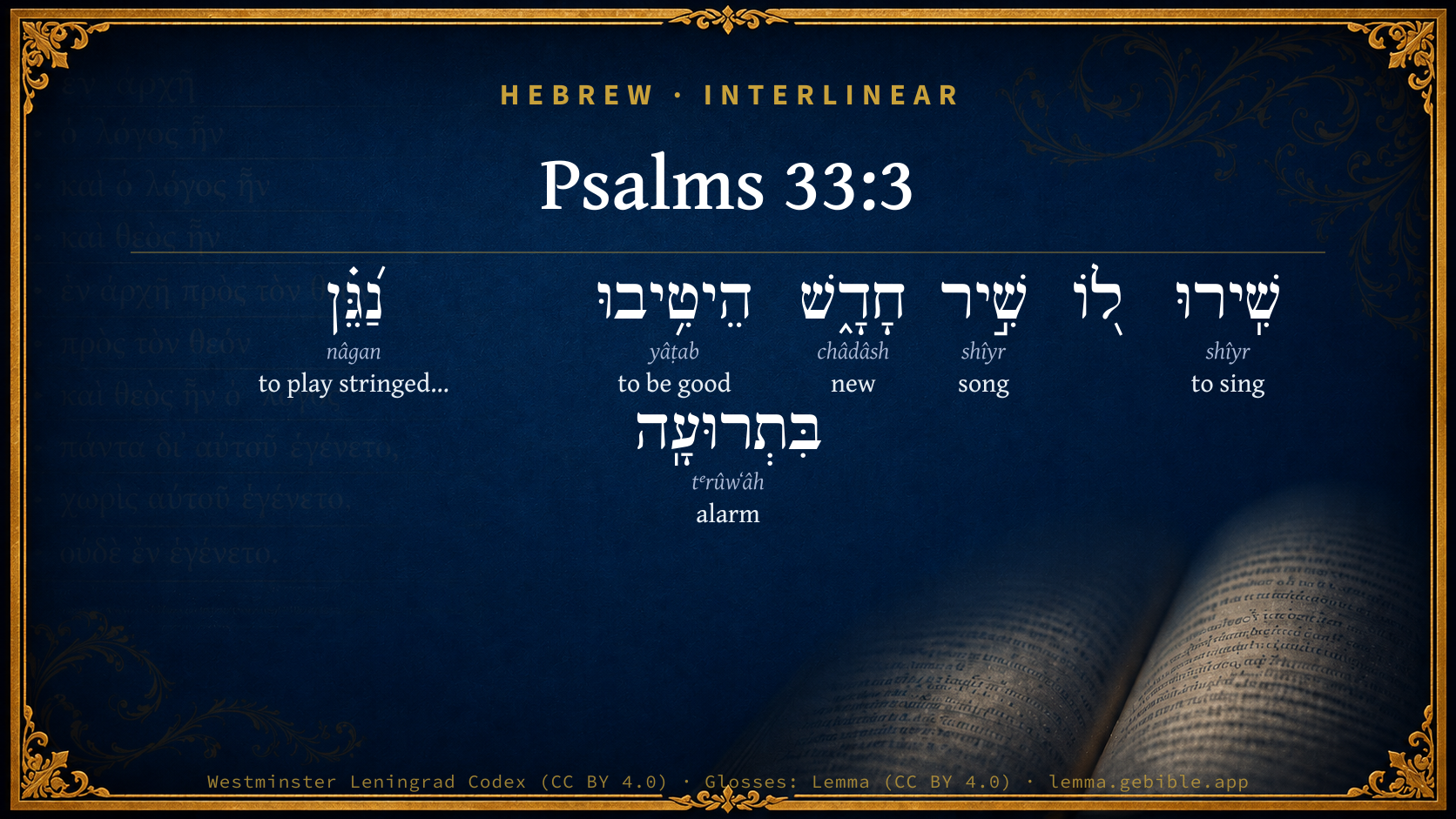
Psalms 33:3

Hebrew (Westminster Leningrad Codex) Psalms 33:3 appears in the Hebrew Old Testament. The text above is from the Westminster Leningrad Codex. Each word links to its Strong’s number, a concise gloss, and parsing drawn from the Open Scriptures Hebrew Bible morphology. Click any word for its full Brown-Driver-Briggs (BDB) entry.
Download image
Cite this verse

Psalms 33:3 (World English Bible). Public Domain. Lemma interlinear Bible study tool, https://lemma.gebible.app/v/psalms/33/3.

Show BibTeX & RIS
BibTeX
RIS
English Translation
Sing to him a new song. Play skillfully with a shout of joy!
World English Bible · Public Domain
Download a study sheet

One document with this verse’s original text, its word-by-word gloss line, the meaning frame, cross-references with their text, attributed commentary, and full source and license credits — printable, and it pastes into notes with its structure intact.

This verse Autodidact and up

Study sheet (.html) Plain text (.txt)

A passage Seminary Student

Up to 50 verses in one chapter. A passage sheet keeps up to 6 commentary sources and 12 cross-references per verse, in the order this page ranks them, and says so on the sheet whenever that leaves anything out. Ask for a single verse and you get the Autodidact verse sheet above.

Everything on this page stays free to read, with no account — the sheet is a download of what is already on screen, not access to it.

Want to remove ads? Support Godless Engineer
Compare translations 3

The same verse in 3 English versions, stacked beneath the original-language interlinear above. Click any original word for its lexicon entry.

Each is an independent rendering of the whole verse — the interlinear is not word-aligned to these translations.

Highlighted words mark where these versions differ — a whole-verse word diff, not a word-by-word alignment.

  • World English Bible Public Domain
    Sing to him a new song. Play skillfully with a shout of joy!
  • King James Version Public Domain
    Sing unto him a new song; play skilfully with a loud noise.
  • unfoldingWord Literal Text CC BY-SA 4.0
    Sing to him a new song; be skillful to play with a shout!

unfoldingWord Literal Text — © unfoldingWord, licensed CC BY-SA 4.0. Word-aligned USFM3 via Door43 (git.door43.org/unfoldingWord/en_ult).

Versions to compare (up to 4)

3 of 4 selected

Show all 18 translations

Every available English version of this verse, each an independent rendering of the whole verse.

  • World English Bible Public Domain
    Sing to him a new song. Play skillfully with a shout of joy!
  • Berean Standard Bible Public Domain
    Sing to Him a new song; play skillfully with a shout of joy.
  • Majority Standard Bible Public Domain
    Sing to Him a new song; play skillfully with a shout of joy.
  • King James Version Public Domain
    Sing unto him a new song; play skilfully with a loud noise.
  • American Standard Version (1901) Public Domain
    Sing unto him a new song; Play skilfully with a loud noise.
  • Revised Version (1885) Public Domain
    Sing unto him a new song; play skilfully with a loud noise.
  • Geneva Bible (1599) Public Domain
    Sing vnto him a newe song: sing cheerefully with a loude voyce.
  • Douay-Rheims (1899) Public Domain
    Sing to him a new canticle, sing well unto him with a loud noise.
  • Young's Literal Translation Public Domain
    Sing ye to Him a new song, Play skilfully with shouting.
  • Literal Standard Version CC BY-SA 4.0
    Sing to Him a new song, || Play skillfully with shouting.
  • Unlocked Literal Bible CC BY-SA 4.0
    Sing to him a new song; play skillfully and sing with joy.
  • unfoldingWord Literal Text CC BY-SA 4.0
    Sing to him a new song; be skillful to play with a shout!
  • Darby Bible Public Domain
    Sing unto him a new song; play skilfully with a loud sound.
  • World Messianic Bible Public Domain
    Sing to him a new song. Play skillfully with a shout of joy!
  • Webster's Bible Public Domain
    Sing to him a new song; play skillfully with a loud noise.
  • Free Bible Version CC BY-SA 4.0
    Sing a new song to him; play your instruments well and shout for joy.
  • Bible in Basic English Public Domain
    Make a new song to him; playing expertly with a loud noise.
  • JPS Tanakh (1917) Public Domain
    Sing unto Him a new song; play skilfully amid shouts of joy.

Literal Standard Version (2020), Covenant Press — licensed CC BY-SA 4.0. Text via the HelloAO Bible API (eBible.org). Unlocked Literal Bible (unfoldingWord) — licensed CC BY-SA 4.0. Text via the HelloAO Bible API (eBible.org). unfoldingWord Literal Text — © unfoldingWord, licensed CC BY-SA 4.0. Word-aligned USFM3 via Door43 (git.door43.org/unfoldingWord/en_ult). Free Bible Version, Dr. Jonathan Gallagher — licensed CC BY-SA 4.0. Text via the HelloAO Bible API (eBible.org).

Word by word

More ways to search: Search by grammar → Find every occurrence → Compare this word →

Practice this passage: Drill this verse → Learn its vocabulary →

About this verse

These counts appear in no published source. They are computed here, from the morphology-tagged text and Lemma’s own curated glosses. What Lemma adds →

7
words
6
distinct lemmas
Wisdom
section

Notable vocabulary

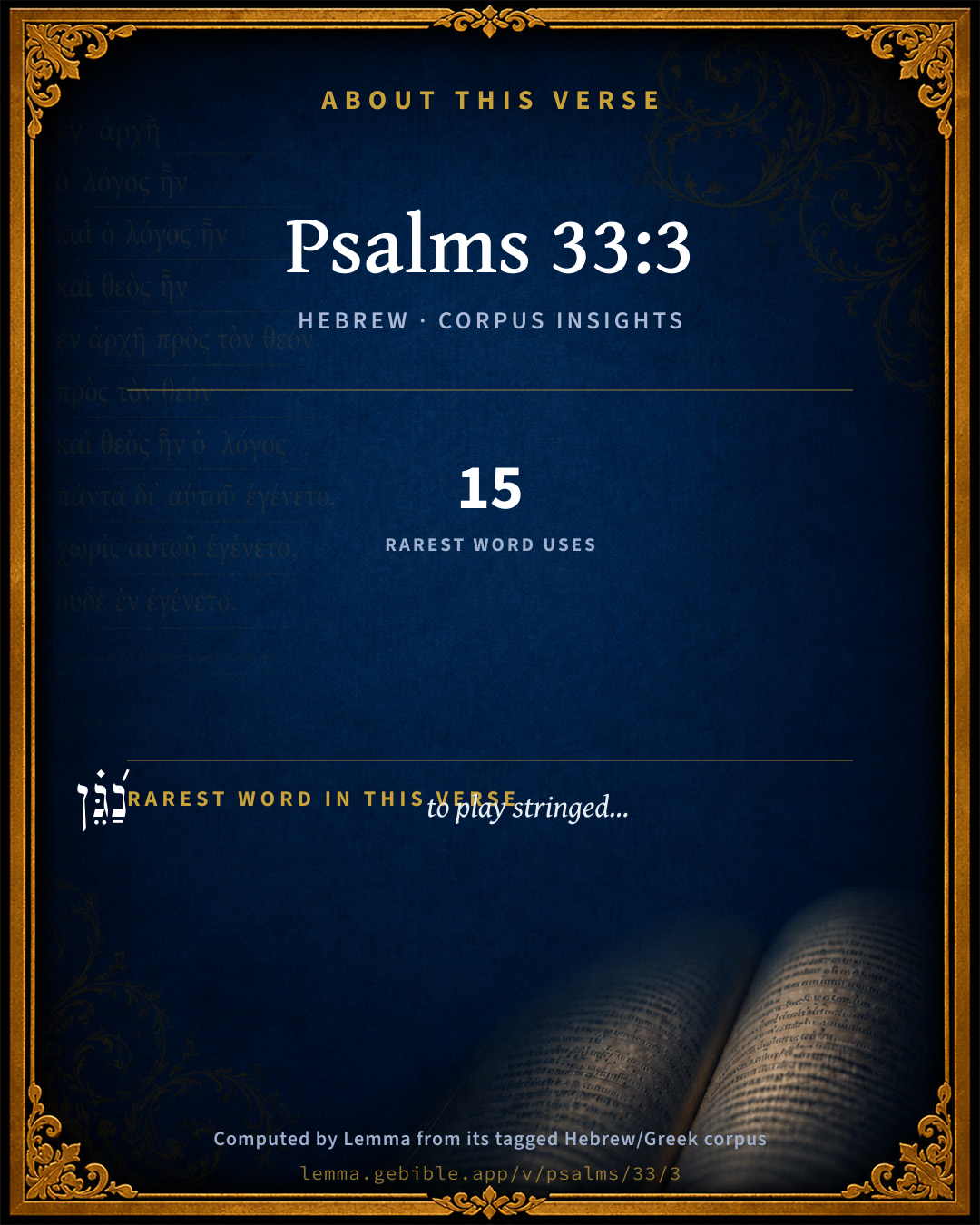
The rarest word here is נַ֝גֵּ֗ן to play stringed instrument H5059 — appearing just 15 times in the whole Hebrew Bible.

Shared distinctive vocabulary

נַ֝גֵּ֗ן to play stringed instrument H5059 occurs in 12 verses of the Hebrew Bible. Also found in:

Grammatical profile

  • 3 verbs
  • 2 nouns
  • 1 adjective
  • 1 preposition

Verb forms

  • שִֽׁירוּ Qal · Imperative
  • הֵיטִ֥יבוּ Hiphil · Imperative
  • נַ֝גֵּ֗ן Piel · Infinitive Construct

Hebrew & Septuagint length

In English translation the verse runs 13 words from the Hebrew and 12 from the Septuagint (LXX English) — closely comparable.

A rough comparison of the two English renderings, which tokenize alike — not a word-level alignment.

Word counts can differ between the Hebrew and the Greek without any difference in meaning — e.g. the Hebrew direct-object marker אֵת has no separate Greek word, and Greek often adds the article ὁ.

Cross-references

14

Topical passages linked to Psalms 33:3 in the Treasury of Scripture Knowledge — connected by theme and wording, ordered by reader-vote popularity; previews shown in the World English Bible.

  • Ephesians 5:19 speaking to one another in psalms, hymns, and spiritual songs; singing, and singing praises in your heart to the Lord;
  • 1 Chronicles 25:7 The number of them, with their brothers who were instructed in singing to Yahweh, even all who were skillful, was two hundred eighty-eight.
  • Psalms 96:1 Sing to Yahweh a new song! Sing to Yahweh, all the earth.
  • Isaiah 42:10 Sing to Yahweh a new song, and his praise from the end of the earth; you who go down to the sea, and all that is therein, the isles, and the inhabitants of it.
  • 1 Chronicles 13:8 David and all Israel played before God with all their might, even with songs, and with harps, and with psalteries, and with tambourines, and with cymbals, and with trumpets.
  • Psalms 98:1 Sing to Yahweh a new song, For he has done marvelous things! His right hand, and his holy arm, have worked salvation for him.
  • Psalms 144:9 I will sing a new song to you, God. On a ten-stringed lyre, I will sing praises to you.
  • Colossians 3:16 Let the word of Christ dwell in you richly; in all wisdom teaching and admonishing one another with psalms, hymns, and spiritual songs, singing with grace in your heart to the Lord.
  • Psalms 40:3 He has put a new song in my mouth, even praise to our God. Many shall see it, and fear, and shall trust in Yahweh.
  • Psalms 149:1 Praise Yahweh! Sing to Yahweh a new song, His praise in the assembly of the saints.
  • Revelation 5:9 They sang a new song, saying, "You are worthy to take the book, And to open its seals: For you were killed, And bought us for God with your blood, Out of every tribe, language, people, and nation,
  • 1 Chronicles 15:22 Chenaniah, chief of the Levites, was over the song: he instructed about the song, because he was skillful.
  • 2 Chronicles 34:12 The men did the work faithfully: and the overseers of them were Jahath and Obadiah, the Levites, of the sons of Merari; and Zechariah and Meshullam, of the sons of the Kohathites, to set it forward; and [others of] the Levites, all who were skillful with instruments of music.
  • Revelation 14:3 They sing a new song before the throne, and before the four living creatures and the elders. No one could learn the song except the one hundred forty-four thousand, those who had been redeemed out of the earth.

Cross-references courtesy of OpenBible.info (CC BY 4.0).

Hebrew and Greek witnesses Masoretic Hebrew ↔ Greek Septuagint

The same verse in the two great witnesses to the Old Testament, shown verse-for-verse.

You’re reading Greek Psalm 32 (Hebrew Psalm 33). The Septuagint counts the superscription, so verse numbers can differ from the Hebrew — chapter-level alignment, not verse-by-verse. Numbering follows Rahlfs.

These are two independent witnesses, not word-aligned to each other, and the Septuagint is shown in lemma (dictionary) form.

Hebrew Psalms 33:3 Masoretic · Westminster Leningrad Codex

שִֽׁירוּ ל֭וֹ שִׁ֣יר חָדָ֑שׁ הֵיטִ֥יבוּ נַ֝גֵּ֗ן בִּתְרוּעָֽה

Sing to him a new song. Play skillfully with a shout of joy!

World English Bible · Public Domain

Greek LXX Greek Psalm 32:3 Septuagint · lemma form

ᾄδω αὐτός ἆ

Sing to him a new song; play skillfully with a loud noise.

LXX2012 (modern English Septuagint) · Public Domain

Hebrew: Westminster Leningrad Codex (CC BY 4.0). Greek: Septuagint (public domain); English from LXX2012 (modern English Septuagint) (Public Domain). How the Septuagint differs from the Hebrew →

Commentary

Notes on Psalms 33:3 from classic Christian and Jewish commentators (each source and its license shown beneath its notes). The classic Christian expositions comment on the surrounding passage and are grouped to its opening verse, so a note may address several verses; the Jewish commentaries on the Tanakh (Rashi and others) are per-verse, so they appear only where the commentator wrote on this verse.

Lemma curates 59 commentaries, every one of them public domain or Creative Commons licensed, each selected and text-cleaned for this edition rather than reprinted as found. About our sources →

Trapp's Complete Commentary

John Trapp

Psa 33:3 Sing unto him a new song; play skilfully with a loud noise.

Ver. 3. Sing unto him a new song] sc. Upon every new emergent occasion. God reneweth his mercies not only every morning, but every moment: so should we our praises; every breath we draw should praise the Lord, Psa 150:6. Doth God give comforts? praise him, and they shall be continued. Doth he send crosses? praise him, and they shall be removed, saith a Father; but "in everything give thanks"; and that not coldly and cursorily, but ardently, and with utmost affection; for which cause this duty is so reiterated here, and pressed with such forcible arguments in the following verses, as might work upon the very stones almost; much more men, for whose sakes all this fair fabric of the world was erected.

Play skilfully (or lustily) with a loud noise] Make good music, set all your skill and might at work to magnify the Lord. It is not an easy matter to praise God aright; it must be done Corde, ore, opere, with the very best of the best. Benefacite canendo, cum iubilatione.

John Trapp, A Commentary or Exposition upon All the Books of the Old and New Testament (1647–1656) — public domain. Text from a community e-Sword module.

J. A. Alexander on Psalms

Joseph Addison Alexander

3. (Psa 33:3) Sing unto him a new song; play well with joyful noise! A new song implies the continual recurrence of fresh reasons and occasions for the praise of God, and also the spontaneous ebullition of devout and thankful feelings in the hearts of those by whom the praise is offered. This is the first instance of the expression, but it frequently reappears in later psalms—Psa 40:4 (3), Psa 96:1; Psa 98:1—and once or twice in the New Testament, Rev 5:9; Rev 14:3.—Play well, literally do well to play or in playing. This peculiar idiom occurs in the history of David, 1Sa 16:17.—Joyful noise, see above, on Ps. xxiii. 6, in which place, as in this, there is no certain or necessary reference to sacrifice, but only to an audible and lively expression of religious feeling.

Joseph Addison Alexander, The Psalms Translated and Explained (1850) — public domain. Text from a community e-Sword module.

Jamieson, Fausset & Brown

Robert Jamieson, A. R. Fausset & David Brown

a new song--fresh, adapted to the occasion (Psa 40:3; Psa 96:1).

play skilfully--(Compare Sa1 16:17).

Jamieson, Fausset & Brown — Commentary Critical and Explanatory on the Whole Bible (1871) — public domain (CC PDM 1.0). Text via the HelloAO Bible API.

Adam Clarke's Commentary

Verse 3. Sing unto him a new song] Do not wear out the old forms: fresh mercies call for new songs of praise and gratitude.

Play skilfully with a loud noise.] Let sense and sound accompany each other; let the style of the music be suited to the words. This skill is possessed by few singers. They can make a loud noise, but they cannot adapt sound to sense.

Adam Clarke's Commentary on the Bible (1810–1826) — public domain. Text from a community e-Sword/MySword module.

John Calvin's Commentaries

3. Sing unto him a new song. As the Psalmist afterwards treats of the mighty works of God, and particularly concerning the preservation of the Church, it is not wonderful that he exhorts the righteous to sing a new, that is, a rare and choice song. The more closely and diligently that believers consider the works of God, the more will they exert themselves in his praises. It is no common song, therefore, which he exhorts them to sing, but a song corresponding to the magnificence of the subject. This is also the meaning of the second clause, in which he urges them to sing loudly. In this sense, I understand the Hebrew word היתיב, heytib, although others refer it rather to the proper setting of the notes.

John Calvin's Commentaries (1540-1563) — public domain. Text from the Calvin Translation Society English edition (1840s-50s) via the Christian Classics Ethereal Library (ccel.org). Calvin's coverage is partial (roughly two-thirds of the Bible); uncommented books and verses are honest gaps, never fabricated. The 19th-century editor's footnotes and remarks are omitted so the notes are faithfully Calvin's own voice.

Ellicott's Commentary for English Readers

(3) A new song.—This expression occurs in Psa_96:1; Psa_98:1; Psa_149:1; Isa_42:10; Jdt_16:13, and was adopted in Rev_5:9; Rev_14:3. The term apparently marked the revival of national psalmody after the Captivity. “Behold, the former things are come to pass, and new things do I declare . . . Sing unto the Lord a new song” (Isa_42:9-10).

Play skilfully with a loud noise.—The latter words represent a Hebrew expression of common hymnic use, describing the full choral effect when instruments and voices were joined in the service of the sanctuary (Psa_95:1; Psa_100:1, &c). Some, however, limit it (after Lev_25:9) to the trumpet accompaniment, and render—

“Strike the harp deftly for him,

Amid the blare of trumpets.”

A Bible Commentary for English Readers, edited by Charles John Ellicott (1878–1897) — public domain. Text from a community e-Sword module.

The Cambridge Bible for Schools and Colleges

gen. ed. J. J. S. Perowne

3. a new song] Fresh mercies demand a fresh expression of gratitude. See Psa_40:3; and cp. Psa_96:1; Psa_98:1; Psa_149:1; Isa_42:10; Jdt_16:13; Rev_5:9. Psa_144:9 reproduces 2 b, and 3 a.

with a loud noise] Referring either to the music itself, or to the accompanying shouts of joy. See note on Psa_27:6, where the same word is rendered joy in A.V.

The Cambridge Bible for Schools and Colleges (gen. ed. J. J. S. Perowne; Cambridge University Press, 1878–1918) — public domain. Text from a community e-Sword module.

John Gill's Exposition

Sing unto him a new song,.... One newly composed on account of recent mercies received; and as the mercies of God are new every morning, there ought to be a daily song of praise to him; and so a new song is a continual song, as Christ is called the "new and living way", Heb 10:20; because he is the everliving way; or the constant and only one, which always was, is, and will be. Or it may denote some famous and excellent song, as a new name is an excellent name, an unknown and unspeakable one; see Rev 2:17; compared with Rev 14:2; or respect may be had to the New Testament dispensation, in which old things are passed away, and all things become new; a new covenant is exhibited, a new and living way opened, and new ordinances instituted, and at the end of it there will be new heavens and a new earth; and so here is a new song made mention of, as suited to it;

play skilfully with a loud voice: either with the quill upon the harp, and the instrument of ten strings; or with the fingers upon the psaltery, at the same time, vocally, and aloud, expressing the new song.

John Gill's Exposition of the Whole Bible (1746–1763) — public domain (CC PDM 1.0). Text via the HelloAO Bible API.

Albert Barnes' Notes on the Bible

Sing unto him a new song - A song specially composed for this occasion; expressive of the special feelings suggested by this occasion, or appropriate to this new manifestation of the divine goodness and mercy. Such occasions, exhibiting some new phase of the divine goodness, demanded new language appropriate to them. So now, new hymns of praise, and new tunes in music, are demanded to meet the ever-varying manifestations of the mercy of God; and as the church is extended in the world, its modes of praise must be adapted to the new state of things which will arise. Nothing could be more absurd than to attempt to restrict the church in its praises to the exact words which were used in the time of David, or to the music which was employed then. Compare the notes at Rev 5:9. The expression “new song” occurs several times in the Psalms, showing that new hymns of praise were composed as adapted to some new manifestation of the goodness of God: Psa 40:3; Psa 96:1; Psa 98:1; Psa 144:9; Psa 149:1. Compare also Isa 42:10.

Play skillfully with a loud noise - literally, “Do well to play;” or, “do well in playing.” That is, do the work well, or with all the skill of music. The word rendered “loud noise,” means properly “a shout of joy” or “rejoicing:” Job 8:21; 1Sa 4:5. It is especially applied to the sound or clangor of trumpets: Lev 25:9; Lev 23:24; Num 29:1. There is rather the idea of “rejoicing” than of “noise” in the word. The meaning is that the music should be such as would be expressive of the highest joy.

Albert Barnes' Notes on the Bible (1834–1885) — public domain. Text from a community e-Sword/MySword module.

Matthew Poole's English Annotations

A new song; either,

1. Newly composed. As God gives you fresh occasions, so do not you content yourselves with the old songs or psalms, made by the holy men of God, but make new ones suited to the occasions. But neither had all the righteous, to whom he speaks, Psa 33:1, the gift of composing songs, nor was it of any necessity or importance that they should make new songs to praise God, at least for the works here mentioned, when there were so many made by David, and other holy prophets, for the use of God’s church and people, when they had any such occasion. Or,

2. Renewed, or repeated, or sung again; in which sense Job saith his glory was new, or fresh in him, Job 29:20, i.e. renewed or continued from day to day; and the command of love is called new, Joh 13:34, because it was renewed and reinforced by Christ. So this song is here called new, not so much from the matter, as from the singing of it; because it was sung afresh, or again.

Matthew Poole's English Annotations on the Holy Bible (1683–1685) — public domain. Text from a community e-Sword/MySword module.

The Treasury of David

Charles H. Spurgeon

Ver. 3. Sing unto him a new song. All songs of praise should be unto him. Singing for singing's sake is nothing worth; we must carry our tribute to the King, and not cast it to the winds. Do most worshippers mind this? Our faculties should be exercised when we are magnifying the Lord, so as not to run in an old groove without thought; we ought to make every hymn of praise a new song. To keep up the freshness of worship is a great thing, and in private it is indispensable. Let us not present old worn out praise, but put life, and soul, and heart, into every song, since we have new mercies every day, and see new beauties in the work and word of our Lord. Play skilfully. It is wretched to hear God praised in a slovenly manner. He deserves the best that we have. Every Christian should endeavour to sing according to the rules of the art, so that he may keep time and tune with the congregation. The sweetest tunes and the sweetest voices, with the sweetest words, are all too little for the Lord our God; let us not offer him limping rhymes, set to harsh tunes, and growled out by discordant voices. With a loud noise. Heartiness should be conspicuous in divine worship. Well bred whispers are disreputable here. It is not that the Lord cannot hear us, but that it is natural for great exultation to express itself in the loudest manner. Men shout at the sight of their kings: shall we offer no loud hosannahs to the Son of David?

Ver. 3. Sing unto him. I. Singing is the music of nature. The Scriptures tell us the mountains sing Isa 55:12; the valleys sing Ps 65:13; the trees of the wood sing 1Ch 16:33; nay, the air is the birds' music room, they chant their musical notes. II. Singing is the music of ordinances. Augustine reports of himself, that when he came to Milan and heard the people sing, he wept for joy in the church to hear that pleasing melody. And Beza confesses that at his first entrance into the congregation, and hearing them sing the ninety-first Psalm, he felt himself exceedingly comforted, and did retain the sound of it afterwards upon his heart. The Rabbins tell us that the Jews, after the feast of the Passover was celebrated, sang the hundred and eleventh and five following Psalms; and our Saviour and his apostles sang a hymn immediately after the blessed Supper. Mt 26:30. III. Singing is the music of saints. (1.) They have performed this duty in their greatest numbers. Ps 149:1-2. (2.) In their greatest straits. Isa 26:19. (3.) In their greatest flight. Isa 42:10-11. (4.) In their greatest deliverances. (5.) In their greatest plenties. Isa 65:14. In all these changes singing hath been their stated duty and delight. And indeed it is meet that the saints and servants of God should sing forth their joys and praises to the Lord Almighty: every attribute of him can set both their song and their tune. IV. Singing is the music of angels. Job tells us "the morning stars sang together, "Job 38:7. Now these "morning stars, "as Pineda tells us, are the angels; to which the Chaldee paraphrase accords, naming these morning stars, aciem angelorum, an host of angels. Nay, when this heavenly host was sent to proclaim the birth of our dearest Jesus, they deliver their message in this raised way of duty. Lu 2:13. They were (ainountev), delivering their messages in a laudatory singing, the whole company of angels making a musical quire. Nay, in heaven there is the angels' joyous music; they there sing hallelujahs to the Most High, and to the Lamb who sits upon the throne, Re 5:11. V. Singing is the music of heaven; the glorious saints and angels accent their praises this way, and make one harmony in their state of blessedness; and this is the music of the Bride chamber. The saints who were tuning here their Psalms, are now singing their hallelujahs in a louder strain, and articulating their joys, which here they could not express to their perfect satisfaction; here they laboured with drowsy hearts, and faltering tongues; but in glory these impediments are removed, and nothing is left to jar their joyful celebration. John Wells, in "Morning Exercises."

Ver. 3. A new song. That is to say, a new and recent composition on account of recent benefits; or constantly new songs, song succeeding song as daily new material for divine praise offers itself to the attentive student of the works of God. Or new, that is, always fresh and full of life, and renewed as new occasions offer themselves: as Job says, "My glory was fresh in me, and my bow was renewed in my hand." Or new, i.e., not common but rare and exquisite; as the new name in Re 2:17; the new commandment; Joh 13:34. Or this respects the gospel state, wherein is a new covenant Heb 8:8, a new Jerusalem Re 21:2, a new man Eph 2:15, and all things new, 2Co 5:17. New, on account of its matter being unknown of men: as in Re 14:3, "They sung a new song, "and no man could learn that song but the hundred and forty and four thousand, which were redeemed from the earth. New may be used in opposition to old. The song of Moses is old, and of the Lamb is new. Martin Geir (1614-1681), in "Poli Synopsis Criticorum."

Ver. 3. Sing unto him a new song. Put off oldness: ye know the new song. A new man, a New Testament, a new song. A new song belongeth not to men that are old; none learn that but new men, renewed through grace from oldness, and belonging now to the New Testament, which is the kingdom of heaven. Augustine.

Ver. 3. A new song; namely, sung with such fervency of affections as novelties usually bring with them; or, always new, seeing God's graces never wax old; or, sung by the motion of this new spirit of grace, which doth not so much look after the old benefits of the creation as after the new benefit of the redemption in Christ, which renews all things. Ps 40:3 96: 1 Re 5:9 14:3. John Diodati.

Ver. 3. Sing unto him a new song. It is a melancholy proof of the decline of the church, when the exhortation to sing a new song is no longer attended to: in such a case, there is need of the greatest care to prevent the old ones falling into oblivion. E. W. Hengstenberg.

Ver. 3. Play skilfully. It is not an easy matter to praise God aright; it must be done corde, ore, spere, with the very best of the best. John Trapp.

Ver. 3. (first clause). The duty of maintaining the freshness of our devotions.

Freshness, skill, and heartiness, to be combined in our congregational psalmody.

Psalms 33:4*

Charles H. Spurgeon's The Treasury of David (1869–1885) — public domain. Psalms only. Text from a community e-Sword/MySword module.

The Pulpit Commentary

Sing unto him a new song. (comp. Psa_40:3 Psa_96:1 Psa_98:1 Isa_42:10 Rev_5:9 Rev_14:3) Not necessarily a song unheard before, but one fresh from the singer"s heart. Play skilfully with a loud noise. The loudness of a thanksgiving song was regarded as an indication of its heartiness. (comp. Psa_98:4 Psa_100:1 Psa_150:5; and see also 2Ch_20:19 2Ch_30:21 Ezr_3:11-13 Neh_12:42)

The Pulpit Commentary (1880–1919), ed. H.D.M. Spence-Jones & Joseph S. Exell — public domain. Text from a community e-Sword module.

John Wesley's Explanatory Notes

A new song - Renewed or continued from day to day.

John Wesley, Explanatory Notes Upon the Whole Bible (1754–1765) — public domain. Text via the GEBible commentary corpus.

Lesson kit

Teaching starters — assembled from the data on this page, not authored interpretation. Every prompt links to the verse data it draws on. Edit before teaching.

Psalms, in the Wisdom, opens this verse with 7 words (6 distinct Hebrew lemmas). Its most distinctive word is nâgan (“to play stringed instrument”). A historical commentator’s framing appears above. Read the whole chapter for the surrounding context.

Discussion questions

  1. How does “to play stringed instrument” (nâgan) shape what this verse is saying?
  2. How does 1 Samuel 16:16, which shares the word «to play stringed instrument», read alongside this verse?
  3. These translations render this verse differently; the difference is in the English rendering, not the original. What questions does that raise?
  4. «שִֽׁירוּ» is a Qal Imperative verb. How does that grammatical form shape the action described?
  5. Compare how Trapp's Complete Commentary and J. A. Alexander on Psalms read this verse. Where do they agree or differ?

Things to notice

Reading settings

Reading text

Shown beneath each verse's original-language words.

Old Testament
Old Testament edition

Read the OT as the Masoretic Hebrew (MT) or the Greek Septuagint (LXX).

English shown for the Greek Septuagint (in the Hebrew ↔ Greek comparison).

Comparing translations? Open the Compare panel on any verse page to stack up to four side by side.