
Psalms 69:31

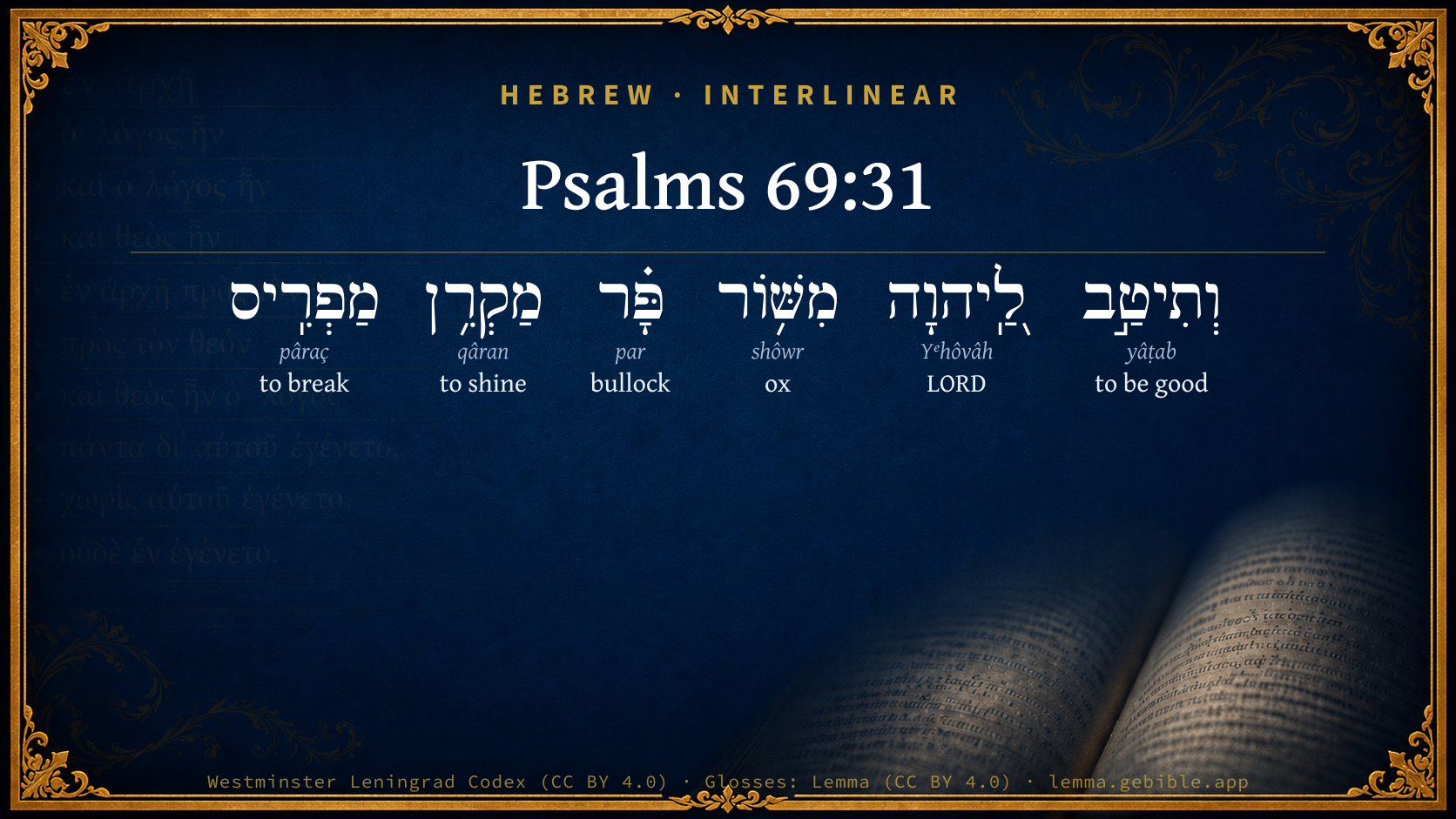
Hebrew (Westminster Leningrad Codex) Psalms 69:31 appears in the Hebrew Old Testament. The text above is from the Westminster Leningrad Codex. Each word links to its Strong’s number, a concise gloss, and parsing drawn from the Open Scriptures Hebrew Bible morphology. Click any word for its full Brown-Driver-Briggs (BDB) entry.
Download image
Cite this verse

Psalms 69:31 (World English Bible). Public Domain. Lemma interlinear Bible study tool, https://lemma.gebible.app/v/psalms/69/31.

Show BibTeX & RIS
BibTeX
RIS
English Translation
It will please Yahweh better than an ox, Or a bull that has horns and hoofs.
World English Bible · Public Domain
Download a study sheet

One document with this verse’s original text, its word-by-word gloss line, the meaning frame, cross-references with their text, attributed commentary, and full source and license credits — printable, and it pastes into notes with its structure intact.

This verse Autodidact and up

Study sheet (.html) Plain text (.txt)

A passage Seminary Student

Up to 50 verses in one chapter. A passage sheet keeps up to 6 commentary sources and 12 cross-references per verse, in the order this page ranks them, and says so on the sheet whenever that leaves anything out. Ask for a single verse and you get the Autodidact verse sheet above.

Everything on this page stays free to read, with no account — the sheet is a download of what is already on screen, not access to it.

Want to remove ads? Support Godless Engineer
Compare translations 3

The same verse in 3 English versions, stacked beneath the original-language interlinear above. Click any original word for its lexicon entry.

Each is an independent rendering of the whole verse — the interlinear is not word-aligned to these translations.

Highlighted words mark where these versions differ — a whole-verse word diff, not a word-by-word alignment.

  • World English Bible Public Domain
    It will please Yahweh better than an ox, Or a bull that has horns and hoofs.
  • King James Version Public Domain
    This also shall please the LORD better than an ox or bullock that hath horns and hoofs.
  • unfoldingWord Literal Text CC BY-SA 4.0
    And this will be better to Yahweh than an ox, a bull having horns and having hooves.

unfoldingWord Literal Text — © unfoldingWord, licensed CC BY-SA 4.0. Word-aligned USFM3 via Door43 (git.door43.org/unfoldingWord/en_ult).

Versions to compare (up to 4)

3 of 4 selected

Show all 18 translations

Every available English version of this verse, each an independent rendering of the whole verse.

  • World English Bible Public Domain
    It will please Yahweh better than an ox, Or a bull that has horns and hoofs.
  • Berean Standard Bible Public Domain
    And this will please the LORD more than an ox, more than a bull with horns and hooves.
  • Majority Standard Bible Public Domain
    And this will please the LORD more than an ox, more than a bull with horns and hooves.
  • King James Version Public Domain
    This also shall please the LORD better than an ox or bullock that hath horns and hoofs.
  • American Standard Version (1901) Public Domain
    And it will please Jehovah better than an ox, `Or' a bullock that hath horns and hoofs.
  • Revised Version (1885) Public Domain
    And it shall please the LORD better than an ox, or a bullock that hath horns and hoofs.
  • Geneva Bible (1599) Public Domain
    This also shall please the Lord better then a yong bullocke, that hath hornes and hoofes.
  • Douay-Rheims (1899) Public Domain
    I will praise the name of God with a canticle: and I will magnify him with praise.
  • Young's Literal Translation Public Domain
    And it is better to Jehovah than an ox, A bullock -- horned -- hoofed.
  • Literal Standard Version CC BY-SA 4.0
    And it is better to YHWH than an ox, || A bullock—horned [and] hoofed.
  • Unlocked Literal Bible CC BY-SA 4.0
    That will please Yahweh better than an ox or a bull that has horns and hooves.
  • unfoldingWord Literal Text CC BY-SA 4.0
    And this will be better to Yahweh than an ox, a bull having horns and having hooves.
  • Darby Bible Public Domain
    And it shall please Jehovah more than an ox, -- a bullock with horns and cloven hoofs.
  • World Messianic Bible Public Domain
    It will please the LORD better than an ox, or a bull that has horns and hoofs.
  • Webster's Bible Public Domain
    \\69:30\\I will praise the name of God with a song, and will magnify him with thanksgiving.
  • Free Bible Version CC BY-SA 4.0
    The Lord is happier with this than with offering animals as sacrifices: cattle, or bulls with horns and hooves.
  • Bible in Basic English Public Domain
    This will be more pleasing to the Lord than an ox, or a young ox of full growth.
  • JPS Tanakh (1917) Public Domain
    (69-32) And it shall please the LORD better than a bullock that hath horns and hoofs.

Literal Standard Version (2020), Covenant Press — licensed CC BY-SA 4.0. Text via the HelloAO Bible API (eBible.org). Unlocked Literal Bible (unfoldingWord) — licensed CC BY-SA 4.0. Text via the HelloAO Bible API (eBible.org). unfoldingWord Literal Text — © unfoldingWord, licensed CC BY-SA 4.0. Word-aligned USFM3 via Door43 (git.door43.org/unfoldingWord/en_ult). Free Bible Version, Dr. Jonathan Gallagher — licensed CC BY-SA 4.0. Text via the HelloAO Bible API (eBible.org).

Word by word

More ways to search: Search by grammar → Find every occurrence → Compare this word →

Practice this passage: Drill this verse → Learn its vocabulary →

About this verse

These counts appear in no published source. They are computed here, from the morphology-tagged text and Lemma’s own curated glosses. What Lemma adds →

6
words
6
distinct lemmas
Wisdom
section

Notable vocabulary

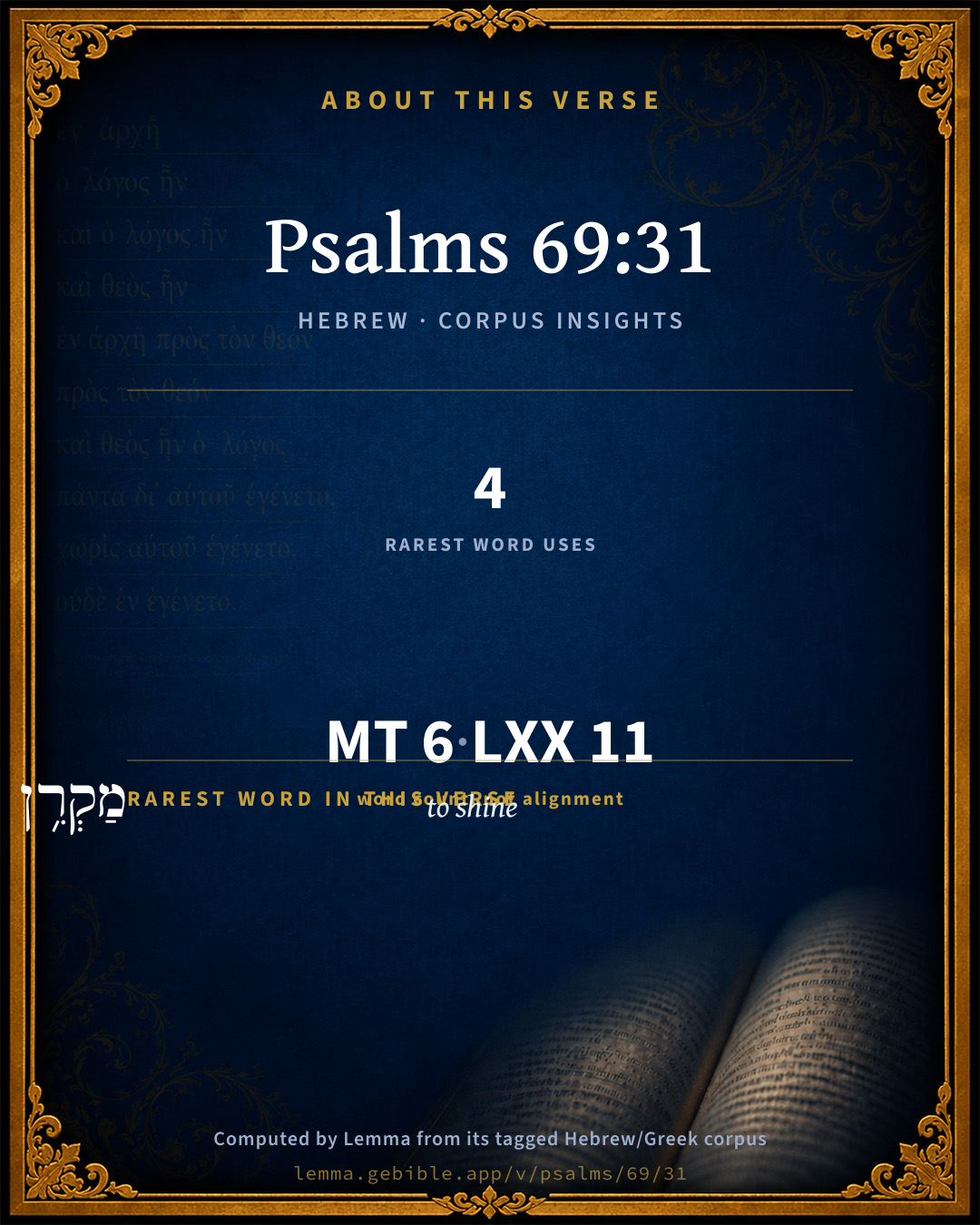
The rarest word here is מַקְרִ֥ן to shine H7160 — appearing just 4 times in the whole Hebrew Bible.

Shared distinctive vocabulary

מַקְרִ֥ן to shine H7160 occurs in 4 verses of the Hebrew Bible. Also found in:

Grammatical profile

  • 3 verbs
  • 3 nouns

Verb forms

  • וְתִיטַ֣ב Qal · Imperfect
  • מַקְרִ֥ן Hiphil · Participle Active
  • מַפְרִֽיס Hiphil · Participle Active

Hebrew & Septuagint length

In English translation the verse runs 16 words from the Hebrew and 14 from the Septuagint (LXX English) — closely comparable.

A rough comparison of the two English renderings, which tokenize alike — not a word-level alignment.

Word counts can differ between the Hebrew and the Greek without any difference in meaning — e.g. the Hebrew direct-object marker אֵת has no separate Greek word, and Greek often adds the article ὁ.

In the original languages it is 6 Hebrew tokens and 11 Greek tokens — but the two are counted differently (Hebrew bundles its prefixes and suffixes into one token; the Greek is in lemma form), so that isn’t a like-for-like length.

Cross-references

6

Topical passages linked to Psalms 69:31 in the Treasury of Scripture Knowledge — connected by theme and wording, ordered by reader-vote popularity; previews shown in the World English Bible.

  • Hebrews 13:15 Through him, then, let us offer up a sacrifice of praise to God continually, that is, the fruit of lips which make confession to his name.
  • Psalms 50:13–14 Will I eat the flesh of bulls, Or drink the blood of goats?
  • Psalms 50:23 Whoever offers the sacrifice of thanksgiving glorifies me, And prepares his way so that I will show God's salvation to him."
  • Ephesians 5:19–20 speaking to one another in psalms, hymns, and spiritual songs; singing, and singing praises in your heart to the Lord;
  • 1 Peter 2:5 You also, as living stones, are built up as a spiritual house, to be a holy priesthood, to offer up spiritual sacrifices, acceptable to God through Jesus Christ.
  • Hosea 14:2 Take words with you, and return to Yahweh. Tell him, "Forgive all our sins, And accept that which is good: So we offer like bulls our lips.

Cross-references courtesy of OpenBible.info (CC BY 4.0).

Hebrew and Greek witnesses Masoretic Hebrew ↔ Greek Septuagint

The same verse in the two great witnesses to the Old Testament, shown verse-for-verse.

You’re reading Greek Psalm 68 (Hebrew Psalm 69). The Septuagint counts the superscription, so verse numbers can differ from the Hebrew — chapter-level alignment, not verse-by-verse. Numbering follows Rahlfs.

These are two independent witnesses, not word-aligned to each other, and the Septuagint is shown in lemma (dictionary) form.

Hebrew Psalms 69:31 Masoretic · Westminster Leningrad Codex

וְתִיטַ֣ב לַֽ֭יהוָה מִשּׁ֥וֹר פָּ֗ר מַקְרִ֥ן מַפְרִֽיס

It will please Yahweh better than an ox, Or a bull that has horns and hoofs.

World English Bible · Public Domain

Greek LXX Greek Psalm 68:31 Septuagint · lemma form

αἰνέω ὁ ὄνομα ὁ θεός μετά ᾠδή μεγαλύνω αὐτός ἐν αἴνεσις

and this shall please God more than a young calf having horns and hoofs.

LXX2012 (modern English Septuagint) · Public Domain

Hebrew: Westminster Leningrad Codex (CC BY 4.0). Greek: Septuagint (public domain); English from LXX2012 (modern English Septuagint) (Public Domain). How the Septuagint differs from the Hebrew →

Commentary

Notes on Psalms 69:31 from classic Christian and Jewish commentators (each source and its license shown beneath its notes). The classic Christian expositions comment on the surrounding passage and are grouped to its opening verse, so a note may address several verses; the Jewish commentaries on the Tanakh (Rashi and others) are per-verse, so they appear only where the commentator wrote on this verse.

Lemma curates 59 commentaries, every one of them public domain or Creative Commons licensed, each selected and text-cleaned for this edition rather than reprinted as found. About our sources →

Trapp's Complete Commentary

John Trapp

Psa 69:31 [This] also shall please the LORD better than an ox [or] bullock that hath horns and hoofs.

Ver. 31. This also shall please the Lord better, &c.] True thankfulness is opimum et optimum saerificium, those calves of our lips, Hos 14:3 Heb 12:15. These calves or bullocks (as in the text) must, 1. Have horns and hoofs, be young and tender, the very best, of the best. 2. They must be slain; our thanks must proceed from a mortified mind. 3. They must be sacrificed; where is required, (1.) An altar, our praises must be tendered in the mediation of Christ. (2.) Fire, our hearts must be inflamed with zeal and ardency. (3.) Our hands must be laid on the head of the bullock; that is, we must in all humility confess our unworthiness, &c. This will surely please the Lord better than an ox or bullock that hath horns and hoofs.

John Trapp, A Commentary or Exposition upon All the Books of the Old and New Testament (1647–1656) — public domain. Text from a community e-Sword module.

J. A. Alexander on Psalms

Joseph Addison Alexander

32. (Psa 69:31). And it shall be better to Jehovah, this shall please him more, than ox (or) bullock horned (and) hoofed. The contrast is not between material and spiritual offerings, but between a legitimate offering of both kinds and the mere oblation of a beast, as an opus operation of intrinsic virtue, or as if God could take delight in hoofs and horns, which are therefore contemptuously specified. See above, on Psa 40:6; Psa 50:8; Psa 51:16. The last words are highly idiomatic, and scarcely susceptible of close translation, the original forms being those of active participles, horning, hoofing, i.e. having or producing horns and hoofs.

Joseph Addison Alexander, The Psalms Translated and Explained (1850) — public domain. Text from a community e-Sword module.

Tyndale Open Study Notes

Tyndale Open Resources

69:31 Making a vow often included a sacrifice (20:3; 51:19; cp. 50:13-14; 51:16).

Tyndale Open Study Notes — © Tyndale Open Resources, licensed CC BY-SA 4.0. Text via the HelloAO Bible API.

Geneva Bible (1599)

Geneva Bible translators

There is no sacrifice, which God more esteemeth, than thanksgiving for his benefits.

Geneva Bible (1599) marginal notes — public domain. Text via Bolls.life.

Adam Clarke's Commentary

Verse 31. An ox or bullock that hath horns and hoofs.] Oxen offered in sacrifice had their horns and hoofs gilded; and the psalmist might mention these parts of the victim more particularly, because they were more conspicuous. Others think that full-grown animals are intended, those that had perfect horns, in opposition to calves or steers. I think the first the preferable sense; for the horns, &c., of consecrated animals are thus ornamented in the east to the present day.

Adam Clarke's Commentary on the Bible (1810–1826) — public domain. Text from a community e-Sword/MySword module.

John Calvin's Commentaries

31. And this will please Jehovah more than a young bullock. The more effectually to strengthen himself for this exercise, David affirms that the thanksgiving which he is about to tender, will be to God a sacrifice of a sweet and an acceptable savor. There cannot be a more powerful incitement to thanksgiving than the certain conviction that this religious service is highly pleasing to God; even as the only recompense which he requires for all the benefits which he lavishes upon us is, that we honor and praise his name. This sets in a stronger light the inexcusableness of those who are so sluggish as, by their silence or forgetfulness, to suppress the praises of God. David neither omitted nor despised the outward sacrifices which the law enjoined; but he very justly preferred the spiritual service, which was the end of all the Levitical ceremonies. This subject I have treated at greater length on Psalm 50:14. By the way, the humility of David is worthy of being noticed, who, although he rose so high as to be a heavenly pattern, yet disdained not to humble himself for the common benefit of the Church, as if he had belonged to the common class of the people, that by the figures of the law he might learn the truth which has since been more clearly manifested in the gospel; namely, that the praises of God, in so far as they proceed from our mouths, are impure, until they are sanctified by Christ. But how gross and stupid is the superstition of those who would again bring into use the outward pomp of ceremonies which were abolished by the one sacrifice of Christ’s death, and think that God is truly pacified when they have wearied themselves with doing nothing! What does this amount to, but to obscure or cover, by the intervention of thick veils, this legitimate service of thanksgiving, which David had no hesitation in greatly preferring to the Mosaic ceremonies, although these were of divine appointment? By a young bullock, he means one of the most choice or select and the idea which he intends to convey is, that there was no sacrifice or victim, however valuable or precious, that he could offer, in which God would take so great delight as in thanksgiving.

John Calvin's Commentaries (1540-1563) — public domain. Text from the Calvin Translation Society English edition (1840s-50s) via the Christian Classics Ethereal Library (ccel.org). Calvin's coverage is partial (roughly two-thirds of the Bible); uncommented books and verses are honest gaps, never fabricated. The 19th-century editor's footnotes and remarks are omitted so the notes are faithfully Calvin's own voice.

Ellicott's Commentary for English Readers

(31) That hath . . .—Literally, showing horns and dividing the hoofs, marking at once clean animals, and those of fit age for sacrifice.

(31, 32) The pre-eminence of praise above sacrifice is not infrequent in the Psalms. (Comp. Psa_50:14.)

A Bible Commentary for English Readers, edited by Charles John Ellicott (1878–1897) — public domain. Text from a community e-Sword module.

The Cambridge Bible for Schools and Colleges

gen. ed. J. J. S. Perowne

31. And it shall please Jehovah better than an ox,

(Or) a bullock that hath horns and hoofs.

The Massoretic accentuation makes one clause of the verse, reading it better than an ox-bullock: but the division of the clauses adopted by R.V. is preferable. The epithets are not merely ornamental: the horns shew that the animal is of full age; the hoofs allude to the definition of ‘clean’ animals in Lev_11:3 ff. But spiritual sacrifices of praise and thanksgiving are more acceptable than the most perfect animal victim. Cp. Psalms 50, 51.

The Cambridge Bible for Schools and Colleges (gen. ed. J. J. S. Perowne; Cambridge University Press, 1878–1918) — public domain. Text from a community e-Sword module.

John Gill's Exposition

This also shall please the Lord,.... That is, this song of praise and thanksgiving. The Targum has it,

"my prayers;''

as if it retorted to Psa 69:29; but what is expressed in Psa 69:30 seems to be the proper antecedent to this, and which is a sacrifice; see Psa 50:14; and more acceptable to God than any of the legal sacrifices, even when they were in force; and much more, now they are abrogated; and especially as offered up by the Messiah himself, all whose offerings are well pleasing to God; particularly the offering up of himself, which was for a sweet smelling savour to him, and in virtue of which all spiritual sacrifices of prayer and praise become acceptable unto God;

better than an ox or bullock that hath horns and hoofs; that is, than the best of legal sacrifices; as an ox or bullock was, whose horns and hoofs were grown; one of three years old, as Jarchi and Kimchi observe: the words may be literally rendered, "than an ox, than a bullock, than horns, than hoofs"; not only better than an ox or a bullock, but than any creature that has horns and hoofs; that is, than the lawful sacrifice of any animal whatever, as Junius renders and explains it.

John Gill's Exposition of the Whole Bible (1746–1763) — public domain (CC PDM 1.0). Text via the HelloAO Bible API.

Albert Barnes' Notes on the Bible

This also shall please the Lord - This will be more acceptable to the Lord.

Better than an ox or bullock that hath horns and hoofs - Better than a burnt sacrifice - horns, and hoofs, and all. The original here is, “horning and hoofing;” that is, an ox whose horns were fully grown, and whose hoofs were compact and solid; a perfect animal in its kind, offered whole on the altar. The psalmist does not say that such an offering would “not” be acceptable to the Lord, but that the offering of the heart - the sacrifice of praise - would be “more” acceptable than any such offering in itself considered. This sentiment accords with the common language of the Old Testament. See the notes at Psa 40:6-8. Compare Psa 51:16-17; 1Sa 15:22.

Albert Barnes' Notes on the Bible (1834–1885) — public domain. Text from a community e-Sword/MySword module.

Matthew Poole's English Annotations

This sincere and hearty sacrifice of praise is and shall be more grateful to God than the most glorious legal sacrifices, for so such moral services ever were, 1Sa 15:22; Hos 6:6, and such sacrifices shall be accepted when those legal ones shall be abolished.

That hath horns and hoofs: this is added as a description and commendation of the sacrifice, or bullock, which he supposeth to be of the best sort, both tender and mature, as it is when the horns bud forth, and the hoofs grow hard.

Matthew Poole's English Annotations on the Holy Bible (1683–1685) — public domain. Text from a community e-Sword/MySword module.

The Treasury of David

Charles H. Spurgeon

Ver. 31. This also shall please the Lord better than an ox or bullock that hath horns and hoofs. No sacrifice is so acceptable to God, who is a Spirit, as that which is spiritual. He accepted bullocks under a dim and symbolical dispensation; but in such offerings, in themselves considered, he had no pleasure. "Will I eat the flesh of bulls, or drink the blood of goats?" Here he puts dishonour upon mere outward offerings by speaking of the horns and hoofs, the offal of the victim. The opus operatum, which our ritualists think so much of, the Lord puffs at. The horning and hoofing are nothing to him, though to Jewish ritualists these were great points, and matters for critical examination; our modern rabbis are just as precise as to the mingling of water with their wine, the baking of their wafers, the cut of their vestments, and the performance of genuflections towards the right quarter of the compass. O fools, and slow of heart to perceive all that the Lord has declared. "Offer unto God thanksgiving" is the everlasting rubric of the true directory of worship. The depths of grief into which the suppliant had been plunged gave him all the richer an experience of divine power and grace in his salvation, and so qualified him to sing more sweetly "the song of loves." Such music is ever most acceptable to the infinite Jehovah.

None.

Charles H. Spurgeon's The Treasury of David (1869–1885) — public domain. Psalms only. Text from a community e-Sword/MySword module.

The Pulpit Commentary

This also shall please the Lord better than an ox or bullock that hath horns and hoofs; i.e. that is fit for legal sacrifice of full age, and clean.

The Pulpit Commentary (1880–1919), ed. H.D.M. Spence-Jones & Joseph S. Exell — public domain. Text from a community e-Sword module.

John Wesley's Explanatory Notes

This - This hearty sacrifice of praise, is more grateful to God, than the most glorious legal sacrifices. Hath horns - That is both tender and mature, as it is when the horns bud forth, and the hoofs grow hard.

John Wesley, Explanatory Notes Upon the Whole Bible (1754–1765) — public domain. Text via the GEBible commentary corpus.

Lesson kit

Teaching starters — assembled from the data on this page, not authored interpretation. Every prompt links to the verse data it draws on. Edit before teaching.

Psalms, in the Wisdom, opens this verse with 6 words (6 distinct Hebrew lemmas). Its most distinctive word is qâran (“to shine”). A historical commentator’s framing appears above. Read the whole chapter for the surrounding context.

Discussion questions

  1. The word qâran carries the sense “to shine.” How does it shape the verse?
  2. How does Exodus 34:29, which shares the word «to shine», read alongside this verse?
  3. These translations render this verse differently; the difference is in the English rendering, not the original. What questions does that raise?
  4. «וְתִיטַ֣ב» is a Qal Imperfect verb. How does that grammatical form shape the action described?
  5. Compare how Trapp's Complete Commentary and J. A. Alexander on Psalms read this verse. Where do they agree or differ?

Things to notice

Reading settings

Reading text

Shown beneath each verse's original-language words.

Old Testament
Old Testament edition

Read the OT as the Masoretic Hebrew (MT) or the Greek Septuagint (LXX).

English shown for the Greek Septuagint (in the Hebrew ↔ Greek comparison).

Comparing translations? Open the Compare panel on any verse page to stack up to four side by side.