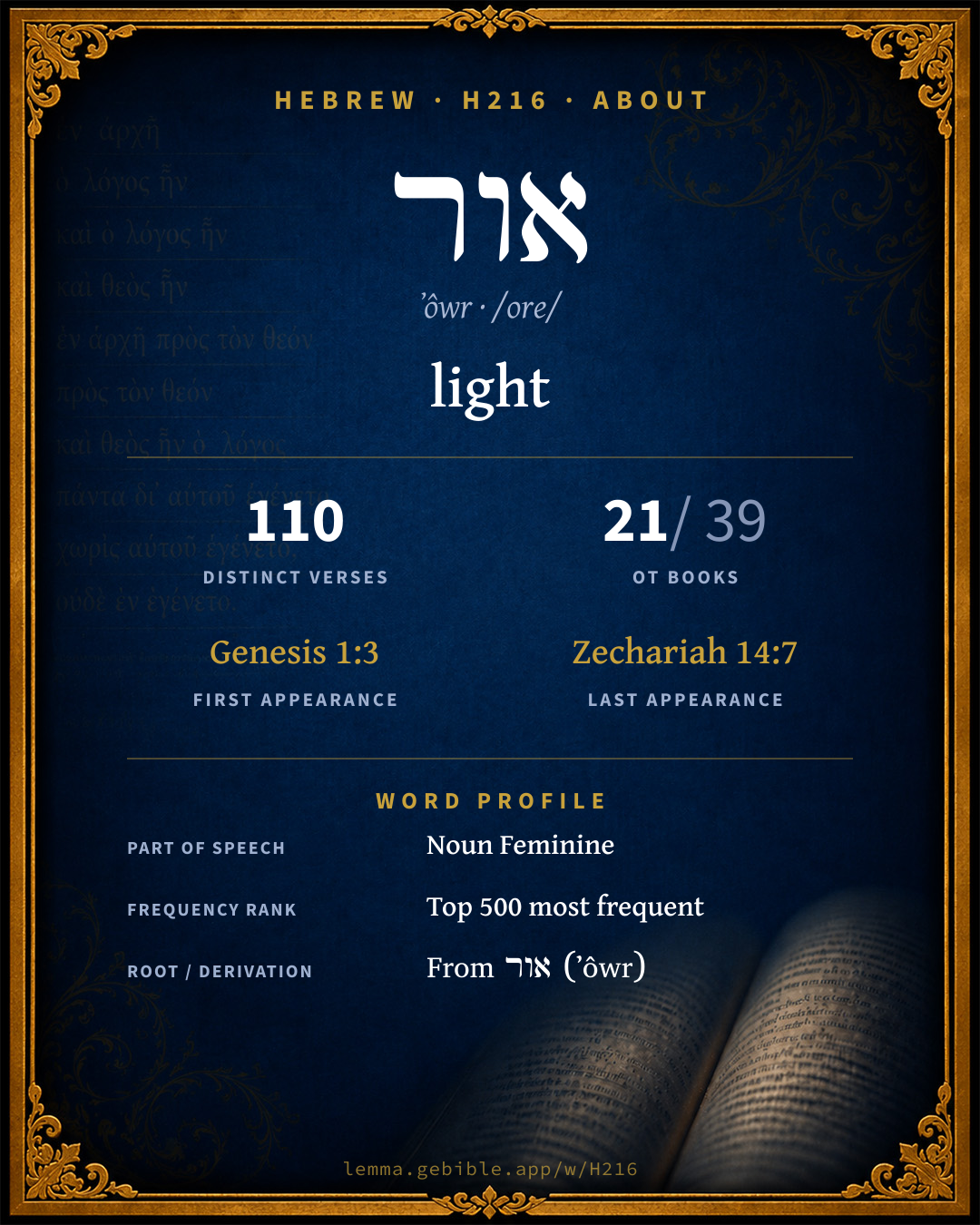
אוֹר
light
‘light’ is one of 12 main senses fuller range ↓
Full lexicon entry — Brown-Driver-Briggs (BDB)
From Brown-Driver-Briggs (BDB)
Where this word appears
See every Absolute-state word in the Hebrew Bible →
Grammar key — what these labels mean
Part of speech
- Noun
- A naming word — a person, place, thing, or idea.
Noun type
- Common
- A common noun — a general class of person, place, or thing (“king,” “city,” “water”), not a specific name.
State
- Absolute
- The independent form of a noun, not bound to a following word.
- Construct
- A noun bound to a following noun in a possessive / “of” relationship (the construct chain).
Gender
- Both
- Attested as both masculine and feminine.
Number
- Singular
- One.
- Plural
- More than one (in Hebrew, generally three or more).
Grammatical forms
- Noun, Common, Both, Singular, Absolute 69 times (57%)
- Noun, Common, Both, Singular, Construct 51 times (42%)
- Noun, Common, Both, Plural, Absolute 1 time (1%)
Parsed forms decoded from the imported morphology (morphhb / Westminster Leningrad Codex — WLC text public domain, morphhb tagging CC BY 4.0), counted across 121 parsed occurrences — not distinct verses.
Every verse where H216 appears — 110 distinct verses across 21 books. Click any verse to open its interlinear word-by-word view. Verse text shown in the World English Bible for context — . Each verse’s Hebrew form is shown with its reference; the English is not keyword-highlighted, since the data carries no word-level English alignment. Use “Compare translations” on any verse to read it across multiple English versions. This concordance covers the Hebrew Bible; Septuagint (Greek Old Testament) occurrences are not indexed here.
Genesis 4 verses
- Genesis 1:3 א֑וֹר אֽוֹר n c bs n c bs God said, "Let there be light," and there was light.
- Genesis 1:4 הָ/א֖וֹר הָ/א֖וֹר ptcl def.art + n c bs ptcl def.art + n c bs God saw the light, and saw that it was good. God divided the light from the darkness.
- Genesis 1:5 לָ/אוֹר֙ prep det + n c bs God called the light Day, and the darkness he called Night. There was evening and there was morning, one day.
- Genesis 1:18 הָ/א֖וֹר ptcl def.art + n c bs and to rule over the day and over the night, and to divide the light from the darkness. God saw that it was good.
Exodus 1 verse
Judges 2 verses
- Judges 16:2 א֥וֹר n c bs cs [It was told] the Gazites, saying, Samson is come here. They compassed him in, and laid wait for him all night in the gate of the city, and were quiet all the night, saying, [Let be] until morning light, then we will kill him.
- Judges 19:26 הָ/אֽוֹר ptcl def.art + n c bs Then came the woman in the dawning of the day, and fell down at the door of the man's house where her lord was, until it was light.
1 Samuel 3 verses
- 1 Samuel 14:36 א֣וֹר n c bs cs Saul said, Let us go down after the Philistines by night, and take spoil among them until the morning light, and let us not leave a man of them. They said, Do whatever seems good to you. Then said the priest, Let us draw near here to God.
- 1 Samuel 25:34 א֥וֹר n c bs cs For in very deed, as Yahweh, the God of Israel, lives, who has withheld me from hurting you, except you had hurried and come to meet me, surely there wouldn't have been left to Nabal by the morning light so much as one man-child.
- 1 Samuel 25:36 א֥וֹר n c bs cs Abigail came to Nabal; and, behold, he held a feast in his house, like the feast of a king; and Nabal's heart was merry within him, for he was very drunken: therefore she told him nothing, less or more, until the morning light.
2 Samuel 2 verses
- 2 Samuel 17:22 א֣וֹר n c bs cs Then David arose, and all the people who were with him, and they passed over the Jordan: by the morning light there lacked not one of them who had not gone over the Jordan.
- 2 Samuel 23:4 וּ/כְ/א֥וֹר conj + prep + n c bs cs [He shall be] as the light of the morning, when the sun rises, A morning without clouds, [When] the tender grass [springs] out of the earth, Through clear shining after rain.
2 Kings 1 verse
Nehemiah 1 verse
Job 32 verses
- Job 3:9 לְ/א֥וֹר prep + n c bs Let the stars of the twilight of it be dark. Let it look for light, but have none, Neither let it see the eyelids of the morning,
- Job 3:16 אֽוֹר n c bs Or as a hidden untimely birth I had not been, As infants who never saw light.
- Job 3:20 א֑וֹר n c bs "Why is light given to him who is in misery, Life to the bitter in soul,
- Job 12:22 לָ/א֣וֹר prep det + n c bs He uncovers deep things out of darkness, And brings out to light the shadow of death.
- Job 12:25 א֑וֹר n c bs They grope in the dark without light. He makes them stagger like a drunken man.
- Job 17:12 א֝֗וֹר n c bs They change the night into day, Saying 'The light is near' in the presence of darkness.
- Job 18:5 א֣וֹר n c bs cs "Yes, the light of the wicked shall be put out, The spark of his fire shall not shine.
- Job 18:6 א֭וֹר n c bs The light shall be dark in his tent, His lamp above him shall be put out.
- Job 18:18 מֵ/א֣וֹר prep + n c bs He shall be driven from light into darkness, And chased out of the world.
- Job 22:28 אֽוֹר n c bs You shall also decree a thing, and it shall be established to you. Light shall shine on your ways.
- Job 24:13 א֥וֹר n c bs "These are of those who rebel against the light; They don't know the ways of it, Nor abide in the paths of it.
- Job 24:14 לָ/א֡וֹר prep det + n c bs The murderer rises with the light. He kills the poor and needy. In the night he is like a thief.
- Job 24:16 אֽוֹר n c bs In the dark they dig through houses. They shut themselves up in the daytime. They don't know the light.
- Job 25:3 אוֹרֵֽ/הוּ n c bs cs + sfx pers 3ms Can his armies be counted? On whom does his light not arise?
- Job 26:10 א֣וֹר n c bs He has described a boundary on the surface of the waters, And to the confines of light and darkness.
- Job 28:11 אֽוֹר n c bs He binds the streams that they don't trickle; The thing that is hidden he brings forth to light.
- Job 29:3 לְ֝/אוֹר/וֹ prep + n c bs cs + sfx pers 3ms When his lamp shone on my head, And by his light I walked through darkness;
- Job 29:24 וְ/א֥וֹר conj + n c bs cs I smiled on them when they had no confidence. They didn't reject the light of my face.
- Job 30:26 לְ֝/א֗וֹר prep + n c bs When I looked for good, then evil came; When I waited for light, there came darkness.
- Job 31:26 א֖וֹר n c bs If I have seen the sun when it shined, Or the moon moving in splendor,
- Job 33:28 בָּ/א֥וֹר prep det + n c bs He has redeemed my soul from going into the pit, My life shall see the light.'
- Job 33:30 בְּ/א֣וֹר prep + n c bs cs To bring back his soul from the pit, That he may be enlightened with the light of the living.
- Job 36:30 אוֹר֑/וֹ n c bs cs + sfx pers 3ms Behold, he spreads his light around him. He covers the bottom of the sea.
- Job 36:32 א֑וֹר n c bs He covers his hands with the lightning, And commands it to strike the mark.
- Job 37:3 וְ֝/אוֹר֗/וֹ conj + n c bs cs + sfx pers 3ms He sends it forth under the whole sky, And his lightning to the ends of the earth.
- Job 37:11 אוֹרֽ/וֹ n c bs cs + sfx pers 3ms Yes, he loads the thick cloud with moisture. He spreads abroad the cloud of his lightning.
- Job 37:15 א֣וֹר n c bs cs Do you know how God controls them, And causes the lightning of his cloud to shine?
- Job 37:21 א֗וֹר n c bs Now men don't see the light which is bright in the skies, But the wind passes, and clears them.
- Job 38:15 אוֹרָ֑/ם n c bs cs + sfx pers 3mp From the wicked, their light is withheld, The high arm is broken.
- Job 38:19 א֑וֹר n c bs "What is the way to the dwelling of light? As for darkness, where is the place of it,
- Job 38:24 א֑וֹר n c bs By what way is the lightning distributed, Or the east wind scattered on the earth?
- Job 41:18 א֑וֹר n c bs His sneezing flashes forth light, His eyes are like the eyelids of the morning.
Psalms 18 verses
- Psalms 4:6 א֨וֹר n c bs cs Many say, "Who will show us any good?" Yahweh, let the light of your face shine on us.
- Psalms 27:1 אוֹרִ֣/י n c bs cs + sfx pers 1cs Yahweh is my light and my salvation. Whom shall I fear? Yahweh is the strength of my life. Of whom shall I be afraid?
- Psalms 36:9 בְּ֝/אוֹרְ/ךָ֗ אֽוֹר prep + n c bs cs + sfx pers 2ms n c bs For with you is the spring of life. In your light shall we see light.
- Psalms 37:6 כָ/א֣וֹר prep det + n c bs He will make your righteousness go forth as the light, And your justice as the noon day sun.
- Psalms 38:10 וְֽ/אוֹר conj + n c bs cs My heart throbs. My strength fails me. As for the light of my eyes, it has also left me.
- Psalms 43:3 אוֹרְ/ךָ֣ n c bs cs + sfx pers 2ms Oh, send out your light and your truth. Let them lead me. Let them bring me to your holy hill, To your tents.
- Psalms 44:3 וְ/א֥וֹר conj + n c bs cs For they didn't get the land in possession by their own sword, Neither did their own arm save them; But your right hand, and your arm, and the light of your face, Because you were favorable to them.
- Psalms 49:19 אֽוֹר n c bs He shall go to the generation of his fathers. They shall never see the light.
- Psalms 56:13 בְּ֝/א֗וֹר prep + n c bs cs For you have delivered my soul from death, And prevented my feet from falling, That I may walk before God in the light of the living.
- Psalms 78:14 בְּ/א֣וֹר prep + n c bs cs In the daytime he also led them with a cloud, And all night with a light of fire.
- Psalms 89:15 בְּֽ/אוֹר prep + n c bs cs Blessed are the people who learn to acclaim you. They walk in the light of your presence, Yahweh.
- Psalms 97:11 א֭וֹר n c bs Light is sown for the righteous, And gladness for the upright in heart.
- Psalms 104:2 א֭וֹר n c bs He covers himself with light as with a garment. He stretches out the heavens like a curtain.
- Psalms 112:4 א֭וֹר n c bs Light dawns in the darkness for the upright, Gracious, merciful, and righteous.
- Psalms 119:105 וְ֝/א֗וֹר conj + n c bs Your word is a lamp to my feet, And a light for my path.
- Psalms 136:7 אוֹרִ֣ים n c bp To him who made the great lights; For his loving kindness endures forever:
- Psalms 139:11 א֣וֹר n c bs If I say, "Surely the darkness will overwhelm me; The light around me will be night;"
- Psalms 148:3 אֽוֹר n c bs Praise him, sun and moon! Praise him, all you shining stars!
Proverbs 4 verses
- Proverbs 4:18 כְּ/א֣וֹר prep + n c bs cs But the path of the righteous is like the dawning light, That shines more and more until the perfect day.
- Proverbs 6:23 א֑וֹר n c bs For the commandment is a lamp, And the law is light. Reproofs of instruction are the way of life,
- Proverbs 13:9 אוֹר n c bs cs The light of the righteous shines brightly, But the lamp of the wicked is snuffed out.
- Proverbs 16:15 בְּ/אוֹר prep + n c bs cs In the light of the king's face is life. His favor is like a cloud of the spring rain.
Ecclesiastes 3 verses
- Ecclesiastes 2:13 הָ/א֖וֹר ptcl def.art + n c bs Then I saw that wisdom excels folly, as far as light excels darkness.
- Ecclesiastes 11:7 הָ/א֑וֹר ptcl def.art + n c bs Truly the light is sweet, And a pleasant thing it is for the eyes to see the sun.
- Ecclesiastes 12:2 וְ/הָ/א֔וֹר conj + ptcl def.art + n c bs Before the sun, the light, the moon, and the stars are darkened, And the clouds return after the rain;
Isaiah 20 verses
- Isaiah 2:5 בְּ/א֥וֹר prep + n c bs cs House of Jacob, come, and let us walk in the light of Yahweh.
- Isaiah 5:20 לְ/אוֹר֙ וְ/א֣וֹר prep + n c bs conj + n c bs Woe to those who call evil good, and good evil; Who put darkness for light, And light for darkness; Who put bitter for sweet, And sweet for bitter!
- Isaiah 5:30 וָ/א֔וֹר conj + n c bs They will roar against them in that day like the roaring of the sea. If one looks to the land, behold, darkness and distress. The light is darkened in its clouds.
- Isaiah 9:2 א֣וֹר א֖וֹר n c bs n c bs The people who walked in darkness have seen a great light: those who lived in the land of the shadow of death, on them has the light shined.
- Isaiah 10:17 אֽוֹר n c bs cs The light of Israel will be for a fire, and his Holy One for a flame; and it will burn and devour his thorns and his briers in one day.
- Isaiah 13:10 אוֹרָ֑/ם אוֹרֽ/וֹ n c bs cs + sfx pers 3mp n c bs cs + sfx pers 3ms For the stars of the sky and the constellations of it shall not give their light; the sun shall be darkened in its going forth, and the moon shall not cause its light to shine.
- Isaiah 18:4 א֔וֹר n c bs For thus has Yahweh said to me, I will be still, and I will see in my dwelling-place, like clear heat in sunshine, like a cloud of dew in the heat of harvest.
- Isaiah 30:26 אֽוֹר כְּ/א֣וֹר וְ/א֤וֹר כְּ/א֖וֹר n c bs cs prep + n c bs cs conj + n c bs cs prep + n c bs cs Moreover the light of the moon shall be as the light of the sun, and the light of the sun shall be sevenfold, as the light of seven days, in the day that Yahweh binds up the hurt of his people, and heals the stroke of their wound.
- Isaiah 42:6 לְ/א֥וֹר prep + n c bs cs I, Yahweh, have called you in righteousness, and will hold your hand, and will keep you, and give you for a covenant of the people, for a light of the Gentiles;
- Isaiah 42:16 לָ/א֗וֹר prep det + n c bs I will bring the blind by a way that they don't know; in paths that they don't know will I lead them; I will make darkness light before them, and crooked places straight. These things will I do, and I will not forsake them.
- Isaiah 45:7 אוֹר֙ n c bs I form the light, and create darkness; I make peace, and create evil. I am Yahweh, who does all these things.
- Isaiah 49:6 לְ/א֣וֹר prep + n c bs cs yes, he says, It is too light a thing that you should be my servant to raise up the tribes of Jacob, and to restore the preserved of Israel: I will also give you for a light to the Gentiles, that you may be my salvation to the end of the earth.
- Isaiah 51:4 לְ/א֥וֹר prep + n c bs cs Attend to me, my people; and give ear to me, my nation: for a law shall go forth from me, and I will establish my justice for a light of the peoples.
- Isaiah 58:8 אוֹרֶ֔/ךָ n c bs cs + sfx pers 2ms Then shall your light break forth as the morning, and your healing shall spring forth speedily; and your righteousness shall go before you; the glory of Yahweh shall by your rearward.
- Isaiah 58:10 אוֹרֶ֔/ךָ n c bs cs + sfx pers 2ms and if you draw out your soul to the hungry, and satisfy the afflicted soul: then shall your light rise in darkness, and your obscurity be as the noonday;
- Isaiah 59:9 לָ/אוֹר֙ prep det + n c bs Therefore is justice far from us, neither does righteousness overtake us: we look for light, but, behold, darkness; for brightness, but we walk in obscurity.
- Isaiah 60:1 אוֹרֵ֑/ךְ n c bs cs + sfx pers 2fs Arise, shine; for your light is come, and the glory of Yahweh is risen on you.
- Isaiah 60:3 לְ/אוֹרֵ֑/ךְ prep + n c bs cs + sfx pers 2fs Nations shall come to your light, and kings to the brightness of your rising.
- Isaiah 60:19 לְ/א֣וֹר לְ/א֣וֹר prep + n c bs prep + n c bs cs The sun shall be no more your light by day; neither for brightness shall the moon give light to you: but Yahweh will be to you an everlasting light, and your God your glory.
- Isaiah 60:20 לְ/א֣וֹר prep + n c bs cs Your sun shall no more go down, neither shall your moon withdraw itself; for Yahweh will be your everlasting light, and the days of your mourning shall be ended.
Jeremiah 4 verses
- Jeremiah 4:23 אוֹרָֽ/ם n c bs cs + sfx pers 3mp I saw the earth, and, behold, it was waste and void; and the heavens, and they had no light.
- Jeremiah 13:16 לְ/אוֹר֙ prep + n c bs Give glory to Yahweh your God, before he cause darkness, and before your feet stumble on the dark mountains, and, while you look for light, he turn it into the shadow of death, and make it gross darkness.
- Jeremiah 25:10 וְ/א֥וֹר conj + n c bs cs Moreover I will take from them the voice of mirth and the voice of gladness, the voice of the bridegroom and the voice of the bride, the sound of the millstones, and the light of the lamp.
- Jeremiah 31:35 לְ/א֣וֹר לְ/א֣וֹר prep + n c bs prep + n c bs Thus says Yahweh, who gives the sun for a light by day, and the ordinances of the moon and of the stars for a light by night, who stirs up the sea, so that the waves of it roar; Yahweh of hosts is his name:
Lamentations 1 verse
Ezekiel 2 verses
- Ezekiel 32:7 אוֹרֽ/וֹ n c bs cs + sfx pers 3ms When I shall extinguish you, I will cover the heavens, and make the stars of it dark; I will cover the sun with a cloud, and the moon shall not give its light.
- Ezekiel 32:8 אוֹר֙ n c bs All the bright lights of the sky will I make dark over you, and set darkness on your land, says the Lord Yahweh.
Hosea 1 verse
Amos 3 verses
- Amos 5:18 אֽוֹר n c bs "Woe to you who desire the day of Yahweh! Why do you long for the day of Yahweh? It is darkness, And not light.
- Amos 5:20 א֑וֹר n c bs Will the day of Yahweh not be darkness, and not light? Even very dark, and no brightness in it?
- Amos 8:9 אֽוֹר n c bs "It will happen in that day," says the Lord Yahweh, "That I will cause the sun to go down at noon, And I will darken the earth in the clear day.
Micah 3 verses
- Micah 2:1 בְּ/א֤וֹר prep + n c bs cs Woe to those who devise iniquity And work evil on their beds! When the morning is light, they practice it, Because it is in the power of their hand.
- Micah 7:8 א֥וֹר n c bs Don't rejoice against me, my enemy. When I fall, I will arise. When I sit in darkness, Yahweh will be a light to me.
- Micah 7:9 לָ/א֔וֹר prep det + n c bs I will bear the indignation of Yahweh, Because I have sinned against him, Until he pleads my case, and executes judgment for me. He will bring me forth to the light. I will see his righteousness.
Habakkuk 2 verses
Zephaniah 1 verse
Zechariah 2 verses
About this entry
At a glance — auto-summarized from this page’s data, not written by a person. Every figure links to its source below. This summary describes the numbers; it doesn’t interpret them.
At its core, אור (ʼôwr) means “light.” Carrying more than one sense, it rewards its full sense range. It appears 110 verses across 21 books of the Hebrew Bible, among its common vocabulary. The word gravitates to Job (29%), then Isaiah and Psalms. First canonically at Genesis 1:3, it enters the text early. Each statement above links to its evidence; the full detail follows below.
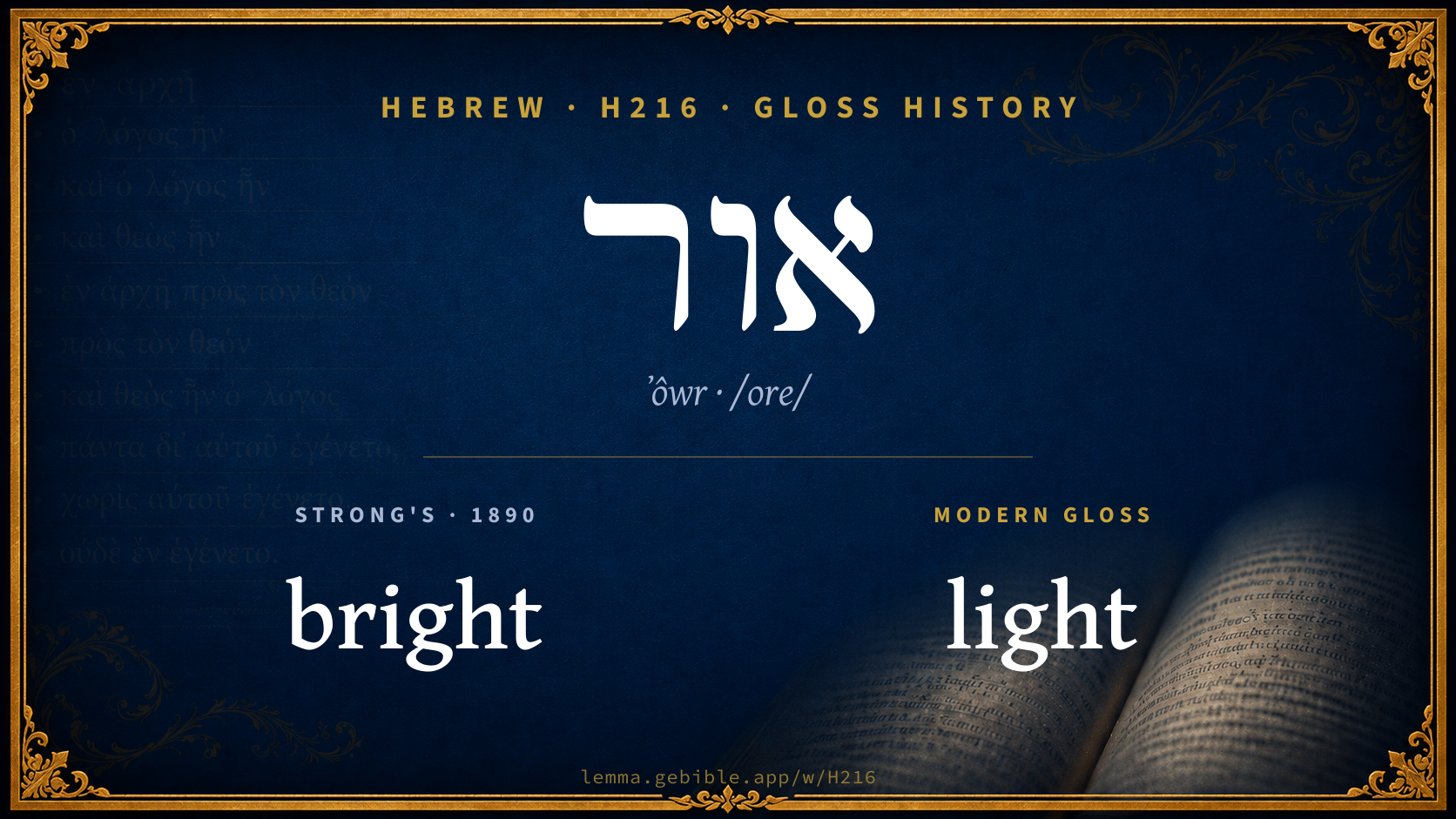
Gloss history
Strong's 1890 vs modern scholarship
About this word
Strong's H216 catalogs a Hebrew word from the Hebrew Old Testament.
These counts are not copied from any lexicon or concordance. They are computed here, from the morphology-tagged Hebrew Old Testament. What Lemma adds →
- 110
- distinct verses
- The word appears in 110 distinct verses.
- 21 / 39
- OT books
- The word appears in 21 of 39 Old Testament books.
- #358
- by frequency
- Top 500 most frequent Hebrew words (rank 358 of 8,640 Hebrew words by occurrence).
View all 110 occurrences in the concordance →
By section of the Old Testament
By traditional corpus
Conventional, traditional groupings — biblical authorship is debated, so this is a traditional corpus grouping, not an authorship claim. Each share is this word’s portion of its verses in that division of the Hebrew canon. Each figure is a share of the word’s 110 distinct verses.
- Writings (Ketuvim) 59 verses · 54%
- Prophets (Nevi'im) 46 verses · 42%
- Torah (Pentateuch) 5 verses · 5%
How translations render this word
Counts come from each version’s own published word-to-Strong’s tagging or interlinear alignment — an approximate guide to how each version renders this word, not a word-level alignment the data otherwise carries. Because each total is that version’s own tagged count, the per-version totals vary from one another and need not match the appearance or distinct-verse counts above. These counts may also differ from a printed concordance because Lemma counts each distinctly tagged rendering and does not collapse phrase taggings into a single head-word total. This is a fixed set of word-tagged versions (KJV, ASV, BSB, ULT) and does not change with the reading translation you choose elsewhere. Each version’s license is shown beside its name below (and on Sources).
BDB lists this Strong’s number as 2 distinct words (homographs). Each count above pools all of them and is not split by sense — see the Senses section below. A low-frequency rendering may belong to a different one of those words, not the primary meaning.
- King James Version†: Light 78×, Is light 2×, Lights 2×
- American Standard Version†: Light 70×, Lightning 3×, Is light 2×
- Berean Standard Bible†: Light 79×, Lightning 4×, Dawn 3×
- unfoldingWord Literal Text†: Light 72×, Light of 27×, Lightning 5×
King James Version Public Domain
Renders H216 across 123† tagged occurrences — most commonly:
Plus 37 renderings that appear only once — usually multi-word phrases or single function words the recovered tagging swept in, not distinct renderings.
American Standard Version Public Domain
Renders H216 across 123† tagged occurrences — most commonly:
Plus 42 renderings that appear only once — usually multi-word phrases or single function words the recovered tagging swept in, not distinct renderings.
Berean Standard Bible Public Domain
Renders H216 across 119† tagged occurrences — most commonly:
Plus 24 renderings that appear only once — usually multi-word phrases or single function words the recovered tagging swept in, not distinct renderings. Not rendered by a distinct English word in 2 further occurrences.
unfoldingWord Literal Text CC BY-SA 4.0
Renders H216 across 126† tagged occurrences — most commonly:
Plus 9 renderings that appear only once — usually multi-word phrases or single function words the recovered tagging swept in, not distinct renderings.
19 senses and sub-senses in the full BDB
Hebrew verbs can shift meaning by stem (binyan): Qal is the basic action, Niphal is often passive or reflexive, Piel often intensifies or makes it factitive, and Hiphil is typically causative. The senses below are grouped under the stem BDB assigns to each.
What do BDB’s symbols mean?
BDB uses these scholarly abbreviations:
| Symbol | Meaning |
|---|---|
| 𝔊 | the Septuagint (the ancient Greek translation, LXX) |
| 𝔙 | the Vulgate (the Latin translation) |
| 𝔖 | the Syriac version (the Peshitta) |
| 𝔗 | the Targum (the Aramaic translation) |
| ψ | the Psalms |
| √ | root (the underlying root or stem) |
| ‖ | parallel passage (a synonymous or contrasted parallel) |
| † | the dagger: every passage where the word occurs is cited |
The 19 senses and sub-senses the full Brown-Driver-Briggs lexicon distinguishes for this word, in lexicon order (not ranked by frequency), with BDB’s own verbatim wording and sub-sense lettering. Shown in Hebrew script with BDB’s own scholarly abbreviations. The condensed entry is in the Lexicon Entry tab. See also the Forms in the corpus table below.
אור I be or become light (cf. Arabic أَوَّرَ enkindle, Aramaic (Nasar.) ܐܘܪ Aph. illumine, & deriv. in Assyrian)
Qal
- Pf. אוֹר Gn 44:3 +; אֹ֫רוּ 1 S 14:29; Impf. 3 fpl. וַתָּאֹרְנָה 1 S 14:27 Qr; Pt. אוֹר Pr 4:18 (Ges§ 72 R. 1); Imv. fs. א֫וֹרִי Is 60:1;—become light, shine of sun (especially in early morn.) Gn 44:3 (J) 1 S 29:10 Pr 4:18 Is 60:1; of eyes (owing to refreshment) 1 S 14:27(Qr) 29. e.g. Genesis 44:3
Niphal
- Impf. וַיֵּאֹר 2 S 2:32; Inf. c. לֵאוֹר Jb 33:30; Pt. נָאוֹר ψ 76:5—become lighted up of day-break 2 S 2:32; by light of life, revival Jb 33:30; by light of glory, enveloped in light ψ 76:5. e.g. 2 Samuel 2:32
Hiphil
- Pf. וְהֵאִיר Ex 25:37, etc.; Impf. יָאִיר Jb 41:24 +; יָאֵר Nu 6:25 +; וַיָּ֫אֶר ψ 118:27 +, etc.; Imv. הָאֵר ψ 80:20 +, הָאִ֫ירָה ψ 31:17 +; Inf. הָאִיר Gn 1:15 +; Pt. מֵאִיר Pr 29:13; מְאִירַת ψ 19:9; מְאִירוֹת Is 27:11— e.g. Exodus 25:37
- 1. give light, of sun, moon & stars Gn 1:15, 17 (P), of moon Is 60:19; of pillar of fire (sq. ל) Ex 13:21; 14:20 (both JE) ψ 105:39 Ne 9:12, 19; of sacred lamp Ex 25:37 Nu 8:2 (both P); fig. of the words of God ψ 119:130. e.g. Genesis 1:15
- 2. lightup, cause to shine, shine, sq. acc. הֵאִירוּ בְרָקִים תֵּבֵל lightnings lighted up the world ψ 77:19; 97:4; abs. הָאָרֶץ הֵאִירָה מִכְּבֹדוֹ Ez 43:2; the earth shined with his glory (of theophany); of leviathan, which makes path shine behind him Jb 41:24; לַיְלָה כַּיּוֹם יָאִיר night shineth as day ψ 139:12. e.g. Psalms 77:19
- 3. light a lamp ψ 18:29; wood Is 27:11; altar(-fire) Mal 1:10. e.g. Psalms 18:29
- 4. lighten, of the eyes, הָאִיר עֵינַיִם, subj. י׳, his law, etc. Pr 29:13 ψ 13:4; 19:9 Ezr 9:8. e.g. Proverbs 29:13
- 5. make shine, of face of God יָאֵר י׳ פָּנָיו אֵלֶיךָ Yahweh make his face shine upon thee Nu 6:25 (priest’s blessing), reappearing ψ 31:17 (sq. עַל־), 67:2 (sq. אֶת־), 80:4, 8, 20; 119:135 (sq. ב), Dn 9:17 cf. ψ 4:7; without פָּנִים (sq. ל) ψ 118:27; once, of face of man, Ec 8:1 חָכַמַת אָדָם תָּאִיר פָּנָיו the wisdom of a man lighteth up his face. e.g. Numbers 6:25
אור II
- 1. light as diffused in nature, light of day Gn 1:3, 4, 5 (P) Jb 3:9; 38:19 +. e.g. Genesis 1:3
- 2. morning light, dawn, אוֹר הַבֹּקֶר light of the morn. Ju 16:2 1 S 14:36; 25:34, 36 2 S 17:22 2 K 7:9 Mi 2:1; א׳ בֹּקֶר 2 S 23:4 (poem of David); עַד־הָא׳ Ju 19:26 (cf. עַד־הַבֹּקֶר v 25); לָאוֹר Jb 24:14; מִן־הָאוֹר עַד מַחֲצִית הַיּוֹם from dawn till mid-day, Ne 8:3 cf. Pr 4:18. e.g. Judges 16:2
- 3. light of the heavenly luminaries; א׳ הַלְּבָנָה, ‖ א׳ הַחַמָּה moonlight & sunlight Is 30:26; כּוֹכְבֵי אוֹר stars of light ψ 148:3; מְאוֹרֵי אוֹר luminaries of light Ez 32:8; אוֹרִים = מְאוֹרִים ψ 136:7; so עֲלֵי־אוֹר in sunshine Is 18:4; the sun itself Jb 31:26. e.g. Isaiah 30:26
- 4. daylight אוֹר רְשָׁעִים light of the wicked Jb 38:15 (their work-day being the night); יוֹם אוֹר a day of light Am 8:9 (= a clear, sunshiny day). e.g. Job 38:15
- 5. lightning Jb 36:32; 37:3, 11, 15 cf. Hb 3:11. e.g. Job 36:32
- 6. light of lamp Pr 13:9 Je 25:10; of crocodile’s hot breath Jb 41:10. e.g. Proverbs 13:9
- 7. light of life א׳ חַיִּים Jb 33:30 ψ 56:14; cf. אוֹר Jb 3:16, 20. e.g. Job 33:30
- 8. light of prosperity Jb 22:28; 30:26 ψ 97:11 La 3:2. e.g. Job 22:28
- 9. light of instruction נֵר מִצְוָה וְתוֹרָה אוֹר Pr 6:23 the commandment is a lamp and instruction a light; so the Messian. servant is אוֹר גּוֹיִם Is 42:6; 49:6; cf. א׳ עַמִּים Is 51:4; the advent of Mess. is shining of great light Is 9:1(×2). e.g. Proverbs 6:23
- 10. light of face אוֹר פָּנִים = bright, cheerful face (of men) Jb 29:24; betokening king’s favour Pr 16:15 (cf. א׳ עֵינַיִם ψ 38:11); of God = his shining, enlightening, favouring face ψ 4:7; 44:4; 89:16. e.g. Job 29:24
- 11. Yahweh is א׳ יִשְׂרָאֵל Is 10:17, as source of enlightenment & prosperity; light & salvation ψ 27:1; light to guide Mi 7:8 cf. ψ 43:3; everlasting light of Zion, instead of sun & moon Is 60:19, 20; house of Jacob is to walk in his light Is 2:5. e.g. Isaiah 10:17
Senses from the full Brown-Driver-Briggs lexicon (Brown, Driver, Briggs; Oxford 1906 — public domain), digitized via Sefaria, supplemented by the OpenScriptures HebrewLexicon (CC BY 4.0). Full attribution on Sources.
Word origin
I. vb. be or become light (cf. Arabic أَوَّرَ enkindle, Aramaic (Nasar.) ܐܘܪ Aph. illumine, & deriv. in Assyrian)—
II. אוֹר121 f. Jb 36:32; Je 13:16; cf. Gn 1:3 light (Assyrian urru = ûru DlW)—abs. Gn 1:3 +; cstr. Ju 16:2 +; sf. אוֹרִי ψ 27:1, etc.; pl. אוֹרִים ψ 136:7;—
— Brown-Driver-Briggs (Oxford 1906, public domain), digitized via Sefaria, supplemented by the OpenScriptures HebrewLexicon (CC BY 4.0). See Sources.
Derived from אור (ʼôwr) (H215) — to shine.
Jastrow Dictionary
A second Hebrew/Aramaic lexicon for comparison, covering Aramaic and post-biblical (Talmudic, Targumic, Midrashic) usage that the biblical-Hebrew BDB does not. Matched by lemma rather than by Strong’s number, so a lemma may carry more than one Jastrow headword (shown separately below), and the entries cover usage well beyond the Bible.
אוֹר I
- to perforate, break through, shine.—Denom. אַוִּיר, מְאוּרָה &c.
- to be broken through, grow light. Y. Ber. I, 2ᶜ משיֵאוֹר המזרח from the time the Eastern horizon is broken through, grows light.
- 1. (neut. v.) (neut. v.) to break through, shine. Y. ib. III, 6ᶜ bot. open thy lips ויָאִירוּ דבריך and let thy words come forth, speak out boldly. Yoma III, 1 ה׳ פני כל וכ׳ it has grown light all over the Eastern horizon.—פנים מֵאִירוֹת bright countenance. Num. R. s. 11; a. e.
- 2. (act. v.) to enlighten, brighten, make shine. Y. M. Kat. III, 83ᵇ ה׳ עיניו וכ׳ (the teacher had opened his (Samuel’s) eyes &c. B. Mets. 33ᵃ. Num. R. l. c. Ib. המזבח מֵאִירִים את (fr. Mal. I, 10) making the altar bright (with fire), feeding the fire on the altar. Yoma 73ᵇ, v. אוּר. e.g. Malachi 1:10
אוֹר
- Part. pass. נָאוֹר clear. Targ. Prov. IV, 25 נְאוֹרָן, נְאֹרָן, v. חֲוַר.
אוֹר II
- foreg.) breaking forth (cmp. Is. LVIII, 8) whence e.g. Isaiah 58:8
- 1. break of day, light, day; fire; trnsf. rise, glory, power, happiness. Ber. 2ᵇ ביאת אוֹרוֹ the entrance of his day-break (dawn of his eighth day; Tosaf. a. l. the sunset of his seventh day). Y. Pes. I, beg. 27ᵃ א׳ החמה sun-light. Ib. א׳ הנר candle light. Keth. 111ᵇ א׳ תורה light of the Law. B. Bath. 4ᵃ אוֹרוֹ של עולם intellectual light of the wold (a great man; the Law). Num. R. s. 15 אור של מעלן the celestial fire (believed to be the source of all light and fire); a. v. fr.
- 2. (breaking in of night) twilight, evening. Pes. I, 1 לארבעה וכ׳ א׳ on the evening (eve) of the fourteenth day of Nissan; v. discussion ibid. 2ᵃ sq., about the meaning of our w. R. Hash. 22ᵇ; Snh. 70ᵇ לא׳ עיבורו the evening following the eventual intercalation, i.e. the evening from the thirtieth of the past to the first of the beginning month.
- 3. (homil. = אוֹרָה II) rue. Gen. R. s. 20 in the Pentat. of R. M. it read כתנות אור וכ׳ (in place of עור Gen. III, 21) this alludes to the garments of Adam resembling the rue, wide below and narrow above; Ar. (Rashi diff.). e.g. Genesis 3:21
אוּר I
- foreg.) prop. light, flame; esp. Pl. אוּרִים ותומים the Urim and Tummim in the High-priest’s breast-plate. Yoma 73ᵇ א׳ שמאירים את דבריהם they are called Urim because they give their decisions in a clear way (not ambiguous as the oracles); cmp. Y. ib. VII, end, 44ᶜ. Sot. IX, 12. Y. Kidd. IV, beg. 65ᵇ
*אוּר II
- (= עוּר q. v.) chaff. Y. Ab. Zar. II, 40ᵈ א׳ דשערין chaff of barley; (Y. Sabb. XIV, 14ᵈ עור דסערין).
A Dictionary of the Targumim, the Talmud Babli and Yerushalmi, and the Midrashic Literature (Marcus Jastrow; London, Luzac, 1903) — Public Domain. Digitized via Sefaria. Digitized via Sefaria. Full attribution on Sources.
Forms in the corpus
The 60 distinct written forms H216 takes in the Hebrew Bible, most frequent first — each parse links to that state’s occurrences in the concordance. Hebrew forms include their vowel points and cantillation, so a single lemma takes many written forms.
Same root — word family
Other BDB entries built from the same root as H216, grouped by Strong’s listed origin. These share a root / origin per the lexicon — not necessarily a shared meaning. Each links to that word’s own entry.
Derives from
Shares the same root
Derived from this word
Proper names from this root
People and places named from this root — a name, not an additional meaning of the word.
Compare all same-root words → Showing 4 of 7 — not the complete family. 1 of the same-root words is a proper name (a person or place). They share a root, not necessarily a meaning.
Septuagint verse parallels
This word appears in 105 verses that also exist in the Greek Old Testament (Septuagint), out of the 110 Hebrew verses it occurs in. You can read those verses in Greek by switching the Old Testament edition to the Septuagint.
Read these verses in the Septuagint
- Genesis 1:3
- Exodus 10:23
- Judges 16:2
- 1 Samuel 14:36
- 2 Samuel 17:22
- 2 Kings 7:9
- Job 3:9
- Psalms 4:6
- Proverbs 4:18
- Ecclesiastes 2:13
- Isaiah 2:5
- Jeremiah 4:23
This is a verse-level parallel only — the same verses exist in both the Hebrew and Greek Old Testaments. No word-level Hebrew↔Greek correspondence is claimed: the data carries no such alignment, so no Greek word is shown as this Hebrew word’s translation. Coverage is not total — the Septuagint omits the deuterocanon and renumbers the Psalms, so some Hebrew verses have no direct Greek parallel.