
Zechariah 14:6

Hebrew (Westminster Leningrad Codex) Zechariah 14:6 appears in the Hebrew Old Testament. The text above is from the Westminster Leningrad Codex. Each word links to its Strong’s number, a concise gloss, and parsing drawn from the Open Scriptures Hebrew Bible morphology. Click any word for its full Brown-Driver-Briggs (BDB) entry.
Download image
Cite this verse

Zechariah 14:6 (World English Bible). Public Domain. Lemma interlinear Bible study tool, https://lemma.gebible.app/v/zechariah/14/6.

Show BibTeX & RIS
BibTeX
RIS
English Translation
It will happen in that day, that there will not be light, cold, or frost.
World English Bible · Public Domain
Download a study sheet

One document with this verse’s original text, its word-by-word gloss line, the meaning frame, cross-references with their text, attributed commentary, and full source and license credits — printable, and it pastes into notes with its structure intact.

This verse Autodidact and up

Study sheet (.html) Plain text (.txt)

A passage Seminary Student

Up to 50 verses in one chapter. A passage sheet keeps up to 6 commentary sources and 12 cross-references per verse, in the order this page ranks them, and says so on the sheet whenever that leaves anything out. Ask for a single verse and you get the Autodidact verse sheet above.

Everything on this page stays free to read, with no account — the sheet is a download of what is already on screen, not access to it.

Want to remove ads? Support Godless Engineer
Compare translations 3

The same verse in 3 English versions, stacked beneath the original-language interlinear above. Click any original word for its lexicon entry.

Each is an independent rendering of the whole verse — the interlinear is not word-aligned to these translations.

Highlighted words mark where these versions differ — a whole-verse word diff, not a word-by-word alignment.

  • World English Bible Public Domain
    It will happen in that day, that there will not be light, cold, or frost.
  • King James Version Public Domain
    And it shall come to pass in that day, that the light shall not be clear, nor dark:
  • unfoldingWord Literal Text CC BY-SA 4.0
    On that day there will be no light, but no cold or frost either.

unfoldingWord Literal Text — © unfoldingWord, licensed CC BY-SA 4.0. Word-aligned USFM3 via Door43 (git.door43.org/unfoldingWord/en_ult).

Versions to compare (up to 4)

3 of 4 selected

Show all 18 translations

Every available English version of this verse, each an independent rendering of the whole verse.

  • World English Bible Public Domain
    It will happen in that day, that there will not be light, cold, or frost.
  • Berean Standard Bible Public Domain
    On that day there will be no light, no cold or frost.
  • Majority Standard Bible Public Domain
    On that day there will be no light, no cold or frost.
  • King James Version Public Domain
    And it shall come to pass in that day, that the light shall not be clear, nor dark:
  • American Standard Version (1901) Public Domain
    And it shall come to pass in that day, that there shall not be light; the bright ones shall withdraw themselves:
  • Revised Version (1885) Public Domain
    And it shall come to pass in that day, that the light shall not be with brightness and with gloom:
  • Geneva Bible (1599) Public Domain
    And in that day shall there bee no cleare light, but darke.
  • Douay-Rheims (1899) Public Domain
    And it shall come to pass in that day, that there shall be no light, but cold and frost.
  • Young's Literal Translation Public Domain
    And it hath come to pass, in that day, The precious light is not, it is dense darkness,
  • Literal Standard Version CC BY-SA 4.0
    And it has come to pass in that day, || The precious light is not, it is dense darkness,
  • Unlocked Literal Bible CC BY-SA 4.0
    On that day there will be no light, but no cold or frost either.
  • unfoldingWord Literal Text CC BY-SA 4.0
    On that day there will be no light, but no cold or frost either.
  • Darby Bible Public Domain
    And it shall come to pass in that day, [that] there shall not be light; the shining shall be obscured.
  • World Messianic Bible Public Domain
    It will happen in that day that there will not be light, cold, or frost.
  • Webster's Bible Public Domain
    And it shall come to pass in that day, that the light shall not be clear, nor dark:
  • Free Bible Version CC BY-SA 4.0
    On that day there will be no longer cold and frost.
  • Bible in Basic English Public Domain
    And in that day there will be no heat or cold or ice;
  • JPS Tanakh (1917) Public Domain
    And it shall come to pass in that day, that there shall not be light, but heavy clouds and thick;

Literal Standard Version (2020), Covenant Press — licensed CC BY-SA 4.0. Text via the HelloAO Bible API (eBible.org). Unlocked Literal Bible (unfoldingWord) — licensed CC BY-SA 4.0. Text via the HelloAO Bible API (eBible.org). unfoldingWord Literal Text — © unfoldingWord, licensed CC BY-SA 4.0. Word-aligned USFM3 via Door43 (git.door43.org/unfoldingWord/en_ult). Free Bible Version, Dr. Jonathan Gallagher — licensed CC BY-SA 4.0. Text via the HelloAO Bible API (eBible.org).

Word by word

More ways to search: Search by grammar → Find every occurrence → Compare this word →

Practice this passage: Drill this verse → Learn its vocabulary →

יקפאון
qâphâʼ
H7087
“to condense”
Verb, Qal, Imperfect, 3rd Person, Masculine, Plural + Suffix, n
Part of Speech
Verb
Stem
Qal
Form
Imperfect
Person
3rd Person
Gender
Masculine
Number
Plural
Full BDB Definition

Origin: a primitive root

TWOT: 2048 , 2048a

to thicken, condense, congeal, settle, become dense (verb) - (Qal) to be condensed - thickening (participle) - (Hiphil) to cause to curdle - congelation (noun masculine)
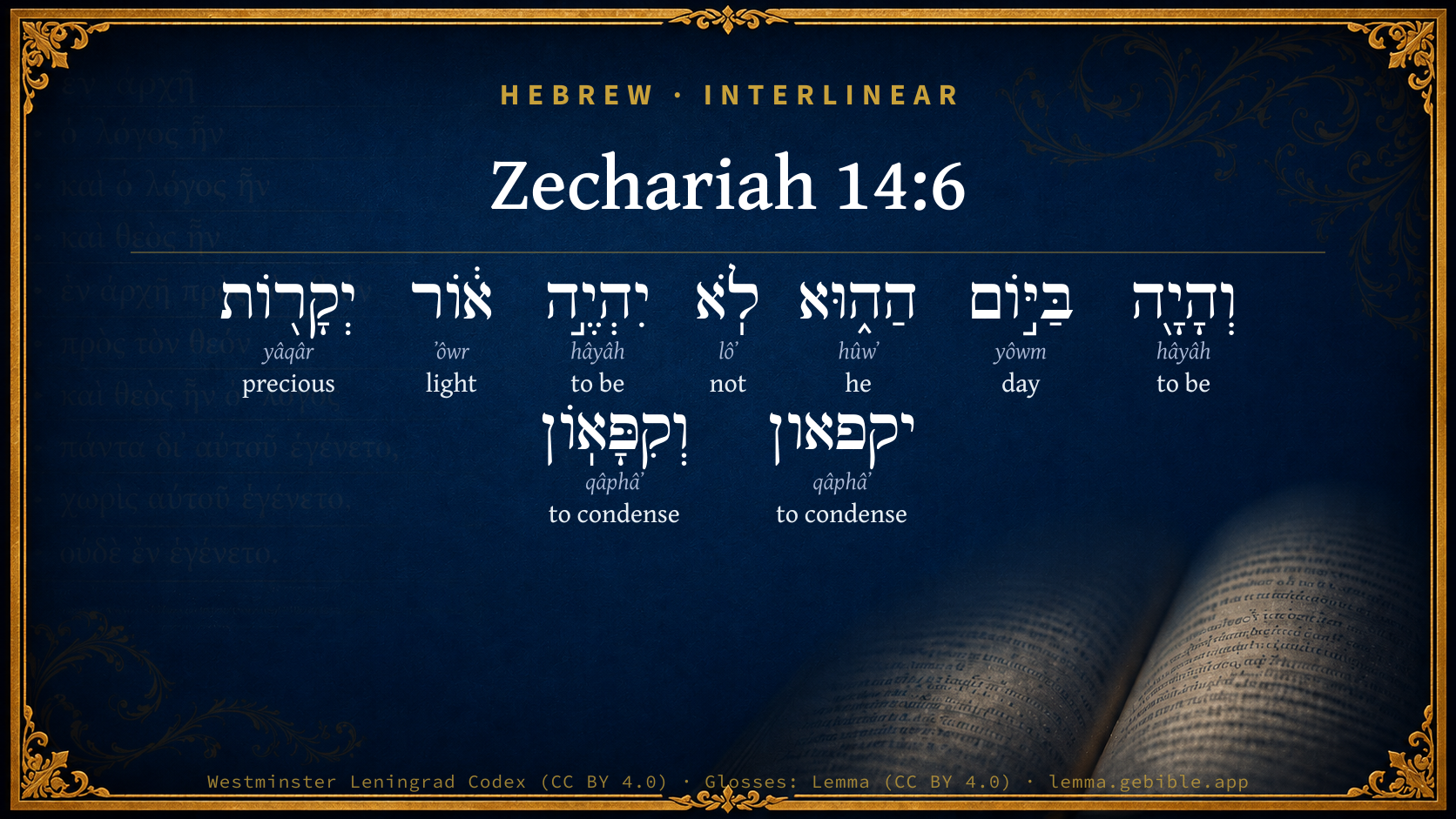
  1. וְהָיָ֖ה hâyâh H1961 “and · to be” Conjunction + Verb, Qal, Sequential Perfect, 3rd Person, Masculine, Singular
  2. בַּיּ֣וֹם yôwm H3117 “in/at the · day” Preposition, Determined + Noun, Common, Masculine, Singular, Absolute
  3. הַה֑וּא hûwʼ H1931 “the · he” Particle, Definite Article + Pronoun, Personal, 3rd Person, Masculine, Singular
  4. לֹֽא lôʼ H3808 “not” Particle, Negative
  5. יִהְיֶ֣ה hâyâh H1961 “to be” Verb, Qal, Imperfect, 3rd Person, Masculine, Singular
  6. א֔וֹר ʼôwr H216 “light” Noun, Common, Both, Singular, Absolute
  7. יְקָר֖וֹת yâqâr H3368 “precious” Adjective, Adjective, Feminine, Plural, Absolute
  8. וְקִפָּאֽוֹן qâphâʼ H7087 “and · frost” Conjunction + Noun, Common, Masculine, Singular, Absolute

About this verse

These counts appear in no published source. They are computed here, from the morphology-tagged text and Lemma’s own curated glosses. What Lemma adds →

9
words
7
distinct lemmas
Prophets
section

Notable vocabulary

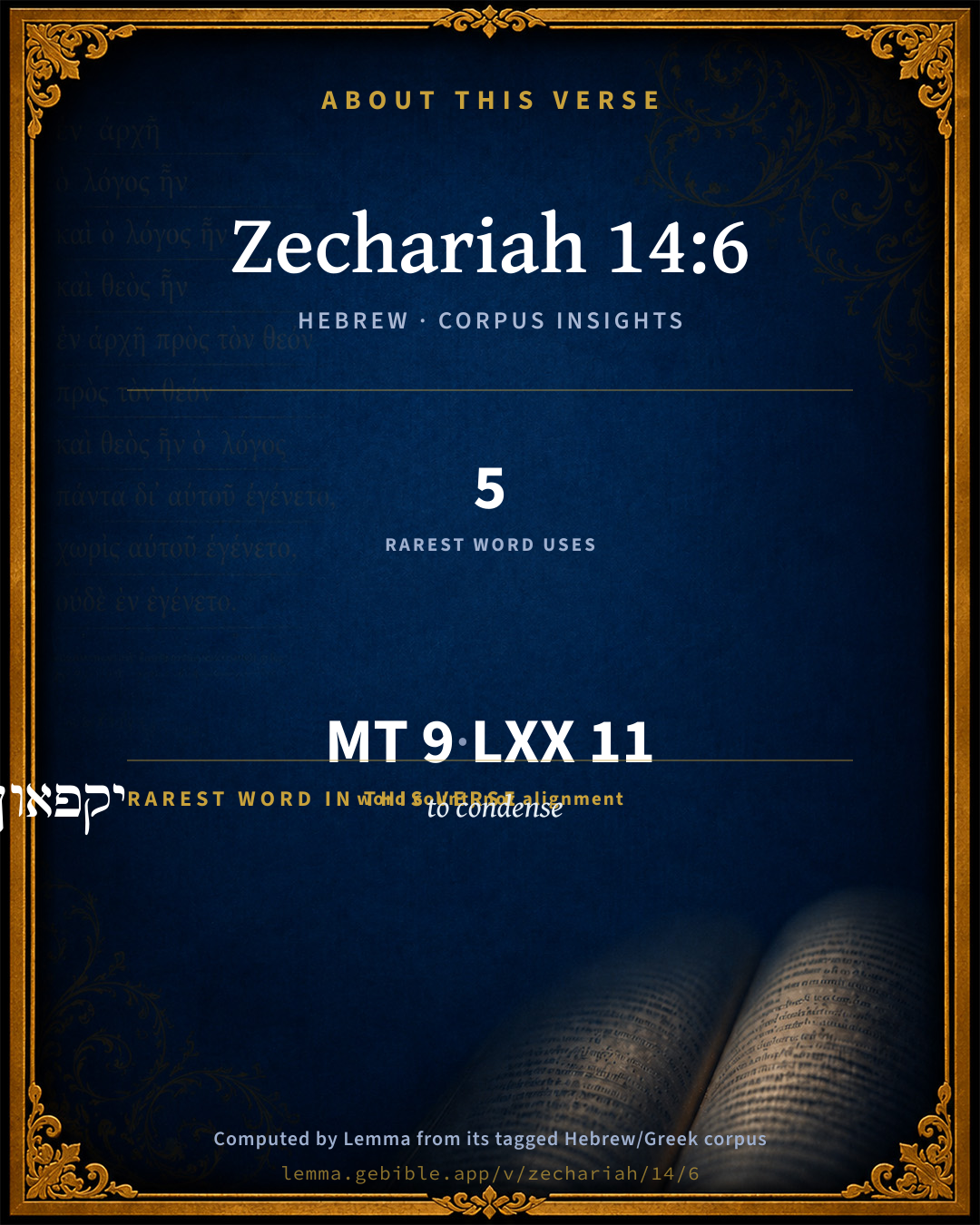
The rarest word here is יקפאון to condense H7087 — appearing just 5 times in the whole Hebrew Bible.

Shared distinctive vocabulary

יקפאון to condense H7087 occurs in 4 verses of the Hebrew Bible. Also found in:

Grammatical profile

  • 3 verbs
  • 3 nouns
  • 1 adjective
  • 1 pronoun
  • 1 particle

Verb forms

  • וְהָיָ֖ה Qal · Sequential Perfect
  • יִהְיֶ֣ה Qal · Imperfect
  • יקפאון Qal · Imperfect

Repetition

Words recur within this verse — often emphatic in Hebrew:

  • וְהָיָ֖ה to be H1961 ×2
  • יקפאון to condense H7087 ×2

Hebrew & Septuagint length

In English translation the verse runs 15 words from the Hebrew and 15 from the Septuagint (LXX English) — the same length.

A rough comparison of the two English renderings, which tokenize alike — not a word-level alignment.

Word counts can differ between the Hebrew and the Greek without any difference in meaning — e.g. the Hebrew direct-object marker אֵת has no separate Greek word, and Greek often adds the article ὁ.

In the original languages it is 9 Hebrew tokens and 11 Greek tokens — but the two are counted differently (Hebrew bundles its prefixes and suffixes into one token; the Greek is in lemma form), so that isn’t a like-for-like length.

Cross-references

16

Topical passages linked to Zechariah 14:6 in the Treasury of Scripture Knowledge — connected by theme and wording, ordered by reader-vote popularity; previews shown in the World English Bible.

  • Psalms 97:10–11 You who love Yahweh, hate evil. He preserves the souls of his saints. He delivers them out of the hand of the wicked.
  • Psalms 112:4 Light dawns in the darkness for the upright, Gracious, merciful, and righteous.
  • John 12:46 I have come as a light into the world, that whoever believes in me may not remain in the darkness.
  • Proverbs 4:18–19 But the path of the righteous is like the dawning light, That shines more and more until the perfect day.
  • Isaiah 60:1–3 Arise, shine; for your light is come, and the glory of Yahweh is risen on you.
  • 2 Peter 1:19 We have the more sure word of prophecy; whereunto you do well that you take heed, as to a lamp shining in a dark place, until the day dawns, and the day star arises in your hearts:
  • Revelation 11:15 The seventh angel sounded, and great voices in heaven followed, saying, "The kingdom of the world has become the Kingdom of our Lord, and of his Christ. He will reign forever and ever!"
  • Isaiah 13:10 For the stars of the sky and the constellations of it shall not give their light; the sun shall be darkened in its going forth, and the moon shall not cause its light to shine.
  • Isaiah 50:10 Who is among you who fears Yahweh, who obeys the voice of his servant? He who walks in darkness, and has no light, let him trust in the name of Yahweh, and rely on his God.
  • Jeremiah 4:23 I saw the earth, and, behold, it was waste and void; and the heavens, and they had no light.
  • Hosea 6:3 Let us acknowledge Yahweh. Let us press on to know Yahweh. As surely as the sun rises, Yahweh will appear. He will come to us like the rain, Like the spring rain that waters the earth."
  • Luke 1:78–79 Because of the tender mercy of our God, Whereby the dawn from on high will visit us,
  • John 1:5 The light shines in the darkness, and the darkness hasn't overcome it.
  • Ephesians 5:8–14 For you were once darkness, but are now light in the Lord. Walk as children of light,
  • Colossians 1:12 giving thanks to the Father, who made us fit to be partakers of the inheritance of the saints in light;
  • Revelation 11:3 I will give power to my two witnesses, and they will prophesy one thousand two hundred sixty days, clothed in sackcloth."

Cross-references courtesy of OpenBible.info (CC BY 4.0).

Hebrew and Greek witnesses Masoretic Hebrew ↔ Greek Septuagint

The same verse in the two great witnesses to the Old Testament, shown verse-for-verse.

These are two independent witnesses, not word-aligned to each other, and the Septuagint is shown in lemma (dictionary) form.

Hebrew Zechariah 14:6 Masoretic · Westminster Leningrad Codex

וְהָיָ֖ה בַּיּ֣וֹם הַה֑וּא לֹֽא יִהְיֶ֣ה א֔וֹר יְקָר֖וֹת יקפאון וְקִפָּאֽוֹן

It will happen in that day, that there will not be light, cold, or frost.

World English Bible · Public Domain

Greek LXX Zechariah 14:6 Septuagint · lemma form

ἐν ἐκεῖνος ὁ ἡμέρα οὐ εἰμί φῶς καί ψῦχος καί πάγος

And it shall come to pass in that day that there shall be no light,

LXX2012 (modern English Septuagint) · Public Domain

On this verse, Jamieson, Fausset & Brown discusses the Septuagint’s reading. Read the note in Commentary ↓

Hebrew: Westminster Leningrad Codex (CC BY 4.0). Greek: Septuagint (public domain); English from LXX2012 (modern English Septuagint) (Public Domain). How the Septuagint differs from the Hebrew →

Targum (Aramaic paraphrase)

1

The Targum is the ancient Jewish Aramaic paraphrase of the Hebrew Scriptures — an interpretive translation, not the Hebrew text itself. Onkelos (literal) and Pseudo-Jonathan (expansive) render the Torah, and Jonathan the Prophets. Coverage is partial: where no permissively-licensed English translation exists for a verse, only the Aramaic is shown. This is verse-level text, not a word-by-word alignment to the Hebrew.

  1. Targum Jonathan Prophets (Joshua–Malachi)
    וִיהֵי בְעִדָנָא הַהִיא לָא יְהֵי נְהוֹרָא אֱלָהֵן עֲדִי וּגְלִיד:

    (no public-domain English translation for this verse)

    Targum Jonathan — Aramaic: “Mikraot Gedolot” (public domain). English: “Sefaria Community Translation” (CC0 1.0 (public-domain dedication)); “London "Chaldee Paraphrase," 1871” (public domain). Text via Sefaria.

Commentary

Notes on Zechariah 14:6 from classic Christian and Jewish commentators (each source and its license shown beneath its notes). The classic Christian expositions comment on the surrounding passage and are grouped to its opening verse, so a note may address several verses; the Jewish commentaries on the Tanakh (Rashi and others) are per-verse, so they appear only where the commentator wrote on this verse.

Lemma curates 59 commentaries, every one of them public domain or Creative Commons licensed, each selected and text-cleaned for this edition rather than reprinted as found. About our sources →

Trapp's Complete Commentary

John Trapp

Zec 14:6 And it shall come to pass in that day, [that] the light shall not be clear, [nor] dark:

Ver. 6. And it shall come to pass in that day] That is, saith Diodati, after the destruction of antichrist, shall the Son of God come in, who shall bring the Church into its glory; where without any vicissitude or variation of day and night, of calamity and prosperity, of knowledge and ignorance, it shall enjoy eternal light by the sight of God, Isa 60:19-20 Rev 21:23; Rev 22:5. Thus he. Between this fall of antichrist and the consummation of all some place the full and final restoration of the Jews, and make this a description of that glorious Church they shall then erect. There shall be no darkness, but perpetual light. It shall not be, saith our prophet here, sometimes clear, sometimes misty, (variable and uncertain weather, now fair, now foul), but one day, not of day and night; for in the evening, when night is wont to come, it shall be light; as if he should say, it shall be always day and no night, ανεσπερος ημερα, a nightless day, a morning without clouds, a clear shining after rain, as David in another case, 2Sa 22:4, and as with the Hyperboreans, the whole half year is said to be but one continuous day; so that they sow and reap in a day.

John Trapp, A Commentary or Exposition upon All the Books of the Old and New Testament (1647–1656) — public domain. Text from a community e-Sword module.

The Biblical Illustrator

Joseph S. Exell

Zec_14:6

It shall come to pass in that day, that the light shall not be clear nor dark

The day of the Lord

This phrase denotes not one time, but many.

Any signal manifestation of the Divine government of the world, or any such event as made mens hearts quake within them for fear, is described as the day of the Lord. Though all nature is, in truth, an exponent of the judgment, as well as the beneficence of God, there are times and places in which His right hand, as it were, is more manifestly bared. There are times when the fervent spirit is tempted to wish for one of the days of the Lord. Yet there are many reasons why, even in the worst times, we should not wish to hasten that day which will in appointed course come surely and will not tarry. Instead of encouraging in ourselves impatience for some great day of the Lord, let us rather engrave upon our minds a conviction that such coming will be at last inevitable. We may estimate the character of such general judgments as are here alluded to, by reading the description of those of old. What, then, is the sort of temper or sentiment with which the idea of any great national visitations should be blended in our minds? As citizens we should be aware sometimes truth and righteousness getteth the upper hand, and sometimes the contrary party, that foment error and unrighteousness. It is a doubtful day in a twofold regard--because light and darkness are either intermixed or alternate. Or else because our estate in respect of either is not durable and fixed, but liable to great uncertainties. There is an intermixture of providences at the same time, and the Church is in several respects both happy and miserable at once. Here things go well and there ill. It is a rare case when there is a perfect harmony between our private condition and public happiness. Successively there is a vicissitude and interchange of conditions. Good and evil succeed each other by turns. Human affairs, under God, depend much on the peoples hearts, and how uncertain are they! Inquire the reason of this, why the day of our conflict is such a mixed, doubtful day. Consider--

1. The equity of it. It is such a day as is very suitable to our condition in the world. We are in a middle place, between heaven and hell, and therefore partake somewhat of both. We have mixed principles--flesh and spirit. As long as sin remaineth in us we cannot be perfectly happy. The flesh needeth to be weakened by divers afflictions. As our principles are mixed, so are all our operations. There is a mixture of good and evil in all our services.

2. Consider the wisdom and justice of God in it. He hath many wise ends to be accomplished by these mixed providences. That a people worn out with long misery may be more pliable to Gods purpose. By such mixed providences God will weaken and waste stubborn nature. To work us from earthly things to things heavenly. To put a cloud and veil on His proceedings. To prevent the excesses of either condition, God tempereth and qualifieth the one with the other. To make way for the exercise of our faith. Faith is neither made void by too great a light, nor extinguished by too great a darkness. To win the heart by the various methods of judgments an mercies, and to gain upon us by both means at first. God doth it to bring His people to a Christian union and accord. When religious interest is divided, God keeps the balance equal, and success is sometimes cast on this side, sometimes on that. To prevent contempt and insolency towards those that are fallen under Gods displeasure. It is also a ground of patience. Heavy afflictions lack not their comforts to make them tolerable. He measureth out good and evil with a great deal of wisdom and tenderness. To show that our comforts and crosses are in His hand; and He doth variously dispense weal or woe as our condition doth require.

Application. What use should we make of all this?

1. Be sure you do not make an ill use of it. This is done when we are not thankful for our mercies, because they are not full and perfect. It is an abuse if we are discouraged in Gods service because of this uncertainty. When you have any respite, or breathing time, then is the time and season to put your hand to the work. If there be uncertainties, remember that never a great work is brought to pass without troubles. And change cometh not until our condition proveth a snare for us.

2. The right use we should make of it. By way of caution, take heed of human confidences, and presuming too much on temporal success by means and instruments. For direction--Walk by a sure rule. Get a sure guide. Encourage yourself by the sure promise that you have to build upon. A man wrapped up in the peace of God, and the quiet of a good conscience, and hopes of eternal life, is fortified against all encounters, storms, and difficulties whatsoever. (T. Manton.)

Light and solace

These verses present a suggestive description of human history as a whole, and of each godly life in that history.

I. The mixed character of our earthly existence, The light shall not be clear, nor dark; It shall be one day, not day, nor night. That is, the lot even of a good man is chequered. Every height has its hollow. And each blessing has its accompanying affiiction. But no Christian is ever in absolute darkness. If the rough wind be blowing, God will take care that it be not from the east. Observe--

1. Through the trials of the past God has disciplined us into fitness for present duties. Present trials are the prophecies of future efficiency.

2. Trials are frequently connected with our sins. Evil deeds are evil seeds which produce a harvest of bitterness.

3. Trials lead us to long for heaven, and wean us from the world.

II. The christians support under this mixed experience--It shall be one day which shall be known, etc. This means--

1. Our condition as a whole--not one separate part, but the whole day of light and dark--is known unto the Lord.

2. Our lot is ordered for us by Jehovah, just according as the grand total demands it.

III. The happy termination of this mixed state of things--And it shall come to pass, that at evening time it shall be light. All doubts and clouds shall have been driven away by the Sun of Righteousness. Relief shall come when it is least expected. Light is the synonym for joy, for purity, for knowledge. In heaven all the elements of darkness shall be absent. It shall be light. (Homilist.)

Mingled experiences

I. The language of the text is descriptive of the present mingled state of affairs, both in the Church and in the world. Darkness is the effect of our low situation. There is nothing really dark with God--nothing imperfect in the Gospel. The Gospel is to our perception not so distinct as to be perfectly clear; but it is not so dark as to be useless and unintelligible. There are clouds and obscurities resting on the subject arising from our weakness and imperfection of understanding. Illustrate--

(1) By the partial distribution of the Gospel among the nations of the earth.

(2) The language is also descriptive of the imperfect attainments of real Christians. In the matter of personal experience it is but twilight. You have faith, but not the full assurance of faith. You have hope, but how few of you hope ever blooming! You have obedience, but it is partial, irregular, imperfect. You have joy, but it is meddled with.

(3) The text finds its illustration in the inscrutable dispensations of the providence of God. How vast, how profound a subject!

II. The superintending care of Divine providence during this chequered and mysterious state of things. This intimates--

1. Gods superintendence of all things.

2. Gods foreknowledge of all things.

3. The harmony of Divine providence.

4. The beneficial tendency of the providence of God.

5. The language is a ground of unlimited resignation and contentment; and

6. A motive for unlimited confidence.

III. The wonders and glories of that auspicious day in which this singular state of affairs shall terminate. This promise contains a reserve of consolation for the feeble Christian against the hour of dissolution. And a reserve of consolation for the feeble Christian in seasons of perplexity and difficulty. The promise contains also an assurance of the final glory, the millennial reign of the Son of God. (Joseph Beaumont, D. D.)

Dark and bright periods in human life

The word rendered clear is in the margin precious, and is in the plural. The word here rendered dark is in the margin thickness.

I. A period of unmitigated distress. This period of unmitigated calamity primarily refers, we have no doubt, to those long centuries of oppression, cruelty, mockery, and scorn, to which the Jewish people have been subjected ever since the destruction of Jerusalem. In the predictions of Joel (Joe_2:31; Joe_3:15) referring to the destruction of the Holy City and breaking up of the Jewish commonwealth, the period is referred to as a period when the sun shall be turned into darkness, and the moon into blood. Three remarks are suggested concerning this dark day.

1. Such a day is the hard destiny of some men. Their life is a day of darkness. It is so with some nations. The history of some nations and tribes is little less than a history of crushing oppression, bloody revolutions and untold cruelties and sufferings.

2. Such a day is deserved by most men. All men are sinners and deserve this blackness and darkness forever. The very tendency of sin, in fact, is to quench every light in the firmament of the soul.

II. Here is a period of uninterrupted joy.

1. Such a day as this is destined to dawn on every good man. Heaven is a scene of light. No clouds of ignorance or suffering obstruct the rays, nor will the sun ever go down. The Lord God is the light thereof.

2. Such a day as this is destined to dawn on the world in the future. (Homilist.)

Light and shade in the Christian life

I. The mixed character of our earthly life. The light shall not be clear nor dark. The lot even of the good man is chequered. No Christian is ever in absolute and unrelieved darkness. It may be a long twilight with him, but it is never night. Why does God permit so much of darkness in our lot? Set forth some of the reasons why we have so much of difficulty and affliction to contend with.

1. Through the trials of the past God has disciplined us into fitness for the duties of the present. We did not see this at first, but we have discovered it now. Resistance is needed for the development of physical vigour, and difficulty is as much required for the formation of strength in moral character.

2. Our trials are frequently connected with our sins. Illustrate from the history of Jacob.

3. The shades of darkness in our earthly lots lead us to long for heaven. If everything here were as we should wish to have it, we should not desire to go elsewhere; but God has provided some better thing for us in the world beyond, and He takes care that we shall not get wedded entirely to the concerns of earth.

II. The Christians solace and support. Suggested by the words, It shall be one day which shall be known to the Lord.

1. Our condition is known to the Lord. The world is governed by a Person, and He under whose eye all things come to pass, is our Father.

2. Our lot is ordered by Jehovah. Our lives are not by chance. There is an order in them, and a plan running through them. Then things that seem to be working against us must really be working for us.

III. The happy termination of this mixed state of things to the Christian. Relief shall come, and that at the time when it is least expected. If the day has been lowering, we look for a deeper darkness than ordinary when evening comes: but here, when men usually anticipate that it will be evening, it will be morning. You have seen this illustrated very often in separate passages of your lives. These separate chapters are only miniatures of life as a whole, for, at its evening time there comes to the Christian the dawning light of heaven. (W. M. Taylor, D. D.)

Mingled light and darkness

The first clause of the text is religious. It does not refer to the light of the natural heavens. It refers to all there is in the religion of man, and in the things which affect him in the experience of it. His condition is to be one of a mixed character, not wholly good, and not wholly evil--not all light, not all dark. This mixture may be seen in several particulars.

1. In the matter of a believers holiness. Therein there is some light, but it is not clear nor dark. The believer has some true conformity to God, but it is not a perfect conformity. He often wonders at himself,--at the inconsistencies and contradictions that he finds in his own experience. In his poor soul faith struggles to get the better of unbelief--the love of the world comes up to combat the love of God. His heart is inconsistent, his soul unsteady, his way devious, and he cannot be ignorant that his holiness is only of an imperfect character. Whenever God spares a regenerated sinner upon the earth after the time of his regeneration, such a regenerated sinner will have this chequered experience.

2. This mixture may be seen in the believers knowledge. There is a mixture of clearness and obscurity in the knowledge of Gods people which nothing could describe more perfectly than Zechariah has here described it. They have knowledge, but, in all parts of it, it is limited. Behold a disciplined believer. He is in the furnace. He knows who put him there. He knows that the process will stop when the purpose of it is accomplished. But there are other things he does not know. He attempts to know them, but he cannot find them out. He asks, For what particular sin am I thus afflicted? He knows not why God has Sent that particular affliction on him. Behold a believer examining his own heart. He knows something about it. He very well knows its deceitfulness. But it is a wonder to him how his deceitfulness will work. When shall he ever be sure of a heart that has so often wandered? We ought to remember that the imperfection of our knowledge results from our creature littleness and the imperfection of our present state; and that so far as we have any necessity of knowing in order to be saved, our knowledge may be as clear and definite as our capacities will allow.

3. The comforts of Gods people have in them a wonderful mingling of light and gloom. It is not all clear day with them, It is not all night: The alternation of comfort and depression which Christians experience, constitutes a chapter of facts which shows the mingled character of their life, whether we can have knowledge of the reasons for it or not.

4. The condition of life. We fail in few things as Christians more than we fail of fitly noticing the changes we pass through as God is leading us on. However this may be, there are strange minglings of light and darkness in our condition. So fluctuating and uncertain is the condition of life here, that no mortal can be found whose biography has any considerable resemblance to his anticipations; his life has not carried out the plans of his youth. We are knocked about in the world. Our condition is shifting, fluctuating, varying. There is scarcely a believer among us who is not compelled, amid this mingling of light and darkness, to recognise the immediate hand of his God. Amid all this mixture of good and evil, we cannot understand why it is so. How needful is faith! After Zechariah has mentioned the mingled clearness and obscurity of our state, he immediately points us to One who can understand it. It shall be one day which shall be known to the Lord, not day nor night. Of itself it is of a mixed character. To us it is mixed. We cannot understand it. God can. We can turn over the chequered scene into His hands. It is to Him all one day. He sees no darkness in it. It is all alike light--all one. He has one intent in all the dispensations that affect us. When it is said, At evening time it shall be light, we are not to understand that the evening or night shall be turned into day. The rain led character of the believers experience shall pass. Light shall come at the end. This may find illustration in all the features of the believers experience. (T. S. Spencer, D. D.)

The mixed experience of the Church

The Church has had a mixed experience, not all dark, not all bright; now defeat and now success; now joy, now grief; mingled light and shade, but at evening time light has always come. So with each Christian, the Church in miniature. Tears and smiles, sighs and songs mingle. Why this discipline?

1. We need it to correct mistakes of nature.

2. Our deliverance from sin and the development of Christian virtues are processes which involve this mingled experience.

3. Our hold on God by faith and prayer is made more steady. But it shall be one day known to the Lord. A precious compensation is this assurance that God knows. God is working out a definite plan. The golden thread of His purpose runs through all that to us seems mixed and contradictory. He weaves the warp and woof. Nothing is confused. It shall be light. (J. Jackson Wray.)

The Biblical Illustrator, edited by Joseph S. Exell (c. 1880s–1900s) — public domain. Text from a community e-Sword module.

Joseph Benson's Commentary

Zec 14:6-7. And it shall come to pass in that day — Namely, when the Lord shall come forth to fight against the enemies of his church, the nations that fought against Jerusalem, as foretold Zec 14:3; or, in that day when he shall come to convert and restore the Jews, and spread his gospel through all the world; the light — Namely, of knowledge, holiness, and happiness in his church; shall not — Namely, at first; be clear — Like that of the perfect day; nor dark — As perfect night, but shall be a kind of twilight, a mixture of light and darkness, of knowledge and ignorance, as to divine things, of holiness and sin, of happiness and misery, or of prosperity and adversity. But it shall be one day — One continued day; there shall be no setting of the sun to make it quite night; but God will invariably pursue the end he has in view, and always act in order to it, namely, the full salvation of his spiritual Jerusalem. Which shall be known to the Lord — The Lord will always have his eye upon this progressive day, and upon all the events of it. He will continually take notice of them, and order and dispose of all for the best, according to the counsel of his own will. But at evening time —

When natural days end, and when, perhaps, the shades of the evening may appear to be coming on, and there may be an apprehension of returning darkness; it shall be light — This spiritual day shall be full of light and glory, Isa 48:8; and Isa 60:19-21. Mr. Scott considers these verses as containing a compendious prophecy of the state of the church, from its establishment in the apostles’ days, to those glorious times which are expected; a prophecy foretelling that, “for a long season, the light would neither be clear nor dark: it would be greatly obscured by ignorance, heresy, superstition, and idolatry, yet not wholly extinguished: and the state of the church would be much deformed by sin and calamities; yet some holiness and consolation would be found. This period could neither be called a clear, bright day, cheered and illumined by the shining of a summer’s sun, nor would it be dark, as if the sun were set or totally eclipsed; but it would contain a great mixture of truth and error, of holiness and sin, of happiness and misery. Yet it would form one day, and never be interrupted by a night of total darkness. It would also be known unto the Lord, as to the degree of its light, and the term of its continuance; and he would watch over, and take care of, his cause and people all the time of it. But his people would hardly know whether to call it day or night, or a compound of both: yet, at length, toward the evening of the world, the Sun of righteousness would break forth and shine with unclouded splendour, dispelling the gloom of ignorance, heresy, idolatry, and superstition, and illuminating the church and the earth with knowledge, righteousness, peace, and consolation.”

Joseph Benson's Commentary on the Old and New Testaments (1811–1818) — public domain. Text from a community e-Sword module.

Keil & Delitzsch

C. F. Keil & F. Delitzsch

Complete salvation. - Zac 14:6. "And it will come to pass on that day, there will not be light, the glorious ones will melt away. Zac 14:7. And it will be an only day, which will be known to Jehovah, not day nor night: and it will come to pass, at evening time it will be light." The coming of the Lord will produce a change on the earth. The light of the earth will disappear. The way in which לא יהיה אור is to be understood is indicated more precisely by יקרות יקפאון. These words have been interpreted, however, from time immemorial in very different ways. The difference of gender in the combination of the feminine יקרות with the masculine verb יקפּאוּן, and the rarity with which the two words are met with, have both contributed to produce the keri יקרות וקפּאון, in which יקרות has either been taken as a substantive formation from קרר, or the reading וקרות with Vav cop. has been adopted in the sense of cold, and קפּאון (contraction, rigidity) taken to signify ice. The whole clause has then been either regarded as an antithesis to the preceding one, "It will not be light, but (sc., there will be) cold and ice" (thus Targ., Pesh., Symm., Itala, Luther, and many others); or taken in this sense, "There will not be light, and cold, and ice, i.e., no alternation of light, cold, and ice will occur" (Ewald, Umbr., Bunsen). But there is intolerable harshness in both these views: in the first, on account of the insertion of יהיה without a negation for the purpose of obtaining an antithesis; in the second, because the combination of light, cold, and ice is illogical and unparalleled in the Scriptures, and cannot be justified even by an appeal to Gen 8:22, since light is no more equivalent to day and night than cold and ice are to frost and heat, or summer and winter. We must therefore follow Hengstenberg, Hofmann, Koehler, and Kliefoth, who prefer the chethib יקפאון, and read it יקפּאוּן, the imperf. kal of קפא. קפא signifies to congeal, or curdle, and is applied in Exo 15:8 to the heaping up of the waters as it were in solid masses. יקרות, the costly or splendid things are the stars, according to Job 31:26, where the moon is spoken of as יקר הולך, walking in splendour. The words therefore describe the passing away or vanishing of the brightness of the shining stars, answering to the prophetic announcement, that on the day of judgment, sun, moon, and stars will lose their brightness or be turned into darkness (Joe 3:15; Isa 13:10; Eze 32:7-8, Mat 24:29; Rev 6:12). In Zac 14:7 this day is still more clearly described: first, as solitary in its kind; and secondly, as a marvellous day, on which the light dawns at evening time. The four clauses of this verse contain only two thoughts; each so expressed in two clauses that the second explains the first. יום אחד, unus dies, is not equivalent to tempus non longum (Cocceius, Hengst.), nor to "only one day, not two or more" (Koehler), but solitary in its kind, unparalleled by any other, because no second of the kind ever occurs (for the use of 'echâd in this sense, compare Zac 14:9, Eze 7:5, Sol 6:9). It is necessary to take the words in this manner on account of the following clause, "it will be known to the Lord;" i.e., not "it will be singled out by Jehovah in the series of days as the appropriate one" (Hitzig and Koehler), nor "it stands under the supervision and guidance of the Lord, so that it does not come unexpectedly, or interfere with His plans" (Hengstenberg), for neither of these is expressed in נודע; but simply, it is known to the Lord according to its true nature, and therefore is distinguished above all other days. The following definition, "not day and not night," does not mean that "it will form a turbid mixture of day and night, in which there will prevail a mongrel condition of mysterious, horrifying twilight and gloom" (Koehler); but it will resemble neither day nor night, because the lights of heaven, which regulate day and night, lose their brightness, and at evening time there comes not darkness, but light. The order of nature is reversed: the day resembles the night, and the evening brings light. At the time when, according to the natural course of events, the dark night should set in, a bright light will dawn. The words do not actually affirm that the alternation of day and night will cease (Jerome, Neumann, Kliefoth); but this may be inferred from a comparison of Rev 21:23 and Rev 21:25.

Keil & Delitzsch — Biblical Commentary on the Old Testament (1861–1891) — public domain (CC PDM 1.0). Text via the HelloAO Bible API. (Old Testament only.)

Jamieson, Fausset & Brown

Robert Jamieson, A. R. Fausset & David Brown

light . . . not . . . clear . . . dark--JEROME, Chaldee, Syriac, and Septuagint translate, "There shall not be light, but cold and ice"; that is, a day full of horror (Amo 5:18). But the Hebrew for "clear" does not mean "cold," but "precious," "splendid" (compare Job 31:26). CALVIN translates, "The light shall not be clear, but dark" (literally, "condensation," that is, thick mist); like a dark day in which you can hardly distinguish between day and night. English Version accords with Zac 14:7 : "There shall not be altogether light nor altogether darkness," but an intermediate condition in which sorrows shall be mingled with joys.

Jamieson, Fausset & Brown — Commentary Critical and Explanatory on the Whole Bible (1871) — public domain (CC PDM 1.0). Text via the HelloAO Bible API.

Adam Clarke's Commentary

Verse 6. The light shall not be clear, nor dark] Metaphorically, there will be a mixture of justice and mercy in all this; or a bright light and darkness. Mercy shall triumph over judgment. There shall be darkness-distress, c. but there shall be more light-joy and prosperity-than darkness.

Adam Clarke's Commentary on the Bible (1810–1826) — public domain. Text from a community e-Sword/MySword module.

John Calvin's Commentaries

The Prophet confirms what we have already observed that the Church would be subject to many troubles and commotions, so that the faithful should not enjoy the common light, but be more miserable than men in general. And he has ever the same object in view, to prepare the faithful to exercise patience, and to remind them that they are not to promise themselves such enjoyments in the holy land, as though they were to be free from the trials of the cross. Lest then they should deceive themselves with vain hopes, he sets before them many evils and many calamities, that they might confidently wait for the aid, of which he had spoken, while immersed in thick darkness, and hardly able to distinguish between day and night. But the rest shall be considered tomorrow.

John Calvin's Commentaries (1540-1563) — public domain. Text from the Calvin Translation Society English edition (1840s-50s) via the Christian Classics Ethereal Library (ccel.org). Calvin's coverage is partial (roughly two-thirds of the Bible); uncommented books and verses are honest gaps, never fabricated. The 19th-century editor's footnotes and remarks are omitted so the notes are faithfully Calvin's own voice.

Ellicott's Commentary for English Readers

(6) That the light shall not be clear, nor dark.—Better, there shall not be light; the glorious ones (i.e., the heavenly bodies) shall fail (literally, become coagulated).

A Bible Commentary for English Readers, edited by Charles John Ellicott (1878–1897) — public domain. Text from a community e-Sword module.

The Cambridge Bible for Schools and Colleges

gen. ed. J. J. S. Perowne

6. the light shall not be clear, nor dark] Rather, there shall not be light, the bright ones shall be contracted; as in R. V. margin, i.e. the heavenly bodies shall be darkened. It shall be a day of deep gloom. Comp. “The sun and the moon shall be darkened, and the stars shall withdraw their shining,” Joe_3:15, and Mat_24:29; Rev_6:12-13.

The Cambridge Bible for Schools and Colleges (gen. ed. J. J. S. Perowne; Cambridge University Press, 1878–1918) — public domain. Text from a community e-Sword module.

John Gill's Exposition

And it shall come to pass in that day,.... Which shall precede the coming of Christ, both his spiritual and personal reign; for what follows will not agree with either state:

that the light shall not be clear nor dark; before the latter day glory it will be a darkish dispensation; not "clear", as in the first times of the Gospel, when the sun of righteousness appeared, and the shadows of the ceremonial law were removed, and the Gospel shone out in the ministry of Christ and his apostles; nor as at the reformation from Popery, when the morning star was given, Rev 2:28 nor as it will be in the spiritual reign of Christ, when Zion's light will be come, and her watchmen will see eye to eye; when the light of the moon shall be as the light of the sun, and the light of the sun seven fold as the light of seven days; and much less as will be in the kingdom state, when there will be no need of the sun or moon; or in the ultimate glory, when we shall see no more darkly through a glass, but face to face: and yet it will not be "dark", as it was with the Jews under the legal dispensation; and much less as with the Gentiles before the coming of Christ; or as in the dark times of Popery; it will be a sort of a twilight, both with respect to the light of doctrine, and of spiritual joy, comfort, and experience; which is much our case now. Some read the words, "there shall be no light, but cold and frost" (k); it will be a time of great coldness and lukewarmness, with regard to divine and spiritual things; iniquity will abound, and the love of many wax cold, Mat 24:12.

(k) , , Sept.; "non erit lux, sed frigus et gelu", V. L; so Syr. Ar.; "congelatio", Tigurine version; so Ben Melech; "non erit lux; frigora potius et congelatio; vel non erit lux; frigoribus congelascent, scilicet peccatores", Hiller. de Arcano Kethib & Keri, p. 370.

John Gill's Exposition of the Whole Bible (1746–1763) — public domain (CC PDM 1.0). Text via the HelloAO Bible API.

Albert Barnes' Notes on the Bible

The light shall not be clear nor dark - Or, more probably, according to the original reading , “In that day there will be no light; the bright ones will contract themselves,” as it is said, “The stars shall withdraw their shining.”

This is evermore the description of the Day of Judgment, that, in the presence of God who is Light, all earthly light shall grow pale. So Joel had said, “The sun and moon shall be darkened, and the stars shall withdraw their shining” Joe 3:15. And Isaiah, “The moon shall be confounded and the sun ashamed, when the Lord of hosts shall reign in Mount Zion and in Jersalem and before His ancients gloriously” Isa 24:23; and, “Behold the day of the Lord cometh, The stars of heaven and the constellations thereof shall not give their light: the sun shall be darkened in his going forth, and the moon shall not cause her light to shine” Isa 13:9-10. All know well our Lord’s words Mat 24:29. John, like Zechariah, unites the failure of the heavenly light “with a great earthquake, and the sun became as sackcloth of hair: and the moon become as blood; and the stars of heaven fell upon the earth” Rev 6:12-13.

Albert Barnes' Notes on the Bible (1834–1885) — public domain. Text from a community e-Sword/MySword module.

Haydock's Catholic Bible Commentary

No light; viz., in that dismal time of the persecution of Antiochus, when it was neither day nor night, (ver. 7.) because they neither had the comfortable light of the day, nor the repose of the night. (Challoner) --- Darkness denotes distress. The citizens shall be in despair, Matthew xxiv. 29., and Ezechiel xxii. 8., and Joel ii. 2., and Apocalypse ix. 2. Hebrew seems to be corrupt: "no precious light, but thick," or a cloud. (Calmet)

George Leo Haydock (1774–1849), Haydock's Catholic Family Bible and Commentary, 1859 edition — public domain. Excludes Psalms (Douay-Rheims chapter numbering differs from Protestant) and Deuterocanonical books (Catholic canon only).

Matthew Poole's English Annotations

In that day; whilst God is fighting with the enemies of his church, the nations that fought against Jerusalem.

The light; good estate, peace, and welfare.

Shall not be clear; unmixed good, all light, it will not be so well with the church.

Nor dark; not so sad as all darkness, there shall be a temper of both, some peace with some trouble; some prosperity with some adversity; some mercy in midst of judgment to allay the bitterness of judgment, and some judgment with our mercies to allay their sweetness.

Matthew Poole's English Annotations on the Holy Bible (1683–1685) — public domain. Text from a community e-Sword/MySword module.

The Pulpit Commentary

The light shall not be clear, nor dark. The Greek, Syriac, and Latin Versions have, "There shall not be light, but ("and," Septuagint) cold and ice." With the absence of light and sun shall come bitter frost, which impedes all activity, and kills life: or, taking the Septuagint rendering, there shall no longer be the interchange of seasons, but one lasting sunshine. It is plain that a time of distress and calamity is intended, and that the passage is threatening and not consolatory, at any rate, at first. There is solid ground for the rendering of the Revised Version margin, adopted by Cheyne and others, which is according to the Khetib, "There shall not be light, the bright ones shall contract themselves;" i.e. the heavenly bodies shall contract their light, or be heaped confusedly together, and cease to shine. The prediction in this case may be compared with that in Joe_3:15 Isa_13:10; and in Mat_24:29 Rev_6:12, Rev_6:13. The Authorized Version is explained in the margin, i.e. "It shall not be clear in some places, and dark in other places of the world a gloss which is inadmissible.

Vers. 6-11. A wonderful day.

"And it shall come to pass in that day, that the light shall not be clear, nor dark," etc. However obscure, in some respects, the opening verses of this passage, the "day" they speak of is to be, very manifestly, a day by itself. How strange, e.g., the character of its light! Is it the light of "day"? or the darkness of "night "? How strange, also, its time so that it should be, apparently, at its brightest just when the light of day is no more (end of ver. 7)! Altogether, a kind of "day" only fully "known to the Lord". (see, though not in exactly the same connection, Mat_24:36) Corresponding to this, in other respects also, shall be the character of that day. In particular, "Jerusalem" shall then, as never before, be

(1) a centre of blessing;

(2) a centre of rule; and

(3) a centre of strength.

I A CENTRE OF BLESSING. This is represented to us under the figure of a flow of "living waters" therefrom. (see Joe_3:18 Eze 47, passim, and especially ver. 9; also Joh_4:10 Joh_7:38) What is remarkable in this case is that the flow of these waters shall be:

1. In most unusual directions. Some will flow, naturally enough, along the intervening descent to the "former," or eastern sea; but some also, altogether supernaturally according to the lie of the land, to the "latter," or western sea. Countries and races, that is to say, which at present are hardly sprinkled with gospel influences, and to which at present it seems almost impossible to send them, shall then be overflowed by them as by a flood.

2. At most unusual seasons. How sadly intermittent, as things are now, is the flow of Church work! Now in decadence, now restored! Now frozen by indifference, now revived by warmth! Now exhausted by heat, now refreshed by rain! (Psa_68:22) The flow of these days is to be independent of seasons rivers all the year through. (comp. Rev_22:2)

II A CENTRE OF RULE. Very naturally does this head follow from that before. Influence of such a gracious character, so universally and constantly in operation, will subdue the whole world in due time. This is what seems foretold in ver. 9. In the present divided rule of the world and, in some measure, of the Church as well it is difficult to give hearty subjection to this authority without rebelling against that. Not so when, in all the world, there shall be but one supreme Head. Not so, still more, when the possessor of that supreme authority shall only be known by one name. At present, in many cases, we have vast composite sovereignties, "united kingdoms," "dual empires," at best. The man obeyed here as Emperor of Austria is only obeyed next door as King of Hungary. Not so at all in "that day." The King of "Jerusalem Christ in his Church shall be the one title of that "only Potentate". (see Dan_7:13, Dan_7:14, 27 Rev_11:15 Rev_19:16 Isa_24:23; also Ps 2 and Ps 110, passim; and Luk_1:32, Luk_1:33)

III A CENTRE OF STRENGTH. "Jerusalem" is to be strong then for three different reasons. There shall be:

1. No facilities for attacking it. Beginning from the ancient fortress of Geba on the north (Pusey, in loc. ), down along the whole mountain range to Rimmon in the south, instead of lofty hills sheltering the invaders and dominating the hill of Mount Zion, the "whole land shall be a plain.

2. Every facility for defending it. What those other mountains lose, as it were, the hill of Zion shall gain. Remaining still "in her place," but "lifted up" (Isa_2:2) far above her former elevation, the holy city shall look down then on the whole subject neighbourhood every ancient wall and battlement being also restored and elevated together with it, and so made doubly effective as a means of defence.

3. Better still, the knowledge of the possession of these advantages shall prevent the very thought of attack. "Men shall dwell there shall choose to dwell there knowing how secure it is from attack. What had been so often there shall be never again. "Jerusalem" now is a city which can never be touched. This shall be felt, this shall be acted on, by all without, by all within.

This glorious prospect of that future day of blessing and peace, whether comparatively near or far off, may console us greatly in the days that now are, whether in witnessing:

1. Their cruel dissensions. What a scene of selfishness, greed, competition, strife, suspicion, distrust, and violence is that now around us! Worse than a "struggle for existence," it is too often a struggle, even where existence is not imperilled, to keep others down. See how the whole civilized(!) world is standing armed to the teeth, possessed of deadlier weapons, and, consequently, of deadlier determination, than ever. How restful to the spirit to look beyond all this to that described here!

2. Their cruel disappointments. Much as these evils have been bewailed and lamented, and often as many men have hitherto tried to relieve them, how little comparative success they have reached! Political endeavours to remedy these evils have only led to worse, as a rule. Even the religion of Jesus, the religion of "liberty, equality, and fraternity," in the very best (and perhaps only possible) sense, has become the occasion, too often, though not the cause, of that which it sought to remove. It is a comfort to know that another hand will itself apply this remedy in due time; and that that will be easily accomplished by him when he comes down from the "mount," which is now impossible to his friends. (Mar_9:14-27)

Vers. 6, 7. The day of days.

The promise that "at evening time it shall be light" is suggestive and comforting.

I THE DAWN. Ordinary light seems withdrawn. Things are seen dimly. Discouragement and fear. Ready to say, "Darkness shall cover us." Call for faith. "God is light." "He will bring the blind by a way that they know not, making darkness light before them". (cf. Isa_1:10)

II PROGRESS. Still uncertainty. Neither wholly day nor night. Alternations. Now the sun seems about to break forth, now the gloom returns. Hopes and fears. But on the whole advance. Faith still finds firm footing. Rope brightens. Love never fails. Amidst all the conflicts with science and philosophy, Christianity abides in its power. There is promise of the "perfect day.

III THE CLOSE. "Evening." After long waiting and many disappointments, When most needed and least expected. Not in the order of nature, but of grace. When the shadows are lengthening and the sun going down, the light shines forth with a sweet and beautiful radiance. Glorious ending to a dark and cloudy day. The history of the Church, and the experience of individual Christians, afford many illustrations. The promise sometimes finds a tender and comforting fulfilment in the last hours of the dying believer. Bunyan tells us of Mr. Fearing, that, at the entrance of the Valley of the Shadow of Death, he was "ready to die for fear." But to him the valley was quiet from troublers. Then Great heart notes, as something very remarkable, at the departure of this pilgrim, "The water of that river was lower, at this time, than ever I saw it in all my life; so he went over at last not much above wet shod. F.

Vers. 6, 7. Dark and bright periods in human life.

"And it shall come to pass in that day, that the light shall not be clear, nor dark: but it shall be one day which shall be known to the Lord, not day, nor night: but it shall come to pass, that at evening time it shall be light." The word rendered "clear" is in the margin "precious," and is in the plural. The word "dark" here is in the margin rendered "thickness." The following translation by Dr. Henderson gives, I think, the meaning: "And it shall be in that day, that there shall not be the light of the precious orbs, but condensed darkness. But there shall be one day, it is known to Jehovah, when it shall not be day and night; for at the time of the evening there shall be light." We have here two distinct periods one of unmitigated distress, the other of uninterrupted prosperity.

I HERE IS A PERIOD OF UNMITIGATED DISTRESS. "Shall not be clear nor dark," or, as it is rendered, "condensed darkness." Dr. Keil gives the same idea as Dr. Henderson, "And it will come to pass on that day, there will not be light, the glorious ones will melt away." This period of unmitigated calamity primarily refers, we have no doubt, to those long centuries of oppression, cruelty, mockery, and scorn, to which the Jewish people have been subjected ever since the destruction of Jerusalem. In the predictions of Joel (Joe_2:31 Joe_3:15) referring to the destruction of the holy city and the breaking up of the Jewish commonwealth, the period is referred to as a period when "the sun shall be turned into darkness, and the moon into blood." The history of the Jews, indeed, for eighteen centuries has been the history of one long starless night. Two remarks are suggested concerning this dark day.

1. Such a day is the hard destiny of some men. It is so with individuals. There are hundreds and thousands of men in every age and country who pass through life from its beginning to its close with scarcely a ray of hope or a beam of joy. Their life is a day of darkness. It is so with some nations. The history of some nations and tribes is little less than a history of crushing oppression, bloody revolutions, and untold cruelties and sufferings. The precious orbs are seldom if ever seen in their political heavens.

2. Such a day is deserved by most men. All men are sinners, and deserve this blackness of darkness forever. The very tendency of sin, in fact, is to quench every light in the firmament of the soul. Thank God, Christ has come a Light to the world, and into that light during our stay here we may all enter.

II HERE IS A PERIOD OF UNINTERRUPTED JOY. "But it shall be one day which shall be known to the Lord, not day, nor night, but it shall come to pass that at evening time it shall be light." This is indeed a unique day. Even when evening might be anticipated, "it shall be light.

1. Such a day as this is destined to dawn on every good man. Heaven is a scene of light. No clouds of ignorance or suffering obstruct the rays, nor will the sun ever go down: "the Lord God is the Light thereof.

2. Such a day as this is destined to dawn on the world in the future. Some expositors consider that the millennium is here pointed to that long bright period when "all shall know the Lord from the least to the greatest." This period is promised, and it must come; for "heaven and earth shall pass away, but not one jot or tittle of his word shall fail to be accomplished." When will it come? It is far off, I know. "It shall be known to the Lord;" "It is not for you to know the times and the seasons," etc.

CONCLUSION. Are there not dark and bright days in every good man"s life? There are days when he walks in darkness, when neither sun nor star appears; and there are days too when all is cloudless and bright. He needs the dark day to prepare him for the full appreciation and enjoyment of the light. As the earth requires the dark cold days of winter as well as the bright and genial days of summer, in order to prepare it to yield the fruits that man and beast require, so doth the human soul require periods of gloom and tempest as well as periods of brightness and calm. D.T.

The Pulpit Commentary (1880–1919), ed. H.D.M. Spence-Jones & Joseph S. Exell — public domain. Text from a community e-Sword module.

John Wesley's Explanatory Notes

In that day - While God is fighting with the enemies of his church, the nations that fought against Jerusalem. Nor dark - There shall be some mercy to allay the bitterness of judgment, and some judgment with our mercy.

John Wesley, Explanatory Notes Upon the Whole Bible (1754–1765) — public domain. Text via the GEBible commentary corpus.

unfoldingWord translationNotes

Door43 World Missions Community

General Information:

These verses continue the description of the final war for the city of Jerusalem and of how God will save her.

On that day

"At that time"

there will be no light

It is implied that there will be no light from the sun. AT: "there will be no light from the sun" (See: Assumed Knowledge and Implicit Information)

a day known only to Yahweh

This can be stated in active form. AT: "only Yahweh knows when that day will begin" or "only Yahweh knows when that time will begin" (See: Active or Passive)

living waters

This normally means running or flowing water, rather than still or stagnant water. (See: Idiom)

the eastern sea

This refers to the Dead Sea, which is east of Jerusalem.

the western sea

This refers to the Mediterranean Sea.

translationWords

light

Yahweh

water

unfoldingWord translationNotes — © Distant Shores Media and the Door43 World Missions Community, licensed CC BY-SA 4.0. Source: git.door43.org/Door43/en_tn.

Rashi

Rabbi Shlomo Yitzchaki (Rashi)

there shall be no light, only disappearing light and thick darkness Jonathan renders. There shall not be light, only light that passes away, and thickness, i.e., there shall not be splendrous light, only יְקָרוֹת and קִפָּאוֹן shall [there] be. יְקָרוֹת An expression similar to (Ps. 37:20), “like the disappearing light over the plains.” Like a sort of light that appears in the morning over the mountains and disappears little by little.

וְקִפָּאוֹן Congealed and dark and thick, like ice that is congealed and frozen, as in (Job 10: 10), “And like cheese You curdled me.”

Rashi on the Tanakh — English translations: “The Judaica Press complete Tanach with Rashi, translated by A. J. Rosenberg” (CC BY 4.0); “Pentateuch with Rashi's commentary by M. Rosenbaum and A.M. Silbermann, 1929-1934” (public domain); “The Metsudah Tanach series, Lakewood, N.J” (CC BY 4.0); and “The Book of Joshua, Metsudah Publications, 1997” (CC BY 4.0). Text via Sefaria.

Radak

Rabbi David Kimhi (Radak)

And it shall come to pass on that day - on the day that he mentioned that there would be the sign, this is the matter, that there will not be light of yeqarot nor of qippa'on, and the interpretation by way of analogy is that the light of day will not be bright, which is the light of yeqarot, as in "the moon walks yaqar (in brightness)" (Job 31:26), and neither [will there be] light of qippa'on, which is frozen and thick, which is like darkness. And the interpretation is that that day will not be neither all like light nor all like darkness, meaning neither comfortable nor troubling, but rather both of them will be in it. And likewise he (Zechariah) says after it (verse 7)"not day and not night." And Jonathan translated, "there will not be light, but rather passing light and ice/thickness/congealment"

Radak on the Tanakh — English translations: “Sefaria Community Translation” (CC0 1.0 (public-domain dedication)); “Eliyahu Munk, HaChut Hameshulash” (CC BY 4.0); “Rabbi Mike Feuer, Jerusalem Anthology” (CC BY 4.0); and “R. David Kimhi on the first book of Psalms, Translated by R.G. Finch, London, 1919” (public domain). Text via Sefaria.

Lesson kit

Teaching starters — assembled from the data on this page, not authored interpretation. Every prompt links to the verse data it draws on. Edit before teaching.

Zechariah, in the Prophets, opens this verse with 9 words (7 distinct Hebrew lemmas). Its most distinctive word is qâphâʼ (“to condense”). A historical commentator’s framing appears above. Read the whole chapter for the surrounding context.

Discussion questions

  1. The word qâphâʼ carries the sense “to condense.” How does it shape the verse?
  2. Exodus 15:8 shares the word «to condense» with this verse. How do the two illuminate each other?
  3. “to be” occurs 2× in this one verse. What is the effect of the repetition?
  4. The translations on this page render this verse differently — a whole-verse word diff, not a word-by-word alignment. What might account for the different wordings?
  5. The verb «וְהָיָ֖ה» is Qal Sequential Perfect. How does its form color the action?
  6. Reading how Trapp's Complete Commentary and The Biblical Illustrator read this verse, where do the two commentators agree and where do they part?

Things to notice

Reading settings

Reading text

Shown beneath each verse's original-language words.

Old Testament
Old Testament edition

Read the OT as the Masoretic Hebrew (MT) or the Greek Septuagint (LXX).

English shown for the Greek Septuagint (in the Hebrew ↔ Greek comparison).

Comparing translations? Open the Compare panel on any verse page to stack up to four side by side.