
Isaiah 60:19

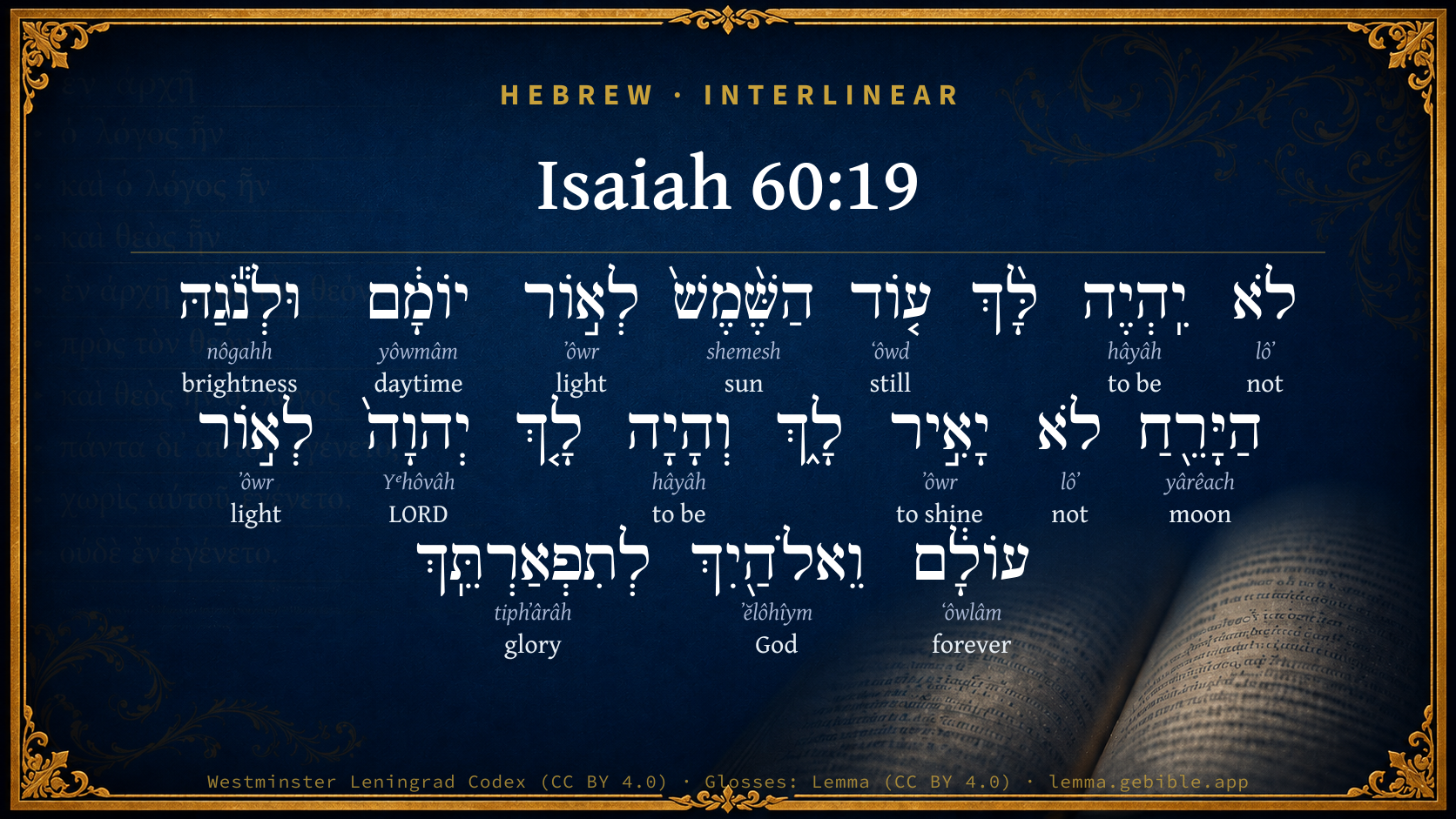
Hebrew (Westminster Leningrad Codex) Isaiah 60:19 appears in the Hebrew Old Testament. The text above is from the Westminster Leningrad Codex. Each word links to its Strong’s number, a concise gloss, and parsing drawn from the Open Scriptures Hebrew Bible morphology. Click any word for its full Brown-Driver-Briggs (BDB) entry.
Download image
Cite this verse

Isaiah 60:19 (World English Bible). Public Domain. Lemma interlinear Bible study tool, https://lemma.gebible.app/v/isaiah/60/19.

Show BibTeX & RIS
BibTeX
RIS
English Translation
The sun shall be no more your light by day; neither for brightness shall the moon give light to you: but Yahweh will be to you an everlasting light, and your God your glory.
World English Bible · Public Domain
Download a study sheet

One document with this verse’s original text, its word-by-word gloss line, the meaning frame, cross-references with their text, attributed commentary, and full source and license credits — printable, and it pastes into notes with its structure intact.

This verse Autodidact and up

Study sheet (.html) Plain text (.txt)

A passage Seminary Student

Up to 50 verses in one chapter. A passage sheet keeps up to 6 commentary sources and 12 cross-references per verse, in the order this page ranks them, and says so on the sheet whenever that leaves anything out. Ask for a single verse and you get the Autodidact verse sheet above.

Everything on this page stays free to read, with no account — the sheet is a download of what is already on screen, not access to it.

Want to remove ads? Support Godless Engineer
Compare translations 3

The same verse in 3 English versions, stacked beneath the original-language interlinear above. Click any original word for its lexicon entry.

Each is an independent rendering of the whole verse — the interlinear is not word-aligned to these translations.

Highlighted words mark where these versions differ — a whole-verse word diff, not a word-by-word alignment.

  • World English Bible Public Domain
    The sun shall be no more your light by day; neither for brightness shall the moon give light to you: but Yahweh will be to you an everlasting light, and your God your glory.
  • King James Version Public Domain
    The sun shall be no more thy light by day; neither for brightness shall the moon give light unto thee: but the LORD shall be unto thee an everlasting light, and thy God thy glory.
  • unfoldingWord Literal Text CC BY-SA 4.0
    The sun will no longer be to you for light by day, and the moon will not give light to you for brightness, but Yahweh will be to you for a light of eternity, and your God, for your splendor.

unfoldingWord Literal Text — © unfoldingWord, licensed CC BY-SA 4.0. Word-aligned USFM3 via Door43 (git.door43.org/unfoldingWord/en_ult).

Versions to compare (up to 4)

3 of 4 selected

Show all 18 translations

Every available English version of this verse, each an independent rendering of the whole verse.

  • World English Bible Public Domain
    The sun shall be no more your light by day; neither for brightness shall the moon give light to you: but Yahweh will be to you an everlasting light, and your God your glory.
  • Berean Standard Bible Public Domain
    No longer will the sun be your light by day, nor the brightness of the moon shine on your night; for the LORD will be your everlasting light, and your God will be your splendor.
  • Majority Standard Bible Public Domain
    No longer will the sun be your light by day, nor the brightness of the moon shine on your night; for the LORD will be your everlasting light, and your God will be your splendor.
  • King James Version Public Domain
    The sun shall be no more thy light by day; neither for brightness shall the moon give light unto thee: but the LORD shall be unto thee an everlasting light, and thy God thy glory.
  • American Standard Version (1901) Public Domain
    The sun shall be no more thy light by day; neither for brightness shall the moon give light unto thee: but Jehovah will be unto thee an everlasting light, and thy God thy glory.
  • Revised Version (1885) Public Domain
    The sun shall be no more thy light by day; neither for brightness shall the moon give light unto thee: but the LORD shall be unto thee an everlasting light, and thy God thy glory.
  • Geneva Bible (1599) Public Domain
    Thou shalt haue no more sunne to shine by day, neither shall the brightnesse of the moone shine vnto thee: for the Lord shall be thine euerlasting light, and thy God, thy glorie.
  • Douay-Rheims (1899) Public Domain
    Thou shalt no more have the sun for thy light by day, neither shall the brightness of the moon enlighten thee: but the Lord shall be unto thee for an everlasting light, and thy God for thy glory.
  • Young's Literal Translation Public Domain
    To thee no more is the sun for a light by day, And for brightness the moon giveth not light to thee, And Jehovah hath become to thee A light age-during, and thy God thy beauty.
  • Literal Standard Version CC BY-SA 4.0
    The sun is no longer your light by day, || And for brightness the moon does not give light to you, || And YHWH has become to you || A continuous light, and your God your beauty.
  • Unlocked Literal Bible CC BY-SA 4.0
    The sun will no longer be your light by day, nor will the brightness of the moon shine on you; but Yahweh will be your everlasting light, and your God your glory.
  • unfoldingWord Literal Text CC BY-SA 4.0
    The sun will no longer be to you for light by day, and the moon will not give light to you for brightness, but Yahweh will be to you for a light of eternity, and your God, for your splendor.
  • Darby Bible Public Domain
    The sun shall be no more thy light by day, neither for brightness shall the moon give light unto thee; but Jehovah shall be thine everlasting light, and thy God thy glory.
  • World Messianic Bible Public Domain
    The sun will be no more your light by day, nor will the brightness of the moon give light to you, but the LORD will be your everlasting light, and your God will be your glory.
  • Webster's Bible Public Domain
    The sun shall be no more thy light by day; neither for brightness shall the moon give light to thee: but the LORD will be to thee an everlasting light, and thy God thy glory.
  • Free Bible Version CC BY-SA 4.0
    You won't need the light of the sun during the day, or the light of the moon at night, for the Lord your God will be your everlasting light, and your God will be your glory.
  • Bible in Basic English Public Domain
    The sun will not be your light by day, and the moon will no longer be bright for you by night: but the Lord will be to you an eternal light, and your God your glory.
  • JPS Tanakh (1917) Public Domain
    The sun shall be no more thy light by day, neither for brightness shall the moon give light unto thee; but the LORD shall be unto thee an everlasting light, and thy God thy glory.

Literal Standard Version (2020), Covenant Press — licensed CC BY-SA 4.0. Text via the HelloAO Bible API (eBible.org). Unlocked Literal Bible (unfoldingWord) — licensed CC BY-SA 4.0. Text via the HelloAO Bible API (eBible.org). unfoldingWord Literal Text — © unfoldingWord, licensed CC BY-SA 4.0. Word-aligned USFM3 via Door43 (git.door43.org/unfoldingWord/en_ult). Free Bible Version, Dr. Jonathan Gallagher — licensed CC BY-SA 4.0. Text via the HelloAO Bible API (eBible.org).

Word by word

More ways to search: Search by grammar → Find every occurrence → Compare this word →

Practice this passage: Drill this verse → Learn its vocabulary →

וּלְנֹ֕גַהּ
nôgahh
H5051
“and · to/for · brightness”
Conjunction + Preposition + Noun, Common, Feminine, Singular, Absolute
Part of Speech
Conjunction + Preposition + Noun
Type
Common
Gender
Feminine
Number
Singular
State
Absolute
Full BDB Definition

Origin: from H5050

TWOT: 1290a

brightness
  1. לֹא lôʼ H3808 “not” Particle, Negative
  2. יִֽהְיֶה hâyâh H1961 “to be” Verb, Qal, Imperfect, 3rd Person, Masculine, Singular
  3. ע֤וֹד ʻôwd H5750 “still” Adverb
  4. הַשֶּׁ֨מֶשׁ֙ shemesh H8121 “the · sun” Particle, Definite Article + Noun, Common, Both, Singular, Absolute
  5. לְא֣וֹר ʼôwr H216 “to/for · light” Preposition + Noun, Common, Both, Singular, Absolute
  6. יוֹמָ֔ם yôwmâm H3119 “daytime” Adverb
  7. הַיָּרֵ֖חַ yârêach H3394 “the · moon” Particle, Definite Article + Noun, Common, Masculine, Singular, Absolute
  8. לֹא lôʼ H3808 “not” Particle, Negative
  9. יָאִ֣יר ʼôwr H215 “to shine” Verb, Hiphil, Imperfect, 3rd Person, Masculine, Singular
  10. וְהָיָה hâyâh H1961 “and · to be” Conjunction + Verb, Qal, Sequential Perfect, 3rd Person, Masculine, Singular
  11. יְהוָה֙ Yᵉhôvâh H3068 “LORD” Noun, Proper
  12. לְא֣וֹר ʼôwr H216 “to/for · light of” Preposition + Noun, Common, Both, Singular, Construct
  13. עוֹלָ֔ם ʻôwlâm H5769 “forever” Noun, Common, Masculine, Singular, Absolute
  14. וֵאלֹהַ֖יִךְ ʼĕlôhîym H430 “and · God(s) · your” Conjunction + Noun, Common, Masculine, Plural, Construct + Suffix, Personal, 2nd Person, Feminine, Singular
  15. לְתִפְאַרְתֵּֽךְ tiphʼârâh H8597 “to/for · glory · your” Preposition + Noun, Common, Feminine, Singular, Construct + Suffix, Personal, 2nd Person, Feminine, Singular

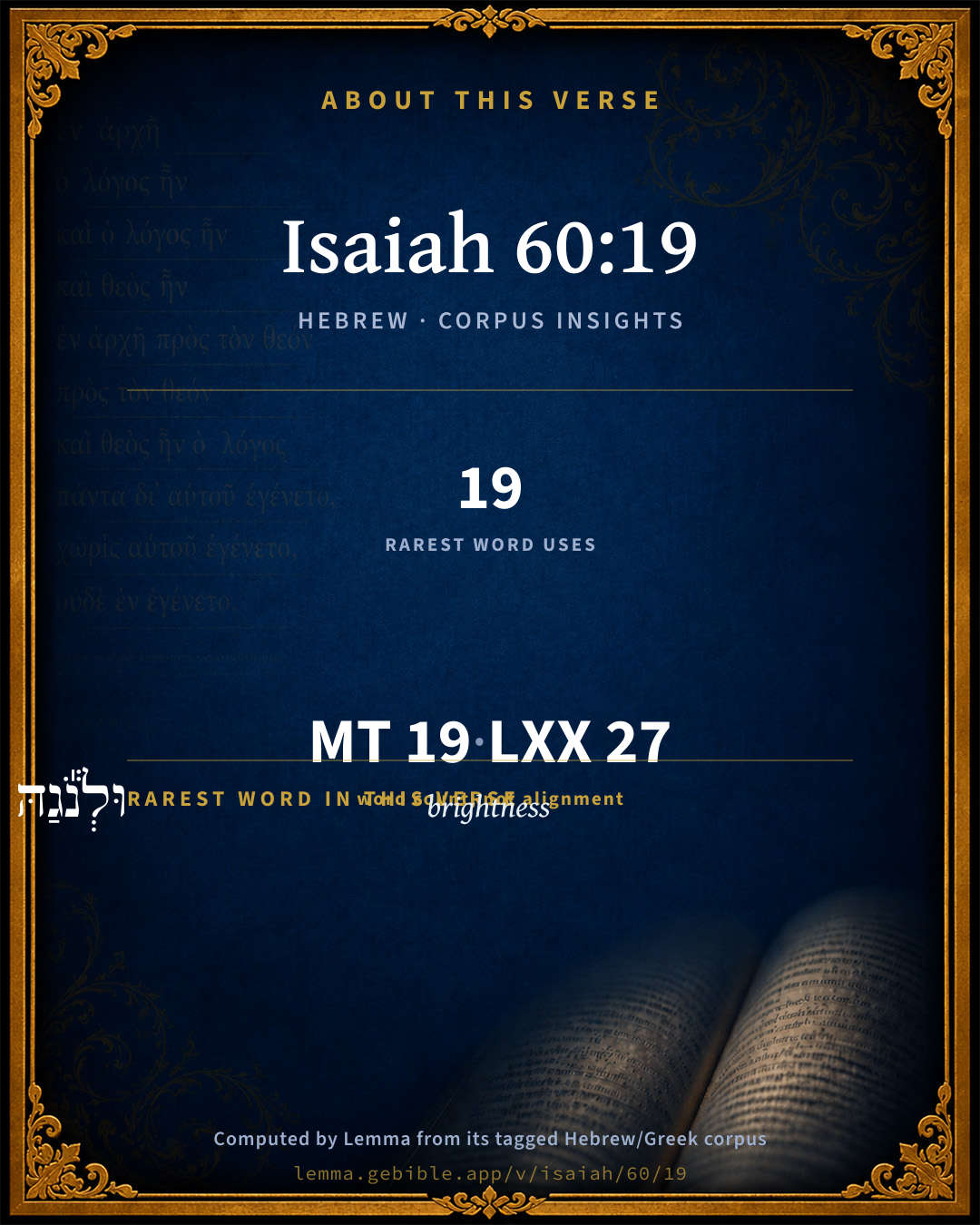
About this verse

These counts appear in no published source. They are computed here, from the morphology-tagged text and Lemma’s own curated glosses. What Lemma adds →

19
words
13
distinct lemmas
Prophets
section

Notable vocabulary

The rarest word here is וּלְנֹ֕גַהּ brightness H5051 — appearing just 19 times in the whole Hebrew Bible.

Shared distinctive vocabulary

וּלְנֹ֕גַהּ brightness H5051 occurs in 19 verses of the Hebrew Bible. Also found in:

Grammatical profile

  • 3 verbs
  • 9 nouns
  • 3 prepositions
  • 2 adverbs
  • 2 particles

Verb forms

  • יִֽהְיֶה Qal · Imperfect
  • יָאִ֣יר Hiphil · Imperfect
  • וְהָיָה Qal · Sequential Perfect

Repetition

Words recur within this verse — often emphatic in Hebrew:

  • יִֽהְיֶה to be H1961 ×2
  • לְא֣וֹר light H216 ×2
  • לֹא not H3808 ×2

Hebrew & Septuagint length

In English translation the verse runs 34 words from the Hebrew and 35 from the Septuagint (LXX English) — closely comparable.

A rough comparison of the two English renderings, which tokenize alike — not a word-level alignment.

Word counts can differ between the Hebrew and the Greek without any difference in meaning — e.g. the Hebrew direct-object marker אֵת has no separate Greek word, and Greek often adds the article ὁ.

In the original languages it is 19 Hebrew tokens and 27 Greek tokens — but the two are counted differently (Hebrew bundles its prefixes and suffixes into one token; the Greek is in lemma form), so that isn’t a like-for-like length.

Cross-references

8

Topical passages linked to Isaiah 60:19 in the Treasury of Scripture Knowledge — connected by theme and wording, ordered by reader-vote popularity; previews shown in the World English Bible.

  • Revelation 21:23 The city has no need for the sun, neither of the moon, to shine, for the very glory of God illuminated it, and its lamp is the Lamb.
  • Revelation 22:5 There will be no night, and they need no lamp light; for the Lord God will illuminate them. They will reign forever and ever.
  • Zechariah 2:5 For I,' says Yahweh, 'will be to her a wall of fire around it, and I will be the glory in the midst of her.
  • Psalms 36:9 For with you is the spring of life. In your light shall we see light.
  • Psalms 3:3 But you, Yahweh, are a shield around me, My glory, and the one who lifts up my head.
  • Psalms 62:7 With God is my salvation and my honor. The rock of my strength, and my refuge, is in God.
  • Luke 2:32 A light for revelation to the Gentiles, And the glory of your people Israel."
  • Psalms 4:2 You sons of men, how long shall my glory be turned into dishonor? Will you love vanity, and seek after falsehood? Selah.

Cross-references courtesy of OpenBible.info (CC BY 4.0).

Hebrew and Greek witnesses Masoretic Hebrew ↔ Greek Septuagint

The same verse in the two great witnesses to the Old Testament, shown verse-for-verse.

These are two independent witnesses, not word-aligned to each other, and the Septuagint is shown in lemma (dictionary) form.

Hebrew Isaiah 60:19 Masoretic · Westminster Leningrad Codex

לֹא יִֽהְיֶה לָּ֨ךְ ע֤וֹד הַשֶּׁ֨מֶשׁ֙ לְא֣וֹר יוֹמָ֔ם וּלְנֹ֕גַהּ הַיָּרֵ֖חַ לֹא יָאִ֣יר לָ֑ךְ וְהָיָה לָ֤ךְ יְהוָה֙ לְא֣וֹר עוֹלָ֔ם וֵאלֹהַ֖יִךְ לְתִפְאַרְתֵּֽךְ

The sun shall be no more your light by day; neither for brightness shall the moon give light to you: but Yahweh will be to you an everlasting light, and your God your glory.

World English Bible · Public Domain

Greek LXX Isaiah 60:19 Septuagint · lemma form

καί οὐ εἰμί σύ ὁ ἥλιος εἰς φῶς ἡμέρα οὐδέ ἀνατολή σελήνη φωτίζω σύ ὁ νύξ ἀλλά εἰμί σύ κύριος φῶς αἰώνιος καί ὁ θεός δόξα σύ

And you shall no more have the sun for a light by day, nor shall the rising of the moon lighten your night; but the Lord shall be your everlasting light, and God your glory.

LXX2012 (modern English Septuagint) · Public Domain

On this verse, Adam Clarke's Commentary discusses the Septuagint’s reading. Read the note in Commentary ↓

Hebrew: Westminster Leningrad Codex (CC BY 4.0). Greek: Septuagint (public domain); English from LXX2012 (modern English Septuagint) (Public Domain). How the Septuagint differs from the Hebrew →

Targum (Aramaic paraphrase)

1

The Targum is the ancient Jewish Aramaic paraphrase of the Hebrew Scriptures — an interpretive translation, not the Hebrew text itself. Onkelos (literal) and Pseudo-Jonathan (expansive) render the Torah, and Jonathan the Prophets. Coverage is partial: where no permissively-licensed English translation exists for a verse, only the Aramaic is shown. This is verse-level text, not a word-by-word alignment to the Hebrew.

  1. Targum Jonathan Prophets (Joshua–Malachi)
    לָא תִצְטַרְכִין לְנֵיהוּר שִׁמְשָׁא בִּימָמָא וְאַף לָא לְזֵיהוּר סִיהֲרָא בְּלֵילְיָא וִיהֵי לִיךְ יְיָ לְנֵיהוֹר עֲלָם וֶאֱלְהָךְ לְתוּשְׁבַּחְתִּיךְ:

    Thou shalt need no more the sun for a light by day, neither for brightness the moon by night: but the Lord shall be unto thee an everlasting light, and thy God thy glory.

    Targum Jonathan — Aramaic: “Mikraot Gedolot” (public domain). English: “Sefaria Community Translation” (CC0 1.0 (public-domain dedication)); “London "Chaldee Paraphrase," 1871” (public domain). Text via Sefaria.

Commentary

Notes on Isaiah 60:19 from classic Christian and Jewish commentators (each source and its license shown beneath its notes). The classic Christian expositions comment on the surrounding passage and are grouped to its opening verse, so a note may address several verses; the Jewish commentaries on the Tanakh (Rashi and others) are per-verse, so they appear only where the commentator wrote on this verse.

Lemma curates 59 commentaries, every one of them public domain or Creative Commons licensed, each selected and text-cleaned for this edition rather than reprinted as found. About our sources →

Trapp's Complete Commentary

John Trapp

Isa 60:19 The sun shall be no more thy light by day; neither for brightness shall the moon give light unto thee: but the LORD shall be unto thee an everlasting light, and thy God thy glory.

Ver. 19. The sun shall be no more.] God shall be thy sun and shield, thy solace and safety. {Psa 84:11} The light of his loving countenance shall be lifted up upon thee, and this shall be better to thee than all outward comforts.

John Trapp, A Commentary or Exposition upon All the Books of the Old and New Testament (1647–1656) — public domain. Text from a community e-Sword module.

The Biblical Illustrator

Joseph S. Exell

Isa_60:19

The sun shall be no more thy light by day

The lower giving place to the higher

The prophet bids his people look forward to a time when even the sun and moon shall become needless to them; when in some new and more direct experience of God they shall need nothing to reflect His light to them, but drink immediately from Himself His strength and inspiration.

That seems to be the meaning of the words; and so it points us to one feature which belongs to every progress, the power to do without one thing after another which has before been essential, the way in which, as we advance to higher and higher supplies, we are able to gather out, of them what we used to get from lower sources. It is like that verse in St. Johns description of the New Jerusalem: I saw no temple therein, for the Lord God Almighty and the Lamb are the temple of it. Or like these soberer words of St. Pauls autobiography: When I became a man I put away childish things. This life that rises to the highest helps and companies is able easily to do without the lower. (Phillips Brooks, D. D.)

Things once needed may cease to be necessary

As we climb a high mountain we must keep our footing strong upon one ledge until we have fastened ourselves strongly on the next. Then we may let the lower foothold go. The lives of men who have been always growing are strewed along their whole course with the things which they have learned to do without. As the track of an army marching deep into an enemys country is scattered all along with the equipage which the men seemed to find necessary when they started, but which they have learned to do without as the exigencies of their march grew greater, and they found that these provisions and equipments were partly such as they did not need at all, and partly such as they could gather out of the land through which they marched; so from the time when the child casts his leading strings aside because his legs are strong enough to carry him alone, the growing man goes on forever caring each help for a higher, until at last, in that great change to which Isaiahs words seem to apply, he can do without sun and moon as he enters into the immediate presence and essential life of God. (E. Paxton Hood.)

A token of growth

As we grow we come to the capacity of higher pleasures and higher occupations, and so let go the lower ones; not by compulsion, because we cannot hold them any longer, but from the satisfaction of our newer lives; because we have got something else better than they are, and can do without them now. (E. Paxton Hood.)

The symbol and the reality

Let us take two or three instances of those things which are valuable as symbols, but which he is able to do without who has got beyond the symbol and gained the reality which it represents.

1. Take the instance of wealth. There are some men who can do without being rich--plenty of men who have to, but some men who can, can easily, can without discontent or trouble. They love comfort and respectability as much as these their neighbours. What is the difference? Simply this, that they have found that comfort and respectability, while money is their natural symbol, are not dependent upon money, and that one may reach past the symbol, and take the reality, and let the symbol go.

2. Or take another symbol. Praise is good. To be applauded by our fellow men, to hear our ambitions about ourselves caught up by their testifying cheers, to have our own best hopes for our own lives confirmed by their appreciation of us, that is a true delight for any man. To be able to do without mens praise because we do not feel its value, because morosely and selfishly we do not care what men think, that is bad; that is a sign of feebleness and conceit. To feel it is wretched, and to affect to feel it is detestable. But to be able to do without mens praise because that which their praise stands for is dearer to us than the praise is, and it so happens that we cannot have both of them, that is a wholly different thing. Mens praise stands for goodness. Every man feels that if it does not mean that, if it is given to iniquity just aa freely as to goodness, praise loses all its value. Praise is the symbol; goodness is the reality.

3. So it runs everywhere. The symbols of the deeper pleasures are the mere animal indulgences--eating and drinking, the lusts of the flesh. They stand for intellectual and spiritual joys. How natural their symbolism is. The Bible talks of hungering and thirsting after righteousness. David says, Taste and see that the Lord is good. Jesus tells His disciples about eating His flesh and drinking His blood. The superficial emotions of the senses stand for and represent the profound emotions of the soul. In the, harmonious life the two will live in harmony. The symbol and reality, the bodys and the souls enjoyment, will be complete together. But when in this unharmonious life which we live the symbol and reality come into unnatural conflict, when either the soul must be, sacrificed to the body or the body to the soul, he who really knows what the souls happiness is does not hesitate. Here is the power of true self-sacrifice; here is the secret which takes out of it all the bitterness and brutality. Always it is the giving up of a symbol that you may have the reality. In the great sacrifice of all, Christ lays down His life, but it is that He may take it again. Do you think that Christ did not care for life and all that makes life beautiful to us? Surely He did; but He cared more for that which they represent--the living purely, the doing of His Fathers will, and the serving of His brethren.

4. I am very much impressed by the truth of all this as concerns the Christian Church. She has her symbols and her ordinances, and she has her true and inner life. Her outward ways of living really belong with her inward power. In a perfectly harmonious world there never could be any conflict. In heaven the outward and the inward Church shall absolutely correspond; but here and now the Church may be so set upon her symbols and her regularities that she shall fail of doing her most perfect work and living her most perfect life. The Christian may be so bound to rites and ceremonies that he loses the God to whom they ought to bring him near. Here it certainly is true that no symbol is doing its true work unless it is educating those who use it to do without itself if need be. (E. Paxton Hood.)

Important questions

1. First you will ask, How can I tell the symbol from the reality, and so know what things it is good to hold less and less, what things it is good to hold more and more indispensable? It is not easy to give the answer in a rule. But the answer no doubt lies in a certain feeling of spirituality and infiniteness and eternity, which belongs to those things which it is good for a man not to be able to do without. Those things which serve the soul rather than the body, those which serve the whole of us and not one special part, and those which can serve us longest--those are the things which we want to make more and more indispensable. Those things whose usefulness belongs mainly to the body, those things which help some part of us and not the whole, and those things whose use is temporal--it is not good for any of us to have to say, I cannot do without these things. This is, perhaps, the nearest that we can come to rules; but he who lives in the spirit of these rules acquires a certain sort of feeling of the infiniteness of some things and the finiteness of others, so that renown, wealth, dignity, sympathy, comfort, friendship, amusement, life, stand on one side; and honour, truth, bravery, purity, love, eternity, God, stand on the other. These last he must have. Those others he can do without. The moment that he touches any new gift he can tell to which order it belongs.

2. But then you say, What then? When I have felt this difference, when I know what things I must not allow to become indispensable to me, what shall I do then? Shall I throw all those things away? Shall I strip my life instantly of all that is not indispensable, and live only in those things which I cannot live without? No; certainly not. That effort to cast away the symbol as soon as it was seen to be a symbol has been the source of much religious unhappiness and failure, and of much of the wrong kind of separation between religious and irreligious life. Not to give up the symbol, but to hold it as a symbol, with that looser grasp which lets its inner reality escape into us, and at the same time makes us always ready to let it go when the reality shall have wholly opened from it, that is the true duty of the Christian as concerns the innocent things of the world. That was the way in which Jesus always seemed to be holding friendship, home, nature, and His own human life; never grasping them so tightly that their spiritual meanings might not come forth from them freely, nor that He could not give them up when a higher vocation summoned Him.

3. And that brings us to the last question. How shall I come to count nothing indispensable but what I really ought to, what I really cannot do without? The answer to that question is in Christ, who holds the answers of all our questions for us. As I read the Gospels I can see how, little by little, Jesus lifted those disciples past one conception of necessity after another, until at last they knew nothing that was absolutely necessary except God. They began as fishermen who could not do without their nets and boats and houses and fishing friends and sports and gains and gossipings. He carried them up till they were crying, Lord, show us the Father, and it sufficeth us. (E. Paxton Hood.)

The Biblical Illustrator, edited by Joseph S. Exell (c. 1880s–1900s) — public domain. Text from a community e-Sword module.

Joseph Benson's Commentary

Isa 60:19-20. The sun shall be no more thy light, &c. — The light of the sun and moon shall not be at all esteemed in comparison of the spiritual light of the church, which shall be so glorious as to eclipse all the light formerly enjoyed by her, the divine glory and majesty illuminating her much more brightly than the luminaries of heaven illuminate and adorn the theatre of nature. Or, as Lowth interprets the clause, “God’s favour and the light of his countenance shall give her greater comfort and lustre than the light of the sun and moon doth to the world.” Every reader must perceive that the passage is metaphorical, and it is here introduced to give the church assurance of comfort, as the preceding was to assure her of safety; so that God will not only be a shield, but a sun to her, Psa 84:11. The Lord shall be unto thee an everlasting light — Christ shall scatter all thy darkness and ignorance, enlightening and comforting thee with the doctrines of the gospel, and the graces of his Spirit, and these blessings shall be everlasting, not waxing and waning, and suffering eclipses and settings, as the sun and moon do, but shall be constant, without shadow or change; and thy God thy glory — Always giving thee reason to glory in him; or, thy relation to him, and interest in him, as thy God, shall be thy greatest honour. Thy sun shall no more go down, &c. — Thy light and comfort shall be no more withdrawn. “If the church, under the economy of the external and typical covenant, saw only a temporary light, and underwent various changes of its state, at this time it shall rejoice, for a long season with unchanged light, in a much more constant and happy state.” The days of thy mourning shall be ended — The prosperity and happiness of the church shall be perpetual and uninterrupted. Hebrew, שׁלמו, shall be recompensed, that is, Thy days of rejoicing shall abundantly recompense all thy days of mourning. Observe, reader, “Jesus Christ is the eternal Sun and Light of his church, illuminating and sanctifying it by his Spirit, filling it with his glory, and prospering its whole state by his providence, for the end of eternal joy. (See Rev 22:5.) Who will say that the church has ever yet enjoyed this blessing of divine providence and grace, in the full extent which is here marked out by the prophet?” — Vitringa.

Joseph Benson's Commentary on the Old and New Testaments (1811–1818) — public domain. Text from a community e-Sword module.

Keil & Delitzsch

C. F. Keil & F. Delitzsch

The fifth turn celebrates the glorifying of Jerusalem, through the shining of Jehovah as its everlasting light and through the form of its ever-growing membership, which is so well-pleasing to God. The prophecy returns to the thought with which it set out, and by which the whole is regulated, viz., that Jerusalem will be light. This leading thought is now unfolded in the most majestic manner, and opened up in all its eschatological depth. "The sun will be no more thy light by day, neither for brightness will the moon shine upon thee: Jehovah will be to thee an everlasting light, and thy God thy glory. Thy sun will no more go down, and thy moon will not be withdrawn; for Jehovah will be to thee an everlasting light, and the days of thy mourning will be fulfilled." Although, in the prophet's view, the Jerusalem of the period of glory in this world and the Jerusalem of the eternal glory beyond flow into one another; the meaning of this prophecy is not that the sun and moon will no longer exist. Even of the Jerusalem which is not to be built by Israel with the help of converted heathen, but which comes down from heaven to earth, the seer in Rev 21:23 merely says, that the city needs neither the shining of the sun nor of the moon (as the Targum renders the passage before us, "thou wilt not need the shining of the sun by day"), for the glory of God lightens it, and the Lamb is the light thereof, i.e., God Himself is instead of a sun to her, and the Lamb instead of a moon. Consequently we do not agree with Stier, who infers from this passage that "there is a final new creation approaching, when there will be no more turning round into the shadow (Jam 1:17), when the whole planetary system, including the earth, will be changed, and when the earth itself will become a sun, yea, will become even more than that, in the direct and primary light which streams down upon it from God Himself." We rather agree with Hofmann, that "there will still be both sun and moon, but the Holy Place will be illuminated without interruption by the manifestation of the presence of God, which outshines all besides." The prophet has here found the most complete expression, for that which has already been hinted at in such prophecies in Isa 4:5; Isa 30:26; Isa 24:23. As the city receives its light neither from the sun nor from the moon, this implies, what Rev 21:25 distinctly affirms, that there will be no more night there. The prophet intentionally avoids a לילה לאור parallel to יומם לאור. We must not render the second clause in Isa 60:19, "and it will not become light to thee with the shining of the moon," for האיר never means to get light; nor "and as for the shining of the moon, it does not give the light," as Hitzig and Knobel propose, for וּלנגהּ is used alone, and not היּרח וּלנגהּ as the antithesis to יומם לאור, in the sense of "to light up the night" (compare נגהּ as applied to the shining of the moon in Isa 13:10, and נגהּ to the glittering of the stars in Joe 2:10), and even the use of הלילה is avoided. The true rendering is either, "and for lighting, the moon will not shine upon thee" (Stier, Hahn, etc.); or, what is more in accordance with the accentuation, which would have given ולנגה tifchah and not tsakeph gadol, if it had been intended to indicate the object, "and as for the lighting" (ל as in Isa 32:1). The glory of Jehovah, which soars above Jerusalem, and has come down into her, is henceforth her sun and her moon - a sun that never sets, a moon יאסף לא which is not taken in towards morning, like a lamp that has been hung out at night (compare נאסף, Isa 16:10, withdrawn, disappeared). The triumph of light over darkness, which is the object of the world's history, is concentrated in the new Jerusalem. How this is to be understood, is explained in the closing clause of Isa 60:20. The sum of the days of mourning allotted to the church is complete. The darkness of the corruption of sin and state of punishment is overcome, and the church is nothing but holy blessed joy without change or disturbance; for it walks no longer in sidereal light, but in the eternally unchangeable light of Jehovah, which with its peaceful gentleness and perfect purity illumines within as well as without. The seer of the Apocalypse also mentions the Lamb. The Lamb is also known to our prophet; for the "Servant of Jehovah" is the Lamb. But the light of transfiguration, in which he sees this exalted Lamb, is not great enough to admit of its being combined with the light of the Divine Nature itself.

Keil & Delitzsch — Biblical Commentary on the Old Testament (1861–1891) — public domain (CC PDM 1.0). Text via the HelloAO Bible API. (Old Testament only.)

Tyndale Open Study Notes

Tyndale Open Resources

60:19-20 Natural sources of light such as the sun and the moon will be as nothing in comparison to the brightness of God’s presence (see also 9:2; 30:26; Zech 2:5; Rev 21:23-24).

Tyndale Open Study Notes — © Tyndale Open Resources, licensed CC BY-SA 4.0. Text via the HelloAO Bible API.

Geneva Bible (1599)

Geneva Bible translators

Signifying, that all worldly means shall cease, and that Christ shall be all in all, as Rev. 21:23 and 22:5.

Geneva Bible (1599) marginal notes — public domain. Text via Bolls.life.

Jamieson, Fausset & Brown

Robert Jamieson, A. R. Fausset & David Brown

The sun and moon, the brightest objects by day and night, shall be eclipsed by the surpassing glory of God manifesting Himself to thee (Isa 30:26; Zac 2:5; Rev 21:23; Rev 22:5).

Jamieson, Fausset & Brown — Commentary Critical and Explanatory on the Whole Bible (1871) — public domain (CC PDM 1.0). Text via the HelloAO Bible API.

Adam Clarke's Commentary

Verse 19. Neither for brightness shall the moon give light unto thee - "Nor by night shall the brightness of the moon enlighten thee"] This line, as it stands in the present text, seems to be defective. The Septuagint and Chaldee both express the night, which is almost necessary to answer to day in the preceding line, as well as to perfect the sense here. I therefore think that we ought, upon the authority of the Septuagint and Chaldee, to read either ולילה velailah, and by night, instead of ולנגה ulenogah, and for brightness; or ולנגה בלילה ulenogah ballailah, adding the word בלילה ballailah, by night. - L.

Adam Clarke's Commentary on the Bible (1810–1826) — public domain. Text from a community e-Sword/MySword module.

Ellicott's Commentary for English Readers

(19) The sun shall be no more . . .—The ideal picture becomes bolder and more transcendent. Sun and moon may still shine, but, as in Rev_21:23 (obviously derived from this), they shall not be needed in the radiance of the greater glory of the presence of Jehovah. Here on earth the sun sets and the moon wanes, but in that Divine glory there is no waning and no setting. “Mourning” will belong to the past (comp. Rev_21:4), everlasting joy to the future.

A Bible Commentary for English Readers, edited by Charles John Ellicott (1878–1897) — public domain. Text from a community e-Sword module.

The Cambridge Bible for Schools and Colleges

gen. ed. J. J. S. Perowne

19. thy glory] thy beauty; Isa_60:7, Isa_9:13.

19, 20. Comp. Rev_21:23 : “And the city had no need of the sun, neither of the moon, to shine in it; for the glory of God did lighten it, and the Lamb is the light thereof”; and Isa_22:5. It is not implied that the sun and moon shall cease to exist; all that is said is that the new Jerusalem shall not be dependent on these natural luminaries. But that an actual physical illumination of the city by the glory of Jehovah is contemplated by the prophet can hardly be doubted. The basis of the conception is perhaps to be found in Eze_43:2.

The Cambridge Bible for Schools and Colleges (gen. ed. J. J. S. Perowne; Cambridge University Press, 1878–1918) — public domain. Text from a community e-Sword module.

John Gill's Exposition

The sun shall be no more thy light by day,.... Here begins the account of the sinless, pure, and perfect state of the church in the personal reign of Christ, even the New Jerusalem church state, as appears from the use of these very words, in the description of that state, Rev 21:23 where it is read, "and the city had no need of the sun, neither of the moon to shine in it: for the glory of God did lighten it, and the Lamb is the light thereof"; and in like manner the Targum renders these words,

"and ye shall have no need any more of the light of the sun by day, nor even of the light of the moon by night;''

and so both Aben Ezra and Jarchi interpret it,

"ye shall have no need of the light of the sun;''

and the former adds, because of the light of the Shechinah; and which seems to be the meaning of the next clause:

neither for brightness shall the moon give light unto thee; that is, because of the exceeding brightness, splendour, and lustre of the divine majesty of Christ, who will appear personally among his people, neither sun nor moon will be able to give any light: as the light of a candle is made useless and unnecessary by the light of the sun, so the light of the sun and moon will be made useless and unnecessary by the vastly superior light and glory of Christ; see Isa 24:23, though the sun and moon may be understood here mystically, not of civil magistrates, who are sometimes signified by these luminaries; and who also will be no more used when this dispensation or personal reign of Christ shall take place; see Isa 13:10, but rather of the Gospel and Gospel ordinances, which the church will no more stand in need of to enlighten, teach, and instruct them, refresh and comfort them, having the immediate presence of Christ with them, as follows:

but the Lord shall be unto thee an everlasting light; that is, the Lord Jesus Christ, the Lamb of God, as it is interpreted in the above cited place in the Revelation; who, as he is the author of the light of nature, and of the light of grace, so of the light of glory in this state, and to all eternity; then will the saints in this light behold the face of God, which is not to be seen now; they shall see Christ in all his glory, in the glory of his Father, and of his holy angels; all the glorious forms, the angels of heaven, and all the saints, those spirits of just then made perfect, that shall come with Christ, and be clothed with glorious bodies; even the New Jerusalem descending from heaven, having the glory of God upon her; likewise all the doctrines of grace, now not so clearly understood; and all the mysteries of Providence, which will be laid open, and made manifest; and this clear light will continue for ever; there will be no more night, but one everlasting day:

and thy God thy glory; it is the saints' glory that God is their God; and it will be their glory in this state to have the God-man Jesus Christ personally with them; the tabernacle of God will be among them; God himself shall be with them, and be their God; and his glory shall lighten them, Rev 21:3.

John Gill's Exposition of the Whole Bible (1746–1763) — public domain (CC PDM 1.0). Text via the HelloAO Bible API.

Albert Barnes' Notes on the Bible

The sun shall be no more - A similar expression denoting the great prosperity and happiness of the church, occurs in Isa 30:26 (see the note at that place). The language here is exceedingly beautiful, and the idea is plain. It is designed to foretell the great glory which would exist in the church under the Messiah; a glory compared with which all that is furnished by the sun, moon, and stars would be as nothing. Expressions singular to this, and probably derived from this, are used by John in describing the lot of heaven. ‘And the city had no need of the sun, neither of the moon to shine in it, for the glory of God did lighten it, and the Lamb is the light thereof’ Rev 21:23. ‘And there shall be no night there; and they need no candle, neither light of the sun, for the Lord God giveth them light’ Rev 22:5. The idea is, the light and beauty of truth would be so great; the divine perfections shine forth so illustriously under the gospel, that the eye would be attracted to that light as superior to all the natural splendor of the sun and moon. All the wonders and beauties of the natural world would be lost in the superior brightness that would shine in the moral world.

Neither for brightness - In order to give light; or, with her brightness she shall not shine on the night.

Shall the moon give light unto thee - The beauty of the moon shall be lost in the superior effulgence of the rays of truth.

But the Lord shall be unto thee - He will furnish a revelation that will disclose far more of his perfections and his glory, and that will be far more valuable to thee as a light and guide, than all the splendor of the heavenly bodies.

And thy God thy glory - The honor of the church shall be that it has the true God for its protector. Its joys shall be found, not in the objects of nature - the beauty of created things - but in the glory of the divine perfections, and in the laws and plans of the Redeemer. His name, his attributes, his laws, his protecting care, constitute her main glory. It is an honor to the church to have such a God and Redeemer; an honor to share his favor, and to be under his everwatchful eye. The glory of the church is not her wealth, her numbers, her influence, nor the rank and talent of her ministers and members; it is the character of her sovereign Lord, and in his perfections it is right that she should exult and rejoice.

Albert Barnes' Notes on the Bible (1834–1885) — public domain. Text from a community e-Sword/MySword module.

Haydock's Catholic Bible Commentary

Thou shalt, &c. In this latter part of the chapter, the prophet passes from the illustrious promises made to the Church militant on earth, to the glory of the Church triumphant in heaven. (Challoner) --- Glory. St. John seems to have copied this, Apocalypse xviii., &c.

George Leo Haydock (1774–1849), Haydock's Catholic Family Bible and Commentary, 1859 edition — public domain. Excludes Psalms (Douay-Rheims chapter numbering differs from Protestant) and Deuterocanonical books (Catholic canon only).

Matthew Poole's English Annotations

The sun shall be no more thy light, & c.; these shall not be at all esteemed in comparison of the spiritual light of the church; and this is laid down as the assurance of the church’s comfort, as the former was for her safety, so that God will not only be a shield, but a sun to her, Psa 84:11; not that they shall not have the sun and moon among them, but that the light of the godly, as such, should principally consist in what is spiritual.

The Lord shall be unto thee an everlasting light; Christ shall scatter all darkness and ignorance, enlightening thee with the doctrines of the gospel, and graces of his Spirit; and this shall be

everlasting, not wax and wane, and suffer eclipses and settings, as the sun and moon do, but it shall be constant, without shadow of change; no night; which will be undoubtedly true of the church in heaven, whatever it will be, or how near soever it will come to it, here, which I presume will bear its analogy.

Thy God thy glory; always ministering matter of thy glorying in him; or, thy interest in this God shall be great honour to thee; or else it is the same thing with the sentence immediately before in other words, that will make time glorious, a metonymy of the efficient; thus he is said to give glory, Psa 84:11.

Matthew Poole's English Annotations on the Holy Bible (1683–1685) — public domain. Text from a community e-Sword/MySword module.

Whedon's Commentary on the Bible

Daniel D. Whedon

19, 20. The sun shall be no more thy light — For thy light and beauty shall exceed its brightness. No words can excel in beauty these verses. The spiritual Jerusalem is glorified through the shining of Jehovah as her everlasting light. In this verse, light denotes knowledge of spiritual truth, as a characteristic source of moral power concreted in the victories and blessedness of the Church militant and triumphant.

Daniel D. Whedon (gen. ed.), Commentary on the Old and New Testaments (1874–1909) — public domain. Text from a community e-Sword module.

The Pulpit Commentary

Vers. 19-22. The fifth stanza. Zion"s crowning glories.

The sun shall be no more thy light by day. Here Isaiah anticipates one of the most sublime thoughts in the Revelation of St. John the Divine, viz. that the heavenly Jerusalem, illuminated perpetually by the radiance of the Divine Presence, shall need neither light of the sun by day, nor of the moon by night, but shall be sufficiently illumined by the direct and primary light which streams down upon it from God himself. Whether the sun and moon will continue to exist or not is beyond the prophet"s ken he makes no announcement on the subject; sufficient for him that the redeemed bask perpetually in a Divine radiance shed upon them by the "Father of lights". (see Rev_21:23 Rev_22:5) The germ of the idea appears in the earlier prophecies. (Isa_24:23) For brightness; rather, for illumination. The Lord shall be unto thee an everlasting light. God is "the Father of lights" (Jam_1:17) true Light, which lighteth every man that cometh into the world.". (Joh_1:9) All other light is but his shadow and his reflex his creature (Gen_1:3) therefore perishable, not to be reckoned on for continuance. (Psa_102:26 Heb_1:11) But God abides; therefore his light will abide. He is "the same yesterday, and to-day, and for ever". (Heb_13:8) And thy God thy glory. (comp. Zec_2:5) God will not only be the Light of the Church, but her "Glory" and boast. As the Shechinah was the glory of the first, so "the eternal unchangeable light of Jehovah, with its peaceful gentleness and perfect purity" (Delitzsch), will be the glory of the final temple.

Our everlasting Light.

Contrasts are suggested with brief days that darken into night, and cloudy days that hide the sunshining. It passes our comprehension, indeed, but it kindles our imagination, to conceive of a day that knows no ending, and a sunrising that never reaches its meridian. Yet we often feel as if we wanted life to be all sunshine; it shall be when we are altogether good. While we are encompassed with infirmities, and must be under discipline, God cannot be to us an "everlasting Light;" there must be clouds coming betwixt, Which our fearing, trembling souls fashion into his forms. In the white heavens, white souls need no sun and no moon to shine upon them, for the glory of God doth lighten them. But this is ideal glory, and the question for us is How near can we get to it now?

I FOR US GOD MAY BE THE LIGHT OF THE MATERIAL WORLD. To let ourselves be so engrossed with business affairs that there is no room for God in thought, or heart, or life, is to lose the everlasting light to be unable to see God in common everyday things. It is hardly conceivable that any man could wish to have this fair earth with its vales and hills, without the gilding beautifying sunshine. O poor earth, dull and dead, like sunless winter in Arctic climes! And yet thousands are willing to have this earth of material relationships without the sunshine of God. Exactly what men want, but do not know that they want, is God their everlasting Light. Common life, with him, is lived in the sunshine.

II FOR US GOD MAY BE THE LIGHT OF THE INTELLECTUAL WORLD. In our day he is only allowed to shine intermittently in this world, and there are many who would blot him out of this sky if they could. Others, who would not go so far as that, would gladly make a thick, foggy atmosphere of their own wisdom, through which he can only shine dimly. We shall never get the full glory of the treasures of the intellectual world until we let the revealing rays of the "everlasting light" fall everywhere upon them.

III FOR US GOD MAY BE THE LIGHT OF THE SPIRITUAL WORLD. Indeed, there is no light at all in the spiritual world if he does not shine. And the one thing above all others which they crave after who dwell in that spiritual world is the full, constant, unshaded, glowing, life-renewing power of the everlasting Light. R.T.

The Pulpit Commentary (1880–1919), ed. H.D.M. Spence-Jones & Joseph S. Exell — public domain. Text from a community e-Sword module.

John Wesley's Explanatory Notes

The sun - These shall not be esteemed in comparison of the spiritual light of the church; but here laid down for the churches comfort as the former was for her safety, so that God will not only be a shield, but a sun. The Lord - Christ shall scatter all darkness and ignorance, and this light shall not wax, and wane, and suffer eclipses, and settings, as the sun and moon do, but shall be constant, without shadow of change. The glory - Always ministering matter of glorying in him.

John Wesley, Explanatory Notes Upon the Whole Bible (1754–1765) — public domain. Text via the GEBible commentary corpus.

J. A. Alexander on Isaiah

Joseph Addison Alexander

“No more shall be to thee the sun for a light by day, and for brightness the moon shall not shine to thee, and Jehovah shall become thy everlasting light, and thy God thy glory.” Some regard this merely as a figurative promise of prosperity, of which light is a natural and common emblem. Others understand it as a promise of God’s residence among His people, clothed in such transcendent brightness as to make the light of the sun and the moon useless. The true sense of the figures seems to be, that all natural sources of illumination shall be swallowed up in the clear manifestation of the presence, power, and will of God. With this verse compare Rev 21:23; Rev 22:5.

Joseph Addison Alexander, The Prophecies of Isaiah (1846–1847; New York: Scribner, 1870–1878) — public domain. Text from a community e-Sword module.

unfoldingWord translationNotes

Door43 World Missions Community

General Information:

Yahweh continues speaking to the people of Israel.

for Yahweh will be your everlasting light

Both verses repeat this same idea for emphasis. (See: Parallelism)

Your sun will no longer set, nor will your moon withdraw and disappear

The moon will not literally disappear. This exaggeration is saying that the light of the sun and the moon will be much less bright than the light of Yahweh. (See: Metaphor and Hyperbole and Generalization)

translationWords

light

Yahweh

glory

eternity

unfoldingWord translationNotes — © Distant Shores Media and the Door43 World Missions Community, licensed CC BY-SA 4.0. Source: git.door43.org/Door43/en_tn.

Rashi

Rabbi Shlomo Yitzchaki (Rashi)

You shall no longer have You shall not require the light of the sun.

Rashi on the Tanakh — English translations: “The Judaica Press complete Tanach with Rashi, translated by A. J. Rosenberg” (CC BY 4.0); “Pentateuch with Rashi's commentary by M. Rosenbaum and A.M. Silbermann, 1929-1934” (public domain); “The Metsudah Tanach series, Lakewood, N.J” (CC BY 4.0); and “The Book of Joshua, Metsudah Publications, 1997” (CC BY 4.0). Text via Sefaria.

Ibn Ezra

Rabbi Abraham ibn Ezra

The sun shall be no more, etc. Thou wilt not want the light of the sun, because of the light of God.

An everlasting light, that shines day and night.

Ibn Ezra on the Tanakh — English translations: “Sefaria Community Translation” (CC0 1.0 (public-domain dedication)); “Yalkut, Sifsei Chachomim Chumash, Metsudah Publications, 2009” (CC BY 4.0); and “Commentary of Ibn Ezra on Isaiah - trans. by M. Friedlander, 1873” (public domain). Text via Sefaria.

Lesson kit

Teaching starters — assembled from the data on this page, not authored interpretation. Every prompt links to the verse data it draws on. Edit before teaching.

Isaiah, in the Prophets, opens this verse with 19 words (13 distinct Hebrew lemmas). Its most distinctive word is nôgahh (“brightness”). A historical commentator’s framing appears above. Read the whole chapter for the surrounding context.

Discussion questions

  1. The word nôgahh carries the sense “brightness.” How does it shape the verse?
  2. How does 2 Samuel 22:13, which shares the word «brightness», read alongside this verse?
  3. What does the repetition of “to be” (2× in this one verse) do in this verse?
  4. These translations render this verse differently. What is at stake in choosing one wording over another?
  5. «יִֽהְיֶה» is a Qal Imperfect verb. How does that grammatical form shape the action described?
  6. Compare how Trapp's Complete Commentary and The Biblical Illustrator read this verse. Where do they agree or differ?

Things to notice

Reading settings

Reading text

Shown beneath each verse's original-language words.

Old Testament
Old Testament edition

Read the OT as the Masoretic Hebrew (MT) or the Greek Septuagint (LXX).

English shown for the Greek Septuagint (in the Hebrew ↔ Greek comparison).

Comparing translations? Open the Compare panel on any verse page to stack up to four side by side.