
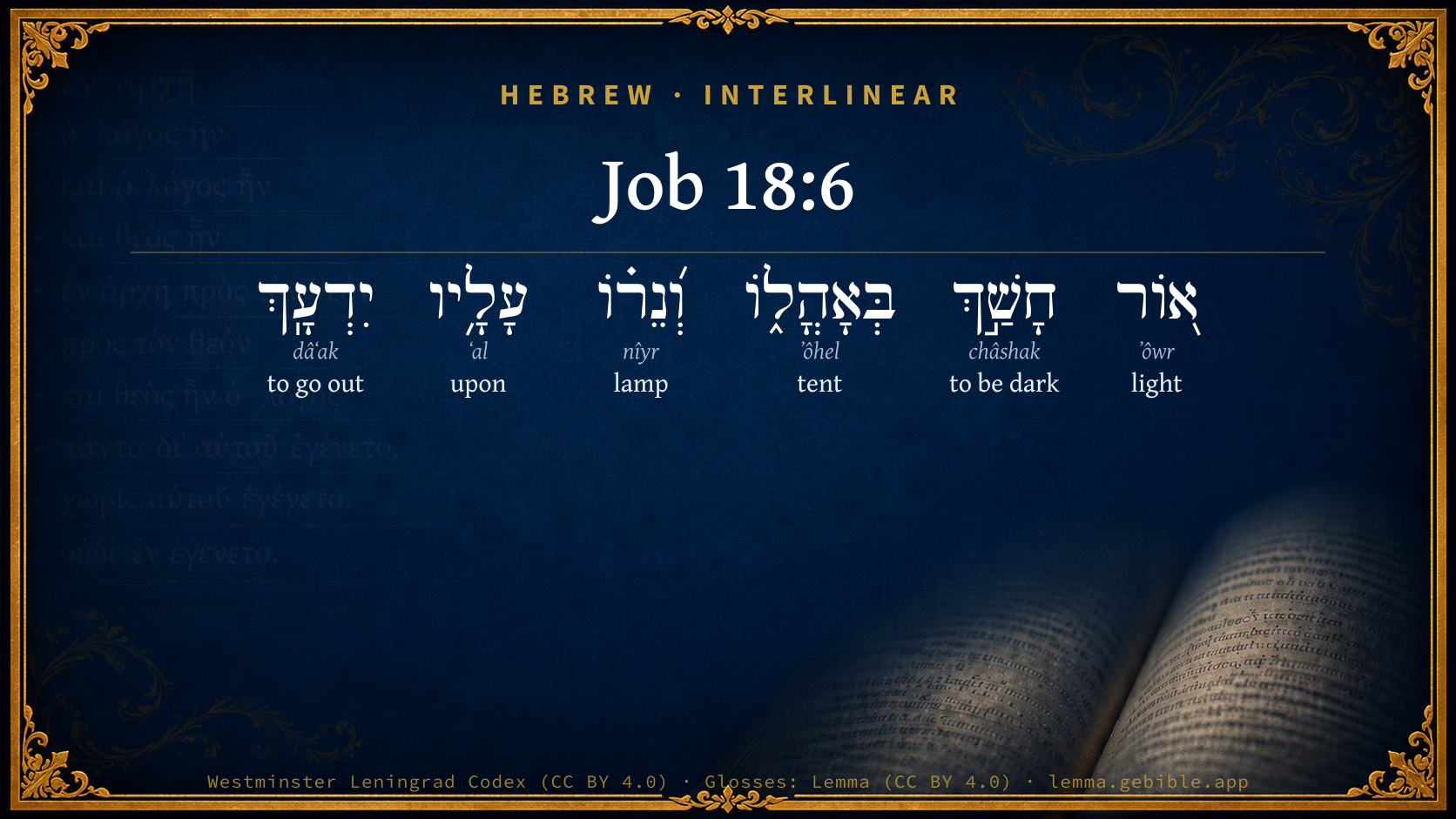
Job 18:6

Hebrew (Westminster Leningrad Codex) Job 18:6 appears in the Hebrew Old Testament. The text above is from the Westminster Leningrad Codex. Each word links to its Strong’s number, a concise gloss, and parsing drawn from the Open Scriptures Hebrew Bible morphology. Click any word for its full Brown-Driver-Briggs (BDB) entry.
Download image
Cite this verse

Job 18:6 (World English Bible). Public Domain. Lemma interlinear Bible study tool, https://lemma.gebible.app/v/job/18/6.

Show BibTeX & RIS
BibTeX
RIS
English Translation
The light shall be dark in his tent, His lamp above him shall be put out.
World English Bible · Public Domain
Download a study sheet

One document with this verse’s original text, its word-by-word gloss line, the meaning frame, cross-references with their text, attributed commentary, and full source and license credits — printable, and it pastes into notes with its structure intact.

This verse Autodidact and up

Study sheet (.html) Plain text (.txt)

A passage Seminary Student

Up to 50 verses in one chapter. A passage sheet keeps up to 6 commentary sources and 12 cross-references per verse, in the order this page ranks them, and says so on the sheet whenever that leaves anything out. Ask for a single verse and you get the Autodidact verse sheet above.

Everything on this page stays free to read, with no account — the sheet is a download of what is already on screen, not access to it.

Want to remove ads? Support Godless Engineer
Compare translations 3

The same verse in 3 English versions, stacked beneath the original-language interlinear above. Click any original word for its lexicon entry.

Each is an independent rendering of the whole verse — the interlinear is not word-aligned to these translations.

Highlighted words mark where these versions differ — a whole-verse word diff, not a word-by-word alignment.

  • World English Bible Public Domain
    The light shall be dark in his tent, His lamp above him shall be put out.
  • King James Version Public Domain
    The light shall be dark in his tabernacle, and his candle shall be put out with him.
  • unfoldingWord Literal Text CC BY-SA 4.0
    The light in his tent will be dark, and his lamp will go out above him.

unfoldingWord Literal Text — © unfoldingWord, licensed CC BY-SA 4.0. Word-aligned USFM3 via Door43 (git.door43.org/unfoldingWord/en_ult).

Versions to compare (up to 4)

3 of 4 selected

Show all 18 translations

Every available English version of this verse, each an independent rendering of the whole verse.

  • World English Bible Public Domain
    The light shall be dark in his tent, His lamp above him shall be put out.
  • Berean Standard Bible Public Domain
    The light in his tent grows dark, and the lamp beside him goes out.
  • Majority Standard Bible Public Domain
    The light in his tent grows dark, and the lamp beside him goes out.
  • King James Version Public Domain
    The light shall be dark in his tabernacle, and his candle shall be put out with him.
  • American Standard Version (1901) Public Domain
    The light shall be dark in his tent, And his lamp above him shall be put out.
  • Revised Version (1885) Public Domain
    The light shall be dark in his tent, and his lamp above him shall be put out.
  • Geneva Bible (1599) Public Domain
    The light shalbe darke in his dwelling, and his candle shalbe put out with him.
  • Douay-Rheims (1899) Public Domain
    The light shall be dark in his tabernacle, and the lamp that is over him, shall be put out.
  • Young's Literal Translation Public Domain
    The light hath been dark in his tent, And his lamp over him is extinguished.
  • Literal Standard Version CC BY-SA 4.0
    The light has been dark in his tent, || And his lamp over him is extinguished.
  • Unlocked Literal Bible CC BY-SA 4.0
    The light will be dark in his tent; his lamp above him will be put out.
  • unfoldingWord Literal Text CC BY-SA 4.0
    The light in his tent will be dark, and his lamp will go out above him.
  • Darby Bible Public Domain
    The light shall become dark in his tent, and his lamp over him shall be put out.
  • World Messianic Bible Public Domain
    The light will be dark in his tent. His lamp above him will be put out.
  • Webster's Bible Public Domain
    The light shall be dark in his tabernacle, and his candle shall be put out with him.
  • Free Bible Version CC BY-SA 4.0
    The light in their home goes out, the lamp hanging above is extinguished.
  • Bible in Basic English Public Domain
    The light is dark in his tent, and the light shining over him is put out.
  • JPS Tanakh (1917) Public Domain
    The light shall be dark in his tent, and his lamp over him shall be put out.

Literal Standard Version (2020), Covenant Press — licensed CC BY-SA 4.0. Text via the HelloAO Bible API (eBible.org). Unlocked Literal Bible (unfoldingWord) — licensed CC BY-SA 4.0. Text via the HelloAO Bible API (eBible.org). unfoldingWord Literal Text — © unfoldingWord, licensed CC BY-SA 4.0. Word-aligned USFM3 via Door43 (git.door43.org/unfoldingWord/en_ult). Free Bible Version, Dr. Jonathan Gallagher — licensed CC BY-SA 4.0. Text via the HelloAO Bible API (eBible.org).

Word by word

More ways to search: Search by grammar → Find every occurrence → Compare this word →

Practice this passage: Drill this verse → Learn its vocabulary →

About this verse

These counts appear in no published source. They are computed here, from the morphology-tagged text and Lemma’s own curated glosses. What Lemma adds →

6
words
6
distinct lemmas
Wisdom
section

Notable vocabulary

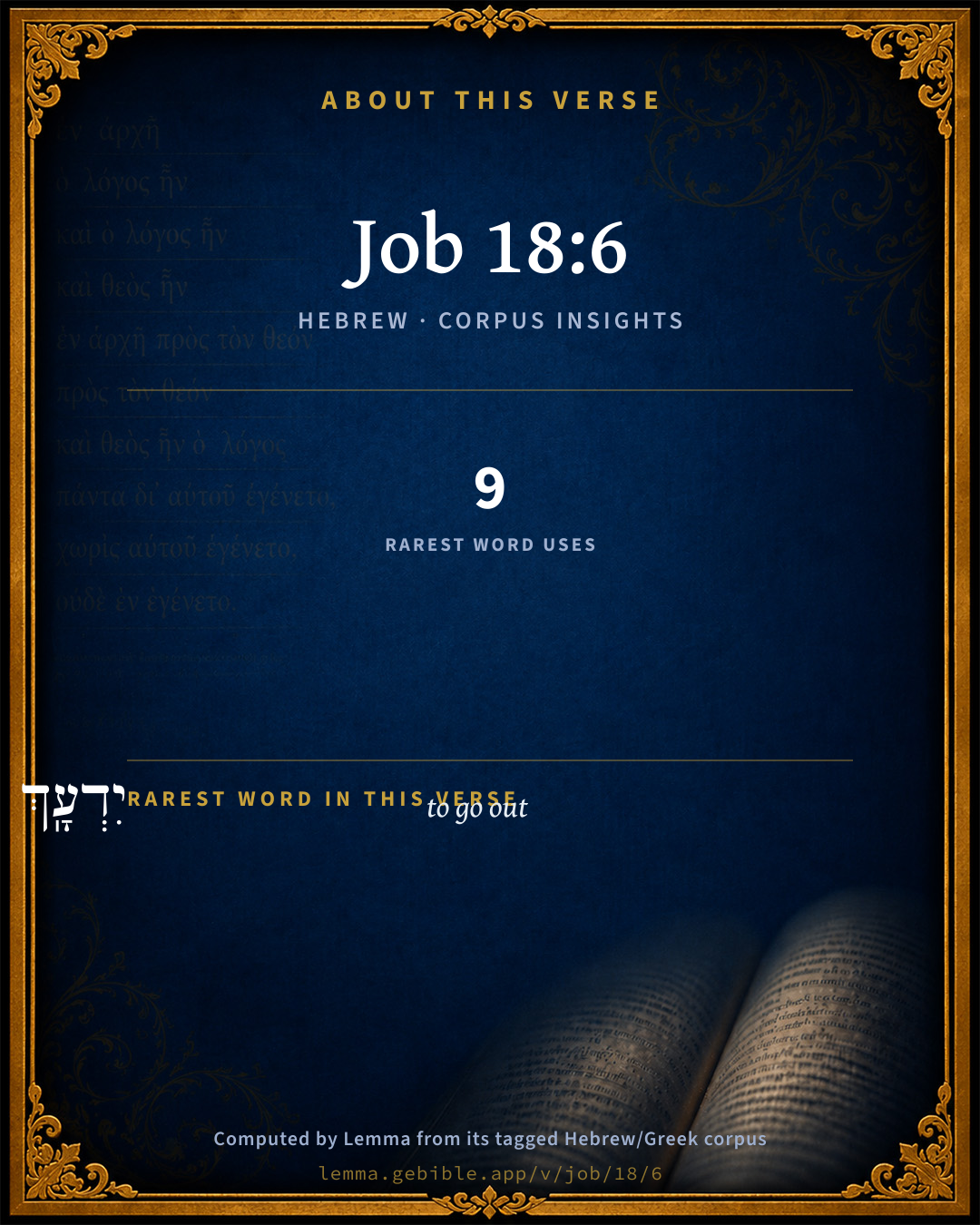
The rarest word here is יִדְעָֽךְ to go out H1846 — appearing just 9 times in the whole Hebrew Bible.

Shared distinctive vocabulary

יִדְעָֽךְ to go out H1846 occurs in 9 verses of the Hebrew Bible. Also found in:

Grammatical profile

  • 2 verbs
  • 3 nouns
  • 1 preposition

Verb forms

  • חָשַׁ֣ךְ Qal · Perfect
  • יִדְעָֽךְ Qal · Imperfect

Hebrew & Septuagint length

In English translation the verse runs 16 words from the Hebrew and 17 from the Septuagint (LXX English) — closely comparable.

A rough comparison of the two English renderings, which tokenize alike — not a word-level alignment.

Word counts can differ between the Hebrew and the Greek without any difference in meaning — e.g. the Hebrew direct-object marker אֵת has no separate Greek word, and Greek often adds the article ὁ.

Cross-references

3

Topical passages linked to Job 18:6 in the Treasury of Scripture Knowledge — connected by theme and wording, ordered by reader-vote popularity; previews shown in the World English Bible.

  • Job 21:17 "How often is it that the lamp of the wicked is put out? That their calamity comes on them? That God distributes sorrows in his anger?
  • Psalms 18:28 For you will light my lamp, Yahweh. My God will light up my darkness.
  • Revelation 18:23 The light of a lamp will shine no more at all in you. The voice of the bridegroom and of the bride will be heard no more at all in you; for your merchants were the princes of the earth; for with your sorcery all the nations were deceived.

Cross-references courtesy of OpenBible.info (CC BY 4.0).

Hebrew and Greek witnesses Masoretic Hebrew ↔ Greek Septuagint

The same verse in the two great witnesses to the Old Testament, shown verse-for-verse.

These are two independent witnesses, not word-aligned to each other, and the Septuagint is shown in lemma (dictionary) form.

Hebrew Job 18:6 Masoretic · Westminster Leningrad Codex

א֭וֹר חָשַׁ֣ךְ בְּאָהֳל֑וֹ וְ֝נֵר֗וֹ עָלָ֥יו יִדְעָֽךְ

The light shall be dark in his tent, His lamp above him shall be put out.

World English Bible · Public Domain

Greek LXX Job 18:6 Septuagint · lemma form

ὁ φῶς αὐτός σκότος ἐν δίαιτα ὁ δέ λύχνος ἐπί αὐτός σβέννυμι

His light shall be darkness in his habitation, and his lamp shall be put out with him.

LXX2012 (modern English Septuagint) · Public Domain

Hebrew: Westminster Leningrad Codex (CC BY 4.0). Greek: Septuagint (public domain); English from LXX2012 (modern English Septuagint) (Public Domain). How the Septuagint differs from the Hebrew →

Commentary

Notes on Job 18:6 from classic Christian and Jewish commentators (each source and its license shown beneath its notes). The classic Christian expositions comment on the surrounding passage and are grouped to its opening verse, so a note may address several verses; the Jewish commentaries on the Tanakh (Rashi and others) are per-verse, so they appear only where the commentator wrote on this verse.

Lemma curates 59 commentaries, every one of them public domain or Creative Commons licensed, each selected and text-cleaned for this edition rather than reprinted as found. About our sources →

Trapp's Complete Commentary

John Trapp

Job 18:6 The light shall be dark in his tabernacle, and his candle shall be put out with him.

Ver. 6. The light shall be dark in his tabernacle] The glory of his family shall be obscured; he and his shall come to utter and unexpected ruin, as Haman’s did.

And his candle shall be put out with him] He and his prosperity shall die together; he shall go out in a snuff, and leave nothing behind him but a detestable name. Sicut felis fugiens pedit, sic ille moriens hunc crepitum cecinit, saith Melancthon concerning Eckius’ last piece, De coniugio sacerdotum. Or, his candle shall be put out above him, so the Vulgate interpreter; the lamps which glittered overhead, during the pride and pomp of his feasts, shall give no more light; or if they give any, it shall be but to shine upon his tomb.

John Trapp, A Commentary or Exposition upon All the Books of the Old and New Testament (1647–1656) — public domain. Text from a community e-Sword module.

Jamieson, Fausset & Brown

Robert Jamieson, A. R. Fausset & David Brown

candle--the lamp which in the East is usually fastened to the ceiling. Oil abounds in those regions, and the lamp was kept burning all night, as now in Egypt, where the poorest would rather dispense with food than the night lamp (Psa 18:28). To put out the lamp was an image of utter desolation.

Jamieson, Fausset & Brown — Commentary Critical and Explanatory on the Whole Bible (1871) — public domain (CC PDM 1.0). Text via the HelloAO Bible API.

Adam Clarke's Commentary

Verse 6. The light shall be dark in his tabernacle] His property shall be destroyed, his house pillaged, and himself and his family come to an untimely end.

His candle shall be put out] He shall have no posterity.

Adam Clarke's Commentary on the Bible (1810–1826) — public domain. Text from a community e-Sword/MySword module.

The Cambridge Bible for Schools and Colleges

gen. ed. J. J. S. Perowne

6. his candle shall be put out with him] The meaning is either: his lamp shall be put out over him, the idea being that it was hung in his dwelling above him or shone upon him, cf. ch. Job_29:3, “when God’s lamp shined upon my head”; or, his lamp shall be put out to him, the prep. being the same reflexive, untranslateable word referred to on ch. Job_14:22.

The Cambridge Bible for Schools and Colleges (gen. ed. J. J. S. Perowne; Cambridge University Press, 1878–1918) — public domain. Text from a community e-Sword module.

John Gill's Exposition

The steps of his strength shall be straitened,.... As a man in health can take large and strong steps, and travel in the greatness of his strength; so in prosperity he can and does take large steps in obtaining fame and reputation among men, in amassing substance to himself, and towards settling his family in the world; he is like one in a large place, and walks at liberty, goes in and out at pleasure, and none can control him; he walks in pride, and with an high and lifted up head, and with contempt of others, and his will is his law, and he does as he pleases; but in adversity, as his strength is weakened in the way, he cannot take the strides he did, his way is hedged up with thorns, he is pressed on every side, and surrounded with troubles, so that, let him turn himself which way he will, he can find no way to escape:

and his own counsel shall cast him down; as Ahithophel's and Haman's did, which issued in their ruin, Sa2 17:23; what wicked men sometimes plot and devise, with a view to their own good, and the injury of others, proves the destruction of themselves; when they have contrived to raise themselves upon the ruins of others, it has been the means of casting them down from the state and condition they were in, instead of raising to an higher, even down to desolation, and into the most miserable circumstances.

John Gill's Exposition of the Whole Bible (1746–1763) — public domain (CC PDM 1.0). Text via the HelloAO Bible API.

Albert Barnes' Notes on the Bible

And his candle - Margin, lamp. The reference is to a lamp that was suspended from the ceiling. The Arabians are fond of this image. Thus, they say, “Bad fortune has extinguished my lamp.” Of a man whose hopes are remarkably blasted, they say, “He is like a lamp which is immediately extinguished if you let it sink in the oil.” See Schultens. The putting out of a lamp is to the Orientals an image of utter desolation. It is the universal custom to have a light burning in their houses at night. “The houses of Egypt, in modern times, are never without lights; they burn lamps all the night long, and in every occupied apartment. So requisite to the comfort of a family is this custom reckoned, and so imperious is the power which it exercises, that the poorest people. would rather retrench part of their food than neglect it.” Paxton. It is not improbable that this custom prevailed in former times in Arabia, as it does now in Egypt; and this consideration will give increased beauty and force to this passage.

Albert Barnes' Notes on the Bible (1834–1885) — public domain. Text from a community e-Sword/MySword module.

Haydock's Catholic Bible Commentary

Light; prosperity, (Menochius) offspring, &c. (Calmet)

George Leo Haydock (1774–1849), Haydock's Catholic Family Bible and Commentary, 1859 edition — public domain. Excludes Psalms (Douay-Rheims chapter numbering differs from Protestant) and Deuterocanonical books (Catholic canon only).

Matthew Poole's English Annotations

In his tabernacle. i.e. in his family. Instead of his former splendour, both he and his shall fall into extremity of misery.

His candle shall be put out with him, i.e. his glory shall die with him, and not descend to his posterity, as he hoped and designed. Or,

his candle, which was with him, or shone upon him, shall be put out.

Matthew Poole's English Annotations on the Holy Bible (1683–1685) — public domain. Text from a community e-Sword/MySword module.

Whedon's Commentary on the Bible

Daniel D. Whedon

6. His candle — The lamp above him shall be put out. The lamp suspended in the tent was kept burning all night. The poorest would rather dispense with part of their food than with a night lamp. The custom still prevails in Aleppo and Egypt. Schultens cites a common saying of the Arab, — “Misfortune has put out my lamp.” Hitzig does violence to the passage when he renders עליוwith him, on the supposition that the torch (lamp) is one that the wicked carries with himself in his wanderings by night. The following verses, he says, would then describe the disastrous consequences of its extinction.

Daniel D. Whedon (gen. ed.), Commentary on the Old and New Testaments (1874–1909) — public domain. Text from a community e-Sword module.

The Pulpit Commentary

The light shall be dark in his tabernacle. This is not, as Rosenmuller asserts, a mere repetition of the thought contained in the preceding verse with a change of terms, and a variation of metaphor. It is a denunciation of woe to the whole house of the ungodly man, not to himself only. As Schultens says, "Lumen ob-tenebratum in tentorio est fortuna domus extincta." And his candle shall be put out with him; rather, as in the Revised Version, his!amp above him shall be put out; i.e. the lamp which swings above him in his tent, or in his chamber, shall be extinguished. Darkness shall fall upon the whole house of the wicked man.

The Pulpit Commentary (1880–1919), ed. H.D.M. Spence-Jones & Joseph S. Exell — public domain. Text from a community e-Sword module.

Lesson kit

Teaching starters — assembled from the data on this page, not authored interpretation. Every prompt links to the verse data it draws on. Edit before teaching.

Job, in the Wisdom, opens this verse with 6 words (6 distinct Hebrew lemmas). Its most distinctive word is dâʻak (“to go out”). A historical commentator’s framing appears above. Read the whole chapter for the surrounding context.

Discussion questions

  1. How does “to go out” (dâʻak) shape what this verse is saying?
  2. Job 6:17 shares the word «to go out» with this verse. How do the two illuminate each other?
  3. These translations render this verse differently; the difference is in the English rendering, not the original. What questions does that raise?
  4. The verb «חָשַׁ֣ךְ» is Qal Perfect. How does its form color the action?
  5. Reading how Trapp's Complete Commentary and Jamieson, Fausset & Brown read this verse, where do the two commentators agree and where do they part?

Things to notice

Reading settings

Reading text

Shown beneath each verse's original-language words.

Old Testament
Old Testament edition

Read the OT as the Masoretic Hebrew (MT) or the Greek Septuagint (LXX).

English shown for the Greek Septuagint (in the Hebrew ↔ Greek comparison).

Comparing translations? Open the Compare panel on any verse page to stack up to four side by side.