
Job 24:16

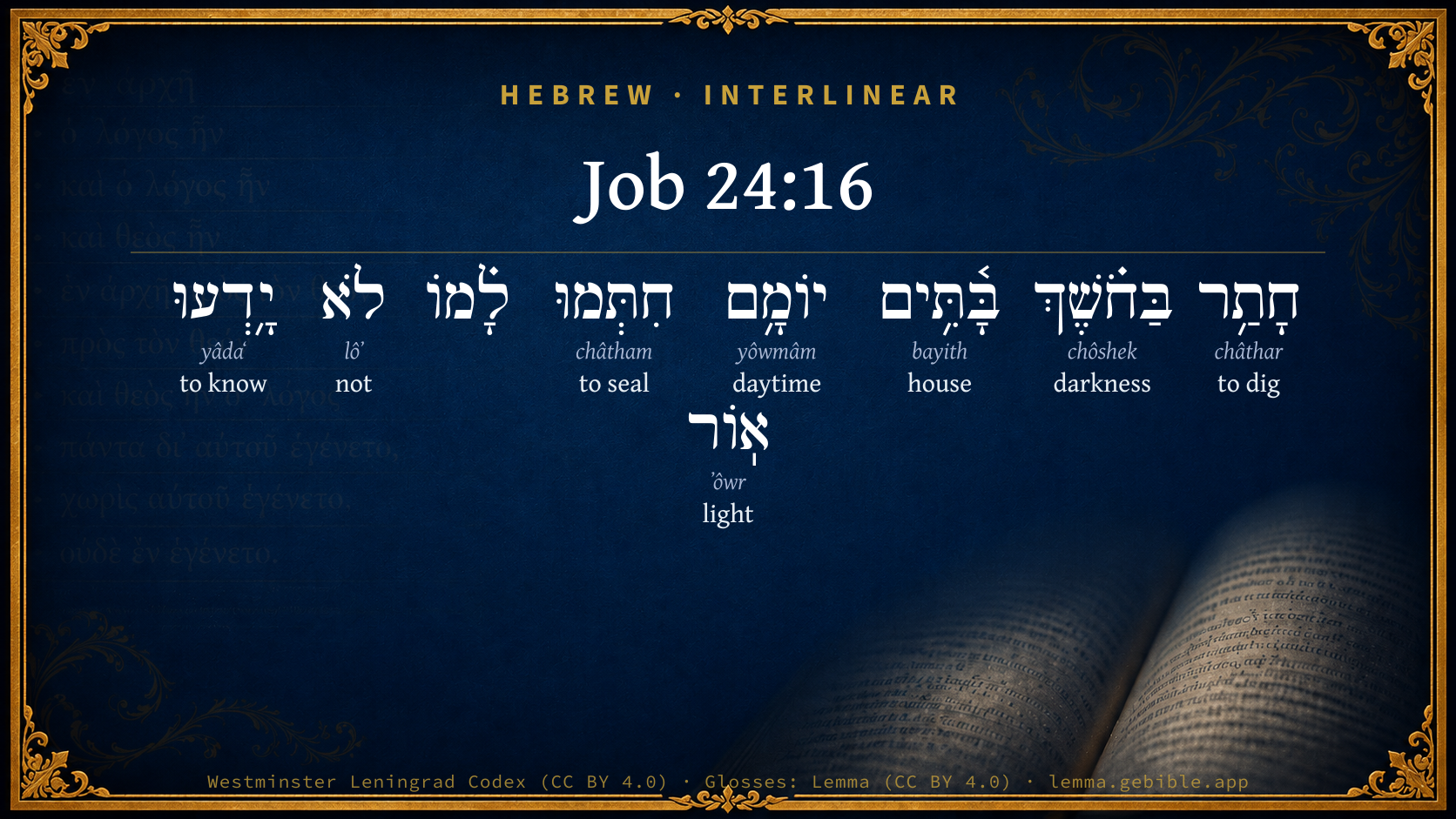
Hebrew (Westminster Leningrad Codex) Job 24:16 appears in the Hebrew Old Testament. The text above is from the Westminster Leningrad Codex. Each word links to its Strong’s number, a concise gloss, and parsing drawn from the Open Scriptures Hebrew Bible morphology. Click any word for its full Brown-Driver-Briggs (BDB) entry.
Download image
Cite this verse

Job 24:16 (World English Bible). Public Domain. Lemma interlinear Bible study tool, https://lemma.gebible.app/v/job/24/16.

Show BibTeX & RIS
BibTeX
RIS
English Translation
In the dark they dig through houses. They shut themselves up in the daytime. They don't know the light.
World English Bible · Public Domain
Highlights
  • 1 first appearance in the Hebrew Bible
Full analysis ↓
Download a study sheet

One document with this verse’s original text, its word-by-word gloss line, the meaning frame, cross-references with their text, attributed commentary, and full source and license credits — printable, and it pastes into notes with its structure intact.

This verse Autodidact and up

Study sheet (.html) Plain text (.txt)

A passage Seminary Student

Up to 50 verses in one chapter. A passage sheet keeps up to 6 commentary sources and 12 cross-references per verse, in the order this page ranks them, and says so on the sheet whenever that leaves anything out. Ask for a single verse and you get the Autodidact verse sheet above.

Everything on this page stays free to read, with no account — the sheet is a download of what is already on screen, not access to it.

Want to remove ads? Support Godless Engineer
Compare translations 3

The same verse in 3 English versions, stacked beneath the original-language interlinear above. Click any original word for its lexicon entry.

Each is an independent rendering of the whole verse — the interlinear is not word-aligned to these translations.

Highlighted words mark where these versions differ — a whole-verse word diff, not a word-by-word alignment.

  • World English Bible Public Domain
    In the dark they dig through houses. They shut themselves up in the daytime. They don't know the light.
  • King James Version Public Domain
    In the dark they dig through houses, which they had marked for themselves in the daytime: they know not the light.
  • unfoldingWord Literal Text CC BY-SA 4.0
    One digs houses in the darkness; by day they shut themselves up; they do not know the light.

unfoldingWord Literal Text — © unfoldingWord, licensed CC BY-SA 4.0. Word-aligned USFM3 via Door43 (git.door43.org/unfoldingWord/en_ult).

Versions to compare (up to 4)

3 of 4 selected

Show all 18 translations

Every available English version of this verse, each an independent rendering of the whole verse.

  • World English Bible Public Domain
    In the dark they dig through houses. They shut themselves up in the daytime. They don't know the light.
  • Berean Standard Bible Public Domain
    In the dark they dig through houses; by day they shut themselves in, never to experience the light.
  • Majority Standard Bible Public Domain
    In the dark they dig through houses; by day they shut themselves in, never to experience the light.
  • King James Version Public Domain
    In the dark they dig through houses, which they had marked for themselves in the daytime: they know not the light.
  • American Standard Version (1901) Public Domain
    In the dark they dig through houses: They shut themselves up in the day-time; They know not the light.
  • Revised Version (1885) Public Domain
    In the dark they dig through houses: they shut themselves up in the daytime; they know not the light.
  • Geneva Bible (1599) Public Domain
    They digge through houses in the darke, which they marked for themselues in the daye: they knowe not the light.
  • Douay-Rheims (1899) Public Domain
    He diggeth through houses in the dark, as in the day they had appointed for themselves, and they have not known the light.
  • Young's Literal Translation Public Domain
    He hath dug in the darkness -- houses; By day they shut themselves up, They have not known light.
  • Literal Standard Version CC BY-SA 4.0
    He has dug in the darkness—houses; By day they shut themselves up, || They have not known light.
  • Unlocked Literal Bible CC BY-SA 4.0
    In the darkness wicked people dig into houses; but they shut themselves up in the daytime; they do not care for the light.
  • unfoldingWord Literal Text CC BY-SA 4.0
    One digs houses in the darkness; by day they shut themselves up; they do not know the light.
  • Darby Bible Public Domain
    In the dark they dig through houses; by day they shut themselves in; they know not the light:
  • World Messianic Bible Public Domain
    In the dark they dig through houses. They shut themselves up in the daytime. They don’t know the light.
  • Webster's Bible Public Domain
    In the dark they dig through houses, which they had marked for themselves in the day-time: they know not the light.
  • Free Bible Version CC BY-SA 4.0
    Thieves break into houses during the night and they sleep during the day. They don't even know what the light is like!
  • Bible in Basic English Public Domain
    In the dark he makes holes in the walls of houses: in the daytime they are shutting themselves up, they have no knowledge of the light.
  • JPS Tanakh (1917) Public Domain
    In the dark they dig through houses; they shut themselves up in the day-time; they know not the light.

Literal Standard Version (2020), Covenant Press — licensed CC BY-SA 4.0. Text via the HelloAO Bible API (eBible.org). Unlocked Literal Bible (unfoldingWord) — licensed CC BY-SA 4.0. Text via the HelloAO Bible API (eBible.org). unfoldingWord Literal Text — © unfoldingWord, licensed CC BY-SA 4.0. Word-aligned USFM3 via Door43 (git.door43.org/unfoldingWord/en_ult). Free Bible Version, Dr. Jonathan Gallagher — licensed CC BY-SA 4.0. Text via the HelloAO Bible API (eBible.org).

Word by word

More ways to search: Search by grammar → Find every occurrence → Compare this word →

Practice this passage: Drill this verse → Learn its vocabulary →

About this verse

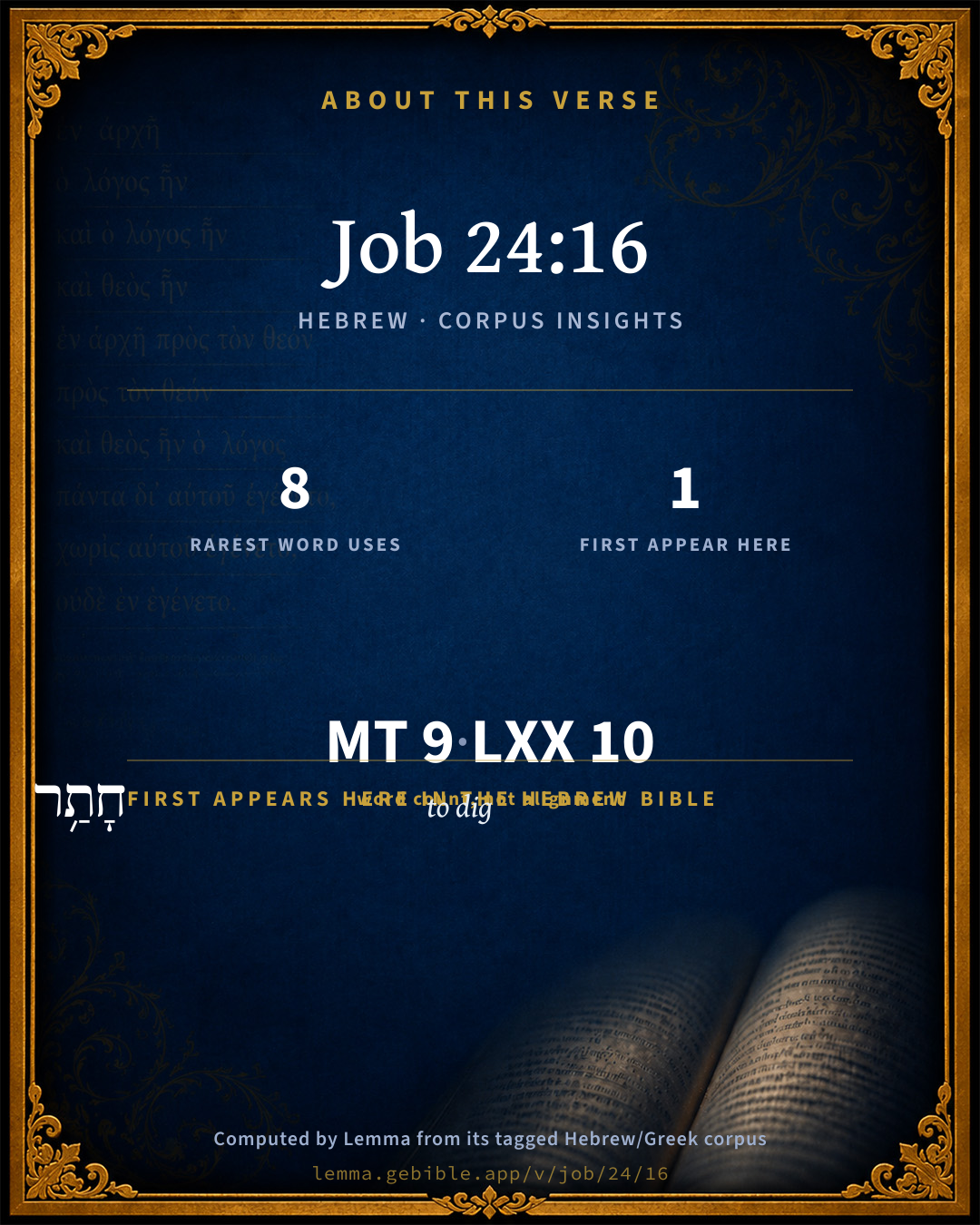
These counts appear in no published source. They are computed here, from the morphology-tagged text and Lemma’s own curated glosses. What Lemma adds →

9
words
8
distinct lemmas
Wisdom
section

Notable vocabulary

The rarest word here is חָתַ֥ר to dig H2864 — appearing just 8 times in the whole Hebrew Bible.

First appearance in Scripture

This word makes its first canonical appearance in the Hebrew Bible here:

  • חָתַ֥ר to dig H2864

Shared distinctive vocabulary

חָתַ֥ר to dig H2864 occurs in 7 verses of the Hebrew Bible. Also found in:

Grammatical profile

  • 3 verbs
  • 3 nouns
  • 1 preposition
  • 1 adverb
  • 1 particle

Verb forms

  • חָתַ֥ר Qal · Perfect
  • חִתְּמוּ Piel · Perfect
  • יָ֥דְעוּ Qal · Perfect

Hebrew & Septuagint length

In English translation the verse runs 19 words from the Hebrew and 17 from the Septuagint (LXX English) — closely comparable.

A rough comparison of the two English renderings, which tokenize alike — not a word-level alignment.

Word counts can differ between the Hebrew and the Greek without any difference in meaning — e.g. the Hebrew direct-object marker אֵת has no separate Greek word, and Greek often adds the article ὁ.

In the original languages it is 9 Hebrew tokens and 10 Greek tokens — but the two are counted differently (Hebrew bundles its prefixes and suffixes into one token; the Greek is in lemma form), so that isn’t a like-for-like length.

Cross-references

9

Topical passages linked to Job 24:16 in the Treasury of Scripture Knowledge — connected by theme and wording, ordered by reader-vote popularity; previews shown in the World English Bible.

  • John 3:20 For everyone who does evil hates the light, and doesn't come to the light, lest his works would be exposed.
  • Ephesians 5:11–13 Have no fellowship with the unfruitful works of darkness, but rather even reprove them.
  • Exodus 22:2–3 If the thief is found breaking in, and is struck so that he dies, there shall be no guilt of bloodshed for him.
  • Job 24:13 "These are of those who rebel against the light; They don't know the ways of it, Nor abide in the paths of it.
  • Job 38:12–13 "Have you commanded the morning in your days, And caused the dawn to know its place;
  • Ezekiel 12:5–7 Dig you through the wall in their sight, and carry out thereby.
  • Ezekiel 12:12 The prince who is among them shall bear on his shoulder in the dark, and shall go forth: they shall dig through the wall to carry out thereby: he shall cover his face, because he shall not see the land with his eyes.
  • Matthew 6:19 "Don't lay up treasures for yourselves on the earth, where moth and rust consume, and where thieves break through and steal;
  • Matthew 24:43 But know this, that if the master of the house had known in what watch of the night the thief was coming, he would have watched, and would not have allowed his house to be broken into.

Cross-references courtesy of OpenBible.info (CC BY 4.0).

Hebrew and Greek witnesses Masoretic Hebrew ↔ Greek Septuagint

The same verse in the two great witnesses to the Old Testament, shown verse-for-verse.

These are two independent witnesses, not word-aligned to each other, and the Septuagint is shown in lemma (dictionary) form.

Hebrew Job 24:16 Masoretic · Westminster Leningrad Codex

חָתַ֥ר בַּחֹ֗שֶׁךְ בָּ֫תִּ֥ים יוֹמָ֥ם חִתְּמוּ לָ֗מוֹ לֹא יָ֥דְעוּ אֽוֹר

In the dark they dig through houses. They shut themselves up in the daytime. They don't know the light.

World English Bible · Public Domain

Greek LXX Job 24:16 Septuagint · lemma form

διαὀρύσσω ἐν σκότος οἰκία ἡμέρα σφραγίζω ἑαυτοῦ οὐ ἐπιγιγνώσκω φῶς

In darkness he digs through houses: by day they conceal themselves securely: they know not the light.

LXX2012 (modern English Septuagint) · Public Domain

On this verse, Keil & Delitzsch discusses the Septuagint’s reading. Read the note in Commentary ↓

Hebrew: Westminster Leningrad Codex (CC BY 4.0). Greek: Septuagint (public domain); English from LXX2012 (modern English Septuagint) (Public Domain). How the Septuagint differs from the Hebrew →

Commentary

Notes on Job 24:16 from classic Christian and Jewish commentators (each source and its license shown beneath its notes). The classic Christian expositions comment on the surrounding passage and are grouped to its opening verse, so a note may address several verses; the Jewish commentaries on the Tanakh (Rashi and others) are per-verse, so they appear only where the commentator wrote on this verse.

Lemma curates 59 commentaries, every one of them public domain or Creative Commons licensed, each selected and text-cleaned for this edition rather than reprinted as found. About our sources →

Trapp's Complete Commentary

John Trapp

Job 24:16 In the dark they dig through houses, [which] they had marked for themselves in the daytime: they know not the light.

Ver. 16. In the dark they dig through the earth, &c.] Heb. He digs through houses; i.e. the adulterer doth, to come at his strumpet, with whom he had agreed upon a place of meeting for that evil purpose, and in whose bosom by night (the dark and black night, as Solomon calleth it, Pro 7:9) he spareth not to bury his name, substance, soul, and carcass, while they glut their unclean desires by the favour of the darkness. This is a bitterness beyond that of death, Ecc 7:26. But the devil presenteth his butter in so lordly a dish, that the soul spies not the hammer and nail in his hand till he have driven it into the temples. Roger Mortimer, who dug that hole at Nottingham castle, and was afterwards hanged at Tyburn (a just reward of his ambition and uncleanness), had the experience of this.

They know not the light] i.e. They brook it not, but run full butt against it, because it discovereth and disquieteth them. See Job 24:13.

John Trapp, A Commentary or Exposition upon All the Books of the Old and New Testament (1647–1656) — public domain. Text from a community e-Sword module.

Joseph Benson's Commentary

Job 24:16-17. In the dark they dig through houses — Either the adulterer last mentioned, or rather the thief or robber, whose common practice this is, of whom he spake, Job 24:14; and having, on that occasion, inserted the mention of the adulterer, as one who acted his sin in the same manner as the night thief did, he now returns to the latter again: which they had marked for themselves — Distinguishing, by some secret mark, the house of some rich man which they intended to rob, and the part of the house where they resolved to enter it. They know not the light — Do not love nor make use of it, but abhor and shun it. For the morning is as the shadow of death — Terrible and hateful, because it both discovers them and hinders their practices. If one know them, &c. — If they are brought to light, or discovered, they are overwhelmed with deadly horrors and terrors.

Joseph Benson's Commentary on the Old and New Testaments (1811–1818) — public domain. Text from a community e-Sword module.

Keil & Delitzsch

C. F. Keil & F. Delitzsch

16 In the dark they dig through houses,

By day they shut themselves up,

They will know nothing of the light.

17 For the depth of night is to them even as the dawn of the morning,

For they know the terrors of the depth of night.

The handiwork of the thief, which is but slightly referred to in Job 24:14, is here more particularly described. The indefinite subj. of חתר, as is manifest from what follows, is the band of thieves. The בּ, which is elsewhere joined with chtr (to break into anything), is here followed by the acc. בּתּים (to be pronounced bâttim, not bottim),

(Note: Vid., Aben-Ezra on Exo 12:7. The main proof that it is to be pronounced bâttim is, that written exactly it is בּתּים, and that the Metheg according to circumstances, is changed into an accent, as Exo 8:7; Exo 12:7; Jer 18:22; Eze 45:4, which can only happen by Kametz, not by Kometz (K. chatph); comp. Khler on Zac 14:2.)

as in the Talmudic, חתר שׁנּו, to pick one's teeth (and thereby to make them loose), b. Kidduschin, 24 b. According to the Talmud, Ralbag, and the ancient Jewish interpretation in general, Job 24:16 is closely connected to btym: houses which they have marked by day for breaking into, and the mode of its accomplishment; but חתם nowhere signifies designare, always obsignare, to seal up, to put under lock and key, Job 14:17; Job 9:7; Job 37:7; according to which the Piel, which occurs only here, is to be explained: by day they seal up, i.e., shut themselves up for their safety (למו is not to be accented with Athnach, but with Rebia mugrasch): they know not the light, i.e., as Schlottm. well explains: they have no fellowship with it; for the biblical ידע, γινώσκειν, mostly signifies a knowledge which enters into the subject, and intimately unites itself with it. In Job 24:17 one confirmation follows another. Umbr. and Hirz. explain: for the morning is to them at once the shadow of death; but יחדּו, in the signification at the same time, as we have taken יחד in Job 17:16 (nevertheless of simultaneousness of time), is unsupportable: it signifies together, Job 2:11; Job 9:32; and the arrangement of the words למו...יחדּו (to them together) is like Isa 9:20; Isa 31:3; Jer 46:12. Also, apart from the erroneous translation of the יחדו, which is easily set aside, Hirzel's rendering of Job 24:17 is forced: the morning, i.e., the bright day, is to them all as the shadow of death, for each and every one of them knows the terrors of the daylight, which is to them as the shadow of death, viz., the danger of being discovered and condemned. The interpretation, which is also preferred by Olshausen, is far more natural: the depth of night is to them as the dawn of the morning (on the precedence of the predicate, comp. Amo 4:13 and Amo 5:8 : walking in the darkness of the early morning), for they are acquainted with the terrors of the depth of night, i.e., they are not surprised by them, but know how to anticipate and to escape them. Job 38:15 also, where the night, which vanishes before the rising of the sun, is called the "light" of the evil-doer, favours this interpretation (not the other, as Olsh. thinks). The accentuation also favours it; for is בקר had been the subj., and were to be translated: the morning is to them the shadow of death, it ought to have been accented בקר למו צלמות, Dech, Mercha, Athnach. It is, however, accented Munach, Munach, Athnach, and the second Munach stands as the deputy of Dech, whose value in the interpunction it represents; therefore בקר למו is the predicate: the shadow of death is morning to them. From the plur. the description now, with יכּיר, passes into the sing., as individualizing it. בּלהות constr. of בּלּהות, is without a Dagesh in the second consonant. Mercier admirably remarks here: sunt ei familiares et noti nocturni terrores, neque eos timet aut curat, quasi sibi cum illis necessitudo et familiaritas intercederet et cum illis ne noceant foedus aut pactum inierit. Thus by their skill and contrivance they escape danger, and divine justice allows them to remain undiscovered and unpunished, - a fact which is most incomprehensible.

It is now time that this thought was once again definitely expressed, that one may not forget what these accumulated illustrations are designed to prove. But what now follows in Job 24:18 seems to express not Job's opinion, but that of his opponents. Ew., Hirz., and Hlgst. regard Job 24:18, Job 24:22, as thesis and antithesis. To the question, What is the lot that befalls all these evil-doers? Job is thought to give a twofold answer: first, to Job 24:21, an ironical answer in the sense of the friends, that those men are overtaken by the merited punishment; then from Job 24:22 is his own serious answer, which stands in direct contrast to the former. But (1) in Job 24:18 there is not the slightest trace observable that Job does not express his own view: a consideration which is also against Schlottman, who regards Job 24:18 as expressive of the view of an opponent. (2) There is no such decided contrast between Job 24:18 and Job 24:22, for Job 24:19 and Job 24:24 both affirm substantially the same thing concerning the end of the evil-doer. In like manner, it is also not to be supposed, with Stick., Lwenth., Bttch., Welte, and Hahn, that Job, outstripping the friends, as far as Job 24:21, describes how the evil-doer certainly often comes to a terrible end, and in Job 24:22 how the very opposite of this, however, is often witnessed; so that this consequently furnishes no evidence in support of the exclusive assertion of the friends. Moreover, Job 24:24 compared with Job 24:19, where there is nothing to indicate a direct contrast, is opposed to it; and Job 24:22, which has no appearance of referring to a direct contrast with what has been previously said, is opposed to such an antithetical rendering of the two final strophes. Job 24:22 might more readily be regarded as a transition to the antithesis, if Job 24:18 could, with Eichh., Schnurr., Dathe, Umbr., and Vaih., after the lxx, Syriac, and Jerome, be understood as optative: "Let such an one be light on the surface of the water, let ... be cursed, let him not turn towards," etc., but Job 24:18 is not of the optative form; and Job 24:18, where in that case אל־יפנה would be expected, instead of אל־יפנה, shows that Job 24:18, where, according to the syntax, the optative rendering is natural, is nevertheless not to be so rendered. The right interpretation is that which regards both Job 24:18 and Job 24:22 as Job's own view, without allowing him absolutely to contradict himself. Thus it is interpreted, e.g., by Rosenmller, who, however, as also Renan, errs in connecting Job 24:18 with the description of the thieves, and understands Job 24:18 of their slipping away, Job 24:18 of their dwelling in horrible places, and Job 24:18 of their avoidance of the vicinity of towns.

Keil & Delitzsch — Biblical Commentary on the Old Testament (1861–1891) — public domain (CC PDM 1.0). Text via the HelloAO Bible API. (Old Testament only.)

Jamieson, Fausset & Brown

Robert Jamieson, A. R. Fausset & David Brown

dig through--Houses in the East are generally built of sun-dried mud bricks (so Mat 6:19). "Thieves break through," literally, "dig through" (Eze 12:7).

had marked--Rather, as in Job 9:7, "They shut themselves up" (in their houses); literally, "they seal up."

for themselves--for their own ends, namely, to escape detection.

know not--shun.

Jamieson, Fausset & Brown — Commentary Critical and Explanatory on the Whole Bible (1871) — public domain (CC PDM 1.0). Text via the HelloAO Bible API.

Adam Clarke's Commentary

Verse 16. In the dark they dig through houses] Thieves in Bengal very frequently dig through the mud wall and under the clay floors of houses, and, entering unperceived, plunder them while the inhabitants are asleep.

Mr. Good's version of this paragraph I shall lay before the reader: -

Ver. 15. For the dark too watcheth the eye of the adulterer;

Exclaiming, No eye shall behold me.

Then putteth he the muffler on his face;

Ver. 16. He wormeth into houses amidst the darkness.

In the daytime they seal themselves up,

They know not the light:

Ver. 17. For, the dawn they reckon to themselves as the

death-shade;

The horrors of the death-shade as it returneth.

Adam Clarke's Commentary on the Bible (1810–1826) — public domain. Text from a community e-Sword/MySword module.

Ellicott's Commentary for English Readers

(16) Which they had marked for themselves in the daytime.—Or, as some understand, they seal (i.e., shut) themselves up in the daytime. It is said that it is still the custom in Eastern cities for such persons to endeavour to obtain access to the harem in female attire.

They know not the light.—Compared with Job_24:13, shows strongly the different usage of the expression in the two cases.

A Bible Commentary for English Readers, edited by Charles John Ellicott (1878–1897) — public domain. Text from a community e-Sword module.

The Cambridge Bible for Schools and Colleges

gen. ed. J. J. S. Perowne

16. which they had marked] Rather, they shut (lit. seal) themselves up in the daytime. In the dark the housebreaker digs through the wall, which in many Eastern houses is of clay or soft brick; in the daytime he abides close in his own retreat; he is unacquainted with the light.

The Cambridge Bible for Schools and Colleges (gen. ed. J. J. S. Perowne; Cambridge University Press, 1878–1918) — public domain. Text from a community e-Sword module.

John Gill's Exposition

In the dark they dig through houses, which they had marked for themselves in the daytime,.... Which some understand of adulterers last mentioned, who, having observed where beautiful women dwell, mark their houses, and the way to them, and the best way into them, and in the dark get in at windows, or by breaking open doors get to the persons they lust after; but as such steps would be neither safe nor prudent, so they are not necessary; such sort of persons get admittance in an easier way, either by bribing servants, or by a previous agreement with the adulteress herself: rather this is to be understood of the thief and his companions, before spoken of; or designs another sort of thieves, such as are guilty of burglary, housebreakers, who in the daytime go about and observe such houses as are full of money, plate, and rich goods, see Job 3:15; and take diligent notice of the way to them, and which is the best and easiest part to get into them, and, perhaps, set on them a private mark that they may know them; these they break up, the walls, or doors, or windows, and get in at them, and rob, and plunder, and carry off all they can; the same sins were committed, and the same methods of committing them were used, formerly as now; there was a law in Israel concerning housebreaking, Exo 22:2; and our Lord alludes to it, Mat 24:43. Some render the words, "they seal up" or "shut up themselves in the day" (u); in their caves, and dens, and lurking places, and do not appear, and scarce ever see the light, and therefore it follows:

they know not the light; it is seldom or ever seen by them, or they do not approve it, like it, and love it, being not for their purpose; while it is light they can do nothing, that manifestly discovers and betrays them, and therefore they hate it; and in a figurative sense they know not, or do not approve of the light of nature, which checks and controls such evil actions, and accuses them of them; nor the light of God's word, or holy law, which forbids them, and therefore they despise it, and cast it away from them, and will not be subject to it; nor God himself, who is light, and against whom their carnal minds are enmity; and whatever knowledge they have of him, or profess to have, in works they deny him, and live without him, as atheists in the world.

(u) , Sept. "includunt sese", some in Mercerus; so Drusius; "semet sigillant", Schultens.

John Gill's Exposition of the Whole Bible (1746–1763) — public domain (CC PDM 1.0). Text via the HelloAO Bible API.

Albert Barnes' Notes on the Bible

In the dark they dig through houses - This refers, probably, to another class of wicked persons. The adulterer steals forth in the night, but it is not his way to “dig” into houses. But the persons here referred to are robbers, who conceal themselves by day, and who at night secretly enter houses for plunder. The phrase “dig through” probably has reference to the fact that houses were made of clay, or of bricks dried in the sun - a species of mud cottages, and whose walls, therefore, could be easily penetrated. In the East, nearly all the houses are made of unburned brick, and there is little difficulty in making a hole in the wall large enough to admit the human body; compare Eze 12:7. In Bengal, says Mr. Ward, it is common for thieves to dig through the walls of houses made of mud, or under the house floors, which are made merely of earth, and enter thus into the dwellings while the inmates are asleep. Rosenmuller’s Alte u. neue Morgenland “in loc.”

Which they had marked for themselves in the day-time - According to this translation the idea would be, that in the day-time they carefully observed houses, and saw where an entrance might be effected. But this interpretation seems contrary to the general sense of the passage. It is said that they avoid the light, and that the night is the time for accomplishing their purposes. Probably, therefore, the meaning of this passage is, “in the day time they shut themselves up.” So it is rendered by Gesenius, Rosenmuller, Noyes, and others. The word here used, and rendered “marked” (חתם châtham), means to seal, to seal up; and hence, the idea of shutting up, or making fast; see Job 9:7, note; Isa 8:17, note. Hence, it may mean to shut up close as if one was locked in; and the idea here is, that in the day-time they shut themselves up close in their places of concealment, and went forth to their depredations in the night.

They know not the light - They do not see the light. They do all their work in the dark.

Albert Barnes' Notes on the Bible (1834–1885) — public domain. Text from a community e-Sword/MySword module.

Haydock's Catholic Bible Commentary

Themselves. The band of robbers had marked out their prey. (Haydock) --- Hebrew, "In the day time they lie concealed, and know not the light." (Calmet) --- Septuagint, or rather Theodotion, from whom ver. 15 to 17., is taken, "They have sealed themselves up during the day." If we should read Greek: eautois, Hebrew lamo, we might translate as well "they marked them out for themselves." (Haydock) --- The adulterer had made is his arrangement with the faithless woman, when he should break into the house. (Menochius)

George Leo Haydock (1774–1849), Haydock's Catholic Family Bible and Commentary, 1859 edition — public domain. Excludes Psalms (Douay-Rheims chapter numbering differs from Protestant) and Deuterocanonical books (Catholic canon only).

Matthew Poole's English Annotations

They dig; either,

1. The adulterer last mentioned; although such persons do not use nor need these violent courses to get into the house of the adulteress, but are commonly admitted upon milder and easier terms. Or,

2. The thief or robber, whose common practice this is, of whom he spoke Job 24:14; and having on that occasion inserted the mention of the adulterer as one who acted his sin in the same manner as the night-thief did, he now returns to him again.

Which they had marked for themselves; the thief and his accomplices, designing by some secret mark the house of some rich man which they intended to rob, and the part of the house where they resolved to enter into it.

They know not the light, i.e. do not love nor like it, as Job 24:13; but abhor it, as it follows.

Matthew Poole's English Annotations on the Holy Bible (1683–1685) — public domain. Text from a community e-Sword/MySword module.

Whedon's Commentary on the Bible

Daniel D. Whedon

16. They — Literally, he, used collectively for house-breakers.

Dig through houses — In the East, the houses of the poorer classes are, according to Kitto, of three kinds: either of wicker hurdles daubed over with mud; or of mud, each layer being left to dry before another is laid on; or of sun-dried bricks with which straw has been mixed in order to strengthen them. — See KITTO, Daily Bib. Illus., in loc. The Greek called a burglar τοιχωρυχος, “one who digs through the wall.” Which they had marked, etc. — Rather, They who by day shut themselves up. Hesiod calls thieves “men who sleep by day.” Apostasy from spiritual light manifests itself in aversion to natural light.

Daniel D. Whedon (gen. ed.), Commentary on the Old and New Testaments (1874–1909) — public domain. Text from a community e-Sword module.

The Pulpit Commentary

In the dark they dig through houses. In ancient times, burglary commonly took this form. Windows were few, and high up in the walls; doors were strongly fastened with bolts and bars. But the walls, being of clay, or rubble, or sun-dried brick, were weak and easily penetrable. This was especially the ease with party walls; and if burglars entered an unoccupied house, nothing was easier than to break through the slight partition which separated it from the house next door. The Greek word for "burglar" is toicwrucov "he who digs through a wall." Which they had marked for themselves in the daytime; rather, they shut themselves up in the daytime; literally, they seal themselves up; the meaning being that they carefully keep themselves close. Professor Lee, however, defends the Authorized Version. They know not the light; i.e. they avoid it, keep away from it, will have nothing to do with it.

The Pulpit Commentary (1880–1919), ed. H.D.M. Spence-Jones & Joseph S. Exell — public domain. Text from a community e-Sword module.

John Wesley's Explanatory Notes

They - The robber: having on that occasion inserted the mention of the adulterer as one who acted his sin in the same manner as the night-thief did, he now returns to him again.

John Wesley, Explanatory Notes Upon the Whole Bible (1754–1765) — public domain. Text via the GEBible commentary corpus.

Rashi

Rabbi Shlomo Yitzchaki (Rashi)

by day, they lock themselves in Those who are weaker than they, too weak to commit robbery by day, would dig under houses at night; by day they were sealed and closed up in their houses.

they know no light They did not recognize the light because it was not [shining at] the time of their prowling.

Rashi on the Tanakh — English translations: “The Judaica Press complete Tanach with Rashi, translated by A. J. Rosenberg” (CC BY 4.0); “Pentateuch with Rashi's commentary by M. Rosenbaum and A.M. Silbermann, 1929-1934” (public domain); “The Metsudah Tanach series, Lakewood, N.J” (CC BY 4.0); and “The Book of Joshua, Metsudah Publications, 1997” (CC BY 4.0). Text via Sefaria.

Lesson kit

Teaching starters — assembled from the data on this page, not authored interpretation. Every prompt links to the verse data it draws on. Edit before teaching.

Job, in the Wisdom, opens this verse with 9 words (8 distinct Hebrew lemmas). Its most distinctive word is châthar (“to dig”). A historical commentator’s framing appears above. Read the whole chapter for the surrounding context.

Discussion questions

  1. The word châthar carries the sense “to dig.” How does it shape the verse?
  2. The word “to dig” first appears here in Scripture. What is being introduced at this debut?
  3. Ezekiel 8:8 shares the word «to dig» with this verse. How do the two illuminate each other?
  4. The translations on this page render this verse differently — a whole-verse word diff, not a word-by-word alignment. What might account for the different wordings?
  5. The verb «חָתַ֥ר» is Qal Perfect. How does its form color the action?
  6. Reading how Trapp's Complete Commentary and Joseph Benson's Commentary read this verse, where do the two commentators agree and where do they part?

Things to notice

Reading settings

Reading text

Shown beneath each verse's original-language words.

Old Testament
Old Testament edition

Read the OT as the Masoretic Hebrew (MT) or the Greek Septuagint (LXX).

English shown for the Greek Septuagint (in the Hebrew ↔ Greek comparison).

Comparing translations? Open the Compare panel on any verse page to stack up to four side by side.