Isaiah 5:30

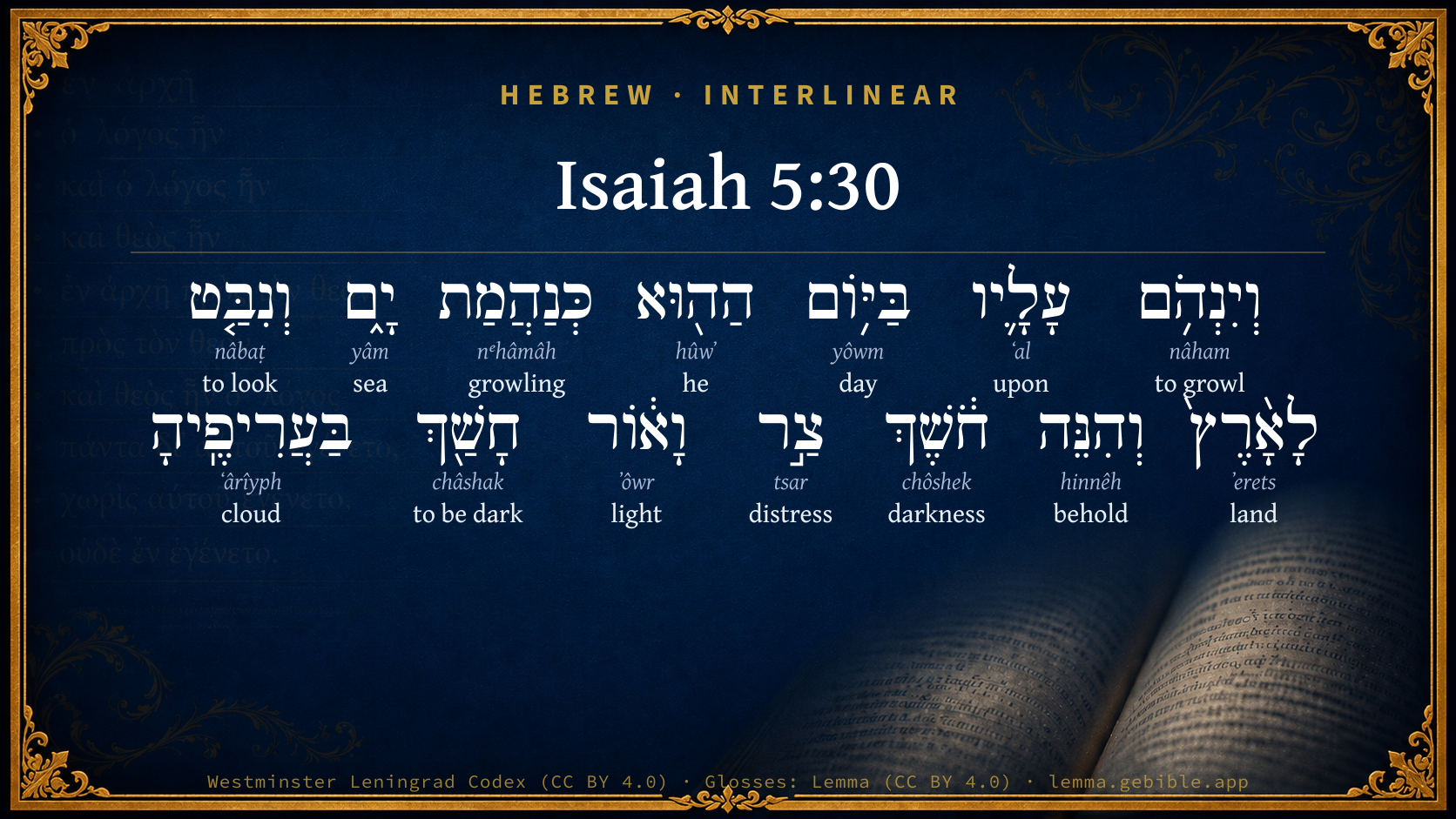
Hebrew (Westminster Leningrad Codex) Isaiah 5:30 appears in the Hebrew Old Testament. The text above is from the Westminster Leningrad Codex. Each word links to its Strong’s number, a concise gloss, and parsing drawn from the Open Scriptures Hebrew Bible morphology. Click any word for its full Brown-Driver-Briggs (BDB) entry.
Download image
Cite this verse

Isaiah 5:30 (World English Bible). Public Domain. Lemma interlinear Bible study tool, https://lemma.gebible.app/v/isaiah/5/30.

Show BibTeX & RIS
BibTeX
RIS
English Translation
They will roar against them in that day like the roaring of the sea. If one looks to the land, behold, darkness and distress. The light is darkened in its clouds.
World English Bible · Public Domain
Highlights
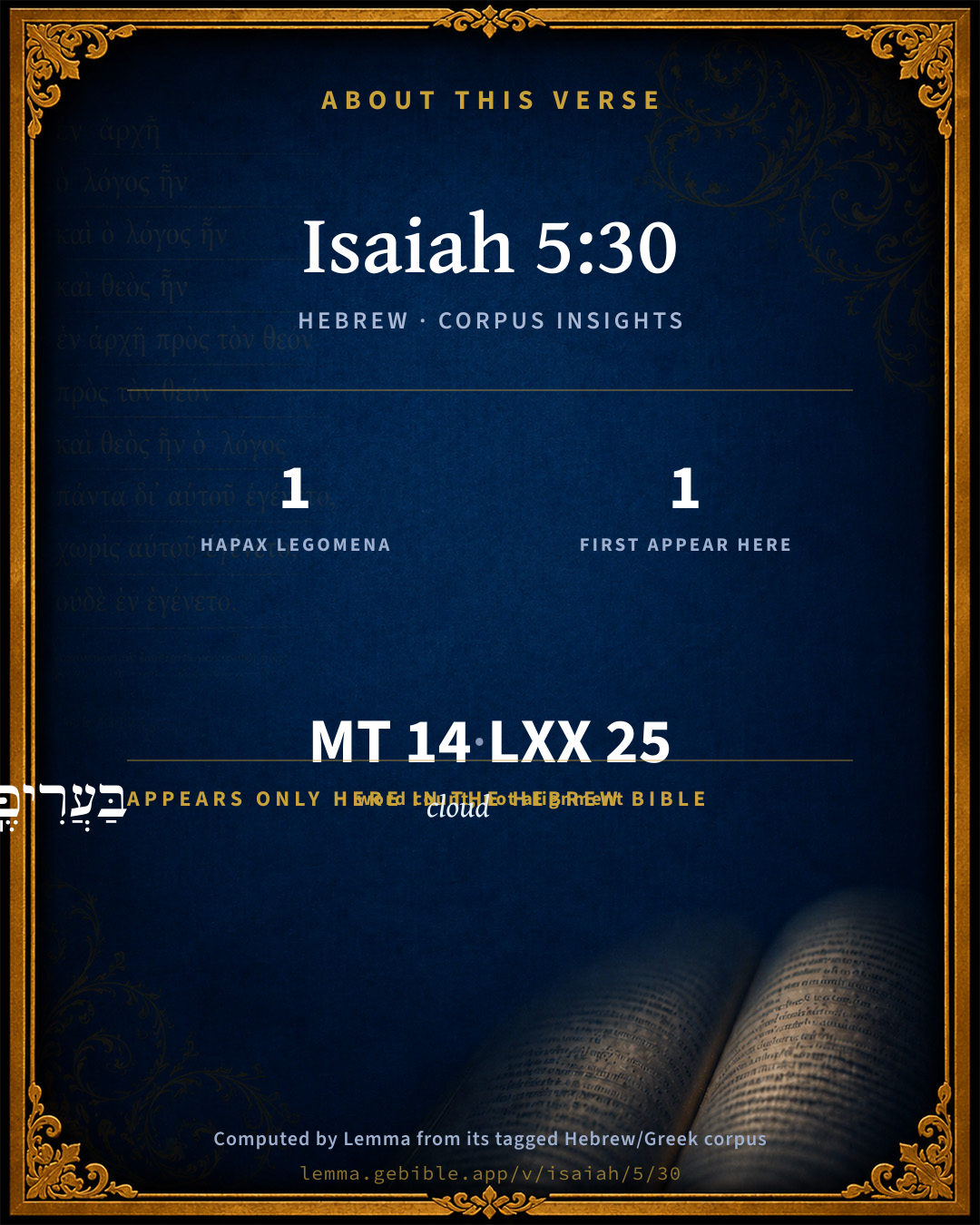
  • 1 hapax legomenon — only here in the Hebrew Bible
  • 1 first appearance in the Hebrew Bible
Full analysis ↓
Download a study sheet

One document with this verse’s original text, its word-by-word gloss line, the meaning frame, cross-references with their text, attributed commentary, and full source and license credits — printable, and it pastes into notes with its structure intact.

This verse Autodidact and up

Study sheet (.html) Plain text (.txt)

A passage Seminary Student

Up to 50 verses in one chapter. A passage sheet keeps up to 6 commentary sources and 12 cross-references per verse, in the order this page ranks them, and says so on the sheet whenever that leaves anything out. Ask for a single verse and you get the Autodidact verse sheet above.

Everything on this page stays free to read, with no account — the sheet is a download of what is already on screen, not access to it.

Want to remove ads? Support Godless Engineer
Compare translations 3

The same verse in 3 English versions, stacked beneath the original-language interlinear above. Click any original word for its lexicon entry.

Each is an independent rendering of the whole verse — the interlinear is not word-aligned to these translations.

Highlighted words mark where these versions differ — a whole-verse word diff, not a word-by-word alignment.

  • World English Bible Public Domain
    They will roar against them in that day like the roaring of the sea. If one looks to the land, behold, darkness and distress. The light is darkened in its clouds.
  • King James Version Public Domain
    And in that day they shall roar against them like the roaring of the sea: and if one look unto the land, behold darkness and sorrow, and the light is darkened in the heavens thereof.
  • unfoldingWord Literal Text CC BY-SA 4.0
    And it will growl over it on that day like the growling of the sea. And one looks at the land, and behold, darkness, trouble, and the light becomes dark by its clouds.

unfoldingWord Literal Text — © unfoldingWord, licensed CC BY-SA 4.0. Word-aligned USFM3 via Door43 (git.door43.org/unfoldingWord/en_ult).

Versions to compare (up to 4)

3 of 4 selected

Show all 18 translations

Every available English version of this verse, each an independent rendering of the whole verse.

  • World English Bible Public Domain
    They will roar against them in that day like the roaring of the sea. If one looks to the land, behold, darkness and distress. The light is darkened in its clouds.
  • Berean Standard Bible Public Domain
    In that day they will roar over it, like the roaring of the sea. If one looks over the land, he will see darkness and distress; even the light will be obscured by clouds.
  • Majority Standard Bible Public Domain
    In that day they will roar over it, like the roaring of the sea. If one looks over the land, he will see darkness and distress; even the light will be obscured by clouds.
  • King James Version Public Domain
    And in that day they shall roar against them like the roaring of the sea: and if one look unto the land, behold darkness and sorrow, and the light is darkened in the heavens thereof.
  • American Standard Version (1901) Public Domain
    And they shall roar against them in that day like the roaring of the sea: and if one look unto the land, behold, darkness `and' distress; and the light is darkened in the clouds thereof.
  • Revised Version (1885) Public Domain
    And they shall roar against them in that day like the roaring of the sea: and if one look unto the land, behold darkness and distress, and the light is darkened in the clouds thereof.
  • Geneva Bible (1599) Public Domain
    And in that day they shall roare vpon them, as the roaring of the sea: and if they looke vnto the earth, beholde darkenesse, and sorowe, and the light shalbe darkened in their skie.
  • Douay-Rheims (1899) Public Domain
    And they shall make a noise against them that day, like the roaring of the sea; we shall look towards the land, and behold darkness of tribulation, and the light is darkened with the mist thereof.
  • Young's Literal Translation Public Domain
    And it howleth against it in that day as the howling of a sea, And it hath looked attentively to the land, And lo, darkness -- distress, And light hath been darkened by its abundance!
  • Literal Standard Version CC BY-SA 4.0
    And it howls against it in that day as the howling of a sea, || And it has looked attentively to the land, || And behold, darkness—distress, || And light has been darkened by its abundance!
  • Unlocked Literal Bible CC BY-SA 4.0
    On that day they will roar against the prey as the sea roars. If anyone looks over the land, he will see darkness and suffering; even the light will be made dark by the clouds.
  • unfoldingWord Literal Text CC BY-SA 4.0
    And it will growl over it on that day like the growling of the sea. And one looks at the land, and behold, darkness, trouble, and the light becomes dark by its clouds.
  • Darby Bible Public Domain
    and they shall roar against them in that day like the roaring of the sea. And if one look upon the earth, behold darkness [and] distress, and the light is darkened in the heavens thereof.
  • World Messianic Bible Public Domain
    They will roar against them in that day like the roaring of the sea. If one looks to the land, behold, darkness and distress. The light is darkened in its clouds.
  • Webster's Bible Public Domain
    And in that day they shall roar against them like the roaring of the sea: and if one looketh to the land, behold darkness and sorrow, and the light is darkened in its heavens.
  • Free Bible Version CC BY-SA 4.0
    At that time they will roar over their prey like the roaring of the sea. Anyone who looks out over the land will see only darkness and distress—even the sunlight will be darkened by clouds.
  • Bible in Basic English Public Domain
    And his voice will be loud over him in that day like the sounding of the sea: and if a man's eyes are turned to the earth, it is all dark and full of trouble; and the light is made dark by thick clouds.
  • JPS Tanakh (1917) Public Domain
    And they shall roar against them in that day like the roaring of the sea; and if one look unto the land, behold darkness and distress, and the light is darkened in the skies thereof.

Literal Standard Version (2020), Covenant Press — licensed CC BY-SA 4.0. Text via the HelloAO Bible API (eBible.org). Unlocked Literal Bible (unfoldingWord) — licensed CC BY-SA 4.0. Text via the HelloAO Bible API (eBible.org). unfoldingWord Literal Text — © unfoldingWord, licensed CC BY-SA 4.0. Word-aligned USFM3 via Door43 (git.door43.org/unfoldingWord/en_ult). Free Bible Version, Dr. Jonathan Gallagher — licensed CC BY-SA 4.0. Text via the HelloAO Bible API (eBible.org).

Word by word

More ways to search: Search by grammar → Find every occurrence → Compare this word →

Practice this passage: Drill this verse → Learn its vocabulary →

בַּעֲרִיפֶֽיהָ
ʻârîyph
H6183
“in/at · clouds · her”
Preposition + Noun, Common, Masculine, Plural, Construct + Suffix, Personal, 3rd Person, Feminine, Singular
Part of Speech
Preposition + Noun
Type
Common
Gender
Masculine
Number
Plural
State
Construct
Full BDB Definition

Origin: from H6201

TWOT: 1701a

cloud, mist
  1. וְיִנְהֹ֥ם nâham H5098 “and · to growl” Conjunction + Verb, Qal, Imperfect, 3rd Person, Masculine, Singular
  2. עָלָ֛יו ʻal H5921 “upon · him” Preposition + Suffix, Personal, 3rd Person, Masculine, Singular
  3. בַּיּ֥וֹם yôwm H3117 “in/at the · day” Preposition, Determined + Noun, Common, Masculine, Singular, Absolute
  4. הַה֖וּא hûwʼ H1931 “the · he” Particle, Definite Article + Pronoun, Personal, 3rd Person, Masculine, Singular
  5. כְּנַהֲמַת nᵉhâmâh H5100 “like/as · growling of” Preposition + Noun, Common, Feminine, Singular, Construct
  6. יָ֑ם yâm H3220 “sea” Noun, Common, Masculine, Singular, Absolute
  7. וְנִבַּ֤ט nâbaṭ H5027 “and · to look” Conjunction + Verb, Piel, Sequential Perfect, 3rd Person, Masculine, Singular
  8. לָאָ֨רֶץ֙ ʼerets H776 “to/for the · land” Preposition, Determined + Noun, Common, Both, Singular, Absolute
  9. וְהִנֵּה hinnêh H2009 “and · behold” Conjunction + Particle, Demonstrative
  10. חֹ֔שֶׁךְ chôshek H2822 “darkness” Noun, Common, Masculine, Singular, Absolute
  11. צַ֣ר tsar H6862 “distress” Adjective, Adjective, Masculine, Singular, Absolute
  12. וָא֔וֹר ʼôwr H216 “and · light” Conjunction + Noun, Common, Both, Singular, Absolute
  13. חָשַׁ֖ךְ châshak H2821 “to be dark” Verb, Qal, Perfect, 3rd Person, Masculine, Singular

About this verse

These counts appear in no published source. They are computed here, from the morphology-tagged text and Lemma’s own curated glosses. What Lemma adds →

14
words
14
distinct lemmas
Prophets
section

Notable vocabulary

1 hapax legomenon — a word that appears only here in the entire Hebrew Bible:

  • בַּעֲרִיפֶֽיהָ cloud H6183

First appearance in Scripture

This word makes its first canonical appearance in the Hebrew Bible here:

  • בַּעֲרִיפֶֽיהָ cloud H6183

Shared distinctive vocabulary

כְּנַהֲמַת growling H5100 occurs in 2 verses of the Hebrew Bible. Also found in:

Grammatical profile

  • 3 verbs
  • 7 nouns
  • 1 adjective
  • 1 pronoun
  • 1 preposition
  • 1 particle

Verb forms

  • וְיִנְהֹ֥ם Qal · Imperfect
  • וְנִבַּ֤ט Piel · Sequential Perfect
  • חָשַׁ֖ךְ Qal · Perfect

Hebrew & Septuagint length

In English translation the verse runs 31 words from the Hebrew and 35 from the Septuagint (LXX English) — closely comparable.

A rough comparison of the two English renderings, which tokenize alike — not a word-level alignment.

Word counts can differ between the Hebrew and the Greek without any difference in meaning — e.g. the Hebrew direct-object marker אֵת has no separate Greek word, and Greek often adds the article ὁ.

In the original languages it is 14 Hebrew tokens and 25 Greek tokens — but the two are counted differently (Hebrew bundles its prefixes and suffixes into one token; the Greek is in lemma form), so that isn’t a like-for-like length.

Cross-references

15

Topical passages linked to Isaiah 5:30 in the Treasury of Scripture Knowledge — connected by theme and wording, ordered by reader-vote popularity; previews shown in the World English Bible.

  • Isaiah 8:22 and they shall look to the earth, and see, distress and darkness, the gloom of anguish; and into thick darkness [they shall be] driven away.
  • Joel 2:10 The earth quakes before them. The heavens tremble. The sun and the moon are darkened, And the stars withdraw their shining.
  • Jeremiah 4:23–28 I saw the earth, and, behold, it was waste and void; and the heavens, and they had no light.
  • Revelation 16:10–11 The fifth poured out his bowl on the throne of the beast, and his kingdom was darkened. They gnawed their tongues because of the pain,
  • Psalms 93:3–4 The floods have lifted up, Yahweh, The floods have lifted up their voice. The floods lift up their waves.
  • Isaiah 13:10 For the stars of the sky and the constellations of it shall not give their light; the sun shall be darkened in its going forth, and the moon shall not cause its light to shine.
  • Jeremiah 6:23 They lay hold on bow and spear; they are cruel, and have no mercy; their voice roars like the sea, and they ride on horses, everyone set in array, as a man to the battle, against you, daughter of Zion.
  • Ezekiel 32:7–8 When I shall extinguish you, I will cover the heavens, and make the stars of it dark; I will cover the sun with a cloud, and the moon shall not give its light.
  • Matthew 24:29 But immediately after the oppression of those days, the sun will be darkened, the moon will not give its light, the stars will fall from the sky, and the powers of the heavens will be shaken;
  • Luke 21:25–26 There will be signs in the sun, moon, and stars; and on the earth anxiety of nations, in perplexity for the roaring of the sea and the waves;
  • Revelation 6:12 I saw when he opened the sixth seal, and there was a great earthquake. The sun became black as sackcloth made of hair, and the whole moon became as blood.
  • Exodus 10:21–23 Yahweh said to Moses, "Stretch out your hand toward the sky, that there may be darkness over the land of Egypt, even darkness which may be felt."
  • Jeremiah 50:42 They lay hold on bow and spear; they are cruel, and have no mercy; their voice roars like the sea; and they ride on horses, everyone set in array, as a man to the battle, against you, daughter of Babylon.
  • Lamentations 3:2 He has led me and caused me to walk in darkness, and not in light.
  • Amos 8:9 "It will happen in that day," says the Lord Yahweh, "That I will cause the sun to go down at noon, And I will darken the earth in the clear day.

Cross-references courtesy of OpenBible.info (CC BY 4.0).

Hebrew and Greek witnesses Masoretic Hebrew ↔ Greek Septuagint

The same verse in the two great witnesses to the Old Testament, shown verse-for-verse.

These are two independent witnesses, not word-aligned to each other, and the Septuagint is shown in lemma (dictionary) form.

Hebrew Isaiah 5:30 Masoretic · Westminster Leningrad Codex

וְיִנְהֹ֥ם עָלָ֛יו בַּיּ֥וֹם הַה֖וּא כְּנַהֲמַת יָ֑ם וְנִבַּ֤ט לָאָ֨רֶץ֙ וְהִנֵּה חֹ֔שֶׁךְ צַ֣ר וָא֔וֹר חָשַׁ֖ךְ בַּעֲרִיפֶֽיהָ

They will roar against them in that day like the roaring of the sea. If one looks to the land, behold, darkness and distress. The light is darkened in its clouds.

World English Bible · Public Domain

Greek LXX Isaiah 5:30 Septuagint · lemma form

καί βοάω διά αὐτός ἐν ὁ ἡμέρα ἐκεῖνος ὡς φωνή θάλασσα κυμαίνω καί ἐνβλέπω εἰς ὁ γῆ καί ἰδού σκότος σκληρός ἐν ὁ ἀπορία αὐτός

And he shall roar on account of them in that day, as the sound of the swelling sea; and they shall look to the land, and, behold, there shall be thick darkness in their perplexity.

LXX2012 (modern English Septuagint) · Public Domain

On this verse, Adam Clarke's Commentary discusses the Septuagint’s reading. Read the note in Commentary ↓

Hebrew: Westminster Leningrad Codex (CC BY 4.0). Greek: Septuagint (public domain); English from LXX2012 (modern English Septuagint) (Public Domain). How the Septuagint differs from the Hebrew →

Targum (Aramaic paraphrase)

1

The Targum is the ancient Jewish Aramaic paraphrase of the Hebrew Scriptures — an interpretive translation, not the Hebrew text itself. Onkelos (literal) and Pseudo-Jonathan (expansive) render the Torah, and Jonathan the Prophets. Coverage is partial: where no permissively-licensed English translation exists for a verse, only the Aramaic is shown. This is verse-level text, not a word-by-word alignment to the Hebrew.

  1. Targum Jonathan Prophets (Joshua–Malachi)
    וְיַכְלֵי עֲלוֹהִי בְּעִדָנָא הַהִיא כְּאִתְרְגוּשַׁת יַמָא דְאִם יִבְעוֹן רַשִׁיעַיָא סָעֵיד מִיַתְבֵי אַרְעָא עָקָא וּתְבַר אַיְתֵי עֲלֵיהוֹן בְּרַם צַדִיקַיָא דִיהוֹן בְּשַׁעְתָּא הַהִיא יִתְכְּסוּן מִן קֳדָם בִּישְׁתָּא:

    And in that time he shall roar against them like the roaring of the sea: so that if the wicked should seek support from the inhabitants of the earth, he will bring upon them oppression and destruction; but the righteous which shall be in that hour shall be protected on account of the evil.

    Targum Jonathan — Aramaic: “Mikraot Gedolot” (public domain). English: “Sefaria Community Translation” (CC0 1.0 (public-domain dedication)); “London "Chaldee Paraphrase," 1871” (public domain). Text via Sefaria.

Commentary

Notes on Isaiah 5:30 from classic Christian and Jewish commentators (each source and its license shown beneath its notes). The classic Christian expositions comment on the surrounding passage and are grouped to its opening verse, so a note may address several verses; the Jewish commentaries on the Tanakh (Rashi and others) are per-verse, so they appear only where the commentator wrote on this verse.

Lemma curates 59 commentaries, every one of them public domain or Creative Commons licensed, each selected and text-cleaned for this edition rather than reprinted as found. About our sources →

Trapp's Complete Commentary

John Trapp

Isa 5:30 And in that day they shall roar against them like the roaring of the sea: and if [one] look unto the land, behold darkness [and] sorrow, and the light is darkened in the heavens thereof.

Ver. 30. Like the roaring of the sea.] The noise whereof is so hideous, that the shrieking of the devil is set forth by it. {Jas 2:19} {See Trapp on "Jas 2:19"}

And if one look into the land.] Or, To the earth below, behold darkness, &c., as if to the heavens, the light also there is darkened. Man cannot help them; God will not. To such straits of "an evil, an only evil," are such oft brought, as think themselves out of the reach of God’s rod. Vae victis. Alas, having been conquered.

John Trapp, A Commentary or Exposition upon All the Books of the Old and New Testament (1647–1656) — public domain. Text from a community e-Sword module.

Joseph Benson's Commentary

Isa 5:30. And in that day, &c. — “Here Isaiah closes this prophecy, with a strong and eloquent description of the consequences of this calamity; setting forth, in the most emphatical terms, the utter confusion, blackness, and desperation of the miserable Jews.” See Isa 8:22. They shall roar against them like the roaring of the sea — Which is violent and frightful; and if one look, &c., behold, darkness and sorrow — Darkness, that is, sorrow: the latter word explains the former. Every thing looks black and dismal. And the light is darkened in the heavens thereof — When they look up to the heavens, as men in distress usually do, they see no light there. Their comforts are wholly eclipsed, and their hopes like the giving up of the ghost. It must be observed, that the Scriptures frequently express great calamities and changes, in states and churches, by the heavens being darkened, and the sun, moon, and stars withdrawing their light, or falling from heaven.

Joseph Benson's Commentary on the Old and New Testaments (1811–1818) — public domain. Text from a community e-Sword module.

Tyndale Open Study Notes

Tyndale Open Resources

5:30 day of destruction (literally that day; see study note on 2:5-22). • In Old Testament prophecy, darkness represents the experience of God’s alienation, wrath, and judgment (see also 8:22), while light stands for his holy presence (see especially 60:2, 19).

Tyndale Open Study Notes — © Tyndale Open Resources, licensed CC BY-SA 4.0. Text via the HelloAO Bible API.

Geneva Bible (1599)

Geneva Bible translators

In the land of Judah.

The Jews shall find no succor.

Geneva Bible (1599) marginal notes — public domain. Text via Bolls.life.

Jamieson, Fausset & Brown

Robert Jamieson, A. R. Fausset & David Brown

sorrow, and the light is darkened--Otherwise, distress and light (that is, hope and fear) alternately succeed (as usually occurs in an unsettled state of things), and darkness arises in, &c. [MAURER].

heavens--literally, "clouds," that is, its sky is rather "clouds" than sky. Otherwise from a different Hebrew root, "in its destruction" or ruins. HORSLEY takes "sea . . . look unto the land" as a new image taken from mariners in a coasting vessel (such as all ancient vessels were), looking for the nearest land, which the darkness of the storm conceals, so that darkness and distress alone may be said to be visible.

Isaiah is outside, near the altar in front of the temple. The doors are supposed to open, and the veil hiding the Holy of Holies to be withdrawn, unfolding to his view a vision of God represented as an Eastern monarch, attended by seraphim as His ministers of state (Kg1 22:19), and with a robe and flowing train (a badge of dignity in the East), which filled the temple. This assertion that he had seen God was, according to tradition (not sanctioned by Isa 1:1; see Introduction), the pretext for sawing him asunder in Manasseh's reign (Heb 11:37). Visions often occur in the other prophets: in Isaiah there is only this one, and it is marked by characteristic clearness and simplicity.

Next: Isaiah Chapter 6

Jamieson, Fausset & Brown — Commentary Critical and Explanatory on the Whole Bible (1871) — public domain (CC PDM 1.0). Text via the HelloAO Bible API.

Adam Clarke's Commentary

Verse 30. If one look unto the land, c. - "And these shall look to the heaven upward, and down to the earth"] ונבט לארץ venibbat laarets. Και εμβλεψονται εις την γην. So the Septuagint, according to the Vatican and Alexandrian copies but the Complutensian and Aldine editions have it more fully, thus: - Και εμβλεψονται εις τον ουρανον ανω, και κατω; and the Arabic from the Septuagint, as if it had stood thus: - Και εμβλεψονται εις ουρανον, και εις την γην κατω, both of which are plainly defective; the words εις την γην, unto the earth, being wanted in the former, and the word ανω, above, in the latter. But an ancient Coptic version from the Septuagint, supposed to be of the second century, some fragments of which are preserved in the library of St. Germain des Prez at Paris, completes the sentence; for, according to this version, it stood thus in the Septuagint. - Και εμβλεψονται εις τον ουρανον ανω, και εις την γην κατω; "And they shall look unto the heavens above and unto the earth beneath," and so it stands in the Septuagint MSS., Pachom. and I. D. II., according to which they must have read their Hebrew text in this manner: - ונבט לשמים למעלה ולארץ למטה. This is probably the true reading, with which I have made the translation agree. Compare Isa 8:22; where the same sense is expressed in regard to both particulars, which are here equally and highly proper, the looking upwards, as well as down to the earth: but the form of expression is varied. I believe the Hebrew text in that place to be right, though not so full as I suppose it was originally here; and that of the Septuagint there to be redundant, being as full as the Coptic version and MSS. Pachom. and I. D. II. represent it in this place, from which I suppose it has been interpolated.

Darkness - "The gloomy vapour"] The Syriac and Vulgate seem to have read בערפלח bearphalach; but Jarchi explains the present reading as signifying darkness; and possibly the Syriac and Vulgate may have understood it in the same manner.

Adam Clarke's Commentary on the Bible (1810–1826) — public domain. Text from a community e-Sword/MySword module.

Ellicott's Commentary for English Readers

(30) They shall roar against them.—Literally, there is a roaring over him. The verb is the same as in the previous verse, and points therefore to the shout and tramp of the armies. It suggests the thought of the roaring of the sea, and this in its turn that of the darkness and thick clouds of a tempest; or possibly, as before, of an earthquake; or possibly, again, of an eclipse. The word for “heavens” is not that commonly used; better, clouds.

A Bible Commentary for English Readers, edited by Charles John Ellicott (1878–1897) — public domain. Text from a community e-Sword module.

The Cambridge Bible for Schools and Colleges

gen. ed. J. J. S. Perowne

30. Apparently an image of the land in the throes of the invasion. The verse, which presents many difficulties, may read somewhat as follows: And he shall growl over him in that day like the growling of the sea, and if one look to the earth, behold darkness of distress (and the light is dark) in its clouds. The text is probably in some disorder. The words in brackets are wanting in the LXX. The first clause is generally interpreted of the growl of the invader over the prostrate land; some, however, understand it of the voice of Jehovah (the thunder) moving overhead and directing the attack. The latter part of the verse has a general resemblance to Isa_8:22; the words “look to the earth” seem to require some such antithesis as “look up” in Isa_8:21.

in the heavens thereof] The word is not elsewhere used and is of uncertain meaning.

The Cambridge Bible for Schools and Colleges (gen. ed. J. J. S. Perowne; Cambridge University Press, 1878–1918) — public domain. Text from a community e-Sword module.

John Gill's Exposition

And in that day they shall roar against them like the roaring of the sea,.... That is, the Romans against the Jews; whose attacks upon them should be with so much fierceness and power, that it should be like the roaring of the sea, which is very dreadful, and threatens with utter destruction; the roaring of the sea and its waves is mentioned among the signs preceding Jerusalem's destruction by the Romans, Luk 21:25,

and if one look unto the land: the land of Judea, when wasted by the Romans, or while those wars continued between them and the Jews; or "into it" (k).

behold darkness; great affliction and tribulation being signified by darkness and dimness; see Isa 8:21.

and sorrow or "distress", great straits and calamities:

and, or "even",

the light is darkened in the heavens thereof; in their civil and church state, the kingdom being removed from the one, and the priesthood from the other; and their principal men in both, signified by the darkness of the sun, moon, and stars. Mat 24:29.

(k) "in terram", Montanus, Piscator; "in hanc terram", Junius & Tremellius.

Next: Isaiah Chapter 6

John Gill's Exposition of the Whole Bible (1746–1763) — public domain (CC PDM 1.0). Text via the HelloAO Bible API.

Albert Barnes' Notes on the Bible

They shall roar against them - The army that shall come up shall roar against the Jews. The image of “the roaring of the sea” indicates the great number that would come; that of the roaring of the “lion” denotes their fierceness and terror.

And if one look unto the land - This expression has given some perplexity, because it is supposed not to be full or complete. The whole image, it has been supposed (see “Lowth”), would be that of looking “upward” to the heaven for help, and then to the land, or “earth;” compare Isa 8:22, where the same expression is used. But there is no need of supposing the expression defective. The prophet speaks of the vast multitude that was coming up and roaring like the tumultuous “ocean.” On “that” side there was no safety. The waves were rolling, and everything was suited to produce alarm. It was natural to speak of the “other” direction, as the “land,” or the shore; and to say that the people would look there for safety. But, says he, there would be no safety there. All would be darkness.

Darkness and sorrow - This is an image of distress and calamity. There should be no light; no consolation; no safety; compare Isa 59:9; Amo 5:18, Amo 5:20; Lam 3:2.

And the light is darkened ... - That which gave light is turned to darkness.

In the heavens thereof - In the “clouds,” perhaps, or by the gloomy thick clouds. Lowth renders it, ‘the light is obscured by the gloomy vapor.’ The main idea is plain, that there would be distress and calamity; and that there would be no light to guide them on their way. On the one hand a roaring, ragtag multitude, like the sea; on the other distress, perplexity, and gloom. Thus shut up, they must perish, and their land be utterly desolate.

Albert Barnes' Notes on the Bible (1834–1885) — public domain. Text from a community e-Sword/MySword module.

Haydock's Catholic Bible Commentary

Mist. Denoting calamity. Hebrew, "ruin." Septuagint, "indigence." (Calmet)

George Leo Haydock (1774–1849), Haydock's Catholic Family Bible and Commentary, 1859 edition — public domain. Excludes Psalms (Douay-Rheims chapter numbering differs from Protestant) and Deuterocanonical books (Catholic canon only).

Matthew Poole's English Annotations

Like the roaring of the sea; which is violent and frightful.

Darkness and sorrow; darkness, to wit, sorrow: the latter word explains the former, and the particle

and is put expositively, as it is frequently.

The light is darkened in the heavens thereof; when they look up to the heavens, as men in distress usually do, they see no light there; their comforts are wholly eclipsed, and their hopes are like the giving up of the ghost.

Matthew Poole's English Annotations on the Holy Bible (1683–1685) — public domain. Text from a community e-Sword/MySword module.

The Pulpit Commentary

Like the roaring of the sea. Not content with one simile, the prophet has recourse to a second. "The noise of the Assyrian army shall be like that of a raging sea;" or, perhaps, "After he has carried off his prey, the Assyrian shall still continue to growl and threaten, like a stormy sea." If one look unto the land, etc. If Israel turn its gaze from Assyria to its own land, it sees nothing but a dark prospect darkness and distress, all light shrouded amid clouds and deep obscurity. The text and the construction are, both of them, uncertain; but the general meaning can scarcely be other than this.

The Pulpit Commentary (1880–1919), ed. H.D.M. Spence-Jones & Joseph S. Exell — public domain. Text from a community e-Sword module.

John Wesley's Explanatory Notes

Sorrow - Darkness; that is, sorrow; the latter word explains the former. The heavens - When they look up to the heavens, as men in distress usually do, they see no light there.

John Wesley, Explanatory Notes Upon the Whole Bible (1754–1765) — public domain. Text via the GEBible commentary corpus.

Keil & Delitzsch

C. F. Keil & F. Delitzsch

"And it utters a deep roar over it in that day like the roaring of the sea: and it looks to the earth, and behold darkness, tribulation, and light; it becomes night over it in the clouds of heaven." The subject to "roars" is the mass of the enemy; and in the expressions "over it" and "it looks" (nibbat; the niphal, which is only met with here, in the place of the hiphil) the prophet has in his mind the nation of Judah, upon which the enemy falls with the roar of the ocean - that is to say, overwhelming it like a sea. And when the people of Judah look to the earth, i.e., to their own land, darkness alone presents itself, and darkness which has swallowed up all the smiling and joyous aspect which it had before. And what then? The following words, tzar vâ'ōr, have been variously rendered, viz., "moon (= sahar) and sun" by the Jewish expositors, "stone and flash," i.e., hail and thunder-storm, by Drechsler; but such renderings as these, and others of a similar kind, are too far removed from the ordinary usage of the language. And the separation of the two words, so that the one closes a sentence and the other commences a fresh one (e.g., "darkness of tribulation, and the sun becomes dark"), which is adopted by Hitzig, Gesenius, Ewald, and others, is opposed to the impression made by the two monosyllables, and sustained by the pointing, that they are connected together. The simplest explanation is one which takes the word tzar in its ordinary sense of tribulation or oppression, and 'ōr in its ordinary sense of light, and which connects the two words closely together. And this is the case with the rendering given above: tzar vâ'ōr are "tribulation and brightening up," one following the other and passing over into the other, like morning and night (Isa 21:12). This pair of words forms an interjectional clause, the meaning of which is, that when the predicted darkness had settled upon the land of Judah, this would not be the end; but there would still follow an alternation of anxiety and glimmerings of hope, until at last it had become altogether dark in the cloudy sky over all the land of Judah (‛ariphim, the cloudy sky, is only met with here; it is derived from âraph, to drop or trickle, hence also arâphel: the suffix points back to lâ'âretz, eretz denoting sometimes the earth as a whole, and at other times the land as being part of the earth). The prophet here predicts that, before utter ruin has overtaken Judah, sundry approaches will be made towards this, within which a divine deliverance will appear again and again. Grace tries and tries again and again, until at last the measure of iniquity is full, and the time of repentance past. The history of the nation of Judah proceeded according to this law until the destruction of Jerusalem by the Romans. The Assyrian troubles, and the miraculous light of divine help which arose in the destruction of the military power of Sennacherib, were only the foreground of this mournful but yet ever and anon hopeful course of history, which terminated in utter darkness, that has continued now for nearly two thousand years.

This closes the third prophetic address. It commences with a parable which contains the history of Israel in nuce, and closes with an emblem which symbolizes the gradual but yet certain accomplishment of the judicial, penal termination of the parable. This third address, therefore, is as complete in itself as the second was. The kindred allusions are to be accounted for from the sameness of the historical basis and arena. During the course of the exposition, it has become more and more evident and certain that it relates to the time of Uzziah and Jotham - a time of peace, of strength, and wealth, but also of pride and luxury. The terrible slaughter of the Syro-Ephraimitish war, which broke out at the end of Jotham's reign, and the varied complications which king Ahaz introduced between Judah and the imperial worldly power, and which issued eventually in the destruction of the former kingdom - those five marked epochs in the history of the kingdoms of the world, or great empires, to which the Syro-Ephraimitish war was the prelude - were still hidden from the prophet in the womb of the future. The description of the great mass of people that was about to roll over Judah from afar is couched in such general terms, so undefined and misty, that all we can say is, that everything that was to happen to the people of God on the part of the imperial power during the five great and extended periods of judgment that were now so soon to commence (viz., the Assyrian, the Chaldean, the Persian, the Grecian, and the Roman), was here unfolding itself out of the mist of futurity, and presenting itself to the prophet's eye. Even in the time of Ahaz the character of the prophecy changed in this respect. It was then that the eventful relation, in which Israel stood to the imperial power, generally assumed its first concrete shape in the form of a distinct relation to Asshur (Assyria). And from that time forth the imperial power in the mouth of the prophet is no longer a majestic thing without a name; but although the notion of the imperial power was not yet embodied in Asshur, it was called Asshur, and Asshur stood as its representative. It also necessarily follows from this, that Chapters 2-4 and 5 belong to the times anterior to Ahaz, i.e., to those of Uzziah and Jotham. But several different questions suggest themselves here. If chapters 2-4 and 5 were uttered under Uzziah and Jotham, how could Isaiah begin with a promise (Isa 2:1-4) which is repeated word for word in Mic 4:1., where it is the direct antithesis to Isa 3:12, which was uttered by Micah, according to Jer 26:18, in the time of Hezekiah? Again, if we consider the advance apparent in the predictions of judgment from the general expressions with which they commence in Chapter 1 to the close of chapter 5, in what relation does the address in chapter 1 stand to chapters 2-4 and 5, inasmuch as Isa 5:7-9 are not ideal (as we felt obliged to maintain, in opposition to Caspari), but have a distinct historical reference, and therefore at any rate presuppose the Syro-Ephraimitish war? And lastly, if Isa 6:1-13 does really relate, as it apparently does, to the call of Isaiah to the prophetic office, how are we to explain the singular fact, that three prophetic addresses precede the history of his call, which ought properly to stand at the commencement of the book? Drechsler and Caspari have answered this question lately, by maintaining that Isa 6:1-13 does not contain an account of the call of Isaiah to the prophetic office, but simply of the call of the prophet, who was already installed in that office, to one particular mission. The proper heading to be adopted for Isa 6:1-13 would therefore be, "The ordination of the prophet as the preacher of the judgment of hardening;" and chapters 1-5 would contain warning reproofs addressed by the prophet to the people, who were fast ripening for this judgment of hardening (reprobation), for the purpose of calling them to repentance. The final decision was still trembling in the balance. But the call to repentance was fruitless, and Israel hardened itself. And now that the goodness of God had tried in vain to lead the people to repentance, and the long-suffering of God had been wantonly abused by the people, Jehovah Himself would harden them. Looked at in this light, Isa 6:1-13 stands in its true historical place. It contains the divine sequel to that portion of Isaiah's preaching, and of the prophetic preaching generally, by which it had been preceded. But true as it is that the whole of the central portion of Israel's history, which lay midway between the commencement and the close, was divided in half by the contents of Isa 6:1-13, and that the distinctive importance of Isaiah as a prophet arose especially from the fact that he stood upon the boundary between these two historic halves; there are serious objections which present themselves to such an explanation of Isa 6:1-13. It is possible, indeed, that this distinctive importance may have been given to Isaiah's official position at his very first call. And what Umbreit says - namely, that Isa 6:1-13 must make the impression upon every unprejudiced mind, that it relates to the prophet's inaugural vision - cannot really be denied. but the position in which Isa 6:1-13 stands in the book itself must necessarily produce a contrary impression, unless it can be accounted for in some other way. Nevertheless the impression still remains (just as at Isa 1:7-9), and recurs again and again. We will therefore proceed to Isa 6:1-13 without attempting to efface it. It is possible that we may discover some other satisfactory explanation of the enigmatical position of Isa 6:1-13 in relation to what precedes.

Keil & Delitzsch — Biblical Commentary on the Old Testament (1861–1891) — public domain (CC PDM 1.0). Text via the HelloAO Bible API. (Old Testament only.)

J. A. Alexander on Isaiah

Joseph Addison Alexander

The roaring of the lion suggests the roaring of the sea, and thus a beautiful transition is effected from the one figure to the other, in describing the catastrophe of all these judgments. Israel is threatened by a raging sea, and looking landward sees it growing dark there, until, after a brief fluctuation, the darkness becomes total. “And he the enemy shall roar against him (Israel) in that day like the roaring of a sea. And he shall look to the land, and behold darkness! Anguish and light! It is dark in the clouds thereof (i.e., of the land, the skies above it).” The Prophet speaks of the vast multitude that was coming up, as a sea. On that side there was no safety. It was natural to speak of the other direction as the land or shore, and to say that the people would look there for safety. But, says he, "there would be no safety there; all would be darkness."

Joseph Addison Alexander, The Prophecies of Isaiah (1846–1847; New York: Scribner, 1870–1878) — public domain. Text from a community e-Sword module.

Rashi

Rabbi Shlomo Yitzchaki (Rashi)

And he will growl That enemy [will growl] at the people of the Lord, mentioned above.

like the growling of the sea whose waves roar, so will he come with roaring armies.

and he will look to the land Heb. וְנִבַּט, an expression of looking. Israel will look and hope that the kings of the land, upon whom they rely, will assist them, like the matter that is stated (infra 31:1): “Those who go down to Egypt for aid.”

and behold darkness for they will have no support. וְנִבַּט is in the passive voice (נִפְעַל) like וְלֹא נִפְתַּח, will not open up, וְלֹא נִתַּק, will not be torn, and the ‘vav’ causes the tense to be reversed to the future. Ediert esvuardeyd in O.F.

the distressed one and the light shall darken Comp. (infra 31:3) “And the helper shall stumble and the one who is helped shall fall.” He who is distressed, upon whom the trouble has come, as well as he who comes to bring light to him, both of them will darken. Some interpret צַר as the moon, whose light was diminished, צַר [meaning narrow,] and אוֹר as the sun, [meaning light].

in its eclipse Heb. בַּעֲרִיפֶיהָ. When its darkening comes. An expression similar to (Deut. 32:2): “Shall drip (יַעֲרֹף) like rain,” for so is the nature that when rain falls, the light darkens.

Rashi on the Tanakh — English translations: “The Judaica Press complete Tanach with Rashi, translated by A. J. Rosenberg” (CC BY 4.0); “Pentateuch with Rashi's commentary by M. Rosenbaum and A.M. Silbermann, 1929-1934” (public domain); “The Metsudah Tanach series, Lakewood, N.J” (CC BY 4.0); and “The Book of Joshua, Metsudah Publications, 1997” (CC BY 4.0). Text via Sefaria.

Ibn Ezra

Rabbi Abraham ibn Ezra

עליו Against him: against Israel.

Like the roaring of the sea, etc.; behold darkness. For the light shall then be withheld from the earth. Comp. darkness of water (Ps. 18:12).

And if he look unto the land, etc. For they will be on the land, not on the sea. And behold darkness. Darkness is here a figure for the distress of the heart. ונבט According to some it is Niphal, And it is looked; but I think it is Piel, And he looks, and its subject is Israel, the same to whom reference is made in the word עליו, as I have already stated.

צר ואור According to some, Sun and moon; according to others, Moon and sun, because the moon is small (צַר) if compared with the sun; R. Adonim thinks that ה is omitted, צהר═צר light; for the letters א ה ו י are sometimes present in a word when they are superfluous, and at others omitted where they properly form part of the root; but he is mistaken, because ה does not belong to the vowel letters, and cannot be dropped except at the end of a word, where it replaces א. I take צר literally; it has here the same meaning as in Ps. 119:143, namely, distress, or—being an adjective—distressed. Palestine will be darkened by distress as well as by the sun, which will cast a gloom over her at the time of her destruction; for a mist will rise and hide the sun.

בעריפיה In her destructions. Comp. יערף (Hos. 10:2) He will destroy; similar to it is וערפתו And break its neck (Exod. 13:13)

Ibn Ezra on the Tanakh — English translations: “Sefaria Community Translation” (CC0 1.0 (public-domain dedication)); “Yalkut, Sifsei Chachomim Chumash, Metsudah Publications, 2009” (CC BY 4.0); and “Commentary of Ibn Ezra on Isaiah - trans. by M. Friedlander, 1873” (public domain). Text via Sefaria.

Lesson kit

Teaching starters — assembled from the data on this page, not authored interpretation. Every prompt links to the verse data it draws on. Edit before teaching.

Isaiah, in the Prophets, opens this verse with 14 words (14 distinct Hebrew lemmas). Its most distinctive word is ʻârîyph (“cloud”). A historical commentator’s framing appears above. Read the whole chapter for the surrounding context.

Discussion questions

  1. The word ʻârîyph carries the sense “cloud.” How does it shape the verse?
  2. 1 word here appears nowhere else in the Hebrew Bible. Why might the author reach for such rare wording?
  3. This is the first place “cloud” appears in Scripture (first appears here). What does its debut here establish?
  4. How does Psalms 38:8, which shares the word «growling», read alongside this verse?
  5. These translations render this verse differently; the difference is in the English rendering, not the original. What questions does that raise?
  6. «וְיִנְהֹ֥ם» is a Qal Imperfect verb. How does that grammatical form shape the action described?
  7. Compare how Trapp's Complete Commentary and Joseph Benson's Commentary read this verse. Where do they agree or differ?

Things to notice

Reading settings

Reading text

Shown beneath each verse's original-language words.

Old Testament
Old Testament edition

Read the OT as the Masoretic Hebrew (MT) or the Greek Septuagint (LXX).

English shown for the Greek Septuagint (in the Hebrew ↔ Greek comparison).

Comparing translations? Open the Compare panel on any verse page to stack up to four side by side.