
Jeremiah 25:10

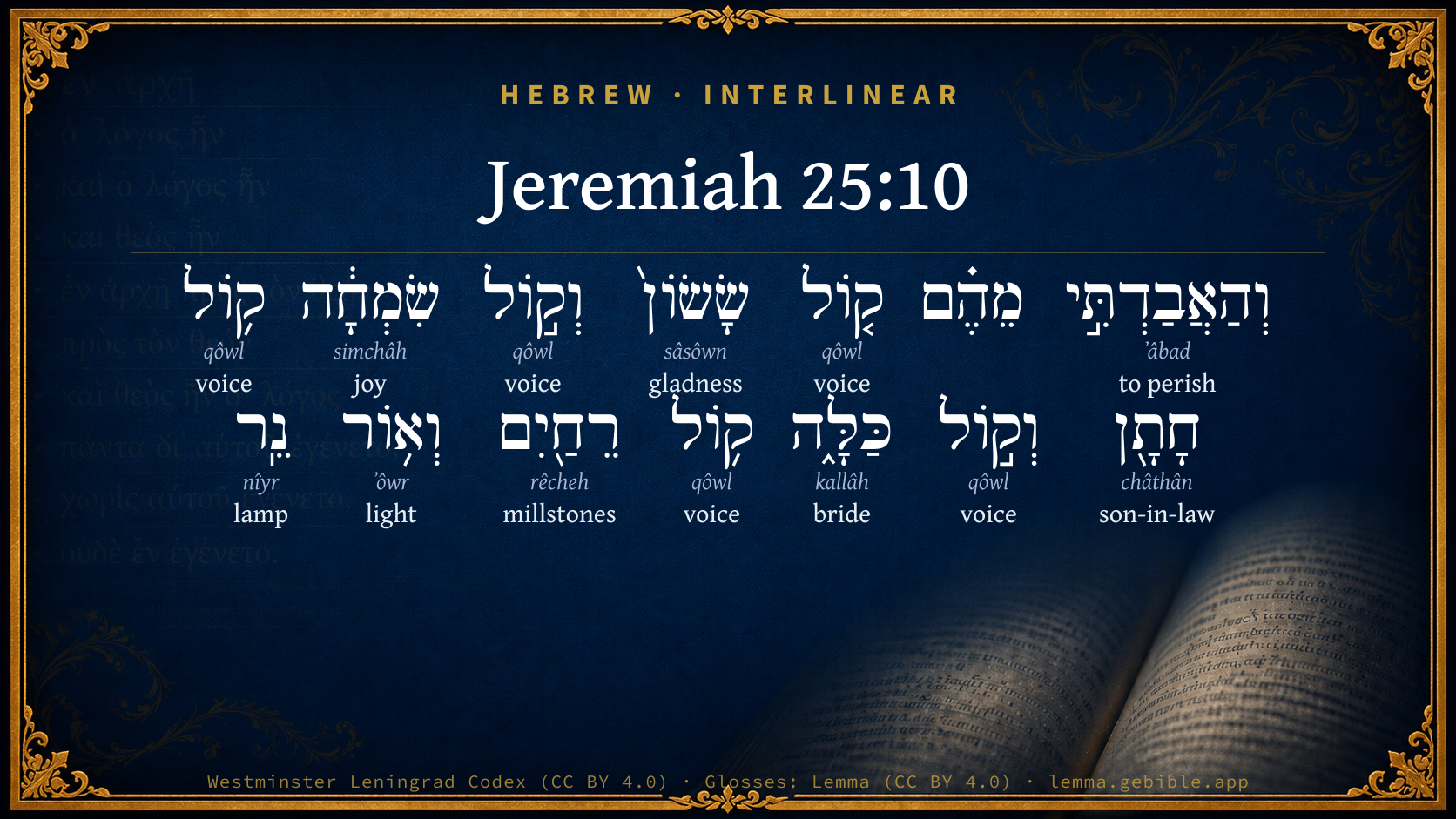
Hebrew (Westminster Leningrad Codex) Jeremiah 25:10 appears in the Hebrew Old Testament. The text above is from the Westminster Leningrad Codex. Each word links to its Strong’s number, a concise gloss, and parsing drawn from the Open Scriptures Hebrew Bible morphology. Click any word for its full Brown-Driver-Briggs (BDB) entry.
Download image
Cite this verse

Jeremiah 25:10 (World English Bible). Public Domain. Lemma interlinear Bible study tool, https://lemma.gebible.app/v/jeremiah/25/10.

Show BibTeX & RIS
BibTeX
RIS
English Translation
Moreover I will take from them the voice of mirth and the voice of gladness, the voice of the bridegroom and the voice of the bride, the sound of the millstones, and the light of the lamp.
World English Bible · Public Domain
Download a study sheet

One document with this verse’s original text, its word-by-word gloss line, the meaning frame, cross-references with their text, attributed commentary, and full source and license credits — printable, and it pastes into notes with its structure intact.

This verse Autodidact and up

Study sheet (.html) Plain text (.txt)

A passage Seminary Student

Up to 50 verses in one chapter. A passage sheet keeps up to 6 commentary sources and 12 cross-references per verse, in the order this page ranks them, and says so on the sheet whenever that leaves anything out. Ask for a single verse and you get the Autodidact verse sheet above.

Everything on this page stays free to read, with no account — the sheet is a download of what is already on screen, not access to it.

Want to remove ads? Support Godless Engineer
Compare translations 3

The same verse in 3 English versions, stacked beneath the original-language interlinear above. Click any original word for its lexicon entry.

Each is an independent rendering of the whole verse — the interlinear is not word-aligned to these translations.

Highlighted words mark where these versions differ — a whole-verse word diff, not a word-by-word alignment.

  • World English Bible Public Domain
    Moreover I will take from them the voice of mirth and the voice of gladness, the voice of the bridegroom and the voice of the bride, the sound of the millstones, and the light of the lamp.
  • King James Version Public Domain
    Moreover I will take from them the voice of mirth, and the voice of gladness, the voice of the bridegroom, and the voice of the bride, the sound of the millstones, and the light of the candle.
  • unfoldingWord Literal Text CC BY-SA 4.0
    And I will cause to perish from them the sound of joy and the sound of gladness, the sound of the bridegroom and the sound of the bride, the sound of the millstones and the light of the lamp.

unfoldingWord Literal Text — © unfoldingWord, licensed CC BY-SA 4.0. Word-aligned USFM3 via Door43 (git.door43.org/unfoldingWord/en_ult).

Versions to compare (up to 4)

3 of 4 selected

Show all 18 translations

Every available English version of this verse, each an independent rendering of the whole verse.

  • World English Bible Public Domain
    Moreover I will take from them the voice of mirth and the voice of gladness, the voice of the bridegroom and the voice of the bride, the sound of the millstones, and the light of the lamp.
  • Berean Standard Bible Public Domain
    Moreover, I will banish from them the sounds of joy and gladness, the voices of the bride and bridegroom, the sound of the millstones, and the light of the lamp.
  • Majority Standard Bible Public Domain
    Moreover, I will banish from them the sounds of joy and gladness, the voices of the bride and bridegroom, the sound of the millstones, and the light of the lamp.
  • King James Version Public Domain
    Moreover I will take from them the voice of mirth, and the voice of gladness, the voice of the bridegroom, and the voice of the bride, the sound of the millstones, and the light of the candle.
  • American Standard Version (1901) Public Domain
    Moreover I will take from them the voice of mirth and the voice of gladness, the voice of the bridegroom and the voice of the bride, the sound of the millstones, and the light of the lamp.
  • Revised Version (1885) Public Domain
    Moreover I will take from them the voice of mirth and the voice of gladness, the voice of the bridegroom and the voice of the bride, the sound of the millstones, and the light of the candle.
  • Geneva Bible (1599) Public Domain
    Moreouer I will take from them the voyce of mirth and the voyce of gladnesse, the voyce of the bridegrome and the voyce of the bride, the noise of the milstones, and the light of the candle.
  • Douay-Rheims (1899) Public Domain
    And I will take away from them the voice of mirth, and the voice of gladness, the voice of the bridegroom, and the voice of the bride, the sound of the mill, and the light of the lamp.
  • Young's Literal Translation Public Domain
    And I have destroyed from them the voice of rejoicing, and the voice of joy, voice of bridegroom and voice of bride, noise of millstones, and the light of lamps.
  • Literal Standard Version CC BY-SA 4.0
    And I have destroyed from them the voice of rejoicing, and the voice of joy, voice of bridegroom and voice of bride, noise of millstones, and the light of lamps.
  • Unlocked Literal Bible CC BY-SA 4.0
    I will put an end to the sound of joy and sound of gladness, the sound of the groom and the sound of the bride, the sound of the millstones and the light of the lamp.
  • unfoldingWord Literal Text CC BY-SA 4.0
    And I will cause to perish from them the sound of joy and the sound of gladness, the sound of the bridegroom and the sound of the bride, the sound of the millstones and the light of the lamp.
  • Darby Bible Public Domain
    And I will cause to perish from them the voice of mirth and the voice of joy, the voice of the bridegroom and the voice of the bride, the sound of the millstones and the light of the lamp.
  • World Messianic Bible Public Domain
    Moreover I will take from them the voice of mirth and the voice of gladness, the voice of the bridegroom and the voice of the bride, the sound of the millstones, and the light of the lamp.
  • Webster's Bible Public Domain
    Moreover I will take from them the voice of mirth, and the voice of gladness, the voice of the bridegroom, and the voice of the bride, the sound of the millstones, and the light of the candle.
  • Free Bible Version CC BY-SA 4.0
    I will also put a stop to the cheerful sounds of celebration and the happy voices of the bride and bridegroom. No noise will come from millstones being used; no lamps will be lit.
  • Bible in Basic English Public Domain
    And more than this, I will take from them the sound of laughing voices, the voice of joy, the voice of the newly-married man, and the voice of the bride, the sound of the stones crushing the grain, and the shining of lights.
  • JPS Tanakh (1917) Public Domain
    Moreover I will cause to cease from among them the voice of mirth and the voice of gladness, the voice of the bridegroom and the voice of the bride, the sound of the millstones, and the light of the lamp.

Literal Standard Version (2020), Covenant Press — licensed CC BY-SA 4.0. Text via the HelloAO Bible API (eBible.org). Unlocked Literal Bible (unfoldingWord) — licensed CC BY-SA 4.0. Text via the HelloAO Bible API (eBible.org). unfoldingWord Literal Text — © unfoldingWord, licensed CC BY-SA 4.0. Word-aligned USFM3 via Door43 (git.door43.org/unfoldingWord/en_ult). Free Bible Version, Dr. Jonathan Gallagher — licensed CC BY-SA 4.0. Text via the HelloAO Bible API (eBible.org).

Word by word

More ways to search: Search by grammar → Find every occurrence → Compare this word →

Practice this passage: Drill this verse → Learn its vocabulary →

רֵחַ֖יִם
rêcheh
H7347
“millstones”
Noun, Common, Masculine, Dual, Absolute
Part of Speech
Noun
Type
Common
Gender
Masculine
Number
Dual
State
Absolute
Full BDB Definition

Origin: from an unused root meaning to pulverise

TWOT: 2144a

handmills - a pair of millstones for grinding
  1. וְהַאֲבַדְתִּ֣י ʼâbad H6 “and · to perish” Conjunction + Verb, Hiphil, Sequential Perfect, 1st Person, Common, Singular
  2. ק֤וֹל qôwl H6963 “voice of” Noun, Common, Masculine, Singular, Construct
  3. שָׂשׂוֹן֙ sâsôwn H8342 “gladness” Noun, Common, Masculine, Singular, Absolute
  4. וְק֣וֹל qôwl H6963 “and · voice of” Conjunction + Noun, Common, Masculine, Singular, Construct
  5. שִׂמְחָ֔ה simchâh H8057 “joy” Noun, Common, Feminine, Singular, Absolute
  6. ק֥וֹל qôwl H6963 “voice of” Noun, Common, Masculine, Singular, Construct
  7. חָתָ֖ן châthân H2860 “son-in-law” Noun, Common, Masculine, Singular, Absolute
  8. וְק֣וֹל qôwl H6963 “and · voice of” Conjunction + Noun, Common, Masculine, Singular, Construct
  9. כַּלָּ֑ה kallâh H3618 “bride” Noun, Common, Feminine, Singular, Absolute
  10. ק֥וֹל qôwl H6963 “voice of” Noun, Common, Masculine, Singular, Construct
  11. וְא֥וֹר ʼôwr H216 “and · light of” Conjunction + Noun, Common, Both, Singular, Construct
  12. נֵֽר nîyr H5216 “lamp” Noun, Common, Masculine, Singular, Absolute

About this verse

These counts appear in no published source. They are computed here, from the morphology-tagged text and Lemma’s own curated glosses. What Lemma adds →

14
words
9
distinct lemmas
Prophets
section

Notable vocabulary

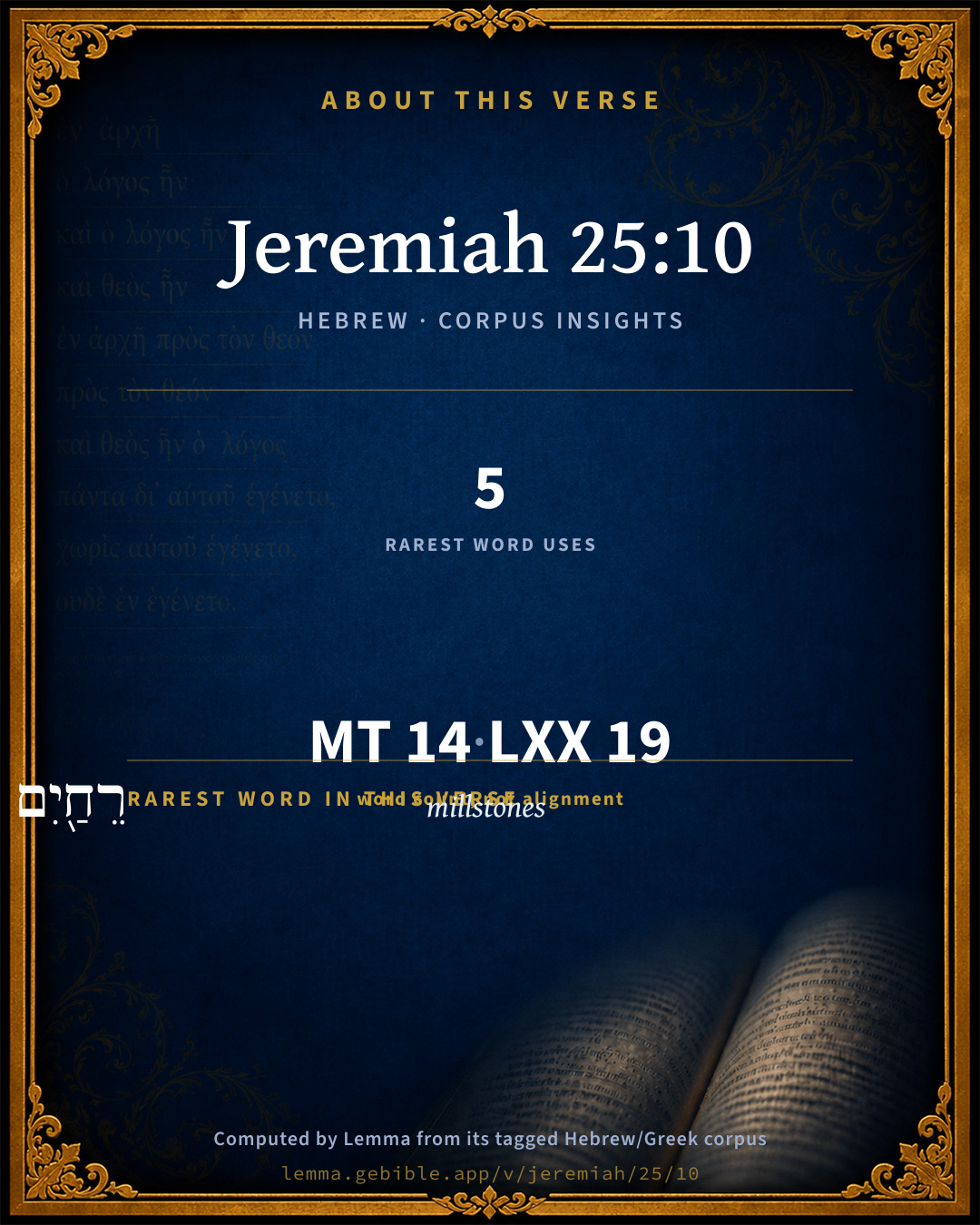
The rarest word here is רֵחַ֖יִם millstones H7347 — appearing just 5 times in the whole Hebrew Bible.

Shared distinctive vocabulary

רֵחַ֖יִם millstones H7347 occurs in 5 verses of the Hebrew Bible. Also found in:

Grammatical profile

  • 1 verb
  • 12 nouns
  • 1 preposition

Verb forms

  • וְהַאֲבַדְתִּ֣י Hiphil · Sequential Perfect

Repetition

A word recurs within this verse — often emphatic in Hebrew:

  • ק֤וֹל voice H6963 ×5

Hebrew & Septuagint length

In the original languages it is 14 Hebrew tokens and 19 Greek tokens — but the two are counted differently (Hebrew bundles its prefixes and suffixes into one token; the Greek is in lemma form), so that isn’t a like-for-like length.

Cross-references

11

Topical passages linked to Jeremiah 25:10 in the Treasury of Scripture Knowledge — connected by theme and wording, ordered by reader-vote popularity; previews shown in the World English Bible.

  • Jeremiah 7:34 Then will I cause to cease from the cities of Judah, and from the streets of Jerusalem, the voice of mirth and the voice of gladness, the voice of the bridegroom and the voice of the bride; for the land shall become a waste.
  • Jeremiah 16:9 For thus says Yahweh of Hosts, the God of Israel: Behold, I will cause to cease out of this place, before your eyes and in your days, the voice of mirth and the voice of gladness, the voice of the bridegroom and the voice of the bride.
  • Ezekiel 26:13 I will cause the noise of your songs to cease; and the sound of your harps shall be no more heard.
  • Revelation 18:22–23 The voice of harpists, minstrels, flute players, and trumpeters will be heard no more at all in you. No craftsman, of whatever craft, will be found any more at all in you. The sound of a mill will be heard no more at all in you.
  • Jeremiah 33:10–11 Thus says Yahweh: Yet again there shall be heard in this place, about which you say, It is waste, without man and without animal, even in the cities of Judah, and in the streets of Jerusalem, that are desolate, without man and without inhabitant and without animal,
  • Esther 3:13 Letters were sent by posts into all the king's provinces, to destroy, to kill, and to cause to perish, all Jews, both young and old, little children and women, in one day, even on the thirteenth [day] of the twelfth month, which is the month Adar, and to take the spoil of them for a prey.
  • Esther 7:4 for we are sold, I and my people, to be destroyed, to be slain, and to perish. But if we had been sold for bondservants and bondmaids, I had held my peace, although the adversary could not have compensated for the king's damage.
  • Esther 8:11 in which the king granted the Jews who were in every city to gather themselves together, and to stand for their life, to destroy, to kill, and to cause to perish, all the power of the people and province that would assault them, [their] little ones and women, and to take the spoil of them for a prey,
  • Ecclesiastes 12:2–4 Before the sun, the light, the moon, and the stars are darkened, And the clouds return after the rain;
  • Isaiah 24:7–12 The new wine mourns, the vine languishes, all the merry-hearted do sigh.
  • Hosea 2:11 I will also cause all her celebrations to cease: Her feasts, her new moons, her Sabbaths, and all her solemn assemblies.

Cross-references courtesy of OpenBible.info (CC BY 4.0).

Hebrew and Greek witnesses Masoretic Hebrew ↔ Greek Septuagint

The same verse in the two great witnesses to the Old Testament, shown verse-for-verse.

These are two independent witnesses, not word-aligned to each other, and the Septuagint is shown in lemma (dictionary) form.

Hebrew Jeremiah 25:10 Masoretic · Westminster Leningrad Codex

וְהַאֲבַדְתִּ֣י מֵהֶ֗ם ק֤וֹל שָׂשׂוֹן֙ וְק֣וֹל שִׂמְחָ֔ה ק֥וֹל חָתָ֖ן וְק֣וֹל כַּלָּ֑ה ק֥וֹל רֵחַ֖יִם וְא֥וֹר נֵֽר

Moreover I will take from them the voice of mirth and the voice of gladness, the voice of the bridegroom and the voice of the bride, the sound of the millstones, and the light of the lamp.

World English Bible · Public Domain

Greek LXX Structure differs

In the Septuagint, Jeremiah is about an eighth shorter than the Hebrew and arranges its material differently — the Oracles Against the Nations (Hebrew chapters 46–51) appear in the middle of the Greek book, after 25:13. Because the chapter and verse boundaries do not line up, a verse-for-verse comparison with the Hebrew is not shown.

A verse-for-verse comparison isn’t shown here because the chapters and verses don’t line up. Switch to the LXX edition with the MT / LXX toggle above to read the Greek directly.

On this verse, Joseph Benson's Commentary discusses the Septuagint’s reading. Read the note in Commentary ↓

Hebrew: Westminster Leningrad Codex (CC BY 4.0). Greek: Septuagint (public domain); English from a public-domain English Septuagint. How the Septuagint differs from the Hebrew →

Targum (Aramaic paraphrase)

1

The Targum is the ancient Jewish Aramaic paraphrase of the Hebrew Scriptures — an interpretive translation, not the Hebrew text itself. Onkelos (literal) and Pseudo-Jonathan (expansive) render the Torah, and Jonathan the Prophets. Coverage is partial: where no permissively-licensed English translation exists for a verse, only the Aramaic is shown. This is verse-level text, not a word-by-word alignment to the Hebrew.

  1. Targum Jonathan Prophets (Joshua–Malachi)
    וְאוֹבַד מִנְהוֹן קַל בִּיעַ וְקַל חֶדְוָא קַל חַתְנִין וְקַל כַּלָן קַל סִיעַן דִמְשַׁבְּחִין בְּנֵיהוֹר בּוּצִין:

    (no public-domain English translation for this verse)

    Targum Jonathan — Aramaic: “Mikraot Gedolot” (public domain). English: “Sefaria Community Translation” (CC0 1.0 (public-domain dedication)); “London "Chaldee Paraphrase," 1871” (public domain). Text via Sefaria.

Commentary

Notes on Jeremiah 25:10 from classic Christian and Jewish commentators (each source and its license shown beneath its notes). The classic Christian expositions comment on the surrounding passage and are grouped to its opening verse, so a note may address several verses; the Jewish commentaries on the Tanakh (Rashi and others) are per-verse, so they appear only where the commentator wrote on this verse.

Lemma curates 59 commentaries, every one of them public domain or Creative Commons licensed, each selected and text-cleaned for this edition rather than reprinted as found. About our sources →

Trapp's Complete Commentary

John Trapp

Jer 25:10 Moreover I will take from them the voice of mirth, and the voice of gladness, the voice of the bridegroom, and the voice of the bride, the sound of the millstones, and the light of the candle.

Ver. 10. Moreover, I will take from them.] See Jer 7:34 Rev 18:22.

John Trapp, A Commentary or Exposition upon All the Books of the Old and New Testament (1647–1656) — public domain. Text from a community e-Sword module.

Joseph Benson's Commentary

Jer 25:10. Moreover, I will take from them the voice of mirth, &c. — See the note on Jer 7:34; Jer 16:9. The sound of the millstones and the light of the candle — There shall be no longer any marks of trade carried on, even respecting the common necessaries of life, such as the grinding of corn; and there will be no use of candles, where the inhabitants are dispersed and destroyed; nor will there be occasion for such illuminations as are usual on festival solemnities, in the time of general desolation, Jer 25:11. See the like expressions used, Rev 18:22; where we may observe that St. John exactly follows the Hebrew text; whereas the LXX., in this place, instead of the sound of the millstones, read οσμην μυρου, the smell of ointment. From which, and several other places of the New Testament, it appears that the apostles and evangelists did not implicitly follow the Greek translation, but only when they thought it consistent with the original text. See Lowth. Mr. Harmer has an excellent observation on this place, which the reader will be glad to see. “The time for grinding their corn is in the morning; which consideration makes the prophet’s selecting the noise of millstones, and the lighting up of candles, as circumstances belonging to inhabited places, appear in a view which no commentators, that I have examined, have taken any notice of. I am indebted to Sir John Chardin’s MS. for the knowledge of this fact. It informs us that ‘in the East they grind their corn at break of day; and that when one goes out in a morning, he hears everywhere the noise of the mill, and that it is the noise that often awakens people.’ It has been commonly known that they bake every day; and that they usually grind their corn as they want it; but this passage informs us, that it is the first work done in a morning, as well as that this grinding of their mills makes a considerable noise, and attracts every ear; and as the lighting up of candles begins the evening, there is an agreeable contrast observable in these words, I will take from thee, &c., the sound of millstones and the light of the candle. And their whole land shall be a desolation — Gloomy shall be the silence of the morning, melancholy the shadows of the evening; no cheerful noise to animate the one, no enlivening ray to soften the gloom of the other. Desolation shall every where reign. A land may abound with habitations, and furnish an agreeable abode, where the voice of mirth is not heard; none of the songs, the music, and the dances of nuptial solemnities; but in the East, where no millstones are heard in the morning, no light seen in the evening, it must be a dreary dismal solitude.” — Chap. 4. obs. 4. See also chap. 3. obs. 18.

Joseph Benson's Commentary on the Old and New Testaments (1811–1818) — public domain. Text from a community e-Sword module.

Tyndale Open Study Notes

Tyndale Open Resources

25:10 All forms of festivity, even simple pleasures such as singing and laughter, would cease. • millstones . . . lights: After the destruction of Judah, no one would remain to do the work or to enjoy its fruits.

Tyndale Open Study Notes — © Tyndale Open Resources, licensed CC BY-SA 4.0. Text via the HelloAO Bible API.

Geneva Bible (1599)

Geneva Bible translators

Or, destroy.

Meaning, that bread and all things that should serve unto their feasts, should be taken away.

Geneva Bible (1599) marginal notes — public domain. Text via Bolls.life.

Jamieson, Fausset & Brown

Robert Jamieson, A. R. Fausset & David Brown

(Jer 7:34; Rev 18:23). The land shall be so desolated that even in the houses left standing there shall be no inhabitant; a terrible stillness shall prevail; no sound of the hand-mill (two circular stones, one above the other, for grinding corn, worked by two women, Exo 11:5; Mat 24:41; in daily use in every house, and therefore forbidden to be taken in pledge, Deu 24:6); no night-light, so universal in the East that the poorest house has it, burning all night.

candle--lamp (Job 21:17; Job 18:6).

Jamieson, Fausset & Brown — Commentary Critical and Explanatory on the Whole Bible (1871) — public domain (CC PDM 1.0). Text via the HelloAO Bible API.

Adam Clarke's Commentary

Verse 10. I will take from them] See Jer 7:34; Jer 16:9.

The sound of the mill-stones, and the light of the candle.] These two are conjoined, because they generally ground the corn before day, by the light of the candle. Sir J. Chardin has remarked, that every where in the morning may be heard the noise of the mills; for they generally grind every day just as much as is necessary for the day's consumption. Where then the noise of the mill is not heard, nor the light of the candle seen, there must be desolation; because these things are heard and seen in every inhabited country.

Adam Clarke's Commentary on the Bible (1810–1826) — public domain. Text from a community e-Sword/MySword module.

John Calvin's Commentaries

He confirms here what I have just said, — that the Jews were not to be chastised in a common manner, but be exposed to extreme distress. For though all things may not be with us prosperous and according to our wishes, yet marriages may still be celebrated, and some hilarity may remain; we may yet eat and drink and enjoy the necessaries of life, though we may have no pleasures; but the Prophet shews here that such would be the devastation of the land, that there would be no thoughts about marriages, that all hilarity and joy would cease, that there would be no preparations of food, no grinding of corn, and that, in short, all feasts usually kept by the light of candles would be no more celebrated. Here, then, he describes to the life that devastation which had been before mentioned.

The Prophet no doubt indirectly condemns that insensibility by which the devil had possessed the minds of the people; for though the prophets continually threatened them, yet there was no end to their exultations and no moderation in them, according to what is said by Isaiah, who complains of such wantonness, that they said, “Let us feast, tomorrow we shall die;” and who also says,

“I have called you to sackcloth and ashes, but ye went to the harp and to feastings.” (Isaiah 22:12, 13)

When, therefore, the Prophet speaks here of the voice of joy and gladness, of the noise of millstones, and of lamps, he doubtless upbraids them with their stupid security; for they feared nothing, and thought themselves safe even when God was shewing himself, as with an outstretched hand, to be their avenging judge. It follows, —

John Calvin's Commentaries (1540-1563) — public domain. Text from the Calvin Translation Society English edition (1840s-50s) via the Christian Classics Ethereal Library (ccel.org). Calvin's coverage is partial (roughly two-thirds of the Bible); uncommented books and verses are honest gaps, never fabricated. The 19th-century editor's footnotes and remarks are omitted so the notes are faithfully Calvin's own voice.

Ellicott's Commentary for English Readers

(10) The voice of mirth, and the voice of gladness.—The language is mainly an echo of Jer_7:34; Jer_16:9, but there are new features in the cessation of “the sound of the millstone,” i.e., of the grinding of corn by female slaves for the mid-day meal (Exo_11:5; Mat_24:41), and the lighting of the candle when the day’s work was done (Mat_5:15). No words could paint more terribly the entire breaking up of family life, not only in its occasional festivities, but in its daily routine. The imagery reappears in Rev_18:22-23.

A Bible Commentary for English Readers, edited by Charles John Ellicott (1878–1897) — public domain. Text from a community e-Sword module.

The Cambridge Bible for Schools and Colleges

gen. ed. J. J. S. Perowne

10. take from them] lit. as mg. cause to perish from them.

the voice of mirth, etc.] Cp. Jer_7:34. Here mention of the millstones and of the candle (lamp) is added, typical of domestic labour and social cheer. See the same description somewhat amplified in Rev_18:22 f.

millstones] See Dr.’s note for description of the hand-mill in daily use in an Eastern village.

The Cambridge Bible for Schools and Colleges (gen. ed. J. J. S. Perowne; Cambridge University Press, 1878–1918) — public domain. Text from a community e-Sword module.

John Gill's Exposition

Moreover, I will take from them the voice of mirth, and the voice of gladness,.... At their festivals, and nuptial solemnities:

the voice of the bridegroom, and the voice of the bride; expressing their mutual love unto, and delight in, each other; so agreeable to one another and their friends: or it may mean those epithalamies, or nuptial songs, sung unto them by their friends:

the sound of the millstones; either the voice of those that sing at the mill while grinding; or rather the sound of the stones themselves used in grinding; either in grinding spices for the bride cakes; or rather in grinding corn for common use; and so denotes the taking away of bread corn from them, and the want of that. The sense is, there should be corn to grind, and so no use of the mill:

and the light of the candle; at their feasts and weddings, or rather, for common use; signifying that houses should be desolate, without inhabitants, no light in them, nor work to be done. The whole shows that they should be deprived of everything both for necessity and pleasure. John seems to have borrowed some phrases from hence, Rev 18:22; in which he appears to have followed the Hebrew text, and not the Greek version. The Targum of the last clause is,

"the voice of the company of those that sing at the light of candles.''

John Gill's Exposition of the Whole Bible (1746–1763) — public domain (CC PDM 1.0). Text via the HelloAO Bible API.

Albert Barnes' Notes on the Bible

Take from them ... the sound of the millstones, and the light of the candle - (or, lamp). To denote the entire cessation of domestic life. The one was the sign of the preparation of the daily meal, the other of the assembling of the family after the labors of the day were over.

Albert Barnes' Notes on the Bible (1834–1885) — public domain. Text from a community e-Sword/MySword module.

Haydock's Catholic Bible Commentary

Sound, or songs of women turning the mill, Matthew xxiv. 41. (Calmet) --- Lamp, or illuminations, on account of some victory, (Haydock) or festival. (Pers. v. 180.) The Jews "light a lamp for the sabbaths," (Seneca, Ep. xcv.) before they commence. (Haydock)

George Leo Haydock (1774–1849), Haydock's Catholic Family Bible and Commentary, 1859 edition — public domain. Excludes Psalms (Douay-Rheims chapter numbering differs from Protestant) and Deuterocanonical books (Catholic canon only).

Matthew Poole's English Annotations

I will take away all your mirth and jollity, whether used at weddings, or at any of your merry meetings; I will leave you nothing to rejoice in; your very wedding times shall be times of mourning and lamentation. Nay, I will not only deprive you of your mirth, but of those things that are necessary for you, as necessary as bread and light; the millstone shall not move; you shall not have the light so much as of a candle. See the like expressions Rev 18:22,23. God here threatens not only to take away their superfluities, and what he had hitherto lent them for their pleasure and delight, but also what they had for their necessary sustenance, and to capacitate them to do their ordinary works.

Matthew Poole's English Annotations on the Holy Bible (1683–1685) — public domain. Text from a community e-Sword/MySword module.

The Pulpit Commentary

The sound of the millstones. Modem travel enables us (so conservative is the East) to realize the full force of this image. The hand-mill is composed of two stones. As a rule, "two women" (comp. Mat_24:41) sit at it facing each other; both have hold of the handle by which the upper is turned round on the "nether" millstone. The one whose right hand is disengaged throws in the grain as occasion requires, through the hole in the upper stone" (Dr. Thomson). "The labor," remarks Dr. Robinson, "is evidently hard; and the grating sound of the mill is heard at a distance, indicating (like our coffee-mills) the presence of a family and of household life" ("Biblical Researches," 2:181). Add to this the light of the candle (or rather, lamp), and we have two of the most universally characteristic signs of domestic life. No family could dispense with the hand-mill, and, as the sermon on the mount implies, the poorest household had its "lamp". (Mat_5:15 the poverty of the family is indicated by the various uses to which the lamp-stand was applied) Comp. this verse with the imitation in Rev_18:22, Rev_18:23.

The Pulpit Commentary (1880–1919), ed. H.D.M. Spence-Jones & Joseph S. Exell — public domain. Text from a community e-Sword module.

John Wesley's Explanatory Notes

Moreover - Nay, I will not only deprive you of your mirth, but of those things that are necessary for you, as necessary as bread and light, the millstone shall not move, you shall not have the light so much as of a candle.

John Wesley, Explanatory Notes Upon the Whole Bible (1754–1765) — public domain. Text via the GEBible commentary corpus.

unfoldingWord translationNotes

Door43 World Missions Community

millstones

These are two large, round stones used to grind grain.

the sound of joy and sound of gladness, the sound of the groom and the sound of the bride

See how you translated this in Jeremiah 7:34.

all of this land will become a desolation and a horror

The words "desolation" and "horror" can be translated with a verbal phrase. AT: "I will cause this land to be desolate and something that horrifies people" (See: Abstract Nouns)

translationWords

joy

voice

bridegroom

bride

light

desolate

servant

unfoldingWord translationNotes — © Distant Shores Media and the Door43 World Missions Community, licensed CC BY-SA 4.0. Source: git.door43.org/Door43/en_tn.

Rashi

Rabbi Shlomo Yitzchaki (Rashi)

the sound of a mill That is an indication of a circumcision feast, since they would grind and crush ingredients for healing the wound.

the light of a candle An indication of a feast. So we learned in Sanhedrin (32b).

Rashi on the Tanakh — English translations: “The Judaica Press complete Tanach with Rashi, translated by A. J. Rosenberg” (CC BY 4.0); “Pentateuch with Rashi's commentary by M. Rosenbaum and A.M. Silbermann, 1929-1934” (public domain); “The Metsudah Tanach series, Lakewood, N.J” (CC BY 4.0); and “The Book of Joshua, Metsudah Publications, 1997” (CC BY 4.0). Text via Sefaria.

Lesson kit

Teaching starters — assembled from the data on this page, not authored interpretation. Every prompt links to the verse data it draws on. Edit before teaching.

Jeremiah, in the Prophets, opens this verse with 14 words (9 distinct Hebrew lemmas). Its most distinctive word is rêcheh (“millstones”). A historical commentator’s framing appears above. Read the whole chapter for the surrounding context.

Discussion questions

  1. What does “millstones” (rêcheh) contribute to the verse as a whole?
  2. How does Exodus 11:5, which shares the word «millstones», read alongside this verse?
  3. What does the repetition of “voice” (5× in this one verse) do in this verse?
  4. The translations on this page render this verse differently — a whole-verse word diff, not a word-by-word alignment. What might account for the different wordings?
  5. «וְהַאֲבַדְתִּ֣י» is a Hiphil Sequential Perfect verb. How does that grammatical form shape the action described?
  6. Compare how Trapp's Complete Commentary and Joseph Benson's Commentary read this verse. Where do they agree or differ?

Things to notice

Reading settings

Reading text

Shown beneath each verse's original-language words.

Old Testament
Old Testament edition

Read the OT as the Masoretic Hebrew (MT) or the Greek Septuagint (LXX).

English shown for the Greek Septuagint (in the Hebrew ↔ Greek comparison).

Comparing translations? Open the Compare panel on any verse page to stack up to four side by side.