
Proverbs 29:13

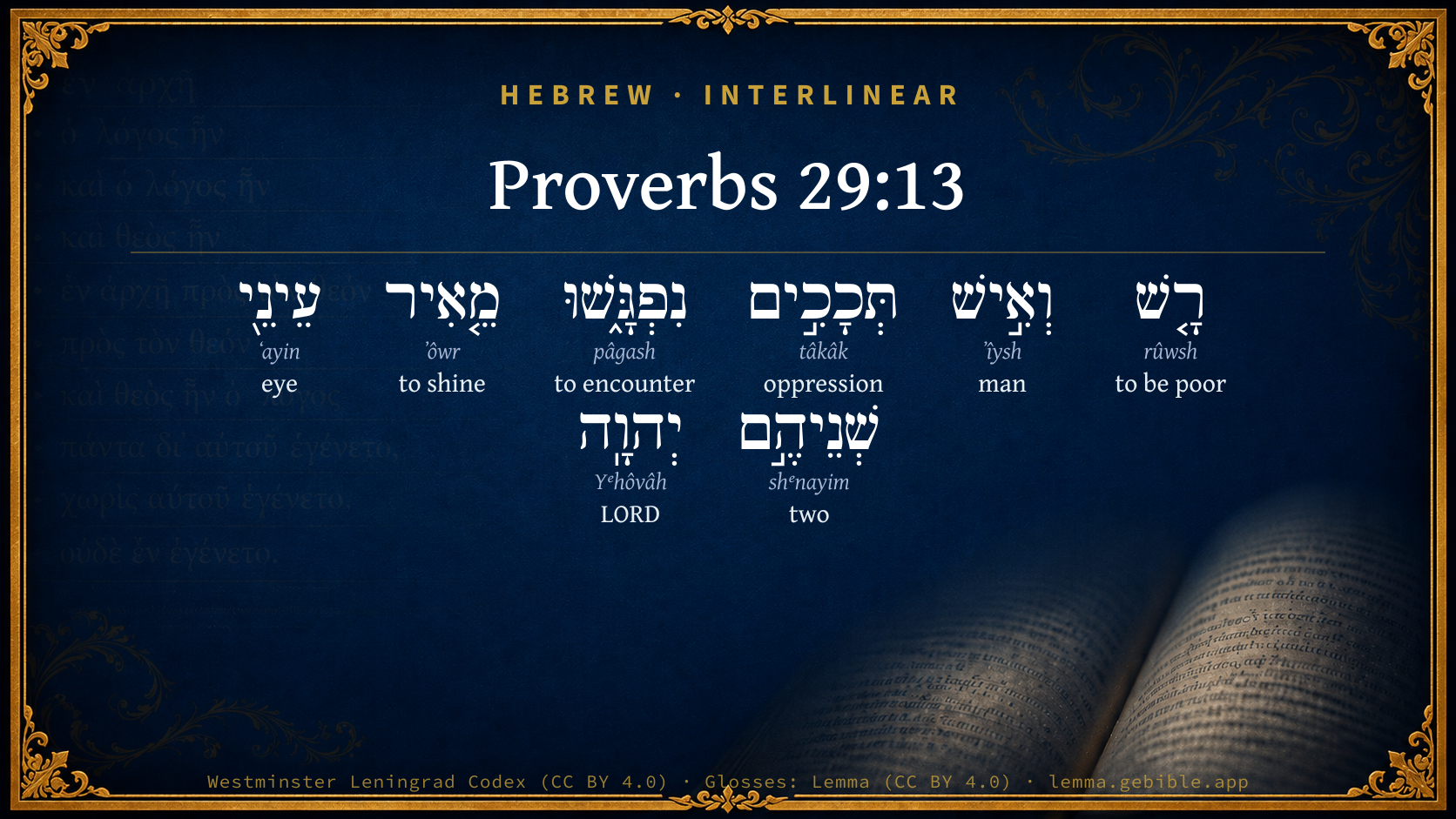
Hebrew (Westminster Leningrad Codex) Proverbs 29:13 appears in the Hebrew Old Testament. The text above is from the Westminster Leningrad Codex. Each word links to its Strong’s number, a concise gloss, and parsing drawn from the Open Scriptures Hebrew Bible morphology. Click any word for its full Brown-Driver-Briggs (BDB) entry.
Download image
Cite this verse

Proverbs 29:13 (World English Bible). Public Domain. Lemma interlinear Bible study tool, https://lemma.gebible.app/v/proverbs/29/13.

Show BibTeX & RIS
BibTeX
RIS
English Translation
The poor man and the oppressor have this in common: Yahweh gives sight to the eyes of both.
World English Bible · Public Domain
Highlights Full analysis ↓
Download a study sheet

One document with this verse’s original text, its word-by-word gloss line, the meaning frame, cross-references with their text, attributed commentary, and full source and license credits — printable, and it pastes into notes with its structure intact.

This verse Autodidact and up

Study sheet (.html) Plain text (.txt)

A passage Seminary Student

Up to 50 verses in one chapter. A passage sheet keeps up to 6 commentary sources and 12 cross-references per verse, in the order this page ranks them, and says so on the sheet whenever that leaves anything out. Ask for a single verse and you get the Autodidact verse sheet above.

Everything on this page stays free to read, with no account — the sheet is a download of what is already on screen, not access to it.

Want to remove ads? Support Godless Engineer
Compare translations 3

The same verse in 3 English versions, stacked beneath the original-language interlinear above. Click any original word for its lexicon entry.

Each is an independent rendering of the whole verse — the interlinear is not word-aligned to these translations.

Highlighted words mark where these versions differ — a whole-verse word diff, not a word-by-word alignment.

  • World English Bible Public Domain
    The poor man and the oppressor have this in common: Yahweh gives sight to the eyes of both.
  • King James Version Public Domain
    The poor and the deceitful man meet together: the LORD lighteneth both their eyes.
  • unfoldingWord Literal Text CC BY-SA 4.0
    A poor one and a man of oppression meet together; the one enlightening the eyes of the two of them Yahweh.

unfoldingWord Literal Text — © unfoldingWord, licensed CC BY-SA 4.0. Word-aligned USFM3 via Door43 (git.door43.org/unfoldingWord/en_ult).

Versions to compare (up to 4)

3 of 4 selected

Show all 18 translations

Every available English version of this verse, each an independent rendering of the whole verse.

  • World English Bible Public Domain
    The poor man and the oppressor have this in common: Yahweh gives sight to the eyes of both.
  • Berean Standard Bible Public Domain
    The poor man and the oppressor have this in common: The LORD gives light to the eyes of both.
  • Majority Standard Bible Public Domain
    The poor man and the oppressor have this in common: The LORD gives light to the eyes of both.
  • King James Version Public Domain
    The poor and the deceitful man meet together: the LORD lighteneth both their eyes.
  • American Standard Version (1901) Public Domain
    The poor man and the oppressor meet together; Jehovah lighteneth the eyes of them both.
  • Revised Version (1885) Public Domain
    The poor man and the oppressor meet together: the LORD lighteneth the eyes of them both.
  • Geneva Bible (1599) Public Domain
    The poore and the vsurer meete together, and the Lord lighteneth both their eyes.
  • Douay-Rheims (1899) Public Domain
    The poor man and the creditor have met one another: the Lord is the enlightener of them both.
  • Young's Literal Translation Public Domain
    The poor and the man of frauds have met together, Jehovah is enlightening the eyes of them both.
  • Literal Standard Version CC BY-SA 4.0
    The poor and the man of frauds have met together, || YHWH is enlightening the eyes of them both.
  • Unlocked Literal Bible CC BY-SA 4.0
    The poor person and the oppressor are similar, for Yahweh gives light to the eyes of them both.
  • unfoldingWord Literal Text CC BY-SA 4.0
    A poor one and a man of oppression meet together; the one enlightening the eyes of the two of them Yahweh.
  • Darby Bible Public Domain
    The indigent and the oppressor meet together; Jehovah lighteneth the eyes of them both.
  • World Messianic Bible Public Domain
    The poor man and the oppressor have this in common: The LORD gives sight to the eyes of both.
  • Webster's Bible Public Domain
    The poor and the deceitful man meet together: the LORD enlighteneth both their eyes.
  • Free Bible Version CC BY-SA 4.0
    Poor people and their oppressors have this in common: the Lord gives life to all of them.
  • Bible in Basic English Public Domain
    The poor man and his creditor come face to face: the Lord gives light to their eyes equally.
  • JPS Tanakh (1917) Public Domain
    The poor man and the oppressor meet together; the LORD giveth light to the eyes of them both.

Literal Standard Version (2020), Covenant Press — licensed CC BY-SA 4.0. Text via the HelloAO Bible API (eBible.org). Unlocked Literal Bible (unfoldingWord) — licensed CC BY-SA 4.0. Text via the HelloAO Bible API (eBible.org). unfoldingWord Literal Text — © unfoldingWord, licensed CC BY-SA 4.0. Word-aligned USFM3 via Door43 (git.door43.org/unfoldingWord/en_ult). Free Bible Version, Dr. Jonathan Gallagher — licensed CC BY-SA 4.0. Text via the HelloAO Bible API (eBible.org).

Word by word

More ways to search: Search by grammar → Find every occurrence → Compare this word →

Practice this passage: Drill this verse → Learn its vocabulary →

About this verse

These counts appear in no published source. They are computed here, from the morphology-tagged text and Lemma’s own curated glosses. What Lemma adds →

8
words
8
distinct lemmas
Wisdom
section

Notable vocabulary

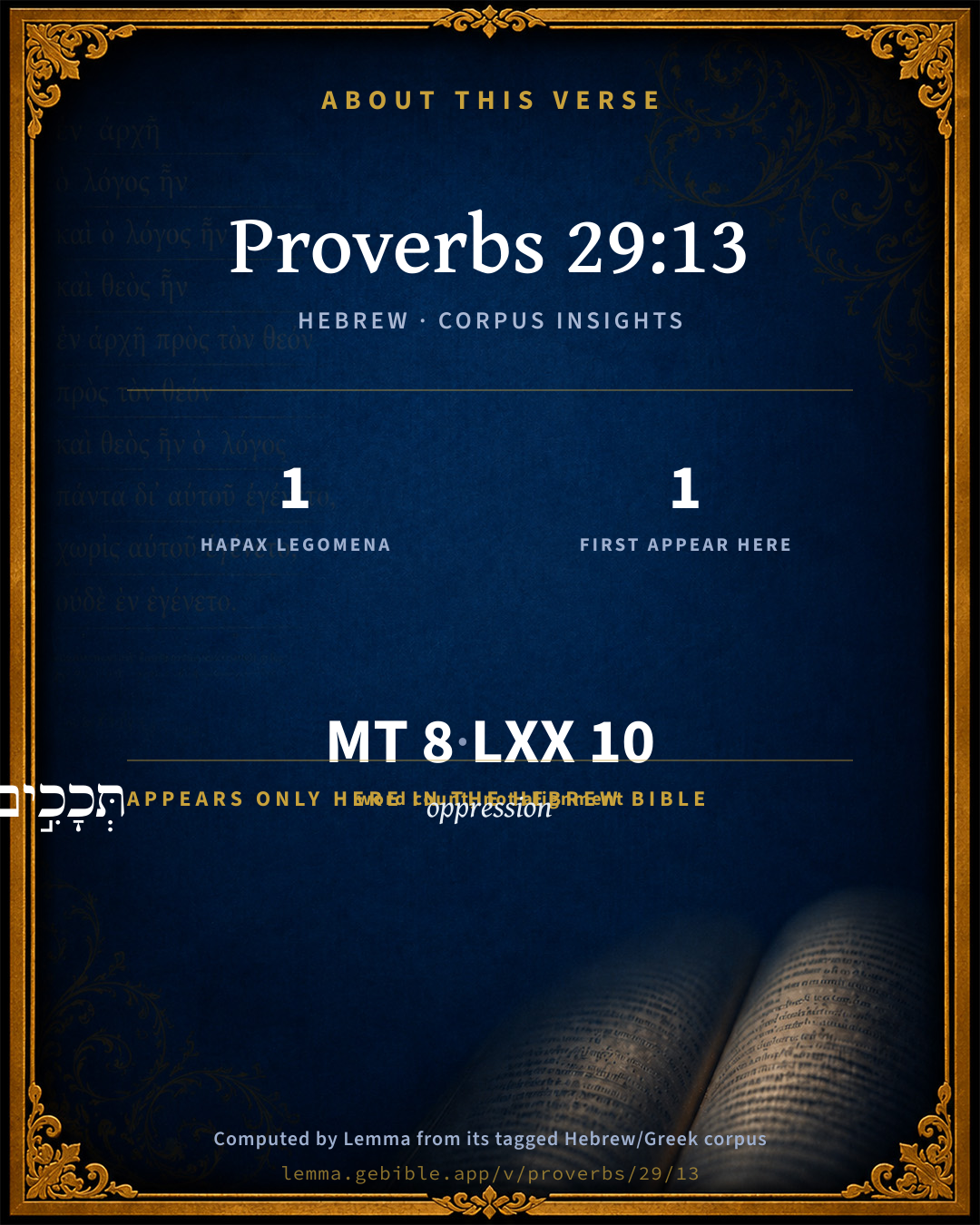
1 hapax legomenon — a word that appears only here in the entire Hebrew Bible:

  • תְּכָכִ֣ים oppression H8501

First appearance in Scripture

This word makes its first canonical appearance in the Hebrew Bible here:

  • תְּכָכִ֣ים oppression H8501

Shared distinctive vocabulary

נִפְגָּ֑שׁוּ to encounter H6298 occurs in 14 verses of the Hebrew Bible. Also found in:

Grammatical profile

  • 3 verbs
  • 4 nouns
  • 1 adjective

Verb forms

  • רָ֤שׁ Qal · Participle Active
  • נִפְגָּ֑שׁוּ Niphal · Perfect
  • מֵ֤אִיר Hiphil · Participle Active

Hebrew & Septuagint length

In English translation the verse runs 18 words from the Hebrew and 12 from the Septuagint (LXX English) — the Septuagint runs noticeably shorter here. See the side-by-side →

A rough comparison of the two English renderings, which tokenize alike — not a word-level alignment.

Word counts can differ between the Hebrew and the Greek without any difference in meaning — e.g. the Hebrew direct-object marker אֵת has no separate Greek word, and Greek often adds the article ὁ.

In the original languages it is 8 Hebrew tokens and 10 Greek tokens — but the two are counted differently (Hebrew bundles its prefixes and suffixes into one token; the Greek is in lemma form), so that isn’t a like-for-like length.

Cross-references

9

Topical passages linked to Proverbs 29:13 in the Treasury of Scripture Knowledge — connected by theme and wording, ordered by reader-vote popularity; previews shown in the World English Bible.

  • Matthew 5:45 that you may be children of your Father who is in heaven. For he makes his sun to rise on the evil and the good, and sends rain on the just and the unjust.
  • Proverbs 22:2 The rich and the poor have this in common: Yahweh is the maker of them all.
  • Psalms 13:3 Behold, and answer me, Yahweh, my God. Give light to my eyes, lest I sleep in death;
  • Ephesians 2:1 You were made alive when you were dead in transgressions and sins,
  • Exodus 22:25–26 "If you lend money to any of my people with you who is poor, you shall not be to him as a creditor; neither shall you charge him interest.
  • Leviticus 25:35–37 "'If your brother has become poor, and his hand can't support him among you; then you shall uphold him. As a stranger and a sojourner he shall live with you.
  • Nehemiah 5:5–7 Yet now our flesh is as the flesh of our brothers, our children as their children: and, behold, we bring into bondage our sons and our daughters to be servants, and some of our daughters are brought into bondage [already]: neither is it in our power to help it; for other men have our fields and our vineyards.
  • Matthew 9:9 As Jesus passed by from there, he saw a man called Matthew sitting at the tax collection office. He said to him, "Follow me." He got up and followed him.
  • 1 Corinthians 6:10 nor thieves, nor covetous, nor drunkards, nor slanderers, nor extortioners, will inherit the Kingdom of God.

Cross-references courtesy of OpenBible.info (CC BY 4.0).

Hebrew and Greek witnesses Masoretic Hebrew ↔ Greek Septuagint

The same verse in the two great witnesses to the Old Testament, shown verse-for-verse.

Here the Septuagint runs noticeably shorter than the Hebrew — LXX2012 (modern English Septuagint) 12 words vs World English Bible 18. A rough length comparison of the two English translations, not a word-level alignment — read both below.

These are two independent witnesses, not word-aligned to each other, and the Septuagint is shown in lemma (dictionary) form.

Hebrew Proverbs 29:13 Masoretic · Westminster Leningrad Codex

רָ֤שׁ וְאִ֣ישׁ תְּכָכִ֣ים נִפְגָּ֑שׁוּ מֵ֤אִיר עֵינֵ֖י שְׁנֵיהֶ֣ם יְהוָֽה

The poor man and the oppressor have this in common: Yahweh gives sight to the eyes of both.

World English Bible · Public Domain

Greek LXX Proverbs 29:13 Septuagint · lemma form

δανειστής καί χρεοφειλέτου ἀλλήλω συνἔρχομαι ἐπισκοπή ποιέω ἀμφότεροι ὁ κύριος

When the creditor and debtor meet together, the Lord oversees them both.

LXX2012 (modern English Septuagint) · Public Domain

On this verse, Joseph Benson's Commentary discusses the Septuagint’s reading. Read the note in Commentary ↓

Hebrew: Westminster Leningrad Codex (CC BY 4.0). Greek: Septuagint (public domain); English from LXX2012 (modern English Septuagint) (Public Domain). How the Septuagint differs from the Hebrew →

Commentary

Notes on Proverbs 29:13 from classic Christian and Jewish commentators (each source and its license shown beneath its notes). The classic Christian expositions comment on the surrounding passage and are grouped to its opening verse, so a note may address several verses; the Jewish commentaries on the Tanakh (Rashi and others) are per-verse, so they appear only where the commentator wrote on this verse.

Lemma curates 59 commentaries, every one of them public domain or Creative Commons licensed, each selected and text-cleaned for this edition rather than reprinted as found. About our sources →

Trapp's Complete Commentary

John Trapp

Pro 29:13 The poor and the deceitful man meet together: the LORD lighteneth both their eyes.

Ver. 13. The poor and the usurer meet together.] That is, The poor and the rich, as Pro 22:2; because commonly usurers are rich men, and many rich men usurers. "The Lord lighteneth both their eyes"; that is, he gives them the light of life, {Job 1:8} and the comforts of life, {Mat 5:45} so that their eyes are lightened, as Jonathan’s were after he had tasted of the wild honey. {1Sa 14:25-30} Others read it thus: "The poor and the deceived," or crushed by the usurer, "meet together" - that is, condole or comfort one another; because they are both in the dark, as it were, of poverty and misery; they can do one another but little help, more than by commending their cases to God, who thereupon "enlighteneth them both" - that is, either he supplies their wants, and so their eyes are opened, as Jonathan’s were; or else gives them patience, as he did those believing Hebrews. {Pro 10:32} But "call to remembrance the former days in which after ye were illuminated" - viz., to see the glory that shall be revealed, whereof all the sufferings of this life are not worthy {Rom 8:18} - ye endured a great fight of affliction. If we read it, "The poor and the usurer meet together: the Lord enlighteneth both their eyes," understand it thus: The poor man he enlighteneth by patience, the usurer by repentance, and grace to "break off his sins by righteousness, and his iniquity by showing mercy to the poor," as Zaccheus, Matthew, and those usurious Jews did. {Neh 5:10-11}

John Trapp, A Commentary or Exposition upon All the Books of the Old and New Testament (1647–1656) — public domain. Text from a community e-Sword module.

Joseph Benson's Commentary

Pro 29:13. The poor and the deceitful man — Hebrew, אישׁ תככים, the man of deceits, or of usuries; that is, who hath enriched himself by such practices; meet together — Converse together, and one needeth the other; the Lord lighteneth both their eyes — Either their bodily eyes, namely, with the light of the sun, which promiscuously shines upon both; or the eyes of their minds, with the light of reason, which he indifferently gives them; and therefore the one should not envy or despise the other, but they should be ready to do good to one another, as God does good to both. The LXX. read, The usurer and debtor meet together; the Lord has the oversight of them both. “The world is made up,” says Bishop Patrick, “of several sorts of men; of poor, for instance, who are fain to borrow; and of rich, who lend them money, and, perhaps, oppress them; but these would all agree well enough when they meet together, if they would but consider that there is one Lord, who makes the sun to shine equally on all; and who intends all should live happily, though in an unequal condition.”

Pro 22:2.

Joseph Benson's Commentary on the Old and New Testaments (1811–1818) — public domain. Text from a community e-Sword module.

Tyndale Open Study Notes

Tyndale Open Resources

29:13 The oppressor should be motivated to treat the poor more humanely because God created them both (see also 3:27; 11:24; 28:27; 29:7).

Tyndale Open Study Notes — © Tyndale Open Resources, licensed CC BY-SA 4.0. Text via the HelloAO Bible API.

Matthew Henry's Commentary

This shows how wisely the great God serves the designs of his providence by persons of very different tempers, capacities, and conditions in the world, even, 1. By those that are contrary the one to the other. Some are poor and forced to borrow; others are rich, have a great deal of the mammon of unrighteousness (deceitful riches they are called), and they are creditors, or usurers, as it is in the margin. Some are poor, and honest, and laborious; others are rich, slothful, and deceitful. They meet together in the business of this world, and have dealings with one another, and the Lord enlightens both their eyes; he causes his sun to shine upon both and gives them both the comforts of this life. To some of both sorts he gives his grace. He enlightens the eyes of the poor by giving them patience, and of the deceitful by giving them repentance, as Zaccheus. 2. By those that we think could best be spared. The poor and the deceitful we are ready to look upon as blemishes of Providence, but God makes even them to display the beauty of Providence; he has wise ends not only in leaving the poor always with us, but in permitting the deceived and the deceiver, for both are his (Job 12:16) and turn to his praise.

Matthew Henry's Commentary on the Whole Bible (1708–1710) — public domain (CC PDM 1.0). Text via the HelloAO Bible API.

Jamieson, Fausset & Brown

Robert Jamieson, A. R. Fausset & David Brown

(Compare Pro 22:2).

deceitful man--literally, "man of vexations," an exactor.

the Lord . . . their eyes--sustains their lives (Sa1 14:27; Psa 13:3); that is, both depend on Him, and He will do justice.

Jamieson, Fausset & Brown — Commentary Critical and Explanatory on the Whole Bible (1871) — public domain (CC PDM 1.0). Text via the HelloAO Bible API.

Adam Clarke's Commentary

Verse 13. The poor and the deceitful man] It is difficult to fix the meaning of תככים techachim, which we here render the deceitful man. The TARGUM has, "The poor and the man of LITTLE WEALTH." The SEPTUAGINT, "The usurer and the DEBTOR." The VULGATE, "The poor and CREDITOR." COVERDALE, "The poor and the LENDER." OTHERS, "The poor and the RICH;" "The poor and the OPPRESSORS." I suppose the meaning may be the same as in Pr 22:2: "The rich and the poor meet together; the Lord is the Maker of them all." Where see the note.

Adam Clarke's Commentary on the Bible (1810–1826) — public domain. Text from a community e-Sword/MySword module.

Ellicott's Commentary for English Readers

(13) The poor and the deceitful man (rather, oppressor) meet together.—A variation of Pro_22:2, on which see note.

The Lord lighteneth both their eyes.—Enlightens the eyes of both with the light of life (Psa_13:4). To Him each owes life, so the one may remember that life with its sorrows will have an end, and the other, that He will take stern vengeance for oppression.

A Bible Commentary for English Readers, edited by Charles John Ellicott (1878–1897) — public domain. Text from a community e-Sword module.

The Cambridge Bible for Schools and Colleges

gen. ed. J. J. S. Perowne

13. deceitful man] Rather, oppressor. The rendering usurer, A.V. marg., which follows the LXX. δανειστής, and Vulg. creditor, restricts the reference to one form of oppression.

lighteneth both their eyes] i.e. with the light of life, Psa_13:3 [Hebrews 4]. Comp. “He maketh His sun to rise on the evil and on the good,” Mat_5:45; and see ch. Pro_22:2.

The Cambridge Bible for Schools and Colleges (gen. ed. J. J. S. Perowne; Cambridge University Press, 1878–1918) — public domain. Text from a community e-Sword module.

John Gill's Exposition

The poor and the deceitful man meet together,.... Or "the usurer" (q); who by usury, by fraud and deception, is possessed of the mammon of unrighteousness, and is become rich; he and the poor man meet together; and so the sense is the same as in Pro 22:2; See Gill on Pro 22:2;

the Lord lighteneth both their eyes; with the light of natural life, and with the light of natural reason, Joh 1:4; and so is the same as being "the Maker of them all", in the above place; or he bestows his providential favours on both; causes his sun to shine upon the rich and poor, the wicked and the righteous, Mat 5:45. Or it may be understood of the light of grace; for though, for the most part, God chooses and calls the poor of the world, and lightens their eyes with the light of his grace, when not many wise and noble are called and enlightened; yet this is not restrained wholly to men of one and the same condition of life; yea, God sometimes calls and enlightens publicans, tax gatherers, and extortioners, as Matthew and Zacchaeus.

(q) "vir usurarum", Mercerus; "foenerator", Piscator, Tigurine version; "usurarius", Munster.

John Gill's Exposition of the Whole Bible (1746–1763) — public domain (CC PDM 1.0). Text via the HelloAO Bible API.

Albert Barnes' Notes on the Bible

Better, The poor and the oppressor. “Usurer,” as in the margin expresses the special form of oppression from which the poor suffer most at the hands of the rich. God has made them both and bestows His light equally on both.

Albert Barnes' Notes on the Bible (1834–1885) — public domain. Text from a community e-Sword/MySword module.

Haydock's Catholic Bible Commentary

Enlightener. Septuagint, "visitor," with punishment, as they seem to speak of palliated usury, which cannot escape God. See chap. xxii. 2.

George Leo Haydock (1774–1849), Haydock's Catholic Family Bible and Commentary, 1859 edition — public domain. Excludes Psalms (Douay-Rheims chapter numbering differs from Protestant) and Deuterocanonical books (Catholic canon only).

Matthew Poole's English Annotations

The deceitful man, Heb. the man of deceits, or of usuries, i.e. who hath enriched himself by such practices,

meet together; converse together, and one needeth the other, as Pro 22:2.

The Lord lighteneth both their eyes; either their bodily eyes with the light of the sun, which promiscuously shines upon both; or the eyes of their minds with the light of reason and grace, which he indifferently gives to them; and therefore the one should not envy nor despise the other, but be ready to do good one to another, as God doth good to both.

Matthew Poole's English Annotations on the Holy Bible (1683–1685) — public domain. Text from a community e-Sword/MySword module.

Whedon's Commentary on the Bible

Daniel D. Whedon

13. Deceitful man — אישׁ תככים, (ish tekhakhim,) the man of oppression or exactions; the usurer, etc. These are all conjectural renderings of the word by different translators, showing that the word is obscure and its meaning uncertain. It occurs only in this place, though a form from the same root occurs in a few others, and is rendered “fraud, deceit.” Chap. Pro_14:31; Psa_10:7; Psa_55:11; Psa_72:14. Meet together — Encounter each other. The teaching is the same as in chap.

Pro_22:2. Men at opposite ends of the scale stand before God on the same footing. He made them both, and bestows his light equally upon them. They must both stand before him in judgment — rich and poor, oppressor and oppressed: a consolation to the lowly well-doer, and a warning to the unrighteous exacter — they are brothers. In accordance with these ideas were the laws against usury. Compare Exo_22:25; Lev_25:36-37; Deu_23:19-20; Psa_15:5; Pro_28:8; Isa_24:2; Jer_15:10; Eze_18:8; Eze_18:13; Eze_18:17; Eze_22:12.

Daniel D. Whedon (gen. ed.), Commentary on the Old and New Testaments (1874–1909) — public domain. Text from a community e-Sword module.

The Pulpit Commentary

A variation of Pro_22:2. The deceitful man. This makes no contrast with the poor. "The man of oppressions" (tekakim) is the usurer, from whom the poor suffer most wrong and cruelty. The needy man and the rich lender are thrown together in social life. St. Jerome calls them pauper et creditor. Septuagint, "When the creditor and debtor meet together, the Lord maketh inspection (epskophn ) of both." The Lord lighteneth both their eyes. Both rich and poor, the oppressor and the oppressed, owe their light and life to God; he makes the sun to rise on the evil and on the good; he sends rain on the just and the unjust; he is the Father, Ruler, and Judge of all. Here is comfort for the poor, that he has a tender Father who watches over him; here is a warning for the rich, that he will have to give an account of his stewardship. The former proverb spoke only generally of God being the Maker of both. (comp. Psa_13:3 Ecc_11:7)

See homily on Pro_22:2. C.

The Pulpit Commentary (1880–1919), ed. H.D.M. Spence-Jones & Joseph S. Exell — public domain. Text from a community e-Sword module.

Keil & Delitzsch

C. F. Keil & F. Delitzsch

13 The poor man and the usurer meet together -

Jahve lighteneth the eyes of both.

A variation of Pro 22:2, according to which the proverb is to be understood in both of its parts. That אישׁ תּככים is the contrast of רשׁ, is rightly supposed in Temura 16b; but Rashi, who brings out here a man of moderate learning, and Saadia, a man of a moderate condition (thus also the Targ. גּברא מצעיא, after Buxtorf, homo mediocris fortunae), err by connecting the word with תּוך. The lxx δανειστοῦ καὶ χρεωφειλέτου (ἀλλήλοις συνελθόντων), which would be more correct inverted, for אישׁ תככים is a man who makes oppressive taxes, high previous payments of interest; the verbal stem תּכך, Arab. tak, is a secondary to R. wak, which has the meanings of pressing together, and pressing firm (whence also the middle is named; cf. Arab. samym âlaklab, the solid = the middle point of the heart). תּך, with the plur. תככים, scarcely in itself denotes interest, τόκος; the designation אישׁ תככים includes in it a sensible reproach (Syr. afflictor), and a rentier cannot be so called (Hitzig). Luther: Reiche [rich men], with the marginal note: "who can practise usury as they then generally all do?" Therefore Lwenstein understands the second line after Sa1 2:7 : God enlighteneth their eyes by raising the lowly and humbling the proud. But this line, after Pro 22:2, only means that the poor as well as the rich owe the light of life (Psa 13:4) to God, the creator and ruler of all things - a fact which has also its moral side: both are conditioned by Him, stand under His control, and have to give to Him an account; or otherwise rendered: God maketh His sun to rise on the low and the high, the evil and the good (cf. Mat 5:45) - an all-embracing love full of typical moral motive.

(Note: מאיר has, by Lwenstein, Mehuppach Legarmeh, but incorrectly, since after Legarmeh two conjunctives cannot occur. Also Norzi with Mehuppach Mercha is irregular, since Ben-Asher recognises only two examples of this double accentuation to which this מאיר does not belong; vid., Thorath Emeth, p. 12. That the penultima toning מאיר in several editions is false scarcely needs to be remarked. Jablonski rightly points with Mehuppach on the ult., and Zinnorith on the preceding open syllable.)

Keil & Delitzsch — Biblical Commentary on the Old Testament (1861–1891) — public domain (CC PDM 1.0). Text via the HelloAO Bible API. (Old Testament only.)

Bridges on Proverbs

Charles Bridges

The doctrine of this proverb, as of one similar to it (Pro 22:2 ), seems to be the real equality of the divine dispensations under apparent inequalities. The rich seem to be intended by the deceitful; so called, from the deceitfulness of riches,†1 and of the means, by which they are too often obtained.†2 The usurer†3 appears to point to the same purport; implying the oppression too often connected with riches.†4 Both these classes, so distinct in their relative condition, meet together on the same level before God. However men may differ; however one may oppress and despise, and the other envy or hate; however the poor may be tempted to murmur because of the oppressions of his richer neighbor; however the rich by usury or unjust gain may take advantage of the necessities of the poor — the LORD enlighteneth both their eyes — "He is no respecter of persons." (Act 10:34 .) Both are partakers of his providential blessings. (Mat 5:45 .) Both are the subjects of his Sovereign grace; ’members of the same body, animated by the same spirit, appointed for the same inheritance; partakers of the same "great and precious promises." There was not one prize for the soul of the poor, and another for the rich. There was not one table for the meaner guests, and another for the greater.’†5 The poor Lazarus and the usurer Zaccheus have long met together in one common home; both alike the undeserved monuments of wondrous everlasting mercy; — the eyes of both enlightened, spiritually, eternally. (Luk 16:22 ; Luk 19:9 .)

Is it not presumption to judge hastily the ways of God; or to judge them at all by the plummet of our own reason? (Eze 18:25 .) Let us wait the appointed time, and all will be clear, as all is right. How far beyond our narrow conceptions is every exercise and display of this manifold wisdom, grace and love!

Footnotes:

†1 Pro 23:5. Mat 13:22 .

†2 1Ti 6:9 .

†3 Compare Pro 22:7 .

†4 Psa 62:9-10. Jas 5:1 . For the same reason our Lord denominates riches generally by the distinctive term of "the mammon of unrighteousness." Luk 16:9 .

†5 Bp. Reynolds’ Vanity of the Creature, Sect. 8.

Charles Bridges, An Exposition of the Book of Proverbs (1846) — public domain. Text from a community e-Sword module.

unfoldingWord translationNotes

Door43 World Missions Community

oppressor

a person who treats people harshly and makes their lives very difficult

Yahweh gives light to the eyes of them both

This idiom means "Yahweh makes both of them alive." (See: Idiom)

his throne

The throne is a metonym for the kingdom he rules from his throne. AT: "his kingdom" (See: Metonymy)

translationWords

Yahweh

light

king

judge

true

throne

eternity

unfoldingWord translationNotes — © Distant Shores Media and the Door43 World Missions Community, licensed CC BY-SA 4.0. Source: git.door43.org/Door43/en_tn.

Rashi

Rabbi Shlomo Yitzchaki (Rashi)

and a man of deep thoughts A man of thoughts, a Torah scholar. And our Sages explained it concerning a disciple who said to a teacher, “Teach me.”

Rashi on the Tanakh — English translations: “The Judaica Press complete Tanach with Rashi, translated by A. J. Rosenberg” (CC BY 4.0); “Pentateuch with Rashi's commentary by M. Rosenbaum and A.M. Silbermann, 1929-1934” (public domain); “The Metsudah Tanach series, Lakewood, N.J” (CC BY 4.0); and “The Book of Joshua, Metsudah Publications, 1997” (CC BY 4.0). Text via Sefaria.

Lesson kit

Teaching starters — assembled from the data on this page, not authored interpretation. Every prompt links to the verse data it draws on. Edit before teaching.

Proverbs, in the Wisdom, opens this verse with 8 words (8 distinct Hebrew lemmas). Its most distinctive word is tâkâk (“oppression”). The Greek Septuagint runs shorter here. A historical commentator’s framing appears above. Read the whole chapter for the surrounding context.

Discussion questions

  1. The word tâkâk carries the sense “oppression.” How does it shape the verse?
  2. This verse holds 1 word here found nowhere else in the Hebrew Bible. What might the rare word draw attention to?
  3. The word “oppression” first appears here in Scripture. What is being introduced at this debut?
  4. Genesis 32:17 shares the word «to encounter» with this verse. How do the two illuminate each other?
  5. Compared with the Hebrew, the Septuagint runs shorter here. What questions does that raise?
  6. These translations render this verse differently. What is at stake in choosing one wording over another?
  7. The verb «רָ֤שׁ» is Qal Participle Active. How does its form color the action?
  8. Reading how Trapp's Complete Commentary and Joseph Benson's Commentary read this verse, where do the two commentators agree and where do they part?

Things to notice

Reading settings

Reading text

Shown beneath each verse's original-language words.

Old Testament
Old Testament edition

Read the OT as the Masoretic Hebrew (MT) or the Greek Septuagint (LXX).

English shown for the Greek Septuagint (in the Hebrew ↔ Greek comparison).

Comparing translations? Open the Compare panel on any verse page to stack up to four side by side.