
Micah 7:9

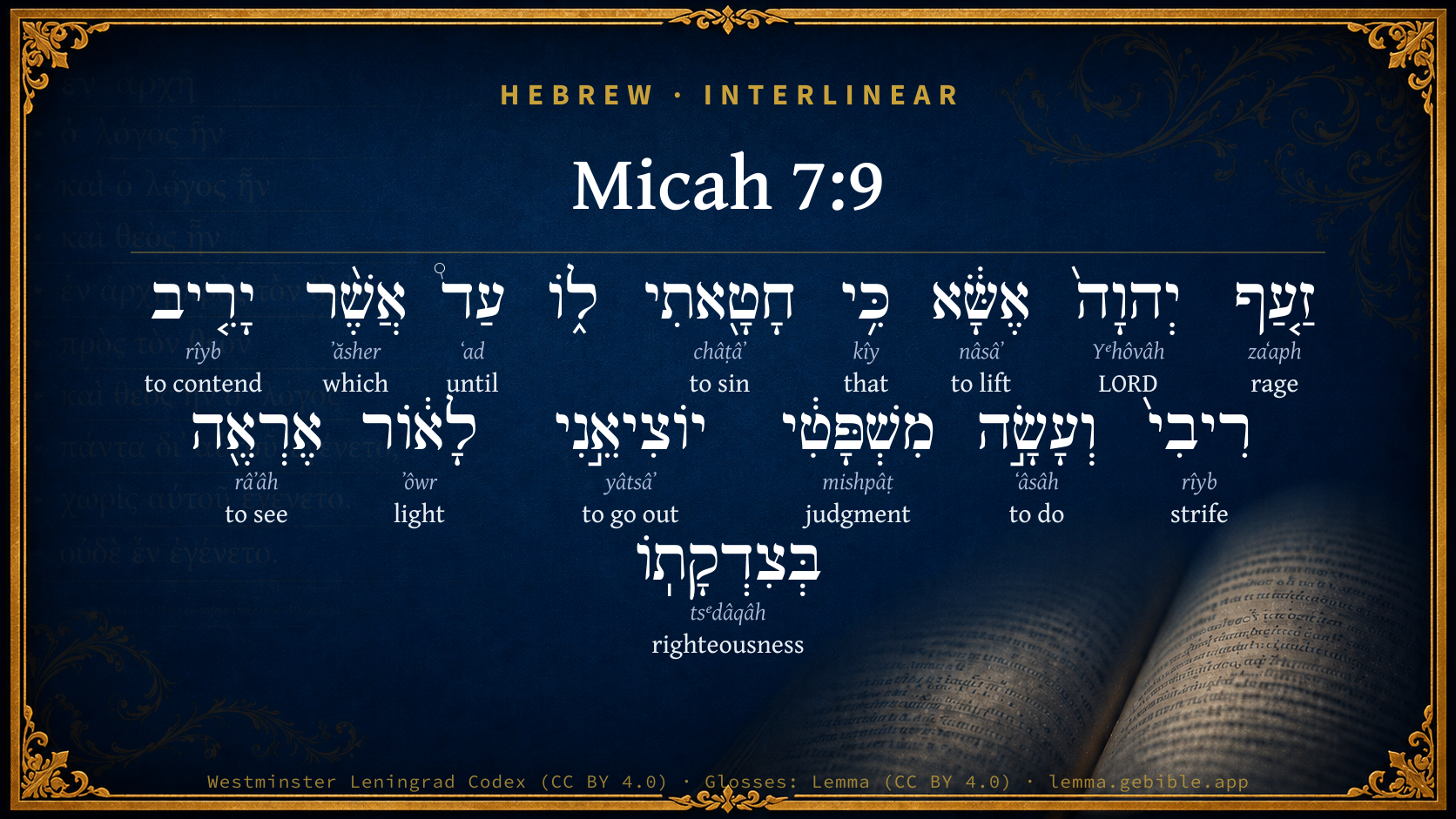
Hebrew (Westminster Leningrad Codex) Micah 7:9 appears in the Hebrew Old Testament. The text above is from the Westminster Leningrad Codex. Each word links to its Strong’s number, a concise gloss, and parsing drawn from the Open Scriptures Hebrew Bible morphology. Click any word for its full Brown-Driver-Briggs (BDB) entry.
Download image
Cite this verse

Micah 7:9 (World English Bible). Public Domain. Lemma interlinear Bible study tool, https://lemma.gebible.app/v/micah/7/9.

Show BibTeX & RIS
BibTeX
RIS
English Translation
I will bear the indignation of Yahweh, Because I have sinned against him, Until he pleads my case, and executes judgment for me. He will bring me forth to the light. I will see his righteousness.
World English Bible · Public Domain
Download a study sheet

One document with this verse’s original text, its word-by-word gloss line, the meaning frame, cross-references with their text, attributed commentary, and full source and license credits — printable, and it pastes into notes with its structure intact.

This verse Autodidact and up

Study sheet (.html) Plain text (.txt)

A passage Seminary Student

Up to 50 verses in one chapter. A passage sheet keeps up to 6 commentary sources and 12 cross-references per verse, in the order this page ranks them, and says so on the sheet whenever that leaves anything out. Ask for a single verse and you get the Autodidact verse sheet above.

Everything on this page stays free to read, with no account — the sheet is a download of what is already on screen, not access to it.

Want to remove ads? Support Godless Engineer
Compare translations 3

The same verse in 3 English versions, stacked beneath the original-language interlinear above. Click any original word for its lexicon entry.

Each is an independent rendering of the whole verse — the interlinear is not word-aligned to these translations.

Highlighted words mark where these versions differ — a whole-verse word diff, not a word-by-word alignment.

  • World English Bible Public Domain
    I will bear the indignation of Yahweh, Because I have sinned against him, Until he pleads my case, and executes judgment for me. He will bring me forth to the light. I will see his righteousness.
  • King James Version Public Domain
    I will bear the indignation of the LORD, because I have sinned against him, until he plead my cause, and execute judgment for me: he will bring me forth to the light, and I shall behold his righteousness.
  • unfoldingWord Literal Text CC BY-SA 4.0
    Because I sinned against Yahweh, I will bear his rage until he pleads my cause, and executes judgment for me. He will bring me to the light, and I will see him rescue me in his justice.

unfoldingWord Literal Text — © unfoldingWord, licensed CC BY-SA 4.0. Word-aligned USFM3 via Door43 (git.door43.org/unfoldingWord/en_ult).

Versions to compare (up to 4)

3 of 4 selected

Show all 18 translations

Every available English version of this verse, each an independent rendering of the whole verse.

  • World English Bible Public Domain
    I will bear the indignation of Yahweh, Because I have sinned against him, Until he pleads my case, and executes judgment for me. He will bring me forth to the light. I will see his righteousness.
  • Berean Standard Bible Public Domain
    Because I have sinned against Him, I must endure the rage of the LORD, until He argues my case and executes justice for me. He will bring me into the light; I will see His righteousness.
  • Majority Standard Bible Public Domain
    Because I have sinned against Him, I must endure the rage of the LORD, until He argues my case and executes justice for me. He will bring me into the light; I will see His righteousness.
  • King James Version Public Domain
    I will bear the indignation of the LORD, because I have sinned against him, until he plead my cause, and execute judgment for me: he will bring me forth to the light, and I shall behold his righteousness.
  • American Standard Version (1901) Public Domain
    I will bear the indignation of Jehovah, because I have sinned against him, until he plead my cause, and execute judgment for me: he will bring me forth to the light, `and' I shall behold his righteousness.
  • Revised Version (1885) Public Domain
    I will bear the indignation of the LORD, because I have sinned against him; until he plead my cause, and execute judgment for me: he will bring me forth to the light, and I shall behold his righteousness.
  • Geneva Bible (1599) Public Domain
    I will beare the wrath of the Lord because I haue sinned against him, vntill he pleade my cause, and execute iudgement for me: then will he bring me foorth to the light, and I shall see his righteousnesse.
  • Douay-Rheims (1899) Public Domain
    I will bear the wrath of the Lord, because I have sinned against him; until he judge my cause and execute judgment for me: he will bring me forth into the light, I shall behold his justice.
  • Young's Literal Translation Public Domain
    The indignation of Jehovah I do bear, For I have sinned against Him, Till that He doth plead my cause, And hath executed my judgment, He doth bring me forth to the light, I look on His righteousness.
  • Literal Standard Version CC BY-SA 4.0
    I bear the indignation of YHWH, || For I have sinned against Him, || Until He pleads my cause, || And has executed my judgment, || He brings me forth to the light, || I look on His righteousness.
  • Unlocked Literal Bible CC BY-SA 4.0
    Because I sinned against Yahweh, I will bear his rage until he pleads my cause, and executes judgment for me. He will bring me to the light, and I will see him rescue me in his justice.
  • unfoldingWord Literal Text CC BY-SA 4.0
    Because I sinned against Yahweh, I will bear his rage until he pleads my cause, and executes judgment for me. He will bring me to the light, and I will see him rescue me in his justice.
  • Darby Bible Public Domain
    I will bear the indignation of Jehovah -- for I have sinned against him -- until he plead my cause, and execute judgment for me: he will bring me forth to the light; I shall behold his righteousness.
  • World Messianic Bible Public Domain
    I will bear the indignation of the LORD, because I have sinned against him, until he pleads my case and executes judgment for me. He will bring me out to the light. I will see his righteousness.
  • Webster's Bible Public Domain
    I will bear the indignation of the LORD, because I have sinned against him, until he shall plead my cause, and execute judgment for me: he will bring me forth to the light, and I shall behold his righteousness.
  • Free Bible Version CC BY-SA 4.0
    I will endure the Lord's anger because I have sinned against him. But after that he will argue my case and give me justice. He will bring me into the light and I will see his integrity.
  • Bible in Basic English Public Domain
    I will undergo the wrath of the Lord, because of my sin against him; till he takes up my cause and does what is right for me: when he makes me come out into the light, I will see his righteousness;
  • JPS Tanakh (1917) Public Domain
    I will bear the indignation of the LORD, because I have sinned against Him; until He plead my cause, and execute judgment for me; He will bring me forth to the light, and I shall behold His righteousness.

Literal Standard Version (2020), Covenant Press — licensed CC BY-SA 4.0. Text via the HelloAO Bible API (eBible.org). Unlocked Literal Bible (unfoldingWord) — licensed CC BY-SA 4.0. Text via the HelloAO Bible API (eBible.org). unfoldingWord Literal Text — © unfoldingWord, licensed CC BY-SA 4.0. Word-aligned USFM3 via Door43 (git.door43.org/unfoldingWord/en_ult). Free Bible Version, Dr. Jonathan Gallagher — licensed CC BY-SA 4.0. Text via the HelloAO Bible API (eBible.org).

Word by word

More ways to search: Search by grammar → Find every occurrence → Compare this word →

Practice this passage: Drill this verse → Learn its vocabulary →

זַ֤עַף
zaʻaph
H2197
“rage of”
Noun, Common, Masculine, Singular, Construct
Part of Speech
Noun
Type
Common
Gender
Masculine
Number
Singular
State
Construct
Full BDB Definition

Origin: from H2196

TWOT: 569a

rage, raging, storming, indignation
  1. יְהוָה֙ Yᵉhôvâh H3068 “LORD” Noun, Proper
  2. אֶשָּׂ֔א nâsâʼ H5375 “to lift” Verb, Qal, Imperfect, 1st Person, Common, Singular
  3. כִּ֥י kîy H3588 “that” Conjunction
  4. חָטָ֖אתִי châṭâʼ H2398 “to sin” Verb, Qal, Perfect, 1st Person, Common, Singular
  5. עַד֩ ʻad H5704 “until” Preposition
  6. אֲשֶׁ֨ר ʼăsher H834 “which” Particle, Relative
  7. יָרִ֤יב rîyb H7378 “to contend” Verb, Qal, Imperfect, 3rd Person, Masculine, Singular
  8. רִיבִי֙ rîyb H7379 “strife · my” Noun, Common, Both, Singular, Construct + Suffix, Personal, 1st Person, Common, Singular
  9. וְעָשָׂ֣ה ʻâsâh H6213 “and · to do” Conjunction + Verb, Qal, Perfect, 3rd Person, Masculine, Singular
  10. מִשְׁפָּטִ֔י mishpâṭ H4941 “judgment · my” Noun, Common, Masculine, Singular, Construct + Suffix, Personal, 1st Person, Common, Singular
  11. יוֹצִיאֵ֣נִי yâtsâʼ H3318 “to go out · me” Verb, Hiphil, Imperfect, 3rd Person, Masculine, Singular + Suffix, Personal, 1st Person, Common, Singular
  12. לָא֔וֹר ʼôwr H216 “to/for the · light” Preposition, Determined + Noun, Common, Both, Singular, Absolute
  13. אֶרְאֶ֖ה râʼâh H7200 “to see” Verb, Qal, Imperfect, 1st Person, Common, Singular
  14. בְּצִדְקָתֽוֹ tsᵉdâqâh H6666 “in/at · righteousness · his” Preposition + Noun, Common, Feminine, Singular, Construct + Suffix, Personal, 3rd Person, Masculine, Singular

About this verse

These counts appear in no published source. They are computed here, from the morphology-tagged text and Lemma’s own curated glosses. What Lemma adds →

16
words
15
distinct lemmas
Prophets
section

Notable vocabulary

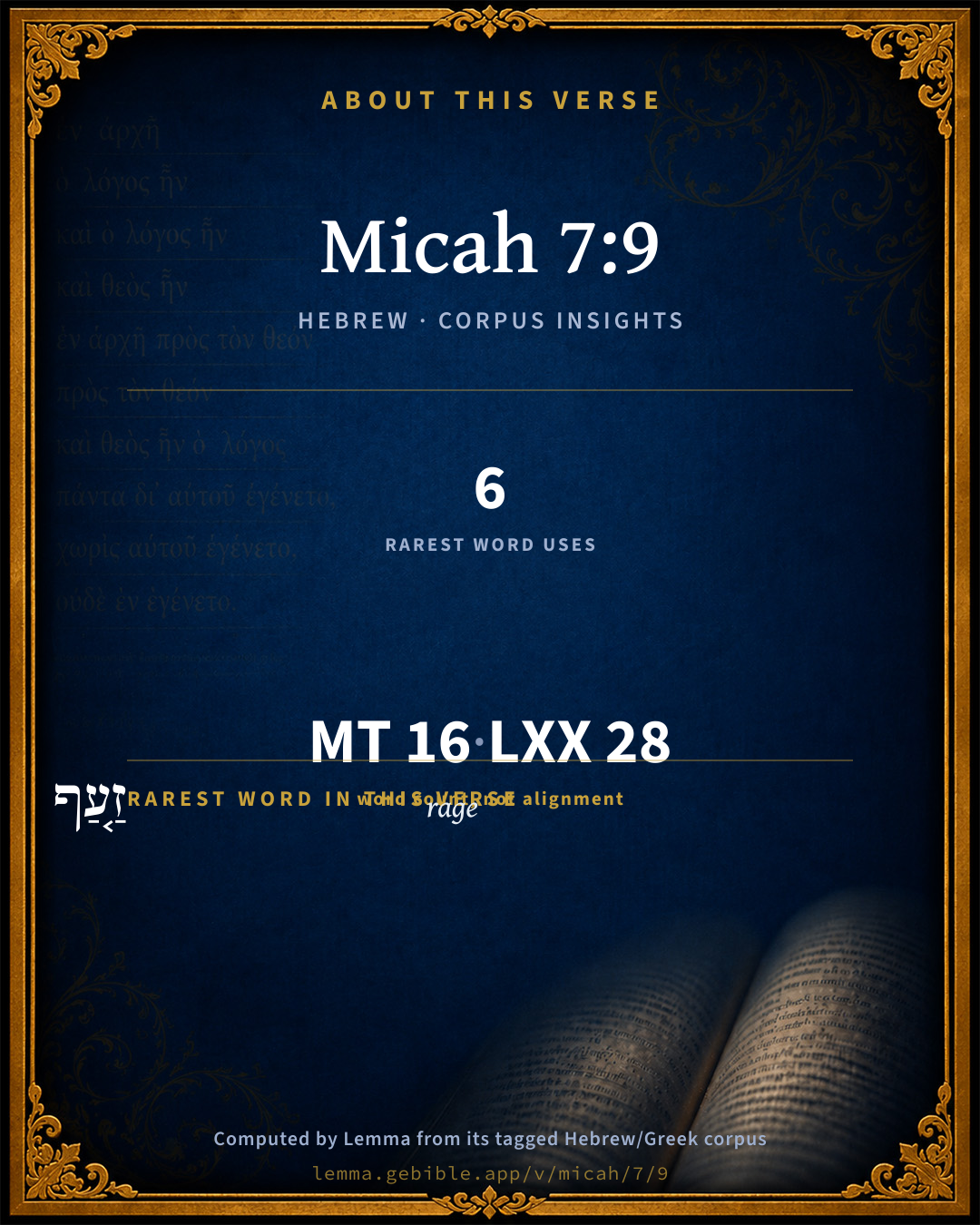
The rarest word here is זַ֤עַף rage H2197 — appearing just 6 times in the whole Hebrew Bible.

Shared distinctive vocabulary

זַ֤עַף rage H2197 occurs in 6 verses of the Hebrew Bible. Also found in:

Grammatical profile

  • 6 verbs
  • 6 nouns
  • 2 prepositions
  • 1 conjunction
  • 1 particle

Verb forms

  • אֶשָּׂ֔א Qal · Imperfect
  • חָטָ֖אתִי Qal · Perfect
  • יָרִ֤יב Qal · Imperfect
  • וְעָשָׂ֣ה Qal · Perfect
  • יוֹצִיאֵ֣נִי Hiphil · Imperfect
  • אֶרְאֶ֖ה Qal · Imperfect

Hebrew & Septuagint length

In English translation the verse runs 36 words from the Hebrew and 40 from the Septuagint (LXX English) — closely comparable.

A rough comparison of the two English renderings, which tokenize alike — not a word-level alignment.

Word counts can differ between the Hebrew and the Greek without any difference in meaning — e.g. the Hebrew direct-object marker אֵת has no separate Greek word, and Greek often adds the article ὁ.

In the original languages it is 16 Hebrew tokens and 28 Greek tokens — but the two are counted differently (Hebrew bundles its prefixes and suffixes into one token; the Greek is in lemma form), so that isn’t a like-for-like length.

Cross-references

26

Topical passages linked to Micah 7:9 in the Treasury of Scripture Knowledge — connected by theme and wording, ordered by reader-vote popularity; previews shown in the World English Bible.

  • 1 Corinthians 4:5 Therefore judge nothing before the time, until the Lord comes, who will both bring to light the hidden things of darkness, and reveal the counsels of the hearts. Then each man will get his praise from God.
  • Psalms 37:6 He will make your righteousness go forth as the light, And your justice as the noon day sun.
  • 1 Samuel 24:15 Yahweh therefore be judge, and give sentence between me and you, and see, and plead my cause, and deliver me out of your hand.
  • 2 Thessalonians 1:5–10 This is an obvious sign of the righteous judgment of God, to the end that you may be counted worthy of the Kingdom of God, for which you also suffer.
  • Hebrews 12:6–7 For whom the Lord loves, he chastens, And scourges every son whom he receives."
  • Lamentations 3:39–42 Why does a living man complain, a man for the punishment of his sins?
  • Malachi 3:18 Then you shall return and discern between the righteous and the wicked, between him who serves God and him who doesn't serve him.
  • 2 Timothy 4:8 From now on, there is stored up for me the crown of righteousness, which the Lord, the righteous judge, will give to me on that day; and not to me only, but also to all those who have loved his appearing.
  • Leviticus 26:41 I also walked contrary to them, and brought them into the land of their enemies: if then their uncircumcised heart is humbled, and they then accept the punishment of their iniquity;
  • 1 Samuel 3:18 Samuel told him every whit, and hid nothing from him. He said, It is Yahweh: let him do what seems him good.
  • 1 Samuel 25:39 When David heard that Nabal was dead, he said, Blessed be Yahweh, who has pleaded the cause of my reproach from the hand of Nabal, and has kept back his servant from evil: and the evil-doing of Nabal has Yahweh returned on his own head. David sent and spoke concerning Abigail, to take her to him as wife.
  • 1 Samuel 26:10 David said, As Yahweh lives, Yahweh will strike him; or his day shall come to die; or he shall go down into battle and perish.
  • 2 Samuel 16:11–12 David said to Abishai, and to all his servants, Behold, my son, who came forth from my bowels, seeks my life: how much more [may] this Benjamite now [do it]? let him alone, and let him curse; for Yahweh has invited him.
  • 2 Samuel 24:17 David spoke to Yahweh when he saw the angel who struck the people, and said, Behold, I have sinned, and I have done perversely; but these sheep, what have they done? Please let your hand be against me, and against my father's house.
  • Job 23:10 But he knows the way that I take. When he has tried me, I shall come forth like gold.
  • Job 34:31–32 "For has any said to God, 'I am guilty, but I will not offend any more.
  • Psalms 7:6 Arise, Yahweh, in your anger. Lift up yourself against the rage of my adversaries. Awake for me. You have commanded judgment.
  • Psalms 43:1 Vindicate me, God, and plead my cause against an ungodly nation. Oh, deliver me from deceitful and wicked men.
  • Isaiah 46:13 I bring near my righteousness, it shall not be far off, and my salvation shall not wait; and I will place salvation in Zion for Israel my glory.
  • Jeremiah 50:17–20 Israel is a hunted sheep; the lions have driven him away: first, the king of Assyria devoured him; and now at last Nebuchadrezzar king of Babylon has broken his bones.
  • Jeremiah 50:33–34 Thus says Yahweh of hosts: The children of Israel and the children of Judah are oppressed together; and all who took them captive hold them fast; they refuse to let them go.
  • Jeremiah 51:35–36 The violence done to me and to my flesh be on Babylon, shall the inhabitant of Zion say; and, My blood be on the inhabitants of Chaldea, shall Jerusalem say.
  • Lamentations 1:18 Yahweh is righteous; for I have rebelled against his commandment: Please hear all you peoples, and see my sorrow: My virgins and my young men are gone into captivity.
  • Luke 15:18–19 I will get up and go to my father, and will tell him, "Father, I have sinned against heaven, and in your sight.
  • Revelation 6:10–11 They cried with a loud voice, saying, "How long, Master, the holy and true, until you judge and avenge our blood on those who dwell on the earth?"
  • Revelation 18:20 Rejoice over her, O heaven, you saints, apostles, and prophets; for God has judged your judgment on her."

Cross-references courtesy of OpenBible.info (CC BY 4.0).

Hebrew and Greek witnesses Masoretic Hebrew ↔ Greek Septuagint

The same verse in the two great witnesses to the Old Testament, shown verse-for-verse.

These are two independent witnesses, not word-aligned to each other, and the Septuagint is shown in lemma (dictionary) form.

Hebrew Micah 7:9 Masoretic · Westminster Leningrad Codex

זַ֤עַף יְהוָה֙ אֶשָּׂ֔א כִּ֥י חָטָ֖אתִי ל֑וֹ עַד֩ אֲשֶׁ֨ר יָרִ֤יב רִיבִי֙ וְעָשָׂ֣ה מִשְׁפָּטִ֔י יוֹצִיאֵ֣נִי לָא֔וֹר אֶרְאֶ֖ה בְּצִדְקָתֽוֹ

I will bear the indignation of Yahweh, Because I have sinned against him, Until he pleads my case, and executes judgment for me. He will bring me forth to the light. I will see his righteousness.

World English Bible · Public Domain

Greek LXX Micah 7:9 Septuagint · lemma form

ὀργή κύριος ὑποφέρω ὅτι ἁμαρτάνω αὐτός ἕως ὁ δικαιόω αὐτός ὁ δίκη ἐγώ καί ποιέω ὁ κρίμα ἐγώ καί ἐκἄγω ἐγώ εἰς ὁ φῶς ὁράω ὁ δικαιοσύνη αὐτός

I will bear the indignation of the Lord, because I have sinned against him, until he make good my cause: he also shall maintain my right, and shall bring me out to the light, and I shall behold his righteousness.

LXX2012 (modern English Septuagint) · Public Domain

Hebrew: Westminster Leningrad Codex (CC BY 4.0). Greek: Septuagint (public domain); English from LXX2012 (modern English Septuagint) (Public Domain). How the Septuagint differs from the Hebrew →

Targum (Aramaic paraphrase)

1

The Targum is the ancient Jewish Aramaic paraphrase of the Hebrew Scriptures — an interpretive translation, not the Hebrew text itself. Onkelos (literal) and Pseudo-Jonathan (expansive) render the Torah, and Jonathan the Prophets. Coverage is partial: where no permissively-licensed English translation exists for a verse, only the Aramaic is shown. This is verse-level text, not a word-by-word alignment to the Hebrew.

  1. Targum Jonathan Prophets (Joshua–Malachi)
    אֲמָרֵית יְרוּשְׁלֵם לְוָט מִן קֳדָם יְיָ קַבְּלֵית אֲרֵי חָבִית קֳדָמוֹהִי עַד דְיָדִין דִינִי וְיִתְפְּרַע עוּלְבָּנִי יַפְקִינַנִי לִנְהוֹר אֶחְזֵי בִּזְכוּתֵיהּ:

    (no public-domain English translation for this verse)

    Targum Jonathan — Aramaic: “Mikraot Gedolot” (public domain). English: “Sefaria Community Translation” (CC0 1.0 (public-domain dedication)); “London "Chaldee Paraphrase," 1871” (public domain). Text via Sefaria.

Commentary

Notes on Micah 7:9 from classic Christian and Jewish commentators (each source and its license shown beneath its notes). The classic Christian expositions comment on the surrounding passage and are grouped to its opening verse, so a note may address several verses; the Jewish commentaries on the Tanakh (Rashi and others) are per-verse, so they appear only where the commentator wrote on this verse.

Lemma curates 59 commentaries, every one of them public domain or Creative Commons licensed, each selected and text-cleaned for this edition rather than reprinted as found. About our sources →

Trapp's Complete Commentary

John Trapp

Mic 7:9 I will bear the indignation of the LORD, because I have sinned against him, until he plead my cause, and execute judgment for me: he will bring me forth to the light, [and] I shall behold his righteousness.

Ver. 9. I will bear the indignation of the Lord, because I have sinned against him] The Church had sinned, and God was angry with her. So Zec 1:12 Isa 57:17. What mean, then, the Antinomians to tell us that God is never angry with his people for their foul and flagitious practices; no, not with a fatherly anger? nor chastiseth them for the same; no, not so much as with a fatherly chastisement? Is not this contra Solem mingere? Godliness is no target against affliction. Blind Nature saw this.

“ nec te tua plurima, Pantheu,

Labentem texit pietas ” -

Only it helps to patient the heart under affliction by considering, 1. That it is the Lord. 2. That, a man suffers for his sin; as the penitent thief also confessed, Luk 23:41 3. That the rod of the wicked shall not lie long upon the lot of the righteous, το πικρον μικρον. Say we then, every one, with David, I know that thy judgments are right, and thou hast afflicted me justly, Psa 119:75; yea, in very faithfulness hast thou done it, that thou mightest be true to my soul: and with that noble Du-plessy, who when he had lost his only son, a gentleman of great hopes (which was the breaking of his mother’s heart), quieted himself with these words of David, "I was silent and said no word, because thou, Lord, didst it," Psa 39:9. See my Love Tokens. It shall be our wisdom in affliction to look to God, and to reflect upon our sins, taking his part against ourselves; as a physician observes which way nature works, and helps it.

Until he plead my cause] As a faithful patron and powerful avenger; for though it be just in God that I suffer, yet it is unjust in mine enemies, who shall shortly be soundly paid for their insolence and cruelty.

He will bring me forth to the light] He will uncloud these gloomy days, and in his light I shall see light.

I shall behold his righteousness] That is, his faithfulness in fulfilling his promise of deliverance in due time. Meanwhile I will live upon reversions, live by faith, and think to make a good living of it too. All the ways of God to his people are "mercy and truth," Psa 25:10 : this is a soul satisfying place of Scripture indeed. All the passages of his providence to them are not only mercy, but truth and righteousness; they come to them in a way of a promise, and by virtue of the covenant, wherein God hath made himself a voluntary debtor to them, 1Jn 1:9.

John Trapp, A Commentary or Exposition upon All the Books of the Old and New Testament (1647–1656) — public domain. Text from a community e-Sword module.

The Biblical Illustrator

Joseph S. Exell

Mic_7:9

I will bear the indignation of the Lord, because I have sinned against Him

The believer, conscious of Gods displeasure, confessing his sin

This is the language of the Church of the living God.

It is a sincere and upright acknowledgment of her own fault. She saw God in the dealing and conduct of her enemies. This led her to confession. This led her to holy determination; and also to patient waiting; and a believing confidence.

I. The solemn purpose of the soul. I will bear the indignation of the Lord. She saw the Lords hand in her afflictions. It is no small wisdom, when we are enabled to see clearly the mind and the dealings of God with us in our afflictions. What was the indignation that the Church had to bear? Not that which God shows to those who despise Him and rebel against Him; but the eternal display of Gods wrath against sin, a holy indignation against iniquity; the indignation of a Fathers displeasure. It is not the less painful for that. It is the very love of the father that makes his displeasure so keen to the heart of the child.

II. The reason that she gives for it. Because I have sinned against Him. Sin should be regarded in three different points of view. There is a course of sin. There are sins into which a child of God may be surprised. There is the missing of the aim of the child of God. There are two features in her confession. She acknowledged the sin to have been against God. And she threw the blame upon herself. Excuse mars confession. She did not throw the blame on inward corruption. Some confess sin, but they only confess it in the general. If a man truly confesses, he searches sin to the root. Nothing more humbles the spirit than such thorough and sincere confession. (J. H. Evans, M. A.)

The child of God under chastisement

The consequences of national backsliding could only be national judgments. This the prophet foresees; and in the name of the pious remnant, he turns to God for that hope and consolation which nothing on earth can yield. As for the chastisement which the Jewish Church was about to suffer, she is taught, in our text, to use the language of submission and of hope. Learn from the text, what are the feelings, what is the behaviour of a child of God under affliction.

I. He submits himself to God. Various are the trials which the people of God are called to endure. There is no promise that they shall be exempt from distressing circumstances. Each one shares the common sorrows of humanity. Each one has also sorrows peculiar to himself, arising from his disposition and circumstances. Yet, in all, the real child of God beholds Gods hand. He knows that, whatever he may have to suffer, it is from the Lord. Knowing, then, whence his troubles come, the child of God bows beneath the chastisement, it may be with a keen feeling of their loss, or woe, but with a patient submission to Gods will.

II. He justifies God. Pride may sometimes enable a man resolutely to bear evils which cannot be avoided. A naturally cheerful temper, also, will not feel the burden of sorrow so heavy as it is felt by a mind naturally anxious and desponding. But Christian submission is accompanied by a feeling which mere cheerfulness cannot produce, and which pride steadily opposes--a feeling of conscious guilt. Every grief is the offspring of sin. The Lord afflicts us, either that we may not forget our original deserts, as children of wrath; or, because we have committed some new transgression; or, as a means of correcting and renewing our naturally corrupt hearts. The child of God, therefore, while he smarts beneath the stroke of chastisement, acknowledges the propriety of it. He submits, for he knows that he has deserved it. This is the state of mind which God desires to behold in every sinner. This is the very end for which earthly trials are sent.

III. Hopes in God. Until He plead my cause. Trust in the mercy of God is no less the duty of a true Christian, than submission to the will of God and an acknowledgment of His justice in afflicting us. The child of God puts his trust in that very hand which smiteth him. Faith enables him to see, that chastisement, when patiently endured, is a sign of his adoption. Being assured of this, he can trust his Fathers kind affection for removing the trial in due time. Thus doth the afflicted child of God lean only upon the hope of His heavenly grace. Worldly sorrows thus become light and tolerable even when they are manifestly the consequences of sin. As I have cautioned you against a merely proud submission to God, and against an impenitent confession of your sinfulness, let me also warn you against a presumptuous hope of Gods mercy. God is a jealous God. There is a hope which will prove at last no better than a vain presumption: and the Bible does not leave us in doubt as to what that hope is. It is the hope of the hypocrite. It is the hope of the careless, thoughtless sinner, who talks loudly about Gods mercy. There is but one way in which you are authorised to hope in God. Approach Him with deep and heartfelt penitence; abhor and forsake every sin; and then your confidence in Him will stand on a secure foundation. (J. Jowett, M. A.)

Culture under trial

Transfer this language from the lips of the Church to the lips of the individual Christian, and consider it as an indication of a spirit which needs to be more largely cultivated.

I. Determination to be cultured under trial. I will bear, etc . . . against Him. Two kinds of indignation spoken of in Scripture. Of one it is said, Who can stand before His indignation? Of the other the Church says, I will bear it. The one, fiery wrath of an offended King; the other, chastening displeasure of a loving Father. The one, hot anger, which utterly consumes; the other, loving correction, which melts, refines, and purifies. While before one none can stand, before the other, that we may be partakers of His holiness, God yearns that we may bow. When the Christian sees chastening displeasure issuing from a Fathers wounded love, he says, I will bear the indignation of the Lord. But something more. Because I have sinned. I will bear it, because it is less than I deserve; because I know who sends it, and the object He has in view. Illustrate Shimeis conduct, and Davids treatment of him (2Sa_16:5-14). Recollect that Gods indignation may fall on us through others, or may come direct from Him.

II. Limit of endurance to be proposed. Until He plead my cause, and execute judgment for me. In the trials which the Church had schooled herself to bear, there had been much of harshness, injustice, and wrong. God permits others to afflict us, whose purpose may be different to His own. Though the wrath of man is hateful, God makes it subservient to His wise purposes, and restrains its exercise. In every case of this kind, we should distinguish between mans purpose and Gods purpose, or patience is beyond our reach. Illustrate Joseph in Egypt; and Israel in Egypt. If then, besides looking at mans purpose, we will train ourselves to look at Gods purpose, and also for Gods limit, we shall be able to appropriate the language of the text, and so follow the example of Christ, who, under trial, committed Himself to Him that judgeth righteously.

III. Expression of confidence to be maintained. He will bring me forth . . . light . . . righteousness. Observe the meaning of the language. Obviously figurative: sorrow, trouble, desolation (whether the temporal or spiritual) continually spoken of as darkness, and the reverse as light. But, when the proper season comes, God fulfils His promise to make darkness light before His servants, by turning doubt into confidence, affliction into prosperity, sorrow into joy; and He brings them forth into the light by removing their burdens, making clear their way, vindicating them from false charges, and revealing, at least in some measure, the reason and benefit of their grief. (W. D. J. Straton, M. A.)

The Biblical Illustrator, edited by Joseph S. Exell (c. 1880s–1900s) — public domain. Text from a community e-Sword module.

Tyndale Open Study Notes

Tyndale Open Resources

7:9 I have sinned: The prophet and other godly people recognize their own failure and culpability, yet trust in the Lord for redemption. • The Lord’s righteousness brings salvation and rescue for his people.

Tyndale Open Study Notes — © Tyndale Open Resources, licensed CC BY-SA 4.0. Text via the HelloAO Bible API.

Jamieson, Fausset & Brown

Robert Jamieson, A. R. Fausset & David Brown

bear--patiently.

the indignation of the Lord--His punishment inflicted on me (Lam 3:39). The true penitent "accepts the punishment of his iniquity" (Lev 26:41, Lev 26:43); they who murmur against God, do not yet know their guilt (Job 40:4-5).

execute judgment for me--against my foe. God's people plead guilty before God; but, in respect to their human foes, they are innocent and undeserving of their foes' injuries.

bring me forth to the light--to the temporal and spiritual redemption.

I shall behold his righteousness--His gracious faithfulness to His promises (Psa 103:17).

Jamieson, Fausset & Brown — Commentary Critical and Explanatory on the Whole Bible (1871) — public domain (CC PDM 1.0). Text via the HelloAO Bible API.

Adam Clarke's Commentary

Verse 9. I will bear the indignation of the Lord] The words of the penitent captives, acknowledging their sins and praying for mercy.

Until he plead my cause] And wo to the slanderers, when God undertakes to plead for the fallen who have returned to him with deep compunction of heart, seeking redemption in the blood of the cross.

Adam Clarke's Commentary on the Bible (1810–1826) — public domain. Text from a community e-Sword/MySword module.

John Calvin's Commentaries

Here the Church of God animates and encourages herself to exercise patience, and does so especially by two arguments. She first sets before herself her sins, and thus humbles herself before God, whom she acknowledges to be a just Judge; and, in the second place, she embraces the hope of the forgiveness of her sins, and from this arises confidence as to her deliverance. By these two supports the Church sustains herself, that she fails not in her troubles, and gathers strength, as I have already said, to endure patiently.

First then he says, The wrath of Jehovah will I bear, for sinned have I against him This passage shows, that when any one is seriously touched with the conviction of God’s judgment, he is at the same time prepared to exercise patience; for it cannot be, but that a sinner, conscious of evil, and knowing that he suffers justly will humbly and thankfully submit to the will of God. Hence when men perversely glamour against God, or murmur, it is certain that they have not as yet been made sensible of their sins. I allow indeed that many feel guilty who yet struggle against God, and fiercely resist his hand as much as they can, and also blaspheme his name when he chastises them: but they are not touched hitherto with the true feeling of penitence, so as to abhor themselves. Judas owned indeed that he had sinned, and freely made such confession, (Matthew 27:3.) Cain tried to cover his sin, but the Lord drew from him an unwilling confession, (Genesis 4:13.) They did not yet repent; nay, they ceased not to contend with God; for Cain complained that his punishment was too heavy to be borne; Judas despaired. And the same thing happens to all the reprobate. They seemed then to have been sufficiently convinced to acknowledge their guilt, and, as it were, to assent to the justice of God’s judgment; but they did not really know their sins, so as to abhor themselves, as I have said, on account of their sins. For true penitence is ever connected with the submission of which the Prophet now speaks. Whosoever then is really conscious of his sins, renders himself at the same time obedient to God, and submits himself altogether to his will. Thus repentance does ever of itself lead to the bearing of the cross; so that he who sets himself before God’s tribunal allows himself to be at the same time chastised, and bears punishment with a submissive mind: as the ox, that is tamed, always takes the yoke without any resistance, so also is he prepared who is really touched with the sense of his sins, to bear any punishment which God may be pleased to inflict on him. This then is the first thing which we ought to learn from these words of the Prophet, The wrath of Jehovah will I bear, for sinned have I against him.

We also learn from this passage, that all who do not patiently bear his scourges contend with God; for though they do not openly accuse God, and say that they are just, they do not yet ascribe to him his legitimate glory, by confessing that he is a righteous judge. — How so? Because these two things are united together and joined by an indissoluble knot — to be sensible of sin — and to submit patiently to the will of the Judge when he inflicts punishment.

Now follows the other argument, Until he decides my cause, and vindicates my right; he will bring me forth into the light, I shall see his righteousness Here the Church leans on another support; for though the Lord should most heavily afflict her, she would not yet cast aside the hope of deliverance; for she knew, as we have already seen, that she was chastised for her good: and indeed no one could even for a moment continue patient in a state of misery, except he entertained the hope of being delivered, and promised to himself a happy escape. These two things then ought not to be separated, and cannot be, — the acknowledgment of our sins, which will humble us before God, — and the knowledge of his goodness, and a firm assurance as to our salvation; for God has testified that he will be ever propitious to us, how much soever he may punish us for our sins, and that he will remember mercy, as Habakkuk says, in the midst of his wrath, (Habakkuk 3:2.) It would not then be sufficient for us to feel our evils, except the consolation, which proceeds from the promises of grace, be added.

The Prophet shows further, that the Church was innocent, with regard to its enemies, though justly suffering punishment. And this ought to be carefully observed; for whenever we have to do with the wicked, we think that there is no blame belonging to us. But these two things ought to be considered, — that the wicked trouble us without reason, and thus our cause as to them is just, — and yet that we are justly afflicted by God; for we shall ever find many reasons why the Lord should chastise us. These two things, then, ought to be both considered by us, as the Prophet seems to intimate here: for at the beginning of the verse he says, The wrath of God will I bear, for sinned have I against him; and now he adds, The Lord will yet vindicate my right, literally, “will debate my dispute,” that is, plead my cause. Since the Church is guilty before God, nay, waits not for the sentence of the judge, but anticipates it, and freely confesses herself to be worthy of such punishment, what does this mean, — that the Lord will decide her quarrel, that he will undertake her cause? These two things seem to militate the one against the other: but they agree well together when viewed in their different bearings. The Church had confessed that she had sinned against God; she now turns her eyes to another quarter; for she knew that she was unjustly oppressed by enemies; she knew that they were led to do wrong by cruelty alone. This then is the reason why the Church entertained hope, and expected that God would become the defender of her innocence, that is, against the wicked: and yet she humbly acknowledged that she had sinned against God. Whenever, then, our enemies do us harm, let us lay hold on this truth, — that God will become our defender; for he is ever the patron of justice and equity: it cannot then be, that God will abandon us to the violence of the wicked. He will then at length plead our pleading, or undertake our cause, and be its advocate. But, in the meantime, let our sins be remembered by us, that, being truly humbled before God, we may not hope for the salvation which he promises to us, except through gratuitous pardon. Why then are the faithful bidden to be of good comfort in their afflictions? Because God has promised to be their Father; he has received them under his protection, he has testified that his help shall never be wanting to them. But whence is this confidence? Is it because they are worthy? Is it because they have deserved something of this kind? By no means: but they acknowledge themselves to be guilty, when they humbly prostrate themselves before God, and when they willingly condemn themselves before his tribunal, that they may anticipate his judgment. We now see how well the Prophet connects together these two things, which might otherwise seem contradictory.

Now follow the words, He will bring me to the light, I shall see his righteousness! The Church still confirms herself in the hope of deliverance: art it is hence also manifest how God is light to the faithful in obscure darkness, because they see that there is prepared for them an escape from their evils; but they see it at a distance, for they extend their hope beyond the boundaries of this life. As then the truth of God diffuses itself through heaven and earth, so the faithful extend their hope far and wide. Thus it is, that they can see light afar off, which seems to be very remote from them. And having this confidence, the Prophet says, The Lord will bring me into the light. They have, in the meantime, as I have already said, some light; they enjoy a taste of God’s goodness in the midst of their evils: but the Prophet now refers to that coming forth which we ought to look for even in the worst circumstances.

He then adds, I shall see his righteousness By God’s righteousness is to be understood, as it has been elsewhere stated, his favor towards the faithful; not that God returns for their works the salvation which he bestows, as ungodly men foolishly imagine; for they lay hold on the word righteousness, and think that whatever favors God freely grants us are due to our merits. — How so? For God in this way shows his own righteousness. But far different is the reason for this mode of speaking. God, in order to show how dear and precious to him is our salvation, does indeed say, that he designs to give an evidence of his justice in delivering us: but there is a reference in this word righteousness to something else; for God has promised that our salvation shall be the object of his care, hence he appears just whenever he delivers us from our troubles. Then the righteousness of God is not to be referred to the merits of works, but, on the contrary, to the promise by which he has bound himself to us; and so also in the same dense God is often said to be faithful. In a word, the righteousness and faithfulness of God mean the same thing. When the Prophet says now in the person of the Church, I shall see his righteousness, he means, that though God concealed his favor for a time, and withdrew his hand, so that no hope of aid remained, it could not yet be, as he is just, but that he would succor us: I shall see then his righteousness, that is, God will at length really show that he is righteous. It now follows —

John Calvin's Commentaries (1540-1563) — public domain. Text from the Calvin Translation Society English edition (1840s-50s) via the Christian Classics Ethereal Library (ccel.org). Calvin's coverage is partial (roughly two-thirds of the Bible); uncommented books and verses are honest gaps, never fabricated. The 19th-century editor's footnotes and remarks are omitted so the notes are faithfully Calvin's own voice.

Ellicott's Commentary for English Readers

(9) I will bear.—Micah places himself and his people with confidence in the hands of God. So, too, id David speak when his sin was brought home to him by God: “I am in a great strait; let us fall now into the hand of the Lord: for His mercies are great; and let me not fall into the hand of man” (2Sa_24:14). “This is the temper of all penitents when stricken by God, or under chastisement from Him.”

A Bible Commentary for English Readers, edited by Charles John Ellicott (1878–1897) — public domain. Text from a community e-Sword module.

The Cambridge Bible for Schools and Colleges

gen. ed. J. J. S. Perowne

9. I will bear the indignation …] The speaker is sure that Jehovah is still his God; consequently in wrath He will still remember mercy, and will, in His own good time, remove the rod.

I have sinned against him] The pious portion of Israel is included in the confession, as in Isa_64:5.

my cause] i.e. Israel’s quarrel with the oppressor.

his righteousness] i.e. His interposition for my deliverance. When God has once entered into a covenant, it is only ‘righteous’ for Him to protect those who are in relations with Him. This conception of the Divine righteousness is important; as another equally Biblical conception (the forensic) has become almost too prominent. So St John says (1st Eph_1:9) that God is ‘faithful and righteous to forgive us our sins.’

The Cambridge Bible for Schools and Colleges (gen. ed. J. J. S. Perowne; Cambridge University Press, 1878–1918) — public domain. Text from a community e-Sword module.

John Gill's Exposition

I will bear the indignation of the Lord,.... The Targum prefaces these words with

"Jerusalem saith;''

and they are the words of the prophet, in the name of Jerusalem or the church, resolving in the strength of divine grace to bear the present affliction, which had at least some appearance of divine indignation in it; not against the persons of God's people, who are always the objects of his love, and towards whom there is no fury in him; but against their sins, which are displeasing and abominable to him; and this is not in a vindictive way, for such indignation they could never bear; nor can any creature stand before it, or bear up under it; and, besides, Christ has bore the wrath and indignation of God in this sense for them but it here means the displicency and indignation of God in fatherly chastisements, consistent with the strongest love and affection for them; and to bear this is to be humble under the mighty hand of God, quietly to submit to it, and patiently to endure the affliction, without murmuring and repining, till the Lord pleases to remove it. The reason follows,

because I have sinned against him; the best of men sin; sin is the cause and reason of all affliction and distress, whether temporal or spiritual. The consideration of this tends to make and keep good men humble, and quietly submit to the chastising rod of their heavenly father, which they see it is right and proper should be used; and as knowing that they are chastised and afflicted less than their iniquities deserve; and that it is all for their good; a sense of sin stops their mouths, that they have nothing to say against God. The word here used sometimes signifies the offering an expiatory sacrifice for sin to God; and Gussetius (c) thinks this is the meaning of it here; and observes, that with the oblation of a contrite heart, and works of charity, the satisfaction of Christ is to be pleaded, and in our way to be offered up to God the Judge, through faith flying to it; whereby the mind is disposed to bear correction patiently, in hope that favour will quickly shine forth in help and deliverance:

until he plead cause, and execute judgment for me; Christ the mighty Redeemer, and powerful and prevalent Mediator, not only pleads the cause of his people with God his Father, and obtains all blessings of grace for them; but he also pleads their cause against their enemies, an ungodly people that strive with them, persecute and distress them; and will in his own time do them justice, and execute vengeance, his righteous judgments, on those that hate them, and rise up against them, as he will on all the antichristian party:

he will bring me forth to the light; like a person taken out of prison, or out of a dungeon, to behold and enjoy the light of the sun and day. The sense is, that he will openly espouse the cause of his church, and give her honour and glory publicly before men; bring forth her righteousness as the light, and her judgment as the noon day; and make her innocence appear as clear as the day, and bring her at last to the light of glory; see Psa 37:6;

and I shall behold his righteousness: the equity of his proceedings with his people, in chastising and afflicting them, that they are all right and good; his justice in punishing their enemies, and executing judgment on them; his goodness and beneficence to the saints, all his ways being mercy and truth; his faithfulness in the fulfilment of his promises; and the righteousness of Christ, which justifies them before God, renders them acceptable to him, will answer for them in a time to come, and introduce them into his everlasting kingdom and glory.

(c) Ebr. Comment. p. 923.

John Gill's Exposition of the Whole Bible (1746–1763) — public domain (CC PDM 1.0). Text via the HelloAO Bible API.

Albert Barnes' Notes on the Bible

I will bear the indignation of the Lord, because I have sinned against Him - This is the temper of all penitents, when stricken by God, or under chastisement from Him. “It is the Lord, let Him, do what seemeth Him good” 1Sa 3:18. “So let him curse, because the Lord hath said unto him, curse David. Who shall then say, Wherefore hast thou done so?” 2Sa 16:10. “He putteth his mouth in the dust; if so be there may be hope” Lam 3:29. The penitent owns the just sentence of God, and, knowing that he deserves far more than God inflicts, is thankful to endure it, “until He remove it, until He plead my cause rend execute judgment for me”, that is, until God Himself think the punishments inflicted, enough, and judge between me and those through whose hands they come. The judgments which God righteously sends, and which man suffers righteously from Him, are unrighteously inflicted by those whose malice He overrules, whether it be that of evil men (as the Assyrian or the Chaldaean or the Edomite) or of Satan. The close of the chastisements of His people is the beginning of the visible punishment of their misdecds, who used amiss the power which God gave them over it.

Whence it is said, “Daughter of Babylon, the wasted! blessed he that rewardth thee as thou hast served us” Psa 137:8. But all is of the mercy of God. So He saith, “He shall bring me forth to the light” of His Countenance and His favor and His truth. Micah speaks in the name of those who were penitent, and so were forgiven, and yet, in that they were under punishment, seemed to lie under the wrath of God. For, although God remits at once the eternal penalty of sin, yet we see daily, how punishment pursues the for given sinner, even to the end of life. The light of God’s love may not, on grounds which He knoweth, shine unchequered upon him. We should not know the blackness of the offence of sin, and should never know the depth of God’s mercy, but for our punishment. The indignation of God toward the penitcnt is an austere form of His love. So then penitents may well say, in every grief or sickness or visitation or disappointment, I will bear the indignation of the Lord, because I have sinned against Him. He says, “I shall behold His righteousness”, because they had a righteous cause against man, although not toward God, and God in His just judgment on their enemies shewed Himself as the righteous Judge of the world.

Albert Barnes' Notes on the Bible (1834–1885) — public domain. Text from a community e-Sword/MySword module.

Matthew Poole's English Annotations

I will bear, patiently and submissively, the indignation of the Lord; the just and chastising anger of the Lord, in the effects of it upon me.

Because I have sinned against him, greatly, continually, both against his law and the precepts thereof, and against his love and the effects thereof. Judah was guilty of idolatry, ingratitude against God; and of injustice, unfaithfulness, and unmercifulness against one another; and these sins deserved sorer punishments than they suffered, therefore the righteous ones here justify God, and humble themselves.

Until he plead my cause against mine enemy, for that he will ere long do, as well as now he doth plead his own cause against me. He will be as well a just judge against mine enemies, to avenge me on them, as he is a just God, by my sins provoked to chastise me.

And execute judgment for me; when that day comes, he will certainly and evidently declare his judgment to be against mine insulting adversaries, my cruel enemies, and that he doth so punish them for my sake, as Psa 137:7; Isa 10:5,12; Jer 30:8; Zec 1:12,15.

He, the great and glorious, the holy and just God, who now chastiseth me,

will bring me forth to the light; as a prisoner brought out of a dark prison or dungeon into the light, is set at liberty, advanced and beautified, so shall the church be delivered and made to prosper.

I shall behold his righteousness; the truth and riches of his promised salvation. This made good, partly in the restitution of the captivity, rebuilding of Jerusalem by order of Cyrus and Darius, and partly before this in Hezekiah’s rescue from Sennacherib’s pride and rage.

Matthew Poole's English Annotations on the Holy Bible (1683–1685) — public domain. Text from a community e-Sword/MySword module.

The Pulpit Commentary

I will bear the indignation of the Lord. However long may be the delay before relief comes, Israel will patiently bear the chastisements inflicted upon her, because she knows that they are deserved. This is the language of the penitent people, owning the justice of the sentence, yet trusting to the covenant God, who in wrath remembers mercy. Until he plead my cause. Until God considers that the punishment has done its work, and takes my cause in hand, and judges between me and the instruments of his vengeance. Execute judgment for me. Secure my rights, violated by the heathen, who misuse the power given them by God. The light (see note on ver. 8). His righteousness; (Mic_6:5) his faithfulness to his premises exhibited in the destruction of the enemies and the restoration of his people. For this conception of the Divine righteousness, Cheyne compares 1Jn_1:9, "He is faithful and righteous to forgive us our sins."

The Pulpit Commentary (1880–1919), ed. H.D.M. Spence-Jones & Joseph S. Exell — public domain. Text from a community e-Sword module.

John Wesley's Explanatory Notes

Plead - Against mine enemy, now he pleads his own cause against me. His righteousness - The truth and riches of his promised salvation.

John Wesley, Explanatory Notes Upon the Whole Bible (1754–1765) — public domain. Text via the GEBible commentary corpus.

Keil & Delitzsch

C. F. Keil & F. Delitzsch

"The wrath of Jehovah shall I bear, for I have sinned against Him, till He shall fight my fight, and secure my right. He will bring me forth to the light; I shall behold His righteousness. Mic 7:10. And may my enemy see it, and shame cover her, who hath said to me, Where is Jehovah thy God? Mine eyes will see it; now will she be for a treading down, like mire of the streets." Confidence in the help of the Lord flows from the consciousness, that the wretchedness and sufferings are a merited punishment for the sins. This consciousness and feeling generate patience and hope: patience to bear the wrath of God manifesting itself in the sufferings; hope that the sufferings, as inflicted by the righteous God, will cease as soon as the divine justice has been satisfied. Za‛aph: lit., the foaming up of wrath (Isa 30:30); hence strong wrath. This the church will bear, till the Lord conducts its conflict and secures its rights. ריבי is the judicial conflict between Israel and the heathen power of the world. Although, for example, God had given up His nation to the power of its enemies, the nations of the world, on account of its sins, so that they accomplished the will of God, by destroying the kingdoms of Israel and Judah, and carrying away the people into exile; yet they grew proud of their own might in so doing, and did not recognise themselves as instruments of punishment in the hand of the Lord, but attributed their victories to the power of their own arm, and even aimed at the destruction of Israel, with scornful defiance of the living God (cf. Isa 10:5-15; Hab 1:11). Thus they violated the rights of Israel, so that the Lord was obliged to conduct the contest of His people with the heathen, and secure the rights of Israel by the overthrow of the heathen power of the world. For ריב ריבי, see Psa 43:1; for עשׂה משׁפּט, Psa 9:4-5; and for the fact itself, Isa 49:25; Isa 51:22. Mishpât is Israel's right, in opposition to the powers of the world, who would destroy it. The following word יוציאני is not governed by עד אשׁר, as the absence of the copula Vav shows. With these words the hope takes the form of the certain assurance that the Lord will remove the distress, and let Israel see His righteousness. Tsedâqâh is the righteousness of God revealing itself in the forgiveness and restoration of Israel to favour; like tsedâqōth in Mic 6:5 : in actual fact, the salvation of Israel about to be secured, regarded as an emanation of the righteousness of the covenant God; hence parallel to אור. ראה with ב, to look at, so that one penetrates, as it were, into an object, seeing with feasting of the eyes (so also in Mic 7:10). This exaltation of Israel to new salvation it is hoped that the enemy will see (ותרא, opt.), and be covered with shame; for the power of the world is overthrown, in order that Israel may be redeemed out of its power. This desire is a just one, because the enemy has despised the Lord God. For the expression, "Where is Jehovah thy God?" compare Joe 2:17. And Israel will see its fulfilment (תּראינּה with Nun doubled after a sharpened ; see Ewald, 198, a). ‛Attâh, now (seeing the future in spirit, as having already come), the enemy will be trodden down like mire of the streets (for this figure, see Isa 10:6).

Keil & Delitzsch — Biblical Commentary on the Old Testament (1861–1891) — public domain (CC PDM 1.0). Text via the HelloAO Bible API. (Old Testament only.)

unfoldingWord translationNotes

Door43 World Missions Community

General Information:

Micah continues the poem that began in Micah 7:8, speaking as if he were one woman speaking to her enemy, another woman. This is perhaps the daughter of Zion (Micah 1:13), who represents the people of Israel, speaking to the "daughter of soldiers" (Micah 5:1), who represents the nations which attacked Israel. (See: Metaphor)

I will bear his rage

Rage is spoken of as if it were a solid object that Yahweh was forcing Micah to carry. AT: "I will suffer because he is angry with me" (See: Metaphor)

until he pleads my cause, and executes judgment for me

Yahweh will punish the people of the other nations who harmed the people of Israel.

he pleads my cause

Yahweh is spoken of as if he were defending Micah in court. AT: "he defends me against those who harm me" (See: Metaphor)

executes judgment for me

"brings about justice for me"

He will bring me to the light

Bringing Micah from darkness (Micah 7:8) to light is a metaphor for ending the suffering from disaster and enabling him to live well. (See: Metaphor)

rescue me in his justice

"bring justice to me and rescue me"

translationWords

sin

Yahweh

judge

light

just

unfoldingWord translationNotes — © Distant Shores Media and the Door43 World Missions Community, licensed CC BY-SA 4.0. Source: git.door43.org/Door43/en_tn.

Lesson kit

Teaching starters — assembled from the data on this page, not authored interpretation. Every prompt links to the verse data it draws on. Edit before teaching.

Micah, in the Prophets, opens this verse with 16 words (15 distinct Hebrew lemmas). Its most distinctive word is zaʻaph (“rage”). A historical commentator’s framing appears above. Read the whole chapter for the surrounding context.

Discussion questions

  1. How does “rage” (zaʻaph) shape what this verse is saying?
  2. 2 Chronicles 16:10 shares the word «rage» with this verse. How do the two illuminate each other?
  3. These translations render this verse differently. What is at stake in choosing one wording over another?
  4. The verb «אֶשָּׂ֔א» is Qal Imperfect. How does its form color the action?
  5. Reading how Trapp's Complete Commentary and The Biblical Illustrator read this verse, where do the two commentators agree and where do they part?

Things to notice

Reading settings

Reading text

Shown beneath each verse's original-language words.

Old Testament
Old Testament edition

Read the OT as the Masoretic Hebrew (MT) or the Greek Septuagint (LXX).

English shown for the Greek Septuagint (in the Hebrew ↔ Greek comparison).

Comparing translations? Open the Compare panel on any verse page to stack up to four side by side.