
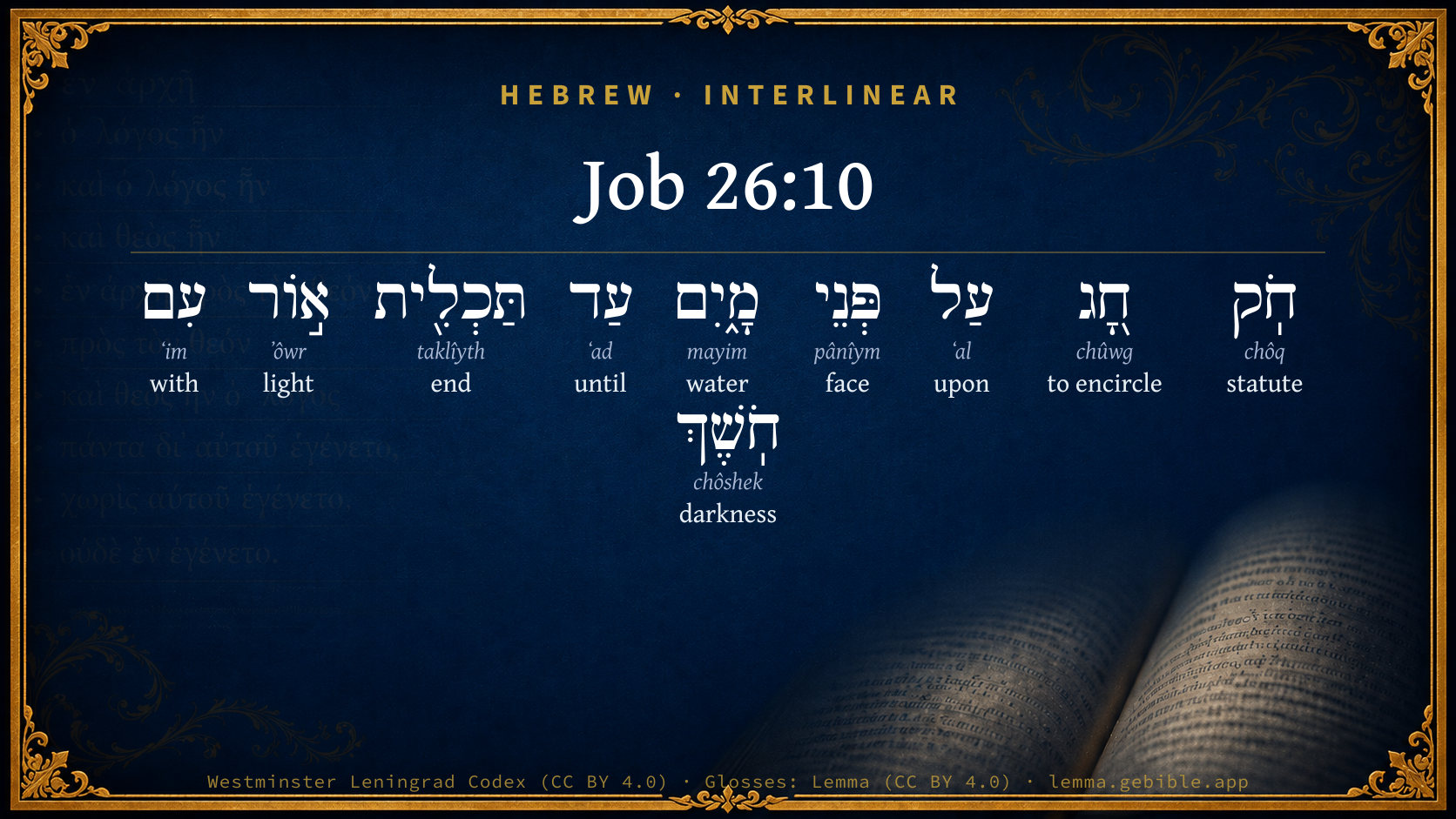
Job 26:10

Hebrew (Westminster Leningrad Codex) Job 26:10 appears in the Hebrew Old Testament. The text above is from the Westminster Leningrad Codex. Each word links to its Strong’s number, a concise gloss, and parsing drawn from the Open Scriptures Hebrew Bible morphology. Click any word for its full Brown-Driver-Briggs (BDB) entry.
Download image
Cite this verse

Job 26:10 (World English Bible). Public Domain. Lemma interlinear Bible study tool, https://lemma.gebible.app/v/job/26/10.

Show BibTeX & RIS
BibTeX
RIS
English Translation
He has described a boundary on the surface of the waters, And to the confines of light and darkness.
World English Bible · Public Domain
Highlights
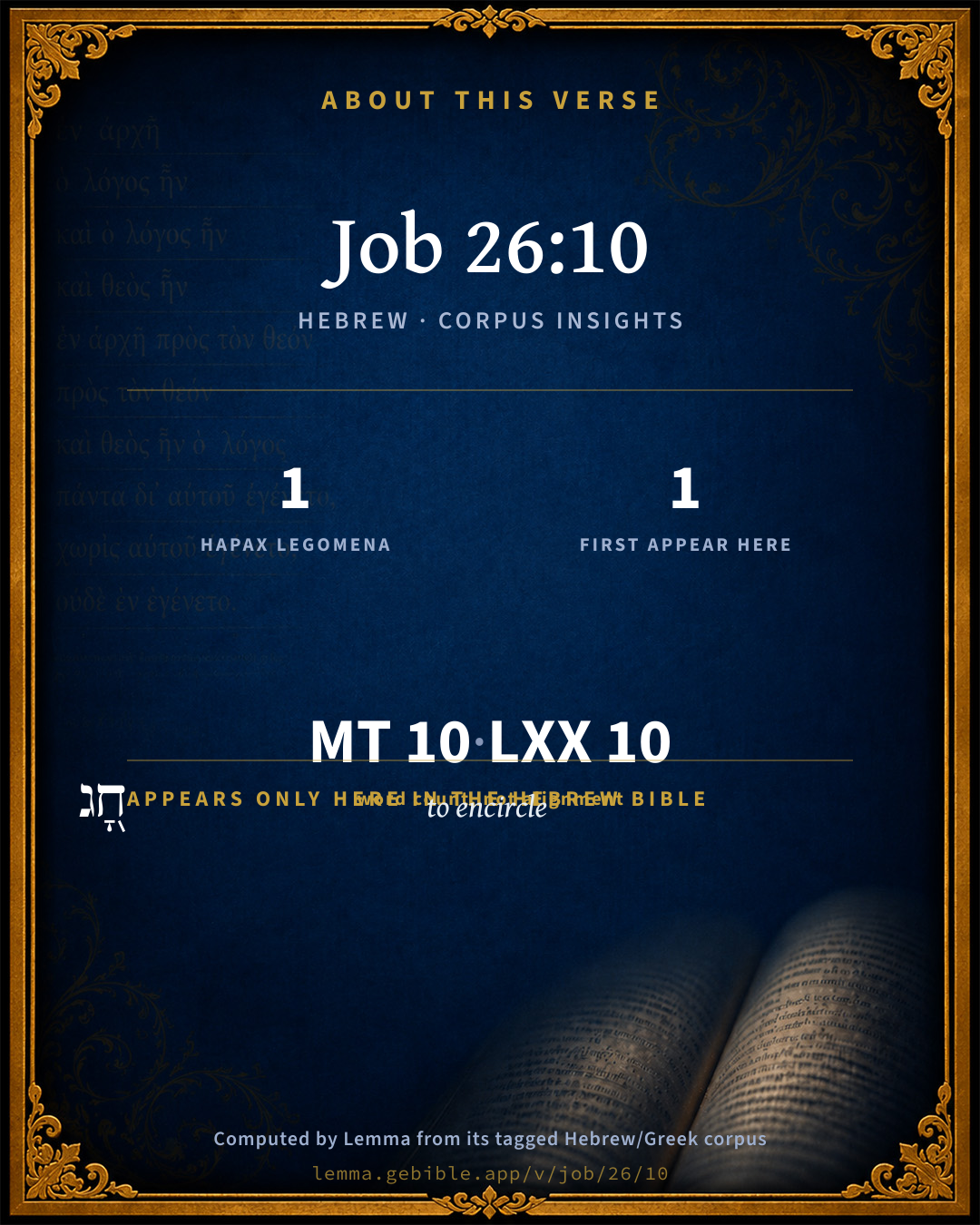
  • 1 hapax legomenon — only here in the Hebrew Bible
  • 1 first appearance in the Hebrew Bible
Full analysis ↓
Download a study sheet

One document with this verse’s original text, its word-by-word gloss line, the meaning frame, cross-references with their text, attributed commentary, and full source and license credits — printable, and it pastes into notes with its structure intact.

This verse Autodidact and up

Study sheet (.html) Plain text (.txt)

A passage Seminary Student

Up to 50 verses in one chapter. A passage sheet keeps up to 6 commentary sources and 12 cross-references per verse, in the order this page ranks them, and says so on the sheet whenever that leaves anything out. Ask for a single verse and you get the Autodidact verse sheet above.

Everything on this page stays free to read, with no account — the sheet is a download of what is already on screen, not access to it.

Want to remove ads? Support Godless Engineer
Compare translations 3

The same verse in 3 English versions, stacked beneath the original-language interlinear above. Click any original word for its lexicon entry.

Each is an independent rendering of the whole verse — the interlinear is not word-aligned to these translations.

Highlighted words mark where these versions differ — a whole-verse word diff, not a word-by-word alignment.

  • World English Bible Public Domain
    He has described a boundary on the surface of the waters, And to the confines of light and darkness.
  • King James Version Public Domain
    He hath compassed the waters with bounds, until the day and night come to an end.
  • unfoldingWord Literal Text CC BY-SA 4.0
    He has circled a limit on the face of the waters unto the boundary of light with darkness.

unfoldingWord Literal Text — © unfoldingWord, licensed CC BY-SA 4.0. Word-aligned USFM3 via Door43 (git.door43.org/unfoldingWord/en_ult).

Versions to compare (up to 4)

3 of 4 selected

Show all 18 translations

Every available English version of this verse, each an independent rendering of the whole verse.

  • World English Bible Public Domain
    He has described a boundary on the surface of the waters, And to the confines of light and darkness.
  • Berean Standard Bible Public Domain
    He has inscribed a horizon on the face of the waters at the boundary between light and darkness.
  • Majority Standard Bible Public Domain
    He has inscribed a horizon on the face of the waters at the boundary between light and darkness.
  • King James Version Public Domain
    He hath compassed the waters with bounds, until the day and night come to an end.
  • American Standard Version (1901) Public Domain
    He hath described a boundary upon the face of the waters, Unto the confines of light and darkness.
  • Revised Version (1885) Public Domain
    He hath described a boundary upon the face of the waters, unto the confines of light and darkness.
  • Geneva Bible (1599) Public Domain
    He hath set bounds about the waters, vntil the day and night come to an ende.
  • Douay-Rheims (1899) Public Domain
    He hath set bounds about the waters, till light and darkness come to an end.
  • Young's Literal Translation Public Domain
    A limit He hath placed on the waters, Unto the boundary of light with darkness.
  • Literal Standard Version CC BY-SA 4.0
    He has placed a limit on the waters, || To the boundary of light with darkness.
  • Unlocked Literal Bible CC BY-SA 4.0
    He has engraved a circular boundary on the surface of the waters as the line between light and darkness.
  • unfoldingWord Literal Text CC BY-SA 4.0
    He has circled a limit on the face of the waters unto the boundary of light with darkness.
  • Darby Bible Public Domain
    He hath traced a fixed circle over the waters, unto the confines of light and darkness.
  • World Messianic Bible Public Domain
    He has described a boundary on the surface of the waters, and to the confines of light and darkness.
  • Webster's Bible Public Domain
    He hath encompassed the waters with bounds, until the day and night come to an end.
  • Free Bible Version CC BY-SA 4.0
    On the surface of the waters he set a boundary; he set a limit dividing light from darkness.
  • Bible in Basic English Public Domain
    By him a circle is marked out on the face of the waters, to the limits of the light and the dark.
  • JPS Tanakh (1917) Public Domain
    He hath described a boundary upon the face of the waters, unto the confines of light and darkness.

Literal Standard Version (2020), Covenant Press — licensed CC BY-SA 4.0. Text via the HelloAO Bible API (eBible.org). Unlocked Literal Bible (unfoldingWord) — licensed CC BY-SA 4.0. Text via the HelloAO Bible API (eBible.org). unfoldingWord Literal Text — © unfoldingWord, licensed CC BY-SA 4.0. Word-aligned USFM3 via Door43 (git.door43.org/unfoldingWord/en_ult). Free Bible Version, Dr. Jonathan Gallagher — licensed CC BY-SA 4.0. Text via the HelloAO Bible API (eBible.org).

Word by word

More ways to search: Search by grammar → Find every occurrence → Compare this word →

Practice this passage: Drill this verse → Learn its vocabulary →

About this verse

These counts appear in no published source. They are computed here, from the morphology-tagged text and Lemma’s own curated glosses. What Lemma adds →

10
words
10
distinct lemmas
Wisdom
section

Notable vocabulary

1 hapax legomenon — a word that appears only here in the entire Hebrew Bible:

  • חָ֭ג to encircle H2328

First appearance in Scripture

This word makes its first canonical appearance in the Hebrew Bible here:

  • חָ֭ג to encircle H2328

Shared distinctive vocabulary

תַּכְלִ֖ית end H8503 occurs in 5 verses of the Hebrew Bible. Also found in:

Grammatical profile

  • 1 verb
  • 6 nouns
  • 3 prepositions

Verb forms

  • חָ֭ג Qal · Perfect

Hebrew & Septuagint length

In English translation the verse runs 19 words from the Hebrew and 19 from the Septuagint (LXX English) — the same length.

A rough comparison of the two English renderings, which tokenize alike — not a word-level alignment.

Word counts can differ between the Hebrew and the Greek without any difference in meaning — e.g. the Hebrew direct-object marker אֵת has no separate Greek word, and Greek often adds the article ὁ.

In the original languages it is 10 Hebrew tokens and 10 Greek tokens — but the two are counted differently (Hebrew bundles its prefixes and suffixes into one token; the Greek is in lemma form), so that isn’t a like-for-like length.

Cross-references

7

Topical passages linked to Job 26:10 in the Treasury of Scripture Knowledge — connected by theme and wording, ordered by reader-vote popularity; previews shown in the World English Bible.

  • Proverbs 8:29 When he gave to the sea its boundary, That the waters should not violate his commandment, When he marked out the foundations of the earth;
  • Job 38:8–11 "Or who shut up the sea with doors, When it broke forth from the womb,
  • Jeremiah 5:22 Don't you fear me? says Yahweh: won't you tremble at my presence, who have placed the sand for the bound of the sea, by a perpetual decree, that it can't pass it? and though the waves of it toss themselves, yet they can't prevail; though they roar, yet they can't pass over it.
  • Psalms 33:7 He gathers the waters of the sea together as a heap. He lays up the deeps in storehouses.
  • Genesis 8:22 While the earth remains, seed time and harvest, and cold and heat, and summer and winter, and day and night shall not cease."
  • Psalms 104:6–9 You covered it with the deep as with a cloak. The waters stood above the mountains.
  • Isaiah 54:9–10 For this is [as] the waters of Noah to me; for as I have sworn that the waters of Noah shall no more go over the earth, so have I sworn that I will not be angry with you, nor rebuke you.

Cross-references courtesy of OpenBible.info (CC BY 4.0).

Hebrew and Greek witnesses Masoretic Hebrew ↔ Greek Septuagint

The same verse in the two great witnesses to the Old Testament, shown verse-for-verse.

These are two independent witnesses, not word-aligned to each other, and the Septuagint is shown in lemma (dictionary) form.

Hebrew Job 26:10 Masoretic · Westminster Leningrad Codex

חֹֽק חָ֭ג עַל פְּנֵי מָ֑יִם עַד תַּכְלִ֖ית א֣וֹר עִם חֹֽשֶׁךְ

He has described a boundary on the surface of the waters, And to the confines of light and darkness.

World English Bible · Public Domain

Greek LXX Job 26:10 Septuagint · lemma form

πρόσταγμα γυρόω ἐπί πρόσωπον ὕδωρ μέχρι συντέλεια φῶς μετά σκότος

He has encompassed the face of the water by an appointed ordinance, until the end of light and darkness.

LXX2012 (modern English Septuagint) · Public Domain

Hebrew: Westminster Leningrad Codex (CC BY 4.0). Greek: Septuagint (public domain); English from LXX2012 (modern English Septuagint) (Public Domain). How the Septuagint differs from the Hebrew →

Commentary

Notes on Job 26:10 from classic Christian and Jewish commentators (each source and its license shown beneath its notes). The classic Christian expositions comment on the surrounding passage and are grouped to its opening verse, so a note may address several verses; the Jewish commentaries on the Tanakh (Rashi and others) are per-verse, so they appear only where the commentator wrote on this verse.

Lemma curates 59 commentaries, every one of them public domain or Creative Commons licensed, each selected and text-cleaned for this edition rather than reprinted as found. About our sources →

Trapp's Complete Commentary

John Trapp

Job 26:10 He hath compassed the waters with bounds, until the day and night come to an end.

Ver. 10. He hath compassed the waters with bounds] Decreto circinavit superficiem aquarum (Tremel.). He hath as it were with a pair of compasses drawn a circle about the sea, that it may not pass to drown the earth. Confer Job 38:8; Job 38:10-11; Psa 33:7; Psa 89:10; Psa 104:9; Pro 8:29. So he drew a circle round about the earth, Pro 8:27, doing all with infinite wisdom, Pondere, mensura, numero, &c. He foundeth the earth not upon solid rocks, but fluid waters. And that it floateth not upon them, nor is shaken with them (as oft as there is a tempest in the ocean that begirteth it), neither yet is overflowed by them, this is the wonderful work of God. Aristotle in his book De Mirabilibus admireth it, and acknowledgeth God’s providence, which elsewhere he denieth. Terminum aquis prescripsit, saith Job here. And this either he had from Moses, Gen 1:10, or, if he lived before Moses, as it is most likely he did, he had it, as he had many other things, by tradition from the fathers. Sailors tell us, that as they draw nigh to the shore, when they enter into a haven, they run as it were downhill. And yet men are said to go down (not up) to the sea in ships, Psa 107:23. See a reason hereof in this text and Psa 104:26. An vero non stupendum est? saith Lavater. But is it not a wonderful thing that so fierce an element, so huge a mass of waters, tossed by the winds, should be bounded and bridled by sands, confined and kept within their prescribed place and shore? Especially if the water be (as some affirm) ten times larger than the earth, the air than the water, the fire than the air.

Until the day and night come to an end] Heb. Until the consummation of light with darkness; that is, till time shall be no more, till the end of the world, when all things shall be let loose to devastation, and the sea shall overflow the land again, as that then it shall, some would gather from this text.

John Trapp, A Commentary or Exposition upon All the Books of the Old and New Testament (1647–1656) — public domain. Text from a community e-Sword module.

Joseph Benson's Commentary

Job 26:10. He hath compassed the waters — Namely, of the sea; for of the waters of the clouds he had just spoken; with bounds — With rocks and shores, and principally his own decree, formed at the creation, and renewed after the deluge, (Gen 9:11; Gen 9:15,) that the waters should not overwhelm the earth; until the day and night come to an end — Until the end of the world, for so long these vicissitudes of day and night are to continue.

Joseph Benson's Commentary on the Old and New Testaments (1811–1818) — public domain. Text from a community e-Sword module.

Tyndale Open Study Notes

Tyndale Open Resources

26:10 created the horizon: See Gen 1:6-10; Ps 104:6-9; Prov 8:29.

Tyndale Open Study Notes — © Tyndale Open Resources, licensed CC BY-SA 4.0. Text via the HelloAO Bible API.

Geneva Bible (1599)

Geneva Bible translators

That is, he hid the heavens which are called his throne.

So long as this world endureth.

Geneva Bible (1599) marginal notes — public domain. Text via Bolls.life.

Jamieson, Fausset & Brown

Robert Jamieson, A. R. Fausset & David Brown

Rather, "He hath drawn a circular bound round the waters" (Pro 8:27; Psa 104:9). The horizon seems a circle. Indication is given of the globular form of the earth.

until the day, &c.--to the confines of light and darkness. When the light falls on our horizon, the other hemisphere is dark. UMBREIT and MAURER translate "He has most perfectly (literally, to perfection) drawn the bound (taken from the first clause) between light and darkness" (compare Gen 1:4, Gen 1:6, Gen 1:9): where the bounding of the light from darkness is similarly brought into proximity with the bounding of the waters.

Jamieson, Fausset & Brown — Commentary Critical and Explanatory on the Whole Bible (1871) — public domain (CC PDM 1.0). Text via the HelloAO Bible API.

Adam Clarke's Commentary

Verse 10. He hath compassed the waters with bounds] Perhaps this refers merely to the circle of the horizon, the line that terminates light and commences darkness, called here עד תכלית אור עם חשך ad tachlith or im chosech, "until the completion of light with darkness." Or, if we take תכלית tachlith here to be the same with תכלת techeleth, Ex 25:4, and elsewhere, which we translate blue, it may mean that sombre sky-blue appearance of the horizon at the time of twilight, i.e., between light and darkness; the line where the one is terminating and the other commencing. Or, He so circumscribes the waters, retaining them in their own place, that they shall not be able to overflow the earth until day and night, that is, time itself, come to an end.

Adam Clarke's Commentary on the Bible (1810–1826) — public domain. Text from a community e-Sword/MySword module.

Ellicott's Commentary for English Readers

(10) He hath compassed the waters with bounds.—Rather, He hath described a circle upon the face of the waters, unto the confines of light and darkness. The phenomenon described is that of the horizon at sea, which is a perfect circle, and which is the limit apparently of light, and beyond which is darkness, for all is invisible.

A Bible Commentary for English Readers, edited by Charles John Ellicott (1878–1897) — public domain. Text from a community e-Sword module.

The Cambridge Bible for Schools and Colleges

gen. ed. J. J. S. Perowne

10. The verse reads,

He hath drawn as a circle a bound upon the face of the waters,

At the confines of light and darkness.

The second clause is literally; even to the confines of light with (or, by) darkness, i. e. as far as where the utmost bound of light borders with darkness. The idea seems to be this: around the surface of the earth flows the ocean (“the face of the waters”); upon this like a circle all around the earth the arch of heaven comes down; all within this bound is light, for the sun rises on one side of it and goes down at the other; beyond this circle lies the utter darkness. Comp. ch. Job_38:19 seq.

The Cambridge Bible for Schools and Colleges (gen. ed. J. J. S. Perowne; Cambridge University Press, 1878–1918) — public domain. Text from a community e-Sword module.

John Gill's Exposition

He hath compassed the waters with bounds,.... Not the waters above the firmament, compassed by that, as if Job was contemplating on and discoursing about what is done in the heavens above; though the Targum seems to incline to this sense, paraphrasing the words,

"he hath decreed that the firmament should be placed upon the face of the waters unto the end of light, with darkness;''

but the waters of the sea, Job descending now to consider the waters of the great deep, and the wonderful restraint that is laid upon them; which is as astonishing as the binding up of the waters in the clouds without being rent by them; for this vast and unwieldy body of waters in the ocean Jehovah manages with as much ease as a mother or nurse does a newborn infant, makes the cloud its garment, and thick darkness a swaddling band for it, Job 38:8; he has as it were with a compass drawn a line upon the face of it; he has broke up for it its decreed place, and set bars, and doors, and bounds to its waves, that they, nay come no further than is his pleasure, as is observed in the same place; the bounds he hath compassed it with are the shores, rocks, and cliffs, so that the waters cannot return and cover earth, as they once did; yea, which is very surprising, he has placed the sand, as weak and fluid as it is, the bound of the sea by a perpetual decree; so that though its waves toss and roar, they cannot prevail, nor pass over it; which must be owing to the almighty power and sovereign will of God, who has given the sea a decree that its waters should not pass his commandment; and it must be ascribed to his promise and oath that the waters no more go over the earth to destroy it; see Psa 104:9, Pro 8:27; until the dark and night come to an end; that is, as long as there will be the vicissitudes of day and night, till time shall be no more, as long as the world stands; for the those shall constitute so long are the ordinances of God, which shall never depart, and the covenant he has made, which shall never become void; wherefore, as long as they remain, the sea and its waters will be bounded as not to overflow the earth, Gen 8:22; or "until the end of light with darkness" (a); until both these have an end in the same form and manner they now have; otherwise, after the end of all things, there will be light in heaven, and darkness in hell. Aben Ezra interprets it thus,

"unto the place which is the end of light, for all that is above it is light, and below it the reverse;''

he seems to have respect to the place that divides the hemispheres, where when one is light the other is dark; and so others seem to understand it of such places or parts of the world as are half day and half night, and where one half of the year is light, and the other dark; but the first sense is best.

(a) "usque ad finem lucis cum tenebris", Cocceius, Michaelis; so Targum & Sept.

John Gill's Exposition of the Whole Bible (1746–1763) — public domain (CC PDM 1.0). Text via the HelloAO Bible API.

Albert Barnes' Notes on the Bible

He hath compassed the waters with bounds - The word rendered “compassed” (חוּג chûg), means to describe a circle - to mark out with a compass; and the reference is to the form of the horizon, which appears as a circle, and which seems to be marked out with a compass. A similar idea Milton has beautifully expressed in his account of the creation:

“Then staid the fervid wheels, and in his hand

He took the golden compasses, prepared

In God’s eternal store, to circumscribe

This universe, and all created things:

One foot he centered, and the other turned

Round through the vast profundity obscure;

And said, ‘Thus far extend thy bounds,

This be thy just cirrumference, O world! ‘“

Paradise Lost, B. vii.

In the passage before us, we have a statement of the ancient views of geography, and of the outer limits of the world. The earth was regarded as a circular plane, surrounded by waters, and those waters encompassed with perpetual night. This region of night - this outer limit of the world, was regarded as at the outer verge of the celestial hemisphere, and on this the concave of heaven seemed to rest. See Virgil, Geor. i. 247.

Illie, ut perhibent, aut intempesta silet nox

Semper, et obtenta densantur, nocte tenebrae;

Aut redit a nobis Aurora, diemque redicited

No maps are preserved constructed at so early an age as the time of Job; but maps have been constructed from the descriptions in Strabo, Herodotus, and others, which furnish illustrations of the prevailing views on the subject of geography in their times. The oldest geographical writer among the Romans is Mela, who lived in the reign of Claudius, and who died 54 a.d. In his work, De Situ Orbis, he gives a description of the world according to the prevailing views, and probably embodied the results of former investigations and discoveries. “We find him adopting, in its fullest extent, the belief of a circumambient ocean; and when he speaks of the high earth in this middle part of it, and describes the sea as going under and washing round it, we are led to believe, that he viewed the earth as a sort of cone, or as a high mountain raised by its elevation above the abyss of waters. Having made a vague division of the world into East, West, and North, he distributed it into five zones, two temperate, one torrid, and two frigid. Only the first two were habitable; and that on the South was inacessible to man, on account of the torrid regions intervening. According to this system, however, there was on that side another earth, inhabited by people whom he calls Antichthones, from their opposite position with respect to that part which we inhabit.

The form and boundaries of the known and habitable earth are thus delineated: The Mediterranean, with its branches of the Straits, the Euxine, and the Palus Moeotis; its great tributaries, the Nile and the Tanais - these combine, in his conception, to form the grand line by which the universe is divided. The Mediterranean itself separates Europe from Africa; and these continents are bounded on the East, the former by the Tanais, the latter by the Nile; all beyond or to the East of these limits was Asia.” The following cut is probably a correct representation of his system, and gives the view of the world which prevailed in his time.

The ancient Arabs supposed the earth to be encompassed with an ocean. This ocean was called the “sea of darkness;” and the Northern sea was regarded as particularly pitchy and gloomy, and was called “the sea of pitchy darkness.” Edrisi, a distinguished Arabic geographer of the middle ages, supposed that the land floated on the sea, only a part of it appearing above the water, like an egg, floating in the water.

A map of the world, constructed during the Crusades, and embodying the views of the world prevailing then, exhibits the world, also, as surrounded by a dark ocean on every side - mare tenebrosum - and may be introduced as an illustration of this passage in Job. It is the map of Sanudo, annexed to Bongar’s “Gesta Dei per Francos.” In this map, Jerusalem, according to the prevailing views, “is placed in the center of the world, as the point to which every other object is to be referred; the earth is made a circle, surrounded by the ocean, the shores of which are represented as every where nearly equidistant from that spiritual capital, the site of which is, indeed, remarkable for its relation to the three continents, Asia, Europe, and Africa. Persia stands in its proper place; but India, under the modifications of Greater and Lesser, is confusedly repeated at different points, while the river Indus is mentioned in the text as the Eastern boundary of Asia. To the North, the castle of Gog and Magog, an Arabian feature, crowns a vast range of mountains, within which, it is said, that the Tartars had been imprisoned by Alexander the Great. The Caspian appears, with the bordering countries of Georgia, Hyrcania, and Albania; but these features stand nearly at the Northern boundary of the habitable earth. Africa has a sea to the South, stated, however, to be inaccessible, on account of the intensity of the heat. The European countries stand in their due place, not even excepting Russia and Scandinavia, though some oversights are observable in the manner in which the two are connected together.”

A similar view prevails among the modern Egyptians. “Of geography, the Egyptians, in general, and with very few exceptions, the best instructed among them, have scarcely any knowledge. Some few of the learned venture to assert that the earth is a globe, but they are opposed by a great majority of the 'Ooláma. The common opinion of all the Moos’lims is, that the earth is an almost plane expanse, surrounded by the ocean, which they say is encompassed by a chain of mountains called Cka'f.” Lane’s Modern Egyptians, vol. i. p. 281. A similar view of the world prevails, also, now among the Independent Nestortans, which may be regarded as the ancient prevailing opinion in Persia, handed down by tradition. “According to their views of geography,” says Dr. Grant, “the earth is a vast plain, surrounded by the ocean, in which a leviathan plays around, to keep the water in motion, and prevent its becoming stagnant and putrid; and this leviathan is of such enormous length, that his head follows his tail in the circuit round the earth! That I had crossed the ocean, where I must have encountered the monster, was a thing almost incredible.”

The Nestortans, p. 100. In ancient times, it was regarded as impossible to penetrate far into the sea surrounding the earth, on account of the thick darkness, and it was believed that after sailing for any considerable distance on that sea, the light would wholly fail. In the ninth century, the Arabic historians tell us, that the brothers Almagrurim sailed from Lisbon due west, designing, if possible, to discover the countries beyond the “sea of darkness.” For ten or eleven days, they steered westward; but, seeing a storm approaching, the light faint, and the sea tempestuous, they feared that they had come to the dark boundaries of the earth. They turned, therefore, south, sailed twelve days in that direction, and came to an island which they called Ganam, or the island of birds, but the flesh of these birds was too bitter to be eaten. They sailed on twelve days further, and came to another island, the king of which assured them that their pursuit was vain; that his father had sent an expedition for the same purpose; but that, after a month’s sail, the light had wholly failed, and they had been obliged to return. A great amount of interesting and valuable information, on the ancient views of the geography of the world, may be seen in the Encyclopedia of Geography, vol. i. pp. 9-68. It is not easy to ascertain what were the exact views in the time of Job, but it is quite probable, from the passage before us, that the earth was supposed to be surrounded by an ocean, and that the outer limits were encompassed with deep and impenetrable darkness.

Until the day and night come to an end - Margin, “end of light with darkness.” The true meaning is, to the confines of light and darkness. To the end, or extremity תכלית taklı̂yth - perfection, completions) of the light with the darkness; that is, where the light terminates in the darkness. Where that limit was, or how the sun was supposed to pass around it, or could pass over it, without illuminating it, it is now impossible to ascertain. The prevailing views on geography and astronomy must have been very obscure, and there must have been many things which they could not pretend to comprehend or explain.

Albert Barnes' Notes on the Bible (1834–1885) — public domain. Text from a community e-Sword/MySword module.

Haydock's Catholic Bible Commentary

End. Till the end of the world, the ocean will respect these limits. (Haydock) --- The ancients looked upon it as a continual miracle that the world was not deluged, as the waters are higher than the earth, Jeremias v. 22., and Amos v. 8. (St. Basil and St. Ambrose, Hexem.) (Cicero, Nat. ii.) --- Philosophers have explained this phenomenon. But it is still certain that the power and wisdom of God preserve the equilibrium, without which all would return to the ancient chaos. (Calmet)

George Leo Haydock (1774–1849), Haydock's Catholic Family Bible and Commentary, 1859 edition — public domain. Excludes Psalms (Douay-Rheims chapter numbering differs from Protestant) and Deuterocanonical books (Catholic canon only).

Matthew Poole's English Annotations

The waters, to wit, of the sea; for of the upper waters coming out of the clouds he spoke before.

With bounds; which are partly the rocks and shores, and principally God’s appointment, made at the first creation, and renewed after the deluge, Gen 9:11,15, that the waters should not overwhelm the earth: see Job 38:8,10,11; Psa 104:3; Jer 5:22.

Until the day and night come to an end, i.e. unto the end of the world, for so long these vicissitudes of day and night are to continue, Gen 8:22; 9:9; Jer 5:22; 31:35,36.

Matthew Poole's English Annotations on the Holy Bible (1683–1685) — public domain. Text from a community e-Sword/MySword module.

Whedon's Commentary on the Bible

Daniel D. Whedon

10. He hath compassed the waters with bounds — The Syriac gives a satisfactory rendering of this difficult passage thus, He hath described a circle on the face of the waters. According to some, (Rosenmuller,) the idea is, He has appointed a rotary motion of the heavens round and above the sea, by which the vicissitudes of day and night are regulated. The more simple view of Dr. A. Clarke is the more correct one, “Perhaps this refers merely to the circle of the horizon, the line that terminates light and commences darkness, called here, until the completion of light with darkness,” which Pareau renders more freely, “unto the confines of light and darkness.” The use of the word taklith, “end,” in Neh_3:21, shows that the marginal rendering here is substantially correct. Comp. Job_11:7. There is no occasion for attributing to Job ancient misconceptions, (VIRGIL, Georg., 1:247,) which lasted well into the middle ages — that the earth is surrounded by the ocean, on the other side of which the region of darkness begins. This view of possible misconception, held by Dillmann, Hitzig very properly scouts.

Daniel D. Whedon (gen. ed.), Commentary on the Old and New Testaments (1874–1909) — public domain. Text from a community e-Sword module.

The Pulpit Commentary

He hath compassed the waters with bounds. God restrains within limits alike the "waters that are above the firmament" and those that are beneath it. (Job_38:11) The boundary is placed, somewhat vaguely, "at the confines of light and darkness." Until the day and night come to an end is a mistranslation.

The Pulpit Commentary (1880–1919), ed. H.D.M. Spence-Jones & Joseph S. Exell — public domain. Text from a community e-Sword module.

Rashi

Rabbi Shlomo Yitzchaki (Rashi)

He encircled a boundary (compas in French), an expression of (Isa. 44: 13), “and with a compass (ובמחוגה) he rounds it.” [He surrounded it with sand for the sand to be a circle for it. Does not appear in all editions.] The word חֹק denotes a perpetual boundary. The sea will not cross that circle until light and dark come to an end.

Rashi on the Tanakh — English translations: “The Judaica Press complete Tanach with Rashi, translated by A. J. Rosenberg” (CC BY 4.0); “Pentateuch with Rashi's commentary by M. Rosenbaum and A.M. Silbermann, 1929-1934” (public domain); “The Metsudah Tanach series, Lakewood, N.J” (CC BY 4.0); and “The Book of Joshua, Metsudah Publications, 1997” (CC BY 4.0). Text via Sefaria.

Lesson kit

Teaching starters — assembled from the data on this page, not authored interpretation. Every prompt links to the verse data it draws on. Edit before teaching.

Job, in the Wisdom, opens this verse with 10 words (10 distinct Hebrew lemmas). Its most distinctive word is chûwg (“to encircle”). A historical commentator’s framing appears above. Read the whole chapter for the surrounding context.

Discussion questions

  1. What does “to encircle” (chûwg) contribute to the verse as a whole?
  2. This verse holds 1 word here found nowhere else in the Hebrew Bible. What might the rare word draw attention to?
  3. The word “to encircle” first appears here in Scripture. What is being introduced at this debut?
  4. Nehemiah 3:21 shares the word «end» with this verse. How do the two illuminate each other?
  5. These translations render this verse differently. What is at stake in choosing one wording over another?
  6. The verb «חָ֭ג» is Qal Perfect. How does its form color the action?
  7. Reading how Trapp's Complete Commentary and Joseph Benson's Commentary read this verse, where do the two commentators agree and where do they part?

Things to notice

Reading settings

Reading text

Shown beneath each verse's original-language words.

Old Testament
Old Testament edition

Read the OT as the Masoretic Hebrew (MT) or the Greek Septuagint (LXX).

English shown for the Greek Septuagint (in the Hebrew ↔ Greek comparison).

Comparing translations? Open the Compare panel on any verse page to stack up to four side by side.