
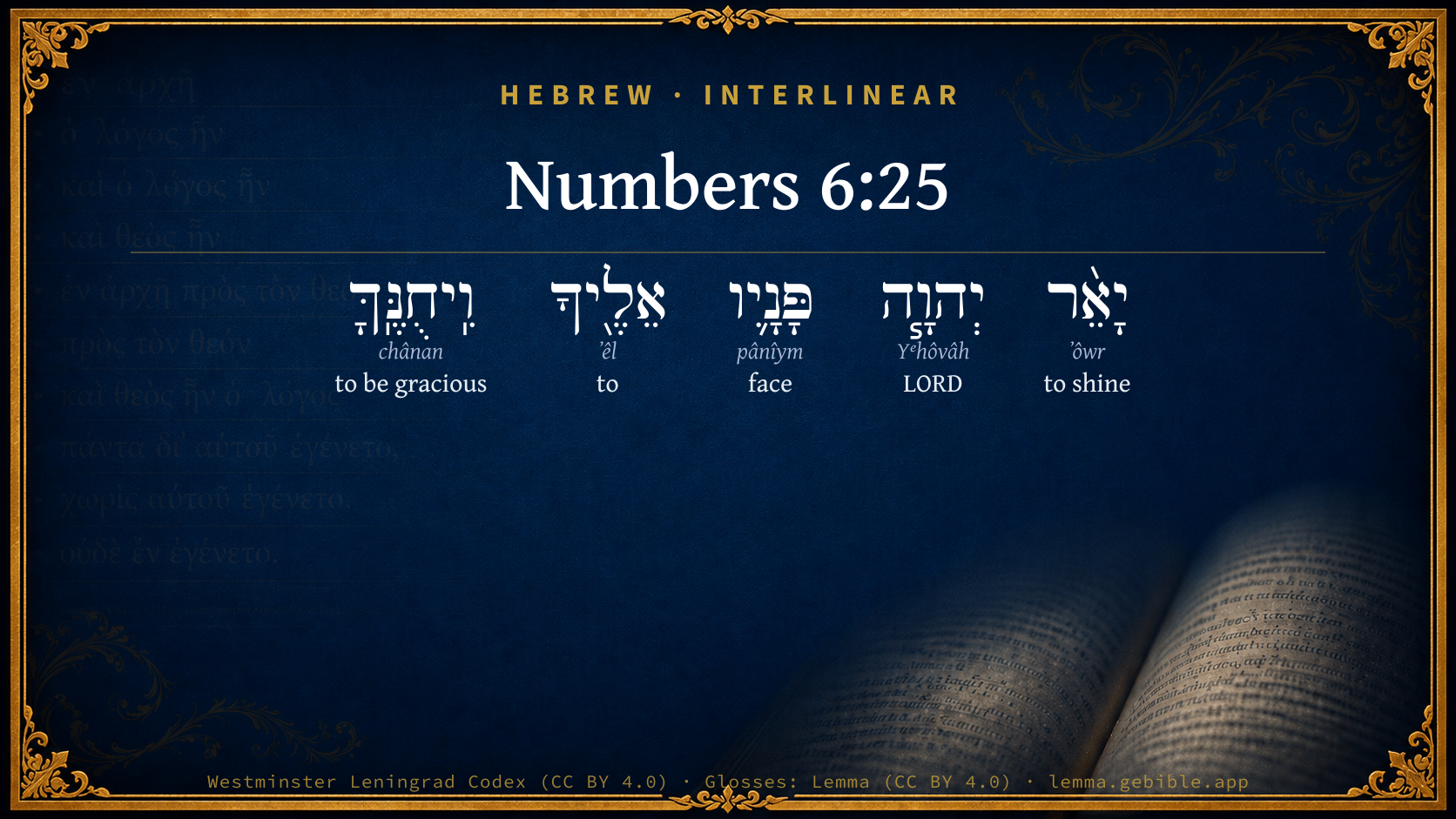
Numbers 6:25

Hebrew (Westminster Leningrad Codex) Numbers 6:25 appears in the Hebrew Old Testament. The text above is from the Westminster Leningrad Codex. Each word links to its Strong’s number, a concise gloss, and parsing drawn from the Open Scriptures Hebrew Bible morphology. Click any word for its full Brown-Driver-Briggs (BDB) entry.
Download image
Cite this verse

Numbers 6:25 (World English Bible). Public Domain. Lemma interlinear Bible study tool, https://lemma.gebible.app/v/numbers/6/25.

Show BibTeX & RIS
BibTeX
RIS
English Translation
Yahweh make his face to shine on you, And be gracious to you.
World English Bible · Public Domain
Download a study sheet

One document with this verse’s original text, its word-by-word gloss line, the meaning frame, cross-references with their text, attributed commentary, and full source and license credits — printable, and it pastes into notes with its structure intact.

This verse Autodidact and up

Study sheet (.html) Plain text (.txt)

A passage Seminary Student

Up to 50 verses in one chapter. A passage sheet keeps up to 6 commentary sources and 12 cross-references per verse, in the order this page ranks them, and says so on the sheet whenever that leaves anything out. Ask for a single verse and you get the Autodidact verse sheet above.

Everything on this page stays free to read, with no account — the sheet is a download of what is already on screen, not access to it.

Want to remove ads? Support Godless Engineer
Compare translations 3

The same verse in 3 English versions, stacked beneath the original-language interlinear above. Click any original word for its lexicon entry.

Each is an independent rendering of the whole verse — the interlinear is not word-aligned to these translations.

Highlighted words mark where these versions differ — a whole-verse word diff, not a word-by-word alignment.

  • World English Bible Public Domain
    Yahweh make his face to shine on you, And be gracious to you.
  • King James Version Public Domain
    The LORD make his face shine upon thee, and be gracious unto thee:
  • unfoldingWord Literal Text CC BY-SA 4.0
    May Yahweh make his face shine to you, and may he be gracious to you.

unfoldingWord Literal Text — © unfoldingWord, licensed CC BY-SA 4.0. Word-aligned USFM3 via Door43 (git.door43.org/unfoldingWord/en_ult).

Versions to compare (up to 4)

3 of 4 selected

Show all 18 translations

Every available English version of this verse, each an independent rendering of the whole verse.

  • World English Bible Public Domain
    Yahweh make his face to shine on you, And be gracious to you.
  • Berean Standard Bible Public Domain
    may the LORD cause His face to shine upon you and be gracious to you;
  • Majority Standard Bible Public Domain
    may the LORD cause His face to shine upon you and be gracious to you;
  • King James Version Public Domain
    The LORD make his face shine upon thee, and be gracious unto thee:
  • American Standard Version (1901) Public Domain
    Jehovah make his face to shine upon thee, and be gracious unto thee:
  • Revised Version (1885) Public Domain
    The LORD make his face to shine upon thee, and be gracious unto thee:
  • Geneva Bible (1599) Public Domain
    The Lord make his face shine vpon thee, and be merciful vnto thee,
  • Douay-Rheims (1899) Public Domain
    The Lord shew his face to thee, and have mercy on thee.
  • Young's Literal Translation Public Domain
    `Jehovah cause His face to shine upon thee, and favour thee;
  • Literal Standard Version CC BY-SA 4.0
    YHWH cause His face to shine on you, || And favor you;
  • Unlocked Literal Bible CC BY-SA 4.0
    May Yahweh make his face shine on you and be gracious to you.
  • unfoldingWord Literal Text CC BY-SA 4.0
    May Yahweh make his face shine to you, and may he be gracious to you.
  • Darby Bible Public Domain
    Jehovah make his face shine upon thee, and be gracious unto thee;
  • World Messianic Bible Public Domain
    The LORD make his face to shine on you, and be gracious to you.
  • Webster's Bible Public Domain
    The LORD make his face to shine upon thee, and be gracious to thee:
  • Free Bible Version CC BY-SA 4.0
    May the Lord smile on you and be gracious to you.
  • Bible in Basic English Public Domain
    May the light of the Lord's face be shining on you in grace:
  • JPS Tanakh (1917) Public Domain
    The LORD make His face to shine upon thee, and be gracious unto thee;

Literal Standard Version (2020), Covenant Press — licensed CC BY-SA 4.0. Text via the HelloAO Bible API (eBible.org). Unlocked Literal Bible (unfoldingWord) — licensed CC BY-SA 4.0. Text via the HelloAO Bible API (eBible.org). unfoldingWord Literal Text — © unfoldingWord, licensed CC BY-SA 4.0. Word-aligned USFM3 via Door43 (git.door43.org/unfoldingWord/en_ult). Free Bible Version, Dr. Jonathan Gallagher — licensed CC BY-SA 4.0. Text via the HelloAO Bible API (eBible.org).

Word by word

More ways to search: Search by grammar → Find every occurrence → Compare this word →

Practice this passage: Drill this verse → Learn its vocabulary →

יָאֵ֨ר
ʼôwr
H215
“to shine”
Verb, Hiphil, Jussive, 3rd Person, Masculine, Singular
Part of Speech
Verb
Stem
Hiphil
Form
Jussive
Person
3rd Person
Gender
Masculine
Number
Singular
Full BDB Definition

Origin: a primitive root

TWOT: 52

to be or become light, shine - (Qal) - to become light (day) - to shine (of the sun) - to become bright - (Niphal) - to be illuminated - to become lighted up - (Hiphil) - to give light, shine (of sun, moon, and stars) - to illumine, light up, cause to shine, shine - to kindle, light (candle, wood) - lighten (of the eyes, his law, etc) - to make shine (of the face)
  1. יְהוָ֧ה Yᵉhôvâh H3068 “LORD” Noun, Proper
  2. פָּנָ֛יו pânîym H6440 “face(s) · his” Noun, Common, Both, Plural, Construct + Suffix, Personal, 3rd Person, Masculine, Singular
  3. אֵלֶ֖יךָ ʼêl H413 “to · you” Preposition + Suffix, Personal, 2nd Person, Masculine, Singular
  4. וִֽיחֻנֶּֽךָּ chânan H2603 “and · to be gracious · you” Conjunction + Verb, Qal, Jussive, 3rd Person, Masculine, Singular + Suffix, Personal, 2nd Person, Masculine, Singular

About this verse

These counts appear in no published source. They are computed here, from the morphology-tagged text and Lemma’s own curated glosses. What Lemma adds →

5
words
5
distinct lemmas
Pentateuch
section

Shared distinctive vocabulary

יָאֵ֨ר to shine H215 occurs in 43 verses of the Hebrew Bible. Also found in:

Grammatical profile

  • 2 verbs
  • 2 nouns
  • 1 preposition

Verb forms

  • יָאֵ֨ר Hiphil · Jussive
  • וִֽיחֻנֶּֽךָּ Qal · Jussive

Hebrew & Septuagint length

In English translation the verse runs 13 words from the Hebrew and 14 from the Septuagint (LXX English) — closely comparable.

A rough comparison of the two English renderings, which tokenize alike — not a word-level alignment.

Word counts can differ between the Hebrew and the Greek without any difference in meaning — e.g. the Hebrew direct-object marker אֵת has no separate Greek word, and Greek often adds the article ὁ.

Cross-references

13

Topical passages linked to Numbers 6:25 in the Treasury of Scripture Knowledge — connected by theme and wording, ordered by reader-vote popularity; previews shown in the World English Bible.

  • Psalms 80:19 Turn us again, Yahweh God of hosts. Cause your face to shine, and we will be saved.
  • Psalms 119:135 Make your face shine on your servant. Teach me your statutes.
  • Psalms 31:16 Make your face to shine on your servant. Save me in your loving kindness.
  • Psalms 67:1 May God be merciful to us, bless us, And cause his face to shine on us. Selah.
  • Daniel 9:17 Now therefore, our God, listen to the prayer of your servant, and to his petitions, and cause your face to shine on your sanctuary that is desolate, for the Lord's sake.
  • Exodus 33:19 He said, "I will make all my goodness pass before you, and will proclaim the name of Yahweh before you. I will be gracious to whom I will be gracious, and will show mercy on whom I will show mercy."
  • Psalms 80:7 Turn us again, God of hosts. Cause your face to shine, And we will be saved.
  • Malachi 1:9 "Now, please entreat the favor of God, that he may be gracious to us. With this, will he accept any of you?" says Yahweh of Hosts.
  • Genesis 43:29 He lifted up his eyes, and saw Benjamin, his brother, his mother's son, and said, "Is this your youngest brother, of whom you spoke to me?" He said, "God be gracious to you, my son."
  • John 1:17 For the law was given through Moses. Grace and truth came through Jesus Christ.
  • Psalms 21:6 For you make him most blessed forever. You make him glad with joy in your presence.
  • Psalms 80:1–3 Hear us, Shepherd of Israel, You who lead Joseph like a flock, You who sit above the cherubim, shine forth.
  • Psalms 86:16 Turn to me, and have mercy on me! Give your strength to your servant. Save the son of your handmaid.

Cross-references courtesy of OpenBible.info (CC BY 4.0).

Hebrew and Greek witnesses Masoretic Hebrew ↔ Greek Septuagint

The same verse in the two great witnesses to the Old Testament, shown verse-for-verse.

These are two independent witnesses, not word-aligned to each other, and the Septuagint is shown in lemma (dictionary) form.

Hebrew Numbers 6:25 Masoretic · Westminster Leningrad Codex

יָאֵ֨ר יְהוָ֧ה פָּנָ֛יו אֵלֶ֖יךָ וִֽיחֻנֶּֽךָּ

Yahweh make his face to shine on you, And be gracious to you.

World English Bible · Public Domain

Greek LXX Numbers 6:25 Septuagint · lemma form

ἐπιφαίνω κύριος ὁ πρόσωπον αὐτός ἐπί σύ καί ἐλεέω σύ

the Lord make his face to shine upon you, and have mercy upon you;

LXX2012 (modern English Septuagint) · Public Domain

On this verse, The Pulpit Commentary discusses the Septuagint’s reading. Read the note in Commentary ↓

Hebrew: Westminster Leningrad Codex (CC BY 4.0). Greek: Septuagint (public domain); English from LXX2012 (modern English Septuagint) (Public Domain). How the Septuagint differs from the Hebrew →

Targum (Aramaic paraphrase)

2

The Targum is the ancient Jewish Aramaic paraphrase of the Hebrew Scriptures — an interpretive translation, not the Hebrew text itself. Onkelos (literal) and Pseudo-Jonathan (expansive) render the Torah, and Jonathan the Prophets. Coverage is partial: where no permissively-licensed English translation exists for a verse, only the Aramaic is shown. This is verse-level text, not a word-by-word alignment to the Hebrew.

  1. Targum Onkelos Torah (Genesis–Deuteronomy)
    יַנְהַר יְיָ שְׁכִנְתֵּהּ לְוָתָךְ וִירַחֵם יָתָךְ

    May Hashem [reveal] (lit. "shine") his presence upon you and love you.

    Targum Onkelos — Aramaic: “Onkelos Genesis” (public domain); “Onkelos Exodus” (public domain); “Onkelos Leviticus” (public domain); “Onkelos Numbers” (public domain); “Onkelos Deuteronomy” (public domain). English: “Sefaria Community Translation” (CC0 1.0 (public-domain dedication)); “J.W. Etheridge. The Targums of Onkelos and Jonathan Ben Uzziel on the Pentateuch. London: Longmans, Green, 1862” (public domain). Text via Sefaria.

  2. Targum Pseudo-Jonathan Torah (Genesis–Deuteronomy)
    יַנְהַר יְיָ סְבַר אַפּוֹי לָךְ בְּמֵעַסְקָךְ בְּאוֹרַיְיתָא וְיִגְלֵי לָךָ טְמִירָן וְיֵיחוֹס עֲלָךְ

    The Lord make His face to shine upon thee, when occupied in the law, and reveal to thee its secrets, and be merciful unto thee.

    Targum Pseudo-Jonathan — Aramaic: “Targum Jonathan on Genesis” (public domain); “Targum Jonathan on Exodus” (public domain); “Targum Jonathan on Leviticus” (public domain); “Targum Jonathan on Numbers” (public domain); “Targum Jonathan on Deuteronomy” (public domain). English: “The Targum of Jonathan ben Uzziel, trans. J. W. Etheridge, London, 1862” (public domain). Text via Sefaria.

Commentary

Notes on Numbers 6:25 from classic Christian and Jewish commentators (each source and its license shown beneath its notes). The classic Christian expositions comment on the surrounding passage and are grouped to its opening verse, so a note may address several verses; the Jewish commentaries on the Tanakh (Rashi and others) are per-verse, so they appear only where the commentator wrote on this verse.

Lemma curates 59 commentaries, every one of them public domain or Creative Commons licensed, each selected and text-cleaned for this edition rather than reprinted as found. About our sources →

Tyndale Open Study Notes

Tyndale Open Resources

6:25 The desire for God’s smile is often translated more literally may he make his face shine upon you. • be gracious to you: God’s people need his grace and mercy in a dangerous world (cp. Pss 31:16; 67:1; 80:3, 7, 19).

Tyndale Open Study Notes — © Tyndale Open Resources, licensed CC BY-SA 4.0. Text via the HelloAO Bible API.

John Gill's Exposition

And the Lord lift up his countenance upon thee,.... Show his face and favour, look cheerfully on his people, declare himself well pleased with them in Christ, and appear as smiling upon them through him, indulging them with visits of love, restoring to them the joys of his salvation, and upholding them with his free Spirit; and so causing them to walk pleasantly and comfortably in the ways of God, expecting eternal life and happiness, as God's free gift through Christ:

and give thee peace; all outward needful prosperity, internal peace of mind, through the blood and righteousness of Christ, the peacemaker, and peace giver, and eternal peace in the world to come.

John Gill's Exposition of the Whole Bible (1746–1763) — public domain (CC PDM 1.0). Text via the HelloAO Bible API.

Haydock's Catholic Bible Commentary

Show. Hebrew, "make his face shine," joyful and serene, (Calmet) like a light to direct thy steps, Psalm lxvi. 2.

George Leo Haydock (1774–1849), Haydock's Catholic Family Bible and Commentary, 1859 edition — public domain. Excludes Psalms (Douay-Rheims chapter numbering differs from Protestant) and Deuterocanonical books (Catholic canon only).

Matthew Poole's English Annotations

upon thee, i.e. Smile upon thee: this is opposed to the hiding of his face, and to the covering himself or his face with a cloud; and it is explained by the following words,

be gracious unto thee. Others expound it of illumination or direction, and the revelation of himself and of his will to them.

Matthew Poole's English Annotations on the Holy Bible (1683–1685) — public domain. Text from a community e-Sword/MySword module.

Whedon's Commentary on the Bible

Daniel D. Whedon

25. Make his face shine — The Targum adds, “when occupied in the law, and reveal to thee its secrets.” Anthropomorphic descriptions of God and boldness of metaphor are characteristic of Hebrew poetry. “If the light of the sun is sweet and pleasant to behold, the light of the divine countenance, the everlasting light, is the sum of all delight.” — Baumgarten. Stripped of figure, the prayer is that Jehovah may deal kindly with Israel, as is indicated in the following part of the parallelism.

And be gracious unto thee — It is a mere play of the fancy to make sharp distinctions between the blessings invoked in these verses. Thus Luther refers the first blessing to bodily good, the second to the spiritual nature and soul, and the third to the same with a desire for final victory over the cross, death, the devil, the world, and the flesh.

Daniel D. Whedon (gen. ed.), Commentary on the Old and New Testaments (1874–1909) — public domain. Text from a community e-Sword module.

The Pulpit Commentary

The Lord make his face shine upon thee. The "face" of God is his personality as turned towards man, or else turned away from him. His face hidden or turned away is despair and death; (Deu_31:17, 18 Job_13:24) his face turned against man is destruction and death; (Lev_17:10 Psa_34:16) his face turned upon man in love and mercy is life and salvation. (Psa_27:1 Psa_44:3) It is to the soul of man what the blessed sun of heaven is to his body. And be gracious unto thee. Elehsai se , Septuagint. Be kind and beneficent to thee: the effect in and on the soul of the clear shining upon it of the face of God.

The Pulpit Commentary (1880–1919), ed. H.D.M. Spence-Jones & Joseph S. Exell — public domain. Text from a community e-Sword module.

John Wesley's Explanatory Notes

Shine upon thee - Alluding to the shining of the sun upon the earth, to enlighten, and warm, and renew the face of it. The Lord love thee, and make thee know that he loves thee. We cannot but be happy, if we have God's love; and we cannot but be easy, if we know that we have it.

John Wesley, Explanatory Notes Upon the Whole Bible (1754–1765) — public domain. Text via the GEBible commentary corpus.

unfoldingWord translationNotes

Door43 World Missions Community

make his face shine on you

This is an idiom which means to have kind intentions towards someone. It can also be expressed by smiling. AT: "smile at you" or "look at you with kindness" (See: Idiom)

look on you with favor

Here the phrase "look on" means to show a certain attitude towards that person. AT: "show you favor" (See: Idiom)

May Yahweh make his face shine on you ... and give you peace

Here "you" is singular. (See: Forms of You)

they must give my name

Here Yahweh speaks about claiming the Israelites as his own by saying that he is giving them "his name." AT: "they must let the people of Israel know that they are mine" (See: Metaphor)

translationWords

Yahweh

light

grace

favor

peace

name

unfoldingWord translationNotes — © Distant Shores Media and the Door43 World Missions Community, licensed CC BY-SA 4.0. Source: git.door43.org/Door43/en_tn.

Rashi

Rabbi Shlomo Yitzchaki (Rashi)

יאר ה' פניו אליך THE LORD MAKE HIS FACE SHINE UPON THEE — i.e. May He show thee a friendly (more lit., smiling) countenance — a beaming countenance.

ויחנך means, May He grant thee good favour (חן) (Sifrei Bamidbar 41).

Rashi on the Tanakh — English translations: “The Judaica Press complete Tanach with Rashi, translated by A. J. Rosenberg” (CC BY 4.0); “Pentateuch with Rashi's commentary by M. Rosenbaum and A.M. Silbermann, 1929-1934” (public domain); “The Metsudah Tanach series, Lakewood, N.J” (CC BY 4.0); and “The Book of Joshua, Metsudah Publications, 1997” (CC BY 4.0). Text via Sefaria.

Lesson kit

Teaching starters — assembled from the data on this page, not authored interpretation. Every prompt links to the verse data it draws on. Edit before teaching.

Numbers, in the Pentateuch, opens this verse with 5 words (5 distinct Hebrew lemmas). Its most distinctive word is ʼôwr (“to shine”). A historical commentator’s framing appears above. Read the whole chapter for the surrounding context.

Discussion questions

  1. What does “to shine” (ʼôwr) contribute to the verse as a whole?
  2. How does Genesis 1:15, which shares the word «to shine», read alongside this verse?
  3. These translations render this verse differently; the difference is in the English rendering, not the original. What questions does that raise?
  4. «יָאֵ֨ר» is a Hiphil Jussive verb. How does that grammatical form shape the action described?
  5. Compare how Tyndale Open Study Notes and John Gill's Exposition read this verse. Where do they agree or differ?

Things to notice

Reading settings

Reading text

Shown beneath each verse's original-language words.

Old Testament
Old Testament edition

Read the OT as the Masoretic Hebrew (MT) or the Greek Septuagint (LXX).

English shown for the Greek Septuagint (in the Hebrew ↔ Greek comparison).

Comparing translations? Open the Compare panel on any verse page to stack up to four side by side.