
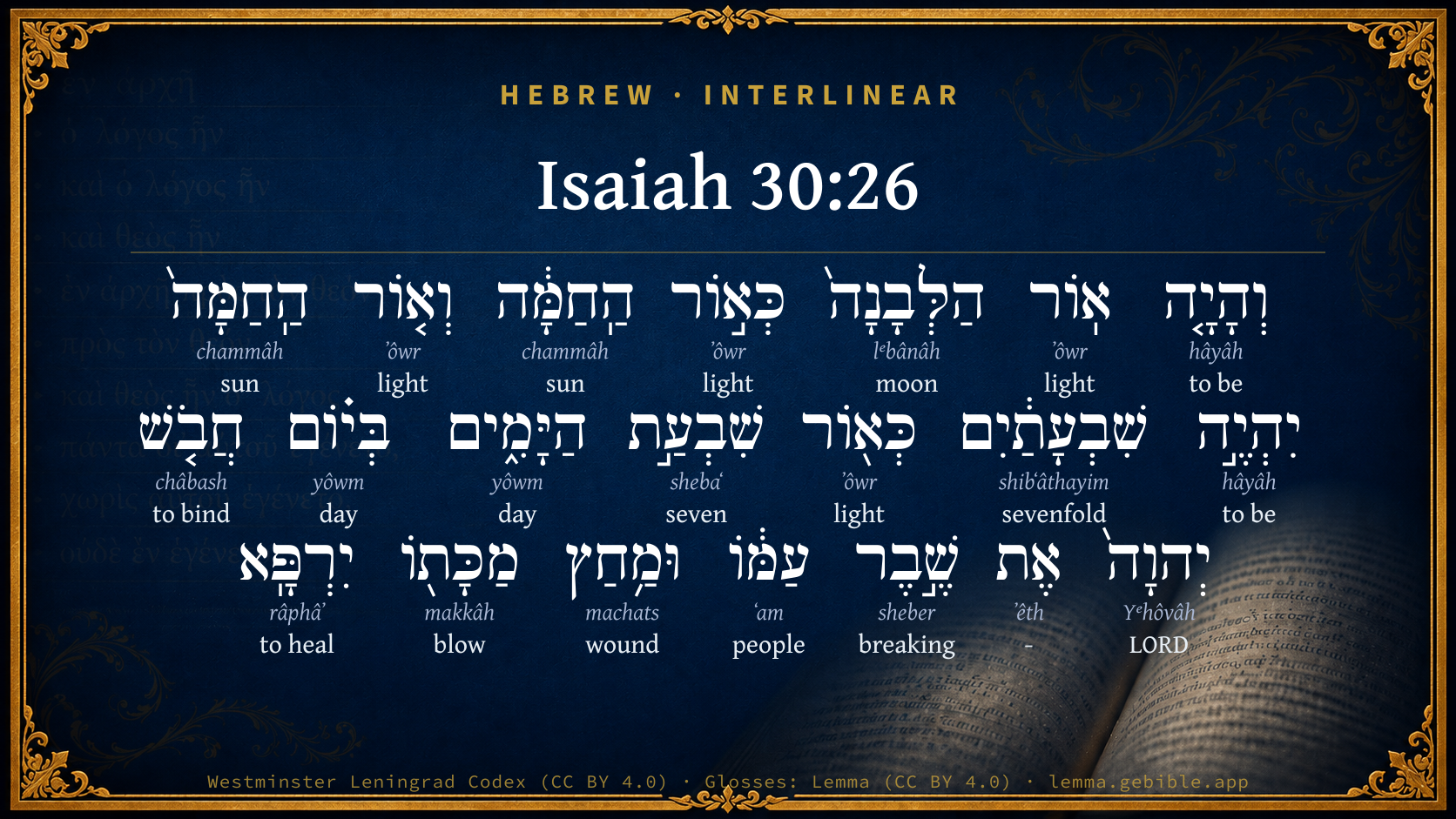
Isaiah 30:26

Hebrew (Westminster Leningrad Codex) Isaiah 30:26 appears in the Hebrew Old Testament. The text above is from the Westminster Leningrad Codex. Each word links to its Strong’s number, a concise gloss, and parsing drawn from the Open Scriptures Hebrew Bible morphology. Click any word for its full Brown-Driver-Briggs (BDB) entry.
Download image
Cite this verse

Isaiah 30:26 (World English Bible). Public Domain. Lemma interlinear Bible study tool, https://lemma.gebible.app/v/isaiah/30/26.

Show BibTeX & RIS
BibTeX
RIS
English Translation
Moreover the light of the moon shall be as the light of the sun, and the light of the sun shall be sevenfold, as the light of seven days, in the day that Yahweh binds up the hurt of his people, and heals the stroke of their wound.
World English Bible · Public Domain
Highlights
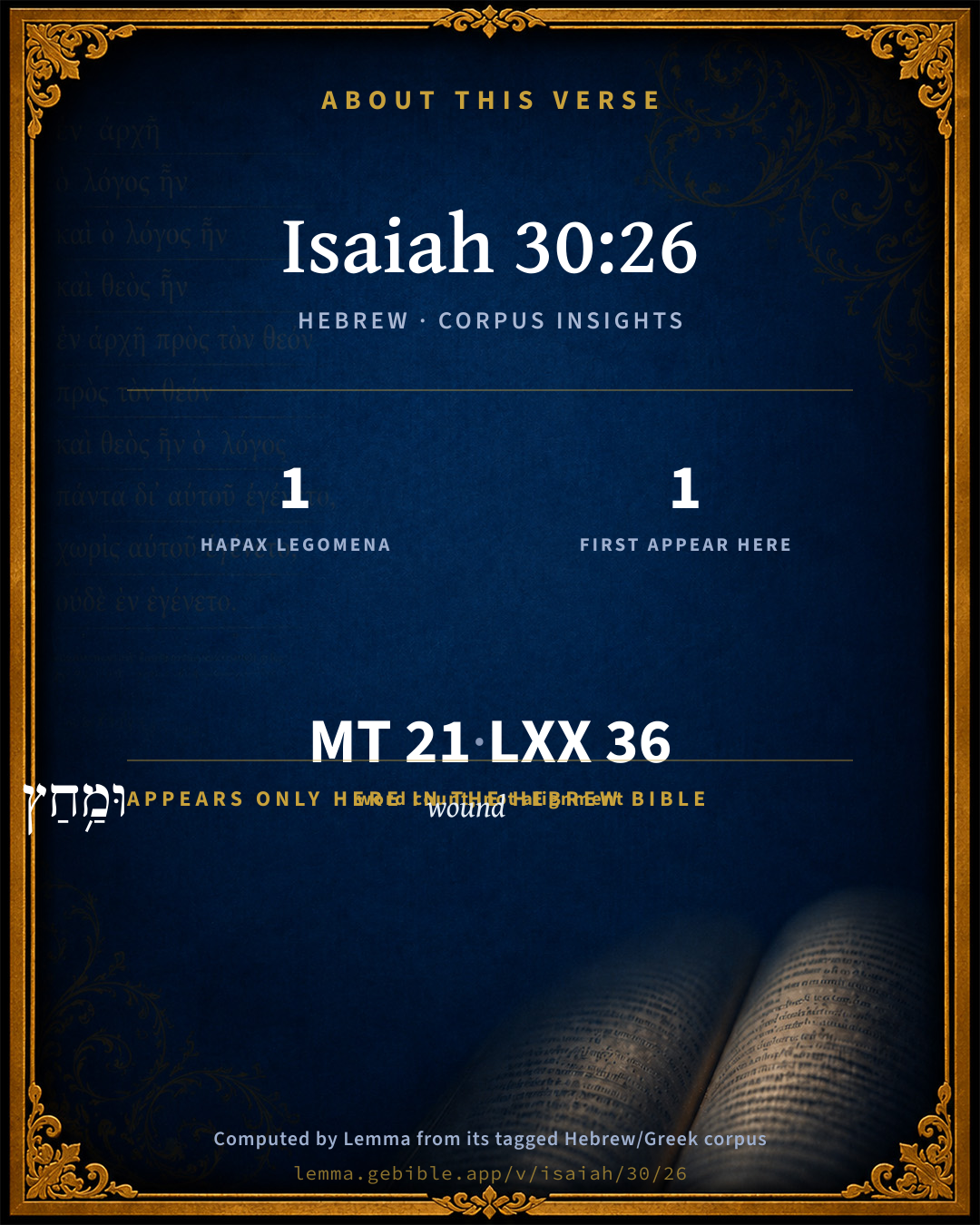
  • 1 hapax legomenon — only here in the Hebrew Bible
  • 1 first appearance in the Hebrew Bible
Full analysis ↓
Download a study sheet

One document with this verse’s original text, its word-by-word gloss line, the meaning frame, cross-references with their text, attributed commentary, and full source and license credits — printable, and it pastes into notes with its structure intact.

This verse Autodidact and up

Study sheet (.html) Plain text (.txt)

A passage Seminary Student

Up to 50 verses in one chapter. A passage sheet keeps up to 6 commentary sources and 12 cross-references per verse, in the order this page ranks them, and says so on the sheet whenever that leaves anything out. Ask for a single verse and you get the Autodidact verse sheet above.

Everything on this page stays free to read, with no account — the sheet is a download of what is already on screen, not access to it.

Want to remove ads? Support Godless Engineer
Compare translations 3

The same verse in 3 English versions, stacked beneath the original-language interlinear above. Click any original word for its lexicon entry.

Each is an independent rendering of the whole verse — the interlinear is not word-aligned to these translations.

Highlighted words mark where these versions differ — a whole-verse word diff, not a word-by-word alignment.

  • World English Bible Public Domain
    Moreover the light of the moon shall be as the light of the sun, and the light of the sun shall be sevenfold, as the light of seven days, in the day that Yahweh binds up the hurt of his people, and heals the stroke of their wound.
  • King James Version Public Domain
    Moreover the light of the moon shall be as the light of the sun, and the light of the sun shall be sevenfold, as the light of seven days, in the day that the LORD bindeth up the breach of his people, and healeth the stroke of their wound.
  • unfoldingWord Literal Text CC BY-SA 4.0
    And the light of the moon will be like the light of the sun, and the light of the sun will be sevenfold, like the light of seven days, in the day Yahweh binds up the breaking of his people and heals the wound of its striking.

unfoldingWord Literal Text — © unfoldingWord, licensed CC BY-SA 4.0. Word-aligned USFM3 via Door43 (git.door43.org/unfoldingWord/en_ult).

Versions to compare (up to 4)

3 of 4 selected

Show all 18 translations

Every available English version of this verse, each an independent rendering of the whole verse.

  • World English Bible Public Domain
    Moreover the light of the moon shall be as the light of the sun, and the light of the sun shall be sevenfold, as the light of seven days, in the day that Yahweh binds up the hurt of his people, and heals the stroke of their wound.
  • Berean Standard Bible Public Domain
    The light of the moon will be as bright as the sun, and the light of the sun will be seven times brighter—like the light of seven days—on the day that the LORD binds up the brokenness of His people and heals the wounds He has inflicted.
  • Majority Standard Bible Public Domain
    The light of the moon will be as bright as the sun, and the light of the sun will be seven times brighter—like the light of seven days—on the day that the LORD binds up the brokenness of His people and heals the wounds He has inflicted.
  • King James Version Public Domain
    Moreover the light of the moon shall be as the light of the sun, and the light of the sun shall be sevenfold, as the light of seven days, in the day that the LORD bindeth up the breach of his people, and healeth the stroke of their wound.
  • American Standard Version (1901) Public Domain
    Moreover the light of the moon shall be as the light of the sun, and the light of the sun shall be sevenfold, as the light of seven days, in the day that Jehovah bindeth up the hurt of his people, and healeth the stroke of their wound.
  • Revised Version (1885) Public Domain
    Moreover the light of the moon shall be as the light of the sun, and the light of the sun shall be sevenfold, as the light of seven days, in the day that the LORD bindeth up the hurt of his people, and healeth the stroke of their wound.
  • Geneva Bible (1599) Public Domain
    Moreouer, the light of the moone shall be as the light of the sunne, and the light of the sunne shalbe seuen folde, and like the light of seuen dayes in the day that the Lord shall binde vp the breach of his people, and heale the stroke of their wound.
  • Douay-Rheims (1899) Public Domain
    And the light of the moon shall be se the light of the sun, and the light of the sun shall be sevenfold, as the light of seven days: in the day when the Lord shall bind up the wound of his people, and shall heal the stroke of their wound.
  • Young's Literal Translation Public Domain
    And the light of the moon hath been as the light of the sun, And the light of the sun is sevenfold, As the light of seven days, In the day of Jehovah's binding up the breach of His people, When the stroke of its wound He healeth.
  • Literal Standard Version CC BY-SA 4.0
    And the light of the moon has been as the light of the sun, || And the light of the sun is sevenfold, || As the light of seven days, || In the day of YHWH’s binding up the breach of His people, || When He heals the stroke of its wound.
  • Unlocked Literal Bible CC BY-SA 4.0
    The light of the moon will be like the light of the sun, and the light of the sun will be seven times brighter, like the sunlight of seven days. Yahweh will bind up the breaking of his people and heal the bruises of his wounding them.
  • unfoldingWord Literal Text CC BY-SA 4.0
    And the light of the moon will be like the light of the sun, and the light of the sun will be sevenfold, like the light of seven days, in the day Yahweh binds up the breaking of his people and heals the wound of its striking.
  • Darby Bible Public Domain
    And the light of the moon shall be as the light of the sun, and the light of the sun shall be sevenfold, as the light of seven days, in the day that Jehovah bindeth up the breach of his people, and healeth the wound of their stroke.
  • World Messianic Bible Public Domain
    Moreover the light of the moon will be like the light of the sun, and the light of the sun will be seven times brighter, like the light of seven days, in the day that the LORD binds up the fracture of his people, and heals the wound they were struck with.
  • Webster's Bible Public Domain
    Moreover the light of the moon shall be as the light of the sun, and the light of the sun shall be seven-fold, as the light of seven days, in the day that the LORD bindeth up the breach of his people, and healeth the stroke of their wound.
  • Free Bible Version CC BY-SA 4.0
    The moon will shine as bright as the sun, and the sun will shine seven times brighter, like having seven days light in one. This is the way it will be when the Lord bandages the injuries of his people and heals the wounds he caused them.
  • Bible in Basic English Public Domain
    And the light of the moon will be as the light of the sun, and the light of the sun will be seven times greater, as the light of seven days, in the day when the Lord puts oil on the wounds of his people, and makes them well from the blows they have undergone.
  • JPS Tanakh (1917) Public Domain
    Moreover the light of the moon shall be as the light of the sun, and the light of the sun shall be sevenfold, as the light of the seven days, in the day that the LORD bindeth up the bruise of His people, and healeth the stroke of their wound.

Literal Standard Version (2020), Covenant Press — licensed CC BY-SA 4.0. Text via the HelloAO Bible API (eBible.org). Unlocked Literal Bible (unfoldingWord) — licensed CC BY-SA 4.0. Text via the HelloAO Bible API (eBible.org). unfoldingWord Literal Text — © unfoldingWord, licensed CC BY-SA 4.0. Word-aligned USFM3 via Door43 (git.door43.org/unfoldingWord/en_ult). Free Bible Version, Dr. Jonathan Gallagher — licensed CC BY-SA 4.0. Text via the HelloAO Bible API (eBible.org).

Word by word

More ways to search: Search by grammar → Find every occurrence → Compare this word →

Practice this passage: Drill this verse → Learn its vocabulary →

וּמַ֥חַץ
machats
H4273
“and · wound of”
Conjunction + Noun, Common, Masculine, Singular, Construct
Part of Speech
Conjunction + Noun
Type
Common
Gender
Masculine
Number
Singular
State
Construct
Full BDB Definition

Origin: from H4272

TWOT: 1183a

severe wound, contusion
  1. וְהָיָ֤ה hâyâh H1961 “and · to be” Conjunction + Verb, Qal, Sequential Perfect, 3rd Person, Masculine, Singular
  2. אֽוֹר ʼôwr H216 “light of” Noun, Common, Both, Singular, Construct
  3. הַלְּבָנָה֙ lᵉbânâh H3842 “the · moon” Particle, Definite Article + Noun, Common, Feminine, Singular, Absolute
  4. כְּא֣וֹר ʼôwr H216 “like/as · light of” Preposition + Noun, Common, Both, Singular, Construct
  5. הַֽחַמָּ֔ה chammâh H2535 “the · sun” Particle, Definite Article + Noun, Common, Feminine, Singular, Absolute
  6. וְא֤וֹר ʼôwr H216 “and · light of” Conjunction + Noun, Common, Both, Singular, Construct
  7. הַֽחַמָּה֙ chammâh H2535 “the · sun” Particle, Definite Article + Noun, Common, Feminine, Singular, Absolute
  8. יִהְיֶ֣ה hâyâh H1961 “to be” Verb, Qal, Imperfect, 3rd Person, Masculine, Singular
  9. שִׁבְעָתַ֔יִם shibʻâthayim H7659 “sevenfold” Adjective, Cardinal number, Feminine, Dual, Absolute
  10. כְּא֖וֹר ʼôwr H216 “like/as · light of” Preposition + Noun, Common, Both, Singular, Construct
  11. שִׁבְעַ֣ת shebaʻ H7651 “seven” Adjective, Cardinal number, Masculine, Singular, Construct
  12. הַיָּמִ֑ים yôwm H3117 “the · days” Particle, Definite Article + Noun, Common, Masculine, Plural, Absolute
  13. בְּי֗וֹם yôwm H3117 “in/at · day” Preposition + Noun, Common, Masculine, Singular, Absolute
  14. חֲבֹ֤שׁ châbash H2280 “to bind” Verb, Qal, Infinitive Construct
  15. יְהוָה֙ Yᵉhôvâh H3068 “LORD” Noun, Proper
  16. אֶת ʼêth H853 “-” Particle, Direct Object
  17. שֶׁ֣בֶר sheber H7667 “breaking of” Noun, Common, Masculine, Singular, Construct
  18. עַמּ֔וֹ ʻam H5971 “people · his” Noun, Common, Masculine, Singular, Construct + Suffix, Personal, 3rd Person, Masculine, Singular
  19. מַכָּת֖וֹ makkâh H4347 “blow · his” Noun, Common, Feminine, Singular, Construct + Suffix, Personal, 3rd Person, Masculine, Singular
  20. יִרְפָּֽא râphâʼ H7495 “to heal” Verb, Qal, Imperfect, 3rd Person, Masculine, Singular

About this verse

These counts appear in no published source. They are computed here, from the morphology-tagged text and Lemma’s own curated glosses. What Lemma adds →

21
words
15
distinct lemmas
Prophets
section

Notable vocabulary

1 hapax legomenon — a word that appears only here in the entire Hebrew Bible:

  • וּמַ֥חַץ wound H4273

First appearance in Scripture

This word makes its first canonical appearance in the Hebrew Bible here:

  • וּמַ֥חַץ wound H4273

Shared distinctive vocabulary

הַלְּבָנָה֙ moon H3842 occurs in 3 verses of the Hebrew Bible. Also found in:

Grammatical profile

  • 4 verbs
  • 14 nouns
  • 2 adjectives
  • 1 particle

Verb forms

  • וְהָיָ֤ה Qal · Sequential Perfect
  • יִהְיֶ֣ה Qal · Imperfect
  • חֲבֹ֤שׁ Qal · Infinitive Construct
  • יִרְפָּֽא Qal · Imperfect

Repetition

Words recur within this verse — often emphatic in Hebrew:

  • אֽוֹר light H216 ×4
  • וְהָיָ֤ה to be H1961 ×2
  • הַֽחַמָּ֔ה sun H2535 ×2
  • הַיָּמִ֑ים day H3117 ×2

Hebrew & Septuagint length

In English translation the verse runs 48 words from the Hebrew and 44 from the Septuagint (LXX English) — closely comparable.

A rough comparison of the two English renderings, which tokenize alike — not a word-level alignment.

Word counts can differ between the Hebrew and the Greek without any difference in meaning — e.g. the Hebrew direct-object marker אֵת has no separate Greek word, and Greek often adds the article ὁ.

In the original languages it is 21 Hebrew tokens and 36 Greek tokens — but the two are counted differently (Hebrew bundles its prefixes and suffixes into one token; the Greek is in lemma form), so that isn’t a like-for-like length.

Cross-references

15

Topical passages linked to Isaiah 30:26 in the Treasury of Scripture Knowledge — connected by theme and wording, ordered by reader-vote popularity; previews shown in the World English Bible.

  • Isaiah 60:19–20 The sun shall be no more your light by day; neither for brightness shall the moon give light to you: but Yahweh will be to you an everlasting light, and your God your glory.
  • Deuteronomy 32:39 See now that I, even I, am he, There is no god with me: I kill, and I make alive; I wound, and I heal; There is none who can deliver out of my hand.
  • Revelation 22:5 There will be no night, and they need no lamp light; for the Lord God will illuminate them. They will reign forever and ever.
  • Revelation 21:23 The city has no need for the sun, neither of the moon, to shine, for the very glory of God illuminated it, and its lamp is the Lamb.
  • Job 5:18 For he wounds, and binds up; He injures, and his hands make whole.
  • Isaiah 24:23 Then the moon shall be confounded, and the sun ashamed; for Yahweh of Hosts will reign on Mount Zion, and in Jerusalem; and before his elders shall be glory.
  • Zechariah 14:7 It will be a unique day which is known to Yahweh; not day, and not night; but it will come to pass, that at evening time there will be light.
  • Jeremiah 33:5–6 while [men] come to fight with the Chaldeans, and to fill them with the dead bodies of men, whom I have killed in my anger and in my wrath, and for all whose wickedness I have hid my face from this city:
  • Zechariah 12:8 In that day Yahweh will defend the inhabitants of Jerusalem. He who is feeble among them at that day will be like David, and the house of David will be like God, like the angel of Yahweh before them.
  • Hosea 6:1 "Come, and let us return to Yahweh; For he has torn us to pieces, And he will heal us; He has injured us, And he will bind up our wounds.
  • Isaiah 1:5–6 Why should you be beaten more, That you revolt more and more? The whole head is sick, And the whole heart faint.
  • Isaiah 11:9 They shall not hurt nor destroy in all my holy mountain; for the earth shall be full of the knowledge of Yahweh, as the waters cover the sea.
  • Lamentations 2:13 What shall I testify to you? what shall I liken to you, daughter of Jerusalem? What shall I compare to you, that I may comfort you, virgin daughter of Zion? For your breach is great like the sea: who can heal you?
  • Hebrews 6:1–2 Therefore leaving the doctrine of the first principles of Christ, let us press on to perfection--not laying again a foundation of repentance from dead works, of faith toward God,
  • Amos 9:11 In that day I will raise up the tent of David who is fallen, and close up its breaches, and I will raise up its ruins, and I will build it as in the days of old;

Cross-references courtesy of OpenBible.info (CC BY 4.0).

Hebrew and Greek witnesses Masoretic Hebrew ↔ Greek Septuagint

The same verse in the two great witnesses to the Old Testament, shown verse-for-verse.

These are two independent witnesses, not word-aligned to each other, and the Septuagint is shown in lemma (dictionary) form.

Hebrew Isaiah 30:26 Masoretic · Westminster Leningrad Codex

וְהָיָ֤ה אֽוֹר הַלְּבָנָה֙ כְּא֣וֹר הַֽחַמָּ֔ה וְא֤וֹר הַֽחַמָּה֙ יִהְיֶ֣ה שִׁבְעָתַ֔יִם כְּא֖וֹר שִׁבְעַ֣ת הַיָּמִ֑ים בְּי֗וֹם חֲבֹ֤שׁ יְהוָה֙ אֶת שֶׁ֣בֶר עַמּ֔וֹ וּמַ֥חַץ מַכָּת֖וֹ יִרְפָּֽא

Moreover the light of the moon shall be as the light of the sun, and the light of the sun shall be sevenfold, as the light of seven days, in the day that Yahweh binds up the hurt of his people, and heals the stroke of their wound.

World English Bible · Public Domain

Greek LXX Isaiah 30:26 Septuagint · lemma form

καί εἰμί ὁ φῶς ὁ σελήνη ὡς ὁ φῶς ὁ ἥλιος καί ὁ φῶς ὁ ἥλιος εἰμί ἑπταπλάσιος ἐν ὁ ἡμέρα ὅταν ἰάομαι κύριος ὁ σύντριμμα ὁ λαός αὐτός καί ὁ ὀδύνη ὁ πληγή σύ ἰάομαι

And the light of the moon shall be as the light of the sun, and the light of the sun shall be sevenfold in the day when the Lord shall heal the breach of his people, and shall heal the pain of your wound.

LXX2012 (modern English Septuagint) · Public Domain

On this verse, Adam Clarke's Commentary discusses the Septuagint’s reading. Read the note in Commentary ↓

Hebrew: Westminster Leningrad Codex (CC BY 4.0). Greek: Septuagint (public domain); English from LXX2012 (modern English Septuagint) (Public Domain). How the Septuagint differs from the Hebrew →

Targum (Aramaic paraphrase)

1

The Targum is the ancient Jewish Aramaic paraphrase of the Hebrew Scriptures — an interpretive translation, not the Hebrew text itself. Onkelos (literal) and Pseudo-Jonathan (expansive) render the Torah, and Jonathan the Prophets. Coverage is partial: where no permissively-licensed English translation exists for a verse, only the Aramaic is shown. This is verse-level text, not a word-by-word alignment to the Hebrew.

  1. Targum Jonathan Prophets (Joshua–Malachi)
    וִיהֵי נֵיהוֹר סִיהֲרָא כְּנֵיהוֹר שִׁמְשָׁא וְנֵיהוֹר שִׁמְשָׁא יְהֵי עֲתִיד לְאַנְהָרָא עַל חָד תְּלַת מְאָה אַרְבְּעִין וּתְלָתָא כְּנֵיהוֹר שַׁבְעַת יוֹמַיָא בְּיוֹמָא דְיָתִיב יְיָ יַת גַלְוַת עַמֵיהּ וּמְרַע מְחָתֵיהּ יָסֵי:

    Moreover the light of the moon shall be as the light of the sun, and the light of the sun shall in future shine three hundred and forty-three times more brightly, as the light of seven days, in the day that the Lord shall turn the captivity of His people, and heal the sickness caused by His blow.

    Targum Jonathan — Aramaic: “Mikraot Gedolot” (public domain). English: “Sefaria Community Translation” (CC0 1.0 (public-domain dedication)); “London "Chaldee Paraphrase," 1871” (public domain). Text via Sefaria.

Commentary

Notes on Isaiah 30:26 from classic Christian and Jewish commentators (each source and its license shown beneath its notes). The classic Christian expositions comment on the surrounding passage and are grouped to its opening verse, so a note may address several verses; the Jewish commentaries on the Tanakh (Rashi and others) are per-verse, so they appear only where the commentator wrote on this verse.

Lemma curates 59 commentaries, every one of them public domain or Creative Commons licensed, each selected and text-cleaned for this edition rather than reprinted as found. About our sources →

Trapp's Complete Commentary

John Trapp

Isa 30:26 Moreover the light of the moon shall be as the light of the sun, and the light of the sun shall be sevenfold, as the light of seven days, in the day that the LORD bindeth up the breach of his people, and healeth the stroke of their wound.

Ver. 26. Moreover, the light of the moon, &c.] i.e., Very great shall be your joy upon that slaughter of Sennacherib’s army: the sun and moon also seeming to rejoice with you by their extraordinary outshinings.

In the day that the Lord bindeth up the breach.] Sunt allegoriae sive similitudes quae instituto mire conveniunt. {a}

{a} Hyperius.

John Trapp, A Commentary or Exposition upon All the Books of the Old and New Testament (1647–1656) — public domain. Text from a community e-Sword module.

The Biblical Illustrator

Joseph S. Exell

Isa_30:26

The Light of the moon shall be as the light of the sun

Faiths astronomy

It is worthy of closest observation that the Bible standpoint is as distinct from the astrologers position as it is from that of the modern observer.

It differs equally from each in this respect, that Gods believing children are ever taught to regard these mightiest natural powers as our servants, and not as our sovereigns. Instead of their regulating our destiny, it is our destiny which regulates their continuance and perpetuity. So in this passage we have an example of faiths astronomy.

I. We have here A VISION OF INTENSE GLORY. We are told that even now the moonlight in the lands with which Isaiah was familiar is far more brilliant than that with which we are favoured. It is the strength of those moonbeams that gives significance to the promise, The sun shall not smite thee by day nor the moon by night. And yet the prophet, with all his acquaintance with brighter heavens than ours, ventures upon the conception of still further splendour both by night and by day. It is evident that he is not looking at these things from a bare mundane standpoint. But he is in an ecstasy over the blessed intents of love which God has or His people, and he finds all the ordinary accounts of well-being too scant and meagre to portray the good which is in store; and so, in a bold flight of descriptive eloquence, he tells of sevenfold suns and of sun-like moons diffusing through renovated skies all the myriad benefits of their beams with unfailing profusion. We observe that this forecast of increased glory is the reverse of that which natural calculation would give. The natural theory that finds favour is that the sun once shone more potently than now he does, and that in the future his ray will become still feebler, until night and death settle down upon the entire solar system. While science, then, tells us of exhausting power and expiring energy, it is the province of revelation and of faith which accepts it to speak of superior founts of being, those original sources from which the sun itself and all on which it shines first derived their existence. We observe, again, that human calculation, if it did foresee such an augmentation of sunlight, would be ready to account it disastrous rather than welcome. A seven-fold sun would only emit one flash, and anon this globe would be drawn into its flaming vortex, and the brightness would be but that of conflagration and ruin. Again, then, we have to hall another wisdom besides that of men, which contemplates exaltation where sense only detects degradation, and which effects felicity where carnal reason would only anticipate evil. For the prophecy came not in old time by the will of man. There was as much disposition in Isaiahs day as there is in ours to think that the world and the sun are wearing out and growing old, and also to think that an intense blaze would be obnoxious rather than welcome. But Isaiah was moved by the Holy Ghost to tell us of a light that should be at once of surpassing effulgence, and yet of sweet and benign influence; a light that should shine, not upon a trembling and alarmed race, but upon those whose breach had been bound up and whose wound had been healed. A vision this, then, of fuller light, of fairer sight, and of people with capacities of beholding and revelling in these sun-like moons and seven-fold suns. Intellectually this promise is accomplished in our days by our discoveries in the structure of the heavens. The moon is for us a grander object than the sun was to the beholders of ancient days, and the sun now strikes our minds as sevenfold, yea, as we speak now, a thousand fold, more magnificent than they thought him then. But the benefit of these discoveries to our spirits was all vouchsafed to Isaiah when the Holy Ghost moved him to contemplate in believing rapture the great resources of God and the beneficence with which He would unlock those resources for the enrichment of men upon whom He would shine with other light than that of suns and moons in the day when the Lord shall bind up the breach of His people. The seven-fold sun is the visage of God Himself; the moon equalling the sun is the glory of the Lamb illuminating the Holy City.

II. This glory is set forth as TARRYING FOR A CERTAIN DAY. Our temptation is to think that our circumstances make our characters. But there is more of truth in the contrary thought, that our characters make our circumstances. The land of Palestine has become barren, but this did not produce the degeneracy of her people, but the people degenerated first and the land subsequently. God turneth a fruitful land into barrenness for the wickedness of them that dwell therein. So material things may lend their aid to spiritual results, but really it is the spiritual that regulates the material. The first great change must happen in us, then we shall be qualified to behold and to enjoy the splendour that God will disclose without us. The light of the moon shall be as the light of the sun on a certain day at a date which is determined, not by the chronology of suns and moons, but by that of quickened spirits and broken hearts in the day that the Lord shall bind up the breach of His people.

III. Notice, ON WHAT IT IS THIS VISION OF GLORY IS THUS SUSPENDED. There is joy amongst the angels of God over one sinner that repenteth, and it is no exaggeration to say that the events that transpire within human hearts are of more account in Gods eyes than the vastest convulsions of nature. And the wonder is that sin has not altered that. The story of Joshuas command over the heavenly orbs is not too severe a demand upon my faith when once I have a firm grasp of the truth that the sun has a personal Maker and Maser. But that when we have erred and offended, when the constancy and regularity which the heavenly masses show is found wanting in us, and we become like shooting stars, wandering on a devious way without settled orbit or consistency of course, that God should still track us with His pity, that He should still reserve Lines of gracious attraction for us, and that even for such offenders as we He should submit an entire universe to reconstruction--is not this the most incredible thing of all? Two practical interpretations may be assigned to this imagery.

(1) The joy of the new convert may be depicted thus. The exultation of the delivered one often causes all outward sights to appear brighter because of the souls quickened enjoyment.

(2) Or, again, the prosperity that attends upon Christian union and concord may be delineated by this imagery. (J. M. Stephens, B. A.)

The seven-fold light of the sun

There is a glory above the brightness, of the midday sun; it is the more excellent glory of the Sun of Righteousness. There is a beauty softer and more tender than the pale splendour of the queen of night; it is that of the Church, walking in the beauty and light of her Lord. Taking it all in all, the Church, even now, is the glory of humanity, and the light of the world. And better days are in store for her, when the clouds and shadows shall flee away, and a more glorious illumination shall break forth upon her and from her. This promise, in common with many other texts of Isaiah, shines out like a sun from an angry and troubled sky. But the gathering clouds only add to the intensity of the splendour. Gods richest love ever shines on the blackest clouds of sorrow and sin. We have here--

I. THE CHURCHS UNHAPPY CONDITION. The breach of His people, and the stroke of their wound, may represent more than internal division or disunion; but it may well stand for that, as being among the most grievous of the Churchs wounds, and the invariable outcome and index of other maladies.

1. As a cause of pain. All the Christians of most Christlike spirit have mourned over these divisions, and have had great searchings of heart because of them.

2. There is also the disfigurement of a wound, in the marring of a most perfect and glorious creation by these internal divisions.

3. There is also fatal weakness for work and service from these wounds.

II. GODS GRACIOUS VISITATION OF HIS CHURCH. The Lord shall bind up the breach of His people, and heal the stroke of their wound. We know that the wounds of the body are healed, not by external applications, but by the vigour of the vital forces within itself pouring out their overflowing life, bringing the parts together, and making them whole; and the Churchs wounds are to be healed by the Lords infusion of a larger measure of spiritual and Divine life; of more piety, more power, more zeal, more affection.

III. THE BLESSED CONSEQUENCES OF THE HEALING OF THESE WOUNDS. The light of the moon shall be as the light of the sun, and the light of the sun seven fold, as the light of seven days.

1. These images denote an immense increase of the Churchs light, or future glory, as the consequence of the healing of the Churchs wounds. Where there is more love there will be more light.

2. The healing of the breach would bring an immense increase of light to the Church within her actual boundaries. This light of the various portions of the Church when brought together, will be more intense--will shine with a mightier fulness, than when separated.

3. The healing of the Churchs wounds would bring increase of light beyond the boundaries of the Church. The Church is destined to be the light of the world. Seven fold! There are days that have a seven-fold fulness of light in comparison of other days, when the summer sunshine has a splendour, and a glory, and a fulness, that are equal to the light of many cloudy and dark days. And what is it that makes the difference? It is the intervening atmosphere that is different; it is the thick and murky air that intercepts and weakens his light. Only let the Church be in a right condition, and the revealed Christ will shine forth in gladness, and the revelation will discover itself in all its fulness. There is no glory of the Church that is not made up of individual excellence, and the only way to promote its splendour and glory is to elevate individually the Christian spirit. (J. Riddell.)

The transfiguring power of righteousness

As men grow in godliness and righteousness so will the glory of all things be revealed and heightened. Just as men realise the grace of God will human nature itself be uplifted and all things be transfigured with it.

I. The text finds an illustration in the direction of NATURE. How wonderfully science has enlarged our conception of the magnitude of the universe; it is always pushing back the sky. How wonderfully, too, has science raised our conception of the orbs which fill the infinite abyss! To us also the sea has become mysterious and magnificent as an inverted sky. And the earth itself has become a veritable wonderland. The microscope, the spectroscope, the telescope, have discovered unexpected treasures. But someone asks, What have godliness and righteousness to do with that science which is ever more fully interpreting the world? I reply, Godliness and righteousness make science possible. Godliness creates that infinite curiosity of soul which is the life of science, and righteousness secures that condition of things which makes the prosecution of science possible. Galileo was a Christian, and it was whilst he was worshipping in the Cathedral of Pisa that the swinging of the lamp set him thinking aright about the sublime forces and laws of the universe. Which historical fact is a parable, for again and again has science lit her torch at the lamp of the temple. Faith and righteousness make science possible. And the more pure in heart men become the more vividly do they see and appreciate the beauty and grandeur of the world.

II. The text will be illustrated in THE PERFECTING OF HUMANITY. As the Spirit of God frees us from unbelief, fear, passion, and puts us into fellowship with our Heavenly Father, so does our nature unfold all its wonderful faculties. Just as men become spiritual and righteous so do they gloriously realise themselves.

1. The fact is that our bodily organs are growing, they are ever becoming enlarged in range and heightened in ability. Our senses are becoming sevenfold. What a wonderful ear the telephone has given us! What a penetrating quality the telegraph has imparted to our voice! What a splendid eye the telescope, the microscope, and camera have given us! What marvellously manifold and facile hands we have acquired in the scientific and mechanical apparatus of our times. All this is equivalent to the enlargement of the bodily organs themselves.

2. A higher moral and spiritual life will realise most gloriously our intellectual faculties. Ruskin assures us that none of the great masters had faults of character but those faults told in their work, mysteriously staining and darkening the prismatic splendours of their masterpieces.

3. Mans highest moral possibilities are being attained in Jesus Christ.

III. The text finds fulfilment in THE TRANSFORMATION OF SOCIETY. By the action of the Spirit of God society is being purified and uplifted; instead of being a mere convention for selfish ends it is becoming a brotherhood, its spirit the spirit of kindness, its law the law of love. And how wonderfully will this change, silently, deeply working, ennoble and glorify everything. Nothing glorifies like unselfishness. How a noble, unselfish spirit will exalt government! And ennoble commerce! And all industrialism! And so everything else will be uplifted and beautified as you get more of the spirit of love into it. All culture, all pleasure, all domesticity, all friendship. I heard a brother say in a love feast that when he walked home after his conversion he thought that all the sign boards in the street had been freshly painted. Yes, indeed, love will paint everything fleshly, both the commonplace and grand; paint them with the hues of heaven, gild them with untarnished gold. Today we have to apologise for government whenever we mention it; we have to confess the vulgarity of trade and industrialism; we have sorrowfully to acknowledge how much there is in social life that justifies cynicism and satire; we have to blush for pleasure; there is little poetry and greatness in these things, but it shall not be always so. Poor sentiments are yielding; nobler thoughts are prevailing; and the prophecy in our text is being fulfilled every day. (W. L. Watkinson.)

The Christian should cherish large expectations concerning the Church and the race

God has done wonderful things, but He will do greater yet. A brother in York told me that one day he noticed an American eagerly scanning one of their ancient buildings. Said the visitor: I am looking at your grand cathedral. Our cathedral, said the citizen; Stranger, come with me, and taking the pilgrim a little distance, he pointed him to the magnificent pile, and said, That is our cathedral, sir. We are always being tempted to pause at some miserable shanty or other as if it were the final shrine of God. We look at our nation as if it were about the embodiment of ultimate civilisation. We look at our Church as if it were the perfected Church of God. But the Spirit is ever showing us beyond all the poor present an idea home, Church, nation, an ideal full of righteousness. (W. L. Watkinson.)

The Biblical Illustrator, edited by Joseph S. Exell (c. 1880s–1900s) — public domain. Text from a community e-Sword module.

Joseph Benson's Commentary

Isa 30:26. The light of the moon shall be as the light of the sun — For constancy and brightness, which, as also the following clause, is to be understood metaphorically, of that glorious and happy state of the church which should take place in future times. And the light of the sun seven- fold, as the light of seven days — As if the light of seven days were combined together in one. Its light shall then be transcendently more bright and glorious than ever it was before. Which magnificent expressions seem evidently to be too high for the deliverance of the Jews, either from Sennacherib or out of Babylon; and do much better agree to the times of the gospel, in which the light is far more clear, and the grace of God conferred on his people much more abundant, than ever it was in former times. In the day that the Lord bindeth up the breach of his people, &c. — When God shall effectually cure the wounds and breaches of his people, first making up the breach between himself and them, then making Israel and Judah to be one, and making Jews and Gentiles to be one fold under one shepherd.

Joseph Benson's Commentary on the Old and New Testaments (1811–1818) — public domain. Text from a community e-Sword module.

The Preacher's Complete Homiletical Commentary

Joseph S. Exell (gen. ed.)

GROWING LIGHT

Isa_30:26. Moreover, the light of the moon, &c.

These words, doubtless, look forward to the restoration of Israel. But there are spiritual truths implied in them, which are of present and immediate application. We have here different kinds of light; different degrees of the same light; and also the seasons when such increase of light is vouchsafed.

I. THE LIGHT OF THE MOON. It is a real light, but it is reflected light. It does not come to us direct from the sun, but is thrown first upon the moon, and from her it comes to us. Hence its peculiarities. It is a dim light; it does not warm and quicken; it does not make things grow and vegetate. It is a waning light; sometimes it is full, but it soon begins to decline, and for a season it is wholly withdrawn. It is a light which never makes day; even at its fullest, it is still night; men occasionally walk and work in it, but usually they rest and sleep.

Why do I notice these things, which are obvious to all on a moment’s reflection? Because I believe there is important Divine truth hidden under them. All Nature is a prefiguring or shadowing forth of grace and truth (H. E. I. 5, 6).

We have been describing the religious knowledge of not a few. It is moonlight; it does not come to them direct from Christ, the Sun of Righteousness, the source of all true light; it is hearsay; they have learned it from their fellow-men. It is not experimental, and hence its deficiencies. It is a vague, dim knowledge; they see nothing clearly, neither sin nor salvation, neither Christ nor themselves, neither law nor gospel, neither grace nor glory. It is a cold, heartless knowledge; it does not warm, quicken, stir their affections, influence their wills. It is a waning knowledge; sometimes they seem full of it—after a stirring sermon, or when they are in the company of frank, lively Christians—but a short time passes and it is all gone, as if it had never been. It never makes them children of the day, it never arouses them from the sleep of sin and worldliness, nor sends them forth to work for God and for eternity.

Such is this moonlight knowledge. Still it would be something if it led those who have it to Christ, the true Light. The people of Sychar had the moonlight when the woman on whom the Sun had just arisen came and cast a portion of her light upon them. But they did not rest on this; they went out of the city and saw and heard for themselves, and so many believed and were saved. But this is what many fail to do in revival times. The Lord has visited His people, has refreshed and saved them; and others speak freely of the good they have received, sing gladly their new songs, and are for the time stirred and affected. But it is only moonlight; they have never come to Him who changes not; and so when the warmth and stir of the revival passes they fall back, and perhaps become worse than before. Not a few are still in the moonlight, and are satisfied with it. You hear about Christ, perhaps can talk about Him, but this is not salvation (H. E. 1. 3148).

II. THE LIGHT OF THE SUN. This comes immediately from the sun, and hence its excellence. It is a clear, bright light, and so things afar off and near at hand are distinctly seen. It is a warm light; there is heat in it; it thaws and chases away the winter; it makes spring and summer; it causes all things to grow and vegetate. It is an awakening light; it makes day, and men arise and go to their work, and wild creatures and evil-doers retire. It is a constant light. The sun never waxes or wanes; he is ever the same. True, there are wintry days, dark, dreary days, but still the sun is there, shining through the clouds, and shining them away, and soon breaking forth again in his glory. Is this the character of your religious knowledge? [Work out the details of the comparison.]

III. DIFFERENT DEGREES OF LIGHT. “The light of the sun shall be sevenfold, as the light of seven days.” Here there is only a change of degree. There is no new luminary; it is still the sun, but it is far more intense and continuous. We can conceive what would be the effect of this in the natural world. Things now invisible from their minuteness or indistinctly seen from their distance would then be clearly revealed, and fruits and flowers which cannot at present be reared in our climate would then be common and indigenous among us. There can be a sevenfold Divine light and Divine warmth. Christ has it to give. He will one day give it to all His people, and the weak shall be as David, and David as the angel of the Lord. Even now He grants it to those who seek Him with the whole heart. The patriarchs, prophets, apostles had it. Nor are these peculiar, exceptional cases. I believe there is more of it than we are aware of, and probably there would be more if we did not straighten and hinder the Lord by our want of desire and expectation.

IV. THE TIMES WHEN THIS BLESSING IS VOUCHSAFED. “In the day that the Lord bindeth up the breach of His people, and healeth the stroke of their wound.” This evidently looks forward to the time when the long alienation between Israel and their God will be healed. But is He the God of the Jews only? Nay, of the Gentiles also. There are two opposite errors into which men fall on the reading of these promises. Some see only the Jew in them; others do not see the Jew in them at all. But there is room for both in those green pastures. Even now there are fulfilments of this promise in its truest, highest sense. Even now the light of the moon becomes as the light of the sun, and the light of the sun as that of seven days. It is so, for instance, often at conversion; it is a passing from darkness into marvellous light. It is often so when the backslider returns. Look at David in the 51st psalm, what light he has got! It is so often in times of sore affliction. Then the exceeding great and precious promises come out into view, as darkness shows us worlds of light we never saw by day (Psa_94:12). It is so at death, when the soul leaves its cage and soars away into heavenly light and liberty. It will be so when the Lord comes on the resurrection morn. And once more, oh! the light there will be when the Lamb opens the books and makes every mystery plain! (H. E. I. 3127, 3128).—John Milne: Gatherings from a Ministry, pp. 114–122).

The Preacher's Complete Homiletical Commentary (gen. ed. Joseph S. Exell; Funk & Wagnalls, c. 1892) — public domain (pre-1929). A full-Bible homiletical/sermon-outline anthology covering 65 of 66 books (2 John is absent from the source module). Text from a community e-Sword module.

Tyndale Open Study Notes

Tyndale Open Resources

30:26 The Lord who struck his people would also heal them and cure the wounds he gave them.

Tyndale Open Study Notes — © Tyndale Open Resources, licensed CC BY-SA 4.0. Text via the HelloAO Bible API.

Geneva Bible (1599)

Geneva Bible translators

When the Church shall be restored, the glory thereof shall pass seven times the brightness of the Sun: for by the Sun and Moon, which are two excellent creatures, he showeth what shall be the glory of the children of God in the kingdom of Christ.

Geneva Bible (1599) marginal notes — public domain. Text via Bolls.life.

Jamieson, Fausset & Brown

Robert Jamieson, A. R. Fausset & David Brown

Image from the heavenly bodies to express the increase of spiritual light and felicity. "Sevenfold" implies the perfection of that felicity, seven being the sacred number. It shall also be literally fulfilled hereafter in the heavenly city (Isa 60:19-20; Rev 21:23-24; Rev 22:5).

breach--the wound, or calamity, sent by God on account of their sins (Isa 1:5).

Jamieson, Fausset & Brown — Commentary Critical and Explanatory on the Whole Bible (1871) — public domain (CC PDM 1.0). Text via the HelloAO Bible API.

Adam Clarke's Commentary

Verse 26. Shall be sevenfold] The text adds כאור שבעת הימים keor shibath haiyamayim, "as the light of seven days," a manifest gloss, taken in from the margin; it is not in most of the copies of the Septuagint. It interrupts the rhythmical construction, and obscures the sense by a false, or at least an unnecessary, interpretation.

By moon, sun, light, are to be understood the abundance of spiritual and temporal felicity, with which God should bless them in the days of the Messiah, which should be sevenfold, i.e. vastly exceed all that they had ever before possessed.

Adam Clarke's Commentary on the Bible (1810–1826) — public domain. Text from a community e-Sword/MySword module.

Ellicott's Commentary for English Readers

(26) The light of the moon shall be . . .—The vision of the future expands, ascending from the new earth to the new heaven. With the passionate joy in light which sees in it, in proportion to its intensity, the symbol of the Divine glory, Isaiah beholds a world in which sun and moon shall shine with a brightness that would now be intolerable, but which shall then be an element of delight.

In the day that the Lord bindeth up.—The day of blessing follows on the day of judgment. Even that had, for God’s true servants, been the beginning of blessings, but this was but the earnest of a more glorious future. Isaiah reasons as St. Paul does. If one is the “reconciling of the world,” what shall the other be but “life from the dead “? (Rom_11:15). (Comp. also Deu_32:39.)

A Bible Commentary for English Readers, edited by Charles John Ellicott (1878–1897) — public domain. Text from a community e-Sword module.

The Cambridge Bible for Schools and Colleges

gen. ed. J. J. S. Perowne

26. moon and sun are, in the original, poetic epithets (see on Isa_24:23).

as the light of seven days] the light of a whole week concentrated in one day. But the clause is wanting in the LXX., and being redundant is probably a late gloss.

bindeth up the breach … wound] Cf. ch. Isa_1:6.

The Cambridge Bible for Schools and Colleges (gen. ed. J. J. S. Perowne; Cambridge University Press, 1878–1918) — public domain. Text from a community e-Sword module.

John Gill's Exposition

Moreover the light of the moon shall be as the light of the sun,.... An hyperbolical expression, used to set forth the exceeding great light of the Gospel under the dispensation of it, which would as far exceed the light of the former dispensation, comparable to the moon, as the light of the sun exceeds the light of the moon; as also that great degree of spiritual joy and comfort that should be in those times, especially in the latter day; and the Jews themselves apply this to the times of the Messiah, and to the times after the war of Gog and Magog, after which they say there will be no more sorrow and distress; so Kimchi; and to these times it is applied in the Talmud (h); and Aben Ezra says, that all interpreters understand it of the time to come:

and the light of the sun shall be sevenfold, as the light of seven days; as if the light of seven days was collected together; or as if there were seven suns shining together. The Targum and Jarchi not only make it to be seven times seven, that is, forty nine; but multiply forty nine by seven, and make it three hundred and forty three, or as the light of so many days. Maimonides (i) thinks it has respect to the seven days of the dedication of the temple in Solomon's time, when the people never had such glory, felicity, and joy, as at that time: with this compare the light of the New Jerusalem state, Rev 21:23,

in the day that the LORD bindeth up the breach of his people, and healeth the stroke of their wound; not only peace being made, by the blood of Christ, between God and his people, and they healed by his stripes, and Jew and Gentile reconciled in one body on his cross, and through the preaching of the Gospel; but as will be in the latter day, the fulness of the Gentiles will be brought in, and all Israel shall be saved; and all the Lord's people will be one in his hands, and be entirely freed from all grievances and afflictions by the man of sin, who will now be destroyed, and also will be in a sound and healthful state and condition. This will be at the time of the rising and ascending of the witnesses, Rev 11:11.

(h) T. Bab. Pesach. fol. 68. 1. & Gloss. in ib. & Sanhedrin, fol. 91. 2. (i) More Nevochim, par. 2. c. 29. p. 267.

John Gill's Exposition of the Whole Bible (1746–1763) — public domain (CC PDM 1.0). Text via the HelloAO Bible API.

Albert Barnes' Notes on the Bible

Moreover - In addition to all the blessings which are enumerated above.

The light of the moon - Light is in the Scriptures an emblem of purity, intelligence, happiness, prosperity; as darkness is an emblem of ignorance, calamity, and sin. This figure is often used by the poets. Thus Horace:

Soles melius nitent.

Carm. liv.: Od. v. 8.

The figure of augmenting light to denote the blessings of religion, and especially of the gospel, is often employed by Isaiah (compare the notes at Isa 2:5; Isa 9:2; Isa 10:17; Isa 13:10; Isa 58:8, Isa 58:10; Isa 60:1, Isa 60:3, Isa 60:19-20). The sense of this passage is, that in those future days the light would shine intensely, and without obscurity; that though they had been walking in the light of the true religion, yet that their light would be greatly augmented, and that they would have much clearer views of the divine character and government. That this refers to the times of the Messiah there can be little or no room to doubt. It is language such as Isaiah commonly employs to describe those times; and there is a fullness and splendor about it which can suit no other period. There is nothing in the connection, moreover, which forbids such an interpretation of the passage.

Shall be as the light of the sun - Shall be clear, bright, intense. The sense is, there shall be a great increase of light, as if the light of the moon were suddenly increased to the brightness of the meridian sun.

Shall be seven-fold - Seven times as intense and clear as usual, as if the light of seven days were concentrated into one. The word ‘seven’ in the Scriptures often denotes a complete or perfect number; and indicates “completeness” or “perfections.” The phrase ‘as the light of seven days,’ Lowth supposes is a gloss which has been introduced into the text from the margin. The reasons which he adduces for this supposition are, that it is missing in the Septuagint, and that it interrupts the rhythmical construction. But this is not sufficient authority for rejecting the words from the text. No authority of MSS. is adduced for thus rejecting them, and they are found in the Vulgate, the Chaldee, and the Syriac. They are missing, however, in the Arabic.

In the day - Vitringa supposes that this refers to the time of the Maccabees; but although there may be a reference to that time, yet the idea is evidently designed to include the future times of the Messiah. The sense of the prophet is, that subsequent to the great calamities which were to befall them, there would be a time of glorious prosperity, and the design of this was to comfort them with the assurance that their nation would not be wholly destroyed.

Bindeth up the breach of his people - Or the wound. The calamity that should come upon them is thus represented as a wound inflicted on them by the stripes of punishment (see the notes at Isa 1:5). Yahweh would heal it by restoring them to their own land, and to their former privileges.

Albert Barnes' Notes on the Bible (1834–1885) — public domain. Text from a community e-Sword/MySword module.

Haydock's Catholic Bible Commentary

Sevenfold. Exceedingly great, equal to the light of 49 days. (Calmet) --- The fame of Ezechias spread widely. His kingdom was a figure of that of Christ, when this was more perfectly realized, the preaching of the gospel having dispelled the darkness of error. (Calmet) --- He alludes to the day of judgment. (St. Jerome) (Menochius)

George Leo Haydock (1774–1849), Haydock's Catholic Family Bible and Commentary, 1859 edition — public domain. Excludes Psalms (Douay-Rheims chapter numbering differs from Protestant) and Deuterocanonical books (Catholic canon only).

Matthew Poole's English Annotations

As the light of the sun, for constancy and brightness; which, as also the following clause, is to be understood metaphorically, of the most glorious and comfortable condition of God’s church, far surpassing what it was in former ages. And so this, as well as other passages in this chapter, concerns the times of the gospel.

As the light of seven days; as if the light of seven days were combined together in one. Its light shall then be transcendently more bright and glorious than it hath hitherto been. Which magnificent expressions seem to be too high for the deliverance of the Jews, either from Sennacherib or but of Babylon; and do much better agree to the times of the gospel, in which the light is far more clear, and the grace of God much more abundant, than ever it was ill former times. And this exposition seems the more probable, because it is the manner of the prophets, and especially of this, who is rightly called the evangelical prophet, to take all occasions to speak of the days of the Messiah, and of the blessed privileges of that time and state of the church, among which they constantly reckon light, whether you take it for knowledge or for comfort, to be one.

In the day that the Lord bindeth up the breach of his people, and healeth the stroke of their wound; when God shall effectually cure the wounds and breaches of his people, first making up the breach between him and them, then making Israel and Judah to be one, who now are sadly divided; and making Jew and Gentile to be one fold under one Shepherd, even the Messiah, which the prophets foretell that it shall be in the times of the gospel.

Matthew Poole's English Annotations on the Holy Bible (1683–1685) — public domain. Text from a community e-Sword/MySword module.

The Pulpit Commentary

The light of the moon shall be as the light of the sun. "The promise now rises higher and higher, and passes from earth to heaven" (Delitzsch). All nature will become more glorious in the last times." Moonlight will be as sunlight, and sunlight will be seven times brighter than it is now. Again, there may be an under allegorical sense. The light of truth will shine with greater brilliancy, so that all inch will be enlightened by it. For the earth shall be full of the knowledge of God, as the waters cover the sea". (Isa_11:9) As the light of seven days; i.e. as though the light of seven days were concentrated into one. In the day that the Lord bindeth up the breach. At that period in the world"s history when God forgives the iniquities of his people, and condescends to reign over them as their actual King, either in this present world or in "anew heaven and anew earth", (Rev_21:1; comp. Isa_66:22) wherein shall "dwell righteousness". (2Pe_3:13) And healeth the stroke of their wound; rather, the wound of his stroke; i.e. the wound caused by the stroke wherewith he has smitten them.

The Pulpit Commentary (1880–1919), ed. H.D.M. Spence-Jones & Joseph S. Exell — public domain. Text from a community e-Sword module.

John Wesley's Explanatory Notes

Sevenfold - As if the light of seven days were combined together in one. Healeth - When God shall effectually cure the wounds of his people, making Israel and Judah to be one, and making Jew and Gentile to be one fold under one shepherd.

John Wesley, Explanatory Notes Upon the Whole Bible (1754–1765) — public domain. Text via the GEBible commentary corpus.

Keil & Delitzsch

C. F. Keil & F. Delitzsch

The promise now rises higher and higher, and passes from earth to heaven. "And the light of the moon will be as the light of the sun, and the light of the sun will be multiplied sevenfold, like the light of seven days, in the day that Jehovah bindeth the hurt of His people, and healeth the crushing of His stroke." Modern commentators from Lowth downwards for the most part pronounce היּמים שׁבעת כּאור a gloss; and there is one external evidence in favour of this, which is wanting in the case of the other supposed glosses in Isaiah, namely, that the words are omitted by the lxx (though not by the Targum, the Syriac, or Jerome). Even Luther (although he notices these words in his exposition and sermons) merely renders them, der Sonnen schein wird siebenmal heller sein denn jtzt (the sunlight will be seven times as bright as it is now). But the internal evidence does not favour their spuriousness even in the case before us; for the fact that the regularity of the verse, as consisting of four members, is thereby disturbed, is no evidence at all, since the v. could be warranted in a pentastic quite as well as in a tetrastic form. We therefore decide in this instance also in favour of the conclusion that the prophet composed the gloss himself. But we cannot maintain, with Umbreit, that the addition was necessary, in order to guard against the idea that there would be seven suns shining in the sky; for the prophet does not predict a multiplication of the sun by seven, but simply the multiplication of its light. The seven days are the length of an ordinary week. Drechsler gives it correctly: "The radiated light, which is sufficient to produce the daylight for a whole week according to the existing order of things, will then be concentrated into a single day." Luther renders it in this way, als wenn sieben tag ynn eynander geschlossen weren (as if seven days were enclosed in one another). This also is not meant figuratively, any more than Paul means is figuratively, when he says, that with the manifestation of the "glory" of the children of God, the "corruption" of universal nature will come to an end. Nevertheless, it is not of the new heaven that the prophet is speaking, but of the glorification of nature, which is promised by both the Old Testament prophecy and by that of the New at the closing period of the world's history, and which will be the closing typical self-annunciation of that eternal glory in which everything will be swallowed up. The brightest, sunniest days then alternate, as the prophet foretells, with the most brilliant moonlight nights. No other miracles will be needed for this than that wonder-working power of God, which even now produces those changes of weather, the laws of which no researches of natural science have enabled us to calculate, and which will then give the greatest brilliancy and most unchangeable duration to what is now comparatively rare - namely, a perfectly unclouded sky, with sun or moon shining in all its brilliancy, yet without any scorching from the one, or injurious effects from the other. Heaven and earth will then put on their sabbath dress; for it will be the Sabbath of the world's history, the seventh day in the world's week. The light of the seven days of the world's week will be all concentrated in the seventh. For the beginning of creation was light, and its close will be light as well. The darkness all comes between, simply that it may be overcome. At last will come a bōqer (morning), after which it will no more be said, "And evening was, and morning was." The prophet is speaking of the last type of this morning. What he predicts here precedes what he predicted in Isa 24:23, just as the date of its composition precedes that of chapters 24-27; for there the imperial city was Babylon, whereas here the glory of the latter day is still placed immediately after the fall of Assyria.

Keil & Delitzsch — Biblical Commentary on the Old Testament (1861–1891) — public domain (CC PDM 1.0). Text via the HelloAO Bible API. (Old Testament only.)

J. A. Alexander on Isaiah

Joseph Addison Alexander

“And the light of the moon shall be as the light of the sun, and the light of the sun shall be sevenfold, as the light of seven days, in the day of Jehovah’s binding up the breach of His people, and the stroke of his wound He will heal.” Instead of the usual words for sun and moon, we have here two poetical expressions, one denoting heat and the other white. The Prophet’s language is designed, not merely to express great joy, but to describe a change in the face of nature, as an emblem of some great revolution in the state of society. Compare Isa 13:10; Isa 13:13. It is therefore another item added to the catalogue of previous similes or comparisons, all denoting the same thing, yet showing by their very diversity that they denote it only in a tropical or figurative manner.

Joseph Addison Alexander, The Prophecies of Isaiah (1846–1847; New York: Scribner, 1870–1878) — public domain. Text from a community e-Sword module.

Rashi

Rabbi Shlomo Yitzchaki (Rashi)

sevenfold (שִׁבְעָתַיִּם.) This means seven sevens as the light of the seven days, i.e., forty nine sevens, equaling three hundred forty-three.

Rashi on the Tanakh — English translations: “The Judaica Press complete Tanach with Rashi, translated by A. J. Rosenberg” (CC BY 4.0); “Pentateuch with Rashi's commentary by M. Rosenbaum and A.M. Silbermann, 1929-1934” (public domain); “The Metsudah Tanach series, Lakewood, N.J” (CC BY 4.0); and “The Book of Joshua, Metsudah Publications, 1997” (CC BY 4.0). Text via Sefaria.

Ibn Ezra

Rabbi Abraham ibn Ezra

Moreover the light of the moon, etc. All commentators refer this verse to the Messianic period, to the time of the war of Gog and Magog; only R. Moses Hakkohen is of opinion, that all this part of the book refers to one and the same event. We read e. g. in the next chapter (ver 1.): Woe unto them that go down to Egypt; the same we read above (ver. 2).

The meaning of this verse is, that the Lord will increase the light of the moon and sun after the rain in a wonderful way.

Sevenfold, the prophet himself explains it, as the light of seven days taken together.

In the day that the Lord bindeth up, etc. When the Lord heals the wounds of Israel; it refers either to the time of the war of Gog or to the time of the Assyrian dominion.

Ibn Ezra on the Tanakh — English translations: “Sefaria Community Translation” (CC0 1.0 (public-domain dedication)); “Yalkut, Sifsei Chachomim Chumash, Metsudah Publications, 2009” (CC BY 4.0); and “Commentary of Ibn Ezra on Isaiah - trans. by M. Friedlander, 1873” (public domain). Text via Sefaria.

Lesson kit

Teaching starters — assembled from the data on this page, not authored interpretation. Every prompt links to the verse data it draws on. Edit before teaching.

Isaiah, in the Prophets, opens this verse with 21 words (15 distinct Hebrew lemmas). Its most distinctive word is machats (“wound”). A historical commentator’s framing appears above. Read the whole chapter for the surrounding context.

Discussion questions

  1. How does “wound” (machats) shape what this verse is saying?
  2. This verse holds 1 word here found nowhere else in the Hebrew Bible. What might the rare word draw attention to?
  3. The word “wound” first appears here in Scripture. What is being introduced at this debut?
  4. Song of Solomon 6:10 shares the word «moon» with this verse. How do the two illuminate each other?
  5. “light” occurs 4× in this one verse. What is the effect of the repetition?
  6. The translations on this page render this verse differently — a whole-verse word diff, not a word-by-word alignment. What might account for the different wordings?
  7. The verb «וְהָיָ֤ה» is Qal Sequential Perfect. How does its form color the action?
  8. Reading how Trapp's Complete Commentary and The Biblical Illustrator read this verse, where do the two commentators agree and where do they part?

Things to notice

  • 1 word in this verse appears nowhere else in the Hebrew Bible.
  • 1 word makes its first canonical appearance in Scripture here.
  • This verse counts 21 Hebrew ↔ 36 Greek words.
  • These translations choose different wording for 15 words in this verse.
  • “light” occurs 4× in this single verse.

Reading settings

Reading text

Shown beneath each verse's original-language words.

Old Testament
Old Testament edition

Read the OT as the Masoretic Hebrew (MT) or the Greek Septuagint (LXX).

English shown for the Greek Septuagint (in the Hebrew ↔ Greek comparison).

Comparing translations? Open the Compare panel on any verse page to stack up to four side by side.