
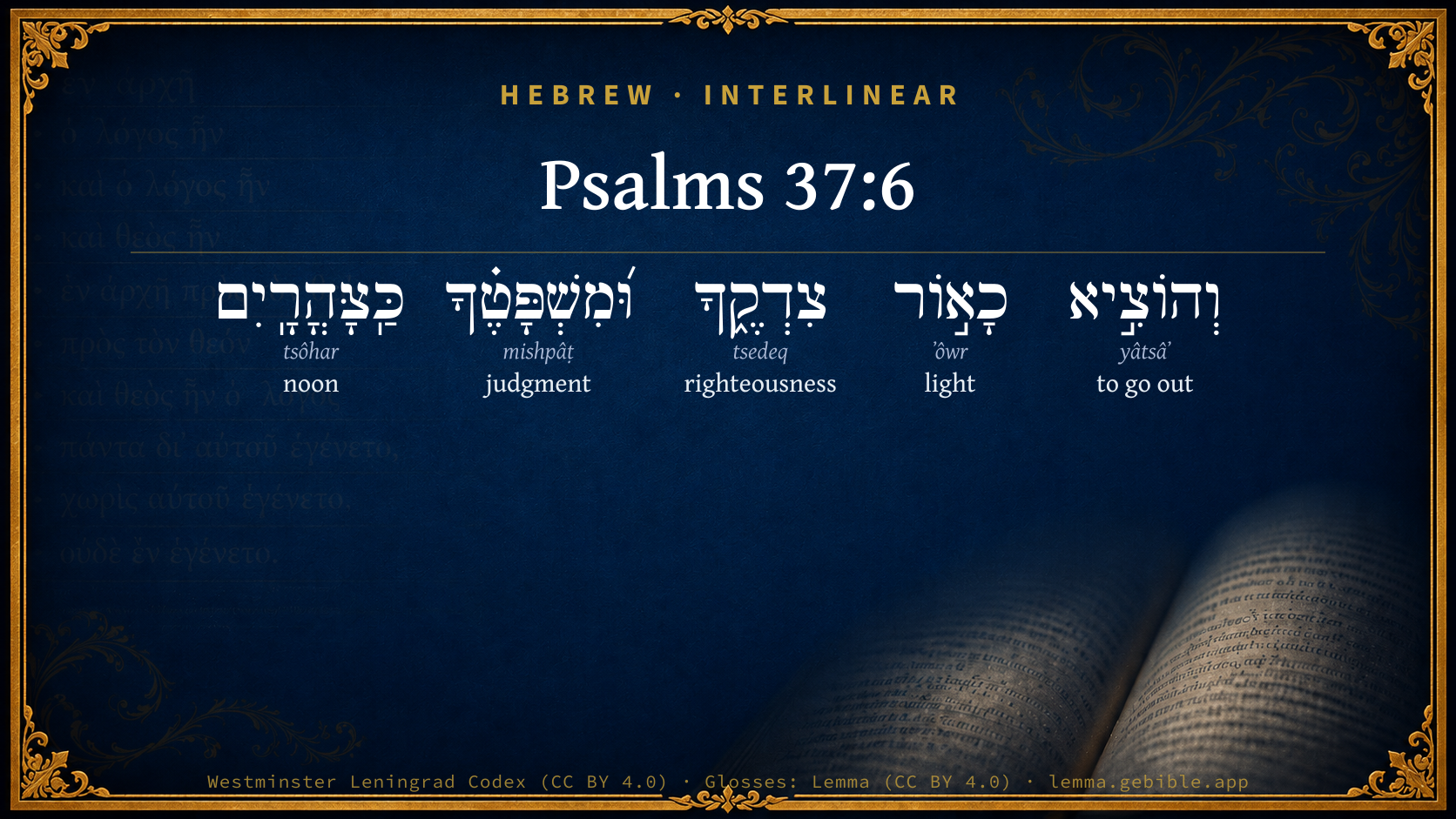
Psalms 37:6

Hebrew (Westminster Leningrad Codex) Psalms 37:6 appears in the Hebrew Old Testament. The text above is from the Westminster Leningrad Codex. Each word links to its Strong’s number, a concise gloss, and parsing drawn from the Open Scriptures Hebrew Bible morphology. Click any word for its full Brown-Driver-Briggs (BDB) entry.
Download image
Cite this verse

Psalms 37:6 (World English Bible). Public Domain. Lemma interlinear Bible study tool, https://lemma.gebible.app/v/psalms/37/6.

Show BibTeX & RIS
BibTeX
RIS
English Translation
He will make your righteousness go forth as the light, And your justice as the noon day sun.
World English Bible · Public Domain
Download a study sheet

One document with this verse’s original text, its word-by-word gloss line, the meaning frame, cross-references with their text, attributed commentary, and full source and license credits — printable, and it pastes into notes with its structure intact.

This verse Autodidact and up

Study sheet (.html) Plain text (.txt)

A passage Seminary Student

Up to 50 verses in one chapter. A passage sheet keeps up to 6 commentary sources and 12 cross-references per verse, in the order this page ranks them, and says so on the sheet whenever that leaves anything out. Ask for a single verse and you get the Autodidact verse sheet above.

Everything on this page stays free to read, with no account — the sheet is a download of what is already on screen, not access to it.

Want to remove ads? Support Godless Engineer
Compare translations 3

The same verse in 3 English versions, stacked beneath the original-language interlinear above. Click any original word for its lexicon entry.

Each is an independent rendering of the whole verse — the interlinear is not word-aligned to these translations.

Highlighted words mark where these versions differ — a whole-verse word diff, not a word-by-word alignment.

  • World English Bible Public Domain
    He will make your righteousness go forth as the light, And your justice as the noon day sun.
  • King James Version Public Domain
    And he shall bring forth thy righteousness as the light, and thy judgment as the noonday.
  • unfoldingWord Literal Text CC BY-SA 4.0
    and he will bring out your righteousness like the light, and your justice like the noonday.

unfoldingWord Literal Text — © unfoldingWord, licensed CC BY-SA 4.0. Word-aligned USFM3 via Door43 (git.door43.org/unfoldingWord/en_ult).

Versions to compare (up to 4)

3 of 4 selected

Show all 18 translations

Every available English version of this verse, each an independent rendering of the whole verse.

  • World English Bible Public Domain
    He will make your righteousness go forth as the light, And your justice as the noon day sun.
  • Berean Standard Bible Public Domain
    He will bring forth your righteousness like the dawn, your justice like the noonday sun.
  • Majority Standard Bible Public Domain
    He will bring forth your righteousness like the dawn, your justice like the noonday sun.
  • King James Version Public Domain
    And he shall bring forth thy righteousness as the light, and thy judgment as the noonday.
  • American Standard Version (1901) Public Domain
    And he will make thy righteousness to go forth as the light, And thy justice as the noon-day.
  • Revised Version (1885) Public Domain
    Add he shall make thy righteousness to go forth as the light, and thy judgment as the noonday.
  • Geneva Bible (1599) Public Domain
    And he shall bring foorth thy righteousnes as the light, and thy iudgement as the noone day.
  • Douay-Rheims (1899) Public Domain
    And he will bring forth thy justice as the light, and thy judgment as the noonday.
  • Young's Literal Translation Public Domain
    And hath brought out as light thy righteousness, And thy judgment as noon-day.
  • Literal Standard Version CC BY-SA 4.0
    And has brought out your righteousness as light, || And your judgment as noon-day.
  • Unlocked Literal Bible CC BY-SA 4.0
    He will display your justice like the daylight and your innocence like the day at noon.
  • unfoldingWord Literal Text CC BY-SA 4.0
    and he will bring out your righteousness like the light, and your justice like the noonday.
  • Darby Bible Public Domain
    and he will bring forth thy righteousness as the light, and thy judgment as the noonday.
  • World Messianic Bible Public Domain
    he will make your righteousness shine out like light, and your justice as the noon day sun.
  • Webster's Bible Public Domain
    And he will bring forth thy righteousness as the light, and thy judgment as the noon-day.
  • Free Bible Version CC BY-SA 4.0
    He will make your vindication shine like a light, the rightness of your cause like the noonday sun.
  • Bible in Basic English Public Domain
    And he will make your righteousness be seen like the light, and your cause like the shining of the sun.
  • JPS Tanakh (1917) Public Domain
    And He will make thy righteousness to go forth as the light, and thy right as the noonday.

Literal Standard Version (2020), Covenant Press — licensed CC BY-SA 4.0. Text via the HelloAO Bible API (eBible.org). Unlocked Literal Bible (unfoldingWord) — licensed CC BY-SA 4.0. Text via the HelloAO Bible API (eBible.org). unfoldingWord Literal Text — © unfoldingWord, licensed CC BY-SA 4.0. Word-aligned USFM3 via Door43 (git.door43.org/unfoldingWord/en_ult). Free Bible Version, Dr. Jonathan Gallagher — licensed CC BY-SA 4.0. Text via the HelloAO Bible API (eBible.org).

Word by word

More ways to search: Search by grammar → Find every occurrence → Compare this word →

Practice this passage: Drill this verse → Learn its vocabulary →

About this verse

These counts appear in no published source. They are computed here, from the morphology-tagged text and Lemma’s own curated glosses. What Lemma adds →

5
words
5
distinct lemmas
Wisdom
section

Notable vocabulary

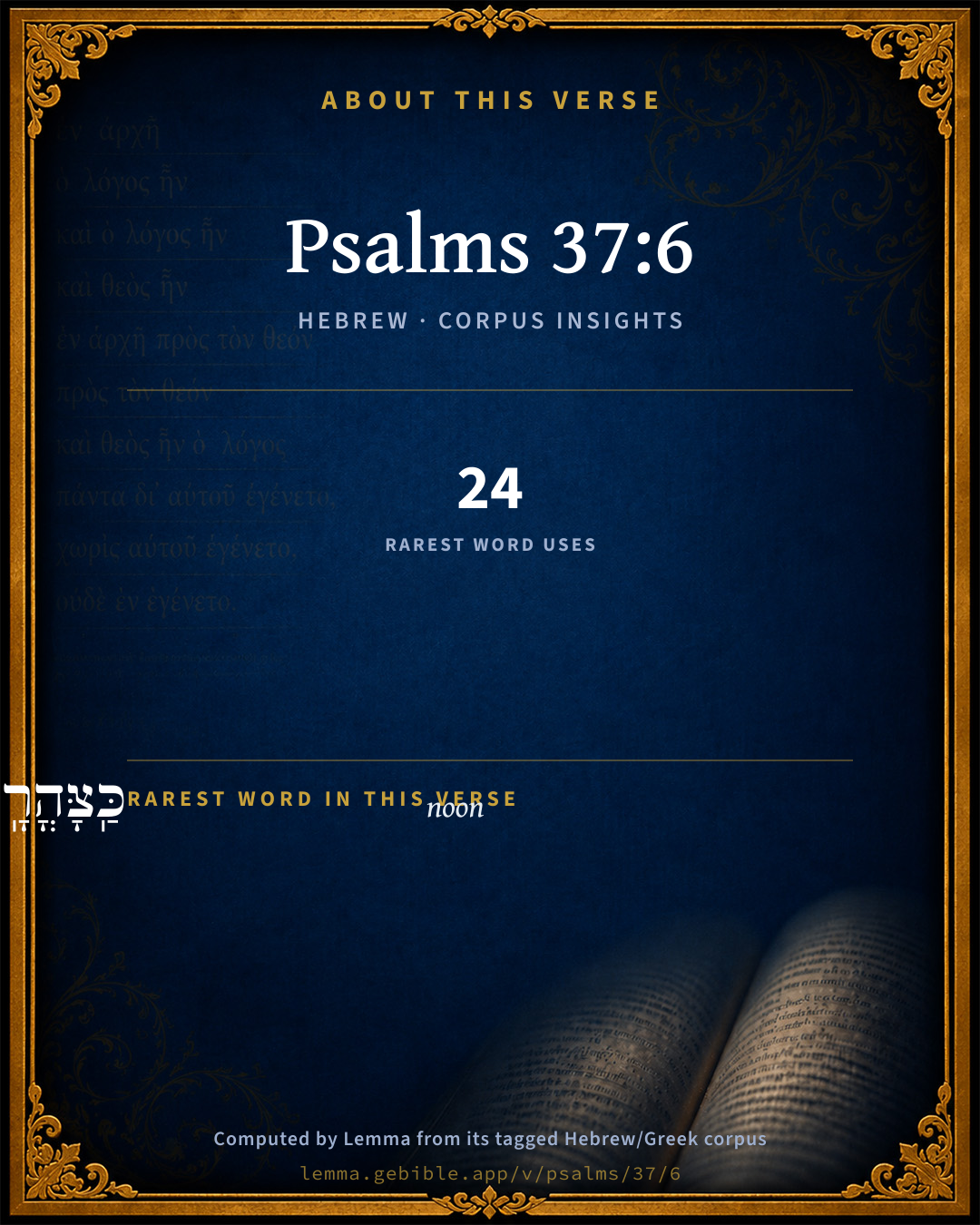
The rarest word here is כַּֽצָּהֳרָֽיִם noon H6672 — appearing just 24 times in the whole Hebrew Bible.

Shared distinctive vocabulary

כַּֽצָּהֳרָֽיִם noon H6672 occurs in 24 verses of the Hebrew Bible. Also found in:

Grammatical profile

  • 1 verb
  • 4 nouns

Verb forms

  • וְהוֹצִ֣יא Hiphil · Perfect

Hebrew & Septuagint length

In English translation the verse runs 18 words from the Hebrew and 16 from the Septuagint (LXX English) — closely comparable.

A rough comparison of the two English renderings, which tokenize alike — not a word-level alignment.

Word counts can differ between the Hebrew and the Greek without any difference in meaning — e.g. the Hebrew direct-object marker אֵת has no separate Greek word, and Greek often adds the article ὁ.

Cross-references

9

Topical passages linked to Psalms 37:6 in the Treasury of Scripture Knowledge — connected by theme and wording, ordered by reader-vote popularity; previews shown in the World English Bible.

  • Isaiah 54:17 No weapon that is formed against you shall prosper; and every tongue that shall rise against you in judgment you shall condemn. This is the heritage of the servants of Yahweh, and their righteousness which is of me, says Yahweh.
  • Job 11:17 Life shall be clearer than the noonday; Though there is darkness, it shall be as the morning.
  • Isaiah 58:8 Then shall your light break forth as the morning, and your healing shall spring forth speedily; and your righteousness shall go before you; the glory of Yahweh shall by your rearward.
  • Micah 7:8–9 Don't rejoice against me, my enemy. When I fall, I will arise. When I sit in darkness, Yahweh will be a light to me.
  • Matthew 13:43 Then the righteous will shine forth like the sun in the Kingdom of their Father. He who has ears to hear, let him hear.
  • Isaiah 58:10 and if you draw out your soul to the hungry, and satisfy the afflicted soul: then shall your light rise in darkness, and your obscurity be as the noonday;
  • Psalms 31:20 In the shelter of your presence you will hide them from the plotting of man. You will keep them secretly in a dwelling away from the strife of tongues.
  • Malachi 3:18 Then you shall return and discern between the righteous and the wicked, between him who serves God and him who doesn't serve him.
  • 1 Corinthians 4:5 Therefore judge nothing before the time, until the Lord comes, who will both bring to light the hidden things of darkness, and reveal the counsels of the hearts. Then each man will get his praise from God.

Cross-references courtesy of OpenBible.info (CC BY 4.0).

Hebrew and Greek witnesses Masoretic Hebrew ↔ Greek Septuagint

The same verse in the two great witnesses to the Old Testament, shown verse-for-verse.

You’re reading Greek Psalm 36 (Hebrew Psalm 37). The Septuagint counts the superscription, so verse numbers can differ from the Hebrew — chapter-level alignment, not verse-by-verse. Numbering follows Rahlfs.

These are two independent witnesses, not word-aligned to each other, and the Septuagint is shown in lemma (dictionary) form.

Hebrew Psalms 37:6 Masoretic · Westminster Leningrad Codex

וְהוֹצִ֣יא כָא֣וֹר צִדְקֶ֑ךָ וּ֝מִשְׁפָּטֶ֗ךָ כַּֽצָּהֳרָֽיִם

He will make your righteousness go forth as the light, And your justice as the noon day sun.

World English Bible · Public Domain

Greek LXX Greek Psalm 36:6 Septuagint · lemma form

καί ἐκφέρω ὡς φῶς ὁ δικαιοσύνη σύ καί ὁ κρίμα σύ ὡς μεσημβρία

And he shall bring forth your righteousness as the light, and your judgment as the noon-day.

LXX2012 (modern English Septuagint) · Public Domain

Hebrew: Westminster Leningrad Codex (CC BY 4.0). Greek: Septuagint (public domain); English from LXX2012 (modern English Septuagint) (Public Domain). How the Septuagint differs from the Hebrew →

Commentary

Notes on Psalms 37:6 from classic Christian and Jewish commentators (each source and its license shown beneath its notes). The classic Christian expositions comment on the surrounding passage and are grouped to its opening verse, so a note may address several verses; the Jewish commentaries on the Tanakh (Rashi and others) are per-verse, so they appear only where the commentator wrote on this verse.

Lemma curates 59 commentaries, every one of them public domain or Creative Commons licensed, each selected and text-cleaned for this edition rather than reprinted as found. About our sources →

Trapp's Complete Commentary

John Trapp

Psa 37:6 And he shall bring forth thy righteousness as the light, and thy judgment as the noonday.

Ver. 6. And he shall bring forth thy righteousness as the light] God will so oil thy good name that infamy shall not stick to it. Dirt will stick upon a mud wall, not so upon marble. But say thou be aspersed and denigrated by calumnies and contumelies cast upon thee, and thou lie under them for a time, as the earth doth under the darkness of the night; yet as the morning suddenly arising driveth away that darkness, so shall God clear up thy wronged innocence; and as the moon wadeth out of a cloud, so shalt thou get over all thy troubles in this kind or any other; it shall be with thee as it was once with Cato, whom Seneca calleth the lively picture of virtues, who was thirty-two times accused in open court, and as many times cleared and absolved.

And thy judgments as the noonday] At the day of judgment, howsoever, if not sooner; then there will be a resurrection as well of names as bodies.

John Trapp, A Commentary or Exposition upon All the Books of the Old and New Testament (1647–1656) — public domain. Text from a community e-Sword module.

J. A. Alexander on Psalms

Joseph Addison Alexander

6. (Psa 37:6) And (will) bring out thy right like the light, and thy cause like the noon. He will espouse thy cause, and make it triumph in the sight of all men. The figure of light suggests the double idea of relief from suffering and clear revelation after long concealment. Compare Job 11:17, Isa 58:8, Mic. 7—The Hebrew word for noon is of the dual form, and properly denotes twofold or double light, i. e. the brightest, the most intense.

Joseph Addison Alexander, The Psalms Translated and Explained (1850) — public domain. Text from a community e-Sword module.

Tyndale Open Study Notes

Tyndale Open Resources

37:6 Justice occurs when the Lord’s will triumphs and the godly experience his rescue (Isa 45:8; 51:5-6; 58:8, 10-11).

Tyndale Open Study Notes — © Tyndale Open Resources, licensed CC BY-SA 4.0. Text via the HelloAO Bible API.

Geneva Bible (1599)

Geneva Bible translators

As the hope of the daylight causeth us not to be offended with the darkness of the night: so ought we patiently to trust that God will clear our cause and restore us to our right.

Geneva Bible (1599) marginal notes — public domain. Text via Bolls.life.

Adam Clarke's Commentary

Verse 6. Thy righteousness as the light] As God said in the beginning, "Let there be light, and there was light;" so he shall say, Let thy innocence appear, and it will appear as suddenly and as evident as the light was at the beginning.

Adam Clarke's Commentary on the Bible (1810–1826) — public domain. Text from a community e-Sword/MySword module.

John Calvin's Commentaries

6. And he will bring forth thy righteousness as the light This David says, in order to anticipate the misgivings which often trouble us when we seem to lose our labor in faithfully serving God, and in dealing uprightly with our neighbors; nay, when our integrity is either exposed to the calumnies of the wicked, or is the occasion of injury to us from men; for then it is thought to be of no account in the sight of God. David, therefore, declares, that God will not suffer our righteousness to be always hid in darkness, but that he will maintain it and bring it forth to the light; namely, when he will bestow upon us such a reward as we desire. He alludes to the darkness of the night, which is soon dispelled by the dawning of the day; as if he had said, We may be often grievously oppressed, and God may not seem to approve our innocence, yet this vicissitude should no more disturb our minds than the darkness of the night which covers the earth; for then the expectation of the light of day sustains our hope.

John Calvin's Commentaries (1540-1563) — public domain. Text from the Calvin Translation Society English edition (1840s-50s) via the Christian Classics Ethereal Library (ccel.org). Calvin's coverage is partial (roughly two-thirds of the Bible); uncommented books and verses are honest gaps, never fabricated. The 19th-century editor's footnotes and remarks are omitted so the notes are faithfully Calvin's own voice.

Ellicott's Commentary for English Readers

(6) The light.—The image is from an Eastern dawn and the progress of the sun to its meridian glory. (Comp. Job_11:17; Isa_58:10.)

A Bible Commentary for English Readers, edited by Charles John Ellicott (1878–1897) — public domain. Text from a community e-Sword module.

The Cambridge Bible for Schools and Colleges

gen. ed. J. J. S. Perowne

6. And he shall make thy righteousness go forth as the light,

And thy judgement as the brightness of the noonday.

The result of that divine working. The justice of thy cause has been hidden, but it shall shine forth like the sun rising out of the darkness of night; thy right has been obscured, but it shall be clear as the full light of the noonday. Cp. Job_11:17; Pro_4:18; Isa_58:10; Mat_13:43.

The Cambridge Bible for Schools and Colleges (gen. ed. J. J. S. Perowne; Cambridge University Press, 1878–1918) — public domain. Text from a community e-Sword module.

John Gill's Exposition

Rest in the Lord,.... Or "be silent to the Lord" (p); be still, and know that he is God; quietly submit to his will, and acquiesce in all the dispensations of his providence: it does not design a stupid indolence, or a stoical apathy, that we should be like sticks and stones, without any concern at the hand of God upon us; nor an entire silence under afflictions; we should own that they are of God, and that we are deserving of them; we should pray to him to sanctify them, to support under them, and deliver out of them; we should bless his name that they are no worse, and that they are any ways useful to us; and we should speak to others of the divine goodness experienced under them; but this stands opposed to an arraigning or murmuring at the providence of God, and intends a patient bearing the hand of God, and a resignation of will to his will; for it follows,

and wait patiently for him: for the enjoyment of him, help from him, and deliverance by him;

fret not thyself because of him who prospereth in his way, because of the man who bringeth wicked devices to pass; this explains the sense of Psa 37:1; it being often an additional uneasiness to the people of God under affliction, when they observe the prosperity of men that go on in a sinful way, and have all or more than heart can wish; and whatever they contrive and devise, though wicked and criminal.

(p) "tace Domino", Pagninus, Montanus; "sile", Musculus, Piscator, Tigurine version, Cocceius, Gejerus, Michaelis; so Ainsworth.

John Gill's Exposition of the Whole Bible (1746–1763) — public domain (CC PDM 1.0). Text via the HelloAO Bible API.

Albert Barnes' Notes on the Bible

And he shall bring forth thy righteousness as the light - That is, if you are slandered; if your character is assailed, and seems for the thee to be under a cloud; if reproach comes upon you from the devices of wicked people in such a way that you cannot meet it - then, if you will commit the case to God, he will protect your character, and will cause the clouds to disperse, and all to be as clear in reference to your character and the motives of your conduct as the sun without a cloud. There are numerous cases in which a man cannot meet the assaults made on his reputation, in which he cannot trace to its source a slanderous accusation, in which he cannot immediately explain the circumstances which may have served to give the slanderous report an appearance of probability, but in which he may be perfectly conscious of innocence; and, in such cases, the only resource is to commit the whole matter to God. And there is nothing that may be more safely left with him; nothing that God will more certainly protect than the injured reputation of a good man. Under his administration things will ultimately work themselves right, and a man will have all the reputation which he deserves to have. But he who spends his life in the mere work of defending himself, will soon have a reputation that is not much worth defending. The true way for a man is to do his duty - to do right always - and then commit the whole to God.

And thy judgment - Thy just sentence. That is, God will cause justice to be done to your character.

As the noon-day - The original word here is in the dual form, and means properly “double-light;” that is, the strongest, brightest light. It means “noon,” because the light is then most clear and bright. The idea is, that he will make your character perfectly clear and bright. No cloud will remain on it.

Albert Barnes' Notes on the Bible (1834–1885) — public domain. Text from a community e-Sword/MySword module.

Matthew Poole's English Annotations

He shall bring forth thy righteousness to the view of the world; from which it hath hitherto seemed to be hid or eclipsed by reproaches, and by grievous calamities, which most men are apt to mistake for tokens and punishments of great wickedness.

As the light; it shall be as visible to men as the light of the sun, and that at noon-day, as it is in the next branch. So effectually will he plead thy cause.

Judgment; the same thing with righteousness, as this word is used here below, Psa 37:28; 99:4, and oft elsewhere.

Matthew Poole's English Annotations on the Holy Bible (1683–1685) — public domain. Text from a community e-Sword/MySword module.

The Treasury of David

Charles H. Spurgeon

Ver. 6. And he shall bring forth thy righteousness as the light. In the matter of personal reputation we may especially be content to be quiet, and leave our vindication with the Judge of all the earth. The more we fret in this case the worse for us. Our strength is to sit still. The Lord will clear the slandered. If we look to his honour, he will see to ours. It is wonderful how, when faith learns to endure calumny with composure, the filth does not defile her, but falls off like snowballs from a wall of granite. Even in the worst cases, where a good name is for awhile darkened, Providence will send a clearing like the dawning light, which shall increase until the man once censured shall be universally admired. And thy judgment as the noonday. No shade of reproach shall remain. The man shall be in his meridian of splendour. The darkness of his sorrow and his ill repute shall both flee away.

Ver. 6. He shall bring forth thy righteousness as the light, etc. If thou shouldest be accused as a man of evil designs, let not that trouble thee neither: for though thy fame may be obscured for a time by calumnies and slanders, as the sun is by mists and clouds, yet as that scatters them all at last, so shall thy integrity appear, and shine as bright as the sun at noonday. Symon Patrick.

Ver. 6. Sweet comfort for slandered saints. Where their character now is. Who shall reveal it. The gradual yet sure manner of the revelation, and the glorious conclusion.

Psalms 37:7*

Charles H. Spurgeon's The Treasury of David (1869–1885) — public domain. Psalms only. Text from a community e-Sword/MySword module.

The Pulpit Commentary

And he shall bring forth thy righteousness as the light, and thy judgment as the noonday. If the prosperity of the wicked frets thee, because it seems to obscure thy righteousness, since while he appears to bask in the sunshine of God"s favour, thy life is possibly overshadowed by clouds and darkness, be sure that, in the end, this seeming injustice will be remedied. God will not frown on thee always; one day he will turn on thee the light of his countenance, and make thy righteousness to shine forth like the sun in its noonday splendour.

The Pulpit Commentary (1880–1919), ed. H.D.M. Spence-Jones & Joseph S. Exell — public domain. Text from a community e-Sword module.

John Wesley's Explanatory Notes

Judgment - It shall be as visible to men, as the light of the sun, at noon-day.

John Wesley, Explanatory Notes Upon the Whole Bible (1754–1765) — public domain. Text via the GEBible commentary corpus.

Lesson kit

Teaching starters — assembled from the data on this page, not authored interpretation. Every prompt links to the verse data it draws on. Edit before teaching.

Psalms, in the Wisdom, opens this verse with 5 words (5 distinct Hebrew lemmas). Its most distinctive word is tsôhar (“noon”). A historical commentator’s framing appears above. Read the whole chapter for the surrounding context.

Discussion questions

  1. What does “noon” (tsôhar) contribute to the verse as a whole?
  2. Genesis 6:16 shares the word «noon» with this verse. How do the two illuminate each other?
  3. The translations on this page render this verse differently — a whole-verse word diff, not a word-by-word alignment. What might account for the different wordings?
  4. The verb «וְהוֹצִ֣יא» is Hiphil Perfect. How does its form color the action?
  5. Reading how Trapp's Complete Commentary and J. A. Alexander on Psalms read this verse, where do the two commentators agree and where do they part?

Things to notice

Reading settings

Reading text

Shown beneath each verse's original-language words.

Old Testament
Old Testament edition

Read the OT as the Masoretic Hebrew (MT) or the Greek Septuagint (LXX).

English shown for the Greek Septuagint (in the Hebrew ↔ Greek comparison).

Comparing translations? Open the Compare panel on any verse page to stack up to four side by side.