
Isaiah 2:5

Hebrew (Westminster Leningrad Codex) Isaiah 2:5 appears in the Hebrew Old Testament. The text above is from the Westminster Leningrad Codex. Each word links to its Strong’s number, a concise gloss, and parsing drawn from the Open Scriptures Hebrew Bible morphology. Click any word for its full Brown-Driver-Briggs (BDB) entry.
Download image
Cite this verse

Isaiah 2:5 (World English Bible). Public Domain. Lemma interlinear Bible study tool, https://lemma.gebible.app/v/isaiah/2/5.

Show BibTeX & RIS
BibTeX
RIS
English Translation
House of Jacob, come, and let us walk in the light of Yahweh.
World English Bible · Public Domain
Download a study sheet

One document with this verse’s original text, its word-by-word gloss line, the meaning frame, cross-references with their text, attributed commentary, and full source and license credits — printable, and it pastes into notes with its structure intact.

This verse Autodidact and up

Study sheet (.html) Plain text (.txt)

A passage Seminary Student

Up to 50 verses in one chapter. A passage sheet keeps up to 6 commentary sources and 12 cross-references per verse, in the order this page ranks them, and says so on the sheet whenever that leaves anything out. Ask for a single verse and you get the Autodidact verse sheet above.

Everything on this page stays free to read, with no account — the sheet is a download of what is already on screen, not access to it.

Want to remove ads? Support Godless Engineer
Compare translations 3

The same verse in 3 English versions, stacked beneath the original-language interlinear above. Click any original word for its lexicon entry.

Each is an independent rendering of the whole verse — the interlinear is not word-aligned to these translations.

Highlighted words mark where these versions differ — a whole-verse word diff, not a word-by-word alignment.

  • World English Bible Public Domain
    House of Jacob, come, and let us walk in the light of Yahweh.
  • King James Version Public Domain
    O house of Jacob, come ye, and let us walk in the light of the LORD.
  • unfoldingWord Literal Text CC BY-SA 4.0
    House of Jacob, come, and let us walk in the light of Yahweh. q1

unfoldingWord Literal Text — © unfoldingWord, licensed CC BY-SA 4.0. Word-aligned USFM3 via Door43 (git.door43.org/unfoldingWord/en_ult).

Versions to compare (up to 4)

3 of 4 selected

Show all 18 translations

Every available English version of this verse, each an independent rendering of the whole verse.

  • World English Bible Public Domain
    House of Jacob, come, and let us walk in the light of Yahweh.
  • Berean Standard Bible Public Domain
    Come, O house of Jacob, let us walk in the light of the LORD.
  • Majority Standard Bible Public Domain
    Come, O house of Jacob, let us walk in the light of the LORD.
  • King James Version Public Domain
    O house of Jacob, come ye, and let us walk in the light of the LORD.
  • American Standard Version (1901) Public Domain
    O house of Jacob, come ye, and let us walk in the light of Jehovah.
  • Revised Version (1885) Public Domain
    O house of Jacob, come ye, and let us walk in the light of the LORD.
  • Geneva Bible (1599) Public Domain
    O house of Iaakob, come ye, and let vs walke in the Lawe of the Lord.
  • Douay-Rheims (1899) Public Domain
    O house of Jacob, come ye, and let us walk in the light of the Lord.
  • Young's Literal Translation Public Domain
    O house of Jacob, come, And we walk in the light of Jehovah.'
  • Literal Standard Version CC BY-SA 4.0
    O house of Jacob, come, || And we walk in the light of YHWH.”
  • Unlocked Literal Bible CC BY-SA 4.0
    House of Jacob, come, and let us walk in the light of Yahweh.
  • unfoldingWord Literal Text CC BY-SA 4.0
    House of Jacob, come, and let us walk in the light of Yahweh. q1
  • Darby Bible Public Domain
    House of Jacob, come ye, and let us walk in the light of Jehovah.
  • World Messianic Bible Public Domain
    House of Jacob, come, and let’s walk in the light of the LORD.
  • Webster's Bible Public Domain
    O house of Jacob, come ye, and let us walk in the light of the LORD.
  • Free Bible Version CC BY-SA 4.0
    Come, you Israelites, let's walk in the Lord's light.
  • Bible in Basic English Public Domain
    O family of Jacob, come, and let us go in the light of the Lord.
  • JPS Tanakh (1917) Public Domain
    O house of Jacob, come ye, and let us walk in the light of the LORD.

Literal Standard Version (2020), Covenant Press — licensed CC BY-SA 4.0. Text via the HelloAO Bible API (eBible.org). Unlocked Literal Bible (unfoldingWord) — licensed CC BY-SA 4.0. Text via the HelloAO Bible API (eBible.org). unfoldingWord Literal Text — © unfoldingWord, licensed CC BY-SA 4.0. Word-aligned USFM3 via Door43 (git.door43.org/unfoldingWord/en_ult). Free Bible Version, Dr. Jonathan Gallagher — licensed CC BY-SA 4.0. Text via the HelloAO Bible API (eBible.org).

Word by word

More ways to search: Search by grammar → Find every occurrence → Compare this word →

Practice this passage: Drill this verse → Learn its vocabulary →

בְּא֥וֹר
ʼôwr
H216
“in/at · light of”
Preposition + Noun, Common, Both, Singular, Construct
Part of Speech
Preposition + Noun
Type
Common
Gender
Both
Number
Singular
State
Construct
Full BDB Definition

Origin: from H215

TWOT: 52a

light - light of day - light of heavenly luminaries (moon, sun, stars) - day-break, dawn, morning light - daylight - lightning - light of lamp - light of life - light of prosperity - light of instruction - light of face (figuratively) - Jehovah as Israel's light
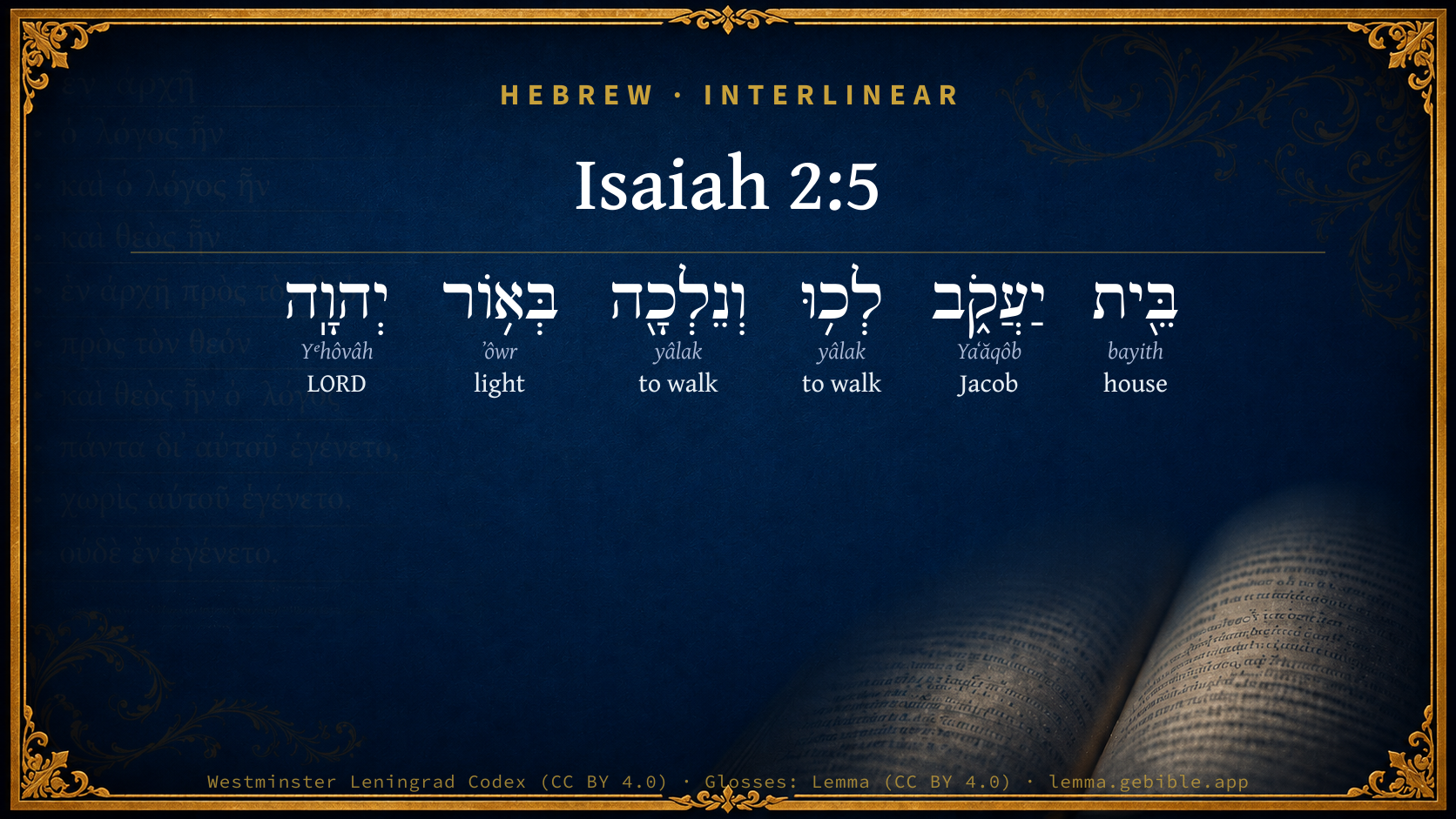
  1. בֵּ֖ית bayith H1004 “house of” Noun, Common, Masculine, Singular, Construct
  2. יַעֲקֹ֑ב Yaʻăqôb H3290 “Jacob” Noun, Proper
  3. לְכ֥וּ yâlak H3212 “walk” Verb, Qal, Imperative, 2nd Person, Masculine, Plural
  4. וְנֵלְכָ֖ה yâlak H3212 “and · to walk” Conjunction + Verb, Qal, Cohortative, 1st Person, Common, Plural
  5. יְהוָֽה Yᵉhôvâh H3068 “LORD” Noun, Proper

About this verse

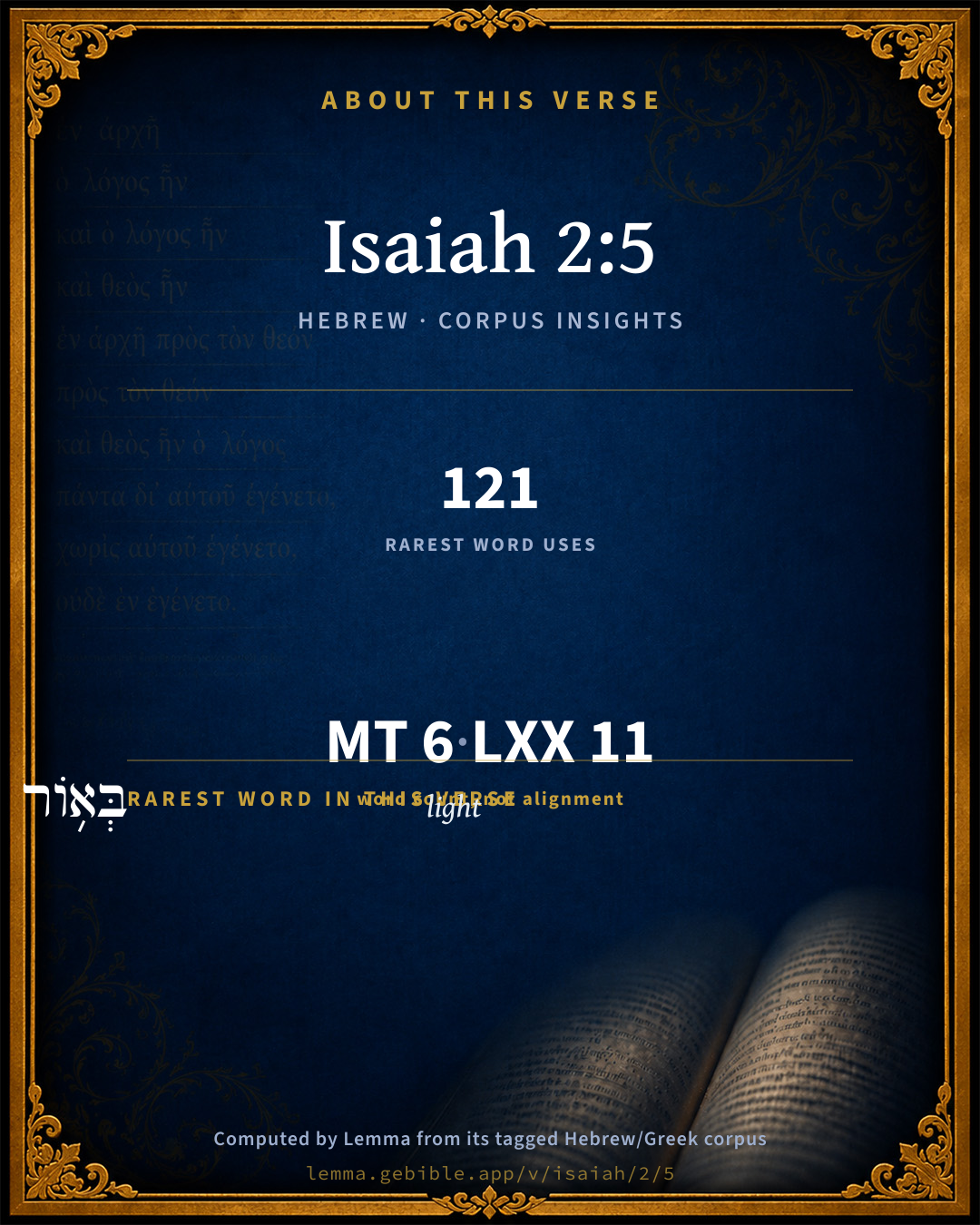
These counts appear in no published source. They are computed here, from the morphology-tagged text and Lemma’s own curated glosses. What Lemma adds →

6
words
5
distinct lemmas
Prophets
section

Grammatical profile

  • 2 verbs
  • 4 nouns

Verb forms

  • לְכ֥וּ Qal · Imperative
  • וְנֵלְכָ֖ה Qal · Cohortative

Repetition

A word recurs within this verse — often emphatic in Hebrew:

  • לְכ֥וּ to walk H3212 ×2

Hebrew & Septuagint length

In English translation the verse runs 13 words from the Hebrew and 17 from the Septuagint (LXX English) — closely comparable.

A rough comparison of the two English renderings, which tokenize alike — not a word-level alignment.

Word counts can differ between the Hebrew and the Greek without any difference in meaning — e.g. the Hebrew direct-object marker אֵת has no separate Greek word, and Greek often adds the article ὁ.

In the original languages it is 6 Hebrew tokens and 11 Greek tokens — but the two are counted differently (Hebrew bundles its prefixes and suffixes into one token; the Greek is in lemma form), so that isn’t a like-for-like length.

Cross-references

14

Topical passages linked to Isaiah 2:5 in the Treasury of Scripture Knowledge — connected by theme and wording, ordered by reader-vote popularity; previews shown in the World English Bible.

  • Ephesians 5:8 For you were once darkness, but are now light in the Lord. Walk as children of light,
  • Isaiah 60:19–20 The sun shall be no more your light by day; neither for brightness shall the moon give light to you: but Yahweh will be to you an everlasting light, and your God your glory.
  • Luke 1:79 To shine on those who sit in darkness and the shadow of death; To guide our feet into the way of peace."
  • 1 John 1:7 But if we walk in the light, as he is in the light, we have fellowship with one another, and the blood of Jesus Christ, his Son, cleanses us from all sin.
  • John 12:35–36 Jesus therefore said to them, "Yet a little while the light is with you. Walk while you have the light, that darkness doesn't overtake you. He who walks in the darkness doesn't know where he is going.
  • 1 John 1:5 This is the message which we have heard from him and announce to you, that God is light, and in him is no darkness at all.
  • Revelation 21:23–24 The city has no need for the sun, neither of the moon, to shine, for the very glory of God illuminated it, and its lamp is the Lamb.
  • Psalms 89:15 Blessed are the people who learn to acclaim you. They walk in the light of your presence, Yahweh.
  • Isaiah 2:3 Many peoples shall go and say, "Come, let's go up to the mountain of Yahweh, To the house of the God of Jacob; And he will teach us of his ways, And we will walk in his paths. For out of Zion the law shall go forth, And the word of Yahweh from Jerusalem.
  • Isaiah 50:10–11 Who is among you who fears Yahweh, who obeys the voice of his servant? He who walks in darkness, and has no light, let him trust in the name of Yahweh, and rely on his God.
  • Isaiah 58:1 Cry aloud, don't spare, lift up your voice like a trumpet, and declare to my people their disobedience, and to the house of Jacob their sins.
  • 1 Thessalonians 5:5–6 You are all children of light, and children of the day. We don't belong to the night, nor to darkness,
  • Isaiah 60:1–2 Arise, shine; for your light is come, and the glory of Yahweh is risen on you.
  • Romans 13:12–14 The night is far gone, and the day is near. Let's therefore throw off the works of darkness, and let's put on the armor of light.

Cross-references courtesy of OpenBible.info (CC BY 4.0).

Hebrew and Greek witnesses Masoretic Hebrew ↔ Greek Septuagint

The same verse in the two great witnesses to the Old Testament, shown verse-for-verse.

These are two independent witnesses, not word-aligned to each other, and the Septuagint is shown in lemma (dictionary) form.

Hebrew Isaiah 2:5 Masoretic · Westminster Leningrad Codex

בֵּ֖ית יַעֲקֹ֑ב לְכ֥וּ וְנֵלְכָ֖ה בְּא֥וֹר יְהוָֽה

House of Jacob, come, and let us walk in the light of Yahweh.

World English Bible · Public Domain

Greek LXX Isaiah 2:5 Septuagint · lemma form

καί νῦν ὁ οἶκος ὁ ἰακώβ δεῦτε πορεύομαι ὁ φῶς κύριος

And now, O house of Jacob, come, and let us walk in the light of the Lord.

LXX2012 (modern English Septuagint) · Public Domain

On this verse, Lange's Commentary on the Holy Scriptures discusses the Septuagint’s reading. Read the note in Commentary ↓

Hebrew: Westminster Leningrad Codex (CC BY 4.0). Greek: Septuagint (public domain); English from LXX2012 (modern English Septuagint) (Public Domain). How the Septuagint differs from the Hebrew →

Targum (Aramaic paraphrase)

1

The Targum is the ancient Jewish Aramaic paraphrase of the Hebrew Scriptures — an interpretive translation, not the Hebrew text itself. Onkelos (literal) and Pseudo-Jonathan (expansive) render the Torah, and Jonathan the Prophets. Coverage is partial: where no permissively-licensed English translation exists for a verse, only the Aramaic is shown. This is verse-level text, not a word-by-word alignment to the Hebrew.

  1. Targum Jonathan Prophets (Joshua–Malachi)
    יֵימְרוּן דְבֵית יַעֲקֹב אֲתוֹ וּנְהַךְ בְּאוּלְפָן אוֹרַיְתָא דַיְיָ:

    Those of the house of Jacob shall say, Come ye, and let us walk in the instruction of the law of the Lord.

    Targum Jonathan — Aramaic: “Mikraot Gedolot” (public domain). English: “Sefaria Community Translation” (CC0 1.0 (public-domain dedication)); “London "Chaldee Paraphrase," 1871” (public domain). Text via Sefaria.

Commentary

Notes on Isaiah 2:5 from classic Christian and Jewish commentators (each source and its license shown beneath its notes). The classic Christian expositions comment on the surrounding passage and are grouped to its opening verse, so a note may address several verses; the Jewish commentaries on the Tanakh (Rashi and others) are per-verse, so they appear only where the commentator wrote on this verse.

Lemma curates 59 commentaries, every one of them public domain or Creative Commons licensed, each selected and text-cleaned for this edition rather than reprinted as found. About our sources →

Trapp's Complete Commentary

John Trapp

Isa 2:5 O house of Jacob, come ye, and let us walk in the light of the LORD.

Ver. 5. O house of Jacob.] So Mic 2:7, "O thou that art called the house of Jacob, and the house of Israel." {Isa 5:7} Thou that art "called a Jew, and makest thy boast of God." {Rom 2:17} This Rupertus maketh to be the voice and advice of the converted and Christian Gentiles to the Jews; others, of our prophet to his perverse countrymen to join with the Gentiles, or rather to go before them as worthy guides in heavenly ways, and not to lie behind those whom they have so much slighted. {a}

Let us walk in the light of the Lord.] That is, in the law of the Lord (for Lex est Lux, Law is light, Pro 6:23) and not by the sparks of our own tinder boxes, {Isa 50:11} not by the rush candle of philosophical prescriptions. Let us "walk in the fear of the Lord, and in the comfort of the Holy Ghost." {as Act 9:31}

{a} Per semulationem provocat. - Oecolamp.

John Trapp, A Commentary or Exposition upon All the Books of the Old and New Testament (1647–1656) — public domain. Text from a community e-Sword module.

The Biblical Illustrator

Joseph S. Exell

Isa_2:5

O house of Jacob, come ye, and let us walk in the light of the Lord

Mutual encouragement

I.

SYMPATHETIC FELLOW FEELING. All who are anxious for their own welfare, desire the welfare of others.

II. MUTUAL PROGRESS. Two together are stronger than two apart. Let us A weak brother at our side will not only get help but will afford us assistance.

III. APPRECIATIVE KNOWLEDGE. Let us walk in the light of the Lord. The light is the place for safety. Light is life, darkness is death.

IV. UNFAILING PROVISION. The light of the Lord. God is the only source of light, but He is an all-efficient source. He never can fail. God is light. (Homilist.)

An invitation to repentance

I. THIS IS ISAIAHS INVITATION TO HIS COUNTRYMEN TO REPENT. To feel the full force of his appeal we must notice the connection of the text with its context.

1. The prophet commences by quoting (Isa_2:2-4) what is probably an ancient prediction, quoted also by Micah (Mic_4:1-3). The people would doubt less look eagerly for the fulfilment of this prophecy, so agreeable to their national hopes. But no sign of its accomplishment was to be seen. They were indeed enjoying in the reign of Uzziah a season of secular prosperity, but they were far from being established in the top of the mountains; they were surrounded by watchful foes, and certainly there were no signs of the long foretold reign of peace.

2. The light of worldly prosperity had not brought them the fulfilment of the prophecy of peace. Isaiah then bids them walk in the light of the Lord; for, as he goes on to show, God had forsaken His people on account of those sins which their prosperity had engendered. Therefore it was that this prophecy was not fulfilled to them. Their very prosperity kept them back from greater prosperity (verses 6-9).

3. But this state of things could not continue. If they refuse to walk in the light of the Lord, He will not only withdraw the promised blessings, but will humble them by taking away the prosperity they already enjoyed (verses 10-21).

II. THE SITUATION OF THE CHURCH OF GOD THUS DESCRIBED BY ISAIAH REMAINS ALMOST UNCHANGED TO THE PRESENT DAY.

1. We still look for the time when the mountain of the Lords house shall be established in the top of the mountains, and the promised peace on earth shall be realised; but we see no sign of its immediate approach. The Church still continues beset with foes, unable to stem the rising tide of rationalism and unbelief; and certainly these are no signs of the long-foretold reign of peace.

2. If we inquire why this is so, the answer is the same as it was in the days of Isaiah. We do not, with a single eye, walk in the light of the Lord. We enjoy a large measure of worldly prosperity. Science and secular knowledge and useful arts make rapid progress, and in their light we walk, too often forgetting that it is but a reflected radiance, borrowed from the one source of all true light. If the Church makes some impression upon the world, the world also makes great inroads upon the Church.

3. But this state of things cannot last forever. Isaiah of old spake of the day of the Lord, which would surely overtake His people if they continued to follow their own inventions and to neglect God. A yet greater and more terrible day of the Lord is at hand. In that day all the pride of our modern civilisation, its wisdom and knowledge, will aid us no more than the idols of silver and gold, unless withal we are found walking in the light of the Lord. (A. K. Cherril, M. A.)

Walking in the light of the Lord

To walk in the light of the Lord implies--

I. THAT WE AVAIL OURSELVES OF HIS REVELATION OF TRUTH.

II. THAT WE ORDER THE COURSE OF OUR LIVES ACCORDING TO HIS EXAMPLE AND THE GUIDANCE OF HIS WORD AND SPIRIT (Jer_10:23).

III. PROGRESS. It supposes that we leave behind our former darkness and sin, our slothfulness and error, and march every day some distance on our road to eternal life.

IV. LIGHT INSPIRES CHEERFULNESS AND JOY; and if we walk in the light of the Lord, we must have the only true happiness and peace. The truth of the Gospel is enough to cause constant exultation. (Homilist.)

Walking in the light of the Lord

I. THE IMPORT OF THE WORDS, the light of the Lord. There appears here to be an allusion to that striking token of special guardianship which was vouchsafed to the Israelites in the Shechinah as it appeared to the Church in the wilderness; which, while it was the recognised token of special favour from God, indicated also their course of movement. The expression to walk in the light of the Lord, we regard--

1. As indicative of a cordial reception of His truth. Light is the general emblem of knowledge; and there are many striking points of analogy between religious knowledge and light. The phrase is applicable to the whole body of Divine revelation, which may be viewed as the light of God, that breaks forth, as it were, from His countenance: His countenance, which is the emblem of His immaculate purity, as well as His infinite intelligence. He is said to dwell in the light which no man can approach unto. And this is also significant of the glory of revealed truth--it is the very light in which the perfections of God stand manifested; the light that develops to us His secret counsels, His plans of government, especially His plan of saving mercy; the light, in allusion to which the prophet elsewhere speaks when he says, Arise, shine, for thy light is come, etc.

(1) This expression is applicable to the law--that law which embodied the principles of the truth, indeed the only authenticated truth which then existed in the world. It was the purpose of God that His Church should walk in this light under that preparatory dispensation; that the Church should travel onward to meet the superior splendours of the Gospel dispensation, the dispensation of the Sun of Righteousness.

(2) To the Gospel, especially, the expression the light of the Lord is exceedingly applicable. This is that great light which shines in the midst of the darkness of the world. This is the glory of the Lord which is revealed. And this Gospel also threw its light on the future; it abolished death; it proclaimed a resurrection. The Gospel showed, also, the principles on which God governs the world, both moral and providential; that the whole world is under mediatorial government; and that everything is moved for religious purposes--to support the Church, to diffuse the truth. To walk, then, in the light of the Lord with respect to the Jews, was to retain the faith which had been handed down to the Church; to retain it free from all Gentile delusion, from all pagan intermixture, from all rabbinical subtleties.

2. To walk in the light of the Lord, seems to imply the full reception of all the blessings which the light revealed. And there is this idea suggested in this view of the phrase, the light of the Lord, that there is an inseparable connection between the truth of God and the favour of God. Whilst the truth creates piety, the piety of the Church is to react on the Church and preserve it from decline.

3. To walk in the light of the Lord implies the zealous prosecution of all those duties which the light unfolds.

(1) It seems to imply that the Church is bound to avow herself, not to put her light under a bushel.

(2) Also that there is to be an aggressive spirit in the Church, arising from those views of evil which the light will give, and which while they concern the purity of the Church, are thrown on the mass of darkness which surrounds the Church.

(3) To walk in the light of the Lord, is to direct the spirit of enterprise in the Church. The ancient Church itself had an office to perform to the world. That Church had to preserve the primitive theology, to protest against the corruptions of paganism: to show, in the connection of religion with public as well as personal happiness, the folly of Gentile paganism, and to show the absolute necessity of submission to the spiritual government of Almighty God. (Isa_2:3.) The Church in her purest ages walked in this light of evangelical enterprise; and her achievements were noble--in beneficence most splendid, in its results the most excellent of the world. And there are in modern times the same decisive evidences of the Divine will as it respects the Church.

4. To walk in the light of the Lord is to walk in the calm contemplation of the final fulfilment of prophecy.

II. THE MOTIVES OR PRINCIPLES WHICH ENFORCE THIS EXHORTATION.

1. There is moral obligation, for what is moral obligation but submission to the will of God--and to Him who is the Sovereign, we being the subjects? Therefore it is incumbent on us to submit to, and to recognise His will, to love His law, to mark His rule, and to feel all the force of the sanctions appended to that rule. This may be very appropriately illustrated by the very phrase itself: it is the light of the Lord--the light of Jehovah, sovereign light; the light dispensed by Him for special purposes and the natural light does not more clearly indicate its office than the moral light indicates the special intentions of the God of heaven. This light is given for a special purpose; it is directing light; and saving light; it regulates the degree of personal as well as collective responsibility.

2. Then there is also obligation specially induced by conviction of privilege. Privilege exists wherever light exists. There was nothing in the Jewish Church which bore any comparison to the gift of religious truth to that nation. Any nation that has the light of the Lord and the ability to use it, is signally privileged, and attains the very altitude of human glory. All this is not given us for vain glory; it is conferred that we might preach Christ and bring the world under His government.

3. The blessings attendant on walking in the light of the Lord. There is personal salvation, for instance, diffused to the very greatest possible extent. Then, if you look at the subject simply in reference to Churches, there is a very powerful motive; for, to walk in the light of the Lord is the sole condition for retaining the light. (G. Steward.)

Walk in the light

From looking into the future Isaiah comes back to his work of trying to amend the present. He neither wastes time in singing funereal dirges over Israels decay, nor spends his life in useless reveries about the future. He saw the sad present, and wept; he saw the bright future, and rejoiced; and then set to work with heart and tongue to arouse the nation, crying, O house of Jacob, etc. So let us all act.

I. THE SECRET CAUSE OF THIS PEOPLES GUILT--moral and spiritual gloom. By implication, at least, we learn from this text that moral darkness is the fruitful mother of every species of iniquity. One master stroke of Pauls pen gives the secret of the sins of Rome in his day--their foolish heart was darkened. The way of the wicked, says Solomon, is as darkness.

I. Let us dwell upon the natural darkness of men--

(1) Observe that sin blinds men as to its own nature. Its solicitations to our first parents were such as to hide from their innocent, unsuspecting minds all knowledge of its own hideous features; and not until it was too late did they know what an evil and bitter thing it was to sin against the Lord. Not till sin has done its work does it allow itself to be seen and known It is in the month honey, but when eaten a deadly poison. It changes its shape like Proteus, and its colours like the chameleon. It has the fascinating voice of a siren, luring to destruction.

(2) Sin also deceives men as to their own moral condition. (Isa_5:20.)

(3) Sin, moreover, hides from man the deep spirituality of the Divine law. He is in the dark as to its inner meaning and far-reaching influence. If he observes the letter of the law he thinks he has done well. He altogether overlooks the fact that whosoever shall keep the whole law, and yet offend in one point, he is guilty of all.

(4) Sin also darkens the mind and heart of man as to the Divine character. This must be so, because it is only the pure in heart who can see God.

2. This darkness is wilfully and wickedly incurred. If the house of Jacob were ignorant of the character of God, this was their own fault, for God had revealed Himself in manifold and marvellous ways. And if they had sufficient light who dwelt in the dim dawn of revelation, what shall be said of us who have the accumulated light of intervening centuries?

II. We have THE ONE REMEDY DECLARED. Walk in the light of the Lord. Like all Divine remedies it is striking in its simplicity.

1. Get into the light. Con version is the passing of the soul out of darkness into His marvellous light. What is this light?

(1) The people to whom this exhortation was first addressed would, I think, understand by it the light of the Divine Word. To Israel the words of the prophet meant, Study the law of the Lord, and so come into the light of that law. To us they mean, Search the Scriptures, and so come into the light of Divine truth. Bible reading of itself will not save, but it reveals the Saviour who can and will.

(2) Isaiah also meant by this exhortation that they should get into the light of communion with God. They bad sought fellowship with idols, but now Isaiah calls them to return to fellowship with Jehovah. Every blessing is born of communion. The diamond which sparkles and flashes out rays of light was once but a piece of black coal It had no inherent light. It is as if by some mysterious process the light has become absorbed until it has transformed that black substance into the likeness of its own essence. Thus the nature of the sinner, black and dark through sin, becomes, in communion with the eternal, pure and beautiful with the light of God.

2. Make progress in the light. Walk in the light. Both the Old Testament and the New speak of the daily life of the godly man as a walk, suggesting that it is to be a progressive life.

3. Associate with the children of light. Let us walk in the light of the Lord, says Isaiah. He will not walk in the light alone, but will seek the company of those like minded with himself. He will use his influence to induce others to walk in the light with him. (W. Williams.)

The gentle strength of light

I have seen the sun with a little ray of distant light challenge all the powers of darkness, and without violence and noise, climbing up the hill, hath made night so retire that its memory was lost in the joys and sprightliness of the morning. If physical light hath such gentle strength, how much more hath spiritual. (Bp. Taylor.)

Walking in the light ensures ever-increasing revelation

That is the only preparation for further revelation. Walking in the light, we shall receive increase of illumination; thankful for the morning dawn, we shall see the noontide splendour; faithful in a little, we shall be entrusted with much; honest children of the twilight, we shall yet see things in their largest and grandest reality. If we do the will, we shall know the doctrine. (J. Parker, D. D.)

Nations prosper as they walk in the light of the Lord

There is inscribed upon the pedestal of the statue of Samuel Morley, late M.P. for Bristol, this sentence, quoted from a speech of his, that tallies with the experience of every country, ancient or modern: I believe that the power of England is to be reckoned, not by her wealth or armies, but the purity and virtue of the great mass of her population. (F. Sessions.)

National religion

Religious Ideas alone have power to transform a nations tendencies and actions. The religious idea is the very breath of humanity,--its life, soul, conscience, and manifestation. (Mazzini.)

The light cure

Lately we have discovered a new method by which a terrible disease can be cured. It is called the light method, and the cure is wrought by concentrating upon the scarred and diseased form a powerful and peculiar light. The effect of the light is so great that in time the disease is arrested and the skin becomes healthy and natural. (Sunday School Chronicle.)

Best things seen in Gods light

Dr. Charles Berry said, in the last pastoral letter he wrote, There are some things--the best things--that can only be seen when the lights of life are turned low, and the light of God is left to shine alone.

The limitations of earthly light

Clear and brilliant light often brings out exquisite colours, as happens among the Alps and also in the north frigid zone, where the humble little plants called lichens and mosses are in many cases dyed of the most brilliant hues, purple and gold predominating. Warmth, in like manner, will stimulate vegetable growth in the most astonishing manner, but it is growth not necessarily accompanied by the secretion of valuable substances, such as give quality and real importance to the plant. In English hot houses, for example, we have plenty of spice trees, those generous plants that yield cinnamon and cassia, the nutmeg and the clove; but although healthy and blossoming freely, they never mature their aromatic secretions. Though they have artificial heat equal to that of their native islands, which burn beneath the sun of the Indian Ocean, we cannot supply them with similar and proportionate solar light. Our cloudy skies shut us in from the full and direct radiance of the sunshine, and wanting this, heat alone will not avail. (Scientific Illustrations and Symbols.)

The Biblical Illustrator, edited by Joseph S. Exell (c. 1880s–1900s) — public domain. Text from a community e-Sword module.

Joseph Benson's Commentary

Isa 2:5. O house of Jacob, come ye — Since the Gentiles will be thus ready and resolved to seek and serve the Lord, and to excite one another so to do, let this oblige and provoke you, O ye Israelites, to join with, or rather to go before them in this good work. “The prophet,” says Lowth, “addresses himself to those Jews of later times, that should live when the glad tidings of the gospel should be published; and exhorts them to make use of those means of grace which God would so plentifully afford them, and not continue stubborn and refractory, like their forefathers, which disobedience of theirs had provoked him to forsake them, as it follows, Isa 2:6. And let us walk in the light of the Lord — Take heed that you do not reject that light, which will be so clear, that even the blind Gentiles will discern it.”

Joseph Benson's Commentary on the Old and New Testaments (1811–1818) — public domain. Text from a community e-Sword module.

The Preacher's Complete Homiletical Commentary

Joseph S. Exell (gen. ed.)

THE LIGHT OF THE LORD

Isa_2:5. O house of Jacob, come ye, and let us walk in the light of the Lord.

“The light of the Lord” streams upon us from His Word (Psa_119:105). The knowledge of God and of His holy will which the Bible imparts to us is the meridian sun which casts his rays on the cold scenes of our earthly career.

I. The religion of the Bible illumines. Into how many errors did unaided human reason fall, when the nature of God and of His operations was the subject of its inquiries! [508] Did not the wisest grope in darkness? Did they not conceive absurdities, even when man and his fate were the subject of their inquiries? [511] How full, clear, and steady is the light which the Scriptures cast upon these and other great subjects of human thought!

[508] Men who seek God by reason and natural strength (though we do not deny common notions and general impressions of a sovereign power) are like mariners who voyaged before the invention of the compass, who were but coasters, and unwillingly left the sight of the land. Such are they who would arrive at God by this world, and contemplate Him only in His creatures and seeming demonstration. Certainly every creature shows God, as a glass; but glimmeringly and transitorily, by the frailty both of the receiver and beholder; ourselves have His image, as medals, permanently and preciously delivered. But by these meditations we get no further than to know what He doth, not what He is.—Donne, 1573–1631.

[511] Reason sees that man is ignorant, guilty, mortal, miserable, transported with vain passions, tormented with accusations of conscience, but it could not redress those evils. Corrupt nature is like an imperfect building that lies in rubbish: the imperfection is visible but not the way to finish it; for through ignorance of the first design every one follows his own fancy, whereas, when the Architect comes to finish His own project, it appears regular and beautiful. Thus the various directions of philosophers to recover fallen man out of his ruins, and to raise him to his first state, were vain. Some glimmerings they had that the happiness of a reasonable nature consisted in its union with God, but in order to this they propounded such means as were not only ineffectual, but opposite. Such is the pride and folly of carnal wisdom, that to bring God and man together, it advances man, but depresses God.—Bates, 1625–1699.

All the days of sinful nature are dark night, in which there is no right discerning of spiritual things: some light there is, of reason, to direct natural and civil actions, but no daylight. Till the sun rise it is night still, for all the stars, and the moon to help them.—Leighton, 1611–1684.

None but the true God can discover[make known] what the true worship of God is. As that glorious eye of heaven is not to be seen but by its own proper light,—a million of torches cannot show us the sun: so it is not all the natural reason in the world that can either discover what God is, or what worship He expects, without Divine and supernatural revelation from Himself.—Arrowsmith, 1602–1659.

II. The religion of the Bible warms. That God is great and all-powerful some philosophers imagined before the divine light of inspired truth shone forth; but the human heart remained cold, and felt in itself no point of contact and union with so exalted a Being. Until God said, “I am your Father,” we were as orphans in a strange land; but then at once the world became to us as a parent’s dwelling, and our heart began to warm with love towards God and man.

III. The religion of the Bible vivifies. It animates and restores the weary, the dying!

IV. The religion of the Bible blesses—now [514] and for ever (1Ti_4:8).—G. Salomon, Twelve Sermons, pp. 1–24.

[514] It is a peculiar advantage of piety, that it furnisheth employment fit for us, worthy of us, hugely grateful, and highly beneficial to us. Man is a very busy and active creature, which cannot live and do nothing, whose thoughts are in restless motion, whose desires are ever stretching at somewhat, who perpetually will be working either good or evil to himself: wherefore greatly profitable must that thing be which determineth him to act well, to spend his care and pain on that which is truly advantageous to him; and that is religion only. It alone fasteneth our thoughts, affections, and endeavours upon occupations worthy the dignity of our nature, suiting the excellence of our natural capacities and endowments, tending to the perfection and advancement of our reason, to the enriching and ennobling of our souls. Secluding that, we have nothing in the world to study, to affect, to pursue, not very mean and below us, not very base and unbecoming us, as men of reason and judgment. What have we to do but to eat and drink, like horses or like swine; but to sport and play, like children or apes; but to bicker and scuffle about trifles and impertinences, like idiots? What but to scrape or scramble for useless pelf, to hunt after empty shows and shadows of honour, or the vain fancies or dreams of men? What but to wallow or bask in sordid pleasures, the which soon degenerate into remorse and bitterness? To which sort of employments were a man confined, what a pitiful thing he would be, and how inconsiderable would be his life! Were a man designed only, like a fly, to buzz about here for a time, sucking in the air and licking the dew, then soon to vanish back into nothing, or to be transformed into worms, how sorry and despicable a thing were he! And such without religion we should be. But it supplieth us with business of a most worthy nature and lofty importance; it setteth us upon doing things great and noble as can be; it engageth us to free our minds from all fond conceits, and cleanse our hearts from all corrupt affections,—to conform the dispositions of our soul and the actions of our life to the eternal laws of righteousness and goodness: it putteth us upon the imitation of God, upon obtaining a friendship and maintaining a correspondence with the High and Holy One, upon filling our minds for conversation and society with the wisest and purest spirits above, upon providing for our immortal state, upon the acquist of joy and glory everlasting. It employeth us in the divinest actions—promoting virtue, performing beneficence, serving the public, and doing good to all: the being exercised in which things doth indeed render a man highly considerable, and his life excellently valuable.—Barrow, 1630–1677.

ATHE WALK OF THE SOUL IN THE LIGHT OF THE LORD

Isa_2:5. O house of Jacob, come ye, and let us walk in the light of the Lord.

There are many lights shining upon the paths of men in this world. There are the lights of science and philosophy; they beam out from the human mind, and are kindled by eager research and investigation. These have been advancing in splendour and in value, age by age, and will, no doubt, continue to do so to the end of time. Men walk in these lights, and vainly imagine that they have found the sun of the soul. They seek no higher illumination. They are mistaken. The lights of science are of but little service to the moral nature; they cannot chase away its darkness, or open up to it a vision of destiny. The True Light cometh down from above, and is Divine in its origin. It is bright. It is beauteous. It is sufficient for the guidance of the soul. Wise men will walk in it. “O house of Jacob,” &c.

I. The walk of the soul. “Let us walk.”

1. The moral walk of the soul is a necessity. The soul of man is endowed with certain convictions and activities which render inaction an impossibility. It must walk either in one direction or another; either toward moral purity or moral evil; either to Christ or to Satan. The moral sensibilities with which it is gifted, the laws under which it is placed, the influences to which it is subject, and the prospects that are stretched out before the soul, render moral progress a necessity of being.

2. The moral walk of the soul is educational. Men gain knowledge in this world by travel. In this way they augment their mental stores. And the soul gains knowledge, strengthens its capabilities, and deepens its experience, by walking forth into the great moral universe in which it lives. Only the souls that have walked in the paths of truth and life know what things are, and they only are able to guide others.

3. The moral walk of the soul is healthful. Those who are inactive are always physically weak. The soul that never takes moral exercise, that never gets out into the broad acres of truth, and that never climbs the great mountains of God, will ever be sickly. If the soul is to be strong, equal to the duties of life, and to the demands of being, it must not indolently repose in its own quiet hiding-place. It must go forth to meet the Eternal.

4. The moral walk of the soul is often perilous. The traveller has often to walk through dark places, along difficult paths, and near the deep precipice. He is in a strange country. And so in the walk of the soul. It is in a land of which it knows but little. It has to pass through the dark mystery of truth, to traverse the windings of intricate problems, and to find its way, through perplexing circumstances, to the throne of God.

II. The light of the Lord. “In the light of the Lord.” The soul of man was not constituted to walk in darkness. It was created with keen moral vision; but, alas! its eye is dimmed by sin, and is but seldom open to the light of heaven.

1. This light is Divine in its origin. It does not come from the orb in the heavens. It comes from beyond the clouds—from the Sun of Righteousness, whose rays are never lost in night. It is not the light of the finite, but of the Infinite. It is perennial and pure. It is unparalleled in beauty. It is unique in lustre. It is life-giving in its influence. The soul can walk in no better radiance.

2. This light is clear in its revelation. But for the sun we should know nothing of this world. And but for the light of the Lord we should be entirely ignorant of the moral world, in which the soul lives and has its being. This light which shines from the Spirit of God, from the Bible, and from the enlightened conscience, reveals the existence of God, the spirituality of His nature, the purity of His character, and the devotion of which He is worthy. It reveals the soul to itself, and bends it in humility, but in joy, as it unfolds the forgiving mercy of the Cross. But for this light of the Lord we should be ignorant of the things of the moral universe. It illumines the soul in its walk to the great and unknown future.

3. This light is cheering in its influence. The light of the sun is cheering to man, and is ever welcome to him. So the light of the Lord is cheering to the pure soul; it enlivens its energies, and lends new beauty to its visions.

4. This light is abiding in its duration. The light of the Lord will never go down from the pure soul, but will only brighten through death into the perfect day.—By what light do we walk? “Come ye,” now, gladly, devoutly, “and let us walk in the light of the Lord.”—J. S. Exell.

The Preacher's Complete Homiletical Commentary (gen. ed. Joseph S. Exell; Funk & Wagnalls, c. 1892) — public domain (pre-1929). A full-Bible homiletical/sermon-outline anthology covering 65 of 66 books (2 John is absent from the source module). Text from a community e-Sword module.

Keil & Delitzsch

C. F. Keil & F. Delitzsch

Isaiah presents himself to his contemporaries with this older prophecy of the exalted and world-wide calling of the people of Jehovah, holds it up before them as a mirror, and exclaims in Isa 2:5, "O house of Jacob, come, let us walk in the light of Jehovah." This exhortation is formed under the influence of the context, from which Isa 2:2-4 are taken, as we may see from Mic 4:5, and also of the quotation itself. The use of the term Jacob instead of Israel is not indeed altogether strange to Isaiah (Isa 8:17; Isa 10:20-21; Isa 29:23), but he prefers the use of Israel (compare Isa 1:24 with Gen 49:24).With the words "O house of Jacob" he now turns to his people, whom so glorious a future awaits, because Jehovah has made it the scene of His manifested presence and grace, and summons it to walk in the light of such a God, to whom all nations will press at the end of the days. The summons, "Come, let us walk," is the echo of Isa 2:3, "Come, let us go;" and as Hitzig observes, "Isaiah endeavours, like Paul in Rom 11:14, to stir up his countrymen to a noble jealousy, by setting before them the example of the heathen." The "light of Jehovah" ('or Jehovah, in which the echo of v'yorenu in Isa 2:3 is hardly accidental; cf., Pro 6:23) is the knowledge of Jehovah Himself, as furnished by means of positive revelation, His manifested love. It was now high time to walk in the light of Jehovah, i.e., to turn this knowledge into life, and reciprocate this love; and it was especially necessary to exhort Israel to this, now that Jehovah had given up His people, just because in their perverseness they had done the very opposite. This mournful declaration, which the prophet was obliged to make in order to explain his warning cry, he changes into the form of a prayerful sigh.

Keil & Delitzsch — Biblical Commentary on the Old Testament (1861–1891) — public domain (CC PDM 1.0). Text via the HelloAO Bible API. (Old Testament only.)

Lange's Commentary on the Holy Scriptures

2. THE FALSE EMINENT THINGS AND THEIR ABASEMENT IN GENERAL

Isa_2:5-11

5          O house of Jacob, come ye,

And let us walk in the light of the Lord.

6     Therefore thou hast6 forsaken thy people the house of Jacob,

Because they be replenished7from the East,

And are soothsayers like the Philistines,

And they 8 9please themselves in the children of strangers.

7     Their land also is full of silver and gold,

Neither is there any end of their treasures;

Their land is also full of horses,

Neither is there any end of their chariots:

8     Their land also is full of idols;

They worship the work of their own hands,

That which their own fingers have made;

9     And 10the mean man boweth down,

And 11the great man humbleth himself:

12Therefore forgive them not.

10     Enter into the rock, and hide thee in the dust,

For fear of the Lord, and for the glory of his majesty.

11     The lofty looks of man shall be humbled,

And the haughtiness of men shall be bowed down,

And the Lord alone shall be exalted in that day.

TEXTUAL AND GRAMMATICAL

Isa_2:5. לְכוּ and וְנֵֽלְכָה, Come, and we will walk, are taken from Isa_2:3, and בְּאוֹר י׳ not only reminds of וְיוֹרֵנוּ, Isa_2:3, but one is almost tempted to believe that בְּאוֹר י׳ Isa_2:3 is an echo of בְּא̇רְחֹתָיו, which, Isa_2:3, follows וְנֵ‍ֽלְכָה. And if the words are compared that in Mich. follow the borrowed verses Isa_4:1-3; (“For all people will walk every one in the name of his God, and we will walk in the name of the Lord our God forever and ever.” Isa_2:5) it will be seen that these words, too, floated before Isaiah’s mind. Grammatically there is nothing to object to the view of the comment below. For נֵ‍ֽלְכָה בְּאוֹר may just as well mean eamus in lucem, as in luce, let us walk into the light, as in the light. And if the words of Isa_2:2-3 that sound alike are not taken in quite the same meaning, I would ask: are they then identical? And if they were identical, must then the בְּאֹרְחוֹת י׳ לֶכֶת (that must, according to Isa_2:3, occur in the last time) be the same with לֶכֶת בְּאוֹר י׳ that the Prophet imposes as a duty o n the Israel of the present?

Isa_2:6. נָטַשׁ stands very commonly in the sense of repudiate: Jdg_6:1; 1Sa_12:22; 1Ki_8:57; Psa_27:9; Psa_94:14; Jer_7:29; Eze_29:5; Eze_32:4. But especially the notion of נָטַשׁ appears significantly as contents of the “burden of Jehovah,” and probably with reference to our passage; Jer_23:33; comp. Jer_12:7 and 2Ki_21:14. In many of these places עָזַב stands parallel with נָטַשׁ. From that, and from the impossibility of taking דֶּרֶךְ עַם—עַם, way, fashion of the people, nationality, the inaccuracy appears of the explanation given by Saadia, Targ., J. D. Michaelis and others: “thou hast abandoned thy nationality.” מלאו מקדם, according to the comment below is particularly to be maintained as the correct reading. Thus both the conjecture of Brenz and Böttcher (Exeg. Krit. Æhrenlese, p. 29) מִקְסָם (comp. Eze_12:24; Eze_13:7), and that of Gesenius (in his Thesau, s. v. קֶדֶם, p. 1193, though in his commentary he declares for the text). מִקֶּסֶם (comp. Jer_14:14; Eze_13:6; Eze_13:23) are needless. Also the signification of old translations (ὡς τὸ ἀπ’ ἆρχῆς,LXX., ut olim, Vulg., ut antea, Peschit., sicut ab initio, Targ., Jon.) is incorrect, because the insertion of the particle of comparison and the leaving out of account the וְ before עֹנְנִים are arbitrary. Drechsler has justly called attention to the fact that מָלֵא with מִן never means the same as מָלֵא with the accusative. For the first does not so much name the matter with which one is filled as the source, the fund, the provision out of which the matter is drawn. Thus e.g. Exo_16:32, מְלֹא הָֹעמֶר מִמֶּנּוּ is not: imple mesuram eo, but ex eo, i.e., fill the omer with the proper quantity taken from the whole mass. Comp. Lev_9:17; Jer_51:34; Eze_32:6; Psa_127:5. It is different Ecc_1:8. עֹנְנִים, (Lev_19:26; Isa_57:3; Jer_27:9; 2Ki_21:6; 2Ch_33:6) or מְעֹנְנִים (Deu_18:10; Deu_18:14; Mic_5:11) according to the context of the passages cited, are places of magicians or diviners. For the word stands parallel with כִּשֵּׁף sometimes, and sometimes with נחשׁ, as, then, in substance both are nearly related. But the fundamental meaning is doubtful. Fleischer in a note in Delitzsch in loc. controverts the fundamental meaning maintained by Fuerst, “tecta, arcana faciens,” and also the derivation from עַיִן (oculo maligno fascinans), and would derive it either from עָנָן, cloud (weathermaker), or from the Arabic root anna (coercere, stop by magic).—As regards the construction, Drechsler has remarked that the absence of הֵם must occasion no surprise. The verb ישׂפיקו in this sentence causes no little trouble. שָׂפַק occurs in only three places in the Old Testament: Job_27:23; 1Ki_20:10 and here. Beside that there is also the noun שֶׂפֶק (סֶפֶק) Job_20:22; Job_36:18.—Job_27:23 we read the words יִשְׂפֹּק עָלֵימוֹ כַפֵּימוֹ. Here evidently שָׂפַק=סָפַק which often occurs for clapping the hands together, or for slapping on the thigh: Num_24:10; Lam_2:15; Jer_31:19; Eze_21:17. But 1Ki_20:10, the king Ben-Hadad of Syria says: “The gods do so unto me and more also, if the dust of Samaria shall suffice (יִשְׂפֹּק) for handfuls for all the people that follow me.” And with this agrees also the Aramaic ספֲק redundare, and the הִשְׂפִּיק “superfluere, satis esse” of the late Hebrew.—Also in regard to the substantive שֶׂפֶק the same division of meaning occurs. For while Job_20:22 the context requires the meaning “abundantia,” opinions vary a great deal in regard to Job_36:18. Still to me the weight of reason seems on the side of the meaning “explosio,” (disapproval, insult by hand clapping, comp. Job_34:26-27). And the explanations of our passage divide into two classes, in that the one bring out the fundamental idea of striking, the other that of superabundance, but each variously modified. The Hiphil occurs only here. It is to be construed in a direct causative sense (complosionem facere).

Isa_2:7. קֵצֶה always with וְאֵין only here and Neh_2:10; Neh_3:3; Neh_3:9.

Isa_2:8. אֱלִילִים from אַל with intentional like sound to אֱלֹהִים ,אֵל, comp. Zec_11:17; Jer_14:14; Isa_2:18; Isa_2:20; Isa_10:10 sq.; Isa_19:1; Isa_19:3; Isa_31:7. The singular suffix in ידיו and אצבעתיו is to be noticed in grammatical respects. Expositors correctly construe the suffixes as distributive. Comp. Isa_5:23 concerning the ideal number.

Isa_2:9. At first sight the explanation (adopted, e.g., by Luther), commends itself, that takes the verbs ישׁח and ישׁפל as descriptive of the voluntary homage that the Israelites rendered to the great things depicted verse 7 sq. It appears to belong to the completeness of the mournful picture that the Prophet draws here of the condition of Israel, that also that recognition should be mentioned which those great things named, Isa_2:7-8, received at their hands. Moreover the similarity of construction seems to point to a continuation of that strain of complaint against Israel already begun. Indeed the second half of Isa_2:9 “and forgive them not,” seems to form the fitting transition to the announcement of judgment, whereas these words, if the announcement of judpment begins with 9 a already, seem to be an ὕστερον πρότερον. That שׁחח and שׁפל in what follows (Isa_2:11-12; Isa_2:17) and especially Isa_5:15, are used for involuntary humiliation would be no objection, in as much as a contrast might be intended. Nevertheless I decide in favor of the meaning approved by all recent expositors, viz., involuntary bowing. What determines me is, first, that already Isa_2:8 b speaks of the voluntary bowing to idols. Had the prophet meant to emphasize, not simply this, but also the bowing before the idols of riches and power, he would surely have joined both in a different fashion than happens if Isa_2:9 a is referred to Isa_2:7. And then Isaiah must have said: ואֲתָּה אַל ת׳, but thou forgive them not. That the antithesis is not marked in Isa_2:9 b, is proof that none exists. But then in this case Isa_2:9 a itself must contain a threatening of judgment. It is no objection to this that it is expressed in narrative form with the vav. consecutivum; comp. Drechsler in loc. Isa_2:9 b is then not antithesis but explanatory continuation. אַל must then be taken in the weaker signification of לֹא. Comp. 2Ki_6:27.—אָדָם and אִישׁ (comp. Isa_5:15; Isa_31:8; Psa_49:3; Pro_8:4) form only a rhetorical, not a logical antithesis. It is not = mean and great, but—all and every. The idea of “man” is only for the sake of parallelism expressed by two synonymous words. Comp. Isa_2:11. After תִּשָּׂא must עָוֹן be supplied, comp. Gen_18:24; Gen_18:26; Hos_1:6, coll. Isa_33:24.

Isa_2:10. פחד י׳ genitive of the object, comp. 1Sa_11:7; 2Ch_14:13; 2Ch_17:10 and below Isa_2:19; Isa_2:21. הדר גאון only here.

Isa_2:11. גבהות only here and Isa_2:17. רוּם in Isaiah only here and Isa_2:17; Isa_10:12. The singular שָׁפֵל is explained in that גבהות is the main idea. Comp. Isa_5:15. שָׁפֵל, a common word with Isaiah (Isa_2:9; Isa_2:11-12; Isa_2:17; Isa_5:15; Isa_40:4, etc.) is verb, not adjective, for the latter is שָׁפָל. The same ramark obtains in reference to אדם and אנשׁים that was made Isa_2:9 concerning אדם and אישׁ.

EXEGETICAL AND CRITICAL

1. The Prophet’s glance has penetrated into the farthest future. There he gazes on the glory of Jehovah and his people. In the words of his fellow prophet Micah, to whom he thereby extends the hand of recognition and joins himself, he portrays how highly exalted then the Lord and His people shall be. That is the true eminence to which Israel is destined, and after which it ought to strive. But what a chasm between that which Israel shall be and what it actually is!

The Prophet calls on the people to set themselves in the light of that word of promise, that promise of glory (Isa_2:5). What a sad picture of the present reveals itself! The people in that glorious picture of the future, so one with its God that it does not at all appear in an independent guise, appears in the present forsaken of God, for it has yielded itself entirely to the influences of the world from the East and West, and all sides (Isa_2:6). In consequence of this, much that is high and great has, indeed, towered up in the midst of them. But this highness consists only of gold and silver, wagons and horses, and dead idols made by men (Isa_2:7-8). For that, in the day of judgment, they shall be bowed down so much the lower and obtain no pardon (Isa_2:9). For in that day they must creep into clefts in the rocks and holes in the ground, before the terrible appearance of Jehovah (Isa_2:10), and then shall every false, earthly eminence be cast down, that Jehovah alone may appear as the high one (Isa_5:11).

2. O house of Jacob—light of the Lord.

Isa_2:5. “House of Jacob,” so the Prophet addresses the inhabitants of Judah and Jerusalem (Isa_2:1), in that he connects what he says in this address, and in the second half of the verse with the prophetic address uttered in what precedes, in which (Isa_2:3) the temple was named “the house of the God of Jacob.” The expression “house of Jacob” for Israel is besides frequent in Isa_8:17; Isa_10:20; Isa_14:1; Isa_29:22; Isa_46:3; Isa_48:1; Isa_58:1.—As the Prophet at once expresses what he has to say to the house of Jacob in words that are taken from the prophecy that precedes, he intimates what use he intends to make of these words.

Expositors understand, אוֹר י׳ partly of the favor and grace of the Lord (for which otherwise often אוֹר־פְּנֵי י׳Psa_89:16; Psa_4:7; Psa_36:10), partly of the instruction through the law of the Lord (lux Jehovæ lex Dei,Vitr.). But neither the one nor the other meaning seems to me to suit the context. For in what follows there is neither a promise of divine grace, nor exhortation to holy walk. I am therefore of the opinion, that the prophet by “light of Jehovah,” understands that light which Jehovah Himself extends to the people by the prophetic word that just precedes. In the light of that word ought Israel to set its present history. The Prophet shows, in what follows, how infinitely distant the present Israel is from the ideal that, Isa_2:2-4, he has shown, and which shall be the destiny of this degenerate Israel in “the last time.” Now if Israel will apply the measure of that future to its present, it may escape the judgment of the last time. On this account the Prophet summons his people to set themselves in the “light of Jehovah.”

3. Therefore thou hast—strangers, Isa_2:6. The words “thou hast repelled thy people” seem to me to indicate the fundamental thought of the whole address to the end of Chap. 5. From Isa_2:2-4, where Jehovah is named the God of Jacob, and Zion the place where God’s word shines so gloriously that all nations assemble to this shining, it is seen that Israel in this last time shall live in most intimate harmony with its God. That it is not so now he proceeds to describe. For God has repudiated His people. Jehovah, however, has not arbitrarily repudiated His people. He could do no otherwise. For the nation had forsaken Him, had abandoned itself to the spirit of the world. They accorded admittance to every influence that pressed on them from East and West. Such is the sense of the following words. “From the east,” means primarily, indeed, those parts of Arabia bordering on Palestine (Jdg_6:3; Jdg_6:33; Jdg_7:12; Jdg_8:10), but here, in contrast with Philistines, it signifies the lands generally that lie east of Palestine. That destructive influences, especially of a religious kind, proceeded from these lands to Israel, appears from the instance of Baal-Peor (Num_25:3; Deu_4:3), and of Chemosh (1Ki_11:7; 2Ki_23:13) of the Moabites, and Milcom of the Ammonites (1Ki_11:5; 1Ki_11:7) the altar in Damascus (2Ki_16:10), and the star worship of Manasseh (2Ki_21:5; Jer_7:18; Jer_44:17 sqq.; Eze_8:16). But Drechsler,in loc, has proved that not only religious influences, but also social culture of every sort penetrated Israel from the East (comp. on Isa_3:18 sqq.; 1Ki_5:10; 1Ki_10:1-15; 1Ki_11:1 sq. If, then, we translate “for they are full from the East,” we would thereby indicate the Prophet’s meaning to be that Israel has drawn from the Orient that of which it is full, in the sense of intellectual nourishment. But the West, too, exercised its destructive influences. The Philistines are named, as representatives of it, and especially they are indicated as Israel’s examples and teachers in witchcraft. It is true that we have no express historical evidence that the Philistines were especially given to witchcraft. Yet 1Sa_6:2 mentions their “diviners,” and 2Ki_1:2, refers to the sanctuary of Baalzebub at Ekron, as a celebrated oracle.

And in the children,etc. Excepting Targ. Jonathan (et in legibus populorum ambulant) all the ancient versions find in our passage a accusation of sexual transgression. The LXX, Peschit, and Ar. understand the words to refer to intercourse of Jewish men or women with the heathen, and the generation of theocratic illegitimate posterity. Jerome, however, understands the “et pueris alienis adhœserunt” of Pederasty, as he expressly says in his commentary. The translation of Symmachus, too, which Jerome quotes, “et cum filiis alienis applauserunt,” is to be understood in the same sense. For Jerome remarks expressly: “Symmachus quodam circuitu et honesto sermone plaudentium eandem cum pueris turpitudinem demonstravit.” Gesenius in his Commentary p. 18 has overlooked this. It is seen that LXX. (τέκνα πολλὰ ἀλλόφυλα ἑγενήθη αὐτοῖς), Peschit. (plurimos exterorum filios educarunt), Arab. (nati sunt eis filii exteri permulti) have found the notion of “fulness, superfluity” in ישּפיקו. But Jerome and the Hebrew scholars that after him translate ἑσφηνώθησαν (wedging oneself in, in an obscene sense) proceed evidently from the fundamental meaning “striking.” The later expositors divide into these two classes. Still the majority decide in favor of the meaning, “striking into, i.e., the hand, as sign of making a covenant,” and refer to the construction פָּגַע בְּ (Gen_32:2; Jos_16:7; Jos_17:10, etc.), to illustrate the construction with בְּ here. Still better is it to compare the construction with בְּ of the verbs, בָּחַד ,אָחַז ,הֶֽחֱזִיק ,דָּבָק ,נָגַיע. are the children of strangers (Psa_18:45, sq.; Isa_60:10, etc.), with only the difference that in ילדי נ the idea of a profane birth is more prominent. The expression is to be understood as generally comprehensive of the eastern and western nations named immediately before, word יֶלֶד itself, it occurs not seldom in Isa_9:5; Isa_8:18; Isa_11:7; Isa_29:23; Isa_57:4-5.

4. Their land—have made.

Isa_2:7-8. Neither the having abundance of children of strangers (Ew.), nor the contenting oneself with such (Drechsler) explains to us why the land of Jacob was full of silver and gold, of horses and wagons. But it is very easily explained if Israel had treaties and a lively commerce with foreign nations. But this was contrary to the law and the covenant of Jehovah. For according to that Israel should be a separate people from all other nations: “And ye shall be holy unto Me; for I the Lord am holy, and have severed you from other people, that ye should be Mine.” Lev_20:26. Commerce with the world, of course, brought the Israelites material gain, in gold and silver, horses and wagons, so that, in fact, there was a superfluity of these in the land. But by this growth in riches and power the divine prohibition (Deu_17:17,) was transgressed. It is plain enough now how necessary this prohibition was. For with the treasures of this world the idols of this world are drawn in. This prohibition would guard against that, for the subtile idolatry of riches and power would serve as a bridge to coarser idolatry, because it turns the heart away from the true God, and thereby opens a free ingress to the false gods. Thus is Israel, in consequence of that being full, of which Isa_2:6 speaks, also outwardly become full of that which passes for great and glorious in the world. But, regarded in the light of Jehovah, this is a false eminence. On the subject matter comp. Mic_5:9 sqq.

5. Enter into—in that day.

Isa_2:10-11. These words stand in an artistic double relation. First, they relate to what precedes (Isa_2:9) as specification. Second, to what follows (as far as Isa_3:26) as a summary of the contents. For the brief words of Isa_2:9 express only in quite a general way the human abasement, and indicate the sole majesty of Jehovah only by ascribing to Him the royal right of pardon. These words are now in both these particulars more nearly determined in Isa_2:10-11. With dramatic animation the prophet summons men, in view of the terror that Jehovah prepares, and before the majestic appearance of His glory, to creep into the clefts of the rocks, and rock chasms (comp. Isa_2:19 and Isa_2:21), and in the depths of the dust i.e., holes or caves in the earth, (comp. Isa_2:19). The terror, therefore, shall be like that which spreads before an overpowering invasion of an enemy (Jdg_6:2; 1Sa_13:6). Then shall the lofty eye be cast down and,—which is the reason for the former—all human highness shall be humiliated. Jehovah alone shall be high in that day, just as all mountains shall have disappeared before the mountain of Jehovah (Isa_2:2). It will immediately appear that the matter of both these verses shall be more exactly detailed in what follows.

[Isa_2:5. “From this distant prospect of the calling of the gentiles, the Prophet now reverts to his own times and countrymen, and calls upon them not to be behind the nations in the use of their distinguishing advantages. If the heathen were one day to be enlightened, surely they who were already in possession of the light ought to make use of it.” “In the light of Jehovah; (in the path of truth and duty upon which the light of revelation shines). The light is mentioned as a common designation of the Scriptures and of Christ Himself.” (Pro_6:23; Psa_119:105; Isa_51:4; Act_26:23; 2Co_4:4). J. A. A.

Isa_2:6 c. And with the children of strangers they abound.—The last verb does not mean they please themselves, but they abound.—Children of strangers.—Means strangers themselves,—foreigners considered as descendents of a strange stock and therefore alien from the commonwealth, of Israel.”—J. A. A. [See comment on Isa_1:4בָּנִים מַשְׁחִיתִים——Tr.]

Isa_2:7. “The common interpretation makes this verse descriptive of domestic wealth and luxury. But these would hardly have be en placed between the superstitions and the idols, with which Judah had been flooded from abroad. Besides, this interpretation fails to account for gold and silver being here combined with horses and chariots.—But on the supposition that the verse has reference to undue dependence upon foreign powers, the money and the armies of the latter would be naturally named together.—The form of expression, too, suggests the idea of a recent acquisition, as the strict sense of the verb is, not it is full, nor even it is filled, but it was, or has been filled.”—J. A. A.

Isa_2:9. “They who bowed themselves to idols should be bowed down by the mighty hand of God, instead of being raised up from their wilful self-abasement by the pardon of their sins. The relative futures denote, not only succession in time, but the relation of cause and effect.”—J. A. A.

Isa_2:10. And hide thee in the dust. “May there not be reference here to the mode prevailing in the East of avoiding the Monsoon, or poisonous heated wind that passes over the desert? Travelers there, in order to be safe, are obliged to throw themselves down, and to place their mouths close to the earth until it has passed.”—Barnes.]

Footnotes:

[6]repudiated.

[7]Or, more than the East.

[8]Or, abound with the children, etc.

[9]make covenant with foreign born.

[10]a man is bowed down.

[11]everybody humbled.

[12]And thou wilt not forgive them.

Lange's Commentary on the Holy Scriptures (Critical, Doctrinal, and Homiletical), ed. John Peter Lange, English translation edited by Philip Schaff (1864–1880) — public domain. Text from a community e-Sword module.

Tyndale Open Study Notes

Tyndale Open Resources

2:5–4:1 Isaiah condemned Israel’s and Judah’s arrogance and self-exaltation, warning them that only God was to be exalted. All attempts by humans to lift themselves up will actually result in humiliation.

2:5-22 The prophet threatened judgment and scoffed at human pride. All human structures (religious, economic, military, social) will come under divine scrutiny and be found deficient on the day of the Lord—that final day in history when God will judge the wicked once and for all (1 Cor 1:8; 1 Thes 5:2; 2 Thes 2:2; 2 Pet 3:10; Rev 20:7-15). At times, the prophets also used the expression “the day of the Lord” (or others like it, such as “that day”) to refer to special instances of God’s judgment upon wickedness during the course of history (see Isa 13:6, 9; Ezek 13:5; 30:3; Obad 1:15). On the day of the Lord, God alone will be exalted, while all human wickedness and pride will be struck down. The glorious day of God’s coming will fill wicked and arrogant humans with terror (Isa 2:10, 19, 21).

2:5 Come . . . let us walk: Walking in God’s light (his revelation) will lead to glorious participation in his kingdom (see 60:1; 1 Jn 1:7). God is the only light that overcomes the darkness of sin and evil (Isa 9:2). People cannot generate such light in and of themselves (59:9) but must walk in the light God provides, as they trust him and live in obedience to his will (50:10). • The phrase descendants of Jacob alludes to Israel’s special historic relationship with the Lord as well as their history of sinfulness and rebellion (see 14:1; 48:1).

Tyndale Open Study Notes — © Tyndale Open Resources, licensed CC BY-SA 4.0. Text via the HelloAO Bible API.

unfoldingWord translationNotes

Door43 World Missions Community

General Information:

In Isa 2:5 Isaiah speaks to the people of Judah, and in Isa 2:6 he speaks to Yahweh. Both times he speaks in the form of a poem. (See: Parallelism)

House of Jacob

"You descendants of Jacob." The word "house" is a metonym for the people who live in the house, the family. Here "Jacob" represents the nation of Judah, but it would be best to use "Jacob" here. (See: Metonymy)

come

a gentle encouragement to do what the speaker is about to tell the hearer to do

let us walk in the light of Yahweh

Isaiah speaks of people learning and then doing what Yahweh wants them to do as if they were walking at night with a lamp that Yahweh has provided so they can see the path. AT: "let us learn how Yahweh wants us to live and then live that way" (See: Metaphor)

For you have abandoned your people

"For you have left your people" and do not care what happens to them. Here the word "you" refers to Yahweh and so is singular. (See: Pronouns)

they are filled with customs from the east

Isaiah speaks as if the people were containers who were full of something from the east. Possible meanings are that he speaks of 1) the deeds that the eastern peoples do. AT: "they do all the time the evil things the people who live in lands east of Israel do" or 2) people, specifically those who claim to speak to dead people, who have come from the east to do evil deeds. AT: "many diviners have come from the east and now live there" (See: Metaphor and Assumed Knowledge and Implicit Information)

they practice divination

they try to tell the future by looking at things like animal parts and leaves

they shake hands with sons of foreigners

Clasping hands together is the symbol of friendship and peace. AT: "they make peace and work together with people who are not from Israel" (See: Symbolic Action)

translationWords

house

Jacob

walk

light

Yahweh

people of God

Philistines

son

alien

unfoldingWord translationNotes — © Distant Shores Media and the Door43 World Missions Community, licensed CC BY-SA 4.0. Source: git.door43.org/Door43/en_tn.

Geneva Bible (1599)

Geneva Bible translators

Seeing the Gentiles will be so ready, make you haste, and show them the way to worship God.

Geneva Bible (1599) marginal notes — public domain. Text via Bolls.life.

Jamieson, Fausset & Brown

Robert Jamieson, A. R. Fausset & David Brown

The connection is: As Israel's high destiny is to be a blessing to all nations (Gen 12:3), let Israel's children walk worthy of it (Eph 5:8).

Jamieson, Fausset & Brown — Commentary Critical and Explanatory on the Whole Bible (1871) — public domain (CC PDM 1.0). Text via the HelloAO Bible API.

Ellicott's Commentary for English Readers

(5) O house of Jacob . . .—The ideal of the future has been brought before Israel; but it is still far off, and the people must learn repentance, must themselves “walk in the light of the Lord,” before they can be as light-bearers to other nations. (Comp. the lines of thought in Rom_11:11-15.)

A Bible Commentary for English Readers, edited by Charles John Ellicott (1878–1897) — public domain. Text from a community e-Sword module.

John Gill's Exposition

O house of Jacob,.... This is either an exhortation of the prophet to the men of his generation, to attend to the light of the law, which the Lord had given them, as Aben Ezra and Kimchi; or rather, as the Targum and Jarchi suggest, an exhortation of the nations to the people of Israel, and are indeed the words of the converted Gentiles to the people of the Jews, being concerned for their conversion and spiritual welfare, as will appear in the latter day; when they will not only encourage one another to go up to the house of the Lord, as in the preceding verses, but will be very solicitous that the Jews, the posterity of Jacob, share with them in all that light and glory that shall be risen upon Zion; as follows:

come ye, and let us walk in the light of the Lord; meaning either Christ, in whom the light of the knowledge of the glory of God is given, and the glory of all the perfections of the divine nature is displayed; who is that light that dwells with the Lord, was sent forth by him, and came into this world as the light of it, and is given for a light to the Gentiles, as well as the glory of the people of Israel; and who is the author of all light; of corporeal light, in the first creation; of the sun, moon, and stars; of the light of nature in every man; of the light of the Gospel of the grace of God; of the spiritual light of grace in the hearts of his people; and of the light of eternal glory: or else the Gospel is intended, called the light of the glorious Gospel of Christ, Co2 4:4 by which some are only notionally enlightened, and some spiritually and savingly, when it is attended with the spirit of wisdom and revelation in the knowledge of Christ: or rather, the light of the latter day glory, which includes the other two; when Christ and his Gospel will be more clearly revealed and seen, not only by the watchmen, who will see eye to eye, but by all the saints; when the light of the moon shall be as the light of the sun, and the light of the sun sevenfold as the light of seven days, and the whole earth shall be lightened with its glory, Isa 30:26 and to "walk" in this light, as it respects Christ, is to walk by faith in him, to go on in believing views of him, and to walk in imitation of him, and as he directs; and as it respects the Gospel, it is to embrace it, profess it, hold it fast, and hold it forth; and to walk as that prescribes and guides, and as becomes it; and to walk as children of the light, wisely and circumspectly; worthy of the calling of God, of the grace he calls by, and the kingdom he calls to: and to walk in the light of the latter day glory is to enjoy it, and share in all the blessings of it, with perseverance therein, through the grace of God; and such walking is pleasant and comfortable; such shall have the communion of God and Christ, and fellowship one with another, and at last enjoy the light of life.

John Gill's Exposition of the Whole Bible (1746–1763) — public domain (CC PDM 1.0). Text via the HelloAO Bible API.

Albert Barnes' Notes on the Bible

O house of Jacob - This is a direct address, or exhortation, of the prophet to the Jews. It is made in view of the fact that God had gracious purposes toward them. He intended to distinguish them by making them the source of blessings to all nations. As this was to be their high destiny, he exhorts them to devote themselves to him, and to live to his honor. The word “house” here means the “family, or nation.” The phrase is applied to the Jews because their tribes were descended from the twelve sons of Jacob.

Let us walk - Let us “live.” The word “walk” is often used to denote human life or conduct; compare Isa 2:3; Rom 6:4; Rom 8:1; 1Co 5:7; Gal 6:16, ...

In the light of the Lord - The sense of this is: Let us obey the commandments of Yahweh; or, as the Chaldee expresses it, ‘Let us walk in the doctrine of the law of the Lord.’ The idea may be thus expressed: ‘Let us not walk in the darkness and error of sin and idolatry, but in the light or instruction which God sheds upon us by his law. He teaches us what we should do, and let us obey him.’ “Light” is often, in the Scriptures, thus put for instruction, or teaching; compare the note at Mat 4:16; note at Joh 1:4; also, note at Eph 5:8.

Albert Barnes' Notes on the Bible (1834–1885) — public domain. Text from a community e-Sword/MySword module.

Haydock's Catholic Bible Commentary

Lord. Ezechias, or rather Christ and his Church, invite all to embrace the true faith. (Calmet)

George Leo Haydock (1774–1849), Haydock's Catholic Family Bible and Commentary, 1859 edition — public domain. Excludes Psalms (Douay-Rheims chapter numbering differs from Protestant) and Deuterocanonical books (Catholic canon only).

Matthew Poole's English Annotations

Come ye; seeing the Gentiles are thus ready and resolved to go to the Lord’s house, let this oblige and provoke you, O ye Israelites, to go with them, or before them. Whereby he secretly intimates their backwardness, and that when the Gentiles did come into the church, they would apostatize from it. Let us walk in the light of the Lord; take heed that you do not reject that light which is so clear that even the blind Gentiles will discern it.

Matthew Poole's English Annotations on the Holy Bible (1683–1685) — public domain. Text from a community e-Sword/MySword module.

Whedon's Commentary on the Bible

Daniel D. Whedon

5. And by this bright vision of outside nations pouring into Zion, the prophet attempts to move the people around him to steadfast fidelity to Jehovah.

House of Jacob — The family of Israel, the Church, or chosen people.

Let us walk — Hortatory appeal, with himself included in it.

Light of the Lord — A glorious revelation, shining on the path of truth and duty. Pro_6:23; Psa_119:105; 2Co_4:4.

Need enough there was for this exhortation to the people, because, as the next verse shows, they were walking directly into an opposite course — all this time preferring darkness to light.

Daniel D. Whedon (gen. ed.), Commentary on the Old and New Testaments (1874–1909) — public domain. Text from a community e-Sword module.

John Wesley's Explanatory Notes

The light - Take heed that you do not reject that light which is so clear that even the blind Gentiles will discern it.

John Wesley, Explanatory Notes Upon the Whole Bible (1754–1765) — public domain. Text via the GEBible commentary corpus.

J. A. Alexander on Isaiah

Joseph Addison Alexander

From this distant prospect of the calling of the Gentiles, the Prophet now reverts to his own times and countrymen, and calls upon them not to be behind the nations in the use of their distinguishing advantages. If even the heathen were one day to be enlightened, surely they who were already in possession of the light ought to make use of it. “O house of Jacob” (family of Israel the church or chosen people) “come ye” (literally go ye, as in v. 3) “and we will go” (or let us walk, including himself in the exhortation) “in the light of Jehovah” (in the path of truth and duty upon which the light of revelation shines). The light is mentioned as a common designation of the Scriptures and of Christ Himself. (Pro 6:23; Psa 119:105; Isa 51:4; Act 26:23; 2Co 4:4).

Joseph Addison Alexander, The Prophecies of Isaiah (1846–1847; New York: Scribner, 1870–1878) — public domain. Text from a community e-Sword module.

Rashi

Rabbi Shlomo Yitzchaki (Rashi)

O house of Jacob... The nations will say this to them, and this verse refers back to the verse [commencing with], “And many peoples shall go...”

come and let us go in the light of the Lord They will say this to them. Jonathan, however, renders: And those of the house of Jacob will say, [“Come and let us go in the teaching of the Law of the Lord”].

Rashi on the Tanakh — English translations: “The Judaica Press complete Tanach with Rashi, translated by A. J. Rosenberg” (CC BY 4.0); “Pentateuch with Rashi's commentary by M. Rosenbaum and A.M. Silbermann, 1929-1934” (public domain); “The Metsudah Tanach series, Lakewood, N.J” (CC BY 4.0); and “The Book of Joshua, Metsudah Publications, 1997” (CC BY 4.0). Text via Sefaria.

Ibn Ezra

Rabbi Abraham ibn Ezra

O house of Jacob, etc. With these words the prophet rebukes Israel, as if he said, Since Zion will now, as you are well aware, be redeemed for her justice, and a time, besides, will come for her great salvation, we all owe obedience to the words of the prophecies, which are true as the light. The prophet includes himself in this rebuke, by using the first person plural, pro formd, as Moses did when he prayed, forgive our iniquity; or because he grew up among the people and acquired something of their mode of speaking, as I shall explain (6:5)

Ibn Ezra on the Tanakh — English translations: “Sefaria Community Translation” (CC0 1.0 (public-domain dedication)); “Yalkut, Sifsei Chachomim Chumash, Metsudah Publications, 2009” (CC BY 4.0); and “Commentary of Ibn Ezra on Isaiah - trans. by M. Friedlander, 1873” (public domain). Text via Sefaria.

Lesson kit

Teaching starters — assembled from the data on this page, not authored interpretation. Every prompt links to the verse data it draws on. Edit before teaching.

Isaiah, in the Prophets, opens this verse with 6 words (5 distinct Hebrew lemmas). Its most distinctive word is ʼôwr (“light”). A historical commentator’s framing appears above. Read the whole chapter for the surrounding context.

Discussion questions

  1. The word ʼôwr carries the sense “light.” How does it shape the verse?
  2. Ephesians 5:8 shares this passage’s theme. How do the two illuminate each other?
  3. “to walk” occurs 2× in this one verse. What is the effect of the repetition?
  4. The translations on this page render this verse differently — a whole-verse word diff, not a word-by-word alignment. What might account for the different wordings?
  5. The verb «לְכ֥וּ» is Qal Imperative. How does its form color the action?
  6. Reading how Trapp's Complete Commentary and The Biblical Illustrator read this verse, where do the two commentators agree and where do they part?

Things to notice

Reading settings

Reading text

Shown beneath each verse's original-language words.

Old Testament
Old Testament edition

Read the OT as the Masoretic Hebrew (MT) or the Greek Septuagint (LXX).

English shown for the Greek Septuagint (in the Hebrew ↔ Greek comparison).

Comparing translations? Open the Compare panel on any verse page to stack up to four side by side.