
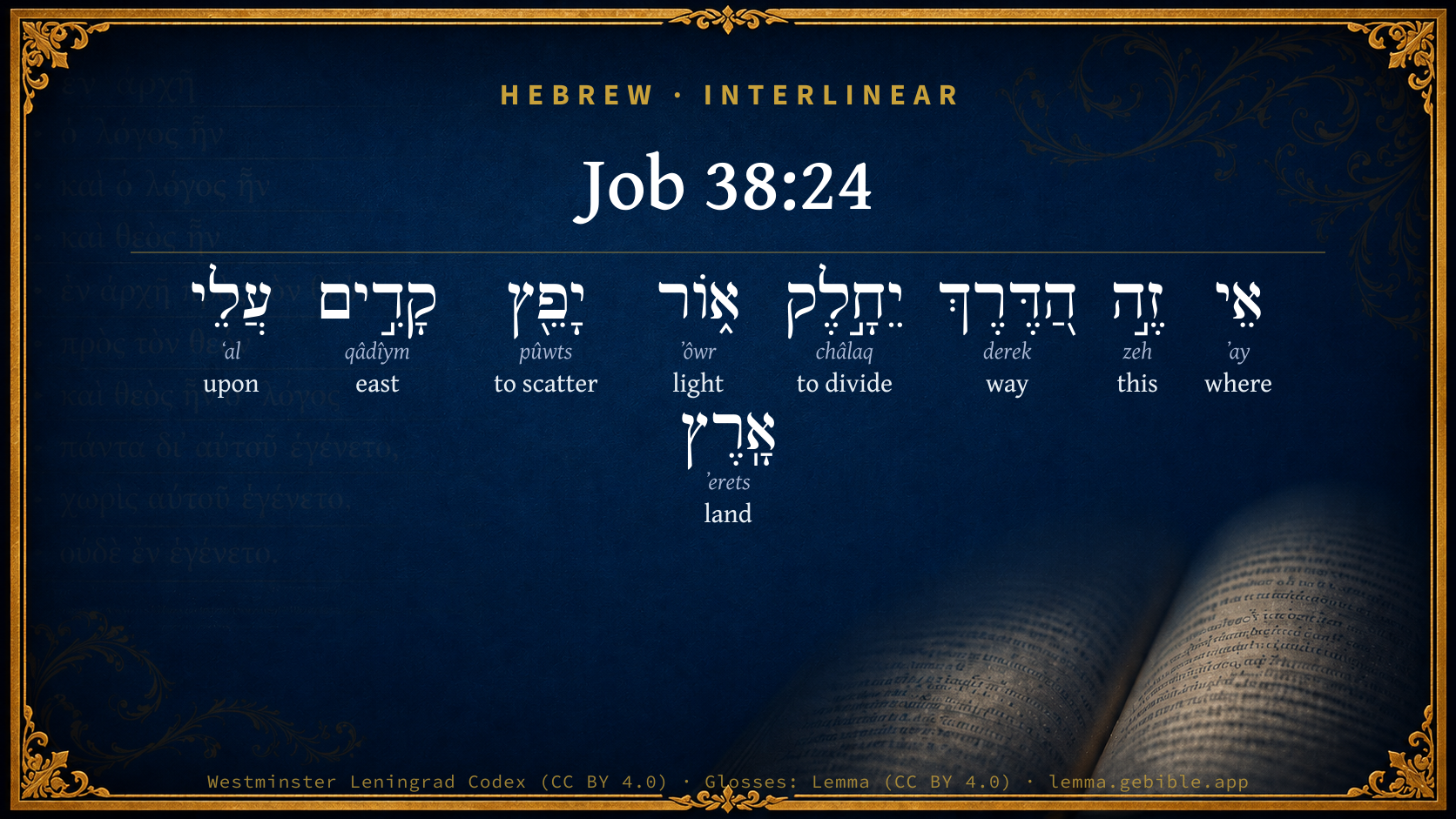
Job 38:24

Hebrew (Westminster Leningrad Codex) Job 38:24 appears in the Hebrew Old Testament. The text above is from the Westminster Leningrad Codex. Each word links to its Strong’s number, a concise gloss, and parsing drawn from the Open Scriptures Hebrew Bible morphology. Click any word for its full Brown-Driver-Briggs (BDB) entry.
Download image
Cite this verse

Job 38:24 (World English Bible). Public Domain. Lemma interlinear Bible study tool, https://lemma.gebible.app/v/job/38/24.

Show BibTeX & RIS
BibTeX
RIS
English Translation
By what way is the lightning distributed, Or the east wind scattered on the earth?
World English Bible · Public Domain
Download a study sheet

One document with this verse’s original text, its word-by-word gloss line, the meaning frame, cross-references with their text, attributed commentary, and full source and license credits — printable, and it pastes into notes with its structure intact.

This verse Autodidact and up

Study sheet (.html) Plain text (.txt)

A passage Seminary Student

Up to 50 verses in one chapter. A passage sheet keeps up to 6 commentary sources and 12 cross-references per verse, in the order this page ranks them, and says so on the sheet whenever that leaves anything out. Ask for a single verse and you get the Autodidact verse sheet above.

Everything on this page stays free to read, with no account — the sheet is a download of what is already on screen, not access to it.

Want to remove ads? Support Godless Engineer
Compare translations 3

The same verse in 3 English versions, stacked beneath the original-language interlinear above. Click any original word for its lexicon entry.

Each is an independent rendering of the whole verse — the interlinear is not word-aligned to these translations.

Highlighted words mark where these versions differ — a whole-verse word diff, not a word-by-word alignment.

  • World English Bible Public Domain
    By what way is the lightning distributed, Or the east wind scattered on the earth?
  • King James Version Public Domain
    By what way is the light parted, which scattereth the east wind upon the earth?
  • unfoldingWord Literal Text CC BY-SA 4.0
    Where this, the way the light is distributed, the east wind scatters over the earth?

unfoldingWord Literal Text — © unfoldingWord, licensed CC BY-SA 4.0. Word-aligned USFM3 via Door43 (git.door43.org/unfoldingWord/en_ult).

Versions to compare (up to 4)

3 of 4 selected

Show all 18 translations

Every available English version of this verse, each an independent rendering of the whole verse.

  • World English Bible Public Domain
    By what way is the lightning distributed, Or the east wind scattered on the earth?
  • Berean Standard Bible Public Domain
    In which direction is the lightning dispersed, or the east wind scattered over the earth?
  • Majority Standard Bible Public Domain
    In which direction is the lightning dispersed, or the east wind scattered over the earth?
  • King James Version Public Domain
    By what way is the light parted, which scattereth the east wind upon the earth?
  • American Standard Version (1901) Public Domain
    By what way is the light parted, Or the east wind scattered upon the earth?
  • Revised Version (1885) Public Domain
    By what way is the light parted, or the east wind scattered upon the earth?
  • Geneva Bible (1599) Public Domain
    By what way is the light parted, which scattereth the East winde vpon the earth?
  • Douay-Rheims (1899) Public Domain
    By what way is the light spread, and heat divided upon the earth?
  • Young's Literal Translation Public Domain
    Where `is' this, the way light is apportioned? It scattereth an east wind over the earth.
  • Literal Standard Version CC BY-SA 4.0
    Where [is] this, the way light is apportioned? It scatters an east wind over the earth.
  • Unlocked Literal Bible CC BY-SA 4.0
    What is the path to where the lightning bolts are distributed or to where the winds are scattered from the east over the earth?
  • unfoldingWord Literal Text CC BY-SA 4.0
    Where this, the way the light is distributed, the east wind scatters over the earth?
  • Darby Bible Public Domain
    By what way is the light parted, [and] the east wind scattered upon the earth?
  • World Messianic Bible Public Domain
    By what way is the lightning distributed, or the east wind scattered on the earth?
  • Webster's Bible Public Domain
    By what way is the light parted, which scattereth the east wind upon the earth?
  • Free Bible Version CC BY-SA 4.0
    Do you know the way to where light comes from, or to where the east wind blows over the earth?
  • Bible in Basic English Public Domain
    Which is the way to the place where the wind is measured out, and the east wind sent out over the earth?
  • JPS Tanakh (1917) Public Domain
    By what way is the light parted, or the east wind scattered upon the earth?

Literal Standard Version (2020), Covenant Press — licensed CC BY-SA 4.0. Text via the HelloAO Bible API (eBible.org). Unlocked Literal Bible (unfoldingWord) — licensed CC BY-SA 4.0. Text via the HelloAO Bible API (eBible.org). unfoldingWord Literal Text — © unfoldingWord, licensed CC BY-SA 4.0. Word-aligned USFM3 via Door43 (git.door43.org/unfoldingWord/en_ult). Free Bible Version, Dr. Jonathan Gallagher — licensed CC BY-SA 4.0. Text via the HelloAO Bible API (eBible.org).

Word by word

More ways to search: Search by grammar → Find every occurrence → Compare this word →

Practice this passage: Drill this verse → Learn its vocabulary →

About this verse

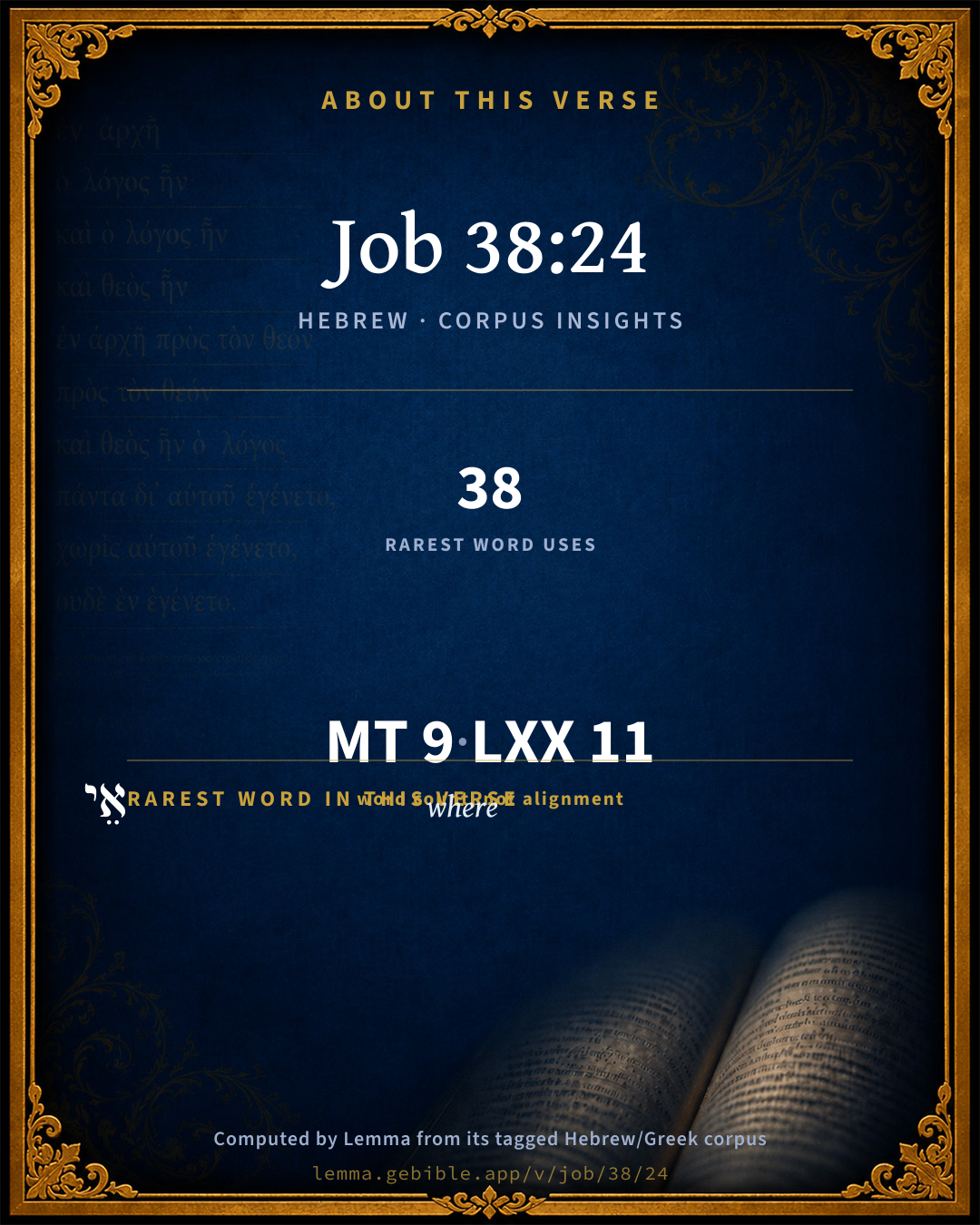
These counts appear in no published source. They are computed here, from the morphology-tagged text and Lemma’s own curated glosses. What Lemma adds →

9
words
9
distinct lemmas
Wisdom
section

Shared distinctive vocabulary

אֵי where H335 occurs in 36 verses of the Hebrew Bible. Also found in:

Grammatical profile

  • 2 verbs
  • 4 nouns
  • 1 pronoun
  • 1 preposition
  • 1 particle

Verb forms

  • יֵחָ֣לֶק Niphal · Imperfect
  • יָפֵ֖ץ Hiphil · Imperfect

Hebrew & Septuagint length

In English translation the verse runs 15 words from the Hebrew and 18 from the Septuagint (LXX English) — closely comparable.

A rough comparison of the two English renderings, which tokenize alike — not a word-level alignment.

Word counts can differ between the Hebrew and the Greek without any difference in meaning — e.g. the Hebrew direct-object marker אֵת has no separate Greek word, and Greek often adds the article ὁ.

In the original languages it is 9 Hebrew tokens and 11 Greek tokens — but the two are counted differently (Hebrew bundles its prefixes and suffixes into one token; the Greek is in lemma form), so that isn’t a like-for-like length.

Cross-references

3

Topical passages linked to Job 38:24 in the Treasury of Scripture Knowledge — connected by theme and wording, ordered by reader-vote popularity; previews shown in the World English Bible.

  • Job 38:12–13 "Have you commanded the morning in your days, And caused the dawn to know its place;
  • Jonah 4:8 It happened, when the sun arose, that God prepared a sultry east wind; and the sun beat on Jonah's head, so that he fainted, and requested for himself that he might die, and said, "It is better for me to die than to live."
  • Matthew 24:27 For as the lightning comes forth from the east, and is seen even to the west, so will be the coming of the Son of Man.

Cross-references courtesy of OpenBible.info (CC BY 4.0).

Hebrew and Greek witnesses Masoretic Hebrew ↔ Greek Septuagint

The same verse in the two great witnesses to the Old Testament, shown verse-for-verse.

These are two independent witnesses, not word-aligned to each other, and the Septuagint is shown in lemma (dictionary) form.

Hebrew Job 38:24 Masoretic · Westminster Leningrad Codex

אֵי זֶ֣ה הַ֭דֶּרֶךְ יֵחָ֣לֶק א֑וֹר יָפֵ֖ץ קָדִ֣ים עֲלֵי אָֽרֶץ

By what way is the lightning distributed, Or the east wind scattered on the earth?

World English Bible · Public Domain

Greek LXX Job 38:24 Septuagint · lemma form

πόθεν δέ ἐκπορεύομαι πάχνη ἤ διασκεδάζω νότος εἰς ὁ ὑπό οὐρανός

And whence proceeds the frost? or whence is the south wind dispersed over the whole world under heaven?

LXX2012 (modern English Septuagint) · Public Domain

On this verse, Haydock's Catholic Bible Commentary discusses the Septuagint’s reading. Read the note in Commentary ↓

Hebrew: Westminster Leningrad Codex (CC BY 4.0). Greek: Septuagint (public domain); English from LXX2012 (modern English Septuagint) (Public Domain). How the Septuagint differs from the Hebrew →

Commentary

Notes on Job 38:24 from classic Christian and Jewish commentators (each source and its license shown beneath its notes). The classic Christian expositions comment on the surrounding passage and are grouped to its opening verse, so a note may address several verses; the Jewish commentaries on the Tanakh (Rashi and others) are per-verse, so they appear only where the commentator wrote on this verse.

Lemma curates 59 commentaries, every one of them public domain or Creative Commons licensed, each selected and text-cleaned for this edition rather than reprinted as found. About our sources →

Trapp's Complete Commentary

John Trapp

Job 38:24 By what way is the light parted, [which] scattereth the east wind upon the earth?

Ver. 24. By what way is the light parted] sc. From the clouds by lightning, or from darkness by the sunrising? Knowest thou that? Or the cause of it? Nothing less. Something philosophers have to say here, but upon no great certainty.

Which scattereth the east wind upon the earth?] Eurus est ventus urens, exsiccans; the east wind hath its name in Hebrew from the sunrising; the Latins call it, Venture subsolanum, as that which usually followeth the rising sun; but whence it cometh, and whither it goeth, is more than Job or any other can tell.

John Trapp, A Commentary or Exposition upon All the Books of the Old and New Testament (1647–1656) — public domain. Text from a community e-Sword module.

Joseph Benson's Commentary

Job 38:24. By what way is the light parted — Or dispersed, or distributed, namely, in the air, or upon the face of the earth. This is variously distributed in the world, shining in one place and time, when it doth not shine in another, or for a longer time, or with greater brightness and power than it doth in another; all which are the effects of God’s infinite wisdom and power, and such as were out of Job’s reach to understand. Which scattereth the east wind — Which light scattereth, or raises the east wind, and causes it to blow hither and thither upon the earth? For as the sun is called by the poets, the father of the winds, because he rarefies the atmosphere by his heat, or condenses it by drawing up and loading it with vapours, and thereby destroys the equilibrium of it which produces winds; so, in particular, the east wind is often observed to rise together with the sun. But as there is no Hebrew for which, the words יפצ קדים, japhetz kadim, would, perhaps, be better translated, By what way does the east wind scatter itself? continuing the interrogation, and making this a distinct question. That is, whence do the winds come, and whither do they go? And how comes it to pass, that they blow in so many manners, and with such various and contrary effects?

Joseph Benson's Commentary on the Old and New Testaments (1811–1818) — public domain. Text from a community e-Sword module.

Tyndale Open Study Notes

Tyndale Open Resources

38:24-27 The east wind blows off the desert to scorch crops (Gen 41:6, 23, 27; Jer 4:11; Jon 4:8) and dry up seas (Exod 14:21; Isa 11:15). It is an arid contrast to the torrents of rain that cause flooding. • Beneficial rain to satisfy the parched ground (Pss 104:10-11; 107:35; Isa 35:7; 58:11) stands in contrast to both scorching winds (Job 38:24) and flooding rains (38:25).

Tyndale Open Study Notes — © Tyndale Open Resources, licensed CC BY-SA 4.0. Text via the HelloAO Bible API.

Jamieson, Fausset & Brown

Robert Jamieson, A. R. Fausset & David Brown

is . . . parted--parts, so as to diffuse itself over the whole earth, though seeming to come from one point. Light travels from the sun to the earth, ninety millions of miles, in eight minutes.

which scattereth--rather, "And by what way the east wind (personified) spreads (scattereth) itself." The light and east wind are associated together, as both come from one quarter, and often arise together (Jon 4:8).

Jamieson, Fausset & Brown — Commentary Critical and Explanatory on the Whole Bible (1871) — public domain (CC PDM 1.0). Text via the HelloAO Bible API.

Adam Clarke's Commentary

Verse 24. By what way is the light parted] Who can accurately describe the cause and operation of a thunder cloud, the cause, nature, and mode of operation of the lightning itself? Is it a simple element or compound substance? What is its velocity? and why not conductible by every kind of substance, as it is known to exist in all, and, indeed, to be diffused through every portion of nature? How is it parted? How does it take its zigzag form? this is the curious, indescribable, and unknown parting. Are all the causes of positive and negative electricity found out? What are its particles, and how do they cohere, and in what order are they propagated? Much has been said on all these points, and how little of that much satisfactorily!

Scattereth the east wind upon the earth?] קדים kadim, the eastern storm, euroclydon, or levanter.

Adam Clarke's Commentary on the Bible (1810–1826) — public domain. Text from a community e-Sword/MySword module.

Ellicott's Commentary for English Readers

(24) By what way is the light parted?—i.e., distributed in turn to all the inhabitants of the earth.

The east wind.—As naturally suggested by the origin of light and the mention of it.

A Bible Commentary for English Readers, edited by Charles John Ellicott (1878–1897) — public domain. Text from a community e-Sword module.

The Cambridge Bible for Schools and Colleges

gen. ed. J. J. S. Perowne

24. The verse seems to mean:

Which is the way to where the light is parted,

And the east wind spreadeth over the earth?

The phrase in clause first is the same as in Job_38:19. The words may mean by which way, or road, is light parted? The “light” was already referred to in Job_38:19, and some consider the word to mean lightning here. This, however, comes from above and is spoken of in Job_38:25. More probably the reference is to the wonderful diffusion of light over the whole earth, and the query concerns the way or path by which this takes place. Such a path appears to lie in the East, from whence also the stormy wind spreads over the earth; hence the two are brought into connexion. Job, of course, knows the way along which this diffusion of light and wind takes place.

24–27. The stormy wind, rain and lightning.

The Cambridge Bible for Schools and Colleges (gen. ed. J. J. S. Perowne; Cambridge University Press, 1878–1918) — public domain. Text from a community e-Sword module.

John Gill's Exposition

Who hath divided a watercourse for the overflowing of waters,.... For a very large shower of rain, as the Vulgate Latin version: for this is not to be understood of an aqueduct, channel, or canal made on earth, either for the draining of waters off of land overflowed thereby, or for the conveyance of it to different parts to overflow it; such as were cut out of the Nile in Egypt, for the overflowing of the land, to make it fruitful; such may be and have been made by men: but of a watercourse in the air or atmosphere, as a canal or channel, for the rain to come down upon the earth; and this is the work of God, and him only, who directs and steers the course of rain, that it falls regularly and gently, not in spouts and floods, but in drops larger or lesser, on what spot of ground, or part of the earth, he pleases: and if what Jarchi says true, that every drop has its course, its canal, through which it passes, it is still more wonderful;

or a way for the lightning of thunder: which generally go together, and are of God. His fire and voice, and for which he makes a way, by which they burst and break forth out of the cloud, and their course is directed by him under the whole heavens; see Job 28:26. So the Gospel, compared to rain and lightning, has its direction and its course steered to what part of the world, he pleases; see Psa 19:4.

John Gill's Exposition of the Whole Bible (1746–1763) — public domain (CC PDM 1.0). Text via the HelloAO Bible API.

Albert Barnes' Notes on the Bible

By what way is the light parted - The reference here is to the light of the morning, that seems to come from one point, and to spread itself at once over the whole earth. It seems to be collected in the east, or, as it were, condensed or concentrated there, and then to divide itself, and to expand over the face of the world. God here asks Job whether he could explain this, or show in what manner it was done. This was one of the subjects which might be supposed early to excite inquiry, and is one which can be as little explained now as then. The causes of the propagation of light, which seems to proceed from a center and to spread rapidly in every direction, are perhaps as little known now as they were in the time of Job. Philosophy has done little to explain this, and the mode in which light is made to travel in eight minutes from the sun to the earth - a distance of ninety million miles - and the manner in which it is “divided” or “parted” from that great center, and spread over the solar system, is as much of a real mystery as it was in the days of Job, and the question proposed here may be asked now with as much emphasis as it was then.

Which scattereth the east wind upon the earth - According to this translation, the idea would be that somehow light is the cause of the east wind. But it may be doubted whether this is the true interpretation, and whether it is meant to be affirmed that light has any agency in causing the wind to blow. Herder renders it:

“When doth the light divide itself,

When the east wind streweth it upon the earth?”

According to this, the idea would be that the light of the morning seemed to be borne along by the wind. Umbreit renders it, “Where is the way upon which the east wind flows forth upon the earth?” That is, the east wind, like the light, comes from a certain point, and seems to spread abroad over the world; and the question is, whether Job could explain this? This interpretation is adopted by Rosenmuller and Noyes, and seems to be demanded by the parallelism, and by the nature of the case. The cause of the rapid spreading of the wind from a certain point of the compass, was involved in as much obscurity as the propagation of the light, nor is that cause much better understood now. There is no reason to suppose that the spread of the light, has any particular agency in causing the east wind, as our common version seems to suppose, nor is that idea necessarily in the Hebrew text. The east wind is mentioned here either because the light comes from the east, and the wind from that quarter was more naturally suggested than any other, or because the east wind was remarkable for its violence. The idea that a strong east wind was somehow connected with the dawn of day or the rising of the sun, was one that prevailed, at least to some extent, among the ancients. Thus, Catullus (lxiv. 270ff) says:

Hic qualis flatu placidum mare matutino

Horrificans zephyrus proclivas incitat undas

Aurora exoriente, vagi sub lumina solis.

Albert Barnes' Notes on the Bible (1834–1885) — public domain. Text from a community e-Sword/MySword module.

Haydock's Catholic Bible Commentary

CHAPTER XXXVIII.

Heat. Hebrew kadim, (Haydock) the "east." Septuagint, "south wind." Perhaps the east winds produced the same bad effects in Egypt, as the south wind did in Judea; (Calmet) or this noxious burning wind might proceed from the south-eastern point of both countries. (Haydock)

George Leo Haydock (1774–1849), Haydock's Catholic Family Bible and Commentary, 1859 edition — public domain. Excludes Psalms (Douay-Rheims chapter numbering differs from Protestant) and Deuterocanonical books (Catholic canon only).

Matthew Poole's English Annotations

By what way; dost thou know all the causes, means, methods, and circumstances of this work of God? Is the light parted or dispersed or distributed, to wit, in the air, or upon the face of the earth? By

light he understands either,

1. The lightning, which breaks forth suddenly out of a cloud, and with strange swiftness disperseth itself, and fleeth from east to west, as is noted, Mat 24:27. But this word light put by itself, and being understood properly, is constantly used in this book for the light of the sun, and never for the lightning; and where it is meant of the lightning, there is some other word added to it, as Job 37:15, where it is called the light of his cloud. And besides, he speaks of the lightning in the next verse; which were superfluous, if it were here mentioned. Or rather,

2. Of the light of the sun, which is commonly called light without any other word added to it, as Job 3:4,9,16; 24:14; 25:3, &c. And this light of the sun is variously parted or distributed in the world, shining in one place and time, when it doth not shine in another; or for a longer time, or with greater brightness, and power, and virtue, than it doth in another; all which are the effects of God’s infinite wisdom and power, and such as were out of Job’s reach to understand, or at least to effect.

Which scattereth the east wind upon the earth, i.e. which light scattereth, &c., i.e. raiseth, the east wind, and causeth it to blow hither and thither upon the earth. For as the sun is justly called by the poets and others the father of the winds, because he draws up those exhalations which give matter to the winds, and for other reasons; so in particular the east wind is oft observed to rise together with the sun, from which also it hath both its Latin and Greek name. But some make this a distinct question from the former, and render the words thus; and (repeat, by which way)

the east wind (under which all the other winds may be comprehended) scattereth itself upon the earth, i.e. whence the winds come, and whither they go, which is mentioned as a secret in nature, Joh 3:8, and how it comes to pass that they blow in such several manners, and with such various and even contrary effects. Or thus, and by which way the east wind scattereth (to wit, the clouds, or other light things; for this is noted in Scripture to be a most vehement wind, and to scatter the clouds, Exo 14:21; Jon 4:8)

upon the earth, i.e. whence it comes to pass that the east wind was so violent and furious. But the words may be rendered thus, which (i.e. which light of the sun, or when it, to wit, this light) scattereth itself (as divers here render this word, that conjugation being often used reciprocally, as is confessed) from (the prefix mem being understood, as it is very frequently in the Hebrew text)

the east (for this Hebrew word doth not only signify the eastern wind, but also the east, or the eastern part of the heavens or earth, as Eze 40:19; 42:16; Hab 1:9, and in many other places; and kedem, the root of this word, is constantly so used) upon or over the earth, all over the earth. And this is justly mentioned as a wonderful work of God, that as soon as ever the sun ariseth, it parteth or scattereth its light in an instant from one end of the hemisphere to another. But this I propose with submission.

Matthew Poole's English Annotations on the Holy Bible (1683–1685) — public domain. Text from a community e-Sword/MySword module.

Whedon's Commentary on the Bible

Daniel D. Whedon

24. By what way, etc. — What is the way that light divides itself? (Dillmann and Hitzig.) Which scattereth, etc. — [How] does the east wind scatter itself over the earth? The east wind, for diffusiveness and destructiveness corresponding to the Eurus of the classics, is here used representatively. It was an east wind that was summoned to hurl the wicked man out of his place, (Job_27:21, on which see note,) and an east wind also which broke the ships of Tarshish. Psa_48:7. The reason that light and the east wind are mentioned together may be that they both take their rise in the same quarter of the sky, or because of the extreme heat associated with each.

Daniel D. Whedon (gen. ed.), Commentary on the Old and New Testaments (1874–1909) — public domain. Text from a community e-Sword module.

The Pulpit Commentary

By what way is the light parted? or, distributed, so as to be enjoyed by all the inhabitants of the earth (Stanley Loathes). Which scattereth, etc.; rather, or by what way is the east wind scattered over the earth? (see the Revised Version) Job is asked to explain God"s modus operandi in nature, which, of course, he cannot do. Hence his answer in Job_40:5.

The Pulpit Commentary (1880–1919), ed. H.D.M. Spence-Jones & Joseph S. Exell — public domain. Text from a community e-Sword module.

John Wesley's Explanatory Notes

Distributed - In the air, and upon the face of the earth. This is variously distributed in the world, shining in one place and time, when it doth not shine in another, or for a longer time, or with greater brightness and power than it doth in another. All which are the effects of God's infinite wisdom and power, and such as were out of Job's reach to understand. Which - Which light scattereth, raises the east-wind, and causes it to blow hither and thither upon the earth? For as the sun is called by the poets, the father of the winds, because he draws up those exhalations which give matter to the winds, so in particular the east-wind is often observed to rise together with the sun.

John Wesley, Explanatory Notes Upon the Whole Bible (1754–1765) — public domain. Text via the GEBible commentary corpus.

Rashi

Rabbi Shlomo Yitzchaki (Rashi)

is the light parted The irradiation of the sun, which diverges this way and that way like the horns of a hind.

the eastern one The sun of the east.

Rashi on the Tanakh — English translations: “The Judaica Press complete Tanach with Rashi, translated by A. J. Rosenberg” (CC BY 4.0); “Pentateuch with Rashi's commentary by M. Rosenbaum and A.M. Silbermann, 1929-1934” (public domain); “The Metsudah Tanach series, Lakewood, N.J” (CC BY 4.0); and “The Book of Joshua, Metsudah Publications, 1997” (CC BY 4.0). Text via Sefaria.

Lesson kit

Teaching starters — assembled from the data on this page, not authored interpretation. Every prompt links to the verse data it draws on. Edit before teaching.

Job, in the Wisdom, opens this verse with 9 words (9 distinct Hebrew lemmas). Its most distinctive word is ʼay (“where”). A historical commentator’s framing appears above. Read the whole chapter for the surrounding context.

Discussion questions

  1. The word ʼay carries the sense “where.” How does it shape the verse?
  2. Genesis 3:9 shares the word «where» with this verse. How do the two illuminate each other?
  3. These translations render this verse differently. What is at stake in choosing one wording over another?
  4. The verb «יֵחָ֣לֶק» is Niphal Imperfect. How does its form color the action?
  5. Reading how Trapp's Complete Commentary and Joseph Benson's Commentary read this verse, where do the two commentators agree and where do they part?

Things to notice

Reading settings

Reading text

Shown beneath each verse's original-language words.

Old Testament
Old Testament edition

Read the OT as the Masoretic Hebrew (MT) or the Greek Septuagint (LXX).

English shown for the Greek Septuagint (in the Hebrew ↔ Greek comparison).

Comparing translations? Open the Compare panel on any verse page to stack up to four side by side.