
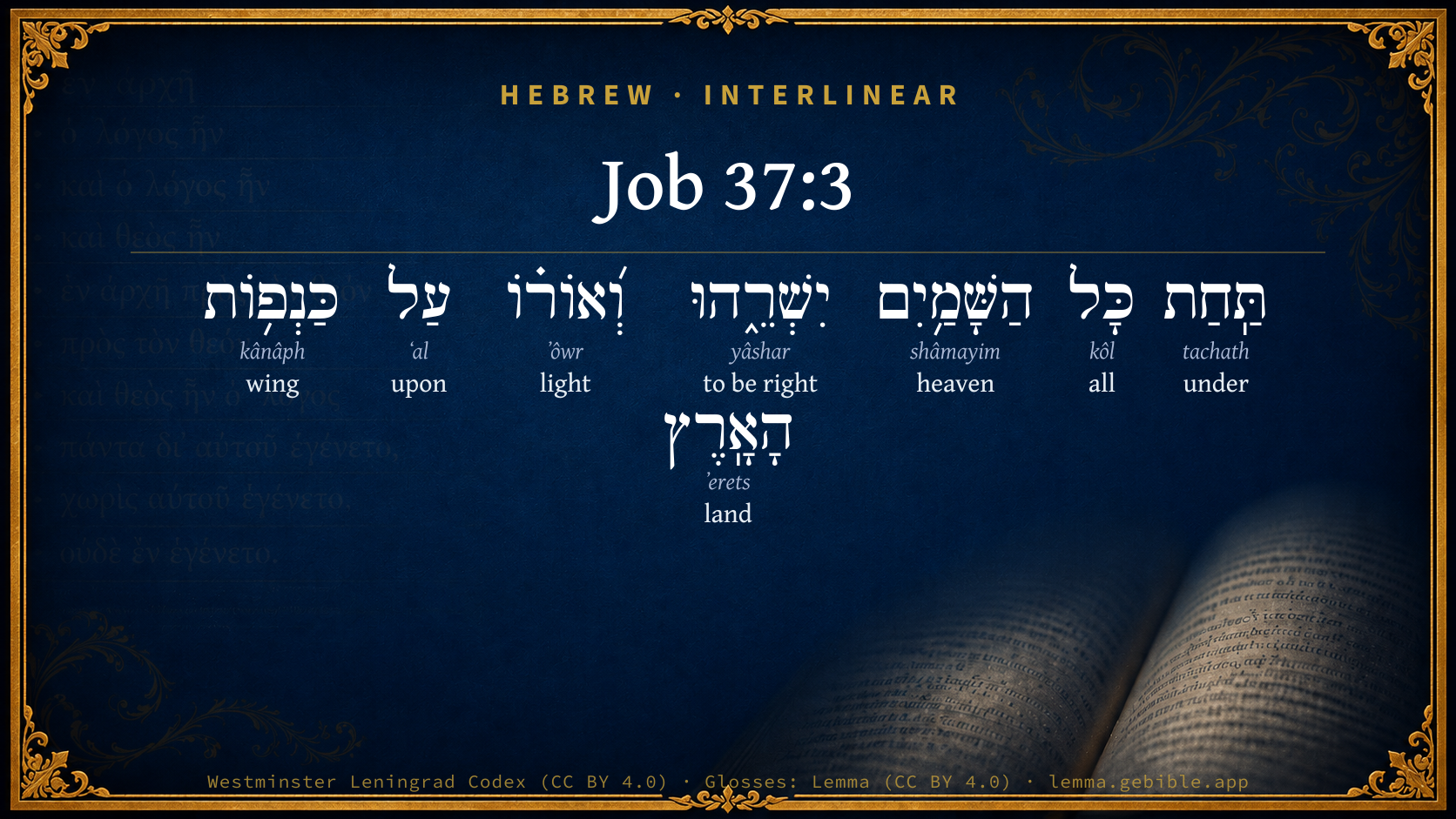
Job 37:3

Hebrew (Westminster Leningrad Codex) Job 37:3 appears in the Hebrew Old Testament. The text above is from the Westminster Leningrad Codex. Each word links to its Strong’s number, a concise gloss, and parsing drawn from the Open Scriptures Hebrew Bible morphology. Click any word for its full Brown-Driver-Briggs (BDB) entry.
Download image
Cite this verse

Job 37:3 (World English Bible). Public Domain. Lemma interlinear Bible study tool, https://lemma.gebible.app/v/job/37/3.

Show BibTeX & RIS
BibTeX
RIS
English Translation
He sends it forth under the whole sky, And his lightning to the ends of the earth.
World English Bible · Public Domain
Download a study sheet

One document with this verse’s original text, its word-by-word gloss line, the meaning frame, cross-references with their text, attributed commentary, and full source and license credits — printable, and it pastes into notes with its structure intact.

This verse Autodidact and up

Study sheet (.html) Plain text (.txt)

A passage Seminary Student

Up to 50 verses in one chapter. A passage sheet keeps up to 6 commentary sources and 12 cross-references per verse, in the order this page ranks them, and says so on the sheet whenever that leaves anything out. Ask for a single verse and you get the Autodidact verse sheet above.

Everything on this page stays free to read, with no account — the sheet is a download of what is already on screen, not access to it.

Want to remove ads? Support Godless Engineer
Compare translations 3

The same verse in 3 English versions, stacked beneath the original-language interlinear above. Click any original word for its lexicon entry.

Each is an independent rendering of the whole verse — the interlinear is not word-aligned to these translations.

Highlighted words mark where these versions differ — a whole-verse word diff, not a word-by-word alignment.

  • World English Bible Public Domain
    He sends it forth under the whole sky, And his lightning to the ends of the earth.
  • King James Version Public Domain
    He directeth it under the whole heaven, and his lightning unto the ends of the earth.
  • unfoldingWord Literal Text CC BY-SA 4.0
    He lets it loose under all of the heavens, and his lightning to the edges of the earth.

unfoldingWord Literal Text — © unfoldingWord, licensed CC BY-SA 4.0. Word-aligned USFM3 via Door43 (git.door43.org/unfoldingWord/en_ult).

Versions to compare (up to 4)

3 of 4 selected

Show all 18 translations

Every available English version of this verse, each an independent rendering of the whole verse.

  • World English Bible Public Domain
    He sends it forth under the whole sky, And his lightning to the ends of the earth.
  • Berean Standard Bible Public Domain
    He unleashes His lightning beneath the whole sky and sends it to the ends of the earth.
  • Majority Standard Bible Public Domain
    He unleashes His lightning beneath the whole sky and sends it to the ends of the earth.
  • King James Version Public Domain
    He directeth it under the whole heaven, and his lightning unto the ends of the earth.
  • American Standard Version (1901) Public Domain
    He sendeth it forth under the whole heaven, And his lightening unto the ends of the earth.
  • Revised Version (1885) Public Domain
    He sendeth it forth under the whole heaven, and his lightning unto the ends of the earth.
  • Geneva Bible (1599) Public Domain
    He directeth it vnder the whole heauen, and his light vnto the endes of the world.
  • Douay-Rheims (1899) Public Domain
    He beholdeth under all the heavens, and his light is upon the ends of the earth.
  • Young's Literal Translation Public Domain
    Under the whole heavens He directeth it, And its light `is' over the skirts of the earth.
  • Literal Standard Version CC BY-SA 4.0
    He directs it under the whole heavens, || And its light [is] over the skirts of the earth.
  • Unlocked Literal Bible CC BY-SA 4.0
    He sends it out under the whole sky, and he sends out his lightning to the edges of the earth.
  • unfoldingWord Literal Text CC BY-SA 4.0
    He lets it loose under all of the heavens, and his lightning to the edges of the earth.
  • Darby Bible Public Domain
    He sendeth it forth under the whole heaven, and his lightning unto the ends of the earth.
  • World Messianic Bible Public Domain
    He sends it out under the whole sky, and his lightning to the ends of the earth.
  • Webster's Bible Public Domain
    He directeth it under the whole heaven, and his lightning to the ends of the earth.
  • Free Bible Version CC BY-SA 4.0
    He sends it across the heaven; his lightning flashes to the ends of the earth.
  • Bible in Basic English Public Domain
    He sends it out through all the heaven, and his thunder-flame to the ends of the earth.
  • JPS Tanakh (1917) Public Domain
    He sendeth it forth under the whole heaven, and His lightning unto the ends of the earth.

Literal Standard Version (2020), Covenant Press — licensed CC BY-SA 4.0. Text via the HelloAO Bible API (eBible.org). Unlocked Literal Bible (unfoldingWord) — licensed CC BY-SA 4.0. Text via the HelloAO Bible API (eBible.org). unfoldingWord Literal Text — © unfoldingWord, licensed CC BY-SA 4.0. Word-aligned USFM3 via Door43 (git.door43.org/unfoldingWord/en_ult). Free Bible Version, Dr. Jonathan Gallagher — licensed CC BY-SA 4.0. Text via the HelloAO Bible API (eBible.org).

Word by word

More ways to search: Search by grammar → Find every occurrence → Compare this word →

Practice this passage: Drill this verse → Learn its vocabulary →

יִשְׁרֵ֑הוּ
yâshar
H3474
“to be right · him”
Verb, Qal, Imperfect, 3rd Person, Masculine, Singular + Suffix, Personal, 3rd Person, Masculine, Singular
Part of Speech
Verb
Stem
Qal
Form
Imperfect
Person
3rd Person
Gender
Masculine
Number
Singular
Full BDB Definition

Origin: a primitive root

TWOT: 930

to be right, be straight, be level, be upright, be just, be lawful, be smooth - (Qal) - to go straight - to be pleasing, be agreeable, be right (figuratively) - to be straightforward, be upright - (Piel) - to make right, make smooth, make straight - to lead, direct, lead straight along - to esteem right, approve - (Pual) to be made level, be laid smoothly out - (Hiphil) to make straight, look straight
  1. תַּֽחַת tachath H8478 “under” Preposition
  2. כָּל kôl H3605 “all of” Noun, Common, Masculine, Singular, Construct
  3. הַשָּׁמַ֥יִם shâmayim H8064 “the · heaven(s)” Particle, Definite Article + Noun, Common, Masculine, Plural, Absolute
  4. וְ֝אוֹר֗וֹ ʼôwr H216 “and · light · his” Conjunction + Noun, Common, Both, Singular, Construct + Suffix, Personal, 3rd Person, Masculine, Singular
  5. עַל ʻal H5921 “upon” Preposition
  6. כַּנְפ֥וֹת kânâph H3671 “wings of” Noun, Common, Feminine, Plural, Construct
  7. הָאָֽרֶץ ʼerets H776 “the · land” Particle, Definite Article + Noun, Common, Both, Singular, Absolute

About this verse

These counts appear in no published source. They are computed here, from the morphology-tagged text and Lemma’s own curated glosses. What Lemma adds →

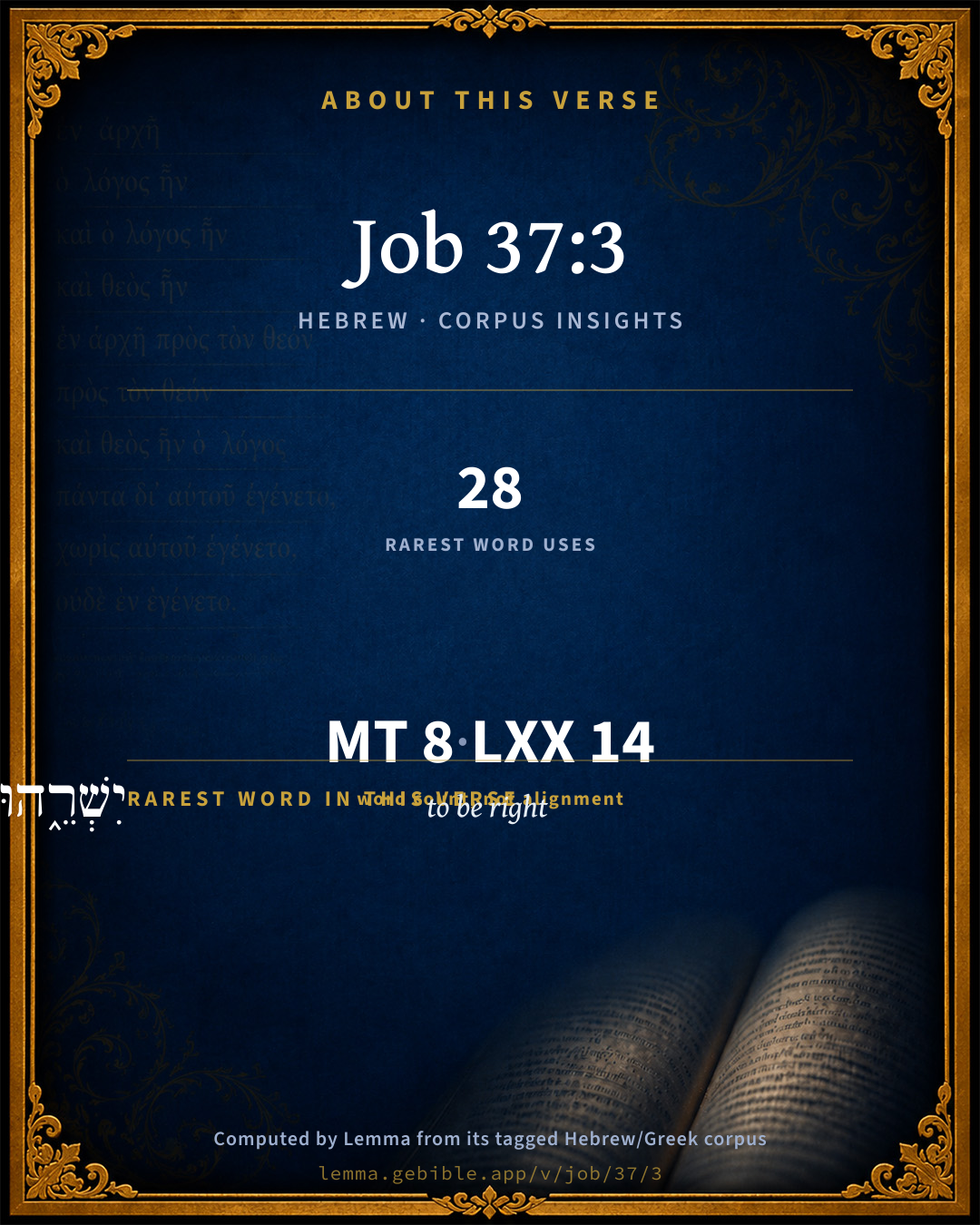
8
words
8
distinct lemmas
Wisdom
section

Shared distinctive vocabulary

יִשְׁרֵ֑הוּ to be right H3474 occurs in 26 verses of the Hebrew Bible. Also found in:

Grammatical profile

  • 1 verb
  • 5 nouns
  • 2 prepositions

Verb forms

  • יִשְׁרֵ֑הוּ Qal · Imperfect

Hebrew & Septuagint length

In English translation the verse runs 17 words from the Hebrew and 17 from the Septuagint (LXX English) — the same length.

A rough comparison of the two English renderings, which tokenize alike — not a word-level alignment.

Word counts can differ between the Hebrew and the Greek without any difference in meaning — e.g. the Hebrew direct-object marker אֵת has no separate Greek word, and Greek often adds the article ὁ.

In the original languages it is 8 Hebrew tokens and 14 Greek tokens — but the two are counted differently (Hebrew bundles its prefixes and suffixes into one token; the Greek is in lemma form), so that isn’t a like-for-like length.

Cross-references

6

Topical passages linked to Job 37:3 in the Treasury of Scripture Knowledge — connected by theme and wording, ordered by reader-vote popularity; previews shown in the World English Bible.

  • Job 38:13 That it might take hold of the ends of the earth, And shake the wicked out of it?
  • Matthew 24:27 For as the lightning comes forth from the east, and is seen even to the west, so will be the coming of the Son of Man.
  • Isaiah 11:12 He will set up an ensign for the nations, and will assemble the outcasts of Israel, and gather together the dispersed of Judah from the four corners of the earth.
  • Psalms 97:4 His lightning lights up the world. The earth sees, and trembles.
  • Psalms 77:13 Your way, God, is in the sanctuary. What god is great like God?
  • Revelation 11:19 God's temple that is in heaven was opened, and the ark of the Lord's covenant was seen in his temple. Lightnings, sounds, thunders, an earthquake, and great hail followed.

Cross-references courtesy of OpenBible.info (CC BY 4.0).

Hebrew and Greek witnesses Masoretic Hebrew ↔ Greek Septuagint

The same verse in the two great witnesses to the Old Testament, shown verse-for-verse.

These are two independent witnesses, not word-aligned to each other, and the Septuagint is shown in lemma (dictionary) form.

Hebrew Job 37:3 Masoretic · Westminster Leningrad Codex

תַּֽחַת כָּל הַשָּׁמַ֥יִם יִשְׁרֵ֑הוּ וְ֝אוֹר֗וֹ עַל כַּנְפ֥וֹת הָאָֽרֶץ

He sends it forth under the whole sky, And his lightning to the ends of the earth.

World English Bible · Public Domain

Greek LXX Job 37:3 Septuagint · lemma form

ὑποκάτω πᾶς ὁ οὐρανός ἀρχή αὐτός καί ὁ φῶς αὐτός ἐπί πτέρυξ ὁ γῆ

His dominion is under the whole heaven, and his light is at the extremities of the earth.

LXX2012 (modern English Septuagint) · Public Domain

Hebrew: Westminster Leningrad Codex (CC BY 4.0). Greek: Septuagint (public domain); English from LXX2012 (modern English Septuagint) (Public Domain). How the Septuagint differs from the Hebrew →

Commentary

Notes on Job 37:3 from classic Christian and Jewish commentators (each source and its license shown beneath its notes). The classic Christian expositions comment on the surrounding passage and are grouped to its opening verse, so a note may address several verses; the Jewish commentaries on the Tanakh (Rashi and others) are per-verse, so they appear only where the commentator wrote on this verse.

Lemma curates 59 commentaries, every one of them public domain or Creative Commons licensed, each selected and text-cleaned for this edition rather than reprinted as found. About our sources →

Trapp's Complete Commentary

John Trapp

Job 37:3 He directeth it under the whole heaven, and his lightning unto the ends of the earth.

Ver. 3. He directeth it under the whole heaven] Heb. He maketh it to go right forward, meaning the thunder, the vehement noise or sound whereof (not altogether unlike that of cloth violently torn, or of air thrust out of bellows, or of a chestnut burst in the fire, but far louder) is brought through the air to our ears with such a mighty force, that it drowns all noises, clappings, clatterings, roarings even of many waters; making the earth to shake again, and all things tremble, non secus quam siquis currum onustum per plateam lapidibus stratum ducat (Lavat.). And this dreadful noise is by God directed to this or that place under the heavens, at his pleasure. The word rendered directeth signifieth also beholdeth; whence some interpret this text of God’s seeing all things under heaven. But the former sense is better.

And his lightning unto the ends of the earth] God commands the lightning to cleave the clouds, and to scatter its flames through the world. Lightning is the brightness of a shining flame, running through the whole air in a moment, rising of a small and thin exhalation kindled in a cloud. See Psa 18:13. The natural end and effect of thunder and lightning is to clear the air, by wasting poisonous vapours. The supernatural is, to show God’s excellent majesty and might, which the mightiest must acknowledge, Psa 29:1-2; to be his officers about him to make room for him, Psa 97:1; Psa 97:4, to execute his wrath upon his enemies, Exo 9:23; Exo 9:27 Psa 77:18-19 1Sa 2:10 Isa 29:6, and his mercy toward his people for the humbling of them, 1Sa 12:18-20, &c., raising them again to an assured confidence, Psa 29:11, &c. But that God can shoot these arrows of his so far, Mat 24:27 Psa 77:18; Psa 97:3-4, and here; yea, and that at the same time when it rains, when one would think that the one should quench the other, Psa 135:7; this is a just wonder, and Jeremiah urgeth it twice as such, Jer 10:13; Jer 51:16.

John Trapp, A Commentary or Exposition upon All the Books of the Old and New Testament (1647–1656) — public domain. Text from a community e-Sword module.

Joseph Benson's Commentary

Job 37:3-5. He directeth it — Namely, his voice, his thunder; under the whole heaven — It is heard far and near, for he darts it through the whole region of the air: and his lightning, &c. — Preceded by terrible, and often most destructive flashes of lightning, which shoot from one end of heaven to the other. After it a voice roareth — After the lightning follow awful claps of thunder, more tremendous than the roarings of a lion; and he will not stay them — They grow louder and louder, till they conclude in a violent tempest of rain or hail. God thundereth marvellously — With a wonderful and terrible noise, and so as to produce, by the accompanying lightning, many wonderful effects, as the breaking down of great and strong trees, or buildings, and the killing of men and beasts in an instantaneous and awful manner. Great things doeth he — Even in the course of nature, and in the visible parts of the creation. Which we cannot comprehend — Which all men see, but of which few or none can give the true and satisfactory reasons. And therefore it is not strange if the secret and deep counsels of divine providence be out of our reach. And it would argue great pride and arrogancy in us if we should take upon us to censure them, because we do not understand them.

Joseph Benson's Commentary on the Old and New Testaments (1811–1818) — public domain. Text from a community e-Sword module.

Jamieson, Fausset & Brown

Robert Jamieson, A. R. Fausset & David Brown

directeth it--however zigzag the lightning's course; or, rather, it applies to the pealing roll of the thunder. God's all-embracing power.

ends--literally, "wings," "skirts," the habitable earth being often compared to an extended garment (Job 38:13; Isa 11:12).

Jamieson, Fausset & Brown — Commentary Critical and Explanatory on the Whole Bible (1871) — public domain (CC PDM 1.0). Text via the HelloAO Bible API.

Adam Clarke's Commentary

Verse 3. He directeth it under the whole heaven] He directeth it (the lightning) under the whole heaven, in the twinkling of an eye from east to west; and its light-the reflection of the flash, not the lightning, unto the ends of the earth, so that a whole hemisphere seems to see it at the same instant.

Adam Clarke's Commentary on the Bible (1810–1826) — public domain. Text from a community e-Sword/MySword module.

Ellicott's Commentary for English Readers

(3) He directeth it.—Or, sendeth it forth: i.e., the noise and rumbling which fills all heaven.

A Bible Commentary for English Readers, edited by Charles John Ellicott (1878–1897) — public domain. Text from a community e-Sword module.

The Cambridge Bible for Schools and Colleges

gen. ed. J. J. S. Perowne

3. he directeth] Rather, assuming another derivation of the word, he sendeth it forth, lets it loose.

The Cambridge Bible for Schools and Colleges (gen. ed. J. J. S. Perowne; Cambridge University Press, 1878–1918) — public domain. Text from a community e-Sword module.

John Gill's Exposition

He directeth it under the whole heaven,.... His voice of thunder, which rolls from one end of the heaven to the other: he charges the clouds with it, and directs both it and them where they shall go and discharge; what tree, house, or man, it shall strike; and where the rain shall fall when the clouds burst: yet Pliny (x) atheistically calls thunder and lightning chance matters. Thus the ministers of the word, who are compared to clouds, Isa 5:6, are charged with it by the Lord: they are directed by him what they shall say, where they shall go and declare it, and he directs where it shall fall with power and weight; yea, he directs it into the very hearts of men, where it pierces and penetrates, and is a discerner and discoverer of their thoughts and intents;

and his lightning unto the ends of the earth: it cometh out of the east, and shineth to the west, Mat 24:27; and swiftly move to the further parts of the earth: and such a direction, motion, and extent, has the Gospel had; the glorious light of it, comparable to lightning, it first broke forth in the east, where Christ, his forerunner and his disciples, first preached it, and Christian churches were formed; and from thence it spread into the western parts of the world, and before the destruction of Jerusalem it was preached unto all nations; it had a free course, ran, and was glorified; the sound of the voice of it went into all the earth, and the words and doctrines of the apostles unto the ends of the world.

(x) Nat. Hist. l. 2. c. 43.

John Gill's Exposition of the Whole Bible (1746–1763) — public domain (CC PDM 1.0). Text via the HelloAO Bible API.

Albert Barnes' Notes on the Bible

He directeth it under the whole heaven - It is under the control of God, and he directs it where he pleases. It is not confined to one spot, but seems to be complaining from every part of the heavens.

And his lightning - Margin, as in Hebrew “light.” There can be no doubt that the lightning is intended.

Unto the ends of the earth - Margin, as in Hebrew “wings.” The word wings is given to the earth from the idea of its being spread out or expanded like the wings of a bird; compare Job 38:13; Eze 7:2. The earth was spoken of as an expanse or plain that had corners or boundaries (see Isa 11:12, note; Isa 24:16, note; Isa 42:5, note), and the meaning here is, that God spread the lightning at pleasure over the whole of that vast expanse.

Albert Barnes' Notes on the Bible (1834–1885) — public domain. Text from a community e-Sword/MySword module.

Haydock's Catholic Bible Commentary

Earth. Lightning appears from the east to the west, Matthew xxiv. 27.

George Leo Haydock (1774–1849), Haydock's Catholic Family Bible and Commentary, 1859 edition — public domain. Excludes Psalms (Douay-Rheims chapter numbering differs from Protestant) and Deuterocanonical books (Catholic canon only).

Matthew Poole's English Annotations

He directeth it, to wit, his voice; which he shooteth or guideth like an arrow to the mark, so disposing it that it may do that work for which he sends it.

Under the whole heaven; far and wide through all the parts of this lower world.

Unto the ends of the earth; from one end of the heaven to the opposite end or part of the earth, as from east to west, Mat 24:27.

Matthew Poole's English Annotations on the Holy Bible (1683–1685) — public domain. Text from a community e-Sword/MySword module.

Whedon's Commentary on the Bible

Daniel D. Whedon

3. He directeth — He letteth it (the thunder) loose; or, better yet, sendeth it forth.

Unto the ends of the earth — “Wings” or “fringes” of the earth; same as in Job_38:13. The word might be rendered “boundaries,” the same word in the Arabic (kanafa) being employed to express bounding. In Isa_11:12, and in Eze_7:2, the word is associated with the numeral four, and is evidently used for the cardinal points. Comp. Rev_7:1; Rev_20:8. In the view of Renan, the earth is here compared “to a carpet spread out; its extremities being in some sort the border of the carpet.” The Greeks in the time of Eratosthenes, so Rosenmuller states, (Bib. Geog., Job_1:3,) compared the shape of the earth to that of an outspread chlamys, or cloak. At one time Gesenius supposed that the Hebrews had, in like manner, erred in taking the earth to be of a quadrangular form. This opinion he afterward retracted by advancing the more correct view, that the Hebrews regarded the four “ends of the earth” as equivalent to the four quarters of heaven. (See his Com. on Isa_11:12.) Winer, however, (Rwb., 1:340,) thinks it to be exceedingly doubtful that the Hebrews ever formed a fixed opinion as to the shape of the earth.

His lightning unto the ends of the earth — We have been assured by a celebrated Abyssinian traveller, that he has seen flashes in that country extending from horizon to horizon, and which he could not estimate as under fifty or one hundred miles in length. — SIR JOHN HERSCHEL, in Encyc. Brit., 8th ed., 14:662.

Daniel D. Whedon (gen. ed.), Commentary on the Old and New Testaments (1874–1909) — public domain. Text from a community e-Sword module.

The Pulpit Commentary

He directeth it under the whole heaven. The reverberations of the thunderclap roll along the entire cloud-canopy, from one end of the heavens to the other, beginning often faint in the distance, then growing loud over our heads, finally sinking into low muttered rumblings on the far horizon. And his lightning unto the ends of the earth. Similarly, the lightning, though originating in a flash at some definite spot, sets the whole sky aglow, shining from side to side of the heavens, and, as it were, to the very "ends of the earth." Both have a character of universality which is marvellous, and which makes them fitting emblems of him of whom they are the messengers and ministers. (see Mat_24:27)

The Pulpit Commentary (1880–1919), ed. H.D.M. Spence-Jones & Joseph S. Exell — public domain. Text from a community e-Sword module.

John Wesley's Explanatory Notes

Directeth - His voice: which he guideth like an arrow to the mark, that it may do that work for which he sends it.

John Wesley, Explanatory Notes Upon the Whole Bible (1754–1765) — public domain. Text via the GEBible commentary corpus.

Rashi

Rabbi Shlomo Yitzchaki (Rashi)

Beneath the entire heaven I have seen it Heb. ישרהו, I have seen it, like (Num. 24:17), “I behold it (אשורנו).” They are the lights illuminated by the lightnings.

Rashi on the Tanakh — English translations: “The Judaica Press complete Tanach with Rashi, translated by A. J. Rosenberg” (CC BY 4.0); “Pentateuch with Rashi's commentary by M. Rosenbaum and A.M. Silbermann, 1929-1934” (public domain); “The Metsudah Tanach series, Lakewood, N.J” (CC BY 4.0); and “The Book of Joshua, Metsudah Publications, 1997” (CC BY 4.0). Text via Sefaria.

Lesson kit

Teaching starters — assembled from the data on this page, not authored interpretation. Every prompt links to the verse data it draws on. Edit before teaching.

Job, in the Wisdom, opens this verse with 8 words (8 distinct Hebrew lemmas). Its most distinctive word is yâshar (“to be right”). A historical commentator’s framing appears above. Read the whole chapter for the surrounding context.

Discussion questions

  1. What does “to be right” (yâshar) contribute to the verse as a whole?
  2. Numbers 23:27 shares the word «to be right» with this verse. How do the two illuminate each other?
  3. These translations render this verse differently; the difference is in the English rendering, not the original. What questions does that raise?
  4. The verb «יִשְׁרֵ֑הוּ» is Qal Imperfect. How does its form color the action?
  5. Reading how Trapp's Complete Commentary and Joseph Benson's Commentary read this verse, where do the two commentators agree and where do they part?

Things to notice

Reading settings

Reading text

Shown beneath each verse's original-language words.

Old Testament
Old Testament edition

Read the OT as the Masoretic Hebrew (MT) or the Greek Septuagint (LXX).

English shown for the Greek Septuagint (in the Hebrew ↔ Greek comparison).

Comparing translations? Open the Compare panel on any verse page to stack up to four side by side.