Isaiah 42:6

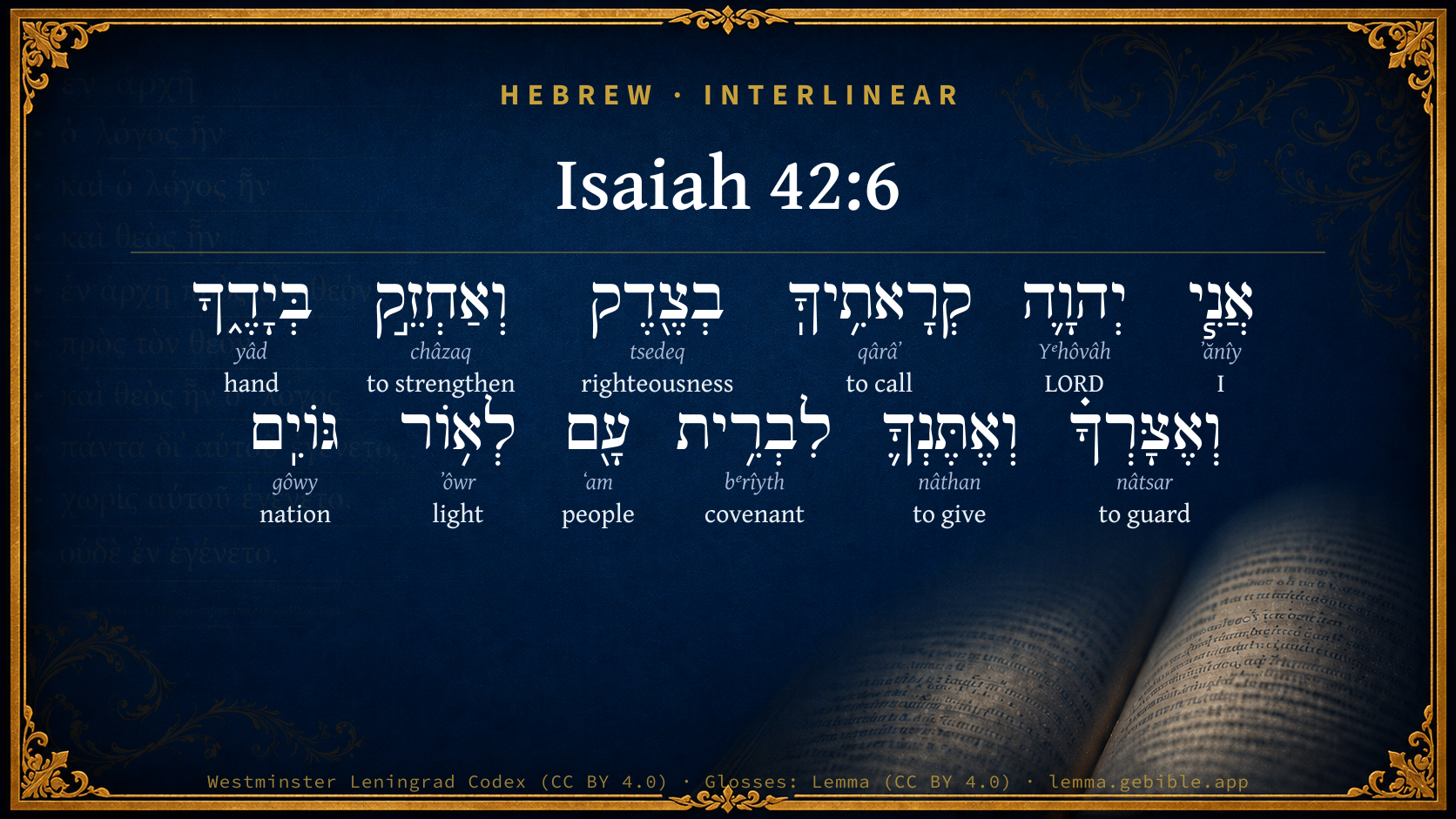
Hebrew (Westminster Leningrad Codex) Isaiah 42:6 appears in the Hebrew Old Testament. The text above is from the Westminster Leningrad Codex. Each word links to its Strong’s number, a concise gloss, and parsing drawn from the Open Scriptures Hebrew Bible morphology. Click any word for its full Brown-Driver-Briggs (BDB) entry.
Download image
Cite this verse

Isaiah 42:6 (World English Bible). Public Domain. Lemma interlinear Bible study tool, https://lemma.gebible.app/v/isaiah/42/6.

Show BibTeX & RIS
BibTeX
RIS
English Translation
I, Yahweh, have called you in righteousness, and will hold your hand, and will keep you, and give you for a covenant of the people, for a light of the Gentiles;
World English Bible · Public Domain
Download a study sheet

One document with this verse’s original text, its word-by-word gloss line, the meaning frame, cross-references with their text, attributed commentary, and full source and license credits — printable, and it pastes into notes with its structure intact.

This verse Autodidact and up

Study sheet (.html) Plain text (.txt)

A passage Seminary Student

Up to 50 verses in one chapter. A passage sheet keeps up to 6 commentary sources and 12 cross-references per verse, in the order this page ranks them, and says so on the sheet whenever that leaves anything out. Ask for a single verse and you get the Autodidact verse sheet above.

Everything on this page stays free to read, with no account — the sheet is a download of what is already on screen, not access to it.

Want to remove ads? Support Godless Engineer
Compare translations 3

The same verse in 3 English versions, stacked beneath the original-language interlinear above. Click any original word for its lexicon entry.

Each is an independent rendering of the whole verse — the interlinear is not word-aligned to these translations.

Highlighted words mark where these versions differ — a whole-verse word diff, not a word-by-word alignment.

  • World English Bible Public Domain
    I, Yahweh, have called you in righteousness, and will hold your hand, and will keep you, and give you for a covenant of the people, for a light of the Gentiles;
  • King James Version Public Domain
    I the LORD have called thee in righteousness, and will hold thine hand, and will keep thee, and give thee for a covenant of the people, for a light of the Gentiles;
  • unfoldingWord Literal Text CC BY-SA 4.0
    “I, Yahweh, I have called you in righteousness, and I will hold your hand, and I will keep you, and I will give you as a covenant of the people, as a light of the nations,

unfoldingWord Literal Text — © unfoldingWord, licensed CC BY-SA 4.0. Word-aligned USFM3 via Door43 (git.door43.org/unfoldingWord/en_ult).

Versions to compare (up to 4)

3 of 4 selected

Show all 18 translations

Every available English version of this verse, each an independent rendering of the whole verse.

  • World English Bible Public Domain
    I, Yahweh, have called you in righteousness, and will hold your hand, and will keep you, and give you for a covenant of the people, for a light of the Gentiles;
  • Berean Standard Bible Public Domain
    “I, the LORD, have called you for a righteous purpose, and I will take hold of your hand. I will keep you and appoint you to be a covenant for the people and a light to the nations,
  • Majority Standard Bible Public Domain
    “I, the LORD, have called you for a righteous purpose, and I will take hold of your hand. I will keep you and appoint you to be a covenant for the people and a light to the nations,
  • King James Version Public Domain
    I the LORD have called thee in righteousness, and will hold thine hand, and will keep thee, and give thee for a covenant of the people, for a light of the Gentiles;
  • American Standard Version (1901) Public Domain
    I, Jehovah, have called thee in righteousness, and will hold thy hand, and will keep thee, and give thee for a covenant of the people, for a light of the Gentiles;
  • Revised Version (1885) Public Domain
    I the LORD have called thee in righteousness, and will hold thine hand, and will keep thee, and give thee for a covenant of the people, for a light of the Gentiles;
  • Geneva Bible (1599) Public Domain
    I the Lord haue called thee in righteousnesse, and will hold thine hand, and I will keepe thee, and giue thee for a couenant of the people, and for a light of the Gentiles,
  • Douay-Rheims (1899) Public Domain
    I the Lord have called thee in justice, and taken thee by the hand, and preserved thee. And I have given thee for a covenant of the people, for a light of the Gentiles:
  • Young's Literal Translation Public Domain
    I, Jehovah, did call thee in righteousness, And I lay hold on thy hand, and keep thee, And I give thee for a covenant of a people, And a light of nations.
  • Literal Standard Version CC BY-SA 4.0
    I, YHWH, called you in righteousness, || And I lay hold on your hand, and keep you, || And I give you for a covenant of a people, || And a light of nations.
  • Unlocked Literal Bible CC BY-SA 4.0
    “I, Yahweh, have called you in righteousness and will hold your hand. I will keep you and set you as a covenant for the people, as a light for the Gentiles,
  • unfoldingWord Literal Text CC BY-SA 4.0
    “I, Yahweh, I have called you in righteousness, and I will hold your hand, and I will keep you, and I will give you as a covenant of the people, as a light of the nations,
  • Darby Bible Public Domain
    I, Jehovah, have called thee in righteousness, and will take hold of thy hand; and I will preserve thee, and give thee for a covenant of the people, for a light of the nations,
  • World Messianic Bible Public Domain
    “I, the LORD, have called you in righteousness. I will hold your hand. I will keep you, and make you a covenant for the people, as a light for the nations,
  • Webster's Bible Public Domain
    I the LORD have called thee in righteousness, and will hold thy hand, and will keep thee, and give thee for a covenant of the people, for a light of the Gentiles;
  • Free Bible Version CC BY-SA 4.0
    “I, the Lord, have called you to demonstrate what's right, and I will hold your hand. I will take care of you, and give you as a sign of my agreement with the people and as a light to the nations.
  • Bible in Basic English Public Domain
    I the Lord have made you the vessel of my purpose, I have taken you by the hand, and kept you safe, and I have given you to be an agreement to the people, and a light to the nations:
  • JPS Tanakh (1917) Public Domain
    I the LORD have called thee in righteousness, and have taken hold of thy hand, and kept thee, and set thee for a covenant of the people, for a light of the nations;

Literal Standard Version (2020), Covenant Press — licensed CC BY-SA 4.0. Text via the HelloAO Bible API (eBible.org). Unlocked Literal Bible (unfoldingWord) — licensed CC BY-SA 4.0. Text via the HelloAO Bible API (eBible.org). unfoldingWord Literal Text — © unfoldingWord, licensed CC BY-SA 4.0. Word-aligned USFM3 via Door43 (git.door43.org/unfoldingWord/en_ult). Free Bible Version, Dr. Jonathan Gallagher — licensed CC BY-SA 4.0. Text via the HelloAO Bible API (eBible.org).

Word by word

More ways to search: Search by grammar → Find every occurrence → Compare this word →

Practice this passage: Drill this verse → Learn its vocabulary →

וְאֶצָּרְךָ֗
nâtsar
H5341
“and · to guard · you”
Conjunction + Verb, Qal, Imperfect, 1st Person, Common, Singular + Suffix, Personal, 2nd Person, Masculine, Singular
Part of Speech
Conjunction + Verb
Stem
Qal
Form
Imperfect
Person
1st Person
Gender
Common
Number
Singular
Full BDB Definition

Origin: a primitive root

TWOT: 1407

to guard, watch, watch over, keep - (Qal) - to watch, guard, keep - to preserve, guard from dangers - to keep, observe, guard with fidelity - to guard, keep secret - to be kept close, be blockaded - watchman (participle)
  1. אֲנִ֧י ʼănîy H589 “I” Pronoun, Personal, 1st Person, Common, Singular
  2. יְהוָ֛ה Yᵉhôvâh H3068 “LORD” Noun, Proper
  3. קְרָאתִ֥יךָֽ qârâʼ H7121 “to call · you” Verb, Qal, Perfect, 1st Person, Common, Singular + Suffix, Personal, 2nd Person, Masculine, Singular
  4. בְצֶ֖דֶק tsedeq H6664 “in/at · righteousness” Preposition + Noun, Common, Masculine, Singular, Absolute
  5. וְאַחְזֵ֣ק châzaq H2388 “and · to strengthen” Conjunction + Verb, Hiphil, Imperfect, 1st Person, Common, Singular
  6. בְּיָדֶ֑ךָ yâd H3027 “in/at · hand · your” Preposition + Noun, Common, Both, Singular, Construct + Suffix, Personal, 2nd Person, Masculine, Singular
  7. וְאֶתֶּנְךָ֛ nâthan H5414 “and · to give · you” Conjunction + Verb, Qal, Imperfect, 1st Person, Common, Singular + Suffix, Personal, 2nd Person, Masculine, Singular
  8. לִבְרִ֥ית bᵉrîyth H1285 “to/for · covenant of” Preposition + Noun, Common, Feminine, Singular, Construct
  9. עָ֖ם ʻam H5971 “people” Noun, Common, Masculine, Singular, Absolute
  10. לְא֥וֹר ʼôwr H216 “to/for · light of” Preposition + Noun, Common, Both, Singular, Construct
  11. גּוֹיִֽם gôwy H1471 “nations” Noun, Common, Masculine, Plural, Absolute

About this verse

These counts appear in no published source. They are computed here, from the morphology-tagged text and Lemma’s own curated glosses. What Lemma adds →

12
words
12
distinct lemmas
Prophets
section

Grammatical profile

  • 4 verbs
  • 7 nouns
  • 1 pronoun

Verb forms

  • קְרָאתִ֥יךָֽ Qal · Perfect
  • וְאַחְזֵ֣ק Hiphil · Imperfect
  • וְאֶצָּרְךָ֗ Qal · Imperfect
  • וְאֶתֶּנְךָ֛ Qal · Imperfect

Hebrew & Septuagint length

In English translation the verse runs 31 words from the Hebrew and 35 from the Septuagint (LXX English) — closely comparable.

A rough comparison of the two English renderings, which tokenize alike — not a word-level alignment.

Word counts can differ between the Hebrew and the Greek without any difference in meaning — e.g. the Hebrew direct-object marker אֵת has no separate Greek word, and Greek often adds the article ὁ.

Cross-references

32

Topical passages linked to Isaiah 42:6 in the Treasury of Scripture Knowledge — connected by theme and wording, ordered by reader-vote popularity; previews shown in the World English Bible.

  • Luke 2:32 A light for revelation to the Gentiles, And the glory of your people Israel."
  • John 8:12 Again, therefore, Jesus spoke to them, saying, "I am the light of the world. He who follows me will not walk in the darkness, but will have the light of life."
  • Isaiah 26:3 You will keep [him] in perfect peace, [whose] mind [is] stayed [on you]; because he trusts in you.
  • Isaiah 49:8 Thus says Yahweh, In an acceptable time have I answered you, and in a day of salvation have I helped you; and I will preserve you, and give you for a covenant of the people, to raise up the land, to make them inherit the desolate heritage:
  • Acts 13:47 For so has the Lord commanded us, saying, 'I have set you as a light for the Gentiles, That you should bring salvation to the uttermost parts of the earth.'"
  • Isaiah 49:6 yes, he says, It is too light a thing that you should be my servant to raise up the tribes of Jacob, and to restore the preserved of Israel: I will also give you for a light to the Gentiles, that you may be my salvation to the end of the earth.
  • 1 Peter 2:9 But you are a chosen race, a royal priesthood, a holy nation, a people for God's own possession, that you may show forth the excellencies of him who called you out of darkness into his marvelous light:
  • Isaiah 60:1–3 Arise, shine; for your light is come, and the glory of Yahweh is risen on you.
  • Jeremiah 23:5–6 Behold, the days come, says Yahweh, that I will raise to David a righteous Branch, and he shall reign as king and deal wisely, and shall execute justice and righteousness in the land.
  • Isaiah 51:4–5 Attend to me, my people; and give ear to me, my nation: for a law shall go forth from me, and I will establish my justice for a light of the peoples.
  • Hebrews 13:20 Now may the God of peace, who brought again from the dead the great shepherd of the sheep with the blood of an eternal covenant, our Lord Jesus,
  • Acts 26:23 how the Christ must suffer, and how, by the resurrection of the dead, he would be first to proclaim light both to these people and to the Gentiles."
  • Romans 3:25–26 whom God set forth to be an atoning sacrifice, through faith in his blood, for a demonstration of his righteousness through the passing over of prior sins, in God's forbearance;
  • Hebrews 9:15 For this reason he is the mediator of a new covenant, since a death has occurred for the redemption of the transgressions that were under the first covenant, that those who have been called may receive the promise of the eternal inheritance.
  • Psalms 45:6–7 Your throne, God, is forever and ever. A scepter of equity is the scepter of your kingdom.
  • Isaiah 41:13 For I, Yahweh your God, will hold your right hand, saying to you, Don't be afraid; I will help you.
  • Isaiah 42:1 Behold, my servant, whom I uphold; my chosen, in whom my soul delights: I have put my Spirit on him; he will bring forth justice to the Gentiles.
  • Isaiah 43:1 But now thus says Yahweh who created you, Jacob, and he who formed you, Israel: Don't be afraid, for I have redeemed you; I have called you by your name, you are mine.
  • Romans 15:8–9 Now I say that Christ has been made a minister of the circumcision for the truth of God, that he might confirm the promises given to the fathers,
  • 2 Corinthians 1:20 For however many are the promises of God, in him is the "Yes." Therefore also through him is the "Amen," to the glory of God through us.
  • Isaiah 45:13 I have raised him up in righteousness, and I will make straight all his ways: he shall build my city, and he shall let my exiles go free, not for price nor reward, says Yahweh of Hosts.
  • Hebrews 7:26 For such a high priest was fitting for us: holy, guiltless, undefiled, separated from sinners, and made higher than the heavens;
  • Hebrews 8:6 But now he has obtained a more excellent ministry, by so much as he is also the mediator of a better covenant, which has been enacted on better promises.
  • Matthew 26:28 for this is my blood of the new covenant, which is poured out for many for the remission of sins.
  • Hebrews 1:8–9 but of the Son he says, "Your throne, O God, is forever and ever; The scepter of uprightness is the scepter of your Kingdom.
  • Hebrews 12:24 to Jesus, the mediator of a new covenant, and to the blood of sprinkling that speaks better than that of Abel.
  • Isaiah 49:1–3 Listen, isles, to me; and listen, you peoples, from far: Yahweh has called me from the womb; from the bowels of my mother has he made mention of my name:
  • Jeremiah 33:15–16 In those days, and at that time, will I cause a Branch of righteousness to grow up to David; and he shall execute justice and righteousness in the land.
  • Luke 1:69–72 And has raised up a horn of salvation for us in the house of his servant David
  • Galatians 3:15–17 Brothers, I speak like men. Though it is only a man's covenant, yet when it has been confirmed, no one makes it void, or adds to it.
  • Isaiah 32:1 Behold, a king shall reign in righteousness, and princes shall rule in justice.
  • Hebrews 7:2 to whom also Abraham divided a tenth part of all (being first, by interpretation, king of righteousness, and then also king of Salem, which is king of peace;

Cross-references courtesy of OpenBible.info (CC BY 4.0).

Hebrew and Greek witnesses Masoretic Hebrew ↔ Greek Septuagint

The same verse in the two great witnesses to the Old Testament, shown verse-for-verse.

These are two independent witnesses, not word-aligned to each other, and the Septuagint is shown in lemma (dictionary) form.

Hebrew Isaiah 42:6 Masoretic · Westminster Leningrad Codex

אֲנִ֧י יְהוָ֛ה קְרָאתִ֥יךָֽ בְצֶ֖דֶק וְאַחְזֵ֣ק בְּיָדֶ֑ךָ וְאֶצָּרְךָ֗ וְאֶתֶּנְךָ֛ לִבְרִ֥ית עָ֖ם לְא֥וֹר גּוֹיִֽם

I, Yahweh, have called you in righteousness, and will hold your hand, and will keep you, and give you for a covenant of the people, for a light of the Gentiles;

World English Bible · Public Domain

Greek LXX Isaiah 42:6 Septuagint · lemma form

ἐγώ κύριος ὁ θεός καλέω σύ ἐν δικαιοσύνη καί κρατέω ὁ χείρ σύ καί ἐνἰσχύω σύ καί δίδωμι σύ εἰς διαθήκη γένος εἰς φῶς ἔθνος

I the Lord God have called you in righteousness, and will hold your hand, and will strengthen you: and I have given you for the covenant of a race, for a light of the Gentiles:

LXX2012 (modern English Septuagint) · Public Domain

Hebrew: Westminster Leningrad Codex (CC BY 4.0). Greek: Septuagint (public domain); English from LXX2012 (modern English Septuagint) (Public Domain). How the Septuagint differs from the Hebrew →

Targum (Aramaic paraphrase)

1

The Targum is the ancient Jewish Aramaic paraphrase of the Hebrew Scriptures — an interpretive translation, not the Hebrew text itself. Onkelos (literal) and Pseudo-Jonathan (expansive) render the Torah, and Jonathan the Prophets. Coverage is partial: where no permissively-licensed English translation exists for a verse, only the Aramaic is shown. This is verse-level text, not a word-by-word alignment to the Hebrew.

  1. Targum Jonathan Prophets (Joshua–Malachi)
    אֲנָא יְיָ רַבִּיתָךְ בִּקְשׁוֹט וְאַתְקְפֵית בִּידָךְ וְאַתְקְנִינָךְ וְאֶתְּנִינָךְ לִקְיַם עַם לְנֵיהוֹר עַמְמִין:

    I, the Lord, I will make thee to grow in truth, and will hold thine hand, and I will direct thee, and give thee for a covenant of the people, for a light of the Gentiles;

    Targum Jonathan — Aramaic: “Mikraot Gedolot” (public domain). English: “Sefaria Community Translation” (CC0 1.0 (public-domain dedication)); “London "Chaldee Paraphrase," 1871” (public domain). Text via Sefaria.

Commentary

Notes on Isaiah 42:6 from classic Christian and Jewish commentators (each source and its license shown beneath its notes). The classic Christian expositions comment on the surrounding passage and are grouped to its opening verse, so a note may address several verses; the Jewish commentaries on the Tanakh (Rashi and others) are per-verse, so they appear only where the commentator wrote on this verse.

Lemma curates 59 commentaries, every one of them public domain or Creative Commons licensed, each selected and text-cleaned for this edition rather than reprinted as found. About our sources →

Jamieson, Fausset & Brown

Robert Jamieson, A. R. Fausset & David Brown

in righteousness--rather, "for a righteous purpose" [LOWTH]. (See Isa 42:21). God "set forth" His Son "to be a propitiation (so as) to declare His (God's) righteousness, that God might be just, and (yet) the justifier of him which believeth in Jesus" (Rom 3:25-26; compare see on Isa 41:2; Isa 45:13; Isa 50:8-9).

hold . . . hand--compare as to Israel, the type of Messiah, Hos 11:3.

covenant--the medium of the covenant, originally made between God and Abraham (Isa 49:8). "The mediator of a better covenant" (Heb 8:6) than the law (see Isa 49:8; Jer 31:33; Jer 50:5). So the abstract "peace," for peace-maker (Mic 5:5; Eph 2:14).

the people--Israel; as Isa 49:8, compared with Isa 42:6, proves (Luk 2:32).

Jamieson, Fausset & Brown — Commentary Critical and Explanatory on the Whole Bible (1871) — public domain (CC PDM 1.0). Text via the HelloAO Bible API.

Trapp's Complete Commentary

John Trapp

Isa 42:6 I the LORD have called thee in righteousness, and will hold thine hand, and will keep thee, and give thee for a covenant of the people, for a light of the Gentiles;

Ver. 6. I the Lord have called thee.] To the Mediatorship.

And will hold thine hand.] Working wonders by thee, and with thee.

And will keep thee.] That thou be not crucified till thine hour be come, and that thou despair not when thou sufferest.

And give thee for a covenant of the people,] i.e., For that "angel of the covenant," {Mal 3:1} and that thou mayest reconcile all the elect in one body to me by thy cross, &c. {Eph 2:16}

For a light to the Gentiles.] See Isa 9:2.

John Trapp, A Commentary or Exposition upon All the Books of the Old and New Testament (1647–1656) — public domain. Text from a community e-Sword module.

The Biblical Illustrator

Joseph S. Exell

Isa_42:6

I the Lord have called thee in righteousness

Gods covenant with man

We are apt to understand that there are two covenants, respectively called the covenant of works and the covenant of grace.

1. Let us define what a covenant is. In its primary sense it signifies a mutual compact or agreement between two parties. The covenant is kept on the one side by those conditions being ratified in a full and faithful observance of them; on the other side by the conferment of the benefit upon the completion of the conditions.

2. When viewing God and man as the two parties between whom a covenant has been made, we perceive that there have been two covenants entered into; in each the benefit offered by the Father has been the same, viz., eternal life, but the terms or conditions are different.

(1) In the covenant of works, the condition to be accepted and ratified by man was single, that is, obedience to the moral law of God, which law contains within its sanctions not merely an obedience to any positive commands or implied wishes, but an inward heart-observance of a complete holiness, this complete holiness being in fact itself the law, and any deviation whatever from the prescription of a complete holiness being an infraction of the law, and consequently that flaw in the covenanted obedience on mans part, which destroys the covenant altogether, and thus, annulling it, renders it nugatory.

(2) The conditions in the covenant of grace are twofold, repentance and faith, obedience to the law constituting no part of the terms on which God will confer the promised boon, though according to this, He will regulate the degrees of glory to be known and shared in and through the heavenly immortality. For the law of God has never been repealed, and never can be; neither does the covenant of grace at all make void the law, nay, as the apostle says, it establishes it.

3. An ordinary attention to the constitution of these two covenants will show us that there is between God and man, now (the now taking in the position and history of man from the fall, to the finished and ultimate recovery of redemption) but this one covenant of grace. Consider, and this partly by contrasting the two, in what this second or new covenant consists.

(1) It agrees with the first in this,

(a) that the ultimate object is the same, viz., everlasting life for man;

(b) that in Gods part of the contract the promise attached to it is the same.

(2) It differs from the other in these respects. That a third party is introduced--the Mediator Christ Jesus, the Son of God. That on mans part the conditions are different, repentance and faith being in the stead of obedience.

4. See the vital importance of understanding the truth with respect to the two covenants. There are not two covenants. There never have been two co-existing covenants. When man broke the first, it was at an end. Morally speaking, it could not be re-instituted; because, the nature of man having become sinful, and this sinfulness a necessary entailment on all his children, it was rendered impossible for man to keep a covenant of works. And a covenant broken is no longer a covenant. God, then, in His mercy and love, instituted another covenant, the same as to intent, but differing in its conditions for man, prescribing conditions which he could observe, because of the new provision made in the Mediator Christ Jesus, by whom the law should be inviolably kept, and so a justifying righteousness procured, and by whom a full, perfect, and sufficient sacrifice should be made in the offering of His own spotless body for the sins of the whole world. See how this strikes at the root of all mans pride and self-dependence, and attempts at working out a self-righteousness for his justification. See, too, the surpassing consideration of God for the pour, condemned helpless, sinner. See also the wondrous force of our text. It was to the dearly-beloved Son that God said, I, the Lord, have called Thee in righteousness, etc. Because on Him devolved the work of rescue, because He is the Mediator, because He will ensure the final victory, because in Him the new covenant was opened, in Him established, by Him maintained, Himself is called the covenant. To reject Him is to reject the covenant; to look anywhere else for salvation, to attempt any other way to Gods favour than by Him, to try any other terms than those of His Gospel, is to reject Him; and that is to reject the covenant of God and to enter into covenant with death. (R. H. Davies, B. A.)

Gods calling

The act of calling here implies--

1. Selection.

2. Designation.

3. Providential introduction to Gods service. (J. A. Alexander.)

Called in righteousness,

Called in righteousness, in accordance with a steadfast and consistent purpose. (Prof. J. Skinner, D. D.)

And give Thee for a covenant of the people.

A covenant of the people, a negotiator between God and the people. (J. A. Alexander.)

Israel a Mediator

Not only the Messiah, but the Israel of God was sent to be a mediator or connecting link between Jehovah and the nations. (J. A. Alexander.)

The new covenant of free grace

I. WHO IT IS THAT SPEAKS THIS GRACIOUS LANGUAGE. The Lord.

II. THE PERSON TO WHOM THIS GRACIOUS LANGUAGE IS DIRECTED AND SPOKEN. CHRIST.

III. WHAT HE SPEAKS UNTO CHRIST HERE, even gracious language in respect of us. He will give Him for a covenant.

IV. UNTO WHOM THE FATHER GIVES CHRIST FOR A COVENANT. Unto the people, and unto the Gentiles; that is, to Jews and to Gentiles, to all sorts of people.

V. THE END AND PURPOSE FOR WHICH THE FATHER GIVES HIM TO BE A COVENANT UNTO THE PEOPLE. To open the blind eyes, to bring the prisoners out of prison. (T. Crisp, D. D.)

Christ a covenant to open blind eyes

I. WHAT IT IS FOR CHRIST TO BE A COVENANT, OR, THE COVENANT.

II. WHAT IT IS FOR CHRIST TO BE GIVEN TO BE A COVENANT.

III. WHAT IT IS FOR CHRIST TO BE A COVENANT TO OPEN THE BLIND EYES.

IV. TO WHOM THIS CHRIST IS GIVEN TO BE A COVENANT. (T. Crisp, D. D.)

A covenant of the people

The idea must be something like this: the Divine ideal represented by the Servant of the Lord becomes the basis of a new national life, inasmuch as it expresses that for the sake of which Jehovah enters into a new covenant relation with His people. (Prof. J. Skinner, D. D.)

A word to go home on

The saintly Miss Frances Ridley Havergal literally lived and moved in the Word of God. It was her constant solace, delight, and inspiration. It is related of her that, on the last day of her life, she asked a friend to read to her the forty-second chapter of Isaiah. When the friend read the sixth verse, I the Lord have called thee in righteousness and will hold thine hand, and will keep thee, Miss Havergal stopped her. Called--held--kept--used, she whispered. Well, I will just go home on that. And she did go home on that, as on a celestial chariot, and the home-going was a triumph, with an abundant entrance into the city of God. (Christian Budget)

The Biblical Illustrator, edited by Joseph S. Exell (c. 1880s–1900s) — public domain. Text from a community e-Sword module.

Tyndale Open Study Notes

Tyndale Open Resources

42:6 my people, Israel . . . my covenant with them (literally a covenant for the people): It is also possible that “the people” referred to all the peoples/nations of the earth (see 49:6). • light to guide the nations: See also 51:4; Acts 13:47.

Tyndale Open Study Notes — © Tyndale Open Resources, licensed CC BY-SA 4.0. Text via the HelloAO Bible API.

Geneva Bible (1599)

Geneva Bible translators

To assist and guide thee.

Meaning, unto a lawful and just vocation.

As him, by whom the promise made to all nations in Abraham shall be fulfilled.

Geneva Bible (1599) marginal notes — public domain. Text via Bolls.life.

Adam Clarke's Commentary

Verse 6. A covenant of the people - "A covenant to the people"] For עם am, two MSS. of Dr. Kennicott's, and of my own, read עולם olam, the covenant of the age to come, or the everlasting covenant; which seems to give a clearer and better sense. But I think the word ברית berith, here, should not be translated covenant, but covenant sacrifice, which meaning it often has; and undoubtedly in this place. This gives a still stronger and clearer sense.

Adam Clarke's Commentary on the Bible (1810–1826) — public domain. Text from a community e-Sword/MySword module.

Ellicott's Commentary for English Readers

(6) Have called thee in righteousness . . .—The words apply to the personal servant. His call was in accordance with the absolute righteousness of God, manifesting itself in love.

A covenant of the people.—The context limits the “people” to Israel. The “servant of the Lord” is to be in Himself not only the mediator of the covenant, but the covenant, the meeting-point between God and man, just as He is the “peace” as well as the peacemaker (Mic_5:5; Eph_2:14). The words may well have furnished a starting-point for the “new covenant” of Jer_31:31, and the whole series of thoughts that have grown out of it.

A light of the Gentiles.—Re-echoed in Luk_2:32.

A Bible Commentary for English Readers, edited by Charles John Ellicott (1878–1897) — public domain. Text from a community e-Sword module.

The Cambridge Bible for Schools and Colleges

gen. ed. J. J. S. Perowne

6. called thee in righteousness] i.e. in accordance with a stedfast and consistent purpose. See Appendix, Note II, and cf. ch. Isa_45:13.

and will keep thee] R.V. marg. (“form thee”) derives the verb from a different root; if this sense be taken, it is necessary to read the words in close connexion with what follows: “I will form and appoint thee for a covenant &c.”

for a covenant of the people] The expression occurs again in ch. Isa_49:8, and is one of the most difficult in this prophecy. The idea is necessarily a pregnant one, and it is nowhere developed in such a way that we can be sure of the exact meaning. The notion of a “national league” must be dismissed, because the Heb. bìrîth, unlike the German “Bund,” nowhere means “confederation.” To take “people” in the sense of “humanity” is also unsuitable because of Isa_49:8, which clearly limits the reference to Israel. Looking at the phrase by itself two constructions are grammatically possible: (a) We may render it, “a covenant of a people,” or “a covenant people,” after the analogy of Gen_16:12, where Ishmael is called “a wild ass of a man” (cf. “Wonder of a Counsellor” in ch. Isa_9:6). This, however, is somewhat strained. (b) The most natural, and on the whole probably the most satisfactory rendering is, “a nation’s covenant,” i.e. the covenant upon which a nation is constituted, the conception implied being that Israel’s future national existence must be based on a new covenant between it and Jehovah (ch. Isa_55:3; Jer_31:30-32). The difficulty is thus reduced to the pregnancy of the statement that the Servant is or shall be this covenant. It is probably to be explained in accordance with such expressions as “thou shalt be a blessing” (Gen_12:2). As “blessing” there means “cause of blessing,” so here “covenant” may be equivalent to the ground or (as most commentators explain) the mediator of a national covenant. The idea at all events must be something like this: the Divine ideal represented by the Servant of the Lord becomes the basis of a new national life, inasmuch as it expresses that for the sake of which Jehovah enters into a new covenant relation with His people.

for a light of the nations] The ultimate destiny of the Servant; see on Isa_42:1.

The Cambridge Bible for Schools and Colleges (gen. ed. J. J. S. Perowne; Cambridge University Press, 1878–1918) — public domain. Text from a community e-Sword module.

John Gill's Exposition

I the Lord have called thee in righteousness,.... Not the Prophet Isaiah, as Jarchi and Aben Ezra interpret it; nor the people of Israel, as Kimchi; but the Messiah, whom Jehovah called to the office of Mediator, in a righteous way and manner, consistent with his own perfections; and not against the will of Christ, but with his full consent: or, "unto righteousness", as some (n); so the Arabic version; to fulfil his righteous purposes, concerning the welfare and salvation of his people; to perform his righteous promises of his coming, and of good things by him; to show his strict vindictive justice against sin, in the punishment of it; and to bring in an everlasting righteousness for his people: or it may be rendered, "I have called thee with righteousness (o)"; Christ came a righteous Person, holy in his nature, harmless in his life, and truly deserved the character of Jesus Christ the righteous:

and will hold thine hand: denoting his presence with him, and nearness unto him; his favour and affection for him; his counsel and direction of him; the support and assistance he gave him; and the strength he received from him as man, to go through his work:

and will keep thee; as the apple of his eye, being dear unto him; from being hurt by his enemies till the time came to be delivered into their hands; and from miscarrying in his work; and from the power of the grave, so as to be long detained in it:

and give thee for a covenant of the people; Christ is a covenantee, a party concerned in the covenant of grace; the representative of his people in it; the surety, Mediator, messenger, and ratifier of it; the great blessing in it; the sum and substance of it; all the blessings and promises of it are in him, and as such he is "given"; it is of God's free grace that he was appointed and intrusted with all this in eternity, and was sent in time to confirm and secure it for "the people"; given him of his Father, redeemed by him and to whom the Spirit applies the blessings and promises of the covenant; even the elect of God, both among Jews and Gentiles, especially the latter, as follows:

for a light of the Gentiles; who were in the dark as to the true knowledge of God and Jesus Christ, and the way of righteousness and salvation by him, and of all divine and spiritual things; now Christ, through the ministry of the word by his Spirit, was a light unto them; by which they were enlightened into their own state and condition by nature, and into the knowledge of himself, and the mysteries of grace.

(n) "Ad, sive in justitiam", Sanctius. (o) "cum justitia", Piscator, Forerius, Cocceius.

John Gill's Exposition of the Whole Bible (1746–1763) — public domain (CC PDM 1.0). Text via the HelloAO Bible API.

Albert Barnes' Notes on the Bible

I the Lord have called thee in righteousness - The phrase ‘in righteousness’ has been very differently understood by different expositors (see the note at Isa 41:10). The most probable meaning may be, ‘I have done it as a righteous and just God, or in the accomplishment of my righteous purposes. I am the just moral governor of the universe, and to accomplish my purposes of justice and fidelity, I have designated thee to this work.’ Lowth has well rendered it, ‘For a righteous purpose.’ In this work all was righteousness. God was righteous, who appointed him; it was because he was righteous, and could not save without a mediator and an atonement, that he sent him into the world; he selected one who was eminently righteous to accomplish his purpose; and he came that he might establish righteousness on the earth, and confirm the just government of God (see Isa 42:21).

And will hold thine hand - I will take thee by the hand, as one does who guides and leads another. The phrase denotes the same as to guard, or keep - as we protect a child by taking him by the hand.

And give thee for a covenant - This is evidently an abbreviated form of expression, and the meaning is, ‘I will give or appoint thee as the medium, or means by which a covenant shall be made with the people; or a mediator of the new covenant which God is about to establish with men’ (see Isa 49:8). A similar expression occurs in Mic 5:5, where it is said of the Messiah, ‘and this man shall be the peace;’ that is, he shall be the source of peace, or peace shall be established and maintained by him. So in Eph 2:14, it is said of him, ‘he is our peace.’

Of the people - It has been doubted whether this means the Jewish people, or the Gentiles. Grotius, Hengstenberg, Vitringa, and others understand it of the Jews; Rosenmuller and others, of the Gentiles. It is not easy to determine which is the correct interpretation. But the meaning, as I apprehend, is, not that he would confirm the ancient covenant with the descendants of Abraham, as Hengstenberg and Vitringa suppose, but that his covenant would be established with all, with both Jews and Gentiles. According to this, it will refer to the Jews, not as Jews, or as already interested in the covenant, but as constituting one portion of the world; and the whole expression will mean, that his religion will be extended to Jews and Gentiles: that is, to the whole world.

For a light of the Gentiles - (See Luk 2:32). ‘Light’ is the emblem of knowledge, instruction, and of the true religion. The Messiah is often called ‘light,’ and the ‘light of the world’ (see Mat 4:16; compare the note at Isa 9:2; Joh 1:4, Joh 1:7, Joh 1:9; Joh 3:19; Joh 8:12; Joh 9:5; Joh 12:35, Joh 12:46; Rev 21:23). This is one of the numerous declarations which occur in Isaiah, that the religion of the Messiah would be extended to the pagan world; and that they, as well as the Jews, would be brought to partake of its privileges.

Albert Barnes' Notes on the Bible (1834–1885) — public domain. Text from a community e-Sword/MySword module.

Haydock's Catholic Bible Commentary

Gentiles. This was literally verified in Christ. Cyrus is also styled the just, (chap. xli. 26.) and gave liberty to many nations.

George Leo Haydock (1774–1849), Haydock's Catholic Family Bible and Commentary, 1859 edition — public domain. Excludes Psalms (Douay-Rheims chapter numbering differs from Protestant) and Deuterocanonical books (Catholic canon only).

Matthew Poole's English Annotations

Have called thee in righteousness; to declare my righteousness, as is said, Rom 3:26, or my faithfulness, which is frequently called righteousness in Scripture; according to my promise long since made, and oft-renewed. As the former verse asserted God’s power, so this clause declares his will and firm purpose and obligation to effect this work, and both together evince the certainty and necessity of it.

Will hold thine hand; will give thee counsel and strength for thy high and hard work.

Will keep thee, that thou shalt not fail in, nor be hindered by, thine enemies from the accomplishment of thy work.

Give thee for a covenant; to be the Angel of the covenant, as Christ is called, Mal 3:1; or the Mediator, in and by whom my covenant of grace is made and confirmed with mankind.

Of the people; either of my people, the Jews; or, indefinitely or universally, of all people, not only Jews, but Gentiles also, as it follows.

For a light of the Gentiles; to enlighten them with true and saving knowledge, and to direct them in the right way to true happiness, from which they had miserably wandered. He alludes to God’s fiery pillar, which enlightened and directed the Israelites in the wilderness.

Matthew Poole's English Annotations on the Holy Bible (1683–1685) — public domain. Text from a community e-Sword/MySword module.

Whedon's Commentary on the Bible

Daniel D. Whedon

6. I the Lord have called thee in righteousness — “Thee,” Messiah. Faithful to my word of promise with Abraham; faithful also to my own intrinsic righteousness. Both are involved in the covenant.

Covenant… light — These are terms equivalent to universal gospel blessings.

Daniel D. Whedon (gen. ed.), Commentary on the Old and New Testaments (1874–1909) — public domain. Text from a community e-Sword module.

The Pulpit Commentary

I the Lord have called thee in righteousness. The "Servant of Jehovah" is addressed. God has "called" him; i.e. appointed him to his mediatorial office in righteousness," in accordance with the righteous purpose which he has entertained towards his fallen creatures from the beginning of the world. And will give thee for a Covenant of the people. (Isa_49:8) The covenant between God and his people being in Christ, it is quite consistent with Hebrew usage to transfer the term to Christ himself, in whom the covenant was, as it were, embodied. So Christ is called our Salvation" and "our Peace," and again, "our Redemption" and "our Life." This is the ordinary tone of Hebrew poetry, which rejoices in personification and embodiment. A prose writer would have said that the Servant of the Lord would be given as the Mediator of a covenant between Jehovah and his people. For a light of the Gentiles. (comp. Isa_49:6 Isa_51:4)

The Pulpit Commentary (1880–1919), ed. H.D.M. Spence-Jones & Joseph S. Exell — public domain. Text from a community e-Sword module.

John Wesley's Explanatory Notes

Called thee - To declare my righteousness, or faithfulness. With-hold - Will give thee counsel and strength for the work. Give thee - To be the mediator in whom my covenant of grace is confirmed with mankind. The people - Of all people, not only of Jews but Gentiles. A light - To enlighten them with true and saving knowledge.

John Wesley, Explanatory Notes Upon the Whole Bible (1754–1765) — public domain. Text via the GEBible commentary corpus.

J. A. Alexander on Isaiah

Joseph Addison Alexander

“I Jehovah have called thee in righteousness, and will lay hold of thee (or hold thee fast), and will keep thee, and will give thee for a covenant of the people, for a light of the Gentiles.” The act of calling here implies selection, designation, and providential introduction to God’s service. In righteousness, (i.e., in the exercise of righteousness on God’s part, including the fulfillment of His promises as well as of His threatenings). I will hold thee fast, and thereby hold thee up, sustain thee. (See above, v. 1.) We may understand by a covenant of the people a negotiator between God and the people. This use of covenant, although unusual, is in itself not more unnatural or forced than that of light in the next phrase. As ‘light of the nations’ must mean a source or dispenser of light to them, so covenant of people, in the very same sentence, may naturally mean the dispenser or mediator of a covenant with them. The only reason why the one appears less natural and simple than the other, is that light is habitually used in various languages both for the element of light and for its source or a luminous body, whereas no such twofold usage of the other word exists, although analogies might easily be traced in the usage of such words as justice for judge, counsel for counselor, in both which cases the functionary takes the name of that which he dispenses or administers. But supposing this to be the true construction of the phrase, the question still arises, who are the contracting parties, or in other words, what are we to understand by people? The great majority of writers make it mean the Jews, the chosen people of Jehovah, and the covenant the mediator or negotiator of a new covenant between them and Jehovah, according to the representation in Jer 31:31-33. But it is better to understand it as a description of the servant of Jehovah in the character, not only of a light (or an enlightener) to the nations, but of a mediator or negotiator between God and the people, (i.e., men in general). These are epithets applicable in their highest sense to Christ alone, to whom they are in fact applied by Simeon (Luk 2:32) and Paul (Act 13:47). That neither of these quotes the phrase ‘a covenant of the people’, does not prove that it has no relation to the Gentiles, but only that it does not relate to them exclusively, but to the whole human race; whereas the other phrase, as applying specifically to the Gentiles, and as being less ambiguous, was exactly suited to Paul’s purpose.

Joseph Addison Alexander, The Prophecies of Isaiah (1846–1847; New York: Scribner, 1870–1878) — public domain. Text from a community e-Sword module.

Scofield Reference Notes

C. I. Scofield

for a light of the Gentiles

The prophets connect the Gentiles with Christ in a threefold way"

(1) as the Light He brings salvation to the Gentiles Luk 2:32; Act 13:47; Act 13:48

(2) as the "Root of Jesse" He is to reign over the Gentiles in His kingdom. Isa 11:10; Rom 15:12. He saves the Gentiles, which is the distinctive feature of this present age.; Rom 11:17-24; Eph 2:11; Eph 2:12 He reigns over the Gentiles in the kingdom-age, to follow this. See "Kingdom (O.T.),"; Gen 1:26-28; Zec 12:8.

(3) Believing Gentiles in the present age, together with believing Jews, constitute "the church which is His body." (See Scofield "Eph 3:6")

The Scofield Reference Bible (1917 edition), notes by C. I. Scofield — public domain. Text from a community e-Sword module.

Rashi

Rabbi Shlomo Yitzchaki (Rashi)

I called you To Isaiah He says.

and I formed you Heb. וְאֶצָּרְךָ. When I formed you (כְּשֶׁיְצַרְתִּיךָ), this was My thought, that you return My people to My covenant and to enlighten them.

for a light to nations Every tribe is called a nation by itself, as the matter is stated (Gen. 35:11): “A nation and a congregation of nations.”

Rashi on the Tanakh — English translations: “The Judaica Press complete Tanach with Rashi, translated by A. J. Rosenberg” (CC BY 4.0); “Pentateuch with Rashi's commentary by M. Rosenbaum and A.M. Silbermann, 1929-1934” (public domain); “The Metsudah Tanach series, Lakewood, N.J” (CC BY 4.0); and “The Book of Joshua, Metsudah Publications, 1997” (CC BY 4.0). Text via Sefaria.

Ibn Ezra

Rabbi Abraham ibn Ezra

I, the Lord, have called thee, etc. The Lord in these words addresses the prophet upon his own concerns.

And I will keep thee, that no evil shall befall thee.

For a covenant of a people. To establish the covenant of a people; comp. 49:8

Ibn Ezra on the Tanakh — English translations: “Sefaria Community Translation” (CC0 1.0 (public-domain dedication)); “Yalkut, Sifsei Chachomim Chumash, Metsudah Publications, 2009” (CC BY 4.0); and “Commentary of Ibn Ezra on Isaiah - trans. by M. Friedlander, 1873” (public domain). Text via Sefaria.

Lesson kit

Teaching starters — assembled from the data on this page, not authored interpretation. Every prompt links to the verse data it draws on. Edit before teaching.

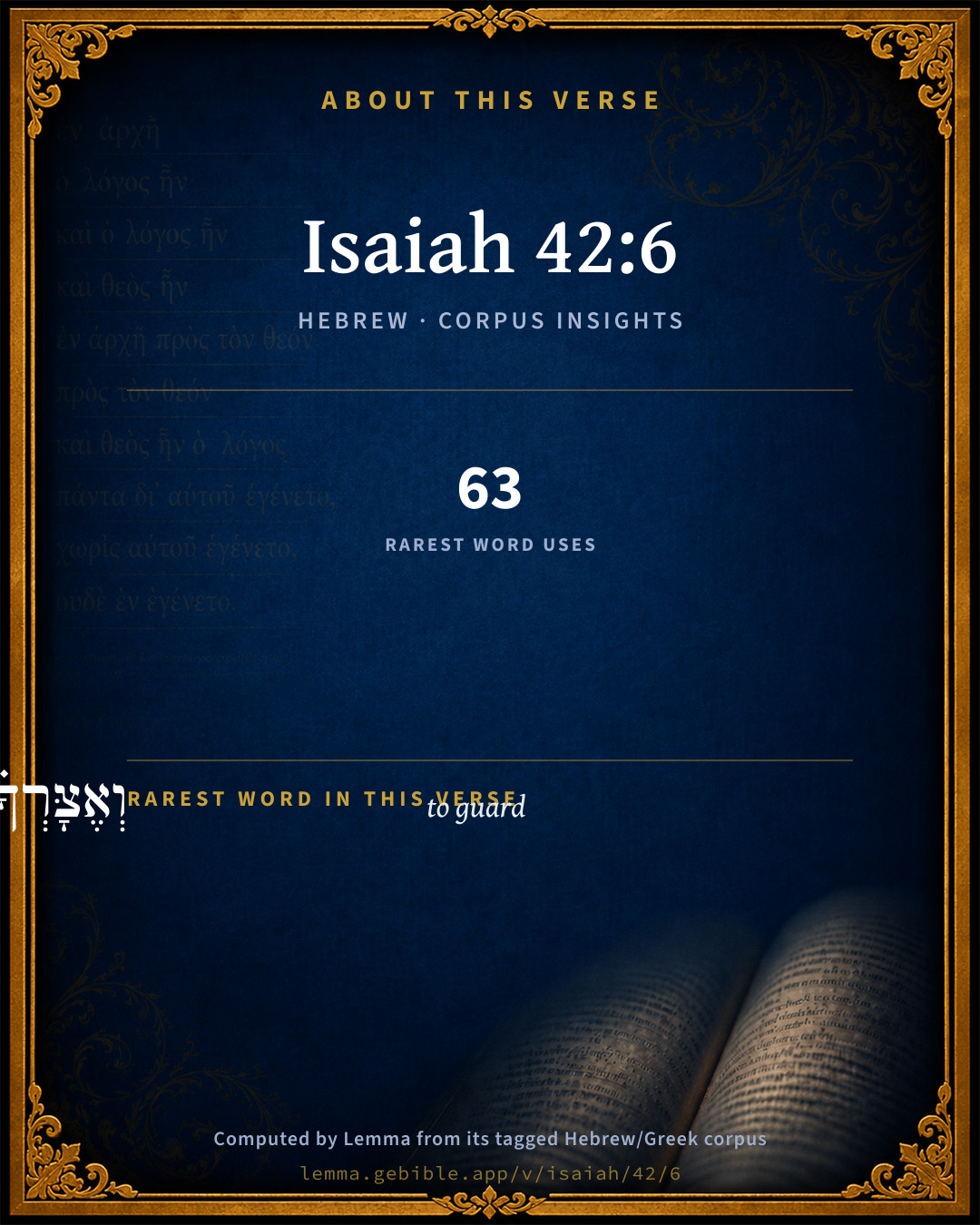
Isaiah, in the Prophets, opens this verse with 12 words (12 distinct Hebrew lemmas). Its most distinctive word is nâtsar (“to guard”). A historical commentator’s framing appears above. Read the whole chapter for the surrounding context.

Discussion questions

  1. How does “to guard” (nâtsar) shape what this verse is saying?
  2. How does Luke 2:32, which shares this passage’s theme, read alongside this verse?
  3. These translations render this verse differently. What is at stake in choosing one wording over another?
  4. «קְרָאתִ֥יךָֽ» is a Qal Perfect verb. How does that grammatical form shape the action described?
  5. Compare how Jamieson, Fausset & Brown and Trapp's Complete Commentary read this verse. Where do they agree or differ?

Things to notice

Reading settings

Reading text

Shown beneath each verse's original-language words.

Old Testament
Old Testament edition

Read the OT as the Masoretic Hebrew (MT) or the Greek Septuagint (LXX).

English shown for the Greek Septuagint (in the Hebrew ↔ Greek comparison).

Comparing translations? Open the Compare panel on any verse page to stack up to four side by side.