Habakkuk 3:11

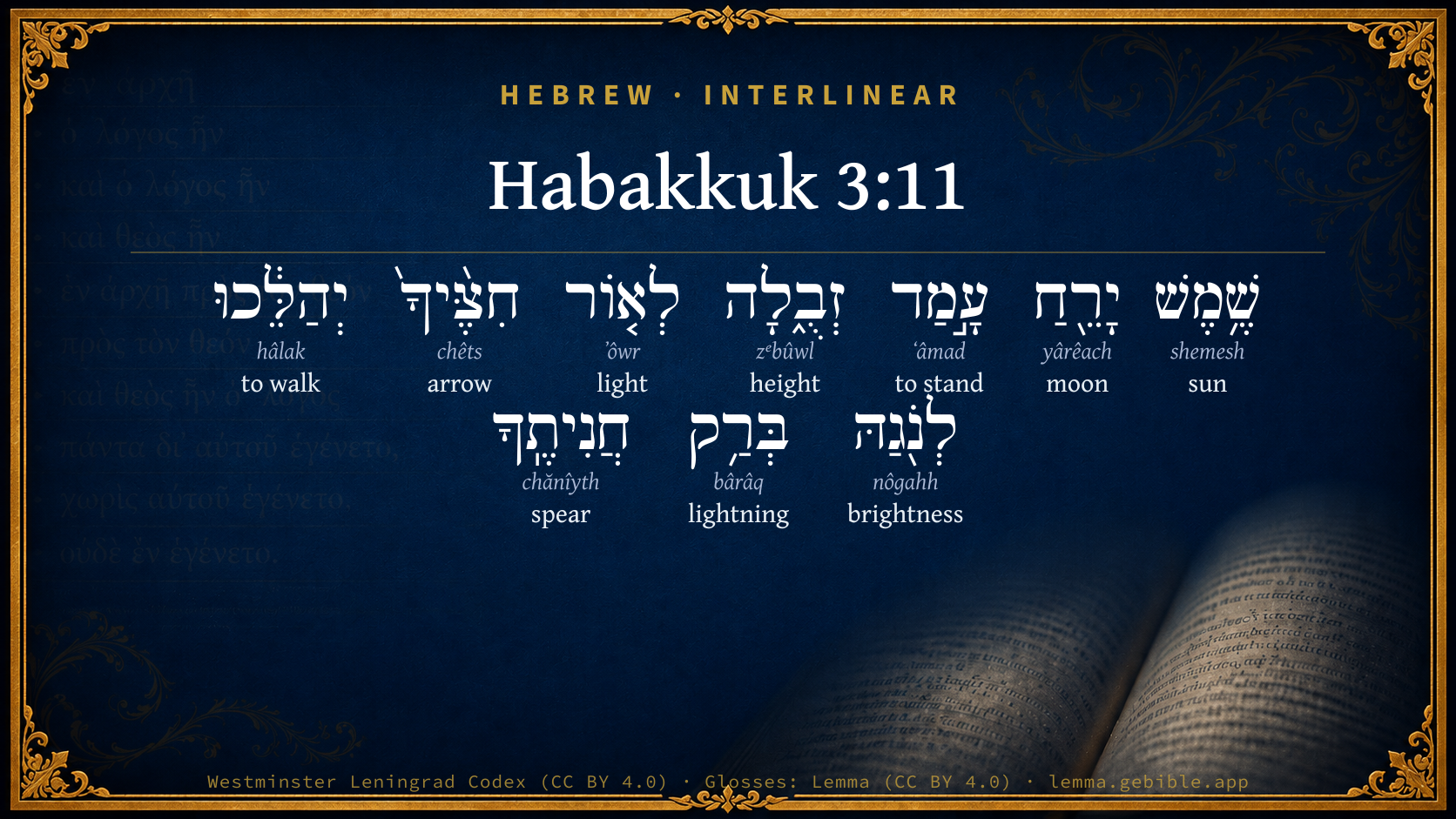
Hebrew (Westminster Leningrad Codex) Habakkuk 3:11 appears in the Hebrew Old Testament. The text above is from the Westminster Leningrad Codex. Each word links to its Strong’s number, a concise gloss, and parsing drawn from the Open Scriptures Hebrew Bible morphology. Click any word for its full Brown-Driver-Briggs (BDB) entry.
Download image
Cite this verse

Habakkuk 3:11 (World English Bible). Public Domain. Lemma interlinear Bible study tool, https://lemma.gebible.app/v/habakkuk/3/11.

Show BibTeX & RIS
BibTeX
RIS
English Translation
The sun and moon stood still in the sky, At the light of your arrows as they went, At the shining of your glittering spear.
World English Bible · Public Domain
Download a study sheet

One document with this verse’s original text, its word-by-word gloss line, the meaning frame, cross-references with their text, attributed commentary, and full source and license credits — printable, and it pastes into notes with its structure intact.

This verse Autodidact and up

Study sheet (.html) Plain text (.txt)

A passage Seminary Student

Up to 50 verses in one chapter. A passage sheet keeps up to 6 commentary sources and 12 cross-references per verse, in the order this page ranks them, and says so on the sheet whenever that leaves anything out. Ask for a single verse and you get the Autodidact verse sheet above.

Everything on this page stays free to read, with no account — the sheet is a download of what is already on screen, not access to it.

Want to remove ads? Support Godless Engineer
Compare translations 3

The same verse in 3 English versions, stacked beneath the original-language interlinear above. Click any original word for its lexicon entry.

Each is an independent rendering of the whole verse — the interlinear is not word-aligned to these translations.

Highlighted words mark where these versions differ — a whole-verse word diff, not a word-by-word alignment.

  • World English Bible Public Domain
    The sun and moon stood still in the sky, At the light of your arrows as they went, At the shining of your glittering spear.
  • King James Version Public Domain
    The sun and moon stood still in their habitation: at the light of thine arrows they went, and at the shining of thy glittering spear.
  • unfoldingWord Literal Text CC BY-SA 4.0
    The sun moon stood still in their habitation, at the light of your arrows as they flew, at the gleam of the lightning of your spear.

unfoldingWord Literal Text — © unfoldingWord, licensed CC BY-SA 4.0. Word-aligned USFM3 via Door43 (git.door43.org/unfoldingWord/en_ult).

Versions to compare (up to 4)

3 of 4 selected

Show all 18 translations

Every available English version of this verse, each an independent rendering of the whole verse.

  • World English Bible Public Domain
    The sun and moon stood still in the sky, At the light of your arrows as they went, At the shining of your glittering spear.
  • Berean Standard Bible Public Domain
    Sun and moon stood still in their places at the flash of Your flying arrows, at the brightness of Your shining spear.
  • Majority Standard Bible Public Domain
    Sun and moon stood still in their places at the flash of Your flying arrows, at the brightness of Your shining spear.
  • King James Version Public Domain
    The sun and moon stood still in their habitation: at the light of thine arrows they went, and at the shining of thy glittering spear.
  • American Standard Version (1901) Public Domain
    The sun and moon stood still in their habitation, At the light of thine arrows as they went, At the shining of thy glittering spear.
  • Revised Version (1885) Public Domain
    The sun and moon stood still in their habitation; at the light of thine arrows as they went, at the shining of thy glittering spear.
  • Geneva Bible (1599) Public Domain
    The sunne and moone stood still in their habitation: at the light of thine arrowes they went, and at the bright shining of thy speares.
  • Douay-Rheims (1899) Public Domain
    The sun and the moon stood still in their habitation, in the light of thy arrows, they shall go in the brightness of thy glittering spear.
  • Young's Literal Translation Public Domain
    Sun -- moon -- hath stood -- a habitation, At the light thine arrows go on, At the brightness, the glittering of thy spear.
  • Literal Standard Version CC BY-SA 4.0
    Sun—moon—has stood—a habitation, || Your arrows go on at the light, || At the brightness, the glittering of Your spear.
  • Unlocked Literal Bible CC BY-SA 4.0
    The sun and moon stood still in their high places at the flash of your arrows as they fly, at the lightning of your flashing spear.
  • unfoldingWord Literal Text CC BY-SA 4.0
    The sun moon stood still in their habitation, at the light of your arrows as they flew, at the gleam of the lightning of your spear.
  • Darby Bible Public Domain
    The sun [and] moon stood still in their habitation, At the light of thine arrows which shot forth, -- At the shining of thy glittering spear.
  • World Messianic Bible Public Domain
    The sun and moon stood still in the sky at the light of your arrows as they went, at the shining of your glittering spear.
  • Webster's Bible Public Domain
    The sun and moon stood still in their habitation: at the light of thy arrows they went, and at the shining of thy glittering spear.
  • Free Bible Version CC BY-SA 4.0
    The sun and moon stood still in the sky as your sparkling arrows flew and your spears flashed bright.
  • Bible in Basic English Public Domain
    At the light of your arrows they went away, at the shining of your polished spear.
  • JPS Tanakh (1917) Public Domain
    The sun and moon stand still in their habitation; at the light of Thine arrows as they go, at the shining of Thy glittering spear.

Literal Standard Version (2020), Covenant Press — licensed CC BY-SA 4.0. Text via the HelloAO Bible API (eBible.org). Unlocked Literal Bible (unfoldingWord) — licensed CC BY-SA 4.0. Text via the HelloAO Bible API (eBible.org). unfoldingWord Literal Text — © unfoldingWord, licensed CC BY-SA 4.0. Word-aligned USFM3 via Door43 (git.door43.org/unfoldingWord/en_ult). Free Bible Version, Dr. Jonathan Gallagher — licensed CC BY-SA 4.0. Text via the HelloAO Bible API (eBible.org).

Word by word

More ways to search: Search by grammar → Find every occurrence → Compare this word →

Practice this passage: Drill this verse → Learn its vocabulary →

זְבֻ֑לָה
zᵉbûwl
H2073
“height · toward”
Noun, Common, Masculine, Singular, Absolute + Suffix, Demonstrative
Part of Speech
Noun
Type
Common
Gender
Masculine
Number
Singular
State
Absolute
Full BDB Definition

Origin: from H2082

TWOT: 526a

exalted, residence, elevation, lofty abode, height, habitation
  1. שֶׁ֥מֶשׁ shemesh H8121 “sun” Noun, Common, Both, Singular, Absolute
  2. יָרֵ֖חַ yârêach H3394 “moon” Noun, Common, Masculine, Singular, Absolute
  3. עָ֣מַד ʻâmad H5975 “to stand” Verb, Qal, Perfect, 3rd Person, Masculine, Singular
  4. לְא֤וֹר ʼôwr H216 “to/for · light of” Preposition + Noun, Common, Both, Singular, Construct
  5. חִצֶּ֨יךָ֙ chêts H2671 “arrows · your” Noun, Common, Masculine, Plural, Construct + Suffix, Personal, 2nd Person, Masculine, Singular
  6. יְהַלֵּ֔כוּ hâlak H1980 “to walk” Verb, Piel, Imperfect, 3rd Person, Masculine, Plural
  7. לְנֹ֖גַהּ nôgahh H5051 “to/for · brightness of” Preposition + Noun, Common, Feminine, Singular, Construct
  8. בְּרַ֥ק bârâq H1300 “lightning of” Noun, Common, Masculine, Singular, Construct
  9. חֲנִיתֶֽךָ chănîyth H2595 “spear · your” Noun, Common, Feminine, Singular, Construct + Suffix, Personal, 2nd Person, Masculine, Singular

About this verse

These counts appear in no published source. They are computed here, from the morphology-tagged text and Lemma’s own curated glosses. What Lemma adds →

10
words
10
distinct lemmas
Prophets
section

Notable vocabulary

The rarest word here is זְבֻ֑לָה height H2073 — appearing just 5 times in the whole Hebrew Bible.

Shared distinctive vocabulary

זְבֻ֑לָה height H2073 occurs in 5 verses of the Hebrew Bible. Also found in:

Grammatical profile

  • 2 verbs
  • 8 nouns

Verb forms

  • עָ֣מַד Qal · Perfect
  • יְהַלֵּ֔כוּ Piel · Imperfect

Hebrew & Septuagint length

In English translation the verse runs 25 words from the Hebrew and 29 from the Septuagint (LXX English) — closely comparable.

A rough comparison of the two English renderings, which tokenize alike — not a word-level alignment.

Word counts can differ between the Hebrew and the Greek without any difference in meaning — e.g. the Hebrew direct-object marker אֵת has no separate Greek word, and Greek often adds the article ὁ.

Cross-references

7

Topical passages linked to Habakkuk 3:11 in the Treasury of Scripture Knowledge — connected by theme and wording, ordered by reader-vote popularity; previews shown in the World English Bible.

  • Psalms 144:5–6 Part your heavens, Yahweh, and come down. Touch the mountains, and they will smoke.
  • Joshua 10:11–13 It happened, as they fled from before Israel, while they were at the descent of Beth Horon, that Yahweh cast down great stones from the sky on them to Azekah, and they died: they were more who died with the hailstones than they whom the children of Israel killed with the sword.
  • Psalms 18:12–14 At the brightness before him his thick clouds passed, Hailstones and coals of fire.
  • Psalms 19:4 Their voice has gone out through all the earth, Their words to the end of the world. In them he has set a tent for the sun,
  • Psalms 77:17–18 The clouds poured out water. The skies resounded with thunder. Your arrows also flashed around.
  • Isaiah 28:21 For Yahweh will rise up as on Mount Perazim, he will be angry as in the valley of Gibeon; that he may do his work, his strange work, and bring to pass his act, his strange act.
  • Isaiah 38:8 behold, I will cause the shadow on the steps, which is gone down on the dial of Ahaz with the sun, to return backward ten steps. So the sun returned ten steps on the dial whereon it was gone down.

Cross-references courtesy of OpenBible.info (CC BY 4.0).

Hebrew and Greek witnesses Masoretic Hebrew ↔ Greek Septuagint

The same verse in the two great witnesses to the Old Testament, shown verse-for-verse.

These are two independent witnesses, not word-aligned to each other, and the Septuagint is shown in lemma (dictionary) form.

Hebrew Habakkuk 3:11 Masoretic · Westminster Leningrad Codex

שֶׁ֥מֶשׁ יָרֵ֖חַ עָ֣מַד זְבֻ֑לָה לְא֤וֹר חִצֶּ֨יךָ֙ יְהַלֵּ֔כוּ לְנֹ֖גַהּ בְּרַ֥ק חֲנִיתֶֽךָ

The sun and moon stood still in the sky, At the light of your arrows as they went, At the shining of your glittering spear.

World English Bible · Public Domain

Greek LXX Habakkuk 3:11 Septuagint · lemma form

ἐπιαἴρω ὁ ἥλιος καί ὁ σελήνη ἵστημι ἐν ὁ τάξις αὐτός εἰς φῶς βολίς σύ πορεύομαι εἰς φέγγος ἀστραπή ὅπλον σύ

The sun was exalted, and the moon stood still in her course: your darts shall go forth at the light, at the brightness of the gleaming of your arms.

LXX2012 (modern English Septuagint) · Public Domain

Hebrew: Westminster Leningrad Codex (CC BY 4.0). Greek: Septuagint (public domain); English from LXX2012 (modern English Septuagint) (Public Domain). How the Septuagint differs from the Hebrew →

Targum (Aramaic paraphrase)

1

The Targum is the ancient Jewish Aramaic paraphrase of the Hebrew Scriptures — an interpretive translation, not the Hebrew text itself. Onkelos (literal) and Pseudo-Jonathan (expansive) render the Torah, and Jonathan the Prophets. Coverage is partial: where no permissively-licensed English translation exists for a verse, only the Aramaic is shown. This is verse-level text, not a word-by-word alignment to the Hebrew.

  1. Targum Jonathan Prophets (Joshua–Malachi)
    אַף בְּמֶעֶבְּדָךְ נִסִין לִיהוֹשֻׁעַ בְּמֵישַׁר גִבְעוֹן שִׁמְשָׁא וְסִיהֲרָא קָמוּ בְּמָדוֹרֵיהוֹן עִמָךְ בְּמֵימְרָךְ אִתְגַבָּרוּ בִּתְקוֹף נִצְחַן גְבוּרְתָּךְ:

    (no public-domain English translation for this verse)

    Targum Jonathan — Aramaic: “Mikraot Gedolot” (public domain). English: “Sefaria Community Translation” (CC0 1.0 (public-domain dedication)); “London "Chaldee Paraphrase," 1871” (public domain). Text via Sefaria.

Commentary

Notes on Habakkuk 3:11 from classic Christian and Jewish commentators (each source and its license shown beneath its notes). The classic Christian expositions comment on the surrounding passage and are grouped to its opening verse, so a note may address several verses; the Jewish commentaries on the Tanakh (Rashi and others) are per-verse, so they appear only where the commentator wrote on this verse.

Lemma curates 59 commentaries, every one of them public domain or Creative Commons licensed, each selected and text-cleaned for this edition rather than reprinted as found. About our sources →

Trapp's Complete Commentary

John Trapp

Hab 3:11 The sun [and] moon stood still in their habitation: at the light of thine arrows they went, [and] at the shining of thy glittering spear.

Ver. 11. The sun and moon stood still in their habitation] viz. In the days of Joshua, and upon his prayer, Jos 10:12-13, whereupon one crieth out, O admirabilem piarum precum vim ac potentiam quibus etiam coelestia cedunt, &c: Oh the admirable power of prayer, that worketh wonders in heaven! and oh the heroic faith of Joshua, the trophies whereof he set in the very orbs of heaven.

At the light of thine arrows they went] By these shining arrows and glittering spears, some understand that terrible lightning, mixed with that horrible hail, Jos 10:11 with Exo 10:23, and then it is figura plane poetica, a poetic expression; for the poets call lightning Dιος βελος, Jove’s arrow. See the like Psa 18:14. The huge hail stones were God’s glittering spears, wherewith he slaughtered his enemies. Others suppose that these things are meant of the arms and weapons of the Israelites, called God’s arrows and spears, because used at his command and ordered by him (as the sword of the Lord and of Gideon, Jdg 7:18). This sense Gualther liketh better, as most comfortable to Christian warriors, who fight the Lord’s battles.

John Trapp, A Commentary or Exposition upon All the Books of the Old and New Testament (1647–1656) — public domain. Text from a community e-Sword module.

Joseph Benson's Commentary

Hab 3:11-12. The sun and moon stood still in their habitation — At the command of Joshua. At the light of thine arrows they went — Or rather, by their light (namely, the light of the sun and moon) thine arrows flew abroad, and by their shining, thy glittering spear. It was to give the Israelites time for the destruction of their enemies, that God caused the sun and moon to stand still; and while these gave them light, Jehovah sent out his arrows and scattered them, &c., Psa 18:14. He alludes to God’s casting down great hailstones and lightnings from heaven, to discomfit the Amorites: see the margin. Thou didst march, &c. — Jehovah is here represented as marching before his people, through the land of Canaan, in his chariot of war, and trampling under foot those that rose up against him; which seems to be the meaning of the second clause, Thou didst thrash, &c.

Joseph Benson's Commentary on the Old and New Testaments (1811–1818) — public domain. Text from a community e-Sword module.

Tyndale Open Study Notes

Tyndale Open Resources

3:11 sun and moon: See Josh 10:12-13.

Tyndale Open Study Notes — © Tyndale Open Resources, licensed CC BY-SA 4.0. Text via the HelloAO Bible API.

Geneva Bible (1599)

Geneva Bible translators

According to thy commandment, the sun was directed by the weapons of thy people, that fought in thy cause, as though it durst not go forward.

As appeareth, Josh. 10:11.

Geneva Bible (1599) marginal notes — public domain. Text via Bolls.life.

Jamieson, Fausset & Brown

Robert Jamieson, A. R. Fausset & David Brown

sun . . . moon stood still--at Joshua's command (Jos 10:12-13). MAURER wrongly translates, "stand" (withdrawn, or hidden from view, by the clouds which covered the sky during the thunders).

light of thine arrows--hail mixed with lightnings (Jos 10:10-11).

they went--The sun and moon "went," not as always heretofore, but according to the light and direction of Jehovah's arrows, namely, His lightnings hurled in defense of His people; astonished at these they stood still [CALVIN]. MAURER translates, "At the light of Thine arrows (which) went" or flew.

Jamieson, Fausset & Brown — Commentary Critical and Explanatory on the Whole Bible (1871) — public domain (CC PDM 1.0). Text via the HelloAO Bible API.

Adam Clarke's Commentary

Verse 11. The sun and moon stood still] This was at the prayer of Joshua, when he fought against the Amorites. See Jos 10:11-12, and the notes there.

At the light of thine arrows they went] I think we should translate, -

By their light, thine arrows went abroad;

By their brightness, the lightning of thy spear.

Calvin very justly remarks that the arrows and spears of the Israelites are called those of God, under whose auspices the people fought: the meaning is, that by the continuation of the light of the sun and moon, then stayed in their course, the Israelites saw how to continue the battle, till their enemies were all defeated.

Adam Clarke's Commentary on the Bible (1810–1826) — public domain. Text from a community e-Sword/MySword module.

John Calvin's Commentaries

Here the Prophet refers to another history; for we know that when Joshua fought, and when the day was not long enough to slay the enemies, the day was prolonged according to his prayer, (Joshua 10:12.) He seems indeed to have authoritatively commanded the sun to stay its course: but there is no doubt, but that having been answered as to his prayer, when he expressed this, he commanded the sun, as he did, through the secret impulse of the Holy Spirit: and we know that the sun would not have stopped in its course, except the moon also was stayed. There must indeed have been the same action as to these two luminaries.

Hence Habakkuk says, that the sun and moon stood still in their habitation; that is, that the sun then rested as it were in its dwelling. When it was hastening in its course, it then stood still for the benefit of God’s people. The sun then and the moon stood,—How? At the light of thy arrows shall they walk. Some refer this to the pillar of fire, as though the Prophet had said, that the Israelites walked by that light, by which God guided them: but I doubt not but that this is said of the sun. The whole sentence is thus connected—that the sun and moon walked, not as from the beginning, but at the light of God’s arrows; that is, when instead of God’s command, which the sun had received from the beginning as its direction, the sun had God’s arrows, which guided it, retarded its course, or restrained the velocity which it had before. There is then an implied contrast between the progress of the sun which it had by nature to that day, and that new direction, when the sun was retained, that it might give place to the arrows of God, and to the sword and the spear; for by the arrows and the spear he means nothing else but the weapons of the elect people; for we know, that when that people fought under the protection of God, they were armed as it were from above. As then it is said of Gideon, “The sword of God and of Gideon;” so also in this place the Prophet calls whatever armor the people of Israel had, the arrows of God and his spear; for that people could not move—no, not a finger’s breadth—without the command of God. The sun then was wont before to regard the ordinary command, of which we read in Genesis; but it was then directed for another purpose: for it had regard to the arrows of God flying on the earth as lightning; and it had regard to the arrows, as though it stood astonished and dared not to advance. Why? because it behoved it to submit to God while he was carrying on war. We now then perceive how much kindness is included in these words.

What, therefore, we have already referred to, ought to be borne in mind—that in this place there is no frigid narrative, but such things are brought before the faithful as avail to confirm their hope, that they may feel assured, that the power of God is sufficient for the purpose of delivering them; for it was for this end that he formerly wrought so many miracles. It follows—

John Calvin's Commentaries (1540-1563) — public domain. Text from the Calvin Translation Society English edition (1840s-50s) via the Christian Classics Ethereal Library (ccel.org). Calvin's coverage is partial (roughly two-thirds of the Bible); uncommented books and verses are honest gaps, never fabricated. The 19th-century editor's footnotes and remarks are omitted so the notes are faithfully Calvin's own voice.

Ellicott's Commentary for English Readers

(11) The sun and moon stand still in their habitation—scil., where they were at the beginning of the judgment. Here, of course, Habakkuk has in mind Jos_10:12-13. The rest of the verse is best rendered, at the light of Thine arrows which go abroad, at the bright glancing of Thy spear. Apparently, the conception is that the surpassing brightness of the theophany shames the heavenly bodies, which accordingly cease to pursue their journey.

A Bible Commentary for English Readers, edited by Charles John Ellicott (1878–1897) — public domain. Text from a community e-Sword module.

The Cambridge Bible for Schools and Colleges

gen. ed. J. J. S. Perowne

11. The sun and moon stood still] stand still, i.e. do not come forth, being behind the storm-cloud. The word possibly means retreat, withdraw into their habitation, hiding themselves from the light of the flying arrows of Jehovah. They are scared and outshone by the terrible brightness of His lightnings; cf. Isa_24:23. Sept. joins “lifted up” of preceding verse to this one, making “the sun” the subject. No acceptable sense is given by the Sept., but certainly the balance of the rhythm seems to require a separate predicate to “the sun”: the sun …, the moon withdraws.

At the light of thine arrows they went] at the light of thine arrows as they go. The “arrows” and “spear” both refer to the lightnings.

The strophe reads as a whole:

8. Art thou displeased against the rivers, O Lord?

Is thine anger against the rivers,

Or thy wrath against the sea,

That thou dost ride upon thine horses,

Upon thy chariots of salvation?

9. Thy bow is made bare

… Selah.

Thou cleavest the rivers into dryland.

10. The mountains see thee, they tremble,

The rainflood of waters passeth on;

The deep uttereth his voice,

And lifteth up his hands on high.

11. The sun, the moon stand still in their habitation,

At the light of thine arrows as they go,

At the shining of thy glittering spear.

The Cambridge Bible for Schools and Colleges (gen. ed. J. J. S. Perowne; Cambridge University Press, 1878–1918) — public domain. Text from a community e-Sword module.

John Gill's Exposition

The sun and moon stood still in their habitation,.... This is generally thought to refer to the miracle in the times of Joshua, Jos 10:12 but a different word is there used, especially of the standing still of the sun; nor are the sun and moon said there to stand in their habitation; nor will the series of the history of times past, or the thread of prophecy of things to come, admit of this reference; nor do the words express the clear shining of the sun and moon at their standing still, but the reverse; for the phrase, "in their habitation", may be rendered, "within their tent" (p), or pavilion; See Gill on Psa 19:4; which is no other than their being encompassed and covered with clouds; which is just such a pavilion as God is said to be in, when "darkness was his secret place; his pavilion round about him dark waters and thick clouds of the skies", Psa 18:11 and so is expressive of the dark times of antichrist, which followed, when the Pagan persecutions were over, Christianity supported by secular powers, and the Christian churches raised to the height of riches and honour; and then the man of sin showed himself, the pope of Rome took upon him the title of universal bishop, and introduced false doctrines, strange worship, and bad discipline, into the church, and obscured the glorious light of it; and Mahomet also arose with his locusts, the Saracens, out of the bottomless pit opened, from whence came a smoke which darkened the sun and air, Rev 9:1,

at the light of thine arrows they went, and at the shining of thy glittering spear; the commonly received sense of the words is, either at the light and shining of the sun and moon, when they stood still in Joshua's time; the arrows of the Almighty, and the lightning of his spear, that is, hailstones mingled with fire, and thunder, and lightning, which the heathens call Jupiter's arrows; these steered their course, being directed against the enemies of the Lord's people, and fought for them, Jos 10:10 or at the light of these, which looked very bright and dazzling through the rays of the sun upon them, the Israelites marched against their enemies, and avenged themselves on them: but these bright arrows and glittering spear, and the light and shining of them, seem to design no other than the weapons of the Christian ministry or warfare; the Gospel, and the doctrines of it; the light of which broke forth at the Reformation, the same that is meant by the "morning star", Rev 2:28 irradiated by which, the ministers of it especially went forth with courage against their antichristian enemies, and prevailed, and spread the Gospel in many countries. It may be rendered as a petition, "let them walk at the light" (q), &c.; a prayer of faith that it might be, and which is a prophecy that it would be.

(p) "intra habitaculum", Cocceius, Van Till, "vel in tugurio", ib. (q) "ambulent ad lucem", &c. Van Till.

John Gill's Exposition of the Whole Bible (1746–1763) — public domain (CC PDM 1.0). Text via the HelloAO Bible API.

Albert Barnes' Notes on the Bible

Sun and moon stood still (as one act retiring into) in their habitation - They withdrew, as it were, in the midst of the great tempest, wherein Jos 10:11-13. “God cast down great stones from heaven upon” His enemies and they died; and “the sun stood still, and the moon stayed.” The sun too withdrew itself in the great darkness at the crucifixion, as not bearing to look upon the death of its Maker, when the majesty of the Sun of Righteousness was darkened o’er; and signs in the sun and in the moon there shall be to the end.

At the light of Thine arrows they went - A. E.: “There was no need of the sun by day, nor of the moon by night; for by the light of Thine arrows can the sons of men hold their way.” Tanchum: “This is a mystical interpretation, as you see; this is like the promise of the Most High; Isa 60:19. ‘the sun shall be no more for thy light by day, neither for brightness shall the moon give light unto thee, and the Lord shall be to thee an everlasting light.’” The judgments of God are a light to His people, while they are the destruction of His enemies; in them they “learn righteousness” Isa 26:9. The arrows are God’s judgments, as they threaten and wound from afar;

The shining of Thy glittering spear - literally, of the lightning of Thy spear, when close at hand. When all other light is withdrawn, and the Sun, our Lord, is hardly beheld in the darkness of the last days, and the moon, the Church, shall not give her light, Christ not shining upon her as before, because “iniquity shall abound, and the love of many shall wax cold,” and “stars,” many who seem to shine with the light of grace, “shall fall from heaven,” His own shall walk on and advance in holiness. Dion.: “from strength to strength, Psa 84:7. from good to better, from the way to their home,” by the bright light of the lightning of God’s Judgments, wherein His glory shall be manifested. Arrows and spears are part of the spiritual armory of God, wherewith the people are subdued unto Him. Cyril: “armory, not wherewith He is girt but which He giveth to those who are meet; bright and as it were full of lightning. For most transparent is virtue.” They went then at the light of Thine arrows. Cyril: “because to those who love sin virtue has no beauty, nor, as yet, any brightness. But to those who know her she is nothing less than lightning, bright and transparent, so that whoso hath her is easily known to all around. The disciples then, first having the lightning of Thine arms, shall lead others also to its Light. Admiring and conceiving in themselves those virtues which are the arms of Christ, they shine forth to others, a gleam, as it were, of the bright flash of light inherent in those graces.” Rup.: “They were enlightened and began, by preaching, to send forth shining words of truth. But those words are Thine arrows, shining arrows, showing by their light the way of life, and by their sharp point pricking the hearts of people unto repentance.”

Albert Barnes' Notes on the Bible (1834–1885) — public domain. Text from a community e-Sword/MySword module.

Haydock's Catholic Bible Commentary

Go. The five kings shall flee at the descent of Bethoron; or the heavenly body shall proceed at thy command, at the signal given by thunder, Josue x. 11.

George Leo Haydock (1774–1849), Haydock's Catholic Family Bible and Commentary, 1859 edition — public domain. Excludes Psalms (Douay-Rheims chapter numbering differs from Protestant) and Deuterocanonical books (Catholic canon only).

Matthew Poole's English Annotations

The sun and moon stood still: though the sun rejoice as a giant to run his race, and had constantly come out of his chamber to run it about two thousand five hundred years past, yet now he stops his course, and with his stay puts stop to the motion of moon and stars, at the command of God’s minister and Israel’s captain, Jos 10:12,13.

Habitation; so the psalmist, Psa 19:4, speaks of a pavilion or tabernacle pitched for the sun, where at Joshua’s word, seconded with the word of Joshua’s and Israel’s God, he makes a halt as it were, stands at the door of his tabernacle to behold and forward the strange work, the miraculous overthrow of the five conspiring kings.

At the light of thine arrows they went: as we read the words they seem somewhat obscure and perplexed, yet very intelligible in this paraphrase: at the light, according to the light which thine arrows gave by their glittering heads, polished shafts, and bright feathers; in their flight thine arrows, O God, for these were the arrows of Israel and thine arrows too, as the sword of Gideon was the sword of the Lord.

They, i.e. sun and moon, went, directed their course, and took their way compliant with the flights of these arrows, not hastening to the place of their going down whilst Israel had arrows to shoot, or enemies that day to discomfit, whilst they were to lift up a spear against any enemy that day. The marginal reading of these words is much plainer:

thine arrows walked in the light, ( which was miraculously continued,) and thy spears walked in the brightness of the lightning (as I venture for once to read the words from the Hebrew); so dreadful was that day to the enemy, so joyful to Israel. O let some such day arise on captive Jews, revive thy works of old: so the prophet prays.

Matthew Poole's English Annotations on the Holy Bible (1683–1685) — public domain. Text from a community e-Sword/MySword module.

The Pulpit Commentary

The sun and moon stood still in their habitation; or, stand still, or withdraw into their habitation. They hide themselves in the tabernacles whence they are said to emerge when they shine. (Psa_19:4, etc.) Overpowered with the splendour of God"s presence, the heavenly luminaries hide their light in this day of the Lord. (comp. Isa_13:10; Joe_2:2, Joe_2:10, 31 3:15; Amo_5:20; Mat_24:29) The miracle of Joshua (Jos_10:12, etc.) may have suggested some of the language here, but the idea is quite different. At the light of thine arrows they went; i.e. the sun and moon fled away discomfited at the glory of God"s weapons, his arrows gleaming with light. The idea may be that, in the absence of the sun and moon, the terrific scene was illuminated only by flashes of lightning. "Lightnings" are sometimes celled God"s "arrows," as in Psa_18:14 Psa_77:17, etc.; but the image here is rather of the arms of a warrior. Many supply the relative in the sentence, and render, "arrows which shoot along." This seems to be unnecessary, and is not supported by the versions. There is no special reference to the hailstorm at Beth-horon, which discomfited the Cananites, but enabled the Israelites to pass on to victory (Joshua, loc. cit.) It is the terror of the judgment that is adumbrated, when the Lord shall come in flames of fire, (2Th_1:8) and the heavens shall be dissolved, and the elements shall melt with fervent heat. (2Pe_3:12)

The Pulpit Commentary (1880–1919), ed. H.D.M. Spence-Jones & Joseph S. Exell — public domain. Text from a community e-Sword module.

John Wesley's Explanatory Notes

Stood still - At the prayer of Joshua. In the light - Which was most miraculously continued.

John Wesley, Explanatory Notes Upon the Whole Bible (1754–1765) — public domain. Text via the GEBible commentary corpus.

Keil & Delitzsch

C. F. Keil & F. Delitzsch

The chaotic condition into which the earth has been brought is heightened by the darkness in which the heaven clothes itself. Sun and moon, which give light to day and night, have put themselves, or entered, into their habitation. זבוּל with ה local, a dwelling-place, is, according to oriental view, the place from which the stars come out when they rise, and to which they return when they set. Nevertheless it is not actual setting that is spoken of here, but simply their obscuration, which is not the effect of heavy clouds that pour out their water in showers of rain, but is caused by the shining of the arrows of God (ל in לאור and לנגהּ denoting the outward cause or occasion). It is not, however, that they "turn pale in consequence of the surpassing brilliancy of the lightnings" (Ewald), but that they "withdraw altogether, from the fear and horror which pervade all nature, and which are expressed in the mountains by trembling, in the waters by roaring, and in the sun and moon by obscuration" (Delitzsch). The idea that this verse refers to the standing still of the sun and moon at the believing word of Joshua (Jos 10:12.), in which nearly all the earlier commentators agreed, is quite untenable, inasmuch as עמד זבוּלה cannot mean to stand still in the sky. The arrows and spear (chănı̄th) of God are not lightnings, as in Psa 77:18-19; Psa 18:15, etc., because this theophany is not founded upon the idea of a storm, but the darts with which God as a warrior smites down His foes, as the instruments and effects of the wrath of God. A brilliant splendour is attributed to them, because they emanate from Him whose coming, like the sunlight, pours out its rays on both sides (Hab 3:4). בּרק חנית has the same meaning here as in Nah 3:3 : the flashing, because naked and sharpened, spear. And just as we cannot understand the "bright sword" of Nah 3:3 as signifying flashes of lightning, so here we cannot take the arrows as lightnings. יהלּכוּ is to be taken relatively, "which pass alone, or shoot by."

Keil & Delitzsch — Biblical Commentary on the Old Testament (1861–1891) — public domain (CC PDM 1.0). Text via the HelloAO Bible API. (Old Testament only.)

Scofield Reference Notes

C. I. Scofield

at the light

Or, thine arrows walked in the light, etc.

The Scofield Reference Bible (1917 edition), notes by C. I. Scofield — public domain. Text from a community e-Sword module.

unfoldingWord translationNotes

Door43 World Missions Community

General Information:

Habakkuk continues to describe his vision of Yahweh.

The sun and moon stood still

The sun and moon not moving in the sky is spoken of as if they were people who stopped walking and stood still. AT: "The sun and moon stopped moving" (See: Metaphor and Personification)

in their high places

"in the sky"

at the flash of your arrows ... at the lightning of your flashing spear

These two phrases share similar meanings and tell why the sun and moon have stood still. The lightning flashes in the sky are spoken of as if they were arrows that Yahweh shoots from his bow or a shining spear that he throws through the sky. (See: Parallelism and Metaphor)

the flash of your arrows as they fly

"the flash of your flying arrows"

indignation

anger of a person who has suffered injustice

you have threshed the nations

Yahweh punishing the people of the nations is spoken of as if he threshed the nations. Threshing refers to the practice of having an ox or some other animal trample upon grain stalks in order to crush them and remove the grain. (See: Metaphor)

translationWords

bow and arrow

spear

wrath

nation

unfoldingWord translationNotes — © Distant Shores Media and the Door43 World Missions Community, licensed CC BY-SA 4.0. Source: git.door43.org/Door43/en_tn.

Rashi

Rabbi Shlomo Yitzchaki (Rashi)

stood in their dwellings in their dwellings. In every word that requires a “lammed” at the beginning - Scripture placed a “he” at the end [meaning “to”]. They explained the phrase as referring to the war of Gibeon, as the Targum paraphrases it.

to the light of Your arrows they go Israel.

Rashi on the Tanakh — English translations: “The Judaica Press complete Tanach with Rashi, translated by A. J. Rosenberg” (CC BY 4.0); “Pentateuch with Rashi's commentary by M. Rosenbaum and A.M. Silbermann, 1929-1934” (public domain); “The Metsudah Tanach series, Lakewood, N.J” (CC BY 4.0); and “The Book of Joshua, Metsudah Publications, 1997” (CC BY 4.0). Text via Sefaria.

Lesson kit

Teaching starters — assembled from the data on this page, not authored interpretation. Every prompt links to the verse data it draws on. Edit before teaching.

Habakkuk, in the Prophets, opens this verse with 10 words (10 distinct Hebrew lemmas). Its most distinctive word is zᵉbûwl (“height”). A historical commentator’s framing appears above. Read the whole chapter for the surrounding context.

Discussion questions

  1. What does “height” (zᵉbûwl) contribute to the verse as a whole?
  2. How does 1 Kings 8:13, which shares the word «height», read alongside this verse?
  3. The translations on this page render this verse differently — a whole-verse word diff, not a word-by-word alignment. What might account for the different wordings?
  4. «עָ֣מַד» is a Qal Perfect verb. How does that grammatical form shape the action described?
  5. Compare how Trapp's Complete Commentary and Joseph Benson's Commentary read this verse. Where do they agree or differ?

Things to notice

Reading settings

Reading text

Shown beneath each verse's original-language words.

Old Testament
Old Testament edition

Read the OT as the Masoretic Hebrew (MT) or the Greek Septuagint (LXX).

English shown for the Greek Septuagint (in the Hebrew ↔ Greek comparison).

Comparing translations? Open the Compare panel on any verse page to stack up to four side by side.