
Psalms 49:19

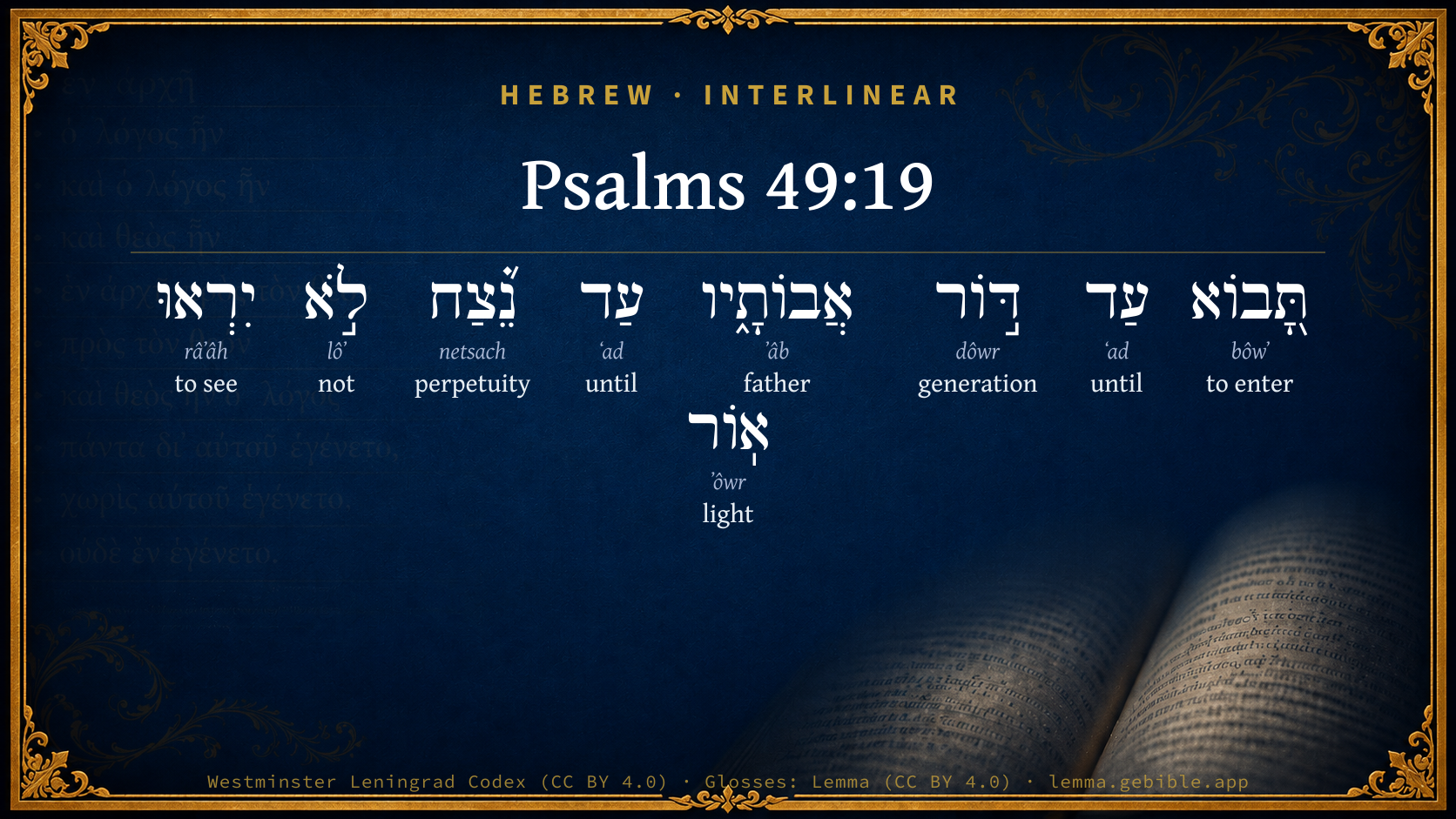
Hebrew (Westminster Leningrad Codex) Psalms 49:19 appears in the Hebrew Old Testament. The text above is from the Westminster Leningrad Codex. Each word links to its Strong’s number, a concise gloss, and parsing drawn from the Open Scriptures Hebrew Bible morphology. Click any word for its full Brown-Driver-Briggs (BDB) entry.
Download image
Cite this verse

Psalms 49:19 (World English Bible). Public Domain. Lemma interlinear Bible study tool, https://lemma.gebible.app/v/psalms/49/19.

Show BibTeX & RIS
BibTeX
RIS
English Translation
He shall go to the generation of his fathers. They shall never see the light.
World English Bible · Public Domain
Download a study sheet

One document with this verse’s original text, its word-by-word gloss line, the meaning frame, cross-references with their text, attributed commentary, and full source and license credits — printable, and it pastes into notes with its structure intact.

This verse Autodidact and up

Study sheet (.html) Plain text (.txt)

A passage Seminary Student

Up to 50 verses in one chapter. A passage sheet keeps up to 6 commentary sources and 12 cross-references per verse, in the order this page ranks them, and says so on the sheet whenever that leaves anything out. Ask for a single verse and you get the Autodidact verse sheet above.

Everything on this page stays free to read, with no account — the sheet is a download of what is already on screen, not access to it.

Want to remove ads? Support Godless Engineer
Compare translations 3

The same verse in 3 English versions, stacked beneath the original-language interlinear above. Click any original word for its lexicon entry.

Each is an independent rendering of the whole verse — the interlinear is not word-aligned to these translations.

Highlighted words mark where these versions differ — a whole-verse word diff, not a word-by-word alignment.

  • World English Bible Public Domain
    He shall go to the generation of his fathers. They shall never see the light.
  • King James Version Public Domain
    He shall go to the generation of his fathers; they shall never see light.
  • unfoldingWord Literal Text CC BY-SA 4.0
    he will come to the generation of his fathers; forever they will not see light.

unfoldingWord Literal Text — © unfoldingWord, licensed CC BY-SA 4.0. Word-aligned USFM3 via Door43 (git.door43.org/unfoldingWord/en_ult).

Versions to compare (up to 4)

3 of 4 selected

Show all 18 translations

Every available English version of this verse, each an independent rendering of the whole verse.

  • World English Bible Public Domain
    He shall go to the generation of his fathers. They shall never see the light.
  • Berean Standard Bible Public Domain
    he will join the generation of his fathers, who will never see the light of day.
  • Majority Standard Bible Public Domain
    he will join the generation of his fathers, who will never see the light of day.
  • King James Version Public Domain
    He shall go to the generation of his fathers; they shall never see light.
  • American Standard Version (1901) Public Domain
    He shall go to the generation of his fathers; They shall never see the light.
  • Revised Version (1885) Public Domain
    He shall go to the generation of his fathers; they shall never see the light.
  • Geneva Bible (1599) Public Domain
    He shall enter into the generation of his fathers, and they shall not liue for euer.
  • Douay-Rheims (1899) Public Domain
    For in his lifetime his soul will be blessed: and he will praise thee when thou shalt do well to him.
  • Young's Literal Translation Public Domain
    It cometh to the generation of his fathers, For ever they see not the light.
  • Literal Standard Version CC BY-SA 4.0
    It comes to the generation of his fathers, || They do not see the light forever.
  • Unlocked Literal Bible CC BY-SA 4.0
    he will go to the generation of his fathers and they will never see the light again.
  • unfoldingWord Literal Text CC BY-SA 4.0
    he will come to the generation of his fathers; forever they will not see light.
  • Darby Bible Public Domain
    It shall go to the generation of his fathers: they shall never see light.
  • World Messianic Bible Public Domain
    he shall go to the generation of his fathers. They shall never see the light.
  • Webster's Bible Public Domain
    \\49:18\\Though while he lived he blessed his soul: and men will praise thee, when thou doest well to thyself.
  • Free Bible Version CC BY-SA 4.0
    but their destiny is the same as their forefathers: they will never again see the light of day.
  • Bible in Basic English Public Domain
    He will go to the generation of his fathers; he will not see the light again.
  • JPS Tanakh (1917) Public Domain
    (49-20) It shall go to the generation of his fathers; they shall never see the light.

Literal Standard Version (2020), Covenant Press — licensed CC BY-SA 4.0. Text via the HelloAO Bible API (eBible.org). Unlocked Literal Bible (unfoldingWord) — licensed CC BY-SA 4.0. Text via the HelloAO Bible API (eBible.org). unfoldingWord Literal Text — © unfoldingWord, licensed CC BY-SA 4.0. Word-aligned USFM3 via Door43 (git.door43.org/unfoldingWord/en_ult). Free Bible Version, Dr. Jonathan Gallagher — licensed CC BY-SA 4.0. Text via the HelloAO Bible API (eBible.org).

Word by word

More ways to search: Search by grammar → Find every occurrence → Compare this word →

Practice this passage: Drill this verse → Learn its vocabulary →

About this verse

These counts appear in no published source. They are computed here, from the morphology-tagged text and Lemma’s own curated glosses. What Lemma adds →

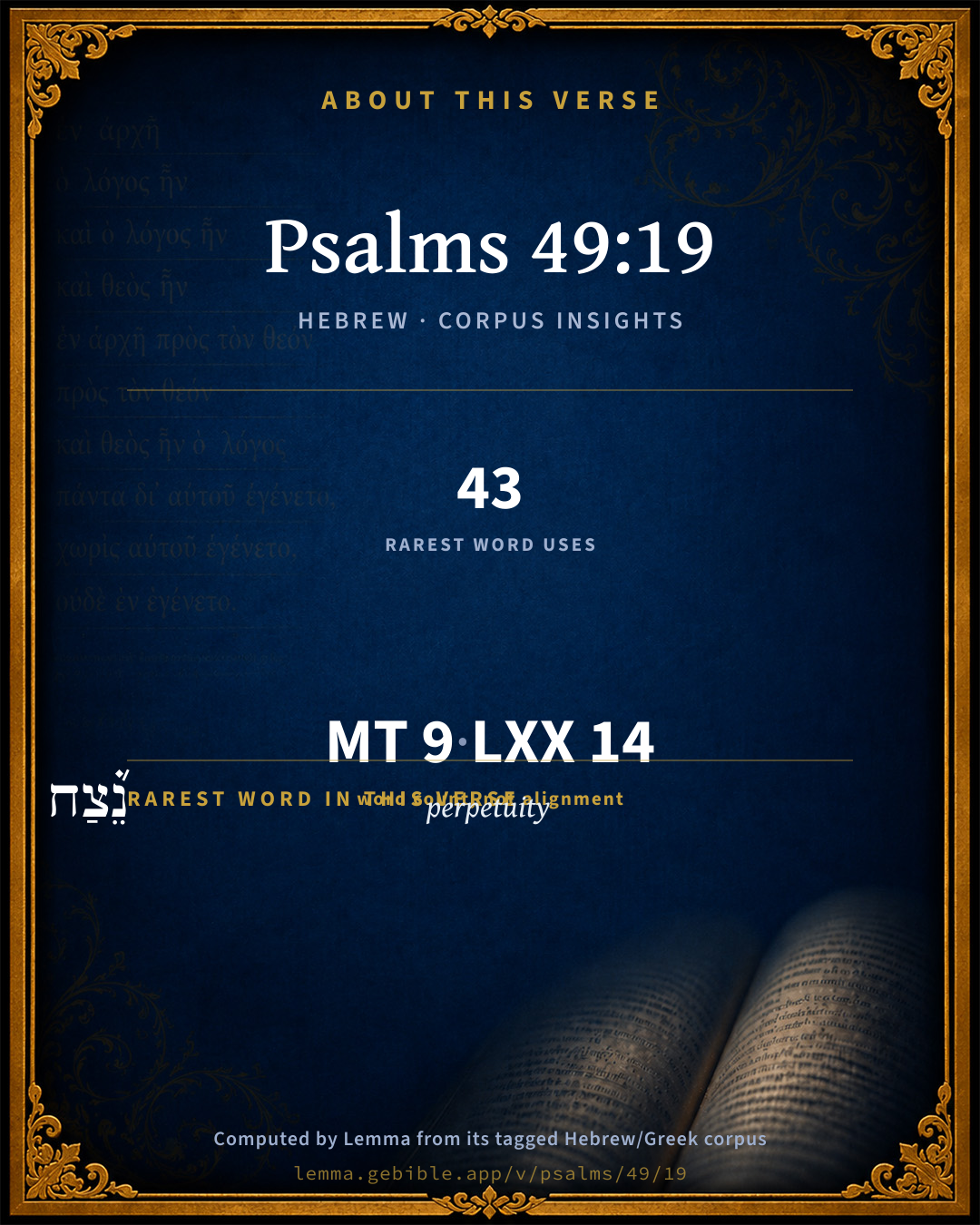
9
words
8
distinct lemmas
Wisdom
section

Shared distinctive vocabulary

נֵ֝֗צַח perpetuity H5331 occurs in 42 verses of the Hebrew Bible. Also found in:

Grammatical profile

  • 2 verbs
  • 4 nouns
  • 2 prepositions
  • 1 particle

Verb forms

  • תָּ֭בוֹא Qal · Imperfect
  • יִרְאוּ Qal · Imperfect

Repetition

A word recurs within this verse — often emphatic in Hebrew:

Hebrew & Septuagint length

In English translation the verse runs 15 words from the Hebrew and 16 from the Septuagint (LXX English) — closely comparable.

A rough comparison of the two English renderings, which tokenize alike — not a word-level alignment.

Word counts can differ between the Hebrew and the Greek without any difference in meaning — e.g. the Hebrew direct-object marker אֵת has no separate Greek word, and Greek often adds the article ὁ.

In the original languages it is 9 Hebrew tokens and 14 Greek tokens — but the two are counted differently (Hebrew bundles its prefixes and suffixes into one token; the Greek is in lemma form), so that isn’t a like-for-like length.

Cross-references

11

Topical passages linked to Psalms 49:19 in the Treasury of Scripture Knowledge — connected by theme and wording, ordered by reader-vote popularity; previews shown in the World English Bible.

  • Job 33:30 To bring back his soul from the pit, That he may be enlightened with the light of the living.
  • Genesis 15:15 But you will go to your fathers in peace. You will be buried in a good old age.
  • Psalms 56:13 For you have delivered my soul from death, And prevented my feet from falling, That I may walk before God in the light of the living.
  • Luke 12:20 "But God said to him, 'You foolish one, tonight your soul is required of you. The things which you have prepared--whose will they be?'
  • 1 Kings 16:6 Baasha slept with his fathers, and was buried in Tirzah; and Elah his son reigned in his place.
  • Ecclesiastes 3:21 Who knows the spirit of man, whether it goes upward, and the spirit of the animal, whether it goes downward to the earth?"
  • Ecclesiastes 12:7 And the dust returns to the earth as it was, And the spirit returns to God who gave it.
  • Matthew 8:12 but the children of the Kingdom will be thrown out into the outer darkness. There will be weeping and the gnashing of teeth."
  • Matthew 22:13 Then the king said to the servants, 'Bind him hand and foot, take him away, and throw him into the outer darkness; there is where the weeping and grinding of teeth will be.'
  • Luke 16:22–23 It happened that the beggar died, and that he was carried away by the angels to Abraham's bosom. The rich man also died, and was buried.
  • Jude 1:13 wild waves of the sea, foaming out their own shame; wandering stars, for whom the blackness of darkness has been reserved forever.

Cross-references courtesy of OpenBible.info (CC BY 4.0).

Hebrew and Greek witnesses Masoretic Hebrew ↔ Greek Septuagint

The same verse in the two great witnesses to the Old Testament, shown verse-for-verse.

You’re reading Greek Psalm 48 (Hebrew Psalm 49). The Septuagint counts the superscription, so verse numbers can differ from the Hebrew — chapter-level alignment, not verse-by-verse. Numbering follows Rahlfs.

These are two independent witnesses, not word-aligned to each other, and the Septuagint is shown in lemma (dictionary) form.

Hebrew Psalms 49:19 Masoretic · Westminster Leningrad Codex

תָּ֭בוֹא עַד דּ֣וֹר אֲבוֹתָ֑יו עַד נֵ֝֗צַח לֹ֣א יִרְאוּ אֽוֹר

He shall go to the generation of his fathers. They shall never see the light.

World English Bible · Public Domain

Greek LXX Greek Psalm 48:19 Septuagint · lemma form

ὅτι ὁ ψυχή αὐτός ἐν ὁ ζωή αὐτός εὐλογέω ἐκὁμολογέω σύ ὅταν ἀγαθύνω αὐτός

Yet he shall go in to the generation of his fathers; he shall never see light.

LXX2012 (modern English Septuagint) · Public Domain

Hebrew: Westminster Leningrad Codex (CC BY 4.0). Greek: Septuagint (public domain); English from LXX2012 (modern English Septuagint) (Public Domain). How the Septuagint differs from the Hebrew →

Commentary

Notes on Psalms 49:19 from classic Christian and Jewish commentators (each source and its license shown beneath its notes). The classic Christian expositions comment on the surrounding passage and are grouped to its opening verse, so a note may address several verses; the Jewish commentaries on the Tanakh (Rashi and others) are per-verse, so they appear only where the commentator wrote on this verse.

Lemma curates 59 commentaries, every one of them public domain or Creative Commons licensed, each selected and text-cleaned for this edition rather than reprinted as found. About our sources →

The Cambridge Bible for Schools and Colleges

gen. ed. J. J. S. Perowne

19. He shall go] There should be a comma at the end of Psa_49:18, as in R.V., for Psa_49:19 forms the apodosis to it. The Heb. verb may be either the 3rd person fem., the subject being the soul, or the 2nd person masc.; so either, ‘Though he blessed his soul … it shall go’ &c.: or, ‘Though men praise thee … thou shalt go.’ The first alternative is preferable. The second involves an intolerably harsh change of person (‘Thou shalt go … his fathers’). For the phrase cp. Gen_15:15, “Thou shalt go to thy fathers in peace.” The more usual expression for dying is, “he was gathered to his people,” or, “his fathers.” Families are contemplated as reunited in Sheol, where existence is a shadowy reflection of life on earth.

they shall never see light] ‘They’ refers to the rich men. The Heb. mind passes from the class to the individual and from the individual to the class with a facility to which we are not accustomed. But it is perhaps better to take the phrase as a relative clause referring to ‘his fathers’; Who shall never more see the light. He goes to join the ranks of those whose lot is fixed irrevocably, who will never return to life. For the phrase cp. Psa_58:8; Job_3:16; Ecc_6:5.

The Cambridge Bible for Schools and Colleges (gen. ed. J. J. S. Perowne; Cambridge University Press, 1878–1918) — public domain. Text from a community e-Sword module.

Trapp's Complete Commentary

John Trapp

Psa 49:19 He shall go to the generation of his fathers; they shall never see light.

Ver. 19. He shall go to the generation of his fathers] i.e. To the grave, or albeit he come to the age of his fathers, that is, live here very long.

They shall never see light] Either have any sound comfort at death or any part in God’s kingdom.

John Trapp, A Commentary or Exposition upon All the Books of the Old and New Testament (1647–1656) — public domain. Text from a community e-Sword module.

J. A. Alexander on Psalms

Joseph Addison Alexander

20. (Psa 49:19). It shall go (or thou shalt go) to the generation of his fathers; for ever they shall not see light. The first verb may be either a third person feminine, agreeing with soul, or a second person masculine, addressed directly to the wealthy sinner. In the latter case, we must suppose an immediate change to the third person, in order to account for the expression his fathers. In either case, the idea is that he shall go, though this would not be a correct translation of the Hebrew words. The whole clause has reference to the frequent description of death in the Old Testament, as a man's sleeping with his fathers, or being gathered to his fathers. Generation may be taken as a collective term, denoting the successive generations of his fathers, either natural or spiritual, i.e. either his literal progenitors, or his predecessors in the same way of thinking and. the same course of life. There is no absurdity indeed in supposing the two senses to be here coincident. To perpetuity they shall not see, in our idiom, they shall never see. The light, i.e. the light of life, or the light of the living, an expression used by David, Psa 56:13 (12). The meaning of the whole verse is, that the wealthy sinner is to die as his fathers died before him, and continue dead like them, without returning to revisit, much less to repossess, the riches and honours which he once imagined were to last for ever. This completes the proof that these advantages are not legitimate or even rational occasions of envious dissatisfaction to the righteous.

Joseph Addison Alexander, The Psalms Translated and Explained (1850) — public domain. Text from a community e-Sword module.

Geneva Bible (1599)

Geneva Bible translators

Or, his soul.

And not pass the term appointed for life.

Both they and their fathers shall live here but a while, and at length die forever.

Geneva Bible (1599) marginal notes — public domain. Text via Bolls.life.

Adam Clarke's Commentary

Verse 19. They shall never see light.] Rise again they shall; but they shall never see the light of glory, for there is prepared for them the blackness of darkness for ever.

Adam Clarke's Commentary on the Bible (1810–1826) — public domain. Text from a community e-Sword/MySword module.

John Calvin's Commentaries

19 He shall come to the age of his fathers He proceeds to show how false are the flatteries by which the wicked deceive themselves, and are deceived by others. Be they ever so intoxicated with the praises of the world, or with their own vain imaginations, yet they cannot live beyond the age of their fathers; and, granting their life to be extended to the longest term, it can never stretch into eternity. Others understand the expression as synonymous with their being gathered to the tomb along with their fathers who have gone before them; as in Scripture death is usually called “The way of all the earth.” The Psalmist, a little above, had spoken of their being gathered together in the grave as sheep in a fold. According to this view, the meaning of the passage is, that having never aspired after heaven, but having been sunk in the low grovelling pursuits of this world, they would come at last to the same fate with their fathers. When it is added, They shall not see the light even for ever, we are to understand their consignment to everlasting darkness. In my opinion, both clauses of the verse combine to express the same truth, That however they may flatter and deceive themselves, they cannot prolong their life beyond the common term of mortality. As either interpretation, however, agrees with the general scope of the psalm, the reader may choose for himself. Should the latter be adopted, the words in the close of the verse are to be considered as asserting that the ungodly can only enjoy the light of life for a short period, as they have no hope of another existence beyond the grave. We are taught by the Psalmist, in the words which have been under our consideration, to beware of flattering ourselves in the possessions of this world, and to be principally anxious for the attainment of that happiness which is reserved for us in heaven. We are also warned not to allow ourselves to be carried away by the erring influence of worldly applause. Even heathen authors have taught us the same lesson. Thus the poet Persius says, —

“Non si quid turbida Roma Elevet, accedas, examenve improbum in illa Castiges trutina: nec te quaesiveris extra,” —

“If Rome, a city full of commotions, exalt or despise any thing, beware of being satisfied with its weight or balance; that is to say, of stopping at its judgment; and do not look to what others say of you, but enter into thyself, and examine what thou art.” But the disposition to be deceived by flattery is one so strongly marked in our nature, as to require that we should attend to the weightier admonition of one who was inspired.

John Calvin's Commentaries (1540-1563) — public domain. Text from the Calvin Translation Society English edition (1840s-50s) via the Christian Classics Ethereal Library (ccel.org). Calvin's coverage is partial (roughly two-thirds of the Bible); uncommented books and verses are honest gaps, never fabricated. The 19th-century editor's footnotes and remarks are omitted so the notes are faithfully Calvin's own voice.

Ellicott's Commentary for English Readers

(19) They shall never.—Better, who will never again look on the light, i.e., “never live again,” implying, in contrast, a hope of a resurrection for the upright. (See Note Psa_49:14.)

A Bible Commentary for English Readers, edited by Charles John Ellicott (1878–1897) — public domain. Text from a community e-Sword module.

John Gill's Exposition

He shall go to the generation of his fathers,.... Be gathered to them at death; or "to the dwelling place of his fathers" (m); either the grave, or hell, or both; the habitation of his wicked ancestors: unless the words be rendered, as they are by some, though "he shall come to the age of his fathers" (n); live as long as they have done; yet he must die at last, and leave all behind, as they have done;

they shall never see light; neither he nor his fathers; they shall never see light of the sun any more, nor return to the light of the living, but shall lie in the dark and silent grave until the resurrection; or rather, they shall never enjoy eternal light, glory, and happiness. The ultimate state of glory is sometimes expressed by "light"; Joh 8:12; this the people of God, such who are made light in the Lord, and are the children of the day, shall see; but wicked men shall not; they will be cast into outer darkness, where are weeping, wailing, and gnashing of teeth.

(m) "ad habitationem", Gejerus. (n) "Usque ad aetatem", Junius & Tremellius, Piscator.

John Gill's Exposition of the Whole Bible (1746–1763) — public domain (CC PDM 1.0). Text via the HelloAO Bible API.

Albert Barnes' Notes on the Bible

He shall go to the generation of his fathers - To be gathered to one’s own people, or to his fathers, is a common expression in the Old Testament in speaking of death. See Gen 25:8, Gen 25:17; Gen 35:29; Gen 49:29, Gen 49:33, Num 20:24, Num 20:26; Num 27:13; Num 31:2; Deu 32:50; Jdg 2:10. It means that they were united again with those who had gone before them, in the regions of the dead. Death had indeed separated them, but by death they were again united.

They shall never see light - He and the “generation” to which he has gone to be united, would no more see the light of this world; no more walk among the living: Job 33:30. Compare the notes at Isa 38:11; notes at Psa 27:13. The meaning is, that the rich sinner will die as others have done before him, leaving all his earthly possessions, and will no more be permitted to revisit the world where his forsaken possessions are, and will not even be permitted to “look” on what before had been to him such a source of self-confidence, self-gratulation, and pride.

Albert Barnes' Notes on the Bible (1834–1885) — public domain. Text from a community e-Sword/MySword module.

Matthew Poole's English Annotations

Now he returns again to the third person. Such sudden and repeated changes are frequent in this book.

To the generation of his fathers, i.e. to the grave and hell, where he shall meet with his wicked parents, who by their counsel and example led him into his evil courses; as the godly also are said to be gathered to their fathers, Gen 15:15; Deu 32:50; Jdg 2:10.

Never see, i.e. never enjoy, as seeing is oft taken.

Light; neither the light of the living, as it is called, Job 33:30; Psa 56:13; or of this life, to which they shall never return; nor of the next life to which they shall never be admitted, but they shall be cast into utter darkness, Mat 8:12.

Matthew Poole's English Annotations on the Holy Bible (1683–1685) — public domain. Text from a community e-Sword/MySword module.

The Treasury of David

Charles H. Spurgeon

Ver. 19. He shall go to the generation of his fathers. Where the former generations lie, the present shall also slumber. The sires beckon to their sons to come to the same land of forgetfulness. Mortal fathers beget not immortal children. As our ancestors have departed, so also must we. They shall never see light. To this upper region the dead worldling shall never return again to possess his estates, and enjoy his dignities. Among the dead he must lie in the thick darkness, where no joy or hope can come to him. Of all his treasures there remains not enough to furnish him one poor candle; the blaze of his glory is out for ever, and not a spark remains to cheer him. How then can we look with fear or envy upon a wretch doomed to such unhappiness?

None.

None.

Psalms 49:20*

Charles H. Spurgeon's The Treasury of David (1869–1885) — public domain. Psalms only. Text from a community e-Sword/MySword module.

The Pulpit Commentary

He shall go to the generation of his fathers. In the Hebrew it is "thou shalt go," or "it (the soul) shall go;" but the meaning is well expressed by the Authorized Version. However much the wicked man delights in his life, and clings to it, nevertheless he has to die (ver. 10), to join the "generations of his fathers," to go where they have gone before him. And, once in Sheol (ver. 14), they shall never see light. God will redeem the soul of the righteous from the power of Sheol (ver. 15); but the rich ungodly man, and those to whom he goes men of his sort shall for evermore not see light.

The Pulpit Commentary (1880–1919), ed. H.D.M. Spence-Jones & Joseph S. Exell — public domain. Text from a community e-Sword module.

John Wesley's Explanatory Notes

He - Now he returns to the third person: such changes are frequent in this book. Go - To the grave and hell, where he shall meet with his wicked parents, who by their counsel and example, led him into his evil courses. See - Neither the light of this life, to which they shall never return: nor of the next life, to which they shall never be admitted.

John Wesley, Explanatory Notes Upon the Whole Bible (1754–1765) — public domain. Text via the GEBible commentary corpus.

Rashi

Rabbi Shlomo Yitzchaki (Rashi)

Because in his lifetime he blesses himself The wicked man blesses himself during his lifetime and says, “All will be well with you, my soul. No harm will befall you.” But others do not say so about him.

but [all] will praise you, for you will benefit yourself But you, if you hearken to my words, all will praise you, for you will benefit your soul by straightening your way.

Rashi on the Tanakh — English translations: “The Judaica Press complete Tanach with Rashi, translated by A. J. Rosenberg” (CC BY 4.0); “Pentateuch with Rashi's commentary by M. Rosenbaum and A.M. Silbermann, 1929-1934” (public domain); “The Metsudah Tanach series, Lakewood, N.J” (CC BY 4.0); and “The Book of Joshua, Metsudah Publications, 1997” (CC BY 4.0). Text via Sefaria.

Lesson kit

Teaching starters — assembled from the data on this page, not authored interpretation. Every prompt links to the verse data it draws on. Edit before teaching.

Psalms, in the Wisdom, opens this verse with 9 words (8 distinct Hebrew lemmas). Its most distinctive word is netsach (“perpetuity”). A historical commentator’s framing appears above. Read the whole chapter for the surrounding context.

Discussion questions

  1. What does “perpetuity” (netsach) contribute to the verse as a whole?
  2. How does 1 Samuel 15:29, which shares the word «perpetuity», read alongside this verse?
  3. What does the repetition of “until” (2× in this one verse) do in this verse?
  4. These translations render this verse differently; the difference is in the English rendering, not the original. What questions does that raise?
  5. «תָּ֭בוֹא» is a Qal Imperfect verb. How does that grammatical form shape the action described?
  6. Compare how The Cambridge Bible for Schools and Colleges and Trapp's Complete Commentary read this verse. Where do they agree or differ?

Things to notice

Reading settings

Reading text

Shown beneath each verse's original-language words.

Old Testament
Old Testament edition

Read the OT as the Masoretic Hebrew (MT) or the Greek Septuagint (LXX).

English shown for the Greek Septuagint (in the Hebrew ↔ Greek comparison).

Comparing translations? Open the Compare panel on any verse page to stack up to four side by side.