
Isaiah 13:10

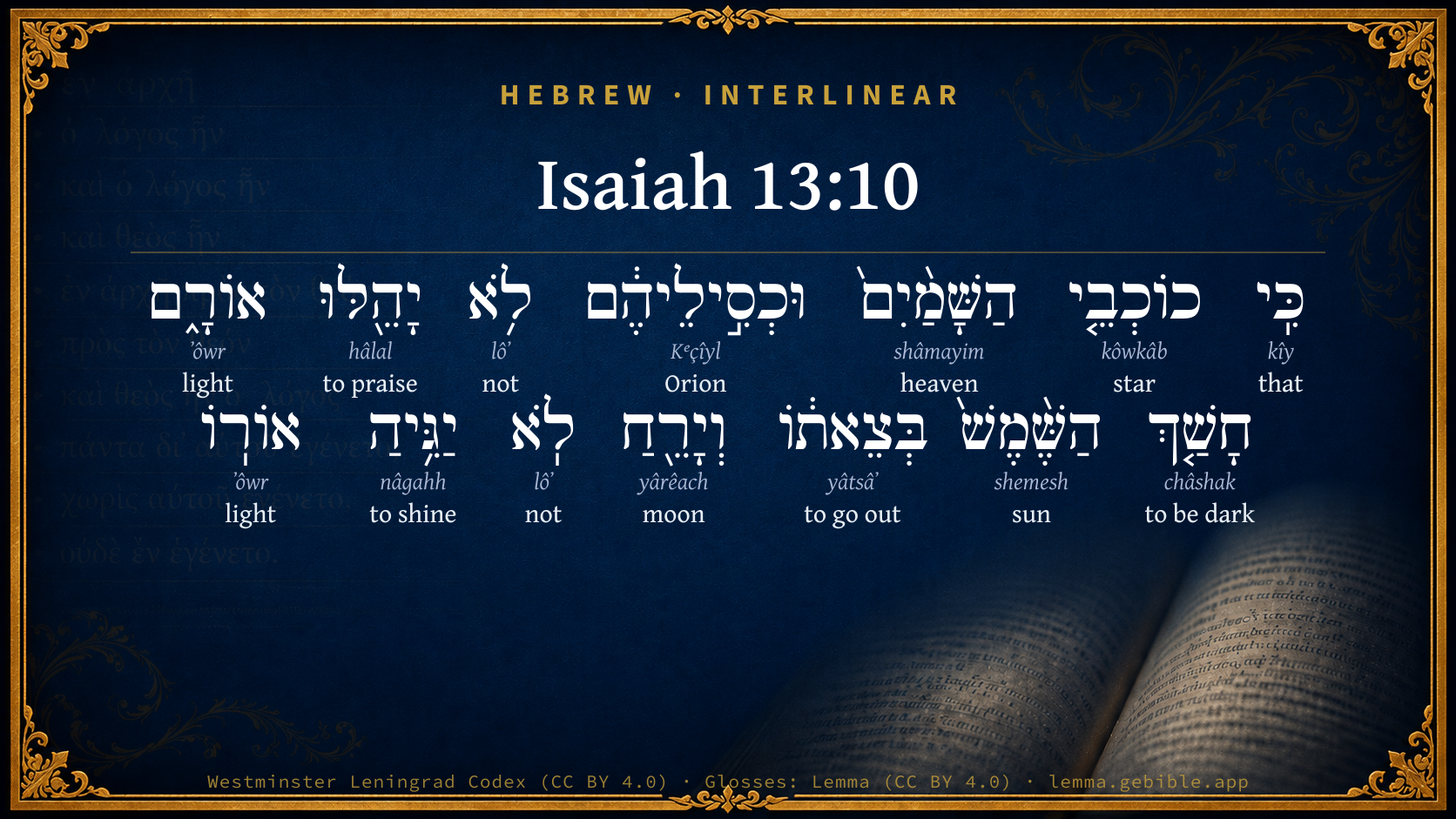
Hebrew (Westminster Leningrad Codex) Isaiah 13:10 appears in the Hebrew Old Testament. The text above is from the Westminster Leningrad Codex. Each word links to its Strong’s number, a concise gloss, and parsing drawn from the Open Scriptures Hebrew Bible morphology. Click any word for its full Brown-Driver-Briggs (BDB) entry.
Download image
Cite this verse

Isaiah 13:10 (World English Bible). Public Domain. Lemma interlinear Bible study tool, https://lemma.gebible.app/v/isaiah/13/10.

Show BibTeX & RIS
BibTeX
RIS
English Translation
For the stars of the sky and the constellations of it shall not give their light; the sun shall be darkened in its going forth, and the moon shall not cause its light to shine.
World English Bible · Public Domain
Download a study sheet

One document with this verse’s original text, its word-by-word gloss line, the meaning frame, cross-references with their text, attributed commentary, and full source and license credits — printable, and it pastes into notes with its structure intact.

This verse Autodidact and up

Study sheet (.html) Plain text (.txt)

A passage Seminary Student

Up to 50 verses in one chapter. A passage sheet keeps up to 6 commentary sources and 12 cross-references per verse, in the order this page ranks them, and says so on the sheet whenever that leaves anything out. Ask for a single verse and you get the Autodidact verse sheet above.

Everything on this page stays free to read, with no account — the sheet is a download of what is already on screen, not access to it.

Want to remove ads? Support Godless Engineer
Compare translations 3

The same verse in 3 English versions, stacked beneath the original-language interlinear above. Click any original word for its lexicon entry.

Each is an independent rendering of the whole verse — the interlinear is not word-aligned to these translations.

Highlighted words mark where these versions differ — a whole-verse word diff, not a word-by-word alignment.

  • World English Bible Public Domain
    For the stars of the sky and the constellations of it shall not give their light; the sun shall be darkened in its going forth, and the moon shall not cause its light to shine.
  • King James Version Public Domain
    For the stars of heaven and the constellations thereof shall not give their light: the sun shall be darkened in his going forth, and the moon shall not cause her light to shine.
  • unfoldingWord Literal Text CC BY-SA 4.0
    For the stars of the heavens and their constellations will not shine their light; the sun will be dark at its coming out, and the moon will not make its light shine.

unfoldingWord Literal Text — © unfoldingWord, licensed CC BY-SA 4.0. Word-aligned USFM3 via Door43 (git.door43.org/unfoldingWord/en_ult).

Versions to compare (up to 4)

3 of 4 selected

Show all 18 translations

Every available English version of this verse, each an independent rendering of the whole verse.

  • World English Bible Public Domain
    For the stars of the sky and the constellations of it shall not give their light; the sun shall be darkened in its going forth, and the moon shall not cause its light to shine.
  • Berean Standard Bible Public Domain
    For the stars of heaven and their constellations will not give their light. The rising sun will be darkened, and the moon will not give its light.
  • Majority Standard Bible Public Domain
    For the stars of heaven and their constellations will not give their light. The rising sun will be darkened, and the moon will not give its light.
  • King James Version Public Domain
    For the stars of heaven and the constellations thereof shall not give their light: the sun shall be darkened in his going forth, and the moon shall not cause her light to shine.
  • American Standard Version (1901) Public Domain
    For the stars of heaven and the constellations thereof shall not give their light; the sun shall be darkened in its going forth, and the moon shall not cause its light to shine.
  • Revised Version (1885) Public Domain
    For the stars of heaven and the constellations thereof shall not give their light: the sun shall be darkened in his going forth, and the moon shall not cause her light to shine.
  • Geneva Bible (1599) Public Domain
    For the starres of heauen and the planets thereof shall not giue their light: the sunne shalbe darkened in his going foorth, and the moone shall not cause her light to shine.
  • Douay-Rheims (1899) Public Domain
    For the stars of heaven, and their brightness shall not display their light: the sun shall be darkened in his rising, and the moon shall not shine with her light.
  • Young's Literal Translation Public Domain
    For the stars of the heavens, and their constellations, Cause not their light to shine, Darkened hath been the sun in its going out, And the moon causeth not its light to come forth.
  • Literal Standard Version CC BY-SA 4.0
    For the stars of the heavens, and their constellations, || Do not cause their light to shine, || The sun has been darkened in its going out, || And the moon does not cause its light to come forth.
  • Unlocked Literal Bible CC BY-SA 4.0
    The stars of heaven and the constellations will not give their light. The sun will be darkened even from dawn, and the moon will not shine.
  • unfoldingWord Literal Text CC BY-SA 4.0
    For the stars of the heavens and their constellations will not shine their light; the sun will be dark at its coming out, and the moon will not make its light shine.
  • Darby Bible Public Domain
    For the stars of the heavens and the constellations thereof shall not give their light; the sun shall be darkened in his going forth, and the moon shall not cause her light to shine.
  • World Messianic Bible Public Domain
    For the stars of the sky and its constellations will not give their light. The sun will be darkened in its going out, and the moon will not cause its light to shine.
  • Webster's Bible Public Domain
    For the stars of heaven and its constellations shall not give their light: the sun shall be darkened in his going forth, and the moon shall not cause her light to shine.
  • Free Bible Version CC BY-SA 4.0
    The stars in the constellations of heaven above will not shine. When the sun rises it will stay dark. The moon will give no light.
  • Bible in Basic English Public Domain
    For the stars of heaven and its bright armies will not give their light: the sun will be made dark in his journey through the heaven, and the moon will keep back her light.
  • JPS Tanakh (1917) Public Domain
    For the stars of heaven and the constellations thereof shall not give their light; the sun shall be darkened in his going forth, and the moon shall not cause her light to shine.

Literal Standard Version (2020), Covenant Press — licensed CC BY-SA 4.0. Text via the HelloAO Bible API (eBible.org). Unlocked Literal Bible (unfoldingWord) — licensed CC BY-SA 4.0. Text via the HelloAO Bible API (eBible.org). unfoldingWord Literal Text — © unfoldingWord, licensed CC BY-SA 4.0. Word-aligned USFM3 via Door43 (git.door43.org/unfoldingWord/en_ult). Free Bible Version, Dr. Jonathan Gallagher — licensed CC BY-SA 4.0. Text via the HelloAO Bible API (eBible.org).

Word by word

More ways to search: Search by grammar → Find every occurrence → Compare this word →

Practice this passage: Drill this verse → Learn its vocabulary →

וּכְסִ֣ילֵיהֶ֔ם
Kᵉçîyl
H3685
“and · constellations · their”
Conjunction + Noun, Common, Masculine, Plural, Construct + Suffix, Personal, 3rd Person, Masculine, Plural
Part of Speech
Conjunction + Noun
Type
Common
Gender
Masculine
Number
Plural
State
Construct
Full BDB Definition

Origin: the same as H3684

TWOT: 1011e

constellation, Orion - Orion, the constellation - constellation (general)
  1. כִּֽי kîy H3588 “that” Conjunction
  2. כוֹכְבֵ֤י kôwkâb H3556 “stars of” Noun, Common, Masculine, Plural, Construct
  3. הַשָּׁמַ֨יִם֙ shâmayim H8064 “the · heaven(s)” Particle, Definite Article + Noun, Common, Masculine, Plural, Absolute
  4. לֹ֥א lôʼ H3808 “not” Particle, Negative
  5. יָהֵ֖לּוּ hâlal H1984 “to praise” Verb, Hiphil, Imperfect, 3rd Person, Masculine, Plural
  6. אוֹרָ֑ם ʼôwr H216 “light · their” Noun, Common, Both, Singular, Construct + Suffix, Personal, 3rd Person, Masculine, Plural
  7. חָשַׁ֤ךְ châshak H2821 “to be dark” Verb, Qal, Perfect, 3rd Person, Masculine, Singular
  8. הַשֶּׁ֨מֶשׁ֙ shemesh H8121 “the · sun” Particle, Definite Article + Noun, Common, Both, Singular, Absolute
  9. בְּצֵאת֔וֹ yâtsâʼ H3318 “in/at · to go out · him” Preposition + Verb, Qal, Infinitive Construct + Suffix, Personal, 3rd Person, Masculine, Singular
  10. וְיָרֵ֖חַ yârêach H3394 “and · moon” Conjunction + Noun, Common, Masculine, Singular, Absolute
  11. לֹֽא lôʼ H3808 “not” Particle, Negative
  12. יַגִּ֥יהַ nâgahh H5050 “to shine” Verb, Hiphil, Imperfect, 3rd Person, Masculine, Singular
  13. אוֹרֽוֹ ʼôwr H216 “light · his” Noun, Common, Both, Singular, Construct + Suffix, Personal, 3rd Person, Masculine, Singular

About this verse

These counts appear in no published source. They are computed here, from the morphology-tagged text and Lemma’s own curated glosses. What Lemma adds →

14
words
12
distinct lemmas
Prophets
section

Notable vocabulary

The rarest word here is וּכְסִ֣ילֵיהֶ֔ם Orion H3685 — appearing just 4 times in the whole Hebrew Bible.

Shared distinctive vocabulary

וּכְסִ֣ילֵיהֶ֔ם Orion H3685 occurs in 4 verses of the Hebrew Bible. Also found in:

Grammatical profile

  • 4 verbs
  • 7 nouns
  • 1 conjunction
  • 2 particles

Verb forms

  • יָהֵ֖לּוּ Hiphil · Imperfect
  • חָשַׁ֤ךְ Qal · Perfect
  • בְּצֵאת֔וֹ Qal · Infinitive Construct
  • יַגִּ֥יהַ Hiphil · Imperfect

Repetition

Words recur within this verse — often emphatic in Hebrew:

  • אוֹרָ֑ם light H216 ×2
  • לֹ֥א not H3808 ×2

Hebrew & Septuagint length

In English translation the verse runs 35 words from the Hebrew and 33 from the Septuagint (LXX English) — closely comparable.

A rough comparison of the two English renderings, which tokenize alike — not a word-level alignment.

Word counts can differ between the Hebrew and the Greek without any difference in meaning — e.g. the Hebrew direct-object marker אֵת has no separate Greek word, and Greek often adds the article ὁ.

Cross-references

14

Topical passages linked to Isaiah 13:10 in the Treasury of Scripture Knowledge — connected by theme and wording, ordered by reader-vote popularity; previews shown in the World English Bible.

  • Joel 2:31 The sun will be turned into darkness, And the moon into blood, Before the great and terrible day of Yahweh comes.
  • Matthew 24:29 But immediately after the oppression of those days, the sun will be darkened, the moon will not give its light, the stars will fall from the sky, and the powers of the heavens will be shaken;
  • Mark 13:24 But in those days, after that oppression, the sun will be darkened, the moon will not give its light,
  • Ezekiel 32:7–8 When I shall extinguish you, I will cover the heavens, and make the stars of it dark; I will cover the sun with a cloud, and the moon shall not give its light.
  • Isaiah 5:30 They will roar against them in that day like the roaring of the sea. If one looks to the land, behold, darkness and distress. The light is darkened in its clouds.
  • Isaiah 24:23 Then the moon shall be confounded, and the sun ashamed; for Yahweh of Hosts will reign on Mount Zion, and in Jerusalem; and before his elders shall be glory.
  • Joel 2:10 The earth quakes before them. The heavens tremble. The sun and the moon are darkened, And the stars withdraw their shining.
  • Joel 3:15 The sun and the moon are darkened, And the stars withdraw their shining."
  • Luke 21:25 There will be signs in the sun, moon, and stars; and on the earth anxiety of nations, in perplexity for the roaring of the sea and the waves;
  • Revelation 6:12–14 I saw when he opened the sixth seal, and there was a great earthquake. The sun became black as sackcloth made of hair, and the whole moon became as blood.
  • Revelation 8:12 The fourth angel sounded, and one third of the sun was struck, and one third of the moon, and one third of the stars; so that one third of them would be darkened, and the day wouldn't shine for one third of it, and the night in the same way.
  • Zephaniah 1:15–16 That day is a day of wrath, a day of distress and anguish, a day of trouble and ruin, a day of darkness and gloom, a day of clouds and blackness,
  • Isaiah 24:21 It shall happen in that day, that Yahweh will punish the host of the high ones on high, and the kings of the earth on the earth.
  • Amos 8:9–10 "It will happen in that day," says the Lord Yahweh, "That I will cause the sun to go down at noon, And I will darken the earth in the clear day.

Cross-references courtesy of OpenBible.info (CC BY 4.0).

Hebrew and Greek witnesses Masoretic Hebrew ↔ Greek Septuagint

The same verse in the two great witnesses to the Old Testament, shown verse-for-verse.

These are two independent witnesses, not word-aligned to each other, and the Septuagint is shown in lemma (dictionary) form.

Hebrew Isaiah 13:10 Masoretic · Westminster Leningrad Codex

כִּֽי כוֹכְבֵ֤י הַשָּׁמַ֨יִם֙ וּכְסִ֣ילֵיהֶ֔ם לֹ֥א יָהֵ֖לּוּ אוֹרָ֑ם חָשַׁ֤ךְ הַשֶּׁ֨מֶשׁ֙ בְּצֵאת֔וֹ וְיָרֵ֖חַ לֹֽא יַגִּ֥יהַ אוֹרֽוֹ

For the stars of the sky and the constellations of it shall not give their light; the sun shall be darkened in its going forth, and the moon shall not cause its light to shine.

World English Bible · Public Domain

Greek LXX Isaiah 13:10 Septuagint · lemma form

ὁ γάρ ἀστήρ ὁ οὐρανός καί ὁ ὠρίων καί πᾶς ὁ κόσμος ὁ οὐρανός ὁ φῶς οὐ δίδωμι καί σκοτίζω ὁ ἥλιος ἀνατέλλω καί ὁ σελήνη οὐ δίδωμι ὁ φῶς αὐτός

For the stars of heaven, and Orion, and all the host of heaven, shall not give their light; and it shall be dark at sunrise, and the moon shall not give her light.

LXX2012 (modern English Septuagint) · Public Domain

On this verse, John Gill's Exposition discusses the Septuagint’s reading. Read the note in Commentary ↓

Hebrew: Westminster Leningrad Codex (CC BY 4.0). Greek: Septuagint (public domain); English from LXX2012 (modern English Septuagint) (Public Domain). How the Septuagint differs from the Hebrew →

Targum (Aramaic paraphrase)

1

The Targum is the ancient Jewish Aramaic paraphrase of the Hebrew Scriptures — an interpretive translation, not the Hebrew text itself. Onkelos (literal) and Pseudo-Jonathan (expansive) render the Torah, and Jonathan the Prophets. Coverage is partial: where no permissively-licensed English translation exists for a verse, only the Aramaic is shown. This is verse-level text, not a word-by-word alignment to the Hebrew.

  1. Targum Jonathan Prophets (Joshua–Malachi)
    אֲרֵי כוֹכְבַי שְׁמַיָא וּכְסִלֵיהוֹן לָא יִזְהֲרוּן נְהוֹרֵיהוֹן וּקְבֵל שִׁמְשָׁא בְּמִפְקֵיהּ וְסִיהֲרָא לָא מִזְהַר נְהוֹרֵיהּ:

    For the stars of heaven and their constellations shall not give their light: the sun shall be darkened in his going forth; and the moon shall not cause her light to shine.

    Targum Jonathan — Aramaic: “Mikraot Gedolot” (public domain). English: “Sefaria Community Translation” (CC0 1.0 (public-domain dedication)); “London "Chaldee Paraphrase," 1871” (public domain). Text via Sefaria.

Commentary

Notes on Isaiah 13:10 from classic Christian and Jewish commentators (each source and its license shown beneath its notes). The classic Christian expositions comment on the surrounding passage and are grouped to its opening verse, so a note may address several verses; the Jewish commentaries on the Tanakh (Rashi and others) are per-verse, so they appear only where the commentator wrote on this verse.

Lemma curates 59 commentaries, every one of them public domain or Creative Commons licensed, each selected and text-cleaned for this edition rather than reprinted as found. About our sources →

Trapp's Complete Commentary

John Trapp

Isa 13:10 For the stars of heaven and the constellations thereof shall not give their light: the sun shall be darkened in his going forth, and the moon shall not cause her light to shine.

Ver. 10. For the stars of heaven shall not give their light.] {a} They shall have punishment without pity, misery without mercy, sorrow without help, mischief without measure, crying without comfort, &c., and all this shall be but a typical hell to them, a foretaste of eternal torments.

The constellations thereof.] Which yet some interpreters take for some single and signal star, magnam lucem magnae sequuntur tenebrae.

The sun shall be darkened.] They shall neither have good day nor good night.

{a} Est hyperbole et hypollage.

John Trapp, A Commentary or Exposition upon All the Books of the Old and New Testament (1647–1656) — public domain. Text from a community e-Sword module.

Tyndale Open Study Notes

Tyndale Open Resources

13:10 Cosmic upheaval and darkness are common images for the day of the Lord, a time of God’s judgment (see also Ezek 32:7-8; Joel 2:10, 31; 3:15; Matt 24:29; Mark 13:24; Rev 6:12-13; 8:12; cp. Isa 30:26).

Tyndale Open Study Notes — © Tyndale Open Resources, licensed CC BY-SA 4.0. Text via the HelloAO Bible API.

Geneva Bible (1599)

Geneva Bible translators

They that are overcome shall think that all the powers of heaven and earth are against them, Ezek. 32:7; Joel 3:15; Matt. 24:29.

Geneva Bible (1599) marginal notes — public domain. Text via Bolls.life.

Jamieson, Fausset & Brown

Robert Jamieson, A. R. Fausset & David Brown

stars, &c.--figuratively for anarchy, distress, and revolutions of kingdoms (Isa 34:4; Joe 2:10; Eze 32:7-8; Amo 8:9; Rev 6:12-14). There may be a literal fulfilment finally, shadowed forth under this imagery (Rev 21:1).

constellations--Hebrew, "a fool," or "impious one"; applied to the constellation Orion, which was represented as an impious giant (Nimrod deified, the founder of Babylon) chained to the sky. See on Job 38:31.

Jamieson, Fausset & Brown — Commentary Critical and Explanatory on the Whole Bible (1871) — public domain (CC PDM 1.0). Text via the HelloAO Bible API.

Adam Clarke's Commentary

Verse 10. For the stars of heaven - "Yea, the stars of heaven"] The Hebrew poets, to express happiness, prosperity, the instauration and advancement of states, kingdoms, and potentates, make use of images taken from the most striking parts of nature, from the heavenly bodies, from the sun, moon, and stars: which they describe as shining with increased splendour, and never setting. The moon becomes like the meridian sun, and the sun's light is augmented sevenfold; (see Isa 30:26;) new heavens and a new earth are created, and a brighter age commences. On the contrary, the overflow and destruction of kingdoms is represented by opposite images. The stars are obscured, the moon withdraws her light, and the sun shines no more! The earth quakes, and the heavens tremble; and all things seem tending to their original chaos, See Joe 2:10; Joe 3:15-16; Am 8:9; Mt 24:29; and De S. Poes. Herb. Prael. VI. et IX.

And the moon shall not cause her light to shine] This in its farther reference may belong to the Jewish polity, both in Church and state, which should be totally eclipsed, and perhaps shine no more in its distinct state for ever.

Adam Clarke's Commentary on the Bible (1810–1826) — public domain. Text from a community e-Sword/MySword module.

Ellicott's Commentary for English Readers

(10) The constellations thereof.—The noun in the singular (kesîl, foolhardy, or impious) is translated as Orion in Job_9:9; Amo_5:8. It is significant, as pointing to some widely-diffused legend, that the Persian name for the constellation is Nimrod and the Arabian Giant. In Greek mythology Orion is a giant hunter, conspicuous for acts of outrage against the gods, and finally slain by Zeus. It is obvious that the words in their first application had a figurative, and not a literal, fulfilment. Such imagery has been at all times the natural symbolism of a time of terror (Joe_2:31; Joe_3:15; Mat_24:29; Mar_13:24; Luk_21:25).

A Bible Commentary for English Readers, edited by Charles John Ellicott (1878–1897) — public domain. Text from a community e-Sword module.

The Cambridge Bible for Schools and Colleges

gen. ed. J. J. S. Perowne

10. “The day of the Lord is darkness, and not light,” Amo_5:18.

the constellations thereof] The Heb. word (kìsîl) is used in the singular in Amo_5:8; Job_9:9; Job_38:31, of a particular constellation, probably Orion (but according to another tradition, the star Canopus). Its meaning, ‘fool’ or ‘foolhardy rebel,’ seems to point to some legend of a Titan chained to the sky for his defiance of the gods (Job_38:31). In the plural (“the Orions”) it denotes here Orion and other constellations that vie with it in brilliancy.

The Cambridge Bible for Schools and Colleges (gen. ed. J. J. S. Perowne; Cambridge University Press, 1878–1918) — public domain. Text from a community e-Sword module.

John Gill's Exposition

For the stars of heaven,.... This and what follows are to be understood, not literally, but figuratively, as expressive of the dismalness and gloominess of the dispensation, of the horror and terror of it, in which there was no light, no comfort, no relief, nor any hope of any; the heavens and all the celestial bodies frowning upon them, declaring the displeasure of him that dwells there:

and the constellations thereof shall not give their light; which are assemblages of stars, or certain configurations of the heavenly bodies, devised by the ancients; to which each of the names are given for the help of the imagination and memory; the number of them are forty eight, twelve in the Zodiac, twenty one on the northern side of it, and fifteen on the southern. R. Jonah, mentioned both by Aben Ezra and Kimchi, says that "Cesil", the word here used, is a large star, called in the Arabic language "Suel", and the stars that are joined unto it are called by its name "Cesilim"; so that, according to this, only one constellation is meant; and Aben Ezra observes, that there are some that say that Cesil is a star near to the south pole, on which, if camels look, they die; but, says he, in my opinion it is "the scorpion's heart". Jerom's Hebrew master interpreted it to him Arcturus; and it is in Job 9:9 rendered Orion, and by the Septuagint here; which is one of the constellations, and one of the brightest; and the word being here in the plural number, the sense may be, were there ever so many Orions in the heavens, they should none of them give light. The Targum and Jarchi interpret it of the planets:

the sun shall be darkened in his going forth; as soon as it rises, when it goes forth out of its chamber, as in Psa 19:5 either by an eclipse of it, or by dark clouds covering it:

and the moon shall not cause her light to shine: by night, which she borrows from the sun; so that it would be very uncomfortable, day and night, neither sun, moon, nor stars appearing, see Act 27:20 by the sun, moon, and stars, may be meant king, queen, and nobles, whose destruction is here prophesied of; it being usual in prophetic language, as well as in other writers (f), to express great personages hereby.

(f) "Solem Asiae Brutum appellat, stellasque salubres appellat comites", Hor. Serm. 1. Satyr. 7.

John Gill's Exposition of the Whole Bible (1746–1763) — public domain (CC PDM 1.0). Text via the HelloAO Bible API.

Albert Barnes' Notes on the Bible

For the stars of heaven - This verse cannot be understood literally, but is a metaphorical representation of the calamities that were coming upon Babylon The meaning of the figure evidently is, that those calamities would be such as would be appropriately denoted by the sudden extinguishment of the stars, the sun, and the moon. As nothing would tend more to anarchy, distress, and ruin, than thus to have all the lights of heaven suddenly and forever quenched, this was an apt and forcible representation of the awful calamities that were coming upon the people. Darkness and night, in the Scriptures, are often the emblem of calamity and distress (see the note at Mat 24:29). The revolutions and destructions of kingdoms and nations are often represented in the Scriptures under this image. So respecting the destruction of Idumea Isa 34:4 :

And all the hosts of heaven shall be dissolved,

And the heavens shall be rolled together as a scroll;

And all their host shall fall down,

As the leaf falleth from off the vine,

And as a falling fig from the fig-tree.

So in Eze 32:7-8, in a prophecy respecting the destruction of Pharaoh, king of Egypt:

And when I shall put time out,

I will cover the heavens, and make the stoa thereof dark,

I will cover the sun with a cloud,

And the moon shall not give her light.

And the bright lights of heaven will I make dark over thee.

And set darkness upon thy land.

(Compare Joe 2:10; Joe 3:15-16.) Thus in Amo 8:9 :

I will cause the sun to go down at noon,

And I will darken the earth in a clear day.

See also Rev 6:12-14 :

And I beheld when he had opened the sixth seal, and lo,

The sun became black as sackcloth of hair,

And the moon became as blood;

And the stars of heaven fell unto the earth,

Even as a fig-tree casteth her untimely figs

When she is shaken of a mighty wind:

And the heaven deputed as a scroll when it is rolled together.

Many have supposed that these expressions respecting the sun, moon, and stars, refer to kings, and princes, and magistrates, as the “lights” of the state; and that the sense is, that their power arid glory should cease. But it is rather a figurative representation, denoting calamity “in general,’ and describing a state of extreme distress, such as would be if all the lights of heaven should suddenly become extinct.

And the constellations thereof - (וּכסיליהם ûkı̂sı̂ylēyhem). The word (כסיל kesı̂yl) means properly “a fool;” Pro 1:32; Pro 10:1, Pro 10:18; Pro 13:19-20, “et al.” It also denotes “hope, confidence, expectation” Job 31:24; Pro 3:26; Job 8:14; also “the reins, the flanks or loins” Lev 3:4, Lev 3:10, Lev 3:15; Psa 38:7. It is also, as here, applied to a constellation in the heavens, but the connection of this meaning of the word with the other significations is uncertain. In Job 9:9; Job 38:31, it is translated ‘Orion.’ In Amo 5:8, it is translated the ‘seven stars’ - the Pleiades. In Arabic, that constellation is called ‘the giant.’ According to an Eastern tradition, it was Nimrod, the founder of Babylon, afterward translated to the skies; and it has been supposed that the name the “impious” or “foolish one” was thus given to the deified Nimrod, and thus to the constellation. The rabbis interpret it “Simis.” The word ‘constellations’ denotes clusters of stars, or stars that appear to be near to each other in the heavens, and which, on the celestial globe, are reduced to certain figures for the convenience of classification and memory, as the bear, the bull, the virgin, the balance. This arrangement was early made, and there is no reason to doubt that it existed in the time of Isaiah (compare the notes at Job 9:9).

Albert Barnes' Notes on the Bible (1834–1885) — public domain. Text from a community e-Sword/MySword module.

Haydock's Catholic Bible Commentary

Stars. This is not to be taken literally, but only implies that the people shall be in as much consternation (Calmet) as if the world were at an end, ver. 13. (Haydock) (Grotius) (Matthew xxiv. 27., Apocalypse vi. 12., and Jeremias iv. 23.)

George Leo Haydock (1774–1849), Haydock's Catholic Family Bible and Commentary, 1859 edition — public domain. Excludes Psalms (Douay-Rheims chapter numbering differs from Protestant) and Deuterocanonical books (Catholic canon only).

Matthew Poole's English Annotations

The constellations; which consist of many stars, and therefore give a greater light.

The sun shall be darkened; either,

1. Properly and really, by an eclipse; for prodigies in heaven do sometimes go before or accompany great and public calamities upon earth. Or,

2. Figuratively, and in appearance. All things shall look darkly and dismally; men shall have no comfort nor hope. See the like descriptions of a most calamitous state, Isa 5:30; 34:4; Joe 2:10,31, &c.

In his going forth; as soon as he riseth, when he is most welcome to men, and giveth them hopes of a pleasant day. As soon as they have any appearance or hope of amendment, they shall be instantly disappointed.

Matthew Poole's English Annotations on the Holy Bible (1683–1685) — public domain. Text from a community e-Sword/MySword module.

The Pulpit Commentary

The stars of heaven... shall not give their light. Nature sympathizes with her Lord. When he is angry, the light of the heavens grows dark. So it was at the crucifixion of Christ; (Mat_27:45) so it will be at the end of the world. (Mat_24:29) So it is often, if not always, at the time of great judgments. The constellations; literally, the Orions. Kesil, the Fool, was the Hebrew name of the constellation of Orion, who was identified with Nimrod, the type of that impious folly which contends against God. From its application to this particular group of stars, (Job_9:9 Job_38:31 Amo_5:8) the word came to be applied to constellations in general. The Baby-Ionians very early marked out the sky into constellations.

The Pulpit Commentary (1880–1919), ed. H.D.M. Spence-Jones & Joseph S. Exell — public domain. Text from a community e-Sword module.

John Wesley's Explanatory Notes

Constellations - Which consist of many stars, and therefore give a greater sight. Darkened - All things shall look darkly and dismally; men shall have no comfort or hope. Going forth - As soon as he rises. As soon as they have any appearance or hope of amendment, they shall be instantly disappointed.

John Wesley, Explanatory Notes Upon the Whole Bible (1754–1765) — public domain. Text via the GEBible commentary corpus.

J. A. Alexander on Isaiah

Joseph Addison Alexander

The day of Jehovah is now described as one of preternatural and awful darkness, in which the very sources of light shall be obscured. This natural and striking figure for sudden and disastrous change is of frequent occurrence in Scripture (Isa 24:23; Isa 34:4; Eze 32:7-8; Joe 2:10; Joe 3:15; Amo 8:9; Mat 24:29). Well may it be called a day of wrath and terror, “for the stars of the heavens and their signs (or constellations) shall not shed their light, the sun is darkened in his going forth, and the moon shall not cause its light to shine.” Some understand the image here presented to be that of a terrific storm, veiling the heavens, and concealing its luminaries. But grand as this conception is, it falls short of the Prophet’s vivid description, which is not that of transient obscuration but of sudden and total extinction. The abrupt change from the future to the preterit and back again, has been retained in the translation, although most modern versions render all the verbs as present. From simply foretelling the extinction of the stars, the Prophet suddenly describes that of the sun as if he saw it, and then adds that of the moon as a necessary consequence.

Joseph Addison Alexander, The Prophecies of Isaiah (1846–1847; New York: Scribner, 1870–1878) — public domain. Text from a community e-Sword module.

Rashi

Rabbi Shlomo Yitzchaki (Rashi)

and its constellations Similar to מַזָּלוֹתֵיהֶם.

illuminate Heb. יָהֵלּוּ. They shall illuminate, and so (Job 29:3), “When his lamp shone,” (בְּהִלּוֹ)” (ibid. 31:26). The light when it shone brightly (יָהֵל).

the sun has become dark Because of their distress, it seems to them as though the sun has become dark.

Rashi on the Tanakh — English translations: “The Judaica Press complete Tanach with Rashi, translated by A. J. Rosenberg” (CC BY 4.0); “Pentateuch with Rashi's commentary by M. Rosenbaum and A.M. Silbermann, 1929-1934” (public domain); “The Metsudah Tanach series, Lakewood, N.J” (CC BY 4.0); and “The Book of Joshua, Metsudah Publications, 1997” (CC BY 4.0). Text via Sefaria.

Ibn Ezra

Rabbi Abraham ibn Ezra

וכסיליהם According to some, כְּסִיל is the name of the star which is nearest to the south pole, at the sight of which the camels die. My opinion is that כסיל is the Heart of the Scorpion constellation; it is, however, possible that כסילים in this verse—comp. כְּסׇלִים flanks (Lev. 3:4)—signifies the stars near the poles. R. Jonah remarks that there is only one star named כסיל, and that here, in the plural כסילים, other stars are included; comp. בתי השן the houses of ivory (Am. 3:15).

יׇהֵלּוּ They will let shine. Its form is like that of וַיׇחֵלּוּ and they began (Judg. 20:31). Its root is הלל, and it is a transitive verb; comp. בהלו גרו when he lights his candle (Job 29:3). יַגִּיהַ Shall cause to shine. Likewise a transitive verb, as proved by יַגִּיהַ חׇשְׁכִּי He will enlighten my darkness (Ps. 18:29)

Ibn Ezra on the Tanakh — English translations: “Sefaria Community Translation” (CC0 1.0 (public-domain dedication)); “Yalkut, Sifsei Chachomim Chumash, Metsudah Publications, 2009” (CC BY 4.0); and “Commentary of Ibn Ezra on Isaiah - trans. by M. Friedlander, 1873” (public domain). Text via Sefaria.

Lesson kit

Teaching starters — assembled from the data on this page, not authored interpretation. Every prompt links to the verse data it draws on. Edit before teaching.

Isaiah, in the Prophets, opens this verse with 14 words (12 distinct Hebrew lemmas). Its most distinctive word is Kᵉçîyl (“Orion”). A historical commentator’s framing appears above. Read the whole chapter for the surrounding context.

Discussion questions

  1. The word Kᵉçîyl carries the sense “Orion.” How does it shape the verse?
  2. Job 9:9 shares the word «Orion» with this verse. How do the two illuminate each other?
  3. “light” occurs 2× in this one verse. What is the effect of the repetition?
  4. These translations render this verse differently; the difference is in the English rendering, not the original. What questions does that raise?
  5. The verb «יָהֵ֖לּוּ» is Hiphil Imperfect. How does its form color the action?
  6. Reading how Trapp's Complete Commentary and Tyndale Open Study Notes read this verse, where do the two commentators agree and where do they part?

Things to notice

Reading settings

Reading text

Shown beneath each verse's original-language words.

Old Testament
Old Testament edition

Read the OT as the Masoretic Hebrew (MT) or the Greek Septuagint (LXX).

English shown for the Greek Septuagint (in the Hebrew ↔ Greek comparison).

Comparing translations? Open the Compare panel on any verse page to stack up to four side by side.