
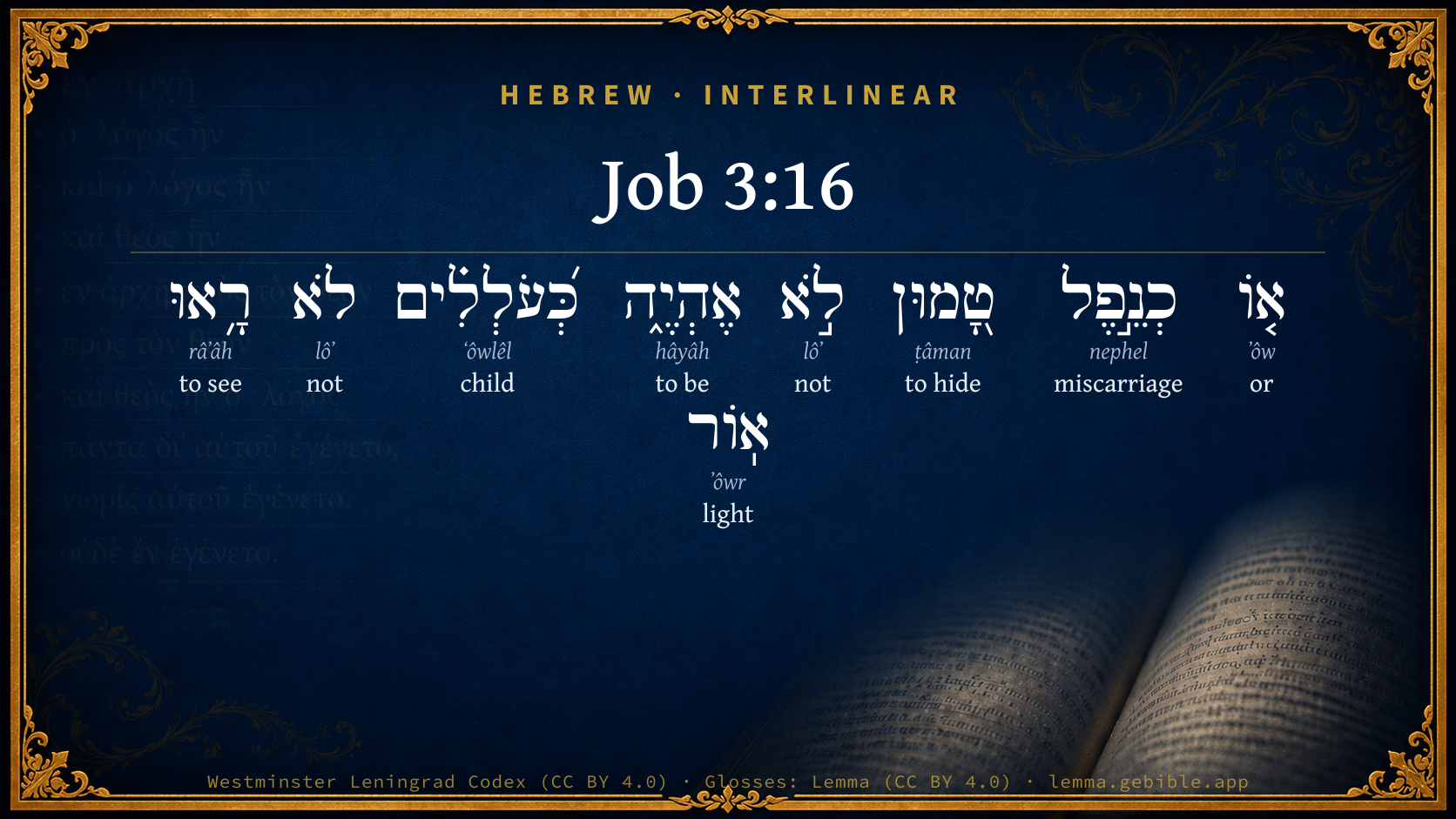
Job 3:16

Hebrew (Westminster Leningrad Codex) Job 3:16 appears in the Hebrew Old Testament. The text above is from the Westminster Leningrad Codex. Each word links to its Strong’s number, a concise gloss, and parsing drawn from the Open Scriptures Hebrew Bible morphology. Click any word for its full Brown-Driver-Briggs (BDB) entry.
Download image
Cite this verse

Job 3:16 (World English Bible). Public Domain. Lemma interlinear Bible study tool, https://lemma.gebible.app/v/job/3/16.

Show BibTeX & RIS
BibTeX
RIS
English Translation
Or as a hidden untimely birth I had not been, As infants who never saw light.
World English Bible · Public Domain
Highlights
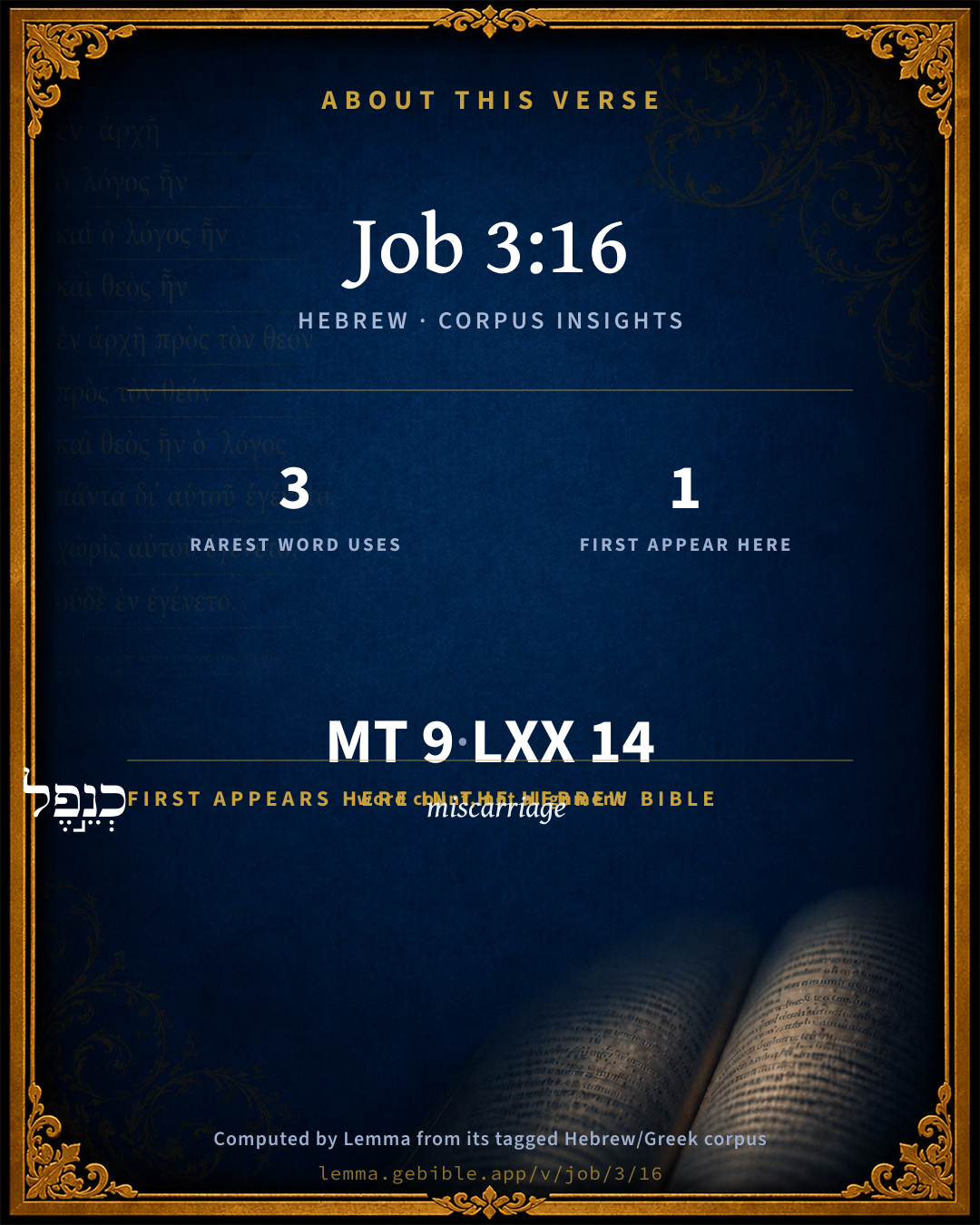
  • 1 first appearance in the Hebrew Bible
Full analysis ↓
Download a study sheet

One document with this verse’s original text, its word-by-word gloss line, the meaning frame, cross-references with their text, attributed commentary, and full source and license credits — printable, and it pastes into notes with its structure intact.

This verse Autodidact and up

Study sheet (.html) Plain text (.txt)

A passage Seminary Student

Up to 50 verses in one chapter. A passage sheet keeps up to 6 commentary sources and 12 cross-references per verse, in the order this page ranks them, and says so on the sheet whenever that leaves anything out. Ask for a single verse and you get the Autodidact verse sheet above.

Everything on this page stays free to read, with no account — the sheet is a download of what is already on screen, not access to it.

Want to remove ads? Support Godless Engineer
Compare translations 3

The same verse in 3 English versions, stacked beneath the original-language interlinear above. Click any original word for its lexicon entry.

Each is an independent rendering of the whole verse — the interlinear is not word-aligned to these translations.

Highlighted words mark where these versions differ — a whole-verse word diff, not a word-by-word alignment.

  • World English Bible Public Domain
    Or as a hidden untimely birth I had not been, As infants who never saw light.
  • King James Version Public Domain
    Or as an hidden untimely birth I had not been; as infants which never saw light.
  • unfoldingWord Literal Text CC BY-SA 4.0
    Or, like a hidden stillborn child, I might not have been, as infants do not see the light.

unfoldingWord Literal Text — © unfoldingWord, licensed CC BY-SA 4.0. Word-aligned USFM3 via Door43 (git.door43.org/unfoldingWord/en_ult).

Versions to compare (up to 4)

3 of 4 selected

Show all 18 translations

Every available English version of this verse, each an independent rendering of the whole verse.

  • World English Bible Public Domain
    Or as a hidden untimely birth I had not been, As infants who never saw light.
  • Berean Standard Bible Public Domain
    Or why was I not hidden like a stillborn child, like an infant who never sees daylight?
  • Majority Standard Bible Public Domain
    Or why was I not hidden like a stillborn child, like an infant who never sees daylight?
  • King James Version Public Domain
    Or as an hidden untimely birth I had not been; as infants which never saw light.
  • American Standard Version (1901) Public Domain
    Or as a hidden untimely birth I had not been, As infants that never saw light.
  • Revised Version (1885) Public Domain
    Or as an hidden untimely birth I had not been; as infants which never saw light.
  • Geneva Bible (1599) Public Domain
    Or why was I not hid, as an vntimely birth, either as infants, which haue not seene the light?
  • Douay-Rheims (1899) Public Domain
    Or as a hidden untimely birth I should not be, or as they that being conceived have not seen the light.
  • Young's Literal Translation Public Domain
    (Or as a hidden abortion I am not, As infants -- they have not seen light.)
  • Literal Standard Version CC BY-SA 4.0
    (Or I am not as a hidden abortion, || As infants—they have not seen light.)
  • Unlocked Literal Bible CC BY-SA 4.0
    Or perhaps I would have been stillborn, like infants that never see the light.
  • unfoldingWord Literal Text CC BY-SA 4.0
    Or, like a hidden stillborn child, I might not have been, as infants do not see the light.
  • Darby Bible Public Domain
    Or as a hidden untimely birth I had not been; as infants that have not seen the light.
  • World Messianic Bible Public Domain
    or as a hidden untimely birth I had not been, as infants who never saw light.
  • Webster's Bible Public Domain
    Or as a hidden untimely birth I had not been; as infants which never saw light.
  • Free Bible Version CC BY-SA 4.0
    Why wasn't I a miscarriage, buried in secret, a baby who never saw the light?
  • Bible in Basic English Public Domain
    Or as a child dead at birth I might never have come into existence; like young children who have not seen the light.
  • JPS Tanakh (1917) Public Domain
    Or as a hidden untimely birth I had not been; as infants that never saw light.

Literal Standard Version (2020), Covenant Press — licensed CC BY-SA 4.0. Text via the HelloAO Bible API (eBible.org). Unlocked Literal Bible (unfoldingWord) — licensed CC BY-SA 4.0. Text via the HelloAO Bible API (eBible.org). unfoldingWord Literal Text — © unfoldingWord, licensed CC BY-SA 4.0. Word-aligned USFM3 via Door43 (git.door43.org/unfoldingWord/en_ult). Free Bible Version, Dr. Jonathan Gallagher — licensed CC BY-SA 4.0. Text via the HelloAO Bible API (eBible.org).

Word by word

More ways to search: Search by grammar → Find every occurrence → Compare this word →

Practice this passage: Drill this verse → Learn its vocabulary →

About this verse

These counts appear in no published source. They are computed here, from the morphology-tagged text and Lemma’s own curated glosses. What Lemma adds →

9
words
8
distinct lemmas
Wisdom
section

Notable vocabulary

The rarest word here is כְנֵ֣פֶל miscarriage H5309 — appearing just 3 times in the whole Hebrew Bible.

First appearance in Scripture

This word makes its first canonical appearance in the Hebrew Bible here:

  • כְנֵ֣פֶל miscarriage H5309

Shared distinctive vocabulary

כְנֵ֣פֶל miscarriage H5309 occurs in 3 verses of the Hebrew Bible. Also found in:

Grammatical profile

  • 3 verbs
  • 3 nouns
  • 1 conjunction
  • 2 particles

Verb forms

  • טָ֭מוּן Qal · Participle Passive
  • אֶהְיֶ֑ה Qal · Imperfect
  • רָ֥אוּ Qal · Perfect

Repetition

A word recurs within this verse — often emphatic in Hebrew:

Hebrew & Septuagint length

In English translation the verse runs 16 words from the Hebrew and 21 from the Septuagint (LXX English) — closely comparable.

A rough comparison of the two English renderings, which tokenize alike — not a word-level alignment.

Word counts can differ between the Hebrew and the Greek without any difference in meaning — e.g. the Hebrew direct-object marker אֵת has no separate Greek word, and Greek often adds the article ὁ.

In the original languages it is 9 Hebrew tokens and 14 Greek tokens — but the two are counted differently (Hebrew bundles its prefixes and suffixes into one token; the Greek is in lemma form), so that isn’t a like-for-like length.

Cross-references

3

Topical passages linked to Job 3:16 in the Treasury of Scripture Knowledge — connected by theme and wording, ordered by reader-vote popularity; previews shown in the World English Bible.

  • Psalms 58:8 Let them be like a snail which melts and passes away, Like the stillborn child, who has not seen the sun.
  • Ecclesiastes 6:3 If a man fathers a hundred children, and lives many years, so that the days of his years are many, but his soul is not filled with good, and moreover he has no burial; I say, that an untimely birth is better than he:
  • 1 Corinthians 15:8 and last of all, as to the child born at the wrong time, he appeared to me also.

Cross-references courtesy of OpenBible.info (CC BY 4.0).

Hebrew and Greek witnesses Masoretic Hebrew ↔ Greek Septuagint

The same verse in the two great witnesses to the Old Testament, shown verse-for-verse.

These are two independent witnesses, not word-aligned to each other, and the Septuagint is shown in lemma (dictionary) form.

Hebrew Job 3:16 Masoretic · Westminster Leningrad Codex

א֤וֹ כְנֵ֣פֶל טָ֭מוּן לֹ֣א אֶהְיֶ֑ה כְּ֝עֹלְלִ֗ים לֹא רָ֥אוּ אֽוֹר

Or as a hidden untimely birth I had not been, As infants who never saw light.

World English Bible · Public Domain

Greek LXX Job 3:16 Septuagint · lemma form

ἤ ὥσπερ ἔκτρωμα ἐκπορεύομαι ἐκ μήτρα μήτηρ ἤ ὥσπερ νήπιος ὅς οὐ ὁράω φῶς

or I should have been as an untimely birth proceeding from his mother's womb, or as infants who never saw light.

LXX2012 (modern English Septuagint) · Public Domain

On this verse, John Gill's Exposition discusses the Septuagint’s reading. Read the note in Commentary ↓

Hebrew: Westminster Leningrad Codex (CC BY 4.0). Greek: Septuagint (public domain); English from LXX2012 (modern English Septuagint) (Public Domain). How the Septuagint differs from the Hebrew →

Commentary

Notes on Job 3:16 from classic Christian and Jewish commentators (each source and its license shown beneath its notes). The classic Christian expositions comment on the surrounding passage and are grouped to its opening verse, so a note may address several verses; the Jewish commentaries on the Tanakh (Rashi and others) are per-verse, so they appear only where the commentator wrote on this verse.

Lemma curates 59 commentaries, every one of them public domain or Creative Commons licensed, each selected and text-cleaned for this edition rather than reprinted as found. About our sources →

Trapp's Complete Commentary

John Trapp

Job 3:16 Or as an hidden untimely birth I had not been; as infants [which] never saw light.

Ver. 16. Or as an hidden untimely birth I had not been] As an abortive or miscarrying embryo that falleth from the mother, as untimely fruit falleth off from the tree. See Rev 6:13. Hidden it is called, because cast aside as an unsightly spectacle, that cometh in with vanity, and departeth in darkness, and his name is covered with darkness, Ecc 6:4. Job could have wished some way or other never to have been, rather than to have been in so calamitous a condition; and herein he sinned, no doubt: for that which is of the flesh is flesh, Joh 3:6.

As infants which never saw light] But were still born, as we call them. The word rendered infants is taken from a word that signifieth to defile, see Job 16:15, for children in the womb are compassed about with pollution; and the first sheet or blanket wherewith they are covered is woven of sin, shame, blood, and filth, Eze 16:4; Eze 16:6.

John Trapp, A Commentary or Exposition upon All the Books of the Old and New Testament (1647–1656) — public domain. Text from a community e-Sword module.

Jamieson, Fausset & Brown

Robert Jamieson, A. R. Fausset & David Brown

untimely birth-- (Psa 58:8); preferable to the life of the restless miser (Ecc 6:3-5).

Jamieson, Fausset & Brown — Commentary Critical and Explanatory on the Whole Bible (1871) — public domain (CC PDM 1.0). Text via the HelloAO Bible API.

Adam Clarke's Commentary

Verse 16. Or as a hidden untimely birth] An early miscarriage, which was scarcely perceptible by the parent herself; and in this case he had not been - he had never had the distinguishable form of a human being, whether male or female.

As infants] Little ones; those farther advanced in maturity, but miscarried long before the time of birth.

Adam Clarke's Commentary on the Bible (1810–1826) — public domain. Text from a community e-Sword/MySword module.

Ellicott's Commentary for English Readers

(16) Untimely birth.—Another condition which would have relieved him from the experience of suffering.

A Bible Commentary for English Readers, edited by Charles John Ellicott (1878–1897) — public domain. Text from a community e-Sword module.

The Cambridge Bible for Schools and Colleges

gen. ed. J. J. S. Perowne

16. With strong revulsion from the anguish of life Job desires even if possible a deeper death than to have died when born, even the death of having been dead born, scarcely to be distinguished from non-existence itself. Comp. Ecc_4:2-3, with Plumptre’s notes and citations from the classics.

The Cambridge Bible for Schools and Colleges (gen. ed. J. J. S. Perowne; Cambridge University Press, 1878–1918) — public domain. Text from a community e-Sword module.

John Gill's Exposition

Or as an hidden untimely birth,.... Or "hid, as one born out of time", as Mr. Broughton reads it; the Septuagint use the same word as the apostle does, when he says the like of himself, Co1 15:8; the word has the signification of "falling" (s), and designs an abortive, which is like to fruit that falls from the tree before it is ripe; and this may be said to be "hidden", either in the belly, as the Targum, or however from the sight of man, it being not come to any proper shape, and much less perfection; now Job suggests, that if he had not lain with kings, counsellors, and princes, yet at least he should have been as an abortion, and that would have been as well to him: then

I had not been; or should have been nothing, not reckoned anything; should not have been numbered among beings, but accounted as a nonentity, and should have had no subsistence or standing in the world at all:

as infants which never saw light; and if not like an untimely birth, which is not come to any perfection, yet should have been like infants, which, though their mothers have gone their full time with them, and they have all their limbs in perfection and proportion, yet are dead, or stillborn, their eyes have never been opened to see any light; meaning not the light of the law, as the Targum, but the light of the sun, or the light of the world, see Ecc 6:3; infants used to be buried in the wells or caves of the mummies (t).

(s) "sicut abortivus qui ex utero excidit, aut in terram cadit", Michaelis. (t) Vansleb, ut supra, (Relation of a Voyage to Egypt,) p. 90.

John Gill's Exposition of the Whole Bible (1746–1763) — public domain (CC PDM 1.0). Text via the HelloAO Bible API.

Albert Barnes' Notes on the Bible

Or as an hidden untimely birth - As an abortion which is hid, or concealed; that is, which is soon removed from the sight. So the Psalmist, Psa 58:8 :

As a snail which melteth, let thom dissolve;

As the untimely birth of a woman, that they may not see the sun.

Septuagint ἔκτρωμα ektrōma, the same word which is used by Paul in 1Co 15:8, with reference to himself; see the notes at that place.

I had not been - I should have perished; I should not have been a man, as I now am, subject to calamity. The meaning is, that he would have been taken away and concealed, as such an untimely birth is, and that he would never have been numbered among the living and the suffering.

As infants which never saw light - Job expresses here no opinion of their future condition, or on the question whether such infants had immortal souls. He is simply saying that his lot would have been as theirs was, and that he would have been saved from the sorrows which he now experienced.

Albert Barnes' Notes on the Bible (1834–1885) — public domain. Text from a community e-Sword/MySword module.

Haydock's Catholic Bible Commentary

Light; dying in the womb. He expresses a desire that he had been thus prevented from feeling his present miseries and danger of sin. (Haydock)

George Leo Haydock (1774–1849), Haydock's Catholic Family Bible and Commentary, 1859 edition — public domain. Excludes Psalms (Douay-Rheims chapter numbering differs from Protestant) and Deuterocanonical books (Catholic canon only).

Matthew Poole's English Annotations

Hidden; undiscerned and unregarded.

Untimely birth; born before the due time, and therefore extinct.

I had not been, to wit, in the land of the living, of which he here speaketh.

As infants which never saw light; being stifled and dead before they were born.

Matthew Poole's English Annotations on the Holy Bible (1683–1685) — public domain. Text from a community e-Sword/MySword module.

Whedon's Commentary on the Bible

Daniel D. Whedon

16. Untimely birth — A like figure appears in Psa_58:8. A similarity has been traced in other passages between Job and the Psalms. That such resemblance should exist does not necessarily determine which of the works was written before the other. The most it attests is, that the prior work (Job) was received as a sacred book by later writers.

Daniel D. Whedon (gen. ed.), Commentary on the Old and New Testaments (1874–1909) — public domain. Text from a community e-Sword module.

The Pulpit Commentary

Or as a hidden untimely birth I had not been; as infants which never saw light. This is added as another way in which Job might have escaped his misery. Though conceived and brought to the birth, he might have been still-born, and so have known no suffering.

"To be or not to be.

I AGAINST BEING AND IN FAVOUR OF NOT-BEING.

1. Life is little other than a capacity for suffering affliction.

2. At the best, life is so short, and man"s powers so feeble, that nothing he undertakes can attain to perfection.

3. In every instance life involves the terrible necessity and painful experience of dying.

4. Life always carries in its bosom the possibility of coming short of everlasting felicity.

II IN FAVOUR OF BEING AND AGAINST NOT-BEING.

1. Life in itself is a thing of pure enjoyment.

2. Man"s powers, though imperfect, are susceptible of infinite improvement.

3. The day of existence, whether long or short, affords a noble opportunity for serving God.

4. The fact that one is born gives him a chance, by being born again, of attaining to salvation and eternal life.

LESSONS.

1. Notwithstanding all the miseries of human life, it is better to have been born than to have remained in non-existence.

2. Notwithstanding all its brevity and imperfection, life is worth living.

3. Because of all its hardships and sorrows, it should be given up with resignation when God recalls it to himself.

The Pulpit Commentary (1880–1919), ed. H.D.M. Spence-Jones & Joseph S. Exell — public domain. Text from a community e-Sword module.

John Wesley's Explanatory Notes

Hidden - Undiscerned and unregarded. Born before the due time. Been - In the land of the living.

John Wesley, Explanatory Notes Upon the Whole Bible (1754–1765) — public domain. Text via the GEBible commentary corpus.

Rashi

Rabbi Shlomo Yitzchaki (Rashi)

like infants Heb. כעוללים, infants. He calls them עוללים because they are all play and dirt, like (below 16:15), “And I sullied (ועללתי) with dust,” and like (Jud. 19:25), “and abused (ויתעללו) her the entire night.”

Rashi on the Tanakh — English translations: “The Judaica Press complete Tanach with Rashi, translated by A. J. Rosenberg” (CC BY 4.0); “Pentateuch with Rashi's commentary by M. Rosenbaum and A.M. Silbermann, 1929-1934” (public domain); “The Metsudah Tanach series, Lakewood, N.J” (CC BY 4.0); and “The Book of Joshua, Metsudah Publications, 1997” (CC BY 4.0). Text via Sefaria.

Lesson kit

Teaching starters — assembled from the data on this page, not authored interpretation. Every prompt links to the verse data it draws on. Edit before teaching.

Job, in the Wisdom, opens this verse with 9 words (8 distinct Hebrew lemmas). Its most distinctive word is nephel (“miscarriage”). A historical commentator’s framing appears above. Read the whole chapter for the surrounding context.

Discussion questions

  1. The word nephel carries the sense “miscarriage.” How does it shape the verse?
  2. This is the first place “miscarriage” appears in Scripture (first appears here). What does its debut here establish?
  3. How does Psalms 58:8, which shares the word «miscarriage», read alongside this verse?
  4. What does the repetition of “not” (2× in this one verse) do in this verse?
  5. The translations on this page render this verse differently — a whole-verse word diff, not a word-by-word alignment. What might account for the different wordings?
  6. «טָ֭מוּן» is a Qal Participle Passive verb. How does that grammatical form shape the action described?
  7. Compare how Trapp's Complete Commentary and Jamieson, Fausset & Brown read this verse. Where do they agree or differ?

Things to notice

Reading settings

Reading text

Shown beneath each verse's original-language words.

Old Testament
Old Testament edition

Read the OT as the Masoretic Hebrew (MT) or the Greek Septuagint (LXX).

English shown for the Greek Septuagint (in the Hebrew ↔ Greek comparison).

Comparing translations? Open the Compare panel on any verse page to stack up to four side by side.