
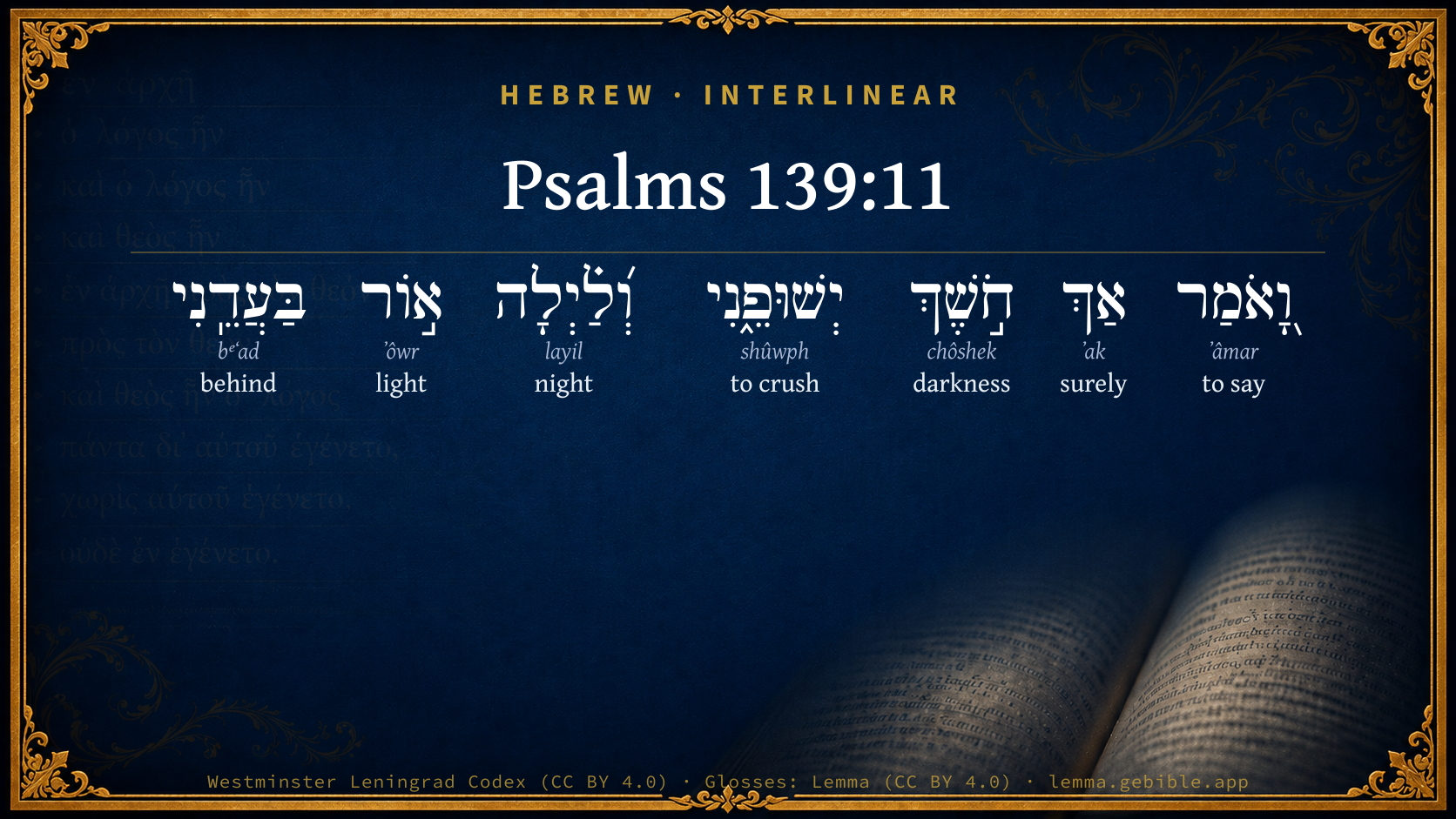
Psalms 139:11

Hebrew (Westminster Leningrad Codex) Psalms 139:11 appears in the Hebrew Old Testament. The text above is from the Westminster Leningrad Codex. Each word links to its Strong’s number, a concise gloss, and parsing drawn from the Open Scriptures Hebrew Bible morphology. Click any word for its full Brown-Driver-Briggs (BDB) entry.
Download image
Cite this verse

Psalms 139:11 (World English Bible). Public Domain. Lemma interlinear Bible study tool, https://lemma.gebible.app/v/psalms/139/11.

Show BibTeX & RIS
BibTeX
RIS
English Translation
If I say, "Surely the darkness will overwhelm me; The light around me will be night;"
World English Bible · Public Domain
Download a study sheet

One document with this verse’s original text, its word-by-word gloss line, the meaning frame, cross-references with their text, attributed commentary, and full source and license credits — printable, and it pastes into notes with its structure intact.

This verse Autodidact and up

Study sheet (.html) Plain text (.txt)

A passage Seminary Student

Up to 50 verses in one chapter. A passage sheet keeps up to 6 commentary sources and 12 cross-references per verse, in the order this page ranks them, and says so on the sheet whenever that leaves anything out. Ask for a single verse and you get the Autodidact verse sheet above.

Everything on this page stays free to read, with no account — the sheet is a download of what is already on screen, not access to it.

Want to remove ads? Support Godless Engineer
Compare translations 3

The same verse in 3 English versions, stacked beneath the original-language interlinear above. Click any original word for its lexicon entry.

Each is an independent rendering of the whole verse — the interlinear is not word-aligned to these translations.

Highlighted words mark where these versions differ — a whole-verse word diff, not a word-by-word alignment.

  • World English Bible Public Domain
    If I say, "Surely the darkness will overwhelm me; The light around me will be night;"
  • King James Version Public Domain
    If I say, Surely the darkness shall cover me; even the night shall be light about me.
  • unfoldingWord Literal Text CC BY-SA 4.0
    And I said, “Surely darkness will crush me, and night, the light around me.”

unfoldingWord Literal Text — © unfoldingWord, licensed CC BY-SA 4.0. Word-aligned USFM3 via Door43 (git.door43.org/unfoldingWord/en_ult).

Versions to compare (up to 4)

3 of 4 selected

Show all 17 translations

Every available English version of this verse, each an independent rendering of the whole verse.

  • World English Bible Public Domain
    If I say, "Surely the darkness will overwhelm me; The light around me will be night;"
  • Berean Standard Bible Public Domain
    If I say, “Surely the darkness will hide me, and the light become night around me”—
  • Majority Standard Bible Public Domain
    If I say, “Surely the darkness will hide me, and the light become night around me”—
  • King James Version Public Domain
    If I say, Surely the darkness shall cover me; even the night shall be light about me.
  • American Standard Version (1901) Public Domain
    If I say, Surely the darkness shall overwhelm me, And the light about me shall be night;
  • Revised Version (1885) Public Domain
    If I say, Surely the darkness shall overwhelm me, and the light about me shall be night;
  • Geneva Bible (1599) Public Domain
    If I say, Yet the darkenes shall hide me, euen the night shalbe light about me.
  • Young's Literal Translation Public Domain
    And I say, `Surely darkness bruiseth me, Then night `is' light to me.
  • Literal Standard Version CC BY-SA 4.0
    And I say, “Surely darkness bruises me,” || Then night [is] light to me.
  • Unlocked Literal Bible CC BY-SA 4.0
    If I said, “Surely the darkness will cover me, and the light will become night around me,”
  • unfoldingWord Literal Text CC BY-SA 4.0
    And I said, “Surely darkness will crush me, and night, the light around me.”
  • Darby Bible Public Domain
    And if I say, Surely darkness shall cover me, and the light about me be night;
  • World Messianic Bible Public Domain
    If I say, “Surely the darkness will overwhelm me. The light around me will be night,”
  • Webster's Bible Public Domain
    If I say, Surely the darkness shall cover me; even the night shall be light about me.
  • Free Bible Version CC BY-SA 4.0
    If I asked the darkness to hide me, and light to become night around me,
  • Bible in Basic English Public Domain
    If I say, Only let me be covered by the dark, and the light about me be night;
  • JPS Tanakh (1917) Public Domain
    And if I say: 'Surely the darkness shall envelop me, and the light about me shall be night';

Literal Standard Version (2020), Covenant Press — licensed CC BY-SA 4.0. Text via the HelloAO Bible API (eBible.org). Unlocked Literal Bible (unfoldingWord) — licensed CC BY-SA 4.0. Text via the HelloAO Bible API (eBible.org). unfoldingWord Literal Text — © unfoldingWord, licensed CC BY-SA 4.0. Word-aligned USFM3 via Door43 (git.door43.org/unfoldingWord/en_ult). Free Bible Version, Dr. Jonathan Gallagher — licensed CC BY-SA 4.0. Text via the HelloAO Bible API (eBible.org).

Word by word

More ways to search: Search by grammar → Find every occurrence → Compare this word →

Practice this passage: Drill this verse → Learn its vocabulary →

About this verse

These counts appear in no published source. They are computed here, from the morphology-tagged text and Lemma’s own curated glosses. What Lemma adds →

7
words
7
distinct lemmas
Wisdom
section

Notable vocabulary

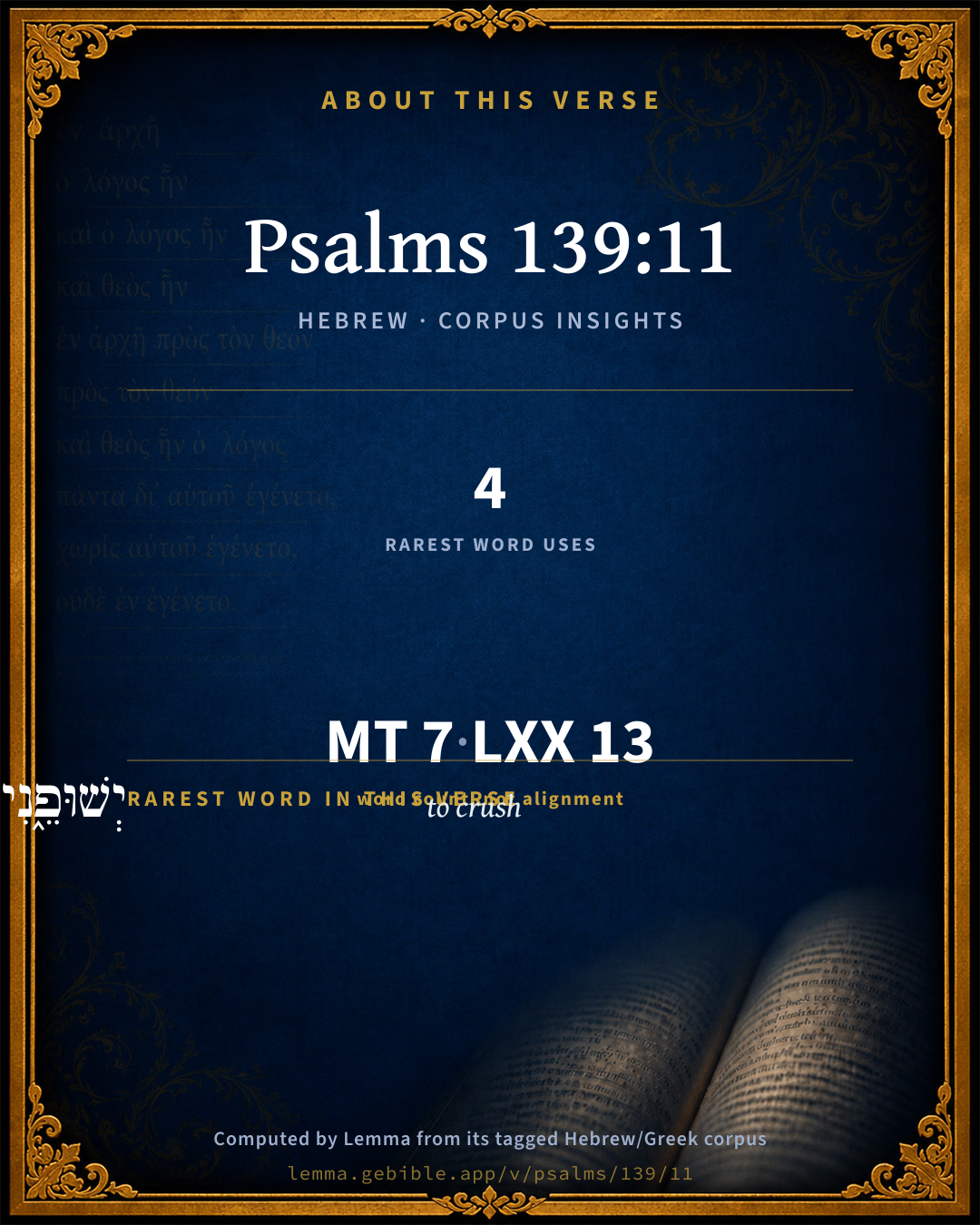
The rarest word here is יְשׁוּפֵ֑נִי to crush H7779 — appearing just 4 times in the whole Hebrew Bible.

Shared distinctive vocabulary

יְשׁוּפֵ֑נִי to crush H7779 occurs in 3 verses of the Hebrew Bible. Also found in:

Grammatical profile

  • 2 verbs
  • 3 nouns
  • 1 preposition
  • 1 particle

Verb forms

  • וָ֭אֹמַר Qal · Sequential Imperfect
  • יְשׁוּפֵ֑נִי Qal · Imperfect

Hebrew & Septuagint length

In English translation the verse runs 16 words from the Hebrew and 17 from the Septuagint (LXX English) — closely comparable.

A rough comparison of the two English renderings, which tokenize alike — not a word-level alignment.

Word counts can differ between the Hebrew and the Greek without any difference in meaning — e.g. the Hebrew direct-object marker אֵת has no separate Greek word, and Greek often adds the article ὁ.

In the original languages it is 7 Hebrew tokens and 13 Greek tokens — but the two are counted differently (Hebrew bundles its prefixes and suffixes into one token; the Greek is in lemma form), so that isn’t a like-for-like length.

Cross-references

6

Topical passages linked to Psalms 139:11 in the Treasury of Scripture Knowledge — connected by theme and wording, ordered by reader-vote popularity; previews shown in the World English Bible.

  • Job 12:22 He uncovers deep things out of darkness, And brings out to light the shadow of death.
  • Jeremiah 23:24 Can any hide himself in secret places so that I shall not see him? says Yahweh. Don't I fill heaven and earth? says Yahweh.
  • Psalms 94:7 They say, "Yah will not see, Neither will Jacob's God consider."
  • Job 22:12–14 "Isn't God in the heights of heaven? See the height of the stars, how high they are!
  • Psalms 10:11–13 He says in his heart, "God has forgotten. He hides his face. He will never see it."
  • Isaiah 29:15 Woe to those who hide deep their counsel from Yahweh, and whose works are in the dark, and who say, Who sees us? and who knows us?

Cross-references courtesy of OpenBible.info (CC BY 4.0).

Hebrew and Greek witnesses Masoretic Hebrew ↔ Greek Septuagint

The same verse in the two great witnesses to the Old Testament, shown verse-for-verse.

You’re reading Greek Psalm 138 (Hebrew Psalm 139). The Septuagint counts the superscription, so verse numbers can differ from the Hebrew — chapter-level alignment, not verse-by-verse. Numbering follows Rahlfs.

These are two independent witnesses, not word-aligned to each other, and the Septuagint is shown in lemma (dictionary) form.

Hebrew Psalms 139:11 Masoretic · Westminster Leningrad Codex

וָ֭אֹמַר אַךְ חֹ֣שֶׁךְ יְשׁוּפֵ֑נִי וְ֝לַ֗יְלָה א֣וֹר בַּעֲדֵֽנִי

If I say, "Surely the darkness will overwhelm me; The light around me will be night;"

World English Bible · Public Domain

Greek LXX Greek Psalm 138:11 Septuagint · lemma form

καί εἶπον ἄρα σκότος καταπατέω ἐγώ καί νύξ φωτισμός ἐν ὁ τρυφή ἐγώ

When I said, Surely the darkness will cover me; even the night was light in my luxury.

LXX2012 (modern English Septuagint) · Public Domain

On this verse, Ellicott's Commentary for English Readers discusses the Septuagint’s reading. Read the note in Commentary ↓

Hebrew: Westminster Leningrad Codex (CC BY 4.0). Greek: Septuagint (public domain); English from LXX2012 (modern English Septuagint) (Public Domain). How the Septuagint differs from the Hebrew →

Commentary

Notes on Psalms 139:11 from classic Christian and Jewish commentators (each source and its license shown beneath its notes). The classic Christian expositions comment on the surrounding passage and are grouped to its opening verse, so a note may address several verses; the Jewish commentaries on the Tanakh (Rashi and others) are per-verse, so they appear only where the commentator wrote on this verse.

Lemma curates 59 commentaries, every one of them public domain or Creative Commons licensed, each selected and text-cleaned for this edition rather than reprinted as found. About our sources →

Trapp's Complete Commentary

John Trapp

Psa 139:11 If I say, Surely the darkness shall cover me; even the night shall be light about me.

Ver. 11. The darkness shall cover me] The Hebrew phrase is taken from beasts that lie a-squat, saith Diodati, Nocte latent mendae, sed non Deum. The guilty conscience sharketh up and down for comfort, but getteth none.

John Trapp, A Commentary or Exposition upon All the Books of the Old and New Testament (1647–1656) — public domain. Text from a community e-Sword module.

J. A. Alexander on Psalms

Joseph Addison Alexander

11. (Psa 139:11) And 1 say, only darkness overwhelms me, night is the light become around me. The ideal situation is the same as in Psa 139:9, one of danger and terror, in which he is constrained to say, nothing but darkness comes upon me, smites me, and the very light is turned to darkness round about me. According to this view of the passage, darkness, as in many other places, is a figure for calamity and danger. See Isa 1:10, Psa 138:7. According to the usual interpretation, it denotes concealment from the eye of God.

Joseph Addison Alexander, The Psalms Translated and Explained (1850) — public domain. Text from a community e-Sword module.

Geneva Bible (1599)

Geneva Bible translators

Though darkness be an hindrance to man’s sight, yet it serveth thine eyes as well as the light.

Geneva Bible (1599) marginal notes — public domain. Text via Bolls.life.

Adam Clarke's Commentary

Verse 11. Surely the darkness shall cover me] Should I suppose that this would serve to screen me, immediately this darkness is turned into light.

Adam Clarke's Commentary on the Bible (1810–1826) — public domain. Text from a community e-Sword/MySword module.

John Calvin's Commentaries

11. If I shall say, etc. David represents himself as a man using every possible method to make his escape from a situation of embarrassment. So having acknowledged that it was vain to dream of flight, he bethinks himself of another remedy, and says, If no speed of mine can bear me out of the range of God’s vision, yet, on the supposition of light being removed, the darkness might cover me, that I might have a short breath of respite. But this also he declares to be hopeless, as God sees equally well in the deepest darkness as at noon-day. It is a mistake in my opinion to consider, as some have done, that the two clauses of the verse are to be taken separately, and read, If I shall say the darkness will cover me, even the night shall be as light before me — meaning that darkness would be converted into light, and so though he saw nothing himself, he would stand manifest before the eye of God. David is rather to be considered as in both clauses expressing what he might be supposed to feel desirous of, and intimates that, could he only find any covert or subterfuge, he would avail himself of the license; “C’est plustost que David prononcant ee propos selon son propre sentiment, entend que pourveu qu’il puisse estre par quelqne moyen couvert et cache, il aura quelque peu de bon temps,” etc. — Fr.

John Calvin's Commentaries (1540-1563) — public domain. Text from the Calvin Translation Society English edition (1840s-50s) via the Christian Classics Ethereal Library (ccel.org). Calvin's coverage is partial (roughly two-thirds of the Bible); uncommented books and verses are honest gaps, never fabricated. The 19th-century editor's footnotes and remarks are omitted so the notes are faithfully Calvin's own voice.

Ellicott's Commentary for English Readers

(11) If I say . . .—Rather,

I say only let darkness crush me,

And light become night around me.

Commentators have mostly been frightened by the metaphor in the first line, though it has been preserved both by the LXX. and Vulg., and can only be avoided either by forcing the meaning of the verb from what it bears in Gen_3:15, Job_9:17, or altering the text. Yet the Latins could speak even in prose of a region “oppressed by darkness” (Sen. Ep. 82); and when night was used as figurative of death, nocte premi was a common poetical figure. Indeed, the word rendered darkness here is actually, in Psa_88:6, used of death, and if we understood this figure here we might render the word trample, illustrating by Horace

“Jam te premet nox fabulæque Manes.”

Such a view would suit the thought to which the poet immediately passes—to God the darkness of death and the nothingness before birth are alike. On the other hand, as the main thought is that nowhere is there escape from God’s sight in height, or depth, or distance so to exhaust the possibilities we seem to need, darkness.

The second clause does not begin the apodosis: it is in synthetic parallelism with the first.

A Bible Commentary for English Readers, edited by Charles John Ellicott (1878–1897) — public domain. Text from a community e-Sword module.

The Cambridge Bible for Schools and Colleges

gen. ed. J. J. S. Perowne

11, 12. And if I say, Nay, but darkness might shroud me,

And the light about me become night;

Even darkness hideth not from thee, &c.

It is as impossible to hide from God under cover of darkness as it is to escape from Him by change of place (Psa_139:8-9). The A.V. even the night shall be light about me seems to mean that the light of God’s presence will banish the terrors of darkness; but this sense does not fit the context. The Psalmist is not expressing his confidence in God’s protection, but his conviction of His omniscience. Those who think to escape God’s notice in the night as they avoid the eye of men (Job_24:13-17) do but delude themselves. The word rendered cover or shroud is a rare one, and is elsewhere taken to mean overwhelm (R.V.) but this sense does not suit the context and we must either assume that it has an unusual meaning, or emend the text. Symm. and Jer. render cover.

The Cambridge Bible for Schools and Colleges (gen. ed. J. J. S. Perowne; Cambridge University Press, 1878–1918) — public domain. Text from a community e-Sword module.

John Gill's Exposition

Yea, the darkness hideth not from thee,.... Any thing that is done by men in it; or "darkeneth not from thee" (i), or causeth such darkness as to hinder the sight of any action committed. The Targum is,

"from thy Word;''

see Heb 4:12;

but the night shineth as the day; or "enlightens as the day" (k), gives as much light with respect to God as the day does;

the darkness and the light are both alike to thee; as is the one, so is the other: the day gives him no more light than the night, and the night no more darkness than the day; he sees as well, as clearly and distinctly, in the one as in the other. The psalmist expresses the same thing in different words three or four times, as Kimchi observes, to show that so the Lord is, that thus it is with him; he has as clear a discerning of all things done in the darkest night as at bright noon day; see Job 34:21.

(i) "non obscurabit a te", Montanus; "non obtenebrant", Gejerus; so Michaelis. (k) "illustrat", Junius & Tremellius; "illuminabit", Gejerus Michaelis; so Ainsworth.

John Gill's Exposition of the Whole Bible (1746–1763) — public domain (CC PDM 1.0). Text via the HelloAO Bible API.

Albert Barnes' Notes on the Bible

If I say, Surely the darkness shall cover me - If I seek to find refuge in the darkness of the night so that God would not see me. The word rendered “cover” - שׁוף shûph - means properly to snap, to gape after; then, to lie in wait for; and then, to attack, or fall upon anyone, unexpectedly. It is rendered “bruise” (twice) in Gen 3:15, “He shall “bruise” thy head, and thou shalt “bruise” his heel;” “breaketh” in Job 9:17, “He “breaketh” me with a tempest;” and in this place “cover.” It does not occur elsewhere. Here it means to fall upon; to overpower; to cover. The idea is, If it should come suddenly upon me; if I should be involved in sudden darkness - “as if” the darkness should come and attempt to “snatch” me away from God. All this would be in vain, for it would be, so far as God is concerned, bright day around me.

Even the night shall be light about me - In respect to me. It shall be as if I stood in the full blaze of light. God can see me still; he can mark my goings; he can perceive all that I do as plainly then as at mid-day. This “is” so: and what a thought this is for a wicked man who seeks to escape detection in his crimes by perpetrating them in the night! What a thought for a good man, that in the darkest night of sorrow, when there seems to be nothing but deep midnight, when there appears to be not a ray of light in his dwelling, or on his path that all to the eye of God is as clear as noon-day! For in that night of sorrow God sees him as plainly as in the brightest days of prosperity and joy.

Albert Barnes' Notes on the Bible (1834–1885) — public domain. Text from a community e-Sword/MySword module.

Matthew Poole's English Annotations

Shall be as clear and manifest to God as the light itself.

Matthew Poole's English Annotations on the Holy Bible (1683–1685) — public domain. Text from a community e-Sword/MySword module.

The Treasury of David

Charles H. Spurgeon

Ver. 11. If I say, Surely the darkness shall cover me. Dense darkness may oppress me, but it cannot shut me out from thee, or thee from me. Thou seest as well without the light as with it, since thou art not dependent upon light which is thine own creature, for the full exercise of thy perceptions. Moreover, thou art present with me whatever may be the hour; and being present you discover all that I think, or feel, or do. Men are still so foolish as to prefer night and darkness for their evil deeds; but so impossible is it for anything to be hidden from the Lord that they might just as well transgress in broad daylight.

Darkness and light in this agree;

Great God, they're both alike to thee.

Thine hand can pierce thy foes as soon

Through midnight shades as blazing noon.

A good man will not wish to be hidden by the darkness, a wise man will not expect any such thing. If we were so foolish as to make sure of concealment because the place was shrouded in midnight, we might well be alarmed out of our security by the fact that, as far as God is concerned, we always dwell in the light; for even the night itself glows with a revealing force,

even the night shall be light about me. Let us think of this if ever we are tempted to take license from the darkit is light about us. If the darkness be light, how great is that light in which we dwell! Note well how David keeps his song in the first person; let us mind that we do the same as we cry with Hagar, "Thou God seest me."

Ver. 11. If I say, Surely the darkness shall cover me, etc. The foulest enormities of human conduct have always striven to cover themselves with the shroud of night. The thief, the counterfeiter, the assassin, the robber, the murderer, and the seducer, feel comparatively safe in the midnight darkness, because no human eye can scrutinize their actions. But what if it should turn out that sable night, to speak paradoxically, is an unerring photographer! What if wicked men, as they open their eyes from the sleep of death, in another world, should find the universe hung round with faithful pictures of their earthly enormities, which they had supposed for ever lost in the oblivion of night! What scenes for them to gaze at for ever! They may now, indeed, smile incredulously at such a suggestion; but the disclosures of chemistry may well make them tremble. Analogy does make it a scientific probability that every action of man, however deep the darkness in which it was performed, has imprinted its image on nature, and that there may be tests which shall draw it into daylight, and make it permanent so long as materialism endures. Edward Hitchcock, in "The Religion of Geology", 1851.

Ver. 11-12. Darkness and light are both alike to God.

1. Naturally. "I form the light, and I create the darkness."

2. Providentially. Providential dispensations that are dark to us are light to him. We change with respect to him, not he to us.

3. Spiritually. "Let him that walketh in darkness", etc. "Yea, though I walk", etc. He went before them in a pillar of cloud to guide them by day, and a pillar of fire to guide them by night. It was the same God in the day cloud and in the night light.

G.R.

Psalms 139:12*

Charles H. Spurgeon's The Treasury of David (1869–1885) — public domain. Psalms only. Text from a community e-Sword/MySword module.

Whedon's Commentary on the Bible

Daniel D. Whedon

11. Darkness—He has found distance to make no difference with the power, knowledge, and presence of God. He now shows that darkness and light are both alike with him.

Daniel D. Whedon (gen. ed.), Commentary on the Old and New Testaments (1874–1909) — public domain. Text from a community e-Sword module.

The Pulpit Commentary

Vers. 11, 12. If I say, Surely the darkness shall cover me; even the night shall be light about me. If I think to escape thee by plunging into darkness, and say to myself, "Surely the darkness shall screen me, and night take the place of light about me," so that I cannot be seen, even then my object is not accomplished; even the darkness hideth not from thee; but the night shineth as the day. Thy essential light penetrates every dark place, and makes the deepest gloom as radiant as the brightest sunshine. The darkness and the light are both alike to thee; literally, as the darkness, so the light; but the paraphrase of the Authorized Version gives the true sense.

The Pulpit Commentary (1880–1919), ed. H.D.M. Spence-Jones & Joseph S. Exell — public domain. Text from a community e-Sword module.

unfoldingWord translationNotes

Door43 World Missions Community

If I said, "Surely the darkness will cover me

The psalmist speaks of the night as if it were a blanket that could conceal him. (See: Metaphor)

The night would shine like the day

The night, which is dark, is spoken of as if it were bright with light. (See: Metaphor)

translationWords

darkness

light

unfoldingWord translationNotes — © Distant Shores Media and the Door43 World Missions Community, licensed CC BY-SA 4.0. Source: git.door43.org/Door43/en_tn.

Rashi

Rabbi Shlomo Yitzchaki (Rashi)

I said, “Darkness will darken me” If I said, “I will be hidden in the darkness, and the darkness will envelop me so that You will not see me.” יְשׁוּפֵנִי is an expression of נֶשֶׁף, evening.

“and the night will be dark about me” Heb. אור, lit. light. And the night will darken before me. This אוֹר is an expression of darkness, like (Job 37:11): “he spreads his clouds of darkness (אור)”; similarly (below 148:3), “all stars of the night (אור)”; similarly (Exod. 14:20), “and it darkened (ויאר) the night.”

Rashi on the Tanakh — English translations: “The Judaica Press complete Tanach with Rashi, translated by A. J. Rosenberg” (CC BY 4.0); “Pentateuch with Rashi's commentary by M. Rosenbaum and A.M. Silbermann, 1929-1934” (public domain); “The Metsudah Tanach series, Lakewood, N.J” (CC BY 4.0); and “The Book of Joshua, Metsudah Publications, 1997” (CC BY 4.0). Text via Sefaria.

Lesson kit

Teaching starters — assembled from the data on this page, not authored interpretation. Every prompt links to the verse data it draws on. Edit before teaching.

Psalms, in the Wisdom, opens this verse with 7 words (7 distinct Hebrew lemmas). Its most distinctive word is shûwph (“to crush”). A historical commentator’s framing appears above. Read the whole chapter for the surrounding context.

Discussion questions

  1. How does “to crush” (shûwph) shape what this verse is saying?
  2. How does Genesis 3:15, which shares the word «to crush», read alongside this verse?
  3. These translations render this verse differently; the difference is in the English rendering, not the original. What questions does that raise?
  4. «וָ֭אֹמַר» is a Qal Sequential Imperfect verb. How does that grammatical form shape the action described?
  5. Compare how Trapp's Complete Commentary and J. A. Alexander on Psalms read this verse. Where do they agree or differ?

Things to notice

Reading settings

Reading text

Shown beneath each verse's original-language words.

Old Testament
Old Testament edition

Read the OT as the Masoretic Hebrew (MT) or the Greek Septuagint (LXX).

English shown for the Greek Septuagint (in the Hebrew ↔ Greek comparison).

Comparing translations? Open the Compare panel on any verse page to stack up to four side by side.