
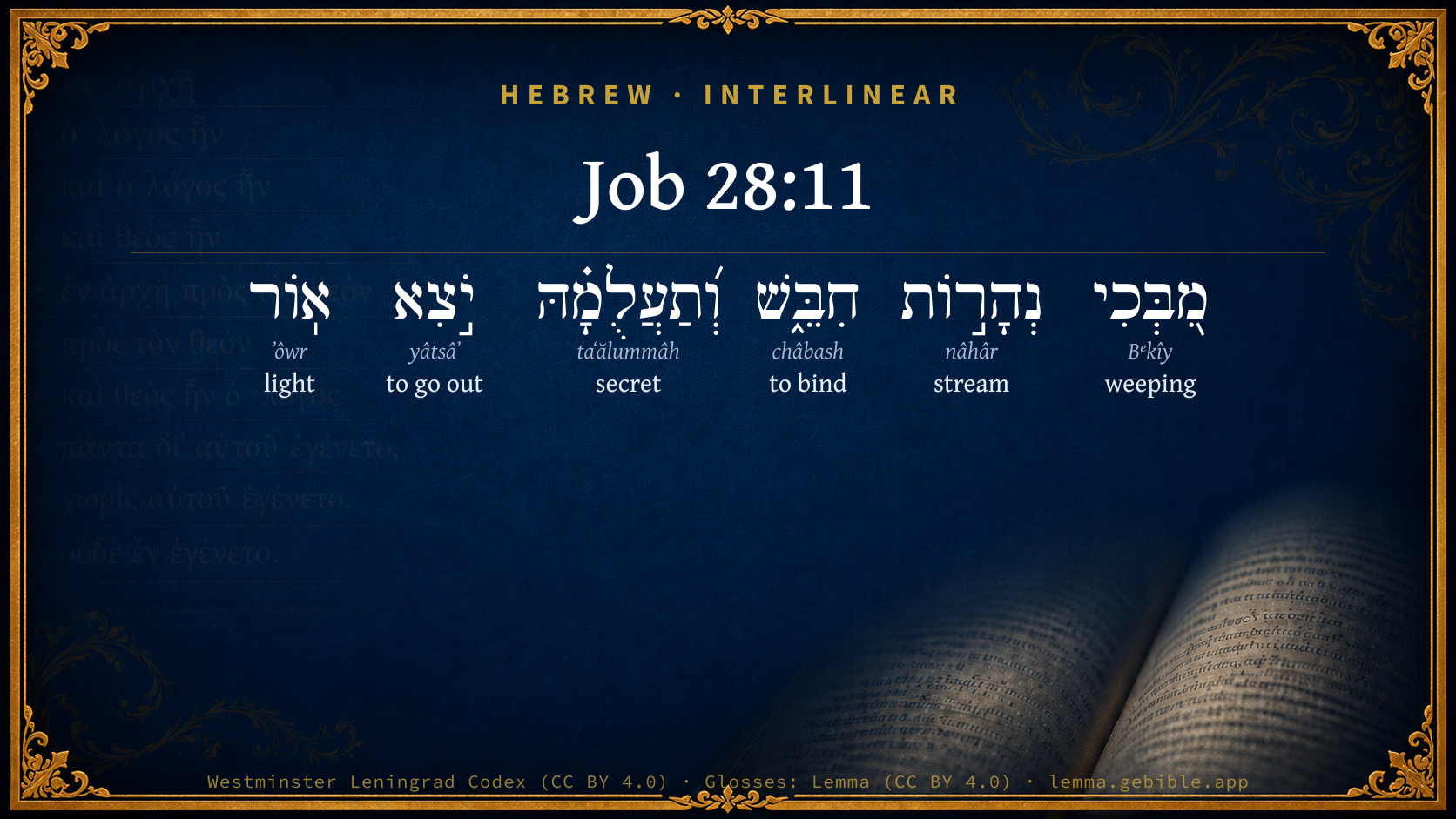
Job 28:11

Hebrew (Westminster Leningrad Codex) Job 28:11 appears in the Hebrew Old Testament. The text above is from the Westminster Leningrad Codex. Each word links to its Strong’s number, a concise gloss, and parsing drawn from the Open Scriptures Hebrew Bible morphology. Click any word for its full Brown-Driver-Briggs (BDB) entry.
Download image
Cite this verse

Job 28:11 (World English Bible). Public Domain. Lemma interlinear Bible study tool, https://lemma.gebible.app/v/job/28/11.

Show BibTeX & RIS
BibTeX
RIS
English Translation
He binds the streams that they don't trickle; The thing that is hidden he brings forth to light.
World English Bible · Public Domain
Download a study sheet

One document with this verse’s original text, its word-by-word gloss line, the meaning frame, cross-references with their text, attributed commentary, and full source and license credits — printable, and it pastes into notes with its structure intact.

This verse Autodidact and up

Study sheet (.html) Plain text (.txt)

A passage Seminary Student

Up to 50 verses in one chapter. A passage sheet keeps up to 6 commentary sources and 12 cross-references per verse, in the order this page ranks them, and says so on the sheet whenever that leaves anything out. Ask for a single verse and you get the Autodidact verse sheet above.

Everything on this page stays free to read, with no account — the sheet is a download of what is already on screen, not access to it.

Want to remove ads? Support Godless Engineer
Compare translations 3

The same verse in 3 English versions, stacked beneath the original-language interlinear above. Click any original word for its lexicon entry.

Each is an independent rendering of the whole verse — the interlinear is not word-aligned to these translations.

Highlighted words mark where these versions differ — a whole-verse word diff, not a word-by-word alignment.

  • World English Bible Public Domain
    He binds the streams that they don't trickle; The thing that is hidden he brings forth to light.
  • King James Version Public Domain
    He bindeth the floods from overflowing; and the thing that is hid bringeth he forth to light.
  • unfoldingWord Literal Text CC BY-SA 4.0
    He binds the torrents from flowing, and he brings a hidden thing light.

unfoldingWord Literal Text — © unfoldingWord, licensed CC BY-SA 4.0. Word-aligned USFM3 via Door43 (git.door43.org/unfoldingWord/en_ult).

Versions to compare (up to 4)

3 of 4 selected

Show all 18 translations

Every available English version of this verse, each an independent rendering of the whole verse.

  • World English Bible Public Domain
    He binds the streams that they don't trickle; The thing that is hidden he brings forth to light.
  • Berean Standard Bible Public Domain
    He stops up the sources of the streams to bring what is hidden to light.
  • Majority Standard Bible Public Domain
    He stops up the sources of the streams to bring what is hidden to light.
  • King James Version Public Domain
    He bindeth the floods from overflowing; and the thing that is hid bringeth he forth to light.
  • American Standard Version (1901) Public Domain
    He bindeth the streams that they trickle not; And the thing that is hid bringeth he forth to light.
  • Revised Version (1885) Public Domain
    He bindeth the streams that they trickle not; and the thing that is hid bringeth he forth to light.
  • Geneva Bible (1599) Public Domain
    He bindeth the floods, that they doe not ouerflowe, and the thing that is hid, bringeth he to light.
  • Douay-Rheims (1899) Public Domain
    The depths also of rivers he hath searched, and hidden things he hath brought forth to light.
  • Young's Literal Translation Public Domain
    From overflowing floods he hath bound, And the hidden thing bringeth out `to' light.
  • Literal Standard Version CC BY-SA 4.0
    He has bound overflowing rivers, || And the hidden thing brings out [to] light.
  • Unlocked Literal Bible CC BY-SA 4.0
    He ties up the streams so they do not run; what is hidden there he brings out to the light.
  • unfoldingWord Literal Text CC BY-SA 4.0
    He binds the torrents from flowing, and he brings a hidden thing light.
  • Darby Bible Public Domain
    He bindeth the streams that they drip not, and what is hidden he bringeth forth to light.
  • World Messianic Bible Public Domain
    He binds the streams that they don’t trickle. The thing that is hidden he brings out to light.
  • Webster's Bible Public Domain
    He bindeth the floods from overflowing; and the thing that is hid he bringeth forth to light.
  • Free Bible Version CC BY-SA 4.0
    They dam the sources of the rivers, and bring to light what is hidden.
  • Bible in Basic English Public Domain
    He keeps back the streams from flowing, and makes the secret things come out into the light.
  • JPS Tanakh (1917) Public Domain
    He bindeth the streams that they trickle not; and the thing that is hid bringeth he forth to light.

Literal Standard Version (2020), Covenant Press — licensed CC BY-SA 4.0. Text via the HelloAO Bible API (eBible.org). Unlocked Literal Bible (unfoldingWord) — licensed CC BY-SA 4.0. Text via the HelloAO Bible API (eBible.org). unfoldingWord Literal Text — © unfoldingWord, licensed CC BY-SA 4.0. Word-aligned USFM3 via Door43 (git.door43.org/unfoldingWord/en_ult). Free Bible Version, Dr. Jonathan Gallagher — licensed CC BY-SA 4.0. Text via the HelloAO Bible API (eBible.org).

Word by word

More ways to search: Search by grammar → Find every occurrence → Compare this word →

Practice this passage: Drill this verse → Learn its vocabulary →

About this verse

These counts appear in no published source. They are computed here, from the morphology-tagged text and Lemma’s own curated glosses. What Lemma adds →

6
words
6
distinct lemmas
Wisdom
section

Notable vocabulary

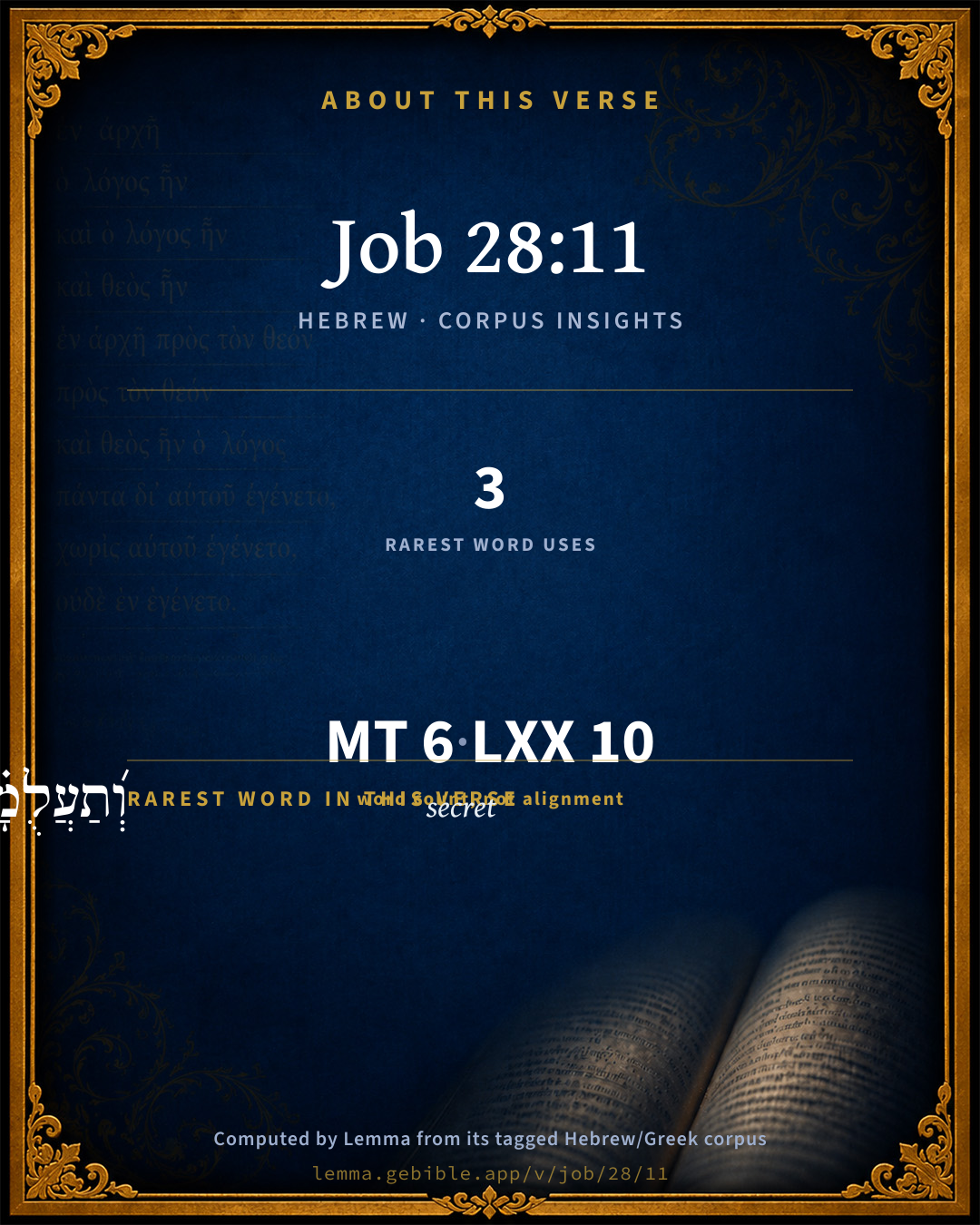
The rarest word here is וְ֝תַעֲלֻמָ֗הּ secret H8587 — appearing just 3 times in the whole Hebrew Bible.

Shared distinctive vocabulary

וְ֝תַעֲלֻמָ֗הּ secret H8587 occurs in 3 verses of the Hebrew Bible. Also found in:

Grammatical profile

  • 2 verbs
  • 4 nouns

Verb forms

  • חִבֵּ֑שׁ Piel · Perfect
  • יֹ֣צִא Hiphil · Imperfect

Hebrew & Septuagint length

In English translation the verse runs 18 words from the Hebrew and 16 from the Septuagint (LXX English) — closely comparable.

A rough comparison of the two English renderings, which tokenize alike — not a word-level alignment.

Word counts can differ between the Hebrew and the Greek without any difference in meaning — e.g. the Hebrew direct-object marker אֵת has no separate Greek word, and Greek often adds the article ὁ.

In the original languages it is 6 Hebrew tokens and 10 Greek tokens — but the two are counted differently (Hebrew bundles its prefixes and suffixes into one token; the Greek is in lemma form), so that isn’t a like-for-like length.

Cross-references

5

Topical passages linked to Job 28:11 in the Treasury of Scripture Knowledge — connected by theme and wording, ordered by reader-vote popularity; previews shown in the World English Bible.

  • Isaiah 45:2–3 I will go before you, and make the rough places smooth; I will break in pieces the doors of brass, and cut in sunder the bars of iron;
  • 1 Corinthians 4:5 Therefore judge nothing before the time, until the Lord comes, who will both bring to light the hidden things of darkness, and reveal the counsels of the hearts. Then each man will get his praise from God.
  • Job 26:8 He binds up the waters in his thick clouds, And the cloud is not burst under them.
  • Isaiah 37:25 I have dug and drunk water, and with the sole of my feet will I dry up all the rivers of Egypt.
  • Isaiah 44:27 who says to the deep, Be dry, and I will dry up your rivers;

Cross-references courtesy of OpenBible.info (CC BY 4.0).

Hebrew and Greek witnesses Masoretic Hebrew ↔ Greek Septuagint

The same verse in the two great witnesses to the Old Testament, shown verse-for-verse.

These are two independent witnesses, not word-aligned to each other, and the Septuagint is shown in lemma (dictionary) form.

Hebrew Job 28:11 Masoretic · Westminster Leningrad Codex

מִ֭בְּכִי נְהָר֣וֹת חִבֵּ֑שׁ וְ֝תַעֲלֻמָ֗הּ יֹ֣צִא אֽוֹר

He binds the streams that they don't trickle; The thing that is hidden he brings forth to light.

World English Bible · Public Domain

Greek LXX Job 28:11 Septuagint · lemma form

βάθος δέ ποταμός ἀνακαλύπτω δεικνύω δέ ἑαυτοῦ δύναμις εἰς φῶς

And he has laid bare the depths of rivers, and has brought his power to light.

LXX2012 (modern English Septuagint) · Public Domain

Hebrew: Westminster Leningrad Codex (CC BY 4.0). Greek: Septuagint (public domain); English from LXX2012 (modern English Septuagint) (Public Domain). How the Septuagint differs from the Hebrew →

Commentary

Notes on Job 28:11 from classic Christian and Jewish commentators (each source and its license shown beneath its notes). The classic Christian expositions comment on the surrounding passage and are grouped to its opening verse, so a note may address several verses; the Jewish commentaries on the Tanakh (Rashi and others) are per-verse, so they appear only where the commentator wrote on this verse.

Lemma curates 59 commentaries, every one of them public domain or Creative Commons licensed, each selected and text-cleaned for this edition rather than reprinted as found. About our sources →

Trapp's Complete Commentary

John Trapp

Job 28:11 He bindeth the floods from overflowing; and [the thing that is] hid bringeth he forth to light.

Ver. 11. He bindeth the floods from overflowing] Heb. From weeping; that is (by an elegant metaphor), from distilling and dropping, as those underground waters use to do; but the miner bindeth them; that is, he dammeth them up, and diverteth them, that they may not fall into his pit and mar his work. Thus he removes all blocks, and devours all difficulties, and all for a little pelf, which perisheth in the use, and will rather hinder from than help men to heaven. How much more should we labour for the true treasure, the pearl of price, the one thing necessary? &c. Si tanti vitreum, quanti veram margaritam? (Tertul.). All those outward things are nec vera, nee vestra, as Austin elegantly; they are neither true riches, nor ours, but another’s, as our Saviour telleth us, Luk 16:12. Aristotle also teacheth us, That wise men may get riches, but not make it their business, Aλλ’ ου τουτ εστι περι ου σπουδαζουσι (Polit. lib. 1). Brentius reads this text, Perplexa fluminum gyrat, He turneth about the crooked rivers, putting them into a new channel, that he may get the gold and precious stones that lie in the bottom; for there are some gold flowing rivers; such as are Ganges in India, Pactolus in Asia, Tagus in Spain, the Rhine in Germany, &c.

And the thing that is hid he bringeth to light] Contrary to the design of nature, he revealeth her secrets, and discovereth all that she hideth by this raking out of her riches, and making those things that lie couchant in her bowels as common as if they grew above ground.

John Trapp, A Commentary or Exposition upon All the Books of the Old and New Testament (1647–1656) — public domain. Text from a community e-Sword module.

The Biblical Illustrator

Joseph S. Exell

Job_28:11-12

The thing that is hid bringeth he forth to light.

The religious uses and limitations of science

I. The religious uses of science. The thing that is hid man bringeth forth to light. Some think there is nothing but antagonism between science and religion. It is obvious that the science which traces out the mind of God in nature ought to be affianced to the faith which discerns the inner grace of His heart, and will, and character.

1. Science is helping to create a perfect environment for men, and so is the sister and helpmeet of the religion which seeks to create a perfect character in them. There is a very close connection between character and environment.

2. Science has a religious use, inasmuch as it reveals more fully the Divine power, and wisdom, and goodness in nature.

3. Science has a religious use, inasmuch as it tends to establish the unity and supremacy of God. These are cardinal articles of our creed. Science has proved the unity and uniformity of nature, and so has confirmed the great doctrine that there is only one living and true God.

II. The limitations of science. It cannot take the place of religion, nor are its revelations all that the deepest heart of man most needs and desires. Scientific methods do not touch the sphere of spiritual facts. Some of Jobs words sound like a prophecy of modern, agnostic teachings. Science has its own sphere, in which its method is valid and its authority supreme. But there is another sphere in which the conscience and the spirit are the organs of observation. Let us accept with devout thankfulness the riches which science is bringing us. But let us never forget that it cannot bring us to the secret place of the Most High, or quench our deepest thirst for peace, and purity, and fellowship with God. The way to these blessings is the way of moral obedience and spiritual communion through love with God in Christ. (W. T. Bankhead, M. A. , B. D.)

The Biblical Illustrator, edited by Joseph S. Exell (c. 1880s–1900s) — public domain. Text from a community e-Sword module.

Jamieson, Fausset & Brown

Robert Jamieson, A. R. Fausset & David Brown

floods--"He restrains the streams from weeping"; a poetical expression for the trickling subterranean rills, which impede him; answering to the first clause of Job 28:10; so also the two latter clauses in each verse correspond.

Jamieson, Fausset & Brown — Commentary Critical and Explanatory on the Whole Bible (1871) — public domain (CC PDM 1.0). Text via the HelloAO Bible API.

Adam Clarke's Commentary

Verse 11. He bindeth the floods] Prevents the risings of springs from drowning the mines; and conducts rivers and streams from their wonted course, in order to bring forth to light what was hidden under their beds. The binding or restraining the water, which, at different depths, annoys the miner, is both difficult and expensive: in some cases it may be drawn off by pipes or canals into neighbouring water courses; in others, it is conducted to one receptacle or reservoir, and thence drawn off. In Europe it is generally done by means of steam-engines. What method the ancients had in mining countries, we cannot tell; but they dug deep in order to find out the riches of the earth. PLINY says, nervously, Imus in viscera terrae; et in sede manium opes quaerimus. "We descend into the bowels of the earth; and seek for wealth even in the abodes of departed spirits." The manes or ghosts of the dead, or spirits presiding over the dead, were supposed to have their habitation in the centre of the earth; or in the deepest pits and caves. OVID, speaking of the degeneracy of men in the iron age, Met. lib. i., ver. 137, says: -

Nec tantum segetes alimentaque debita dives

Poscebatur humus; sed itum est in viscera terrae:

Quasque recondiderat, Stygiisque admoverat umbris,

Effodiuntur opes, irritaenenta malorum.

Jamque nocens ferrum, ferroque nocentius aurum

Prodierat: prodit bellum, quod pugnat utroque;

Sanguineaque manu crepitantia concutit arma.

"Nor was the ground alone required to bear

Her annual income to the crooked share:

But greedy mortals, rummaging her store,

Digg'd from her entrails first the precious ore;

And that alluring ill to sight display'd,

Which, next to hell, the prudent gods had laid.

Thus cursed steel, and more accursed gold,

Gave mischief birth, and made that mischief bold;

And double death did wretched man invade,

By steel assaulted, and by gold betray'd."

DRYDEN.

By binding the floods from overflowing, some have supposed that there is an allusion to the flux and reflux of the sea. In its flowing it is so bound, has its bounds assigned by the Most High, that it does not drown the adjacent country; and in its ebbing the parts which are ordinarily covered with the water are brought to view.

Adam Clarke's Commentary on the Bible (1810–1826) — public domain. Text from a community e-Sword/MySword module.

The Cambridge Bible for Schools and Colleges

gen. ed. J. J. S. Perowne

11. he bindeth the floods from overflowing] Rather, he bindeth up the streams that they drip not, lit. that they weep not. The reference is to the use of lime or clay to prevent water percolating into the mine. “The picturesque phrase (‘that they weep not’) may have been a technical term among miners in ancient times, just as our colliers name the action of the water that percolates through and into their workings weeping, and our navvies call the fine sand which percolates through the sides of a tunnel crying sand” (Cox, Comm. on Job, p. 360).

These references to mining operations shew that the Writer was familiar with them. The frequent allusions to Egypt indicate that the Author of the Book was well acquainted with that country, and possibly the mines that were extensively worked in the peninsula of Sinai would be an object of interest to travellers from Palestine to Egypt. It appears, however, that mining was in ancient times carried on in the Hauran and even in the Lebanon; and in Deu_8:9 Palestine is described as “a land whose stones are iron, and out of whose hills thou mayest dig brass.”

The Cambridge Bible for Schools and Colleges (gen. ed. J. J. S. Perowne; Cambridge University Press, 1878–1918) — public domain. Text from a community e-Sword module.

John Gill's Exposition

He bindeth the floods from overflowing,.... As the miner finds ways and means of cutting through rocks, and draining and carrying off the waters in his mine; so he makes use of other methods of restraining and keeping back the waters from coming into and overflowing his works, and even "from weeping" (m), as in the original text; he binds them up so firmly, and stops every avenue and passage so close, that the waters cannot so much as ooze, or distil and drop as a tear from the eye:

and the thing that is hid bringeth he forth to light; the several metals and minerals, gems and precious stones, that lay hid in the bosom of the earth, are fetched out, and brought to light by the diligence and labours of the miner; the same that are called stones of darkness, and of the shadow of death, Job 28:3. This verse is likewise by several interpreted of God, and of what is done by him in the things of nature and providence; he it is that at first shut up the sea with doors; made the cloud its garment, and thick darkness its swaddling bands, in which he wrapped and bound it, as an infant, and still sets bars and doors to it, and says, hitherto shalt thou come, and no further, Job 38:8; and, in a spiritual sense, he restrains the floods of affliction from overflowing and overwhelming his people; and, when the temptations of Satan come in like a flood upon them, his Spirit sets up a standard against them, which keeps them from doing them any harm; and, when the wrath of persecutors rises up against them, and threatens them with destruction, he withholds those proud waters from going over their souls and overwhelming them: and so likewise it is he that bringeth hidden things to light, things in nature men had never seen or known before; things in providence, dark and intricate; things in grace, out of the sight of the most penetrating understanding: he reveals the secrets of his love and grace to them that fear him; the glorious scheme of salvation by Christ, which was hid in himself, in the thoughts, purposes, and counsels of his heart; the mysteries of his Gospel, hid from the wise and prudent, Mat 11:25; and life and immortality itself, or the way to it, which he has brought to light through the Gospel; yea, he brings to light all the hidden things of a man's heart, and sets them before him, and convinces him of them in a loving way; and if not now, he will hereafter "bring to light the hidden things of darkness, and will make manifest the counsels of the hearts", Co1 4:5; but, as before observed, it is best to understand the whole paragraph of miners; of their sagacity in opening mines, and searching into the bowels of the earth, where none were ever before them; and of their indefatigableness, industry, and labour therein, and of the success that attends them; Job's design being to show, that things rich and valuable, and most remote from the sight of men, may, by diligent application, be investigated and obtained; yet such wisdom is not attainable as to understand the reason of the various dealings of God with the sons of men, both good and bad; and therefore, after all he had said on the above subject, still the question is as follows.

(m) "a fletu", Montanus, Bolducius, Junius & Tremellius, Michaelis, Schultens; so Broughton; "a stillatione", Vatablus, Mercerus, Drusius.

John Gill's Exposition of the Whole Bible (1746–1763) — public domain (CC PDM 1.0). Text via the HelloAO Bible API.

Albert Barnes' Notes on the Bible

He bindeth the floods from overflowing - Margin, Weeping The Hebrew also is “from weeping” מבכי mı̂bekı̂y; referring to the water which trickles down the shaft of the mine. The idea is, that even the large streams which break out in such mines, the fountains and springs which the miner encounters in his operations, he so effectually restrains that they do not even trickle down or “weep” on the sides of the shaft, but it is left perfectly dry. This is necessary in opening mines of coal or minerals, and in making tunnels or other excavations. Yet anyone who has passed into a coal mine, through a tunnel, or into any one of the deep natural caves of the earth, will see how difficult it is to close all the places where water would trickle down. It is in fact seldom done; and if done literally in the time of Job, it indicates a very advanced state of the art of mining. In sinking a shaft, it is often necessary to pass at different depths through strata of earth where the water oozes out in abundance, and where the operations would be necessarily suspended if it could not be stopped or drawn off. The machinery necessary for this constitutes a considerable part of the expense of mining operations.

And the thing that is hid he bringeth forth to light - The concealed treasures; the gold and gems that are buried deep in the earth. He brings them out of their darkness, and converts them to ornament and to use. This ends the description which Job gives of the operations of mining in his time. We may remark in regard to this description:

(1) That the illustration was admirably chosen. His object was to show that true wisdom was not to be found by human science, or by mere investigation. He selects a case, therefore, where man had shown the most skill and wisdom, and where he had penetrated farthest into darkness. He penetrated the earth; drove his shaft through rocks; closed up gushing fountains, and laid bare the treasures that had been buried for generations in the regions of night. Yet all this did not enable him fully to explain the operations of the divine government.

(2) The art of mining was carried to a considerable degree of perfection in the time of Job. This is shown by the fact that his description would apply very well to that art even as it is practiced now. Substantially the same things were done then which are done now, though we cannot suppose with the same skill, or to the same extent, or with the same perfection of machinery.

(3) The time when Job lived was in a somewhat advanced period of society. The art of working metals to any considerable extent indicates such an advance. It is not found among barbarous tribes, and even where the art is to a considerable extent known, it is long before men learn to sink shafts in the earth, or to penetrate rocks, or to draw off water from mines.

(4) We see the wisdom and goodness which God has shown in regard to the things that are most useful to man. Those things which are necessary to his being, or which are very desirable for his comfort, are easily accessible; those which are less necessary, or whose use is dangerous, are placed in deep, dark, and almost inaccessible places. The fruits of the earth are near to man; water flows every where, and it is rare that he has to dig deep for it; and when found by digging, it is a running fountain, not soon exhausted like a mine of gold; and iron, also, the most valuable of the metals, is usually placed near the surface of the earth. But the pearl is at the bottom of the ocean; diamonds and other precious stones are in remote regions or imbedded in rocks; silver runs along in small veins, often in the fissures of rocks, and extending far into the bowels of the earth. The design of placing the precious metals in these almost inaccessible fissures of the rocks, it is not difficult to understand. Had they been easily accessible, and limited in their quantity, they would long since have been exhausted - causing at one time a glut in the market, and at others absolute want. As they are now, they exercise the utmost ingenuity of man, first to find them, and then to procure them; they are distributed in small quantities, so that their value is always great; they furnish a convenient circulating medium in all countries; they afford all that is needful for ornament.

(5) There is another proof of wisdom in regard to their arrangement in the earth, which was probably unknown in the time of Job. It is the fact that the most useful of the metals are found in immediate connection with the fuel required for their reduction, and the limestone which facilitates that reduction. This is now perfectly understood by mineralogists, and it is an instance of the goodness of God, and of the wisdom of his arrangements, which ought not to be disregarded or overlooked. They who wish to examine this subject more at length, may find some admirable views in Buckland’s Geology and Mineralogy (Bridgewater Treatises), vol. i. pp. 392-415.

Albert Barnes' Notes on the Bible (1834–1885) — public domain. Text from a community e-Sword/MySword module.

Haydock's Catholic Bible Commentary

Searched, by diving; (Calmet) or, Hebrew, "he bindeth the rivers from flowing;" diverting their course by dams, &c. This is another proof of the power of man. (Calmet) ---Labor omnia vincit. (Horace)

George Leo Haydock (1774–1849), Haydock's Catholic Family Bible and Commentary, 1859 edition — public domain. Excludes Psalms (Douay-Rheims chapter numbering differs from Protestant) and Deuterocanonical books (Catholic canon only).

Matthew Poole's English Annotations

He restraineth

the floods, and as it were bindeth them to their good behaviour, that they may not overflow the mine; and those metals which did lie hid in the secret parts of the earth, he discovers to himself and others.

Matthew Poole's English Annotations on the Holy Bible (1683–1685) — public domain. Text from a community e-Sword/MySword module.

Whedon's Commentary on the Bible

Daniel D. Whedon

11. From overflowing — From weeping, (margin.) A beautiful figure to represent the commonplace task of the miner, that of binding up the ever trickling subterranean rills. Umbreit’s rather free rendering, he stilleth the tears of the streams, is in harmony with the poetical conception of the Hebrew who looked upon a fountain (ayin) as an eye of nature.

Second strophe — Application of the preceding description to wisdom — a good unattainable by any sense of man; unlimited by place it is not to be found in the world of the living nor in Abaddon, the lowest world of the dead; in value it far surpasses all conceivable wealth, and is therefore infinitely beyond the reach of the covetous and extortionate, living or dead, Job_28:12-22.

Daniel D. Whedon (gen. ed.), Commentary on the Old and New Testaments (1874–1909) — public domain. Text from a community e-Sword module.

The Pulpit Commentary

He bindeth the floods from overflowing. This, again, may be either taken generally of man"s ability to create dams, dykes, and embankments, whereby the overflow of waters is prevented; or specially of such works when connected with mines, from which it is possible, in some instances, to dam out water that would otherwise interfere with their working. The word translated "overflowing" means probably "weeping," and seems to point to that leakage from the roofs and sides of galleries which is more difficult to control and stop than even subterranean springs or rivers. And the thing that is hid bringeth he forth to light. This is the final result of mining operations. Things useful or beautiful that are hidden deep down in the heart of the earth, and that might have seemed wholly inaccessible, are brought out of the pit"s month into the light of day for the service and delectation of mankind.

The Pulpit Commentary (1880–1919), ed. H.D.M. Spence-Jones & Joseph S. Exell — public domain. Text from a community e-Sword module.

Rashi

Rabbi Shlomo Yitzchaki (Rashi)

He bound up the depths of the rivers Heb. מבכי. In the Creation of the world, when the lower waters wept (בכו). the depths Heb. מבכי, like (below 38:16), “the depths of (נבכי) the sea.”

bound up Heb. חבש, like (Gen. 22:3), “and saddled (ויחבש) his donkey.” I did not hear this. [Other editions: Because of the weeping etc. Because of the weeping of Israel, who were weeping, saying, “What will we drink,” He bound up and fixed for them water from the rock. (Lev. 8:13),”And he fixed hats (ויחבש) for them,” is translated into Aramaic as ואתקין.]

and [from] Taalumah He brings out light There is a window in the firmament, named Taalumah, from which the sun develops in its orbit [in Pirke d’Rabbi Eliezer] (ch. 6). That is to say that everything has a source and an end; only wisdom has no source except from His mouth, and never an end.

Rashi on the Tanakh — English translations: “The Judaica Press complete Tanach with Rashi, translated by A. J. Rosenberg” (CC BY 4.0); “Pentateuch with Rashi's commentary by M. Rosenbaum and A.M. Silbermann, 1929-1934” (public domain); “The Metsudah Tanach series, Lakewood, N.J” (CC BY 4.0); and “The Book of Joshua, Metsudah Publications, 1997” (CC BY 4.0). Text via Sefaria.

Lesson kit

Teaching starters — assembled from the data on this page, not authored interpretation. Every prompt links to the verse data it draws on. Edit before teaching.

Job, in the Wisdom, opens this verse with 6 words (6 distinct Hebrew lemmas). Its most distinctive word is taʻălummâh (“secret”). A historical commentator’s framing appears above. Read the whole chapter for the surrounding context.

Discussion questions

  1. What does “secret” (taʻălummâh) contribute to the verse as a whole?
  2. How does Job 11:6, which shares the word «secret», read alongside this verse?
  3. These translations render this verse differently. What is at stake in choosing one wording over another?
  4. «חִבֵּ֑שׁ» is a Piel Perfect verb. How does that grammatical form shape the action described?
  5. Compare how Trapp's Complete Commentary and The Biblical Illustrator read this verse. Where do they agree or differ?

Things to notice

Reading settings

Reading text

Shown beneath each verse's original-language words.

Old Testament
Old Testament edition

Read the OT as the Masoretic Hebrew (MT) or the Greek Septuagint (LXX).

English shown for the Greek Septuagint (in the Hebrew ↔ Greek comparison).

Comparing translations? Open the Compare panel on any verse page to stack up to four side by side.