
Job 37:15

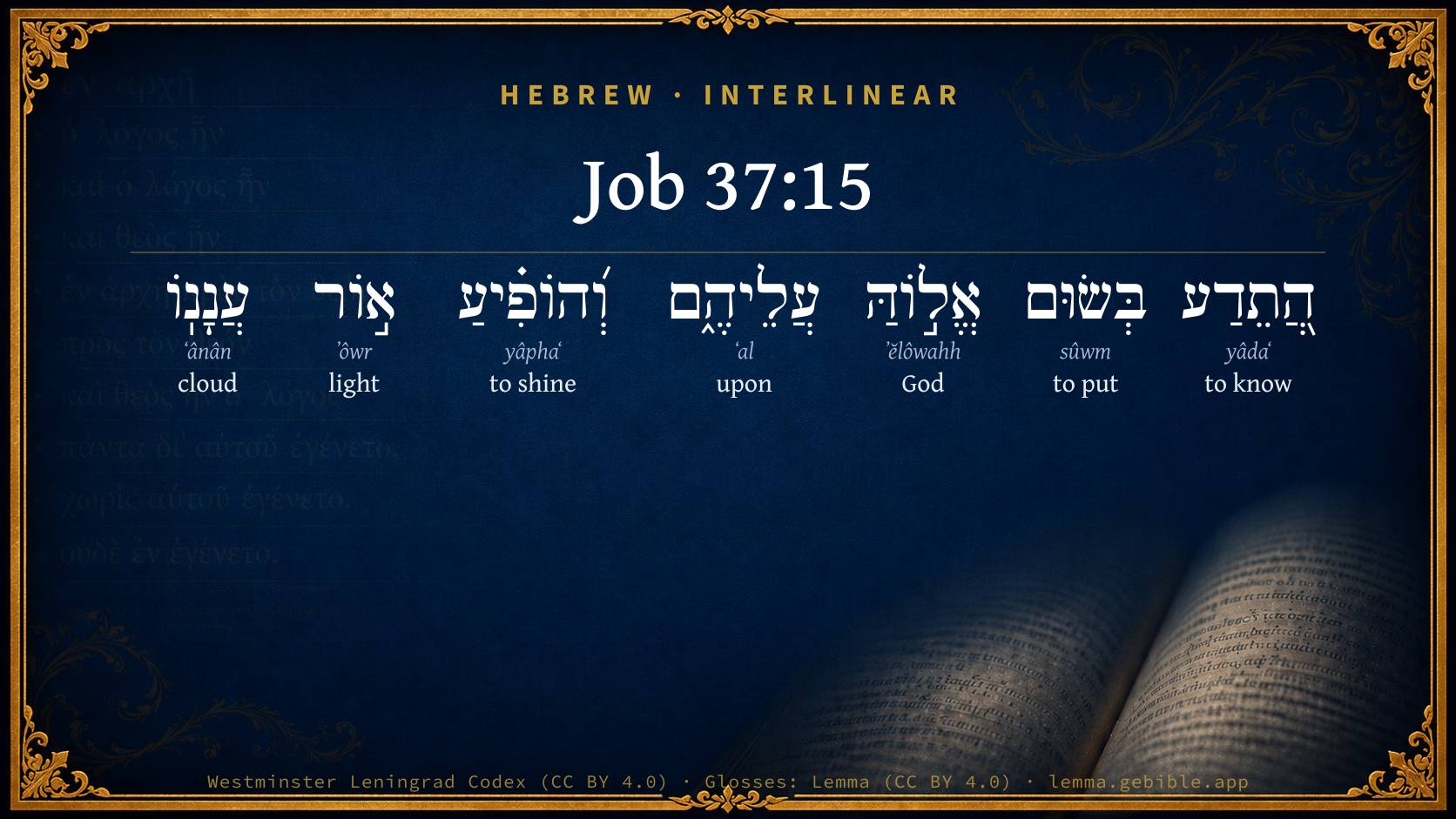
Hebrew (Westminster Leningrad Codex) Job 37:15 appears in the Hebrew Old Testament. The text above is from the Westminster Leningrad Codex. Each word links to its Strong’s number, a concise gloss, and parsing drawn from the Open Scriptures Hebrew Bible morphology. Click any word for its full Brown-Driver-Briggs (BDB) entry.
Download image
Cite this verse

Job 37:15 (World English Bible). Public Domain. Lemma interlinear Bible study tool, https://lemma.gebible.app/v/job/37/15.

Show BibTeX & RIS
BibTeX
RIS
English Translation
Do you know how God controls them, And causes the lightning of his cloud to shine?
World English Bible · Public Domain
Download a study sheet

One document with this verse’s original text, its word-by-word gloss line, the meaning frame, cross-references with their text, attributed commentary, and full source and license credits — printable, and it pastes into notes with its structure intact.

This verse Autodidact and up

Study sheet (.html) Plain text (.txt)

A passage Seminary Student

Up to 50 verses in one chapter. A passage sheet keeps up to 6 commentary sources and 12 cross-references per verse, in the order this page ranks them, and says so on the sheet whenever that leaves anything out. Ask for a single verse and you get the Autodidact verse sheet above.

Everything on this page stays free to read, with no account — the sheet is a download of what is already on screen, not access to it.

Want to remove ads? Support Godless Engineer
Compare translations 3

The same verse in 3 English versions, stacked beneath the original-language interlinear above. Click any original word for its lexicon entry.

Each is an independent rendering of the whole verse — the interlinear is not word-aligned to these translations.

Highlighted words mark where these versions differ — a whole-verse word diff, not a word-by-word alignment.

  • World English Bible Public Domain
    Do you know how God controls them, And causes the lightning of his cloud to shine?
  • King James Version Public Domain
    Dost thou know when God disposed them, and caused the light of his cloud to shine?
  • unfoldingWord Literal Text CC BY-SA 4.0
    Do you know of the placing of God upon them, and his cloud causes lightning to flash?

unfoldingWord Literal Text — © unfoldingWord, licensed CC BY-SA 4.0. Word-aligned USFM3 via Door43 (git.door43.org/unfoldingWord/en_ult).

Versions to compare (up to 4)

3 of 4 selected

Show all 18 translations

Every available English version of this verse, each an independent rendering of the whole verse.

  • World English Bible Public Domain
    Do you know how God controls them, And causes the lightning of his cloud to shine?
  • Berean Standard Bible Public Domain
    Do you know how God dispatches the clouds or makes the lightning flash?
  • Majority Standard Bible Public Domain
    Do you know how God dispatches the clouds or makes the lightning flash?
  • King James Version Public Domain
    Dost thou know when God disposed them, and caused the light of his cloud to shine?
  • American Standard Version (1901) Public Domain
    Dost thou know how God layeth `his charge' upon them, And causeth the lightning of his cloud to shine?
  • Revised Version (1885) Public Domain
    Dost thou know how God layeth his charge upon them, and causeth the lightning of his cloud to shine?
  • Geneva Bible (1599) Public Domain
    Diddest thou knowe when God disposed them? and caused the light of his cloud to shine?
  • Douay-Rheims (1899) Public Domain
    Dost thou know when God commanded the rains, to shew his light of his clouds?
  • Young's Literal Translation Public Domain
    Dost thou know when God doth place them, And caused to shine the light of His cloud?
  • Literal Standard Version CC BY-SA 4.0
    Do you know when God places them, || And caused the light of His cloud to shine?
  • Unlocked Literal Bible CC BY-SA 4.0
    Do you know how God establishes the clouds and makes the lightning bolts to flash in them?
  • unfoldingWord Literal Text CC BY-SA 4.0
    Do you know of the placing of God upon them, and his cloud causes lightning to flash?
  • Darby Bible Public Domain
    Dost thou know how +God hath disposed them, and how he causeth the lightning of his cloud to flash?
  • World Messianic Bible Public Domain
    Do you know how God controls them, and causes the lightning of his cloud to shine?
  • Webster's Bible Public Domain
    Dost thou know when God disposed them, and caused the light of his cloud to shine?
  • Free Bible Version CC BY-SA 4.0
    Do you know how God controls the clouds, or makes his lightning flash from them?
  • Bible in Basic English Public Domain
    Have you knowledge of God's ordering of his works, how he makes the light of his cloud to be seen?
  • JPS Tanakh (1917) Public Domain
    Dost thou know how God enjoineth them, and causeth the lightning of His cloud to shine?

Literal Standard Version (2020), Covenant Press — licensed CC BY-SA 4.0. Text via the HelloAO Bible API (eBible.org). Unlocked Literal Bible (unfoldingWord) — licensed CC BY-SA 4.0. Text via the HelloAO Bible API (eBible.org). unfoldingWord Literal Text — © unfoldingWord, licensed CC BY-SA 4.0. Word-aligned USFM3 via Door43 (git.door43.org/unfoldingWord/en_ult). Free Bible Version, Dr. Jonathan Gallagher — licensed CC BY-SA 4.0. Text via the HelloAO Bible API (eBible.org).

Word by word

More ways to search: Search by grammar → Find every occurrence → Compare this word →

Practice this passage: Drill this verse → Learn its vocabulary →

About this verse

These counts appear in no published source. They are computed here, from the morphology-tagged text and Lemma’s own curated glosses. What Lemma adds →

7
words
7
distinct lemmas
Wisdom
section

Notable vocabulary

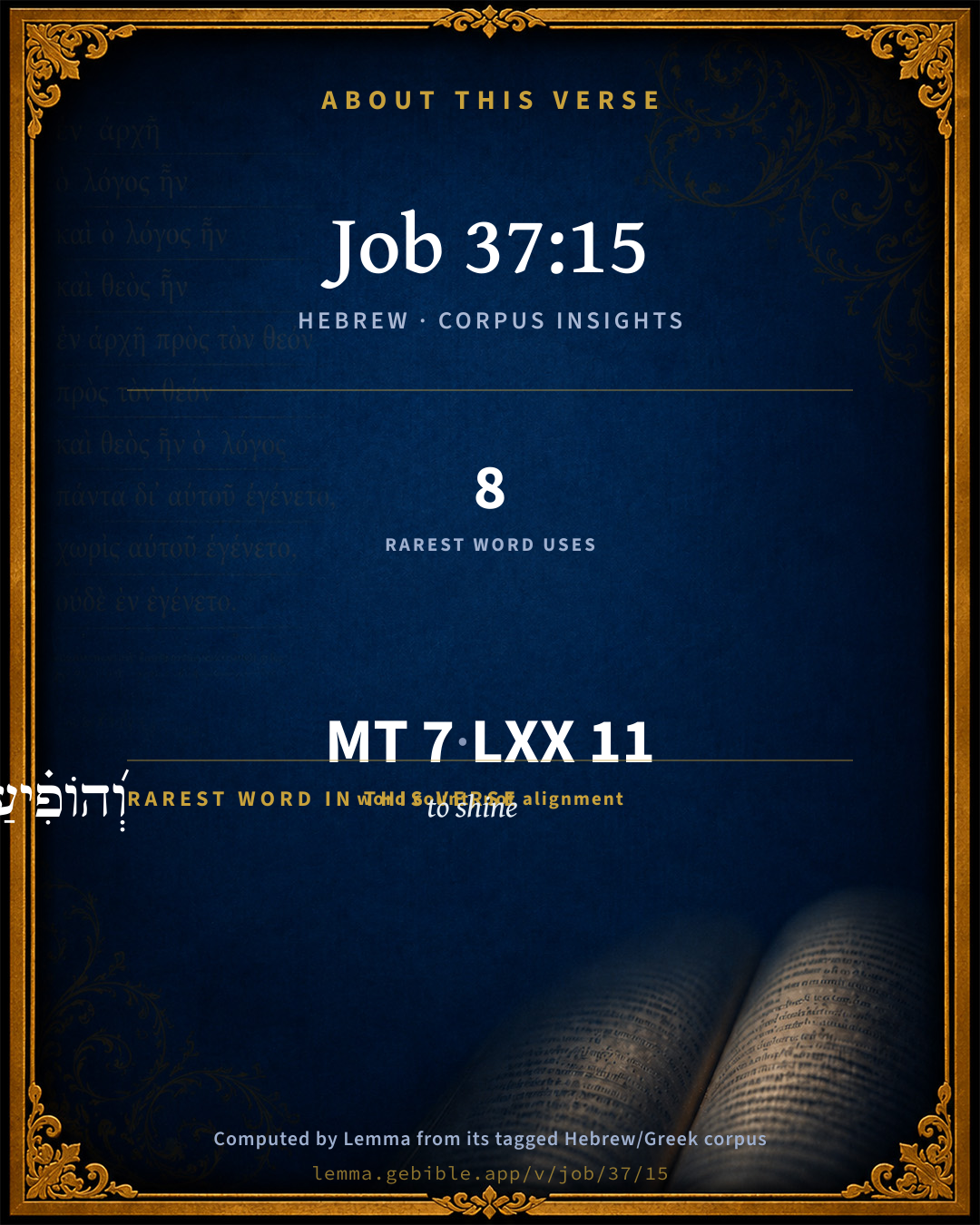
The rarest word here is וְ֝הוֹפִ֗יעַ to shine H3313 — appearing just 8 times in the whole Hebrew Bible.

Shared distinctive vocabulary

וְ֝הוֹפִ֗יעַ to shine H3313 occurs in 8 verses of the Hebrew Bible. Also found in:

Grammatical profile

  • 3 verbs
  • 3 nouns
  • 1 preposition

Verb forms

  • הֲ֭תֵדַע Qal · Imperfect
  • בְּשׂוּם Qal · Infinitive Construct
  • וְ֝הוֹפִ֗יעַ Hiphil · Perfect

Hebrew & Septuagint length

In English translation the verse runs 16 words from the Hebrew and 14 from the Septuagint (LXX English) — closely comparable.

A rough comparison of the two English renderings, which tokenize alike — not a word-level alignment.

Word counts can differ between the Hebrew and the Greek without any difference in meaning — e.g. the Hebrew direct-object marker אֵת has no separate Greek word, and Greek often adds the article ὁ.

In the original languages it is 7 Hebrew tokens and 11 Greek tokens — but the two are counted differently (Hebrew bundles its prefixes and suffixes into one token; the Greek is in lemma form), so that isn’t a like-for-like length.

Cross-references

7

Topical passages linked to Job 37:15 in the Treasury of Scripture Knowledge — connected by theme and wording, ordered by reader-vote popularity; previews shown in the World English Bible.

  • Job 36:30–32 Behold, he spreads his light around him. He covers the bottom of the sea.
  • Job 37:11 Yes, he loads the thick cloud with moisture. He spreads abroad the cloud of his lightning.
  • Job 38:4–41 "Where were you when I laid the foundations of the earth? Declare, if you have understanding.
  • Isaiah 40:26 Lift up your eyes on high, and see who has created these, who brings out their host by number; he calls them all by name; by the greatness of his might, and because he is strong in power, not one is lacking.
  • Job 28:24–27 For he looks to the ends of the earth, And sees under the whole sky.
  • Job 34:13 Who gave him a charge over the earth? Or who has appointed him over the whole world?
  • Psalms 119:90–91 Your faithfulness is to all generations. You have established the earth, and it remains.

Cross-references courtesy of OpenBible.info (CC BY 4.0).

Hebrew and Greek witnesses Masoretic Hebrew ↔ Greek Septuagint

The same verse in the two great witnesses to the Old Testament, shown verse-for-verse.

These are two independent witnesses, not word-aligned to each other, and the Septuagint is shown in lemma (dictionary) form.

Hebrew Job 37:15 Masoretic · Westminster Leningrad Codex

הֲ֭תֵדַע בְּשׂוּם אֱל֣וֹהַּ עֲלֵיהֶ֑ם וְ֝הוֹפִ֗יעַ א֣וֹר עֲנָנֽוֹ

Do you know how God controls them, And causes the lightning of his cloud to shine?

World English Bible · Public Domain

Greek LXX Job 37:15 Septuagint · lemma form

οἶδα ὅτι ὁ θεός τίθημι ἔργον αὐτός φῶς ποιέω ἐκ σκότος

We know that god has disposed his works, having made light out of darkness.

LXX2012 (modern English Septuagint) · Public Domain

On this verse, Albert Barnes' Notes on the Bible discusses the Septuagint’s reading. Read the note in Commentary ↓

Hebrew: Westminster Leningrad Codex (CC BY 4.0). Greek: Septuagint (public domain); English from LXX2012 (modern English Septuagint) (Public Domain). How the Septuagint differs from the Hebrew →

Commentary

Notes on Job 37:15 from classic Christian and Jewish commentators (each source and its license shown beneath its notes). The classic Christian expositions comment on the surrounding passage and are grouped to its opening verse, so a note may address several verses; the Jewish commentaries on the Tanakh (Rashi and others) are per-verse, so they appear only where the commentator wrote on this verse.

Lemma curates 59 commentaries, every one of them public domain or Creative Commons licensed, each selected and text-cleaned for this edition rather than reprinted as found. About our sources →

Trapp's Complete Commentary

John Trapp

Job 37:15 Dost thou know when God disposed them, and caused the light of his cloud to shine?

Ver. 15. Dost thou know when God disposed them] viz. Those wondrous works of God in the air especially; those varieties of meteors, the generation and motions whereof the greatest philosophers cannot perfectly find out by their natural causes, neither do they well agree among themselves concerning those causes. For Anaximander holdeth one thing, Metrodorus another, Anaxagoras a third, Aristotle a fourth; let those that have a mind to it read their janglings and disputes in Plutarch, De placitis philosophorum. Now if no man (though never so wise) can understand the wondrous works of God in these common things of nature, how can he comprehend his hidden works, hoc est, crucem? saith Brentius.

And caused the light of his cloud to shine?] Or, That he may cause the light of his cloud to shine. Hereby he meaneth lightnings, issuing out of the moist and cold cloud, say some; the rainbow, say others, that wonderful work of God (feigned therefore by the heathens to be the daughter of Thaumantias, or of wonderment), which is full of wonders, witness the beautiful shape thereof and various colours, with their several significations, as some conceive (Plato); the several prognostics; viz. of rain in the morning, of fair weather in the evening, as Scaliger concludeth; the form of it, a bow, which yet never shooteth any man unless it be with astonishment and love, &c. God puts his bow in his hand (saith Ambrose on Gen 9:13), not his arrow, but his bow, and the string of the bow is to us ward. The Jews conceit that the name Jehovah is written on the rainbow, and therefore they no sooner see it, but they hide their eyes, confess their sins, that deserve a second deluge, celebrate God’s great goodness to mankind, &c. Some by the light of God’s cloud here understand the sunshine through the clouds, causing it to clear up. Now who can certainly foretell rain or fair weather? Some learned men have spent much time and pains in astronomy to get skill in prognosticating, but could do little good of it; when they foretell a fair day it commonly raineth, and the contrary. The countryman’s prognostics, the shepherd’s calendar, hold better, for the most part, than the predictions of these artisans.

John Trapp, A Commentary or Exposition upon All the Books of the Old and New Testament (1647–1656) — public domain. Text from a community e-Sword module.

Geneva Bible (1599)

Geneva Bible translators

That is, the lightning to break forth in the clouds?

Geneva Bible (1599) marginal notes — public domain. Text via Bolls.life.

Jamieson, Fausset & Brown

Robert Jamieson, A. R. Fausset & David Brown

when--rather, "how."

disposed them--lays His charge on these "wonders" (Job 37:14) to arise.

light--lightning.

shine--flash. How is it that light arises from the dark thundercloud?

Jamieson, Fausset & Brown — Commentary Critical and Explanatory on the Whole Bible (1871) — public domain (CC PDM 1.0). Text via the HelloAO Bible API.

Adam Clarke's Commentary

Verse 15. Dost thou know when God disposed them] Dost thou know the laws by which they are governed; and the causes which produce such and such phenomena?

And caused the light of his cloud to shine?] Almost every critic of note understands this of the rainbow, which God gave as a sign that the earth should no more be destroyed by water. See Ge 9:13, and the note there.

Adam Clarke's Commentary on the Bible (1810–1826) — public domain. Text from a community e-Sword/MySword module.

Ellicott's Commentary for English Readers

(15) Light of His cloud—i.e., lightning, as before. “Dost thou know all the secrets of God’s thunderbolts, at whom and how He will use them?” Some understand this otherwise: “Dost thou know when God setteth the sun over them (the clouds), and causeth the light (i.e., the sun) to shine upon His cloud?” i.e., “Dost thou know how God useth the sun to disperse the clouds?”

A Bible Commentary for English Readers, edited by Charles John Ellicott (1878–1897) — public domain. Text from a community e-Sword module.

The Cambridge Bible for Schools and Colleges

gen. ed. J. J. S. Perowne

15. when God disposed them] Rather, how God layeth his command upon them, and causeth, &c.?

The Cambridge Bible for Schools and Colleges (gen. ed. J. J. S. Perowne; Cambridge University Press, 1878–1918) — public domain. Text from a community e-Sword module.

John Gill's Exposition

Dost thou know when God disposed them?.... The clouds, that part of the wondrous works of God he was speaking of; when he decreed concerning them that they should be, when he put into them and stored them with rain, hail, snow, &c. disposed of them here and there in the heavens, and gave them orders to fall on this and the other spot of ground; wast thou present at all this, and knew what God was doing secretly in the clouds, and before heard what would break out of them, or fall from them? and if thou art ignorant of these things, canst thou imagine that thou shouldest be made acquainted with the secret springs of God's providential dealings with the children of men?

and caused the light of his cloud to shine; either the lightning to break through the cloud, or rather the light of the sun to shine upon his cloud, prepared to receive the light reflected on it, and form the rainbow; which, as it is called his bow, the cloud in which it is may be called his cloud; which is one of the wondrous works of God, and is called by the Heathens the daughter of wonder (u); formed in a semicircle, with various colours, and as a token that God will drown the earth no more; an emblem of the covenant of peace, and of Jesus Christ, said to be clothed with a cloud, and with a rainbow about his head, Rev 10:1.

(u) Apollodorus, l. 1. p. 5.

John Gill's Exposition of the Whole Bible (1746–1763) — public domain (CC PDM 1.0). Text via the HelloAO Bible API.

Albert Barnes' Notes on the Bible

Dost thou know when God disposed them? - That is, the winds, the clouds, the cold, the snow, the sky, etc. The question refers to the manner in which God arranges and governs them, rather than to the time when it was done. So the Hebrew implies, and so the connection demands. The question was not whether Job knew “when” all this was done, but whether he could explain “how” it was that God thus arranged and ordered the things referred to. Elihu asks him whether he could explain the manner in which the balancings of the clouds were preserved; in which the lightnings were directed; in which his garments were warm, and in which God had made and sustained the sky? The Septuagint renders this, “We know that God hath disposed his works that he hath made light out of darkness.”

And caused the light of his cloud to shine - That is, Canst thou explain the cause of lightning? Canst thou tell how it is that it seems to break out of a dark cloud? Where has it been concealed? And by what laws is it now brought forth? Elihu assumes that all this was done by the agency of God, and since, as he assumes to be true, it was impossible for people to explain the manner in which it was done, his object is to show that profound veneration should be shown for a God who works in this manner. Somewhat more is known now of the laws by which lightning is produced than there was in the time of Job; but the question may still be asked of man, and is as much fitted to produce awe and veneration as it was then, whether he understands the way in which God produces the bright lightning from the dark bosom of a cloud. Can he tell what is the exact agency of the Most High in it? Can he explain all the laws by which it is done?

Albert Barnes' Notes on the Bible (1834–1885) — public domain. Text from a community e-Sword/MySword module.

Haydock's Catholic Bible Commentary

Light: the rain-bow, according to the best interpreters; or the lightning. (Calmet)

George Leo Haydock (1774–1849), Haydock's Catholic Family Bible and Commentary, 1859 edition — public domain. Excludes Psalms (Douay-Rheims chapter numbering differs from Protestant) and Deuterocanonical books (Catholic canon only).

Matthew Poole's English Annotations

When God disposed them, to wit, the things before mentioned, the clouds, rain, snow, thunder and lightning, and other meteors. Did God ask counsel from thee to acquaint thee with his counsels in the producing and ordering of them, when, and where, and in what manner he should dispose them? God ordereth all these things not as it pleaseth thee, but as he thinks meet; and in like manner he disposeth of all human affairs, and of thine among the rest.

Caused the light of his cloud to shine; which may be understood either,

1. Of the light of the sun breaking through the clouds, when it is most glorious and comfortable. But though this light break through the clouds, yet it is very improper to call it the light of the clouds. Or,

2. The lightning, which is properly so called, as being produced by and in a cloud. Or,

3. The rainbow, which is a lightsome and glorious work of God, and therefore not likely to be omitted in this place, and which is seated in a cloud, which also may well be called God’s cloud, because therein God puts his bow, as the rainbow is called, Gen 9:13.

Matthew Poole's English Annotations on the Holy Bible (1683–1685) — public domain. Text from a community e-Sword/MySword module.

Whedon's Commentary on the Bible

Daniel D. Whedon

Third division — AN APPLICATION TO JOB OF THE PRECEDING DISCOURSES. THE FOLLY OF CONTENDING WITH GOD, OR OF STRIVING TO GRASP THE MYSTERY OF SUFFERING WHILE THE MYSTERIES OF GOD’S WORKING IN NATURE REMAIN UNEXPLAINED, Job_37:14-24.

a. He who presumes to arraign God in judgment, (compare Job_37:19 with Job_13:18; Job_23:4,) and cannot account for the simplest of his doings except to admit that they are, may with reason fear that such blindness of mind will transform itself into a fool-headedness of action which will bring down swift destruction, Job_37:14-20.

15. When — Others, how. The most satisfactory reading is that of Heiligstedt: “Knowst thou how God imposed [laws] upon them; how he did, that these wonders should arise; for instance, how the light streams forth from out the dark cloud.”

Daniel D. Whedon (gen. ed.), Commentary on the Old and New Testaments (1874–1909) — public domain. Text from a community e-Sword module.

The Pulpit Commentary

Dost thou know when God disposed them; rather, disposes them gives them their orders, arranges for their course and sequence? Or dost thou know when he caused (or rather, causes) the light of his cloud (either the lightning, or perhaps the rainbow, as Schultens suggests) to shine Thou canst not pretend to any such knowledge.

The Pulpit Commentary (1880–1919), ed. H.D.M. Spence-Jones & Joseph S. Exell — public domain. Text from a community e-Sword module.

John Wesley's Explanatory Notes

Them - The things before mentioned, the clouds, rain, snow, and other meteors. Did God acquaint thee with his counsels in the producing and ordering of them? His cloud - Probably the rainbow, seated in a cloud, which may well be called God's cloud, because therein God puts his bow, Gen. ix, 13.

John Wesley, Explanatory Notes Upon the Whole Bible (1754–1765) — public domain. Text via the GEBible commentary corpus.

Rashi

Rabbi Shlomo Yitzchaki (Rashi)

how God places the law of the covenant upon them, how they are suspended by His decree.

Rashi on the Tanakh — English translations: “The Judaica Press complete Tanach with Rashi, translated by A. J. Rosenberg” (CC BY 4.0); “Pentateuch with Rashi's commentary by M. Rosenbaum and A.M. Silbermann, 1929-1934” (public domain); “The Metsudah Tanach series, Lakewood, N.J” (CC BY 4.0); and “The Book of Joshua, Metsudah Publications, 1997” (CC BY 4.0). Text via Sefaria.

Lesson kit

Teaching starters — assembled from the data on this page, not authored interpretation. Every prompt links to the verse data it draws on. Edit before teaching.

Job, in the Wisdom, opens this verse with 7 words (7 distinct Hebrew lemmas). Its most distinctive word is yâphaʻ (“to shine”). A historical commentator’s framing appears above. Read the whole chapter for the surrounding context.

Discussion questions

  1. The word yâphaʻ carries the sense “to shine.” How does it shape the verse?
  2. How does Deuteronomy 33:2, which shares the word «to shine», read alongside this verse?
  3. The translations on this page render this verse differently — a whole-verse word diff, not a word-by-word alignment. What might account for the different wordings?
  4. «הֲ֭תֵדַע» is a Qal Imperfect verb. How does that grammatical form shape the action described?
  5. Compare how Trapp's Complete Commentary and Geneva Bible (1599) read this verse. Where do they agree or differ?

Things to notice

Reading settings

Reading text

Shown beneath each verse's original-language words.

Old Testament
Old Testament edition

Read the OT as the Masoretic Hebrew (MT) or the Greek Septuagint (LXX).

English shown for the Greek Septuagint (in the Hebrew ↔ Greek comparison).

Comparing translations? Open the Compare panel on any verse page to stack up to four side by side.